Search Results: "nic"

1 March 2022

Paul Wise: FLOSS Activities February 2022

Focus This month I didn't have any particular focus. I just worked on issues in my info bubble.

Changes

Issues

Review

Administration
  • Debian BTS: fix usertags for some users, unarchive/reopen/triage bugs for reintroduced packages: horae dh-haskell shutter logging-tree openstreetmap-carto gnome-commander
  • Debian servers: restore wiki data from backup, restarted bacula director for TLS cert update
  • Debian wiki: restore wiki account from backup, approve accounts

Communication
  • Respond to queries from Debian users and contributors on the mailing lists and IRC

Sponsors The purple-discord, gensim, DiskANN, SPTAG, wsproto work was sponsored by my employer. All other work was done on a volunteer basis.

Russell Coker: SAGE (ITPA) Spam

In 2008 I joined SAGE (the System Administrators Guild of Australia). It was a professional society for people doing sysadmin work (running computer servers). I quit when I found that the level of clue was lower than hoped and that members used the code of ethics as nothing but a way to score points in online debates. After quitting SAGE kept emailing me and wouldn t respect my request to be removed from all lists so I had to block their mail server. SAGE has in recent times changed it s name to ITPA (Information Technology Professionals Association) and is still sending me email. I ve just sent yet another unsubscribe request. How many years of sending unwanted email can be caused by incompetence and when should we assume it s malice? They have been doing this for over a decade now. Even if it s incompetence, that s still damning given that it s incompetence in the main topic of the organisation. Here is the ITPA Code of Ethics [1], as you can see there is no reference to spam. The nearest seems to be I will continue to enlarge my understanding of the social and legal issues that arise in computing environments, and I will communicate that understanding to others when appropriate . So it s great that they aren t breaking their own code of ethics :-# but I d still like them to stop emailing me.

28 February 2022

Junichi Uekawa: The World is changing.

The World is changing. People are not satisfied with COVID-19.

25 February 2022

Reproducible Builds (diffoscope): diffoscope 206 released

The diffoscope maintainers are pleased to announce the release of diffoscope version 206. This version includes the following changes:
* Also allow "Unicode text, UTF-8 text" as well as "UTF-8 Unicode text" to
  match for .buildinfo files too.
* Add a test for recent file(1) issue regarding .changes files.
  (Re: reproducible-builds/diffoscope#291)
* Drop "_PATH" suffix from some module-level globals that are not paths.
You find out more by visiting the project homepage.

24 February 2022

Charles Plessy: New media types in 2022

At the beginning of this year I updated a hundred of media types associated with file name extensions in the file called /etc/mime.types, distributed by the media-types package. Most changes are additions originating from recent submissions to the IANA. Amon the themes that caught my attention, there are telecommunications, computer security, commerce, healthcare and industrial automation. The vast majority of the update come from western provenance. Did the rest of the World decide to move ahead without us?

Dirk Eddelbuettel: #36: pub/sub for live market monitoring with R and Redis

Welcome to the 36th post of the really randomly reverberating R, or R4 for short, write-ups. Today s post is about using Redis, and especially RcppRedis, for live or (near) real-time monitoring with R. market monitor There is an saying that you can take the boy out of the valley, but you cannot the valley out of the boy so for those of us who spent a decade or two in finance and on trading floors, having some market price information available becomes second nature. And/or sometimes it is just good fun to program this. A good while back Josh posted a gist on a simple-yet-robust while loop. It (very cleverly) uses his quantmod package to access the SP500 in real-time . (I use quotes here because at the end of retail broadband one is not at the same market action as someone co-located in a New Jersey data center. It is however not delayed: as an index, it is not immediately tradeable as a stock, etf, or derivative may be all of which are only disseminated as delayed price information, usually by ten minutes.) I quite enjoyed the gist and used it and started tinkering with it. For example, it collects data but only saves (i.e. persists ) it after market close. If for whatever reason one needs to restart recent history is gone. In any event, I used his code and generalized it a little and published this about a year ago as function intradayMarketMonitor() in my dang package. (See this blog post announcing it.) The chart of the left shows this in action, the chart is a snapshot from a couple of days ago when the vignettes (more on them below) were written. As lovely as intradayMarketMonitor() is, it also limits itself to market hours. And sometimes you want to see, say, how the market opens on Sunday (futures usually restart at 17h Chicago time), or how news dissipates during the night, or where markets are pre-open, or . So I both wanted to complement this with futures, and also cache it locally so that, say, one machine might collect data and one (or several others) can visualize. For such tasks, Redis is unparalleled. (Yet I also always felt Redis could do with another, simple, short and sweet introduction stressing the key features of i) being multi-lingual: write in one language, consume in another and ii) loose coupling: no linking as one talks to Redis via standard tcp/ip networking. So I wrote a new intro vignette that is now in RcppRedis. I hope this comes in handy. Comments welcome!) Our RcppRedis package had long been used for such tasks, and it was easy to set it up. Standard use is to loop, fetch some data, push it to Redis, sleep, and start over. Clients do the same: fetch most recent data, plot or report it, sleep, start over. That works, but it has a dual delay as the client sleeping may miss the data update! The standard answer to this is called publish/pubscribe, or pub/sub. Libraries such as 0mq or zeromq specialise in this. But it turns out Redis already has it. I had some initial difficulty adding it to RcppRedis so for a trial I tested the marvellous rredis package by Bryan and simply instantiated two Redis clients. Now the data getter simply publishes a new data point in a given channel, by convention named after the security it tracks. Clients register with the Redis server which does all the actual work of keeping track of who listens to what. The clients now simply listen (which is a blocking operation) and as soon as data comes in receive it. market monitor This is quite mesmerizing when you just run two command-line clients (in a byobu session, say). As sone as the data is written (as shown on console log) it is consumed. No measruable overhead. Just lovely. Bryan and I then talked a litte as he may or may not retire rredis. Having implemented the pub/sub logic for both sides once, he took a good hard look at RcppRedis and just like that added it there. With some really clever wrinkles for (optional) per-symbol callback as closure attached to the instance. Truly amazeballs And once we had it in there, generalizing from publishing or subscribing to just one symbol easily generalizes to having one listener collect and publish for multiple symbols, and having one or more clients subscribe and listen one, more or even all symbol. All with ease thanks tp Redis. The second chart, also from a few days ago, shows four symbols for four (front-contract) futures for Bitcoin, Crude Oil, SP500, and Gold. As all this can get a little technical, I wrote a second vignette for RcppRedis on just this: market monitoring. Give this a read, if interested, feedback on this one is most welcome too! But all the code you need is included in the package just run a local Redis instance. Before closing, one sour note. I uploaded all this in a new and much improved updated RcppRedis 0.2.0 to CRAN on March 13 ten days ago. Not only is it still not there , but CRAN in their most delightful way also refuses to answer any emails of mine. Just lovely. The package exhibited just one compiler warning: a C++ compiler objected to the (embedded) C library hiredis (included as a fallback) for using a C language construct. Yes. A C++ compiler complaining about C. It s a non-issue. Yet it s been ten days and we still have nothing. So irritating and demotivating. Anyway, you can get the package off its GitHub repo. If you like this or other open-source work I do, you can sponsor me at GitHub.

This post by Dirk Eddelbuettel originated on his Thinking inside the box blog. Please report excessive re-aggregation in third-party for-profit settings.

23 February 2022

Joey Hess: announcing zephyr-copilot

I recently learned about the Zephyr Project which is a rather neat embedded OS for devices too small to run Linux. This led me to wondering if I could adapt arduino-copilot to target Zephyr, and so be able to program any of the 350+ boards it supports using Haskell. At the same time I had an opportunity to give a talk at the Houston Functional Programmers group. On February 1st I decided to give that talk, about arduino-copilot. That left 2 weeks to buy some hardware supported by Zephyr and port arduino-copilot to it. The result is zephyr-copilot, and I was able to demo it during my talk. This example can be used with any of 293 different boards, and will blink an on-board LED:
module Examples.Blink.Demo where
import Copilot.Zephyr.Board.Generic
main :: IO ()
main = zephyr $ do
        led0 =: blinking
        delay =: MilliSeconds (constant 100)
Doing much more than that needs a board specific module to set up GPIO pins etc. So far I only have written those for a couple of boards I have, but they are fairly easy to write. I'd be happy to help anyone who wants to contribute one. Due to the time constraints I have not implemented serial port support, or PWM or ADC yet, although all should be fairly easy. Zephyr also has no end of other capabilities, from networking to file systems to sensors, that could perhaps be supported in zephyr-copilot. My talk has now been published on youtube. I really enjoyed presenting again for the first time in 4 years(!), and to a very nice group of people. Thanks to Claude Rubinson for his persistence in getting me to give a talk.
Development of zephyr-copilot was sponsored by Mark Reidenbach, Erik Bj reholt, Jake Vosloo, and Graham Spencer on Patreon.

Jonathan McDowell: Upgrading my home internet; a story of yak shaving

RB5009 This has ended up longer than I expected. I ll write up posts about some of the individual steps with some more details at some point, but this is an overview of the yak shaving I engaged in. The TL;DR is:
The desire for a faster connection When I migrated my home connection to FTTP I kept the same 80M/20M profile I d had on FTTC. I didn t have a pressing need for faster, and I saved money because I was no longer paying for the phone line portion. I wanted more, but at the time I think the only option was for a 160M/30M profile instead and I didn t need it and it wasn t enough better to convince me. Time passed and BT rolled out their GigE (really 900M) download option. And again, I didn t need it, but I wanted it. My provider, Aquiss, initially didn t offer this (I think they had up to 330M download options available by this point). So I stayed on 80M/20M. And the only time I really wanted it to be faster was when pushing off-site backups to rsync.net. Of course, we ve had the pandemic, and that s involved 2 adults working from home with plenty of video calls throughout the day. The 80M/20M connection has proved rock solid for this, so again, I didn t feel an upgrade was justified. We got a 4K capable TV last year and while the bandwidth usage for 4K streaming is noticeably higher, again the connection can handle it no problem. At some point last year I noticed Aquiss had added speed options all the way to 900M down. At the end of the year I accepted a new role, which is fully remote, so I had a bit of an acceptance about the fact that I wasn t going back into an office any time soon. The combination (and the desire for the increased upload speed) finally allowed me to justify the upgrade to myself.

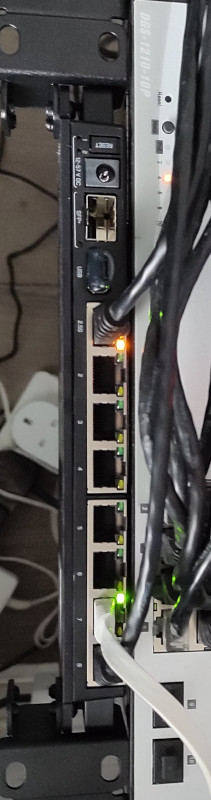
Testing the current setup for bottlenecks The first thing to do was see whether my internal network could cope with an upgrade. I m mostly running Cat6 GigE so I wasn t worried about that side of things. However I m using an RB3011 as my core router, and while it has some coprocessors for routing acceleration they re not supported under mainline Linux (and unlikely to be any time soon). So I had to benchmark what it was capable of routing. I run a handful of VLANs within my home network, with stateful firewalling between them, so I felt that would be a good approximation of the maximum speed to the outside world I might be able to get if I had the external connection upgraded. I went for the easy approach and fired up iPerf3 on 2 hosts, both connected via ethernet but on separate networks, so routed through the RB3011. That resulted in slightly more than a 300Mb/s throughput. Ok. I confirmed that I could get 900Mb/s+ on 2 hosts both on the same network, just to be sure there wasn t some other issue I was missing. Nope, so unsurprisingly the router was the bottleneck. So. To upgrade my internet speed I need to upgrade my router. I could just buy something off the shelf, but I like being able to run Debian (or OpenWRT) on the router rather than some horrible vendor firmware. Lucky MikroTik launched the RB5009 towards the end of last year. RouterOS is probably more than capable, but what really interested me was the fact it s an ARM64 platform based on an Armada 7040, which is pretty well supported in mainline kernels already. There s a 10G connection from the internal switch to the CPU, as well as a 2.5Gb/s ethernet port and a 10G SFP+ cage. All good stuff. I ordered one just before the New Year. Thankfully the OpenWRT folk had done all of the hard work on getting a mainline kernel booting on the device; Sergey Sergeev and Robert Marko in particular fighting RouterBoot and producing a suitable device tree file to get everything up and running. I ended up soldering a serial console connection up to aid debugging, and lightly patching Rob s u-boot to fix the incorrect RAM size reported by RouterBoot. A few kernel tweaks were necessary to make the networking entirely happy and at that point it was time to think about actually doing a replacement.

Upgrading to Debian 11 (bullseye) My RB3011 is currently running Debian 10 (buster); an upgrade has been on my todo list, but with the impending replacement I decided I d hold off and create a new Debian 11 (bullseye) image for the RB5009. Additionally, I don t actually run off the internal NAND in the RB3011; I have a USB flash drive for the rootfs and just the kernel booting off internal NAND. Originally this was for ease of testing, then a combination of needing to figure out a good read-only root solution and a small enough image to fit in the 120M available. For the upgrade I decided to finally look at these pieces. I ve ended up with a script that will build me a squashfs image, and the initial rootfs takes care of mounting this and then a tmpfs as an overlay fs. That means I can easily see what pieces are being written to. The RB5009 has a total of 1G NAND so I m not as space constrained, but the squashfs ends up under 50M. I ve added some additional pieces to allow me to pre-populate the overlay fs with updates rather than always needing to rebuild the squashfs image. With that done I decided to try it out on the RB3011; I tweaked the build script to be able to build for armhf (the RB3011) or arm64 (the RB5009) and to deal with some slight differences in configuration between the two (e.g. interface naming). The idea here was to ensure I d got all the appropriate configuration sorted for the RB5009, in the known-good existing environment. Everything is still on a USB stick at this stage and the new device has an armhf busybox root meaning it can be used on either device, and the init script detects the architecture to select the appropriate squashfs to mount.

A problem with ESP8266 home automation devices Everything seemed to work fine - a few niggles with the watchdog, which is overly sensitive on the RB3011, but I got those sorted (and the build script updated) and the device came up and successfully did the PPPoE dance to bring up external connectivity. And then I noticed that my home automation devices were having problems connecting to the mosquitto MQTT server. It turned out it was only the ESP8266 based devices that were failing, and examining the serial debug output on one of my test devices revealed it was hitting an out of memory issue (displaying E:M 280) when establishing the TLS MQTT connection. I rolled back to the Debian 10 image and set about creating a test environment to look at the ESP8266 issues. My first action was to try and reduce my RAM footprint to try and ensure there was enough spare to establish the connection. I moved a few functions that were still sitting in IRAM into flash. I cleaned up a couple of buffers that are on the stack to be more correctly sized. I tried my new image, and I didn t get the memory issue. Instead I progressed a bit further and got a watchdog reset. Doh! It was obviously something related to the TLS connection, but I couldn t easily see what the difference was; the same x509 cert was in use, it looked like the initial handshake was the same (and trying with openssl s_client looked pretty similar too). I set about instrumenting the ancient Mbed TLS used in the Espressif SDK and discovered that whatever had changed between buster + bullseye meant the EPS8266 was now trying a TLS-DHE-RSA-WITH-AES-256-CBC-SHA256 handshake instead of a TLS-RSA-WITH-AES-256-CBC-SHA256 handshake and that was causing enough extra CPU usage that it couldn t complete in time and the watchdog kicked in. So I commented out MBEDTLS_KEY_EXCHANGE_DHE_RSA_ENABLED in the config_esp.h for mbedtls and rebuilt things. Hacky, but I ll go back to trying to improve this generally at some point.

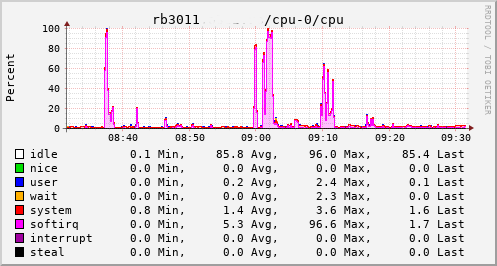
A detour into interrupt load Now, my testing of the RB3011 image is generally done at weekends, when I have enough time to tear down and rebuild the connection rather than doing it in the evening and having limited time to get things working again in time for work in the morning. So at the point I had an image ready to go I pulled the trigger on the line upgrade. I went with the 500M/75M option rather than the full 900M - I suspect I d have difficulty actually getting that most of the time and 75M of upload bandwidth seems fairly substantial for now. It only took a couple of days from the order to the point the line was regraded (which involved no real downtime - just a reconnection in the night). Of course this happened just after the weekend I d discovered the ESP8266 issue. collectd CPU usage for RB3011 This provided an opportunity to see just what the RB3011 could actually manage. In the configuration I had it turned out to be not much more than the 80Mb/s speeds I had previously seen. The upload jumped from a solid 20Mb/s to 75Mb/s, so I knew the regrade had actually happened. Looking at CPU utilisation clearly showed the problem; softirqs were using almost 100% of a CPU core. Now, the way the hardware is setup on the RB3011 is that there are two separate 5 port switches, each connected back to the CPU via a separate GigE interface. For various reasons I had everything on a single switch, which meant that all traffic was boomeranging in and out of the same CPU interface. The IPQ8064 has dual cores, so I thought I d try moving the external connection to the other switch. That puts it on its own GigE CPU interface, which then allows binding the interrupts to a different CPU core. That helps; throughput to the outside world hits 140Mb/s+. Still a long way from the expected max, but proof we just need more grunt.
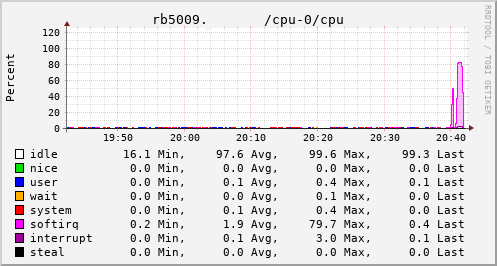
Success collectd CPU usage for RB5009 Which brings us to this past weekend, when, having worked out all the other bits, I tried the squashfs root image again on the RB3011. Success! The home automation bits connected to it, the link to the outside world came up, everything seemed happy. So I double checked my bootloader bits on the RB5009, brought it down to the comms room and plugged it in instead. And, modulo my failing to update the nftables config to allow it to do forwarding, it all came up ok. Some testing with iperf3 internally got a nice 912Mb/s sustained between subnets, and some less scientific testing with wget + speedtest-cli saw speeds of over 460Mb/s to the outside world. Time from ordering the router until it was in service? Just under 8 weeks

Russ Allbery: Review: Elder Race

Review: Elder Race, by Adrian Tchaikovsky
Publisher: Tordotcom
Copyright: November 2021
ISBN: 1-250-76871-3
Format: Kindle
Pages: 199
(It's a shame that a lot of people will be reading this novella on a black-and-white ebook reader, since the Emmanuel Shiu cover is absolutely spectacular. There's a larger image without the words at the bottom of that article.) When reports arrive at the court about demons deep in the forest that are taking over animals and humans and bending them to their will, the queen doesn't care. It's probably some unknown animal, and regardless, the forest kingdom is a rival anyway. Lynesse Fourth Daughter disagrees vehemently, but she has no power at court. Even apart from her lack of seniority, her love of stories and daring and adventures is a source of endless frustration to her mother. That is why this novella opens with her climbing the mountain path to the Tower of Nyrgoth Elder, the last of the ancient wizards, to seek his help. Nyr Illim Tevitch is an anthropologist second class of Earth's Explorer Corps, part of the second wave of Earth's outward expansion through the galaxy. In the first wave, colonies were seeded on habitable planets, only to be left stranded when Earth's civilization collapsed in an ecological crisis. Nyr was a member of a team of four, sent to make careful and limited contact with one of those lost colonies as part of Earth's second flourishing with more advanced technology. When the team lost contact with Earth, the other three went back while Nyr stayed to keep their field observations going. It's now 291 years of intermittent suspended animation later. Nyr's colleagues never came back, and there have been no messages from Earth. Elder Race is a Prime Directive anthropology story, a subgenre so long-standing that it has its own conventions and variations. Variations of the theme have been written by everyone from Eleanor Arnason to Iain M. Banks (linking to the book I have in mind is arguably a spoiler). Per the dedication, Tchaikovsky's take is based on Gene Wolfe's story "Trip, Trap," which I have not read but whose plot looks very similar. To that story structure, Tchaikovsky brings two major twists. First, Nyr is cut off from his advanced civilization, and has considerable reason to believe that civilization no longer exists. Do noninterference rules still have any meaning if Nyr is stranded and the civilization that made the rules is gone? Second, Nyr has already broken those rules rather spectacularly. More than a hundred years previously, he had ridden with Astresse Regent, a warrior queen and Lynesse's ancestor, to defeat a local warlord who had found control codes for abandoned advanced machinery and was using it as weaponry. In the process, he fell in love and made a rash promise to come to the aid of any of her descendants if he were needed. Lynesse has come to collect on the promise. Elder Race is told in alternating chapters between Nyr and Lynesse's viewpoints: first person for Nyr and tight third person for Lynesse. The core of the story is this doubled perspective, one from a young woman who wants to live in a fantasy novel and one from a deeply depressed anthropologist torn between wanting human contact, wanting to follow the rules of his profession, and wanting to explain to Lynesse that he is not a wizard. Nyr talks himself into helping with another misuse of advanced technology using the same logic he used a hundred years earlier: he's protecting Lynesse's pre-industrial society from interference rather than causing it. But the demons Lynesse wants him to fight are something entirely unexpected. This parallel understanding is a great story structure. What worked less for me was Tchaikovsky's reliance on linguistic barriers to prevent shared understanding. Whenever Nyr tries to explain something, Lynesse hears it in terms of magic and high fantasy, and often exactly backwards from how Nyr intended it. This is where my suspension of disbelief failed me, even though I normally don't have suspension of disbelief problems in SF stories. I was unable to map Lynesse's misunderstandings to any realistic linguistic model. Lynesse's language is highly complex (a realistic development within an isolated population), and Nyr complains about his inability to speak it properly given it's blizzard of complex modifiers. This is entirely believable. What is far less believable is that Lynesse perceives him as fluent in her language, but often saying the precise opposite of what he's trying to say. One chapter in the middle of the book gives Nyr's intended story side-by-side with Lynesse's understanding. This is a brilliant way to show the divide, but I found the translation errors unbelievable. If Nyr is failing that profoundly to communicate his meaning, he should be making more egregious sentence-level errors, occasionally saying something bizarre or entirely nonsensical, referring to a person as an animal or a baby, or otherwise not fluently telling a coherent story that's fundamentally different than the one he thinks he's telling. If you can put that aside, though, this is a fun story. Nyr has serious anxiety and depression made worse by his isolation, and copes by using an implanted device called a Dissociative Cognition System that lets him temporarily turn off his emotions at the cost of letting them snowball. He has a wealth of other augments and implants, including horns, which Lynesse sees as evidence that he's a different species of magical being and which he sees as occasionally irritating field equipment with annoying visual menus. The key to writing a story like this is for both perspectives to be correct given their own assumptions, and to offer insight that the other perspective is missing. I thought the linguistic part of that was unsuccessful, but the rest of it works. One of the best parts of novellas is that they don't wear out their welcome. This is a fun spin on well-trodden ground that tells a complete story in under 200 pages. I wish the ending had been a bit more satisfying and the linguistics had been more believable, but I enjoyed the time I spent in this world. Content warning for some body horror. Rating: 7 out of 10

22 February 2022

Russ Allbery: Review: Children of Earth and Sky

Review: Children of Earth and Sky, by Guy Gavriel Kay
Publisher: New American Library
Copyright: 2016
ISBN: 0-698-18327-4
Format: Kindle
Pages: 572
Nine hundred years have passed since the events of Lord of Emperors. Twenty-five years ago, Sarantium, queen of cities, fell to the Osmanlis, who have renamed it Asharias in honor of their Asherite faith. The repercussions are still echoing through the western world, as the Osmanlis attempt each spring to push farther west and the forces of Rodolfo, Holy Emperor in Obravic and defender of the Jaddite faith, hold them back. Seressa and Dubrava are city-state republics built on the sea trade. Seressa is the larger and most renown, money-lenders to Rodolfo and notorious for their focus on business and profit, including willingness to trade with the Osmanlis. Dubrava has a more tenuous position: smaller, reliant on trade and other assistance from Seressa, but also holding a more-favored trading position with Asharias. Both are harassed by piracy from Senjan, a fiercely Jaddite raiding city north up the coast from Dubrava and renown for its bravery against the Asherites. The Senjani are bad for business. Seressa would love to wipe them out, but they have the favor of the Holy Emperor. They settled for attempting to starve the city with a blockade. As Children of Earth and Sky opens, Seressa is sending out new spies. One is a woman named Leonora Valeri, who will present herself as the wife of a doctor that Seressa is sending to Dubrava. She is neither his wife nor Seressani, but this assignment gets her out of the convent to which her noble father exiled her after an unapproved love affair. The other new spy is the young artist Pero Villani, a minor painter whose only notable work was destroyed by the woman who commissioned it for being too revealing. Pero's destination is farther east: Grand Khalif Gur u the Destroyer, the man whose forces took Sarantium, wants to be painted in the western style. Pero will do so, and observe all he can, and if the opportunity arises to do more than that, well, so much the better. Pero and Leonora are traveling on a ship owned by Marin Djivo, the younger son of a wealthy Dubravan merchant family, when their ship is captured by Senjani raiders. Among the raiders is Danica Gradek, the archer who broke the Seressani blockade of Senjan. This sort of piracy, while tense, should be an economic transaction: some theft, some bargaining, some ransom, and everyone goes on their way. That is not what happens. Moments later, two men lie dead, and Danica's life has become entangled with Dubravan merchants and Seressani spies. Children of Earth and Sky is in some sense a sequel to the Sarantine Mosaic, and knowing the events of that series adds some emotional depth and significant moments to this story, but you can easily read it as a stand-alone novel. (That said, I recommend the Sarantine Mosaic regardless.) As with nearly all of Kay's work, it's historical fiction with the names changed (less this time than in most of this books) and a bit of magic added. The setting is the middle of the 15th century. Seressa is, of course, Venice. The Osmanlis are the Ottoman Turks, and Asharias is Istanbul, the captured Constantinople. Rodolfo is a Habsburg Holy Roman Emperor, holding court in an amalgam of northern cities that (per the afterward) is primarily Prague. Dubrava, which is central to much of this book, is Dubrovnik in Croatia. As usual with Kay's novels, you don't need to know this to enjoy the story, but it may spark some fun secondary reading. The touch of magic is present in several places, but comes primarily from Danica, whose grandfather resides as a voice in her head. He is the last of her family that she is in contact with. Her father and older brother were killed by Osmanli raiders, and her younger brother taken as a slave to be raised as a djanni warrior in the khalif's infantry. (Djannis are akin to Mamluks in our world.) Damaz, as he is now known, is the remaining major viewpoint character I've not mentioned. There are a couple of key events in the book that have magic at the center, generally involving Danica or Damaz, but most of the story is straight historical fiction (albeit with significant divergences from our world). I'd talked myself out of starting this novel several times before I finally picked it up. Like most of Kay's, it's a long book, and I wasn't sure if I was in the mood for epic narration and a huge cast. And indeed, I found it slow at the start. Once the story got underway, though, I was as enthralled as always. There is a bit of sag in the middle of the book, in part because Kay didn't follow up on some relationships that I wish were more central to the plot and in part because he overdoes the narrative weight in one scene, but the ending is exceptional. Guy Gavriel Kay is the master of a specific type of omniscient tight third person narration, one in which the reader sees what a character is thinking but also gets narrative commentary, foreshadowing, and emotional emphasis apart from the character's thoughts. It can feel heavy-handed; if something is important, Kay tells you, explicitly and sometimes repetitively, and the foreshadowing frequently can be described as portentous. But in return, Kay gets fine control of pacing and emphasis. The narrative commentary functions like a soundtrack in a movie. It tells you when to pay close attention and when you can relax, what moments are important, where to slow down, when to brace yourself, and when you can speed up. That in turn requires trust; if you're not in the mood for the author to dictate your reading pace to the degree Kay is attempting, it can be irritating. If you are in the mood, though, it makes his novels easy to relax into. The narrator will ensure that you don't miss anything important, and it's an effective way to build tension. Kay also strikes just the right balance between showing multiple perspectives on a single moment and spending too much time retelling the same story. He will often switch viewpoint characters in the middle of a scene, but he avoids the trap of replaying the scene and thus losing the reader's interest. There is instead just a moment of doubled perspective or retrospective commentary, just enough information for the reader to extrapolate the other character's experience backwards, and then the story moves on. Kay has an excellent feel for when I badly wanted to see another character's perspective on something that just happened. Some of Kay's novels revolve around a specific event or person. Children of Earth and Sky is not one of those. It's a braided novel following five main characters, each with their own story. Some of those stories converge; some of them touch for a while and then diverge again. About three-quarters of the way through, I wasn't sure how Kay would manage a satisfying conclusion for the numerous separate threads that didn't feel rushed, but I need not have worried. The ending had very little of the shape that I had expected, focused more on the small than the large (although there are some world-changing events here), but it was an absolute delight, with some beautiful moments of happiness that took the rest of the novel to set up. This is not the sort of novel with a clear theme, but insofar as it has one, it's a story about how much of the future shape and events of the world are unknowable. All we can control is our own choices, and we may never know their impact. Each individual must decide who they want to be and attempt to live their life in accordance with that decision, hopefully with some grace towards others in the world. The novel does, alas, still have some of Kay's standard weaknesses. There is (at last!) an important female friendship, and I had great hopes for a second one, but sadly it lasted only a scant handful of pages. Men interact with each other and with women; women interact almost exclusively with men. Kay does slightly less awarding of women to male characters than in some previous books (although it still happens), but this world is still weirdly obsessed with handing women to men for sex as a hospitality gesture. None of this is too belabored or central to the story, or I would be complaining more, but as soon as one sees how regressive the gender roles typically are in a Kay novel, it's hard to unsee. And, as always for Kay, the sex in this book is weirdly off-putting to me. I think this goes hand in hand with Kay's ability to write some of the best conversations in fantasy. Kay's characters spar and thrust with every line and read nuance into small details of wording. Frequently, the turn of the story rests on the outcome of a careful conversation. This is great reading; it's the part of Kay's writing I enjoy the most. But I'm not sure he knows how to turn it off between characters who love and trust each other. The characters never fully relax; sex feels like another move in ongoing chess games, which in turn makes it feel weirdly transactional or manipulative instead of open-hearted and intimate. It doesn't help that Kay appears to believe that arousal is a far more irresistible force for men than I do. Those problems did get in the way of my enjoyment occasionally, but I didn't think they ruined the book. The rest of the story is too good. Danica in particular is a wonderful character: thoughtful, brave, determined, and deeply honest with herself in that way that is typical of the best of Kay's characters. I wanted to read the book where Danica's and Leonora's stories stayed more entwined; alas, that's not the story Kay was writing. But I am in awe at Kay's ability to write characters who feel thoughtful and insightful even when working at cross purposes, in a world that mostly avoids simple villains, with a plot that never hinges on someone doing something stupid. I love reading about these people. Their triumphs, when they finally come, are deeply satisfying. Children of Earth and Sky is probably not in the top echelon of Kay's works with the Sarantine Mosaic and Under Heaven, but it's close. If you like his other writing, you will like this as well. Highly recommended. Rating: 9 out of 10

21 February 2022

Raphaël Hertzog: Freexian s report about Debian Long Term Support, January 2022

A Debian LTS logo
Every month we review the work funded by Freexian s Debian LTS offering. Please find the report for January below. Debian project funding We continue to looking forward to hearing about Debian project proposals from various Debian stakeholders. This month has seen work on a survey that will go out to Debian Developers to gather feedback on what they think should be the priorities for funding in the project. Learn more about the rationale behind this initiative in this article. Debian LTS contributors In January, 13 contributors were paid to work on Debian LTS, their reports are available below. If you re interested in participating in the LTS or ELTS teams, we welcome participation from the Debian community. Simply get in touch with Jeremiah or Rapha l. Evolution of the situation In January we released 34 DLAs. The security tracker currently lists 39 packages with a known CVE and the dla-needed.txt file has 20 packages still needing an update. Thanks to our sponsors Sponsors that joined recently are in bold.

18 February 2022

Colin Watson: Launchpad now supports SSH Ed25519 keys and RSA SHA-2 signatures

As of 2022-02-16, Launchpad supports a couple of features on its SSH endpoints (git.launchpad.net, bazaar.launchpad.net, ppa.launchpad.net, and upload.ubuntu.com) that it previously didn t: Ed25519 public keys (a well-regarded format, supported by OpenSSH since 6.5 in 2014) and signatures with existing RSA public keys using SHA-2 rather than SHA-1 (supported by OpenSSH since 7.2 in 2016). I m hesitant to call these features new , since they ve been around for a long time elsewhere, and people might quite reasonably ask why it s taken us so long. The problem has always been that Launchpad can t really use a normal SSH server such as OpenSSH because it needs features that aren t practical to implement that way, such as virtual filesystems and dynamic user key authorization against the Launchpad database. Instead, we use Twisted Conch, which is a very extensible Python SSH implementation that has generally served us well. The downside is that, because it s an independent implementation and one that occupies a relatively small niche, it often lags behind in terms of newer protocol features. Catching up to this point has been something we ve been working on for around five years, although it s taken a painfully long time for a variety of reasons which I thought some people might find interesting to go into, at least people who have the patience for details of the SSH protocol. Many of the delays were my own responsibility, although realistically we probably couldn t have added Ed25519 support before OpenSSL/cryptography work that landed in 2019. Phew! Thanks to everyone who works on Twisted, cryptography, and OpenSSL - it s been really useful to be able to build on solid lower-level cryptographic primitives - and to those who helped with code review.

16 February 2022

Joerg Jaspert: Funny CPU usage - rewrite it in rust

Munin plugin and it s CPU usage (and a rewrite in rust) With my last blog on the Munin plugins CPU usage I complained about Oracle Linux doing something really weird, driving up CPU usage when running a fairly simple Shell script with a loop in. Turns out, I was wrong. It is not OL7 that makes this problem show up. It appears to be something from the Oracle Enterprise Database installed on the system, that makes it go this crazy. I ve now had this show up on RedHat7 systems too, and the only thing that singles them out is that overpriced index card system on it. I still don t know what the actual reason for this is, and honestly, don t have enough time to dig deep into it. It is not something that a bit of debugging/tracing finds - especially as it does start out all nice, and accumulates more CPU usage over time. Which would suggest some kind of leak leading to more processing needed, or so - but then it is only CPU affected, not memory, and ONLY on systems with that database on. Meh. Well, I recently (December vacation) got me to look deeper into learning Rust. My first project with that was a multi-threaded milter to do some TLS checks on outgoing mails (kind of fun customer requirements there), and heck, Rust did make that a surprisingly easy task in the end. (Comparing the old, single-threaded C code with my multi-threaded Rust version, a third of the code length doing more, and being way easier to extend with wanted new features is nice). So my second project was Replace this shell script with a Rust binary doing the same . Hell yeah. Didn t take that long and looks good (well, the result. Not sure about the code. People knowing rust may possibly scratch out eyes when looking at it). Not yet running for that long, but even compared to the shell on systems that did not show the above mentioned bugs (read: Debian, without Oracle foo), uses WAY less CPU (again, mentioned by highly accurate outputs of the top command). So longer term I hope this version won t run into the same problems as the shell one. Time will tell. If you are interested in the code, go find it here, and if you happen to know rust and not run away screaming, I m happy for tips and code fixes, I m sure this can be improved lots. (At least cargo clippy is happy, so basics are done ) Update: According to munin, the rust version creates 14 forks/second less than the shell one. And the fork rate change is same on machines with/without the database. That 14 is more than I would have guessed. CPU usage as expected: only on the problem hosts with Oracle Database installed you can see a huge difference, otherwise it is not an easily noticable difference. That is, on an otherwise idle host (munin graph shows average use of low one-digit numbers), one can see a drop of around 1% in the CPU usage graph from munin. Ohwell, poor Shell.

14 February 2022

Neil McGovern: Handing over

In 2017, I was attending FOSDEM when GNOME announced that I was to become the new Executive Director of the Foundation. Now, nearly 5 years later, I ve decided the timing is right for me to step back and for GNOME to start looking for its next leader. I ve been working closely with Rob and the rest of the board to ensure that there s an extended and smooth transition, and that GNOME can continue to go from strength to strength. GNOME has changed a lot in the last 5 years, and a lot has happened in that time. As a Foundation, we ve gone from a small team of 3, to employing people to work on marketing, investment in technical frameworks, conference organisation and much more beyond. We ve become the default desktop on all major Linux distributions. We ve launched Flathub to help connect application developers directly to their users. We ve dealt with patent suits, trademarks, and bylaw changes. We ve moved our entire development platform to GitLab. We released 10 new GNOME releases, GTK 4 and GNOME 40. We ve reset our relationships with external community partners and forged our way towards that future we all dream of where everyone is empowered by technology they can trust. For that future, we now need to build on that work. We need to look beyond the traditional role that desktop Linux has held and this is something that GNOME has always been able to do. I ve shown that the Foundation can be more than just a bank account for the project, and I believe that this is vital in our efforts to build a diverse and sustainable free software personal computing ecosystem. For this, we need to establish programs that align not only with the unique community and technology of the project, but also deliver those benefits to the wider world and drive real impact. 5 years has been the longest that the Foundation has had an ED for, and certainly the longest that I ve held a single post for. I remember my first GUADEC as ED. As you may know, like many of you, I m used to giving talks at conferences and yet I have never been so nervous as when I walked out on that stage. However, the welcome and genuine warmth that I received that day, and the continued support throughout the last 5 years makes me proud of what a welcoming and amazing community GNOME is. Thank you all.

13 February 2022

Junichi Uekawa: Troubleshooting network issues.

Troubleshooting network issues. Completely forgot how to use dig command.

7 February 2022

John Goerzen: KDE: A Nice Tiling Envieonment and a Surprisingly Awesome DE

I recently wrote that managing an external display on Linux shouldn t be this hard. I went down a path of trying out some different options before finally landing at an unexpected place: KDE. I say unexpected because I find tiling window managers are just about a necessity. Background: xmonad Until a few months ago, I d been using xmonad for well over a decade. Configurable, minimal, and very nice; it suited me well. However, xmonad is getting somewhat long in the tooth. xmobar, which is commonly used with it, barely supports many modern desktop environments. I prefer DEs for the useful integrations they bring: everything from handling mount of USB sticks to display auto-switching and sound switching. xmonad itself can t run with modern Gnome (whether or not it runs well under KDE 5 seems to be a complicated question, according to wikis, but in any case, there is no log applet for KDE 5). So I was left with XFCE and such, but the isues I identified in the shouldn t be this hard article were bad enough that I just could not keep going that way. An attempt: Gnome and PaperWM So I tried Gnome under Wayland, reasoning that Wayland might stand a chance of doing things well where X couldn t. There are several tiling window extensions available for the Gnome 3 shell. Most seemed to be rather low-quality, but an exception was PaperWM and I eventually decided on it. I never quite decided if I liked its horizontal tape of windows or not; it certainly is unique in any case. I was willing to tolerate my usual list of Gnome problems for the sake of things working. For instance: Under Wayland, I found a disturbing lack of logs. There was nothing like /var/log/Xorg.0.log, nothing like ~/.xsession-errors, just nothing. Searching for answers on this revealed a lot of Wayland people saying it s a Gnome issue and the trail going cold at that point. And there was a weird problem that I just could not solve. After the laptop was suspended and we-awakened, I would be at a lock screen. I could type in my password, but when hitting Enter, the thing would then tend to freeze. Why, I don t know. It seemed related to Gnome shell; when I switched Gnome from Wayland to X11, it would freeze but eventually return to the unlock screen, at which point I d type in my password and it would freeze again. I spent a long time tracking down logs to see what was happening, but I couldn t figure it out. All those hard resets were getting annoying. Enter KDE So I tried KDE. I had seen mentions of kwin-tiling, a KDE extension for tiling windows. I thought I d try this setup. I was really impressed by KDE s quality. Not only did it handle absolutely every display-related interaction correctly by default, with no hangs ever, all relevant settings were clearly presented in one place. The KDE settings screens were a breath of fresh air lots of settings available, all at one place, and tons of features I hadn t seen elsewhere. Here are some of the things I was pleasantly surprised by with KDE: Tiling So how about the tiling system, kwin-tiling? The out of the box experience is pretty nice. There are fewer built-in layouts than with xmonad, but the ones that are there are doing a decent job for me, and in some cases are more configurable (those that have a large window pane are configurable on its location, not forcing it to be on the left as with many systems.) What s more, thanks to the flexibility in the KDE shortcut settings, I can configure it to be nearly keystroke-identical to xmonad! Issues Encountered I encountered a few minor issues: In short, I m very impressed.

Gustavo R. Montesino: Hardware failures...

The Bad: When I got to work today, I've found our server (white box with Debian etch responsible for networking, files, printers, etc) powered off - most likely the UPS' battery didn't survive a power outage during the night. When I turned the server on I was greeted by all those nice lines telling me I had a hard disk problem. The Ugly: Instead off marking the disk showing the read errors as bad, the RAID stack (device mapper?) somehow concluded the "good" disk of the RAID 1 array wasn't synched and kicked it out... The good The bad sectors did take only some unimportant collectd status files with them. After some poking with dd trying to force the HD to redirect the bad sectors, the read errors vanished and the Reallocated Sector Count didn't increase according to smartctl, which seems like a good signal.

Russ Allbery: Review: Embers of War

Review: Embers of War, by Gareth L. Powell
Series: Embers of War #1
Publisher: Titan Books
Copyright: February 2018
ISBN: 1-78565-519-1
Format: Kindle
Pages: 312
The military leadership of the Outward faction of humanity was meeting on the forest world of Pelapatarn, creating an opportunity for the Conglomeration to win the war at a stroke. Resistance was supposed to be minimal, since the Outward had attempted to keep the conference secret rather than massing forces to protect it. But the Outward resistance was stronger than expected, and Captain Deal's forces would not be able to locate and assassinate the Outward leadership before they could escape. She therefore followed orders from above her and ordered the four incoming Carnivore heavy cruisers to jump past the space battle and bomb the planet. The entire planet. The Carnivores' nuclear and antimatter weaponry reduced the billion-year-old sentient jungle of Pelapatarn to ash. Three years later, Sal Konstanz is a ship captain for the House of Reclamation, a strictly neutral search and rescue force modeled after a long-vanished alien fleet that prioritizes preservation of life above all else. Anyone can join Reclamation, provided that they renounce their previous alliances and devote themselves to the Reclamation cause. Sal and her crew member Alva Clay were Outward. The ship medic was Conglomeration. So was the ship: the Trouble Dog, a sentient AI heavy cruiser built to carry an arsenal of weapons and three hundred crew, and now carrying three humans and a Druff mechanic. More precisely, the Trouble Dog was one of the four Carnivores that destroyed Pelapatarn. Meanwhile, Ona Sudak, a popular war poet, is a passenger on a luxury cruise on the liner Geest van Amsterdam, which is making an unscheduled stop in the star system known as the Gallery. The Gallery is the home of the Objects: seven planets that, ten thousand years earlier, were carved by unknown aliens into immense sculptures for unknown reasons. The Objects appear to be both harmless and mysterious, making them an irresistible tourist attraction for the liner passengers. The Gallery is in disputed space, but no one was expecting serious trouble. They certainly weren't expecting the Geest van Amsterdam to be attacked and brought down on the Object known as the Brain, killing nearly everyone aboard. The Trouble Dog is the closest rescue ship. This book was... fine. It's a perfectly serviceable science fiction novel that didn't stand out for me, which I think says more about the current excellent state of the science fiction field than about this book. When I was a teenager reading Asimov, Niven, and Heinlein, I would have devoured this. It compares favorably to minor Niven or Heinlein (The Integral Trees, for example, or Double Star), but the bar for excellent science fiction is just so much higher now. The best character in this book (and the reason why I read it) is the Trouble Dog. I love science fiction about intelligent space ships, and she did not disappoint. The AI ships in this book are partly made from human and dog neurons, so their viewpoint is mostly human but with some interesting minor variations. And the Trouble Dog would be a great character even if she weren't an intelligent ship: ethical, aggressive, daring, and introspective, with a nuanced relationship with her human crew. Unfortunately, Embers of War has four other viewpoint characters, and Powell chose to write them all in the first person. First person narration depends heavily on a memorable and interesting character because the reader is so thoroughly within their perspective. This works great for the Trouble Dog, and is fine for Nod, the Druff who serves as the ship mechanic. (Nod's perspective is intriguing, short, almost free-verse musings, rather than major story segments.) Sal, the ship captain, is a bit of a default character, but I didn't mind her much. Neither of the other two viewpoint characters are interesting enough to warrant the narrative attention. The Conglomerate agent Ashton Childe has such an uninteresting internal monologue that I would have liked the character better if he'd only been seen through other people's viewpoints, and although Powell needs some way to show Ona Sudak's view of events, I didn't think her thoughts added much to the story. The writing is adequate but a bit clunky: slightly flat descriptions, a bit too predictable at the sentence level, and rarely that memorable. There is a bit of fun world-building of the ancient artifact variety and a couple of decent set pieces (and one rather-too-obvious Matrix homage that I didn't think was as effective as the author did), but most of the story is focused on characters navigating their lives and processing trauma from the war. The story kept me turning the pages with interest, but I also doubt it will surprise anyone who has read much science fiction. I suspect a lot of it is setup for the following two books of the trilogy, and there are plenty of hooks for more stories in this universe. I really wanted a first-person story from the perspective of the Trouble Dog, possibly with some tight third-person interludes showing Ona Sudak's story. What I got instead was entertaining but not memorable enough to stand out in the current rich state of science fiction. I think I'm invested enough in this story to want to read the next book, though, so that's still a recommendation of sorts. Followed by Fleet of Knives. Rating: 6 out of 10

6 February 2022

Jonathan McDowell: Free Software Activities for 2021

About a month later than I probably should have posted it, here s a recap of my Free Software activities in 2021. For previous years see 2019 + 2020. Again, this year had fewer contributions than I d like thanks to continuing fatigue about the state of the world, and trying to work on separation between work and leisure while working from home. I ve made some effort to improve that balance but it s still a work in progress.

Conferences No surprise, I didn t attend any in-person conferences in 2021. I find virtual conferences don t do a lot for me (a combination of my not carving time out for them in the same way, because not being at the conference means other things will inevitably intrude, and the lack of the social side) but I did get to attend a few of the DebConf21 talks, which was nice. I m hoping to make it to DebConf22 this year in person.

Debian Most of my contributions to Free software continue to happen within Debian. As part of the Data Protection Team I responded to various inbound queries to that team. Some of this involved chasing up other project teams who had been slow to respond - folks, if you re running a service that stores personal data about people then you need to be responsive to requests about it. Some of this was dealing with what look like automated scraping tools which send no information about the person making the request, and in all the cases we ve seen so far there s been no indication of any data about that person on any systems we have access to. Further team time was wasted dealing with the Princeton-Radboud Study on Privacy Law Implementation (though Matthew did the majority of the work on this). The Debian Keyring was possibly my largest single point of contribution. We re in a roughly 3 month rotation of who handles the keyring updates, and I handled 2021.03.24, 2021.04.09, 2021.06.25, 2021.09.25 + 2021.12.24 For Debian New Members I m mostly inactive as an application manager - we generally seem to have enough available recently. If that changes I ll look at stepping in to help, but I don t see that happening. I continue to be involved in Front Desk, having various conversations throughout the year with the rest of the team, but there s no doubt Mattia and Pierre-Elliott are the real doers at present. I did take part in an NM Committee appeals process. In terms of package uploads I continued to work on gcc-xtensa-lx106, largely doing uploads to deal with updates to the GCC version or packaging (8 + 9). sigrok had a few minor updates, libsigkrok 0.5.2-3, pulseview 0.4.2-3 as well as a new upstream release of sigrok CLI 0.7.2-1. There was a last minute pre-release upload of libserialport 0.1.1-4 thanks to a kernel change in v5.10.37 which removed termiox support. Despite still not writing any VHDL these days I continue to keep an eye on ghdl, because I found it a useful tool in the past. Last year that was just a build fix for LLVM 11.1.0 - 1.0.0+dfsg+5. Andreas Bombe has largely taken over more proactive maintenance, which is nice to see. I uploaded OpenOCD 0.11.0~rc1-2, cleaning up some packaging / dependency issues. This was followed by 0.11.0~rc2-1 as a newer release candidate. Sadly 0.11.0 did not make it in time for bullseye, but rc2 was fairly close and I uploaded 0.11.0-1 once bullseye was released. Finally I did a drive-by upload for garmin-forerunner-tools 0.10repacked-12, cleaning up some packaging issues and uploading it to salsa. My Forerunner 305 has died (after 11 years of sterling service) and the Forerunner 45 I ve replaced it with uses a different set of tools, so I decided it didn t make sense to pick up longer term ownership of the package.

Linux My Linux contributions continued to revolve around pushing MikroTik RB3011 support upstream. There was a minor code change to Set FIFO sizes for ipq806x (which fixed up the allowed MTU for the internal switch + VLANs). The rest was DTS related - adding ADM DMA + NAND definitions now that the ADM driver was merged, adding tsens details, adding USB port info and adding the L2CC and RPM details for IPQ8064. Finally I was able to update the RB3011 DTS to enable NAND + USB. With all those in I m down to 4 local patches against a mainline kernel, all of which are hacks that aren t suitable for submission upstream. 2 are for patching in details of the root device and ethernet MAC addresses, one is dealing with the fact the IPQ8064 has some reserved memory that doesn t play well with AUTO_ZRELADDR (there keeps being efforts to add some support for this via devicetree, but unfortunately it gets shot down every time), and the final one is a hack to turn off the LCD backlight by treating it as an LED (actually supporting the LCD properly is on my TODO list).

Personal projects 2021 didn t see any releases of onak. It s not dead, just resting, but Sequoia PGP is probably where you should be looking for a modern OpenPGP implementation. I continued work on my Desk Viking project, which is an STM32F103 based debug tool inspired by the Bus Pirate. The main addtion was some CCLib support (forking it in the process to move to Python 3 and add some speed ups) to allow me to program my Zigbee dongles, but I also added some 1-Wire search logic and some support for Linux emulation mode with VCD output to allow for a faster development cycle. I really want to try and get OpenOCD JTAG mode supported at some point, and have vague plans for an STM32F4 based version that have suffered from a combination of a silicon shortage and a lack of time. That wraps up 2021. I d like to say I m hoping to make more Free Software contributions this year, but I don t have a concrete plan yet for how that might happen, so I ll have to wait and see.

Christian Kastner: New release of sbuild-qemu Utilities

I just released a new version of the sbuild-qemu utilities as part of sbuild. Notable changes are support for new architectures, and a new sbuild-qemu-boot utility to start a VM and interact with its console directly through the terminal. As a reminder, these utilities leverage functionality in vmdb2, autopkgtest, and sbuild to use QEMU VM images for building and testing packages in strongly isolated environments and/or on foreign architectures and/or that might break the system. For example, the following would create an image for sid on the ppc64el architecture, and then use that image to build a package:
# Creating an image still requires root, unfortunately
$ sudo sbuild-qemu-create --arch ppc64el -o simple.img unstable http://deb.debian.org/debian
$ sudo chown <user>:<group> simple.img

# Building a package doesn't
$ sbuild-qemu --arch ppc64el --image simple.img -d unstable [<other sbuild options>] FOO.dsc

# Neither does updating the image (runs apt-get update && dist-upgrade in the VM)
$ sbuild-qemu-update --arch ppc64el simple.img
Since the sbuild-qemu utilities build on top of the autopkgtest utilities, the created images can also be used for running autopkgtests:
$ autopkgtest <test params> -- qemu --dpkg-architecture ppc64el simple.img
sbuild-qemu-boot This new release now ships with sbuild-qemu-boot which boots a VM directly to a console, where it can be used as a porterbox, or to evaluate changes that might break the system, etc. By default, the VM is started in read-only mode, so changes are not saved when the VM is shut down. This can be changed with the --read-write option. With the --shared-dir option, a directory can be shared with the host. It will be mounted at /shared within the VM.
$ sbuild-qemu-boot --arch ppc64el --shared-dir /path/to/folder simple.img
Note that the console in the VM is 24x80 by default. This can be changed within the VM with stty to match your host, e.g.:
$ stty rows M cols N
I'm still pondering whether to automate this in sbuild-qemu-create.
New Architectures Thanks to updates to vmdb2 and autopkgtest, the sbuild-qemu utilities now also support new architectures. Currently, amd64, i386, arm64, armhf, and ppc64el are supported, so most of the official architectures. However, there's an autopkgtest issue (#10031002) with the host-guest communication bridge on armhf and on multi-core arm64 (single-core seems to work fine) that currently makes images unusable for sbuild and autopkgtest. I haven't yet figured out what the problem seems to be, but for the time being, the images can still be used with sbuild-qemu-boot.

Next.

Previous.