Search Results: "mt"

14 June 2010

Christine Spang: Christine Spang: the end of an era

The world around me seems to whirl these days. One week ago, I graduated from MIT. People I've known during the last four years have been dispelling to various parts of the globe one by one, day by day. California, Canada, Indonesia, Seattle. Some will be back again. Some will not, or if so only to visit. pika is a continuous bustle of activity as the summer has commenced and it has filled with creative and adventurous MIT students who've suddenly found themselves having free time. A hammock being built on the roofdeck. Thrice-weekly icecream forays. Common areas overflowing with people playing musical instruments, chatting, and messing around on laptops. Summer's warmth has arrived, bringing with it farmer's markets, strawberry picking, and swimming expeditions. While it's wonderful to get to meet so many new people living in a college environment, I can't help but feel sadness thinking about everyone who's left. There are always more friends to be made as new people arrive, but old ones moving away leave bittersweet memories, and the new relationships are always a bit different as the age discrepancy between me and others changes. Or the me-the-ephemeral-collection-of-thoughts-which-when-regarding-other-people-sometimes-involve-the-mentor/mentee-distinctions-caused-by-one-party-being-older-or-more-knowledgeable-than-the-other-at-least-in-certain-areas changes. The end of a semester always feels like this, but this year even more so as the people I started university with start down new paths. For me, that was going to involve staying on at MIT to complete a one-year master's program, the "M.Eng." in electrical engineering and computer science. That plan, too, has changed. I've deferred the degree and accepted a full-time engineering position at Ksplice, an exciting early-stage Linux startup here in Cambridge. I'd been working at Ksplice part-time since January before joining full-time immediately following graduation. Ksplice is the realization of ideas I saw being born on the whiteboard at SIPB when I was a freshman, and it's fun to see that play out in a small, ever-changing, low-bullshit company. All in all, there are many more exciting things down the road, and, working at an MIT startup, I haven't even escaped the MIT/Cambridge reality-distortion bubble yet. Still, it's tempting to resist change and let myself romanticize the good old days, hoping to catch every person I've ever enjoyed spending time with and hold them down here forever. That's not the way life works, though. Change happens.

13 June 2010

Petter Reinholdtsen: Lenny->Squeeze upgrades, removals by apt and aptitude

My testing of Debian upgrades from Lenny to Squeeze continues, and I've finally made the upgrade logs available from http://people.skolelinux.org/pere/debian-upgrade-testing/. I am now testing dist-upgrade of Gnome and KDE in a chroot using both apt and aptitude, and found their differences interesting. This time I will only focus on their removal plans. After installing a Gnome desktop and the laptop task, apt-get wants to remove 72 packages when dist-upgrading from Lenny to Squeeze. The surprising part is that it want to remove xorg and all xserver-xorg-video* drivers. Clearly not a good choice, but I am not sure why. When asking aptitude to do the same, it want to remove 129 packages, but most of them are library packages I suspect are no longer needed. Both of them want to remove bluetooth packages, which I do not know. Perhaps these bluetooth packages are obsolete? For KDE, apt-get want to remove 82 packages, among them kdebase which seem like a bad idea and xorg the same way as with Gnome. Asking aptitude for the same, it wants to remove 192 packages, none which are too surprising. I guess the removal of xorg during upgrades should be investigated and avoided, and perhaps others as well. Here are the complete list of planned removals. The complete logs is available from the URL above. Note if you want to repeat these tests, that the upgrade test for kde+apt-get hung in the tasksel setup because of dpkg asking conffile questions. No idea why. I worked around it by using 'echo >> /proc/pidofdpkg/fd/0' to tell dpkg to continue. apt-get gnome 72
bluez-gnome cupsddk-drivers deskbar-applet gnome gnome-desktop-environment gnome-network-admin gtkhtml3.14 iceweasel-gnome-support libavcodec51 libdatrie0 libgdl-1-0 libgnomekbd2 libgnomekbdui2 libmetacity0 libslab0 libxcb-xlib0 nautilus-cd-burner python-gnome2-desktop python-gnome2-extras serpentine swfdec-mozilla update-manager xorg xserver-xorg xserver-xorg-core xserver-xorg-input-all xserver-xorg-input-evdev xserver-xorg-input-kbd xserver-xorg-input-mouse xserver-xorg-input-synaptics xserver-xorg-input-wacom xserver-xorg-video-all xserver-xorg-video-apm xserver-xorg-video-ark xserver-xorg-video-ati xserver-xorg-video-chips xserver-xorg-video-cirrus xserver-xorg-video-cyrix xserver-xorg-video-dummy xserver-xorg-video-fbdev xserver-xorg-video-glint xserver-xorg-video-i128 xserver-xorg-video-i740 xserver-xorg-video-imstt xserver-xorg-video-intel xserver-xorg-video-mach64 xserver-xorg-video-mga xserver-xorg-video-neomagic xserver-xorg-video-nsc xserver-xorg-video-nv xserver-xorg-video-openchrome xserver-xorg-video-r128 xserver-xorg-video-radeon xserver-xorg-video-radeonhd xserver-xorg-video-rendition xserver-xorg-video-s3 xserver-xorg-video-s3virge xserver-xorg-video-savage xserver-xorg-video-siliconmotion xserver-xorg-video-sis xserver-xorg-video-sisusb xserver-xorg-video-tdfx xserver-xorg-video-tga xserver-xorg-video-trident xserver-xorg-video-tseng xserver-xorg-video-v4l xserver-xorg-video-vesa xserver-xorg-video-vga xserver-xorg-video-vmware xserver-xorg-video-voodoo xulrunner-1.9 xulrunner-1.9-gnome-support aptitude gnome 129
bluez-gnome bluez-utils cpp-4.3 cupsddk-drivers dhcdbd djvulibre-desktop finger gnome-app-install gnome-mount gnome-network-admin gnome-spell gnome-vfs-obexftp gnome-volume-manager gstreamer0.10-gnomevfs gtkhtml3.14 libao2 libavahi-compat-libdnssd1 libavahi-core5 libavcodec51 libbluetooth2 libcamel1.2-11 libcdio7 libcucul0 libcupsys2 libcurl3 libdatrie0 libdirectfb-1.0-0 libdvdread3 libedataserver1.2-9 libeel2-2.20 libeel2-data libepc-1.0-1 libepc-ui-1.0-1 libfaad0 libgail-common libgd2-noxpm libgda3-3 libgda3-common libgdl-1-0 libgdl-1-common libggz2 libggzcore9 libggzmod4 libgksu1.2-0 libgksuui1.0-1 libgmyth0 libgnomecups1.0-1 libgnomekbd2 libgnomekbdui2 libgnomeprint2.2-0 libgnomeprint2.2-data libgnomeprintui2.2-0 libgnomeprintui2.2-common libgnomevfs2-bin libgpod3 libgraphviz4 libgtkhtml2-0 libgtksourceview-common libgtksourceview1.0-0 libgucharmap6 libhesiod0 libicu38 libiw29 libkpathsea4 libltdl3 libmagick++10 libmagick10 libmalaga7 libmetacity0 libmtp7 libmysqlclient15off libnautilus-burn4 libneon27 libnm-glib0 libnm-util0 libopal-2.2 libosp5 libparted1.8-10 libpoppler-glib3 libpoppler3 libpt-1.10.10 libpt-1.10.10-plugins-alsa libpt-1.10.10-plugins-v4l libraw1394-8 libsensors3 libslab0 libsmbios2 libsoup2.2-8 libssh2-1 libsuitesparse-3.1.0 libswfdec-0.6-90 libtalloc1 libtotem-plparser10 libtrackerclient0 libxalan2-java libxalan2-java-gcj libxcb-xlib0 libxerces2-java libxerces2-java-gcj libxklavier12 libxtrap6 libxxf86misc1 libzephyr3 mysql-common nautilus-cd-burner openoffice.org-writer2latex openssl-blacklist p7zip python-4suite-xml python-eggtrayicon python-gnome2-desktop python-gnome2-extras python-gtkhtml2 python-gtkmozembed python-numeric python-sexy serpentine svgalibg1 swfdec-gnome swfdec-mozilla totem-gstreamer update-manager wodim xserver-xorg-video-cyrix xserver-xorg-video-imstt xserver-xorg-video-nsc xserver-xorg-video-v4l xserver-xorg-video-vga zip apt-get kde 82
cupsddk-drivers karm kaudiocreator kcoloredit kcontrol kde kde-core kdeaddons kdeartwork kdebase kdebase-bin kdebase-bin-kde3 kdebase-kio-plugins kdesktop kdeutils khelpcenter kicker kicker-applets knewsticker kolourpaint konq-plugins konqueror korn kpersonalizer kscreensaver ksplash libavcodec51 libdatrie0 libkiten1 libxcb-xlib0 quanta superkaramba texlive-base-bin xorg xserver-xorg xserver-xorg-core xserver-xorg-input-all xserver-xorg-input-evdev xserver-xorg-input-kbd xserver-xorg-input-mouse xserver-xorg-input-synaptics xserver-xorg-input-wacom xserver-xorg-video-all xserver-xorg-video-apm xserver-xorg-video-ark xserver-xorg-video-ati xserver-xorg-video-chips xserver-xorg-video-cirrus xserver-xorg-video-cyrix xserver-xorg-video-dummy xserver-xorg-video-fbdev xserver-xorg-video-glint xserver-xorg-video-i128 xserver-xorg-video-i740 xserver-xorg-video-imstt xserver-xorg-video-intel xserver-xorg-video-mach64 xserver-xorg-video-mga xserver-xorg-video-neomagic xserver-xorg-video-nsc xserver-xorg-video-nv xserver-xorg-video-openchrome xserver-xorg-video-r128 xserver-xorg-video-radeon xserver-xorg-video-radeonhd xserver-xorg-video-rendition xserver-xorg-video-s3 xserver-xorg-video-s3virge xserver-xorg-video-savage xserver-xorg-video-siliconmotion xserver-xorg-video-sis xserver-xorg-video-sisusb xserver-xorg-video-tdfx xserver-xorg-video-tga xserver-xorg-video-trident xserver-xorg-video-tseng xserver-xorg-video-v4l xserver-xorg-video-vesa xserver-xorg-video-vga xserver-xorg-video-vmware xserver-xorg-video-voodoo xulrunner-1.9 aptitude kde 192
bluez-utils cpp-4.3 cupsddk-drivers cvs dcoprss dhcdbd djvulibre-desktop dosfstools eyesapplet fifteenapplet finger gettext ghostscript-x imlib-base imlib11 indi kandy karm kasteroids kaudiocreator kbackgammon kbstate kcoloredit kcontrol kcron kdat kdeadmin-kfile-plugins kdeartwork-misc kdeartwork-theme-window kdebase-bin-kde3 kdebase-kio-plugins kdeedu-data kdegraphics-kfile-plugins kdelirc kdemultimedia-kappfinder-data kdemultimedia-kfile-plugins kdenetwork-kfile-plugins kdepim-kfile-plugins kdepim-kio-plugins kdeprint kdesktop kdessh kdict kdnssd kdvi kedit keduca kenolaba kfax kfaxview kfouleggs kghostview khelpcenter khexedit kiconedit kitchensync klatin klickety kmailcvt kmenuedit kmid kmilo kmoon kmrml kodo kolourpaint kooka korn kpager kpdf kpercentage kpf kpilot kpoker kpovmodeler krec kregexpeditor ksayit ksim ksirc ksirtet ksmiletris ksmserver ksnake ksokoban ksplash ksvg ksysv ktip ktnef kuickshow kverbos kview kviewshell kvoctrain kwifimanager kwin kwin4 kworldclock kxsldbg libakode2 libao2 libarts1-akode libarts1-audiofile libarts1-mpeglib libarts1-xine libavahi-compat-libdnssd1 libavahi-core5 libavc1394-0 libavcodec51 libbluetooth2 libboost-python1.34.1 libcucul0 libcurl3 libcvsservice0 libdatrie0 libdirectfb-1.0-0 libdjvulibre21 libdvdread3 libfaad0 libfreebob0 libgail-common libgd2-noxpm libgraphviz4 libgsmme1c2a libgtkhtml2-0 libicu38 libiec61883-0 libindex0 libiw29 libk3b3 libkcal2b libkcddb1 libkdeedu3 libkdepim1a libkgantt0 libkiten1 libkleopatra1 libkmime2 libkpathsea4 libkpimexchange1 libkpimidentities1 libkscan1 libksieve0 libktnef1 liblockdev1 libltdl3 libmagick10 libmimelib1c2a libmozjs1d libmpcdec3 libneon27 libnm-util0 libopensync0 libpisock9 libpoppler-glib3 libpoppler-qt2 libpoppler3 libraw1394-8 libsmbios2 libssh2-1 libsuitesparse-3.1.0 libtalloc1 libtiff-tools libxalan2-java libxalan2-java-gcj libxcb-xlib0 libxerces2-java libxerces2-java-gcj libxtrap6 mpeglib networkstatus openoffice.org-writer2latex pmount poster psutils quanta quanta-data superkaramba svgalibg1 tex-common texlive-base texlive-base-bin texlive-common texlive-doc-base texlive-fonts-recommended xserver-xorg-video-cyrix xserver-xorg-video-imstt xserver-xorg-video-nsc xserver-xorg-video-v4l xserver-xorg-video-vga xulrunner-1.9

8 June 2010

Mike Hommey: Playing with icegrind

In the past few days, I ve been playing with icegrind, a little valgrind plugin that Taras Glek wrote to investigate how Firefox startup spends its time in libxul.so reading/initialization, mostly. I invite you to check out his various posts on the subject, it s an interesting read. After some fiddling with the original icegrind patch in the bug linked above, I got some better understanding on the binary initialization phase (more on that in another post), as we could call it, and hit some problems due to problems in icegrind and elflog. The latest version of the icegrind patch as of writing solved my main problem half way (though it needs further modifications to work properly, see below). What icegrind actually does is to track memory accesses in mmap()ed memory. When the program being profiled mmap()s a file, icegrind looks for a corresponding sections file next to it (e.g. libxul.so.sections for libxul.so ). The sections file contains offsets, sizes, and sections names, that will be used by icegrind to report the accesses. Whenever the profiled program makes memory accesses (whether it is for instructions or data) within the mmap()ed range, icegrind will add the corresponding section name in a log file (e.g. libxul.so.log for libxul.so ). Please note it will only do so for the first access in the given section. To generate section information for ELF files, Taras also hacked an elflog program that scans an ELF binary (program or library) and will output sections for symbols present in its symtab. This means the binary needs not to be stripped, though the full fledged debugging symbols are not needed. It outputs the sections names in a form that would be reusable in a linker script after a build with the -ffunction-sections and -fdata-sections compiler options, but that s mostly irrelevant when what you are after is only to see what is going on, not to reorder the sections at link time. There are glitches in the way elflog works that makes the section names for .bss symbols wrong (they will start with .symtab, .shstrtab, .comment, etc. instead of .bss). Also, technically, the .bss section is not mapped from the file. Note icegrind has rough edges, is still experimental, and isn t very user friendly, as in unix permissions, because its input and output files need to be next to the file being mmap()ed, and when that is a library in /usr/lib, well, you need write access there ; or you need to copy the library in a different directory and adjust LD_LIBRARY_PATH. Anyways, it s already useful as it currently is. If you want to play with it yourself, here are steps that worked well for me: Once you re done with this setup, you are ready to start playing: Obviously, you don t have to play around with Firefox. You can try with other libraries, or even programs. You ll see in a subsequent post, however, that to get more interesting information, the elflog output is unfortunately not enough.

2 June 2010

Christoph Egger: [FAIL] Security

I'm all for security and really like encryption (my Notebook's harddrive is encrypted, I've recently got a GPG Smartcard, ...) but sometimes you see big failes where security is atemted but doesn't actually secure anything but only hinders the legitimate user. Today one of these candidates ate way to much of my time again. I'm currently getting more and more used to GNU Emacs and currently experimenting with emacs-jabber. Therefore copying my jabber accounts over from psi. As with these passwords you never type in I couldn't remember some of my jabber passwords -- no problem psi has to store them so it should be easy to get them, right? Well actually not. The configuration file (XML) had a password entry but all that was in it was just obviously hex-encoded numbers. These numbers turned out to be be 16bit packages of characters that are XOR-ed against the JID So now you have to read them in in junks of 16bit, XOR them against the JID and get the password. Time to recapitulate what this security helped. I've written a hacky 10 lines C Program that can reliably retrieve passwords from any config file I might come across. Seems you can do the same in 2 lines of perl. Ergo no security at all was added. Next question: What did it cost? Needed an hour or so of researching the encryption and trial&error out the right program fragment. For nothing gained at all. Fail.

Jon Dowland: bup

Packages of bup, a git-based de-duplicating backup tool, are now available in unstable.

29 May 2010

Matt Zimmerman: Extracting files from a nandroid backup using unyaffs

I recently upgraded my G1 phone to the latest Cyanogen build (5.x). Since the upgrade instructions recommend wiping user data, I made a nandroid backup first, using the handy Amon_RA recovery image. I ve gotten pretty familiar with the Android filesystem layout, and was confident I could restore anything I really missed (such as my wpa_supplicant.conf with all of my WiFi credentials). It wasn t until I finished with the upgrade that I realized the backup wasn t trivial to work with. It s a raw yaffs2 flash image, which can t be simply mounted on a loop device. After messing around for a bit with the nandsim module, mtd-utils and the yaffs2 kernel module, I realized there was a much simpler way: the unassuming unyaffs. It says that it can only extract images created by mkyaffs2image, but apparently the images in the nandroid backup are created this way (or otherwise compatible with unyaffs). So I downloaded and built unyaffs:
svn checkout http://unyaffs.googlecode.com/svn/trunk/ unyaffs
cd unyaffs
gcc -o unyaffs unyaffs.c
and then ran it on the backup image:
mkdir g1data && cd g1data # unyaffs extracts into the current directory
~/src/android/unyaffs/unyaffs /media/G1data/nandroid/HT839GZ23983/BCDS-20100529-1311/data.img
At which point I could restore files one by one, e.g.:
adb push /tmp/g1data/misc/wifi/wpa_supplicant.conf /data/misc/wifi/
After toggling WiFi off and then back on, all of my credentials were restored. I was able to restore preferences for various applications in the same way.

Thibaut Girka: First week of GSoC

It's almost been a week since the GSoC started! Before describing what I've been doing this week I would like to write a word on the project and thank the ones I'm thankful to. The project Currently, Debian can be installed on the Neo Freerunner (FR) by running a shell script called install.sh on an already running Linux installation on the device (more information here). This works. However, it doesn't make use of the Debian Installer, and it is specific to the FR. The plan is to port Debian Installer to the FR and other similar devices. In order to succeed in this project, I'm mentored by Gaudenz Steinlin and Per Andersson, who I want to thank for their guidance (and the patience they'll probably need to have :p). I have to thank Obey Arhur Liu for all his organizing work, especially for the DebConf 10 sponsoring. While I'm at thanking, I want to thank Google, whithout which this program wouldn't exist at all, and especially Carol Smith, who makes an amazing job at organizing every aspect of the GSoC! What I've been doing Now, what have I been doing this week? As we did not set up git repositories yet, I'll not share the full patches, but only a few files for now: If you want to try the uImage, here is how to boot it. What's coming next First, I hope everything will be in place to share the full sources by then. The first thing I'll do next week is finishing identifying and including the needed drivers. Then, depending on how good goes the installation process, I may:

27 May 2010

Vincent Sanders: Ex Phone

I went to the Linux Plumbers Conference (LPC) last year (which was very interesting and productive). While I was there Qualcomm were in attendance giving out penguin mints and running a competition. The lucky winners of this draw were to receive an ADP1 Android phone. So I dutifully filled in the entry form, handed it in and thought no more about it.

In the break after attending a particularly interesting workshop on the last day of the conference several other people congratulated me on winning the Qualcomm draw, this was the first I knew about it! I went in search of the nice people from Qualcomm and sure enough they handed over an ADP1 after getting a couple of photos.

Once I returned home I switched to using ADP1 as my phone and started experimenting with Android kernel stuff. Then one day the Wi-Fi stopped working which while odd could be overcome by repeatedly unloading and reloading the driver until it worked once more. Then one day the USB stopped working, no more ADB, no more console, no more debugging, no more hacking.

Then one day it turned itself off and never came back. I have been forced to return to using a hand me down, very kindly given to me by Daniel Silverstone. Alas it is not a smart phone of any kind and my finances do not allow for me to spend the money to replace it.

I have repeatedly tried to contact Qualcomm open source to see if there is any kind of warranty I might be able to use to get the phone repaired alas all the contact addresses I have are now simply returning SMTP errors.

So this is pretty much a tale without a happy ending, unless anyone out there knows the right people to contact? Perhaps someone at Google maybe? I only revisit the subject at all because of the recent announcement of an Android 2.1 based edition for these devices which reminded me I like to play with these things.

25 May 2010

Russell Coker: Links May 2010

AdRevenge is an interesting concept to pay for Google Adsense adverts about how companies suck [1]. If a suitably large group of people pay to warn you about a company then it s a good signal that the company is actually doing the wrong thing. A guest post by Mili on Charles Stross blog has an interesting analysis of the economcs of Intellectual Property and concludes that content is a public good [2]. New Age Terrorists Develop Homeopathic Bomb [3], an amusing satire of medical fraud and security theatre. The sit has a lot of other good satire too. Mark Shuttleworth wrote an interesting post about new window management changes that will soon go into Ubuntu [4]. He points out that the bottom status bar in applications is a throw-back to Windows 3.1 and notes that a large part of the incentive for removing it (and using the title-bar for the status) is the work on the Netbook version of Ubuntu. This is really ironic given that the resolution of current Netbooks is quite similar to that of desktop systems that were current when Windows 3.1 came out. Omar Ahmad gave an insightful TED talk about the benefit of using a pen and paper to send a letter to a politician [5]. Sebastian Wernicke gave an amusing and informative TED talk about how to give a good TED talk [6]. His talk gives some useful ideas for public speaking that are worth considering. Catherine Mohr gave a brief and interesting TED talk about how to build an energy efficient house with low embodied energy [7]. Her blog at www.301monroe.com has the details. Stephen Wolfram (of Mathematica fame) gave an interesting TED talk [8]. He covers a lot of interesting things that can be done with computers, primarily based on the Wolfram Alpha [9] platform which allows natural language queries of a large data set. He also talks about the search for a Theory of Everything. Esther Duflo gave an interesting TED talk about using social experiments to fight poverty [10]. She describes how scientific tests have been used to determine the effectiveness of various ways of preventing disease and encouraging education in developing countries. One example of the effectiveness of such research is the DeWormTheWorld.org project which was founded after it was discovered that treating intestinal worms was the most cost effective way of getting African children to spend longer at school. David L. Rosenhan wrote an interesting research paper On Being Sane In Insane Places about pseudo-patients admitted to psychiatric hospitals [11]. It seems that psychiatric staff were totally unable to recognise a sane person who was admitted even though other patients could do so. It also documents how psychiatric patients were treated as sub-human. One would hope that things had improved since 1973, but it seems likely that many modern psychiatric hospitals are as bad as was typical in 1973. It s also worth considering the issue of the treatment in society of people who have been diagnosed with a mental illness, it seems likely that the way people are treated in the community would have similar bad results to that which was documented for treatment in psychiatric hospitals even the sanest people will act strangely if treated in an insane manner! Also it seems to me that there could be potential for using a panel of patients assembled via the Delphi Method as part of the psychiatric assessment process as it has been demonstrated that patients can sometimes assess other patients more accurately than psychiatrists! Simon Sinek gave an inspiring TED talk about how great leaders inspire action [12]. Of course the ideas he describes don t just apply to great leaders, they should apply to ordinary people who just want to convince others to adopt their ideas. Stephen Collins write a good article summarising the main reasons why the proposed great firewall of Australia is a bad idea [13]. Lenore Skenazy who is famous for letting her 9yo son catch the metro alone during broad daylight on a pre-planned route home has created a web site about Free Range Kids [14]. She seems to be starting a movement to oppose Helicopter Parenting and has already written a book about her ideas for parenting. The incidence of crime has been steadily increasing, as has the ability of the police to apprehend criminals and recover abducted children. There s no reason for children to be prevented from doing most of the things that children did when I was young!

24 May 2010

Axel Beckert: Perfect Team: autossh and GNU Screen

SSH is definitely one of my most often used tools, not only for system administration at work but also on the road with my netbook, an EeePC 701 running Debian Sid. On the road, it often happens that I have a flaky WLAN or UMTS connection, so I often have to kill (via <Enter>~.) and reconnect my SSH session due to a changed IP address or so. First step against problems arising from using SSH over unreliable network connections is of course GNU Screen. Second step is use SSH keys and ssh-agent to not needing to type the password on every reconnect. But it s still very annoying to kill the SSH connection and call ssh again manually. For luck there is autossh, a wrapper around SSH which regularily checks via two tunnels connect to each other on the remote side if the connection is still alive, and if not, it kills the ssh and starts a new one with the same parameters (i.e. tunnels, port forwardings, commands to call, etc.). It s quite obvious that this is perfect to be combined with screen s -R and -d options (Reattach if a detached screen is around, else start a new screen; detach a currently attached screen), so I found myself very often typing (or fetching it from the commandline history :-):
autossh -t sym.noone.org 'screen -Rd'
-t is necessary to allocate a terminal device on the remote machine which is not done by default if you directly call a command via ssh. In comparision to OpenSSH, autossh needs the single quotes, because otherwise it would parse -Rd as options to parse to ssh and bail out. That s not a real problem, but when you re used to just type ssh -t sym.noone.org screen -Rd without any quotes, you ll run into this then and when. Update, 25-May-2010, 14:55: As Carsten Hey points out, autossh also supports the -- option to declare that all following options and parameters must be passed to ssh itself. (End of Update) Typing that often and mistyping it then and when cries for an shell alias or an shell function. So I came up with the following shell function:
asc()  
    autossh -x -a -t "$@" 'screen -RdU'
 
I used a function instead of an alias in case of autossh will in future regard all parameters given after the command as part of the command as ssh does. The additional options -x and -a disable X and SSH Agent forwarding which both don t work if you reattach to an already running screen. And if you re using Zsh as I do, you can even add some more format string magic to set the window title more or less to the expanded alias, eh, function:
function asc()  
    # Set the title to something more obvious, e.g. the expanded
    # alias, eh, function
    print -Pn "\e]0;%n@%m: autossh -t $* 'screen -RdU'\a";
    autossh -x -a -t "$@" 'screen -RdU'
 
compdef asc=ssh
Update, 25-May-2010, 14:59: As Hauke points out in a comment, Zsh users should also declare that asc should have the same tab completion as ssh itself. The example above has been updated accordingly. (End of Update) In the meanwhile on the EeePC I use asc on the commandline more often than ssh itself. And I nearly no more type autossh. (The most common exception here is autossh hostname tail -F /path/to/some/logfile.) Using that function you can also add common ssh options for tunneling, etc. I use it most often like this:
asc -D 1080 sym.noone.org
This opens a SOCKS proxy on localhost, port 1080 and that way I can surf via the host I m connecting to by SSH. There s one small drawback though: You didn t expect that I can just invent some new three letter command without a namespace clash, did you? There is a free game called Advanced Strategic Command whose binary (and Debian package) is named asc, too. If you have that game installed, you can always call it using its full path, e.g. /usr/games/asc on Debian. P.S.: My whole grml based .zshrc is also available via git at git.noone.org as well as on github.

22 May 2010

Marco d'Itri: Less widely known features of iproute

While iproute (AKA ip(8)) nowadays has become the ultimate Linux network configuration tool, it is also poorly documented: many features are not documented in the man page or even in the built-in help. With this post I would like to raise the attention to some of its more recent features which are not getting the attention they deserve. And remember: every time you use ifconfig(8), Cthulhu eats a kitten. Please, think of the kittens. VLANs management
ip link add link eth0 type vlan name eth0.2 id 2
ip link add link eth0 type vlan name myvlan2 id 2 loose_binding on
ip link add foo type vlan help
This replaces the obsolete vconfig(8) program and adds new features. The loose_binding flag stops the VLAN interface from tracking the line protocol status of the underlying device. Creation of dummy interfaces
ip link add mydummy type dummy
The only way to create more dummy interfaces after the dummy module has been loaded used to be loading it again with a different name, and they were all named dummyN. Since module-init-tools does not support anymore loading the same module multiple times, iproute fully replaced this method. Ethernet in GRE tunnels
ip link add mygretun type gretap remote 192.0.2.1
ip link add foo type gretap help
A practical way to remotely bridge two Ethernet networks. The IP MTU is reduced of the expected 20 (IP) + 4 (GRE) + 14 (Ethernet II) bytes. L2TPv3 static tunnels See Documentation/networking/l2tp.txt for details, this requires kernels >= 2.6.34.

20 May 2010

Martin Michlmayr: Debian on QNAP TS-11x/TS-21x/TS-41x users: go make a backup

I recently discovered that there are two variants of the recovery mode used on QNAP TS-11x/TS-21x (and possible TS-41x) devices and that one has a different behaviour than what my documentation claims. While this issue should hopefully affect few users (but please take a moment and check if you're affected), it has implications to all Debian users on TS-11x/TS-21x. My install guide originally told users to create backup of some mtd partitions only but from now on you need a copy of all partitions in order to use the recovery mode. Therefore, please take a moment now to create a backup of the remaining partitions:

cat /dev/mtdblock0 > mtd0
cat /dev/mtdblock4 > mtd4
cat /dev/mtdblock5 > mtd5
(You should have copies of mtd1, mtd2 and mtd3 already if you following my guide.) Make sure to copy the files to another machine and add them to your backup.

13 May 2010

Steve Kemp: Can you stand on your head?

I've been a little quieter than usual recently, having spent more time outdoors putting cute people in front of the camera. However that said I've still been doing some things. Most interestingly I've given away my first ever project. The collection of small scripts known as xen-tools (which was initially a sleazy hack to go with a small introduction to Xen article) has now got new developers, and a new home where development is continuing. This isn't the first time I've stopped working on something, but it is the first time I've explicitly "given away" a project. (Mostly on the basis that if I didn't care nobody else did either, or people cared but were too busy/unable to actually do soemthing useful.) I'll be following new updates with interest, even though these days I'm 100% Xen-free. No need to go into huge details about why, but I'm enjoying KVM. Having said that I recently got into a huge mess with a combination of LVM, KVM, and ext3. I've written up the details on ServerFault in the optimistic hope that somebody will report having experienced a similar problem. If you have seen something similar I'd love to hear from you. Otherwise I'm genuinely at a loss to understand what went wrong, and why things failed. I could suspect hardware issues, but that feels like a cop-out, albeit one that has a potential solution (Mad Hatter: All Change!) rather than my current answer and explaination "It broke. I don't know why. It might happen again. It might not. Trust me?". ObFilm: Alice In Wonderland (1951 version.)

11 May 2010

Jonathan McDowell: Going to DebConf10


im_going_to_debconf10.pngNot that I ever thought I wasn't going, but due to some uncertainty about where I needed flights from I've only got round to booking things today - wish I'd gone ahead and done it last week!

Outbound:

2010-07-31 10:55 BHD -> 12:15 LHR BD85
2010-07-31 16:20 LHR -> 19:00 EWR VS001

Inbound:

2010-08-08 18:15 JFK -> 06:35 LHR VS004
2010-08-09 10:55 LHR -> 12:20 BHD BD84

See you all there!

Ian Wienand: A short tour of TERM

I'd wager probably more people today don't know what the TERM environment variable really does than do (yes, everyone who used to use ed over a 300-baud acoustic-coupler is laughing, but times have changed!). I recently got hit by what was, at the time, a strange bug. Consider the following trivial Python program, that uses curses and issues the "hide the cursor" command.
$ cat curses.py
import curses
curses.initscr()
curses.curs_set(0)
curses.nocbreak()
curses.echo()
curses.endwin()
If you run it in your xterm or linux console, nothing should happen. But change your TERM to vt102 and it won't work:
$ TERM=vt102 python ./test.py
Traceback (most recent call last):test-curses.py
  File "./test-curses.py", line 5, in <module>
    curses.curs_set(0)
_curses.error: curs_set() returned ERR
(obvious when you explicitly reset the term, no so obvious when some script is doing it behind your back -- as I can attest!) So, what really happened there? The curs_set man page gives us the first clue:
curs_set returns the previous cursor state, or ERR if the requested visibility is not supported.
How do we know if visibility is supported? For that, curses consults the terminfo library. This is a giant database streching back to the dawn of time that says what certain terminals are capable of, and how to get them to do whatever it is you want them to do. So the TERM environment variable tells the terminfo libraries what database to use (see /usr/share/terminfo/*) when reporting features to people who ask, such as ncurses. man 5 terminfo tells us:
cursor_invisible civis vi make cursor invisible
So curses is asking terminfo how to make the cursor invisible, and getting back "that's not possible here", and hence throwing our error. But how can a person tell if their current terminal supports this feature? infocmp will echo out the features and what escape codes are used to access them. So we can check easily:
$ echo $TERM
xterm
$ infocmp   grep civis
					   bel=^G, blink=\E[5m, bold=\E[1m, cbt=\E[Z, civis=\E[?25l,
$ TERM=vt102 infocmp   grep civis
$
So we can now clearly see that the vt102 terminal doesn't support civis, and hence has no way to make the cursor invisible; hence the error code. If you're ever looking for a good read, check out the termcap/terminfo master file. The comments are like a little slice of the history of computing!

9 May 2010

Gregor Herrmann: RC bugs 2010/17, 2010/18

the usual short overview about my RC bug activities: luckily the count of RC bugs is going down; but some more people tackling the remaining ones would be great!

25 April 2010

Vincent Sanders: XCB programming is hard

I have been looking at writing a program with XCB today. I seem to pick projects that are an exercise in undocumented frustration.

All I wanted to do was have an x window open and be able to plot an arbitrary changeable image to it (no I am not writing yet another image viewer!). The XCB documentation seems to be a cross between "good luck with that" and some rather erratic doxygen output.

The utility libraries are rather skimpy on examples and its tiresome worrying that when you feed any of the xcb function names into Google (web or codesearch) there are very, very few hits beyond the freedesktop API docs.

My favourite has to be the xcb_image_create documentation, go on I challenge anyone to follow that logic without going and reading the sources! The answer (afaict) is that if you pass a pointer in base that pointer will be freed by xcb_image_destroy otherwise the data pointer will be used, unless the bytes value is too small in which case memory will be allocated with malloc and the passed pointer ignored.
Anyhow, I have succeeded and the result is below, mainly so I do not loose it :-)

/* XCB application drawing an updating bitmap in a window
*
* Inspired by the xcb black rectangle in a window example
*
* Copyright 2010 V. R. Sanders, released under the MIT licence
*/

/* compile with:
* gcc -Wall -lxcb-icccm -lxcb -lxcb-image -o disp disp.c
*/

#include <string.h>

#include <xcb/xcb.h>
#include <xcb/xcb_image.h>
#include <xcb/xcb_atom.h>
#include <xcb/xcb_icccm.h>
#include <stdio.h>
#include <stdlib.h>
#include <sys/types.h>

static xcb_format_t *
find_format (xcb_connection_t * c, uint8_t depth, uint8_t bpp)

const xcb_setup_t *setup = xcb_get_setup(c);
xcb_format_t *fmt = xcb_setup_pixmap_formats(setup);
xcb_format_t *fmtend = fmt + xcb_setup_pixmap_formats_length(setup);
for(; fmt != fmtend; ++fmt)
if((fmt->depth == depth) && (fmt->bits_per_pixel == bpp))
/* printf("fmt %p has pad %d depth %d, bpp %d\n",
fmt,fmt->scanline_pad, depth,bpp); */
return fmt;

return 0;


void
fillimage(unsigned char *p, int width, int height)

int i, j;
for(i=0; i < width; i++)

for(j=0; j < height; j++)

if((i < 256)&&(j < 256))

*p++=rand()%256; // blue
*p++=rand()%256; // green
*p++=rand()%256; // red
else
*p++=i%256; // blue
*p++=j%256; // green
if(i < 256)
*p++=i%256; // red
else if(j < 256)
*p++=j%256; // red
else
*p++=(256-j)%256; // red

p++; /* unused byte */


xcb_image_t *
CreateTrueColorImage(xcb_connection_t *c,
int width,
int height)

const xcb_setup_t *setup = xcb_get_setup(c);
unsigned char *image32=(unsigned char *)malloc(width*height*4);
xcb_format_t *fmt = find_format(c, 24, 32);
if (fmt == NULL)
return NULL;

fillimage(image32, width, height);

return xcb_image_create(width,
height,
XCB_IMAGE_FORMAT_Z_PIXMAP,
fmt->scanline_pad,
fmt->depth,
fmt->bits_per_pixel,
0,
setup->image_byte_order,
XCB_IMAGE_ORDER_LSB_FIRST,
image32,
width*height*4,
image32);


int
main (int argc, char **argv)

xcb_connection_t *c;
xcb_screen_t *s;
xcb_window_t w;
xcb_pixmap_t pmap;
xcb_gcontext_t gc;
xcb_generic_event_t *e;
uint32_t mask;
uint32_t values[2];
int done=0;
xcb_image_t *image;
uint8_t *image32;
xcb_expose_event_t *ee;
char *title="Hello World!";
xcb_size_hints_t *hints;

/* open connection with the server */
c = xcb_connect (NULL, NULL);

if (!c)
printf ("Cannot open display\n");
exit (1);


s = xcb_setup_roots_iterator (xcb_get_setup (c)).data;

/* printf("root depth %d\n",s->root_depth); */

/* create image */
image = CreateTrueColorImage(c, 640, 480);
if (image == NULL)
printf ("Cannot create iamge\n");
xcb_disconnect(c);
return 1;

image32 = image->data;

/* create window */
mask = XCB_CW_BACK_PIXEL XCB_CW_EVENT_MASK;
values[0] = s->white_pixel;
values[1] = XCB_EVENT_MASK_EXPOSURE
XCB_EVENT_MASK_KEY_PRESS
XCB_EVENT_MASK_BUTTON_PRESS;

w = xcb_generate_id (c);
xcb_create_window (c, XCB_COPY_FROM_PARENT, w, s->root,
10, 10, image->width, image->height, 1,
XCB_WINDOW_CLASS_INPUT_OUTPUT,
s->root_visual,
mask, values);

/* set title on window */
xcb_set_wm_name(c, w, STRING, strlen(title), title);

/* set size hits on window */
hints = xcb_alloc_size_hints();
xcb_size_hints_set_max_size(hints, image->width,image->height);
xcb_size_hints_set_min_size(hints, image->width,image->height);
xcb_set_wm_size_hints(c, w, WM_NORMAL_HINTS, hints);

/* create backing pixmap */
pmap = xcb_generate_id(c);
xcb_create_pixmap(c, 24, pmap, w, image->width, image->height);

/* create pixmap plot gc */
mask = XCB_GC_FOREGROUND XCB_GC_BACKGROUND;
values[0] = s->black_pixel;
values[1] = 0xffffff;

gc = xcb_generate_id (c);
xcb_create_gc (c, gc, pmap, mask, values);

/* put the image into the pixmap */
xcb_image_put(c, pmap, gc, image, 0, 0, 0);

/* show the window */
xcb_map_window (c, w);
xcb_flush (c);

/* event loop */
while (!done && (e = xcb_wait_for_event (c)))
switch (e->response_type)
case XCB_EXPOSE:
ee=(xcb_expose_event_t *)e;
/* printf ("expose %d,%d - %d,%d\n",
ee->x,ee->y,ee->width,ee->height); */
xcb_copy_area(c, pmap, w, gc,
ee->x,
ee->y,
ee->x,
ee->y,
ee->width,
ee->height);
xcb_flush (c);
image32+=16;
break;

case XCB_KEY_PRESS:
/* exit on keypress */
done = 1;
break;

case XCB_BUTTON_PRESS:
fillimage(image->data, image->width, image->height);
memset(image->data, 0, image32 - image->data);
xcb_image_put(c, pmap, gc, image, 0, 0, 0);
xcb_copy_area(c, pmap, w, gc, 0,0,0,0,image->width,image->height);
xcb_flush (c);
break;

free (e);


/* free pixmap */
xcb_free_pixmap(c, pmap);

/* close connection to server */
xcb_disconnect (c);

return 0;


20 April 2010

Jon Dowland: new job

I'm changing jobs! From June 1st, I will be team leader of the Computing Support team for the School of Computing Science at Newcastle University. I will be leaving my current job as a Computing Officer within the central IT department's UNIX infrastructure team (ISS). My professional career began within ISS nearly 6 years ago. I have made many friends and will miss working with them as closely as I have. I am really looking forward to getting stuck into my new role. Working within a school means I will be a lot closer to the University's business of teaching and learning. As a Computing Science graduate I've always had an interest in computing research and my new role will have me up close and personal with world-class researchers.

13 April 2010

Steve Kemp: Dwayne, I think you might be colorblind.

It is unfortunate that most server-packages don't seperate out their init scripts into separate packages: Right now its a real pain to have to modify things like /etc/init.d/ssh to launch two daemons, running on two different ports, with two different configuration files. Running multiple copies of SMTP daemons, databases, and similar things is basically more complex than it has to be, because our packages aren't setup for it. If you maintain a daemon please do consider this, failing that honoring a flag such as "DISABLED=true" in /etc/default/foo would allow people to use their own /etc/init.d/foo.local initscript. (That's not perfect, but it is a step in the right direction.) ObFilm: Little Miss Sunshine.

8 April 2010

Stefano Zacchiroli: RC bugs of the week - issue 26

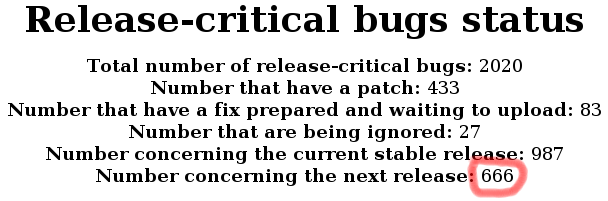
RCBW - #26 RC bug count: 666 It is getting down, even though the current number is scary. My personal RC bug count is not so mystical and as low as 205 RC bugs to go, which is quite encouraging. Without any further ado, here are this week squashes: Random points:

Next.

Previous.