Search Results: "edd"

2 January 2015

John Goerzen: Sound players: Adventures with Ampache, mpd, pulseaudio, Raspberry Pi, and Logitech Media Server

I finally decided it was about time to get my whole-house sound project off the ground. As an added bonus, I d like to be able to stream music from my house to my Android phone. Some Background It was about 2.5 years ago that I last revisited the music-listening picture on Linux. I used Spotify for awhile, but the buggy nature of its support for local music eventually drove me up the wall. I have a large collection of music that will never be on Spotify (local choirs, for instance) and this was an important feature. When Google Play Music added the feature of uploading your local collection, I used that; it let me stream music from my phone in my car (using the Bluetooh link to the car). I could also listen at home on a PC, or plug my phone into various devices to play. But that was a hassle, and didn t let me have music throughout the house. Google Play is reasonable for that, but it has a number of really glaring issues. One is that it often gets album artwork wrong; it doesn t use the ID3 tags embedded in the files, but rather tries to guess . Another is that the sync is only add . Move files to another place in your collection, or re-rip them to FLAC and replace your old MP3s, and suddenly they re in Google Play twice. It won t ever see updated metadata, either quite a hassle for someone that uses Musicbrainz and carefully curates metadata. My Hardware I already have an oldish PC set up as a entertainment box running MythTV. It is a diskless system (boots PAE over the network and has NFS root) and very quiet. It has video output to my TV, and audio output via S/PDIF to my receiver. It is one logical audio frontend. My workstation in my office is another obvious place. My kitchen has a radio with a line in jack, and I also have a small portable speaker with a line in jack to make the last two options. I also have a Raspberry Pi model B that I bought awhile ago and was looking for a purpose, so I thought this should be cheap and easy, right? Well. Cheap, yes. Easy, not so much. First attempt: Ampache The Ampache project produces quite a nice piece of software. Ampache has matured significantly in the last 2.5 years, and the usability of its web-interface with HTML5 and Flash players as options is quite impressive. It is easily as usable as Google s, though its learning curve is rather more steep. There are multiple Android apps for Ampache to stream remotely. And, while most are terribly buggy and broken, there is at least one that seems to work well. Ampache can also output m3u/pls files for a standalone player. It does on-the-fly transcoding. There are some chinks in the armor, however. The set of codecs that are transcoded or passed through is a global setting, not a per-device setting. The bitrates are per-account, so you can t easily have it transcode FLAC into 320Kbps mp3 for streaming on your LAN and 128Kbps MP3 for streaming to your phone. (There are some hacks involving IP address ranges and multiple accounts, but they are poorly documented and cumbersome.) Ampache also has a feature called localplay in which it drives local players instead of remote ones. I tried to use this in combination with mpd to drive music to the whole house. Ampache s mpd interface is a bit odd; it actually loads things up into mpd s queue. Sadly it shares the same global configs as the rest. Even though mpd is perfectly capable of handling FLAC audio, the Ampache web player isn t, so you have to either make it transcode mp3 for everything or forego the web player (or use a second account that has transcode everything set). Frustratingly, not one of the Android clients for Ampache is even remotely compatible with Localplay, and some will fail in surprising ways if you have been using Localplay on the web client. So let s see how this mpd thing worked out. Ampache with mpd for whole-house audio The primary method here is to use mpd s pulseaudio driver. I configured it like so:
audio_output
type "pulse"
name "MPD stream"
#server "remote_server" # optional
sink "rtp" # optional
mixer_type "software"

Then in /etc/pulse/system.pa:
load-module module-null-sink sink_name=rtp format=s16be channels=2 rate=44100 sink_properties="device.description='RTP Multicast Sink'"
load-module module-rtp-send source=rtp.monitor
This tells Pulse to use multicast streaming to the LAN for the audio packets. Pulse is supposed to have latency synchronization to achieve perfect audio everywhere. In practice, this works somewhat poorly. Plus I have to install pulse everywhere, which inserts its tentacles way too deeply into the ALSA stack for my taste. (alsamixer suddenly turns useless by default, for instance.) But I gave it a try. After much fiddling Pulse is rather poorly documented and the interactions of configuration tools with it even more so I found a working configuration. On my MythTV box, I added:
load-module module-rtp-recv
load-module module-native-protocol-tcp auth-ip-acl=127.0.0.1;x.x.x.x
The real annoyance was getting it to set the output through the S/PDIF digital port. Finally I figured out the magic potion:
set-card-profile 0 output:iec958-stereo+input:analog-stereo
This worked reasonably well. The Raspberry Pi was a much bigger challenge, however. I put Raspbian on it easily enough, and installed Pulse. But apparently it is well-known in the Pulse community that Pulse s RTP does not work well with wifi. Multicast itself works poorly with wifi in general, and Pulse won t do unicast RTP. However, Pulse assumes very low latency and just won t work well with wifi at all. Morever, pulseaudio on the rpi is something of a difficult beast to tame. It has crackling audio, etc. I eventually got it working decently with: daemon.conf:
realtime-scheduling = yes
realtime-priority = 5
resample-method = src-sinc-fastest
default-sample-rate = 44100
default-fragments = 4
default-fragment-size-msec=20
and in system.pa, commented out the module-udev-detect and module-detect, and added:
load-module module-alsa-card device_id=0 tsched=0 fragments=10 fragment_size=640 tsched_buffer_size=4194384 tsched_buffer_watermark=262144
plus the rtp-recv and tcp protocol lines as before. This got it working with decent quality, but it was always out of sync by at least a few tenths of a second, if not a whole second, with the other rooms. Brief diversion: mplayer Many players besides pulseaudio can play the RTP streams that pulseaudio generates. mplayer, for instance, can. I found this worked on the Raspberry Pi:
mplayer -really-quiet -cache 64 -cache-min 95 -demuxer rawaudio -rawaudio format=0x20776172 rtp://224.0.0.56:46510
But this produced even worse sync. It became clear that Ampache was not going to be the right solution. Logitech Media Server I have looked at this a few times over the years, but I ve somehow skipped it. But I looked at it again now. It is an open source (GPL) server, and was originally designed to work with Logitech hardware. There are now all sorts of software clients out there. There is a helpful wiki about it, although Logitech has rebranded the thing so many times, it s not even consistent internally on what the heck it s called (is it LMS? or Squeezebox Server? or Slimserver? The answer is: yes.) LMS does no web-based streaming. At all. But I thought I d give it a try. Installation is a little weird (its .deb packages up binary perl modules for things that are already in Debian, for half a dozen architectures and many Perl versions.) I had some odd issues but eventually it worked. It scanned my media collection. I installed squeezelite on my workstation as my first player, and things worked reasonably well out of the box. I proceeded to install squeezelite on the Raspberry Pi and MythTV server (where I had to compile libsoxr for wheezy, due to an obscure error I couldn t find the cause of until I used strace). Log in to the LMS web interface, tell it to enable synchronization, and bam! Perfect synchronization! Incredible. But I ran into two issues: one was that it used a lot of CPU even on my workstation (50% or more, even when idle). Strangely, it used far less CPU on the pi than did pulseaudio. Secondly, I d get annoying clicks from it from time to time. Some debugging and investigation revealed that they were both somewhat related; it was getting out of sync with the pi and correcting. Initially I assumed this to be an issue with the pi, but tracked it down to something else. I told it to upsample to 48kHz and this made the problem go away. My command on PC hardware is:
squeezelite -a 200:10 -o dmix -u hLX -z
And on the Raspberry Pi:
squeezelite -a 800:10:16:0 -n kitchen -z
It is working perfectly now. LMS even has an Android remote control app that can control all devices together, queue up playlists, etc. Very slick. The Raspberry Pi The Raspberry Pi, even the model B+, apparently has notoriously bad audio output. I noticed this first as very low volume on the output. I found a $11 USB DAC on Amazon that seems to do the trick, so we will see. I am also using the $10 Edimax USB Wifi and it seems to work well. Other Options The big-name other option here is Sonos. They have perfect sync audio already working. But they re pricy, closed, and proprietary; you have to buy Sonos speakers, transmitters, etc. for the entire house. Their receivers start at $200, and it s at least $350 to integrate an existing stereo into the system. I d be shelling out over $1000 to use Sonos for this setup. As it is, I ve bought less than $100 of equipment (a second Pi and its accessories) and getting output that, while no doubt not quite as pristine, it still quite nice and acceptable. Quite nice. Update: LMS with Apache It turns out that Logitech Media Server can automatically save created playlists to a spot where Ampache can find them. So an Ampache streaming player can be used to access the same collection LMS uses, with full features. Nice!

1 January 2015

Dirk Eddelbuettel: (Belated) 2014 Running Recap

Having just blogged about today's 5k, I noticed that I did not blog at all about running in 2014. There wasn't much, but another Ragnar Relay in February, again as an Ultra team. I more-or-less live tweeted this though: Pre-race warning (and that was my route!), Team photo at start, Leg 1, Leg 2, Leg 3, Leg 4, Leg 5, Leg 6, and Chilling I also ran the Philly Half-Marathon in November following up on the Penn R Workshop, and posted some tweets: Post race selfie, Strava result (thinking it was a 13.5 miler race--WTF), and Post-race chill.

This post by Dirk Eddelbuettel originated on his Thinking inside the box blog. Please report excessive re-aggregation in third-party for-profit settings.

Dirk Eddelbuettel: New Year's Run 2015

Nice, crisp and pretty cold morning for the 2015 New Year's 5k. I had run this before with friends: 2003, 2005, 2006 and 2007. Needless to say, I am a little slower now: A hand-stopped 23:13 for a 7:27 min/mile pace is fine by me given the weather, lack of speedwork in the last few months, and generally reduced running---but also almost a minute slower than the last time I ran this. In case you're a fellow running geek and into this, Strava has my result nicely aggregated.

This post by Dirk Eddelbuettel originated on his Thinking inside the box blog. Please report excessive re-aggregation in third-party for-profit settings.

31 December 2014

Chris Lamb: 2014: Selected highlights

Previously: 2012 & 2013.


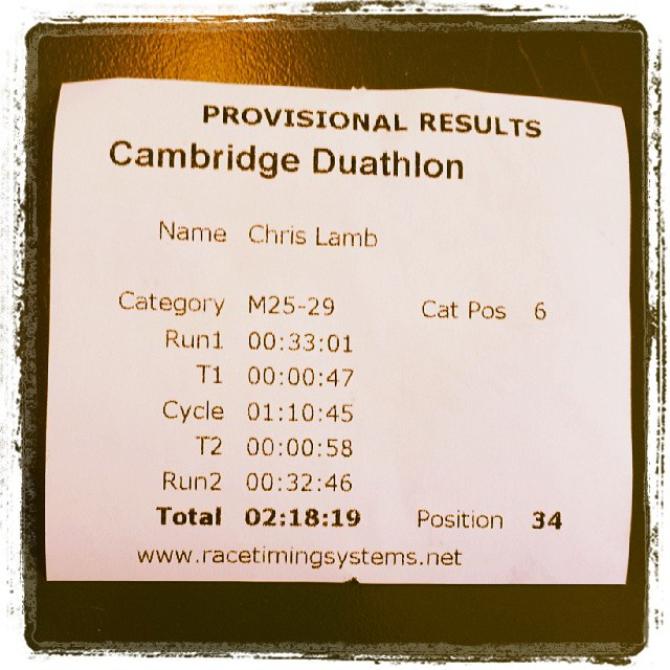
January https://d1icoid1cnixnp.cloudfront.net/yadt/blog.Image/image/cropped/15.jpeg Was lent a 15-course baroque lute. February https://d1icoid1cnixnp.cloudfront.net/yadt/blog.Image/image/cropped/19.jpeg Grandpa's funeral. In December he was posthumously awarded the Ushakov Medal (pictured) for his service in the Royal Navy's Arctic Convoys during the Second World War. March https://d1icoid1cnixnp.cloudfront.net/yadt/blog.Image/image/cropped/14.jpeg A lot of triathlon training but also got back into cooking. April https://d1icoid1cnixnp.cloudfront.net/yadt/blog.Image/image/cropped/2.jpeg Returned to the Cambridge Duathlon. May https://d1icoid1cnixnp.cloudfront.net/yadt/blog.Image/image/cropped/13.jpeg Raced 50 and 100 mile cycling time trials & visited the Stratford Olympic pool (pictured). June https://d1icoid1cnixnp.cloudfront.net/yadt/blog.Image/image/cropped/1.jpeg Ironman Austria. July https://d1icoid1cnixnp.cloudfront.net/yadt/blog.Image/image/cropped/9.jpeg Paced my sister at the Downtow-Upflow Half-marathon. Also released the first version of the Strava Enhancement Suite. August https://d1icoid1cnixnp.cloudfront.net/yadt/blog.Image/image/cropped/3.jpeg Visited Cornwall for my cousin's wedding (pictured). Another month for sport including my first ultramarathon and my first sub-20 minute 5k. September https://d1icoid1cnixnp.cloudfront.net/yadt/blog.Image/image/cropped/11.jpeg Entered a London Oxford London cycling brevet, my longest single-ride to date (269 km). Also visited the Tour of Britain and the Sri Chomnoy 24-hour endurance race. October https://d1icoid1cnixnp.cloudfront.net/yadt/blog.Image/image/cropped/10.jpeg London Paris London cycling tour (588 km). November https://d1icoid1cnixnp.cloudfront.net/yadt/blog.Image/image/cropped/5.jpeg Performed Handel's Messiah in Kettering. December https://d1icoid1cnixnp.cloudfront.net/yadt/blog.Image/image/cropped/18.jpeg Left Thread.com.

Dirk Eddelbuettel: digest 0.6.8

Release 0.6.8 of digest package is now on CRAN and will get to Debian shortly. This release opens the door to also providing the digest functionality at the C level to other R packages. Wush Wu is going to use the murmurHash C implementation in his recently-created FeatureHashing package. We plan to export the other hashing function as well. Another small change attempts to overcome a build limitation on that other largely-irrelevant-but-still-check-by-CRAN OS. CRANberries provides the usual summary of changes to the previous version.

This post by Dirk Eddelbuettel originated on his Thinking inside the box blog. Please report excessive re-aggregation in third-party for-profit settings.

29 December 2014

Dirk Eddelbuettel: rfoaas 0.0.5

A new version of rfoaas is now on CRAN. The rfoaas package provides an interface for R to the most excellent FOAAS service--which provides a modern, scalable and RESTful web service for the frequent need to tell someone to eff off. This version aligns the rfoaas version number with the (at long last) updated upstream version number, and brings a change suggested by Richie Cotton to set the encoding of the returned object. As usual, CRANberries provides a diff to the previous release. Questions, comments etc should go to the GitHub issue tracker off the GitHub repo.

This post by Dirk Eddelbuettel originated on his Thinking inside the box blog. Please report excessive re-aggregation in third-party for-profit settings.

28 December 2014

Dirk Eddelbuettel: RcppArmadillo 0.4.600.0

Conrad produced another minor release 4.600 of Armadillo. As before, I had created a GitHub-only pre-release(s) of his pre-release(s), and tested a pre-release as well as the actual release against the now over one hundred CRAN dependents of our RcppArmadillo package. The tests passed fine as usual with less than a handful of checks not passing, all for known cases -- and results are as always in the rcpp-logs repository. Changes are summarized below based on the NEWS.Rd file.
Changes in RcppArmadillo version 0.4.600.0 (2014-12-27)
  • Upgraded to Armadillo release Version 4.600 ("Off The Reservation")
    • added .head() and .tail() to submatrix views
    • faster matrix transposes within compound expressions
    • faster accu() and norm() when compiling with -O3 -ffast-math -march=native (gcc and clang)
    • workaround for a bug in GCC 4.4
Courtesy of CRANberries, there is also a diffstat report for the most recent release. As always, more detailed information is on the RcppArmadillo page. Questions, comments etc should go to the rcpp-devel mailing list off the R-Forge page.

This post by Dirk Eddelbuettel originated on his Thinking inside the box blog. Please report excessive re-aggregation in third-party for-profit settings.

25 December 2014

Dirk Eddelbuettel: rfoaas 0.0.4.20141225 -- not on CRAN

A new version of rfoaas was prepared for CRAN, but refused on the grounds of having been updated within 24 hours. Oh well. To recap, the rfoaas package provides an interface for R to the most excellent FOAAS service -- which provides a modern, scalable and RESTful web service for the frequent need to tell someone to eff off. And having seen the Christmas Eve (ie December 24) update, upstream immediatly and rather kindly added a new xmas(name, from) function -- so now we could do rfoaas::xmas("CRAN Maintainers") to wish the CRAN Maintainers a very Merry Christmas. So for once, there is no CRANberries report as the package is not on CRAN :-/ There is of course always GitHub. Questions, comments etc should go to the GitHub issue tracker off the GitHub repo.

This post by Dirk Eddelbuettel originated on his Thinking inside the box blog. Please report excessive re-aggregation in third-party for-profit settings.

Dirk Eddelbuettel: rfoaas 0.0.4.20141224

A new version of rfoaas is now on CRAN. The rfoaas package provides an interface for R to the most excellent FOAAS service -- which provides a modern, scalable and RESTful web service for the frequent need to tell someone to eff off. This is minor update, affecting only the rfoaas side without changes at the FOAAS backend side. We documented that the result may need an encoding update (at least on the World's leading consumer OS), and now provide a default value for from so that many services can be called argument-less, or at least with one argument less than before. Both of these were suggested by Richie Cotton via issue tickets at the GitHub repo. CRANberries also provides a diff to the previous release. Questions, comments etc should go to the GitHub issue tracker off the GitHub repo.

This post by Dirk Eddelbuettel originated on his Thinking inside the box blog. Please report excessive re-aggregation in third-party for-profit settings.

23 December 2014

Dirk Eddelbuettel: RcppEigen 0.3.2.3.0

A new release of RcppEigen is now on CRAN, and will get to Debian shortly. This is thanks to a fabulous pull request by Yixuan Qiu who single-handedly managed to upgrade to the new minor release of Eigen -- after having expanded the unit tests a few weeks earlier in another pull request. The NEWS file entry follows.
Changes in RcppEigen version 0.3.2.3.0 (2014-12-22)
  • Updated to version 3.2.3 of Eigen
  • Added a number of additional unit tests for wrap, transform and sparse
  • Updated one of the examples
Courtesy of CRANberries, there is also a diffstat report for the most recent release.

This post by Dirk Eddelbuettel originated on his Thinking inside the box blog. Please report excessive re-aggregation in third-party for-profit settings.

22 December 2014

Dirk Eddelbuettel: BH release 1.55.0-1

A new release of BH, our package providing (a large part of the) Boost C++ libraries as a set of template headers for use by R, is now on CRAN. There are two changes. First, we upgraded to Boost 1.55. While Boost 1.57 is now current, I am playing it somewhat safe and conservative here by relying on what is the current version in Debian (and Ubuntu). I even started from the Debian tarball. This ensures we include nothing not in accordance with the Debian Free Software Guidelines (as they are a good proxy for what is acceptable to CRAN). The second change was the addition of Boost.Geometry as requested in issue ticket 5. This may be a good time to recall that best way to get in touch for desired additions in BH are the mailing list or the issue tracker at the GitHub repo. A brief summary of changes from the NEWS file (which we failed to update for the release; the text below is however now in the repo):
Changes in version 1.55.0-1 (2014-12-21)
Courtesy of CRANberries, there is also a (very long!) diffstat report for the most recent release. Comments and suggestions are welcome via the mailing list or the issue tracker at the GitHubGitHub repo.

This post by Dirk Eddelbuettel originated on his Thinking inside the box blog. Please report excessive re-aggregation in third-party for-profit settings.

21 December 2014

Dirk Eddelbuettel: If only there was a Romeo somewhere ...

Attention: rant coming. You have been warned, and may want to tune out now. So the top of my Twitter timeline just had a re-tweet posting to this marvel on the state of Julia. I should have known better than to glance at it as it comes from someone providing (as per the side-bar) Thought leadership in Big Data, systems architecture and more. Reading something like this violates the first rule of airport book stores: never touch anything from the business school section, especially on (wait for it) leadership or, worse yet, thought leadership. But it is Sunday, my first cup of coffee still warm (after finalising two R package updates on GitHub, and one upload to CRAN) and so I read on. Only to be mildly appalled by the usual comparison to R based on the same old Fibonacci sequence. Look, I am as guilty as anyone of using it (for example all over chapter one of my Rcpp book), but at least I try to stress each and every time that this is kicking R where it is down as its (fairly) poor performance on functions calls (that is well-known and documented) obviously gets aggravated by recursive calls. But hey, for the record, let me restate those results. So Julia beats R by a factor of 385. But let's take a closer look. For n=25, I get R to take 241 milliseconds---as opposed to his 6905 milliseconds---simply by using the same function I use in every workshop, eg last used at Penn in November, which does not use the dreaded ifelse operator:
fibR <- function(n)  
  if (n < 2) return(n)
  return(fibR(n-1) + fibR(n-2))
 
Switching that to the standard C++ three-liner using Rcpp
library(Rcpp)
cppFunction('int fibCpp(int n)   
  if (n < 2) return(n);  
  return(fibCpp(n-1) + fibCpp(n-2));  
   ')
and running a standard benchmark suite gets us the usual result of
R> library(rbenchmark)
R> benchmark(fibR(25),fibCpp(25),order="relative")[,1:4]
        test replications elapsed relative
2 fibCpp(25)          100   0.048    1.000
1   fibR(25)          100  24.674  514.042
R> 
So for the record as we need this later: that is 48 milliseconds for 100 replications, or about 0.48 milliseconds per run. Now Julia. And of my standard Ubuntu server running the current release 14.10:
edd@max:~$ julia
ERROR: could not open file /home/edd//home/edd//etc/julia/juliarc.jl
 in include at boot.jl:238
edd@max:~$ 
So wait, what? You guys can't even ensure a working release on what is probably the most popular and common Linux installation? And I get to that after reading a post on the importance of "Community, Community, Community" and you can't even make sure this works on Ubuntu? Really? So a little bit of googling later, I see that julia -f is my friend for this flawed release, and I can try to replicate the original timing
edd@max:~$ julia -f
               _
   _       _ _(_)_        A fresh approach to technical computing
  (_)       (_) (_)       Documentation: http://docs.julialang.org
   _ _   _   _  __ _      Type "help()" to list help topics
               / _      
       _        (_        Version 0.2.1 (2014-02-11 06:30 UTC)
 _/  \__'_ _ _ \__'_      
 __/                      x86_64-linux-gnu
julia> fib(n) = n < 2 ? n : fib(n - 1) + fib(n - 2)
fib (generic function with 1 method)
julia> @elapsed fib(25)
0.002299559
julia> 
Interestingly the posts author claims 18 milliseconds. I see 2.3 milliseconds here. Maybe someone is having a hard time comparing things to the right of the decimal point. Or maybe his computer is an order of magnitude slower than mine. The more important thing is that Julia is of course faster than R (no surprise: LLVM at work) but also still a lot slower than a (trivial to write and deploy) C++ function. Nothing new here. So let's recap. Comparison to R was based on a flawed version of a function we only use when we deliberately want to put R down, can be improved significantly when using a better implementation, results are still off by order of magnitude to what was reported ("math is hard"), and the standard C / C++ way of doing things is still several times faster than our new saviour language---which I can't even launch on the current version of one of the more common free operating systems. Ok then. Someone please wake me up in a few years and I will try again. Now, coming to the end of the rant I should really stress that of course I too hope that Julia succeeds. Every user pulled away from Matlab is a win for all us. We're in this together and the endless navel gazing between ourselves is so tiresome and irrelevant. And as I argue here, even more so when we among ourselves stick to unfair comparisons as well as badly chosen implementation details. What matters are wins against the likes of Matlab, Excel, SAS and so on. Let's build on our joint strength. I am sure I will use Julia one day, and I am grateful for everyone helping with it---as a lot of help seems to be needed. In the meantime, and with CRAN at 6130 packages that just work I'll continue to make use of this amazing community and trying my bit to help it grow and prosper. As part of our joint community.

20 December 2014

Dirk Eddelbuettel: digest 0.6.7

Release 0.6.7 of digest package is now on CRAN and in Debian. Jim Hester was at it again and added murmurHash. I cleaned up several sets of pedantic warnings in some of the source files, updated the test reference out, and that forms version 0.6.7. CRANberries provides the usual summary of changes to the previous version.

This post by Dirk Eddelbuettel originated on his Thinking inside the box blog. Please report excessive re-aggregation in third-party for-profit settings.

Rudy Godoy: Apache Phoenix for Cloudera CDH

Apache Phoenix is a relational database layer over HBase delivered as a client-embedded JDBC driver targeting low latency queries over HBase data. Apache Phoenix takes your SQL query, compiles it into a series of HBase scans, and orchestrates the running of those scans to produce regular JDBC result sets. What the above statement means for developers or data scientists is that you can talk SQL to your HBase cluster. Sounds good right? Setting up Phoenix on Cloudera CDH can be really frustrating and time-consuming. I wrapped-up references from across the web with my own findings to have both play nice. Building Apache Phoenix Because of dependency mismatch for the pre-built binaries, supporting Cloudera s CDH requires to build Phoenix using the versions that match the CDH deployment. The CDH version I used is CDH4.7.0. This guide applies for any version of CDH4+. Note: You can find CDH components version in the CDH Packaging and Tarball Information section for the Cloudera Release Guide . Current release information (CDH5.2.1) is available in this link. Preparing Phoenix build environment Phoenix can be built using maven or gradle. General instructions can be found in the Building Phoenix Project webpage. Before building Phoenix you need to have: Checkout correct Phoenix branch Phoenix has two major release versions: Clone the Phoenix git repository
git clone https://github.com/apache/phoenix.git
Work with the correct branch
git fetch origin
git checkout 3.2
Modify dependencies to match CDH Before building Phoenix, you will need to modify the dependencies to match the version of CDH you are trying to support. Edit phoenix/pom.xml and do the following changes: Add Cloudera s Maven repository
+  <repository>
+  <id>cloudera</id>
+  https://repository.cloudera.com/artifactory/cloudera-repos/
+  </repository>
Change component versions to match CDH s.
  
-  <hadoop-one.version>1.0.4</hadoop-one.version>
-  <hadoop-two.version>2.0.4-alpha</hadoop-two.version>
+  <hadoop-one.version>2.0.0-mr1-cdh4.7.0</hadoop-one.version>
+  <hadoop-two.version>2.0.0-cdh4.7.0</hadoop-two.version>
  <!-- Dependency versions -->
-  <hbase.version>0.94.19
+  <hbase.version>0.94.15-cdh4.7.0
  <commons-cli.version>1.2</commons-cli.version>
-  <hadoop.version>1.0.4
+  <hadoop.version>2.0.0-cdh4.7.0
  <pig.version>0.12.0</pig.version>
  <jackson.version>1.8.8</jackson.version>
  <antlr.version>3.5</antlr.version>
  <log4j.version>1.2.16</log4j.version>
  <slf4j-api.version>1.4.3.jar</slf4j-api.version>
  <slf4j-log4j.version>1.4.3</slf4j-log4j.version>
-  <protobuf-java.version>2.4.0</protobuf-java.version>
+  <protobuf-java.version>2.4.0a</protobuf-java.version>
  <commons-configuration.version>1.6</commons-configuration.version>
  <commons-io.version>2.1</commons-io.version>
  <commons-lang.version>2.5</commons-lang.version>
Change target version, only if you are building for Java 6. CDH4 is built for JRE 6.
  <artifactId>maven-compiler-plugin</artifactId>
  <version>3.0</version>
  <configuration>
-  <source>1.7</source>
-  <target>1.7</target>
+  <source>1.6</source>
+  <target>1.6</target>
  </configuration>
Phoenix building Once, you have made the changes you are set to build Phoenix. Our CDH4.7.0 cluster uses Hadoop 2, so make sure to activate the hadoop2 profile.
mvn package -DskipTests -Dhadoop.profile=2
If everything goes well, you should see the following result:
[INFO] ------------------------------------------------------------------------
[INFO] Reactor Summary:
[INFO]
[INFO] Apache Phoenix .................................... SUCCESS [2.729s]
[INFO] Phoenix Hadoop Compatibility ...................... SUCCESS [0.882s]
[INFO] Phoenix Core ...................................... SUCCESS [24.040s]
[INFO] Phoenix - Flume ................................... SUCCESS [1.679s]
[INFO] Phoenix - Pig ..................................... SUCCESS [1.741s]
[INFO] Phoenix Hadoop2 Compatibility ..................... SUCCESS [0.200s]
[INFO] Phoenix Assembly .................................. SUCCESS [30.176s]
[INFO] ------------------------------------------------------------------------
[INFO] BUILD SUCCESS
[INFO] ------------------------------------------------------------------------
[INFO] Total time: 1:02.186s
[INFO] Finished at: Mon Dec 15 13:18:48 PET 2014
[INFO] Final Memory: 45M/1330M
[INFO] ------------------------------------------------------------------------
Phoenix Server component deployment Since Phoenix is a JDBC layer on top of HBase a server component has to be deployed on every HBase node. The goal is to have Phoenix server component added to HBase classpath. You can achieve this goal either by copying the server component directly to HBase s lib directory, or copy the component to an alternative path then modify HBase classpath definition. For the first approach, do:
cp phoenix-assembly/target/phoenix-3.2.3-SNAPSHOT-server.jar /opt/cloudera/parcels/CDH/lib/hbase/lib/
Note: In this case CDH is a synlink to the current active CDH version. For the second approach, do:
cp phoenix-assembly/target/phoenix-3.2.3-SNAPSHOT-server.jar /opt/phoenix/
Then add the following line to /etc/hbase/conf/hbase-env.sh
/etc/hbase/conf/hbase-env.sh
export HBASE_CLASSPATH_PREFIX=/opt/phoenix/phoenix-3.2.3-SNAPSHOT-server.jar
Wether you ve used any of the methods, you have to restart HBase. If you are using Cloudera Manager, restart the HBase service. To validate that Phoenix is on HBase class path, do:
sudo -u hbase hbase classpath   tr ':' '\n'   grep phoenix
Phoenix server validation Phoenix provides a set of client tools that you can use to validate the server component functioning. However, since we are supporting CDH4.7.0 we ll need to make few changes to such utilities so they use the correct dependencies. phoenix/bin/sqlline.py: sqlline.py is a wrapper for the JDBC client, it provides a SQL console interface to HBase through Phoenix.
index f48e527..bf06148 100755
--- a/bin/sqlline.py
+++ b/bin/sqlline.py
@@ -53,7 +53,8 @@ colorSetting = "true"
 if os.name == 'nt':
  colorSetting = "false"
-java_cmd = 'java -cp "' + phoenix_utils.hbase_conf_path + os.pathsep + phoenix_utils.phoenix_client_jar + \
+extrajars="/opt/cloudera/parcels/CDH/lib/hadoop/lib/commons-collections-3.2.1.jar:/opt/cloudera/parcels/CDH/lib/hadoop/hadoop-auth-2.0.0-cdh4.7.0.jar:/opt/cloudera/parcels/CDH/lib/hadoop/hadoop-common-2.0.0-cdh4.7.0.jar:/opt/cloudera/parcerls/CDH/lib/oozie/libserver/hbase-0.94.15-cdh4.7.0.jar"
+java_cmd = 'java -cp ".' + os.pathsep + extrajars + os.pathsep + phoenix_utils.hbase_conf_path + os.pathsep + phoenix_utils.phoenix_client_jar + \
  '" -Dlog4j.configuration=file:' + \
  os.path.join(phoenix_utils.current_dir, "log4j.properties") + \
  " sqlline.SqlLine -d org.apache.phoenix.jdbc.PhoenixDriver \
phoenix/bin/psql.py: psql.py is a wrapper tool that can be used to create and populate HBase tables.
index 34a95df..b61fde4 100755
--- a/bin/psql.py
+++ b/bin/psql.py
@@ -34,7 +34,8 @@ else:
 # HBase configuration folder path (where hbase-site.xml reside) for
 # HBase/Phoenix client side property override
-java_cmd = 'java -cp "' + phoenix_utils.hbase_conf_path + os.pathsep + phoenix_utils.phoenix_client_jar + \
+extrajars="/opt/cloudera/parcels/CDH/lib/hadoop/lib/commons-collections-3.2.1.jar:/opt/cloudera/parcels/CDH/lib/hadoop/hadoop-auth-2.0.0-cdh4.7.0.jar:/opt/cloudera/parcels/CDH/lib/hadoop/hadoop-common-2.0.0-cdh4.7.0.jar:/opt/cloudera/parcerls/CDH/lib/oozie/libserver/hbase-0.94.15-cdh4.7.0.jar"
+java_cmd = 'java -cp ".' + os.pathsep + extrajars + os.pathsep + phoenix_utils.hbase_conf_path + os.pathsep + phoenix_utils.phoenix_client_jar + \
  '" -Dlog4j.configuration=file:' + \
  os.path.join(phoenix_utils.current_dir, "log4j.properties") + \
  " org.apache.phoenix.util.PhoenixRuntime " + args
After you have done such changes you can test connectivity by issuing the following commands:
./bin/sqlline.py zookeeper.local
Setting property: [isolation, TRANSACTION_READ_COMMITTED]
issuing: !connect jdbc:phoenix:zookeeper.local none none org.apache.phoenix.jdbc.PhoenixDriver
Connecting to jdbc:phoenix:zookeeper.local
14/12/16 19:26:10 WARN conf.Configuration: dfs.df.interval is deprecated. Instead, use fs.df.interval
14/12/16 19:26:10 WARN conf.Configuration: hadoop.native.lib is deprecated. Instead, use io.native.lib.available
14/12/16 19:26:10 WARN conf.Configuration: fs.default.name is deprecated. Instead, use fs.defaultFS
14/12/16 19:26:10 WARN conf.Configuration: topology.script.number.args is deprecated. Instead, use net.topology.script.number.args
14/12/16 19:26:10 WARN conf.Configuration: dfs.umaskmode is deprecated. Instead, use fs.permissions.umask-mode
14/12/16 19:26:10 WARN conf.Configuration: topology.node.switch.mapping.impl is deprecated. Instead, use net.topology.node.switch.mapping.impl
14/12/16 19:26:11 WARN conf.Configuration: fs.default.name is deprecated. Instead, use fs.defaultFS
14/12/16 19:26:11 WARN util.NativeCodeLoader: Unable to load native-hadoop library for your platform... using builtin-java classes where applicable
14/12/16 19:26:12 WARN conf.Configuration: fs.default.name is deprecated. Instead, use fs.defaultFS
Connected to: Phoenix (version 3.2)
Driver: PhoenixEmbeddedDriver (version 3.2)
Autocommit status: true
Transaction isolation: TRANSACTION_READ_COMMITTED
Building list of tables and columns for tab-completion (set fastconnect to true to skip)...
77/77 (100%) Done
Done
sqlline version 1.1.2
0: jdbc:phoenix:zookeeper.local>
Then, you can either issue SQL-commands or Phoenix-commands.
0: jdbc:phoenix:zookeeper.local> !tables
+------------------------------------------+------------------------------------------+------------------------------------------+---------------------------+
  TABLE_CAT    TABLE_SCHEM    TABLE_NAME    TABLE_TYPE  
+------------------------------------------+------------------------------------------+------------------------------------------+---------------------------+
  null    SYSTEM    CATALOG    SYSTEM TABLE   
  null    SYSTEM    SEQUENCE    SYSTEM TABLE   
  null    SYSTEM    STATS    SYSTEM TABLE   
  null    null    STOCK_SYMBOL    TABLE   
  null    null    WEB_STAT    TABLE   
+------------------------------------------+------------------------------------------+------------------------------------------+---------------------------+

Craig Small: WordPress 4.1 for Debian

Release 4.1 of WordPress came out on Friday so after some work to fit in with the Debian standards, the Debian package 4.1-1 of WordPress will be uploaded shortly. WordPress have also updated their themes with a 14-day early theme called twentyfifteen. This is the default theme for WordPress 4.1 on-wards. I have also made some adjustments with the embedded code that WordPress ships. This is the usually JavaScript or PHP code that WordPress has in their release tarballs that comes from other projects. There is a fine line between keeping the WordPress install the same and having to deal with the maintenance of the embedded code. An example of a good one not to use embedded code is php-getid which the Debian maintainer has put in some additional patches for a better security fix while the alternative is jquery which is a little sad in the Debian-word being so many versions behind. php-snoopy got reverted to embedded code because its not exactly the same as upstream. A significant (or invisible, depends on your browser) is the mediaelement components now don t use the un-maintainable silverlight and flash plugins, which is the same how the libjs-mediaelement package works. In fact the code IS from that package. dh_linktree As I was looking into the embedded js/php code in WordPress, I also had to look into how the previous maintainer kept all the versions in order without some horrible mess of patchfiles and symlinks. The answer was dh_linktree. This program plugs into the standard debhelper rules file and can basically use symlinks in the package to use the standard Debian versions of files. It a bit cleverer than symlinks in that you can say use the link always or only if the files are the same. If you need to remove some of your embedded code out of Debian packages, have a look into it. It might save you a lot of agnst or hand-crafted rules files.

19 December 2014

Dirk Eddelbuettel: Rocker is now the official R image for Docker

big deal Something happened a little while ago which we did not have time to commensurate properly. Our Rocker image for R is now the official R image for Docker itself. So getting R (via Docker) is now as simple as saying docker pull r-base. This particular container is essentially just the standard r-base Debian package for R (which is one of a few I maintain there) plus a mininal set of extras. This r-base forms the basis of our other containers as e.g. the rather popular r-studio container wrapping the excellent RStudio Server. A lot of work went into this. Carl and I also got a tremendous amount of help from the good folks at Docker. Details are as always at the Rocker repo at GitHub. Docker itself continues to make great strides, and it has been great fun help to help along. With this post I achieved another goal: blog about Docker with an image not containing shipping containers. Just kidding.

This post by Dirk Eddelbuettel originated on his Thinking inside the box blog. Please report excessive re-aggregation in third-party for-profit settings.

14 December 2014

Dirk Eddelbuettel: rfoaas 0.0.4.20141212

A new version of rfoaas is now on CRAN. The rfoaas package provides an interface for R to the most excellent FOAAS service -- which provides a modern, scalable and RESTful web service for the frequent need to tell someone to eff off. The FOAAS backend gets updated in spurts, and yesterday a few pull requests were integrated, including one from yours truly. So with that it was time for an update to rfoaas. As the version number upstream did not change (bad, bad, practice) I appended the date the version number. CRANberries also provides a diff to the previous release. Questions, comments etc should go to the GitHub issue tracker off the GitHub repo.

This post by Dirk Eddelbuettel originated on his Thinking inside the box blog. Please report excessive re-aggregation in third-party for-profit settings.

12 December 2014

Dirk Eddelbuettel: RProtoBuf 0.4.2

A new release 0.4.2 of RProtoBuf is now on CRAN. RProtoBuf provides R bindings for the Google Protocol Buffers ("Protobuf") data encoding library used and released by Google, and deployed as a language and operating-system agnostic protocol by numerous projects. Murray and Jeroen did almost all of the heavy lifting. Many changes were triggered by two helpful referee reports, and we are slowly getting to the point where we will resubmit a much improved paper. Full details are below.
Changes in RProtoBuf version 0.4.2 (2014-12-10)
  • Address changes suggested by anonymous reviewers for our Journal of Statistical Software submission.
  • Make Descriptor and EnumDescriptor objects subsettable with "[[".
  • Add length() method for Descriptor objects.
  • Add names() method for Message, Descriptor, and EnumDescriptor objects.
  • Clarify order of returned list for descriptor objects in as.list documentation.
  • Correct the definition of as.list for EnumDescriptors to return a proper list instead of a named vector.
  • Update the default print methods to use cat() with fill=TRUE instead of show() to eliminate the confusing [1] since the classes in RProtoBuf are not vectorized.
  • Add support for serializing function, language, and environment objects by falling back to R's native serialization with serialize_pb and unserialize_pb to make it easy to serialize into a Protocol Buffer all of the more than 100 datasets which come with R.
  • Use normalizePath instead of creating a temporary file with file.create when getting absolute path names.
  • Add unit tests for all of the above.
CRANberries also provides a diff to the previous release. RProtoBuf page which has a draft package vignette, a a 'quick' overview vignette, and a unit test summary vignette. Questions, comments etc should go to the GitHub issue tracker off the GitHub repo.

This post by Dirk Eddelbuettel originated on his Thinking inside the box blog. Please report excessive re-aggregation in third-party for-profit settings.

11 December 2014

Dirk Eddelbuettel: digest 0.6.6 (and 0.6.5)

A new release 0.6.6 of the digest package is now on CRAN and in Debian. This release brings the xxHash non-cryptographic hash function by Yann Collet, thanks to several pull requests by Jim Hester. After the upload of version 0.6.5 we uncovered another lovely non-standardness of Windoze: you cannot format unsigned long long via printf() format strings. Great. Luckily Jim found a quick (and portable) fix via the inttypes.h header, and that went into the 0.6.6 release. The release also contains an earlier extension for hmac() to also cover crc32 hashes, kindly provided by Suchen Jin. I also made a number of small internal changes such as CRANberries provides the usual summary of changes to the previous version.

This post by Dirk Eddelbuettel originated on his Thinking inside the box blog. Please report excessive re-aggregation in third-party for-profit settings.

Dirk Eddelbuettel: RcppRedis 0.1.3

A very minor bugfix release of RcppRedis is now on CRAN. The zcount function now returns the correct type.
Changes in version 0.1.3 (2014-12-10)
  • Bug fix setting correct return type of zcount
Courtesy of CRANberries, there is also a diffstat report for the most recent release. More information is on the RcppRedis page.

This post by Dirk Eddelbuettel originated on his Thinking inside the box blog. Please report excessive re-aggregation in third-party for-profit settings.

Next.

Previous.