Search Results: "bod"

20 September 2015

Jonathan Dowland: Kolo ep, Dubrovnik, Dalmatia

Trsteno Trsteno (near Botanical gardens)
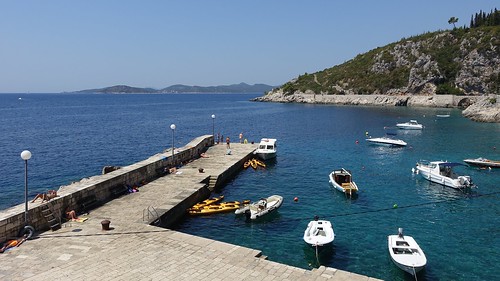
This year, Sarah and I spent two weeks off the coast of Dubrovnik, on Kolo ep island. We'd never been to Croatia before, and I was a little nervous that if there wasn't much to do on the island, we wouldn't be able to get elsewhere particularly easily. I needn't have worried: We thoroughly enjoyed our stay. It might even be my favourite holiday so far. We did travel around a bit: twice to Dubrovnik's old town and once to a botanical gardens in Trsteno but there was also loads to see on the island itself. One of our favourite trips was simply to a cave on the opposite side of the island known as a "blue cave" because you looked like a Smurf on the inside. We had to jump into the sea from the boat and swim into and out of the cave before continuing on our trip. Simply puttering about on the boat, either around the island or to Trsteno was a great experience in itself. Our guide Sammi was very friendly, the weather was great and swimming around or just enjoying the sun on the back of the boat was enough for me to want to check property prices out there. On Kolo ep island is a little restaurant called Villa Ruza. We managed to eat there twice during our stay. I think it is considered to be one of the top ten restaurants in Croatia. It's one of the best places I've ever eaten in my life. In terms of price, it was about half that of restaurants in Dubrovnik itself.
Kolo ep Kolo ep bay, from Villa Ruza
Dubrovnik itself was, quite predictably, much busier than Kolo ep. It is a stunningly attractive old town. On our second visit we took a tour. There are a variety of different themed tours that you can take, including Game Of Thrones sight-seeing tours, and there were Game Of Thrones tat shops all over the place. We opted for A Story About The War. One thing we love to do when visiting foreign places is to get an idea of what life is like for people there, and this war was not all that long ago - I can remember the news coverage from the time. We were the only two people on that particular tour, so we had a fairly tailored experience. I wish I could remember our guide's name. She was the same age as us and grew up as a child in the city when it was under siege. Her personal story included details about where her family stayed; what life was like for kids growing up at the time; how people got supplies; which areas were badly affected and much more. It was a very heartfelt tour and gave us an intimate and personal portrait of what life was like for people there at a time that most tour operators tend to prefer to ignore. This was exactly what we were looking for. Sarah and I were both a little teary at the end! We tried to do things a little different on this holiday. Normally we keep ourselves to ourselves and don't socialise much with other guests. We also rarely do trips and excursions, preferring to sort things out for ourselves. This time we made an effort to be more sociable and I'm glad we did because we met some really nice people. The trips we did were great fun and on the last day I blew through most of the rest of our currency by hiring a jet ski for half an hour. Those things are FUN. Top speed on the one I was using was 57 land mph. Every muscle in my body was screaming for a few days afterwards! Often on a two-week holiday we reach a point around 10 days where we've pretty much had enough. This time around I could have stayed for twice as long. This was the first proper test of my new camera and I've uploaded a set of photographs from our holiday to a Flickr gallery.

19 September 2015

Russ Allbery: Review: Magic's Promise

Review: Magic's Promise, by Mercedes Lackey
Series: Last Herald Mage #2
Publisher: DAW
Copyright: January 1990
ISBN: 0-88677-401-2
Format: Mass market
Pages: 320
Magic's Promise is the second book of the Last Herald Mage trilogy and a sequel to Magic's Pawn. As tempting as it is to skip the first book, which isn't very good, I think you'd miss a lot of the emotional dynamics between Vanyel and his family if you didn't read it. Magic's Promise opens years after the end of Magic's Pawn. Vanyel has become the most powerful Herald-mage of the kingdom, which is lucky for the kingdom because it's beset on all sides by magical attack. Heralds are being killed, countries on the border are looking for opportunities to spring, and Vanyel is being run ragged. Ragged enough that he's worried he's going to hurt someone by mistake when surprised. It's time for a desperately-needed vacation. Unfortunately for his ability to relax, that vacation means going home to visit his parents, who have never understood him and who disapprove strongly of his sexuality. (Not that he's actually had a lover in years.) It also means being in the same household as the armsmaster who broke his wrist as a child, and his father's deeply disapproving priest. And the border near his parents' lands may be heating up as well. Magic's Promise is the book where this trilogy hits its stride. After the events of the previous book, Vanyel is ridiculously overpowered and will be for the rest of the trilogy, but the problems in this book aren't the sort that raw power can fix. (That's a balance Lackey handles well in general.) There are a few places where Vanyel can simply overpower his problems, but the heart of the plot is a mystery that requires analysis, investigation, and a bit of undercover snooping. I enjoyed the defense of the kingdom plot (more than I had remembered, in fact), but the heart of this book is Vanyel and his family coming to terms with each other. Vanyel is a lot older and more confident than he was in the first book, and his service to the kingdom forces some grudging respect. But the way that grudging respect turns into real affection over the course of this book is a delight to read. This degree of reconciliation is wish-fulfillment most of the Valdemar series is heavy on wish-fulfillment but it's the sort of wish-fulfillment that matches the way that you wish the world would work. People figure out that they've been ignorant and cruel and actually change, and Vanyel learns some important lessons about giving people room to change. I particularly liked that the growth of respect wasn't one-sided. Most of the movement comes (and has to come) from Vanyel's family, but Vanyel gains some new-found appreciation and empathy for some strengths that he'd previously been blind to. Lackey's writing is still not the best here. There's something a bit awkward about the dialogue patterns in places, one gets a bit tired of the repetitive narrative focus on Vanyel's exhaustion, and the sentence-level construction of the story is more workable than delightful. You have to be invested in the characters; the beauty of the writing itself isn't going to win you over. As with a lot of Lackey's writing, I think your enjoyment will depend greatly on whether she happens to hit your emotional buttons. But the story she tells here, of people finding the inner goodness in each other and healing over past wounds, is one that I very much enjoy reading. I think this is the third time I read this book, and it's the first of the Valdemar series in this re-read that held up to my memory. So far, it's the best of the series. Followed by Magic's Price. Rating: 8 out of 10

Russ Allbery: Review: Magic's Pawn

Review: Magic's Pawn, by Mercedes Lackey
Series: Last Herald Mage #1
Publisher: DAW
Copyright: June 1989
ISBN: 0-88677-352-0
Format: Mass market
Pages: 349
Continuing my (very slow) re-read of Mercedes Lackey's Valdemar series. I've read all these books before (this series several times, in fact), but long before I started writing reviews. Vanyel is a legendary hero by the time of Talia (the hero of the first Valdemar series, starting with Arrows of the Queen). Talia was reading stories about him at the start of her story: the mage Herald who defended Valdemar against its enemies in the distant past. This is the first book of the trilogy that tells his story, starting (as Lackey's books often do) from rather inauspicious beginnings. Vanyel is the son of a border lord, and about as poorly suited for it as possible. He's small, pretty, entirely uninterested in the hammer-and-tongs sword fighting the arms master wants to teach him, and also gay, not that he has any idea that's even something that exists and has a name. His only ally was his sister, who is now off serving in Valdemar's military. Most of his life is spent hiding, feeling utterly lost and out of place, and wishing he could be a Bard. This is a Valdemar story, so if you're familiar with the series, you know what's coming next. What might come as a surprise is that "next" is quite some time into the story. Vanyel does not get rescued from his situation by a Companion. Instead, his father decides to exile him to the capital under the care of his aunt, who he's only met once and who didn't think highly of him. He expects to be even more miserable, and shuts emotionally down in anticipation. This is one of those books that I remembered as being better than it actually was, and one of the reasons why I enjoyed it less than I expected is that far too much of this book is devoted to describing Vanyel's mental state. This usually involves various elaborate emo analogies (which can be a failing of this series in general), and it's quite hard to maintain sympathy for Vanyel. Lackey gets us to feel for him at the start of the book, when he's really in a bad situation. But once he gets to the capital, he's his own worst enemy, and it's hard to avoid the desire to shake him. I also didn't remember just how much I disliked Tylendel. I'm sure it will come as a surprise to no one that Vanyel eventually meets someone who draws him out of his shell and gives him a reason to want to live. Unfortunately, that person, despite a positive surface impression, is self-obsessed, unstable, and not above manipulating Vanyel into actions that are so obviously catastrophic that it makes one want to yell at the book. I disliked this part of the book so much that even a Companion's choosing was overshadowed. The book does get a bit better after that truly awful middle, but it never hits the emotional stride that other Valdemar books hit. Lackey does introduce the Tayledras, which will be hugely important in later books in this series (and who are some of my favorite characters), but there too I prefer their later appearances. Vanyel's inability to see a good thing when it hits him in the face, punctuated by being occasionally cruel to the people who try to help him, makes it quite hard to enjoy his slow path to becoming a better person. I remember really liking this trilogy, so I think it gets better. But I also remembered liking Vanyel's claiming, and it didn't do much for me on a re-read. I can only recommend this one as a necessary preface to the later books in the trilogy, and expect to need a high tolerance for constant woe-is-me despair. Followed by Magic's Promise. Rating: 5 out of 10

18 September 2015

Russ Allbery: Review: The Three-Body Problem

Review: The Three-Body Problem, by Cixin Liu & Ken Liu
Series: Three-Body Problem #1
Author: Liu Cixin ( )
Translator: Ken Liu
Publisher: Tor
Copyright: 2006, 2014
Printing: November 2014
ISBN: 1-4668-5344-1
Format: Kindle
Pages: 399
Liu Cixin ( ) is one of the best-known and most popular SF authors in China, but, due to the paucity of translated SF in the English-speaking world, was largely unknown to English-speaking SF readers. That made this translation by Ken Liu (no relation) highly anticipated: a window into a large world of SF by authors most of us have never read. And Ken Liu is an excellent writer in his own right (see, for instance, "The Literomancer" or "Altogether Elsewhere, Vast Herds of Reindeer"), which was a hopeful sign for a good translation. Indeed, the translation is very good. One can tell that the book comes from a different literary tradition, but primarily from unusual (to US readers, at least) emotional focal points for the characters and lots of Chinese history that the author feels little need to explain. (Ken Liu adds translator notes for the bits most likely to lose non-Chinese audiences.) I found the characters a bit odd and occasionally hard to identify with, but I didn't mind: it added to the feeling of exploring a slightly different literary tradition with different character conventions. Unfortunately, the end of the book went entirely off the rails, at least for me. The Three-Body Problem opens during the Cultural Revolution, with the murder of Ye Wenjie's father, a physics professor, and the suicide of her advisor and friend. Two years later, she's at a work camp in inner Mongolia, cutting trees, numb, keeping her head down. But a traveling journalist smuggles in a secret copy of Silent Spring and gives it to her. The book both hardens her own belief in the evil of humanity and gets her into deeper trouble when she agrees to recopy a draft of a letter to the central leadership about the environmental devastation caused by the logging. Ye Wenjie is forced to choose permanent exile to an experimental radar facility on a remote mountain in Mongolia. Ye Wenjie is vital to the slowly-developing plot of the book, but this is the last the reader sees of her for some time. Part II jumps to present time and to a different protagonist: Wang Miao, a distinguished nanotechnology researcher who is recruited by the PLA and the police into a secret war room. Distinguished scientists are killing themselves in frighteningly large numbers, including one that Wang Miao had a crush on. She left a suicide note before overdosing on sleeping pills, one that says only, cryptically, that physics doesn't exist. The government is desperate to figure out what's going on. The "radar" facility and the suicide of scientists are linked, of course, but it takes much of the book for Wang Miao and his colleagues to piece together how. Key clues come in the form of an odd puzzle virtual reality MMORPG that becomes a popular sensation. In it, players find themselves on an alien world whose suns rise and set at strange and unpredictable intervals: sometimes far too far away and horribly cold, sometimes far too close and destructively hot, and sometimes not seen for long periods of time. The players can somehow dehydrate themselves and the rest of the population to weather the worst seasons, but life is a constant struggle against apparently unpredictable elements. Despite that, players slowly find ways to build civilizations and attempt to predict the strange cycles of heat and cold. It takes the characters a long time to understand what's happening. Readers will probably be much faster, since they have out-of-band information the characters don't. At first, this game seems entirely unrelated to the suicides of the scientists or, for that matter, to Ye Wenjie, who is easy to almost forget. But they all weave together in a way that's almost compelling. I say almost because the motivations of the characters are quite tangled and interesting, but the science is... awful. Those who have read my other book reviews know that I don't insist on hard science in my SF. Usually I'm willing to roll with it, and I can read past even obvious scientific nonsense. But science is critical to the plot of this book; some very specific actions, with a detailed in-book scientific justifications, are the underpinning of the entire plot. And they make utter nonsense of physics. I've rarely had science in a novel destroy my suspension of disbelief this thoroughly. Physics isn't even alone: biology, chemistry, computing, and astronomy are all in for it as Liu reveals the causes of the book's events. I wanted to be engaged by the conflict of ethics and philosophy that drive the plot, and some of that conflict is quite interesting. But every other page would have another colossal pile of scientific nonsense that would throw me out of the book again, usually in the service of a set piece that missed grand and landed on absurdly silly. Be warned that this book also ends on a bit of a cliff-hanger, and there are two more books in the series. The second has been released in a translated edition, but with a different translator, which is disappointing (Ken Liu did an excellent job); the third isn't out yet. If you can get past the awful science, The Three-Body Problem is doing some interesting things. The characters are a bit wooden and forgettable, but the philosophical problems they encounter are ones I don't see often in western SF. This a refreshing change, and I'm interested enough that I'm still considering picking up the sequels. But the science hurts the book so badly. Followed by The Dark Forest. Rating: 6 out of 10

17 September 2015

Russ Allbery: Review: How to Make Your Dreams Come True

Review: How to Make Your Dreams Come True, by Mark Forster
Publisher: Hodder
Copyright: 2002
Printing: 2006
ISBN: 0-340-78629-9
Format: Kindle
Pages: 208
Mark Forster is my favorite time management author. His books are less comprehensive systems and more collections of tips, mental shortcuts, and ways of thinking about time management and prioritization that tend to resonate for me. I've already read and reviewed several other books by Forster, but hadn't read this one because it was thoroughly out of print (at least in the US). When it turned up for the Kindle, I decided to give it a try, if for no other reason than completionism. After reading How to Make Your Dreams Come True, I can see why it fell out of print. It's a rather odd book, and quite different from Forster's other work. The topic is still time management, if you squint at it properly, but in the form of a philosophical discussion of life goals and becoming an artist who creates one's own life. Forster structures the book as a series of dialogues between Forster in the present and his own future self and takes the mental exercise surprisingly seriously, even comparing his own coaching technique with that of his future self. The levels of meta get even deeper towards the end of the book, where Forster writes a dialogue between his future self and his even more future self. Those drift into philosophy of life, high-level (and personal) life goals, and some speculations about the reason for existence. The primary concept Forster is exploring is the difference between push, pull, and drift modes of life. He argues that a lot of time management falls into the category of push systems: you're exerting effort to push yourself along towards goals. In this book, he argues that this is a starting point but not a technique to stop on. Instead, one should try to move to pull mode, where one has a compelling and detailed vision of where one wants to be, repeatedly developing and refining it, and then lets that vision pull you through life. The advantages, in his conception, over the push form of time management is that this requires less expenditure of effort, feels more natural, and lets one be more flexible and nimble in how one achieves one's goals. It can be tricky, however, to avoid settling into the middle ground of drift mode, where one does not have a goal in mind and doesn't act towards anything in particular. I found the idea interesting and mildly useful, but Forster's presentation of it seemed too convinced of its own correctness. The exercises he proposes don't seem interesting to me; the dialogues with one's future self in particular felt very gimmicky. I admire his ability to invent some of the interactions he came up with, but I don't think it would be a useful technique for me, or as universal as he seems to think it could be. Forster talks quite a lot about reducing effort in his blog (somewhat less in his other books), and seems constantly convinced that he's found a new way to reduce the sense of effort around time management. After having tried a few of these, I suspect that new systems feel less effortful than older systems, and that it's the constant changing of systems that reduces the feeling of effort more than the details of any specific system. I can develop a lot of enthusiasm about a new system for tracking work, and enthusiasm makes everything feel like it requires less effort. Other than that central idea, and quite a lot of philosophy that didn't particularly speak to me, this book reiterates a few of Forster's ideas in a less specific framework: adopt a process and trust it, use it for long enough to give it a chance to work, keep refreshing your vision, and try to reach a flow where you're not exerting lots of effort to force yourself to do things. Good ideas, but better, and more practically, presented in Forster's other books. I'd characterize this as an odd and minor work. I like Forster's writing in general and still only read this for the sake of completeness. His other books offer more practical and actionable ideas. Unless this idea and method of presentation really speaks to you, I think you'll get more out of other books. Rating: 5 out of 10

16 September 2015

Russ Allbery: Review: The Goblin Emperor

Review: The Goblin Emperor, by Katherine Addison
Publisher: Tor
Copyright: April 2014
ISBN: 1-4299-4640-7
Format: Kindle
Pages: 446
Maia is the child of the current emperor of the Elflands, but not a favored one. He's the half-goblin son of a political marriage to a goblin princess, quickly orphaned away from the capital and kept in seclusion well out of the way of his father and court politics. And in the care of his cousin Setheris: cruel and abusive companionship. Then the airship Wisdom of Choharo crashes with no survivors, killing everyone in the line of succession. Except Maia. Maia is in no way prepared to be emperor, but the rules of succession are clear: he is now emperor. We all know from medieval history, both real and fantastic, that clear rules rarely got in the way of aggressive political maneuvering, but Maia's short-term survival is helped considerably by complex factions at play at court (of which he is almost wholly ignorant), and a certain lack of bloodthirstiness in elven politics. Rather than disposing of the unexpected heir, people instead start maneuvering to manipulate and control him. The current Lord Chancellor is the first, beginning his play in the message sent informing Maia of his father's death, and his cousin isn't far behind, but they're only the first two. Meanwhile, Maia, who had never been trained for any sort of court life, has to learn nearly everything about his new life: how to interact with servants, the rituals of court, his new duties, and all of the factions in play. One might expect that Maia would quickly be reduced to a pawn of one faction or another, but he has two secret weapons. One is that he is a legitimately nice person with a strongly developed sense of empathy. Early on, he lucks into some opportunities to show this and wins some popularity and some allies of his own, particularly among those people not used to being treated with respect. And two, he's had enough of his cousin controlling and abusing him. He's determined to make his own decisions and not take orders from someone else, and now has enough nominal power to possibly pull this off. The Goblin Emperor is a fantasy of political agency, and a story about political maneuvering, tricky decisions, navigating alliances, and learning politics. There isn't a lot of action here: most of the plot happens in conversation. The tension is high Maia's situation is precarious but it mostly involves second-guessing his decisions and actions, and hoping that his weaknesses and ignorance don't get him into too much trouble. That is an extremely tricky book to write. Addison had to walk a tightrope between letting Maia's new responsibilities come unrealistically easily, making him seem like a Chosen One with special plot powers, and having readers get too frustrated with realistically bad decisions and lose their desire to read about him. Addison walks that tightrope magnificently. I liked Maia throughout this book, and that's the strength of it. He never felt like the typical fantasy coming of age hero who is magically protected by the plot. He's just a genuine, honest person, reacting to his own past as best he can, making the best decisions he knows how to make. He makes mistakes, but Addison wisely avoids making those mistakes cringe-worthy or too obvious. Instead, they're like bad moves in a chess match: they create problems but also some opportunities, and they're realistically recoverable. And it's a delight to see Maia bring empathy and a disinterested outside perspective to the hothouse mess of court politics and come up with some very creative solutions. Obviously, the situation that allows Maia to succeed is artificial. This is a fantasy: Maia happens to be just the right person the empire needs, and that's clearly an authorial construction. It may be impossible to write a political story about a well-meaning, naive outsider that isn't a tragedy without a bit of cheating. But Addison hides the cheating well. Maia may be very lucky in the empire he inherits, but it feels coherent and believable. By the end of the book, Maia has dealt with everything from international diplomacy to the incredibly complex negotiations around further heirs to the empire. And (realistically) he doesn't stay lucky throughout the book: eventually, no matter how careful he tries to be, he angers some powerful people. I enjoyed every step along the way, and would have happily read more about Maia. In my personal ranking, this was second only to Ancillary Sword in the nominees for the 2015 Hugo, and I wouldn't disagree too strongly with someone who argued it was better. It's not a typical sort of fantasy, but it's one I enjoyed very much. Recommended. One warning: consider going to the back of the book and reading the glossary at the start. There may be some mild spoilers in there, but it also explains the title conventions in the empire, and some of those titles look very much like proper names. If, like me, you don't read this until the end of the book, you may find yourself horribly confused by several apparently similarly-named characters. Rating: 8 out of 10

15 September 2015

Russ Allbery: Review: Let's Pretend This Never Happened

Review: Let's Pretend This Never Happened, by Jenny Lawson
Publisher: Berkley
Copyright: 2012, 2013
Printing: March 2013
ISBN: 0-425-26101-8
Format: Trade paperback
Pages: 366
Let's Pretend This Never Happened, subtitled (A Mostly True Memoir), is the closest that I've ever found to the book form of a stand-up comedy routine. Lawson grew up in rural Texas with a taxidermist father, frequent contact with animals in various forms of distress, an undiagnosed anxiety disorder, and a talent for creatively freaking out about things that never occur to anyone else. But, more importantly, she has a talent for putting down on paper the random thoughts that go through her head so the rest of us can read them. Not to mention excellent comic timing and absolute mastery of the strangely relevant digression. It's always tricky to review comedy. I think tastes differ more wildly in this genre than any other. Things some people find hilarious others will find offensive or just boring. That may be particularly true of Lawson, who, similar to some of the best stand-up comics, specializes in taking off filters and saying all sorts of offensive things that people might think but not say. This kind of comedy is a knife's edge, since it can easily turn into punching down. Lawson avoids this (rather well, in my opinion) by making herself the punch line of most of the jokes. A pretty typical paragraph of the book, so that you know the sort of thing that you're in for:
The following is a series of actual events pulled form my journal that led me to believe that our home was possessed by demons and/or built over an Indian burial ground. (Also, please note that the first part of this chapter actually happens just before the previous chapter, and the last part of it happens just after it. This could be viewed as "clunky and awkward," but I prefer to think of it as "intellectually challenging and chronologically surreal. Like if Memento was a book. About dead dogs and vaginas and puppets made out of squirrel corpses." You can feel free to use that quote if you're reviewing this chapter, or if you're a student and your teacher asks you, "What was the author trying to say here?" That was it. That's what I was trying to say. That and "Use condoms if you're going to have sex, for God's sake. There are a lot of skanks out there." That's not really covered in this book, but it's still good advice.)
That has a little bit of everything this book had for me: Lawson's somewhat surreal worries, the extended digression, a rhythm that's quite compelling once you start reading it, random uncomfortable topics, and the occasional miss that I don't find funny (the last few sentences). It's all mixed together in a slightly breathless rush of narrative momentum. For more samples, Lawson's writing started as a blog and she's still actively blogging, so you can get a good advance sample by reading some of The Bloggess. Her tone there matches the book closely. What makes this book more than only comedy is that Lawson is very open about her struggles with mental illness (anxiety and depression). A lot of the humor comes from "this is the ridiculous nonsense that my brain throws out on a regular basis" and inviting you to laugh along with her, but the undertone is use of humor as a coping mechanism to deal with anxiety spirals. And alongside that coping mechanism is an open-hearted message of "you are not the only person to have completely irrational reactions to the world please laugh along with mine and feel better about yours." Due to that, the best comparison I can make to another book I've read is to Allie Brosh's Hyperbole and a Half. Brosh is more serious in places, more analytical, and a bit better at generalizing to experiences the reader can identify with. (And, of course, more graphical.) Lawson is more madcap, a bit more manic, and focused on absurd situations that don't normally happen to people. I loved this book from beginning to end, and it had me laughing out-loud in multiple places. Despite being a collection of disconnected stories, it has a rhythm and flow that kept me reading. Some books of this kind are best read in small segments with a break between, but I devoured Let's Pretend This Never Happened in large chunks (and had to be careful about reading it in public and laughing too loudly). Check first whether the sense of humor works for you, but if it does, highly recommended. Rating: 9 out of 10

13 September 2015

Russ Allbery: Review: My Real Children

Review: My Real Children, by Jo Walton
Publisher: Tor
Copyright: May 2014
ISBN: 0-7653-3265-5
Format: Hardcover
Pages: 317
Patricia, the one form of her name that she's never used, is what the staff in the nursing home call her. "VC" is the frequent annotation on her daily chart: very confused. She's old, and forgetful, and trying very hard not to be her mother, and she remembers two lives. Not only remembers but lives: the nursing home isn't the same from day to day. They keep misplacing the lift, and the staff keep changing. But the memories are the strongest. She has two lives, two sets of children, all of whom she recognizes. When someone from one life visits, the other feels like a dream, but both of them persist. Two lives that divided at the most significant decision of her life. My Real Children is one of those books that fits in the broader speculative fiction genre as alternate history, but also has many of the virtues of mimetic fiction. It's the story of one woman's life, told, except for the opening frame, chronologically from start to finish. At the start, it's simple biography, telling Patty's story from childhood, through World War II, until the moment of her fateful decision in 1949. From there the narrative splits, and she lives two lives. And the world splits as well: in one, Kennedy was assassinated by a bomb; in another, the Cuban Missile Crisis escalated into something much worse. Much is still unchanged, including the general lives of people Patty knew well in one life and not in another, but the worlds keep diverging from each other and from ours. The exact nature of the divergence is not, however, a significant part of the book. This is not the type of alternate history that is obsessed with the point of change, or even the implications for the world. Rather, this novel is about one woman, one decision, and two very different paths through life. Different friends, different challenges, different careers... different hopes and dreams, and different children. But always the same person, the same sense of practicality, the same ethics. It's beautifully told, striking just the right balance of showing important moments in detail and passing quickly, but smoothly, over some years. And, as with Among Others, Walton strikes the perfect emotional balance, leaving some reactions understated, letting the reader bring their own reactions to the book, and filling it with small bits of telling, factual detail rather than internal monologues. This is also one of the most heart-wrenching books I've ever read. My Real Children is a whole life, and not an easy one, complete with the heartaches and betrayals, the good and bad decisions, care for elderly relatives, dementia, tragedy, and even abuse. And moments of shining joy or profound satisfaction, but made all the more poignant because they're fleeting. The reader knows, in a sense, how the story ends, which casts a shadow over the rest of the book. But, even without that shadow, life can be hard, or cruel, alongside the wonder and joy. And it ends, and the ending is not neat and clean and uplifting, although one can choose how one meets it. This is the story of a life, all of it, and how choices can divide that life, and how they can cast a long shadow over how one later defines oneself. This book hurts. A lot. Enough that I want to warn you in advance I was in tears through the last third of the book. But it hurts because it's so very real and deep, not via a blow-by-blow description of daily actions, but by striding unafraid into the deep complications of choice and consequence. It's also a profoundly feminist book, in a quiet and descriptive way. It shared the Tiptree award for 2015 and fully deserved it. Both of the protagonist's lives are struggles against expectations, around gender, sexuality, and the role of women in society. Those struggles take very different forms, but they share some deep similarities. Walton shows the impact from the bottom up: the effects on specific lives, specific people, specific situations. It's brilliantly done. One can't help but think of The Female Man given the telling of parallel lives, but this is a case study, whereas Russ's novel was a battle cry. It gets under your skin instead of in your face. (Use of subtlety on this topic is easier now, forty years of occasional progress past when Russ wrote her classic.) This is a much harder book to read than Among Others. It's less forgiving, less reassuring, less willing to provide a happy ending. Lives rarely have clean, happy endings; one has to construct them, by choosing the material to build the ending on. But it's a brilliant, profound book, in that way that stories about people in all their complexity can be. Be cautious about your mood when you read this, particularly if you've had the experience of caring for a dying relative, but it's a book I will remember for a very long time. Rating: 9 out of 10

Russ Allbery: Review: The Sea Thy Mistress

Review: The Sea Thy Mistress, by Elizabeth Bear
Series: Edda of Burdens #3
Publisher: Tor
Copyright: February 2011
ISBN: 0-7653-1884-9
Format: Hardcover
Pages: 334
The Sea Thy Mistress is the third book in the Edda of Burdens series, but the second book (By the Mountain Bound) was a prequel to the first, telling the story of an earlier world and the betrayal that ended it. This one is a direct sequel to All the Windwracked Stars, a complex and idea-rich book that I read more than six years ago. A challenging property of Bear's fiction is that it's short on explanation and doesn't hold your hand. This makes it lean, sharp, and effective if you're fully invested in it and can keep the context in your head. It becomes very hard to understand if you've mostly forgotten the plot of an earlier book. (Once again, I bemoan the death of the previous book synopsis in series fiction.) The Sea Thy Mistress is all about aftermath, loss, despair, unhealed wounds, old grudges, and complicated personal histories, and it relies very heavily on the reader being invested enough in the characters to care about all of those things. I wish I'd read this entire series closer together so that I could retain more of the state. The start of this story was therefore somewhat frustrating, as I scrambled to rebuild my memory of the first book and piece together the large cast. Thankfully, most of the characters are easy to care about. Aethelred reliably brought a smile to my face, and the opening scene of him finding a baby on the sea shore is a great piece of writing. Selene is back; she was one of my favorite characters in the first book. And Bear pulls off something I didn't think she could: the Grey Wolf is also back, for the third book, and he actually won me over. I think he grew up a bit; there's at least less whining and angst, and more effective action. It probably also helped that less of the story was told from his perspective. The Sea Thy Mistress is primarily the story of Cathoair and his son, Cathmar, and their encounter with a truly nasty threat: a goddess who has way more knowledge of how their world works than they do, and is out to destroy it. This review will necessarily be sketchy on details; most of them would partly spoil All the Windwracked Stars. (I suppose I'm spoiling it a bit anyway just by listing characters who are still around.) Cathmar is... not too irritating. He's young and stupid, and the first half of the book is a bit painful as he plays into the hands of the plot with much less information than the reader has available. But I was okay with him by the end of the book. Cathoair is a more complicated matter. I suspect whether you like this book will depend mostly on whether you can find some sympathy for his personal angst and self-destructive behavior, or at least tolerate him long enough to get to the ending. Quite a lot of this book consists of people behaving stupidly and horribly while those who love them stand by helplessly, unable to figure out how to break the cycle. If that sounds frustrating, you have the right impression. I really struggled with the first two-thirds of the book and started regretting reading it. But there is a payoff: one that's uncomfortable, raw, perilous, and sad, but also beautiful and honest and effective. Muire's role in this book may be minor, but it's very memorable. Despite the difficulties of the early book, I was very glad to have read it for the payoff. I'm not sure whether to recommend this or not, but I think it's worth reading if you enjoyed All the Windwracked Stars. If you do read it, though, try to read the whole series in close proximity. You'll want to remember the details between books. I'm now somewhat tempted to go back and re-read the whole series to experience it in context. Rating: 6 out of 10

12 September 2015

Ritesh Raj Sarraf: Google Take Action - Encryption

So I got an email yesterday from Google's Jess Hemerly, talking about how they care about encryption To quote a small snippet of the email:
We use locks to keep our homes and our possessions safe offline. But how can we protect our digital things, like photos on a smartphone or email traveling across the web? The answer is encryption.
To change, it has to start from home. That means, add encryption support to Gmail. Add encryption to Google Photos. To every service you provide. So that, if tomorrow, your service is compromised, you don't public our data. What all the service providers need to realize, is that it is not the tool that needs encryption, but the data. You could claim that newer Androids are safer because encryption is enabled by default. But the data that you are backing up on your cloud, is not encrypted. It only makes sense to have an end-to-end encryption, or rather, encryption at source. Had you just stacked the interface to have write() transparently call encrypt() for any and all data, there'd be no worry about privacy. But wait, then how'd you munch.

Categories:

Keywords:

Like:

11 September 2015

Daniel Pocock: Payment for shadow work

A significant court ruling yesterday means that companies in the EU have to pay employees for time spent traveling to and from work. If something seems too good to be true, it usually is. Once you get past the headline, you find that it only applies to workers who are going to appointments outside their workplace. Some companies have been careless about scheduling such appointments, sometimes leaving an employee more than 2 hours from his home at the end of the day and this new ruling may just force them to either try a little harder to schedule appointments with consideration for the employee or pay for the extra time if excessive travel sometimes occurs. The ruling may be good news for IT workers, road congestion and the environment. With companies now becoming more efficient in managing travel time, they may well need to improve the software they use for scheduling the employee's time. With certain types of employee potentially having a shorter journey after the last appointment, this means less road congestion and less pollution. Professionals who have to fly may also be taking note: if you work in Paris but have to fly to London one day for meetings, then your working time starts when you leave your home at 05:30 and finishes at 22:00 when you get home. Shadow work comes in many forms It is good to see society taking note of the hidden cost of shadow work. What about all those other nasty and inefficient practices that take time but you don't get paid for them? Have you ever wondered why some companies send bills and statements to you by email or post, but others expect you to waste 5 minutes of your time logging in to their web site to download the bill or statement? Should people be paid for this time too and would that force these companies to stop being so lazy? Some companies have been trying to avoid doing the right thing by arguing that email is not secure, but this just doesn't add up: the original PGP MIME specs for email encryption were published through the IETF process in 1996. Barclaycard recently began offering to send credit card statements using encrypted PDF, proving that many of the excuses given by other companies are just that: excuses. For developers For people who are interested in improving the way their organization sends communications to customers, a popular choice is the Apache Camel integration framework. I've deployed Camel for customer trade notification and other purposes at several large and well known firms in financial services. It has a rich set of features for transforming messages, including a PGP data format for encryption and it is able to send messages out using a vast number of connectivity options, including many of the basic ones like SMTP, SMPP (for SMS), XMPP/Jabber and message queues.

10 September 2015

Gunnar Wolf: UNAM, more open than ever before.

Today I was refered to the publication of an "agreement" signed by my university's Rector: The Agreement that establishes the General Guidelines for the Open Access Policy of Universidad Nacional Aut noma de M xico. This is a document we have been waiting and pushing for throughout several years; I got involved in the Network of Digital Collections (Red de Acervos Digitales), RAD-UNAM back in 2011, and am honored to be its current coordinator, but this group has roots back in 2005. And, of course, by then several other people had been working on the topic without formal coordination. Not only we are happy because the agreement explicitly mentions our group as one of The Venues for Open Access publishing and dissemination in UNAM. In its seventh point, it mentions:
In the matters of Open Access, academic entities and university dependencies have the following obligations:
(...)
VII. Promote and support the creation and maintenance of institutional repositories, as well as the deposit of the digital resources produced by its academic community, which should be incorporated into Red de Acervos Digitales de la UNAM
(...)
So... We have done a good job. And there will be surely more to follow! I'm including here a copy of the agreement by itself (without the whole number of the Gaceta UNAM) because I will surely have to refer to it in the future.
AttachmentSize
Lineamientos generales para la pol tica de acceso abierto de la Universidad Nacional Aut noma de M xico89.83 KB

Dirk Eddelbuettel: Rcpp 0.12.1: First boat load of fixes!

The first updated in the 0.12.* series of Rcpp is now on the CRAN network for GNU R this morning, and I will push a Debian package. This follows the 0.12.0 release from late July which started to some serious new features. Rcpp has become the most popular way of enhancing GNU R with C++ code. As of today, 461 packages on CRAN depend on Rcpp for making analyses go faster and further. This release once again features contributions from a number of new contributors, with Florian Plaza O ate and Dan Dillon joining the fray with several pull requests each. Kurt Hornik also helped with a fix for a bad interaction between very recent R (3.2.2) changes and Rcpp; another related one was also addressed. A big Thanks! to everybody helping with code, bug reports or documentation, See below for a detailed list of changes extracted from the NEWS file.
Changes in Rcpp version 0.12.1 (2015-09-10)
  • Changes in Rcpp API:
    • Correct use of WIN32 instead of _WIN32 to please Windows 10
    • Add an assignment operator to DimNameProxy (PR #339 by Florian)
    • Add vector and matrix accessors .at() with bounds checking (PR #342 by Florian)
    • Correct character vector conversion from single char (PR #344 by Florian fixing issue #343)
    • Correct on use of R_xlen_t back to size_t (PR #348 by Romain)
    • Correct subsetting code to allow for single assignment (PR #349 by Florian)
    • Enable subset assignment on left and righ-hand side (PR #353 by Qiang, fixing issue #345)
    • Refreshed to included tinyformat template library (PR #357 by Dirk, issue #356)
    • Add operator<<() for vectors and matrices (PR #361 by Dan fixing issue #239)
    • Make String and String_Proxy objects comparable (PR #366 and PR #372 by Dan, fixing issue #191)
    • Add a new class Nullable for objects which may be NULL (PR #368 by Dirk and Dan, fixing issue #363)
    • Correct creation and access of large matrices (PR #370 by Florian, fixing issue #369)
  • Changes in Rcpp Attributes:
    • Correctly reset directory in case of no-rebuilding but Windows code (PR #335 by Dirk)
  • Changes in Rcpp Modules:
    • We no longer define multiple Modules objects named World in the unit tests with was seen to have a bad effect with R 3.2.2 or later (PR #351 by Dirk fixing issue #350).
    • Applied patch by Kurt Hornik which improves how Rcpp loads Modules (PR #353 by Dirk)
  • Changes in Rcpp Documentation:
    • The Rcpp.bib file with bibliographic references was updated.
Thanks to CRANberries, you can also look at a diff to the previous release As always, even fuller details are on the Rcpp Changelog page and the Rcpp page which also leads to the downloads page, the browseable doxygen docs and zip files of doxygen output for the standard formats. A local directory has source and documentation too. Questions, comments etc should go to the rcpp-devel mailing list off the R-Forge page.

This post by Dirk Eddelbuettel originated on his Thinking inside the box blog. Please report excessive re-aggregation in third-party for-profit settings.

Norbert Preining: Getting CafeOBJ via MacPorts

I have finally finished the Portfile for CafeOBJ, which allows users to install CafeOBJ via the usual port command of MacPorts. For one needs to add our local source (which only ships CafeOBJ port), but I hope to get the port into the standard distribution soon. cafeobj-logo Necessary steps:

  • Add the following line to your MacPorts sources.conf, which usually resides in /opt/local/etc/macports/sources.conf:
    http://cafeobj.org/macport/ports.tar.gz
  • After that, call the following two commands (as root or with sudo), the first syncronizing the ports, the second one installing CafeOBJ:
    port sync
    port install cafeobj
This should give you a working installation of CafeOBJ 1.5.3. The port will be updated as soon as 1.5.4 is released (which should be rather soon). Enjoy, and please leave comments and suggestions how to improve the port file here, per email, or at our bug tracker.

Antoine Beaupr : Switched to bootstrap theme

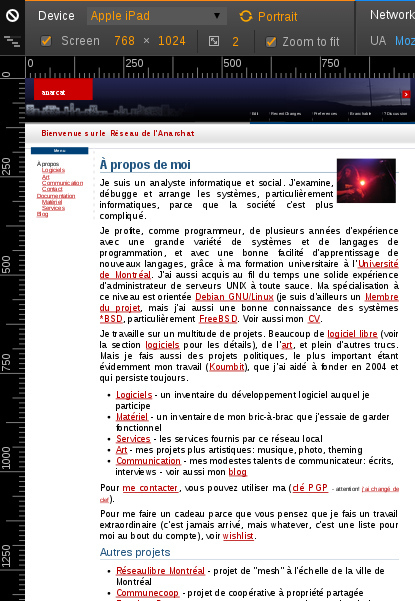
I finally gave up and drank the cool-aid of the Bootstrap theme. The main reason was that I noticed the site was basically unusable on any mobile device, including tablet computers like the iPad, which are unfortunately very, very common. Phones wouldn't render the site in a legible way either, unfortunately. The change is rather drastic, so I figured it was important to mention it here. I am not so satisfied pretty exctied with the result: the theme is very basic, if not absent. I actually like that purified form now, and it works across devices now much better. But I do feel I just made my blog look like everyone else that uses Bootstrap. We seem to enter an era where non-graphic designers (like me) are back to building web pages that all look the same, not very different, in a way, from the old days of plain HTML, like the default ikiwiki theme. I did some work to change the look at least minimally, but the top black navbar is really a killer giveaway this is a bootstrap theme. Bootstrap does a lot for the typography, at least when checking the presslabs checklist or the practical typography checklist, but I still had to change the main body width, which helped a lot I think. Anyways, the old Night City theme is still available for download and I could still flip it back on here if I need to.

What changed The new theme keeps the distractions away, but ironically, it's slower than the previous theme even though there are no images and basically no colors at all. On my tests, it now loads in about 3.42 seconds on the "Regular 2G (250Kbps)" simulation of Chromium with 72KB in 12 requests. Whereas my tests with the previous theme were taking 3.25 seconds with 43.5KB in 17 requests. This is due to the Bootstrap CSS, which takes a whopping 19KB itself, but especially because I now load JQuery, which takes a whopping 32.8KB! And that is probably gzip-compressed, as the original is more around 90KB. But at least the thing is readable on phones and tablets now. Compare:

Samsung S3, before Screenshot of a fake rendering on the Samsung Galaxy S3 in night city

Samsung S3, after Screenshot of a fake rendering on the Samsung Galaxy S3 in bootstrap I like this: much simpler, purer version on smaller devices. And we see what counts: the freaking text. Of course, on tablets, it doesn't fare as well: the top menu gets wrapped around...

Apple iPad, before Screenshot of a fake rendering on the iPad in night city

Apple iPad, after Screenshot of a fake rendering on the iPad in bootstrap Apparently, the fix would be for me to "customize the @grid-float-breakpoint variable" in LESS (which I thought was a pager, but seems to be a CSS preprocessor, graaah). Still, I think it's better that way, more readable, and less crufty.

How it was done After doing a thorough evaluation of all the Bootstrap ikiwiki themes I could find (there are more than 4 at least!), I figured I prefered the Jak Linux one. It seemed to be better implemented than the others, cleaner, and I liked the mean black border on top. Black is cool. Oh, and I liked the subtle footer as well. Subtle is cool. Unfortunately, that theme originally required a custom plugin to have a menu on top, which i thought was silly. So I patched it to make it work with the sidebar plugin, which turned out to be trivially simple: just dump the sidebar content, and make the sidebar page have explicit HTML tags in it that match Bootstrap's required classes. I also added the regular action links in the top navbar, but that does overload it quite a bit. I also did some code cleanups and various other small changes, all of which are available in my personnal git repo.

What doesn't work So of course, there are always problems. The first problem is the extra bandwidth usage. Not sure that can be fixed, other than switching to the upcoming Bootstrap 4, which is smaller than Bootstrap 3, bizarrely. The more annoying problems are weird alignment issues. If the screen gets two narrow without kicking some collapse rules in place (the iPad bug above), the navbar rows overflow and look ugly. Even more bizarre, in some cases the right navbar can just completely disappear, in fact, that's the only fix I could find: to assign the hidden-xs and hidden-sm classes to the navbar-right <UL> element. But then it just goes away, which is pretty darn stupid. Still - I assigned the classes to a few actions that seemed low priority, both in the theme and in the sidebar page. Similarly, the search form at the bottom of the page doesn't seem to want to fit in the footer properly. No idea why and I can't bother to figure that one out. I ended up merging this with the backlinks, tags and trails navigation items. Oh, and amazingly enough: comments are simply not rendered at all right now. Oops. I seemed to have picked the single bootstrap Ikiwiki theme that does *not* have comments rendering... Aaaargh. For now I just copy-pasted stuff from the [ramseydsilva][] theme and it looks pretty ugly, but at least it works. I ended up theming comments the same way i did for Night City, which looks pretty good, but is not in sync with the LESS stuff in Bootstrap. I also add to add back trails, backlinks and favicon... looks like the Jak theme wasn't made for a blog after all... but that's now fixed! :) Another improvement would be to change the font from the canonical Helvetica to something prettier, like suggested in Practical Typography, in the font recommendations section, or the presslabs checklist. So far I have settled on Mozilla's Fira font (which means, yes, one set of objects is actually loading from the CDN, sorry). Feedback welcome.

8 September 2015

Russ Allbery: Review: Dark Currents

Review: Dark Currents, by Jacqueline Carey
Series: Agent of Hel #1
Publisher: Roc
Copyright: 2012
Printing: October 2013
ISBN: 0-451-41483-7
Format: Mass market
Pages: 399
This is another much-belated review. Hopefully I can remember the book well enough to do it justice. Daisy Johanssen has normal urban fantasy problems: her father was an incubus who (somewhat unsurprisingly) didn't stick around, she has to keep careful control of her own demonic side, her father occasionally tries to tempt her to invoke demonic power, and it's possible that she could breach the walls protecting the world from demons and bring about Armageddon. The typical sort of thing. Also, there's an unexplained murder in her home town, a mid-western US resort town whose image does not go well with eldritch murders. Daisy's only official role with the town police department is as a part-time file clerk, but this is urban fantasy, so you know the protagonist is going to be hip-deep in some sort of crime investigation. In this case, that's because the Norse goddess Hel (as distinct from the origin of Daisy's father entirely different thing) also lives here, in a manner of speaking, and Daisy is her liaison. In this case, Hel decides she's the one who should dispense justice. Carey previously has primarily been an epic fantasy writer, and this is her first foray into urban fantasy. (Well, arguably Santa Olivia and its sequel count, but those felt closer to superhero fiction to me.) The language and tone of her epic fantasy is far different than the conventions of either urban fantasy or superhero fiction, and I thought Santa Olivia was somewhat awkward in places. (None of the profanity quite worked, for instance.) Dark Currents felt smoother and more comfortable, aided by a charming mid-western feel. A few of Daisy's first-person narrative quirks wore poorly, such as every reference to "the Seven Deadlies," but Carey did a solid job with a typical out-of-her-depth urban fantasy protagonist. I'm pretty tired of the standard mythology of urban fantasy, and that is a bit of a drawback here: vampires and werewolves both feature, and I think I could happily go ten years before reading another story about vampires or hunky werewolves. Carey adds her own take on ghouls, but it's still pretty similar to lots (and lots) of other series. Thankfully, there's a bit of Norse mythology, a bit of fairy, and one extremely memorable lamia (of the serpent-tail-below-the-waist variety, at least some of the time). Lurine, a reclusive, retired starlet, a friend of Daisy's mother, and Daisy's childhood babysitter, is the lamia in question. She absolutely steals the show. The dynamic between her and Daisy is perfect: Carey resists the urge to ruin it with dark hints or falling-outs to increase tension. Instead, she lets it be a bit quirky, a bit complicated, but full of the reliability of a deep friendship. And Lurine is a wonderful character, the kind that only works as a supporting character because she's best seen through other people's eyes. Daisy's mother just makes the dynamic better. The reader can believe she's the sort of person who would have an ill-advised fling with an incubus, but also the sort of person who could raise a daughter like Daisy without many resources other than sheer grit. She never loses her optimistic outlook on the world, but has enough backbone behind it to make Lurine's friendship with her entirely believable. The plot here is nothing particularly special. Daisy unravels various clues, gets deeper into complicated relationships between various factions, occasionally finds herself in serious trouble, and relies on the help of friends and allies. I would have enjoyed the book more with a lot less Cody and more of the less typical mythology. But the relationships between the female characters, and the sheer persistence of mid-western normality and ordinary life challenges in the face of so much supernatural meddling, help this book stand out from the crowd. Dark Currents is different from most of what Carey has written, and you may be a bit disappointed if you were hoping for the epic sweep of the Kushiel series. But I found myself charmed by it, and will be reading the next book of the series. Followed by Autumn Bones. Rating: 7 out of 10

7 September 2015

Ben Armstrong: Hike at Blomidon Park: Late Summer, 2015

I had the wonderful privilege to go camping and hiking with my kids scouting group, the Pathfinders of Tantallon SDA church. The day started with a quick trip to Pugwash with one of the leaders to bring back some chairs to their school, and then we headed back out to Blomidon to meet up with the group. Click the photo below to start the slideshow.
The road trip started early to fetch some chairsThe road trip started early to fetch some chairs click to start
The smudgy truck windows make an interesting filter Still an hour or more away from our first stop More funky filtering, this time with trees participating Wentworth valley taken over the cluttered dash We disturbed a great blue heron s breakfast at Wallace The beach at Pugwash SDA Camp where we loaded the chairs Trucking along past Truro After dropping off chairs, finally approaching Blomidon Getting very close to Blomidon Some bikers out to enjoy the views Interesting white berries Interesting red berries My first up close look at the point with my hiking buddy, Dave, on the first day An experimental panorama. Not sure I have the knack for keeping the horizon straight. We must bring the group out here tomorrow! Fast ringneck snake! Hard to get a clear shot Pre-dawn over the campground The first blush of coming dawn The Moon and Venus just before dawn Evergreens surrounding our camp site, pre-dawn Seems I m still the only one up Half of the tents on the spacious group site Half of the tents on the spacious group site My daughter, the artist My two youngest and their best friend Some relaxing down time after breakfast Not sure who said what, but apparently they were hilarious. :) The smoke was a bit much for my eldest Geoff entertaining the troops Dave making breakfast Dave making breakfast Breakfast just wrapping up Relaxing while we finish breakfast Looks like that needs some tweaking A bit too smoky The whole group The whole group Just goofing around Who s winning? Enjoying the last embers of the breakfast fire before heading to Jodrey Trail I admire this young lady s great eye for photography She has some sweet gear A lot of old hardwoods out here Dave did this hike with me yesterday Excellent hiking buddy! Words can t describe how much more stunning these views are in person All the cameras came out Got to get that perfect shot! A tree clinging to the eroding ground above the sheer cliff A lookoff on Jodrey Trail A lookoff on Jodrey Trail Lining up her shot /a> A lookoff on Jodrey Trail A lookoff on Jodrey Trail A lookoff on Jodrey Trail A fern with sharply serrated sturdy leaves I m not familiar with Breaking camp at group site 404 One final chance to enjoy the view from the park entrance before heading home
facebooktwittergoogle_plusredditpinterestlinkedinmail

Thorsten Alteholz: My Debian Activities in August 2015

FTP assistant Another month passed and another statistic arrives: This month I marked 408 packages for accept and rejected only 32 of them. Almost like last month I had to send 14 emails to maintainers. Squeeze LTS This was my fourteenth month that I did some work for the Squeeze LTS initiative, started by Raphael Hertzog at Freexian. As anybody else visited Debconf15, I got assigned a workload of 17h this month. I spent some time to prepare an upload of php5, which I did to people.d.o to let others do some tests with the package. I also uploaded some DLAs
  • [DLA 290-1] xmltooling security update Thorsten Alteholz
  • [DLA 290-2] opensaml2 security update Thorsten Alteholz
  • [DLA 292-1] libstruts1.2-java security update Thorsten Alteholz
  • [DLA 296-1] extplorer security update Thorsten Alteholz
  • [DLA 297-1] wesnoth-1.8 security update Thorsten Alteholz
  • [DLA 298-1] roundup security update Thorsten Alteholz
The patch for [DLA 290-1] was prepared by Ferenc Wagner. As opensaml2 needed a rebuild with the new version of xmltooling, that upload got [DLA-290-2] instead of an own DLA-number. This month I also had another term of doing frontdesk work. So I answered questions on the IRC channel and looked for CVEs that are important for Squeeze LTS or could be ignored. Other stuff As $WORK needed some time this month, my other activities had been almost nil. But expect more to come in September :-) .

Steve Kemp: The Jessie 8.2 point-release broke for me

I have about 18 personal hosts, all running the Jessie release of Debian GNU/Linux. To keep up with security updates I use unattended-upgrades. The intention is that every day, via cron, the system will look for updates and apply them. Although I mostly expect it to handle security updates I also have it configured such that point-releases will be applied by magic too. Unfortunately this weekend, with the 8.2 release, things broke in a significant way - The cron deamon was left in a broken state, such that all cronjobs failed to execute. I was amazed that nobody had reported a bug, as several people on twitter had the same experience as me, but today I read through a lot of bug-reports and discovered that #783683 is to blame:

  • Old-cron runs.
  • Scheduled unattended-upgrades runs.
  • This causes cron to restart.
  • When cron restarts the jobs it was running are killed.
  • The system is in a broken state.
The solution:
# dpkg --configure -a
# apt-get upgrade
I guess the good news is I spotted it promptly, with the benefit of hindsight the bug report does warn of this as being a concern, but I guess there wasn't a great solution. Anyway I hope others see this, or otherwise spot the problem themselves. In unrelated news the seaweedfs file-store I previously introduced is looking more and more attractive to me. I reported a documentation-related bug which was promptly handled, even though it turned out I was wrong, and I contributed CIDR support to whitelisting hosts which was merged in well. I've got a two-node "cluster" setup at the moment, and will be expanding that shortly. I've been doing a lot of little toy-projects in Go recently. This weekend I was mostly playing with the nats.io message-bus, and tying it together with sinatra.

4 September 2015

Norbert Preining: How to rename a local OfflineIMAP managed folder

Since quite some time I am using OfflineIMAP to keep my mailbox status from various servers locally available on my machine. I did more or less follow the excellent guide A unix style mail setup, but didn t use folder name translation right from the beginning. So I got stuck with four folders named INBOX: acc1/INBOX, acc2/INBOX, etc. This wouldn t be a big problem, but when using Mutt with the folder sidebar patch (as available in the mutt-patched package in Debian), there is the problem that only the INBOX part is shown. offlineimap So I decided to rename all the local folders to the scheme described in the above guide. At the end I want to have a folder layout as follows:
  Maildir/acc1/acc1
  Maildir/acc1/acc1.folder1
  Maildir/acc1/acc1.folder2
where the acc1 related to the INBOX on the remote account acc1, and the others are folders on the remote end. Unfortunately, renaming is not supported in offlineimap, it would simply download everything again at best! So I checked what needs to be done, and it turned out it is not as complicated as I thought. The necessary steps are:
  • rename the actual maildir folders
  • rename the status files in ~/.offlineimap/Account-acc1/LocalStatus/
  • rename the status files in ~/.offlineimap/Repository-acc1local/FolderValidity/
  • add the correct nametrans functions to your configuration file
  • do a dry-run test
To make this more specific, let us assume I want to reorganize the account acc1 in this way, and there are two folders synced. That is, before we start the Maildir folder contains:
Maildir/acc1/INBOX
Maildir/acc1/folder1
Maildir/acc1/folder2
and we want to achieve that the layout is
Maildir/acc1/acc1
Maildir/acc1/acc1.folder1
Maildir/acc1/acc1.folder2
Due to the fact that both the LocalStatus files and the FolderValidity files are naned in the same way as the folders, the following trivial script does all the necessary renaming for this simple case:
for d in ~/Maildir/acc1 ~/.offlineimap/Account-acc1/LocalStatus ~/.offlineimap/Repository-acc1local/FolderValidity ; do
  mv $d/INBOX $d/acc1
  mv $d/folder1 $d/acc1.folder1
  mv $d/folder2 $d/acc1.folder2
done
Finally, the correct renaming has to be done by adding nametrans rules to the helper script. The functions oimaptransfolder_acc1 and localtransfolder_acc1 as defined in the above tutorial can be used as is, and need only be added to the respective Repository sections in the configuration file. After having done the necessary renaming, what remains is to give it a good test. Best way to do it is with
offlineimap --dry-run -o -a acc1
which runs the syncronization in dry-run mode, so nothing is actually copied, and only once and only for acc1. If during this test run nothing strange appears, like many many emails are deleted on either end, then you are fine. Enjoy.

Next.

Previous.