Search Results: "bab"

8 October 2016

Norbert Preining: Debian/TeX update October 2016: all of TeX Live and Biber 2.6

Finally a new update of many TeX related packages: all the texlive-* including the binary packages, and biber have been updated to the latest release. This upload was delayed by my travels around the world, as well as the necessity to package a new Perl module (libdatetime-calendar-julian-perl) as required by new Biber. Also, my new job leaves me only the weekends for packaging. Anyway, the packages are now uploaded and should appear soon on your friendly local server. texlive2016-debian There are several highlights: The binaries have been patched with several upstream fixes (tex4ht and XeTeX compatibility, as well as various Japanese TeX engine fixes), updated biber and biblatex, and as usual loads of new and updated packages. Last but not least I want to thank one particular author: His package was removed from TeX Live due to the addition of a rather unusual clause in the license. Instead of simply uploading new packages to Debian with the rather important removed, I contacted the author and asked for clarification. And to my great pleasure he immediately answered with an update of the package with fixed license. All of us user of these many packages should be grateful to the authors of the packages who invest loads of their free time into supporting our community. Thanks! Enough now, here as usual the list of new and updated packages with links to their respective CTAN pages. Enjoy. New packages addfont, apalike-german, autoaligne, baekmuk, beamerswitch, beamertheme-cuerna, beuron, biblatex-claves, biolett-bst, cooking-units, cstypo, emf, eulerpx, filecontentsdef, frederika2016, grant, latexgit, listofitems, overlays, phonenumbers, pst-arrow, quicktype, revquantum, richtext, semantic-markup, spalign, texproposal, tikz-page, unfonts-core, unfonts-extra, uspace. Updated packages achemso, acmart, acro, adobemapping, alegreya, allrunes, animate, arabluatex, archaeologie, asymptote, attachfile, babel-greek, bangorcsthesis, beebe, biblatex, biblatex-anonymous, biblatex-apa, biblatex-bookinother, biblatex-chem, biblatex-fiwi, biblatex-gost, biblatex-ieee, biblatex-manuscripts-philology, biblatex-morenames, biblatex-nature, biblatex-opcit-booktitle, biblatex-phys, biblatex-realauthor, biblatex-science, biblatex-true-citepages-omit, bibleref, bidi, chemformula, circuitikz, cochineal, colorspace, comment, covington, cquthesis, ctex, drawmatrix, ejpecp, erewhon, etoc, exsheets, fancyhdr, fei, fithesis, footnotehyper, fvextra, geschichtsfrkl, gnuplottex, gost, gregoriotex, hausarbeit-jura, ijsra, ipaex, jfontmaps, jsclasses, jslectureplanner, latexdiff, leadsheets, libertinust1math, luatexja, markdown, mcf2graph, minutes, multirow, mynsfc, nameauth, newpx, newtxsf, notespages, optidef, pas-cours, platex, prftree, pst-bezier, pst-circ, pst-eucl, pst-optic, pstricks, pstricks-add, refenums, reledmac, rsc, shdoc, siunitx, stackengine, tabstackengine, tagpair, tetex, texlive-es, texlive-scripts, ticket, translation-biblatex-de, tudscr, turabian-formatting, updmap-map, uplatex, xebaposter, xecjk, xepersian, xpinyin. Enjoy.

5 October 2016

Russ Allbery: Review: Uprooted

Review: Uprooted, by Naomi Novik
Publisher: Del Rey
Copyright: 2015
Printing: 2016
ISBN: 0-8041-7904-2
Format: Kindle
Pages: 465
Agnieszka lives in a small peasant village on the border of the Wood. The malevolent forest is the source of dark corruption, illnesses that turn people into ravaging monsters, and lures and traps for the unwary who disappear into the Wood. Or, worse, return and appear the same, and then do horrific things, smiling all the time. This neighboring storehouse of horrors is not what occupies Agnieszka's thoughts at the start of the book, however. Instead, it's the village's protector against the Wood: the Dragon. The Dragon is not a flying lizard; he's a man, a wizard who has lived in his tower for living memory and fights back against the Wood with magic. And, once every ten years, he takes a girl from a village. They go to his tower and serve him for ten years, and then leave, generally to move to some far-away city and never return to their village. Each says afterwards that the Dragon never did anything untoward to them. No one entirely believes them. Agnieszka was born in the year that makes her one of the candidates for being taken by the Dragon. But that's not what she's worried about. She's known for certain since she was a small child that her best friend, Kasia, would be the one taken by the Dragon. Kasia was always the exceptional one: the most beautiful, the most talented, the one who stood out among all the girls in the neighboring villages. And she's about to be taken out of Agnieszka's life, to a mysterious and unknown fate. It will hopefully surprise no fantasy reader (and hence not be much of a spoiler) that awkward Agnieszka, who can't keep her dress unstained for more than five minutes and has none of the skills that Kasia has, is the one the Dragon chooses. I think a warning is important here, since I'm about to recommend this book highly. However, it is very fond of its stereotypes. Most of the other wizards are men, and they focus on books and formal understanding of magic. The one female wizard whose magic we see in some detail is a smith described as wearing male clothing. Uprooted then introduces a different type of magic that's much more intuitive, described largely through natural metaphors, and doesn't play well with formal rules... and is practiced by a woman. This is, unfortunately, persistently gendered, although the book never comes right out and calls it female magic. There are also quite a few traditional gender roles scattered through the rest of the book (although it does get a bit of a pass due to its obvious deep roots in traditional fairy tales). Uprooted is still an excellent book despite this, but it's best read when you're in the mood to tolerate this sort of story. If you go in feeling irritated about gender stereotypes, you'll probably get frustrated by the book, overwhelming its merits. Best saved for a forgiving mood (or skipped entirely if this style of story just doesn't sound fun). The beginning of Uprooted is about Agnieszka finding her feet in her bizarre arrangement with the Dragon, who turns out to be nothing like what either her or the reader expected. I think her panic and confusion drags on a little long, but Novik makes up for that by the delightful descriptions of Agnieszka's eventual understanding and the Dragon's frustrated consternation. Fantasy is full of prickly, arrogant wizards, but few have felt quite so human to me as the Dragon. Agnieszka is clearly nothing like he expected or like he's dealt with before, and his path from arrogant contempt to outrage to prickly confusion to uncomfortable respect is a delight. This is, of course, a coming-of-age story for Agnieszka, and by the end the book deals with both the origins of the Wood and some sort of resolution. But the path there wanders through an exploration of a rather interesting magic system, quite a lot of court intrigue, and Agnieszka persistently defying everyone's expectations. As with the introductory panic and confusion, I could have done with less of her awkward bumbling at court (in general, I think the book could have been a bit tighter), but once I reached the second half of the book I couldn't put it down. I've previously read a fair chunk of Novik's Temeraire series, which were fun (at least in spots), but Uprooted is definitely better. There is a fair bit of horror-tinged stuff in this book, as well as the stereotypes mentioned above, so it won't be for everyone. But I usually hate horror of any kind, and I still loved this. Agnieszka is sufficiently positive and solution-focused that the story never falls into the constant fear and panic and disgust that I particularly dislike in horror. If you're in the mood for a good fantasy coming-of-age story coupled with delightful disruption of the life of a prickly, cynical, but surprisingly ethical wizard, give this one a try. Rating: 8 out of 10

4 October 2016

Iain R. Learmonth: Decentralise (in a kind of centralised way)

Once a month I am involved in running an informal session, loosely affiliated with Open Rights Group and FSFE, called Cryptonoise. Cryptonoise explores methods for protecting your digital rights, with a leaning towards focusing on privacy, and provides a venue for like minded people to meet up and discuss the state of the digital landscape and those that may try to infringe on the rights of digital citizens. We ve all made it easy for large enterprises and governments to collect masses of data about our online activities because we perform most of those activities in the same place. Facebook, Google and Twitter spring to mind as examples of companies that have grown to dangerous sizes with little competition. This is not paranoia. This is real. We make it a lot more difficult when we spread out. Our meetups are held at 57North Hacklab and at the last meetup on the 29th September I set up a GNU Social instance for the members of 57North. GNU Social provides the same functionality as Twitter but as a decentralised federated network. Federation is a feature that is found in protocols like E-Mail, XMPP and SIP. It doesn t matter which server you re using, you can still talk to all the other users on all the other servers. While I m using social.57north.org.uk I can still follow FSF on status.fsf.org, for example, with no prior coordination with system administrators or anything complicated. It all just works. People have pointed out that I ve just introduced another point of centralisation but I don t see it necessarily as a bad thing. I think too many users in a single service starts to look dangerous but as long as user counts don t go too high I believe that the benefits of sharing the administrative workload (performing updates, monitoring, keeping the TLS cert current, etc.) far outweigh the effects of having a few extra users. I think 100 is probably about the maximum number I would be comfortable with, although I ll admit I ve not based this on anything and it s chosen arbitrarily. The jabber.ccc.de server is an example of a service that grew too large. It was set up by members of CCC and made available to all, but ended up becoming the de facto service for hackers. The jabber.ccc.de team have made appeals for others to set up their own servers, and you should. For a great overview and guide for setting up your own real-time commmunication servers, check out the RTC Quick Start Guide. This work was enabled by Shell who had previously set up a Central Authentication Service, which GNU Social already had a plugin to use as the authentication backend. No one likes to have a whole load of different passwords for different services and integration with this allows for identities to be consistent across the 57North services. She has also setup a Matrix homeserver, another step towards decentralisation and an end of reliance on centralised giants. If you have an account on a GNU Social instance, you can follow me here.

3 October 2016

Shirish Agarwal: Using JOSM and gpx tracks

This would be a longish post. I had bought a Samsung Galaxy J-5/500 just a few days before Debconf16 which I had written about a bit earlier as well. As can be seen in the specs there isn t much to explore other than A-GPS. There were a couple of temperature apps. which I wanted to explore before buying the smartphone but as there were budget constraints and there weren t any good budget smartphones with environmental sensors built-in had to let go of those features. I was looking for a free app. which would have OSM support and came across osmand . I was looking for an app. which would have support for OSM and support for the gpx format. I was planning to use osmand in South Africa but due to the over-whelming nature of meeting people, seeing places and just being didn t actually get the time and place to try it. Came back home and a month and a half passed. In-between I had done some simple small tracks but nothing major. This week-end I got the opportunity as I got some free data balance from my service provider (a princely 50 MB) as well an opportunity to go about 40 odd kms. from the city. I had read about osmand and was looking if the off-line method worked or not from the webpage Works online (fast) or offline (no roaming charges when you are abroad) So armed with a full battery I started the journey which took about an hour and half even though technically it was a holiday. On the way back, got a different route and recorded that as well. The app. worked flawlessly. I was able to get the speed of the vehicle and everything. The only thing I haven t understood till date is how to select waypoints but other than that I got the whole route on my mobile. What was cool to see that on most roads, at least through the app. there were speed limits. Now I don t know from where the data was getting there. Most city roads had 65 and some roads had 55 at the maximum. I am assuming that it was at km/hr as also shared later. Just for fun I also looked at the gpx file after copying it from mobile to hdd (an extract) https://paste.debian.net/853231/ While it s not a complete extract, What was interesting for me to note here is the time was in UTC . What was also interesting is that in the gpx tracks I also saw some entries about speed as can be seen in the paste above. Although it doesn t say whether it was in km/hr or mph, I believe it probably is km/hr. as that is the unit I defined in the app. Anyways, the next step was trying to see which tool was good enough to show me the tracks with tiles underneath and labels of places, paths etc. I tried three tools 1. jmapviewer this didn t work at all.
2. gnome-maps this worked remarkably well but has numerous gtk3.0 warnings [shirish@debian] - [~/osmand] - [10149]
[$] gnome-maps 2016-10-01_08-11_Sat.gpx
(gnome-maps:21017): Gtk-WARNING **: Theme parsing error: gtk.css:63:28: The :prelight pseudo-class is deprecated. Use :hover instead. (gnome-maps:21017): Gtk-WARNING **: Theme parsing error: gtk.css:73:35: The :prelight pseudo-class is deprecated. Use :hover instead. (gnome-maps:21017): Gtk-WARNING **: Theme parsing error: application.css:14:30: The style property GtkButton:image-spacing is deprecated and shouldn't be used anymore. It will be removed in a future version (gnome-maps:21017): Gtk-WARNING **: Theme parsing error: application.css:15:31: The style property GtkWidget:interior-focus is deprecated and shouldn't be used anymore. It will be removed in a future version (gnome-maps:21017): Gdk-WARNING **: /build/gtk+3.0-Tod2iD/gtk+3.0-3.22.0/./gdk/x11/gdkwindow-x11.c:5554 drawable is not a native X11 window (gnome-maps:21017): Gdk-WARNING **: /build/gtk+3.0-Tod2iD/gtk+3.0-3.22.0/./gdk/x11/gdkwindow-x11.c:5554 drawable is not a native X11 window (gnome-maps:21017): Gdk-WARNING **: /build/gtk+3.0-Tod2iD/gtk+3.0-3.22.0/./gdk/x11/gdkwindow-x11.c:5554 drawable is not a native X11 window (gnome-maps:21017): Gdk-WARNING **: /build/gtk+3.0-Tod2iD/gtk+3.0-3.22.0/./gdk/x11/gdkwindow-x11.c:5554 drawable is not a native X11 window (gnome-maps:21017): Gdk-WARNING **: /build/gtk+3.0-Tod2iD/gtk+3.0-3.22.0/./gdk/x11/gdkwindow-x11.c:5554 drawable is not a native X11 window (gnome-maps:21017): Gdk-WARNING **: /build/gtk+3.0-Tod2iD/gtk+3.0-3.22.0/./gdk/x11/gdkwindow-x11.c:5554 drawable is not a native X11 window (gnome-maps:21017): Gtk-WARNING **: GtkClutterOffscreen 0x4c4f3f0 is drawn without a current allocation. This should not happen. (gnome-maps:21017): Gtk-WARNING **: GtkImage 0x4ed4140 is drawn without a current allocation. This should not happen. Now I m not sure whether all of those are gtk3+ issues or me running them under Debian MATE. I know that there are issues with mate and gtk3+ as had been told/shared a few times in p.d.o. Anyways, one of the issues I encountered is that gnome-maps doesn t work in offline-mode, saw https://bugzilla.gnome.org/show_bug.cgi?id=708799 . Also saw ~/.cache/champlain/osm-mapquest and the listing underneath is gibberish in the sense you don t know what it meant to do
[shirish@debian] - [~/.cache/champlain/osm-mapquest] - [10163]
[$] ll -h
drwx------ 6 shirish shirish 4.0K Jun 11 2015 10
drwx------ 26 shirish shirish 4.0K Oct 24 2014 11
drwx------ 10 shirish shirish 4.0K Jun 11 2015 12
drwx------ 11 shirish shirish 4.0K Jun 11 2015 13
drwx------ 12 shirish shirish 4.0K Jun 11 2015 14
drwx------ 12 shirish shirish 4.0K Jun 11 2015 15
drwx------ 27 shirish shirish 4.0K Oct 24 2014 16
drwx------ 25 shirish shirish 4.0K Oct 24 2014 17
drwx------ 4 shirish shirish 4.0K Mar 4 2014 3
drwx------ 5 shirish shirish 4.0K Mar 4 2014 8
drwx------ 9 shirish shirish 4.0K Mar 29 2014 9
What was/is interesting to see things like this maybe imagery offset As I was in a moving vehicle, it isn t easy to know if the imagery is at fault or was it app. , sensor of my mobile ? Did see http://learnosm.org/en/josm/correcting-imagery-offset/ but as can be seen that requires more effort from my side. The last tool proved to be the most problematic 3. JOSM Getting the tracks into josm which was easily done. While firing up josm came across https://josm.openstreetmap.de/ticket/13735 which I subsequently filed. One of the other first things which has been a major irritant for a long time is JOSM is, for a lack of better term, ugly. See the interface, especially the one having preferences, all cluttered look and specifically see the plugins corner/tab josm-preferences-plugin tab The part about it being ugly, I dunno but have seen most java apps are a bit ugly. It is a bit generalist I know but that has been my experience with whatever little java apps. I have used. I don t know what the reasons for that are, maybe because java is known/rumoured to use lot of memory which seems true in my case as well OR it doesn t have toolkits like gtk3+ or qt quick, although have to say that the looks have improved from before when I used it last some years ago
[shirish@debian] - [~] - [10340]
[$] ps -eo size,pid,user,command awk ' hr=$1/1024 ; printf("%13.6f Mb ",hr) for ( x=4 ; x<=NF ; x++ ) printf("%s ",$x) print "" ' grep josm
0.324219 Mb /bin/sh /usr/bin/josm
419.468750 Mb /usr/lib/jvm/java-8-openjdk-amd64/bin/java -Djosm.restart=true -Djava.net.useSystemProxies=true -jar /usr/share/josm/josm.jar
This is when I m just opening josm and have not added any tracks or done any work. Now I wanted to explore the routing in good amount of detail on josm. This was easily said than done. When trying to get imagery I got the Download area too large issue/defect . Multiple tries didn t get me anywhere. Then hunting on the web came across the continous-download plugin which is part of the plugin infrastructure . This I found to be a very good tool. It downloads the tiles and puts them in ~/.josm/cache/tiles
[shirish@debian] - [~/.josm/cache/tiles] - [10147]
[$] ll -h
total 28M
-rw-r--r-- 1 shirish shirish 28M Oct 2 02:13 TMS_BLOCK_v2.data
-rw-r--r-- 1 shirish shirish 290K Oct 3 12:59 TMS_BLOCK_v2.key
-rw-r--r-- 1 shirish shirish 4 Oct 3 12:59 WMS_BLOCK_v2.key
-rw-r--r-- 1 shirish shirish 4 Oct 3 12:59 WMTS_BLOCK_v2.key
While unfortunately I cannot see this/make sense of it I m guessing it is some sort of database with key and data files. What did become apparent is that the OSM needs lots more love if it is to become something which can be used everyday. At the end I had to change the open-source gpx track file to a Google map kml file to be able to make sense as there are whole areas which need to be named, numbered etc. One of the newbie mistakes that I did was trying to use the slippy map in josm (using Openstreetmap/Mapnik at the back-end) to move/pan using the left-hand mouse button. It took me quite sometime to figure out that it is with right-hand mouse button that you can make the slippy map pan. This is different from almost all maps, gnome-maps uses the traditional left-hand button, Google maps also uses the same. I have filed it in upstream as https://josm.openstreetmap.de/ticket/13751 . So at least, in these rounds it is gnome-maps which has kind of won even though it doesn t do any of the things that josm claims to do. I am sure there might be some interesting tricks and tips that people might have to share about mapping
Filed under: Miscellenous Tagged: #Debconf16, #GNOME-MAPS, #JOSM, OSM

Russell Coker: 10 Years of Glasses

10 years ago I first blogged about getting glasses [1]. I ve just ordered my 4th pair of glasses. When you buy new glasses the first step is to scan your old glasses to use that as a base point for assessing your eyes, instead of going in cold and trying lots of different lenses they can just try small variations on your current glasses. Any good optometrist will give you a print-out of the specs of your old glasses and your new prescription after you buy glasses, they may be hesitant to do so if you don t buy because some people get a prescription at an optometrist and then buy cheap glasses online. Here are the specs of my new glasses, the ones I m wearing now that are about 4 years old, and the ones before that which are probably about 8 years old:
New 4 Years Old Really Old
R-SPH 0.00 0.00 -0.25
R-CYL -1.50 -1.50 -1.50
R-AXS 180 179 180
L-SPH 0.00 -0.25 -0.25
L-CYL -1.00 -1.00 -1.00
L-AXS 5 10 179
The Specsavers website has a good description of what this means [2]. In summary SPH is whether you are log-sighted (positive) or short-sighted (negative). CYL is for astigmatism which is where the focal lengths for horizontal and vertical aren t equal. AXS is the angle for astigmatism. There are other fields which you can read about on the Specsavers page, but they aren t relevant for me. The first thing I learned when I looked at these numbers is that until recently I was apparently slightly short-sighted. In a way this isn t a great surprise given that I spend so much time doing computer work and very little time focusing on things further away. What is a surprise is that I don t recall optometrists mentioning it to me. Apparently it s common to become more long-sighted as you get older so being slightly short-sighted when you are young is probably a good thing. Astigmatism is the reason why I wear glasses (the Wikipedia page has a very good explanation of this [3]). For the configuration of my web browser and GUI (which I believe to be default in terms of fonts for Debian/Unstable running KDE and Google-Chrome on a Thinkpad T420 with 1600 900 screen) I can read my blog posts very clearly while wearing glasses. Without glasses I can read it with my left eye but it is fuzzy and with my right eye reading it is like reading the last line of an eye test, something I can do if I concentrate a lot for test purposes but would never do by choice. If I turn my glasses 90 degrees (so that they make my vision worse not better) then my ability to read the text with my left eye is worse than my right eye without glasses, this is as expected as the 1.00 level of astigmatism in my left eye is doubled when I use the lens in my glasses as 90 degrees to it s intended angle. The AXS numbers are for the angle of astigmatism. I don t know why some of them are listed as 180 degrees or why that would be different from 0 degrees (if I turn my glasses so that one lens is rotated 180 degrees it works in exactly the same way). The numbers from 179 degrees to 5 degrees may be just a measurement error.

Russ Allbery: Review: Winds of Fury

Review: Winds of Fury, by Mercedes Lackey
Series: Mage Winds #3
Publisher: DAW
Copyright: August 1994
ISBN: 0-88677-612-0
Format: Mass market
Pages: 427
This is the concluding book of the Mage Winds trilogy and a direct sequel to Winds of Change. This series doesn't make sense to read out of order. In traditional fantasy trilogies of this type, the third book is often the best. The author can stop developing characters, building the world, and setting the scene and can get to the meat of the story. All the guns on the mantles go off, all the twists the author has been saving can be used, and there's usually a lot more action than in the second book of a trilogy. That is indeed the case here. I'm not sure Winds of Fury rises to the level of a good book, but if you're invested in the Valdemar story, it works better than the previous books of this series. As one might expect, the protagonists do return to Valdemar, finally. The method of that return makes sense of some things that happened in Winds of Change and is an entertaining surprise, although I wish more had been done with it through the rest of the book and we'd gotten more world-building details. I also like how Lackey handles the Valdemar reactions to the returning protagonists, and their own reactions to Valdemar. Lackey's characters might fit some heavy-handed stereotypes a bit too neatly, but they do grow and change over the course of a series, and the return home is a good technique for showing that. Lackey also throws in her final twist for the villains of this series at the start of this book, and it's a good one (if typical Lackey; she does love her abused youth characters). The villains are still far too one-dimensional and far too stereotyped evil, but the twist (which I'll avoid spoiling) does make that dynamic a bit more interesting. And she manages to get the reader to root for one evil over another, since one of them is at least competent. You'd think from the direction the series was taking that Winds of Fury would culminate in another epic war of magic, but not this book. Lackey takes a more personal and targeted approach, heavier on characterization and individual challenge. This gives Firesong a chance to grow into an almost-likable character and earn some of that empathy and insight that he'd gotten for free. Unfortunately, it sidelines Nyara a lot, and pushes her back into a stereotyped role, which made me sad. The series otherwise emphasizes the importance of magic users who know their own limitations and can thoughtfully use the power they have, but rarely extends that to Nyara herself. I would have much rather seen her play a role like that in the final climax instead of the one she played. This is partly made up for by centering Need in the story and having her play the key connecting role between two different threads of effort. Those are probably the best parts of this book. I wish the entire series had been told from Need's perspective, with a heavy helping of exasperated grumbling, although I don't think Lackey could have written that series. But what we get of her is a delight. The gryphons, sadly, are relegated to fairly minor roles, but we get a few more tantalizing hints about the Companions to make up for it. (Although not enough to figure out their great mystery, which isn't revealed until future books.) This series is nowhere near as good as I remembered, sadly, but I did enjoy bits of it. If you like Valdemar in general, the world building is fairly important and reveals quite a lot about the underpinnings and power dynamics of Lackey's universe. I'm not sure that makes up for some tedious characters, poor communication, and some uncomfortable and dragging sections, but if you're trying to get the whole Valdemar story, the events here are rather important. And this ending was at least entertaining, if not great fiction. Rating: 6 out of 10

2 October 2016

Russell Coker: Hostile Web Sites

I was asked whether it would be safe to open a link in a spam message with wget. So here are some thoughts about wget security and web browser security in general. Wget Overview Some spam messages are designed to attack the recipient s computer. They can exploit bugs in the MUA, applications that may be launched to process attachments (EG MS Office), or a web browser. Wget is a very simple command-line program to download web pages, it doesn t attempt to interpret or display them. As with any network facing software there is a possibility of exploitable bugs in wget. It is theoretically possible for an attacker to have a web server that detects the client and has attacks for multiple HTTP clients including wget. In practice wget is a very simple program and simplicity makes security easier. A large portion of security flaws in web browsers are related to plugins such as flash, rendering the page for display on a GUI system, and javascript features that wget lacks. The Profit Motive An attacker that aims to compromise online banking accounts probably isn t going to bother developing or buying an exploit against wget. The number of potential victims is extremely low and the potential revenue benefit from improving attacks against other web browsers is going to be a lot larger than developing an attack on the small number of people who use wget. In fact the potential revenue increase of targeting the most common Linux web browsers (Iceweasel and Chromium) might still be lower than that of targeting Mac users. However if the attacker doesn t have a profit motive then this may not apply. There are people and organisations who have deliberately attacked sysadmins to gain access to servers (here is an article by Bruce Schneier about the attack on Hacking Team [1]). It is plausible that someone who is targeting a sysadmin could discover that they use wget and then launch a targeted attack against them. But such an attack won t look like regular spam. For more information about targeted attacks Brian Krebs article about CEO scams is worth reading [2]. Privilege Separation If you run wget in a regular Xterm in the same session you use for reading email etc then if there is an exploitable bug in wget then it can be used to access all of your secret data. But it is very easy to run wget from another account. You can run ssh otheraccount@localhost and then run the wget command so that it can t attack you. Don t run su otheraccount as it is possible for a compromised program to escape from that. I think that most Linux distributions have supported a switch user functionality in the X login system for a number of years. So you should be able to lock your session and then change to a session for another user to run potentially dangerous programs. It is also possible to use a separate PC for online banking and other high value operations. A 10yo PC is more than adequate for such tasks so you could just use an old PC that has been replaced for regular use for online banking etc. You could boot it from a CD or DVD if you are particularly paranoid about attack. Browser Features Google Chrome has a feature to not run plugins unless specifically permitted. This requires a couple of extra mouse actions when watching a TV program on the Internet but prevents random web sites from using Flash and Java which are two of the most common vectors of attack. Chrome also has a feature to check a web site against a Google black list before connecting. When I was running a medium size mail server I often had to determine whether URLs being sent out by customers were legitimate or spam, if a user sent out a URL that s on Google s blacklist I would lock their account without doing any further checks. Conclusion I think that even among Linux users (who tend to be more careful about security than users of other OSs) using a separate PC and booting from a CD/DVD will generally be regarded as too much effort. Running a full featured web browser like Google Chrome and updating it whenever a new version is released will avoid most problems. Using wget when you have to reason to be concerned is a possibility, but not only is it slightly inconvenient but it also often won t download the content that you want (EG in the case of HTML frames).

1 October 2016

Kees Cook: security things in Linux v4.6

Previously: v4.5. The v4.6 Linux kernel release included a bunch of stuff, with much more of it under the KSPP umbrella. seccomp support for parisc Helge Deller added seccomp support for parisc, which including plumbing support for PTRACE_GETREGSET to get the self-tests working. x86 32-bit mmap ASLR vs unlimited stack fixed Hector Marco-Gisbert removed a long-standing limitation to mmap ASLR on 32-bit x86, where setting an unlimited stack (e.g. ulimit -s unlimited ) would turn off mmap ASLR (which provided a way to bypass ASLR when executing setuid processes). Given that ASLR entropy can now be controlled directly (see the v4.5 post), and that the cases where this created an actual problem are very rare, means that if a system sees collisions between unlimited stack and mmap ASLR, they can just adjust the 32-bit ASLR entropy instead. x86 execute-only memory Dave Hansen added Protection Key support for future x86 CPUs and, as part of this, implemented support for execute only memory in user-space. On pkeys-supporting CPUs, using mmap(..., PROT_EXEC) (i.e. without PROT_READ) will mean that the memory can be executed but cannot be read (or written). This provides some mitigation against automated ROP gadget finding where an executable is read out of memory to find places that can be used to build a malicious execution path. Using this will require changing some linker behavior (to avoid putting data in executable areas), but seems to otherwise Just Work. I m looking forward to either emulated QEmu support or access to one of these fancy CPUs. CONFIG_DEBUG_RODATA enabled by default on arm and arm64, and mandatory on x86 Ard Biesheuvel (arm64) and I (arm) made the poorly-named CONFIG_DEBUG_RODATA enabled by default. This feature controls whether the kernel enforces proper memory protections on its own memory regions (code memory is executable and read-only, read-only data is actually read-only and non-executable, and writable data is non-executable). This protection is a fundamental security primitive for kernel self-protection, so making it on-by-default is required to start any kind of attack surface reduction within the kernel. On x86 CONFIG_DEBUG_RODATA was already enabled by default, but, at Ingo Molnar s suggestion, I made it mandatory: CONFIG_DEBUG_RODATA cannot be turned off on x86. I expect we ll get there with arm and arm64 too, but the protection is still somewhat new on these architectures, so it s reasonable to continue to leave an out for developers that find themselves tripping over it. arm64 KASLR text base offset Ard Biesheuvel reworked a ton of arm64 infrastructure to support kernel relocation and, building on that, Kernel Address Space Layout Randomization of the kernel text base offset (and module base offset). As with x86 text base KASLR, this is a probabilistic defense that raises the bar for kernel attacks where finding the KASLR offset must be added to the chain of exploits used for a successful attack. One big difference from x86 is that the entropy for the KASLR must come either from Device Tree (in the /chosen/kaslr-seed property) or from UEFI (via EFI_RNG_PROTOCOL), so if you re building arm64 devices, make sure you have a strong source of early-boot entropy that you can expose through your boot-firmware or boot-loader. zero-poison after free Laura Abbott reworked a bunch of the kernel memory management debugging code to add zeroing of freed memory, similar to PaX/Grsecurity s PAX_MEMORY_SANITIZE feature. This feature means that memory is cleared at free, wiping any sensitive data so it doesn t have an opportunity to leak in various ways (e.g. accidentally uninitialized structures or padding), and that certain types of use-after-free flaws cannot be exploited since the memory has been wiped. To take things even a step further, the poisoning can be verified at allocation time to make sure that nothing wrote to it between free and allocation (called sanity checking ), which can catch another small subset of flaws. To understand the pieces of this, it s worth describing that the kernel s higher level allocator, the page allocator (e.g. __get_free_pages()) is used by the finer-grained slab allocator (e.g. kmem_cache_alloc(), kmalloc()). Poisoning is handled separately in both allocators. The zero-poisoning happens at the page allocator level. Since the slab allocators tend to do their own allocation/freeing, their poisoning happens separately (since on slab free nothing has been freed up to the page allocator). Only limited performance tuning has been done, so the penalty is rather high at the moment, at about 9% when doing a kernel build workload. Future work will include some exclusion of frequently-freed caches (similar to PAX_MEMORY_SANITIZE), and making the options entirely CONFIG controlled (right now both CONFIGs are needed to build in the code, and a kernel command line is needed to activate it). Performing the sanity checking (mentioned above) adds another roughly 3% penalty. In the general case (and once the performance of the poisoning is improved), the security value of the sanity checking isn t worth the performance trade-off. Tests for the features can be found in lkdtm as READ_AFTER_FREE and READ_BUDDY_AFTER_FREE. If you re feeling especially paranoid and have enabled sanity-checking, WRITE_AFTER_FREE and WRITE_BUDDY_AFTER_FREE can test these as well. To perform zero-poisoning of page allocations and (currently non-zero) poisoning of slab allocations, build with:
CONFIG_DEBUG_PAGEALLOC=n
CONFIG_PAGE_POISONING=y
CONFIG_PAGE_POISONING_NO_SANITY=y
CONFIG_PAGE_POISONING_ZERO=y
CONFIG_SLUB_DEBUG=y
and enable the page allocator poisoning and slab allocator poisoning at boot with this on the kernel command line:
page_poison=on slub_debug=P
To add sanity-checking, change PAGE_POISONING_NO_SANITY=n, and add F to slub_debug as slub_debug=PF . read-only after init I added the infrastructure to support making certain kernel memory read-only after kernel initialization (inspired by a small part of PaX/Grsecurity s KERNEXEC functionality). The goal is to continue to reduce the attack surface within the kernel by making even more of the memory, especially function pointer tables, read-only (which depends on CONFIG_DEBUG_RODATA above). Function pointer tables (and similar structures) are frequently targeted by attackers when redirecting execution. While many are already declared const in the kernel source code, making them read-only (and therefore unavailable to attackers) for their entire lifetime, there is a class of variables that get initialized during kernel (and module) start-up (i.e. written to during functions that are marked __init ) and then never (intentionally) written to again. Some examples are things like the VDSO, vector tables, arch-specific callbacks, etc. As it turns out, most architectures with kernel memory protection already delay making their data read-only until after __init (see mark_rodata_ro()), so it s trivial to declare a new data section ( .data..ro_after_init ) and add it to the existing read-only data section ( .rodata ). Kernel structures can be annotated with the new section (via the __ro_after_init macro), and they ll become read-only once boot has finished. The next step for attack surface reduction infrastructure will be to create a kernel memory region that is passively read-only, but can be made temporarily writable (by a single un-preemptable CPU), for storing sensitive structures that are written to only very rarely. Once this is done, much more of the kernel s attack surface can be made read-only for the majority of its lifetime. As people identify places where __ro_after_init can be used, we can grow the protection. A good place to start is to look through the PaX/Grsecurity patch to find uses of __read_only on variables that are only written to during __init functions. The rest are places that will need the temporarily-writable infrastructure (PaX/Grsecurity uses pax_open_kernel()/pax_close_kernel() for these). That s it for v4.6, next up will be v4.7!

2016, Kees Cook. This work is licensed under a Creative Commons Attribution-ShareAlike 3.0 License.
Creative Commons License

30 September 2016

Chris Lamb: Free software activities in September 2016

Here is my monthly update covering what I have been doing in the free software world (previous month):
Reproducible builds

Whilst anyone can inspect the source code of free software for malicious flaws, most Linux distributions provide binary (or "compiled") packages to end users. The motivation behind the Reproducible Builds effort is to allow verification that no flaws have been introduced either maliciously and accidentally during this compilation process by promising identical binary packages are always generated from a given source. My work in the Reproducible Builds project was also covered in our weekly reports #71, #72, #71 & #74. I made the following improvements to our tools:

diffoscope

diffoscope is our "diff on steroids" that will not only recursively unpack archives but will transform binary formats into human-readable forms in order to compare them.

  • Added a global Progress object to track the status of the comparison process allowing for graphical and machine-readable status indicators. I also blogged about this feature in more detail.
  • Moved the global Config object to a more Pythonic "singleton" pattern and ensured that constraints are checked on every change.

disorderfs

disorderfs is our FUSE filesystem that deliberately introduces nondeterminism into the results of system calls such as readdir(3).

  • Display the "disordered" behaviour we intend to show on startup. (#837689)
  • Support relative paths in command-line parameters (previously only absolute paths were permitted).

strip-nondeterminism

strip-nondeterminism is our tool to remove specific information from a completed build.

  • Fix an issue where temporary files were being left on the filesystem and add a test to avoid similar issues in future. (#836670)
  • Print an error if the file to normalise does not exist. (#800159)
  • Testsuite improvements:
    • Set the timezone in tests to avoid a FTBFS and add a File::StripNondeterminism::init method to the API to to set tzset everywhere. (#837382)
    • "Smoke test" the strip-nondeterminism(1) and dh_strip_nondeterminism(1) scripts to prevent syntax regressions.
    • Add a testcase for .jar file ordering and normalisation.
    • Check the stripping process before comparing file attributes to make it less confusing on failure.
    • Move to a lookup table for descriptions of stat(1) indices and use that for nicer failure messages.
    • Don't uselessly test whether the inode number has changed.
  • Run perlcritic across the codebase and adopt some of its prescriptions including explicitly using oct(..) for integers with leading zeroes, avoiding mixing high and low-precedence booleans, ensuring subroutines end with a return statement, etc.

I also submitted 4 patches to fix specific reproducibility issues in golang-google-grpc, nostalgy, python-xlib & torque.


Debian https://lamby-www.s3.amazonaws.com/yadt/blog.Image/image/original/28.jpeg

Patches contributed

Debian LTS

This month I have been paid to work 12.75 hours on Debian Long Term Support (LTS). In that time I did the following:
  • "Frontdesk" duties, triaging CVEs, etc.
  • Issued DLA 608-1 for mailman fixing a CSRF vulnerability.
  • Issued DLA 611-1 for jsch correcting a path traversal vulnerability.
  • Issued DLA 620-1 for libphp-adodb patching a SQL injection vulnerability.
  • Issued DLA 631-1 for unadf correcting a buffer underflow issue.
  • Issued DLA 634-1 for dropbear fixing a buffer overflow when parsing ASN.1 keys.
  • Issued DLA 635-1 for dwarfutils working around an out-of-bounds read issue.
  • Issued DLA 638-1 for the SELinux policycoreutils, patching a sandbox escape issue.
  • Enhanced Brian May's find-work --unassigned switch to take an optional "except this user" argument.
  • Marked matrixssl and inspircd as being unsupported in the current LTS version.

Uploads
  • python-django 1:1.10.1-1 New upstream release and ensure that django-admin startproject foo creates files with the correct shebang under Python 3.
  • gunicorn:
    • 19.6.0-5 Don't call chown(2) if it would be a no-op to avoid failure under snap.
    • 19.6.0-6 Remove now-obsolete conffiles and logrotate scripts; they should have been removed in 19.6.0-3.
  • redis:
    • 3.2.3-2 Call ulimit -n 65536 by default from SysVinit scripts to normalise the behaviour with systemd. I also bumped the Debian package epoch as the "2:" prefix made it look like we are shipping version 2.x. I additionaly backported this upload to Debian Jessie.
    • 3.2.4-1 New upstream release, add missing -ldl for dladdr(3) & add missing dependency on lsb-base.
  • python-redis (2.10.5-2) Bump python-hiredis to Suggests to sync with Ubuntu and move to a machine-readable debian/copyright. I also backported this upload to Debian Jessie.
  • adminer (4.2.5-3) Move mysql-server dependencies to default-mysql-server. I also backported this upload to Debian Jessie.
  • gpsmanshp (1.2.3-5) on behalf of the QA team:
    • Move to "minimal" debhelper style, making the build reproducible. (#777446 & #792991)
    • Reorder linker command options to build with --as-needed (#729726) and add hardening flags.
    • Move to machine-readable copyright file, add missing #DEBHELPER# tokens to postinst and prerm scripts, tidy descriptions & other debian/control fields and other smaller changes.

I sponsored the upload of 5 packages from other developers:

I also NMU'd:


FTP Team

As a Debian FTP assistant I ACCEPTed 147 packages: alljoyn-services-1604, android-platform-external-doclava, android-platform-system-tools-aidl, aufs, bcolz, binwalk, bmusb, bruteforce-salted-openssl, cappuccino, captagent, chrome-gnome-shell, ciphersaber, cmark, colorfultabs, cppformat, dnsrecon, dogtag-pki, dxtool, e2guardian, flask-compress, fonts-mononoki, fwknop-gui, gajim-httpupload, glbinding, glewmx, gnome-2048, golang-github-googleapis-proto-client-go, google-android-installers, gsl, haskell-hmatrix-gsl, haskell-relational-query, haskell-relational-schemas, haskell-secret-sharing, hindsight, i8c, ip4r, java-string-similarity, khal, khronos-opencl-headers, liblivemedia, libshell-config-generate-perl, libshell-guess-perl, libstaroffice, libxml2, libzonemaster-perl, linux, linux-grsec-base, linux-signed, lua-sandbox, lua-torch-trepl, mbrola-br2, mbrola-br4, mbrola-de1, mbrola-de2, mbrola-de3, mbrola-ir1, mbrola-lt1, mbrola-lt2, mbrola-mx1, mimeo, mimerender, mongo-tools, mozilla-gnome-keyring, munin, node-grunt-cli, node-js-yaml, nova, open-build-service, openzwave, orafce, osmalchemy, pgespresso, pgextwlist, pgfincore, pgmemcache, pgpool2, pgsql-asn1oid, postbooks-schema, postgis, postgresql-debversion, postgresql-multicorn, postgresql-mysql-fdw, postgresql-unit, powerline-taskwarrior, prefix, pycares, pydl, pynliner, pytango, pytest-cookies, python-adal, python-applicationinsights, python-async-timeout, python-azure, python-azure-storage, python-blosc, python-can, python-canmatrix, python-chartkick, python-confluent-kafka, python-jellyfish, python-k8sclient, python-msrestazure, python-nss, python-pytest-benchmark, python-tenacity, python-tmdbsimple, python-typing, python-unidiff, python-xstatic-angular-schema-form, python-xstatic-tv4, quilt, r-bioc-phyloseq, r-cran-filehash, r-cran-png, r-cran-testit, r-cran-tikzdevice, rainbow-mode, repmgr, restart-emacs, restbed, ruby-azure-sdk, ruby-babel-source, ruby-babel-transpiler, ruby-diaspora-prosody-config, ruby-haikunator, ruby-license-finder, ruby-ms-rest, ruby-ms-rest-azure, ruby-rails-assets-autosize, ruby-rails-assets-blueimp-gallery, ruby-rails-assets-bootstrap, ruby-rails-assets-bootstrap-markdown, ruby-rails-assets-emojione, ruby-sprockets-es6, ruby-timeliness, rustc, skytools3, slony1-2, snmp-mibs-downloader, syslog-ng, test-kitchen, uctodata, usbguard, vagrant-azure, vagrant-mutate & vim.

28 September 2016

Sean Whitton: 'Do you really need to do that?'

A new postdoc student arrived at our department this semester, and after learning that he uses GNU/Linux for all his computing, I invited him along to TFUG. During some of our meetings people asked how could I do X on my GNU/Linux desktop? and, jokingly, the postdoc would respond the answer to your question is do you really need to do that? Sometimes the more experienced GNU/Linux users at the table would respond to questions by suggesting that the user should simply give up on doing X, and the postdoc would slap his thigh and laugh and say see? I told you that s the answer! The phenomenon here is that people who have at some point made a commitment to at least try to use GNU/Linux for all their computing quickly find that they have come to value using GNU/Linux more than they value engaging in certain activities that only work well/at all under a proprietary operating system. I think that this is because they get used to being treated with respect by their computer. And indeed, one of the reasons I ve almost entirely given up on computer gaming is that computer games are non-free software. Are you sure you need to do that? starts sounding like a genuine question rather than simply a polite way of saying that what someone wants to do can t be achieved. I suggest that this is a blessing in disguise. The majority of the things that you can only do under a proprietary operating system are things that it would be good for you if you were to switch them out for other activities. I m not suggesting that switching to a GNU/Linux is a good way to give up on the entertainment industry. It s a good way of moderating your engagement with the entertainment industry. Rather than logging onto Netflix, you might instead pop in a DVD of a movie. You can still engage with contemporary popular culture, but the technical barriers give you an opportunity to moderate your consumption: once you ve finished watching the movie, the software won t try to get you to watch something else by making a calculation as to what you re most likely to assent to watching next based on what you ve watched before. For this behaviour of the Netflix software is just another example of non-free software working against its user s interests: watching a movie is good for you, but binge-watching a TV series probably isn t. In cases like this, living in the world of Free Software makes it easier to engage with media healthily.

25 September 2016

Vincent Sanders: I'll huff, and I'll puff, and I'll blow your house in

Sometimes it really helps to have a different view on a problem and after my recent writings on my Public Suffix List (PSL) library I was fortunate to receive a suggestion from my friend Enrico Zini.

I had asked for suggestions on reducing the size of the library further and Enrico simply suggested Huffman coding. This was a technique I had learned about long ago in connection with data compression and the intervening years had made all the details fuzzy which explains why it had not immediately sprung to mind.

A small subset of the Public Suffix List as stored within libnspslHuffman coding named for David A. Huffman is an algorithm that enables a representation of data which is very efficient. In a normal array of characters every character takes the same eight bits to represent which is the best we can do when any of the 256 values possible is equally likely. If your data is not evenly distributed this is not the case for example if the data was english text then the value is fifteen times more likely to be that for e than k.

every step of huffman encoding tree build for the example string tableSo if we have some data with a non uniform distribution of probabilities we need a way the data be encoded with fewer bits for the common values and more bits for the rarer values. To be efficient we would need some way of having variable length representations without storing the length separately. The term for this data representation is a prefix code and there are several ways to generate them.

Such is the influence of Huffman on the area of prefix codes they are often called Huffman codes even if they were not created using his algorithm. One can dream of becoming immortalised like this, to join the ranks of those whose names are given to units or whole ideas in a field must be immensely rewarding, however given Huffman invented his algorithm and proved it to be optimal to answer a question on a term paper in his early twenties I fear I may already be a bit too late.

The algorithm itself is relatively straightforward. First a frequency analysis is performed, a fancy way of saying count how many of each character is in the input data. Next a binary tree is created by using a priority queue initialised with the nodes sorted by frequency.

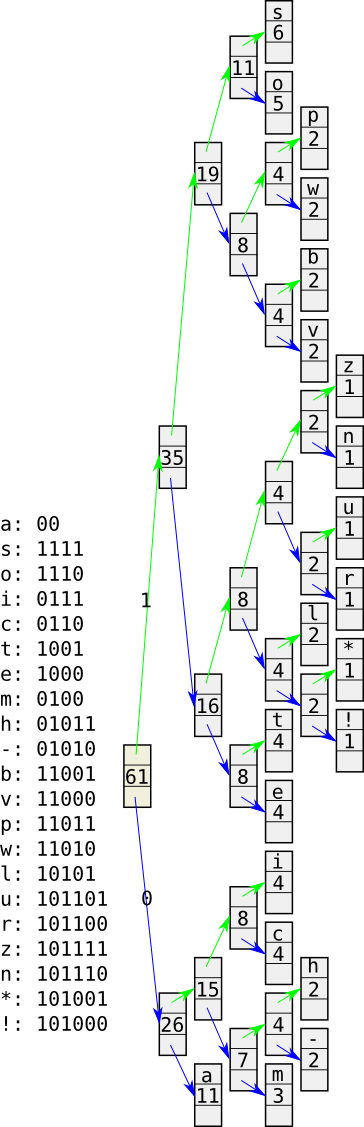
The resulting huffman tree and the binary representation of the input symbols
The two least frequent items count is summed together and a node placed in the tree with the two original entries as child nodes. This step is repeated until a single node exists with a count value equal to the length of the input.

To encode data once simply walks the tree outputting a 0 for a left node or 1 for right node until reaching the original value. This generates a mapping of values to bit output, the input is then simply converted value by value to the bit output. To decode the data the data is used bit by bit to walk the tree to arrive at values.

If we perform this algorithm on the example string table *!asiabvcomcoopitamazonawsarsaves-the-whalescomputebasilicata we can reduce the 488 bits (61 * 8 bit characters) to 282 bits or 40% reduction. Obviously in a real application the huffman tree would need to be stored which would probably exceed this saving but for larger data sets it is probable this technique would yield excellent results on this kind of data.

Once I proved this to myself I implemented the encoder within the existing conversion program. Although my perl encoder is not very efficient it can process the entire PSL string table (around six thousand labels using 40KB or so) in less than a second, so unless the table grows massively an inelegant approach will suffice.

The resulting bits were packed into 32bit values to improve decode performance (most systems prefer to deal with larger memory fetches less frequently) and resulted in 18KB of output or 47% of the original size. This is a great improvement in size and means the statically linked test program is now 59KB and is actually smaller than the gzipped source data.

$ ls -alh test_nspsl
-rwxr-xr-x 1 vince vince 59K Sep 25 23:58 test_nspsl
$ ls -al public_suffix_list.dat.gz
-rw-r--r-- 1 vince vince 62K Sep 1 08:52 public_suffix_list.dat.gz

To be clear the statically linked program can determine if a domain is in the PSL with no additional heap allocations and includes the entire PSL ordered tree, the domain label string table and the huffman decode table to read it.

An unexpected side effect is that because the decode loop is small it sits in the processor cache. This appears to cause the string comparison function huffcasecmp() (which is not locale dependant because we know the data will be limited ASCII) performance to be close to using strcasecmp() indeed on ARM32 systems there is a very modest improvement in performance.

I think this is as much work as I am willing to put into this library but I am pleased to have achieved a result which is on par with the best of breed (libpsl still has a data representation 20KB smaller than libnspsl but requires additional libraries for additional functionality) and I got to (re)learn an important algorithm too.

19 September 2016

Mike Gabriel: Rocrail changed License to some dodgy non-free non-License

The Background Story A year ago, or so, I took some time to search the internet for Free Software that can be used for controlling model railways via a computer. I was happy to find Rocrail [1] being one of only a few applications available on the market. And even more, I was very happy when I saw that it had been licensed under a Free Software license: GPL-3(+). A month ago, or so, I collected my old M rklin (Digital) stuff from my parents' place and started looking into it again after +15 years, together with my little son. Some weeks ago, I remembered Rocrail and thought... Hey, this software was GPLed code and absolutely suitable for uploading to Debian and/or Ubuntu. I searched for the Rocrail source code and figured out that it got hidden from the web some time in 2015 and that the license obviously has been changed to some non-free license (I could not figure out what license, though). This made me very sad! I thought I had found a piece of software that might be interesting for testing with my model railway. Whenever I stumble over some nice piece of Free Software that I plan to use (or even only play with), I upload this to Debian as one of the first steps. However, I highly attempt to stay away from non-free sofware, so Rocrail has become a no-option for me back in 2015. I should have moved on from here on... Instead... Proactively, I signed up with the Rocrail forum and asked the author(s) if they see any chance of re-licensing the Rocrail code under GPL (or any other FLOSS license) again [2]? When I encounter situations like this, I normally offer my expertise and help with such licensing stuff for free. My impression until here already was that something strange must have happened in the past, so that software developers choose GPL and later on stepped back from that decision and from then on have been hiding the source code from the web entirely. Going deeper... The Rocrail project's wiki states that anyone can request GitBlit access via the forum and obtain the source code via Git for local build purposes only. Nice! So, I asked for access to the project's Git repository, which I had been granted. Thanks for that. Trivial Source Code Investigation... So far so good. I investigated the source code (well, only the license meta stuff shipped with the source code...) and found that the main COPYING files (found at various locations in the source tree, containing a full version of the GPL-3 license) had been replaced by this text:
Copyright (c) 2002 Robert Jan Versluis, Rocrail.net
All rights reserved.
Commercial usage needs permission.
The replacement happened with these Git commits:
commit cfee35f3ae5973e97a3d4b178f20eb69a916203e
Author: Rob Versluis <r.j.versluis@rocrail.net>
Date:   Fri Jul 17 16:09:45 2015 +0200
    update copyrights
commit df399d9d4be05799d4ae27984746c8b600adb20b
Author: Rob Versluis <r.j.versluis@rocrail.net>
Date:   Wed Jul 8 14:49:12 2015 +0200
    update licence
commit 0daffa4b8d3dc13df95ef47e0bdd52e1c2c58443
Author: Rob Versluis <r.j.versluis@rocrail.net>
Date:   Wed Jul 8 10:17:13 2015 +0200
    update
Getting in touch again, still being really interested and wanting to help... As I consider such a non-license as really dangerous when distributing any sort of software, be it Free or non-free Software, I posted the below text on the Rocrail forum:
Hi Rob,
I just stumbled over this post [3] [link reference adapted for this
blog post), which probably is the one you have referred to above.
It seems that Rocrail contains features that require a key or such
for permanent activation.  Basically, this is allowed and possible
even with the GPL-3+ (although Free Software activists will  not
appreciate that). As the GPL states that people can share the source
code, programmers can  easily deactivate license key checks (and
such) in the code and re-distribute that patchset as they  like.
Furthermore, the current COPYING file is really non-protective at
all. It does not really protect   you as copyright holder of the
code. Meaning, if people crash their trains with your software, you  
could actually be legally prosecuted for that. In theory. Or in the
U.S. ( ;-) ). Main reason for  having a long long license text is to
protect you as the author in case your software causes t trouble to
other people. You do not have any warranty disclaimer in your COPYING
file or elsewhere. Really not a good idea.
In that referenced post above, someone also writes about the nuisance
of license discussions in  this forum. I have seen various cases
where people produced software and did not really care for 
licensing. Some ended with a letter from a lawyer, some with some BIG
company using their code  under their copyright holdership and their
own commercial licensing scheme. This is not paranoia,  this is what
happens in the Free Software world from time to time.
A model that might be much more appropriate (and more protective to
you as the author), maybe, is a  dual release scheme for the code. A
possible approach could be to split Rocrail into two editions:  
Community Edition and Professional/Commercial Edition. The Community
Edition must be licensed in a  way that it allows re-using the code
in a closed-source, non-free version of Rocrail (e.g.   MIT/Expat
License or Apache2.0 License). Thus, the code base belonging to the
community edition  would be licensed, say..., as Apache-2.0 and for
the extra features in the Commercial Edition, you  may use any
non-free license you want (but please not that COPYING file you have
now, it really  does not protect your copyright holdership).
The reason for releasing (a reduced set of features of a) software as
Free Software is to extend  the user base. The honey jar effect, as
practise by many huge FLOSS projects (e.g. Owncloud,  GitLab, etc.).
If people could install Rocrail from the Debian / Ubuntu archives
directly, I am  sure that the user base of Rocrail will increase.
There may also be developers popping up showing  an interest in
Rocrail (e.g. like me). However, I know many FLOSS developers (e.g.
like me) that  won't waste their free time on working for a non-free
piece of software (without being paid).
If you follow (or want to follow) a business model with Rocrail, then
keep some interesting  features in the Commercial Edition and don't
ship that source code. People with deep interest may  opt for that.
Furthermore, another option could be dual licensing the code. As the
copyright holder of Rocrail  you are free to juggle with licenses and
apply any license to a release you want. For example, this  can be
interesing for a free-again Rocrail being shipped via Apple's iStore. 
Last but not least, as you ship the complete source code with all
previous changes as a Git project  to those who request GitBlit
access, it is possible to obtain all earlier versions of Rocrail. In 
the mail I received with my GitBlit credentials, there was some text
that  prohibits publishing the  code. Fine. But: (in theory) it is
not forbidden to share the code with a friend, for local usage.  This
friend finds the COPYING file, frowns and rewinds back to 2015 where
the license was still  GPL-3+. GPL-3+ code can be shared with anyone
and also published, so this friend could upload the  2015-version of
Rocrail to Github or such and start to work on a free fork. You also
may not want  this.
Thanks for working on this piece of software! It is highly
interesing, and I am still sad, that it  does not come with a free
license anymore. I won't continue this discussion and move on, unless
you  are interested in any of the above information and ask for more
expertise. Ping me here or directly  via mail, if needed. If the
expertise leads to parts of Rocrail becoming Free Software again, the 
expertise is offered free of charge ;-).
light+love
Mike
Wow, the first time I got moderated somewhere... What an experience! This experience now was really new. My post got immediately removed from the forum by the main author of Rocrail (with the forum's moderator's hat on). The new experience was: I got really angry when I discovererd having been moderated. Wow! Really a powerful emotion. No harassment in my words, no secrets disclosed, and still... my free speech got suppressed by someone. That feels intense! And it only occurred in the virtual realm, not face to face. Wow!!! I did not expect such intensity... The reason for wiping my post without any other communication was given as below and quite a statement to frown upon (this post has also been "moderately" removed from the forum thread [2] a bit later today):
Mike,
I think its not a good idea to point out a way to get the sources back to the GPL periode.
Therefore I deleted your posting.
(The phpBB forum software also allows moderators to edit posts, so the critical passage could have been removed instead, but immediately wiping the full message, well...). Also, just wiping my post and not replying otherwise with some apology to suppress my words, really is a no-go. And the reason for wiping the rest of the text... Any Git user can easily figure out how to get a FLOSS version of Rocrail and continue to work on that from then on. Really. Now the political part of this blog post... Fortunately, I still live in an area of the world where the right of free speech is still present. I found out: I really don't like being moderated!!! Esp. if what I share / propose is really noooo secret at all. Anyone who knows how to use Git can come to the same conclusion as I have come to this morning. [Off-topic, not at all related to Rocrail: The last votes here in Germany indicate that some really stupid folks here yearn for another this time highly idiotic wind of change, where free speech may end up as a precious good.] To other (Debian) Package Maintainers and Railroad Enthusiasts... With this blog post I probably close the last option for Rocrail going FLOSS again. Personally, I think that gate was already closed before I got in touch. Now really moving on... Probably the best approach for my new train conductor hobby (as already recommended by the woman at my side some weeks back) is to leave the laptop lid closed when switching on the train control units. I should have listened to her much earlier. I have finally removed the Rocrail source code from my computer again without building and testing the application. I neither have shared the source code with anyone. Neither have I shared the Git URL with anyone. I really think that FLOSS enthusiasts should stay away from this software for now. For my part, I have lost my interest in this completely... References light+love,
Mike

18 September 2016

Gregor Herrmann: RC bugs 2016/37

we're not running out of (perl-related) RC bugs. here's my list for this week:

Norbert Preining: Fixing packages for broken Gtk3

As mentioned on sunweaver s blog Debian s GTK-3+ v3.21 breaks Debian MATE 1.14, Gtk3 is breaking apps all around. But not only Mate, probably many other apps are broken, too, in particular Nemo (the file manager of Cinnamon desktop) has redraw issues (bug 836908), and regular crashes (bug 835043). gtk-breakage I have prepared packages for mate-terminal and nemo built from the most recent git sources. The new mate-terminal now does not crash anymore on profile changes (bug 835188), and the nemo redraw issues are gone. Unfortunately, the other crashes of nemo are still there. The apt-gettable repository with sources and amd64 binaries are here:

deb http://www.preining.info/debian/ gtk3fixes main
deb-src http://www.preining.info/debian/ gtk3fixes main
and are signed with my usual GPG key. Last but not least, I quote from sunweaver s blog: Questions
  1. Isn t GTK-3+ a shared library? This one was rhetorical Yes, it is.
  2. One that breaks other application with every point release? Well, unfortunately, as experience over the past years has shown: Yes, this has happened several times, so far and it happened again.
  3. Why is it that GTK-3+ uploads appear in Debian without going through a proper transition? This question is not rhetorical. If someone has an answer, please enlighten me.
(end of quote) <rant>
My personal answer to this is: Gtk is strongly related to Gnome, Gnome is strongly related to SystemD, all this is pushed onto Debian users in the usual way of we don t care for breaking non-XXX apps (for XXX in Gnome, SystemD). It is very sad to see this recklessness taking more and more space all over Debian.
</rant> I finish with another quote from sunweaver s blog:
already scared of the 3.22 GTK+ release, luckily the last development release of the GTK+ 3-series

17 September 2016

Jonas Meurer: apache rewritemap querystring

Apache2: Rewrite REQUEST_URI based on a bulk list of GET parameters in QUERY_STRING Recently I searched for a solution to rewrite a REQUEST_URI based on GET parameters in QUERY_STRING. To make it even more complicated, I had a list of ~2000 parameters that have to be rewritten like the following:
if % QUERY_STRING  starts with one of <parameters>:
    rewrite % REQUEST_URI  from /new/ to /old/
Honestly, it took me several hours to find a solution that was satisfying and scales well. Hopefully, this post will save time for others with the need for a similar solution. Research and first attempt: RewriteCond % QUERY_STRING ... After reading through some documentation, particularly Manipulating the Query String, the following ideas came to my mind at first:
RewriteCond % REQUEST_URI  ^/new/
RewriteCond % QUERY_STRING  ^(param1)(.*)$ [OR]
RewriteCond % QUERY_STRING  ^(param2)(.*)$ [OR]
...
RewriteCond % QUERY_STRING  ^(paramN)(.*)$
RewriteRule /new/ /old/?%1%2 [R,L]
or instead of an own RewriteCond for each parameter:
RewriteCond % QUERY_STRING  ^(param1 param2 ... paramN)(.*)$

There has to be something smarter ... But with ~2000 parameters to look up, neither of the solutions seemed particularly smart. Both scale really bad and probably it's rather heavy stuff for Apache to check ~2000 conditions for every ^/new/ request. Instead I was searching for a solution to lookup a string from a compiled list of strings. RewriteMap seemed like it might be what I was searching for. I read the Apache2 RewriteMap documentation here and here and finally found a solution that worked as expected, with one limitation. But read on ... The solution: RewriteMap and RewriteCond $ mapfile:% QUERY_STRING ... Finally, the solution was to use a RewriteMap with all parameters that shall be rewritten and check given parameters in the requests against this map within a RewriteCond. If the parameter matches, the simple RewriteRule applies. For the inpatient, here's the rewrite magic from my VirtualHost configuration:
RewriteEngine On
RewriteMap RewriteParams "dbm:/tmp/rewrite-params.map"
RewriteCond % REQUEST_URI  ^/new/
RewriteCond $ RewriteParams:% QUERY_STRING NOT_FOUND  !=NOT_FOUND
RewriteRule ^/new/ /old/ [R,L]

A more detailed description of the solution First, I created a RewriteMap at /tmp/rewrite-params.txt with all parameters to be rewritten. A RewriteMap requires two field per line, one with the origin and the other one with the replacement part. Since I use the RewriteMap merely for checking the condition, not for real string replacement, the second field doesn't matter to me. I ended up putting my parameters in both fields, but you could choose every random value for the second field: /tmp/rewrite-params.txt:
param1 param1
param2 param2
...
paramN paramN
Then I created a DBM hash map file from that plain text map file, as DBM maps are indexed, while TXT maps are not. In other words: with big maps, DBM is a huge performance boost:
httxt2dbm -i /tmp/rewrite-params.txt -o /tmp/rewrite-params.map

Now, let's go through the VirtualHost configuration rewrite magic from above line by line. First line should be clear: it enables the Apache Rewrite Engine:
RewriteEngine On
Second line defines the RewriteMap that I created above. It contains the list of parameters to be rewritten:
RewriteMap RewriteParams "dbm:/tmp/rewrite-params.map"
The third line limits the rewrites to REQUEST_URIs that start with /new/. This is particularly required to prevent rewrite loops. Without that condition, queries that have been rewritten to /old/ would go through the rewrite again, resulting in an endless rewrite loop:
RewriteCond % REQUEST_URI  ^/new/
The fourth line is the core condition: it checks whether QUERY_STRING (the GET parameters) is listed in the RewriteMap. A fallback value 'NOT_FOUND' is defined if the lookup didn't match. The condition is only true, if the lookup was successful and the QUERY_STRING was found within the map:
RewriteCond $ RewriteParams:% QUERY_STRING NOT_FOUND  !=NOT_FOUND
The last line is a simple RewriteRule from /new/ to /old/. It is executed only if all previous conditions are met. The flags are R for redirect (issuing a HTTP redirect to browser) and L for last (causing mod_rewrite to stop processing immediately after that rule):
RewriteRule ^/new/ /old/ [R,L]

Known issues A big limitation of this solution (compared to the ones above) is, that it looks up the whole QUERY_STRING in RewriteMap. Therefore, it works only if param is the only GET parameter. In case of additional GET parameters, the second rewrite condition fails and nothing is rewritten even if the first GET parameter is listed in RewriteMap. If anyone comes up with a solution to this limitation, I would be glad to learn about it :)

Jonas Meurer: hello world

Hello world! Finally, this is my first post to my own blog. For years, I refrained from having an own blog, even though I think about it since 10 years at least. Today I decided to give it a try, let's see where it takes me. I'll write about Free Software topics from time to time, probably with a strong emphasis on Debian GNU/Linux. Welcome to everybody who steps by. Cheers,
mejo

15 September 2016

Craig Sanders: Frankenwheezy! Keeping wheezy alive on a container host running libc6 2.24

It s Alive! The day before yesterday (at Infoxchange, a non-profit whose mission is Technology for Social Justice , where I do a few days/week of volunteer systems & dev work), I had to build a docker container based on an ancient wheezy image. It built fine, and I got on with working with it. Yesterday, I tried to get it built on my docker machine here at home so I could keep working on it, but the damn thing just wouldn t build. At first I thought it was something to do with networking, because running curl in the Dockerfile was the point where it was crashing but it turned out that many programs would segfault e.g. it couldn t run bash, but sh (dash) was OK. I also tried running a squeeze image, and that had the same problem. A jessie image worked fine (but the important legacy app we need wheezy for doesn t yet run in jessie). After a fair bit of investigation, it turned out that the only significant difference between my workstation at IX and my docker machine at home was that I d upgraded my home machines to libc6 2.24-2 a few days ago, whereas my IX workstation (also running sid) was still on libc6 2.23. Anyway, the point of all this is that if anyone else needs to run a wheezy on a docker host running libc6 2.24 (which will be quite common soon enough), you have to upgrade libc6 and related packages (and any -dev packages, including libc6-dev, you might need in your container that are dependant on the specific version of libc6). In my case, I was using docker but I expect that other container systems will have the same problem and the same solution: install libc6 from jessie into wheezy. Also, I haven t actually tested installing jessie s libc6 on squeeze if it works, I expect it ll require a lot of extra stuff to be installed too. I built a new frankenwheezy image that had libc6 2.19-18+deb8u4 from jessie. To build it, I had to use a system which hadn t already been upgraded to libc6 2.24. I had already upgraded libc6 on all the machines on my home network. Fortunately, I still had my old VM that I created when I first started experimenting with docker crazily, it was a VM with two ZFS ZVOLs, a small /dev/vda OS/boot disk, and a larger /dev/vdb mounted as /var/lib/docker. The crazy part is that /dev/vdb was formatted as btrfs (mostly because it seemed a much better choice than aufs). Disk performance wasn t great, but it was OK and it worked. Docker has native support for ZFS, so that s what I m using on my real hardware. I started with the base wheezy image we re using and created a Dockerfile etc to update it. First, I added deb lines to the /etc/apt/sources.list for my local jessie and jessie-updates mirror, then I added the following line to /etc/apt/apt.conf:
APT::Default-Release "wheezy";
Without that, any other apt-get installs in the Dockerfile will install from jesssie rather than wheezy, which will almost certainly break the legacy app. I forgot to do it the first time, and had to waste another 10 minutes or so building the app s container again. I then installed the following:
apt-get -t jessie install libc6 locales libc6-dev krb5-multidev comerr-dev zlib1g-dev libssl-dev libpq-dev
To minimise the risk of incompatible updates, it s best to install the bare minimum of jessie packages required to get your app running. The only reason I needed to install all of those -dev packages was because we needed libpq-dev, which pulled in all the rest. If your app doesn t need to talk to postgresql, you can skip them. In fact, I probably should try to build it again without them I added them after the first build failed but before I remembered to set Apt::Default::Release (OTOH, it s working OK now and we re probably better off with libssl-dev from jessie anyway). Once it built successfully, I exported the image to a tar file, copied it back to my real Docker machine (co-incidentally, the same machine with the docker VM installed) and imported it into docker there and tested it to make sure it didn t have the same segfault issues that the original wheezy image did. No problem, it worked perfectly. That worked, so I edited the FROM line in the Dockerfile for our wheezy app to use frankenwheezy and ran make build. It built, passed tests, deployed and is running. Now I can continue working on the feature I m adding to it, but I expect there ll be a few more yaks to shave before I m finished. When I finish what I m currently working on, I ll take a look at what needs to be done to get this app running on jessie. It s on the TODO list at work, but everyone else is too busy a perfect job for an unpaid volunteer. Wheezy s getting too old to keep using, and this frankenwheezy needs to float away on an iceberg. Frankenwheezy! Keeping wheezy alive on a container host running libc6 2.24 is a post from: Errata

13 September 2016

John Goerzen: Two Boys, An Airplane, Plus Hundreds of Old Computers

Was there anything you didn t like about our trip? Jacob s answer: That we had to leave so soon! That s always a good sign. When I first heard about the Vintage Computer Festival Midwest, I almost immediately got the notion that I wanted to go. Besides the TRS-80 CoCo II up in my attic, I also have fond memories of an old IBM PC with CGA monitor, a 25MHz 486, an Alpha also in my attic, and a lot of other computers along the way. I didn t really think my boys would be interested. But I mentioned it to them, and they just lit up. They remembered the Youtube videos I d shown them of old line printers and punch card readers, and thought it would be great fun. I thought it could be a great educational experience for them too and it was. It also turned into a trip that combined being a proud dad with so many of my other interests. Quite a fun time. IMG_20160911_061456 (Jacob modeling his new t-shirt) Captain Jacob Chicago being not all that close to Kansas, I planned to fly us there. If you re flying yourself, solid flight planning is always important. I had already planned out my flight using electronic tools, but I always carry paper maps with me in the cockpit for backup. I got them out and the boys and I planned out the flight the old-fashioned way. Here s Oliver using a scale ruler (with markings for miles corresponding to the scale of the map) and Jacob doing calculating for us. We measured the entire route and came to within one mile of the computer s calculation for each segment those boys are precise! 20160904_175519 We figured out how much fuel we d use, where we d make fuel stops, etc. The day of our flight, we made it as far as Davenport, Iowa when a chance of bad weather en route to Chicago convinced me to land there and drive the rest of the way. The boys saw that as part of the exciting adventure! Jacob is always interested in maps, and had kept wanting to use my map whenever we flew. So I dug an old Android tablet out of the attic, put Avare on it (which has aviation maps), and let him use that. He was always checking it while flying, sometimes saying this over his headset: DING. Attention all passengers, this is Captain Jacob speaking. We are now 45 miles from St. Joseph. Our altitude is 6514 feet. Our speed is 115 knots. We will be on the ground shortly. Thank you. DING Here he is at the Davenport airport, still busy looking at his maps: IMG_20160909_183813 Every little airport we stopped at featured adults smiling at the boys. People enjoyed watching a dad and his kids flying somewhere together. Oliver kept busy too. He loves to help me on my pre-flight inspections. He will report every little thing to me a scratch, a fleck of paint missing on a wheel cover, etc. He takes it seriously. Both boys love to help get the plane ready or put it away. The Computers Jacob quickly gravitated towards a few interesting things. He sat for about half an hour watching this old Commodore plotter do its thing (click for video): VID_20160910_142044 His other favorite thing was the phones. Several people had brought complete analog PBXs with them. They used them to demonstrate various old phone-related hardware; one had several BBSs running with actual modems, another had old answering machines and home-security devices. Jacob learned a lot about phones, including how to operate a rotary-dial phone, which he d never used before! IMG_20160910_151431 Oliver was drawn more to the old computers. He was fascinated by the IBM PC XT, which I explained was just about like a model I used to get to use sometimes. They learned about floppy disks and how computers store information. IMG_20160910_195145 He hadn t used joysticks much, and found Pong ( this is a soccer game! ) interesting. Somebody has also replaced the guts of a TRS-80 with a Raspberry Pi running a SNES emulator. This had thoroughly confused me for a little while, and excited Oliver. Jacob enjoyed an old TRS-80, which, through a modern Ethernet interface and a little computation help in AWS, provided an interface to Wikipedia. Jacob figured out the text-mode interface quickly. Here he is reading up on trains. IMG_20160910_140524 I had no idea that Commodore made a lot of adding machines and calculators before they got into the home computer business. There was a vast table with that older Commodore hardware, too much to get on a single photo. But some of the adding machines had their covers off, so the boys got to see all the little gears and wheels and learn how an adding machine can do its printing. IMG_20160910_145911 And then we get to my favorite: the big iron. Here is a VAX a working VAX. When you have a computer that huge, it s easier for the kids to understand just what something is. IMG_20160910_125451 When we encountered the table from the Glenside Color Computer Club, featuring the good old CoCo IIs like what I used as a kid (and have up in my attic), I pointed out to the boys that we have a computer just like this that can do these things and they responded wow! I think they are eager to try out floppy disks and disk BASIC now. Some of my favorites were the old Unix systems, which are a direct ancestor to what I ve been working with for decades now. Here s AT&T System V release 3 running on its original hardware: IMG_20160910_144923 And there were a couple of Sun workstations there, making me nostalgic for my college days. If memory serves, this one is actually running on m68k in the pre-Sparc days: IMG_20160910_153418 Returning home After all the excitement of the weekend, both boys zonked out for awhile on the flight back home. Here s Jacob, sleeping with his maps still up. IMG_20160911_132952 As we were nearly home, we hit a pocket of turbulence, the kind that feels as if the plane is dropping a bit (it s perfectly normal and safe; you ve probably felt that on commercial flights too). I was a bit concerned about Oliver; he is known to get motion sick in cars (and even planes sometimes). But what did I hear from Oliver? Whee! That was fun! It felt like a roller coaster! Do it again, dad!

Rapha&#235;l Hertzog: Freexian s report about Debian Long Term Support, August 2016

A Debian LTS logoLike each month, here comes a report about the work of paid contributors to Debian LTS. Individual reports In August, 140 work hours have been dispatched among 10 paid contributors. Their reports are available: Evolution of the situation The number of sponsored hours rised to 167 hours per month thanks to UR Communications BV joining as gold sponsor (funding 1 day of work per month)! In practice, we never distributed this amount of work per month because some sponsors did not renew in time and some of them might not even be able to renew at all. The security tracker currently lists 31 packages with a known CVE and the dla-needed.txt file 29. It s a small bump compared to last month but almost all issues are affected to someone. Thanks to our sponsors New sponsors are in bold.

No comment Liked this article? Click here. My blog is Flattr-enabled.

Joey Hess: PoW bucket bloom: throttling anonymous clients with proof of work, token buckets, and bloom filters

An interesting side problem in keysafe's design is that keysafe servers, which run as tor hidden services, allow anonymous data storage and retrieval. While each object is limited to 64 kb, what's to stop someone from making many requests and using it to store some big files? The last thing I want is a git-annex keysafe special remote. ;-) I've done a mash-up of three technologies to solve this, that I think is perhaps somewhat novel. Although it could be entirely old hat, or even entirely broken. (All I know so far is that the code compiles.) It uses proof of work, token buckets, and bloom filters.
Each request can have a proof of work attached to it, which is just a value that, when hashed with a salt, starts with a certain number of 0's. The salt includes the ID of the object being stored or retrieved. The server maintains a list of token buckets. The first can be accessed without any proof of work, and subsequent ones need progressively more proof of work to be accessed. Clients will start by making a request without a PoW, and that will often succeed, but when the first token bucket is being drained too fast by other load, the server will reject the request and demand enough proof of work to allow access to the second token bucket. And so on down the line if necessary. At the worst, a client may have to do 8-16 minutes of work to access a keysafe server that is under heavy load, which would not be ideal, but is acceptible for keysafe since it's not run very often. If the client provides a PoW good enough to allow accessing the last token bucket, the request will be accepted even when that bucket is drained. The client has done plenty of work at this point, so it would be annoying to reject it. To prevent an attacker that is willing to burn CPU from abusing this loophole to flood the server with object stores, the server delays until the last token bucket fills back up.
So far so simple really, but this has a big problem: What prevents a proof of work from being reused? An attacker could generate a single PoW good enough to access all the token buckets, and flood the server with requests using it, and so force everyone else to do excessive amounts of work to use the server. Guarding against that DOS is where the bloom filters come in. The server generates a random request ID, which has to be included in the PoW salt and sent back by the client along with the PoW. The request ID is added to a bloom filter, which the server can use to check if the client is providing a request ID that it knows about. And a second bloom filter is used to check if a request ID has been used by a client before, which prevents the DOS. Of course, when dealing with bloom filters, it's important to consider what happens when there's a rare false positive match. This is not a problem with the first bloom filter, because a false positive only lets some made-up request ID be used. A false positive in the second bloom filter will cause the server to reject the client's proof of work. But the server can just request more work, or send a new request ID, and the client will follow along. The other gotcha with bloom filters is that filling them up too far sets too many bits, and so false positive rates go up. To deal with this, keysafe just keeps count of how many request IDs it has generated, and once it gets to be too many to fit in a bloom filter, it makes a new, empty bloom filter and starts storing request IDs in it. The old bloom filter is still checked too, providing a grace period for old request IDs to be used. Using bloom filters that occupy around 32 mb of RAM, this rotation only has to be done every million requests of so. But, that rotation opens up another DOS! An attacker could cause lots of request IDs to be generated, and so force the server to rotate its bloom filters too quickly, which would prevent any requests from being accepted. To solve this DOS, just use one more token bucket, to limit the rate that request IDs can be generated, so that the time it would take an attacker to force a bloom filter rotation is long enough that any client will have plenty of time to complete its proof of work.
This sounds complicated, and probably it is, but the implementation only took 333 lines of code. About the same number of lines that it took to implement the entire keysafe HTTP client and server using the amazing servant library. There are a number of knobs that may need to be tuned to dial it in, including the size of the token buckets, their refill rate, the size of the bloom filters, and the number of argon2 iterations in the proof of work. Servers may eventually need to adjust those on the fly, so that if someone decides it's worth burning large quantities of CPU to abuse keysafe for general data storage, the server throttles down to a rate that will take a very long time to fill up its disk. This protects against DOS attacks that fill up the keysafe server storage. It does not prevent a determined attacker, who has lots of CPU to burn, from flooding so many requests that legitimate clients are forced to do an expensive proof of work and then time out waiting for the server. But that's an expensive attack to keep running, and the proof of work can be adjusted to make it increasingly expensive.

Next.

Previous.