Search Results: "ed"

25 June 2012

Jan Wagner: nagios-plugins 1.4.16 is going to be released

Short before Debian is freezing the upcoming release of a new version of nagios-plugins is scheduled for Wednesday. The good news is, that a recent version is available in unstable and testing. Upstream only fixed some check_ping issues, which are not included in nagios-plugins 1.4.16~pre1-1. There is also a package available through squeeze-backports. If you are able to, please test the packages as soon as possible. If there are some quirks, these can be fixed in the next two days upstream.

Robert Collins: Running juju against a private openstack instance.

My laptop has somewhat less than 1/2 the grunt of my desktop at home, but I prefer to work on it as I can go sit in the sun etc, very hard to do that with a mini tower case :) However, running everything through ssh to another machine makes editing and iterating more clumsy; I need to do agent forwarding etc not terribly hard, but not free either, particularly when I travel, I need to remember to sync my source trees back to my laptop. So I prefer to live on my laptop and use my desktop for compute power. I had a couple of Juju charms I wanted to investigate, but I needed enough compute power to make my laptop really quite warm so I thought, its time to update my local cloud provider from Eucalyptus to Openstack. This was easy enough, until I came to run Juju. Turns out that Juju s commands really want to talk to the public DNS name of the instance (in order to SSH tunnel a connection to Zookeeper). But! Openstack returns DNS names like Server-3 , and if you think about a home network, its fairly rare to have a local DNS server *anyway*, so putting a suffix on names like that won t help at all: you either need to use a DNS naming provider (openstack ships with an LDAP provider, which adds even more complexity), and configure your clients to know how to find it, or you need to use the public IP addresses (which default to the FlatNetwork, which is routable within a home LAN by simply adding a route to 10.0.0.0/8 to your wifi interface). Adding to confusion, some wifi routers fail to forward avahi messages, which is a) terrible and b) breaks the only obvious way of doing no-config local DNS :( . So, I did some yak shaving this morning. Turns out other folk have already run into this and filed a Juju bug and a supporting txaws bug. The txaws bug was fixed, but just missed the release of Precise. Clint Byrum is going to SRU it this week though, so we ll have it soon. I ve put a patch up to address the Juju side, which is now pending review. Running the two together works very happily for me. \o/

24 June 2012

Pablo Lorenzzoni: Zotero and note-taking

I was looking for an excuse to try Zotero and the perfect opportunity appeared when I got a whole lot of references to group for a month of Magnetic Ressonance studies I am currently taking. I was also pleased to notice it is packaged to Debian. I am used to note-taking software. Back when I used a Palm m130 (and a Treo 650), I managed a lot of Memos I eventually migrated to Note-Everything in my current Android phone. Zotero, unfortunatelly, is not interfaceable with my phone (or I was still unable to figure out how to do so), but it s powerful in managing references beyond simple note-taking. Is anyone using Zotero in a more ambitious way? I ve read about people using it to keep large researchs to support fiction and non-fiction book-writing I also watched some YouTube videos on it. As far as I went with it, Zotero might become an important piece in my toolbox wrt reference keeping, so I was just trying to figure out how many other niches it can fill

Joey Hess: trying obnam

Obnam 1.0 was released during several months when I had no well-connected server to use for backups. Yesterday I installed a terabyte disk in a basement with a fiber optic network connection, so my backupless time is over. Now, granted, I have a very multi-layered approach to backups; all my data is stored in git, most of it with dozens of copies automatically maintained, and with archival data managed by git-annex. But I still like to have a "real" backup system underneath, to catch anything else. And to back up those parts of my user's data that I have not given them tools to put into git yet... My backup server is not my basement, so I need to securely encrypt the backups stored there. Encrypting your offsite backups is such a good idea that I've always been surprised at the paucity of tools to do it. I got by with duplicity for years, but it's increasingly creaky, and the few times I've needed to restore, it's been a terrific pain. So I'm excited to be trying Obnam today. So far I quite like it. The only real problem is that it can be slow, when there's a transatlantic link between the client and the server. Each file backed up requires several TCP round-trips, and the latency kills the bandwidth. Large files are still sent fast, and obnam uses little resources on either the client or server while running. And this mostly only affects the initial, full backup. But the encryption and ease of use more than make up for this. The real killer feature with Obnam's encryption isn't that it's industry-standard encryption with gpg, that can be trivially enabled with a single option (--encrypt-with=DEADBEEF). No, the great thing about it is its key management. I generate a new gpg key for each system I back up. This prevents systems reading each other's backups. But that means you have to backup the backup keys.. or when a system is lost, the backup would be inaccessible. With Obnam, I can instead just grant my personal gpg key access to the repository: obnam add-key --keyid 2512E3C7. Now both the machine's key and my gpg key can access the data. Great system; can't revoke access, but otherwise perfect. I liked this so much I stole the design and used it in git-annex too. :) I'm also pleased I can lock down .ssh/authorized_keys on my backup server, to prevent clients running arbitrary commands. Duplicity runs ad-hoc commands over ssh, which defeated me from ever locking it down. Obnam can be easily locked down, like this: command="/usr/lib/openssh/sftp-server" This could still be improved, since clients can still read the whole filesystem with sftp. I'd like to have something like git-annex's git-annex-shell, which can limit access to only a specific repository. Hmm, if Obnam had its own server-side program like this, it could stream backup data to it using a protocol that avoids the roundtrips needed by the SFTP protocol, and fix the latency issue too. Lars, I know you've been looking for a Haskell starter project ... perhaps this is it? :)

Gregor Herrmann: RC bugs 2012/25

good news of the RCBW week: more & more patches from people I haven't seen before in the BTS. keep them coming!

Paul Tagliamonte: So, it happened

I m now a Debian Developer (or rather, I ve gotten my account created) I still don t feel right calling myself a Debian Developer just yet :) Before I go off with my usual rants, I think now s about a good of time as any to thank everyone who helped me here. So, thank you. Really. All of you. I only hope to live up to the stellar example of those before me.

Russell Coker: Targeted Advertising

Don Marti has written another blog post about targeted advertising [1]. His main point is that when a company uses the most targeted adverts (such as Google advertising) everyone knows that they are paying a small number of cents per click and nothing for the people who don t click. This compares to TV adverts which cost a lot of money and for which most viewers either leave the room or use fast-forward. Therefore using Google adverts doesn t send a signal about the amount of money invested in the products. Don also cited an example of a company sponsoring an OK Go film clip, that was a great idea, it shows that the company can do expensive things which are also a bit creative and fans will thank them (watch all the OK Go videos on Youtube, they are great). The next question is how else companies can advertise? One thing I d really like to see is sponsorship of authors. Pick an author and pay them a salary with paid editorial services for releasing a book a year for free in HTML and ebook formats. Having a fixed salary is a significant benefit when it comes time to apply for a mortgage or plan a holiday and being able to freely distribute books would be a significant benefit for an author who hasn t got a large fan base. In the computer industry it seems that there s a lot of potential for sponsoring people who produce free things. That ranges from free software and designs for free hardware to blog posts and documentation. Five years ago Sun had a blogging contest and my friend Dave Hall won a server that was worth $21K [2]. It would be nice if some other companies started doing similar things and if Sun did a repeat so some other people I like could get some free kit. Related posts:
  1. What is Appropriate Advertising? Colin Charles writes about a woman who is selling advertising...
  2. Advertising Free Software Projects Today I just noticed the following advert on one of...
  3. Friends and Adverts For some time I have been running Google Adsense adverts...

Petter Reinholdtsen: Song book for Computer Scientists

Many years ago, while studying Computer Science at the University of Troms , I started collecting computer related songs for use at parties. The original version was written in LaTeX, but a few years ago I got help from H kon W. Lie, one of the inventors of W3C CSS, to convert it to HTML while keeping the ability to create a nice book in PDF format. I have not had time to maintain the book for a while now, and guess I should put it up on some public version control repository where others can help me extend and update the book. If anyone is volunteering to help me with this, send me an email. Also let me know if there are songs missing in my book. I have not mentioned the book on my blog so far, and it occured to me today that I really should let all my readers share the joys of singing out load about programming, computers and computer networks. Especially now that Debconf 12 is about to start (and I am not going). Want to sing? Check out Petter's Computer Science Songbook.

Paul Tagliamonte: debian-desktop/7.0.0~exp2 in experimental

Mirroring my post to debian-desktop here:
Howdy, -desktop,
Hopefully we can contain the flame to the other thread.
desktop-base/7.0.0~exp2 has been accepted into experimental, for testing
by y'all (and generally interested folks) for feedback and testing
before pushing to unstable.
I urge y'all to give it a try and provide feedback on issues that you
may run into.
You can overlay experimental on any unstable install, and install
desktop-base by running:
    $ sudo apt-get -t experimental install desktop-base
For more information on using experimental, check out the wiki[1].
If you would care to test out the plymouth bootsplash, here's the short
version of how to get it running:
 1) Install plymouth via apt ($ sudo apt-get install plymouth)
 2) Set the theme to use  joy' ($ sudo /usr/sbin/plymouth-set-default-theme joy)
 3) Edit the file /etc/default/grub, and add
    "splash" to GRUB_CMDLINE_LINUX_DEFAULT
 4) update your initramfs ($ sudo update-initramfs -u)
Here's the full list of changes from the version in unstable:
    desktop-base (7.0.0~exp2) experimental; urgency=low
      * Remove GConf defaults, they are not used anymore.
      * Remove the GDM3 settings, since the configuration format for GDM
        change again, yay.
      * Add a dconf file for the new-style GDM3 configuration.
      * Add a XML file describing the available resolutions for the
        background (for use with GNOME).
      * postinst: use a higher priority for the 1920x1080 background.
      * Cleanup postinst/prerm/postrm.
      * Add a new alternative: desktop-background.xml.
      * Use it from the gsettings override.
      * Reload gdm3 after installation/removal.
      * Drop old libgnome2-common hack.
      * Clean up an alternative that is no longer available.
     -- Josselin Mouette <joss@debian.org>  Sat, 23 Jun 2012 23:28:15 +0200
    desktop-base (7.0.0~exp1) experimental; urgency=low
      [ Paul Tagliamonte ]
      * Adding myself as a maintainer
      * We've got a new theme --  joy' by Adrien Aubourg. Thanks, Adrien!
         - Theme added to backgrounds.
         - Theme added for Grub
         - Background changed for GDM3
         - Theme added for KDM & changed that to default.
         - Theme added for ksplash & changed to default.
      * Standards bump to 3.9.3
      * Pre-Dependency added for dpkg (>= 1.15.7.2~), since we use dpkg helpers
        in our preinst.
      * Add in Jonathan Carter's Plymouth theme.
      [ Jonathan Carter ]
      * Remove splashy theme since it's no longer available in archives
      [ Yves-Alexis Perez ]
      * Install emblem in the correct folder.
     -- Paul Tagliamonte <paultag@ubuntu.com>  Sat, 23 Jun 2012 13:00:47 +0200
I thank all of you dearly for putting up with this,
  Paul
[1]: http://wiki.debian.org/DebianExperimental

23 June 2012

Richard Darst: The size of DebConf12

Phil blogged about DebConf12 having many fewer attendees than past DebConfs (10 and 11). Dealing with registration for several years, I can say these numbers tell a different story.First and foremost, these numbers tell me that DebConf12 hasn't happened yet, DC10 and DC11 have. People are told to sign up register early and reconfirm, but in reality, only the people who have accommodations with us have a significant motivation to do it. Once DebConf starts, lots of day-attendees will drop by, be told to register, and greatly inflate our numbers without staying for a very long time. The number of advance registrants also depends on how much advertisement is done. In terms of people who have both dates in the registration system (Phil's updated graph), I don't place much weight on this number, either.It's my opinion that number of beds occupied is a better indication of the scale of a DebConf, and especially at this stage. This also roughly correlates to number of Debian developers staying, though for years with cheap rooms or lots of external funding, even this number can get inflated. We need some things like t-shirts and badges for every attendee (possibly registered before a certain time), but for now, the number of rooms is what matters.In fact, I wouldn't be surprised if DebConf13 had lower "reconfirmed" numbers, because it is further away form population centers, yet still was a "bigger" conference because there are more people staying on-site or coming for multiple days.For DebConf12, I see an average of 130 people/night, for DebConf11, I see an average of 240 people/night, and for DebConf10, I see an average of 200 people/night. So, DebConf12 is smaller, but in a different way than it seems, and even this is subject to change or variable interpretation. I'm not really wanting to predict DebConf sizes at this stage.So basically, one does not simply expect DebConf registration data to make sense. One should not simply dismiss any DebConf before it happens. And most importantly, one can not simply use this data to plan a conference. The registration team has been frantically running around trying to correct every possible inconsistency you can imagine.Tags: debconf

Bernd Zeimetz: Report from the Bug Squashing Party in Salzburg

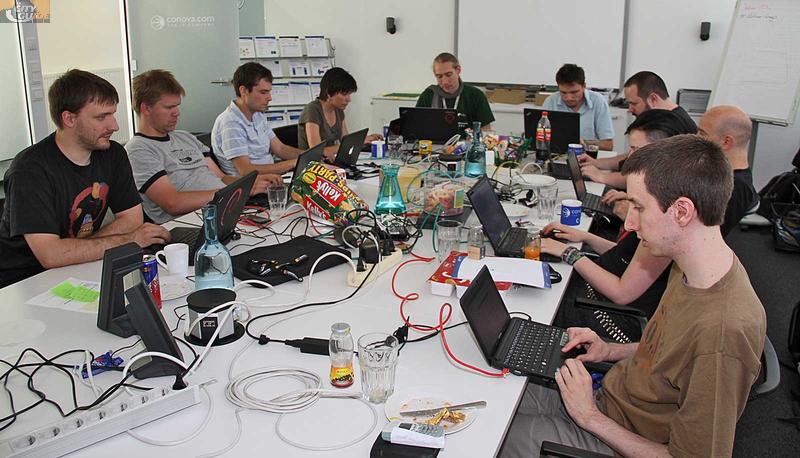
bsp_2012_salzburg photo from salzburg-cityguide.com, Copyright (C) Uwe Brandl

Participation and Results From June 15-17th we held a Debian BugSquashingParty in Salzburg, hosted and sponsored by conova communications GmbH. It was a fun and busy weekend, with 15-17 people from 5 countries being around, mainly working on RC bugs in Testing/Unstable. Gerfried Fuchs (rhonda) also worked on triaging the impact of RC bugs on the version in Squeeze, while Peter Palfrader (weasel) took care of Tor related things and Debian sysadmin work, including starting on the new bugs and udd hosts. Phillip Hug (hug) worked on the debian.ch infrastructure. Together with Miroslav Such from Red Hat Bernd Zeimetz (bzed) worked on the packaging of the necessary libraries and daemons to add (basic) Spacewalk client support to Debian. As soon as the packages passed NEW and #677871 was applied (thanks to the APT guys for working on that already), managing Debian clients with Spacewalk should work out of the box. Of course we also had a little keysigning party :)

Statistics
  • about 68 bugs in unstable/testing were triaged/patched/fixed or at least pinged
  • 54 bugs were tagged to show if they affect Squeeze, several other bugs were pinged to retrieve necessary information or to trigger an update in the next stable pointrelease.
  • 5 packages were introduced into Debian (still in NEW, though) - the Spacewalk client related packages and libapache2-mod-auth-memcookie.

Accomodation Thanks to Debian funds we were able to provide accomodation for four participants in the JUFA youth hostel in Salzburg. We had paid in advance for eight, but changing to rooms with a higher category for only 4 people would have been equally or more expensive.

Press/Media coverage Additionally to being mentioned in the calendars on ProLinux and similar pages, we had some press coverage by the local newspaper and online magazines:

Fun facts We consumed 2kg of Leberkas, a big plate of "Buchteln mit Vanillesosse", about 16000cm^2 of Pizza, about 80 litres of coke, juice, beer and wine and I guess we drank at least the same amount of water. We had coffee made of 1.5kg coffee beans and managed to empty the (formerly well filled) icemaker in the fridge. Also we had successful training sessions of a standard Debconf game (rules won't be explained here obviously). Maybe we even successfully spread the game to the employees of a commercial linux distribution ;)

Dirk Eddelbuettel: Rcpp 0.9.11

Release 0.9.11 of Rcpp arrived on CRAN this morning and in Debian later today. This is a somewhat incremental release with a few internal improvements and few new features. One interesting new development has been contributed by John Chambers who is extending 'Rcpp modules' into 'Rcpp classes' which allows R code to modify and extend C++ classes loaded via Rcpp modules; see help(setRcppClass) for more. This also lead to some changes in the code for loading modules which however requires the brand-new R version 2.15.1 released today as well. The complete NEWS entry for 0.9.11 is below; more details are in the ChangeLog file in the package and on the Rcpp Changelog page.
0.9.11  2012-06-22
    o   New member function for vectors (and lists etc) containsElementNamed() 
        which returns a boolean indicating if the given element name is present
    o   Updated the Rcpp.package.skeleton() support for Rcpp modules by
        carrying functions already present from the corresponding unit test
        which was also slightly expanded; and added more comments to the code 
    o   Rcpp modules can now be loaded via loadRcppModules() from .onLoad(),
        or via loadModule("moduleName") from any R file 
    o   Extended functionality to let R modify C++ clases imported via modules
        documented in help(setRcppClass)
    o   Support compilation in Cygwin thanks to a patch by Dario Buttari
    o   Extensions to the Rcpp-FAQ and the Rcpp-modules vignettes
    o   The minium version of R is now 2.15.1 which is required for some of
        the Rcpp modules support 
Thanks to CRANberries, you can also look at a diff to the previous release 0.9.10. As always, even fuller details are on the Rcpp Changelog page and the Rcpp page which also leads to the downloads, the browseable doxygen docs and zip files of doxygen output for the standard formats. A local directory has source and documentation too. Questions, comments etc should go to the rcpp-devel mailing list off the R-Forge page

22 June 2012

Michael Casadevall: Announcement of Calxeda Highbank Images for Quantal

Hello all,

As many of you are aware, Canonical, in coordination with Calxeda and others have been working to bring Ubuntu to this new class of high-performance cluster yet low power-consumption computers built around ARM processors. Many of you who were in attendance at UDS in Oakland may remember seeing Calxeda's talks and demonstration live, and the exciting news that this represents. The full presentation is available here.

In line of this work, I'm am extremely pleased to announce that the initial images for the Calxeda Highbank platform are now available for download, with installation instructions available here. Please remember that Quantal is still in alpha development, and is not currently recommended for use in a production environment. As development of 12.10 continues, we will continue to refine these images, and our tools to fully embrace MAAS on ARM, and make 12.10 to be our best release yet.


As an additional note, Highbank support for Ubuntu 12.04 LTS will be released as part of the 12.04.1 update in mid-August and will join our support for ArmadaXP from Marvell, which was released as part of 12.04.

---
Michael Casadevall
ARM Server Tech Lead
Professional Engineering and Services, Canonical
michael.casadevall@canonical.com

Philipp Kern: The upcoming DebConf 12

Update 2: Richard and especially Moray debunked my statistics and given that they're actually on the DebConf team, they simply know it better what to look at and which numbers cannot be trusted. So look over to Moray's post for some numbers about DC11 and DC12.

Oops. At least the average count of days per person seems slightly higher. (But then the stats may likely be off, given that any part of the day counts as full.)
This year's DebConf will have remote participation through video streams and IRC chat, as usual. But they will be late at night for Europeans. Despite those hurdles, let's make this conference a success! The same procedure as every year. ;-)

Update: I don't have any privileged access to Pentabarf and hence I was just working on the exported data at the link above. When perusing the "Statistics for ONLY people who have both dates in Penta" I get this:
That's because this year seems to have a much higher percentage of people filling out both fields (~58% for DC10/DC11 and 85% for DC12). I'm still unsure if Penta was set to filter out those who did not reconfirm. But after all the others would not be very meaningful for room planning.

Tanguy Ortolo: We need you for the NTP pool!

Ferdinand Berthoud's marine clock #2 You already know NTP, the protocol that allows your computers to keep an accurate clock. Thanks to a global pool of time servers, it is available to everyone on the Internet. This public pool is constituted by volunteers' servers and it needs more.So, if you you should consider joining the pool. It is actually quite easy:
  1. install NTP;
  2. configure it to use five good servers from your region;
  3. register your server.

Alexander Reichle-Schmehl: Release Critical Bug report for Week 25

The bug webinterface of the Ultimate Debian Database currently knows about the following release critical bugs:
In Total:1167
Affecting Wheezy:771
Wheezy only:189
Remaining to be fixed in Wheezy:582
Of these 582 bugs, the following tags are set:
Pending in Wheezy:31
Patched in Wheezy:82
Duplicates in Wheezy:57
Can be fixed in a security Update:21
Contrib or non-free in Wheezy:11
Claimed in Wheezy:2
Delayed in Wheezy:5
Otherwise fixed in Wheezy:47
Ignoring all the above (multiple tags possible) 376 bugs need to be fixed by Debian Contributors to get Debian 7.0 Wheezy released. However, with the view of the Release Managers, 671 need to be dealt with for the release to happen. Please see Interpreting the release critical bug statistics for an explanation of the different numbers.

Christian Perrier: 2012 update 27 for Debian Installer localization

The D-I beta release is in preparation so we have many last minute updates and I'm uploading gazillion of packages. Each time, I upload one....a translator pops up and sends another update, etc. :-) Status for D-I level 1 (core D-I files): Status for D-I level 2 (packages that have localized material that may appear during default installs, such as iso-codes, tasksel, etc.): Status for D-I level 3 (packages that have localized material that may appear during non-default installs, such as win32-loader) Full 100% completeness (hall of fame) for 28 languages: Asturian, Belarusian, Bulgarian, Catalan, Czech, Welsh, Danish, German, Esperanto, Spanish, Persian, French, Hebrew, Indonesian, Italian, Japanese, Kazakh, Khmer, Latvian, Dutch, Polish, Portuguese, Russian, Slovak, Slovenian, Swedish, Turkish, Simplified Chinese

Paul Tagliamonte: my quest to get desktop-base set before wheezy

I ve begun work on desktop-base to get it ready for wheezy. As many of you know, we saw the SpaceFun theme with Squeeze, and currently Wheezy as well. Rather then see the same theme twice, I ve taken the liberty of updating desktop-base to use the Joy theme proposed for Wheezy. My announcement can be seen on lists.debian.org, and details can be found there. Rather then drone on, check out what s been done so far. We ll be going from this: To: Game on!

21 June 2012

Raphael Geissert: Introducing http.debian.net, Debian's mirrors redirector

You've been there: you are about to install a package, upgrade, or get the source package, and the mirror fails. It is offline, it is out of date, etc. Whatever the reason, you couldn't do it.

That's only one of the issues that http.debian.net attempts to address. In a nutshell: it works as an http-only content distribution network. It uses the network and geographic location to select the best online and up-to-date mirrors.

APT's sources.list one liner:
deb http://http.debian.net/debian stable main

Use /debian-backports for backports, and /debian-archive for archive.debian.org.

Originally introduced to the Debian mirrors community back in January, the code on the server and client sides has improved since. All is needed is squeeze's APT (or aptitude), but wheezy's and sid's will perform better.

Advantages and more details are discussed at the Debian mirrors redirector's website.

(Thanks to the early testers, everyone who has provided feedback, my friends at PuffinHost, and all the mirrors-related people, obviously including those who sponsor them!)

Russell Coker: New SE Linux Policy for Wheezy

I ve just uploaded a new SE Linux policy for Debian/Wheezy. It now works correctly with systemd and Chromium, two significant features that I wanted for Wheezy. Now it turns out that we have until the end of the month for Wheezy updates, so I may get another version of the policy uploaded before then. If so it will only be for relatively minor changes, I think that most SE Linux users would be reasonably happy with policy the way it is. Anything that doesn t work now can probably be solved by local configuration changes. execmem The current version of KDE in Debian is 4.8.4, it seems that large parts of the KDE environment depend on execmem access, this includes kwin and plasma-desktop. Basically there is no possibility of having a KDE desktop environment without those programs and therefore KDE depends on execmem access. Debugging this is difficult as the important programs SEGV when denied execmem access and the KDE crash handler really gets in the way of debugging it running /usr/bin/plasma-desktop results in the process forking a child and detaching from the gdb session. The most clear example of an execmem issue in KDE is from the program /usr/lib/kde4/libexec/kwin_opengl_test which gives the following error:
LLVM ERROR: Allocation failed when allocating new memory in the JIT
Can t allocate RWX Memory: Permission denied To make this work you run the command setsebool -P allow_execmem 1 which gives many domains the ability to create writable-executable memory regions. I raised this issue for discussion on the SE Linux mailing list and Hinnerk van Bruinehsen wrote an informative message in response summarising the situation [1]. It seems that it s possible to compile some of the programs in question to not use the JIT and therefore not require such access and there is a build option in Gentoo to allow it. But it s impractically difficult for me to fork KDE in Debian so the only option is to recommend that people enable the allow_execmem boolean for Debian desktop systems running SE Linux. Related posts:
  1. /run and SE Linux Policy Currently Debian/Unstable is going through a transition to using /run...
  2. An Update on DKIM Signing and SE Linux Policy In my previous post about DKIM [1] I forgot to...
  3. New SE Linux Policy for Squeeze I have just uploaded refpolicy version 0.2.20100524-1 to Unstable. This...

Next.

Previous.