Search Results: "ag"

19 October 2011

Alastair McKinstry: Dear Lazyweb,

I'm building a debian package, CDAT. The latest version 6.0.alpha uses CMAKE to build, rather than configure. The trouble is that CMake doesn't build. It doesn't even fail.
$ mkdir build
$ cd build
$ cmake ..
()-- Configuring done
-- Generating done
-- Build files have been written to: /home/amckinstry/deb-packages /cdat/cdat-6.0.alpha/build
$ make
$
The problem is, 'make' does nothing. A Makefile is generated by CMake, which calls cmake which calls make again on ./CMakeFiles/Makefile2 ... which does nothing useful. Apparently the CMake is supposed to put useful stuff in there, but doesn't. What puts stuff into Makefile2, and where should I pick up the bugs trail? Tags , ,

Julien Valroff: Openbox 3.5 & xdg autostart

Since the 3.5.0 release, Openbox automatically starts applications with .desktop files in /etc/xdg/autostart. This was already the case with previous releases when setting the . $GLOBALAUTOSTART instruction in the autostart script. This instruction is now deprecated. This has puzzled me as some applications were started twice in my Openbox session: those launched via my ~/.config/openbox/autostart script which are also launched through xdg autostart. I also like to use notify-osd when in openbox, but it seems the new gnome-fallback session requires notification-daemon. In my Openbox session, I have noticed that notification-daemon was launched whereas my autostart script specifies to use notify-osd. I then discovered that /etc/xdg/autostart/notification-daemon.desktop was the cause of this. I had to drop a notification-daemon.desktop file in my ~/.config/autostart/ directory with the following contents:
[Desktop Entry]
Name=Notification Daemon
Comment=Display notifications
Exec=/usr/lib/notification-daemon/notification-daemon
Terminal=false
Type=Application
NoDisplay=true
OnlyShowIn=LXDE;OPENBOX;GNOME;
AutostartCondition=GNOME3 unless-session gnome
X-GNOME-Autostart-enabled=true
X-OPENBOX-Autostart-enabled=false
The last two lines allow me to not start notification-daemon only when using Openbox ie. it still starts automatically when launching a GNOME session. You can check what applications are automatically started through xdg with:
/usr/lib/openbox/openbox-xdg-autostart --list
The results are quite amazing, most applications being only configured to start in GNOME or KDE, but nothing seems to be very coordinated amongst maintainers. I find this quite misleading, and would prefer openbox to stick with the previous default behaviour. Who said diehard ?!

Matthew Garrett: Management of UEFI secure booting

This post is made in a personal capacity. While it represents the outcome of multiple discussions on the topic with a variety of people, nothing written below should be construed as Red Hat's corporate position

The FSF have released a statement on UEFI secure boot. It explains the fundamental issue here, which isn't something as simple as "will OEMs let me install Linux". It's "Does the end user have the ability to manage their own keys".

Secure boot is a valuable feature. It does neatly deal with the growing threat of pre-OS malware. There is an incentive for it to be supported under Linux. I discussed the technical aspects of implementing support for it here - it's not a huge deal of work, and it is being worked on. So let's not worry about that side of things. The problem is with the keys.

Secure boot is implemented in a straightforward way. Each section of a PE-COFF file is added together and a hash taken[1]. This hash is signed with the private half of a signing key and embedded into the binary. When you attempt to execute a file under UEFI, the firmware attempts to decrypt the embedded hash. This requires that the firmware have a either a copy of the public half of the signing key in its key database, or for there to be a chain of trust from the signing key to a key in its key database. Once it has the decrypted hash, it generates its own hash of the binary and compares them. If they match, the binary is executed.

What happens if it doesn't match? Per the UEFI specification, the firmware can then prompt the user and ask if they want to execute it anyway. If the user accepts then the hash of the binary is remembered[4] and can continue to be executed in future. This is similar to what you get when you visit a self-signed https site, or when you connect to an ssh server for the first time - the user must explicitly state that they trust the software that is being booted.

This is a little awkward for a couple of reasons. First, it means that any updates to the bootloader would require the user to manually accept the binary again. Second, as we've seen with https, there's the risk of uesrs just blindly accepting things. If it's acceptable to do this off internal media[5] then malware could just rely on some number of users saying "yes". And thirdly, we've been told that Microsoft's Windows logo requirements forbid this option.

The first is problematic but manageable with appropriate documentation. The second is a real risk that makes this approach far less compelling. And the third is probably a showstopper.

So signed but untrusted binaries are probably out, on technological, UI and policy grounds. What else?

We can sign binaries with a trusted key. This gets us interoperability, but comes at a cost. The first issue here is that we still don't know what the process for getting a trusted key is going to be. One option is for something like a generic Linux key that's provided by all firmware vendors. As long as the OEM doesn't remove it, then that Linux key could be used to sign other keys that are used by individual Linux vendors. The main difficulty involved in this is having the Linux key be managed by an authority that OEMs can trust to only provide keys to trustworthy organisations and maintain control of the private half of the key. Remember, if any malware is signed with any of these keys, it'll boot on any machine carrying this key. It's a lot of trust. It's not obvious that there's an organisation with sufficient trust at the moment.

The second approach is for each Linux vendor to generate their own key and get every OEM to carry it. Let's rule this out on the basis that it's an approach that doesn't scale at all. Red Hat could probably get its key into a bunch of OEM systems. Canonical too. Oracle? Probably for the vendors they care about. It's likely to be much harder for everyone else, and you still end up with the risk that you've just bought a computer that'll boot Red Hat but not Ubuntu.

The third approach is for each Linux vendor to obtain a key from someone who's already trusted. The most obvious authority here is Microsoft. Ignoring the PR unpleasantness involved with Linux vendors having to do business with Microsoft to get signed, so far Microsoft haven't given us any indication that this will be possible.

So every approach that involves us signing with a trusted key comes with associated problems. There's also a common problem with all of them - you only get to play if you have your own trusted key. Corporate Linux vendors can probably find a way to manage this. Everyone else (volunteer or hobbyist vendors, end users who want to run their own OS, anyone who wants to use a modified bootloader or kernel) is shut out.

The obvious workaround is for them to just turn off secure boot. Ignoring the arguments over whether or not OEMs will provide that option[6], it benefits nobody for Linux installation to require disabling a legitimate security feature. It's also not likely to be in a standard location on all systems and may have different naming. It's a support nightmare. Let's focus on trying to find a solution that provides the security and doesn't have obvious scaling issues.

There's a pretty simple one. If the problem centres around installing signing keys, why not have a standardised way of installing signing keys?

What we've proposed for this is an extension of the current UEFI standard for booting off removable media. There's a standardised location for putting the bootloader for USB sticks or optical media. For 32-bit PCs, it's EFI/BOOT/BOOTIA32.EFI. For 64-bit, it's EFI/BOOT/BOOTX64.EFI. Our proposal is to specify a path for key storage on the media. If the user attempts to boot off an item of removable media and finds a key file, we would like the firmware to prompt the user to install the key. Once the key is installed, the firmware will attempt to boot the bootloader on the removable media.

How does this avoid the problems associated with prompting the user to boot untrusted binaries? The first is that there's no problem with updates. Because a key has been imported, as long as future bootloader updates are signed with the same key, they'll boot without prompting the user. The second is that it can be limited to removable media. If malware infects the system and installs itself onto the hard drive, the firmware won't prompt for key installation. It'll just refuse to boot and fall back on whatever recovery procedures the OEM has implemented. The only way it could get on the system would involve the user explicitly booting off removable media, which would be a significant hurdle. If you're at that stage then you can also convince the user to disable secure boot entirely.

This proposal has been brought up with the UEFI standards working group, and with the UEFI plugfest taking place next week we're hoping it'll be discussed. It seems to satisfy the dual requirements of maintaining system security and ensuring that users have the flexibility to choose what they run on their system. But as with all technical proposals, feedback is entirely welcome.

[1] Hilariously, Microsoft's signing tool gets this wrong by also adding the contents of gaps between sections in direct contravention of their own specification. This is fine for binaries generated by Microsoft's toolchain because they don't have any gaps, but since our binaries do contain gaps[2] and since the standard firmware implementation[3] does implement the specification correctly, any Linux-generated binaries signed with the Microsoft tool fail validation. Go team.
[2] Something that is, as far as we can tell, permitted by the PE-COFF specification
[3] Written by Intel, not Microsoft
[4] Note that this means that only the specific binary is considered trusted. No key is imported, and any other binaries signed with the same key will also need to be manually trusted in the same way.
[5] As would be required if you ever want to be able to update your bootloader
[6] And to forestall panic, at this point we expect that most OEMs will provide this option on most hardware, if only because customers will still want to boot Windows 7. We do know that some hardware will ship without it. It's not implausible that some OEMs will remove it in order to reduce their support burden. But for the foreseeable future, you'll be able to buy hardware that runs Linux.

comment count unavailable comments

Ritesh Raj Sarraf: OpenXenManager

OpenXenManager cleared the NEW queue and is now available in the archive. What it is:read more

Lior Kaplan: LibreOffice Conference 2011

I ve recently been to the LibreOffice Conference 2011 in Paris. It s very nice to finally meet in person all those names from the malinglist and the bug reports. Although meeting most people for the first time, I left the conference with a strong feeling of a community (which I m proud to be a member of), this is a very motivating feeling. During the conference I had the chance to work on LibreOffice related issues: The 3 patches began when I noticed a few weird strings to translate in the context of installation media good luck to those who will try to install LibreOffice from 5.25 disk, 3.5 disk or a tape drive. These 3 strings are now removed from the code with other 36 unused strings. So translators please take the strings to translate with a grain of salt. Post conference tasks (always ending up with more stuff to do after a conference):
Filed under: LibreOffice, Openoffice.org

Steve Langasek: Debian: not stale, just hardened

Rapha l Hertzog recently announced a new dpkg-buildflags interface in dpkg that at long last gives the distribution, the package maintainers, and users the control they want over the build flags used when building packages. The announcement mail gives all the gory details about how to invoke dpkg-buildflags in your build to be compliant; but the nice thing is, if you're using dh(1) with debian/compat=9, debhelper does it for you automatically so long as you're using a build system that it knows how to pass compiler flags to. So for the first time, /usr/share/doc/debhelper/examples/rules.tiny can now be used as-is to provide a policy-compliant package by default (setting -g -O2 or -g -O0 for your build regardless of how debian/rules is invoked). Of course, none of my packages actually work that way; among other things I have a habit of liberally sprinkling DEB_MAINT_CFLAGS_APPEND := -Wall in my rules, and sometimes DEB_LDFLAGS_MAINT_APPEND := -Wl,-z,defs and DEB_CFLAGS_MAINT_APPEND := $(shell getconf LFS_CFLAGS) as well. And my upstreams' build systems rarely work 100% out of the box with dhauto* without one override or another somewhere. So in practice, the shortest debian/rules file in any of my packages seems to be 13 lines currently. But that's 13 lines of almost 100% signal, unlike the bad old days of cut'n'pasted dh_* command lists. The biggest benefit, though, isn't in making it shorter to write a rules file with the old, standard build options. The biggest benefit is that dpkg-buildflags now also outputs build-hardening compiler and linker flags by default on Debian. Specifically, using the new interface lets you pick up all of these hardening flags for free:
-fstack-protector --param=ssp-buffer-size=4 -Wformat -Wformat-security -Werror=format-security -Wl,-z,relro
It also lets you get -fPIE and -Wl,-z,now by adding this one line to your debian/rules (assuming you're using dh(1) and compat 9):
export DEB_BUILD_MAINT_OPTIONS := hardening=+pie,+bindnow
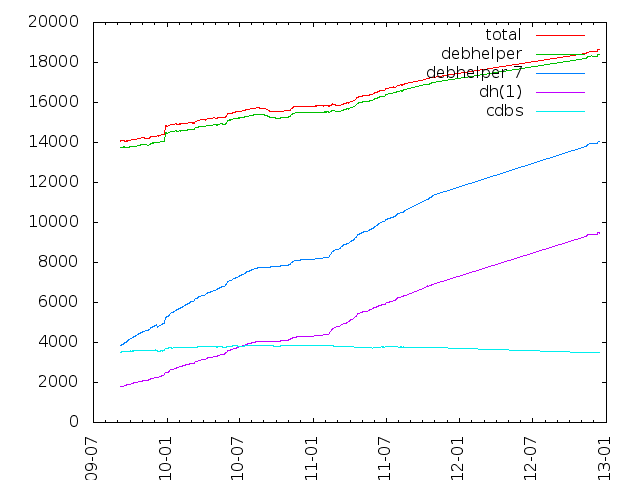
Converting all my packages to use dh(1) has always been a long-term goal, but some packages are easier to convert than others. This was the tipping point for me, though. Even though debhelper compat level 9 isn't yet frozen, meaning there might still be other behavior changes to it that will make more work for me between now and release, over the past couple of weekends I've been systematically converting all my packages to use it with dh. In particular, pam and samba have been rebuilt to use the default hardening flags, and openldap uses these flags plus PIE support. (Samba already builds with PIE by default courtesy of upstream.) You can't really make samba and openldap out on the graph, but they're there (with their rules files reduced by 50% or more). I cannot overstate the significance of proactive hardening. There have been a number of vulnerabilities over the past few years that have been thwarted on Ubuntu because Ubuntu is using -fstack-protector by default. Debian has a great security team that responds quickly to these issues as soon as they're revealed, but we don't always get to find out about them before they're already being exploited in the wild. In this respect, Debian has lagged behind other distros. With dpkg-buildflags, we now have the tools to correct this. It's just a matter of getting packages to use the new interfaces. If you're a maintainer of a security sensitive package (such as a network-facing daemon or a setuid application), please enable dpkg-buildflags in your package for wheezy! (Preferably with PIE as well.) And if you don't maintain security sensitive packages, you can still help out with the hardening release goal.

Christian Perrier: New update about Debian Installer localization

Full stats are here Status for D-I level 1 (core D-I files): Status for D-I level 2 (packages that have localized material that may appear during default installs, such as iso-codes, tasksel, etc.): Status for D-I level 3 (packages that have localized material that may appear during non-default installs, such as win32-loader) So, full 100% completeness (hall of fame) for: Persian (fa), French (fr), Portuguese (pt).

Andrew Pollock: [life] Found Smudge!

I'm indescribably happy to be able to say that I found Smudge alive and well this morning. I was getting ready to head out the door to work, and I opened the shutters in the kitchen and saw that the trap that I had outside by the front door was closed. The trap itself was wrapped in a sheet, so I couldn't immediately see what I'd caught. I quickly went outside, half-expecting to find a raccoon in there, and I was pleasantly surprised to find Smudge in there! I brought the trap inside and got Smudge out and raced her over to the food and water, where she had a long drink of water and something to eat. She's definitely lost some weight, but otherwise doesn't seem any worse for wear. She's currently sitting in my lap as I write this, so I don't think she's too traumatised by her ordeal. Lily was a bit standoffish this morning, hissing and growling at her, but I suspect that's because she didn't smell right. If she keeps that up, I'll put a drop of vanilla essence on both of them so they smell the same. Yesterday, I'd received a report of a possible sighting three streets over (houses on one side of the street back onto the Hetch Hetchy trail, where there were also reported sightings), so last night I placed the other trap in the backyard of one of the houses where there'd been a sighting. A couple of hours after that, I got another report of a possible sighting from someone else on the same street, further down. So I was pretty keen to substantiate all of these sightings on this particular street. Unfortunately, after two trips up there, I didn't see any black cats, so we'll never know if it was her or not. The night before last, I'd upgraded the food in the traps to some sardines, tuna and some fresh wet cat food, to try and lure her in. I have no idea if that helped or not, or she just finally found her way home, but it was such a relief to find her in the trap this morning. It turns out I caught an opossum in the other trap. Those are the funniest animals. They have a totally broken fight or flight reflex. This one would not leave the trap when I opened it. I ended up having to upend the trap and shake it out, and even then it just lay there playing dead - even when I shoved a bowl of food in its mouth. I've just done the rounds of the neighbourhood and taken down all the posters I'd put up. It had been suggested that I might want to update the posters and say that I'd found her, but I honestly don't want to do the extra trip to then take them all down again after that.

18 October 2011

Lars Wirzenius: In search of boredom

A month ago I started a new job, at Codethink, a British software development company. We work mainly on and with free software. I'm working on a new project called Baserock, a way to build embedded Linux systems that we think will avoid many of the pain points that people usually have. Baserock is still in its formative stages, not something you can really play with. Codethink has its main office in Manchester, so the past weekend I moved there with my fianc . Oh yeah, Soile and I got engaged. Rings of Palladium. While I've been having a lot of fun, I'd like to be bored for a while now. Instead, I'm going to Prague for ELC Europe.

John Goerzen: Greece part 3: Water

See also parts 1 and 2. That s a photo of Vlicha Beach, near our hotel. But before I talk about the Greek beaches, I need to explain something about living in Kansas. Kansas is in the middle of the United States. The nearest ocean is the Gulf of Mexico, which is 700 miles (1100km) away. That s roughly the same as the distance between Berlin and Minsk, or New York and Chicago. And I believe it s farther away from a saltwater body than all (or almost all) of Europe. So we re not just going to the beach every weekend or something. Vlicha Beach was all those incredible things you ever hear about beaches. The water was so clear that I could easily see my feat while wading in it. That, and the fish swimming around them. It was peaceful, relaxing, and picturesque. Between the deep blue of the sea and the same in the sky, I suppose it is no wonder that blue is often associated with Greece. We weren t exactly the only ones there. Though I think we were the only ones there with Kindles, which seemed to be much more popular in the USA than in Europe. We got several interested people carrying paper books asking what they were. Towards dusk, the mist would become more pronounced and the mountains off in the distance started to fade: The evening before we were set to fly home, we spent some time sitting on our balcony watching dusk set in. One last gaze out over the beautiful Aegean, the misty mountains, and the boats in the distance.

Raphaël Hertzog: What about creating The Ubuntu Administrator s Handbook?

I am currently running a crowdfunding campaign whose ultimate goal is to liberate the English translation of a French book that I have written. This book will be named The Debian Administrator s Handbook because it has primarily been written for Debian. Creating a new Ubuntu book based on The Debian Administrator s Handbook But since Ubuntu is based on Debian, a large part of its content applies equally well to Ubuntu. While discussing with Mark Shuttleworth, he suggested me to reuse those parts and to create a new book dedicated to Ubuntu. It would also cover the latest cloud technologies that Ubuntu has been delivering (since this is a topic that the current book does not cover). This is something that I have been envisioning for a while and something that I would be ready to try if we manage to complete the liberation of the current book. This project would then bring a truly free book to the Ubuntu ecosystem. Why? The official Ubuntu books are not really free There s a policy in place that ensures that official Ubuntu books use a free software/culture license and they are effectively available under the terms of a Creative Commons Share Alike license. But try to create a derivative book you won t find the sources (LaTeX or DocBook usually with most big books). You can only find a few PDF copies if you google for it. But this is really not the preferred form of modification for such a book. Those books are also not packaged. Ubuntu much like Debian deserves to have a good book embodying the values of free software that can be shipped together with its product. When I speak of liberation of the book, I really mean it in the way that free software hackers are used to: a public Git repository containing the DocBook sources, the pictures and the .dia files for the various schemas. Help Ubuntu by spreading the word I understand that at this point this proposed Ubuntu book is really hypothetical ( vaporware one could say) but we need to go step by step to make it a reality. And the first step is to ensure that we manage to liberate the Debian Administrator s Handbook. For this I am seeking the support of the Ubuntu community to promote the current fundraising campaign. If the perspective of the Ubuntu book is not enough to convince you, you ll be glad to learn that I also commit to give back to Ubuntu 15% of the money raised via the link below (once VAT has been subtracted). Click here to go to the crowdfunding campaign page and pledge a few euros. Then share this article (or the link http://debian-handbook.info/go/ulule-ubuntu/) and convince others to participate. At this point, the liberation target is entirely reachable with your help and the help of the community: the remaining 18 K needed in the liberation fund represent 720 persons giving 25 EUR each or 1800 persons giving 10 EUR each. Thank you very much for your support and your help in this project!

One comment Liked this article? Click here. My blog is Flattr-enabled.

Jon Dowland: NIN album collection now complete

[pic]
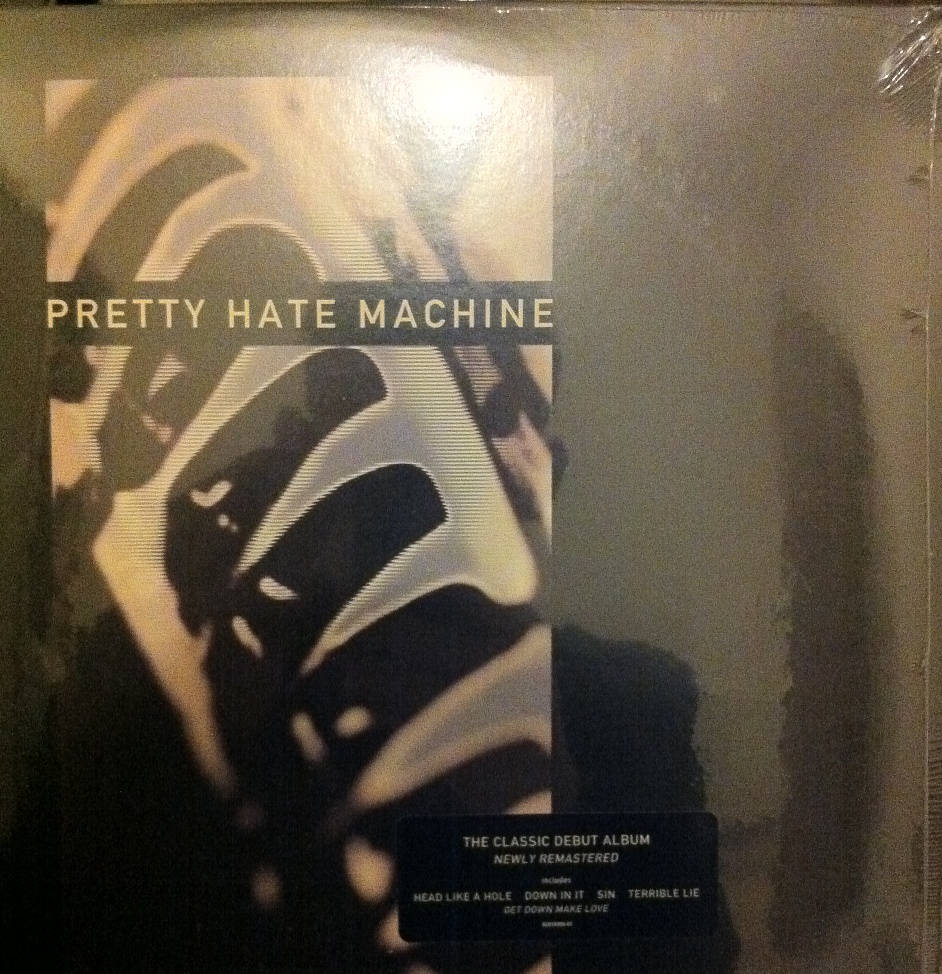
With this, my NIN vinyl album collection is now complete. I don't have a comprehensive NIN vinyl collection by any account: I don't have all the singles nor the remix albums, rarities, etc., but I do have all the albums. This is the newly-remastered version of "Pretty Hate Machine", which sites proudly next to an original. I'm still waiting for the much-anticipated remaster of The Fragile, which turned 12 last month. It appears to have been sidelined by movie soundtrack work.

Russell Coker: Servers vs Phones

Hetzner have recently updated their offerings to include servers with 16G and 24G of RAM [1]. You can get a dedicated server with two 3TB SATA disks, an i7-2600 quad-core CPU, and 16G of RAM for E49 per month plus an E149 setup fee. That is a good deal and I ll probably soon be running a few more servers at Hetzner because of it. HTC is currently offering five different Android phones that have 1G of RAM [2]. So while Hetzner is offering some great deals on dedicated servers, the affordable option has 16* the memory of a modern phone and the high-end option and the biggest option has a mere 24* the RAM of a phone! Linode is a virtual server provider that I m using for some of my clients, they offer virtual servers with 20GB of RAM for $US800 per month [3]. That doesn t compare well to Hetzner s offer of 24G for E59 ($US81) per month. Admittedly the management interface for Linode is really good while the process of recovering from a Hetzner server with a serious configuration issue is painful but getting two Hetzner servers in some sort of HA configuration would be 1/5 the cost of a Linode virtual server. HTC offers two Android phones with 16G of built-in flash storage that have the ability to take a 32G microSD card for a total of 48G of storage. Linode s smallest virtual server plans have 20G, 30G, and 40G of storage, so a modern phone can store more than twice as much data as the smallest Linode plan and more data than any of the three smallest plans. While it s obvious that phones don t perform well for any real server use (lack of fast network access, disk IO speed, and CPU power being obvious issues) it does seem that the recent announcements of newer cheaper server plans aren t that exciting when compared to mobile phones. For a similar monthly rate I could get a mobile phone free on a two year contract or a Hetzner server that has 16* the RAM. It s a pity that Hetzner does t offer servers with up to 128G of RAM and more than four disks. RAM isn t THAT expensive nowadays and their business model includes having the customer pay for various options that other companies don t tend to offer in a similar price range (such as SSD and other hardware customisation). Also see XKCD s comparison of HDTV and mobile phones [4].

17 October 2011

Peter Makholm: Splicing two sockets in Perl (request for help)

A couple of times I have written code which basically does this:

  1. accept() an incoming connection
  2. do some magic to get another socket
  3. start passing bit between the two sockets
  4. perform a correct close down sequence
An example use case of this is a proxy implementing the HTTP CONNECT method, but in for some known hostnames it will log a message and mangle the hostname before proceeding. This has been used as a legacy fall back solution while changing a network setup. But my uses are not restricted to HTTP proxies I have done the same for a few legacy protocols where the magic has been of different complexities. The two final steps are quite general and it would be nice to have a module doing just that. Take two sockets and make it easy (or even automatic) to pass bytes between them. The na ve non-blocking solution would use a scalar string buffer for each direction and perform a select loop while maintaining the write vector depending on which buffers contain data. I have written this code multiple times. In development this is usually quite successful, in production less so. While Perl might be quite suited for the magic in step 2, the na ve way of passing bytes have quite an overhead for the buffer management. A less na ve way would use a array of strings for buffers, but I m not quite sure if this would be a win in all cases. You might be able to get away with some string operations on the read side of the buffer, but it might be more expensive on the write side. I have not benchmarked this. Most of the time I don t care about Perl level IO handles. I know that there is a real C level file descriptor beneath. So an even better POSIX compliant solution might be to use XS to have plain C strings and use readv()/writev() and a iovec structure as buffer. Can we do even better? At least on Linux we can. With the Linux splice() specific system call it is possible to us a pipe as buffer and never to have to copy data from and to user space. I have not been able to find any off the shelf solution on CPAN. So I think I need to write it myself, but what would the nice and general API be? I guess the basic interface would be something like:
    my $chain = IO::Splice->new($fh1, $fh2);
    $chain->pump(); # read and write from both handles if possible and needed
    $chain->read($fh1);  # read to buffer from one specific handle
    $chain->write($fh2); # write from buffer to one specific handle
    $chain->can_write(); # returns the handles it needs to write to
but it might be simpler to have two callbacks for setting a file handle in write or no-write state:
    my $readset  = IO::Select->new( $fh1, $fh2);
    my $writeset = IO::Select->new();
    my $chain = IO::Splice->new( $fh1, $fh2,
        writable => sub    $writeset->add( shift )  ,
        unwritable => sub   $writeset->remove( shift )  
    );
    while ( ... select ... )  
        $chain->pump();
     
As said, I think I have plenty of implementations of the na ve way but before releasing some code it would be nice to get some input on the API. But the best feedback would be a module that already have a usable API but might not implement the Linux specific way. That would allow me to steal the interface

Raphaël Hertzog: GNOME 3 transition happening in Debian unstable

The few articles I wrote that explained how to install GNOME 3 from Debian experimental have been very popular. So I figured out that a small update would be welcome. The Debian GNOME team started uploading a mix of GNOME 3.0 and 3.2 packages to Debian unstable because the release team is ready to take care of this transition. This means that as soon as the packages are ready in Debian unstable, the release team will ensure that they also reach wheezy (aka the current testing distribution). So if you re a Debian unstable/testing user with a GNOME Desktop, expect some important changes by the way my experience with GNOME 3 was recently plagued by some rendering issues resulting in parts of the screen not being properly refreshed. While trying to track this down (and investigating clutter as a possible culprit) I came upon this mail on the clutter-devel mailing list. I recompiled mutter with the indicated patch and it fixed my issue. I immediately uploaded mutter 3.0.2.1-4 with the fix so this issue should be gone for the many people who are going to experience GNOME 3 for the first time in the coming days. It s also worth noting that contrary to how upstream handles it (they hide the fallback mode and the user has to enable an option to use it in place of the GNOME Shell), Debian has a dedicated session for the GNOME 3 fallback mode so you decide what you get right from the login screen. This will be appreciated by the people who do not see GNOME 3 as a step in the right direction. Unless they switch to XFCE as some did. As far I am concerned, I m already used to GNOME 3. I spend most of my time in terminals, browsers and an IRC application and the whole Shell does not fundamentally changes my work habits.

21 comments Liked this article? Click here. My blog is Flattr-enabled.

Martin Meredith: Adventures with the Galaxy SII

Good morning all! It feels like forever since I last blogged . Which is extremely bad of me *slaps own wrist*. However, I m been horrendously stupidly busy. As some of you may know, I m very much an Android fan. Recently, I ve gotten myself a shiny Galaxy SII. Given the fact that alongside my day job of being a Web Developer for an Online Retailer, I m also a Voluntary Ambulance Person I thought it d be useful to ask my current workplace if they d provide me a mobile phone cover for my new phone. Of course, work were more than happy to provide me with a shiny Samsung Galaxy S2 case (I actually went for the Case-Mate Barely There in brushed aluminium). Being a voluntary Ambulance Person, I regularly have to go to random places to pick up an ambulance/attend an event. Because of that I rely quite heavily on Google Maps and it s navigation features (Free Sat Nav in my opinion, the killer feature of Android). Having only had my phone a week, I started to find that there were a few problems with the GPS. Whereas previously, I d been able to lock on almost instantly, It d now take me about half an hour (literally) to get a lock on anything. I tried Googling, I tried everything I could think of, but to no avail. I downloaded GPS Test, and it was showing that while it was picking up a couple of sattelites, it wasn t picking up enough to get a decent lock The image above is a screenshot of the GPS test from directly outside my front door, taken after it had settled down. As you can imagine, I wasn t happy and was ready to send the phone back. Then, for some reason, a brainwave hit me (It doesn t happen often). What changed from when it was working to now? I know! The Case *takes case off, tries GPS test again* It can be amazing what happens when you realise that shiny case you have is mainly made of aluminium. Guess what works well at deflecting radio signals and the like You got it, aluminium. So now I need to decide whether to get another case or whether to just take the case off when I need to do sensible things. Other than the case problem, I m finding that the Samsung Galaxy SII is a great phone (as soon as I got rid of Touchwiz). I m not a fan of the OEM Samsung crap that s been bolted onto the phone, and will, as soon as there s a decent release, be putting a copy of CyanogenMod on the phone (I ve already made most of the tweaks I just want rid of SNS) In other news I ve started more and more gaming again. If you re interested in a couple of rounds of TF2 or some SC2 (or some Portal 2 Co-Op) then give me a shout with your Steam ID / Battle.net ID and I ll see what I can do. I m thinking of starting doing some Let s Play Videos, as my Youtube Channel is looking a bit sparse! I m going to try and start blogging a bit more aswell so if there s anything you want to see me blog about pop a post in the comments below! Till next time..

16 October 2011

Biella Coleman: Going to S o Paulo next week

lolcat_brazilian First, is that image really the best LOLcat referencing Brazil that exists out on the Internets? I sure hope not as it is sort of lame but it was the only one I could find (in the 30 seconds I looked, which I admit, is not all that much time). But all of this lolcat in Brazil stuff is really to say, I am heading to S o Paulo tomorrow to give a talk on Anon on Thursday at this conference. If you are an Anon in the city and can make it, please do. If you are not Anon and are still interested, come along as well ;=) If there are Debian developers as well in the city, it would be great to meet at some point. I am there from Tuesday morning to Friday night.

Gregor Herrmann: RC bugs 2011/41

here's my list of recent RC bug fixes, again comprising bugs which already had a patch in the BTS:
Tim Retout: BITE server

This week, Google released an extension called BITE which lets you file bug reports from within Chrome (or Chromium). If you are testing web applications, it lets you attach screenshots and/or automated tests to reproduce the bug you've found. There's just one small catch: they haven't released a server to go with the client. Oops. Apparently the internal systems are too tightly integrated to make that possible. I have hacked up enough stubs of a BITE server in Perl to get the client to "log in" and show off some features. (Warning: it doesn't actually do anything useful yet.) So far, I have learnt:

Alastair McKinstry: Testing DIASPORA*

As you may have noticed, I'm testing DIASPORA* as a blogging platform. Its been working reasonably well recently for me, with friends and family; even though the "Main" platform joindiaspora.com is not giving general invites, the code works and a bunch of distributed 'pods' have been set up. You can make entries public, and I've tested a public address for this: http://diaspora.sceal.ie/u/amckinstry which looks ok, a bit plain for the moment, but I'll work on that later. The problem has been the atom feed is garbage. (It's putting the content into both the Subject line (as unadulterated MarkDown, no less), and into the content). So, I've put the old blog back up for the moment. While I debug some Ruby on Rails, not a language i'm too familiar with ... Note: only logged in DIASPORA users can leave notes on the Diaspora site, but go to the login page and registrations are open. At least until spammers notice... Tags , , ,

Next.

Previous.