Search Results: "tar"

1 March 2007

Bastian Venthur: Pimp My Boot Process (III)

Short version:

$ sudo aptitude install desktop-base splashy splashy-themes
$ sudo splashy_config --set-theme debian-moreblue
$ sudo vim /boot/grub/menu.lst

[...]
timeout 3
hiddenmenu
[...]
# defoptions=quiet splash
[...]
$ sudo update-grub Long version: A few weeks ago I tried to improve the visual appearance of my boot process using usplash and a matching grub splash theme. It took me quite a while to create my first very own usplash theme and it was a rather complicated affair (Thanks to Petter Reinholdtsen for his patch which lead to my first working prototype). Since creating usplash themes is rather tricky and not really suitable for the average user I decided to switch to splashy. Splashy has many advantages above usplash like a very easy way to create themes, support of high resolution images and many themes already available in Debian. So here is my current solution for a nice bootup: First I installed desktop-base in order to get the nice moreblue KDM theme: $ sudo aptitude install desktop-base Then I installed splashy and splashy-themes in order to get a theme matching KDM’s moreblue theme:

$ sudo aptitude install splashy splashy-themes
$ sudo splashy_config --set-theme debian-moreblue

Since grub has only rudimentary support for theming, I decided to remove the boot menu completely. Most of the time I’ll boot the first kernel in the list anyway and you still have $timeout seconds to press Escape in order to bring the menu back. $ sudo vim /boot/grub/menu.lst

[...]
timeout 3
hiddenmenu
[...]
# defoptions=quiet splash
[...]
$ sudo update-grub The result looks quite cool and gives my boot process a polished an clean look. It’s still not perfect since splashy’s theme does not match exactly KDM’s theme and KDM flicks in an other wallpaper before it starts and after the login, but it’s good enough for now.
Paul van Tilburg: Space Efficient Algorithms

Last Tuesday I finished my paper about Space Efficient Algorithms and Histograms that will comprise most of the grade of my last remaining Master course, Advanced Algorithms. While I’ve been mostly enjoying writing this paper, I am glad it is finished for several reasons, one of them being able to do other things than just working on it and another is that it allows me to focus fully on my Master Project which is starting to progress nicely. (More about this later.) FOSDEM 2007 Due to the amount of time I needed to work on the paper, the need to save money (I really would like to go to Debconf7) and that the scheduled talks didn’t seem to interest me that much, I decided to break with tradition and not to go to FOSDEM this year. Just before FOSDEM, however, it seemed that lots of the people I would have liked to meet did go. While that was a pity, I hope to meet them in three months at Debconf7.

Russell Coker: Mercedes S class and car safety

The S Class Mercedes has some really interesting safety features, see this 6.8M PDF file for details. If you are interested in technology then you want to read it just to learn about all the cool features - it's got more technology than a Prius!

The S class includes the following features to protect the occupants in the event of a crash:

The following features reduce the risk and/or severity of a crash:

After a crash there are more safety features that can help you:

These features are documented as being available in the latest S Class, I haven't investigated what is available in the cheaper models and I'm not even sure where to find information on the safety features available in older models (a second-hand E class is more in my price range). But if I won the lottery a S class Merc would be high on my list of things to buy!

If you know of other cars that have a similar set of safety features to the S class and cost less then please let me know.

I will probably write a blog post about the BMW safety features in the near future. I couldn't do so immediately because the BMW web site sucks. They have a form for me to fill in contact details so that they can post me a brochure (I want to read it NOW ONLINE). The form doesn't like my postcode and refuses to proceed (it should at least have an option for them to contact me via email or phone).

Sune Vuorela: Seriousness

Was Sam a joke-candidate or not ?
I hope that his platform will make the last people think that he is serious. I am not able to vote - but if someone wants to sponsor a ballot for me, I can provide one. I wish good luck to all the candidates - I might start commenting on all the candidates soonish.

Lars Wirzenius: Debian: Automatic testing wishlist

Joey Hess writes about automated system testing in his anti-platform. That's one of the things that I'd like to work on, some day, when I have some free time again. There's two things I would like to do next in this area. First are improvements to piuparts so divide the tests it does into smaller bits, and to add a plugin framework so that it becomes easy to write new tests. The current piuparts code isn't really well suited for this, but the whole program is only a few hundred lines of code, so even if it had to be rewritten completely from scratch, it shouldn't take more than a couple of weeks of full time work (piuparts development is often slow because you need to run tests on large parts of the archive). The other thing would be to test upgrades not of individual packages, which piuparts does now, but of entire systems, preferably in emulated machines instead of chroots. This would probably need a new tool. The third of these two things would be to start adding automatic tests to packages so that we can test whether they work when they're installed. Ian Jackson did some work on a tool for this, but we need to use the tool. Ideally, we would have a setup where packages get tested automatically, continuously (daily, if possible) and results are reported instantly. At the moment, piuparts results need to be filtered manually, and that's a pain. Adding a "package health indicator" the PTS based on these automatic tests would be cool. We could even have a "Debian big board" web page, with a small square for each package, colored green if it's bug free and passes automatic tests; colored cyan if there's only bugs of severity normal or below, or a problem with some of the automatic tests; colored pink if there's a bug of severity important, or all automatic tests fail; and colored red if there's bugs of severity higher than important. This would give an overview to the health of Debian with a glance.

Benjamin Mako Hill: The Revolution Will Be Colorful

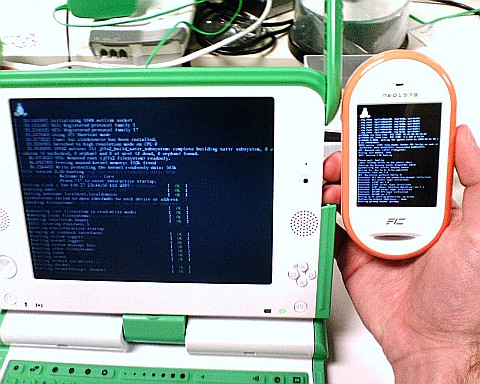
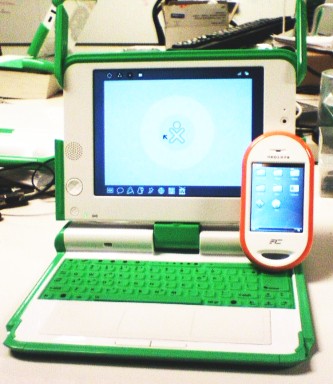
I forgot to mention the coolest thing about the last Ubucon in my summary. I heard that my friend Sean Moss-Pultz (the person who started the OpenMoko project) would be in New York the week of Ubucon so I managed to contact him and get him to drop by on his way to the airport so we could have lunch. To my surprise, he had one of the early versions of the free-phone for me (I wasn't expecting one for several weeks). I had brought my OLPC XO so, for the first time ever (as far as we know) we managed to get the two coolest, and most important, technology platform projects in the world together. While the XO and OpenMoko share a commitment to freedom, the similarities between the projects are, in fact, also skin deep. If we all work hard, we can look forward to a future that is free. Apparently, it's also white with bright trim.
/copyrighteous/images/xo_plus_openmoko-03-boot.jpg
/copyrighteous/images/xo_plus_openmoko-01.jpg
Apologies for the pictures taken from my current inferior, both ethically and technically, mobile phone.

28 February 2007

Joey Hess: my anti-platform

Why you won't be voting for me for DPL this year. Or, my plans for Debian stuff over the next year (or three). Most of these plans embody larger themes and directions that I feel Debian should take. I am a strong beliver that working code and getting stuff done is the best way to work toward larger goals, so I won't bother to try to explain the larger goals.
constantly usable testing This is so important that it has its own page. This is my first public posting of that proposal, and it should not be considered finished. I plan to finish it, and get to work on it. website www.debian.org is deprecated, but this is not obvious to either users or developers. That's because it's not formally deprecated, we just treat it like it is: We don't use it for anything new. Instead we have wikis, planet, times.debian.net, etc, etc, etc, etc. Unfortunatly that has created a bit of a mess for users, who are still often stuck trying to use www.debian.org, or who can't find new stuff that is on other sites. A solution could be creating an alternate starting point for users, to help them learn about Debian, install it, and point them to docs and all the other useful sites once they're more involved and using Debian. I hope to find time to work on and promote such a thing. I plan to continue moving stuff that needs to be maintained actively and grow off of www.debian.org to the wiki (as I've done with some of d-i stuff, for example), and encourage others to do so as well. Anything under /devel/ on www.debian.org is an especially good candidate for the wiki. double the archive sync frequency again Now that we've switched to updating the archive twice a day, and dealt with the (minor) issues caused by it, it should be easier to increase it to a frequency that is more likely to cause noticible turnaround time improvements and thus speed up some development. As it is, many people sleep through one or the other archive update. So I support doubling it to four times a day, or more (six seems better). automated whole system testing Automated whole system testing is important because Debian needs to keep working in so many obscure and annoying to test situations. Does d-i work on m68k? Does the desktop task install properly and work? Does debootstrap install a usable system on every architecture? If we rely on user reports, things can fall through the cracks entirely or not be noticed for too long. I've been running a d-i lab for a few years, which tries to automatically test installs on 6 architectures. However, between the current kernel not supporting several of my test machines due to hardware and software bugs, and the general time sync of keeping a rack of aging and obscure test boxes working, this has not been very useful lately. I feel that the solution is emulation: It should be possible to run Debian under emulation for most architectures. I hope to get an absurdly powerful server donated, and switch my test lab over to running in emulation on it. developer (virtual) machines The other benefit of emulation is that everything needed for testing stuff under emulation can be easily distributed to others. Getting developer accessible machines for certian architectures has been a problem in Debian. Emulated systems can sidestep this problem. All that's needed is a collection of documents and/or bootable images that developers can use to set up virtual machines for as many architectures as possible. We have steps in this direction. Hercules contains documentation for how to install in it using d-i. There is a kernel flavor and d-i boot images for mips on qemu. Having to ssh out to a DSA adminned box to deal with a buld failure on $ARCH, and having to wait for build deps to be installed should begin to feel antequated and quaint. It is. find the next nslu2 Debian's support for the nslu2 is an excellent development. It opens up using Debian for a whole new set of tasks, that need low-powered, semi-embedded, commodity hardware, that before were the province of special-purpose embedded distros. It also blew the popcon numbers for arm through the roof. We need to find the next nslu2-like target and get to work on it. I'm hoping that it will be a wireless router, because that's the only thing I'm not running Debian on now. :-) But it could also be a cell phone, or PDA..

Evan Prodromou: 9 Vent se CCXV

Lots of short, sharp items today that I want to get down.

LinuxQuestions.org supports OpenID First, I'm psyched to see that LinuxQuestions Wiki now supports OpenID. Jeremy gave the scoop in The LQ Wiki Now Supports OpenID. I was glad to see that LQ's on the OpenID path. It's a really strong community site, and I think it'll benefit greatly from opening up the authentication process. tags:

Wikia and OpenID Angela Beesley had some comments on my Journal/7 Vent se CCXV posting about wikiHow's support of OpenID. In that posting, I said that I thought companies with lots of wikis, like Wikia or wiki farms, might have a disincentive to participate in the OpenID network. Angela put me straight on the issue in a post on WikiAngela about OpenID. I'm glad to hear that Wikia is considering supporting the protocol. Then again, it's hard to believe that an Open Content, Open Source company is really going to go out of its way to avoid open standards and open login. tags:

DemoCampMontreal1 I had a good time last night at DemoCampMontreal1. I gave the first demo -- on, of course, the MediaWiki OpenID extension -- and I had some technical difficulties that didn't let me show off all the functionality. Which was kind of a bummer, but there were lots of questions about it from the audience, so that kind of made up my time. The room was packed, by the way -- pretty much anyone who's anyone in Montreal tech was there. I'm looking forward to DemoCampMontreal2 on 29 March! tags:

certifi.ca One of the best ways to establish credentials on the Web is to use a signed SSL certificate in your browser. It's fast, incredibly secure, and once you get it set up you can just forget it. They're also practically immune to phishing. Unfortunately, most people don't even know what browser certificates are, how they work, or what to do with them. Consequently, most Web sites don't support browser certificate authentication. Vicious cycle. But, one of the cool things about OpenID is that you can disconnect the authentication method from the Web site you're using. Most OpenID identity providers still use username/password combos for authentication, which is why critics have said that the standard is vulnerable to phishing attacks. I wanted to see if it were possible to set up an OpenID identity provider that used browser certificates as the only authentication system. So, in my copious free time, I've hacked up certifi.ca. It's based on the cool PHP OpenID Server that JanRain made, but I've ripped out all the password stuff, and now it runs on luscious certificatey goodness. I'm going to be enhancing the service in the near future, but I wanted to get feedback from folks interested in OpenID as soon as possible. I'm using it for my primary OpenID delegate, and it seems to be working great. Please give it a try and let me know what you think (admin@certifi.ca). tags:

DemoCampMontreal1 on Montreal Poutine There's an article on DemoCampMontreal1 on Midnight Poutine. That's me up on the stage, in the photo! tags:

Nepean Hotspurs Selects win On Saturday, a Muslim girl named "Azzy" Mansour, from Ontario playing in a soccer tournament in Laval was ejected from the tournament (by a Muslim referee, notably) for wearing a hijab -- reportedly because it was a safety hazard. (Montreal Gazette story, registration required.) Admirably, her entire team forfeited the tournament in protest. I'm not excited about Quebec's reactionary activity around Muslim, Sikh, and other religious community's different clothing rules. However, I understand that Quebecois -- and French people -- have a different idea of personal freedom than Americans. I try to be understanding and put myself in the Quebec headspace for this kind of stuff. Mostly, though: I admire the soccer team, the Nepean Hotspurs Selects, for standing up for their teammate and their friend. A lot of teams might have gone ahead and played without her, and it took some courage to drop out of a tournament they'd had high hopes for. They're sixth-grade girls, but they've learned something about integrity that most adults never learn. Kudos to them. tags:

Hanna Wallach: crazy crochet

It’s a crocheted atari!
crocheted atari
And a crocheted television displaying Pitfall to go with it!
crocheted atari
Awesome. (Via Wonderland.)

Simon Richter: NATOMGWTFBBQ

I needed a bunch of documents on ASN.1 as I'm currently hacking on an SNMP server. Said documents are available for free from the ITU, and linked on the ASN.1 site. Sounds easy enough, doesn't it? For some obscure reason however, I cannot get the documents when I'm behind NAT. Tcpdump shows the connection setup going through, but the HTTP request is not acknowledged from the other side, and no response is sent. If I start the request from the router, it works (although there seems to be a bit of packet loss or something else slowing down the download). Now the question is why this is happening, and whether it is the fault of my NAT setup, or of their firewall.

27 February 2007

Sune Vuorela: aggregated on planet debian!

Thanks to Ana I am now on debian planet. I have ended up underneath Steve McIntyre, but as I am quite strong, I think I can handle it. Lately on the Debian devel maillist, there has been some flaming about maintainers and when to answer their bugs. I whined a bit about KDE team being a bit overloaded - and suddenly a guy started working on the KDE related bugs. Olivier Vitrat is my current hero for the next couple of days.

Sune Vuorela: Hello world

Frist! every one has to start blogging once - so this is my attempt. Even if it fails, it is also cooler to be a ex-blogger than not having blogged at all.

Jesus Climent: If hardware sucks

It sucks even more when you have lost it. I have no fricking idea where my iPod (with shiny, brand new Rockbox) is at the moment, and have had no idea for the last 10 days, so I guess I will start looking for a replacement. iPod is a good idea, so I will take a look at the 80GB masterpiece. I also need a new phone, since mine dropped two times while doing some work at home and now it sometimes goes off or reboots without noticing. Let’s see what Nokia has to offer…

Josselin Mouette: Le grand retour

With each new GNOME versions, the icon themes from gnome-themes-extras are becoming less useful. The desktop and applications needs evolve, and the default theme is growing, providing more and more icons the icon themes can't provide. Because of that, the desktop is looking less consistent when using those icon themes. With GNOME 2.16 and the move to the Tango naming scheme, it is even worse as most icons got renamed. As upstream isn't touching this package anymore, I have decided to rework it entirely, and to migrate it to the new naming scheme. It was a very tedious task, but the result is much better than what I expected. To my surprise, I found the freedesktop.org icon naming specification to be a very good document that brings much simplicity to icon themes. Especially, the MIME types specification makes it much simpler to provide only a few icons, and the default theme contains much fewer icons than before. The result is in the pkg-gnome alioth repository, and uploaded to experimental. As Clearlooks is good but not great, I appreciate much the grand retour of Gorilla and Nuvola, the best themes ever, on my desktop. They are now more tightly integrated to the desktop than ever before. What now? First, I'd like people to test the themes. There are 6 of them and I don't use all of them. Please report inconsistencies, obviously missing icons, or wrongly named ones. You can also help by making new icons. Just grab inkscape, open icons, and make the changes. It's much easier than you could expect, especially if you start by combining existing icons. The icon naming specification will show you which icons can be useful additions. Some translations are also completely wrong, please don't hesitate to send me updates.

Thijs Kinkhorst: Wel de lusten, niet de lasten

To CEO's, Wellink and members of the parliament: I cannot agree [nl] more [en]: please stop this discussion [nl] about hedge funds or other shareholders actually exercising their rights. If you sell your company on the stock market you get a lot of cash. But you also sell control to random interested parties, that's what being publicly traded means. You'll have to live with that situation, it's called the market. Thank you for your attention.

Gerfried Fuchs: Birthday 2007: Grossstadtgefluester

For once I know exactly what to look foward to for my birthday: I will spend the evening at a concert of Grossstadtgeflüster. They are a German language band from Berlin, and I really started to love their lyrics. You can download a very fine remix of Ich muss gar nix — the song they are best known for. Today was the day: I received the CD I ordered (just listened to them before through a copy of a friend) together with some stickers, an autograph card and a small button, and also today I bought ten tickets for the concert! *bounces*
"10?!" you might ask. Well, for a start they weren't too expensive, and I also want to have some of my closer friends around me and at least thank them for being there for me all the time. I also want to make sure that they don't miss the chance of buying tickets — it happened to me too often, so this is also a bit of a precaution. I take this as a chance to finally write more about the propably most important part of my life: the music. I have totally neglected this love over the years, but I want to change that and at least reinitiate this part of my blog. Let's see how it's coming along.

Andrew McMillan: Switching to IPv6

From today my blog is available on IPv6. I've set it up so that http://debiana.org/ is only serving an AAAA record (for this server) and no IPv4 records (+/- DNS timeouts, of course...). Tomorrow I will work on getting a nameserver or two running on IPv6, to extend the IPv6 infrastructure another level. This is all me fiddling now that we have an IPv6 allocation at Catalyst, and are developing our IPv6 infrastructure in order to be able to deploy a couple of the .nz nameservers on IPv6 in due course. I'm not sure if I can point a .org domain at IPv6 nameservers so I might have to pick one of my .nz domains and use that to have a top to bottom IPv6 infrastructure. For IPv6 to start to work, I think people just have to start using it, so I'm going to change the systems that I can change. So I've also put a fixed IPv6 address onto my laptop, which is nice, and I will be converting all of my home systems to IPv6 addresses as well as time permits. Of course I can't get rid of IPv4 yet, but I think I will probably be trying to run that through a proxy somewhere non-local if I possibly can. If you can access this server via IPv6 I would be really interested to see a traceroute from you :-)

Holger Levsen: FOSDEM videos and d-community.org

FOSDEM was great! And too short. (But this is maybe a feature.) And too crowded, which is also a feature. Too tired for more, I am only blogging anyway, cause I cannot sleep and because I realized I should probably comment on the videos here, instead of answering many times indiviudally.

The recording of the videos went fine. I have all 13 talks of the debian devroom on (unchecked) tapes. Thanks to Herman for the camera, I'll send your powersupply to you tomorrow.

A hour of DV needs about 13 GB. So I need to buy a new hard drive. Then I need to give it to a friend, who'll copy the tapes to disc. Then encoding and uploading. If all goes well, the videos should be online in a week or two. Definitly, when they're ready :-)

The debian-community talk went well, although I was too much in a hurry, because I had to start late due to the previous talk and having to end 5min early, so pixie could get her (then belated) plan back (with the camera and awesome tripod). I got quite some good feedback, which already resulted in a bit further developing of some ideas, which I "documented"on #debian-community before writing this. More to come.

26 February 2007

Biella Coleman: Critical Mass in Computing

Social Studies of Science just published an article by on the importance of reaching a critical mass for recruiting women to study computer science. Below is the abstract: The Strength of Numbers
Strategies to Include Women into Computer Science
Vivian Anette Lagesen Vivian Anette Lagesen, Norwegian University of Science and Technology (NTNU), Norway, Vivian.Lagesen@hf.ntnu.no This paper investigates four different inclusion strategies used to recruit women to computer science: achieving a critical mass, educational reform, redefining the gendered symbolism of computer science and changing the content of the discipline. The relationship between and the relative importance of these four strategies are explored by looking at the extensive and successful Women and Computing Initiative (WCI) that was run by the Norwegian University of Science and Technology (NTNU), starting in 1996, to recruit and retain more women in computer science. The findings suggest that a direct effort to increase the relative number of women is the most important strategy. While raising the number of women recruited seems to affect the symbolic perception of computer science, this effect is difficult to achieve through attempts to directly change the symbolic image of the discipline. In addition, a substantial increase in the number of women appears to cause an improvement in their learning environment, probably because minority problems such as too much visibility and unwanted attention became less prominent. Key Words: computer science critical mass gender higher education inclusion

Martin F. Krafft: After the Wedding

Following Adam's Apples, I went to see yet another Danish film in my favourite theatre tonight: After the Wedding (warning: flash content) by Susanne Bier and Anders Thomas Jensen (who wrote the apple tree story), starring once again Mads Mikkelsen. I will only say three things about this movie, because the plot has so many surprises that I wouldn't want to spoil it for you; that was the first thing. While on the subject of the plot, I have to say that it's a great story, which never felt forced or unreal in any way, maybe apart from two cheesy scenes towards the end. And finally: it's been a while since I went to a movie that would stimulate my lachrymal glands in a noticeable way; this one did. Highly recommended. NP: Rocket Scientists / Oblivion Days

Next.

Previous.