Search Results: "will"

2 September 2007

Joerg Jaspert: Upgrading packages.debian.org

Finally we (Frank Lichtenheld, myself) took the time and upgraded the host for packages.d.o to etch. This was absolutely needed, as pdo was always running with a very high load for the machine, and the new code needed some etch-specific packages/package versions. So, today we went, turned off old pdo and upgraded it. It got a new kernel and lots of new package (versions) from etch, including apache2-mpm-worker. It is now accessible for everyone again, and its running the new code. Which does look nice, is way better and also much faster. Uses libapache2-mod-perl2, database files (instead of textfiles and grep) and a nice new layout. And possibly much more changes, but Frank will send a mail about it later. (At the time of writing this blog pdo is still generating its initial database files, so not everything working atm, but when that first run is done it will be MUCH faster in the future…) Say thanks to Frank for his work on pdo! Update: Thanks to the new and fast code (a full update now only takes real 40m26.415s, user 16m36.538s and sys 0m50.055s instead of hours), packages.d.o will now update twice a day, with a push directly after the mirror update has happened. Which should greatly help to reduce the “packages.d.o is out of date” symptom…

Russell Coker: Out Of Memory Errors and Apache

I’ve been having problems with one of my Xen virtual servers crashing with kernel error messages regarding OOM conditions. One thing I had been meaning to do is to determine how to make a core dump of a Xen domain and then get data such as the process list from it. But tonight I ended up catching the machine after the problem occurred but before the kernel gave OOM messages so I could log in to fix things. I discovered the following issues:
  1. 10+ instances of spf-policy.pl (a Postfix program to check the Sender Policy Framework data for a message that is being received), most in D state.

  2. All my Planet news feeds being updated simultaneously (four of them taking 20M each takes a bite out of 256M for a virtual machine).

  3. Over 100 Apache processes running in D state.

I think that there is a bug with having so many instances spf-policy.pl, I’ve also been seeing warning messages from Postfix about timeouts when running it. For the Planet feeds I changed my cron jobs to space them out. Now unless one job takes 40 minutes to run there will be no chance of having them all run at the same time. For Apache I changed the maximum number of processes from 150 to 40 and changed the maximum number of requests that a client may satisfy to 100 (it used to be a lot higher). If more than 40 requests come in at the same time then the excess ones will wait in the TCP connection backlog (of 511 entries) until a worker process is ready to service the request. While keeping the connections waiting is not always ideal, it’s better than killing the entire machine! Finally I installed my memlockd program so that next time I have paging problems the process of logging in and fixing them will be a little faster. Memlockd locks a specified set of files into RAM so that they won’t be paged out when memory runs low. This can make a dramatic difference to the time taken to login to a system that is paging heavily. It also can run ldd on executables to discover the shared objects that they need so it can lock them too.

Bernd Zeimetz: debconf7 flashback

debconf7 flashback Somehow I didn't find the time to blog during the last weeks, so there's a lot of stuff on my blog todo list. But let's start with a little flashback , back to Debconf7 in Edinburgh. Yesterday I got a film back from the lab with photos I've taken during the daytrip-day. As a few of you probably realized I was not on the train/boat to the island in the west, mainly because Andreas (afit), Julian (codemonk) and me decided to spend the day in Ediburgh, not only for some geocaching fun but also to see a bit more of this beautiful town and area. We've also been up on Arthur's Seat, Edinburgh, where I took this panorama: Creative Commons License It will be published on placesofinterest.info, which is currently in public beta state, but definitely worth a look (just don't use IE, but I doubt you use non-free software, right?). I'll blog more about placesofinterest.info as soon as the page is finished. As usual, the pano was created with the help of The Gimp, hugin and enblend. The only commercial software involved was the software for the Imacon scanner at university. Original resolution: 24044×2551 pixel, stitched from 14 slides. If anybody is interested - large format prints for Debconf participants are available for the cost of paper and ink.

1 September 2007

Russell Coker: A New Spam Trick

One item on my todo list is to set up a bunch of email addresses on sub-domains of domains that I am responsible for (with the consent of all people involved of course) and perform various actions to get the addresses noticed by spammers and measure how effective the various anti-spam measures are. As part of such tests I would click on every URL in every message sent to some accounts and see what difference it makes. My plan is to run a set of Xen virtual machines with different configurations of some common anti-spam measures used in MTAs and see how they fare with sets of accounts with similar publicity. I am not aware of any work having been done in this area (a quick Google search turned up nothing). There are many honeypots for tracking spam sources, matching email address harvesting to spamming, etc. But I’m not aware of any research into the effectiveness of various methods of combatting spam by setting up multiple honeypots. Please inform me via comments if I have missed something! The most common advice about spam is to NEVER click on the URL that supposedly removes you from a list. By clicking on such a URL the spammer can recognise that you actually read the email and therefore know that it’s a live address and a good target for more spam. I am not aware of any good studies proving this, which is why it’s one of the things I’d like to investigate. A counter theory (for which there is also a lack of evidence AFAIK) is that spammers used to measure delivery etc but now that bot-nets are large and cheap it’s easier to just send mail to all possible addresses. Even though I am not aware of any great evidence to support the idea I avoid clicking on URLs in spam messages. Refraining from hitting the spam web-sites can’t do any harm (it’s not as if the meager contribution to their system load caused by my web browser will cause them a problem). But today I was tricked. A spammer subscribed me to a mailman mailing list, as I am subscribed to many lists (about half of which use mailman) the fact that I didn’t recognise the list name didn’t necessarily mean that I hadn’t signed up to it. After signing in I saw the list archives which had only one post concerning spam. I unsubscribed (there was no other reasonable option open to me) and sent the mailman message to SpamCop. This technique will probably be effective for a while. People will think that they subscribes to a list and forgot about it and that it’s just another list that doesn’t have strong anti-spam measures. That should greatly increase the amount of time taken to black-list the spam server. So from now on if I receive a spam via a mailing list that I am not familiar with then I’ll send it to SpamCop immediately. Also this is yet another good reason for not subscribing people to mailing lists without their consent (a practice that is far too common - it’s really not difficult to send someone an email asking whether they would like to join the list). If you subscribe me to a list without prior discussion and the first post I receive on the list is a spam then it will be sent to SpamCop and this might result in you being black-listed.

Miriam Ruiz: Stormbaan Coureur

The name Stormbaan Coureur means “Assault Course Driver” in Dutch. It was previously called Sturmbahnfahrer as a joke, playing with the words in german, but some people considered that name offensive, and the author, Bram Stolk, kindly decided to change it. Put a car into a course full of obstacles, and give the whole world a physically realist behaviour, and you have the basic design of this game. the game also has support for quad buffer stereo and passive stereo setups. The game has only one track for practice and another one for competition right now, but once more tracks are developed, I’m pretty sure many people will stick to it. The package for the game has entered Debian repositories today, so it’ll soon be in the mirrors, available for everyone. You can see the game in action in this MPEG movie. Impressive, isn’t it? :)

Lior Kaplan: OpenProj and the Common Public Attribution License

On August 20th, Projity have released OpenProj which is a Java based project management software (like Microsoft Project). With the release they made a .deb file available for download, which caught my attention. I checked the deb file, and while it probably does the work of installing the application, it’s far from being a valid Debian package. I contacted the company though the package maintainer (Laurent Chretienneau) to suggest they would invest time to make their software an official part of Debian, and I’m willing to help if needed. Laurent said they would be happy for OpenProj to be officially a part of Debian. Today, I decided it would be smart to open an ITP for the package, so other people won’t spend time doing the same packaging work as the company already did. For the ITP license field I had to check the license of the software. While it’s webpage states: ” OpenProj is a free, open source project management solution” I thought that would be a no brainer, but it seems they use the Common Public Attribution License, a recently OSI approved license. Of course the license should go though the usual debian-legal review, but I guess it would be non free due to some attribution requirements and limitations. I was disappointed to find that OpenProj isn’t licensed under the GPL or other common free software (and DFSG compliant) license. I’m still not sure if I want to invest time of they software due to this issue, I guess I’ll give it much lower priority now.

Patrick Winnertz: Virtualbox finally in Debian Main

Some good news after all After removing all remaining license issues regarding missing copyright statements or license statements in some files virtualbox is finally in debian unstable. Since I needed the statements in these files and cause of some bugfixes debian ships now an svn version. So this big and important piece of software is now finally official available. To integrate virtualbox in debian I had to remove some sourcecode and therefore virtualbox doesn't contain the Guest Additions (they contain non-free code from e.g Microsoft). The good news here are that in the next version of virtualbox these Guest Additions will be available from the website and can be downloaded automatically with virtualbox. Enjoy it! :) Thanks to feivel, who sponsored me :)

Erich Schubert: Postfix under siege

Many people will have seen their postfix reporting new errors these days, like if is overloaded:
postfix/master[7287]: warning: service "smtp" (25) has reached its process limit "100": new clients may experience noticeable delays
This is not really because your system is overloaded. To me, it looks more like a (deliberate?) malfunction of some spammers software. When you rejected it's spam mail a few times, it starts opening up lots of connections to your system, but never sends any data. They just sit there and time out.The solution is simple: limit the number of connections per client. Make sure the 'anvil' service is enabled (default at least on Debian) and then add
smtpd_client_connection_count_limit = 10
to your postfix configuration.You should now begin to see messages such as
postfix/smtpd[21680]: warning: Connection concurrency limit exceeded: 11 from unknown[210.210.247.52] for service smtp
A corean cable IP. Yeah, I don't think this would have been legitimate mail traffic anyway.Feel free to pick the limit value even lower than 10 on really busy systems (or if these 'attacks' become stronger) - most people should never need more than 2 parallel connections (note: you can send multiple emails over one connection, there isn't much to be gained by using more than one connection).

31 August 2007

Russell Coker: Carbon Geo-Sequestration

My post about Why Hydrogen Powered Cars Will Never Work has received a record number of comments. Some of them suggested that carbon geo-sequestration (storing carbon-dioxide at high pressure under-ground) is the solution to the climate change problem. The idea is that you can mix natural gas or coal gas with steam at high temperature to give carbon-dioxide and hydrogen. Then the carbon dioxide gets stored under-ground while the hydrogen is used for relatively clean fuel. Beyond Zero Emissions has produced a media release about the fallacies expressed in the FutureGen document promoting so-called “clean-coal”, the best content is in their PDF document titled FutureGen Conceptual Design Retort. Note that I did some research to support the preparation of the retort, I am not referencing them to support my arguments but as background information. One overwhealming problem with geo-sequestration for coal based power plants is that it is significantly more expensive than the current coal-fired power plant design. Currently the price difference between coal power and wind power is quite small and there are several technologies that are almost ready for production which will decrease the cost of wind power, it is expected that before so-called “clean coal” becomes viable (they are planning for the first production plants to go live in 2022) the cost of renewable energy will be lower than the current cost of coal power. There is no reasonable possibility of “clean coal” being cheaper than renewable energy. The underground reservoirs that could be used for storing CO2 currently contain brine, which can contain toxic metals and radioactive substances (according to the Bureau of Land and Water Quality in the US). If toxic and radioactive substances need to be pumped out to make room for CO2 then it’s hardly a clean process! The US Geological Survey has an interesting page about volcanic gas. Apparently it’s not uncommon for small animals to be killed when CO2 forms pools in low lying areas. If (when?) CO2 escapes from geo-sequestration the same might happen with humans. They also have a page about CO2 killing trees at Mammoth Mountain! Before I read this I never realised that plants could be killed by excessive CO2. Apparently tree roots need oxygen and CO2 in the ground will kill them. The release of 300 tons of CO2 per day killed 100 acres of trees. The FutureGen trial power plant is designed to support sequestration of over 1,000,000 tons of CO2 per year (that is over 2,700 tons per day). If it leaked at 1/9 that rate then damage comparable to Mammoth Mountain would be the result. Note that the FutureGen trial plant will be a fraction of the size of a real coal power station so an escape of significantly less than 1/9 of the CO2 from a real sequestration plant would have such a bad result. It’s interesting to note that tents and basements are documented as CO2 risks, so I guess we have to avoid camping in areas near power plants! What would happen if a large geo-sequestration project had a sudden failure? IE if the reservoir broke and all the CO2 erupted suddenly? We already have an answer to this question because such things have happened in the past. In 1986 in Cameroon 1.2 cubic kilometers of CO2 gas was released from a volcanic lake, that is 2,400,000 tons (or just over two years of output from the proposed FutureGen plant). It killed over 2000 people. What might happen if 10 years of output from a commercial scale coal power plant was suddenly released into the atmosphere? As far as I know there has been no research on de-sequestration of CO2. If a reservoir is discovered to be unstable after 20,000,000 tons of CO2 have been stored in it, what will we do? Geo-sequestration of CO2 makes nuclear power plants seem safe by comparison.

Simon Richter: Carbon emissions

Russell thinks that trading emission "rights" individually would decrease emissions. The global emission market has shown quite the opposite happening, countries that have no industry and did not contribute to the problem now sell their rights to industrial countries, with the net effect being as if all these countries suddenly became industrialized over night. I don't think anything different would happen at an individual level. The fundamental problem is this: emission rights trading happens only when buying rights is cheaper than actually reducing your emissions. When this is relatively cheap, you remove any incentive to develop better processes in individual companies; if it is more expensive, most industries will remain at the status quo (no emission trading) while those where it still makes sense fiscally now have an alternative, which diminishes the market for technology companies specializing in filtering technology and process optimization (i.e. it becomes even more expensive to behave environmentally conscious). At the same time, the cost of buying these rights from individuals will be passed on to the consumer, the only way to get this money back will be to sell off their emission rights. From a macroeconomic perspective, no money ever changes hands, but you have effectively transferred the individual emission rights over to the industry. Looking at individuals, you are penalizing those that behave environmentally conscious and neither use their "rights" nor sell them. So, emission rights trading is a really bad idea.

Biella Coleman: OA for Books vs Journals

Peter Suber provides a nice summary of the debatesaround Open Access for books vs. journals. The debate started when Karl Fogel posted a comment on my blog asking about the licensing terms for the recently released Decoding Liberation. Tonight Karl, Scott, and Samir will meet for the first time at my house. I imagine the conversation will continue to be lively!

Kartik Mistry: ldtp 0.9.0, ayttm 0.5.0+10

* LDTP (aka Linux Desktop Testing Project) has released 0.9.0. Download it. Debian packages will be there soon (temporary at mentors). * Ayttm 0.5.0+10 is in Debian too! I have changed upstream minor version from -10 to +10 to avoid confusion with Debian revision number. Thanks to mones for upload and tips. * Late but, we submitted joint proposal for Project Days at Foss.in for ‘Debian and Ubuntu‘. I hope that it will be accepted and we will have great time/fun. Thanks to Teknofreak, Soumyadip and others for help in drafting proposal.

Russell Coker: Interesting Ideas from George Monbiot

Here is a transcript of a lecture by George Monbiot about climate change and what we need to do. The latest scientific evidence suggests that we need to cut emissions to zero by 2030 to avoid significant increases in the sea level over the next century, George describes some options that will form part of a solution to this problem. Below are my comments on what I consider the most interesting (the ideas that I hadn’t heard of before), I recommend reading the full article for the rest.
  1. Have a carbon ration for each citizen. Wealthy people who want to use more resources could buy carbon rations from poorer people on an open market. That way people who use less than their ration still have an incentive to save more because the extra savings are worth money! As everyone would then have a financial incentive to reduce emissions there would be a lot of new development of methods and technologies for eliminating or compensating for carbon emissions, capitalism works!

  2. Build battery powered cars with interchangeable batteries. The idea is that you rent a battery from a fuel company, and whenever it runs low you go to a service station and swap it for a fully charged battery (for a small fee). If doing this the service station could use cheap night-time electricity to charge the batteries, and the batteries that are charged could be used to put electricity back into the grid at times of peak demand. A common idea is to have Prius+ type vehicles charge from the grid when not being used and then sell electricity back to the grid at peak times. Implementing such a system for millions of homes is technically challenging and expensive. But having a much smaller number of service stations sell larger quantities of electricity back to the grid is easier to manage.

  3. Reduce air travel by 90%. I wonder how much of this can be achieved by using high-speed trains for all national travel systems and for most travel within the EU. I have often travelled between Amsterdam and London by train, it’s much more civilised than flying.

  4. Classic quote from George on John Howard: “if Howard believes a slight reduction in consumption is a recessionary measure he ought to see what a total reduction of land area would be as a result of the melting of the west Antarctic ice sheet. The two things are just completely out of proportion..”

George Monbiot also has recently released a new book Heat: How to Stop the Planet from Burning.

John Goerzen: The Story of One Barn

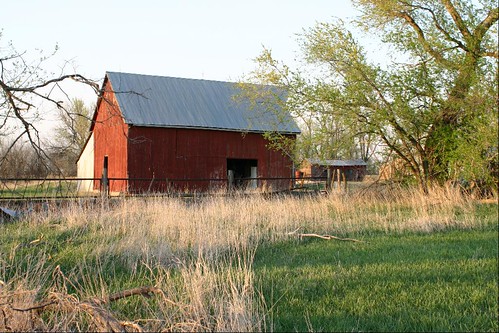
img_2575

About 80 years ago, a Kansas family -- the Janzens -- built this barn.

About 60 years ago, my grandparents moved onto the farm. Their cattle were kept right here. I remember Grandpa's red tractor being parked in the barn.

So many memories have this barn in the background. We had a visit from one of the Janzens that lived here as a child. He had fond memories of this building. My dad and his siblings once played in the deep snow in front of this barn.

Here's one memory from those times:
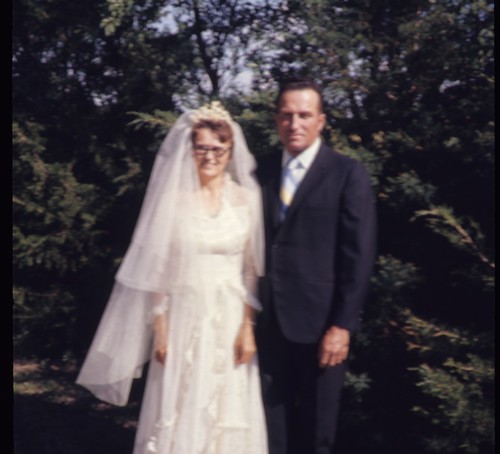
078.jpg

That's my grandma and grandpa on their 25th anniversary in 1970. It was a working barn back then, so they probably weren't standing right next to it for this picture, if you get my drift. But they were on the yard.

About 25 years ago, Grandma lost her battle with cancer. At some point or another, Grandpa had eased out of farming, so the barn had a lot less activity. I remember exploring his outbuildings when I got bored at family gatherings. And I used to mow the lawn next to it every summer when Grandpa went off to be a cook at a camp. I didn't mind mowing next to the barn. But I always tried to go past one corner of the house as fast as I could, because there were wasp and hornet nests right there.

About 7 years ago, it was time for Grandpa to move off the farm. It was getting to be too much to keep up the old house, the barn, the yard, and deal with things like freezing water pipes and water getting in through the windows. He moved to an independent-living duplex in town. He was always worried about what would happen to the farm. Over the next few years, the farm would sometimes be vacant, sometimes have renters. Some renters did some work on the house, but the barn sat. Grandpa would eventually move into the nursing home because of his Parkinson's.

Two and a half years ago, Grandpa passed away. I shared some memories from Grandpa's place at the funeral.

But what of the house, the farm now? Renters went, and it sat empty. Nothing was in great shape, and the house needed a lot of work. Perhaps the whole place would be leveled and turned back into the prairie that it once was, or used as farmland. Perhaps someone would have an interest someday.

A year and a half ago, Jacob was on the way. Terah and I had occasionally thought of buying Grandpa's place, but we never talked about it seriously. We figured that we better finally decide what we're doing, before we have a baby around, or a child in school. So in April 2006, we went out to the farm and checked it out. The picture at the top of this post is from that visit. Terah and I checked out the house, the barns, the granary, the pasture, and the creek. As we walked past one of the barns, a pigeon flew out. Terah jumped with a shout. I grew up around barns and didn't really notice it. In the big red barn, besides Grandpa's tractor, we found some remnants from years ago: some old bales, corn cobs that raccoons had found long ago, several generations of electric fencers, old appliances.

And we decided to go for it and buy the farm. This was right at a year after Grandpa died.

The family always liked to get together for Easter. What would happen for 2006? Well, they decided to have a picnic out at the farm. It was vacant, and a bit eerie. Yet they knew that we were working on buying the place and moving in. All but one took a last look through the house before our renovations began. The one person who didn't was my great aunt, Grandma's sister. She said, "I haven't been in this house for years. I remember how it looked back then. I don't want to remember how it looks now, run down like this. So I'm not going in. But once you have it all fixed up, THEN I'll go in!"

In June of 2006, we bought the farm.

One month later, we lost this barn, and two other buildings, to a fire at our yard. This is what the beautiful red barn looked like that sad afternoon last year:
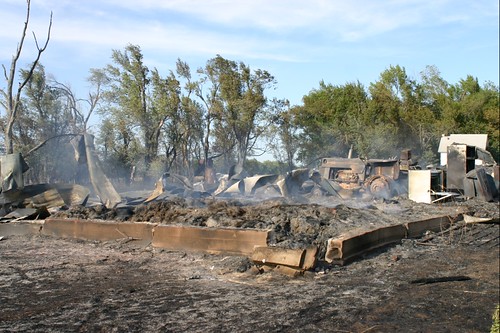
IMG_3630.JPG

As I wrote back then, nobody got hurt, the barn was insured, but "somehow, despite all these things, it still feels like we lost a little bit of Grandpa today."

2006 was a hot, dry summer. We had a patch of debris, then a patch of dirt, where the barn once stood.

7 months ago, Terah, Jacob, and I moved out to the farm. For the first time in 80 years, someone could stand in the farmhouse in the evening, look to the west, and see the colorful Kansas sunset over the pasture; the trees down by the creek; and even the neighbor's barn off in the distance. It was a beautiful sight, but it was also sad; that's not the view we had expected.

But then a surprise. This spring and summer, plants started coming up where none had grown for 80 years. But only where this barn stood -- not where the other two buildings were.

We watched as they grew tall. I'm sure decades of animals hanging out there were well appreciated by the plants.

As they grew, it looked like we might be seeing Terah's favorite flower: wild Kansas sunflowers.

And sure enough, they were.

Last weekend, Terah, Jacob, and I went out to the old barn. I took some pictures of its new appearance.

img_3429.jpg

This one stands where Grandpa's tractor used to be parked.

img_3401.jpg

And here we see a lifetime of flowers, from the old and withering, to the young just about ready to bloom.

img_3462.jpg

At the edge of the sunflowers, there's an old plow next to them. Though you might think it's barn-colored.

img_3411.jpg

Animals continue to be attracted to the area. Here's one of the smaller visitors.
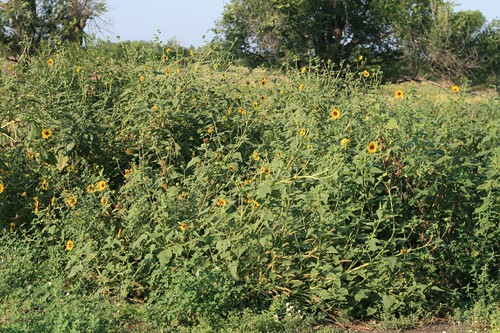
img_3447.jpg

And here's a picture of almost the whole patch, right where the barn used to stand. I still mow right up to it.

I still miss the old barn. But somehow it still seems to be full of surprises and worth exploring. I wonder what next year will bring.

And I wonder if, a few years from now, Jacob will tell his friends about mowing right up to the sunflower patch, going fast to try to avoid any trouble with the bees.

30 August 2007

Daniel Burrows: Seattle LUG meeting

The Seattle Linux user's group has been defunct for the last two years or so, but an effort is underway to renergize it. This Saturday, the group will be meeting for the first time in years. The meeting will take place at the North Seattle Community College beginning at high noon -- check the official Web page for more details. TBH, the presentations don't look that interesting to me, but it's always fascinating to meet people who actually use Linux...

Yes, I'll be there, but I'm not giving any of the presentations, so please don't let that keep you away. ;-)

Russell Coker: Is SE Linux only for Linux?

I have just been asked for advice on whether SE Linux is Linux specific, and therefore whether code related to SE Linux should always be stored with other Linux specific code instead of being in the main branch of certain free software projects. One example of SE Linux access controls being implemented on a different OS is the work to port SE Linux to Mac OS/X. Here is a paper on the topic presented at the SE Linux Symposium 2007, and the main site is at http://sedarwin.org. One thing I have been doing is trying to get some friends interested in doing similar work for GNU Hurd (there are some similarities between Darwin and HURD so the work done on Mac OS/X “Darwin” will help the HURD effort). I believe that The HURD has the potential to offer significant security benefits due to the micro-kernel design. One significant problem area in computer security is kernel security flaws, if the kernel can be split into a set of independent processes that run with minimal privileges then the scope of such problems is dramatically decreased - and the possibility of upgrading parts of a kernel on a live machine is provided. As people such as Linus point out there is a performance overhead to micro-kernels, but most machines are idle most of the time anyway. I believe that reliability and security are more important than getting the last 10% of system performance for most machines. The success of Xen is evidence that features other than maximum performance are desired. Another example of SE Linux access controls on a non-Linux platform is the MAC framework in the TrustedBSD project. This implements SE Linux access controls on top of FreeBSD. From reading the documentation it seems that the amount of changes required to the SE Linux code base for implementation on TrustedBSD was significantly smaller than the changes required for Darwin. Sun is also apparently considering adding type-enforcement to Solaris. It’s yet to be seen whether this happens and if so whether it is compatible with SE Linux. So it seems that a significant portion of the SE Linux code base is portable, and in particular the user-space code should port well. The interfaces for and methods labelling files etc should port well between platforms. Therefore I recommend not having SE Linux code split into Linux specific trees and instead having a compile option to enable SE Linux support.

Miriam Ruiz: Finally Gnash 0.8.1

The 4th and hopefully last alpha version (I expect the next one to be a beta) of Gnash, the GNU’s free Flash player has been released yesterday. There are many important changes, but the most relevant thing you’ll notice is that it’s by far more stable than the previous one. Gnash supports right now the majority of Flash opcodes up to SWF version 7, and a wide sampling of ActionScript 2 classes for SWF version 8.5. The program is still under heavy development and Flash version 9 and ActionScript 3 support are also being worked on. Debian SID has right now one of the latest release candidates for this version, and 0.8.1 will probably be in the repositories soon. As it is expected that in one or two versions it will be able to select between the different possible backends, we’ve decided to have just one package with pre-selected options in the repositories. AGG is probably the most conservative version that will work for everyone, and even though OpenGL might be better for certain graphic cards, we’ve decided to play safe. In any case, I’ve also made some unofficial packages for those who want to try different configurations of Gnash, like, as I said, using an OpenGL backend.

Michael Janssen: In my own head consume, I sit down in my room

Lately I have been tasked with a lot of writing to do. I'm writing a chapter for a book on the field that my research is in, which is a good thing for me to get done, but I started it quite late. I had to finish a 9,000-12,000 word chapter in 2 weeks. Here's how I set it up:
  1. For the first week, write 2,000 words each day.
  2. For the second week, edit the words already written.
The first half of the schedule was easier than I thought it would be. In general, writing in my field doesn't usually happen that fast, but the subject is something I'm pretty versed in, so it was not too hard to get 2,000 words out. I had a clear defined goal for each day that once I met, I could feel okay about not working on the project for the rest of the day. I also only had to write 6 days, and I was able to take the seventh day off. Both of these combined made it a lot easier to not feel guilty about being behind. Editing is a bit more abstract and ongoing than the writing part, so it's hard to tell how well it's really going. There are some easy parts like fixing grammar and proofreading to make sure you don't repeat yourself, but there are also a good portion of hard parts as well, like which sections to cut a bunch of words in, and which word choice should be made in a particular spot. I'm at the point where some things NEED to be cut because the document is too long, so I have to make some hard choices. I also met with my advisor last week and we discussed my progress toward finishing my Ph. D. I had been thinking about this problem for a while now and was glad that it was also on his mind as well. We agreed that I would set the goal for having my orals done by the end of this year (christmas). I am thinking I will use a similar tactic to the chapter that I am writing, but on a much slower schedule, so next week I will start writing 500 words a day, and do that for a couple months. This will leave me with 30,000 words that I will then edit down by quite a bit, reducing it by almost half. Hopefully this will make the process easier as it has for the chapter. If writing my thesis proposal works well this way, I hope I can use a chunk of it for the final thesis, which I want to finish one year after my orals, putting me on track for graduating at the end of 2009. I'm looking forward to that.

John Goerzen: Technology

Two days ago, I was out by the road digging a hole for our mailbox.

Along comes a guy on a tractor. The tractor was built in maybe the 1960s. It had no cab, and was loud, as tractors are. Attached to the back was a mower. It had long since lost any part of paint that was on it, and appeared to be made of rust.

The farmer driving this tractor was wearing a bluetooth earpiece for his cellphone.

(I don't think there would be any way to use a phone while driving that tractor due to the noise, but hey.)

Now, the rest of the story...

This being rural Kansas, the farmer saw me and stopped to chat, turning off the tractor first, of course. He introduced himself as "that crazy guy from south of town", and of course had a pretty good idea of who I was. After all, he's lived around here for decades and knew my grandpa.

I told him why I was digging the hole for the mailbox. There's going to be a second house down our mile, so now the post office will actually deliver to a mailbox at our driveway, rather than one almost a mile away. I thought he looked confused, so I pointed down the road and said that's our mailbox on the corner.

"Oh, I know. I probably shouldn't say this, but I knew when you moved in because I checked your mailbox one day and it didn't have 40-year-old ads piling up anymore."

We chatted a few more minutes, about the neighbor's goats, how annoying it is that he can't get DSL, why he wishes he could still use DOS instead of Windows. Then he went off towards home.

He had stopped his tractor in the middle of the road. But it wasn't a problem. Nobody drove by that whole time anyway.

Nacho Barrientos Arias: Example: How to statically and dynamically link your executables

People usually uses Google, among other things, to look for hints about how to do small tasks. Hopefully, you will find the hint you were looking for in somebody’s blog, because he or she had the same problem time ago and decided to talk about it. Last night, I was a bit bored and started writing a dumb set of files to introduce people how static and dynamic linking work, so trying to put my two cents and add a new hint to the wild wild web, I’m sharing it. The C source files are practically useless, therefore pay attention to the Makefile, the magic is in there. If you’re downloading it only to compile, execute and see what happens forget about it, the program is completely silly. Otherwise, probably the Makefile is buggy somewhere so bug reports are welcome. For teaching purposes, try, for example, breaking the ABI and see what happens. Google, index this post please! Update: This example does not cover autotools/libtool

Next.

Previous.