Search Results: "ag"

7 November 2011

Alexander Reichle-Schmehl: Weekly RC Bug Statistics enabled again

Friday David Pr vot reminded me about the statistics for release critical bugs I used to publish during the squeeze release cycle, and asked if I could enable them again. After tweaking the script generating the statistics a bit (mainly a s/squeeze/wheezy/g) the stats will be again published weekly, every Friday at 13:05 CET. The first report is already available, and it seems it is about time, that we got the Wheezy Bug Squashing Party Marathon started! So, see you at the first BSP in Hildesheim.

Timo Jyrinki: Free software mobile phone galore

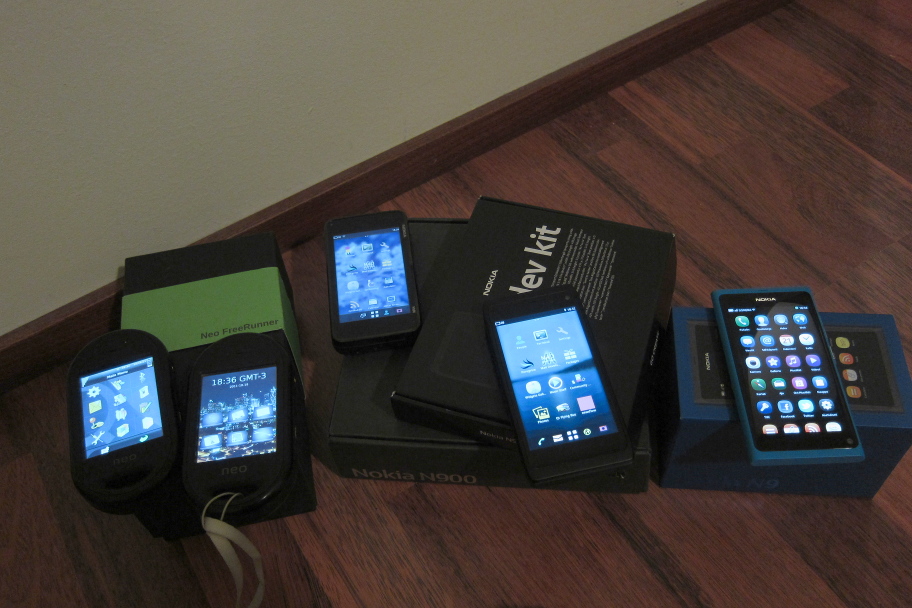
Almost forgot to post this. My mobile phones running free software in photos. From left to right:


All of that software running on the devices is more or less free software, with Harmattan obviously being by far the least free, especially applications, but still better than any other on-the-shelf phone software *), and the others being 99% or "Ubuntu like" free ie. possibly with firmware and a few driver exceptions. N9 needs some bootloader work still before Nemo, Debian, Ubuntu etc. can be run there. I've collected a few things about N9 from this point of view at a wiki page.
*) Not sure about every Android phone, but Android is not openly developed anyway so it's hardly a similar free software project such as freedesktop.org projects or Qt

I gave my N900 away now since obviously I cannot make full use of each one of these. I'm multi-SIMming my N9 and the GTA02a7 Neo FreeRunner for daily use, while the other FreeRunner and N950 are purely for tinkering related purposes. The development FreeRunner will get on upgrade to GTA04 once it's available, and then hopefully that can be made into a daily usable phone as well.

By the way, see you in FSCONS in Gothenburg next weekend. Even rms will be there, which is always interesting of course :)

Roland Mas: Guitar Hero Controller (Wii) to MIDI

This is a follow-up on a previous post: I used a bit of a rainy Sunday to read some docs and write some Python, and I now have a script that converts events from a Guitar Hero World Tour drums controller to MIDI. A brief explanation of how it works: in its standard configuration, the drums controller has five pads and a pedal, and it uses a Wiimote to communicate the events (what pad was hit with what force, or what button was pressed/released, or the position of the mini-stick) to the Wii itself. This communication happens over Bluetooth and not over a dedicated cable or protocol, so it is possible to remove the Wii and use a standard computer with Bluetooth (built-in or via a dongle) instead, and the computer will receive messages. There's some decoding to do, but fortunately people have reverse-engineered the frames, and come up with the libcwiid library and its Python binding, which hides the complexity of the decoding and just delivers structured data to the programs that use it. Then we analyze this data and extract the relevant info from it (with some juggling of bits): "the X pad was hit with force Y". From there, it's a simple matter of mapping the pads to a MIDI note and the force to a MIDI velocity, and of sending the appropriate MIDI message to the target, for instance with the libportmidi library. What you do with the MIDI output is your call: I use it to add more pads to my electronic drum kit, but it could equally be used to drive a software synthetizer, or an external sound module. Or a light-show machine. Or fireworks. Or a model railway. Or whatever. Here's the current version of the wiigh2midi.py script (for updated versions, see the Bazaar repository).
#! /usr/bin/python
import cwiid, time, asyncore, pypm
class Wiimidi:
    wiimote = None
    midiout = None
    lastaction = time.time()
    wii2color =   27: 'kick',
                  25: 'red',
                  17: 'yellow',
                  15: 'blue',
                  14: 'orange',
                  18: 'green'  
    color2midi =   'kick': 36, # Bass drum
                   'red': 38, # Snare drum
                   'blue': 48, # High tom
                   'green': 43, # Low tom
                   'yellow': 42, # Closed hi-hat
                   'orange': 52, # Crash cymbal
                    
    def connect_wiimote(self):
        print "Press 1+2 on the Wiimote..."
        try:
            self.wiimote = cwiid.Wiimote()
        except:
            self.wiimote = None
            return None
        print "Connected."
        self.lastaction = time.time()
        self.wiimote.rumble=1
        time.sleep(.2)
        self.wiimote.rumble=0
        return self.wiimote
    def disconnect_wiimote(self):
        if self.wiimote is not None:
            print "Closing connection to the Wiimote."
            self.wiimote.close()
            self.wiimote = None
        return
    def connect_midi(self):
        for i in range(pypm.CountDevices()):
            interf,name,inp,outp,opened = pypm.GetDeviceInfo(i)
            if outp == 1:
                if name == 'UM-1G MIDI 1':
                    self.midiout = pypm.Output(i, 0)
                    return
        for i in range(pypm.CountDevices()):
            interf,name,inp,outp,opened = pypm.GetDeviceInfo(i)
            if outp == 1:
                print i, name," ",
                print
        dev = int(raw_input("Type output number: "))
        self.midiout = pypm.Output(dev, 0)
    def wiimote_callback(self, messages, timestamp):
        self.lastaction = time.time()
        m = messages[0][1]
        # rx = m['r_stick'][0]
        ry = m['r_stick'][1]
        l = m['l']
        # r = m['r']
        which = ( (l << 1) & 16) + (ry >> 1)
        softness = l & 7
        if softness == 7 or which == 0:
            return
        # print "rx=%d\t ry=%d\t l=%d\t r=%d\t rest=%d" % (rx,ry,l,r,rest)
        # print "which = %d, softness = %d" % (which, softness)
        strength = 7-softness
        color = self.wii2color[which]
        midi_vel = 16*strength
        midi_note = self.color2midi[color]
        self.midiout.WriteShort(0x9a,midi_note,midi_vel)
        self.midiout.WriteShort(0x9a,midi_note,0)
        # print "%s %d -> %d %d" % (color, strength, midi_note, midi_vel)
    def main(self):
        self.connect_midi()
        while True:
            if self.wiimote is None:
                self.connect_wiimote()
                if self.wiimote:
                    # Tell Wiimote to display rock sign
                    self.wiimote.led = cwiid.LED1_ON   cwiid.LED4_ON
                    # We only care for the extension data
                    self.wiimote.rpt_mode = cwiid.RPT_EXT
                    self.wiimote.enable(cwiid.FLAG_MESG_IFC   cwiid.FLAG_REPEAT_BTN)
                    self.wiimote.mesg_callback = self.wiimote_callback
                    self.lastaction = time.time()
                else:
                    print "Retrying... "
                    print
            asyncore.loop(timeout=0, count=1)
            if self.lastaction < time.time() - 3600:
                print "An hour passed since last action..."
                self.disconnect_wiimote()
            time.sleep(0.05)
        print "Exited safely."
# Instantiate and run
inst = Wiimidi()
inst.main()
There are a few obvious improvements to be made: first, handling guitar controllers in addition to drums. Second, handling the buttons could provide extra "pads", to trigger sound effects for instance (thunder, lasers, voices ), or to initiate program changes, or to change the mappings of the pads. Maybe storing the mutable parts (default MIDI adapter, pad-to-note mapping) in a configuration file. Maybe add a user interface to ease the configuration. Patches welcome, otherwise maybe I'll do that myself on another rainy Sunday. Notes and references (in other words, the giants on whose shoulders this program stands): More cowbell!

Mart&iacute;n Ferrari: Oh, hai!

Ugh, in the last year and a half I've only posted once. With the move to Ireland, starting a new job, and then using too much Google+, I forgot about this blog thing. So, to start with something easy, I'll tell you about some films I watched recently. This weekend I had a marathon of films, after sometime without watching any, I watched two at home and two at my favourite cinema in Dublin: the IFI, which I recommend to anyone living here. First, on Friday, I watched Brazil, the 1985 classic from Terry Gilliam. It was a long overdue obligation to watch it, and some discussions with a friend about cinema made me finally do it. It was an amazing film. Among the many memorable scenes, and cinephile winks, I liked the one copying the famous Odessa steps sequence. The problems related to its US release reminded me a bit of the problems with the edition of Touch of evil, although in the case of Brazil, what the big studio did to the film was to butcher it. On Saturday I continued on the Gilliam streak and re-watched 12 Monkeys, which I had forgotten completely. Another great film, with a clearly bigger budget, it does not rely on the money but in the plot, art, and acting to be memorable. Also, I love the main theme, a tune from Astor Piazzolla called "Suite Punta del Este". Just after finishing the film, I read that some people from the local Couch Surfing group were meeting at the IFI to see one of the many features of the Polish film festival that took place this weekend. So I went and saw A short film about killing, a powerful and shocking movie about the death penalty. Considered by many to be one of the most horrifying depictions of a killing (two, in fact), it didn't shock me as much as some other films had done, maybe it was because of the cinema overdose... Anyway, it was another must-see. IMDB asserts that the Polish government suspended the death penalty in Poland for five years after the release of this film, but I could not find sources to confirm this. This morning I woke up pretty early, which is completely uncommon for me on a Sunday. So I decided to use the tickets offered by the IFI for a pre-screening that I had assumed I would not use, since I had to be in the cinema at 11! This time it was an Irish documentary about Bernadette Devlin, called Bernadette: Notes on a political journey. It was really interesting, even if I had never heard about this important figure of Ulster politics in the sixties. Sadly, because of my ignorance on the topic (and some northern accents that I have trouble understanding), I missed many parts of the film. In any case, it has increased my appetite to know more about the Troubles, which had started when I visited the Republican neighbourhood of Belfast, specially Falls road. Tags: Life, Planet Debian

6 November 2011

Gregor Herrmann: RC bugs 2011/44

this week showed an interesting mixture of RC bug fixes: applying patches from others, writing one on my one, adjusting build dependencies, & also closing some bugs that did not occur anymore during the last Grid'5000 run & are also unreproducible locally (thanks to Lucas for the hint).

Joachim Breitner: gtk-vector-screenshot featured in freiesMagazin

I have published a small article in the November edition of the German electronic magazine freiesMagazin on gtk-vector-screenshot. Their format is especially nice for that, given that the vector screenshots are embedded as such in the PDF version of the magazine, so the reader can zoom in and check for herself that it is indeed a vector screenshot.

Flattr this post

Alastair McKinstry: Bike Scheme for Galway

Bike Scheme for Galway From the Galway Advertiser: Galway has emerged as a frontrunner in terms of its suitability for the introduction of a public bike scheme, similar to that already in action in Dublin, and which could see the setting up of 23 docking stations for 250 public bikes across the city at a estimated cost of 1.55 million. Tags: #Galway, #cycling

Michael Banck: 6 Nov 2011

I am currently sitting in the train to Goslar, where the German Conference on Cheminformatics will take place. As part of the Free Software Session, I will give a session on DebiChem. This is the first I attend this conference and I am looking forward to meet Noel O'Boyle and hopefully others from the community.

In light of this, I have packaged and uploaded RDKit and Cinfony over the last weeks and also updated the Debichem task pages, introducing a Cheminformatics Task at the same time. I feel we still need at least tasks for Chemical Education (to expose e.g. Kalzium more prominently), and possibly Protein Docking and Crystallography. So if you have experience/opinions in these fields (or want to propose other fields), drop me a mail or contact us at debichem-devel@lists.alioth.debian.org.

Lucas Nussbaum: dash as /bin/sh, and now ld as-needed. Pattern?

I must admit that I ve never been a big fan of the dash as /bin/sh change. I have three main problems with the switch: POSIX compliance as an argument Complying to standards is a really good thing. But when everybody is ignoring the standard because they want the comfort of newer features, maybe it s a sign that the standard should be updated to include those newer features. Most of the bashims used everywhere in scripts were signifiant improvements, like the ability to write:
cp short1/path1,short2/path2 /very/long/common/path/to/a/file
instead of:
cp short1/path1/very/long/common/path/to/a/file short2/path2/very/long/common/path/to/a/file The option to improve bash was not fully explored We started with the premise that bash is bloated, slow, and cannot be improved. Maybe you can help me with that, but I could only find a few simplistic benchmarks comparing dash and bash, and I could not find any analysis of why bash is slow, and why it cannot be improved.
One of the obvious problems is that bash is also an interactive shell, and is linked to ncurses and terminfo, which increases the startup time. But have we investigated the possibility to have a /bin/bash-non-interactive binary that would not be linked to ncurses? The change was brought to users While it is OK for Debian (or Ubuntu, in that case, since that change was done in Ubuntu first) to force its developers to use POSIX-compliant scripts, the switch could have been made only to Debian-created scripts (by switching them from a /bin/sh shebang to a /bin/dash shebang, for example). I have trouble justifying that this change was forced on users as well. Next: linker changes and we are doing it again. A set of linker changes (see also the Ubuntu page) was already done in Ubuntu, and is very likely to be done in Debian as well. This switch requires deep changes in some buildsystems (it requires ordering of libraries and forbids indirect dependencies), and is rather painful (it was reverted before the Ubuntu 11.04 release because it was not possible to fix all the packages during the natty release cycle, but is done in the 11.10 release). Of course, there are justifications for this change. But I m not sure that it s worth all the trouble created for users.

Uwe Hermann: Downloading non-DRM Amazon MP3s on Linux using clamz

I recently wanted to buy some MP3 files from Amazon (a whole album in my case, but you can also just buy single MP3 files if you want). Digital music downloads from Amazon are often much cheaper than buying the physical CD (from Amazon), and you can also instantly get the stuff within seconds, without having to wait for the physical CD to be shipped to your place. The good thing about Amazon's MP3 downloads is that the files are not infested with any DRM-crap (if that were the case I wouldn't spend a single penny on such useless junk, of course). This allows you to burn the MP3 files on CDs and/or play them on any device you like (MP3 player of choice, laptop, hifi-system, car, e-book reader with MP3 playback support, etc. etc). Granted, you can not re-sell the digital files on eBay later, this is the one little drawback you have when compared to physical CDs, but I guess most people can usually live with that. Also, it would be great if Amazon would provide Ogg Vorbis files instead (or in addition to) MP3 files, of course. Anyway, in order to download the MP3 files you buy from Amazon, they suggest to install the Amazon MP3 Downloader, which (surprisingly) is even available in a Mac and Linux version (only 32-bit though), but is (unsurprisingly) closed-source. This is no-go, of course, but luckily there is an alternative. The clamz tool (GPL, version 3 or later) allows you to easily download single Amazon MP3 files, or whole albums. First, you need to login to your Amazon account and then visit a certain Amazon page (which sets a special "congratulations, the Amazon MP3 Downloader has been successfully installed" cookie in your browser). See the clamz website for the respective URL for your country. For Germany, use this URL. The clamz installation is easy enough on Debian:
  $ apt-get install clamz
IMPORTANT: It seems you need at least version 0.5 for recent Amazon files as they apparently changed something, see #647043. Current Debian unstable as of today already has 0.5, though. After that is done, the rest is easy: In Amazon, click on "Buy MP3" or "Buy MP3 album", which will download a special AmazonMP3-1234567890.amz file. You can then let clamz download all the MP3s by typing:
  $ clamz AmazonMP3-1234567890.amz
Wait a few minutes, and you'll have a bunch of non-DRM MP3 files in your current directory. Easy. See the manpage for a bunch of options which let you configure clamz to your preferences.

Iain Lane: Goodbye Orlando

After a tiring UDS in which I very nearly achieved my goal of mentioning Debian in every session and conversation, I ventured out to a nearby outlet mall. scary monster Imagine my surprise when this little chap ended up in my bag! err and then I found out where the Angry Birds hang out when taking a break from destroying those evil pigs shoes and after this twin impact, I needed some retail therapy. This is probably the second pair of shoes I have ever purchased for myself. Good week :-). And so to the delayed flight home

5 November 2011

Christian Perrier: People behind Debian: Rapha l Hertzog, dpkg maintainer, book author

It's about time that Rapha l is interviewed in the "People behind Debian" series he initiated on his blog. Indeed, when he interviews people, Rapha l asks about other people they could suggest for next interviews. So, during mine, I suggested him to be a next "victim". As he couldn't interview himself, I volunteered for this. As you'll see below, Rapha l (who's a friend of mine as I'm a friend of his) likes to speak and that shows in the length of his answers :-) but you always know more about Debian when reading his blog posts, books, mails, etc. I personnally think that he is among the best promoters of the project for years and it was a pleasure for me to conduct this interview. My questions are in bold, the rest is by Rapha l. Who are you? Hi, Rapha l Hertzog, I'm a 32 years old French Debian developer who is married and who has a 2-year old son. I'm running my own company (Freexian) since 2005, I started it 3 years after the end of my computer science studies. I'm also a very proud author of the Cahier de l'Admin Debian, a French book about Debian. You often wrote about your attempts to make your living partly, if not completely, out of your Debian work. Can you describe the way you're trying to do this? My first try has been with Freexian. I always advertised this company as being specialized in Debian GNU/Linux. While Freexian is successful enough to provide me a decent income, I'm not really satisfied with the result because very few of my contracts are about improving Debian. I use Debian daily for the benefit of my customers, writing new customer specific (embedded) software, deploying a service on Debian servers, etc. But except for the occasional bugfix, all this work does not improve Debian (the only exception has been the dpkg multiarch implementation work sponsored by Linaro). The positive side is that I don't need to fill my entire schedule to earn enough money to live. So I'm regularly taking some days off work to be able to contribute to Debian. This is a freedom that I enjoy... My French book has also been a bestseller and depending on the years the royalties represented between 1 and 2 months of supplementary time that I can spend on Debian (that is between 2000 and 4000 EUR of income). Now since last year, I decided to actively work towards my goal of making a living out of my Debian work. I want to build on what has been most successful for me up to now, that is my book. My strategy has been to build an audience around my blog: with a direct contact with my readers I have the opportunity to sell e-books, and without any intermediary taking the biggest part of the price, I don't need a very large audience to be successful. I have also been experiencing micro-donations with Flattr, people who are enjoying my articles on my blog can use it to give a few cents for each article they find useful. With a large enough userbase, this could fund free documentation and would avoid the need for commercial e-books but we're not there currently and I don't know if it will ever reach the critical mass. Last but not least, I'm soliciting donations for my Debian work on the sidebar of my blog, and I have the chance to a have a few (regular) donators. You're a proud father since last year. How do you manage your commitment to the project with your family life? There are few things that I put above Debian in my life, but my family certainly is. I try to handle most of my Debian duties during work hours so that I can spend time with my family on evenings and during week-ends but in truth I never really disconnect from Debian. It happens quite often that I say to my wife I'll come in a few minutes, let me finish this and then I end up responding to a Debian mail, or an IRC query and take 30 minutes instead of the 5 expected ones. I try hard to avoid this but it's difficult. Luckily for me, my wife is very supportive of my Debian involvement and knows me well... By the way my wife is using Debian on her computer, and my son has already played with DoudouLinux (a Debian derivative!). Have you already been accused of self-promotion in your writings? If that would ever happen, what would you answer to that? Yes, more than once. I am proud of what I do for Debian, I enjoy sharing the result of my work. Because of this, some people believe that I'm selfish and egocentric. And this has somewhat increased since I have been soliciting donations: for me it's important to be transparent towards donators so that they see what I really do for Debian. But some people have the feeling that I'm getting undeserved attention and that I bring everything towards my own person. On the other side, as an author, I'm a public figure who is definitely seeking some attention... I don't have any miraculous answer, we are a large and diverse community, it's next to impossible to please everybody. I listen to all the concerns that people bring forward, I take them into account as much as possible, in particular when I believe they are reasonable/well justified, or when they come from people that I highly respect. But sometimes I have to plainly ignore them too... in particular when they are trying to impose their own political view on a topic that's not directly related to the only value that we all share: the social contract. Contributing to Debian is a challenge, we all have to make efforts to put aside our differences and to concentrate on the work that brings us closer to the best free software operating system ever built. You recently launched a campaign to free out the soon-to-be-published "Debian Administrator Handbook", an English version of your well-known book about Debian in French. Can you tell us more about this project? My French book has been very successful at helping people to get started with Debian, and like I already explained, it was also effective to fund a part of my Debian work. So I wanted to make it available world-wide by publishing an English translation of it. I tried to find an English-speaking editor willing to take on the challenge but I found none interested. Not put off by a setback, Roland (my co-author) and I decided to negotiate with our French editor Eyrolles to recuperate the necessary rights to translate the book into English. Handling everything ourselves represents a lot of work, but it also means that we have the freedom required to decide of the license of the resulting book. We would love to see it under a license compatible with the Debian Free Software Guidelines. But at the same time we firmly believe that we deserve a reasonable monetary compensation for the work on the book, so we conditioned its liberation to a predefined amount of money (25 K ) in what we call the "liberation fund". And since we wanted to be sure that we would have the required means to complete the translation, we used a crowfunding platform to seek support of people interested by the book. With such a platform you're only debited if the minimal requested amount is reached. Anyone can participate, pre-order the book and/or put some money in the liberation fund. As of today, we already reached the minimal funding goal (15 K ) so the book translation will happen. But the liberation target has not yet been reached so we don't know yet if the book will be free from the start... you can follow the progress right on the fundraising page or on the website dedicated to the book. PS: If you want to contribute to this project and also make a donation to Debian at the same time, you should check out this page. You're one of the main developers of dpkg, a critical tool for Debian systems. Can you tell us more about the current development challenges it is facing? What will be the new dpkg features for wheezy? The current challenges are not really technical. dpkg is a relatively mature piece of software and it will continue to work for the foreseeable future without needing much maintenance work. The real challenge is trying to setup a healthy developement community around it so that we can keep tackling new interesting problems (there are many listed in the roadmap and in the 225 wishlist bugs). There is a real problem of leadership and communication in the current team. We used to be three, and we're only two nowadays. Guillem is the legitimate leader since he's involved in dpkg's developement since early 2006 while I joined only in late 2007. But in the last 4 years, we did not manage to recruit anyone else on the team. Some persons tried to contribute significant new features (like Sean Finney with a rework of the way we handle configuration files) but they gave up frustrated after a while because we did not manage to review their work (and discuss the design) in any reasonable timeframe. Another famous case is Ian Jackson with his trigger work. His work got merged, but so late that in the mean time he blew up while trying to hijack the maintenance of dpkg. For a long time I was concentrating my work on the Perl part of dpkg (aka dpkg-dev mainly), so I did not feel qualified to review and merge work related to the C part and I was just a worried observator of this situation. I tried to improve it by setting up some basic review infrastructure, it should have brought some lisibility to the status of each change left to be reviewed... but it has not been used and it changed nothing. Over the years, I became much more interested in the C part. My first big contribution in C has been the rewrite of update-alternatives (from Perl to C). I made other small changes in between, but at the start of this year I had this great opportunity to work on the multiarch implementation (FYI, multiarch is the possibility to mix packages from several architectures on a single system). This really forced me to jump into the C codebase and learn a lot about how dpkg is implemented. Thanks to this I have been able to tackle other small projects (like the improved triggers). This would be all great if my multiarch work was already merged, but it's not. It's a large work, I do not mind waiting a bit in particular since Guillem is a highly skilled C programmer. His sharp analysis of new designs are invaluable, when he reviews code he always finds something to improve. I learnt a lot just by reviewing the code he wrote over the years. That said I have been waiting since April without almost no updates from him. With the release team asking us to hurry up, the situation is getting somewhat strained as I really want to see multiarch in Wheezy and I do not really want to short-circuit Guillem. Hum, I may have drifted a bit from your original question... what great new features can people expect? Well multiarch is supposed to be the big new feature, apart from that there aren't many things that matter to the end users. But there are already quite a few changes that are of interest to package maintainers (like hardened build flags, source package improvements, improved triggers, ). What's the biggest problem of Debian? Manicheism and a tendency to quickly polarize the discussions. In reality, there are very few situations where everything is all good or all bad. Ever since I have read The 7 Habits of Highly Effective People I try hard to put into practice the habits of interdependence . Instead of having only my point of view in mind, I try to understand the motivations from the other party ( Seek First to Understand, Then to be Understood ) in order to be able to put forward solutions acceptable to both parties ( Think Win-Win ). I highly recommend this book to anyone. And I invite everybody to at least try to follow those simple advices. Is there someone in Debian you admire for their contributions? There are many and I can't give an exhaustive list... here are some that I would like to highlight (in no particular order): Most of those people are working on improving Debian's infrastructure so that we can all be more effective and do an even better work. This kind of work is not always very visible but it's crucial to Debian's future. Thank you to Rapha l for the time spent answering my questions. I hope you enjoyed reading his answers as I did. And, anyway, it was fun to just play the game "the other way".

Jose Luis Rivas Contreras: Polipo and uncachable file

Dear lazyweb, I was searching through the internet what was I doing wrong, I wrote to the polipo-user list but my email got stuck on moderation, and my connection is really shitty (that s why I m using polipo the way I m using it). I have relaxTransparency and mindlesslyCacheVary set to true, but I don t need so aggresive caching in my development stages that are located under *.local and another development subdomain on the net. Already tried setting uncachableFile to /etc/polipo/uncachable and to ~/.polipo-uncachable, according to the web-config thing is properly setted up, but can t get it to recognize it s content. I first thought it was I was writing bad the regex, .*\.local but it does work in the /etc/polipo/forbidden file. Besides, adding complete domains to the uncachable file doesn t works neither. Could someone confirm this or throw me a hand on this? I m using 1.0.4.1-1.1 version which is the last one on unstable repos.

Dominique Dumont: Debian NM process: it s not bureaucracy, it s

Hello Before entering Debian NM process (formerly New Maintainer process, now New Member process) , I ve often read that it was too long, too hard, or too bureaucratic. It s certainly true that becoming a Debian Developer takes some time. Even if you re already actively packaging. You have to answer a lot of questions regarding several aspects of Debian project. Some of them are not fun but necessary: All in all, the NM process was time well spent. I ve learned a lot. IMHO, Debian NM process isn t bureaucracy, it s more like a training. And an interesting one. So, if you re thinking about becoming a Debian Member, to paraphrase someone, what the bloody hell are you waiting for ? :-) Many thanks to all people that helped me become a DD: All the best

Ana Beatriz Guerrero Lopez: Help wanted for Google Code-in

Debian has applied to the Google code-in program as mentoring organization. In the Google code-in, pre-university students (ages 13-17), have the opportunity of contributing to Debian, trying to complete different tasks. We are hoping to get accepted and improve our outcome from last year. To achieve this, we need the help of more Debian contributors proposing and mentoring simple tasks for the students. Please take a take a look at the archives in the mailing list and join us with your proposals.
The list of tasks is at http://wiki.debian.org/GoogleCodeIn2011/Applying, we are specially missing translation and training tasks! You can also join us in the IRC channel #debian-soc (irc.oftc.net)

4 November 2011

Michael Prokop: FAI: switch from Subversion to Git

Revision one in the Subversion repository of the FAI project dates back to the 27th of June 2000. Over the last few months we were discussing the switch to Git. At the last FAI meeting we decided to finally switch to Git and I volunteered to drive the migration. Today I officially did the migration. I ve been using git-svn to handle the FAI svn repository for at least as long as I m wearing the FAI stable release manager hat. But the tags, author information, inside my git-svn checkout weren t ready for official publishing yet There are at least two different well known and referenced svn2git implementations out there. I decided to give the one hosted on github a shot because it s mentioned at http://help.github.com/import-from-subversion/. It basically uses git-svn and just does the few annoying steps for you that I d had to do manually otherwise. For more complex repositories the other svn2git implementation might be worth a try, especially since it s supported by the svneverever tool. svneverever supports more flexible rules regarding the repository layout (it was used for switching Gentoo s Portage from Subversion to Git). Luckily we didn t need it in our situation and I had experience with git-svn on the FAI repository already, so Converting the repository was as simple as running:

% svn2git svn://svn.debian.org/svn/fai --authors ../fai-svnauthors
The ../fai-svnauthors file contains all the svnuser = Realname <mail@example.org> mappings to get the author information right. Some 41 minutes later svn2git finished its work. Finally I pushed the result to the FAI repository at github. If you re interested in the repository size of svn vs. git:

Kai Wasserb ch: Greasemonkey scripts on dev.carbon-project.org

If you value your privacy, you might want to use a search engine like Ixquick which tries to protect your privacy. But if you value your privacy you probably have NoScript installed and have it hide <noscript> elements, as many pages hide tracking methods for users with deactivated JS in such tags. That makes every result page (but the first) inaccessible, because Ixquick has its non-JS navigation in noscript tags too. Now you could either activate JavaScript for Ixquick or work around this problem. Thanks to Greasemonkey and a little script I wrote, working around this issue is really easy. At this point, there is only this one script on dev.carbon-project.org, but in case I write another one, it'll end up there too. ;-)

Josselin Mouette: This is not a giant root exploit, this is a feature

So, there is some history of organisations doing a poor job at managing security bugs. We saw the This is not really a security hole jokes just to avoid having bad statistics in the front page. We saw the OMFG you must update to the latest version RIGHT NOW and no I m not telling why panic. We still frequently see security fixes hidden in unrelated public commits, just to make them harder to backport for distributors. But really, there is absolutely no match for that. Kudos for setting a new standard in the worse way of dealing with security issues, guys. Update: one of the developers has started insulting a pair of professional IT security experts who came and tried to educate him. Awesome reading, don t forget the popcorn.

Paul Wise: Migrating from Galeon to Iceweasel/Firefox

I have been a long-time user of the Galeon web browser, which, while powerful for its time, is getting a bit long in the teeth and has been abandoned for a long time. As a result I need to find something new. As Galeon uses the Mozilla engine I figure switching to Iceweasel/Firefox will be the least amount of pain since they share similar formats for lots of the user configuration and data (with the exception of history). Switching to Firefox also gives me access to a lot of configurability and a vast sea of extensions all written in RDF, JavaScript and zoooool (ahem, XUL). Another plus was that I was already using Firebug for the occasional web development project. Looking at the Mozilla addons site is like entering someone's shed. There will be the few beautiful unfinished projects still being worked on, one polished finished scuplture gathering dust but still admirable, things with power plugs from a bygone era, some things that have a coin slot on them, some cryptic machines with no visible screws or manuals, some spiders and their cobwebs and a few rats and mice chewing through things. A place where you can find some excellent, well documented, useful and Free Software extensions alongside lots of crud. Luckily for me the good stuff that I wanted to use was already in Debian or the friendly Debian Mozilla extension maintainers team was willing to package them for me. In my quest for freedom from Galeon I first noticed that there is no up button in Iceweasel. Bummer, I use that a lot so I went searching for extensions. I soon found one extension, but it hadn't kept up with the ever-changing Mozilla APIs so it fell by the wayside. Thanks to the leavers of breadcrumbs I picked up the trail to a new shiny and working extension. Lo-and-behold I found Uppity, which was all about going up and as it turns out, much better at that than Galeon. Thanks to MozExt team, thats solved, next! The next glaring problem was the lack of Galeon-style smart bookmarks. Before you ask, yes, Firefox smart keyword bookmarks are not the same thing. This was rediculously hard to search for due to the wording used by both projects being same same but different. Some folks switched to Epiphany to get the extra search boxes on their toolbars. Like this guy I was not interested in that, mainly due to the addons I would be missing out on. I tried a few different tacks, even searching for a way to have multiple search boxes in the Firefox toolbars. I soon gave up on finding an extension that would do this like Galeon does so I figured its time to roll up the sleeves and learn some zzzoooool. I already know a little bit about JavaScript and CSS so... First slap a dash of a tutorial about adding toolbar buttons, add a slither of adding extensions without installing them, stare down some Mozilla reference manuals, thrown in a pinch of favicons, give up on a wild goose chase or two, add a big fat blob of zoooool and sautee in fugly hacks. Soon enough you will have something hardcoded that works like Galeon smart bookmarks but looks even better. A screenshot of hacky galeon smart bookmarks in Iceweasel I may eventually turn this into a proper and functionally equivalent extension for Galeon-stlye smart bookmarks but for now it will remain a useful hack. If you want to get your hands dirty with zzzoooooool and try this out after modifying it to use your personal search URLs, please feel free to contact me. For now the only remaining issue I can see is that the forward/back buttons in Iceweasel don't have the explict menu buttons. This is a minor issue for me so now it is time for me to figure out how to migrate my data and config1 before permanently switching away from Galeon. Wish me luck! 1. Of course the data and config are fugly, but that is a something for another, much broader and more complicated hack

3 November 2011

Andrew Pollock: [life] Zoe at 18 months

Wow, a lot (of travel) has happened in the last three months. Zoe has been to Chicago, Langkawi, Brisbane, and is now back in Mountain View. I'm actually feeling really guilty about our carbon footprint for this year. She spent the last about 3.5 weeks in Brisbane with Sarah after the wedding in Langkawi, until I flew there last weekend for my sister's wedding. Losing and finding Smudge helped pass the time, as did having Liam stay with me while he was visiting from Zurich. I could have done without the former, but really appreciated the timing of the latter. There was quite a noticeable vocabulary difference when I finally saw Zoe again. I can't keep up with all the words she can say now, and she's starting to grasp concepts as well. For example, she opened a small cardboard box, and declared it "empty". Apparently we say "uh oh" a lot, as this is one of her favourite things to blurt out whenever anything happens, ranging from my sister's bridal train dragging on the ground at her wedding, to vomiting all over herself in the back of the car. She's definitely not going to be a girly girl. When the flight from Brisbane landed in Los Angeles she yelled out a big "WHOA!" and then "Again!" while furiously doing the baby sign language for "more". Fortunately we were able to oblige for the flight from LAX to San Jose, and she again enjoyed the landing (she got to sit in her own seat for this one) and did a loud "Wow!" and "Again!" I'm looking forward to taking her on her first roller coaster ride. Her canine teeth still haven't come through yet, but I think they've just started to make an appearance. We're still trying to de-jetlag her at the moment, so it's unclear if the wake-ups throughout the night are because of jetlag or teeth issues (or a combination of both). She handled all of the travel fairly well, although she's now too long for a aeroplane bassinet. She didn't get a lot of sleep on the 12.5 hour flight from Brisbane to Los Angeles (which meant we got none), but she was pretty well behaved for the bulk of it. She's good enough on her legs now that she can just tear up and down the aisles without incident, so we made countless laps of the plane to keep her occupied. The return flight was on Halloween, and the cabin crew had gotten into the spirit with temporary face tattoos, some cabin decorations and some "costumes". The trip back home was actually epic in that it was littered with minor annoyances, but I'll save that for a separate blog post. This Christmas should be a fun one, as she'll be old enough to be a bit more interactive about the whole thing. She may also freak out sitting on Santa's knee, so we may not get quite as nice a photo as we got last year.

Next.

Previous.