Search Results: "uli"

22 December 2007

Julien Danjou: Christmas gifts for awesome users

I was ill since several days, and totally unable to work and even more on awesome. Today I tried to hack a little and so I've add 2 new widgets using the new widget system Aldo wrote last week. First we have a iconbox widget which can draw any PNG you want it to: C And then.. the support for the so legen... wait for it.... wait a little more... dary! NET_WM_ICON: awesome NET_WM_ICON

14 December 2007

Julien Blache: Dear bloody spammer^W^WAndrea Infurna

Spamming every @*.debian.org email address you can find to advertise your new website related to free software is not a good idea. At all. If you know this person IRL, please make heavy use of the cluebat on him. kthxbye.

13 December 2007

Martin F. Krafft: Delaying mail delivery

My current mailfilter has two features which increase my day-to-day productivity:
  1. a "tickler," which is a reminder system inspired by the tickler file component of David Allen's Getting Things Done action management method: I can submit emails and notes to the tickler along with a timestamp in the future, and the tickler delivers the mail (or note) to my inbox when the timestamp has passed.
  2. the ability to delay certain types of mail (e.g. Debian mail is held until the weekend, while news items and the like are only delivered at night).
My current implementations work alright, but they're brittle and crap. What's worse is that the two features could be combined and handled by one and the same tool, but I implemented them differently for now: The tickler consists of a Maildir, to which I can submit mails, either by mailing a note to a specific email address (currently broken, thus not linked from here), or by adding a tickle stamp (X-Tickle header) to a message with this script, saving it to the local tickler mailbox and asking offlineimap to shove it to the server. On this server, the tickler queue is regularly scanned by a script, which resubmits mail whose timestamp has expired to my mailfilter, where it is treated somewhat specially as a resubmitted mail. After almost three months with this setup, I can identify the following shortcomings: When I implemented the delay queue, I knew of these problems and went a different way: delayed mail is stored in a Maildir and a (msgid, timestamp, filename) tuple is inserted into an sqlite3 database on the mail server. This script regularly processes the queue. If I just sent you the chills, at least we have the same taste. There are numerous problems with this approach, the foremost being that Maildir filenames are not guaranteed to be constant: mails jump between the new and cur directories, and tags, such as seen are encoded in the filename (thus, symlinks also cannot be used). My script now uses an ugly heuristic, which at least makes it work. I should investigate whether inodes could be used instead as I think those wouldn't change throughout the lifetime of a mail, at least while it's not moved between folders. I initially considered just dumping messages to files and encoding the timestamp in the files' mtime, but then I would not be able to access the queue with mutt in case I needed to fetch a delayed mail prematurely, or if I wanted to synchronise the queue with offlineimap as well. The past few days, I've been condensing experiences from both approaches and am working out a new technique to combine both features. In essence, I think the database/index approach is the best, if I can figure out a way to uniquely identify mail message files, ideally across folders. Assuming I can use inodes for that, delayed mail would then be stored into the delayed Maildir and an (inode, timestamp) tuple saved into the database. Tickler mail would be stored along with all other mail in my store Maildir and would get a similar entry in the database. This approach solves some problems and leaves others. Assuming I synchronise the store Maildir remotely (which I do), then I can easily fathom making modifications via IMAP which causes orphan records in the database (if only IMAP would allow me to store key=value pairs for mails ). Furthermore, I'd have to submit mails to the tickler by bouncing them to an email address, and deleting the local copy, unless I want duplicates. If now the mail is somehow dropped, I've lost mail. Still unhappy about all of this, still searching for a better implementation, I'd appreciate any feedback! NP: Luminous Flesh Giants: Duma I Upadek

12 December 2007

Julien Blache: pommed v1.14: bugfix

A bugfix release for pommed, fixing a crash when the default beep file is not available. One part of the audio code we’ve reused had a broken error handling, and you know how that kind of things tend to end (badly). Also, the default beep sound was pretty horrible according to the feedback I’ve got so far, so the default beep sound has changed and another sound is shipped if you don’t like the default (the clicking sound that was in gpomme).

11 December 2007

Julien Valroff: #455196: DM application for Julien Valroff - closed

It seems like my application to become Debian Maintainer has been accepted. This means that in the near future, I will be able to upload myself the updated packages I currently (co-)maintain.
All of them still need to be uploaded by my current sponsors with the DM-Upload-Allowed field. Again, many thanks to Micah Anderson, Christoph Haas and Lo c Minier for their advocacies and, in a more general way, for the help they bring on a day-to-day basis.

Julien Danjou: Fruit Fly in the box

awesome 2.0 just released. Great. Someone on #awesome pointed me to a post of Don Stewart comparing the rise of the new tiled window managers. This is quite encouraging, and I hope awesome will grow more with the next releases!

9 December 2007

Julien Valroff: libpam-gnome-keyring

Some time ago, I had explained why I thought would never use network-manager, especially because of the gnome-keyring password which should be typed in at every new session. The last evolution-data-server upload introduced a gnome-keyring binding which forced me to inquire again on how to avoid this annoying gnome-keyring password. This led to the libpam-gnome-keyring which allows the keyring to be unlocked automatically at login from the display manager. This is great! I am now using network-manager on my laptop! I am still puzzled about the fact that there is no network connection until someone logs in, but I guess I will live with this, especially with a desktop machine.

7 December 2007

Julien Blache: pommed v1.13: MacBook3,1 backlight, video switch, bugfix

Pommed v1.13 is out and features a couple of new features and a bugfix for a potentially annoying bug. This release adds support for the MacBook3,1 LCD backlight; turns out the 965GM works pretty much the same way the previous versions did. Following my previous post on the subject, I’ve added the ability to run a script when the video switch button is pressed. The script is run by the frontend, so you need to have either gpomme or wmpomme running; see the documentation in the INSTALL file for details. Feedback on this feature and sample scripts for the different machines are welcome. In v1.11, I moved the beep code from gpomme to pommed, making pommed beep on volume change. Not everybody likes this, so you can now turn that off in the config file (beep = no in the audio section). And, last, the bugfix. Pommed could turn into a CPU hog under certain circumstances; this releases fixes that, and though most systems won’t trigger this bug, you should upgrade if you’re running 1.11 or 1.12.

4 December 2007

Julien Danjou: rebuildd demo

I've set up a quick rebuildd demo. It may allow you to rebuild one of your package on etch/lenny/sid and for amd64/i386 as you wish. You will get build log by email. I've just wrote the PHP page in 2 hours. I just hate Web interfaces and PHP is crap, seriously. For the record, I've tried to use DataGrid, and after having lost 1h to get it work with no PHP/PEAR error printed or available, I managed to have it working with a big pear upgrade-all. OMFG.

Ondřej Čertík: M rida - wrap up

From November 28 till December 2, 2007, I attended a Debian QA and release teams work session in Extremadura, which is an autonomous community of western Spain, that managed to install Debian on 90000 computers in every school (technically a Debian based distribution called gnuLinEx) and Junta de Extremadura also sponsored this meeting.

I took photos of all participants, see my first, second and third posts. When I arrived at the Madrid airport where we first met, I set myself a goal to remember all names and faces, so I used my blog to help me and I think I succeeded in the end. :)

See also our wiki page that we used prior and during the meeting.

So what did we do besides throwing candies?


Lucas Nussbaum will send a summary email soon about the meeting, so I'll just speak for myself:
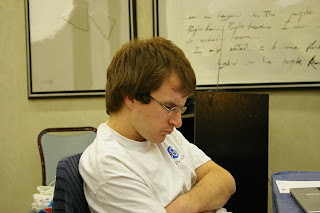

I worked with Gon ri on svnbuildstat, that is a service for building packages and show statistics about lintian/linda/piuparts checks. It for example contains all packages of the Debian Python Modules Team (that I am a member of) and many others. We discussed and started to work on how to create robust buildbots, that can be installed as a regular Debian package with zero (if possible) configuration, so that many people can just install them without pain, thus providing a huge scalability to the project.

We wrote a preliminary patch to pbuilder for killing the build if it exceeds given memory/disk usage. I had to learn the internals of pbuilder and I lost quite some time squashing some stupid bug I caused while writing the patch.

I spent most of my time with svnbuildstat, mostly learning and discussing things. This will be important for the future, but to also have some real results, I also fixed some packages I comaintain:

Together with Kumar Appaiah we fixed the python-numpy package and I had it uploaded, then I learned how to work with quilt instead of dpatch to handle patches in Debian packages, thanks to Holger's webpage, that contains a nice tutorial. Then I switched from dpatch to quilt in python-scipy and backported a patch from upstream svn to fix a segfault bug and had the package uploaded.

Then I finished the Cython package and had it uploaded. Cython is a marvelous package to speed up Python programs and interface C/C++ programs. I greatly recommend to try. If you don't like it, you can try some of at least 10 other ways to wrap C code in Python. I also used quilt in there to backport a patch from the upstream Mercurial repository to implement parsing @classmethods. Quilt is really a pleasure to work with.

Impressions from the meeting

I've been using Debian since 2001 as my only operating system on all of my computers, so I am not a complete beginner. But it never occured to me I could get involved in Debian more than a user and an occasional bug reporter. What a mistake.

I started packaging new things and fixing packages that I need for my work and that didn't work. This got me involved quite a bit in Debian. But in M rida it was the first time I could dring a beer (well, especially wine) with Debian Developers and I found out they are really cool people. They are all very skilled. Also something, that I love about Debian, is that the people involved in it share two common features, that are very important for them - respect to democracy and personal freedom. When I think about it, those are probably the first two items on my presonal list of values.

Of course, everytime there is a group of 1000+ people, there are good and bad people, more and less skilled, but important is the overall atmosphere - and that is as I described. I think Debian is truly unique. There is Gentoo, that has maybe 40 (?) active developers. There is Ubuntu, that has maybe 100 (?) developers, but it's basically a comercial distribution and there is not so many interesting work for non employees of Canonical. There is opensuse and fedora, where I am not sure about the numbers. The atmosphere in Debian can change in the future, one never knows, but as of the end of 2007, I think it's very cool to get involved.

Maybe it's not for everyone, but it's the right place for me.

3 December 2007

Julien Danjou: rebuildd 0.3.0 released

Everything seems to work, so just releasing it. I think it's becoming an amazing tool to do archive rebuild. It just misses a good Web interface. :-(

Edd Dumbill: Smartcard authentication on Linux and Mac

For various reasons, I need to secure access to some resources using two-factor authentication, and thus have been looking at smartcards. These little devices store digital keys and certificates, protected by a passphrase, and calculate digital signatures on-device. Hence the two factors: possession of the card, and knowledge of the password.This sort of scheme is widely used by government agencies and large corporations (and largely reliant on Windows, too), but I wanted to find the low cost way in for the small operator using open source.
OpenSC on Linux
The best starting point for Linux is the OpenSC project. It supports a reasonably broad array of devices, and is well supported by Linux distributions. Using command line tools you can create keys and certificates, as you would in OpenSSL for web servers and so on, and then upload them to the smartcard.Although OpenSSH source code has support for OpenSC, it is not compiled in by default in Debian and derived distributions. Unfortunately this means a bit of recompilation to get SSH supporting OpenSC. When that's done, you have an SSH implementation that can use an RSA key from your smartcard, and best of all, you can add this key to the ssh-agent like you would with regular keys. The hardwareI ordered two devices, which seemed to have the best support from OpenSC, the Axalto Cryptoflex E-Gate, and an Aladdin eToken. I got these from UsaSmartCard, who have a special section in their catalogue for Open Source compatible products. Both these cards have a USB interface built-in, I didn't want to be toting around an extra card reader in addition to the tokens themselves.
On the MacWhile both the devices worked as advertised under Linux, the experience has been a lot less fruitful under Mac OS 10.5 Leopard. There is a port of the OpenSC project for Mac OS, called SCA. The promise of the integration is great: you can use the on-device keys with apps like Safari and Mail, but there is a change in the way that the daemon responsible for talking to the smartcards (pcscd) works on Leopard, which means OpenSC won't recognise the cards.
With some fiddling, I have managed to force the Cryptoflex device to work with Mac. Unfortunately the Leopard/Darwin source for OpenSSH has diverged significantly enough from the upstream OpenSSH, that I couldn't apply the OpenSC patches. Not having ssh-agent work with the smartcard is a significant nuisance for me, as it's the easiest way to patch in the extra security to deployment processes.The Aladdin eToken just plain didn't work on Leopard. There is a report that Aladdin are working on Leopard drivers, however.I think a small number of mainly US federal smart cards will work out of the box on Leopard, though I've seen a few complaints about these on the Apple forums. It loooks unfortunately like smartcard support slipped through the net a bit. ConclusionSmartcard support is relatively straightforward on Linux. On Mac OS 10.5, it looks like some waiting is in order before things will work properly.

2 December 2007

Julien Danjou: Testing out rebuildd 0.3.0

awesome beiing in rc state, that leaves me a small amount of spare time. I decided to spend it on rebuildd. I had started the 0.3.0 version back in August, but never touched it again until now. I was afraid because I did not remember in which state I left the code repository. And, good surprise, the code was in a quite good shape! I just implemented and fixed some stuff that were reported on the BTS, and then, I only had to test it out. For that I used the servers kindly provided by TuxFamily.org: I stored the MySQL database on whisky. filled it with rebuildd-job add-quinn-diff (new feature in 0.3.0) and then started rebuildd on each node. And then I saw the 2 hosts starting to grab, lock jobs, build packages on each side. Wonderful. That just works. :-) rebuildd-job stats says that 20 % of the archive is now built in less than 24h, seems fast, cool. Bad point is that I'm building and trashing logs into /dev/null because I've no QA idea to implement right now.

29 November 2007

Julien Danjou: Second release candidate for awesome 2.0 released

Hopla, awesome 2.0-rc2 released. Cool. Happy me.

25 November 2007

Julien Blache: Pommed: how should the video switch button work?

The radeonhd xorg driver recently gained full RandR 1.2 support, I’ve tested it out moments ago and it works. It just works. (DIE fglrx, DIE DIE DIE). Joy and happiness today, and thanks to Julien CRISTAU, it’s even packaged in experimental (I owe you a beer, obviously). Now, given that we now have a working video driver, and an opensource one even, let’s think about implementing something in pommed for that nice little video switch button that’s on F7. I don’t really know how to go about implementing the video switch feature. Either I’m doing it in pommed in the form of a shell script that will have to “steal” the user’s X session, or I’m doing it in the frontends, which will obviously be a bit easier. Which raises another question: shell script around xrandr, or RandR support in the frontends? That latter option doesn’t look terribly appealing to me, as it involves quite some code that will have to be maintained up-to-date wrt RandR evolutions, and that also means being backward-compatible with older RandR versions etc. So it’s probably going to be only a simple shell script, executed by the frontend. I’d like more input on this, so if you have a take on how it should/could be done, please drop me a mail. Otherwise you’ll have to live with whatever I’ll come up with ;-)

24 November 2007

Julien Valroff: OOoCalc limitations

I have brought some work with me to be able to catch up during the week-end. Usually, I take a laptop running Windows which allows to connect to our network through a VPN the credentials of which I am not in possession of. This time, I just want to make some analyzes on spreadsheets (created on MS Excel). I have tried to use OOoCalc for the first time in “work conditions” - ie. I expect a little bit more than the basic features, which was source of disappointment. Autofiltering feature does not allow wilcards in the conditions. Even advanced filters do not seem to allow them. I want to select columns which contents end with ‘00?’ (ie ‘00′ followed by any unique character), and I can’t. I have read some posts talking about regular expressions in filters in the old 1.x series, but can’t find anything related in the documentation of the current series - regular expressions seem to be used only for the ‘find & replace’ feature. Moreover, you cannot set more than 3 conditions in autofilter, which is not a lot (I am not sure that previous releases of MS Excel were better). I am fully aware of the advanced filters which do allow up to 8 conditions, but I must say they are not easy to use on a day to day basis. Filters are mostly considered as visibility filters, which means if you apply a filter and use the ‘Fill down’ feature, hidden cells are also filled in. At least it is not the case with copying & pasting: only visible cells are copied. These limitations (bugs?) as well as the old existing bug regarding the decimal separator make it impossible for me to use OOoCalc for my work. I guess I could easily achieve to do my work thanks to OOoBase, but the data I want to extract need to be used and amended by collaboarators who exclusively use MS Excel. Are there any advanced users able to work around these issues?

19 November 2007

Julien Blache: pommed v1.12: oops

That’s a bugfix release for MacBook, PowerBook and iBook users. Pommed v1.11 will refuse to start on these machines claiming it didn’t find any event devices to use; I raised the number of expected event devices in v1.11, but unfortunately that number is only correct for the MacBook Pro. So, here is v1.12 to fix that, and sorry :-)

18 November 2007

Evan Prodromou: 27 Brumaire CCXVI

I've been getting really interested in the new crop of Linux-based operating systems for mobile devices. I got a Nokia N800 earlier this year, which I've found really useful -- although a little frustrating, too. And I've been following the developments on OpenMoKo with great interest, too. So last Monday, when Google Android came out, I offered to give an experienced developer's opinion of the development kit for Network World. I spent most of the afternoon trying out the SDK, checking out the documentation, watching the presentation videos, and working on sample applications to get a feel for it. I'm pretty impressed with Android, and I think it's got a good shot to become the Open Source mobile application platform. I think that whoever wins in this space has the chance to shape how all mobile phone platforms work in the future, and to take a good chunk of the market. Opening up the phone platform to allow a real marketplace of third-party apps is, I believe, going to be a huge advantage for whoever can make it work. I think the main two contenders in the area are well ahead of Android so far, but they're really going to have to capitalize on that lead in the next 8-10 months before the first Android handsets are set to hit the market (late 2008 -- although we'll see about that schedule). And I'm not sure they've got the means and commitment to do it. Nokia has been screwing around with the N series of Internet tablets for a while. Which is great -- the operating system is clever, the GUI ("Hildon") GTK-based, and development in Python on the platform is a breeze. The basic tools -- media player, RSS reader (ingenious), Web browser, email, etc. -- work well. However, for unexplained reasons, Nokia hasn't put a damn phone into the thing. If there is a similar device that does everything that the N800 (or N810) does, plus has a phone in it, which one are people going to buy? It seems obvious to me. The other interesting OS is OpenMoKo, which I think is a great project with exactly the right goals. However, there's been some disappointment in the enthusiastic community around the OS as schedules have slipped and the developer preview devices shipped without a functioning dialer app. These two projects will have to fight uphill against the fear, uncertainty and doubt generated by the Android announcement and SDK release, even to stay in the game. And, to be fair, Google's announcement was masterful: classic vaporware -- for a product that won't be shipping for at least a year. But they got a pretty solid list of partners for the platform to sign on (albeit with only vague requirements for support). Best of all, they released a one-two punch of a bunch of developer information videos with tantalizing views of a nice-looking potential device, and a good SDK with tons of documentation and developer tools. It even includes an emulator that looks like a little phone. Awww! Android is slick, it's deep, and it's well-designed. The architecture is smart and sophisticated without being too clever for its own good. It's built on conservative -- maybe a little too conservative -- twin pillars: Java and Linux. For hardware providers, there's Linux's tried-and-true driver framework. For applications developers, way up at the top of the stack, there's good ol' boring Java, with new and smart APIs targeted specifically for mobile device apps, all on top of a new virtual machine called Dalvik that (supposedly) optimizes the hell out of Java bytecode. I was really impressed that the emulator emulates much more than just the Java APIs -- you can build ARM binaries in C that run on the thing. Very nice. Am I still going to get an OpenMoKo device? Maybe. But I'm going to continue playing around with the Android SDK, and looking for early developer versions of Android-supporting devices? Oh, yeah. Oh, and the article I did the research for is here; strangely it ended up on ComputerWorld rather than NetworkWorld. OK for me, though. tags:

More about me and my cool life So, I talked yesterday (Journal/27 Brumaire CCXVI) about how much weight I've lost in the last few months, which has been great. Another thing that's been going on for me is that I've started using the Getting Things Done process for scheduling my tasks and my time. I've never been particularly good at managing my time, but at least I've always known that however late or irresponsible I might be, my brother Ted would always be later. But when I visited San Francisco in August, Ted was really doing great. Friends and family kept telling me how responsible and down-to-earth Ted seemed lately. And whenever he had an idea for something to do, he wrote it down in his little Sidekick device. Ted showed me how the GTD system worked for him, and so I went out and bought the book and started reading it. I have been doing GTD for a few months now, and I've found it really satisfying. I don't worry as much any more about little things that I should be doing -- they're all captured in my system. It's really gratifying. I don't know if I've been quite as successful as Ted in improving my personal productivity, but I do know that I'm feeling a lot better about things and about myself. Which is really all that matters. tags:

Skating away Maj, Amita June and I went ice-skating today. It was AJ's first time out on the ice, and she really enjoyed it (most of the time). We had a couple of spills, mostly because it was really my first time skating with a 2-year-old, and partly because it was her first time skating with anyone. We went to the indoor rink near our old house on rue Cartier at the corner of Marie-Anne. Pretty soon we'll be able to go outside on the pond at Parc Lafontaine. catching our breath Maj isn't really a big skating fan, but she seemed to have a good time this time around. Which made three of us. I think we've got the makings of a Sunday-afternoon family tradition. We'll see, at least. tags:

More one-liners
  • I'm glad to see that the Mister Wong logo contest I talked about a while ago (Journal/21 Thermidor CCXV) has borne fruit. The top 12 logos look pretty good.
  • Maj and I have been catching up on season 3 of Deadwood lately. Great show, nice to see that season three is as solid as previous ones.
  • We've got RecentChangesCamp coming up in San Francisco in February 2008 (I think). Anyone interested should get involved at http://aboutus.org/RCC2008 .
  • What's the best alternative to the Sitemaps protocol for people who are into RDF? I'm thinking you could just make a hugantic RSS 1.0 feed -- after all, it is the "RDF Site Summary" format. Best of all, most search engines consume RSS as a recommended feed format. I'm going to try it with Vinismo and let you all know. The downside: I'm not sure many processors will handle a 100,000-item RSS feed very well.
  • Norman Mailer died just as I got around to reading the copy of ''Oswald's Tale'' I stole from the Driskill Hotel last year at South by Southwest. I can't help feeling responsible.
tags:

Julien Blache: pommed v1.11: MacBook3,1, bugfixes and more

Pommed v1.11 is out, including bugfixes, support for new hardware and some other changes. As I mentioned already, the MacBook3,1 is now partially supported. Also, I’ve fixed a long lasting bug with event devices disappearing after suspend; details can be found in this post. If you use an external Apple USB keyboard, it should now work with pommed. At least the White and the Alu keyboards have been added, but there may be some other variants that I don’t know about. If you were having trouble with the system beep feature, it may be because your system has the uinput device node in a different location than /dev/input/uinput; pommed now knows about 2 other locations. Speaking of the beep, pommed now beeps when the audio volume is changed through the volume up/down keys. This used to be done in gpomme, but as pommed can do this by itself now, it was a good opportunity to remove some code from gpomme.

16 November 2007

Julien Danjou: awesome 2.0-rc1

awesome 2.0-rc1 released and waiting in Debian NEW queue. :-)

Next.

Previous.