Search Results: "sten"

30 October 2014

Matthew Garrett: Hacker News metrics (first rough approach)

I'm not a huge fan of Hacker News[1]. My impression continues to be that it ends up promoting stories that align with the Silicon Valley narrative of meritocracy, technology will fix everything, regulation is the cancer killing agile startups, and discouraging stories that suggest that the world of technology is, broadly speaking, awful and we should all be ashamed of ourselves.

But as a good data-driven person[2], wouldn't it be nice to have numbers rather than just handwaving? In the absence of a good public dataset, I scraped Hacker Slide to get just over two months of data in the form of hourly snapshots of stories, their age, their score and their position. I then applied a trivial test:
  1. If the story is younger than any other story
  2. and the story has a higher score than that other story
  3. and the story has a worse ranking than that other story
  4. and at least one of these two stories is on the front page
then the story is considered to have been penalised.

(note: "penalised" can have several meanings. It may be due to explicit flagging, or it may be due to an automated system deciding that the story is controversial or appears to be supported by a voting ring. There may be other reasons. I haven't attempted to separate them, because for my purposes it doesn't matter. The algorithm is discussed here.)

Now, ideally I'd classify my dataset based on manual analysis and classification of stories, but I'm lazy (see [2]) and so just tried some keyword analysis:
KeywordPenalisedUnpenalised
Women134
Harass20
Female51
Intel23
x8634
ARM34
Airplane12
Startup4626

A few things to note:
  1. Lots of stories are penalised. Of the front page stories in my dataset, I count 3240 stories that have some kind of penalty applied, against 2848 that don't. The default seems to be that some kind of detection will kick in.
  2. Stories containing keywords that suggest they refer to issues around social justice appear more likely to be penalised than stories that refer to technical matters
  3. There are other topics that are also disproportionately likely to be penalised. That's interesting, but not really relevant - I'm not necessarily arguing that social issues are penalised out of an active desire to make them go away, merely that the existing ranking system tends to result in it happening anyway.

This clearly isn't an especially rigorous analysis, and in future I hope to do a better job. But for now the evidence appears consistent with my innate prejudice - the Hacker News ranking algorithm tends to penalise stories that address social issues. An interesting next step would be to attempt to infer whether the reasons for the penalties are similar between different categories of penalised stories[3], but I'm not sure how practical that is with the publicly available data.

(Raw data is here, penalised stories are here, unpenalised stories are here)


[1] Moving to San Francisco has resulted in it making more sense, but really that just makes me even more depressed.
[2] Ha ha like fuck my PhD's in biology
[3] Perhaps stories about startups tend to get penalised because of voter ring detection from people trying to promote their startup, while stories about social issues tend to get penalised because of controversy detection?

comment count unavailable comments

Alessio Treglia: Handling identities in distributed Linux cloud instances

I ve many distributed Linux instances across several clouds, be them global, such as Amazon or Digital Ocean, or regional clouds such as TeutoStack or Enter. Probably many of you are facing the same issue: having a consistent UNIX identity across all multiple instances. While in an ideal world LDAP would be a perfect choice, letting LDAP open to the wild Internet is not a great idea. So, how to solve this issue, while being secure? The trick is to use the new NSS module for SecurePass. While SecurePass has been traditionally used into the operating system just as a two factor authentication, the new beta release is capable of holding extended attributes , i.e. arbitrary information for each user profile. We will use SecurePass to authenticate users and store Unix information with this new capability. In detail, we will: SecurePass and extended attributes The next generation of SecurePass (currently in beta) is capable of storing arbitrary data for each profile. This is called Extended Attributes (or xattrs) and -as you can imagine- is organized as key/value pair. You will need the SecurePass tools to be able to modify users extended attributes. The new releases of Debian Jessie and Ubuntu Vivid Vervet have a package for it, just:
# apt-get install securepass-tools
ERRATA CORRIGE: securepass-tools hasn t been uploaded to Debian yet, Alessio is working hard to make the package available in time for Jessie though.
For other distributions or previous releases, there s a python package (PIP) available. Make sure that you have pycurl installed and then:
# pip install securepass-tools
While SecurePass tools allow local configuration file, we highly recommend for this tutorial to create a global /etc/securepass.conf, so that it will be useful for the NSS module. The configuration file looks like:
[default]
app_id = xxxxx
app_secret = xxxx
endpoint = https://beta.secure-pass.net/
Where app_id and app_secrets are valid API keys to access SecurePass beta. Through the command line, we will be able to set UID, GID and all the required Unix attributes for each user:
# sp-user-xattrs user@domain.net set posixuid 1000
While posixuid is the bare minimum attribute to have a Unix login, the following attributes are valid: Install and Configure NSS SecurePass In a similar way to the tools, Debian Jessie and Ubuntu Vivid Vervet have native package for SecurePass:
# apt-get install libnss-securepass
For previous releases of Debian and Ubuntu can still run the NSS module, as well as CentOS and RHEL. Download the sources from: https://github.com/garlsecurity/nss_securepass Then:
./configure
make
make install (Debian/Ubuntu Only)
For CentOS/RHEL/Fedora you will need to copy files in the right place:
/usr/bin/install -c -o root -g root libnss_sp.so.2 /usr/lib64/libnss_sp.so.2
ln -sf libnss_sp.so.2 /usr/lib64/libnss_sp.so
The /etc/securepass.conf configuration file should be extended to hold defaults for NSS by creating an [nss] section as follows:
[nss]
realm = company.net
default_gid = 100
default_home = "/home"
default_shell = "/bin/bash"
This will create defaults in case values other than posixuid are not being used. We need to configure the Name Service Switch (NSS) to use SecurePass. We will change the /etc/nsswitch.conf by adding sp to the passwd entry as follows:
$ grep sp /etc/nsswitch.conf
 passwd:  files sp
Double check that NSS is picking up our new SecurePass configuration by querying the passwd entries as follows:
$ getent passwd user
 user:x:1000:100:My User:/home/user:/bin/bash
$ id user
 uid=1000(user)  gid=100(users) groups=100(users)
Using this setup by itself wouldn t allow users to login to a system because the password is missing. We will use SecurePass authentication to access the remote machine. Configure PAM for SecurePass On Debian/Ubuntu, install the RADIUS PAM module with:
# apt-get install libpam-radius-auth
If you are using CentOS or RHEL, you need to have the EPEL repository configured. In order to activate EPEL, follow the instructions on http://fedoraproject.org/wiki/EPEL Be aware that this has not being tested with SE-Linux enabled (check off or permissive). On CentOS/RHEL, install the RADIUS PAM module with:
# yum -y install pam_radius
Note: as per the time of writing, EPEL 7 is still in beta and does not contain the Radius PAM module. A request has been filed through RedHat s Bugzilla to include this package also in EPEL 7 Configure SecurePass with your RADIUS device. We only need to set the public IP Address of the server, a fully qualified domain name (FQDN), and the secret password for the radius authentication. In case of the server being under NAT, specify the public IP address that will be translated into it. After completion we get a small recap of the already created device. For the sake of example, we use secret as our secret password. Configure the RADIUS PAM module accordingly, i.e. open /etc/pam_radius.conf and add the following lines:
radius1.secure-pass.net secret 3
radius2.secure-pass.net secret 3
Of course the secret is the same we have set up on the SecurePass administration interface. Beyond this point we need to configure the PAM to correct manage the authentication. In CentOS, open the configuration file /etc/pam.d/password-auth-ac; in Debian/Ubuntu open the /etc/pam.d/common-auth configuration and make sure that pam_radius_auth.so is in the list.
auth required   pam_env.so
auth sufficient pam_radius_auth.so try_first_pass
auth sufficient pam_unix.so nullok try_first_pass
auth requisite  pam_succeed_if.so uid >= 500 quiet
auth required   pam_deny.so
Conclusions Handling many distributed Linux poses several challenges, from software updates to identity management and central logging. In a cloud scenario, it is not always applicable to use traditional enterprise solutions, but new tools might become very handy. To freely subscribe to securepass beta, join SecurePass on: http://www.secure-pass.net/open
And then send an e-mail to info@garl.ch requesting beta access.

Matthew Garrett: On joining the FSF board

I joined the board of directors of the Free Software Foundation a couple of weeks ago. I've been travelling a bunch since then, so haven't really had time to write about it. But since I'm currently waiting for a test job to finish, why not?

It's impossible to overstate how important free software is. A movement that began with a quest to work around a faulty printer is now our greatest defence against a world full of hostile actors. Without the ability to examine software, we can have no real faith that we haven't been put at risk by backdoors introduced through incompetence or malice. Without the freedom to modify software, we have no chance of updating it to deal with the new challenges that we face on a daily basis. Without the freedom to pass that modified software on to others, we are unable to help people who don't have the technical skills to protect themselves.

Free software isn't sufficient for building a trustworthy computing environment, one that not merely protects the user but respects the user. But it is necessary for that, and that's why I continue to evangelise on its behalf at every opportunity.

However.

Free software has a problem. It's natural to write software to satisfy our own needs, but in doing so we write software that doesn't provide as much benefit to people who have different needs. We need to listen to others, improve our knowledge of their requirements and ensure that they are in a position to benefit from the freedoms we espouse. And that means building diverse communities, communities that are inclusive regardless of people's race, gender, sexuality or economic background. Free software that ends up designed primarily to meet the needs of well-off white men is a failure. We do not improve the world by ignoring the majority of people in it. To do that, we need to listen to others. And to do that, we need to ensure that our community is accessible to everybody.

That's not the case right now. We are a community that is disproportionately male, disproportionately white, disproportionately rich. This is made strikingly obvious by looking at the composition of the FSF board, a body made up entirely of white men. In joining the board, I have perpetuated this. I do not bring new experiences. I do not bring an understanding of an entirely different set of problems. I do not serve as an inspiration to groups currently under-represented in our communities. I am, in short, a hypocrite.

So why did I do it? Why have I joined an organisation whose founder I publicly criticised for making sexist jokes in a conference presentation? I'm afraid that my answer may not seem convincing, but in the end it boils down to feeling that I can make more of a difference from within than from outside. I am now in a position to ensure that the board never forgets to consider diversity when making decisions. I am in a position to advocate for programs that build us stronger, more representative communities. I am in a position to take responsibility for our failings and try to do better in future.

People can justifiably conclude that I'm making excuses, and I can make no argument against that other than to be asked to be judged by my actions. I hope to be able to look back at my time with the FSF and believe that I helped make a positive difference. But maybe this is hubris. Maybe I am just perpetuating the status quo. If so, I absolutely deserve criticism for my choices. We'll find out in a few years.

comment count unavailable comments

28 October 2014

Jonny Lamb: Sciopero

screenshot Public transport strikes in Rome are so frequent that it s hard to remember when they are. I wrote a Gnome Shell extension to help remind me when there s one either coming up or in progress. Find it on extensions.gnome.org. It gets its data from another little service I just made.
A Roma gli scioperi dei mezzi pubblici sono cos frequenti che spesso facile dimenticarsi quando ci sono. Ho scritto un estensione per Gnome Shell per avvisare quando c o si avvicina uno sciopero dell Atac. La puoi trovare su extensions.gnome.org. Funziona grazie ad un altro piccolo servizio che ho creato.

26 October 2014

Joey Hess: a programmable alarm clock using systemd

I've taught my laptop to wake up at 7:30 in the morning. When it does, it will run whatever's in my ~/bin/goodmorning script. Then, if the lid is still closed, it will go back to sleep again. So, it's a programmable alarm clock that doesn't need the laptop to be left turned on to work. But it doesn't have to make noise and wake me up (I rarely want to be woken up by an alarm; the sun coming in the window is a much nicer method). It can handle other tasks like downloading my email, before I wake up. When I'm at home and on dialup, this tends to take an hour in the morning, so it's nice to let it happen before I get up. This took some time to figure out, but it's surprisingly simple. Besides ~/bin/goodmorning, which can be any program/script, I needed just two files to configure systemd to do this. /etc/systemd/system/goodmorning.timer
[Unit]
Description=good morning
[Timer]
Unit=goodmorning.service
OnCalendar=*-*-* 7:30
WakeSystem=true
Persistent=false
[Install]
WantedBy=multi-user.target
/etc/systemd/system/goodmorning.service
[Unit]
Description=good morning
RefuseManualStart=true
RefuseManualStop=true
ConditionACPower=true
[Service]
Type=oneshot
ExecStart=/bin/systemd-inhibit --what=handle-lid-switch --why=goodmorning /bin/su joey -c "/usr/bin/timeout 45m /home/joey/bin/goodmorning"
installation After installing those files, run (as root): systemctl enable goodmorning.timer; systemctl start goodmorning.timer Then, you'll also need to edit /etc/systemd/logind.conf, and set LidSwitchIgnoreInhibited=no -- this overrides the default, which is not to let systemd-inhibit block sleep on lid close. almost too easy I don't think this would be anywhere near as easy to do without systemd, logind, etc. Especially the handling of waking the system at the right time, and the behavior around lid sleep inhibiting. The WakeSystem=true relies on some hardware support for waking from sleep; my laptop supported it with no trouble but I don't know how broadly available that is. Also, notice the ConditionACPower=true, which I added once I realized I don't want the job to run if I forgot to leave the laptop plugged in overnight. Technically, it will still wake up when on battery power, but then it should go right back to sleep. Quite a lot of nice peices of systemd all working together here! xfce workaround If using xfce, xfce4-power-manager takes over handling of lid close from systemd, and currently prevents the system from going back to sleep if the lid is still closed when goodmorning finishes. Happily, there is an easy workaround; this configures xfce to not override the lid switch behavior: xfconf-query -c xfce4-power-manager -n -p /xfce4-power-manager/logind-handle-lid-switch -t bool -s true Other desktop environments may have similar issues. why not a per-user unit? It would perhaps be better to use the per-user systemd, not the system wide one. Then I could change the time the alarm runs without using root. What's prevented me from doing this is that systemd-inhibit uses policykit, and policykit prevents it from being used in this situation. It's a lot easier to run it as root and use su, than it is to reconfigure policykit.

Colin Watson: Moving on, but not too far

The Ubuntu Code of Conduct says:
Step down considerately: When somebody leaves or disengages from the project, we ask that they do so in a way that minimises disruption to the project. They should tell people they are leaving and take the proper steps to ensure that others can pick up where they left off.
I've been working on Ubuntu for over ten years now, almost right from the very start; I'm Canonical's employee #17 due to working out a notice period in my previous job, but I was one of the founding group of developers. I occasionally tell the story that Mark originally hired me mainly to work on what later became Launchpad Bugs due to my experience maintaining the Debian bug tracking system, but then not long afterwards Jeff Waugh got in touch and said "hey Colin, would you mind just sorting out some installable CD images for us?". This is where you imagine one of those movie time-lapse clocks ... At some point it became fairly clear that I was working on Ubuntu, and the bug system work fell to other people. Then, when Matt Zimmerman could no longer manage the entire Ubuntu team in Canonical by himself, Scott James Remnant and I stepped up to help him out. I did that for a couple of years, starting the Foundations team in the process. As the team grew I found that my interests really lay in hands-on development rather than in management, so I switched over to being the technical lead for Foundations, and have made my home there ever since. Over the years this has given me the opportunity to do all sorts of things, particularly working on our installers and on the GRUB boot loader, leading the development work on many of our archive maintenance tools, instituting the +1 maintenance effort and proposed-migration, and developing the Click package manager, and I've had the great pleasure of working with many exceptionally talented people. However. In recent months I've been feeling a general sense of malaise and what I've come to recognise with hindsight as the symptoms of approaching burnout. I've been working long hours for a long time, and while I can draw on a lot of experience by now, it's been getting harder to summon the enthusiasm and creativity to go with that. I have a wonderful wife, amazing children, and lovely friends, and I want to be able to spend a bit more time with them. After ten years doing the same kinds of things, I've accreted history with and responsibility for a lot of projects. One of the things I always loved about Foundations was that it's a broad church, covering a wide range of software and with a correspondingly wide range of opportunities; but, over time, this has made it difficult for me to focus on things that are important because there are so many areas where I might be called upon to help. I thought about simply stepping down from the technical lead position and remaining in the same team, but I decided that that wouldn't make enough of a difference to what matters to me. I need a clean break and an opportunity to reset my habits before I burn out for real. One of the things that has consistently held my interest through all of this has been making sure that the infrastructure for Ubuntu keeps running reliably and that other developers can work efficiently. As part of this, I've been able to do a lot of work over the years on Launchpad where it was a good fit with my remit: this has included significant performance improvements to archive publishing, moving most archive administration operations from excessively-privileged command-line operations to the webservice, making build cancellation reliable across the board, and moving live filesystem building from an unscalable ad-hoc collection of machines into the Launchpad build farm. The Launchpad development team has generally welcomed help with open arms, and in fact I joined the ~launchpad team last year. So, the logical next step for me is to make this informal involvement permanent. As such, at the end of this year I will be moving from Ubuntu Foundations to the Launchpad engineering team. This doesn't mean me leaving Ubuntu. Within Canonical, Launchpad development is currently organised under the Continuous Integration team, which is part of Ubuntu Engineering. I'll still be around in more or less the usual places and available for people to ask me questions. But I will in general be trying to reduce my involvement in Ubuntu proper to things that are closely related to the operation of Launchpad, and a small number of low-effort things that I'm interested enough in to find free time for them. I still need to sort out a lot of details, but it'll very likely involve me handing over project leadership of Click, drastically reducing my involvement in the installer, and looking for at least some help with boot loader work, among others. I don't expect my Debian involvement to change, and I may well find myself more motivated there now that it won't be so closely linked with my day job, although it's possible that I will pare some things back that I was mostly doing on Ubuntu's behalf. If you ask me for help with something over the next few months, expect me to be more likely to direct you to other people or suggest ways you can help yourself out, so that I can start disentangling myself from my current web of projects. Please contact me sooner or later if you're interested in helping out with any of the things I'm visible in right now, and we can see what makes sense. I'm looking forward to this!

22 October 2014

Steve Kemp: On writing test-cases and testsuites.

Last night I mostly patched my local copy of less to build and link against the PCRE regular expression library. I've wanted to do that for a while, and reading Raymond Chen's blog post last night made me try it out. The patch was small and pretty neat, and I'm familiar with GNU less having patched it in the past. But it doesn't contain tests. Test cases are hard. Many programs, such as less, are used interactively which makes writing a scaffold hard. Other programs suffer from a similar fate - I'm not sure how you'd even test a web browser such as Firefox these days - mangleme would catch some things, eventually, but the interactive stuff? No clue. In the past MySQL had a free set of test cases, but my memory is that Oracle locked them up. SQLite is famous for its decent test coverage. But off the top of my head I can't think of other things. As a topical example there don't seem to be decent test-cases for either bash or openssl. If it compiles it works, more or less. I did start writing some HTTP-server test cases a while back, but that was just to automate security attacks. e.g. Firing requests like:

GET /../../../etc/passwd HTTP/1.0
GET //....//....//....//etc/passwd HTTP/1.0
etc
(It's amazing how many toy HTTP server components included in projects and products don't have decent HTTP-servers.) I could imagine that being vaguely useful, especially because it is testing the protocol-handling rather than a project-specific codebase. Anyway, I'm thinking writing test cases for things is good, but struggling to think of a decent place to start. The project has to be: Comments welcome; but better yet why not think about the test-coverage of any of your own packages and projects...?

21 October 2014

Erich Schubert: Avoiding systemd isn't hard

Don't listen to trolls. They lie.
Debian was and continues to be about choice. Previously, you could configure Debian to use other init systems, and you can continue to do so in the future.
In fact, with wheezy, sysvinit was essential. In the words of trolls, Debian "forced" you to install SysV init!
With jessie, it will become easier to choose the init system, because neither init system is essential now. Instead, there is an essential meta-package "init", which requires you to install one of systemd-sysv sysvinit-core upstart. In other words, you have more choice than ever before.
Again: don't listen to trolls.
However, notice that there are some programs such as login managers (e.g. gdm3) which have an upstream dependency on systemd. gdm3 links against libsystemd0 and depends on libpam-systemd; and the latter depends on systemd-sysv systemd-shim so it is in fact a software such as GNOME that is pulling systemd onto your computer.
IMHO you should give systemd a try. There are some broken (SysV-) init scripts that cause problems with systemd; but many of these cases have now been fixed - not in systemd, but in the broken init script.
However, here is a clean way to prevent systemd from being installed when you upgrade to jessie. (No need to "fork" Debian for this, which just demonstrates how uninformed some trolls are ... - apart from Debian being very open to custom debian distributions, which can easily be made without "forking".)
As you should know, apt allows version pinning. This is the proper way to prevent a package from being installed. All you need to do is create a file named e.g. /etc/apt/preferences.d/no-systemd with the contents:
Package: systemd-sysv
Pin: release o=Debian
Pin-Priority: -1
from the documentation, a priority less than 0 disallows the package from being installed. systemd-sysv is the package that would enable systemd as your default init (/sbin/init).
This change will make it much harder for aptitude to solve dependencies. A good way to help it to solve the dependencies is to install the systemd-shim package explicitly first:
aptitude install systemd-shim
After this, I could upgrade a Debian system from wheezy to jessie without being "forced" to use systemd...
In fact, I could also do an aptitude remove systemd systemd-shim. But that would have required the uninstallation of GNOME, gdm3 and network-manager - you may or may not be willing to do this. On a server, there shouldn't be any component actually depending on systemd at all. systemd is mostly a GNOME-desktop thing as of now.
As you can see, the trolls are totally blaming the wrong people, for the wrong reasons... and in fact, the trolls make up false claims (as a fact, systemd-shim was updated on Oct 14). Stop listening to trolls, please.
If you find a bug - a package that needlessly depends on systemd, or a good way to remove some dependency e.g. via dynamic linking, please contribute a patch upstream and file a bug. Solve problems at the package/bug level, instead of wasting time doing hate speeches.

19 October 2014

Thorsten Alteholz: Key transition, move to stronger key

Finally I was able to do the enormous paperwork (no, it is not that much) to switch my old 1024D key to a new 4096R one. I was a bit afraid that there might be something bad happening, but my fear was without any reason. After the RT bug was closed, I could upload and sent signed emails to mailing lists. So thanks alot to everyone involved.
old key, 0xD362B62A54B99890
pub   1024D/54B99890 2008-07-23
      Key fingerprint = 36E2 EDDE C21F EC8F 77B8  7436 D362 B62A 54B9 9890
uid                  Thorsten Alteholz (...)
sub   4096g/622D94A8 2008-07-23
new key, 0xA459EC6715B0705F
pub   4096R/0xA459EC6715B0705F 2014-02-03
  Schl.-Fingerabdruck = C74F 6AC9 E933 B306 7F52  F33F A459 EC67 15B0 705F
uid                 [ uneing.] Thorsten Alteholz (...)
sub   4096R/0xAE861AE7F39DF730 2014-02-03
  Schl.-Fingerabdruck = B8E7 6074 5FF4 C707 1C77  870C AE86 1AE7 F39D F730
sub   4096R/0x96FCAC0D387B5847 2014-02-03
  Schl.-Fingerabdruck = 6201 FBFF DBBD E078 22EA  BB96 96FC AC0D 387B 5847

17 October 2014

Martin Pitt: Ramblings from LinuxCon/Plumbers 2014

I m on my way home from D sseldorf where I attended the LinuxCon Europe and Linux Plumber conferences. I was quite surprised how huge LinuxCon was, there were about 1.500 people there! Certainly much more than last year in New Orleans. Containers (in both LXC and docker flavors) are the Big Thing everybody talks about and works with these days; there was hardly a presentation where these weren t mentioned at all, and (what felt like) half of the presentations were either how to improve these, or how to use these technologies to solve problems. For example, some people/companies really take LXC to the max and try to do everything in them including tasks which in the past you had only considered full VMs for, like untrusted third-party tenants. For example there was an interesting talk how to secure networking for containers, and pretty much everyone uses docker or LXC now to deploy workloads, run CI tests. There are projects like fleet which manage systemd jobs across an entire cluster of containers (distributed task scheduler) or like project-builder.org which auto-build packages from each commit of projects. Another common topic is the trend towards building/shipping complete (r/o) system images, atomic updates and all that goodness. The central thing here was certainly Stateless systems, factory reset, and golden images which analyzed the common requirements and proposed how to implement this with various package systems and scenarios. In my opinion this is certainly the way to go, as our current solution on Ubuntu Touch (i. e. Ubuntu s system-image) is far too limited and static yet, it doesn t extend to desktops/servers/cloud workloads at all. It s also a lot of work to implement this properly, so it s certainly understandable that we took that shortcut for prototyping and the relatively limited Touch phone environment. On Plumbers my main occupations were mostly the highly interesting LXC track to see what s coming in the container world, and the systemd hackfest. On the latter I was again mostly listening (after all, I m still learning most of the internals there..) and was able to work on some cleanups and improvements like getting rid of some of Debian s patches and properly run the test suite. It was also great to sync up again with David Zeuthen about the future of udisks and some particular proposed new features. Looks like I m the de-facto maintainer now, so I ll need to spend some time soon to review/include/clean up some much requested little features and some fixes. All in all a great week to meet some fellows of the FOSS world a gain, getting to know a lot of new interesting people and projects, and re-learning to drink beer in the evening (I hardly drink any at home :-P). If you are interested you can also see my raw notes, but beware that there are mostly just scribbling. Now, off to next week s Canonical meeting in Washington, DC!

15 October 2014

Raphaël Hertzog: Freexian s second report about Debian Long Term Support

Like last month, here comes a report about the work of paid contributors to Debian LTS. Individual reports In September 2014, 3 contributors have been paid for 11h each. Here are their individual reports: Evolution of the situation Compared to last month, we have gained 5 new sponsors, that s great. We re now at almost 25% of a full-time position. But we re not done yet. We believe that we would need at least twice as many sponsored hours to do a reasonable work with at least the most used packages, and possibly four times as much to be able to cover the full archive. We re now at 39 packages that need an update in Squeeze (+9 compared to last month), and the contributors paid by Freexian did handle 11 during last month (this gives an approximate rate of 3 hours per update, CVE triage included). Open questions Dear readers, what can we do to convince more companies to join the effort? The list of sponsors contains almost exclusively companies from Europe. It s true that Freexian s offer is in Euro but the economy is world-wide and it s common to have international invoices. When Ivan Kohler asked if having an offer in dollar would help convince other companies, we got zero feedback. What are the main obstacles that you face when you try to convince your managers to get the company to contribute? By the way, we prefer that companies take small sponsorship commitments that they can afford over multiple years over granting lots of money now and then not being able to afford it for another year. Thanks to our sponsors Let me thank our main sponsors:

7 October 2014

Thorsten Glaser: mksh R50d released

The last MirBSD Korn Shell update broke update-initramfs because I accidentally introduced a regression in field splitting while fixing other bugs sorry! mksh R50d was just released to fix that, and a small NULL pointer dereference found by Goodbox on IRC. Thanks to my employer tarent for a bit of time to work on it.

3 October 2014

Ian Donnelly: Config::Model and Elektra

Hi Everybody, Today I want to talk about the different approaches of Elektra and Config::Model. We have gotten a lot of questions lately about why Elektra is necessary and what differentiates it between similar tools like Config::Model. While there are a lot of similarities between Config::Model and Elektra, there are some key differences and that is what I will be focusing on in this post. Once a specification is defined for Elektra and a plug-in is written to work with that specification, other developers will be able to reuse these specifications for programs that have similar configurations (such a specification and plug-in for the ini file type.) Additionally, specifications, once defined in KDB can be used across multiple programs. For instance, if I were to define a specification for my program within KDB:
[/myapp/file_dialog/show_hidden_files]
type=Boolean
default=true

Any other program could use my specification just by referring to show_hidden_files. These features allow Elektra to solve the problem of cross-platform configurations by providing a consistent API and also allow users to easily be aware of other applications configurations which allows for easier integration between programs. Config:: Model also moves to provide a unified interface for configuration data and it also supports validation such as the type=Boolean like in the above example. The biggest differences between these two projects is that Elektra is intended for use by the programs themselves and by external GUIs and validation tools unlike Config::Model. Config::Model provides a tool allowing developers to provide a means for users to interactively edit configuration data in a safe way. Additionally, Elektra uses self-inscribing data. This means that all the specifications are saved within KDB and in metadata. More differences are that validators can be written in any language for Elektra because the specifications are just stored as data and they can enforce constraints on any access because plug-ins define the behavior of KDB itself. Tying this all together with my GSoC project is the topic of three-way merges. Config::Model actually does not rely on a base for merges since the specifications all must be complete. This is a very good approach to handle merges in an advanced way too. This is an avenue that Elektra would like to explore in the future when we have enough specifications to handle all types on configuration. I hope that this post clarifies the different approaches of Elektra and Config::Model. While both of these tools offer a better answer to configuration files they do have different goals and implementations that make them unique. I want to mention that we have a good relationship with the developers of Config::Model, who supported my Google Summer of Code Project. We believe that both of these tools have their own place and uses and they do not compete to achieve the same goals. For now,
Ian S. Donnelly

Thorsten Glaser: mksh R50c released, security fix

The MirBSD Korn Shell has got a new security and maintenance release. This release fixes one mksh(1)-specific issue when importing values from the environment. The issue has been detected by the main developer during careful code review, looking at whether the shell is affected by the recent shellshock bugs in GNU bash, many of which also affect AT&T ksh93. (The answer is: no, none of these bugs affects mksh.) Stephane Chanzelas kindly provided me with an in-depth look at how this can be exploited. The issue has not got a CVE identifier because it was identified as low-risk. The problem here is that the environment import filter mistakenly accepted variables named FOO+ (for any FOO), which are, by general environ(7) syntax, distinct from FOO , and treated them as appending to the value of FOO . An attacker who already had access to the environment could so append values to parameters passed through programs (including sudo(8) or setuid) to shell scripts, including indirectly, after those programs intended to sanitise the environment, e.g. invalidating the last $PATH component. It could also be used to circumvent sudo s environment filter which protected against the vulnerability of an unpatched GNU bash being exploited. tl;dr: mksh not affected by any shellshock bugs, but we found a bug of our own, with low impact, which does not affect any other shell, during careful code review. Please do update to mksh R50c quickly.

2 October 2014

Andrew Pollock: [opinion] On Islamaphobia

It's taken me a while to get sufficiently riled up about Australia's current Islamaphobia outbreak, but it's been brewing in me for a couple of weeks. For the record, I'm an Atheist, but I'll defend your right to practise your religion, just don't go pushing it on me, thank you very much. I'm also not a huge fan of Islam, because it does seem to lend itself to more violent extremism than other religions, and ISIS/ISIL/IS (whatever you want to call them) aren't doing Islam any favours at the moment. I'm against extremism of any stripes though. The Westboro Baptists are Christian extremists. They just don't go around killing people. I'm also not a big fan of the burqa, but again, I'll defend a Muslim woman's right to choose to wear one. They key point here is choice. I got my carpets cleaned yesterday by an ethnic couple. I like accents, and I was trying to pick theirs. I thought they may have been Turkish. It turned out they were Kurdish. Whenever I hear "Kurd" I habitually stick "Bosnian" in front of it after the Bosnian War that happened in my childhood. Turns out I wasn't listening properly, and that was actually "Serb". Now I feel dumb, but I digress. I got chatting with the lady while her husband did the work. I got a refresher on where most Kurds are/were (Northern Iraq) and we talked about Sunni versus Shia Islam, and how they differed. I learned a bit yesterday, and I'll have to have a proper read of the Wikipedia article I just linked to, because I suspect I'll learn a lot more. We briefly talked about burqas, and she said that because they were Sunni, they were given the choice, and they chose not to wear it. That's the sort of Islam that I support. I suspect a lot of the women running around in burqas don't get a lot of say in it, but I don't think banning it outright is the right solution to that. Those women need to feel empowered enough to be able to cast off their burqas if that's what they want to do. I completely agree that a woman in a burqa entering a secure place (for example Parliament House) needs to be identifiable (assuming that identification is verified for all entrants to Parliament House). If it's not, and they're worried about security, that's what the metal detectors are for. I've been to Dubai. I've seen how they handle women in burqas at passport control. This is an easily solvable problem. You don't have to treat burqa-clad women as second class citizens and stick them in a glass box. Or exclude them entirely.

1 October 2014

Thorsten Alteholz: My Debian Activities in September 2014

FTP assistant Starting an article with self laudation might be bad style, but this month I was busy as a bee and could accept 312 packages, 75 packages more than last month. 34 times I contacted the maintainer to ask a question and 51 times I had to reject a package. These numbers remain constant. The number of packages in NEW dropped to about 180. If you want your package included in Jessie, please double-check it and upload an improved version. Squeeze LTS This was my third month that I did some work for the Squeeze LTS initiative, started by Raphael Hertzog at Freexian. All in all I got assigned a workload of 11h for September and I spent these hours to upload new versions of I further tried to upload a new version of python-django. Unfortunately I could not figure out why some of the internal tests of the package failed. So I fowarded the package to Raphael, who could resolve all issues. The Squeeze version of PHP5 contains 140 patches. According to quilt 47 of them are identified to be already in 5.3.29 and 48 patches need to be revised. Some of them are really big, rather old and not really supported in the new 5.3.n version.
As nobody will talk about Squeeze LTS in a few months, I better better avoid the hassle of preparing a point release and concentrate only on security patches further on. Other packages This month I uploaded a new version of net-dns-fingerprint, which closes an RC bug. Unfortunately the package does not work with all DNS servers anymore. Patches or hints what happened are very welcome :-) . Support If you would like to support my Debian work you could either be part of the Freexian initiative (see above) or consider to send some bitcoins to 1JHnNpbgzxkoNexeXsTUGS6qUp5P88vHej. Contact me at donation@alteholz.eu if you prefer another way to donate. Every kind of support is most appreciated.
Vincent Sanders: It is a bad plan that admits of no modification

I find it somewhat interesting that thousands of years later that our society still uses Publilius Syrus sententiae though I imagine the tendency to leave well enough alone means such phrases stay in usage.

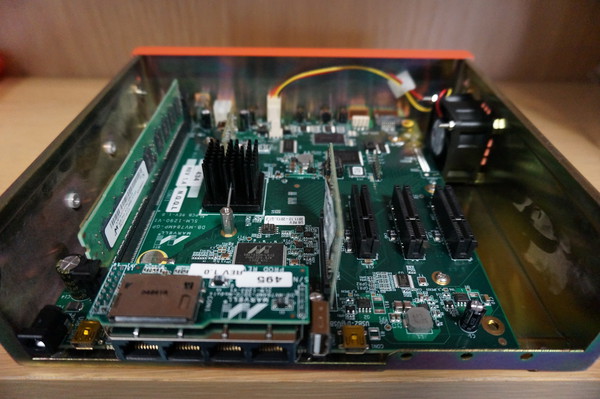
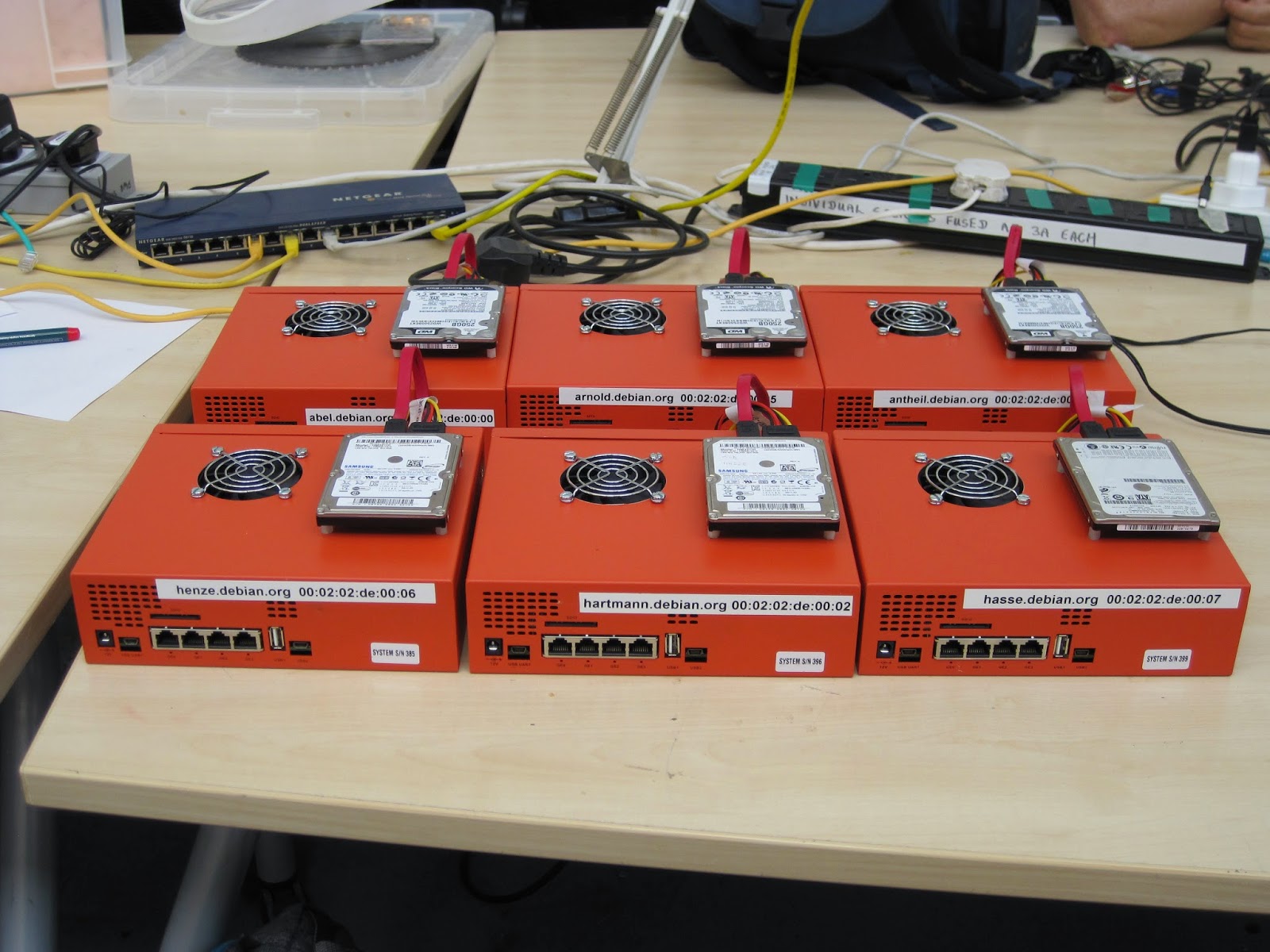
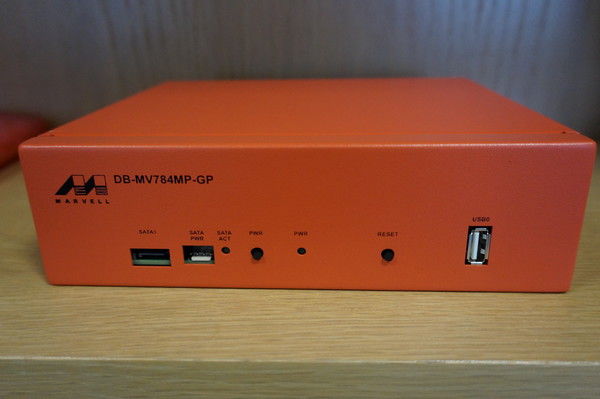
Marvell ARM system - Photo from Steve McIntyre
One weekend Steve McIntyre asked me if I could find a source of some of some 40mm fans for some systems with some pretty strict requirements. They needed to be long life and shift a lot of air to combat a persistent overheating issue.

I sat with him and went through the Farnell utterly hateful parametric web interface and eventually came up with a couple of options which were very expensive. Only then did I stop and ask what the actual problem was.

Marvell ARM system Original internal cooling arrangement - Photo from Steve McIntyre
Steve showed me one of the Debian ARM buildd boxes which are Marvell development machines. These systems are powerful quad core machines housed in compact steel enclosures.

There is a single 40mm fan trying to provide cooling for the entire enclosure. When the units are placed horizontally and used intermittently this proves adequate. Unfortunately when the system are arranged vertically in a rack and run at full load continuously they often overheat and have to be restarted. In addition the small high speed fans need replacing frequently as their bearings wore out quickly.

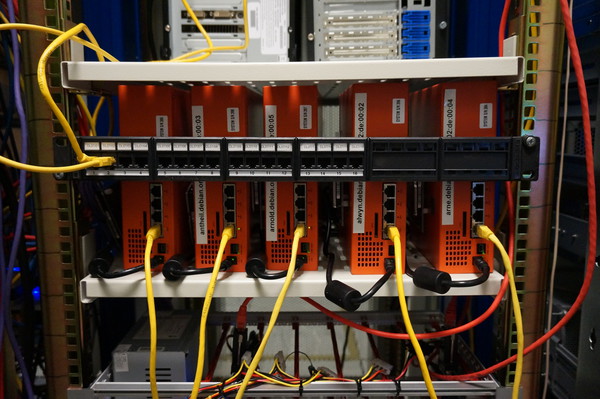
Debian ARM buildd systems - Photo from Steve McIntyreThis was obviously causing some issues for the ARM Debian ports which Steve wanted to rectify. After talking the problem through for a while we came to the conclusion we could use much larger 60mm fans to blow air directly through the top of the case onto the cpu heatsink.

Larger fans can be run much more slowly to move a similar volume of air to the smaller 40mm fans which gives a much longer service life.

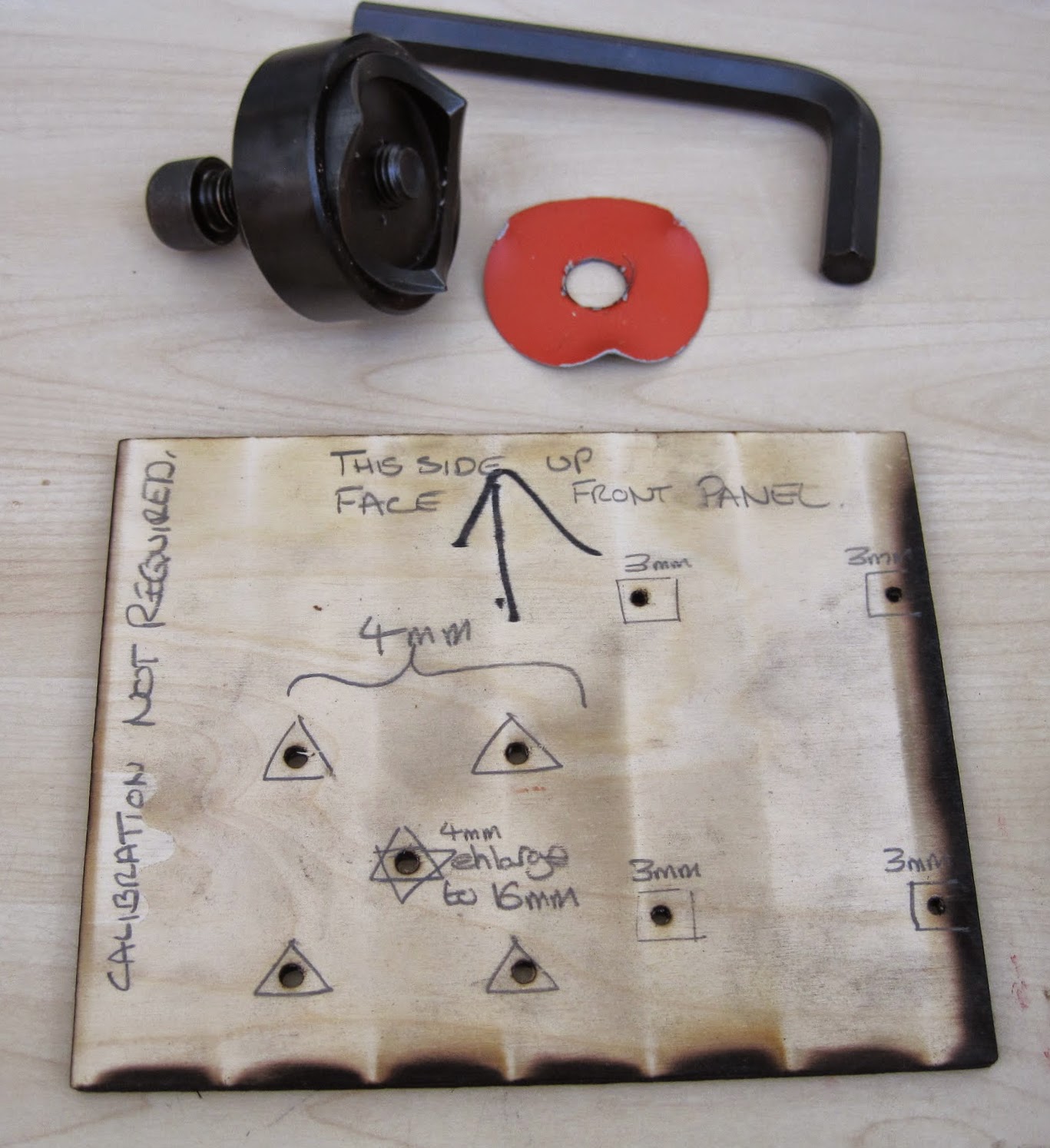
Hole punch and Drilling template
Steve proceeded to order enough parts to allow us to modify all the Debian systems, this worked out cheaper than a single "special" 40mm high volume fan.

I acquired a rather large steel hole punch, I chose this tool because it produces a much superior finish to a hole cutter and this project demanded a high level of finish (not to mention I loved having a valid excuse to own and use a huge allen key!)

If we had simply been modifying a single case I would have measured and marked up by hand. With the prospect of altering at least eight I laser cut a template from plywood which Andy Simpkins took great glee in excessively annotating.

We also used the opportunity to add bolt holes to securely attach the 2.5 inch SATA drives instead of using sticky pads.

Steve and I modified a single system to begin with both to check our alignment and the efficacy of the change. We were pleasantly surprised to discover that hoiby could now repeatedly do kernel compiles with all four cores flat out which was not possible before. The measured CPU temperature, which had previously been around 90 C, did not rise above 40 C

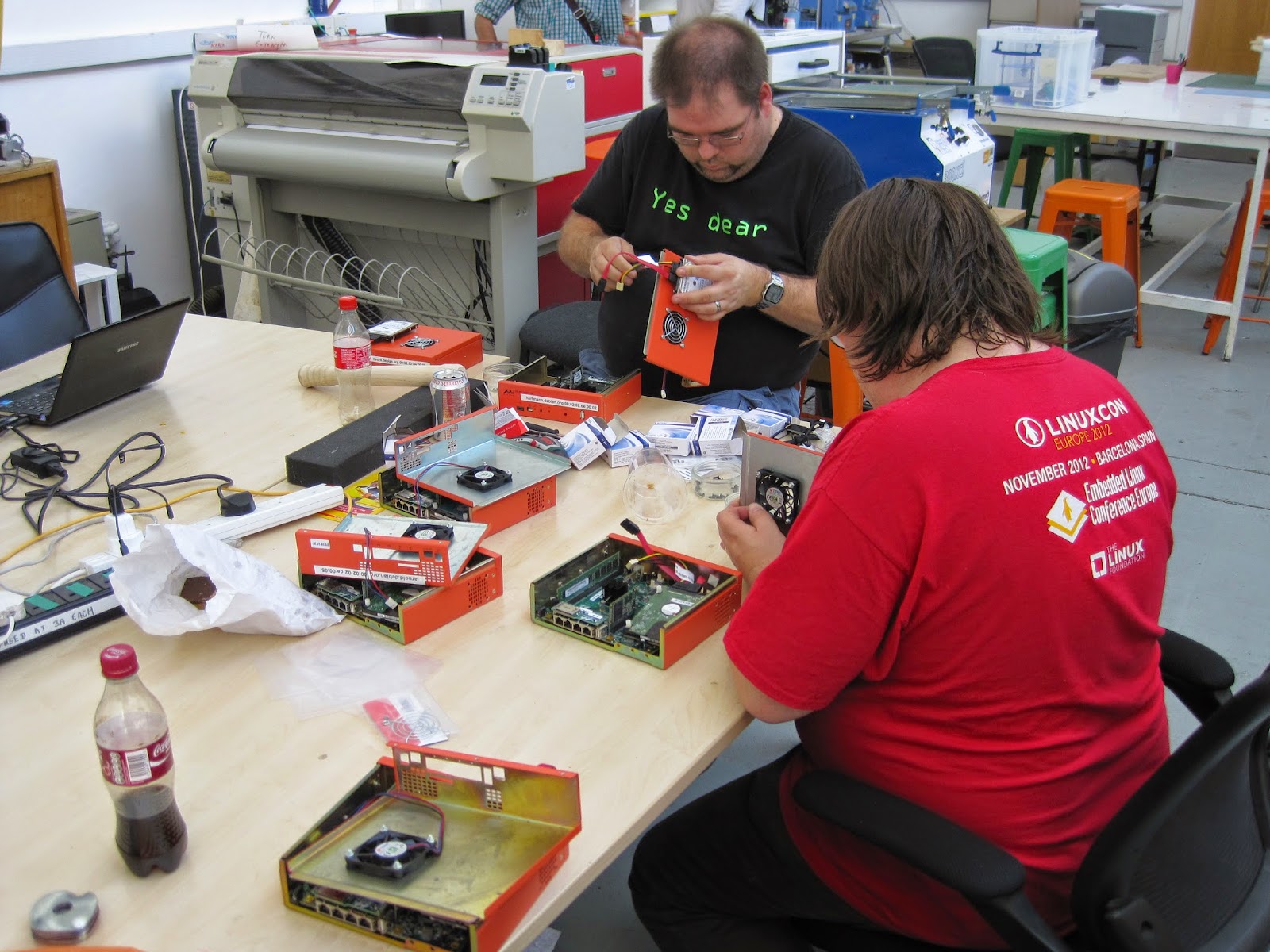
Steve and Andy on the assembly line
Steve, Andy and I then arranged a day where we took all the remaining units out of the rack at ARM, modified and returned them. We used the facilities at the Cambridge Makespace where I am a member to do the modifications.

I broke two 3mm drill bits and dulled a 4mm bit drilling all the holes, Roger Smith was good enough to loan us the use of his "Christmas tree bit" to ream the fan hole out to 16mm so we could thread the hole punch and cut the 60mm fan aperture out.

six modified systems ready to be re-racked.
We managed to get quite an assembly line going and, in my opinion, the results look pretty professional.

It has been several months since we did this work and these systems continue to run without issue. To complete the story we can see some graphs courtesy of the DSA munin instance.

CPU load on arnold.debian.org
You can clearly see the huge drop in temperature at the end of Week 25 despite the continuously high CPU load. Also there is only a single gap in the data after the changes (these indicate crashes where data was not recorded) where before there were frequent and extensive times where the systems were simply unusable.

CPU Temperature of arnold.debian.org
One reason I continue to enjoy Debian so much is the wide variety of ways in which I can contribute not only by maintaining my packages. Sometimes this kind of work does not receive the credit it deserves and hopefully highlights a small part of the frantic paddling that goes on under the serene surface of the Debian project to keep things "just working".

30 September 2014

Raphaël Hertzog: My Debian LTS report for September

Thanks to the sponsorship of multiple companies, I have been paid to work 11 hours on Debian LTS this month. CVE triagingI started by doing lots of triage in the security tracker (if you want to help, instructions are here) because I noticed that the dla-needed.txt list (which contains the list of packages that must be taken care of via an LTS security update) was missing quite a few packages that had open vulnerabilities in oldstable. In the end, I pushed 23 commits to the security tracker. I won t list the details each time but for once, it s interesting to let you know the kind of things that this work entailed: And when I say I reviewed it s a simplification for this kind of process: CVE triaging is often almost half the work in the general process: once you know that you are affected and that you have a patch, the process to release an update is relatively straightforward (sometimes there s still work to do to backport the patch). Once I was over that first pass of triaging, I had already spent more than the 11 hours paid but I still took care of preparing the security update for python-django. Thorsten Alteholz had started the work but got stuck in the process of backporting the patches. Since I m co-maintainer of the package, I took over and finished the work to release it as DLA-65-1.

No comment Liked this article? Click here. My blog is Flattr-enabled.

Dirk Eddelbuettel: Rcpp 0.11.3

A new release 0.11.3 of Rcpp is now on the CRAN network for GNU R, and an updated Debian package has been uploaded too. Rcpp has become the most popular way of enhancing GNU R with C++ code. As of today, 273 packages on CRAN depend on Rcpp for making analyses go faster and further. This release brings a fairly large number of continued enhancements, fixes and polishing to Rcpp. These were provided by a total of seven different contributors---which is a new record as well. See below for a detailed list of changes extracted from the NEWS file, but some highlights included in this release are One sore point, however, is that we missed that packages using Rcpp Modules appear to require a rebuild. We are sorry for the inconvenience; this has highlighted a shortcoming in our fairly robust and extensive tests. While we test our packages against all known CRAN dependents, such tests check for the ability to compile and run freshly and not whether previously built packages still run. We intend to augment our testing in this direction to avoid a repeat occurrence of such a misfeature.
Changes in Rcpp version 0.11.3 (2014-09-27)
  • Changes in Rcpp API:
    • The deprecation of RCPP_FUNCTION_* which was announced with release 0.10.5 last year is proceeding as planned, and the file macros/preprocessor_generated.h has been removed.
    • Timer no longer records time between steps, but times from the origin. It also gains a get_timers(int) methods that creates a vector of Timer that have the same origin. This is modelled on the Rcpp11 implementation and is more useful for situations where we use timers in several threads. Timer also gains a constructor taking a nanotime_t to use as its origin, and a origin method. This can be useful for situations where the number of threads is not known in advance but we still want to track what goes on in each thread.
    • A cast to bool was removed in the vector proxy code as inconsistent behaviour between clang and g++ compilations was noticed.
    • A missing update(SEXP) method was added thanks to pull request by Omar Andres Zapata Mesa.
    • A proxy for DimNames was added.
    • A no_init option was added for Matrices and Vectors.
    • The InternalFunction class was updated to work with std::function (provided a suitable C++11 compiler is available) via a pull request by Christian Authmann.
    • A new_env() function was added to Environment.h
    • The return value of range eraser for Vectors was fixed in a pull request by Yixuan Qiu.
  • Changes in Rcpp Sugar:
    • In ifelse(), the returned NA type was corrected for operator[].
  • Changes in Rcpp Attributes:
    • Include LinkingTo in DESCRIPTION fields scanned to confirm that C++ dependencies are referenced by package.
    • Add dryRun parameter to sourceCpp.
    • Corrected issue with relative path and R chunk use for sourceCpp.
  • Changes in Rcpp Documentation:
    • The Rcpp-FAQ vignette was updated with respect to OS X issues.
    • A new entry in the Rcpp-FAQ clarifies the use of licenses.
    • Vignettes build results no longer copied to /tmp to please CRAN.
    • The Description in DESCRIPTION has been shortened.
  • Changes in Rcpp support functions:
    • The Rcpp.package.skeleton() function will now use pkgKitten package, if available, to create a package which passes R CMD check without warnings. A new Suggests: has been added for pkgKitten.
    • The modules=TRUE case for Rcpp.package.skeleton() has been improved and now runs without complaints from R CMD check as well.
  • Changes in Rcpp unit test functions:
    • Functions from the RUnit package are now prefixed with RUnit::
    • The testRcppModule and testRcppClass sample packages now pass R CMD check --as-cran cleanly with NOTES or WARNINGS
Thanks to CRANberries, you can also look at a diff to the previous release As always, even fuller details are on the Rcpp Changelog page and the Rcpp page which also leads to the downloads page, the browseable doxygen docs and zip files of doxygen output for the standard formats. A local directory has source and documentation too. Questions, comments etc should go to the rcpp-devel mailing list off the R-Forge page.

This post by Dirk Eddelbuettel originated on his Thinking inside the box blog. Please report excessive re-aggregation in third-party for-profit settings.

24 September 2014

Robert Collins: what-poles-for-the-tent

So Monty and Sean have recently blogged about about the structures (1, 2) they think may work better for OpenStack. I like the thrust of their thinking but had some mumblings of my own to add. Firstly, I very much like the focus on social structure and needs what our users and deployers need from us. That seems entirely right. And I very much like the getting away from TC picking winners and losers. That was never an enjoyable thing when I was on the TC, and I don t think it has made OpenStack better. However, the thing that picking winners and losers did was that it allowed users to pick an API and depend on it. Because it was the X API for OpenStack . If we don t pick winners, then there is no way to say that something is the X API for OpenStack , and that means that there is no forcing function for consistency between different deployer clouds. And so this appears to be why Ring 0 is needed: we think our users want consistency in being able to deploy their application to Rackspace or HP Helion. They want vendor neutrality, and by giving up winners-and-losers we give up vendor neutrality for our users. Thats the only explanation I can come up with for needing a Ring 0 because its still winners and losers (e.g. picking an arbitrary project) keystone, grandfathering it in, if you will. If we really want to get out of the role of selecting projects, I think we need to avoid this. And we need to avoid it without losing vendor neutrality (or we need to give up the idea of vendor neutrality). One might say that we must pick winners for the very core just by its, but I don t think thats true. If the core is small, many people will still want vendor neutrality higher up the stack. If the core is large, then we ll have a larger % of APIs covered and stable granting vendor neutrality. So a core with fixed APIs will be under constant pressure to expand: not just from developers of projects, but from users that want API X to be fixed and guaranteed available and working a particular way at [most] OpenStack clouds. Ring 0 also fulfils a quality aspect we can check that it all works together well in a realistic timeframe with our existing tooling. We are essentially proposing to pick functionality that we guarantee to users; and an API for that which they have everywhere, and the matching implementation we ve tested. To pull from Monty s post: What does a basic end user need to get a compute resource that works and seems like a computer? (end user facet) What does Nova need to count on existing so that it can provide that. He then goes on to list a bunch of things, but most of them are not needed for that: We need Nova (its the only compute API in the project today). We don t need keystone (Nova can run in noauth mode and deployers could just have e.g. Apache auth on top). We don t need Neutron (Nova can do that itself). We don t need cinder (use local volumes). We need Glance. We don t need Designate. We don t need a tonne of stuff that Nova has in it (e.g. quotas) end users kicking off a simple machine have -very- basic needs. Consider the things that used to be in Nova: Deploying containers. Neutron. Cinder. Glance. Ironic. We ve been slowly decomposing Nova (yay!!!) and if we keep doing so we can imagine getting to a point where there truly is a tightly focused code base that just does one thing well. I worry that we won t get there unless we can ensure there is no pressure to be inside Nova to win . So there s a choice between a relatively large set of APIs that make the guaranteed available APIs be comprehensive, or a small set that that will give users what they need just at the beginning but might not be broadly available and we ll be depending on some unspecified process for the deployers to agree and consolidate around what ones they make available consistently. In sort one of the big reasons we were picking winners and losers in the TC was to consolidate effort around a single API not implementation (keystone is already on its second implementation). All the angst about defcore and compatibility testing is going to be multiplied when there is lots of ecosystem choice around APIs above Ring 0, and the only reason that won t be a problem for Ring 0 is that we ll still be picking winners. How might we do this? One way would be to keep picking winners at the API definition level but not the implementation level, and make the competition be able to replace something entirely if they implement the existing API [and win hearts and minds of deployers]. That would open the door to everything being flexible and its happened before with Keystone. Another way would be to not even have a Ring 0. Instead have a project/program that is aimed at delivering the reference API feature-set built out of a single, flat Big Tent and allow that project/program to make localised decisions about what components to use (or not). Testing that all those things work together is not much different than the current approach, but we d have separated out as a single cohesive entity the building of a product (Ring 0 is clearly a product) from the projects that might go into it. Projects that have unstable APIs would clearly be rejected by this team; projects with stable APIs would be considered etc. This team wouldn t be the TC : they too would be subject to the TC s rulings. We could even run multiple such teams as hinted at by Dean Troyer one of the email thread posts. Running with that I d then be suggesting So OpenStack/NaaS would have an API or set of APIs, and they d be responsible for considering maturity, feature set, and so on, but wouldn t own Neutron, or Neutron incubator or any other component they would be a *cross project* team, focused at the product layer, rather than the component layer, which nearly all of our folk end up locked into today. Lastly Sean has also pointed out that we have large N N^2 communication issues I think I m proposing to drive the scope of any one project down to a minimum, which gives us more N, but shrinks the size within any project, so folk don t burn out as easily, *and* so that it is easier to predict the impact of changes clear contracts and APIs help a huge amount there.

Next.

Previous.