Search Results: "sf"

26 September 2016

Reproducible builds folks: Reproducible Builds: week 74 in Stretch cycle

Here is what happened in the Reproducible Builds effort between Sunday September 18 and Saturday September 24 2016: Outreachy We intend to participate in Outreachy Round 13 and look forward for new enthusiastic applications to contribute to reproducible builds. We're offering four different areas to work on: Reproducible Builds World summit #2 We are planning e a similar event to our Athens 2015 summit and expect to reveal more information soon. If you haven't been contacted yet but would like to attend, please contact holger. Toolchain development and fixes Mattia uploaded dpkg/1.18.10.0~reproducible1 to our experimental repository. and covered the details for the upload in a mailing list post. The most important change is the incorporation of improvements made by Guillem Jover (dpkg maintainer) to the .buildinfo generator. This is also in the hope that it will speed up the merge in the upstream. One of the other relevant changes from before is that .buildinfo files generated from binary-only builds will no longer include the hash of the .dsc file in Checksums-Sha256 as documented in the specification. Even if it was considered important to include a checksum of the source package in .buildinfo, storing it that way breaks other assumptions (eg. that Checksums-Sha256 contains only files part of that are part of a single upload, wheras the .dsc might not be part of that upload), thus we look forward for another solution to store the source checksum in .buildinfo. Bugs filed Reviews of unreproducible packages 250 package reviews have been added, 4 have been updated and 4 have been removed in this week, adding to our knowledge about identified issues. 4 issue types have been added: 3 issue types have been updated: Weekly QA work FTBFS bugs have been reported by: Documentation updates h01ger created a new Jenkins job so that every commit pushed to the master branch for the website will update reproducible-builds.org. diffoscope development strip-nondeterminism development reprotest development tests.reproducible-builds.org Misc. This week's edition was written by Chris Lamb, Holger Levsen and Mattia Rizzolo and reviewed by a bunch of Reproducible Builds folks on IRC.

25 September 2016

Vincent Sanders: I'll huff, and I'll puff, and I'll blow your house in

Sometimes it really helps to have a different view on a problem and after my recent writings on my Public Suffix List (PSL) library I was fortunate to receive a suggestion from my friend Enrico Zini.

I had asked for suggestions on reducing the size of the library further and Enrico simply suggested Huffman coding. This was a technique I had learned about long ago in connection with data compression and the intervening years had made all the details fuzzy which explains why it had not immediately sprung to mind.

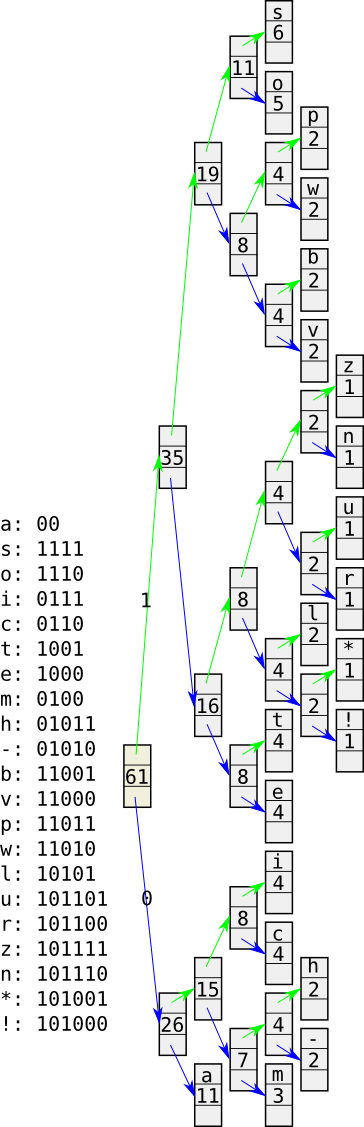
A small subset of the Public Suffix List as stored within libnspslHuffman coding named for David A. Huffman is an algorithm that enables a representation of data which is very efficient. In a normal array of characters every character takes the same eight bits to represent which is the best we can do when any of the 256 values possible is equally likely. If your data is not evenly distributed this is not the case for example if the data was english text then the value is fifteen times more likely to be that for e than k.

every step of huffman encoding tree build for the example string tableSo if we have some data with a non uniform distribution of probabilities we need a way the data be encoded with fewer bits for the common values and more bits for the rarer values. To be efficient we would need some way of having variable length representations without storing the length separately. The term for this data representation is a prefix code and there are several ways to generate them.

Such is the influence of Huffman on the area of prefix codes they are often called Huffman codes even if they were not created using his algorithm. One can dream of becoming immortalised like this, to join the ranks of those whose names are given to units or whole ideas in a field must be immensely rewarding, however given Huffman invented his algorithm and proved it to be optimal to answer a question on a term paper in his early twenties I fear I may already be a bit too late.

The algorithm itself is relatively straightforward. First a frequency analysis is performed, a fancy way of saying count how many of each character is in the input data. Next a binary tree is created by using a priority queue initialised with the nodes sorted by frequency.

The resulting huffman tree and the binary representation of the input symbols
The two least frequent items count is summed together and a node placed in the tree with the two original entries as child nodes. This step is repeated until a single node exists with a count value equal to the length of the input.

To encode data once simply walks the tree outputting a 0 for a left node or 1 for right node until reaching the original value. This generates a mapping of values to bit output, the input is then simply converted value by value to the bit output. To decode the data the data is used bit by bit to walk the tree to arrive at values.

If we perform this algorithm on the example string table *!asiabvcomcoopitamazonawsarsaves-the-whalescomputebasilicata we can reduce the 488 bits (61 * 8 bit characters) to 282 bits or 40% reduction. Obviously in a real application the huffman tree would need to be stored which would probably exceed this saving but for larger data sets it is probable this technique would yield excellent results on this kind of data.

Once I proved this to myself I implemented the encoder within the existing conversion program. Although my perl encoder is not very efficient it can process the entire PSL string table (around six thousand labels using 40KB or so) in less than a second, so unless the table grows massively an inelegant approach will suffice.

The resulting bits were packed into 32bit values to improve decode performance (most systems prefer to deal with larger memory fetches less frequently) and resulted in 18KB of output or 47% of the original size. This is a great improvement in size and means the statically linked test program is now 59KB and is actually smaller than the gzipped source data.

$ ls -alh test_nspsl
-rwxr-xr-x 1 vince vince 59K Sep 25 23:58 test_nspsl
$ ls -al public_suffix_list.dat.gz
-rw-r--r-- 1 vince vince 62K Sep 1 08:52 public_suffix_list.dat.gz

To be clear the statically linked program can determine if a domain is in the PSL with no additional heap allocations and includes the entire PSL ordered tree, the domain label string table and the huffman decode table to read it.

An unexpected side effect is that because the decode loop is small it sits in the processor cache. This appears to cause the string comparison function huffcasecmp() (which is not locale dependant because we know the data will be limited ASCII) performance to be close to using strcasecmp() indeed on ARM32 systems there is a very modest improvement in performance.

I think this is as much work as I am willing to put into this library but I am pleased to have achieved a result which is on par with the best of breed (libpsl still has a data representation 20KB smaller than libnspsl but requires additional libraries for additional functionality) and I got to (re)learn an important algorithm too.

20 September 2016

Reproducible builds folks: Reproducible Builds: week 73 in Stretch cycle

What happened in the Reproducible Builds effort between Sunday September 11 and Saturday September 17 2016: Toolchain developments Ximin Luo started a new series of tools called (for now) debrepatch, to make it easier to automate checks that our old patches to Debian packages still apply to newer versions of those packages, and still make these reproducible. Ximin Luo updated one of our few remaining patches for dpkg in #787980 to make it cleaner and more minimal. The following tools were fixed to produce reproducible output: Packages reviewed and fixed, and bugs filed The following updated packages have become reproducible - in our current test setup - after being fixed: The following updated packages appear to be reproducible now, for reasons we were not able to figure out. (Relevant changelogs did not mention reproducible builds.) The following 3 packages were not changed, but have become reproducible due to changes in their build-dependencies: jaxrs-api python-lua zope-mysqlda. Some uploads have addressed some reproducibility issues, but not all of them: Patches submitted that have not made their way to the archive yet: Reviews of unreproducible packages 462 package reviews have been added, 524 have been updated and 166 have been removed in this week, adding to our knowledge about identified issues. 25 issue types have been updated: Weekly QA work FTBFS bugs have been reported by: diffoscope development A new version of diffoscope 60 was uploaded to unstable by Mattia Rizzolo. It included contributions from: It also included from changes previous weeks; see either the changes or commits linked above, or previous blog posts 72 71 70. strip-nondeterminism development New versions of strip-nondeterminism 0.027-1 and 0.028-1 were uploaded to unstable by Chris Lamb. It included contributions from: disorderfs development A new version of disorderfs 0.5.1 was uploaded to unstable by Chris Lamb. It included contributions from: It also included from changes previous weeks; see either the changes or commits linked above, or previous blog posts 70. Misc. This week's edition was written by Ximin Luo and reviewed by a bunch of Reproducible Builds folks on IRC.

17 September 2016

Jonas Meurer: apache rewritemap querystring

Apache2: Rewrite REQUEST_URI based on a bulk list of GET parameters in QUERY_STRING Recently I searched for a solution to rewrite a REQUEST_URI based on GET parameters in QUERY_STRING. To make it even more complicated, I had a list of ~2000 parameters that have to be rewritten like the following:
if % QUERY_STRING  starts with one of <parameters>:
    rewrite % REQUEST_URI  from /new/ to /old/
Honestly, it took me several hours to find a solution that was satisfying and scales well. Hopefully, this post will save time for others with the need for a similar solution. Research and first attempt: RewriteCond % QUERY_STRING ... After reading through some documentation, particularly Manipulating the Query String, the following ideas came to my mind at first:
RewriteCond % REQUEST_URI  ^/new/
RewriteCond % QUERY_STRING  ^(param1)(.*)$ [OR]
RewriteCond % QUERY_STRING  ^(param2)(.*)$ [OR]
...
RewriteCond % QUERY_STRING  ^(paramN)(.*)$
RewriteRule /new/ /old/?%1%2 [R,L]
or instead of an own RewriteCond for each parameter:
RewriteCond % QUERY_STRING  ^(param1 param2 ... paramN)(.*)$

There has to be something smarter ... But with ~2000 parameters to look up, neither of the solutions seemed particularly smart. Both scale really bad and probably it's rather heavy stuff for Apache to check ~2000 conditions for every ^/new/ request. Instead I was searching for a solution to lookup a string from a compiled list of strings. RewriteMap seemed like it might be what I was searching for. I read the Apache2 RewriteMap documentation here and here and finally found a solution that worked as expected, with one limitation. But read on ... The solution: RewriteMap and RewriteCond $ mapfile:% QUERY_STRING ... Finally, the solution was to use a RewriteMap with all parameters that shall be rewritten and check given parameters in the requests against this map within a RewriteCond. If the parameter matches, the simple RewriteRule applies. For the inpatient, here's the rewrite magic from my VirtualHost configuration:
RewriteEngine On
RewriteMap RewriteParams "dbm:/tmp/rewrite-params.map"
RewriteCond % REQUEST_URI  ^/new/
RewriteCond $ RewriteParams:% QUERY_STRING NOT_FOUND  !=NOT_FOUND
RewriteRule ^/new/ /old/ [R,L]

A more detailed description of the solution First, I created a RewriteMap at /tmp/rewrite-params.txt with all parameters to be rewritten. A RewriteMap requires two field per line, one with the origin and the other one with the replacement part. Since I use the RewriteMap merely for checking the condition, not for real string replacement, the second field doesn't matter to me. I ended up putting my parameters in both fields, but you could choose every random value for the second field: /tmp/rewrite-params.txt:
param1 param1
param2 param2
...
paramN paramN
Then I created a DBM hash map file from that plain text map file, as DBM maps are indexed, while TXT maps are not. In other words: with big maps, DBM is a huge performance boost:
httxt2dbm -i /tmp/rewrite-params.txt -o /tmp/rewrite-params.map

Now, let's go through the VirtualHost configuration rewrite magic from above line by line. First line should be clear: it enables the Apache Rewrite Engine:
RewriteEngine On
Second line defines the RewriteMap that I created above. It contains the list of parameters to be rewritten:
RewriteMap RewriteParams "dbm:/tmp/rewrite-params.map"
The third line limits the rewrites to REQUEST_URIs that start with /new/. This is particularly required to prevent rewrite loops. Without that condition, queries that have been rewritten to /old/ would go through the rewrite again, resulting in an endless rewrite loop:
RewriteCond % REQUEST_URI  ^/new/
The fourth line is the core condition: it checks whether QUERY_STRING (the GET parameters) is listed in the RewriteMap. A fallback value 'NOT_FOUND' is defined if the lookup didn't match. The condition is only true, if the lookup was successful and the QUERY_STRING was found within the map:
RewriteCond $ RewriteParams:% QUERY_STRING NOT_FOUND  !=NOT_FOUND
The last line is a simple RewriteRule from /new/ to /old/. It is executed only if all previous conditions are met. The flags are R for redirect (issuing a HTTP redirect to browser) and L for last (causing mod_rewrite to stop processing immediately after that rule):
RewriteRule ^/new/ /old/ [R,L]

Known issues A big limitation of this solution (compared to the ones above) is, that it looks up the whole QUERY_STRING in RewriteMap. Therefore, it works only if param is the only GET parameter. In case of additional GET parameters, the second rewrite condition fails and nothing is rewritten even if the first GET parameter is listed in RewriteMap. If anyone comes up with a solution to this limitation, I would be glad to learn about it :)

Jonas Meurer: data recovery

Data recovery with ddrescue, testdisk and sleuthkit From time to time I need to recover data from disks. Reasons can be broken flash/hard disks as well as accidently deleted files. Fortunately, this doesn't happen to often, which on the downside means that I usually don't remember the details about best practice. Now that a good friend asked me to recover very important data from a broken flash disk, I take the opportunity to write down what I did and hopefully don't need to read the same docs again next time :) Disclaimer: I didn't take the time to read through full documentation. This is rather a brief summary of the best practice to my knowledge, not a sophisticated and detailed explanation of data recovery techniques. Create image with ddrescue First and most secure rule for recovery tasks: don't work on the original, use a copied image instead. This way you can do, whatever you want without risking further data loss. The perfect tool for this is GNU ddrescue. Contrary to dd, it doesn't reiterate over a broken sector with I/O errors again and again while copying. Instead, it remembers the broken sector for later and goes on to the next sector first. That way, all sectors that can be read without errors are copied first. This is particularly important as every extra attempt to read a broken sector can further damage the source device, causing even more data loss. In Debian, ddrescue is available in the gddrescue package:
apt-get install gddrescue
Copying the raw disk content to an image with ddrescue is as easy as:
ddrescue /dev/disk disk-backup.img disk.log
Giving a logfile as third argument has the great advantage that you can interupt ddrescue at any time and continue the copy process later, possibly with different options. In case of very large disks where only the first part was in use, it might be useful to start with copying the beginning only:
ddrescue -i0 -s20MiB /dev/disk disk-backup.img disk.log
In case of errors after the first run, you should start ddrescue again with direct read access (-d) and tell it to try again bad sectors three times (-r3):
ddrescue -d -r3 /dev/disk disk-backup.img disk.log
If some sectors are still missing afterwards, it might help to run ddrescue with infinite retries for some time (e.g. one night):
ddrescue -d -r-1  /dev/disk disk-backup.img disk.log

Inspect the image Now that you have an image of the raw disk, you can take a first look at what it contains. If ddrescue was able to recover all sectors, chances are high that no further magic is required and all data is there. If the raw disk (used to) contain a partition table, take a first look with mmls from sleuthkit:
mmls disk-backup.img
In case of a intact partition table, you can try to create device maps with kpartx after setting up a loop device for the image file:
losetup /dev/loop0 disk-backup.img
kpartx -a /dev/loop0
If kpartx finds partitions, they will be made available at /dev/mapper/loop0p1, /dev/mapper/loop0p2 and so on. Search for filesystems on the partitions with fsstat from sleuthkit on the partition device map:
fsstat /dev/mapper/loop0p1
Or directly on the image file with the offset discovered by mmls earlier. This also might work in case of
fsstat -o 8064 disk-backup.img
The offset obviously is not needed if the image contains a partition dump (without partition table):
fsstat disk-backup.img
In case that a filesystem if found, simply try to mount it:
mount -t <fstype> -o ro /dev/mapper/loop0p1 /mnt
or
losetup -o 8064 /dev/loop1 disk-backup.img
mount -t <fstype> -o ro /dev/loop1 /mnt

Recover partition table If the partition table is broken, try to recover it with testdisk. But first, create a second copy of the image, as you will alter it now:
ddrescue disk-backup.img disk-backup2.img
testdisk disk-backup2.img
In testdisk, select a media (e.g. Disk disk-backup2.img) and proceed, then select the partition table type (usually Intel or EFI GPT) and analyze -> quick search. If partitions are found, select one or more and write the partition structure to disk.

Recover files Finally, let's try to recover the actual files from the image. testdisk If the partition table recovery was sucessfull, try to undelete files from within testdisk. Go back to the main menu and select advanced -> undelete. photorec Another option is to use the photorec tool that comes with testdisk. It searches the image for known file structures directly, ignoring possible filesystems:
photorec sdb2.img
You have to select either a particular partition or the whole disk, a file system (ext2/ext3 vs. other) and a destination for recovered files. Last time, photorec was my last resort as the fat32 filesystem was so damaged that testdisk detected only an empty filesystem. sleuthkit sleuthkit also ships with tools to undelete files. I tried fls and icat. fls searches for and lists files and directories in the image, searching for parts of the former filesystem. icat copies the files by their inode numer. Last time I tried, fls and icat didn't recover any new files compared to photorec. Still, for the sake of completeness, I document what I did. First, I invoked fls in order to search for files:
fls -f fat32 -o 8064 -pr disk-backup.img
Then, I tried to backup one particular file from the list:
icat -f fat32 -o 8064 <INODE>
Finally, I used the recoup.pl script from Dave Henk in order to batch-recover all discovered files:
wget http://davehenk.googlepages.com/recoup.pl
chmod +x recoup.pl
vim recoup.pl
[...]
my $fullpath="~/recovery/sleuthkit/";
my $FLS="/usr/bin/fls";
my @FLS_OPT=("-f","fat32","-o","8064","-pr","-m $fullpath","-s 0");
my $FLS_IMG="~/recovery/disk-image.img";
my $ICAT_LOG="~/recovery/icat.log";
my $ICAT="/usr/bin/icat";
my @ICAT_OPT=("-f","fat32","-o","8064");
[...]
Further down, the double quotes around $fullfile needed to be replaced by single quotes (at least in my case, as $fullfile contained a subdir called '$OrphanFiles'):
system("$ICAT @ICAT_OPT $ICAT_IMG $inode > \'$fullfile\' 2>> $ICAT_LOG") if ($inode != 0);
That's it for now. Feel free to comment with suggestions on how to further improve the process of recovering data from broken disks.

Norbert Preining: Android 7.0 Nougat Root PokemonGo

Since my switch to Android my Nexus 6p is rooted and I have happily fixed the Android (<7) font errors with Japanese fonts in English environment (see this post). The recently released Android 7 Nougat finally fixes this problem, so it was high time to update. In addition, a recent update to Pokemon Go excluded rooted devices, so I was searching for a solution that allows me to: update to Nougat, keep root, and run PokemonGo (as well as some bank security apps etc). android-nougat-root-poke After some playing around here are the steps I took: Installation of necessary components Warning: The following is for Nexus6p device, you need different image files and TWRP recovery for other devices. Flash Nougat firmware images Get it from the Google Android Nexus images web site, unpack the zip and the included zip one gets a lot of img files.

unzip angler-nrd90u-factory-7c9b6a2b.zip
cd angler-nrd90u/
unzip image-angler-nrd90u.zip
As I don t want my user partition to get flashed, I did not use the included flash script, but did it manually:
fastboot flash bootloader bootloader-angler-angler-03.58.img
fastboot reboot-bootloader
sleep 5
fastboot flash radio radio-angler-angler-03.72.img
fastboot reboot-bootloader
sleep 5
fastboot erase system
fastboot flash system system.img
fastboot erase boot
fastboot flash boot boot.img
fastboot erase cache
fastboot flash cache cache.img
fastboot erase vendor
fastboot flash vendor vendor.img
fastboot erase recovery
fastboot flash recovery recovery.img
fastboot reboot
After that boot into the normal system and let it do all the necessary upgrades. Once this is done, let us prepare for systemless root and possible hiding of it. Get the necessary file Get Magisk, SuperSU-magisk, as well as the Magisk-Manager.apk from this forum thread (direct links as of 2016/9: Magisk-v6.zip, SuperSU-v2.76-magisk.zip, Magisk-Manager.apk). Transfer these two files to your device I am using an external USB stick that can be plugged into the device, or copy it via your computer or via a cloud service. Also we need to get a custom recovery image, I am using TWRP. I used the version 3.0.2-0 of TWRP I had already available, but that version didn t manage to decrypt the file system and hangs. One needs to get at least version 3.0.2-2 from the TWRP web site. Install latest TWRP recorvery Reboot into boot-loader, then use fastboot to flash twrp:
fastboot erase recovery
fastboot flash recovery twrp-3.0.2-2-angler.img
fastboot reboot-bootloader
After that select Recovery with the up-down buttons and start twrp. You will be asked you pin if you have one set. Install Magisk-v6.zip Select Install in TWRP, select the Magisk-v6.zip file, and see you device being prepared for systemless root. Install SuperSU, Magisk version Again, boot into TWRP and use the install tool to install SuperSU-v2.76-magisk.zip. After reboot you should have a SuperSU binary running. Install the Magisk Manager From your device browse to the .apk and install it. How to run safety net programs Those programs that check for safety functions (Pokemon Go, Android Pay, several bank apps) need root disabled. Open the Magisk Manager and switch the root switch to the left (off). After this starting the program should bring you past the special check.

15 September 2016

Craig Sanders: Frankenwheezy! Keeping wheezy alive on a container host running libc6 2.24

It s Alive! The day before yesterday (at Infoxchange, a non-profit whose mission is Technology for Social Justice , where I do a few days/week of volunteer systems & dev work), I had to build a docker container based on an ancient wheezy image. It built fine, and I got on with working with it. Yesterday, I tried to get it built on my docker machine here at home so I could keep working on it, but the damn thing just wouldn t build. At first I thought it was something to do with networking, because running curl in the Dockerfile was the point where it was crashing but it turned out that many programs would segfault e.g. it couldn t run bash, but sh (dash) was OK. I also tried running a squeeze image, and that had the same problem. A jessie image worked fine (but the important legacy app we need wheezy for doesn t yet run in jessie). After a fair bit of investigation, it turned out that the only significant difference between my workstation at IX and my docker machine at home was that I d upgraded my home machines to libc6 2.24-2 a few days ago, whereas my IX workstation (also running sid) was still on libc6 2.23. Anyway, the point of all this is that if anyone else needs to run a wheezy on a docker host running libc6 2.24 (which will be quite common soon enough), you have to upgrade libc6 and related packages (and any -dev packages, including libc6-dev, you might need in your container that are dependant on the specific version of libc6). In my case, I was using docker but I expect that other container systems will have the same problem and the same solution: install libc6 from jessie into wheezy. Also, I haven t actually tested installing jessie s libc6 on squeeze if it works, I expect it ll require a lot of extra stuff to be installed too. I built a new frankenwheezy image that had libc6 2.19-18+deb8u4 from jessie. To build it, I had to use a system which hadn t already been upgraded to libc6 2.24. I had already upgraded libc6 on all the machines on my home network. Fortunately, I still had my old VM that I created when I first started experimenting with docker crazily, it was a VM with two ZFS ZVOLs, a small /dev/vda OS/boot disk, and a larger /dev/vdb mounted as /var/lib/docker. The crazy part is that /dev/vdb was formatted as btrfs (mostly because it seemed a much better choice than aufs). Disk performance wasn t great, but it was OK and it worked. Docker has native support for ZFS, so that s what I m using on my real hardware. I started with the base wheezy image we re using and created a Dockerfile etc to update it. First, I added deb lines to the /etc/apt/sources.list for my local jessie and jessie-updates mirror, then I added the following line to /etc/apt/apt.conf:
APT::Default-Release "wheezy";
Without that, any other apt-get installs in the Dockerfile will install from jesssie rather than wheezy, which will almost certainly break the legacy app. I forgot to do it the first time, and had to waste another 10 minutes or so building the app s container again. I then installed the following:
apt-get -t jessie install libc6 locales libc6-dev krb5-multidev comerr-dev zlib1g-dev libssl-dev libpq-dev
To minimise the risk of incompatible updates, it s best to install the bare minimum of jessie packages required to get your app running. The only reason I needed to install all of those -dev packages was because we needed libpq-dev, which pulled in all the rest. If your app doesn t need to talk to postgresql, you can skip them. In fact, I probably should try to build it again without them I added them after the first build failed but before I remembered to set Apt::Default::Release (OTOH, it s working OK now and we re probably better off with libssl-dev from jessie anyway). Once it built successfully, I exported the image to a tar file, copied it back to my real Docker machine (co-incidentally, the same machine with the docker VM installed) and imported it into docker there and tested it to make sure it didn t have the same segfault issues that the original wheezy image did. No problem, it worked perfectly. That worked, so I edited the FROM line in the Dockerfile for our wheezy app to use frankenwheezy and ran make build. It built, passed tests, deployed and is running. Now I can continue working on the feature I m adding to it, but I expect there ll be a few more yaks to shave before I m finished. When I finish what I m currently working on, I ll take a look at what needs to be done to get this app running on jessie. It s on the TODO list at work, but everyone else is too busy a perfect job for an unpaid volunteer. Wheezy s getting too old to keep using, and this frankenwheezy needs to float away on an iceberg. Frankenwheezy! Keeping wheezy alive on a container host running libc6 2.24 is a post from: Errata

10 September 2016

Sylvain Le Gall: Release of OASIS 0.4.7

I am happy to announce the release of OASIS v0.4.7. Logo OASIS small OASIS is a tool to help OCaml developers to integrate configure, build and install systems in their projects. It should help to create standard entry points in the source code build system, allowing external tools to analyse projects easily. This tool is freely inspired by Cabal which is the same kind of tool for Haskell. You can find the new release here and the changelog here. More information about OASIS in general on the OASIS website. Pull request for inclusion in OPAM is pending. Here is a quick summary of the important changes: Features: This version contains a lot of changes and is the achievement of a huge amount of work. The addition of OMake as a plugin is a huge progress. The overall work has been targeted at making OASIS more library like. This is still a work in progress but we made some clear improvement by getting rid of various side effect (like the requirement of using "chdir" to handle the "-C", which leads to propage ~ctxt everywhere and design OASISFileSystem). I would like to thanks again the contributor for this release: Spiros Eliopoulos, Paul Snively, Jeremie Dimino, Christopher Zimmermann, Christophe Troestler, Max Mouratov, Jacques-Pascal Deplaix, Geoff Shannon, Simon Cruanes, Vladimir Brankov, Gabriel Radanne, Evgenii Lepikhin, Petter Urkedal, Gerd Stolpmann and Anton Bachin.

8 September 2016

Wouter Verhelst: Installing files for other applications with autotools

Let's say you have a configure.ac file which contains this:
PKG_CHECK_VAR([p11_moduledir], "p11-kit-1", "p11_module_path")
AC_SUBST([p11_moduledir])
and that it goes with a Makefile.am which contains this:
dist_p11_module_DATA = foo.module
Then things should work fine, right? When you run make install, your modules install to the right location, and p11-kit will pick up everything the way it should. Well, no. Not exactly. That is, it will work for the common case, but not for some other cases. You see, if you do that, then make distcheck will fail pretty spectacularly. At least if you run that as non-root (which you really really should do). The problem is that by specifying the p11_moduledir variable in that way, you hardcode it; it doesn't honour any $prefix or $DESTDIR variables that way. The result of that is that when a user installs your package by specifying --prefix=/opt/testmeout, it will still overwrite files in the system directory. Obviously, that's not desireable. The $DESTDIR bit is especially troublesome, as it makes packaging your software for the common distributions complicated (most packaging software heavily relies on DESTDIR support to "install" your software in a staging area before turning it into an installable package). So what's the right way then? I've been wondering about that myself, and asked for the right way to do something like that on the automake mailinglist a while back. The answer I got there wasn't entirely satisfying, and at the time I decided to take the easy way out (EXTRA_DIST the file, but don't actually install it). Recently, however, I ran against a similar problem for something else, and decided to try to do it the proper way this time around. p11-kit, like systemd, ships pkg-config files which contain variables for the default locations to install files into. These variables' values are meant to be easy to use from scripts, so that no munging of them is required if you want to directly install to the system-wide default location. The downside of this is that, if you want to install to the system-wide default location by default from an autotools package (but still allow the user to --prefix your installation into some other place, accepting that then things won't work out of the box), you do need to do the aforementioned munging. Luckily, that munging isn't too hard, provided whatever package you're installing for did the right thing:
PKG_CHECK_VAR([p11_moduledir], "p11-kit-1", "p11_module_path")
PKG_CHECK_VAR([p11kit_libdir], "p11-kit-1", "libdir")
if test -z $ac_cv_env_p11_moduledir_set; then
    p11_moduledir=$(echo $p11_moduledir sed -e "s,$p11kit_libdir,\$ libdir ,g")
fi
AC_SUBST([p11_moduledir])
Whoa, what just happened? First, we ask p11-kit-1 where it expects modules to be. After that, we ask p11-kit-1 what was used as "libdir" at installation time. Usually that should be something like /usr/lib or /usr/lib/gnu arch triplet or some such, but it could really be anything. Next, we test to see whether the user set the p11_moduledir variable on the command line. If so, we don't want to munge it. The next line looks for the value of whatever libdir was set to when p11-kit-1 was installed in the value of p11_module_path, and replaces it with the literal string $ libdir . Finally, we exit our if and AC_SUBST our value into the rest of the build system. The resulting package will have the following semantics: I suppose it would've been easier if the PKG_CHECK_VAR macro could (optionally) do that munging by itself, but then, can't have everything.

5 September 2016

Rapha&#235;l Hertzog: My Free Software Activities in August 2016

My monthly report covers a large part of what I have been doing in the free software world. I write it for my donators (thanks to them!) but also for the wider Debian community because it can give ideas to newcomers and it s one of the best ways to find volunteers to work with me on projects that matter to me. This months is rather light since I was away in vacation for two weeks. Kali related work The new pkg-security team is working full steam and I reviewed/sponsored many packages during the month: polenum, accheck, braa, t50, ncrack, websploit. I filed bug #834515 against sbuild since sbuild-createchroot was no longer usable for kali-rolling due to the embedded dash. That misfeature has been reverted and implemented through an explicit option. I brought the attention of ftpmasters on #832163 since we had unexpected packages in the standard section (they have been discovered in the Kali live ISO while we did not want them). I uploaded two fontconfig NMU to finally push to Debian a somewhat cleaner fix for the problem of various captions being displayed as squares after a font upgrade (see #828037 and #835142). I tested (twice) a live-build patch from Adrian Gibanel Lopez implementing EFI boot with grub and merged it into the official git repository (see #731709). I filed bug #835983 on python-pypdf2 since it has an invalid dependency forbidding co-installation with python-pypdf. I orphaned splint since its maintainer was missing in action (MIA) and immediately made a QA upload to fix the RC bug which kicked it out of testing (this package is a build dependency of a Kali package). django-jsonfield I wrote a patch to make python-django-jsonfield compatible with Django 1.10 (#828668) and I committed that patch in the upstream repository. Distro Tracker I made some changes to make the codebase compatible with Django 1.10 (and added Django 1.10 to the tox test matrix). I added a Debian Maintainer Dashboard link next to people s name on request of Lucas Nussbaum (#830548). I made a preliminary review of Paul Wise s patch to add multiarch hints (#833623) and improved the handling of the mailbot when it gets MIME Headers referencing an unknown charset (like cp-850 , Python only knows of cp850 ) I also helped Peter Palfrader to enabled a .onion address for tracker.debian.org, see onion.debian.org for the full list of services available over Tor. Misc stuff I updated my letsencrypt.sh salt formula to work with the latest version of letsencrypt.sh (0.2.0) I merged updated translations for the Debian Administrator s Handbook from weblate.org and uploaded a new version to Debian. Thanks See you next month for a new summary of my activities.

No comment Liked this article? Click here. My blog is Flattr-enabled.

3 September 2016

Iustin Pop: Nationalpark Bike Marathon 2016

Nationalpark Bike Marathon 2016 report: gravity rules! "Marathon" is a bit of a misnomer, since I did the short route, not the medium nor the long one. But hey, it's the official name! Setup This race has four possible lengths: "Valader" which is full round-trip Scuol-Scuol (137km/4'026m), "Jauer" (Fuldera-Scuol, 103km/2'934m), "Livignasco" (Livigno-Scuol, 66km/1'871m) and "Put r" (S-chanf to Scuol, 47Km/1'051m). After many debates, I settled on the Livignasco route, as that was what I was reasonably confident to be able to do. The only problem was that this route (and all the longer ones, of course) were going over Pass Chaschauna, which is a quite hard climb. My bike shop person, who did the full length a number of times, just said when hearing the route I was planning: "Chaschauna is a bitch " Bad language, proper characterisation. The route choice also impacts the logistics: except for the full route, the question is where to sleep the night before? One can sleep either at the start place, or sleep in Scuol itself and take the official shuttle to the start place, but this means waking up much earlier. I decided to sleep in Livigno, as with a 7:45 start this would allow me to sleep until ~6:30, have a quick breakfast and be in time for the race. Problem #1 So on Friday (26th) I drove to Scuol, picked up my start number, and then drove over to Livigno and checked in to the hotel. Speaking of picking up the start number, I saw this at the start area: While picking up my start number: the race is so fast that an STI is needed as pacer?? An STI needed as pacer? How fast are these people, I wondered? Day of the race My plan to have a relaxing sleep until relatively late failed. I went to sleep with difficulties: late dinner due to my late arrival in Livigno, and then I was stressed enough about not missing the race that at 05:05 I already woke up, and was checking the clock every five minutes. Finally at 05:30 I gave up and got out of bed, with only about 6 hours of sleep. Problem #2. The other problem was that I na vely thought the hotel will have breakfast from 07:00 or even 07:30. Hah, as if this was Switzerland. The hotel had breakfast from 08:00, no reason to hurry, right? So I had a poor man's breakfast in the room, some energy bars and an ice tea. Problem #3. At least I had time to grab this picture from the hotel room: Good morning Livigno! Not bad. On to the race! But before that, remember to fill my hydration pack with 3L of water, and put it in my not-so-light backpack. Of course I had tools and some spare parts with me, what if something happens? Problem #4, over-planning. The race The setup at the start was pretty easy. Wait near the start until 07:45, then go. For me, not too in front, of course: Ready for the start! Pass Chaschauna About 3 kilometres of easy/flat road, and then it starts. Pass Chaschauna, killing your legs softly Already climbing  on foot! But not everybody. But at least the pictures were nice! The climb is hard, but the view is worth it! Still climbing So high already! Good legs :) Looking back: it's been a loong way up I can see the top!  and the remaining steep meters to climb :( The climb is difficult. It was around 22% for most of the time, and very few people were able to bike up. Not only the absolute meters were the problem, but also the fact that the ground was quite loose, and pushing the bike, or rather climbing up while pushing the bike, was difficult to do in bike shoes with cleats. Proper hiking shoes would have been much more adequate. Maybe this is why despite the effort, some people biked as much as possible? I was careful not to over-exert myself and walked almost all the way up. Hence the pictures But at last, reached the top of the pass, and was very happy to be done with it. The GPX file from my Garmin says it took only 4 minutes (1.2km) after the race start to actually start climbing (it was not obvious we were climbing so early), and then 1h:20m/8Km to get from 1'817m altitude to the highest point at 2'658m. 8Km in 1h:20m, faster than walking pace but quite slower than running pace (on flat terrain, of course). At the top of the pass I was quite happy: Finally at the top! Clipping in and Go! Smilling and happy! And then the descent started: I wonder how steep it will be going down This was an easy section :/ All the way leading to the race I kept thinking only about climbing Chaschauna, and not about going down on it. It was quite an experience, which I won't forget soon. The trail was already well travelled, which means that besides the loose ground in form of large clumps of dried earth, there was a layer of fine, somewhat moist earth, about 3-5 centimetres deep, which made the downhill "interesting". Coupled with what was a much steeper trail than going up I saw most of the time ~33% it's no surprise that many, or even most, of the people were walking their bikes down. The GPX track says that the trail goes 319m down in 1Km (so a 31.9% over one entire kilometre), then another 130m over the next 1.4Km (9.28%), and then (not sure if this is the pass per se or after) another longer segment of ~260m over 3Km (8.56%). The first steep segment needs lots of skill and concentration, the others are normal gradients. But at least things go fast. What took uphill took ~40 minutes for the last 450m up, downhill it took only 15 minutes! Falling I was able, thanks to recent training, to bike down the trail, or at least I thought so. So on the steep segment I was struggling to bike down and keep control of my bike, putting one leg down on some sections but in general being "on the bike", being hit by the dirt I was throwing in the air despite the mud-guards, being careful but at the same time enjoying this difficult section. That is, right up to the point where I got, I think, too comfortable. After the second-to-last curve, the rear wheel slides, I lose balance and fall in the (thankfully soft) dirt a bit more forcefully than I should have, the bike also sliding along in the dirt. No damage to myself, just some trivial scratches; the bike seems a bit shaken (fork was turned 180 , full of dirt, etc.). I get again on the bike and I continue down; however, something seems off: the rear brake level doesn't have a return anymore, I have to push it to go back. Still usable, but strange. So I continue the other two segment of this descent, and over these ~4-5Km I feel the brake issue going worse and worse: it's actually hard to push the brake lever back, and even pressing it doesn't seem to have much effect. And then the realisation dawns on my: I have hydraulic brakes, and the worsening thing leads me to think my brake hose has been punctured (by what? I fell in loose dirt) and I'm losing the brake fluid with every press. Now, on flat road, biking with only the front brake is tricky but doable. On an MTB course, having only one brake is not a smart thing . Not easy, not smart, and definitely dangerous. It also felt very strange to not have both brakes, and then I realised how much I work with the brakes in unison. I knew that there are repair posts in the race, but I didn't know if they can fix such things (and doing a brake fluid refill how complicated is it, how much time does it take?). Anyway, I resolved to try and continue if the terrain allows until I reach the first repair post, and stop if it gets too steep. It would be pretty sad to have to abort the race after only 10Km, right? The terrain did cooperate: up and down, so I was able to bleed speed easily, and even though through forest, the visibility was good enough that I could plan ahead. It was strangely lonely at this time: I was going slowly and thus not reaching from behind anyone, but also not being reached by riders from behind. I did enjoy it a bit, the quietness of the forest, just interrupted by the squeaking of my front brake And then I finally see the sign for "Repair: 1Km". Yaaay! maybe I don't have to quit the race. And then, about 100m further on, another sign: "Danger! Steep descent". Uh-oh tantalisingly close Let's go slow. And yes, here I was overtaken by 3-4 other cyclists. This was the single moment in the race where I did have a moment of real fear: at one point, I was going down with the remaining brake as pressed as I could without compromising stability, and I was still gaining speed. Not smart, and as I was debating how to fall to stop my descent, the terrain started to get less steep, and I finally reached the repair station, at kilometre 21. Difficult repairs There was another person being serviced for a flat rear tire, so I wait in line and discuss with him my problem. Upon hearing I only had the front brake, he said: "Wow, how did you manage to descend this last segment?" "Well, slowly ". My turn came up, I explain my problem and my theory, and the repair guy gives me one look, the bike one look, but doesn't look at the brake hose. Instead, he looks once at the brake lever, sees that another cable guide on my handle bar was bent during the fall and actually was mechanically interfering with the brake lever, unbends that thing, and says "here you go". I was stunned. 15 seconds of looking at the problem without stress, and the problem was solved. I could have done this myself if I took the time to look and think, and not hurry. And I could have enjoyed all the downhill on the pass, with two functioning brakes. Some lessons have to be learned the hard way, and this was one. I got off easy though, as I didn't have a real accident while biking with only one brake. And they say you get wiser as you get older Anyway, brake repaired, I stopped at the Sanit r tent to have my scratches disinfected, and onwards. The following few kilometres until S-chanf I enjoyed very much. S-chanf And then, 2 hours 10 minutes into the race, I exit the forest trail, reach S-chanf, and start climbing and descending and climbing and descending. In the sun, which now (after 10 AM) is not that light anymore. The initial climb at S-chanf, while not much, took away my remaining short-term reserves. The route is 50m ascent, then down and then another 50m ascent, and after a bit of flat another 75m ascent I was getting tired, despite eating energy bars and drinking water (and juice at stops). This goes one for an entire hour, during which I cover about 23Km, so not a bad speed everything considered. But getting more and more tired. There were also some very nice segments, along the river, in the shade of the forest. Some fast downhill, some fast flat. I got overtaken by quite a few real racers, that were going so fast I couldn't keep up with them as in I didn't dare ride that fast even when I had the energy. Clearly they were from the longer segments, and boy were they fast! A number of couples (or pairs?) one woman one man, a number of bigger groups, all going as if they had E-bikes or super-powers, not just biking along tired like me Last climb And then, the last big climb: half an hour of going about 300m up (absolute values, so cumulative number would probably be higher), in the sun, over about 6Km, so only 5% average gradient. But I was tired and even resorted to walking on some portions At least I could take some pictures again: Much later, climbing again. Or have pictures taken: A bit of a smile left. Yes, that's a smile, not a grimace! Nice views: Look, nice castle! Stopping for a picture, and not because I was *dead tired* :) At one point, in a bit of a shade, I stop to catch my breath. Somebody else stopped as well and, seeing as I was checking my GPS, asks: I got overtaken by a lot of cyclists here, although many of them were from S-chanf route (based on the number colour). Sad The thing is, besides the climbing and the sun, this and the previous part was a very nice route: through small towns, high above the valley, beautiful landscapes, etc. Just enjoying it was hard, since I wasn't a) trained well enough and b) prepared well enough. Last segment, last downhill In any case, after that hard half hour, it's flat (or rather said, average gradient zero): Flat route, good pavement. Can catch my breath, and take a another picture. Good road, good views, but I'm on the last virtual bar of my battery, so the remaining 15Km I do in 40 minutes, also "eating" the last ascent meters still about 300 left, I think, but up/down/up/down, so you could reuse kinetic energy to gain potential one. The only question I had now was, the route was at this moment about 400m higher (in absolute altitude) than the finish point, so when do we lose that altitude? The answer was a very very nice answer: in the last 5Km, for an average gradient of 8%, just perfect. I was tired however, so I couldn't really enjoy or go fast here, but it was a good feeling. Finish! And then, entering Scuol, not really believing I'm near the finish, that I will be able to actually stop and relax. My finish picture doesn't do justice to how happy I was at that moment: At the finish, happy happy happy! However, after passing the finish line, it was a bit weird. I just stop now? What next? So weird to just walk, not push pedals, and not go up. Or down. The funny thing here was that I thought I didn't use much of my water (hydration pack) during the race. But soon after finishing, I drank the equivalent of about two glasses (let's say 0.5L) and it was over. So I did manage to drink 2.5L during the race, plus the sport drinks at the stops. Time for stats: my Garmin says 67.07Km, 4h:29m, average speed 15.0kph (hah), 1'615m elevation gain. Official numbers say 66Km, 1'871m elevation, and thus 14.22kph. Ranking-wise: Sigh, could have done better. I was aiming for somewhere around last 33%, not last 25% :-P First classed was ~66% faster than me Going to the train station was hard as in difficult to move my legs. Took one nice picture of Scuol though, so was able to think a bit: After the race: Scuol is not so bad And then the long way back to Livigno. Took me 4 h to bike to Scuol, and about 3 hours to go back via public transport. At least I ate a sandwich in the meantime. Then reached Livigno, which was also looking nice: Took me almost as long by public transport as by bike, but finally back in Livigno. Also nice! Then got on my bike, which at this point was magically light and easy to ride (it seems I was at least partially recovered), rode to the hotel, packed my stuff, and drove home. On the highway I had my first real meal for that day, but I was quite tired so didn't feel like the achievement it should have been Lessons The biggest takeaway from this race was the huge learning experience I got. The race was itself awesome, but the learning even more so. First, for this particular race, it's much better to sleep in Scuol and (if not doing the whole route) take the shuttle to the actual start. Yes, one has to wake up earlier, but you have assured breakfast via the organisers (++++!), and after the race you don't have to get even more tired by taking the train and the bus and Second, I need better logistics: I don't need to carry that heavy load (spare tube, pump, tools, jacket in case it's cold) when the race is well organised. The water in the hydration pack was useful, but carrying it up Chaschauna was a pain. Not sure what I'll do next; it's possible to survive only on water/drinks from the food posts (basically 2.5-2.8L is equivalent to only 4 750ml bottles, and there were I think about 6 stops?), but the hydration pack is so easy to use Keeping one's head cool and not stress about things also would help: had I looked at my brake lever in peace, I could have solved it myself, and not ride ~10Km with only one brake. Also, losing some weight (as in losing fat, not having a lighter bike) would definitely help. I could stand to lose 5Kg easily, probably 10Kg, and that would bring me more in line with other people in the race (at least looking at the pictures). And hey, my Watts/Kg would improve magically! And last but most important, I need better training. Training on how to use my energy, training longer rides so that my body gets used to it and doesn't bonk after 3 hours, training training training. Which I like, but the problem is time to do it Also, in case anybody wonders: yes, I do recommend this race! It was definitely fun, and the route itself is very nice, nicer than the pictures here show. Closing words: gravity rules. Up or down, it's hard and punishing. Still: Ride on!

2 September 2016

Daniel Pocock: Arrival at FSFE Summit and QtCon 2016, Berlin


The FSFE Summit and QtCon 2016 are getting under way at bcc, Berlin. The event comprises a range of communities, including KDE and VideoLAN and there are also a wide range of people present who are active in other projects, including Debian, Mozilla, GSoC and many more. Talks Today, some time between 17:30 and 18:30 I'll be giving a lightning talk about Postbooks, a Qt and PostgreSQL based free software solution for accounting and ERP. For more details about how free, open source software can make your life easier by helping keep track of your money, see my comparison of free, open source accounting software. Saturday, at 15:00 I'll give a talk about Free Communications with Free Software. We'll look at some exciting new developments in this area and once again, contemplate the question can we hope to use completely free and private software to communicate with our friends and families this Christmas? (apologies to those who don't celebrate Christmas, the security of your communications is just as important too). A note about the entrance fee... There is an entry fee for the QtCon event, however, people attending the FSFE Summit are invited to attend by making a donation. Contact FSFE for more details and consider joining the FSFE Fellowship.

31 August 2016

Chris Lamb: Free software activities in August 2016

Here is my monthly update covering what I have been doing in the free software world (previously):

Reproducible builds

Whilst anyone can inspect the source code of free software for malicious flaws, most Linux distributions provide binary (or "compiled") packages to end users. The motivation behind the Reproducible Builds effort is to allow verification that no flaws have been introduced either maliciously and accidentally during this compilation process by promising identical binary packages are always generated from a given source.

Diffoscope diffoscope is our "diff on steroids" that will not only recursively unpack archives but will transform binary formats into human-readable forms in order to compare them:
  • Added a command-line interface to the try.diffoscope.org web service.
  • Added a JSON comparator.
  • In the HTML output, highlight lines when hovering to make it easier to visually track.
  • Ensure that we pass str types to our Difference class, otherwise we can't be sure we can render them later.
  • Testsuite improvements:
    • Generate test coverage reports.
    • Add tests for Haskell and GitIndex comparators.
    • Completely refactored all of the comparator tests, extracting out commonly-used routines.
    • Confirm rendering of text and HTML presenters when checking non-existing files.
    • Dropped a squashfs test as it was simply too unreliable and/or has too many requirements to satisfy.
  • A large number of miscellaneous cleanups, including:
    • Reworking the comparator setup/preference internals by dynamically importing classes via a single list.
    • Split exceptions out into dedicated diffoscope.exc module.
    • Tidying the PROVIDERS dict in diffoscope/__init__.py.
    • Use html.escape over xml.sax.saxutils.escape, cgi.escape, etc.
    • Removing hard-coding of manual page targets names in debian/rules.
    • Specify all string format arguments as logging function parameters, not using interpolation.
    • Tidying imports, correcting indentation levels and drop unnecessary whitespace.

disorderfs disorderfs is our FUSE filesystem that deliberately introduces nondeterminism in system calls such as readdir(3).
  • Added a testsuite to prevent regressions. (f124965)
  • Added a --sort-dirents=yes no option for forcing deterministic ordering. (2aae325)

Other
  • Improved strip-nondeterminism, our tool to remove specific nondeterministic information after a build:
    • Match more styles of Java .properties files.
    • Remove hyphen from "non-determinism" and "non-deterministic" throughout package for consistency.
  • Improvements to our testing infrastucture:
    • Improve the top-level navigation so that we can always get back to "home" of a package.
    • Give expandable elements cursor: pointer CSS styling to highlight they are clickable.
    • Drop various trailing underlined whitespaces after links.
    • Explicitly log that build was successful or not.
    • Various code-quality improvements, including prefering str.format over concatentation.
  • Miscellaneous updates to our filter-packages internal tool:
    • Add --random=N and --url options.
    • Add support for --show=comments.
    • Correct ordering so that --show-version runs after --filter-ftbfs.
    • Rename --show-ftbfs to --filter-ftbfs and --show-version to --show=version.
  • Created a proof-of-concept reproducible-utils package to contain commonly-used snippets aimed at developers wishing to make their packages reproducible.


I also submitted 92 patches to fix specific reproducibility issues in advi, amora-server, apt-cacher-ng, ara, argyll, audiotools, bam, bedtools, binutils-m68hc1x, botan1.10, broccoli, congress, cookiecutter, dacs, dapl, dateutils, ddd, dicom3tools, dispcalgui, dnssec-trigger, echoping, eekboek, emacspeak, eyed3, fdroidserver, flashrom, fntsample, forkstat, gkrellm, gkrellm, gnunet-gtk, handbrake, hardinfo, ircd-irc2, ircd-ircu, jack-audio-connection-kit, jpy, kxmlgui, libbson, libdc0, libdevel-cover-perl, libfm, libpam-ldap, libquvi, librep, lilyterm, mozvoikko, mp4h, mp4v2, myghty, n2n, nagios-nrpe, nikwi, nmh, nsnake, openhackware, pd-pdstring, phpab, phpdox, phpldapadmin, pixelmed-codec, pleiades, pybit, pygtksourceview, pyicu, python-attrs, python-gflags, quvi, radare2, rc, rest2web, roaraudio, rt-extension-customfieldsonupdate, ruby-compass, ruby-pg, sheepdog, tf5, ttf-tiresias, ttf-tiresias, tuxpaint, tuxpaint-config, twitter-bootstrap3, udpcast, uhub, valknut, varnish, vips, vit, wims, winswitch, wmweather+ & xshisen.

Debian GNU/Linux
Debian LTS

This month I have been paid to work 15 hours on Debian Long Term Support (LTS). In that time I did the following:
  • "Frontdesk" duties, triaging CVEs, etc.
  • Authored the patch & issued DLA 596-1 for extplorer, a web-based file manager, fixing an archive traversal exploit.
  • Issued DLA 598-1 for suckless-tools, fixing a segmentation fault in the slock screen locking tool.
  • Issued DLA 599-1 for cracklib2, a pro-active password checker library, fixing a stack-based buffer overflow when parsing large GECOS fields.
  • Improved the find-work internal tool adding optional colour highlighting and migrating it to Python 3.
  • Wrote an lts-missing-uploads tool to find mistakes where there was no correponding package in the archive after an announcement.
  • Added optional colour highlighting to the lts-cve-triage tool.

Uploads
  • redis 2:3.2.3-1 New upstream release, move to the DEP-5 debian/copyright format, ensure that we are running as root in LSB initscripts and add a README.Source regarding our local copies of redis.conf and sentinel.conf.
  • python-django:
    • 1:1.10-1 New upstream release.
    • 1:1.10-2 Fix test failures due to mishandled upstream translation updates.

  • gunicorn:
    • 19.6.0-2 Reload logrotate in the postrotate action to avoid processes writing to the old files and move to DEP-5 debian/copyright format.
    • 19.6.0-3 Drop our /usr/sbin/gunicorn ,3 -debian and related Debian-specific machinery to be more like upstream.
    • 19.6.0-4 Drop "template" systemd .service files and point towards examples and documentation instead.

  • adminer:
    • 4.2.5-1 Take over package maintenance, completely overhauling the packaging with a new upstream version, move to virtual-mysql-server to support MariaDB, updating package names of dependencies and fix the outdated Apache configuration.
    • 4.2.5-2 Correct the php5 package names.


FTP Team As a Debian FTP assistant I ACCEPTed 90 packages: android-platform-external-jsilver, android-platform-frameworks-data-binding, camlpdf, consolation, dfwinreg, diffoscope, django-restricted-resource, django-testproject, django-testscenarios, gitlab-ci-multi-runner, gnome-shell-extension-taskbar, golang-github-flynn-archive-go-shlex, golang-github-jamesclonk-vultr, golang-github-weppos-dnsimple-go, golang-golang-x-time, google-android-ndk-installer, haskell-expiring-cache-map, haskell-hclip, haskell-hdbc-session, haskell-microlens-ghc, haskell-names-th, haskell-persistable-record, haskell-should-not-typecheck, haskell-soap, haskell-soap-tls, haskell-th-reify-compat, haskell-with-location, haskell-wreq, kbtin, libclipboard-perl, libgtk3-simplelist-perl, libjs-jquery-selectize.js, liblemon, libplack-middleware-header-perl, libreoffice, libreswan, libtest-deep-json-perl, libtest-timer-perl, linux, linux-signed, live-tasks, llvm-toolchain-3.8, llvm-toolchain-snapshot, lua-luv, lua-torch-image, lua-torch-nn, magic-wormhole, mini-buildd, ncbi-vdb, node-ast-util, node-es6-module-transpiler, node-es6-promise, node-inline-source-map, node-number-is-nan, node-object-assign, nvidia-graphics-drivers, openhft-chronicle-bytes, openhft-chronicle-core, openhft-chronicle-network, openhft-chronicle-threads, openhft-chronicle-wire, pycodestyle, python-aptly, python-atomicwrites, python-click-log, python-django-casclient, python-git-os-job, python-hypothesis, python-nosehtmloutput, python-overpy, python-parsel, python-prov, python-py, python-schema, python-tackerclient, python-tornado, pyvo, r-cran-cairo, r-cran-mi, r-cran-rcppgsl, r-cran-sem, ruby-curses, ruby-fog-rackspace, ruby-mixlib-archive, ruby-tzinfo-data, salt-formula-swift, scapy3k, self-destructing-cookies, trollius-redis & websploit.

30 August 2016

Daniel Stender: My work for Debian in August

Here's again a little list of my humble off-time contributions I'm happy to add to the large amount of work we're completing all together each month. Then there is one more "new in Debian" (meaning: "new in unstable") announcement. First, the uploads (a few of them are from July): New packages: Sponsored uploads: Requested resp. suggested for packaging: New in Debian: Lasagne (deep learning framework) Now that the mathematical expression compiler Theano is available in Debian, deep learning frameworks resp. toolkits which have been build on top of it can become available within Debian, too (like Blocks, mentioned before). Theano is an own general computing engine which has been developed with a focus on machine learning resp. neural networks, which features an own declarative tensor language. The toolkits which have build upon it vary in the way how much they abstract the bare features of Theano, if they are "thick" or "thin" so to say. When the abstraction gets higher you gain more end user convenience up to the level that you have the architectural components of neural networks available for combination like in a lego box, while the more complicated things which are going on "under the hood" (like how the networks are actually implemented) are hidden. The downside is, thick abstraction layers usually makes it difficult to implement novel features like custom layers or loss functions. So more experienced users and specialists might to seek out for the lower abstraction toolkits, where you have to think more in terms of Theano. I've got an initial package of Keras in experimental (1.0.7-1), it runs (only a Python 3 package is available so far) but needs some more work (e.g. building the documentation with mkdocs). Keras is a minimalistic, high modular DNN library inspired by Torch1. It has a clean, rather easy API for experimenting and fast prototyping. It can also run on top of Google's TensorFlow, and we're going to have it ready for that, too. Lasagne follows a different approach. It's, like Keras and Blocks, a Python library to create and train multi-layered artificial neural networks in/on Theano for applications like image recognition resp. classification, speech recognition, image caption generation or other purposes like style transfers from paintings to pictures2. It abstracts Theano as little as possible, and could be seen rather like an extension or an add-on than an abstraction3. Therefore, knowledge on how things are working in Theano would be needed to make full use out of this piece of software. With the new Debian package (0.1+git20160728.8b66737-1)4, the whole required software stack (the corresponding Theano package, NumPy, SciPy, a BLAS implementation, and the nividia-cuda-toolkit and NVIDIA kernel driver to carry out computations on the GPU5) could be installed most conveniently just by a single apt-get install python ,3 -lasagne command6. If wanted with the documentation package lasagne-doc for offline use (no running around on remote airports seeking for a WIFI spot), either in the Python 2 or the Python 3 branch, or both flavours altogether7. While others have to spend a whole weekend gathering, compiling and installing the needed libraries you can grab yourself a fresh cup of coffee. These are the advantages of a fully integrated system (sublime message, as always: desktop users switch to Linux!). When the installation of packages has completed, the MNIST example of Lasagne could be used for a quick check if the whole library stack works properly8:
$ THEANO_FLAGS=device=gpu,floatX=float32 python /usr/share/doc/python-lasagne/examples/mnist.py mlp 5
Using gpu device 0: GeForce 940M (CNMeM is disabled, cuDNN 5005)
Loading data...
Downloading train-images-idx3-ubyte.gz
Downloading train-labels-idx1-ubyte.gz
Downloading t10k-images-idx3-ubyte.gz
Downloading t10k-labels-idx1-ubyte.gz
Building model and compiling functions...
Starting training...
Epoch 1 of 5 took 2.488s
  training loss:        1.217167
  validation loss:      0.407390
  validation accuracy:      88.79 %
Epoch 2 of 5 took 2.460s
  training loss:        0.568058
  validation loss:      0.306875
  validation accuracy:      91.31 %
The example on how to train a neural network on the MNIST database of handwritten digits is refined (it also provides --help) and explained in detail in the Tutorial section of the documentation in /usr/share/doc/lasagne-doc/html/. Very good starting points are also the IPython notebooks that are available from the tutorials by Eben Olson9 and Geoffrey French on the PyData London 201610. There you have Theano basics, examples for employing convolutional neural networks (CNN) and recurrent neural networks (RNN) for a range of different purposes, how to use pre-trained networks for image recognition, etc.

  1. For a quick comparison of Keras and Lasagne with other toolkits, see Alex Rubinsteyn's PyData NYC 2015 presentation on using LSTM (long short term memory) networks on varying length sequence data like Grimm's fairy tales (https://www.youtube.com/watch?v=E92jDCmJNek 27:30 sq.)
  2. https://github.com/Lasagne/Recipes/tree/master/examples/styletransfer
  3. Great introduction to Theano and Lasagne by Eben Olson on the PyData NYC 2015: https://www.youtube.com/watch?v=dtGhSE1PFh0
  4. The package is "freelancing" currently being in collab-maint, to set up a deep learning packaging team within Debian is in the stage of discussion.
  5. Only available for amd64 and ppc64el.
  6. You would need "testing" as package source in /etc/apt/sources.list to install it from the archive at the present time (I have that for years, but if Debian Testing could be advised as productive system is going to be discussed elsewhere), but it's coming up for Debian 9. The cuda-toolkit and pycuda are in the non-free section of the archive, thus non-free (mostly used in combination with contrib) must be added to main. Plus, it's a mere suggestion of the Theano packages to keep Theano in main, so --install-suggests is needed to pull it automatically with the same command, or this must be given explicitly.
  7. For dealing with Theano in Debian, see this previous blog posting
  8. Like suggested in the guideline From Zero to Lasagne on Ubuntu 14.04. cuDNN isn't available as official Debian package yet, but could be downloaded as a .deb package after registration at https://developer.nvidia.com/cudnn. It integrates well out of the box.
  9. https://github.com/ebenolson/pydata2015
  10. https://github.com/Britefury/deep-learning-tutorial-pydata2016, video: https://www.youtube.com/watch?v=DlNR1MrK4qE

22 August 2016

Satyam Zode: Google Summer of Code 2016 : Final Report

Project Title : Improving diffoscope tool and reproducibility of Debian packages Project details This project aims to improve diffoscope tool and fix Debian packages which are unreproducible in Reproducible builds testing framework. diffoscope recursively unpack archives of many kinds and transform various binary formats into more human readable form to compare them. As a part of this project I worked on argument completion feature and ignoring .buildinfo feature. This project is a part of Reproducible Builds effort Mentor and Co-Mentor Project Discussion Project Implementation Challenges and Work Left Future work Acknowledgement I would like to express my deepest gratitude to Lunar for mentoring me throughout Google Summer of Code program and for being cool. Lunar s deep knowledge regarding diffoscope and Python skills helped me a lot throughout the project and we literally had great discussions. I would also like to thank Debaian community and Google for giving me this opportunity. Special thanks to Reproducible Builds folks for all the guidance!

Vincent Sanders: Down the rabbit hole

My descent began with a user reporting a bug and I fear I am still on my way down.

Like Alice I headed down the hole. https://commons.wikimedia.org/wiki/File:Rabbit_burrow_entrance.jpg
The bug was simple enough, a windows bitmap file caused NetSurf to crash. Pretty quickly this was tracked down to the libnsbmp library attempting to decode the file. As to why we have a heavily used library for bitmaps? I am afraid they are part of every icon file and many websites still have favicons using that format.

Some time with a hex editor and the file format specification soon showed that the image in question was malformed and had a bad offset header entry. So I was faced with two issues, firstly that the decoder crashed when presented with badly encoded data and secondly that it failed to deal with incorrect header data.

This is typical of bug reports from real users, the obvious issues have already been encountered by the developers and unit tests formed to prevent them, what remains is harder to produce. After a debugging session with Valgrind and electric fence I discovered the crash was actually caused by running off the front of an allocated block due to an incorrect bounds check. Fixing the bounds check was simple enough as was working round the bad header value and after adding a unit test for the issue I almost moved on.

Almost...

american fuzzy lop are almost as cute as cats https://commons.wikimedia.org/wiki/File:Rabbit_american_fuzzy_lop_buck_white.jpg
We already used the bitmap test suite of images to check the library decode which was giving us a good 75% or so line coverage (I long ago added coverage testing to our CI system) but I wondered if there was a test set that might increase the coverage and perhaps exercise some more of the bounds checking code. A bit of searching turned up the american fuzzy lop (AFL) projects synthetic corpora of bmp and ico images.

After checking with the AFL authors that the images were usable in our project I added them to our test corpus and discovered a whole heap of trouble. After fixing more bounds checks and signed issues I finally had a library I was pretty sure was solid with over 85% test coverage.

Then I had the idea of actually running AFL on the library. I had been avoiding this because my previous experimentation with other fuzzing utilities had been utter frustration and very poor return on investment of time. Following the quick start guide looked straightforward enough so I thought I would spend a short amount of time and maybe I would learn a useful tool.

I downloaded the AFL source and built it with a simple make which was an encouraging start. The library was compiled in debug mode with AFL instrumentation simply by changing the compiler and linker environment variables.

$ LD=afl-gcc CC=afl-gcc AFL_HARDEN=1 make VARIANT=debug test
afl-cc 2.32b by <lcamtuf@google.com>
COMPILE: src/libnsbmp.c
afl-cc 2.32b by <lcamtuf@google.com>
afl-as 2.32b by <lcamtuf@google.com>
[+] Instrumented 751 locations (64-bit, hardened mode, ratio 100%).
AR: build-x86_64-linux-gnu-x86_64-linux-gnu-debug-lib-static/libnsbmp.a
COMPILE: test/decode_bmp.c
afl-cc 2.32b by <lcamtuf@google.com>
afl-as 2.32b by <lcamtuf@google.com>
[+] Instrumented 52 locations (64-bit, hardened mode, ratio 100%).
LINK: build-x86_64-linux-gnu-x86_64-linux-gnu-debug-lib-static/test_decode_bmp
afl-cc 2.32b by <lcamtuf@google.com>
COMPILE: test/decode_ico.c
afl-cc 2.32b by <lcamtuf@google.com>
afl-as 2.32b by <lcamtuf@google.com>
[+] Instrumented 65 locations (64-bit, hardened mode, ratio 100%).
LINK: build-x86_64-linux-gnu-x86_64-linux-gnu-debug-lib-static/test_decode_ico
afl-cc 2.32b by <lcamtuf@google.com>
Test bitmap decode
Tests:606 Pass:606 Error:0
Test icon decode
Tests:392 Pass:392 Error:0
TEST: Testing complete

I stuffed the AFL build directory on the end of my PATH, created a directory for the output and ran afl-fuzz

afl-fuzz -i test/bmp -o findings_dir -- ./build-x86_64-linux-gnu-x86_64-linux-gnu-debug-lib-static/test_decode_bmp @@ /dev/null

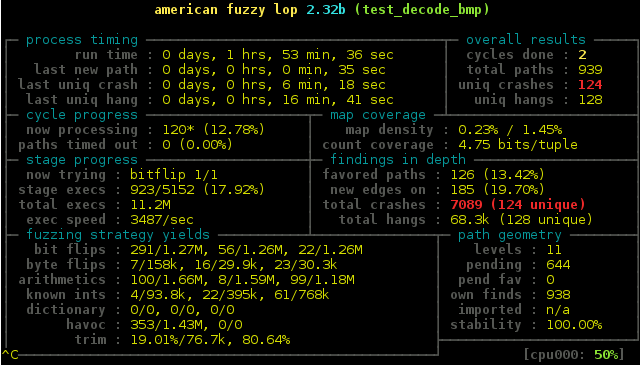
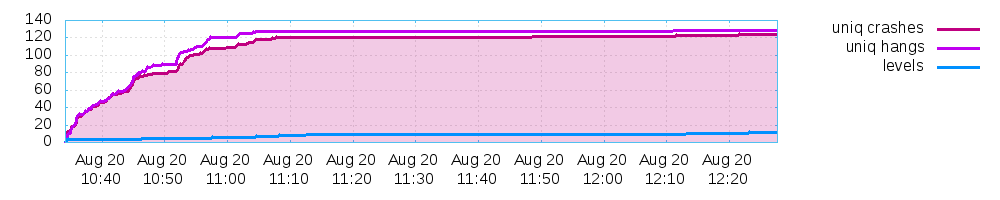
The result was immediate and not a little worrying, within seconds there were crashes and lots of them! Over the next couple of hours I watched as the unique crash total climbed into the triple digits.

I was forced to abort the run at this point as, despite clear warnings in the AFL documentation of the demands of the tool, my laptop was clearly not cut out to do this kind of work and had become distressingly hot.

AFL has a visualisation tool so you can see what kind of progress it is making which produced a graph that showed just how fast it managed to produce crashes and how much the return plateaus after just a few cycles. Although it was finding a new unique crash every ten minutes or so when aborted.

I dove in to analyse the crashes and it immediately became obvious the main issue was caused when the test tool attempted allocations of absurdly large bitmaps. The browser itself uses a heuristic to determine the maximum image size based on used memory and several other values. I simply applied an upper bound of 48 megabytes per decoded image which fits easily within the fuzzers default heap limit of 50 megabytes.

The main source of "hangs" also came from large allocations so once the test was fixed afl-fuzz was re-run with a timeout parameter set to 100ms. This time after several minutes no crashes and only a single hang were found which came as a great relief, at which point my laptop had a hard shutdown due to thermal event!

Once the laptop cooled down I spooled up a more appropriate system to perform this kind of work a 24way 2.1GHz Xeon system. A Debian Jessie guest vm with 20 processors and 20 gigabytes of memory was created and the build replicated and instrumented.

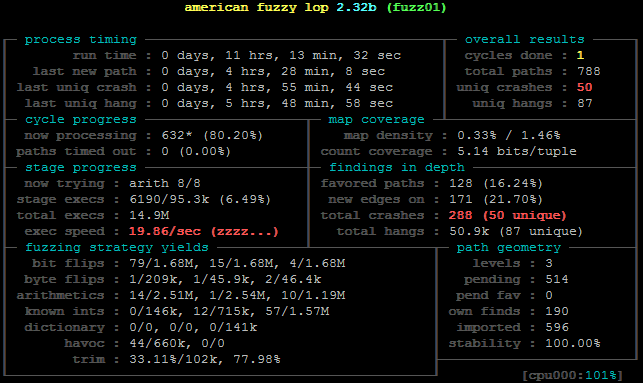
AFL master node display
To fully utilise this system the next test run would utilise AFL in parallel mode. In this mode there is a single "master" running all the deterministic checks and many "secondary" instances performing random tweaks.

If I have one tiny annoyance with AFL, it is that breeding and feeding a herd of rabbits by hand is annoying and something I would like to see a convenience utility for.

The warren was left overnight with 19 instances and by morning had generated crashes again. This time though the crashes actually appeared to be real failures.

$ afl-whatsup sync_dir/
Summary stats
=============

Fuzzers alive : 19
Total run time : 5 days, 12 hours
Total execs : 214 million
Cumulative speed : 8317 execs/sec
Pending paths : 0 faves, 542 total
Pending per fuzzer : 0 faves, 28 total (on average)
Crashes found : 554 locally unique

All the crashing test cases are available and a simple file command immediately showed that all the crashing test files had one thing in common the height of the image was -2147483648 This seemingly odd number is actually meaningful to a programmer, it is the largest negative number which can be stored in a 32bit integer (INT32_MIN) I immediately examined the source code that processes the height in the image header.

if ((width <= 0)   (height == 0))          
return BMP_DATA_ERROR;
if (height < 0)
bmp->reversed = true;
height = -height;

The bug is where the height is made a positive number and results in height being set to 0 after the existing check for zero and results in a crash later in execution. A simple fix was applied and test case added removing the crash and any possible future failure due to this.

Another AFL run has been started and after a few hours has yet to find a crash or non false positive hang so it looks like if there are any more crashes to find they are much harder to uncover.

Main lessons learned are:
I will of course be debugging any new crashes that occur and perhaps turning my sights to all the projects other unit tested libraries. I will also be investigating the generation of our own custom test corpus from AFL to replace the demo set, this will hopefully increase our unit test coverage even further.

Overall this has been my first successful use of a fuzzing tool and a very positive experience. I would wholeheartedly recommend using AFL to find errors and perhaps even integrate as part of a CI system.

Michal &#268;iha&#345;: Continuous integration on multiple platforms

Over the weekend I've played with continuous integration for Gammu to make it run on more platforms. I had to remember many things from the Windows world on the way and the solution is not yet complete, but the basic build is working, the only problematic part are external dependencies. First of all we already have Linux builds on Travis CI. These cover compilation with both GCC and Clang compilers, hopefully covering most of the possible problems. Recently I've added OS X builds on Travis CI, what was pretty much painless and worked out of the box. The next major architecture to support is Windows. Once I've discovered AppVeyor I thought it might be the way to go. The have free plans for open-source projects (though it has only one parallel build compared to four provided by Travis CI). As our build system is cross platform based on CMake, it should work pretty much out of the box, right? Well almost, tweaking the basics took some time (unfortunately there is no CMake support on AppVeyor, so you have to script it a bit). The most painful things on the way: You can check our current appveyor.yml in case you're going to try something similar. Current build results are on AppVeyor. As a nice side effect, we now have up to date Windows binaries for Gammu.

Filed under: Debian English Gammu 0 comments

Zlatan Todori : When you wake up with a feeling

I woke up at 5am. Somehow made myself to soon go back to sleep again. Woke up at 6am. Such is the life of jet-lag. Or I am just getting old for it. But the truth wouldn't be complete with only those assertion. I woke inspired and tired and the same time. Tired because I am doing very time consumable things. Also in the same time very emotional things. AND at the exact same time things that inspire me. On paper, I am technical leader of Purism. In reality, I have insanely good relations with my CEO for such a short time. So good that I for months were not leading the technical shift only, but also I overtook operations (getting orders and delivering them while working with our assembly line to automate most of the tasks in this field). I was playing also as first line of technical support (forums, IRC and email). Actually I was pretty much the only line of support for few months. I was doing some website changes: change some wording, updating bunch of plugins and making it sure all works, resolved (hopefully) Tor and Cloudflare issues for it, annoying caching system for forums, stopped forum spam and so on. I worked on better messaging for Purism public relations. I thought my team to use keys for signing and encryption. I interviewed (and read all mails) for people that were interested in working or helping Purism. In process of doing all that, I maybe wasn't the most speedy person for all our users needs but I hope they understand and forgive me. I was doing all that while I was researching and developing tablets (which ended up not being the most successful campaign but we now do have them as product). I was doing all that while seeing (and resolving) that our kernel builds were failing. Worked on pushing touchpad (not so good but we are still working on) patches upstream (and they ended being upstreamed). While seeing repos being down because of our host. Repos being down because of broken sync with Debian. Repos being down because of our key mis-management. Metadata not working well. PureBrowser getting broken all the time. Tor browser out of date. No real ISO updates. Wrong sources.list entries and so on. And the hardest part on work was, I was doing all this with very limited scope and even more limited resources. So what kept me on, what is pushing me forward and what am I doing? One philosophy - Free software. Let me not explain it as a technical debt. Let me explain it as social movement. In age, where people are "bombed" by media, by all-time lying politicians (which use fear of non-existent threats/terror as model to control population), in age where proprietary corporations are selling your freedom so you can gain temporary convenience the term Free software is like Giordano Bruno in age of Inquisitions. Free software does not only preserve your Freedom to software source usage but it preserves your Freedom to think and think out of the box and not being punished for that. It preserves the Freedom to live - to choose what and when to do, without having the negative impact on your or others people lives. The Freedom to be transparent and to share. Because not only ideas grow with sharing, but we, as human beings, grow as we share. The Freedom to say "NO". NO. I somehow learnt, and personally think, that the Freedom to say NO is the most important Freedom in our lives. No I will not obey some artificially created master that think they can plan and choose my life decision. No I will not negotiate my Freedom for your convenience (also, such Freedom is anyway not real and it is matter of time where you will be blown away by such illusion). No I will not accept your credit because it has STRINGS attached to it which you either don't present or you blur it in mountain of superficial wording. No I will not implant a chip inside me for sake of your research or my convenience. No I will not have social account on media where majority of people are. No, I will not have pacemaker which is a blackbox with proprietary (buggy) software and it harvesting my data without me being able to look at it. Yin-Yang. Yes, I want to collaborate on making world better place for us all. I don't agree with most of people, but that doesn't make them my enemies (although media would like us to feel and think like that). I will try to preserve everyones Freedom as much as I can. Yes I will share with my community and friends. Yes I want to learn from better than I am. Yes I want to have awesome mentors. Yes, I will try to be awesome mentor. Yes, I choose to care and not ignore facts and actions done by me and other people. Yes, I have the right to be imperfect and do mistakes as long as I will aknowledge and work on them. Bugfixing ourselves as humans is the most important task in our lives. As in software, it is very time consumable but also as in software, it is improvement and incredible satisfaction to see better version of yourself, getting more and more features (even if that sometimes means actually getting read of other/bad features). This all is blending with my work at Purism. I spend a lot of time thinking about projects, development and future. I must do that in order not to make grave mistakes. Failing hardware and software is not grave mistake. Serious, but not grave. Grave is if we betray ourselves and our community in pursue for Freedom. We are trying to unify many things - we want to give you security, privacy and FREEDOM with convenience. So I am pushing myself out of comfort zones and also out of conventional and sometimes even my standard way of thinking. I have seen that non-existing infrastructure for PureOS is hurting is a lot but I needed to cope with it to the time where I will be able to say: not anymore, we are starting to build our own infrastructure. I was coping with Cloudflare being assholes to Tor users but now we also shifting away from them. I came to team where people didn't properly understand what and why are we building this. Came to very small and not that efficient team. Now, we employed a dedicated and hard working person on operations (Goran) which I trust. We have dedicated support person (Mladen) which tries hard to work with people. A very creative visual mastermind (Francois). We have a capable Debian Developer (Matthias Klumpp) working on PureOS new infra. We have a capable and dedicated sysadmins (Theo and Stelio) which we didn't even have in past. We are trying to LEVEL UP Free software and unify them in convenient solution which is lead by Joey Hess. We have a hard-working PureOS developer (Hema) who is coping with current non-existent PureOS infra. We have GNOME Boards of Directors person (Jeff) who is trying to light up our image in world (working with James, to try bring some lights into our shadows caused by infinite supply chain delays). We have created Advisory Board for Freedom, Privacy and Security which I don't want to name now as we are preparing to announce soon that (and trust me, we have good people in here). But, the most important thing here is not that they are all capable or cool people. It is the core value in all of them - they care about Freedom and I trust them on their paths. The trust is always important but in Purism it is essential for our work. I built the workflow without time management (everyone spends their time every single day as they see it fit as long as the work gets done). And we don't create insane short deadlines because everyone else thinks it is important (and rarely something is more important than our time freedom). So the trust is built out of knowledge and the knowledge I have about them and their works is because we freely share with no strings attached. Because of them, and other good people from our community I have the energy to sacrifice my entire time for Purism. It is not white and black: CEO and me don't always agree, some members of my team don't always agree with me or I with them, some people in community are very rude, impolite and don't respect our work but even with disagreement everyone in Purism finds agreement at the end (we use facts in our judgments) and all the people who just try to disturb my and mine teams work aren't as efficient as all the lovely words of people who believe in us, who send us words of support and who share ideas and their thoughts with us. There is no more satisfaction for me than reading a personal mail giving us kudos for the work and their understanding of underlaying amount of work and issues. While we are limited with resources we had an occasional outcry from community to help us. Now I want to help them to help me (you see the Freedom of sharing here?). PureOS has now a wiki. It will be a community wiki which is endorsed by Purism as company. Yes you read it right, Purism considers its community part of company (you don't need to get paycheck to be Purism member). That is why a call upon contributors (technical but mostly non-technical too) to help us make PureOS wiki the best resource on net for our needs. Write tutorials for others, gather and put info on wiki, create an ideas page and vote on them so we can see what community wants to see, chat with us so we all understand what, why and how are we working on things. Make it as transparent as possible. Everyone interested please get in touch with our teams by either poking us online (IRC, social accounts) or via emails (our personal or [hr, pr, feedback]@puri.sm. To finish this writing (as it is 8am here and I still want to rest a bit because I will have meetings for 6 hours straight today) - I wanted to share some personal insight into few things from my point of view. I wanted to say despite all the troubles and people who tried to make our time even harder (and it is already hard by all the limitation which come naturally today with our kind of work), we still create products, we still ship them, we still improved step by step, we still hired and we are still building. Keeping all that together and making progress is for me a milestone greater than just creating a technical product. I just hope we will continue and improve our pace so we can start progressing towards my personal great goal - integrate and cooperate with most of FLOSS ecosystem. P.S. yes, I also (finally!) became an official Debian Developer - still didn't have time to sit and properly think and cry (as every good men) about it.

Christian Perrier: [LIFE] Running activities - Ultra Trail du Mont-Blanc

Hello dear readers, It's been ages since I last blogged. Being far less active in Debian than I've been in the past, I guess this is a logical consequence. However, I'm still active as you may witness if you read the debian-boot mailing list : I still consider myself part of the D-I team and I'm maintaining a few sports-related packages. Most know what has taken precedence over Debian development, namely trail and ultra-trail running. And, well, it hasn't decreased, far from that : I ran about 10 races already this year....6 of them being above 50km and I ran my favourite 100km moutain race in early July for the second year in a row. So, the upcoming week, I'll be trying to reach what is usually considered as the Grail of ultra-trail runners : the Ultra-Trail du Mont-Blanc race in Chamonix. The race is fairly simple : run all around the Mont-Blanc summits, for a 160km race with a bit less than 10,000 meters positive climb. The race itself takes place between 800 and 2700 meters (so no "high mountain") and I expect to complete it (if I succeed) in about 40 hours. I'm very confident (maybe too much?) as I successfully completed a much more difficult race last year (only 144km, but over 11,000 meters positive climb and a much more difficult path...it took me over 50 hours to complete it). You can follow me on the live tracking site. The race starts on Friday August 26th, 18:00 CET DST. I everything goes well, I have great projects for next year, including a 100-mile race in Colorado in August (we'll be traveling in USA for over 3 weeks, peaking with the solar eclipse of August 21st in Kansas City).

19 August 2016

Dirk Eddelbuettel: RQuantLib 0.4.3: Lots of new Fixed Income functions

A release of RQuantLib is now on CRAN and in Debian. It contains a lot of new code contributed by Terry Leitch over a number of pull requests. See below for full details but the changes focus on Fixed Income and Fixed Income Derivatives, and cover swap, discount curves, swaptions and more. In the blog post for the previous release 0.4.2, we noted that a volunteer was needed for a new Windows library build of QuantLib for Windows to replace the outdated version 1.6 used there. Josh Ulrich stepped up, and built them. Josh and I tried for several month to get the win-builder to install these, but sadly other things took priority and we were unsuccessful. So this release will not have Windows binaries on CRAN as QuantLib 1.8 is not available there. Instead, you can use the ghrr drat and do
if (!require("drat")) install.packages("drat")
drat::addRepo("ghrr")
install.packages("RQuantLib")
to fetch prebuilt Windows binaries from the ghrr drat. Everybody else gets sources from CRAN. The full changes are detailed below.
Changes in RQuantLib version 0.4.3 (2016-08-19)
  • Changes in RQuantLib code:
    • Discount curve creation has been made more general by allowing additional arguments for day counter and fixed and floating frequency (contributed by Terry Leitch in #31, plus some work by Dirk in #32).
    • Swap leg parameters are now in combined variable and allow textual description (Terry Leitch in #34 and #35)
    • BermudanSwaption has been modfied to take option expiration and swap tenors in order to enable more general swaption structure pricing; a more general search for the swaptions was developed to accomodate this. Also, a DiscountCurve is allowed as an alternative to market quotes to reduce computation time for a portfolio on a given valuation date (Terry Leitch in #42 closing issue #41).
    • A new AffineSwaption model was added with similar interface to BermudanSwaption but allowing for valuation of a European exercise swaption utlizing the same affine methods available in BermudanSwaption. AffineSwaption will also value a Bermudan swaption, but does not take rate market quotes to build a term structure and a DiscountCurve object is required (Terry Leitch in #43).
    • Swap tenors can now be defined up to 100 years (Terry Leitch in #48 fising issue #46).
    • Additional (shorter term) swap tenors are now defined (Guillaume Horel in #49, #54, #55).
    • New SABR swaption pricer (Terry Leitch in #60 and #64, small follow-up by Dirk in #65).
    • Use of Travis CI has been updated and switch to maintained fork of deprecated mainline.
Courtesy of CRANberries, there is also a diffstat report for the this release. As always, more detailed information is on the RQuantLib page. Questions, comments etc should go to the rquantlib-devel mailing list off the R-Forge page. Issue tickets can be filed at the GitHub repo.

This post by Dirk Eddelbuettel originated on his Thinking inside the box blog. Please report excessive re-aggregation in third-party for-profit settings.

Next.

Previous.