Search Results: "rra"

1 June 2012

C.J. Adams-Collier: Vacation Tasks

So, I m taking vacation this week and next. Here s a (partial) list of tasks that are left to do: That s probably enough, if not too much. Here s some of the bits I ve done this week: And probably some other stuff ;-)

Petter Reinholdtsen: SOAP based webservice from Dell to check server support status

A few years ago I wrote how to extract support status for your Dell and HP servers. Recently I have learned from colleges here at the University of Oslo that Dell have made this even easier, by providing a SOAP based web service. Given the service tag, one can now query the Dell servers and get machine readable information about the support status. This perl code demonstrate how to do it:
use strict;
use warnings;
use SOAP::Lite;
use Data::Dumper;
my $GUID = '11111111-1111-1111-1111-111111111111';
my $App = 'test';
my $servicetag = $ARGV[0] or die "Please supply a servicetag. $!\n";
my ($deal, $latest, @dates);
my $s = SOAP::Lite
    -> uri('http://support.dell.com/WebServices/')
    -> on_action( sub   join '', @_   )
    -> proxy('http://xserv.dell.com/services/assetservice.asmx')
    ;
my $a = $s->GetAssetInformation(
    SOAP::Data->name('guid')->value($GUID)->type(''),
    SOAP::Data->name('applicationName')->value($App)->type(''),
    SOAP::Data->name('serviceTags')->value($servicetag)->type(''),
);
print Dumper($a -> result) ;
The output can look like this:
$VAR1 =  
          'Asset' =>  
                     'Entitlements' =>  
                                       'EntitlementData' => [
                                                             
                                                              'EntitlementType' => 'Expired',
                                                              'EndDate' => '2009-07-29T00:00:00',
                                                              'Provider' => '',
                                                              'StartDate' => '2006-07-29T00:00:00',
                                                              'DaysLeft' => '0'
                                                             ,
                                                             
                                                              'EntitlementType' => 'Expired',
                                                              'EndDate' => '2007-07-29T00:00:00',
                                                              'Provider' => '',
                                                              'StartDate' => '2006-07-29T00:00:00',
                                                              'DaysLeft' => '0'
                                                             
                                                          ]
                                      ,
                     'AssetHeaderData' =>  
                                          'SystemModel' => 'GX620',
                                          'ServiceTag' => '8DSGD2J',
                                          'SystemShipDate' => '2006-07-29T19:00:00-05:00',
                                          'Buid' => '2323',
                                          'Region' => 'Europe',
                                          'SystemID' => 'PLX_GX620',
                                          'SystemType' => 'OptiPlex'
                                         
                    
         ;
I have not been able to find any documentation from Dell about this service outside the inline documentation, and according to one comment it can have stability issues, but it is a lot better than scraping HTML pages. :) Wonder if HP and other server vendors have a similar service. If you know of one, drop me an email. :)

29 May 2012

C.J. Adams-Collier: Ohai! It looks like I m back online!

I m working on my disk array today. The plan is to take the data off of a 6-disk RAID-6 and put it onto three 4-disk RAID-4s. image

28 May 2012

Vincent Bernat: Integration of NetSNMP into an event loop

NetSNMP comes with its own event loop based on the select() system call. While you can build your program around it, you may prefer to use an existing event loop, either a custom one or something like libevent, libev or Twisted.

Own custom event loop Let s start with the easiest case: you have written your own event loop. This means you make a call to select(), poll(), epoll(), kqueue() or something similar. All those functions take a set of file descriptors and wait for any of them to become available in a specified time frame. Here is a typical use of select() (adapted from Quagga)
readfd = m->readfd;
writefd = m->writefd;
exceptfd = m->exceptfd;
timer_wait = thread_timer_wait (&m->timer);
num = select (FD_SETSIZE,
              &readfd, &writefd, &exceptfd,
              timer_wait);
if (num < 0)
   
    if (errno == EINTR)
      continue; /* signal received - process it */
    zlog_warn ("select() error: %s",
               safe_strerror (errno));
    return NULL;
   
if (num == 0)
   
    /* Timeout handling */
    thread_timer_process (&m->timer);
   
if (num > 0)
   
    thread_process_fd (&readfd);
    thread_process_fd (&writefd);
   
thread_process_fd (fds) function iterates on each file descriptor fd and executes the appropriate action if FD_ISSET (fds, fd) is true. Integrating NetSNMP into such an event loop is easy: NetSNMP provides the snmp_select_info() function which alters a set of file descriptors to insert its own. Here is the new code:
#if defined HAVE_SNMP
struct timeval snmp_timer_wait;
int snmpblock = 0;
int fdsetsize;
#endif
/* ... */
#if defined HAVE_SNMP
fdsetsize = FD_SETSIZE;
snmpblock = 1;
if (timer_wait)
   
    snmpblock = 0;
    memcpy(&snmp_timer_wait, timer_wait,
           sizeof(struct timeval));
   
snmp_select_info(&fdsetsize, &readfd,
                 &snmp_timer_wait, &snmpblock);
if (snmpblock == 0)
  timer_wait = &snmp_timer_wait;
#endif
num = select (FD_SETSIZE,
              &readfd, &writefd, &exceptfd,
              timer_wait);
if (num < 0)   /* ... */  
#if defined HAVE_SNMP
if (num > 0)
  snmp_read(&readfd);
else if (num == 0)
   
    snmp_timeout();
    run_alarms();
   
netsnmp_check_outstanding_agent_requests();
#endif
/* ... */
snmp_select_info() may modify the provided set of file descriptors (and therefore, its size). It may also modify the provided timer in case it needs to schedule an action before the original timeout. snmpblock is a tricky variable. While select() can be called with a timeout set to NULL, this is not the case of snmp_select_info(): you have to pass a valid pointer. snmpblock is set to 0 if the provided timeout must be considered or to 1 otherwise. snmp_select_info() will set snmpblock to 0 if and only if it alters the timeout. Here are a two examples of integration. Both are for a subagent but the code for a manager is the same:

Third-party event loop With a third party event loop, you don t have access to the select() system call anymore. Therefore, you cannot alter it with snmp_select_info(). Instead, at each iteration of the loop, a list of SNMP related file descriptors is kept up-to-date with the help of snmp_select_info(): new ones are added and old ones are removed.

libevent Let s assume that snmp_fds is the list of current SNMP related events1. A function levent_snmp_update() calls snmp_select_info() to update this list. Here is a partial implementation (error handling removed and some declarations omitted, look at the complete version from lldpd):
static void
levent_snmp_update()
 
    int maxfd = 0;
    int block = 1;
    FD_ZERO(&fdset);
    snmp_select_info(&maxfd, &fdset, &timeout, &block);
    /* We need to untrack any event whose FD is not in  fdset 
       anymore */
    for (snmpfd = TAILQ_FIRST(snmp_fds);
         snmpfd;
         snmpfd = snmpfd_next)  
        snmpfd_next = TAILQ_NEXT(snmpfd, next);
        if (event_get_fd(snmpfd->ev) >= maxfd  
            (!FD_ISSET(event_get_fd(snmpfd->ev), &fdset)))  
            event_free(snmpfd->ev);
            TAILQ_REMOVE(snmp_fds, snmpfd, next);
            free(snmpfd);
          else
            FD_CLR(event_get_fd(snmpfd->ev), &fdset);
     
    /* Invariant: FD in  fdset  are not in list of FD */
    for (int fd = 0; fd < maxfd; fd++)
        if (FD_ISSET(fd, &fdset))  
            snmpfd->ev = event_new(base, fd,
                EV_READ   EV_PERSIST,
                levent_snmp_read,
                NULL);
            event_add(snmpfd->ev, NULL);
            TAILQ_INSERT_TAIL(snmp_fds, snmpfd, next);
         
    /* If needed, handle timeout */
    evtimer_add(snmp_timeout, block?NULL:&timeout);
 
Then, replace the main loop (usually, a call to event_base_dispatch()) with this:
do  
    if (event_base_got_break(base)  
        event_base_got_exit(base))
        break;
    netsnmp_check_outstanding_agent_requests();
    levent_snmp_update();
  while (event_base_loop(base, EVLOOP_ONCE) == 0);
Here is how are defined the two callbacks:
static void
levent_snmp_read(evutil_socket_t fd, short what, void *arg)
 
    FD_ZERO(&fdset);
    FD_SET(fd, &fdset);
    snmp_read(&fdset);
    levent_snmp_update();
 
static void
levent_snmp_timeout(evutil_socket_t fd, short what, void *arg)
 
    snmp_timeout();
    run_alarms();
    levent_snmp_update();
 

Twisted reactor As a second example, here is how to integrate NetSNMP into Twisted reactor. Twisted is an event-driven network programming framework written in Python. It does not come with support for SNMP2. Because of the language mismatch, the integration of NetSNMP in Twisted needs to be done using a C extension or the ctypes module. Twisted event loop is called a reactor. Like for libevent, events need to be registered. It is possible to register file descriptor-like objects using a class implementing a handful of methods. Here is the implementation of such a class (adapted from PyNetSNMP, a subproject of Zenoss using the ctypes module):
class SnmpReader:
    "Respond to input events"
    implements(IReadDescriptor)
    def __init__(self, fd):
        self.fd = fd
    def doRead(self):
        netsnmp.snmp_read(self.fd)
    def fileno(self):
        return self.fd
Like for libevent, we have a function to update the list of SNMP related events (stored as a mapping between file descriptors and SnmpReader instances):
class Timer(object):
    callLater = None
timer = Timer()
fdMap =  
def updateReactor():
    "Add/remove event handlers for SNMP file descriptors and timers"
    fds, t = netsnmp.snmp_select_info()
    for fd in fds:
        if fd not in fdMap:
            reader = SnmpReader(fd)
            fdMap[fd] = reader
            reactor.addReader(reader)
    current = Set(fdMap.keys())
    need = Set(fds)
    doomed = current - need
    for d in doomed:
        reactor.removeReader(fdMap[d])
        del fdMap[d]
    if timer.callLater:
        timer.callLater.cancel()
        timer.callLater = None
    if t is not None:
        timer.callLater = reactor.callLater(t, checkTimeouts)
Contrary to libevent, we cannot alter the main loop to call updateReactor() at each iteration. Therefore, it must be called after each SNMP related function. For another example, have a look at my equivalent implementation as a C extension.

Miscellaneous

Lack of asynchronicity Integrating NetSNMP into an event-based program is not risk-free. I have written a fairly comprehensive article on the lack of asynchronicity in NetSNMP AgentX protocol implementation. I urge you to read it if you want to integrate a SNMP subagent into an existing program. On the manager side, you will get similar drawbacks when using SNMPv3. To retrieve or manipulate management information using SNMPv3, it is necessary to know the identifier of the remote SNMP protocol engine. This identifier can be configured directly on each manager but it is usually discovered by querying SNMP-FRAMEWORK-MIB:: snmpEngineID, as described in RFC 5343. Unfortunately, this discovery is done synchronously by NetSNMP. There is a bug report for this issue but it seems difficult to fix. I have not been able to come up with a proper patch but I have described a workaround around snmp_sess_async_send(). There is no such problem with SNMPv2.

Limitation of file descriptor sets snmp_select_info() and snmp_read() uses the fd_set type to handle a set of file descriptors. This type should be manipulated with FD_CLR(), FD_ISSET(), FD_SET() and FD_ZERO(). Those may be defined as functions but they usually are macros. Moreover, no file descriptor greater than FD_SETSIZE (which is usually set to 1024) can be handled with the fd_set type. This means that if you have a file descriptor greater than 1024, you won t be able to use snmp_select_info() with it. Starting from NetSNMP 5.5, you can use snmp_select_info2() and snmp_read2() instead of snmp_select_info() and snmp_read(). They use the netsnmp_large_fd_set. If you want to keep compatibility with NetSNMP 5.4, here is another twist. The fd_set type is usually a fixed-size array of long integers. FD_CLR(), FD_ISSET() and FD_SET() are size-independant. The size only matters for FD_ZERO() which is not used by either snmp_select_info() or snmp_read(). You can therefore allocate a larger fd_set. A common way is to compile your program with -D__FD_SETSIZE=4096. You can still use FD_ZERO() yourself. However, this is not portable (GNU C Library only). Another way is to allocate your own array of long integers and cast it to fd_set. You ll have to redefine FD_ZERO():
typedef struct  
   long int fds_bits[4096/sizeof(long int)];
  my_fdset;
#undef FD_ZERO
#define FD_ZERO(fdset) memset((fdset), 0, sizeof(my_fdset))
 
   /* ... */
   my_fdset fdset;
   FD_ZERO(&fdset);
   /* ... */
   rc = snmp_select_info(&n, (fd_set *)&fdset, &timeout, &block);
   /* ... */
 

Threads NetSNMP provides two API:
  • the traditional session API which is not thread-safe and
  • the single session API.
In the above examples, I have used the traditional session API. If you are using threads, you need to ensure that all SNMP operations are done in a single thread. Otherwise, you need to adapt the examples to use the single session API. snmp_select_info() is part of the traditional session API. You should replace it with snmp_sess_select_info() and keep a list of SNMP sessions. This API is not available for the agent side of NetSNMP.

  1. The event list is global but some code could be added to bind a different list for each base in case you use different bases. This is not needed in the case of lldpd which uses only one event base.
  2. TwistedSNMP is an SNMP protocol implementation for Twisted based on PySNMP but is not maintained anymore. PySNMP comes with examples on how to integrate with Twisted.

26 May 2012

Tanguy Ortolo: Fun with spammers

Email spam is a plague, but sometimes there is at least on category of spammers it is easy to have fun with: naive manual spammers. People that try to do more or less legal business, using Internet in an illegitimate way, for instance (this is a real example, including the spammer's address: spamming bots, please use it ;-) !): Reporting Well, in that case it may or may not be a scam, but even if it is not a criminal activity such as selling fake drugs, it is not a very honest business. Anyway, that lady is using her Google account to send her crap, so neutralizing her is quite easy:
  1. checking that it really comes from Google Mail, using DKIM or SPF;
  2. writing to Google, reporting that spam (and, in that specific case, the abuse they are offering to commit on Google +1);
  3. optional, do not do that with scammers: replying to the spammer explaining that this is spamming, that you reported it and that she can expect to loose her Google account and everything on it.
That should work with any good email provider, that is, any provider that listens to complaints at <abuse@> and takes action on them. For what I have seen, Google and Yahoo! are, but fossils such as traditional national telephonists are not. If the message headers allow you to identify it, you can also report the abuse to the spammer's network operator if it is a good one (this is rarely the case). Consequences With a bit of luck, that can seriously damage the business of the spammer, and if he was really careless (e.g. storing important documents on the same Google account with no local backup), cause serious trouble in his personal stuff. If you replied to the spammer, you can get fun answers such as (these are taken from real examples I got): Conclusion This is too complicated to be done for each spam of course, but it is worth doing for spam messages that are not catch by one's antispam. And the rules for email marketing are well known: only write to people that explicitly allowed you to do so, full stop, so there is no reason to show any mercy for a spammer.

25 May 2012

Matthew Garrett: Fedora 17 and Mac support

Fedora 17 will be shipping next week. It's got a bunch of new features, none of which I contributed to in the slightest. What I did work on was improving our support for installation on x86 Apple hardware. There's still a few shortcomings in this so it's not an announced or supported feature, but it's sufficient progress that it's worth writing about.

There's a few ways that Apple platforms differs from normal PC hardware. The first is that Apples are very much intended to be EFI first and BIOS second, while that's still not really true for commodity PC hardware. Apple launched Boot Camp shortly after they started shipping x86 Macs (and shortly after I'd got Ubuntu running on one for the first time[1]) but the focus of Boot Camp has always been to be good enough to boot Windows and not much else[2]. The other is the integration with the boot environment. You can boot Linux easily enough by setting the standard EFI boot variables, but if you ever boot back into OS X it's easy to trigger deletion of those. There's then no straightforward way of resetting them, and you're left having to recover your installation.

The other difficult bit has been actually starting the installer at all. If you're happy to use BIOS emulation than this can be done without too much misery, but you're then left with dealing with Apple's custom synchronised GPT/MBR. More modern Macs will boot via the standard EFI mechanisms, but there's a range of problems that can be caused that way. Fedora 17 is the first Linux distribution to ship install media that will EFI boot a Mac when either written to optical media or a USB stick[3]. Put the install media in your system and then either select it in the OS X Startup Disk preferences menu and reboot, or reboot and hold down the alt key. In the latter case there'll be a nice Fedora logo. Click on it and it'll boot.

The biggest difference between Apple hardware and anyone else is that we'd normally put the bootloader in a FAT partition that's shared with any other installed operating systems. That does actually work on Apples, but then you run into the earlier point I mentioned. The Apple startup picker that you get by holding down the alt key doesn't pay any attention to the standard EFI boot variables, so it won't show a FAT partition merely because it's got an EFI bootloader on it. The same is true of the OS X Startup Disk preferences. The best way to get a drive to appear in the menu is to make it look like an OS X drive.

This was problematic in a few ways, due to the requirement for an OS X drive to be HFS+. The first was that we didn't have any support for that in our installer, so work had to be done there. The second was that the state of HFS+ was woefully poor in Linux[4]. Linux will refuse to write to an HFS+ filesystem if it hasn't been cleanly unmounted or fscked, and since we can't rely on everyone always shutting their machine down cleanly that means a working fsck.hfsplus. In theory we were shipping one of those. In practice, it reliably segfaulted on 64-bit systems[5]. So I had to package the latest version of Apple's code, and doing that involved dealing with the fact that Apple now use blocks almost as much as Grub 2 uses nested functions, and that meant using Clang and that meant dealing with a bug where Clang segfaulted if it had been built with gcc 4.7[6], but finally once all of those yaks had been shaven we could trust our filesystem.

Of course, more problems existed. You can't just drop a bootloader onto an HFS+ partition and expect it to work. You need to write its inode value into the superblock. Trivial, except that if you do this from userspace then the kernel kindly overwrites your update when you unmount the disk and it updates the superblock. That required a mechanism for updating that data via the kernel, which meant adding an ioctl. This would have been fine, except the OS X Startup Disk preference looks for a bootloader in a location other than where Fedora installs it. Changing our bootloader install path wasn't a great option, so the easiest thing to do was just to link them together. Except HFS+ doesn't really support hardlinks. When you hardlink something the original file gets moved into a magic directory in the filesystem root and the links are special files that refer to it. And it turns out that it's not actually the inode that the firmware wants when finding the bootloader, it's the catalogue ID, and these aren't the same when hardlinks are involved. So, another kernel patch.

All that was left for the boot partition then was adding an icon and a drive label. We already had code for generating the icon, and the drive label wasn't that difficult. Hurrah!

Ok, so we can construct a filesystem that (a) appears in the bootpicker, and (b) appears in the OS X Startup Disk preferences. We can even put a bootloader on it. This led to the next problem. The bootloader started without any trouble. But the bootloader couldn't read any files off the boot partition, including its configuration. This should have been obvious with hindsight - the problem was simply that grub legacy[7] doesn't support HFS+. Writing an HFS+ driver seemed like an excessive amount of work, especially since the firmware already supported reading HFS+, so instead I wrote a simple grub filesystem driver that uses the UEFI interfaces to read files.

A working bootloader! One more problem there. grub looks in its startup directory to find its configuration file. We have two "copies" of grub hardlinked to each other, each looking in a different directory for configuration. Hardlinking the config files together worked fine, except that most tools that update config files have this irritating habit of writing to a temporary file and moving that over the original, thus breaking the hardlink. Easily solved by using a symlink instead, except that the UEFI filesystem semantics don't really support symlinks because UEFI only really envisaged using FAT. If you use Apple's UEFI HFS+ driver to open a symlink, you get a short file containing the target path of the symlink. Rather less than ideal, and a rather gross hack to cope with it.

All set now, other than a bug in some older Mac firmware where read would return BUFFER_TOO_SMALL without returning the real buffersize and the odd way that Apple treat CDs. Oh, and a bug in Apple's Broadcom wifi driver that could overwrite the kernel, and case-sensitivity, something that obviously isn't something you often hit on UEFI when all you usually see is FAT.

Kernel-side, we had a couple of things. Obviously there the bugs I'd mentioned in the past, but those had already been dealt with. New issues included the fact that we were frequently picking the wrong framebuffer address, especially on machines with multiple GPUs. Fixed now, along with another issue where we'd sometimes get confused by models with different GPU configurations. And at that point, most of the implementation work was done.

Of course, there was also the work of integrating this into the tools that we use to generate our install media, and I'd like to thank Will Woods, Brian Lane and Dennis Gilmore for the work they put into that, along with anyone I've forgotten. Tom Calloway handled getting the device label graphics generated right before deadline. A cast of thousands helped with testing.

So why did I mention shortcomings? First, this only works on machines with 64-bit firmware. Early 64-bit Apples still had 32-bit firmware. In theory we can support that case - in practice it's a moderate amount of writing, including some mildly awkward kernel code. But anything later than mid-2007 should have 64-bit firmware, so it's not a massive concern. Second, we seem to have fairly significant trouble with Radeon hardware on a lot of Macs. We fixed one bug there, but something's still going wrong in setup and you'll frequently end up with a black screen. And thirdly, I'm sure there's some other machines that still don't work for (as yet) undetermined reasons.

With luck we'll get these things dealt with by Fedora 18. But even with these flaws, Fedora 17 will work fine on a lot of Apple hardware, and testing it is as simple as downloading and booting a live image. Bugs go in the usual place.

[1] Note my charming belief that the Ubuntu installer would fully support this hardware via EFI in the near future. 6 years ago. It still doesn't.
[2] This can be fairly easily seen from little things like the name "Windows" being hardcoded into every UI that sees a Boot Camp drive.
[3] I cover this in more depth here
[4] To be fair, it mostly still is - there's plenty of work to be done there.
[5] Approximately nobody had noticed this, which is all kinds of unreassuring.
[6] Thanks to Kalev Lember for dealing with that
[7] Still the EFI bootloader in Fedora 17. We've already swapped Fedora 18 over to grub 2.

comment count unavailable comments

23 May 2012

Anand Kumria: Lifelong learning

Below are four of my (150!) browser tabs opened, that I oddly had in sequence. Various tabs open to online learning websites. There has been much made of the pheonmen of lifelong learning and although I thought I had finished my exams when I finished University, I'm still doing them. From left to right:
Duolingo, where I am learning Spanish.
Quite a reasonable site, currently invite-only. My worry is my pronounciation will be crap though. I do wish that it did not have to use Flash to accomplish things though.
Udacity, where I am doing CS212 - Design of Computer Programs
Nice interface, annoying that it uses YouTube to host videos as that meant I had to whitelist YouTube in Flashblock.I picked this course as one of the other ones I wanted to do had already closed. I suspect I'll eventually do each of the courses they have on offer. One nice thing is that courses run every 8 weeks or so.
Codeacademy, I am currently doing their Codeyear course.
Well presented, but I find that their Javascript interface is extremely slow to startup. It consistently lags behind my typing speed by about 3 seconds.I'm using Firefox beta, so I'm always running something fairly fast and modern too.I'm primarily doing this course to see how/what they are trying to teach non-programmers. My feedback is that it is not geared towards someone with no programming knowledge. The initial 10 weeks of Javascript presentation proceeded at a very fast pace. If I weren't a programmer already, I'd have stuggled to keep up.
Coursera, here I am doing the Machine Learning class.
I'm not a fan of this interface at all, which is why I find it hard to come back to the site each week. I'm not sure exactly why though, since it uses WebM and no Flash. Hurray!!Either way, I'm doing the Machine Learning class. I tried this last time it was offered and got to week 5 same week I'm on now and then I got suddenly busy IRL, so was not able to complete the course.Unlike Udacity, courses run at set times and you have to do the work on the required dates in order to get the statement of attainment, which can be hard when you are juggling multiple things
Keep in mind, these are just the extra things I have decided to learn. I'm also learning more about Django, Puppet and Python in my work everyday. Plus I'm actually doing a Spanish course in real life too. Oh, and I have a job and I go out. I'm generally actually pushed for time. Which probably explains why I have not been keeping up with the blog. It isn't because I hate you, although it might be too ;-) , I'm just busy.

21 May 2012

Johannes Schauer: sisyphus wins ICRA 2012 VMAC

Sisyphus is a piece of software that I wrote as a member of a team from Jacobs University led by Prof. Dr. Andreas N chter. It managed to place our team first in this year's IEEE ICRA 2012 Virtual Manufacturing Automation Competition in all three rounds. The goal was, to stack a given set of boxes of different length, height and width on a pallet in a way that achieved optimal volume utilization, center of mass and interlock of the boxes. Besides the cartesian placement of a box on the pallet, the only other degree of freedom was a 90 rotation of the box around a vertical axis. Since the arrangement of boxes into a three dimensional container is NP hard (three dimensional orthogonal knapsack), I decided for a heuristic for an approximate solution. The premise is, that there are many boxes of equal height which was the case in the test cases that were available from the 2011 VMAC. Given this premise, my heuristic was, to arrange the boxes into layers of equal height and then stack these layers on top of each other. A set of boxes that would be left over or too little from the start to form its own full layer, would then be stacked on the top of the completed layers. There is a video of how this looked like. My code is now online on github and it even documented for everybody who is not me (or a potential future me of course). This blog post is about the "interesting" parts of sisyphus. You can read about the overall workings of it in the project's README. Python dict to XML and XML to Python dict The evaluation program for the challenge is reading XML files and the pallet size and the list of articles with their sizes are also given in XML format. So I had to have a way to easily read article information from XML and to easily dump my data into XML format. Luckily, all the XML involved was not making use of XML attributes at all, so the only children a node had, where other nodes. Thus, the whole XML file could be represented as an XML dictionary with keys being tagnames and the values being other dictionaries or lists or strings or integers. The code doing that uses xml.etree.ElementTree and turns out to be very simple:
from xml.etree import ElementTree

def xmltodict(element):
def xmltodict_handler(parent_element):
result = dict()
for element in parent_element:
if len(element):
obj = xmltodict_handler(element)
else:
obj = element.text
if result.get(element.tag):
if hasattr(result[element.tag], "append"):
result[element.tag].append(obj)
else:
result[element.tag] = [result[element.tag], obj]
else:
result[element.tag] = obj
return result
return element.tag: xmltodict_handler(element)

def dicttoxml(element):
def dicttoxml_handler(result, key, value):
if isinstance(value, list):
for e in value:
dicttoxml_handler(result, key, e)
elif isinstance(value, basestring):
elem = ElementTree.Element(key)
elem.text = value
result.append(elem)
elif isinstance(value, int) or isinstance(value, float):
elem = ElementTree.Element(key)
elem.text = str(value)
result.append(elem)
elif value is None:
result.append(ElementTree.Element(key))
else:
res = ElementTree.Element(key)
for k, v in value.items():
dicttoxml_handler(res, k, v)
result.append(res)
result = ElementTree.Element(element.keys()[0])
for key, value in element[element.keys()[0]].items():
dicttoxml_handler(result, key, value)
return result

def xmlfiletodict(filename):
return xmltodict(ElementTree.parse(filename).getroot())

def dicttoxmlfile(element, filename):
ElementTree.ElementTree(dicttoxml(element)).write(filename)

def xmlstringtodict(xmlstring):
return xmltodict(ElementTree.fromstring(xmlstring))

def dicttoxmlstring(element):
return ElementTree.tostring(dicttoxml(element))
Lets try this out:
>>> from util import xmlstringtodict, dicttoxmlstring
>>> xmlstring = "<foo><bar>foobar</bar><baz><a>1</a><a>2</a></baz></foo>"
>>> xmldict = xmlstringtodict(xmlstring)
>>> print xmldict
 'foo':  'baz':  'a': ['1', '2'] , 'bar': 'foobar' 
>>> dicttoxmlstring(xmldict)
'<foo><baz><a>1</a><a>2</a></baz><bar>foobar</bar></foo>'
The dict container doesnt preserve order, but as XML doesnt require that, this is also not an issue. Arranging items in layers When it was decided, that I wanted to take the layered approach, it boiled down the 3D knapsack problem to a 2D knapsack problem. The problem statement now was: how to best fit small rectangles into a big rectangle? I decided for a simple and fast approach as it is explained in Jake Gordon's blog article. There is a demo of his code and should the site vanish from the net, the code is on github. This solution seemed to generate results that were "good enough" while simple to implement and fast to execute. If you look very hard, you can still see some design similarities between my arrange_spread.py and his packer.js code. Jake Gordon got his idea from Jim Scott who wrote an article of arranging randomly sized lightmaps into a bigger texture. There is also an ActiveState Code recipe from 2005 which looks very similar to the code by Jake Gordon. The posts of Jake Gordon and Jim Scott explain the solution well, so that I dont have to repeat it. Should the above resources go offline, I made backups of them here and here. There is also a backup of the ActiveState piece here. Spreading items out The algorithm above would cram all rectangles into a top-left position. As a result, there would mostly be space at the bottom and left edge of the available pallet surface. This is bad for two reasons:
  1. the mass is distributed unequally
  2. articles on the layer above at the bottom or left edge, are prone to overhang too much so that they tumble down
Instead all articles should be spread over the available pallet area, creating small gaps between them instead big spaces at the pallet borders. Since articles were of different size, it was not clear to me from the start what "equal distribution" would even mean because it was obvious that it was not as simple as making the space between all rectangles equal. The spacing had to be different between them to accommodate for differently sized boxes. The solution I came up with, made use of the tree structure, that was built by the algorithm that arranged the rectangles in the first place. The idea is, to spread articles vertically first, recursively starting with the deepest nodes and spreading them out in their parent rectangle. And then spreading them horizontally, spreading the upper nodes first, recursively resizing and spreading child nodes. The whole recursion idea created problems of its own. One of the nicest recursive beauty is the following function:
def get_max_horiz_nodes(node):
if node is None or not node['article']:
return [], []
elif node['down'] and node['down']['article']:
rightbranch, sr = get_max_horiz_nodes(node['right'])
rightbranch = [node] + rightbranch
downbranch, sd = get_max_horiz_nodes(node['down'])
ar = rightbranch[len(rightbranch)-1]['article']
ad = downbranch[len(downbranch)-1]['article']
if ar['x']+ar['width'] > ad['x']+ad['width']:
return rightbranch, sr+[downbranch[0]]
else:
return downbranch, sd+[rightbranch[0]]
else:
rightbranch, short = get_max_horiz_nodes(node['right'])
return [node] + rightbranch, short
get_max_horiz_nodes() traverses all branches of the tree that node has below itself and returns a tuple containing the list of nodes that form the branch that stretches out widest plus the list of nodes that are in the other branches (which are shorter than the widest). Another interesting problem was, how to decide on the gap between articles. This was interesting because the number resulting of the subtraction of the available length (or width) and the sum of the articles lengths (or widths), was mostly not divisible by the amount of gaps without leaving a rest. So there had to be an algorithm that gives me a list of integers, neither of them differing by more than one to any other, that when summed up, would give me the total amount of empty space. Or in other words: how to divide a number m into n integer pieces such that each of those integers doesnt differ more than 1 from any other. Surprisingly, generating this list doesnt contain any complex loop constructs:
>>> m = 108 # total amount
>>> n = 7 # number of pieces
>>> d,e = divmod(m, n)
>>> pieces = (e)*[(d+1)]+(n-e)*[d]
>>> print pieces
[16, 16, 16, 15, 15, 15, 15]
>>> sum(pieces) == m
True
>>> len(pieces) == n
True
You can test out the algorithms that arrange rectangles and spread them out by cloning the git and then running:
PYTHONPATH=. python legacy/arrange_spread.py
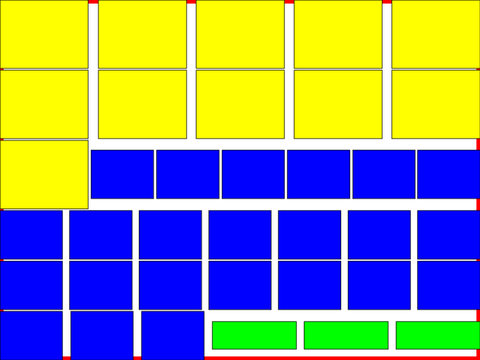
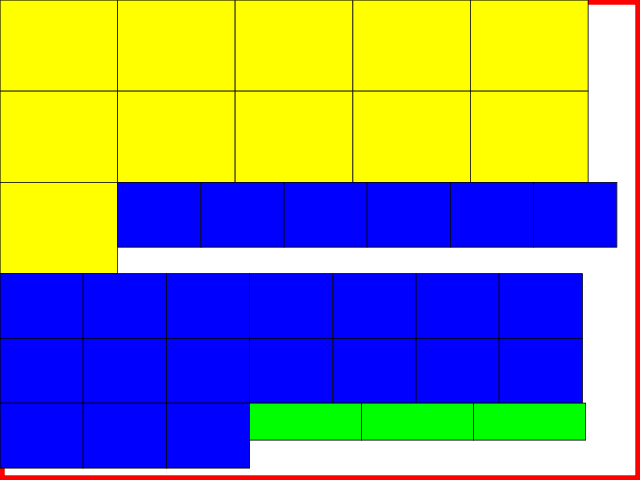
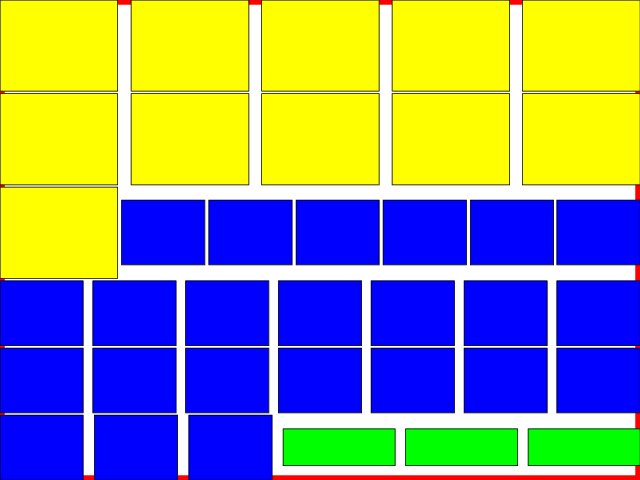
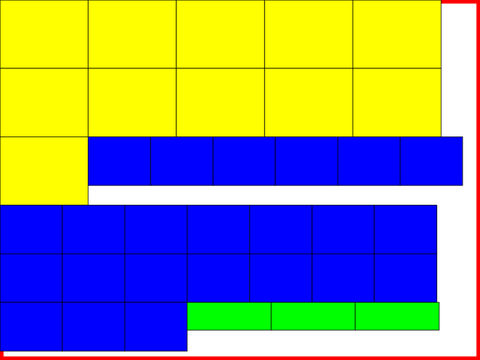
The results will be svg files test1.svg and test2.svg, the latter showing the spread-out result. Here is an example how the output looks like (without the red border which is drawn to mark the pallet border): arrange_spread2.py contains an adaption of arrange_spread.py for the actual problem. Permutations without known length When creating a layer out of articles of same height, then there are four strategies that I can choose from. It is four because there are two methods that I can either use or not. I can rotate the article by 90 per default or not and I can rotate the pallet or not. So every time that I build a new layer, there are those four options. Depending on which strategy I choose, there is a different amount of possible leftover articles that did not fit into any layer. The amount is different because each strategy is more or less efficient. To try out all combinations of possible layer arrangements, I have to walk through a tree where at each node I branch four times for each individual strategy. Individual neighboring nodes might be the same but this outcome is unlikely due to the path leading to those neighboring nodes being different. To simplify, lets name the four possible strategies for each layers 0, 1, 2 and 3. I now want an algorithm that enumerates through all possible permutations of those four numbers for "some" length. This is similar to counting. And the itertools module comes with the product() method that nearly does what I want. For example, should I know that my tree does not become deeper than 8 (read: no more than eight layers will be built), then I can just run:
>>> for i in itertools.product([0,1,2,3], repeat=8):
...     print i
...
(0,0,0,0,0,0,0,0)
(0,0,0,0,0,0,0,1)
(0,0,0,0,0,0,0,2)
(0,0,0,0,0,0,0,3)
(0,0,0,0,0,0,1,0)
(0,0,0,0,0,0,1,1)
(0,0,0,0,0,0,1,2)
(0,0,0,0,0,0,1,3)
This would work if the number of layers created with each strategy was the same. But as each strategy behaves differently depending on the input, it cannot be known before actually trying out a sequence of strategies, how many layers it will yield. The strategy (0,0,0,0,0,0,0,0) might create 7 layers, resulting in (0,0,0,0,0,0,0,1), (0,0,0,0,0,0,0,2) and (0,0,0,0,0,0,0,3) yielding the same output as only the first 7 strategies count. This would create duplicates which I should not waste cpu cycles on later. It might also be that (0,0,0,0,0,0,1,0) turns out to be a combination of strategies that creates more than 8 layers in which case the whole thing fails. So what I need is a generator, that gives me a new strategy depending on how often it is asked for one. It should dynamically extend the tree of possible permutations to accommodate for any size. Since the tree will become humongous (4^11 = 4194304), already traversed nodes should automatically be cleaned so that only the nodes that make the current list of strategies stays in memory at any point in time. This sounded all complicated which made me even more surprised by how simple the solution was in the end. Here a version of the algorithm that could easily be ported to C:
class Tree:
def __init__(self, branch_factor):
self.branch_factor = branch_factor
self.root = "value": None, "parent": None, "children": []
self.current = self.root

def next(self):
if not self.current["children"]:
self.current["children"] = [ "value":val, "parent":self.current, "children":[] for val in range(self.branch_factor)]
self.current = self.current["children"][0]
return self.current["value"]

def reset(self):
if self.current["parent"]:
self.current["parent"]["children"].pop(0)
else:
return False
if self.current["parent"]["children"]:
self.current = self.root
return True
else:
self.current = self.current["parent"]
return self.reset()

def __str__(self):
return str(self.root)
It would be used like this:
>>> tree = Tree(4)
>>> print tree.next(), tree.next(), tree.next()
>>> while tree.reset():
...     print tree.next(), tree.next(), tree.next()
Which would be equivalent to calling itertools.product([1,2,3,4], 3). The special part is, that in each iteration of the loop I can call tree.next() an arbitrary amount of times, just how much it is needed. Whenever I cannot generate an additional layer anymore, I can call tree.reset() to start a new permutation. For my code I used a python specific version which is a generator:
def product_varlength(branch_factor):
root = "value": None, "parent": None, "children": []
current = root
while True:
if not current["children"]:
current["children"] = [ "value":val, "parent":current, "children":[] for val in range(branch_factor)]
current = current["children"][0]
if (yield current["value"]):
while True:
if current["parent"]:
current["parent"]["children"].pop(0)
else:
return
if current["parent"]["children"]:
current = root
break
else:
current = current["parent"]
It is used like this:
it = product_varlength(4)
print it.next(), it.send(False), it.send(False)
while True:
    print it.send(True), it.send(False), it.send(False)
Again, the expression in the loop can have any number of it.send(False). The first it.send(True) tells the generator to do a reset.

19 May 2012

Richard Hartmann: Mongolia

I will start linking to places we stayed at etc, from now on. On the one hand, we already left those places so my paranoid self can rest assured that no one will come hunt us down, on the other hand, I decided to only to name and link to those places which really deserve a mention. If they are linked here, I can whole-heartedly recommend them. Mongolia After leaving through the Russian border fortifications, Mongolia was an instant and welcome change. Trees growing right next to the tracks, branches forming a bit of a natural tunnel; the trains passing by keeping branches at bay, but the trees free to grow wherever else they pleased. A few hundred meters later below a rocky ledge, a cow had apparently fallen down and died. Partially decomposed flesh still clinging halfway to its rib-cage, it proved to be a sign of the (mostly) more laid-back attitude Mongolians tend to take. After finally getting our passports back and being allowed to leave the train, we first headed to the station to get some money. At ~1800:1, the exchange rate for Tugruk against Euro speaks volumes about inflation; imagine my surprise that the MNT 20,000 note is the largest one. It's also the one and only amount any and all ATMs will default to. We were quite surprised by how cheap everything was, even in the one single store within the station directly behind the border. In Russia, travellers expect to pay hefty markups when shopkeepers know they can charge them, not so in Mongolia. The woman in the trash Upon returning from the station, our waggon was just merrily being driving away on its own by a lone engine, something we had not anticipated or appreciated a whole lot. A woman (we hadn't noticed her before) who was busy scavenging a trash container for food for herself and her scrawny-looking son happily stopped what she was doing and, with a big smile, moved her hands around and smacked them back together, signalling us that our waggon would be attached to a different train for the subsequent journey. To put it mildly, I was stunned; we had met people eating from the trash in Russia as well (yes, I always make a point of giving them enough for a few decent meals; anyone eating out of the trash actually needs and definitely deserves something good happening to them), but they were glum and disheartened. Here, there was someone who not only had to look out for herself, but for a three or four year old boy as well, and still was just so... positive... I don't know if I would have it in me to act the same way... As an aside, even though we were just a few kilometers across the border from Russia, she did not actually take the money from me, she cupped her hands to receive it by having me place it into her hands; this is a very Asian thing in my experience and something we would see both in Mongolia and China consistently. Later, when we were back in our waggon, she passed by and happened to see the Spot Messgenger 2 dangling in front of our window, its lights blinking every five seconds. For a solid twenty minutes, until the train started moving again, she squatted down with her son, oggling the Spot. I have no idea what she was thinking it was and I had no chance to explain it to her, but she was really fascinated and just kept staring and staring. When we finally left the station, we waved to and smiled at each other, she ran after us, and then she was gone. All in all, this was one the more memorable things which happened to us. Mongolian Infrastructure When I say that Mongolians as a whole tend to be a lot more laid back than Russians, this extends to infrastructure as well, but not in the good way. Ulan Bator Little Dhingis Khan We arrived in Ulan Bator at six in the morning and started haggling with taxi drivers. Our hostel had (stale, it turned out) information about acceptable fare from station to their place on their website, 5,000 MNT was supposedly OK. Our driver tried to get 20,000, then 15,000, then 12,000, then 10,000, went down to 7,000 and finally settled for 5,000, all this interspersed with frequent "no" by us and walking away. Once on the road, he wanted to convince me that we had agreed upon 5,000 per person, something that did not quite work out for him. When we arrived, he started to tell me that he was good friends with the hostel manager and that said manager would surely want us to pay more; again, that did not work too well. He made the mistake of getting our luggage out of his trunk immediately (we always kept all our stuff in the passenger area afterwards...) before I paid and even though I only had a 10,000 or 20,000 note, I insisted on correct change. The same old dance began anew, with him edging closer to the correct change in steps of 1,000 MNT. He tried to get away several times, but I stood in his door and held it open; if he had just driven off, I couldn't have stopped him, but that thankfully didn't occur to him. After he shoved all small change (MNT is bill only, no coins) he had with him at me and wanted to make off yet again, I was close to throwing all the small crap at him, but after he, a man of maybe 1.65 meter and sitting down, tried to signal his willingness for a fist fight and me, a man of 1.94 meter and standing started laughing, he gave me 2,000 more and drove off cursing. In case you forgot, at that exchange rate, we argued about two to three Euro, but as he tried to cheat, it became a matter of principle. The Hostel, part one All parking lots and other property in Ulan Bator have a small watchtower with private 24/7 guards; said guard ambled down, let us in and woke the poor woman who was forced to let us check in. As she was Mongolian as well, we were a bit surprised when she switched from broken English to perfect German, but the owners of the OASIS are a German-Austrian couple so I guess that makes sense. Fighting through the war Traffic in Ulan Bator is war. Lonely Planet talks about the city being too newly motorized and that it did not have to develop a culture of driving, yet. This is a euphemism for "no one has any qualms maiming or killing you". Everyone is driving like mad, nudging and racing their way in front of each other. If a driver has an oppurtunity to get ahead by a few centimeters with his small car, thereby blocking the way for several buses, making a whole parking lot grind to a halt and thereby deadlocking themselves, they will take said opportunity, and gladly. Red lights are gentle suggestions, there to be mainly ignored; police will not drive over red lights, but they will not stop anybody else from doing so, either. A hearse will have a dozen or more cars following it, all driving in a tight pack, aggressively attacking anyone who dares to wedge in between them and expecting all other traffic to make way even if they are driving over a red light. Crossing a main street in Ulan Bator as a pedestrian is hell. There are a few traffic lights and they help to some extent, but you still need to be extremely careful when crossing a street. Thailand, India, Russia, China, no matter where it's supposedly hard to cross a street by foot, I never had any issues weaseling through. In UB, it takes planning, determination, and a lot of attention, especially as there are stretches where there's not a traffic light in sight. While maintaining eye contact with a driver usually ensures that they will try not to hit you, this does not work in the least in UB. In the evening, I took to shining a high-powered flashlight at the ground to the oncoming traffic's side to mark ourselves and decrease the likelihood of being hit. This worked well in combination with sprinting through gaps in the traffic, except for one guy who actively aimed for us and did not slow down. He even changed lanes, just to keep us in front of his car... Shining the flashlight directly at him in highest mode made him break quite violently though; a good thing, as he may have hit us had he not slowed down. UB itself Ulan Bator is weird. It has clear signs of westernization, but it's still very much an old city. There is one large store which would fit into any random shopping center in Germany (which are tiny when compared to most other countries) and which carries most goods, if with a limited selection. Its supermarket is extremely well stocked with food and drink from all other the world and laughably cheap (for us) prices. While its infrastructure is definitely crumbling, the city is clean, especially when compared to Russia. Two girls from Stuttgart who we met during our Trans-Siberian travels commented on how clean Russian cities were when compared to home, but that may be more of a statement about Stuttgart than about Russia... Anyway, in Mongolia in general and in UB in particular, there's a concise effort to make what they have look nice and clean. There is no trash in the streets, loose gravel and earth is removed from the curb by dedicated workers, all areas of packed earth are sieved and all large stones removed. All in all, it's a lot cleaner (if more dusty and sandy) than Russian cities if somewhat older and more shabby-looking. That being said, Mongolia's countryside is littered There were several street stalls consisting of nothing more than a cardboard box on a stool selling single chewing gums and cigarettes from the original packaging; it's normal for people to buy one cigarette or one piece of chewing gum and walk on. The sights of UB were nice, but nothing too special. Outlook In the next part, I'll cover "The Hostel, part disaster" and generally talk more about excrement than I thought one could write before moving on to China (were I am located at the time of this writing).

17 May 2012

Ritesh Raj Sarraf: Laptop Mode Tools - 1.61

Laptop Mode Tools, version 1.61, has been released and will land up soon for Debian. This is the version that would be targetting Wheezy.
This release includes many bug fixes and should make power savings much better on your machines.
This is mainly a bug fix release. Some parallel module execution approach has been used which could show runtime improvements.
Changelog:

1.61 - Thu May 17 17:44:26 IST 2012
* Handle devices with persistent device naming. This fixes the issues where
you don't have a disk referenced by a block name, the commit= value was
completely skipped
* Fix issue where hdparm skips SSDs for power management
* Add parallel execution for the modules. In theory this should speeden up the
execution. See git commit log comments for details
* Add support for non-deafult customized settings
* calculate design_capacity_warning on machines/arches where it is not readily
available

We have switched the SCM to git. The current code repository is
available at [1] along with the changelog.

The tarball is available here [2].
The md5 checksum for the tarball is 6685af5dbb34c3d51ca27933b58f484e

[1] https://github.com/rickysarraf/laptop-mode-tools
[2]http://samwel.tk/laptop_mode/tools/downloads/laptop-mode-tools_1.61.tar.gz

16 May 2012

Dirk Eddelbuettel: RProtoBuf 0.2.4

A new release 0.2.4 of RProtoBuf is now on CRAN. RProtoBuf provides GNU R bindings for the Google Protobuf data encoding library used and released by Google. This release once again contains a number of patches kindly contributed by Murray Stokely, as well as an added header file needed to build with the g++ 4.7 version which has become the build standard on CRAN. The NEWS file entry follows below:
0.2.4   2012-05-15
    o   Applied several patches kindly supplied by Murray Stokely to
         - properly work with repeated strings 
         - correct C++ function naming in a few instances
         - add an example of ascii export/import of messages
    o   Suppport g++-4.7 and stricter #include file checking by adding unistd
    o   Made small improvements to the startup code
CRANberries also provides a diff to the previous release 0.2.3. More information is at the RProtoBuf page which has a draft package vignette, a 'quick' overview vignette and a unit test summary vignette. Questions, comments etc should go to the rprotobuf mailing list off the RProtoBuf page at R-Forge. Updated to show NEWS rather than ChangeLog

15 May 2012

Christian Perrier: Trip to Nicaragua post-Debconf

This year, the annual Debian conference will be held in Managua, Nicaragua. And I'll be lucky enough to spend two weeks visiting the country after Debconf, along with Elisabeth. Yes, I'll arrive in Nicarague on July 2nd, spend nearly the entire Debcamp, then Debconf, then we'll spend 16 days around the western part of Nicaragua, trying to discover the magic of this country. So, this post is about sharing our plans with my readers. Of course, I do not know the country so we may have made mistakes and bad choices. We'll see. Immediately after Debconf, Elisabeth will join in Managua. She'll be landing on July 15th. We'll then spend a night in an hotel near the airport and immediately leave the day after for Matagalpa, in North Nicaragua. We rented a car for the entire trip indeed, and will be on our own on wild Nicaragua roads..:-) We'll spend two nights in Matagalpa. We plan to visit some coffee or cigar plants, probably have a trip to Lake Apanas and Jinotega. Then, we'll have a short road trip to Esteli where we spend again two nights. We'll be visiting a coffee growing place (beneficio seco de caf ). A full day visit is planned at Miraflor natural reserve to enjoy te beauties of hundreds orchids and some local natural marvels. The next move will be to Leon, where we'll spend 4 nights, visiting a cigar factory (tabacaleras de puros?) on the way, as well as San Jacinto, a place with hydrothermal sources and "Hervideros" (geysers). Four nights in Leon leaves plenty of time for several activities *and* enjoying the colonial city. We'll have a full day at Juan Venado Island reserve with boat trip from Las Penitas (on a fisherman's boat from what the travel agency mentioned), then another full day climbing on the Cerro Negro volcano. Indeed, I was originally considering climbing the Momotombo, but our travel agency warned about the high difficulty. I would have loved that myself but maybe not the two of us...and this is a trip for both of us! So, we played the safe option..:-) After these 4 nights in Leon, we'll move to Granada for 3 nights, through Leon Viejo (the former site of Leon). From Granada, one day will there be used for a visit in the Masaya National Park and see the beauties of Masaya volcano (this is indeed something that could be done for Debconf day trip, IMHO, as it doesn't seem that far from Managua). Another day will be spent to Las Isletas on lake Nicaragua and others visiting the colonial city of Granada. Or, of course, whatever things we don't even known about now..:-) Then we'll move to what I personnally consider the peak of the trip: 3 nights on Ometepe island on lake Nicaragua. Just check Wikipedia to see why Ometepe is, in my opinion, THE place to go in Nicaragua. Here, I'll have my volcano..:-). Indeed, Elizabeth "authorized" me to book a local guide and then climb Concepcion Volcan, if the weather allows for it. 1600m height, that doesn' seem to be a big issue....except when starting from a little bit above sea level and are climbing a volcano that looks like s postcard volcano : nearly a perfect cone shape. So, let's cross fingers for having good weather that day. I promise myself I'll record the GPS track of that one and, even if I'll probably be walking most of the climbing (except if I have a very trained guide...), I'll add it to my run tracks! We might also be going to climb Ometepe's other volcano (Maderas) the day after so that Elizabeth also enjoys these beauties. There also seems to be great places around Maderas such as San Ramon Cascade, Finca el Porvenir, etc. Then, at the end of all this, it will be time to come back to Managua in the final day and fly back to Paris in the early morning of July 31st. All over, I'll be in Nicaragua from July 2nd until July 31st! Full month away, yay! Hurrah for the crazy number of holidays those lazy French people have..:-) During this trip, we might find it interesting some local geeks (not too many as Elizabeth is not that deeply interested in beersigning!) and share a few nice things in local places which are only known by locals. In case you're interested, out (very clever) travel agency is named Nicaragua Adventures and they're definitely worth contacting if you want to travel around .ni, particularly if we prefer booking things in advance as we do. They speak Spanish (of course!), English and French. They're very responsive to e-mail as well.

14 May 2012

Vipin Nair: A quick and beautiful hack!

You can get inspired from the most unlikely of places, and this time it was a twitter background image. I came across the twitter profile of @Nitish today, a fellow GSoC student from India. One thing that held my attention, apart from the fact that he tweets crazy, was the background picture in his profile. Yes I had not seen something like that before and I absolutely loved the concept. The image was large grid and each tile carried the profile picture of one of his twitter followers. It was beautiful. The background image was generated by twilk, a very popular application that I had never heard of. I wanted to try it, but I figured my follower count might be a little too low for the application to work. Twilk works only with twitter and I wanted it for Facebook. Instead of looking for something similar, I decided to write it myself. I had worked with the Python Imaging Library some time back and knew it would not be very difficult task. The first thing I needed was the profile pic thumbnails of my friends. Facebook API supports a call which returns a small 50x50 pixel profile pic of a user, if we send a valid user ID. I wrote a quick script that returned the user ID s of my friends on Facebook as JSON data. I grepped the user ID s from the JSON and wrote a small wget script to download the profile pics of all my friends to a directory. Once the download was in progress, I started my work with the imaging library. I knew the image count beforehand and after some quick math, I fixed the dimensions of the output image that I wanted. Once the dimensions were fixed, the work was fairly easy. I knew before hand how many images will be there in each row and how many rows will be there in total. All I had to do was to randomly pick one of the images from the directory, and arrange it on the output image canvas. Few lines of code later I get the result that I wanted and it is on my twitter profile. Yay! :) I have uploaded the python code in here. If you are running it, make sure you change the values according to your requirements. The image below is a cropped out from the output image to fit this div. Click on it to see the actual output. When I showed this to @Jaseeemabid, he asked me to put this up on Google App Engine and start a service so that even non geeks could use this. I liked the idea but I am slightly busy(lazy) now. I ll do it when I am free or when I see that there is some demand for this! :) Update As few Redditors pointed out, this may not be the best way to do it. This was just a quick hack to get something done. The JSON could be processed in Python itself and files can be downloaded as well. I modified an old PHP script to get the JSON data and since the structure was relatively simple, I grepped the relevant information and fed it to wget as I prefer wget over any other tool for mass downloads. Update 2 Redditor Bio Lazarus improved upon this and made an end to end version that does all of the above in one single python script and the code is available here. And if you like this post, you should follow me on twitter :)

12 May 2012

Joachim Breitner: 10 years of using Debian

Today, it must have been exactly 10 years that I started using Debian. The story of how I came to Debian shows some of its strengths, so I ll use this occasion to share it. I spent the first half of 2002 as an high-school exchange student in Wenatchee, USA. I was already a user of Linux at that time: I made my first contact roughly in 1996 and did my first installation at home two years later, but all that time I was dual-booting and my main system was a well-arranged Windows 98. The machine was a regular tower PC, but nevertheless I put the computer into my trunk when I flew to the US. It took away most of the space, and I had to put some of my cloths inside the case. So I was there, happily using my Windows and my manually set up Linux From Scratch until one day the inevitable happened; inevitable at least until you start doing backups: On April 30th, my hard drive crashed, and took the two systems together with 4 years of personal data with it. Two weeks later I had a new hard drive and was pondering my options. I did plan to install Windows again; at that time Windows XP was just released. But I wanted a German version of Windows, which would be hard to get there. Also, I did not want to use Linux from Scratch any more, and wanted to make a well-founded choice of a distribution. On the other hand, I really wanted to get my machine up and running quickly, to be able to read my mail more comfortably. I had heard that Debian had good support for network installations (downloading a full 700MB CD was something to avoid at that time), so I grabbed some netinst images, burned a CD, and quickly installed Debian. I was planning to use the system for about two weeks. I did not pay any particular attention to the setup. Heck, I even picked from my Simpsons sidekick machine naming scheme one that I would not miss being used up ( barney ). Nevertheless, I was using this installation for many years (and many upgrades), until I eventually switched to using laptops. In fact, that very installation is still on the machine somewhere and works. I did install Windows XP a few weeks later as well, but hardly used it. So May 12th of 2002 was when I turned into a full-time Linux and Debian user. I soon became interested in Debian the project and started to contribute. But that is another story for another ten year anniversary blog post, most likely on October 21, 2013...

Flattr this post

11 May 2012

Andrew Pollock: [life] Zoe at 24 months

Once again, another 3 months have flown by. Honestly, it's been a total blur. What on earth has happened since February? Well, heaps more travel of course. There was the trip to New Orleans, which I already wrote about. The other big trip we did was to Washington D.C. for a week, which I'm yet to write up. We stayed with friends in Alexandria for the week. Unfortunately, Zoe came down with conjunctivitis before Sarah's very eyes on the flight over (I'd been in North Carolina for work the week before, so they flew without me and I flew up to D.C. to meet them). She also developed an ear infection and a general cough/cold. Fortunately, we caught it all pretty much as soon as it happened, and spent Easter Sunday at an Urgent Care in Virginia getting antibiotics for her, but her sleep was not so great the whole time we were in D.C. Other than that, we've just been doing the normal stuff. Swimming classes have continued (she's very confident in the water now). Her speech continues developing well. Toilet training is continuing to go very well. There haven't been very many accidents at all. She's really loving the "new" day care. It was definitely the right thing to do to move her. Physically, she's in the 80th percentile for height and the 50th percentile for weight, so I guess she's currently tracking to be on the tall and thin side of things. We had another birthday party in the park behind our home, and this year the weather was much nicer, so we had people hanging around until about 7pm, and a good time was had by all. Zoe even successfully blew out her candle on the first attempt. Her two-year molars still haven't come through. They seem to go through various stages of giving her a lot of grief, and then they stop messing with her sleep. I was beginning to think we'd never get back to an uninterrupted night's sleep ever again. It's still a bit hit and miss, but she usually settles down again fairly quickly if she does wake up, and doesn't always require intervention from us. I've arrived at the theory that the "terrible twos" are largely the fault of trying to cut these two year molars. Her tantrums are so much worse when her teeth are actively giving her trouble. If she's had a good night's sleep and her teeth aren't driving her crazy, she's still pretty well behaved. If she's been awake half the night and her teeth are hurting during the day, she can be quite difficult. We seem to be currently at a point where they're not causing too much trouble at night, but she'll chew on her fingers like crazy if given the chance during the day. I think seasonal allergies are also messing with her a bit. After she got over the cold she came down with in Washington D.C., she's still had a runny nose and a bit of a cough, but I don't think she's actually "sick" I think it's more related to allergies. She passed on whatever she had to me, and since I've recovered from it I'm also not feeling quite right. I read somewhere that pollen counts are off the charts this year due to the weird weather, and Sarah's having a bit of a hard time as well, so I think we're all going to just have to ride it out with the judicious use of antihistamines. Speaking of allergies, it's about time to re-test her for her egg allergy. We'll have to try that at a point when she's not regularly taking antihistamines for seasonal allergies, so it might be a while yet before we can do that. I guess the next big development will be graduating from the crib to a toddler bed. I'm not in any hurry to do that though, so as long as she's not escaping the crib, her sleeping arrangements can stay the way they are. It'd be nice if she can cut her teeth first and then once she's sleeping properly, we can try converting the crib into a toddler bed. Zoe walking down Castro Street in Mountain View

7 May 2012

Lars Wirzenius: Quality of discussion in free software development

The Online Photographer has a meta-article on some discussion in the photography world. Summary: someone wrote an opinion piece on one site, and people on the discussion forum of another site got his name wrong, possibly repeatedly. And the quality of the discussion went down from there. The quality of the discourse of free software development is frequently of some concern. Debian has a reputation as being a host to, er, particularly vigorous discussions. That reputation is not unwarranted, but, I think, we've improved a lot since 2005. The problem is hardly restricted to Debian, however. How can we improve this? I don't know. As a community, I'm not even sure we agree what the problems are. Here's my list. Insults, personal attacks, and other such outrageously bad behavior is uncommon. It crosses the line so clearly it becomes easy to deal with; I don't think handling this needs much attention. What can we do about this? I'm not sure. I have, for the time being, abandonded Debian mailing lists as a way to influence what goes on in the project, but that's just a way for me to clear some space in my head and time in my day to actually do things. My pet hypothetical solution of the day is that mailing lists might raise the quality of the debates by limiting the number of messages written by each person per day in each thread. This might, I think, induce people to write with more thought and put more effort into making each message count.

6 May 2012

Russell Coker: A Quick Review of the Mac Mini with OS/X Lion compared to Linux

A client just lent me a new Mac Mini with OS/X Lion to play with. I think it s interesting to compare it with regular PCs running Linux. Hardware The Mac Mini is tiny. It s volume can be compared to that of a laptop. The entire outside apart from the base is made from aluminium which helps dissipate heat, it s not as effective as copper but a lot better than plastic. The ports on the system are sound input/output, 4*USB, Ethernet, Firewire, Thunderbolt (replacement for Firewire), SDXC, and HDMI. It ships with a HDMI to DVI-D adapter which is convenient if you have an older monitor (or if you have a recent monitor but no HDMI cable as I do). To open the case you unscrew the bottom, this is much like opening a watch. Also like opening a watch it s not particularly easy to screw it back on tightly, I will probably return the Mac Mini without managing to completely screw the base in. The hardware is very stylish and intricately designed, what we expect from Apple. It s also quiet. In every way it s a much better system than the workstation I m using to write this blog post. The difference of course is that this workstation was free and the Mac Mini cost just over $1000 including the RAM upgrade. A Mac Mini could be a decent Linux workstation and if I see one about to be recycled I ll be sure to grab it! Installation The Mac OS comes pre-installed so I didn t get to do a full installation. When I first booted it up it asked me if I wanted to migrate the configuration from an existing server, I don t know how well this works as I don t have a second Mac system but the concept is a good one. Maybe having full support for such a migration process would be a good release goal for a Linux distribution. After determining that the installation is a fresh one I was asked for a mac.com email address or other form of registration. I skipped this step as I don t have such an email address, but it could be useful. Red Hat has Kickstart to allow configuration of an OS install based on a file from a server (via NFS or HTTP). Debian supports preseeding to take OS configuration options from a file at install time [1] and the same option can be used for later stages of OS autoconfiguration. One thing that would be really useful is to allow the user to enter a URL for configuration data for an individual account or for all accounts, so someone with an account on one workstation could upload the configuration (which would be either encrypted or sanitised to not have secret data) and then download it when first logging in to a new system. I can easily take a tar archive of my home directory to a new system, but people like my parents don t have the skill to do that. One of the final stages of system configuration was to identify the keyboard. The system asked me to press the key to the right of the left shift key and then the key to the left of the right shift key and then offered me three choices of keyboard. That was an interesting way of reducing the list of possible keyboards offered to the user and thus preventing the user from selecting one that is grossly incorrect. Cloud Storage When first logging in I was asked for an iCloud [2] login. iCloud doesn t seem like a service that should be trusted, it s based in the US and has been designed to facilitate access by government agencies. Ubuntu One [3] is a similar service that is run by a more reputable organisation, but the data is still stored by Amazon (a US corporation) which seems like a security risk. Ubuntu One isn t in Debian (which is strange as Ubuntu is based on Debian) so it was too much effort for me to determine whether it encrypts data in a way that protects the users against US surveillance. The cost of Ubuntu One storage is $4 per month with music streaming. A better option is to use a self-hosted OwnCloud installation for a private or semi-private cloud [4]. A cheap server from someone like Hetzner (E49 per month for 3TB of RAID-1 storage) [5] is a good option for OwnCloud hosting. A cheap Hetzner server is about $US64 per month (at current conversion rates) which is equivalent to about 16 users of Ubuntu One for music streaming. So if 20 people shared a Hetzner server they could save money when compared to Ubuntu One while also getting a lot more storage. I ve got about 300G of unused disk space on the Hetzner server that hosts my blog and when the system is migrated to a newer Hetzner server with 3TB disks it will have 2.5TB of unused space, I could store a lot of cloud data in that! The main features of iCloud and Ubuntu One seem to be distribution of random data files (anything you wish), streaming music to various playing systems, and copying pictures from phones as soon as they are taken. These are all great features but it s a pity that they don t appear to support distributed document storage. Apple Pages apparently allows documents to be immediately saved to the cloud. I d like to be able to save a file with Libre Office at home and then access it from my netbook using the cloud, of course that would require encryption for secret files but that s not so hard to do. One advantage with such distributed storage is that when combined with offline-IMAP for email it would almost entirely remove the need for backups of the desktop systems I maintain for my relatives. I could have all their pictures and documents go to the cloud and all their email stay on the server so if their desktop PC dies I could just give them a new PC and get it all back from the cloud! OwnCloud supports replication, so if I got two servers I would be covered against a server failure. But I think that for a small server with less than a dozen users it s probably better to just take some down-time when things go wrong and do regular backups to an array of cheap SATA disks. App Store Apple has an App Store in the OS. The use of such a store on a desktop OS is a new thing for me. It s basically the same as the Android Market (Google Play) but on the desktop. I think that there is a real scope for an organisation such as Canonical to provide such a market service for Linux. I think that there is a lot of potential for apps to be sold for less than $10 to a reasonable number of Linux users. A small payment would be inconvenient for the seller if they have to interact with the customer in any way and also inconvenient for the buyer if they are entering all their credit card details into a web site for the sale. But for repeat sales with one company being an intermediary it would be convenient for everyone. A market program for a desktop Linux system could provide a friendly interface to selecting free apps from repositories (for Debian, Ubuntu, Fedora, or other distributions) and also have the same interface used for selecting paid applications. Conclusion This isn t much of a review of Apple OS/X or the Mac Mini. Thinking about ways of implementing the best features of Lion on Linux is a lot more interesting. I admire Apple in the same way that I admire sharks, they are really good at what they do but they don t care about my best interests any more than a hungry shark cares about me. Update I got the currency conversion wrong in the first version of this article. It seems that to save money via a shared Hetzner server instead of Ubuntu One about 20 users would be needed instead of 10. But that s still not too many and would still give a lot more storage. It would be a little more difficult to arrange though, probably anyone who is seriously into computers knows 10 people who would want to share such a service (including people like their parents who want things to just work and don t understand what s happening). But getting 20 people would be more difficult. Related posts:
  1. Xen and SE Linux EWeek review of RHEL5 The online magazine EWeek has done a review of RHEL5....
  2. Servers vs Phones Hetzner have recently updated their offerings to include servers with...
  3. Modern Laptops Suck One of the reasons why I m moving from a laptop...

5 May 2012

Ritesh Raj Sarraf: Cancer cure drugs now more affordable

Now these are the kind of moves that needs to happen more often. Whether this will cause a negative impact on the overall market, and the further invention of drugs (including patent control), but the affordability of the medicatoin to an average citizen is a great move.The typical Chemotherapy can be on an average of 22 times. When summed up with the dosage (somewhere around 250 mg IIRC), the cost comes to approx: (22/4) * 15000 = 82k, which now, will be affordable at 27k.I guess the price slash is only for India and am not sure what the impact to the global market will look like.Quoting the article: http://www.moneycontrol.com/news/business/cipla-drug-price-cut-not-to-hurt-revenue-much-say-analysts_700380.html

Cipla cut price of its kidney cancer drug Sorafenib, which is sold under brand name Nexavar by multi-national Bayer to Rs 6,840 for a month's supply, from around Rs 28,000 earlier. Its lung cancer drug Gestinib, which is sold under brand name Iressa by AstraZeneca will cost Rs 4,250, versus Rs 10,200 earlier, and price of Temozolamide used to treat brain tumour, has been reduced by Rs 15,000 to Rs 5,000.

India's Patent Office recently issued a compulsory licence allowing Natco to make a generic copy of Sorafenib, on the payment of a royalty to Bayer, which sells the drug at around Rs 2 lakh.

Domestic sales account for 46-47% of Cipla's total sales and of that the cancer drugs portfolio is a very small portion, so these price cuts are unlikely to have any major impact on its revenue, Hitesh Mahida of Fortune Equity Brokers told moneycontrol.com

"Cipla's idea seems to be to create disruption in the market, increase its market share..." the analyst says.

Swiss pharma major Roche had earlier this year signed a manufacturing deal with India's Emcure Pharma so that its anti-cancer drugs Herceptin and MabThera could be made in India at affordable prices. Analysts say Cipla's move to slash prices could in future deter some MNCs from launching their drugs in India at all, but some may also look at doing deals like the one struck by Roche.

Meanwhile, shares of pharma major Cipla surged over 3% on Friday after brokerage CLSA upgraded the stock to "outperform" from "underperform," saying, Cipla would be strongest beneficiaries of a weakening rupee.

The rupee has been sliding sharply against the US dollar in recent days and hit over four month low of around Rs 53.78 earlier in trade.

"We expect improving margins over the coming quarters on back of a weak rupee and a low base. We expect strong operating profit growth over coming quarters led by margin expansion and high margin product supplies," CLSA's Hemant Bakhru said.

The US Food and Drugs Administration has approved Meda's drug Dymista for allergic rhinitis and the product is widely expected to reach USD 300-500 million in annual sales over the coming years. The analyst says Cipla being a partner, will benefit through product supplies over a longer term.

"Apart from approval (outside North America) related milestone payment (US$5m), we expect gradual increase in Cipla s sales from product related supplies to Meda. Assuming Cipla supplies product at 10-15% of sales, it could earn US$50-75m at peak sales," Bakhru said.

Additionally, a low base in domestic formulations could result in reasonable India growth, he adds.

Cipla shares were up 2.8% at Rs 326.60 on NSE in noon trade.

Keywords:

2 May 2012

Matthew Garrett: Anatomy of a Fedora 17 ISO image

My spare time has been limited lately, so progress on producing Mac-bootable Fedora install images has been a bit slow. Thankfully it looks like everything's gong to land in time for Fedora 17[1] so hurrah for that - all that's missing right now are the last couple of patches that make sure the boot picker displays useful labels on the drives.

So how is this accomplished? Here's a hex dump of the first few K of the image.
00000000  45 52 08 00 00 00 90 90  00 00 00 00 00 00 00 00   ER.............. 
00000010  00 00 00 00 00 00 00 00  00 00 00 00 00 00 00 00   ................ 
00000020  33 ed fa 8e d5 bc 00 7c  fb fc 66 31 db 66 31 c9   3...... ..f1.f1. 
00000030  66 53 66 51 06 57 8e dd  8e c5 52 be 00 7c bf 00   fSfQ.W....R.. .. 
00000040  06 b9 00 01 f3 a5 ea 4b  06 00 00 52 b4 41 bb aa   .......K...R.A.. 
00000050  55 31 c9 30 f6 f9 cd 13  72 16 81 fb 55 aa 75 10   U1.0....r...U.u. 
00000060  83 e1 01 74 0b 66 c7 06  f1 06 b4 42 eb 15 eb 00   ...t.f.....B.... 
00000070  5a 51 b4 08 cd 13 83 e1  3f 5b 51 0f b6 c6 40 50   ZQ......?[Q...@P 
00000080  f7 e1 53 52 50 bb 00 7c  b9 04 00 66 a1 b0 07 e8   ..SRP.. ...f.... 
00000090  44 00 0f 82 80 00 66 40  80 c7 02 e2 f2 66 81 3e   D.....f@.....f.> 
000000a0  40 7c fb c0 78 70 75 09  fa bc ec 7b ea 44 7c 00   @ ..xpu.... .D . 
000000b0  00 e8 83 00 69 73 6f 6c  69 6e 75 78 2e 62 69 6e   ....isolinux.bin 
000000c0  20 6d 69 73 73 69 6e 67  20 6f 72 20 63 6f 72 72    missing or corr 
000000d0  75 70 74 2e 0d 0a 66 60  66 31 d2 66 03 06 f8 7b   upt...f f1.f... 
000000e0  66 13 16 fc 7b 66 52 66  50 06 53 6a 01 6a 10 89   f... fRfP.Sj.j.. 
000000f0  e6 66 f7 36 e8 7b c0 e4  06 88 e1 88 c5 92 f6 36   .f.6. .........6 
00000100  ee 7b 88 c6 08 e1 41 b8  01 02 8a 16 f2 7b cd 13   . ....A...... .. 
00000110  8d 64 10 66 61 c3 e8 1e  00 4f 70 65 72 61 74 69   .d.fa....Operati 
00000120  6e 67 20 73 79 73 74 65  6d 20 6c 6f 61 64 20 65   ng system load e 
00000130  72 72 6f 72 2e 0d 0a 5e  ac b4 0e 8a 3e 62 04 b3   rror...^....>b.. 
00000140  07 cd 10 3c 0a 75 f1 cd  18 f4 eb fd 00 00 00 00   ...<.u.......... 
00000150  00 00 00 00 00 00 00 00  00 00 00 00 00 00 00 00   ................ 
This is the boot sector. One of the fun things about ISO9660 is that it doesn't have a boot sector in the usual x86 sense - firmwares are expected to read enough of the filesystem that they can find the bootloader in it and run it directly. x86 isn't really smart enough to manage that, so it uses something called El Torito[2]. In any case, this is usually empty space on an x86 CD. But with an increasing number of systems shipping without optical drives, real CD installs are decreasing in popularity. We use a piece of software called isohybrid that allows the building of ISO9660 images that can be written directly onto a USB stick. Asking a machine to boot off them will execute the boot sector located here, which then loads a real bootloader that's capable of reading ISO and booting the OS. It'll just be ignored when it's on a real CD.

There's one difference here, though. The isohybrid bootsector has been modified so that the first 32 bytes are just noops, and this has been inserted:
00000000  45 52 08 00 00 00 90 90  00 00 00 00 00 00 00 00   ER.............. 
45 52 ("ER") indicates the presence of an Apple partition map. This will become important later. 0800 indicates that it's using 2048-byte sectors. The 9090 is a lie to convince the firmware that it's not a zero-sized disk without representing dangerous code. We need an Apple partition map because some older Macs won't boot off CD unless the CD has one. But it's sitting right at the start of the boot sector, and this code is going to be executed. Thankfully, the entire Apple header decodes to
00000000  45                inc bp
00000001  52                push dx
00000002  0800              or [bx+si],al
00000004  0000              add [bx+si],al
00000006  90                nop
00000007  90                nop
00000008  0000              add [bx+si],al
0000000A  0000              add [bx+si],al
0000000C  0000              add [bx+si],al
0000000E  0000              add [bx+si],al
00000010  0000              add [bx+si],al
00000012  0000              add [bx+si],al
00000014  0000              add [bx+si],al
00000016  0000              add [bx+si],al
00000018  0000              add [bx+si],al
0000001A  0000              add [bx+si],al
0000001C  0000              add [bx+si],al
0000001E  0000              add [bx+si],al
which is completely harmless - we can execute all these instructions without any interesting changes in state. They'll all be undone by the rest of the boot sector.
000001b0  14 05 00 00 00 00 00 00  4c 1e ed 76 00 00 80 00   ........L..v.... 
000001c0  01 00 00 3f a0 89 00 00  00 00 00 50 14 00 00 fe   ...?.......P.... 
000001d0  ff ff ef fe ff ff a4 00  00 00 70 04 00 00 00 fe   ..........p..... 
000001e0  ff ff 00 fe ff ff 44 05  00 00 c0 08 00 00 00 00   ......D......... 
000001f0  00 00 00 00 00 00 00 00  00 00 00 00 00 00 55 aa   ..............U. 
This is the MBR partition table. The aim here was to produce media that would boot via BIOS just as well as it does via EFI, and it turns out that there are some systems that refuse to BIOS-boot off GPT media. So we need an MBR partition map. The first entry covers the entire disk and is of type 0. This is important, because some EFI implementations are strict about MBR parsing - if there's an MBR with overlapping partitions, the entire MBR will be ignored. Inconvenient. Fortunately, we've got the source code to this code, and it turns out that partitions of type 0 are ignored when performing this check. So, there's a partition of type 0.

Why does it cover the entire disk? Once we've booted the OS, we need to be able to read the ISO image contained on the USB stick. That means the kernel needs to be able to mount it, which means we need a partition entry that covers the entire disk. Linux is perfectly happy mounting a filesystem from a partition of type 0.

So, the next partition. This is an EFI boot partition that points at the embedded VFAT El-Torito image. Some firmware will decide that we've got an MBR and so will only boot off a partition that exists in it. So, here's an MBR partition to keep them happy.

The final partition covers the embedded HFS+ image. It's there purely for convenience - it means we can access it under Linux in order to update its contents for testing purposes.
00000200  45 46 49 20 50 41 52 54  00 00 01 00 5c 00 00 00   EFI PART....\... 
00000210  09 27 93 7e 00 00 00 00  01 00 00 00 00 00 00 00   .'.~............ 
00000220  fe 4f 14 00 00 00 00 00  30 00 00 00 00 00 00 00   .O......0....... 
00000230  de 4f 14 00 00 00 00 00  2a 26 0f 37 23 c9 7f 4f   .O......*&.7#..O 
00000240  90 df 5e fe 0a 60 1c b0  10 00 00 00 00 00 00 00   ..^.. .......... 
00000250  80 00 00 00 80 00 00 00  ec 70 63 c1 00 00 00 00   .........pc..... 
00000260  00 00 00 00 00 00 00 00  00 00 00 00 00 00 00 00   ................ 
And here we have the GPT header. Nothing complicated here, other than it indicates that the first partition descriptor is at LBA 0x10, ie byte 0x2000 - that's further into the disk than normal. That leaves us enough space to fit the Apple partition entries.

Why have a GPT at all? The EFI spec says that machines should boot fine from an MBR partition. Sadly, not all seem to. It also lets us represent the HFS+ partition in a way that makes the Mac firmware happy.
00000800  50 4d 00 00 00 00 00 03  00 00 00 01 00 00 00 10   PM.............. 
00000810  41 70 70 6c 65 00 00 00  00 00 00 00 00 00 00 00   Apple........... 
00000820  00 00 00 00 00 00 00 00  00 00 00 00 00 00 00 00   ................ 
00000830  41 70 70 6c 65 5f 70 61  72 74 69 74 69 6f 6e 5f   Apple_partition_ 
00000840  6d 61 70 00 00 00 00 00  00 00 00 00 00 00 00 00   map............. 
00000850  00 00 00 00 00 00 00 0a  00 00 00 03 00 00 00 00   ................ 
00000860  00 00 00 00 00 00 00 00  00 00 00 00 00 00 00 00   ................ 
2K into the disk, here's an Apple partition map. It's 2K into the disk because we set the sector size to 2K in the partition map header. Why did we do that? Because the default is 512 bytes, and if we'd put the partition map at 512 bytes it would have been on top of the GPT header. Why 2K rather than 1K? A couple of reasons. First, the Apple partition map is only used when we boot off an actual CD, and the CD sector size is genuinely 2K. Secondly, because CDs have a sector size of 2K, 2K is a value that's actually been tested in the real world. It's nice to avoid tempting fate.
00001000  50 4d 00 00 00 00 00 03  00 00 00 29 00 00 04 70   PM.........)...p 
00001010  45 46 49 00 00 00 00 00  00 00 00 00 00 00 00 00   EFI............. 
00001020  00 00 00 00 00 00 00 00  00 00 00 00 00 00 00 00   ................ 
00001030  41 70 70 6c 65 5f 48 46  53 00 00 00 00 00 00 00   Apple_HFS....... 
00001040  00 00 00 00 00 00 00 00  00 00 00 00 00 00 00 00   ................ 
00001050  00 00 00 00 00 00 04 70  00 00 00 33 00 00 00 00   .......p...3.... 
00001060  00 00 00 00 00 00 00 00  00 00 00 00 00 00 00 00   ................ 
*
00001800  50 4d 00 00 00 00 00 03  00 00 01 51 00 00 08 c0   PM.........Q.... 
00001810  45 46 49 00 00 00 00 00  00 00 00 00 00 00 00 00   EFI............. 
00001820  00 00 00 00 00 00 00 00  00 00 00 00 00 00 00 00   ................ 
00001830  41 70 70 6c 65 5f 48 46  53 00 00 00 00 00 00 00   Apple_HFS....... 
00001840  00 00 00 00 00 00 00 00  00 00 00 00 00 00 00 00   ................ 
00001850  00 00 00 00 00 00 08 c0  00 00 00 33 00 00 00 00   ...........3.... 
00001860  00 00 00 00 00 00 00 00  00 00 00 00 00 00 00 00   ................ 
The Apple partition map entries. One partition covers the entire disk, the other the embedded HFS+ filesystem. Why do this? Because not all Macs understand EFI El Torito, so won't EFI boot a CD unless there's an Apple partition map. Why have an HFS+ partition at all? Because the same Macs won't boot off FAT.
00002000  a2 a0 d0 eb e5 b9 33 44  87 c0 68 b6 b7 26 99 c7   ......3D..h..&.. 
00002010  d0 84 a5 d4 aa 89 e0 40  81 f9 fc e4 04 e9 c2 99   .......@........ 
00002020  00 00 00 00 00 00 00 00  10 4b 14 00 00 00 00 00   .........K...... 
00002030  00 00 00 00 00 00 00 00  49 53 4f 48 79 62 72 69   ........ISOHybri 
00002040  64 20 49 53 4f 00 49 53  4f 48 79 62 72 69 64 00   d ISO.ISOHybrid. 
00002050  41 70 70 6c 00 00 00 00  00 00 00 00 00 00 00 00   Appl............ 
00002060  00 00 00 00 00 00 00 00  00 00 00 00 00 00 00 00   ................ 
*
00002080  a2 a0 d0 eb e5 b9 33 44  87 c0 68 b6 b7 26 99 c7   ......3D..h..&.. 
00002090  68 d5 e0 27 72 83 c6 4c  a7 ae 92 dd ed 6c 89 71   h..'r..L.....l.q 
000020a0  a4 00 00 00 00 00 00 00  13 05 00 00 00 00 00 00   ................ 
000020b0  00 00 00 00 00 00 00 00  49 53 4f 48 79 62 72 69   ........ISOHybri 
000020c0  64 00 41 70 70 6c 65 00  41 70 70 6c 00 00 00 00   d.Apple.Appl.... 
000020d0  00 00 00 00 00 00 00 00  00 00 00 00 00 00 00 00   ................ 
*
00002100  00 53 46 48 00 00 aa 11  aa 11 00 30 65 43 ec ac   .SFH.......0eC.. 
00002110  68 d5 e0 27 72 83 c6 4c  a7 ae 92 dd ed 6c 89 71   h..'r..L.....l.q 
00002120  44 05 00 00 00 00 00 00  03 0e 00 00 00 00 00 00   D............... 
00002130  00 00 00 00 00 00 00 00  49 53 4f 48 79 62 72 69   ........ISOHybri 
00002140  64 00 41 70 70 6c 65 00  41 70 70 6c 00 00 00 00   d.Apple.Appl.... 
00002150  00 00 00 00 00 00 00 00  00 00 00 00 00 00 00 00   ................ 
Three GPT entries - one covers the entire CD, one covers the embedded FAT filesystem, one covers the embedded EFI filesystem. That ensures that they're all accessible to the firmware.
00008000  01 43 44 30 30 31 01 00  4c 49 4e 55 58 20 20 20   .CD001..LINUX    
00008010  20 20 20 20 20 20 20 20  20 20 20 20 20 20 20 20                    
00008020  20 20 20 20 20 20 20 20  46 65 64 6f 72 61 2d 4c           Fedora-L 
00008030  69 76 65 43 44 20 20 20  20 20 20 20 20 20 20 20   iveCD            
00008040  20 20 20 20 20 20 20 20  00 00 00 00 00 00 00 00           ........ 
00008050  c4 12 05 00 00 05 12 c4  00 00 00 00 00 00 00 00   ................ 
00008060  00 00 00 00 00 00 00 00  00 00 00 00 00 00 00 00   ................ 
00008070  00 00 00 00 00 00 00 00  01 00 00 01 01 00 00 01   ................ 
00008080  00 08 08 00 40 00 00 00  00 00 00 40 15 00 00 00   ....@......@.... 
00008090  00 00 00 00 00 00 00 17  00 00 00 00 22 00 1d 00   ............"... 
000080a0  00 00 00 00 00 1d 00 08  00 00 00 00 08 00 70 05   ..............p. 
000080b0  01 09 30 36 f0 02 00 00  01 00 00 01 01 00 20 20   ..06..........   
000080c0  20 20 20 20 20 20 20 20  20 20 20 20 20 20 20 20                    
The ISO9660 superblock. This is completely standard. From here on there's nothing terribly surprising - the CD filesystem itself is entirely normal. The only slight oddity is that we have three embedded El Torito images. The first of these is a BIOS-bootable disk image. That'll be executed whenever the CD is put in a non-EFI machine. The second is a VFAT EFI boot image. That's used for the majority of EFI systems. The third is an HFS+ EFI boot image. There's no strict requirement for the HFS+ one to be an El Torito image - CD booting on Macs is already handled by the Apple partition map. Storing it as an El Torito is purely for convenience, since it guarantees correct alignment and avoids us having to parse the entire ISO9660 image to find its location when generating the partition maps.

In summary: Three partition maps, three bootable images, support for BIOS, UEFI and Mac platforms, works whether it's burned to a CD or written directly to a USB stick. I'm pretty pleased with that.

[1] Other than an awkward bug where something goes horribly wrong during Radeon graphics init, so Radeon-based Macs aren't working too well at the moment. We're working on it.

[2] The world decided that writing a real ISO9660 driver for BIOS was hard, so came up with El Torito. El Torito is a spec for embedding disk images inside ISO9660. There's a pointer to the disk image in the Cd header, so the BIOS simply reads a few blocks off CD, finds that pointer and then sets up a bunch of disk i/o interrupts to point at the embedded filesystem rather than a real disk. From that point on, the El Torito image simply behaves like a floppy or hard drive. This was a reasonable compromise given how resource limited older BIOS implementations were.

For reasons that aren't entirely clear, UEFI doesn't mandate that implementations support ISO9660. So even though our firmware is now sufficiently capable that the only thing standing between it and emacs is someone being sufficiently bored, we still use El Torito. Fortunately the spec allows multiple El Torito images to be embedded, so we can include one that's bootable by BIOS systems and another that's bootable by UEFI systems.

comment count unavailable comments

27 April 2012

Russell Coker: BTRFS and ZFS as Layering Violations

LWN has an interesting article comparing recent developments in the Linux world to the Unix Wars that essentially killed every proprietary Unix system [1]. The article is really interesting and I recommend reading it, it s probably only available to subscribers at the moment but should be generally available in a week or so (I used my Debian access sponsored by HP to read it). A comment on that article cites my previous post about the reliability of RAID [2] and then goes on to disagree with my conclusion that using the filesystem for everything is the right thing to do. The Benefits of Layers I don t believe as strongly in the BTRFS/ZFS design as the commentator probably thinks. The current way my servers (and a huge number of other Linux systems) work of having RAID to form a reliable array of disks from a set of cheap disks for the purpose of reliability and often capacity or performance is a good thing. I have storage on top of the RAID array and can fix the RAID without bothering about the filesystem(s) and have done so in the past. I can also test the RAID array without involving any filesystem specific code. Then I have LVM running on top of the RAID array in exactly the same way that it runs on top of a single hard drive or SSD in the case of a laptop or netbook. So Linux on a laptop is much the same as Linux on a server in terms of storage once we get past the issue of whether a single disk or a RAID array is used for the LVM PV, among other things this means that the same code paths are used and I m less likely to encounter a bug when I install a new system. LVM provides multiple LVs which can be used for filesystems, swap, or anything else that uses storage. So if a filesystem gets badly corrupted I can umount it, create an LVM snapshot, and then take appropriate measures to try and fix it without interfering with other filesystems. When using layered storage I can easily add or change layers when it s appropriate. For example I have encryption on only some LVs on my laptop and netbook systems (there is no point encrypting the filesystem used for .iso files of Linux distributions) and on some servers I use RAID-0 for cached data. When using a filesystem like BTRFS or ZFS which includes subvolumes (similar in result to LVM in some cases) and internal RAID you can t separate the layers. So if something gets corrupted then you have to deal with all the complexity of BTRFS or ZFS instead of just fixing the one layer that has a problem. Update: One thing I forgot to mention when I first published this is the benefits of layering for some uncommon cases such as network devices. I can run an Ext4 filesystem over a RAID-1 array which has one device on NBD on another system. That s a bit unusual but it is apparently working well for some people. The internal RAID on ZFS and BTRFS doesn t support such things and using software RAID underneath ZFS or BTRFS loses some features. When using DRBD you might have two servers with local RAID arrays, DRBD on top of that, and then an Ext4 filesystem. As any form of RAID other than internal RAID loses reliability features for ZFS and BTRFS that means that no matter how you might implement those filesystems with DRBD it seems that you will lose somehow. It seems that neither BTRFS nor ZFS supports a disconnected RAID mode (like a Linux software RAID with a bitmap so it can resync only the parts that didn t change) so it s not possible to use BTRFS or ZFS RAID-1 with an NBD device. The only viable way of combining ZFS data integrity features with DRBD replication seems to be using a zvol for DRBD and then running Ext4 on top of that. The Benefits of Integration When RAID and the filesystem are separate things (with some added abstraction from LVM) it s difficult to optimise the filesystem for RAID performance at the best of times and impossible in many cases. When the filesystem manages RAID it can optimise it s operation to match the details of the RAID layout. I believe that in some situations ZFS will use mirroring instead of RAID-Z for small writes to reduce the load and that ZFS will combine writes into a single RAID-Z stripe (or set of contiguous RAID-Z stripes) to improve write performance. It would be possible to have a RAID driver that includes checksums for all blocks, it could then read from another device when a checksum fails and give some of the reliability features that ZFS and BTRFS offer. Then to provide all the reliability benefits of ZFS you would at least need a filesystem that stores multiple copies of the data which would of course need checksums (because the filesystem could be used on a less reliable block device) and therefore you would end up with two checksums on the same data. Note that if you want to have a RAID array with checksums on all blocks then ZFS has a volume management feature (which is well described by Mark Round) [3]. Such a zvol could be used for a block device in a virtual machine and in an ideal world it would be possible to use one as swap space. But the zvol is apparently managed with all the regular ZFS mechanisms so it s not a direct list of blocks on disk and thus can t be extracted if there is a problem with ZFS. Snapshots are an essential feature by today s standards. The ability to create lots of snapshots with low overhead is a significant feature of filesystems like BTRFS and ZFS. Now it is possible to run BTRFS or ZFS on top of a volume manager like LVM which does snapshots to cover the case of the filesystem getting corrupted. But again that would end up with two sets of overhead. The way that ZFS supports snapshots which inherit encryption keys is also interesting. Conclusion It s technically possible to implement some of the ZFS features as separate layers, such as a software RAID implementation that put checksums on all blocks. But it appears that there isn t much interest in developing such things. So while people would use it (and people are using ZFS ZVols as block devices for other filesystems as described in a comment on Mark Round s blog) it s probably not going to be implemented. Therefore we have a choice of all the complexity and features of BTRFS or ZFS, or the current RAID+LVM+Ext4 option. While the complexity of BTRFS and ZFS is a concern for me (particularly as BTRFS is new and ZFS is really complex and not well supported on Linux) it seems that there is no other option for certain types of large storage at the moment. ZFS on Linux isn t a great option for me, but for some of my clients it seems to be the only option. ZFS on Solaris would be a better option in some ways, but that s not possible when you have important Linux software that needs fast access to the storage. Related posts:
  1. Starting with BTRFS Based on my investigation of RAID reliability [1] I have...
  2. ZFS vs BTRFS on Cheap Dell Servers I previously wrote about my first experiences with BTRFS [1]....
  3. Reliability of RAID ZDNet has an insightful article by Robin Harris predicting the...

Next.

Previous.