Search Results: "ron"

29 April 2022

Russ Allbery: Review: Interesting Times

Review: Interesting Times, by Terry Pratchett
Series: Discworld #17
Publisher: Harper
Copyright: 1994
Printing: February 2014
ISBN: 0-06-227629-8
Format: Mass market
Pages: 399
Interesting Times is the seventeenth Discworld novel and certainly not the place to start. At the least, you will probably want to read The Colour of Magic and The Light Fantastic before this book, since it's a sequel to those (although Rincewind has had some intervening adventures). Lord Vetinari has received a message from the Counterweight Continent, the first in ten years, cryptically demanding the Great Wizzard be sent immediately. The Agatean Empire is one of the most powerful states on the Disc. Thankfully for everyone else, it normally suits its rulers to believe that the lands outside their walls are inhabited only by ghosts. No one is inclined to try to change their minds or otherwise draw their attention. Accordingly, the Great Wizard must be sent, a task that Vetinari efficiently delegates to the Archchancellor. There is only the small matter of determining who the Great Wizzard is, and why it was spelled with two z's. Discworld readers with a better memory than I will recall Rincewind's hat. Why the Counterweight Continent would demanding a wizard notorious for his near-total inability to perform magic is a puzzle for other people. Rincewind is promptly located by a magical computer, and nearly as promptly transported across the Disc, swapping him for an unnecessarily exciting object of roughly equivalent mass and hurling him into an unexpected rescue of Cohen the Barbarian. Rincewind predictably reacts by running away, although not fast or far enough to keep him from being entangled in a glorious popular uprising. Or, well, something that has aspirations of being glorious, and popular, and an uprising. I hate to say this, because Pratchett is an ethically thoughtful writer to whom I am willing to give the benefit of many doubts, but this book was kind of racist. The Agatean Empire is modeled after China, and the Rincewind books tend to be the broadest and most obvious parodies, so that was already a recipe for some trouble. Some of the social parody is not too objectionable, albeit not my thing. I find ethnic stereotypes and making fun of funny-sounding names in other languages (like a city named Hunghung) to be in poor taste, but Pratchett makes fun of everyone's names and cultures rather equally. (Also, I admit that some of the water buffalo jokes, despite the stereotypes, were pretty good.) If it had stopped there, it would have prompted some eye-rolling but not much comment. Unfortunately, a significant portion of the plot depends on the idea that the population of the Agatean Empire has been so brainwashed into obedience that they have a hard time even imagining resistance, and even their revolutionaries are so polite that the best they can manage for slogans are things like "Timely Demise to All Enemies!" What they need are a bunch of outsiders, such as Rincewind or Cohen and his gang. More details would be spoilers, but there are several deliberate uses of Ankh-Morpork as a revolutionary inspiration and a great deal of narrative hand-wringing over how awful it is to so completely convince people they are slaves that you don't need chains. There is a depressingly tedious tendency of western writers, even otherwise thoughtful and well-meaning ones like Pratchett, to adopt a simplistic ranking of political systems on a crude measure of freedom. That analysis immediately encounters the problem that lots of people who live within systems that rate poorly on this one-dimensional scale seem inadequately upset about circumstances that are "obviously" horrific oppression. This should raise questions about the validity of the assumptions, but those assumptions are so unquestionable that the writer instead decides the people who are insufficiently upset about their lack of freedom must be defective. The more racist writers attribute that defectiveness to racial characteristics. The less racist writers, like Pratchett, attribute that defectiveness to brainwashing and systemic evil, which is not quite as bad as overt racism but still rests on a foundation of smug cultural superiority. Krister Stendahl, a bishop of the Church of Sweden, coined three famous rules for understanding other religions:
  1. When you are trying to understand another religion, you should ask the adherents of that religion and not its enemies.
  2. Don't compare your best to their worst.
  3. Leave room for "holy envy."
This is excellent advice that should also be applied to politics. Most systems exist for some reason. The differences from your preferred system are easy to see, particularly those that strike you as horrible. But often there are countervailing advantages that are less obvious, and those are more psychologically difficult to understand and objectively analyze. You might find they have something that you wish your system had, which causes discomfort if you're convinced you have the best political system in the world, or are making yourself feel better about the abuses of your local politics by assuring yourself that at least you're better than those people. I was particularly irritated to see this sort of simplistic stereotyping in Discworld given that Ankh-Morpork, the setting of most of the Discworld novels, is an authoritarian dictatorship. Vetinari quite capably maintains his hold on power, and yet this is not taken as a sign that the city's inhabitants have been brainwashed into considering themselves slaves. Instead, he's shown as adept at maintaining the stability of a precarious system with a lot of competing forces and a high potential for destructive chaos. Vetinari is an awful person, but he may be better than anyone who would replace him. Hmm. This sort of complexity is permitted in the "local" city, but as soon as we end up in an analog of China, the rulers are evil, the system lacks any justification, and the peasants only don't revolt because they've been trained to believe they can't. Gah. I was muttering about this all the way through Interesting Times, which is a shame because, outside of the ham-handed political plot, it has some great Pratchett moments. Rincewind's approach to any and all danger is a running (sorry) gag that keeps working, and Cohen and his gang of absurdly competent decrepit barbarians are both funnier here than they have been in any previous book and the rare highly-positive portrayal of old people in fantasy adventures who are not wizards or crones. Pretty Butterfly is a great character who deserved to be in a better plot. And I loved the trouble that Rincewind had with the Agatean tonal language, which is an excuse for Pratchett to write dialog full of frustrated non-sequiturs when Rincewind mispronounces a word. I do have to grumble about the Luggage, though. From a world-building perspective its subplot makes sense, but the Luggage was always the best character in the Rincewind stories, and the way it lost all of its specialness here was oddly sad and depressing. Pratchett also failed to convince me of the drastic retcon of The Colour of Magic and The Light Fantastic that he does here (and which I can't talk about in detail due to spoilers), in part because it's entangled in the orientalism of the plot. I'm not sure Pratchett could write a bad book, and I still enjoyed reading Interesting Times, but I don't think he gave the politics his normal care, attention, and thoughtful humanism. I hope later books in this part of the Disc add more nuance, and are less confident and judgmental. I can't really recommend this one, even though it has some merits. Also, just for the record, "may you live in interesting times" is not a Chinese curse. It's an English saying that likely was attributed to China to make it sound exotic, which is the sort of landmine that good-natured parody of other people's cultures needs to be wary of. Followed in publication order by Maskerade, and in Rincewind's personal timeline by The Last Continent. Rating: 6 out of 10

28 April 2022

Raphaël Hertzog: Freexian s report about Debian Long Term Support, March 2022

A Debian LTS logo
Every month we review the work funded by Freexian s Debian LTS offering. Please find the report for March below. Debian project funding Learn more about the rationale behind this initiative in this article. Debian LTS contributors In March, 11 contributors were paid to work on Debian LTS, their reports are available below. If you re interested in participating in the LTS or ELTS teams, we welcome participation from the Debian community. Simply get in touch with Jeremiah or Rapha l if you are if you are interested in participating. Evolution of the situation In March we released 42 DLAs. The security tracker currently lists 81 packages with a known CVE and the dla-needed.txt file has 52 packages needing an update. We re glad to welcome a few new sponsors such as lectricit de France (Gold sponsor), Telecats BV and Soliton Systems. Thanks to our sponsors Sponsors that joined recently are in bold.

Louis-Philippe V ronneau: Montreal's Debian & Stuff - April 2022

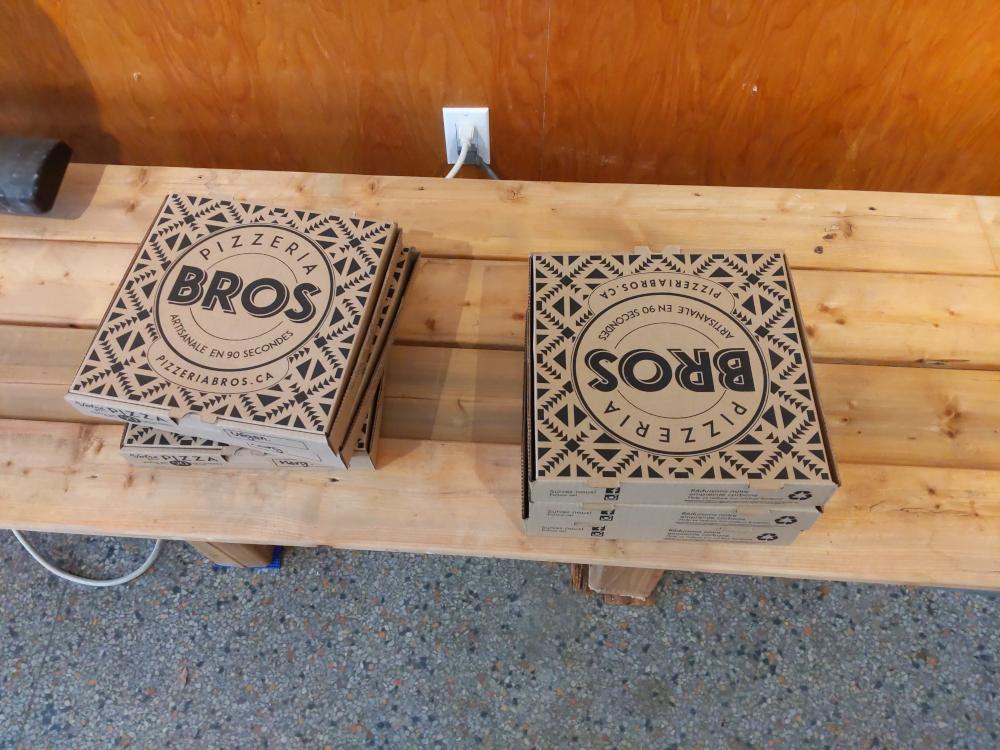
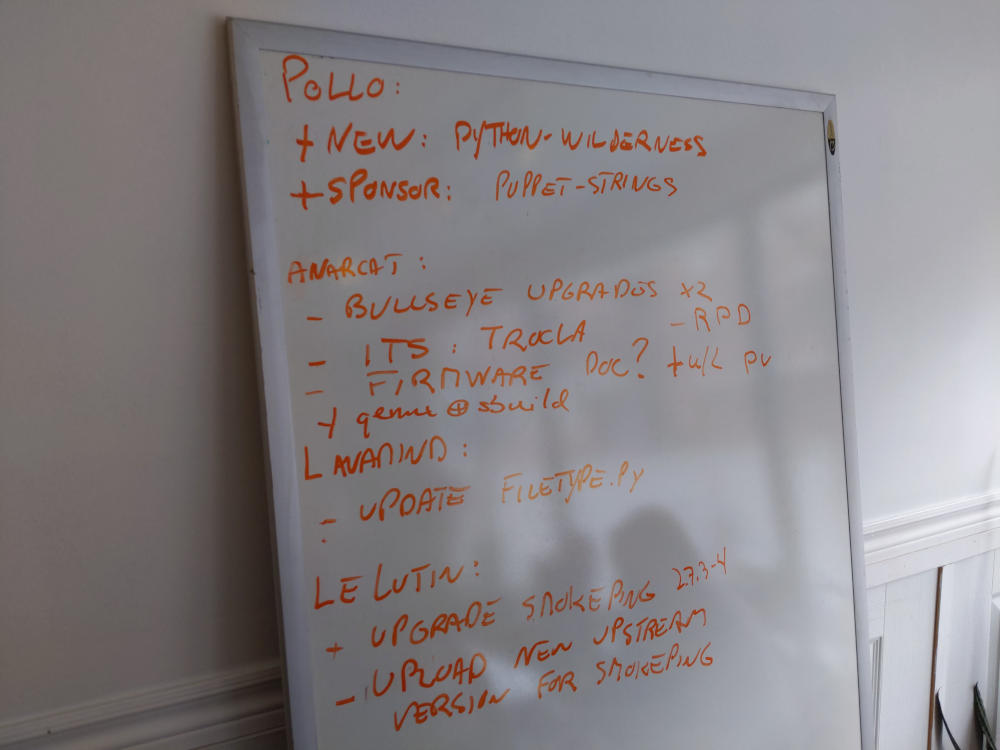
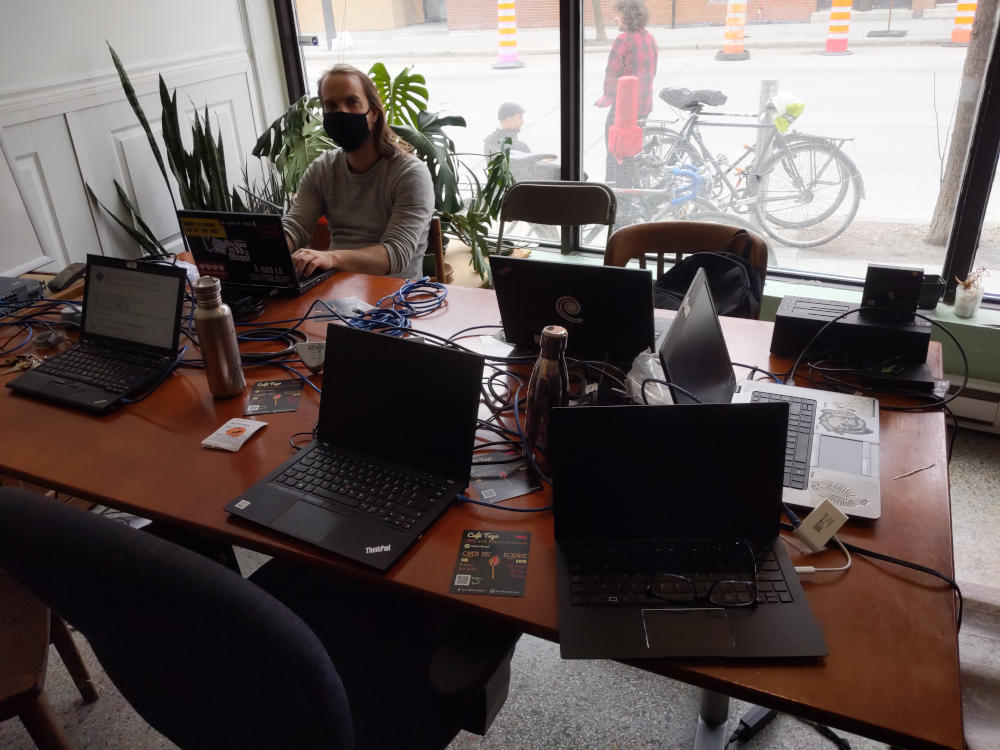
After two long years of COVID hiatus, local Debian events in Montreal are back! Last Sunday, nine of us met at Koumbit to work on Debian (and other stuff!), chat and socialise. Even though these events aren't always the most productive, it was super fun and definitely helps keeping me motivated to work on Debian in my spare time. Many thanks to Debian for providing us a budget to rent the venue for the day and for the pizzas! Here are a few pictures I took during the event: Pizza boxes on a wooden bench Whiteboard listing TODO items for some of the participants A table with a bunch of laptops, and LeLutin :) If everything goes according to plan, our next meeting should be sometime in June. If you are interested, the best way to stay in touch is either to subscribe to our mailing list or to join our IRC channel (#debian-quebec on OFTC). Events are also posted on Quebec's Agenda du libre.

27 April 2022

Antoine Beaupr : building Debian packages under qemu with sbuild

I've been using sbuild for a while to build my Debian packages, mainly because it's what is used by the Debian autobuilders, but also because it's pretty powerful and efficient. Configuring it just right, however, can be a challenge. In my quick Debian development guide, I had a few pointers on how to configure sbuild with the normal schroot setup, but today I finished a qemu based configuration.

Why I want to use qemu mainly because it provides better isolation than a chroot. I sponsor packages sometimes and while I typically audit the source code before building, it still feels like the extra protection shouldn't hurt. I also like the idea of unifying my existing virtual machine setup with my build setup. My current VM is kind of all over the place: libvirt, vagrant, GNOME Boxes, etc?). I've been slowly converging over libvirt however, and most solutions I use right now rely on qemu under the hood, certainly not chroots... I could also have decided to go with containers like LXC, LXD, Docker (with conbuilder, whalebuilder, docker-buildpackage), systemd-nspawn (with debspawn), unshare (with schroot --chroot-mode=unshare), or whatever: I didn't feel those offer the level of isolation that is provided by qemu. The main downside of this approach is that it is (obviously) slower than native builds. But on modern hardware, that cost should be minimal.

How Basically, you need this:
sudo mkdir -p /srv/sbuild/qemu/
sudo apt install sbuild-qemu
sudo sbuild-qemu-create -o /srv/sbuild/qemu/unstable.img unstable https://deb.debian.org/debian
Then to make this used by default, add this to ~/.sbuildrc:
# run autopkgtest inside the schroot
$run_autopkgtest = 1;
# tell sbuild to use autopkgtest as a chroot
$chroot_mode = 'autopkgtest';
# tell autopkgtest to use qemu
$autopkgtest_virt_server = 'qemu';
# tell autopkgtest-virt-qemu the path to the image
# use --debug there to show what autopkgtest is doing
$autopkgtest_virt_server_options = [ '--', '/srv/sbuild/qemu/%r-%a.img' ];
# tell plain autopkgtest to use qemu, and the right image
$autopkgtest_opts = [ '--', 'qemu', '/srv/sbuild/qemu/%r-%a.img' ];
# no need to cleanup the chroot after build, we run in a completely clean VM
$purge_build_deps = 'never';
# no need for sudo
$autopkgtest_root_args = '';
Note that the above will use the default autopkgtest (1GB, one core) and qemu (128MB, one core) configuration, which might be a little low on resources. You probably want to be explicit about this, with something like this:
# extra parameters to pass to qemu
# --enable-kvm is not necessary, detected on the fly by autopkgtest
my @_qemu_options = ['--ram-size=4096', '--cpus=2'];
# tell autopkgtest-virt-qemu the path to the image
# use --debug there to show what autopkgtest is doing
$autopkgtest_virt_server_options = [ @_qemu_options, '--', '/srv/sbuild/qemu/%r-%a.img' ];
$autopkgtest_opts = [ '--', 'qemu', @qemu_options, '/srv/sbuild/qemu/%r-%a.img'];
This configuration will:
  1. create a virtual machine image in /srv/sbuild/qemu for unstable
  2. tell sbuild to use that image to create a temporary VM to build the packages
  3. tell sbuild to run autopkgtest (which should really be default)
  4. tell autopkgtest to use qemu for builds and for tests
Note that the VM created by sbuild-qemu-create have an unlocked root account with an empty password.

Other useful tasks
  • enter the VM to make test, changes will be discarded (thanks Nick Brown for the sbuild-qemu-boot tip!):
     sbuild-qemu-boot /srv/sbuild/qemu/unstable-amd64.img
    
    That program is shipped only with bookworm and later, an equivalent command is:
     qemu-system-x86_64 -snapshot -enable-kvm -object rng-random,filename=/dev/urandom,id=rng0 -device virtio-rng-pci,rng=rng0,id=rng-device0 -m 2048 -nographic /srv/sbuild/qemu/unstable-amd64.img
    
    The key argument here is -snapshot.
  • enter the VM to make permanent changes, which will not be discarded:
     sudo sbuild-qemu-boot --readwrite /srv/sbuild/qemu/unstable-amd64.img
    
    Equivalent command:
     sudo qemu-system-x86_64 -enable-kvm -object rng-random,filename=/dev/urandom,id=rng0 -device virtio-rng-pci,rng=rng0,id=rng-device0 -m 2048 -nographic /srv/sbuild/qemu/unstable-amd64.img
    
  • update the VM (thanks lavamind):
     sudo sbuild-qemu-update /srv/sbuild/qemu/unstable-amd64.img
    
  • build in a specific VM regardless of the suite specified in the changelog (e.g. UNRELEASED, bookworm-backports, bookworm-security, etc):
     sbuild --autopkgtest-virt-server-opts="-- qemu /var/lib/sbuild/qemu/bookworm-amd64.img"
    
    Note that you'd also need to pass --autopkgtest-opts if you want autopkgtest to run in the correct VM as well:
     sbuild --autopkgtest-opts="-- qemu /var/lib/sbuild/qemu/unstable.img" --autopkgtest-virt-server-opts="-- qemu /var/lib/sbuild/qemu/bookworm-amd64.img"
    
    You might also need parameters like --ram-size if you customized it above.
And yes, this is all quite complicated and could be streamlined a little, but that's what you get when you have years of legacy and just want to get stuff done. It seems to me autopkgtest-virt-qemu should have a magic flag starts a shell for you, but it doesn't look like that's a thing. When that program starts, it just says ok and sits there. Maybe because the authors consider the above to be simple enough (see also bug #911977 for a discussion of this problem).

Live access to a running test When autopkgtest starts a VM, it uses this funky qemu commandline:
qemu-system-x86_64 -m 4096 -smp 2 -nographic -net nic,model=virtio -net user,hostfwd=tcp:127.0.0.1:10022-:22 -object rng-random,filename=/dev/urandom,id=rng0 -device virtio-rng-pci,rng=rng0,id=rng-device0 -monitor unix:/tmp/autopkgtest-qemu.w1mlh54b/monitor,server,nowait -serial unix:/tmp/autopkgtest-qemu.w1mlh54b/ttyS0,server,nowait -serial unix:/tmp/autopkgtest-qemu.w1mlh54b/ttyS1,server,nowait -virtfs local,id=autopkgtest,path=/tmp/autopkgtest-qemu.w1mlh54b/shared,security_model=none,mount_tag=autopkgtest -drive index=0,file=/tmp/autopkgtest-qemu.w1mlh54b/overlay.img,cache=unsafe,if=virtio,discard=unmap,format=qcow2 -enable-kvm -cpu kvm64,+vmx,+lahf_lm
... which is a typical qemu commandline, I'm sorry to say. That gives us a VM with those settings (paths are relative to a temporary directory, /tmp/autopkgtest-qemu.w1mlh54b/ in the above example):
  • the shared/ directory is, well, shared with the VM
  • port 10022 is forward to the VM's port 22, presumably for SSH, but not SSH server is started by default
  • the ttyS1 and ttyS2 UNIX sockets are mapped to the first two serial ports (use nc -U to talk with those)
  • the monitor UNIX socket is a qemu control socket (see the QEMU monitor documentation, also nc -U)
In other words, it's possible to access the VM with:
nc -U /tmp/autopkgtest-qemu.w1mlh54b/ttyS2
The nc socket interface is ... not great, but it works well enough. And you can probably fire up an SSHd to get a better shell if you feel like it.

Nitty-gritty details no one cares about

Fixing hang in sbuild cleanup I'm having a hard time making heads or tails of this, but please bear with me. In sbuild + schroot, there's this notion that we don't really need to cleanup after ourselves inside the schroot, as the schroot will just be delted anyways. This behavior seems to be handled by the internal "Session Purged" parameter. At least in lib/Sbuild/Build.pm, we can see this:
my $is_cloned_session = (defined ($session->get('Session Purged')) &&
             $session->get('Session Purged') == 1) ? 1 : 0;
[...]
if ($is_cloned_session)  
$self->log("Not cleaning session: cloned chroot in use\n");
  else  
if ($purge_build_deps)  
    # Removing dependencies
    $resolver->uninstall_deps();
  else  
    $self->log("Not removing build depends: as requested\n");
 
 
The schroot builder defines that parameter as:
    $self->set('Session Purged', $info-> 'Session Purged' );
... which is ... a little confusing to me. $info is:
my $info = $self->get('Chroots')->get_info($schroot_session);
... so I presume that depends on whether the schroot was correctly cleaned up? I stopped digging there... ChrootUnshare.pm is way more explicit:
$self->set('Session Purged', 1);
I wonder if we should do something like this with the autopkgtest backend. I guess people might technically use it with something else than qemu, but qemu is the typical use case of the autopkgtest backend, in my experience. Or at least certainly with things that cleanup after themselves. Right? For some reason, before I added this line to my configuration:
$purge_build_deps = 'never';
... the "Cleanup" step would just completely hang. It was quite bizarre.

Disgression on the diversity of VM-like things There are a lot of different virtualization solutions one can use (e.g. Xen, KVM, Docker or Virtualbox). I have also found libguestfs to be useful to operate on virtual images in various ways. Libvirt and Vagrant are also useful wrappers on top of the above systems. There are particularly a lot of different tools which use Docker, Virtual machines or some sort of isolation stronger than chroot to build packages. Here are some of the alternatives I am aware of: Take, for example, Whalebuilder, which uses Docker to build packages instead of pbuilder or sbuild. Docker provides more isolation than a simple chroot: in whalebuilder, packages are built without network access and inside a virtualized environment. Keep in mind there are limitations to Docker's security and that pbuilder and sbuild do build under a different user which will limit the security issues with building untrusted packages. On the upside, some of things are being fixed: whalebuilder is now an official Debian package (whalebuilder) and has added the feature of passing custom arguments to dpkg-buildpackage. None of those solutions (except the autopkgtest/qemu backend) are implemented as a sbuild plugin, which would greatly reduce their complexity. I was previously using Qemu directly to run virtual machines, and had to create VMs by hand with various tools. This didn't work so well so I switched to using Vagrant as a de-facto standard to build development environment machines, but I'm returning to Qemu because it uses a similar backend as KVM and can be used to host longer-running virtual machines through libvirt. The great thing now is that autopkgtest has good support for qemu and sbuild has bridged the gap and can use it as a build backend. I originally had found those bugs in that setup, but all of them are now fixed:
  • #911977: sbuild: how do we correctly guess the VM name in autopkgtest?
  • #911979: sbuild: fails on chown in autopkgtest-qemu backend
  • #911963: autopkgtest qemu build fails with proxy_cmd: parameter not set
  • #911981: autopkgtest: qemu server warns about missing CPU features
So we have unification! It's possible to run your virtual machines and Debian builds using a single VM image backend storage, which is no small feat, in my humble opinion. See the sbuild-qemu blog post for the annoucement Now I just need to figure out how to merge Vagrant, GNOME Boxes, and libvirt together, which should be a matter of placing images in the right place... right? See also hosting.

pbuilder vs sbuild I was previously using pbuilder and switched in 2017 to sbuild. AskUbuntu.com has a good comparative between pbuilder and sbuild that shows they are pretty similar. The big advantage of sbuild is that it is the tool in use on the buildds and it's written in Perl instead of shell. My concerns about switching were POLA (I'm used to pbuilder), the fact that pbuilder runs as a separate user (works with sbuild as well now, if the _apt user is present), and setting up COW semantics in sbuild (can't just plug cowbuilder there, need to configure overlayfs or aufs, which was non-trivial in Debian jessie). Ubuntu folks, again, have more documentation there. Debian also has extensive documentation, especially about how to configure overlays. I was ultimately convinced by stapelberg's post on the topic which shows how much simpler sbuild really is...

Who Thanks lavamind for the introduction to the sbuild-qemu package.

Russ Allbery: Review: Sorceress of Darshiva

Review: Sorceress of Darshiva, by David Eddings
Series: The Malloreon #4
Publisher: Del Rey
Copyright: December 1989
Printing: November 1990
ISBN: 0-345-36935-1
Format: Mass market
Pages: 371
This is the fourth book of the Malloreon, the sequel series to the Belgariad. Eddings as usual helpfully summarizes the plot of previous books (the one thing about his writing that I wish more authors would copy), this time by having various important people around the world briefed on current events. That said, you don't want to start reading here (although you might wish you could). This is such a weird book. One could argue that not much happens in the Belgariad other than map exploration and collecting a party, but the party collection involves meddling in local problems to extract each new party member. It's a bit of a random sequence of events, but things clearly happen. The Malloreon starts off with a similar structure, including an explicit task to create a new party of adventurers to save the world, but most of the party is already gathered at the start of the series since they carry over from the previous series. There is a ton of map exploration, but it's within the territory of the bad guys from the previous series. Rather than local meddling and acquiring new characters, the story is therefore chasing Zandramas (the big bad of the series) and books of prophecy. This could still be an effective plot trigger but for another decision of Eddings that becomes obvious in Demon Lord of Karanda (the third book): the second continent of this world, unlike the Kingdoms of Hats world-building of the Belgariad, is mostly uniform. There are large cities, tons of commercial activity, and a fairly effective and well-run empire, with only a little local variation. In some ways it's a welcome break from Eddings's previous characterization by stereotype, but there isn't much in the way of local happenings for the characters to get entangled in. Even more oddly, this continental empire, which the previous series set up as the mysterious and evil adversaries of the west akin to Sauron's domain in Lord of the Rings, is not mysterious to some of the party at all. Silk, the Drasnian spy who is a major character in both series, has apparently been running a vast trading empire in Mallorea. Not only has he been there before, he has houses and factors and local employees in every major city and keeps being distracted from the plot by his cutthroat capitalist business shenanigans. It's as if the characters ventured into the heart of the evil empire and found themselves in the entirely normal city next door, complete with restaurant recommendations from one of their traveling companions. I think this is an intentional subversion of the normal fantasy plot by Eddings, and I kind of like it. We have met the evil empire, and they're more normal than most of the good guys, and both unaware and entirely uninterested in being the evil empire. But in terms of dramatic plot structure, it is such an odd choice. Combined with the heroes being so absurdly powerful that they have no reason to take most dangers seriously (and indeed do not), it makes this book remarkably anticlimactic and weirdly lacking in drama. And yet I kind of enjoyed reading it? It's oddly quiet and comfortable reading. Nothing bad happens, nor seems very likely to happen. The primary plot tension is Belgarath trying to figure out the plot of the series by tracking down prophecies in which the plot is written down with all of the dramatic tension of an irritated rare book collector. In the middle of the plot, the characters take a detour to investigate an alchemist who is apparently immortal, featuring a university on Melcena that could have come straight out of a Discworld novel, because investigating people who spontaneously discover magic is of arguably equal importance to saving the world. Given how much the plot is both on rails and clearly willing to wait for the protagonists to catch up, it's hard to argue with them. It felt like a side quest in a video game. I continue to find the way that Eddings uses prophecy in this series to be highly amusing, although there aren't nearly enough moments of the prophecy giving Garion stage direction. The basic concept of two competing prophecies that are active characters in the world attempting to create their own sequence of events is one that would support a better series than this one. It's a shame that Zandramas, the main villain, is rather uninteresting despite being female in a highly sexist society, highly competent, a different type of shapeshifter (I won't say more to avoid spoilers for earlier books), and the anchor of the other prophecy. It's good material, but Eddings uses it very poorly, on top of making the weird decision to have her talk like an extra in a Shakespeare play. This book was astonishingly pointless. I think the only significant plot advancement besides map movement is picking up a new party member (who was rather predictable), and the plot is so completely on rails that the characters are commenting about the brand of railroad ties that Eddings used. Ce'Nedra continues to be spectacularly irritating. It's not, by any stretch of the imagination, a good book, and yet for some reason I enjoyed it more than the other books of the series so far. Chalk one up for brain candy when one is in the right mood, I guess. Followed by The Seeress of Kell, the epic (?) conclusion. Rating: 6 out of 10

Russell Coker: PIN for Login

Windows 10 added a new PIN login method, which is an optional login method instead of an Internet based password through Microsoft or a Domain password through Active Directory. Here is a web page explaining some of the technology (don t watch the YouTube video) [1]. There are three issues here, whether a PIN is any good in concept, whether the specifics of how it works are any good, and whether we can copy any useful ideas for Linux. Is a PIN Any Good? A PIN in concept is a shorter password. I think that less secure methods of screen unlocking (fingerprint, face unlock, and a PIN) can be reasonably used in less hostile environments. For example if you go to the bathroom or to get a drink in a relatively secure environment like a typical home or office you don t need to enter a long password afterwards. Having a short password that works for short time periods of screen locking and a long password for longer times could be a viable option. It could also be an option to allow short passwords when the device is in a certain area (determined by GPS or Wifi connection). Android devices have in the past had options to disable passwords when at home. Is the Windows 10 PIN Any Good? The Windows 10 PIN is based on TPM security which can provide real benefits, but this is more of a failure of Windows local passwords in not using the TPM than a benefit for the PIN. When you login to a Windows 10 system you will be given a choice of PIN or the configured password (local password or AD password). As a general rule providing a user a choice of ways to login is bad for security as an attacker can use whichever option is least secure. The configuration options for Windows 10 allow either group policy in AD or the registry to determine whether PIN login is allowed but doesn t have any control over when the PIN can be used which seems like a major limitation to me. The claim that the PIN is more secure than a password would only make sense if it was a viable option to disable the local password or AD domain password and only use the PIN. That s unreasonably difficult for home users and usually impossible for people on machines with corporate management. Ideas For Linux I think it would be good to have separate options for short term and long term screen locks. This could be implemented by having a screen locking program use two different PAM configurations for unlocking after short term and long term lock periods. Having local passwords based on the TPM might be useful. But if you have the root filesystem encrypted via the TPM using systemd-cryptoenroll it probably doesn t gain you a lot. One benefit of the TPM is limiting the number of incorrect attempts at guessing the password in hardware, the default is allowing 32 wrong attempts and then one every 10 minutes. Trying to do that in software would allow 32 guesses and then a hardware reset which could average at something like 32 guesses per minute instead of 32 guesses per 320 minutes. Maybe something like fail2ban could help with this (a similar algorithm but for password authentication guesses instead of network access). Having a local login method to use when there is no Internet access and network authentication can t work could be useful. But if the local login method is easier then an attacker could disrupt Internet access to force a less secure login method. Is there a good federated authentication system for Linux? Something to provide comparable functionality to AD but with distributed operation as a possibility?

26 April 2022

Reproducible Builds: Supporter spotlight: Google Open Source Security Team (GOSST)

The Reproducible Builds project relies on several projects, supporters and sponsors for financial support, but they are also valued as ambassadors who spread the word about our project and the work that we do. This is the fourth instalment in a series featuring the projects, companies and individuals who support the Reproducible Builds project. If you are a supporter of the Reproducible Builds project (of whatever size) and would like to be featured here, please let get in touch with us at contact@reproducible-builds.org. We started this series by featuring the Civil Infrastructure Platform project and followed this up with a post about the Ford Foundation as well as a recent one about ARDC. However, today, we ll be talking with Meder Kydyraliev of the Google Open Source Security Team (GOSST).
Chris Lamb: Hi Meder, thanks for taking the time to talk to us today. So, for someone who has not heard of the Google Open Source Security Team (GOSST) before, could you tell us what your team is about? Meder: Of course. The Google Open Source Security Team (or GOSST ) was created in 2020 to work with the open source community at large, with the goal of making the open source software that everyone relies on more secure.
Chris: What kinds of activities is the GOSST involved in? Meder: The range of initiatives that the team is involved in recognizes the diversity of the ecosystem and unique challenges that projects face on their security journey. For example, our sponsorship of sos.dev ensures that developers are rewarded for security improvements to open source projects, whilst the long term work on improving Linux kernel security tackles specific kernel-related vulnerability classes. Many of the projects GOSST is involved with aim to make it easier for developers to improve security through automated assessment (Scorecards and Allstar) and vulnerability discovery tools (OSS-Fuzz, ClusterFuzzLite, FuzzIntrospector), in addition to contributing to infrastructure to make adopting certain best practices easier. Two great examples of best practice efforts are Sigstore for artifact signing and OSV for automated vulnerability management.
Chris: The usage of open source software has exploded in the last decade, but supply-chain hygiene and best practices has seemingly not kept up. How does GOSST see this issue and what approaches is it taking to ensure that past and future systems are resilient? Meder: Every open source ecosystem is a complex environment and that awareness informs our approaches in this space. There are, of course, no silver bullets , and long-lasting and material supply-chain improvements requires infrastructure and tools that will make lives of open source developers easier, all whilst improving the state of the wider software supply chain. As part of a broader effort, we created the Supply-chain Levels for Software Artifacts framework that has been used internally at Google to protect production workloads. This framework describes the best practices for source code and binary artifact integrity, and we are engaging with the community on its refinement and adoption. Here, package managers (such as PyPI, Maven Central, Debian, etc.) are an essential link in the software supply chain due to their near-universal adoption; users do not download and compile their own software anymore. GOSST is starting to work with package managers to explore ways to collaborate together on improving the state of the supply chain and helping package maintainers and application developers do better all with the understanding that many open source projects are developed in spare time as a hobby! Solutions like this, which are the result of collaboration between GOSST and GitHub, are very encouraging as they demonstrate a way to materially strengthen software supply chain security with readily available tools, while also improving development workflows. For GOSST, the problem of supply chain security also covers vulnerability management and solutions to make it easier for everyone to discover known vulnerabilities in open source packages in a scalable and automated way. This has been difficult in the past due to lack of consistently high-quality data in an easily-consumable format. To address this, we re working on infrastructure (OSV.dev) to make vulnerability data more easily accessible as well as a widely adopted and automation friendly data format.
Chris: How does the Reproducible Builds effort help GOSST achieve its goals? Meder: Build reproducibility has a lot of attributes that are attractive as part of generally good build hygiene . As an example, hermeticity, one of requirements to meet SLSA level 4, makes it much easier to reason about the dependencies of a piece of software. This is an enormous benefit during vulnerability or supply chain incident response. On a higher level, however, we always think about reproducibility from the viewpoint of a user and the threats that reproducibility protects them from. Here, a lot of progress has been made, of course, but a lot of work remains to make reproducibility part of everyone s software consumption practices.
Chris: So if someone wanted to know more about GOSST or follow the team s work, where might they go to look? Meder: We post regular updates on Google s Security Blog and on the Linux hardening mailing list. We also welcome community participation in the projects we work on! See any of the projects linked above or OpenSSF s GitHub projects page for a list of efforts you can contribute to directly if you want to get involved in strengthening the open source ecosystem.
Chris: Thanks for taking the time to talk to us today. Meder: No problem. :)


For more information about the Reproducible Builds project, please see our website at reproducible-builds.org. If you are interested in ensuring the ongoing security of the software that underpins our civilisation and wish to sponsor the Reproducible Builds project, please reach out to the project by emailing contact@reproducible-builds.org.

22 April 2022

Andrej Shadura: To England by train (part 1)

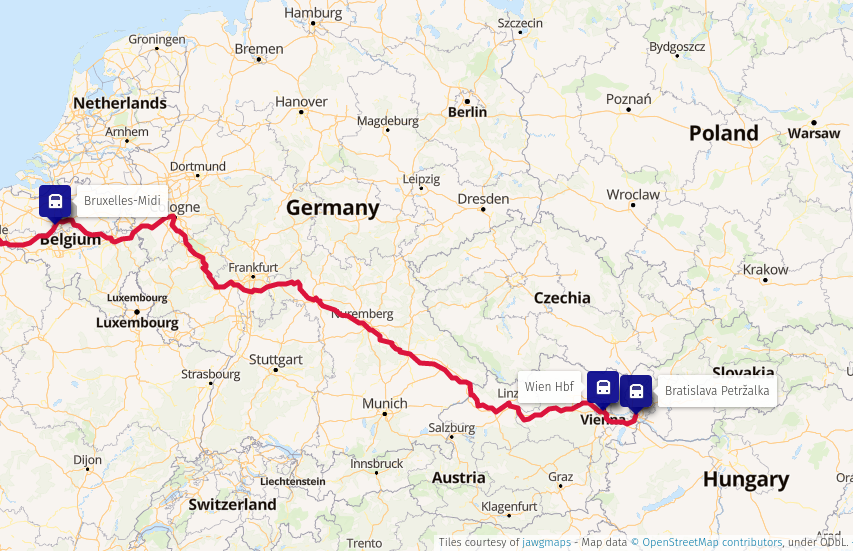
This post was written in August 2021. Just as I was going to publish it, I received an email from BB stating that due to a railway strike in Germany my night train would be cancelled. Since the rest of the trip has already been booked well in advance, I had to take a plane to Charleroi and a bus to Brussels to catch my Eurostar. Ultimately, I ended up publishing it in April 2022, just as I m about to leave for a fully train-powered trip to the UK once again. Before the pandemic started, I planned to use the last months of my then-expiring UK visa and go to England by train. I ve completed two train long journeys by that time already, to Brussels and to Belarus and Ukraine, but this would be something quite different, as I wanted to have multiple stops on my way, use night trains where it made sense, and to go through the Channel Tunnel. The Channel Tunnel fascinated me since my childhood; I first read about it in the Soviet Science and Life magazine ( ) when I was seven. I ve never had the chance to use it though, since to board any train going though it I d first need to get to France, Belgium or the Netherlands, making it significantly more expensive than the cheap 30 Ryanair flights to Stansted. As the coronavirus spread across the world, all of my travel plans along with plans for a sabbatical had to be cancelled. During 2020, I only managed to go on two weekend trips to Prague and Budapest, followed by a two-weeks holiday on Crete (we returned just a couple of weeks before the infection numbers rose and lockdowns started). I do realise that a lot of people couldn t even have this much because the situation in their countries was much worse we were lucky to have had at least some travel. Fast forward to August 2021, I m fully vaccinated, I once again have a UK visa for five years, and the UK finally recognises the EU vaccination passports yay! I can finally go to Devon to see my mother and sister again. By train, of course. Compared to my original plan, this journey will be different: about the same or even more expensive than I originally planned, but shorter and with fewer stops on the way. My original plan would be to take multiple trains from Bratislava to France or Belgium and complete this segment of the trip in about three days, enjoying my stay in a couple of cities on the way. Instead, I m taking a direct NightJet from Vienna to Brussels, not stopping anywhere on the way.
Map: train route from Bratislava to BrusselsTrain route from Bratislava to Brussels
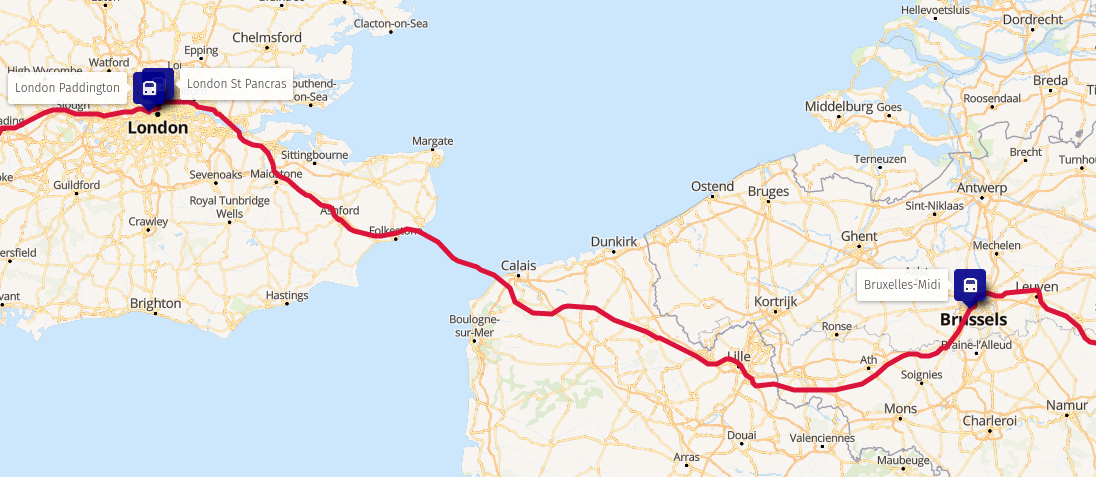
Since I was booking my trip just two weeks ahead, the price of the ticket is not that I hoped for, but much higher: 109 for the ticket itself and 60 for the berth (advance bookings could be about twice as cheap). Next, to London! Eurostar is still on a very much reduced schedule, running one train only from Amsterdam through Brussels and Lille to London each day. This means, of course, higher ticket prices (I paid about 100 for the ticket) and longer waiting time in Brussels my sleeper arrives about 10 am, but the Eurostar train is scheduled to depart at 3 pm.
Map: train route from Brussels to LondonTrain route from Brussels to London
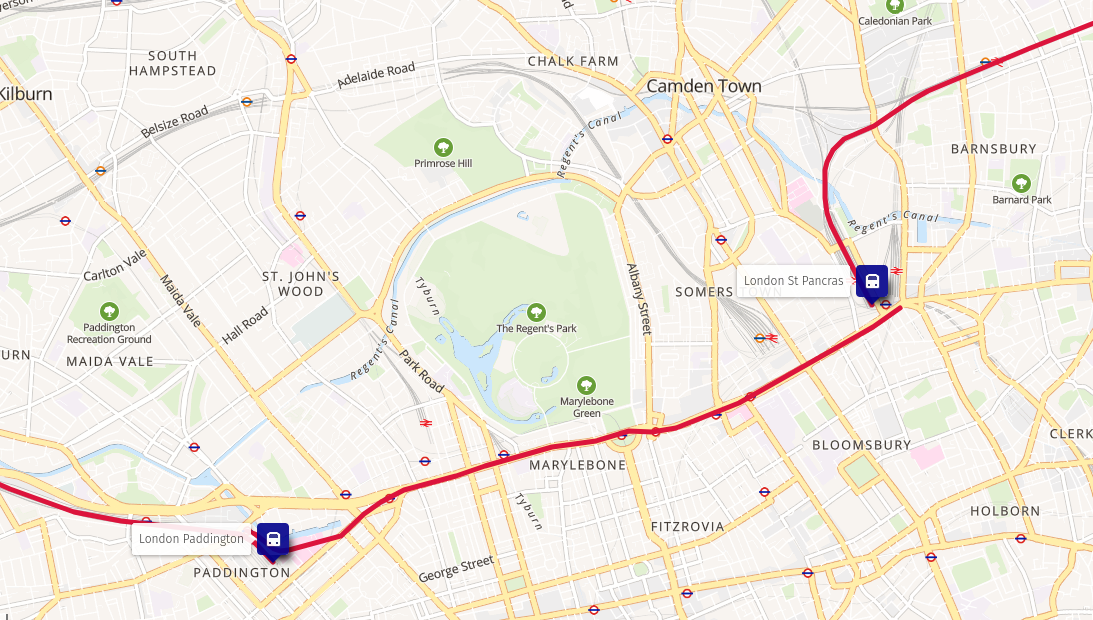
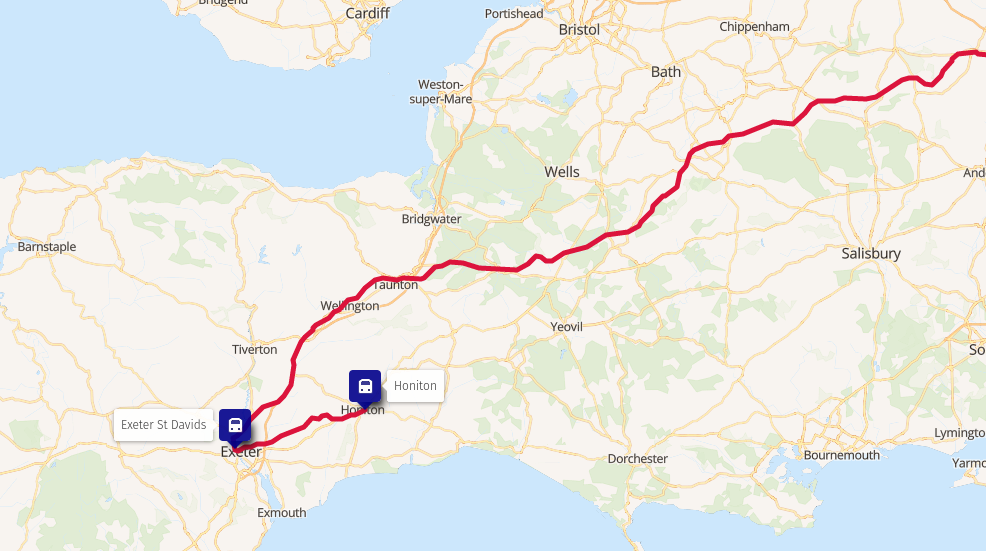
The train makes a stop in Lille, which I initially suspected to be risky as at the time when I booked my tickets, as at the time France was on the amber plus list for the UK, requiring a quarantine upon arrival. However, Eurostar announced that they will assign travellers from Lille to a different carriage to avoid other passengers having to go to quarantine, but recently France was taken off the amber plus list. The train fare system in the UK is something I don t quite understand, as sometimes split tickets are cheaper, sometimes they re expensive, sometimes prices for the same service at different times can be vastly different, off-peak tickets don t say what exactly off-peak means (very few people in the UK are asked were able to tell me when exactly off-peak hours are). Curiously, transfers between train stations using London Underground services can be included into railway tickets, but some last mile connection like Exeter to Honiton cannot (but this used to be possible). Both GWR.com and TrainLine refused to sell me a single ticket from London to Honiton through Exeter, insisting I split the ticket at Exeter St Davids or take the slower South Western train to Honiton via Salisbury and Yeovil. I ended up buying a 57 ticket from Paddington to Exeter St Davids with the first segment being the London Underground from St Pancras, and a separate 7.70 ticket to Honiton.
Map: arrival at St Pancras, the underground, departure from PaddingtonChange of trains in London
Map: arrival at Exeter St Davids, change to a South Western train, arrival at HonitonChange of trains in Exeter
Date Station Arrival Departure Train
12.8 Bratislava-Petr alka 18:15 REX 7756
Wien Hbf 19:15 19:53 NJ 50490
13.8 Bruxelles-Midi 9:55 15:06 EST 9145
London St Pancras 16:03 16:34 TfL
London Paddington 16:49 17:04 GWR 59231
Exeter St Davids 19:19 19:25 SWR 52706
Honiton 19:54
Unfortunately, due to the price of the tickets, I m taking a 15 Ryanair flight back Update after the journey Since I flew to Charleroi instead of comfortably sleeping in a night train, I had to put up with inconveniences of airports, including cumbersome connections to the nearby cities. The only reasonable way of getting from Charleroi to Brussels is an overcrowded bus which takes almost an hour to arrive. I used to take this bus when I tried to save money on my way to FOSDEM, and I must admit it s not something I missed. Boarding the Eurostar train went fine, my vaccination passport and Covid test wasn t really checked, just glanced at. The waiting room was a bit of a disappointment, with bars closed and vending machines broken. Since it was underground, I couldn t even see the trains until the very last moment when we were finally allowed on the platform. The train itself, while comfortable, disappointed me with the bistro carriage: standing only, instant coffee, poor selection of food and drinks. I m glad I bought some food at Carrefour at the Midi station! When I arrived in Exeter, I soon found out why the system refused to sell me a through ticket: 6 minutes is not enough to change trains at Exeter St Davids! Or, it might have been if I took the right footbridge but I took the one which led into a very talkative (and slow!) lift. I ended up running to the train just as it closed the doors and departed, leaving me tin Exeter for an hour until. I used this chance and walked to Exeter Central, and had a pint in a conveniently located pub around the corner. P.S. The maps in this and other posts were created using uMap; the map data come from OpenStreetMap. The train route visualisation was generated with help of the Raildar.fr OSRM instance.

Ritesh Raj Sarraf: Systemd Service Hang

Finally, TIL, what can all be the reason for systemd services to hang indefinitely. The internet is flooded with numerous reports on this topic but no clear answers. So no more uselessly marked workarounds like: systemctl daemon-reload and systemctl-daemon-reexec for this scenario. The scene would be something along the lines of:
rrs         6467  0.0  0.0  23088 15852 pts/1    Ss   12:53   0:00          \_ /bin/bash
rrs        11512  0.0  0.0  14876  4608 pts/1    S+   13:18   0:00              \_ systemctl restart snapper-timeline.timer
rrs        11513  0.0  0.0  14984  3076 pts/1    S+   13:18   0:00                  \_ /bin/systemd-tty-ask-password-agent --watch
rrs        11514  0.0  0.0 234756  6752 pts/1    Sl+  13:18   0:00                  \_ /usr/bin/pkttyagent --notify-fd 5 --fallback
The snapper-timeline service is important to me and it not running for months is a complete failure. Disappointingly, commands like systemctl --failed do not report of this oddity. The overall system status is reported to be fine, which is completely incorrect. Thankfully, a kind soul s comment gave the hint. The problem is that you could be having certain services in Activating status, which thus blocks all other services; quietly. So much for the unnecessary fun. Looking further, in my case, it was:
rrs@priyasi:~$ systemctl list-jobs 
JOB  UNIT                           TYPE  STATE  
81   timers.target                  start waiting
85   man-db.timer                   start waiting
88   fstrim.timer                   start waiting
3832 snapper-timeline.service       start waiting
83   snapper-timeline.timer         start waiting
39   systemd-time-wait-sync.service start running
87   logrotate.timer                start waiting
84   debspawn-clear-caches.timer    start waiting
89   plocate-updatedb.timer         start waiting
91   dpkg-db-backup.timer           start waiting
93   e2scrub_all.timer              start waiting
40   time-sync.target               start waiting
86   apt-listbugs.timer             start waiting

13 jobs listed.
13:12                      
That was it. I knew the systemd-timesyncd service, in the past, had given me enough headaches. And so was it this time, just quietly doing it all again.
rrs@priyasi:~$ systemctl status systemd-time-wait-sync.service
  systemd-time-wait-sync.service - Wait Until Kernel Time Synchronized
     Loaded: loaded (/lib/systemd/system/systemd-time-wait-sync.service; enabled; vendor preset>
     Active: activating (start) since Fri 2022-04-22 13:14:25 IST; 1min 38s ago
       Docs: man:systemd-time-wait-sync.service(8)
   Main PID: 11090 (systemd-time-wa)
      Tasks: 1 (limit: 37051)
     Memory: 836.0K
        CPU: 7ms
     CGroup: /system.slice/systemd-time-wait-sync.service
              11090 /lib/systemd/systemd-time-wait-sync

Apr 22 13:14:25 priyasi systemd[1]: Starting Wait Until Kernel Time Synchronized...
Apr 22 13:14:25 priyasi systemd-time-wait-sync[11090]: adjtime state 5 status 40 time Fri 2022->
13:16                   => 3  
Dear LazyWeb, anybody knows of why the systemd-time-wait-sync service would hang indefinitely? I ve had identical setups on many machines, in the same network, where others don t exhibit this problem.
rrs@priyasi:~$ systemctl cat systemd-time-wait-sync.service

...snipped...

[Service]
Type=oneshot
ExecStart=/lib/systemd/systemd-time-wait-sync
TimeoutStartSec=infinity
RemainAfterExit=yes

[Install]
WantedBy=sysinit.target
The TimeoutStartSec=infinity is definitely an attribute that shouldn t be shipped in any system services. There are use cases for it but that should be left for local admins to explicitly decide. Hanging for infinity is not a desired behavior for a system service. In figuring all this out, today I learnt the handy systemctl list-jobs command, which will give the list of active running/blocked/waiting jobs.

21 April 2022

Andy Simpkins: Firmware and Debian

There has been a flurry of activity on the Debian mailing lists ever since Steve McIntyre raised the issue of including non-free firmware as part of official Debian installation images. Firstly I should point out that I am in complete agreement with Steve s proposal to include non-free firmware as part of an installation image. Likewise I think that we should have a separate archive section for firmware. Because without doing so it will soon become almost impossible to install onto any new hardware. However, as always the issue is more nuanced than a first glance would suggest. Lets start by defining what is firmware? Firmware is any software that runs outside the orchestration of the operating system. Typically firmware will be executed on a processor(s) separate from the processor(s) running the OS, but this does not need to be the case. As Debian we are content that our systems can operate using fully free and open source software and firmware. We can install our OS without needing any non-free firmware. This is an illusion! Each and every PC platform contains non-free firmware It may be possible to run free firmware on some Graphics controllers, Wi-Fi chip-sets, or Ethernet cards and we can (and perhaps should) choose to spend our money on systems where this is the case. When installing a new system we might still be forced to hold our nose and install with non-free firmware on the peripheral before we are able to upgrade it to FLOSS firmware later if this is exists or is even possible to do so. However after the installation we are running a full FLOSS system in terms of software and firmware. We all (almost without exception) are running propitiatory firmware whether we like it or not. Even after carefully selecting graphics and network hardware with FLOSS firmware options we still haven t escaped from non-free-firmware. Other peripherals contain firmware too each keyboard, disk (SSDs and Spinning rust). Even your USB memory stick that you use to contain the Debian installation image contains a microcontroller and hence also contains firmware that runs on it.
  1. Much of this firmware can not even be updated.
  2. Some can be updated, but is stored in FLASH ROM and the hardware vendor has defeated all programming methods (possibly circumnavigated with a hardware mod).
  3. Some of it can be updated but requires external device programmers (and often the programming connections are a series of test points dotted around the board and not on a header in order to make programming as difficult as possible).
  4. Sometimes the firmware can be updated from within the host operating system (i.e. Debian)
  5. Sometimes, as Steve pointed out in his post, the hardware vendor has enough firmware on a peripheral to perform basic functions perhaps enough to install the OS, but requires additional firmware to enable specific feature (i.e. higher screen resolutions, hardware accelerated functions etc.)
  6. Finally some vendors don t even bother with any non-volatile storage beyond a basic boot loader and firmware must be loaded before the device can be used in any mode.
What about the motherboard? If we are lucky we might be able to run a FLOSS implementation of the UEFI subsystem (edk2/tianocore for example), indeed the non AMD64/i386 platforms based around ARM, MIPS architectures are often the most free when it comes to firmware. What about the microcode on the processor? Personally I wasn t aware that that this was updatable firmware until the Spectre and Meltdown classes of vulnerabilities arose a few years back. So back to Debian images including non-free firmware. This is specifically to address the last two use cases mentioned above, i.e. where firmware needs to be loaded to achieve a minimum functioning of a device. Although it could also include motherboard support, and microcode as well. As far as I can tell the proposal exists for several reasons: #1 Because some freely distributable firmware is required for more and more devices, in order to install Debian, or because whilst Debian can be installed a desktop environment can not be started or fully function #2 Because frankly it is less work to produce, test and maintain fewer installation images As someone who performs tests on our images, this clearly gets my vote :-) and perhaps most important of all.. #3 Because our least experienced users, and new users will download an official image and give up if things don t just work TM Steve s proposal option 5 would address theses issues and I fully support it. I would love to see separate repositories for firmware and firmware-none free. Additionally to accompany firmware non-free I would like to have information on what the firmware actually does. Can I run my hardware without it, what function(s) are limited without the firmware, better yet is there a FLOSS equivalent that I can load instead? Is this something that we can present in Debian installer? I would love not to require non-free firmware, but if I can t, I would love if DI would enable a user to make an informed choice as to what, if any, firmware is installed. Should we be requesting (requiring?) this information for any non-free firmware image that we carry in the archive? Finally lets consider firmware in the wider general case, not just the case where we need to load firmware from within Debian each and every boot. Personally I am annoyed whenever a hardware manufacturer has gone out of their way to prevent firmware updates. Lets face it software contains bugs, and we can assume that the software making up a firmware image will as well. Critical (security) vulnerabilities found in firmware, especially if this runs on the same processor(s) as the OS can impact on the wider system, not just the device itself. This will mean that, without updatable firmware, the hardware itself should be withdrawn from use whilst it would otherwise still function. By preventing firmware updates vendors are forcing early obsolescence in the hardware they sell, perhaps good for their bottom line, but certainly no good for users or the environment. Here I can practice what I preach. As an Electronic Engineer / Systems architect I have been beating the drum for In System Updatable firmware for ALL programmable devices in a system, be it a simple peripheral or a deeply embedded system. I can honestly say that over the last 20 years (yes I have been banging this particular drum for that long) I have had 100% success in arguing this case commercially. Having device programmers in R&D departments is one thing, but that is additional cost for production, and field service. Needing custom programming headers or even a bed of nails fixture to connect your target device to a programmer is more trouble than it is worth. Finally, the ability to update firmware in the field means that you can launch your product on schedule, make a sale and ship to a customer even if the first thing that you need to do is download an update. Offering that to any project manager will make you very popular indeed. So what if this firmware is non-free? As long as the firmware resides in non-volatile media without needing the OS to interact with it, we as a project don t need to carry it in our archives. And we as principled individuals can vote with our feet and wallets by choosing to purchase devices that have free firmware. But where that isn t an option, I ll take updatable but non-free firmware over non-free firmware that can not be updated any day of the week. Sure, the manufacture can choose to no longer support the firmware, and it is shocking how soon this happens often in the consumer market, the manufacture has withdrawn support for a product before it even reaches the end user (In which case we should boycott that manufacture in future until they either change their ways of go bust). But again if firmware can be updated in system that would at least allow the possibility of open firmware to arise. Indeed the only commercial case I have seen to argue against updatable firmware has been either for DRM, in which case good lets get rid of both, or for RF licence compliance, and even then it is tenuous because in this case the manufacture wants ISP for its own use right up until a device is shipped out the door, typically achived by blowing one time programmable fuse links .

19 April 2022

Bits from Debian: ITP Prizren Platinum Sponsor of DebConf22

itplogo We are very pleased to announce that ITP - Innovation and Training Park Prizren has committed to supporting DebConf22 as a Platinum sponsor. Also, ITP Prizren will host the Conference for all 15 days! The ITP Prizren intends to be a changing and boosting element in the area of ICT, agro-food and creatives industries, through the creation and management of a favourable environment and efficient services for SMEs, exploiting different kinds of innovations that can contribute to Kosovo to improve its level of development in industry and research, bringing benefits to the economy and society of the country as a whole. ITP Prizren is a focal point in the Balkan region for innovation, business and skills development, and a source of innovative and successful ideas. With this commitment as Platinum Sponsor, ITP Prizren is contributing to make possible our annual conference, and directly supporting the progress of Debian and Free Software, helping to strengthen the community that continues to collaborate on Debian projects throughout the rest of the year. Thank you very much ITP Prizren, for your support of DebConf22! Become a sponsor too! DebConf22 will take place from July 17th to 24th, 2022 at the Innovation and Training Park (ITP) in Prizren, Kosovo, and will be preceded by DebCamp, from July 10th to 16th. And DebConf22 is still accepting sponsors! Interested companies and organizations may contact the DebConf team through sponsors@debconf.org, and visit the DebConf22 website at https://debconf22.debconf.org/sponsors/become-a-sponsor. DebConf22 banner open registration

17 April 2022

Matthew Garrett: The Freedom Phone is not great at privacy

The Freedom Phone advertises itself as a "Free speech and privacy first focused phone". As documented on the features page, it runs ClearOS, an Android-based OS produced by Clear United (or maybe one of the bewildering array of associated companies, we'll come back to that later). It's advertised as including Signal, but what's shipped is not the version available from the Signal website or any official app store - instead it's this fork called "ClearSignal".

The first thing to note about ClearSignal is that the privacy policy link from that page 404s, which is not a great start. The second thing is that it has a version number of 5.8.14, which is strange because upstream went from 5.8.10 to 5.9.0. The third is that, despite Signal being GPL 3, there's no source code available. So, I grabbed jadx and started looking for differences between ClearSignal and the upstream 5.8.10 release. The results were, uh, surprising.

First up is that they seem to have integrated ACRA, a crash reporting framework. This feels a little odd - in the absence of a privacy policy, it's unclear what information this gathers or how it'll be stored. Having a piece of privacy software automatically uploading information about what you were doing in the event of a crash with no notification other than a toast that appears saying "Crash Report" feels a little dubious.

Next is that Signal (for fairly obvious reasons) warns you if your version is out of date and eventually refuses to work unless you upgrade. ClearSignal has dealt with this problem by, uh, simply removing that code. The MacOS version of the desktop app they provide for download seems to be derived from a release from last September, which for an Electron-based app feels like a pretty terrible idea. Weirdly, for Windows they link to an official binary release from February 2021, and for Linux they tell you how to use the upstream repo properly. I have no idea what's going on here.

They've also added support for network backups of your Signal data. This involves the backups being pushed to an S3 bucket using credentials that are statically available in the app. It's ok, though, each upload has some sort of nominally unique identifier associated with it, so it's not trivial to just download other people's backups. But, uh, where does this identifier come from? It turns out that Clear Center, another of the Clear family of companies, employs a bunch of people to work on a ClearID[1], some sort of decentralised something or other that seems to be based on KERI. There's an overview slide deck here which didn't really answer any of my questions and as far as I can tell this is entirely lacking any sort of peer review, but hey it's only the one thing that stops anyone on the internet being able to grab your Signal backups so how important can it be.

The final thing, though? They've extended Signal's invitation support to encourage users to get others to sign up for Clear United. There's an exposed API endpoint called "get_user_email_by_mobile_number" which does exactly what you'd expect - if you give it a registered phone number, it gives you back the associated email address. This requires no authentication. But it gets better! The API to generate a referral link to send to others sends the name and phone number of everyone in your phone's contact list. There does not appear to be any indication that this is going to happen.

So, from a privacy perspective, going to go with things being some distance from ideal. But what's going on with all these Clear companies anyway? They all seem to be related to Michael Proper, who founded the Clear Foundation in 2009. They are, perhaps unsurprisingly, heavily invested in blockchain stuff, while Clear United also appears to be some sort of multi-level marketing scheme which has a membership agreement that includes the somewhat astonishing claim that:

Specifically, the initial focus of the Association will provide members with supplements and technologies for:

9a. Frequency Evaluation, Scans, Reports;

9b. Remote Frequency Health Tuning through Quantum Entanglement;

9c. General and Customized Frequency Optimizations;


- there's more discussion of this and other weirdness here. Clear Center, meanwhile, has a Chief Physics Officer? I have a lot of questions.

Anyway. We have a company that seems to be combining blockchain and MLM, has some opinions about Quantum Entanglement, bases the security of its platform on a set of novel cryptographic primitives that seem to have had no external review, has implemented an API that just hands out personal information without any authentication and an app that appears more than happy to upload all your contact details without telling you first, has failed to update this app to keep up with upstream security updates, and is violating the upstream license. If this is their idea of "privacy first", I really hate to think what their code looks like when privacy comes further down the list.

[1] Pointed out to me here

comment count unavailable comments

14 April 2022

Reproducible Builds: Supporter spotlight: Amateur Radio Digital Communications (ARDC)

The Reproducible Builds project relies on several projects, supporters and sponsors for financial support, but they are also valued as ambassadors who spread the word about the project and the work that we do. This is the third instalment in a series featuring the projects, companies and individuals who support the Reproducible Builds project. If you are a supporter of the Reproducible Builds project (of whatever size) and would like to be featured here, please let get in touch with us at contact@reproducible-builds.org. We started this series by featuring the Civil Infrastructure Platform project and followed this up with a post about the Ford Foundation. Today, however, we ll be talking with Dan Romanchik, Communications Manager at Amateur Radio Digital Communications (ARDC).
Chris Lamb: Hey Dan, it s nice to meet you! So, for someone who has not heard of Amateur Radio Digital Communications (ARDC) before, could you tell us what your foundation is about? Dan: Sure! ARDC s mission is to support, promote, and enhance experimentation, education, development, open access, and innovation in amateur radio, digital communication, and information and communication science and technology. We fulfill that mission in two ways:
  1. We administer an allocation of IP addresses that we call 44Net. These IP addresses (in the 44.0.0.0/8 IP range) can only be used for amateur radio applications and experimentation.
  2. We make grants to organizations whose work aligns with our mission. This includes amateur radio clubs as well as other amateur radio-related organizations and activities. Additionally, we support scholarship programs for people who either have an amateur radio license or are pursuing careers in technology, STEM education and open-source software development projects that fit our mission, such as Reproducible Builds.
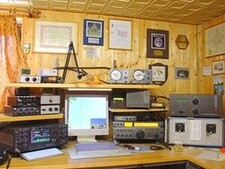
Chris: How might you relate the importance of amateur radio and similar technologies to someone who is non-technical? Dan: Amateur radio is important in a number of ways. First of all, amateur radio is a public service. In fact, the legal name for amateur radio is the Amateur Radio Service, and one of the primary reasons that amateur radio exists is to provide emergency and public service communications. All over the world, amateur radio operators are prepared to step up and provide emergency communications when disaster strikes or to provide communications for events such as marathons or bicycle tours. Second, amateur radio is important because it helps advance the state of the art. By experimenting with different circuits and communications techniques, amateurs have made significant contributions to communications science and technology. Third, amateur radio plays a big part in technical education. It enables students to experiment with wireless technologies and electronics in ways that aren t possible without a license. Amateur radio has historically been a gateway for young people interested in pursuing a career in engineering or science, such as network or electrical engineering. Fourth and this point is a little less obvious than the first three amateur radio is a way to enhance international goodwill and community. Radio knows no boundaries, of course, and amateurs are therefore ambassadors for their country, reaching out to all around the world. Beyond amateur radio, ARDC also supports and promotes research and innovation in the broader field of digital communication and information and communication science and technology. Information and communication technology plays a big part in our lives, be it for business, education, or personal communications. For example, think of the impact that cell phones have had on our culture. The challenge is that much of this work is proprietary and owned by large corporations. By focusing on open source work in this area, we help open the door to innovation outside of the corporate landscape, which is important to overall technological resiliency.
Chris: Could you briefly outline the history of ARDC? Dan: Nearly forty years ago, a group of visionary hams saw the future possibilities of what was to become the internet and requested an address allocation from the Internet Assigned Numbers Authority (IANA). That allocation included more than sixteen million IPv4 addresses, 44.0.0.0 through 44.255.255.255. These addresses have been used exclusively for amateur radio applications and experimentation with digital communications techniques ever since. In 2011, the informal group of hams administering these addresses incorporated as a nonprofit corporation, Amateur Radio Digital Communications (ARDC). ARDC is recognized by IANA, ARIN and the other Internet Registries as the sole owner of these addresses, which are also known as AMPRNet or 44Net. Over the years, ARDC has assigned addresses to thousands of hams on a long-term loan (essentially acting as a zero-cost lease), allowing them to experiment with digital communications technology. Using these IP addresses, hams have carried out some very interesting and worthwhile research projects and developed practical applications, including TCP/IP connectivity via radio links, digital voice, telemetry and repeater linking. Even so, the amateur radio community never used much more than half the available addresses, and today, less than one third of the address space is assigned and in use. This is one of the reasons that ARDC, in 2019, decided to sell one quarter of the address space (or approximately 4 million IP addresses) and establish an endowment with the proceeds. This endowment now funds ARDC s a suite of grants, including scholarships, research projects, and of course amateur radio projects. Initially, ARDC was restricted to awarding grants to organizations in the United States, but is now able to provide funds to organizations around the world.

Chris: How does the Reproducible Builds effort help ARDC achieve its goals? Dan: Our aspirational goals include: We think that the Reproducible Builds efforts in helping to ensure the safety and security of open source software closely align with those goals.
Chris: Are there any specific success stories that ARDC is particularly proud of? Dan: We are really proud of our grant to the Hoopa Valley Tribe in California. With a population of nearly 2,100, their reservation is the largest in California. Like everywhere else, the COVID-19 pandemic hit the reservation hard, and the lack of broadband internet access meant that 130 children on the reservation were unable to attend school remotely. The ARDC grant allowed the tribe to address the immediate broadband needs in the Hoopa Valley, as well as encourage the use of amateur radio and other two-way communications on the reservation. The first nation was able to deploy a network that provides broadband access to approximately 90% of the residents in the valley. And, in addition to bringing remote education to those 130 children, the Hoopa now use the network for remote medical monitoring and consultation, adult education, and other applications. Other successes include our grants to:

Chris: ARDC supports a number of other existing projects and initiatives, not all of them in the open source world. How much do you feel being a part of the broader free culture movement helps you achieve your aims? Dan: In general, we find it challenging that most digital communications technology is proprietary and closed-source. It s part of our mission to fund open source alternatives. Without them, we are solely reliant, as a society, on corporate interests for our digital communication needs. It makes us vulnerable and it puts us at risk of increased surveillance. Thus, ARDC supports open source software wherever possible, and our grantees must make a commitment to share their work under an open source license or otherwise make it as freely available as possible.
Chris: Thanks so much for taking the time to talk to us today. Now, if someone wanted to know more about ARDC or to get involved, where might they go to look? To learn more about ARDC in general, please visit our website at https://www.ampr.org. To learn more about 44Net, go to https://wiki.ampr.org/wiki/Main_Page. And, finally, to learn more about our grants program, go to https://www.ampr.org/apply/

For more about the Reproducible Builds project, please see our website at reproducible-builds.org. If you are interested in ensuring the ongoing security of the software that underpins our civilisation and wish to sponsor the Reproducible Builds project, please reach out to the project by emailing contact@reproducible-builds.org.

Jonathan Dowland: hledger

This year I've decided to bite the bullet and properly try out hledger for personal accounting. It seems I need to commit to it properly if I'm to figure out whether it will work for me or not. Up until now I'd been strictly separating my finances into two buckets: family and personal. I'd been using GNUCash for a couple of years for my personal finances, initially to evaluate it for use for the family, but I had not managed to adopt it for that. I set up a new git repository to track the ledger file, as well as a notes.txt "diary" that documents my planning around its structure and how to use it, and a import.txt which documents what account data I have imported and confirmed that the resulting balances match those reported on monthly statements. For this evaluation, I decided to bite the bullet and track both family and personal finances at the same time. I'm still keeping them conceptually very separate. To reflect that I've organised my account names around that: all accounts relating to family are prefixed family:, and likewise personal jon:.1 Some example accounts:

family:assets:shared    - shared bank account
family:dues:jon         - I owe to family
family:expenses:cat     - budget category for the cat
income                  - where money enters this universe
jon:assets:current      - my personal account
jon:dues:peter          - money Peter owes me
jon:expenses:snacks     - budget category for coffees etc
jon:liabilities:amex    - a personal credit card
I decided to make the calendar year a strict cut-over point: my personal opening balances in hledger are determined by what GNUCash reports. It's possible those will change over this year, as adjustments are made to last year's data: but it's easy enough to go in and update the opening balances in hledger to reflect that. Credit cards are a small exception. January's credit card bills are paid in January but cover transactions from mid-December. I import those transactions into hledger to balance the credit card payment. As a consequence, the "spend per month" view of my data is a bit skewed: All the transactions in December should be thought of as in January since that's when they were paid. I need to explore options to fix this. When I had family and personal managed separately, occasionally something would be paid for on the wrong card and end up in the wrong data. The solution I used last year was to keep an account dues:family to which I posted those and periodically I'd settle it with a real-world bank transfer. I've realised that this doesn't work so well when I manage both together: I can't track both dues and expense categorisation with just one posting. The solution I'm using for now is hledger's unbalanced virtual postings: a third posting for the transaction to the budget category, which is not balanced, e.g.:
2022-01-02 ZTL*RELISH
    family:liabilities:creditcard        -3.00
    family:dues:jon                       3.00
    (jon:expenses:snacks)                 3.00
This works, but it completely side-steps double-entry book keeping, which is the whole point of using a double-entry system. There's also no check and balance that the figure I put in the virtual posting ( 3) matches the figure in the rest of the transaction. I'm therefore open to other ideas.

  1. there are a couple of places in hledger where default account names are used, such as the default place that expenses are posted to during CSV imports: expenses:unknown, that obviously don't fit my family/jon: prefix scheme. The solution is to make sure I specify a default posting-to account in all my CSV import rules.

8 April 2022

Reproducible Builds: Reproducible Builds in March 2022

Welcome to the March 2022 report from the Reproducible Builds project! In our monthly reports we outline the most important things that we have been up to over the past month.
The in-toto project was accepted as an incubating project within the Cloud Native Computing Foundation (CNCF). in-toto is a framework that protects the software supply chain by collecting and verifying relevant data. It does so by enabling libraries to collect information about software supply chain actions and then allowing software users and/or project managers to publish policies about software supply chain practices that can be verified before deploying or installing software. CNCF foundations hosts a number of critical components of the global technology infrastructure under the auspices of the Linux Foundation. (View full announcement.)
Herv Boutemy posted to our mailing list with an announcement that the Java Reproducible Central has hit the milestone of 500 fully reproduced builds of upstream projects . Indeed, at the time of writing, according to the nightly rebuild results, 530 releases were found to be fully reproducible, with 100% reproducible artifacts.
GitBOM is relatively new project to enable build tools trace every source file that is incorporated into build artifacts. As an experiment and/or proof-of-concept, the GitBOM developers are rebuilding Debian to generate side-channel build metadata for versions of Debian that have already been released. This only works because Debian is (partial) reproducible, so one can be sure that that, if the case where build artifacts are identical, any metadata generated during these instrumented builds applies to the binaries that were built and released in the past. More information on their approach is available in README file in the bomsh repository.
Ludovic Courtes has published an academic paper discussing how the performance requirements of high-performance computing are not (as usually assumed) at odds with reproducible builds. The received wisdom is that vendor-specific libraries and platform-specific CPU extensions have resulted in a culture of local recompilation to ensure the best performance, rendering the property of reproducibility unobtainable or even meaningless. In his paper, Ludovic explains how Guix has:
[ ] implemented what we call package multi-versioning for C/C++ software that lacks function multi-versioning and run-time dispatch [ ]. It is another way to ensure that users do not have to trade reproducibility for performance. (full PDF)

Kit Martin posted to the FOSSA blog a post titled The Three Pillars of Reproducible Builds. Inspired by the shock of infiltrated or intentionally broken NPM packages, supply chain attacks, long-unnoticed backdoors , the post goes on to outline the high-level steps that lead to a reproducible build:
It is one thing to talk about reproducible builds and how they strengthen software supply chain security, but it s quite another to effectively configure a reproducible build. Concrete steps for specific languages are a far larger topic than can be covered in a single blog post, but today we ll be talking about some guiding principles when designing reproducible builds. [ ]
The article was discussed on Hacker News.
Finally, Bernhard M. Wiedemann noticed that the GNU Helloworld project varies depending on whether it is being built during a full moon! (Reddit announcement, openSUSE bug report)

Events There will be an in-person Debian Reunion in Hamburg, Germany later this year, taking place from 23 30 May. Although this is a Debian event, there will be some folks from the broader Reproducible Builds community and, of course, everyone is welcome. Please see the event page on the Debian wiki for more information. Bernhard M. Wiedemann posted to our mailing list about a meetup for Reproducible Builds folks at the openSUSE conference in Nuremberg, Germany. It was also recently announced that DebConf22 will take place this year as an in-person conference in Prizren, Kosovo. The pre-conference meeting (or Debcamp ) will take place from 10 16 July, and the main talks, workshops, etc. will take place from 17 24 July.

Misc news Holger Levsen updated the Reproducible Builds website to improve the documentation for the SOURCE_DATE_EPOCH environment variable, both by expanding parts of the existing text [ ][ ] as well as clarifying meaning by removing text in other places [ ]. In addition, Chris Lamb added a Twitter Card to our website s metadata too [ ][ ][ ]. On our mailing list this month:

Distribution work In Debian this month:
  • Johannes Schauer Marin Rodrigues posted to the debian-devel list mentioning that he exploited the property of reproducibility within Debian to demonstrate that automatically converting a large number of packages to a new internal source version did not change the resulting packages. The proposed change could therefore be applied without causing breakage:
So now we have 364 source packages for which we have a patch and for which we can show that this patch does not change the build output. Do you agree that with those two properties, the advantages of the 3.0 (quilt) format are sufficient such that the change shall be implemented at least for those 364? [ ]
In openSUSE, Bernhard M. Wiedemann posted his usual monthly reproducible builds status report.

Tooling diffoscope is our in-depth and content-aware diff utility. Not only can it locate and diagnose reproducibility issues, it can provide human-readable diffs from many kinds of binary formats. This month, Chris Lamb prepared and uploaded versions 207, 208 and 209 to Debian unstable, as well as made the following changes to the code itself:
  • Update minimum version of Black to prevent test failure on Ubuntu jammy. [ ]
  • Updated the R test fixture for the 4.2.x series of the R programming language. [ ]
Brent Spillner also worked on adding graceful handling for UNIX sockets and named pipes to diffoscope. [ ][ ][ ]. Vagrant Cascadian also updated the diffoscope package in GNU Guix. [ ][ ] reprotest is the Reproducible Build s project end-user tool to build the same source code twice in widely different environments and checking whether the binaries produced by the builds have any differences. This month, Santiago Ruano Rinc n added a new --append-build-command option [ ], which was subsequently uploaded to Debian unstable by Holger Levsen.

Upstream patches The Reproducible Builds project detects, dissects and attempts to fix as many currently-unreproducible packages as possible. We endeavour to send all of our patches upstream where appropriate. This month, we wrote a large number of such patches, including:

Testing framework The Reproducible Builds project runs a significant testing framework at tests.reproducible-builds.org, to check packages and other artifacts for reproducibility. This month, the following changes were made:
  • Holger Levsen:
    • Replace a local copy of the dsa-check-running-kernel script with a packaged version. [ ]
    • Don t hide the status of offline hosts in the Jenkins shell monitor. [ ]
    • Detect undefined service problems in the node health check. [ ]
    • Update the sources.lst file for our mail server as its still running Debian buster. [ ]
    • Add our mail server to our node inventory so it is included in the Jenkins maintenance processes. [ ]
    • Remove the debsecan package everywhere; it got installed accidentally via the Recommends relation. [ ]
    • Document the usage of the osuosl174 host. [ ]
Regular node maintenance was also performed by Holger Levsen [ ], Vagrant Cascadian [ ][ ][ ] and Mattia Rizzolo.
If you are interested in contributing to the Reproducible Builds project, please visit our Contribute page on our website. However, you can get in touch with us via:

7 April 2022

Gunnar Wolf: How is the free firmware for the Raspberry progressing?

Raspberry Pi computers require a piece of non-free software to boot the infamous raspi-firmware package. But for almost as long as there has been a Raspberry Pi to talk of (this year it turns 10 years old!), there have been efforts to get it to boot using only free software. How is it progressing? Michael Bishop (IRC user clever) explained today in the #debian-raspberrypi channel in OFTC that it advances far better than what I expected: It is even possible to boot a usable system under the RPi2 family! Just There is somewhat incomplete hardware support: For his testing, he has managed to use a xfce environment but over the composite (NTSC) video output, as HDMI initialization support is not there. However, he shared with me several interesting links and videos, and I told him I d share them there are still many issues; I do not believe it is currently worth it to make Debian images with this firmware. Before anything else: Go visit the librerpi/lk-overlay repository. Its README outlines hardware support for each of the RPi families; there is a binary build available with nixos if you want to try it out, and instructions to build it. But what clever showed me that made me write this post Is the amount of stuff you can do with the RPi s VPU (why Vision Vector Processing Unit and not the more familiar GPU, Graphical Processing Unit? I don t really know But I trust clever s definitions beyond how I trust my own ) before it loads an opearting system: There s not too much I can add to this. I was just Truly amazed. And I hope to see the remaining hurdles for regular Linux booting on this range of machines with purely free software quickly go away! Packaging this for Debian? Well, not yet not so fast I first told clever we could push this firmware to experimental instead of unstable, as it is not yet ready for most production systems. However, pabs made some spot-on further questions. And yes, it requires installing three(!) different cross-compilers, one of which vc4-toolchain, for the VPU is free software, but not yet upstreamed, and hence is not available for Debian. Anyway, the talk continued long after I had to go. I have gone a bit over the backlog, but I have to leave now so that will be it as for this blog post

6 April 2022

Thorsten Alteholz: My Debian Activities in March 2022

FTP master This month I accepted 332 and rejected 15 packages. This ratio gives a reason to hope. The overall number of packages that got accepted was 342. Debian LTS This was my ninety-third month that I did some work for the Debian LTS initiative, started by Raphael Hertzog at Freexian. This month my all in all workload has been 40h. During that time I did LTS and normal security uploads of: All my PU bugs for Buster and Bullseye, that accumulated over the last months, were part of the latest point release. So new ones have to be created now :-). I also continued to work on security support for golang packages. As a result #1008577 and #1008578 were the first real tests with a simple package. Debian ELTS This month was the forty-fifth ELTS month. During my allocated time I uploaded: Unfortunately uploads have to be done for younger releases first, so I had to withhold some uploads for ELTS. Hopefully they can be done in April. Probably this policy needs to be reconsidered. Last but not least I did some days of frontdesk duties. Debian Printing This month I uploaded new upstream versions or improved packaging of: In order to make the Debian Edu team happy, I uploaded a new version of cups-filters with an adapted Apparmor-file to Unstable and Bullseye. Debian Astro This month I uploaded new upstream versions or improved packaging of: Other stuff This month I uploaded new upstream versions or improved packaging of: In order to avoid an AUTORM of some Osmocom packages, I also had to NMU:

Jonathan Dowland: Stanley Kubrick's A Clockwork Orange (Music From The Soundtrack)

I was reminded of this record over the weekend, as Radio 4's Front Row was discussing the 50th anniversary of Kubrick's movie. To me, the soundtrack has a strange, whimsical, almost cynical element to it (especially with the selection of things like Pomp and Circumstance), but I was familiar with the movie before the soundtrack and it might just be the association that triggers those feelings.
Picture of 'A Clockwork Orange' vinyl record playing on my turntable
I think I picked this up at Tynemouth Market when I lived close by, but I'm not sure. I am sure I didn't pay much for it. Mine is a UK re-pressing from 1971. The abridged (and sped-up) version of William Tell Overture is great for getting the kids to complete a task. Burgess's novel (now 60 years old) has been on my to-read pile for years. in 2018 Electronic Sound magazine featured a cover-mount CD "New Clockwork Music" of music inspired by this soundtrack: It's very good. I must dig that out

5 April 2022

Dirk Eddelbuettel: RcppArmadillo 0.11.0.0.0 on CRAN: Upstream Updates

armadillo image Armadillo is a powerful and expressive C++ template library for linear algebra aiming towards a good balance between speed and ease of use with a syntax deliberately close to a Matlab. RcppArmadillo integrates this library with the R environment and language and is widely used by (currently) 972 other packages on CRAN, downloaded over 24 million times (per the partial logs from the cloud mirrors of CRAN), and the CSDA paper (preprint / vignette) by Conrad and myself has been cited 465 times according to Google Scholar. This release brings a new upstream release 11.0.0. We tested this very rigorously via three different RC release each of which got a full reverse-dependencies run (for which results are always logged here). The full set of changes (since the last CRAN release 0.10.8.1.0) follows.

Changes in RcppArmadillo version 0.11.0.0 (2022-04-04)
  • Upgraded to Armadillo release 11.0.0 (Creme Brulee)
    • added variants of inv() and inv_sympd() that provide rcond (reciprocal condition number)
    • expanded inv() and inv_sympd() with options inv_opts::tiny and inv_opts::allow_approx
    • stricter handling of singular matrices by inv() and inv_sympd()
    • stricter handling of non-sympd matrices by inv() and inv_sympd()
    • stricter handling of non-finitie matrices by pinv()
    • more robust handling of rank deficient matrices by solve()
    • faster handling of diagonal matrices by rcond()
    • changed eigs_sym() and eigs_gen() to use higher quality RNG
    • quantile() and median() will now throw an exception if given matrices/vectors have NaN elements
    • workaround for yet another bug in Intel MKL
  • Until May 2022, protect correction to Field behavior via define of RCPP_ARMADILLO_FIX_Field
  • If a LAPACK installation with missing complex routines is found (as e.g. Ubuntu using 3.9.0) then the LAPACK unit test is skipped.

Changes in RcppArmadillo version 0.10.8.2.0 (2022-02-01)
  • Upgraded to Armadillo release 10.8.2 (Realm Raider)
    • fix potential speed regression in pinv() and rank()

Courtesy of my CRANberries, there is a diffstat report relative to previous release. More detailed information is on the RcppArmadillo page. Questions, comments etc should go to the rcpp-devel mailing list off the R-Forge page. If you like this or other open-source work I do, you can sponsor me at GitHub.

This post by Dirk Eddelbuettel originated on his Thinking inside the box blog. Please report excessive re-aggregation in third-party for-profit settings.

Kees Cook: security things in Linux v5.10

Previously: v5.9 Linux v5.10 was released in December, 2020. Here s my summary of various security things that I found interesting: AMD SEV-ES
While guest VM memory encryption with AMD SEV has been supported for a while, Joerg Roedel, Thomas Lendacky, and others added register state encryption (SEV-ES). This means it s even harder for a VM host to reconstruct a guest VM s state. x86 static calls
Josh Poimboeuf and Peter Zijlstra implemented static calls for x86, which operates very similarly to the static branch infrastructure in the kernel. With static branches, an if/else choice can be hard-coded, instead of being run-time evaluated every time. Such branches can be updated too (the kernel just rewrites the code to switch around the branch ). All these principles apply to static calls as well, but they re for replacing indirect function calls (i.e. a call through a function pointer) with a direct call (i.e. a hard-coded call address). This eliminates the need for Spectre mitigations (e.g. RETPOLINE) for these indirect calls, and avoids a memory lookup for the pointer. For hot-path code (like the scheduler), this has a measurable performance impact. It also serves as a kind of Control Flow Integrity implementation: an indirect call got removed, and the potential destinations have been explicitly identified at compile-time. network RNG improvements
In an effort to improve the pseudo-random number generator used by the network subsystem (for things like port numbers and packet sequence numbers), Linux s home-grown pRNG has been replaced by the SipHash round function, and perturbed by (hopefully) hard-to-predict internal kernel states. This should make it very hard to brute force the internal state of the pRNG and make predictions about future random numbers just from examining network traffic. Similarly, ICMP s global rate limiter was adjusted to avoid leaking details of network state, as a start to fixing recent DNS Cache Poisoning attacks. SafeSetID handles GID
Thomas Cedeno improved the SafeSetID LSM to handle group IDs (which required teaching the kernel about which syscalls were actually performing setgid.) Like the earlier setuid policy, this lets the system owner define an explicit list of allowed group ID transitions under CAP_SETGID (instead of to just any group), providing a way to keep the power of granting this capability much more limited. (This isn t complete yet, though, since handling setgroups() is still needed.) improve kernel s internal checking of file contents
The kernel provides LSMs (like the Integrity subsystem) with details about files as they re loaded. (For example, loading modules, new kernel images for kexec, and firmware.) There wasn t very good coverage for cases where the contents were coming from things that weren t files. To deal with this, new hooks were added that allow the LSMs to introspect the contents directly, and to do partial reads. This will give the LSMs much finer grain visibility into these kinds of operations. set_fs removal continues
With the earlier work landed to free the core kernel code from set_fs(), Christoph Hellwig made it possible for set_fs() to be optional for an architecture. Subsequently, he then removed set_fs() entirely for x86, riscv, and powerpc. These architectures will now be free from the entire class of kernel address limit attacks that only needed to corrupt a single value in struct thead_info. sysfs_emit() replaces sprintf() in /sys
Joe Perches tackled one of the most common bug classes with sprintf() and snprintf() in /sys handlers by creating a new helper, sysfs_emit(). This will handle the cases where kernel code was not correctly dealing with the length results from sprintf() calls, which might lead to buffer overflows in the PAGE_SIZE buffer that /sys handlers operate on. With the helper in place, it was possible to start the refactoring of the many sprintf() callers. nosymfollow mount option
Mattias Nissler and Ross Zwisler implemented the nosymfollow mount option. This entirely disables symlink resolution for the given filesystem, similar to other mount options where noexec disallows execve(), nosuid disallows setid bits, and nodev disallows device files. Quoting the patch, it is useful as a defensive measure for systems that need to deal with untrusted file systems in privileged contexts. (i.e. for when /proc/sys/fs/protected_symlinks isn t a big enough hammer.) Chrome OS uses this option for its stateful filesystem, as symlink traversal as been a common attack-persistence vector. ARMv8.5 Memory Tagging Extension support
Vincenzo Frascino added support to arm64 for the coming Memory Tagging Extension, which will be available for ARMv8.5 and later chips. It provides 4 bits of tags (covering multiples of 16 byte spans of the address space). This is enough to deterministically eliminate all linear heap buffer overflow flaws (1 tag for free , and then rotate even values and odd values for neighboring allocations), which is probably one of the most common bugs being currently exploited. It also makes use-after-free and over/under indexing much more difficult for attackers (but still possible if the target s tag bits can be exposed). Maybe some day we can switch to 128 bit virtual memory addresses and have fully versioned allocations. But for now, 16 tag values is better than none, though we do still need to wait for anyone to actually be shipping ARMv8.5 hardware. fixes for flaws found by UBSAN
The work to make UBSAN generally usable under syzkaller continues to bear fruit, with various fixes all over the kernel for stuff like shift-out-of-bounds, divide-by-zero, and integer overflow. Seeing these kinds of patches land reinforces the the rationale of shifting the burden of these kinds of checks to the toolchain: these run-time bugs continue to pop up. flexible array conversions
The work on flexible array conversions continues. Gustavo A. R. Silva and others continued to grind on the conversions, getting the kernel ever closer to being able to enable the -Warray-bounds compiler flag and clear the path for saner bounds checking of array indexes and memcpy() usage. That s it for now! Please let me know if you think anything else needs some attention. Next up is Linux v5.11.

2022, Kees Cook. This work is licensed under a Creative Commons Attribution-ShareAlike 4.0 License.
CC BY-SA 4.0

Next.

Previous.