
Search Results: "js"

22 October 2007

Sven Mueller: RE Anthonys some fun post

I really dislike posts like (sorry AJ, you are just one example) AJ Towns blog post
“Some fun”. What I dislike? Well, the post lacks critical information: Which slashdot post inspired him? What data is he talking about? How did he turn the data into those graphics? Sorry AJ, your post is just the latest example of this style of post, and I really got frustrated over such posts, this is not meant as a personal attack. Edit:
So to make my wish clear: Please, fellow bloggers, don’t assume that your readers are following your favourite web resources as closely as you do (and with the same specific interests). Explicitly say what you are writing about, reference resources needed to understand what you are doing, at least give readers a chance to find out what you did. In AJs case, it would probably have been enough to reference the /. article or comment which inspired him.

Holger Levsen: Small report from the meeting in Extremadura

The last five days I've spent at the combined Debian Edu, FAI and CDD meeting in M rida in Extremadura, together with 17 others. The Debian Edu / Skolelinux crowd was the biggest, followed by FAI, followed by CDD people, though many were part of more than one project. "As usual" it was great to meet many known faces and some unknown ones and to be able to discuss stuff in RL.

Besides various small different things, I worked on the Debian Edu etch r1 release, our lenny roadmap (see the bottom of our roadmap page which also covers etch r1) and the (technical side of the) german translation of the Debian Edu documentation. Non edu related the new setupharddisk2 for FAI took most of my brain activity. And I've signed all keys allready :-)

We stayed at a very nice hotel in the even much nicer city of Merida, which features a lot of roman ruins and history. For example, we walked over the biggest roman bridge in the world! The only thing that was bigger was the amount of good food we were forced to eat every day... Incredible. This was my second visit to Merida and this time I finally managed to visit the amphitheatre (with seats for 15000 people) and the Roman theatre. (Unfortunatly the english page about Emerita Augusta is a stub.) If you happen to come around that area make sure to spend some time sight seeing, it is really worth it! People living in Merida literally fear to rebuild their houses, because as soon as they start to dig, they find something historical and have to turn their property into a museum :-)

In case you have not seen it yet, you should watch this small movie from euro news about the free software efforts in Extremadura. Insightful and very good promotion, also to show around.

Many thanks to C sar, Jos Luis and the Junta de Extremdura for hosting such a great meeting! You rock!

On a unrelated note, spam has gone crazy yesterday while traveling back, 15000 mails were not catched by my so far well working setup. ARG. I still used to have a catchall setting, which was useful to give out addresses like $company@mydomain, but now I will explicitly list those addresses and disable catchall. And luckily for you I will not blog about every spam mail I got... :) Generally I dont consider spam (the source of) evil, it's money: as long as money rules the world, there will be spam. So since it's a social problem, it is hardly solvable by technology. (That is, as long as you want to receive mails from strangers, which I do.) IMO what's worse than spammers are autoresponders to spam. Most of those 15000 mails were auto-replies to spam. OMFSM.

Thijs Kinkhorst: eduota segfaults on etch

I spent some time today trying to find out why in a simple quota configuration on Debian etch, edquota keeps failing:
# edquota thijs
Segmentation fault
I haven't pinpointed the exact cause, upgrading the kernel didn't help, but what did help is taking the quota package from unstable and recompiling it for etch. I'm posting it here so it might help someone else with the same problem; I may create a backport for etch of quota when I get home later.

15 October 2007

Biella Coleman: On Adivising Grad Students: A grad student perspective

Joe Reagle, who happens to be a PhD student I am happily advising, wrote a response to my blog entry on the Chronicle of Higher Education article lamenting and lambasting advising graduate students. I am quoting it here in its entirety because it is a very thoughtful response:
Difficult issue. I certainly feel sympathy with the anonymous faculty member with respect to her amorous and litigious students. Also, I often wonder how I would deal with students who don’t share my sensibilities or workstyle if I were advising them under such circumstances. However, I also find much of her disappointment is related to disappointment of what her students do next, and in this I feel she may be a little unfair. She rightly recognizes that graduate school is a time of flux, no student can really guarantee what’s going to happen next. (One of my favorite religious jokes is: “How do you make God laugh?… Tell her your plans.”) If she is disappointed that a student she tried to help achieve a position at a tier 1 research institute accommodates themselves to something less than that, I’m sure at the student worked just as hard and was even more disappointed. The heart of the issue is that academia is so ridiculously competitive. It is never good enough to make a contribution or to be helpful, one always needs to be the best. It’s an exemplar for “The Winner Takes All.” I often think of this in relation to my technical work. One of the most rewarding professional relationships I had was when a more experienced programmer co-authored a Python software library with me. I don’t think he did it with any expectation that he was somehow seeding the discipline with followers, or even that I would someday be able to reciprocate in a similar manner. He was a good guy, we enjoyed our collaboration, I think he was learning by helping me, and in the end we made something useful, even if neither of us ever became Python gods. This is one of the things I like about open content communities, yes the people at the top get a fair amount of attention, but even if you spellcheck Wikipedia articles or write a Python library for canonicalising XML, that work is still appreciated.

13 October 2007

Biella Coleman: Bad Apples .

I am not even sure what to make of this article, written by a professor at a well-known university, on the perils of advising graduate students. Given that I have been sitting at my computer for nearly 12 hours straight and since 4 a.m, I don’t think I am really in a state of mind to think too much of it. Neither do I have much experience doing this (though whatever experience I have had, it has been good so far), so I can’t really comment back via personal experience. I only hope that her/his experience was the exception or that he/she allowed too many boundaries to be crossed, but whatever the case, interesting food for thought. I am sure a graduate student could write an interesting counterpoint, talking about all the questionable things their professors did back to them too and knowing the web, I am sure that will be forthcoming soon.

10 October 2007

Cyril Brulebois: Linking on hppa

Problem present in openscenegraph 1.9.x and 2.x series: bug #425837. Looking at the build logs of unstable or experimental for the hppa architecture, there's a linking problem around. Shorten error message:
/usr/bin/g++ -fPIC -shared -Wl,-soname,libosgUtil.so.6 
    -o ../../lib/libosgUtil.so.6.0.0 "many *.o"
    -L/build/buildd/openscenegraph-2.2/build/osg/lib  -losg
    -lOpenThreads -lGLU -lGL -lSM -lICE -lX11 -lXext -lm -lpthread
    -Wl,-rpath,/build/buildd/openscenegraph-2.2/build/osg/lib 
/usr/bin/ld: CMakeFiles/osgUtil.dir/Optimizer.o(.text._ZNSt8_Rb_tree 
     IjSt4pairIKjSt3setIPN3osg9Texture2DESt4lessIS5_ESaIS5_EEESt10_S 
     elect1stISA_ES6_IjESaISA_EE9_M_insertEPSt18_Rb_tree_node_baseSH 
     _RKSA_("unmangled name"): cannot reach 0000393f__ZNSt10_Select1 
     stISt4pairIKjSt3setIPN3osg9Texture2DESt4lessIS5_ESaIS5_EEEEC1Ev+0,
    recompile with -ffunction-sections
/usr/bin/ld: final link failed: Bad value
First, just in case demangling is needed (that's not the case, but imagine), there's a nice tool to get the signature back (output skipped, it is very huge, that C++!). That's c++filt from the binutils package:
c++filt _ZNSt8_Rb_treeIjSt4pairIKjSt3setIPN3osg9Texture2DESt4lessIS\
5_ESaIS5_EEESt10_Select1stISA_ES6_IjESaISA_EE9_M_insertEPSt18_Rb_tr\
ee_node_baseSH_RKSA_
Then, one tends to trust the compiler. Added the following to the cmake command in debian/rules:
-D CMAKE_CXX_CFLAGS='-ffunction-sections'
But not much better. Oh wait, there's a quite interesting string in the build log now: cannot handle R_PARISC_PCREL17F, which looks like quite arch-dependant and perfect to be searched through the internets. Some old bugreports came out: bug #334959 and bug #416496 and the solution: use -mlong-calls. From http://www.projectblackdog.com/3rdParty/gcc/HPPA-Options.html, the relevant parts: Generate code that uses long call sequences. This ensures that a call is always able to reach linker generated stubs. [ ] It is normally not desirable to use this option as it will degrade performance. However, it may be useful in large applications, particularly when partial linking is used to build the application. It looks like it might do the job. And indeed it does. Conditionally added for the hppa architecture. And -ffunction-sections isn't even needed. Thanks to the http://www.parisc-linux.org/ folks for the access to their cluster, which really helped finding out a fix very quickly! And it looks like the number of blockers for the transition to testing has been reduced. \o/

9 October 2007

Adrian von Bidder: Microsoft declares Bankruptcy

Intellectually, I mean. According to some Media outlets Ballmer (once again) declares war on the Free Software community. The technical “we are better” argument is apparently completely dropped (honesty, at last) and replaced by the pure “we have more money and patents”, this time not even thinly veiled in marketing speak. But I don't think PJ is right when she sais that “FOSS can't survive in an IP regime such as Ballmer has laid before our eyes.”. We've all seen how successful the sue your own customers business model is. At this time, I think it's safe to say that most big Linux users are also big Microsoft customers because Linux in the enterprise still means primarily Linux on the Server, Windows on the Desktop, so going after the big Linux users will be exactly that. Going after the small Linux users is just not interesting. Going after hobbyist FOSS developers will not work because only using patented works commercially actually violates the patent, as far as I understand patent law. Going against the commercial Linux developers will work to some degree, so let's look at this closer: Software patents are strongest in the U.S., so in Europe it will be much harder for MS for one thing. And, Novell and Red Hat excluded (and IBM, who should be big enough to take on MS, especially since their lawyers by now have had extensive training in what Linux is abaut), the commercial Linux space is still dominated by small companies, so MS would have to overload the judges with thousands of small lawsuits all over the world, and since no two companies do exactly the same thing I doubt the lawsuit templating technique adapted by the RIAA for music downloads will work. And, finally, the nice thing about Open Source Software (using this term here on purpose): it's out in the open. So kill one company, its former employees will found three new ones because the former customers (even if they're scared and would like to get rid of their Free Software) will still need support because they can't all switch (back) to MS based environments immediately. And I haven't even talked about public opinion and what antitrust offices might have to say, because those are extremely hard to predict and their effects are uncertain.

8 October 2007

Thijs Kinkhorst: Utrechts Kampioenschap Programmeren

Last Saturday we organised the Utrecht Programming Championship, which apart from declaring a local champion also selects for the Benelux championship. Team A-Cognito won by solving 6 out of 8 problems, the best score of all cities organising parallel contests. See the results here. We organise this every year, but this year was special as it was a general rehearsal for the North Western European contest that we are also hosting this autumn. This is part of the ACM ICPC worldwide network of contests which culminate in the ICPC World Finals. Luckily everything went great. Of course there were some problems, but they were resolved in a calm and adequate fashion. It gives good hope that NWERC will be a success, at least from the techinical side...

3 October 2007

Thijs Kinkhorst: Welcome back red pencil

This Monday, state secretary Bijlevelt of interior affairs finally decided that any current type of voting computer is not safe enough for elections. This decision is not a surprise for anyone who's followed along with the wedonttrustvotingcomputers.nl action group, but it's the first time the government has acknowledged the full problem. This means that on the next "election" at October 10th here in Utrecht, already the red pencils will be recovered from their long time storage. Most interesting about this whole discussion is the question I only see asked sparingly:
What problem are voting computers trying to solve?
As a data point: on the last general elections, the Amsterdam district finished their counts of pen-and-paper voting before midnight on election day.

Thijs Kinkhorst: Interesting coincidence or advanced retail tactics?

Just as I stepped up to the V&D department store watches-department to get my watch repaired, the background music played Time Stood Still. Nice.

11 September 2007

Thijs Kinkhorst: My First Advisory

This weekend I prepared my first Debian Security Advisory that was released under my own name: DSA-1370. More is to follow, of course. We hope to take this opportunity to improve the documentation of the process. The cooperation with the other team members has been good so far, thanks for that (especially Moritz). Of course my first advisory contained an error making an update necessary: I uploaded the package for sarge to stable-security, not oldstable-security... made me think whether there would be use for a kind of lintian-for-DSA's. For anyone interested in helping out with Debian's security: working on the Security Tracker is a great way to help and has a low barrier of entry. Provide information on whether issues apply to Debian, file bugs against the packages, provide fixes or NMU's...

10 September 2007

David Welton: What language will mobile phone apps be written in, in the near future?

Given that Hecl is very much tied to the Java ME platform, this question is pretty important to me. I was thinking about simply posting it here, on my line journal, but having recently started reading The Wisdom of Crowds, I decided to have a little fun with it, and created a "prediction market" on the Inkling Markets (a YCombinator startup) web site: http://home.inklingmarkets.com/market/show/6481 Of course, if you just want to comment on your answer, that's ok too. My thoughts on the current possibilities: In any case, I think it's a space that's bound to be very interesting, and loaded with interesting possibilities. Update YC.news user jsjenkins points out a silly oversight on my part: Flash Lite. It slipped my mind completely, but is certainly an important player in this market. The Java folks have to be hoping that history will not repeat itself.

7 September 2007

Mike Hommey: Javascript performance in browsers

Ars Technica has recently posted an article about the new Opera alpha release, with some Javascript benchmark results showing it is quite faster than version 9.23. It also goes to compare with Firefox and IE7, but omits some other not so unimportant browsers. I think the main reason is because they seem to have only tested Windows browsers. Sure, Safari has been released recently on Windows, but it is still quite marginal. Anyways, I was wondering how all this was going under Linux, and also, how (good?) WebKit would perform compared to others. So, I tried the same Javascript speed tests on various browsers under Linux on my laptop, which happens to be a Pentium M 1.5GHz. And the winner is…
Test Iceweasel 2.0.0.6 Epiphany 2.18.3/libxul 1.8.1.6 GdkWebKit Opera 9.23 Opera 9.50 alpha 1
Try/Catch with errors 80 81 41 18 22
Layer movement 250 214 76 53 47
Random number engine 280 190 57 72 68
Math engine 343 274 82 101 91
DOM speed 205 225 18 41 54
Array functions 97 97 72 82 44
String functions 14 12 12 46 52
Ajax declaration 178 127 16 21 17
Total 1447 1220 374 434 395
So, It seems the speed gain Opera got on Windows doesn’t happen much on Linux. An interesting result, is that Iceweasel, with a bunch of extensions installed, is slower than Epiphany, despite both using the same rendering engine and Javascript library. Running Iceweasel in safe mode makes it the same speed as Epiphany, though. So having extensions does not only clutter the UI, but actually has an impact on how fast the Javascript code in web pages is going to run. And well, WebKit is the fastest for this testcase, though it stays behind Opera on some specific tests.

5 September 2007

Thijs Kinkhorst: Japanese Free Software Biking

Japanese professor and free software advocate Masayuki Ida is in The Netherlands, and yesterday gave a lecture about his activities in bringing free software to several Asian developing countries. It was interesting to learn what the state of technology is in a country as Vietnam, and why specifically free software is very welcome to change it. They are not interested in the pricing aspect, since a Windows CD is $1 there. Free software allows and stimulates its users to gain a much better technical understanding of a system, and there's a dire need for people with technical knowledge in the country. By using free software, they are making bigger leaps in their technological development. The professor wanted to do something typically Dutch afterwards, so a couple of us took him on a bicycle ride from Amsterdam to Ouderkerk aan de Amstel, along the Amstel river (known for naming both Amsterdam and a beer brand). He was friendly and very interested in how education works in The Netherlands. We once lost the professor - as it turned out we'd passed a windmill, which none of us locals even noticed, but the professor did and wanted to take some pictures of it. After a stop for a beer we returned to Amsterdam, delivering the professor at his next appointment (a bit late).

3 September 2007

Biella Coleman: Dependability

In the last week, I have been witness to and part of many conversations and probably one of my favorite ones was about coffee. My friend reasoned that coffee is as wonderful as it is because of its dependability (unlike, for example, your relatives). You know that for a moderate sum of money, you can drink a drink that makes you happy, alert, and, for some of us, allows us to face the rest of the day on an even keel. It is pure comfort that derives from a form of almost ritualistic dependability. This morning, as I was sipping my coffee, I came across a short blog post by Stanley Fish who certainly does not make me as happy as my morning cup of joe, but I do admire him for his dependability and consistency when it comes to reporting on matters of liberalism. For over 20 years he has dependably written on the quandaries and limit of liberal political ideology and his most recent installment, which focuses primarily on a new book by Paul Starr, is no different. Well, his conclusion strikes just a little differently than the tone of some of his previous works. In the past (or perhaps in some of his longer academic works), Fish’s solution to the problem of competing ideologies is that there are no solutions, just incommensurable ideologies and you gotta sort of duke it out, and the strong man/woman/group wins (see Terry Eagleton for this characterization of Fish’s work. But the ending to this piece is subtly different, a tone and stance I rather prefer: So again, what to do? Lilla s answer is pragmatic rather than philosophical (and all the better for that). All we can do, he says, is cope ; that is, employ a succession of ad hoc, provisional strategies that take advantage of, and try to extend, moments of perceived mutual self-interest and practical accommodation. We need to recognize that coping is the order of the day, not defending high principles. Now there s a principle we can live with, maybe. What I like about his ending is that it acknowledges there are times when compromise is possible, where a common meeting ground can be forged, however provisional these may be. As someone interested in the politics of consensus and accommodation, I think it is important to recognize that human beings are not simply molded by one set of values but are are often dwelling within various systems (of sometimes contradictory) values. And it is because of this multiplicity that forms of accommodation and consensus emerge and can emerge, signaling a more hopeful politics that derive not from abstract adherence to precept such as tolerance, but from the far messier realm of actual life experience.
31 August 2007

Romain Francoise: Shared links for 2007-08-31

28 August 2007

Kai Hendry: MBP versus X40

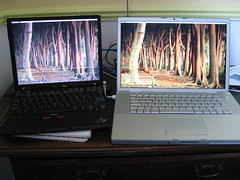
Thinkpad X40 vs MBP I’ve spent a bit of the bank holiday weekend by probably violating the warranty of a new 15” Macbook Pro (MBP) from work. I also was at the Debian bbq 2007 in Cambridge and met some friendly faces. :) More MBP & X40 porn So now I can boot into MacOSX and run Ubuntu or boot straight into Ubuntu from rEFIt. There are a couple of problems. There are some things I quite like about the MBP compared to the X40: Currently I remain not totally convinced about the Apple MBP. I’ll keep my Debian X40 my personal machine and the MBP for work. Now I can compile Webkit on Apple OSX (Debian can too) and see what’s happening in Ubuntu.

19 August 2007

Bernhard R. Link: Using slapd as thunderbird/icedove addressbook

It&aposs been some time since I got this working, but I decided to now also blog about it here now, as I was just asked it.

The main magic to get thunderbird/icedove use your ldap server as addressbook, is to include the proper schema. Search the web for mozillaAbPersonObsolete and you should find it. You do not have to use any of it&aposs new fields, not even the object class in it is needed. Your slap only have to know about the field names, then thunderbird will be able to show the normal inetorgperson&aposs mail attribute.

Some caveats, though:

You might think you might test your settings in thunderbirds by using that button to download everything and store it locally. In my experience that never works but strangly asks for a password, while the addressbook is already nicely working and needs no password at all.

Also don&apost be confused by no records shown in the new addressbook. I guess that is some measure against always loading a possibly large remote addressbook. To test just enter anything in the search field, and the matching records should show up nicely. (I&aposm not sure if all versions allow searching for substrings. If they do, try searching for the at sign, to get a full list.)

The shown fields seem also a bit strange, and differ with the different mozilla messenger/thunderbird/icedove versions. In some versions the field the primary name is extracted from can be changed, but directive to set that seems to change even more often.

Finaly, some snippet for your /etc/icedove/global-config.js, which causes all newly created users to have an addressbook as default. I forgot if all are needed or why I added them, but those that are unnecessary at least do not seem to harm. (Last tested version is the one in etch, though. Newer version might again have something changed).

   /* ldap-Server for FOOBAR */
   pref("ldap_2.autoComplete.useDirectory", true);
   pref("ldap_2.prefs_migrated", true);
   pref("ldap_2.servers.mathematik.attrmap.DisplayName", "displayName");
   pref("ldap_2.servers.default.attrmap.DisplayName", "displayName");
   pref("ldap_2.servers.mathematik.auth.savePassword", true);
   pref("ldap_2.servers.mathematik.description", "FOOBAR");
   pref("ldap_2.servers.mathematik.filename", "foobar.mab");
   pref("ldap_2.servers.mathematik.maxHits", 500);
   pref("ldap_2.servers.mathematik.uri", "ldap://HOSTNAME:389/ou=People,dc=FOOBAR,dc=TLD??sub?(mail=*)");
   

10 August 2007

Romain Francoise: Shared links for 2007-08-10

9 August 2007

Thijs Kinkhorst: Debian Birthday next week in Breda

Next week, Debian will turn 14. The celebration of this here in Holland means nothing specifically other than a good occasion to get together and have a drink. It will traditionally take place in Breda, organised by our good friend Geertje Stappers, on Thursday the 16th. See the wiki page for this and other celebrations.

Next.

Previous.