Yesterday, the right-wing
PAN candidate for the presidency of Mexico, Felipe Calder n, made a declaration that shadows the current president,
Vicente Fox (from his same political party) almost look like a genuine statesman. (some links,
La Jornada,
El Universal) - And that's no easy feat, given that Mr. Fox is -so far- the nation's
most prolific president... When it comes to stupid sayings.
How come Calder n rose so quickly to become a statesman? Let me first go through a bit of history. Not much, promise. Well, I'll do my best.
Twelve years and one month ago, Mexicans woke up with the frightening news we had a violent guerrilla group in Chiapas, one of Mexico's richest states, but one with the highest percentages of poor people - and, not coincidentally, of indigenous population as well. This uprising was very soon known all over the world - And its leaders quickly learned how to ensure they would not be prosecuted and exterminated: Simultaneously with the fighting, they made as large a media coverage as they could, strongly supported in the Internet democratization of the information that had just begun. Thousands of people all over the world understood their ideas -at least what they said at that time- and spread the word. I had my first trip in Europe with my (now) wife in 1996, and we saw many grafittis stating Viva Chiapas, Viva EZLN... It was amazing.
EZLN was (is) specially hard for the government to kill. As they don't do military sabotages, terrorism or so on, it is very hard to justify military action. After 12 days of fighting, a truce was decreed. The truce was broken once, in the early years of the Zedillo government, but officially there is a cease-fire, observed by both sides. The Zapatistas have took the ideas and further promoted them, with action. My Chiapas-born friend
Alex Ju rez often tells me about the tremendous cultural difference between the Zapatista territories and the paramilitary ones - In the Zapatista areas, you see indians reading books, working their land, organizing themselves in the Fair Government councils, and strongly opposing alcohol and drugs. Just the opposite from the other areas.
EZLN shifted their strategy some months ago, going beyond stating their wishes for a fair regime and waiting for the government to look at them. I still don't really understand where they are heading, but the
Sixth Declaration of the Lacandon Rainforest turns them into a political movement, clearly separated from the existing regime. They do not seek to be elected, they oppose every party and candidate. They define themselves as an anticapitalist movement, located down and to the left - Lets see where this goes to.
Well, back on track... One of the president's most famous stupid quotes is that, during his campaign, he promised to solve the Chiapas conflict in fifteen minutes. Well, it's been either fifteen very long minutes, or he just hasn't had any time to devote to those dirty indians. Mexicans are very frustrated by the lack of importance this man gave to one of our country's longest and most desperate needs.
Of course, Felipe Calder n must do something in this regard. Fox's shadow is a big one, and this little man must try to escape from Fox's biggest mistakes. So he just came with a formula that I don't know why no statesman thought of before: Instead of negotiating, instead of working to solve a very difficult problem, he declared he will unilaterally declare peace with EZLN.
I wonder if this year's Nobel prize will go to such an abnegated, smart and selfless person. Man, we could take this same solution to Darfur, to Israel/Palestine, to Congo, to Chechnya... If rulers all over the world start declaring peace unilaterally, all of the world's problems will be solved! What comes next, he will declare (maybe as Salinas did) that we are a first world country? Poor people are only sad reflections in the sand but don't exist in his reality?
Please, Mexicans: The man is clearly schizoid. Are you happy with Foxilandia? It seems that alternate realities are part of the PAN's action program. If you are not satisfied with Fox's results (who is?), don't vote for this guy. We will all regret it.


 After dinner (11:30PM!) we hustled up to
 Right that is my post for the day.
Other news:

 So, thanks to my parents’ immense help, I now have a hugely nice studio apartment:

 With daring and finesse, they commandeered an IP phone.
 After 45 minutes of trying to add value, they failed to bring it to the
table, since one major oversight was that they lacked any capacity to
generate speech. H las ! cried the one that wasn't translucent at all,
and he did so silently.
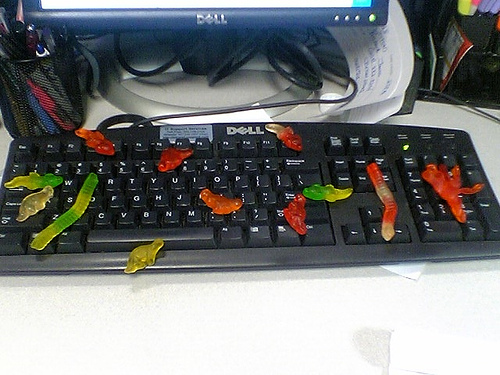 Cleverly devising a backup strategem, they rushed to a computer to send some
emails. Unfortunately, Outlook crashed on them six times, and then they
were, like, totally diverted by a fascinating exchange between two guys named
BJ and William. By the time they managed. To send their first email. Which
they typed like this. Because the little guy on the period key. Had a tick.
It was too late.
 Oh, you poor, foolish things! If only you had used free software, she wouldn't
be giving you oral herpes right now.