Search Results: "eric"

20 May 2010

Dirk Eddelbuettel: RcppArmadillo 0.2.0 (and 0.2.1)

With the Rcpp 0.8.0 release on Monday, Romain, Doug and I were able to follow-up with a new RcppArmadillo release. RcppArmadillo uses Rcpp (and a few dozen lines of 'glue') to provide a transparent interface from R to Conrad Sanderson's impressive Armadillo library for linear algebra. This new release offers a number of key improvements: While we had tested this quite rigourously, the combination of some last minute changes that were meant to be stylistic-only, some troubles with the tests and builds at CRAN that were not apparent in all our tests (hint: do not yet use dynamic help features referencing other packages even if you have a Depends: on them) and an upcoming travel deadline meant that we missed a gotcha on Windows---so release 0.2.1 had to follow a few hours after the short-lived 0.2.0. More information is on the RcppArmadillo page. Questions, comments etc should go to the rcpp-devel mailing list off the R-Forge page.

19 May 2010

Petter Reinholdtsen: Pieces of the roaming laptop puzzle in Debian

Today, the last piece of the puzzle for roaming laptops in Debian Edu finally entered the Debian archive. Today, the new libpam-mklocaluser package was accepted. Two days ago, two other pieces was accepted into unstable. The pam-python package needed by libpam-mklocaluser, and the sssd package passed NEW on Monday. In addition, the libpam-ccreds package we need is in experimental (version 10-4) since Saturday, and hopefully will be moved to unstable soon. This collection of packages allow for two different setups for roaming laptops. The traditional setup would be using libpam-ccreds, nscd and libpam-mklocaluser with LDAP or Kerberos authentication, which should work out of the box if the configuration changes proposed for nscd in BTS report #485282 is implemented. The alternative setup is to use sssd with libpam-mklocaluser to connect to LDAP or Kerberos and let sssd take care of the caching of passwords and group information. I have so far been unable to get sssd to work with the LDAP server at the University, but suspect the issue is some SSL/GnuTLS related problem with the server certificate. I plan to update the Debian package to version 1.2, which is scheduled for next week, and hope to find time to make sure the next release will include both the Debian/Ubuntu specific patches. Upstream is friendly and responsive, and I am sure we will find a good solution. The idea is to set up the roaming laptops to authenticate using LDAP or Kerberos and create a local user with home directory in /home/ when a usre in LDAP logs in via KDM or GDM for the first time, and cache the password for offline checking, as well as caching group memberhips and other relevant LDAP information. The libpam-mklocaluser package was created to make sure the local home directory is in /home/, instead of /site/server/directory/ which would be the home directory if pam_mkhomedir was used. To avoid confusion with support requests and configuration, we do not want local laptops to have users in a path that is used for the same users home directory on the home directory servers. One annoying problem with gdm is that it do not show the PAM message passed to the user from libpam-mklocaluser when the local user is created. Instead gdm simply reject the login with some generic message. The message is shown in kdm, ssh and login, so I guess it is a bug in gdm. Have not investigated if there is some other message type that can be used instead to get gdm to also show the message. If you want to help out with implementing this for Debian Edu, please contact us on debian-edu@lists.debian.org.

John Goerzen: Time to learn a new language

I have something of an informal goal of learning a new programming language every few years. It s not so much a goal as it is something of a discomfort. There are so many programming languages out there, with so many niches and approaches to problems, that I get uncomfortable with my lack of knowledge of some of them after awhile. This tends to happen every few years. The last major language I learned was Haskell, which I started working with in 2004. I still enjoy Haskell and don t see anything displacing it as my primary day-to-day workhorse. Yet there are some languages that I d like to learn. I have an interest in cross-platform languages; one of my few annoyances with Haskell is that it can t (at least with production quality) be compiled into something like Java bytecode or something else that isn t architecture-dependent. I have long had a soft spot for functional languages. I haven t had such a soft spot for static type checking, but Haskell s type inference changed that for me. Also I have an interest in writing Android apps, which means some sort of Java tie-in would be needed. Here are my current candidates: Of some particular interest to me is that Haskell has interpreters for Scheme, Lua, and JavaScript as well as code generators for some of these languages (though not generic Haskell-to-foo compilers). Languages not in the running because I already know them include: OCaml, POSIX shell, Python, Perl, Java, C, C++, Pascal, BASIC, Common Lisp, Prolog, SQL. Languages I have no interest in learning right now include Ruby (not different enough from what I already know plus bad experiences with it), any assembly, anything steeped in the Microsoft monoculture (C#, VB, etc.), or anything that is hard to work with outside of an Emacs or vim environment. (If your language requires or strongly encourages me to use your IDE or proprietary compiler, I m not interested that means you, flash.) Brief Reivews of Languages I Have Used To give you a bit of an idea of where I m coming from:

18 May 2010

Erich Schubert: Apple announces new iPad

In a surprise move Apple today announced a new product closely related to the behyped iPad. This move went completely unexpected with technology analysts, who were expecting a new iPhone dubbed "iPhone 4G" to be released next.The new product is called iPad mini, and features most of the iPad functionality in a lot smaller form factor, with extended battery life and without the overheating issues. It will focus on gamers, instead of the deprecated community of newspaper readers. The smaller form factor allows the users to bring the device along at any time.Get all the specifications of the new iPad mini here [www.apple.com]. There is also a special edition with voice-over-3G functionality [www.apple.com].Yes, I'm referring to the iPod touch and the iPhone. Just goofing around.

17 May 2010

Dirk Eddelbuettel: Rcpp 0.8.0

Romain and I are happy to announce the release of Rcpp version 0.8.0. It has been uploaded to CRAN. A Debian upload is delayed until the now-required inline package is accepted into Debian. The source package is also available from here. This release brings a number of changes that are detailed below. Of particular interest may be the much more robust treatment of exceptions, the new classes for data frames and formulae, and the availability of the new helper function cppfunction for use with inline. Also of note is the new support for the 'LinkingTo' directive with which packages using Rcpp will get automatic access to the header files. An announcement email went to the r-packages list (ETH Zuerich, Gmane); Romain also blogged about the release. The full NEWS entry for this release follows below:
0.8.0   2010-05-17
    o   All Rcpp headers have been moved to the inst/include directory,
	allowing use of 'LinkingTo: Rcpp'. But the Makevars and Makevars.win
	are still needed to link against the user library.
    o   Automatic exception forwarding has been withdrawn because of
	portability issues (as it did not work on the Windows platform).
	Exception forwarding is still possible but is now based on explicit
	code of the form:
	
	  try  
	    // user code
	    catch( std::exception& __ex__)  
	    forward_exception_to_r( __ex___ ) ;
	   
	
	Alternatively, the macro BEGIN_RCPP and END_RCPP can use used to enclose
	code so that it captures exceptions and forward them to R. 
	
	  BEGIN_RCPP
	  // user code
	  END_RCPP
	
    o   new __experimental__ macros 
	
	The macros RCPP_FUNCTION_0, ..., RCPP_FUNCTION_65 to help creating C++
	functions hiding some code repetition: 
	
	  RCPP_FUNCTION_2( int, foobar, int x, int y) 
	    return x + y ;
	   
	The first argument is the output type, the second argument is the 
	name of the function, and the other arguments are arguments of the C++ 
	function. Behind the scenes, the RCPP_FUNCTION_2 macro creates 
	an intermediate function compatible with the .Call interface and handles 
	exceptions
	
	Similarly, the macros RCPP_FUNCTION_VOID_0, ..., RCPP_FUNCTION_VOID_65 
	can be used when the C++ function to create returns void. The generated
	R function will return R_NilValue in this case.
	
	  RCPP_FUNCTION_VOID_2( foobar, std::string foo ) 
	    // do something with foo
	   
	  
	The macro RCPP_XP_FIELD_GET generates a .Call compatible function that
	can be used to access the value of a field of a class handled by an 
	external pointer. For example with a class like this: 
	
	  class Foo 
		public:
			int bar ;
	   
	
	  RCPP_XP_FIELD_GET( Foo_bar_get, Foo, bar ) ;
	  
	RCPP_XP_FIELD_GET will generate the .Call compatible function called
	Foo_bar_get that can be used to retrieved the value of bar.
	
	
	The macro RCPP_FIELD_SET generates a .Call compatible function that 
	can be used to set the value of a field. For example:
	
	  RCPP_XP_FIELD_SET( Foo_bar_set, Foo, bar ) ;
	
	generates the .Call compatible function called "Foo_bar_set" that 
	can be used to set the value of bar
	
	
	The macro RCPP_XP_FIELD generates both getter and setter. For example
	
	  RCPP_XP_FIELD( Foo_bar, Foo, bar )
	  
	generates the .Call compatible Foo_bar_get and Foo_bar_set using the 
	macros RCPP_XP_FIELD_GET and RCPP_XP_FIELD_SET previously described
	
	  
	The macros RCPP_XP_METHOD_0, ..., RCPP_XP_METHOD_65 faciliate 
	calling a method of an object that is stored in an external pointer. For 
	example: 
	
	  RCPP_XP_METHOD_0( foobar, std::vector<int> , size )
	
	creates the .Call compatible function called foobar that calls the
	size method of the std::vector<int> class. This uses the Rcpp::XPtr<
	std::vector<int> > class.
	
	The macros RCPP_XP_METHOD_CAST_0, ... is similar but the result of
	the method called is first passed to another function before being
	wrapped to a SEXP.  For example, if one wanted the result as a double
	
	   RCPP_XP_METHOD_CAST_0( foobar, std::vector<int> , size, double )
	
	The macros RCPP_XP_METHOD_VOID_0, ... are used when calling the
	method is only used for its side effect.
	
	  RCPP_XP_METHOD_VOID_1( foobar, std::vector<int>, push_back ) 
	
	Assuming xp is an external pointer to a std::vector<int>, this could
	be called like this :
	
	  .Call( "foobar", xp, 2L )
	
    o	Rcpp now depends on inline (>= 0.3.4)
	
    o   A new R function "cppfunction" was added which invokes cfunction from
	inline with focus on Rcpp usage (enforcing .Call, adding the Rcpp
	namespace, set up exception forwarding). cppfunction uses BEGIN_RCPP
	and END_RCPP macros to enclose the user code
    o	new class Rcpp::Formula to help building formulae in C++
    
    o   new class Rcpp::DataFrame to help building data frames in C++
	
    o   Rcpp.package.skeleton gains an argument "example_code" and can now be
	used with an empty list, so that only the skeleton is generated. It
	has also been reworked to show how to use LinkingTo: Rcpp
	
    o   wrap now supports containers of the following types: long, long double,
	unsigned long, short and unsigned short which are silently converted
	to the most acceptable R type.
	
    o	Revert to not double-quote protecting the path on Windows as this
	breaks backticks expansion used n Makevars.win etc
        
    o   Exceptions classes have been moved out of Rcpp classes,
	e.g. Rcpp::RObject::not_a_matrix is now Rcpp::not_a_matrix
As always, even fuller details are in Rcpp Changelog page and the Rcpp page which also leads to the downloads, the browseable doxygen docs and zip files of doxygen output for the standard formats. A local directory has source and documentation too. Questions, comments etc should go to the rcpp-devel mailing list off the R-Forge page

Mark Brown: ASoC updates in 2.6.34

Linux 2.6.34 was released today. This contains a fairly substantial batch of ASoC updates, including:

Matt Zimmerman: Ubuntu 10.10 (Maverick) Developer Summit

I spent last week at the Ubuntu Developer Summit in Belgium, where we kicked off the 10.10 development cycle. Due to our time-boxed release cycle, not everything discussed here will necessarily appear in Ubuntu 10.10, but this should provide a reasonable overview of the direction we re taking. Presentations While most of our time at UDS is spent in small group meetings to discuss specific topics, there are also a handful of presentations to convey key information and stimulate creative thinking. A few of the more memorable ones for me were: The talks were all recorded, though they may not all be online yet. Foundations The Foundations team provides essential infrastructure, tools, packages and processes which are central to the development of all Ubuntu products. They make it possible for the desktop and server teams to focus on their areas of expertise, building on a common base system and development procedures. Highlights from their track: Desktop The desktop team manages both Desktop Edition and Netbook Edition, on a mission to provide a top-notch experience to users across a range of client computing devices. Highlights from their track: Server/Cloud The server team is charging ahead with making Ubuntu the premier server OS for cloud computing environments. Highlights from their track: ARM Kiko Reis gave a talk introducing ARM and the corresponding opportunity for Ubuntu. The ARM team ran a full track during the week on all aspects of their work, from the technical details of the kernel and toolchain, to the assembly of a complete port of Netbook Edition 10.10 for several ARM platforms. Kernel The kernel team provided essential input and support for the above efforts, and also held their own track where they selected 2.6.35 as their target version, agreed on a variety of changes to the Ubuntu kernel configuration, and created a plan for providing backports of newer kernels to LTS releases to support deployment on newer hardware. Security Like the kernel team, the security team provided valuable input into the technical plans being developed by other teams, and also organized a security track to tackle some key security topics such as clarifying the duration of maintenance for various collections of packages, and the ongoing development of AppArmor and Ubuntu s AppArmor profiles. QA The QA team focuses on testing, test automation and bug management throughout the project. While quality is everyone s responsibility, the QA team helps to coordinate these activities across different teams, establish common standards, and maintain shared infrastructure and tools. Highlights from their track include: Design The design team organized a track at UDS for the first time this cycle, and team manager Ivanka Majic gave a presentation to help explain its purpose and scope. Toward the end of the week, I joined in a round table discussion about some of the challenges faced by the team in engaging with the Ubuntu community and building support for their work. This is a landmark effort in mating professional design with free software community, and there is still much to learn about how to do this well. Community The community track discussed the usual line-up of events, outreach and advocacy programs, organizational tools, and governance housekeeping for the 10.10 cycle, as well as goals for improving the translation of Ubuntu and related resources into many languages. One notable project is an initiative to aggressively review patches submitted to the bug tracker, to show our appreciation for these contributions by processing them more quickly and completely.

15 May 2010

Erich Schubert: Beware of the "startpar" bug!

UPDATE: the bug is already fixed after a few hours, and only affected a minority of users (of a now deprecated, experimental option in the 'unstable' distribution, and only users that rebooted with the affected version).The sysvinit version that hit unstable today has a grave bug if you have been running "startpar" or maybe "shell" style parallel booting. Read this bug report, if you have been using these (they were not enabled by default, so unless you've been giving parallel boot a try before, you should be ok.)How to check if you are affected:
grep CONCURRENCY /etc/default/rcS
If this command says "startpar", then you ARE affected. If it says "shell" you MIGHT be affected. If you have not set CONCURRENCY or if it's "none" or "makefile", then you should be ok (according to the bug).The workaround is as simple: just put either "none" or "makefile" in there, these are the only two values that are still distinct.How to recover a broken system:
  1. Boot recovery mode aka "single-user". At some point you should be asked for the root password. Login.
  2. Run mount -o remount,rw / to enable write mode on your disk.
  3. $EDITOR /etc/default/rcS and change the value of "CUNCURRENCY"
  4. reboot
You should have a working system again.I can only confirm that changing "startpar" to "none" helped me. I havn't tried "makefile" yet, and "none" seemed more likely to fix things.

Erich Schubert: How to block "Facebook Like" tracking in Chrome

Since AdBlock in Chrome does not block, just hide (the same probably applies to Safari and other WebKit-based-browsers), here's a simple method to actually block Facebook Like tracking:Use a proxy.pac file, also known as Proxy auto-config. Then redirect Facebook Like to a blackhole or filtering proxy. I use privoxy, and this replaces Facebook Like embeds with an error message, which enables me to see which site uses Facebook like and that my filter is working.Here's the relevant excerpt of my proxy.pac file:
function FindProxyForURL(url, host)  
  var fblike = /https?:\/\/([^/]*)\.facebook\.com\/(plugins widgets)\/like.*/;
  if (fblike.test(url))  
    return "PROXY 127.0.0.1:8118";
   
  return "DIRECT";
 
Where "127.0.0.1:8118" is the proxy to use. If you use an unreachable proxy - I've seen 255.255.255.0:3421 used as blackhole server - then it should just time out as "unreachable". Or you use a proxy such as privoxy and block the URL there. Any proxy that refuses to serve the request will do.Note that you can add arbitrary domains and regexps to this filter, if you want to block additional sites, such as Google Analytics, that you do not want to be able to track your surfing behaviour.

11 May 2010

Gunnar Wolf: e-voting seminar, Mexico City, tomorrow

If anybody is interested or can attend: Tomorrow and the day after (Wednesday and Thursday 12-13/05/2010) FLACSO (a leading Social Sciences faculty spanning countries all over Latin America) and IFE (Mexico's federal electoral authority) are presenting a seminar on e-voting: Electronic vote experiences in Mexico and around the world. Sadly, I will be unable to attend, as I will be on the road once again (Ecuador!). However, I hope those among my readers who are interested in the topic can attend or at least follow the audio and video transmission from the IFE website. The seminar will be held at IFE's auditorium Viaducto Tlalpan No. 100, Col. Arenal Tepepan, Delegaci n Tlalpan, c.p. 14610, M xico, DF. [update] If you don't know what is my stand on this topic (and can read Spanish), please read this short article. In short: I am against e-voting, and hope we are still in time (and can push at the right places) to avoid it becoming the rule in our country.

Torsten Werner: Ubuntu Developer Summit

That is my second day at the UDS in Brussels. I have attended some sessions about server and cloud yesterday. The Ubuntu people are better organized than the Debian people during Debconf. They are collaboratively preparing the sessions in Launchpad and make notes with the Gobby editor during the session. Gobby allows group editing via Internet. The release date helps to keep the focus on stuff that can be done within the time frame and helps to concentrate on getting results.

It will probably be only 5 months for Maverick because Mark asked for a release on 10.10.10 which is an interesting date after removing the dots and converting it to a decimal number. I am comparing it to Debian: Toy Story 3 will be shown in cinemas soon and the Squeeze character is promoting the film. Will we use such a coincidence for more public attention and will will we release our Squeeze soon? I am afraid that it won't happen.

Our last session yesterday was about Tomcat packaging improvements. Debian and Ubuntu are using and maintaining identical packages of tomcat6 using the alioth infrastructure of the pkg-java team. Some of our plans are:

10 May 2010

Romain Beauxis: Ubuntu, the firm and its employees

This post is not meant to be offensive in any way. I would just like to write down things that came to my mind recently. It all started when I was considering applying for the right to upload the package I maintain into Ubuntu. Looking at the procedure, I realized that this needs to be present during an IRC meeting at a given date online. This stopped me immediately. I am working most of my day-time and, given the time zone I am living now, this was not an option. But, since I had registered to the corresponding mailing list, I started receiving mails of other applicants that where trying to arrange things with their work and private life to be able to participate. Now, today, I stumbled upon these notes of Mark's presentation in Bruxelles, relayed by a friend that is not either working for Ubuntu. Reading it gave me a strong taste of management-oriented presentation, with all this sort of "yeah we want our product in every box next year" propaganda. Not like Steve Ballmer, fortunately, but not far perhaps. So, yeah, there is something that makes me uncomfortable with Ubuntu. I am really happy by its success and I will continue to recommend it to friends around me. However, I wonder if, in a way, Ubuntu is not a model of commercial company where a minimal core of developers are actually payed, while a second layer of developers are fan-boys that are willing to participate as if there were employees but without being actually payed, and a third layer being the open-source developers whose work is actually what makes 90% of the core of the OS. A very good illustration is at the end of the note from Mark's presentation. It reads:
Somebody asks about advertising Ubuntu, looks like there are no plans for the moment to actually advertise Ubuntu across traditional media. Mark uses the Ubuntu Manual as an example of how Ubuntu gets advertised and will reach the mainstream, Mark points out myself and the room applauds the Ubuntu Manual Project! Woohoo!
Now, guess what:
About Us We are a group of individuals trying to promote the use of Ubuntu and its variants. This is a private web site that is not connected in any official or financial way with Ubuntu, Canonical PL or Ubuntu.com. Official Ubuntu guides and downloads are freely available at www.ubuntu.com. Ubuntu is a registered trademark of Canonical PL
Source: http://ubuntumanual.org/about-us

5 May 2010

Gunnar Wolf: Post-apocalyptic times

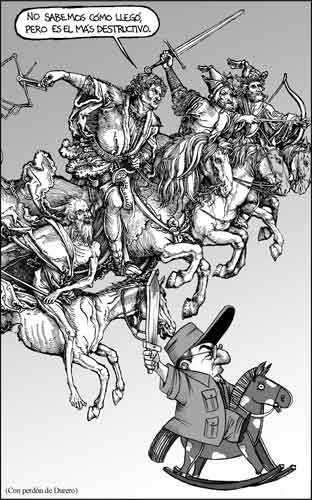
Pestilence, War, Famine, and Death, the mythological Four Horsemen of the Apocalypse. Mexico's de facto president, Felipe Calder n, once again showed his involuntary aptitude for deep political analysis: On Monday, on a State visit to Germany, he declared Mexico has faced the Five Horsemen of the Apocalypse (second source, in English). I agree: One year ago, we were facing a health emergency, the AH1N1 epidemic, hence pestilence. Since he took power in December 2006, the president's main action has been the war on drugs, hence war. The country was the worst performing Latin American country in 2009, with our economy falling 6.5%, more than any other country, and prices have been really on the rise, hence famine. Finally, death... official numbers state that there have been over 22000 deaths in the "war on drugs" And merrily he stated that only 10% of that were civilians. Whatever that meant... But... What about the fifth? Who is he? A plausible hypothesis is offered by cartoonist El Fisg n in today's cartoon in La Jornada:
We don't know how he got here, but he is the most effective one Now... However good El Fisg n's analysis might be... Lets not get distracted with silly details. Hern ndez, another of La Jornada's great cartoonists, shows the hidden meaning:
We are over the apocalypse!
Does that mean we are facing the Final Judgement?
The coming of the five horsemen of apocalypse can only mean... It is time for the Final Judgement and the end of time!
AttachmentSize
hernandez_20100505.jpg16.6 KB
fisgon_20100505.jpg28.11 KB

4 May 2010

Erich Schubert: Facebook tracking users via "like" function.

Facebook recently launched the "Like" function, which basically can be embedded into arbitrary web sites. Naively, it does two things:
  1. Provide a "Like" button for sharing the web site
  2. Show you how many other users like the web site
Sounds good, doesn't it?But now reconsider: even when you don't use the "Like" function, facebook is in fact notified of which web sites you visit!.Encouraging you to "share" content with friends is the hanger for this function. This is what makes web masters install it on their sites: they expect to get some extra traffic from your friends, so they just add it.But whether you like it or not, it basically allows Facebook to track your complete web viewing habits. And it's the target web site that opts in, not the user! Combined with all the personal information Facebook already has on you, this is a major privacy concern. Combining this information might even be illegal in some countries (but probably not in the US where Facebook lives, privacy unfortunately has a low role here).The best workaround currently is to blacklist Facebooks "Like" function using some kind of AdBlock, for example using this element filter:
IFRAME[src^="http://www.facebook.com/plugins/like.php"]
But in general, we should try to make this kind of data aggregation illegal without explicit consent and force Facebook to make this an opt-in feature. Political work needed here ...P.S.: Make sure to check if your AdBlock actually blocks and not just hides. As far as I can tell, WebKit Adblock, including Chromes, only hide ads. Firefoxs AdblockPlus seems to be more powerful.P.P.S.: yes I've read the claim that Facebook doesn't track. No wait, all they basically said was that they are not going to announce at F8 they will be selling web surfing behaviour based ads to their customers. They actually did NOT state (or guarantee) they will NOT use data mining on this data. Just that you probably will not be able to buy eyeballs based on rules such as "has visited/liked disney.com" ...P.P.P.S.: I've been told that facebook.com/widgets/like.php also needs to be blocked, since some sites use this URI scheme. And of course, Privoxy and similar privacy-increasing proxies are a useful addition, too.

3 May 2010

Lucas Nussbaum: Castles in the air

When people ask me why I m so fond of computers , I already answer that it s like being able to build very large buildings or bridges, super-fast cars, etc without having to care about buying the raw material needed, or about the consequences: computers are like a giant Lego box which is only limited by the programmer s abilities. What I discovered today is that there s a quote from Frederick P. Brooks that says about the same thing:

The programmer, like the poet, works only slightly removed from pure thought-stuff. He builds his castles in the air, from air, creating by exertion of the imagination. Few media of creation are so flexible, so easy to polish and rework, so readily capable of realizing grand conceptual structures.

30 April 2010

Erich Schubert: Oil spill: fortunately it was "just oil" - and not nuclear.

Face it: technology fails. Sometimes. Sooner or later.Statistics are a nice way to fool people, because they can't interpret the numbers properly. And usually this is done to make things sound less risky than they really are. But it's just too easy to lie with numbers. Say, they risk of a major incident at a plant is less than 1% (per year). Sounds good, doesn't it? But if you have 100 plants, that means it will happen about once a year. Make that 1000. Or even more.There are currently around 440 nuclear reactors in use for electricity. Probably some more the IAEA doesn't know about. There are definitely extra reactors in various military vehicles including unmaintained russian submarines. So make that 500. So looking forward to the next 200 years, we want to make sure things are not likely to happen at a rate of 0.001%. Unless our atomic plants are way more than 99.999% secure, we're likely to see a major nuclear accident sooner or later.Which brings us to a totally differnt scale when we look at photovoltaics or wind power. There are just so many more of these plants, that you can bet on some of them failing completely every day. The good news about these plants is that their damage potential is just so much lower. They might be as much as thousandfold more likely to fail than a nuclear plant. And there are probably a thousand more, too. But even if we completely underestimate the risk they just don't do as much damage even in the worst case. Much unlike a nuclear meltdown or such an oil spill. I bet noone would have thought of oil drilling being this risky. After all, it has been done for years.So how is your risk assessment of nuclear power? Is it less risky than oil drilling?

28 April 2010

Andrew Pollock: [life/americania] TransLink to become Clipper

No sooner do I discover it, and TransLink up and renames itself to Clipper. I wonder how much that exercise is going to cost? I'm also curious as to what they're going to do in terms of a new domain name. Ah, marketing:
Why is the name being changed? Now that the system is fully operational on five transit agencies - Muni, BART, AC Transit, Caltrain and Golden Gate Transit and Ferry - it is available to the majority of Bay Area transit riders. Giving the system a new name and logo helps make it more appealing to potential customers and also takes away any confusion with other local programs such as FasTrak, Fast Pass, as well as several other transportation programs around the world that are also named TransLink.
With Bay Area public transportation being woefully inadequate, I have to wonder if much of any adoption problems (which is what I presume they're trying to solve with this rebranding) are more a function of overall patronage?

27 April 2010

Ingo Juergensmann: Johan Schl ter: "Child pornography is great"

For many activists in net-politics it is apparent that the fight against child pornography is just an excuse for establishing a EU-wide content filtering infrastructure. This infrastructure for content filtering can be used to filter other content than child pornography as well. For example politicians in Germany already requested blocking gambling sites, Nazi sites, left extremistic political sites and others, when we had that kind of discussion last year over here. The proposal of a law putting up stop pages in front of child pronography sites by former minister for family Ursula "Zensursula" von der Leyen passed the parliament, but shortly after last years parliament elecetion all political parties didn't want that law anymore.
EU commissioner Cecilia "Censilia" Malmstr m introduced a similar proposal for a EU-wide blocking iinitiative a short while ago, as you might now. Christian Engstr m, member of the EU parliament of the swedish Pirate Party, wrote today on his blog that content right industry welcomes child pornography as a way to introduce content filter and blocking infrastructure:

Child pornography is great, the speaker at the podium declared enthusiastically. It is great because politicians understand child pornography. By playing that card, we can get them to act, and start blocking sites. And once they have done that, we can get them to start blocking file sharing sites .

The venue was a seminar organized by the American Chamber of Commerce in Stockholm on May 27, 2007, under the title Sweden A Safe Haven for Pirates? . The speaker was Johan Schl ter from the Danish Anti-Piracy Group, a lobby organization for the music and film industry associations, like IFPI and others.

[...]

Start with child porn, which everybody agrees is revolting, and find some politicians who want to appear like they are doing something. Never mind that the blocking as such is ridiculously easy to circumvent in less than 10 seconds. The purpose at this stage is only to get the politicians and the general public to accept the principle that censorship in the form of filters is okay. Once that principle has been established, it is easy to extend it to other areas, such as illegal file sharing. And once censorship of the Internet has been accepted in principle, they can start looking at ways to make it more technically difficult to circumvent.


If you already have not, then please act now and contact your local EU representive and kindly ask to refuse this directive of Malmstr m and enlighten them by supplying arguments such those MOGIS (MissbrauchsOpfer Gegen InternetSperren, abuse survivors against internet blocking) put up on their webpage (English and other languages).

The abuse of childs and the documentation of such abuse (child pornography is a bad term anyway) needs to be stopped! But access blocking is the wrong direction. Better take care of a more effective criminal prosecution. Documentation of child abuse needs to get removed from the web and the producers needs to get arrested.

So, please act now!

P.S.: there's a nice video on http://cleanternet.org/

26 April 2010

Biella Coleman: Progress Island!

For like the millionth time, I am back in Puerto Rico, AKA Progress Island, at least according to MST 3000. My mom came down with severe pneumonia and I am waiting it out until she is more stable. Today, my friend forwarded the MST 3000 video as she suspected it would cheer me up and she was right. I have not seen anything so fine in a long time. If you know nothing of PR-America relations, it won t be (that) funny but if you do, it is sharp as a nail. Oh and the 70s music adds a real nice almost porn-like touch. Make sure to watch part two so you can sugar frost your damn corn flakes, you filfthy American pigs!

Next.

Previous.