Search Results: "dom"

14 June 2016

Simon McVittie: GTK versioning and distributions

Allison Lortie has provoked a lot of comment with her blog post on a new proposal for how GTK is versioned. Here's some more context from the discussion at the GTK hackfest that prompted that proposal: there's actually quite a close analogy in how new Debian versions are developed. The problem we're trying to address here is the two sides of a trade-off: Historically, GTK has aimed to keep compatible within a major version, where major versions are rather far apart (GTK 1 in 1998, GTK 2 in 2002, GTK 3 in 2011, GTK 4 somewhere in the future). Meanwhile, fixing bugs, improving performance and introducing new features sometimes results in major changes behind the scenes. In an ideal world, these behind-the-scenes changes would never break applications; however, the world isn't ideal. (The Debian analogy here is that as much as we aspire to having the upgrade from one stable release to the next not break anything at all, I don't think we've ever achieved that in practice - we still ask users to read the release notes, even though ideally that wouldn't be necessary.) In particular, the perceived cost of doing a proper ABI break (a fully parallel-installable GTK 4) means there's a strong temptation to make changes that don't actually remove or change C symbols, but are clearly an ABI break, in the sense that an application that previously worked and was considered correct no longer works. A prominent recent example is the theming changes in GTK 3.20: the ABI in terms of functions available didn't change, but what happens when you call those functions changed in an incompatible way. This makes GTK hard to rely on for applications outside the GNOME release cycle, which is a problem that needs to be fixed (without stopping development from continuing). The goal of the plan we discussed today is to decouple the latest branch of development, which moves fast and sometimes breaks API, from the API-stable branches, which only get bug fixes. This model should look quite familiar to Debian contributors, because it's a lot like the way we release Debian and Ubuntu. In Debian, at any given time we have a development branch (testing/unstable) - currently "stretch", the future Debian 9. We also have some stable branches, of which the most recent are Debian 8 "jessie" and Debian 7 "wheezy". Different users of Debian have different trade-offs that lead them to choose one or the other of these. Users who value stability and want to avoid unexpected changes, even at a cost in terms of features and fixes for non-critical bugs, choose to use a stable release, preferably the most recent; they only need to change what they run on top of Debian for OS API changes (for instance webapps, local scripts, or the way they interact with the GUI) approximately every 2 years, or perhaps less often than that with the Debian-LTS project supporting non-current stable releases. Meanwhile, users who value the latest versions and are willing to work with a "moving target" as a result choose to use testing/unstable. The GTK analogy here is really quite close. In the new versioning model, library users who value stability over new things would prefer to use a stable-branch, ideally the latest; library users who want the latest features, the latest bug-fixes and the latest new bugs would use the branch that's the current focus of development. In practice we expect that the latter would be mostly GNOME projects. There's been some discussion at the hackfest about how often we'd have a new stable-branch: the fastest rate that's been considered is a stable-branch every 2 years, similar to Ubuntu LTS and Debian, but there's no consensus yet on whether they will be that frequent in practice. How many stable versions of GTK would end up shipped in Debian depends on how rapidly projects move from "old-stable" to "new-stable" upstream, how much those projects' Debian maintainers are willing to patch them to move between branches, and how many versions the release team will tolerate. Once we reach a steady state, I'd hope that we might have 1 or 2 stable-branched versions active at a time, packaged as separate parallel-installable source packages (a lot like how we handle Qt). GTK 2 might well stay around as an additional active version just from historical inertia. The stable versions are intended to be fully parallel-installable, just like the situation with GTK 1.2, GTK 2 and GTK 3 or with the major versions of Qt. For the "current development" version, I'd anticipate that we'd probably only ship one source package, and do ABI transitions for one version active at a time, a lot like how we deal with libgnome-desktop and the evolution-data-server family of libraries. Those versions would have parallel-installable runtime libraries but non-parallel-installable development files, again similar to libgnome-desktop. At the risk of stretching the Debian/Ubuntu analogy too far, the intermediate "current development" GTK releases that would accompany a GNOME release are like Ubuntu's non-LTS suites: they're more up to date than the fully stable releases (Ubuntu LTS, which has a release schedule similar to Debian stable), but less stable and not supported for as long. Hopefully this plan can meet both of its goals: minimize breakage for applications, while not holding back the development of new APIs.

13 June 2016

Scarlett Clark: Debian: KDE: Reproducible Builds week 3, Randa Platforms Equals Busy times!

Debian: I am a smidgen late on post due to travel, sorry! choqok:
https://bugs.debian.org/cgi-bin/bugreport.cgi?bug=825322
For this I was able to come up with a patch for kconfig_compiler to encode generated files to utf-8.
Review request is here:
https://git.reviewboard.kde.org/r/128102/
This has been approved and I will be pushing it as soon as I patch the qt5 frameworks version. kxmlgui:
WIP this has been a steep learning curve, according to the notes it was an easy embedded kernel version, that was not the case! After grueling hours of
trying to sort out randomness in debug output I finally narrowed it down to cases where QStringLiteral was used and there were non letter characters eg. ( <") These were causing debug symbols to generate with ( lambda() ) which caused unreproducible symbol/debug files. It is now a case of fixing all of these in the code to use QString::fromUtf8 seems to fix this. I am working on a mega patch for upstream and it should be ready early in the week.
This last week I spent a large portion making my through a mega patch for kxmlgui, when it was suggested to me to write a small qt app
to test QStringLiteral isolated and sure enough two build were byte for byte identical. So this means that QStringLiteral may not be the issue at all. With some
more assistance I am to expand my test app with several QStringLiterals of varying lengths, we have suspicion it is a padding issue, which complicates things. KDE:
On the KDE front, I have arrived safe and sound in Randa and aside from some major jetlag, reproducible builds, I have been quite busy with the KDE CI. I am reworking
my DSL to use friendly yaml files to generate jobs for all platforms ( linux, android, osx, windows, snappy, flatpak ) and can easily be extended later.
Major workpoints so far for Randa: TODO: Have a great day.

Rapha&#235;l Hertzog: Freexian s report about Debian Long Term Support, May 2016

A Debian LTS logoLike each month, here comes a report about the work of paid contributors to Debian LTS. Individual reports In May, 166 work hours have been dispatched among 9 paid contributors. Their reports are available: Evolution of the situation The number of sponsored hours stayed the same over May but will likely increase a little bit the next month as we have two new Bronze sponsors being processed. The security tracker currently lists 36 packages with a known CVE and the dla-needed.txt file lists 36 packages awaiting an update. Despite the higher than usual number of work hours dispatched in May, we still have more open CVE than we used to have at the end of the squeeze LTS period. So more support is always needed Thanks to our sponsors New sponsors are in bold.

No comment Liked this article? Click here. My blog is Flattr-enabled.

12 June 2016

Mario Lang: A Raspberry Pi Zero in a Handy Tech Active Star 40 Braille Display

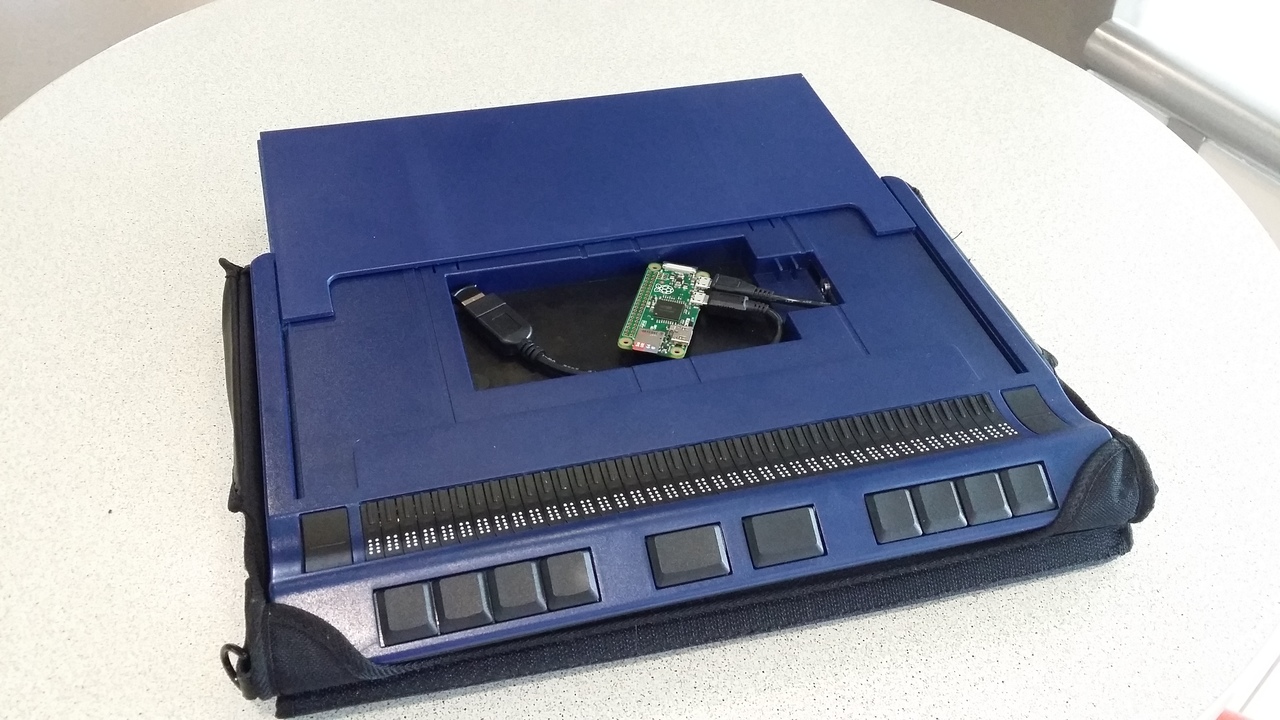
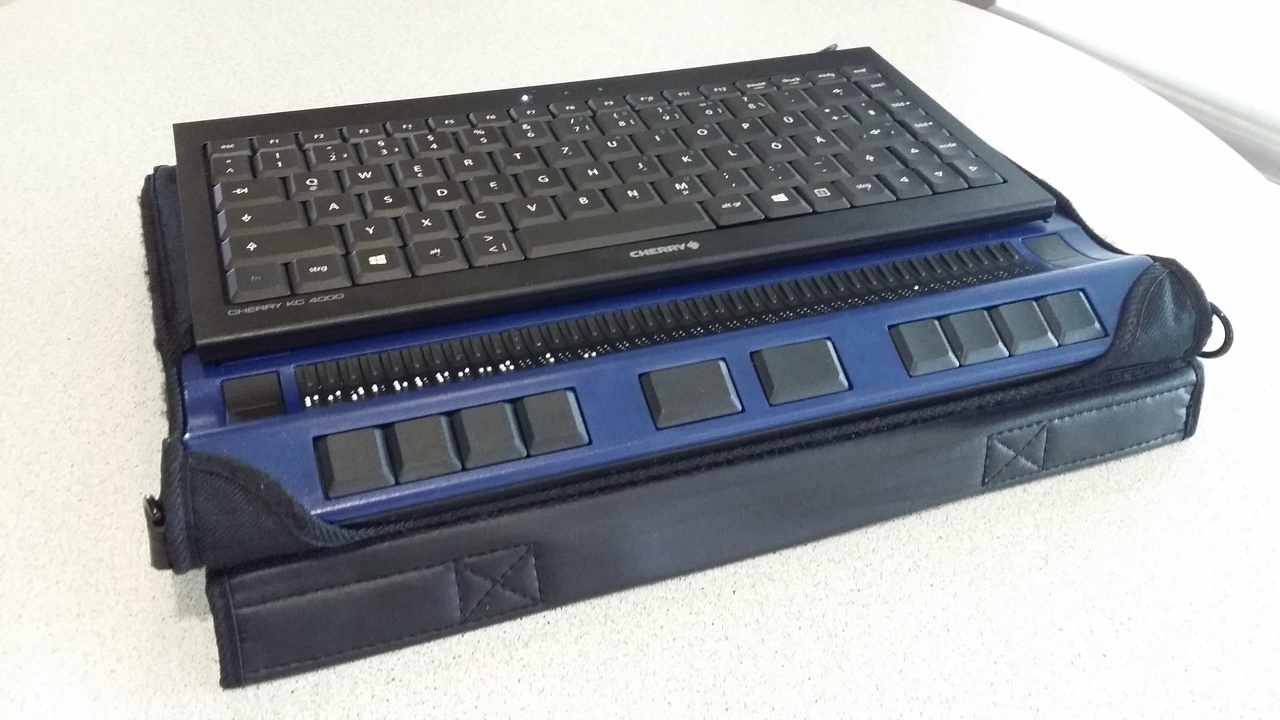
TL;DR: I put a $5 Raspberry Pi Zero, a Bluetooth USB dongle, and the required adapter cable into my new Handy Tech Active Star 40 braille display. An internal USB port provides the power. This has transformed my braille display into an ARM-based, monitorless, Linux laptop that has a keyboard and a braille display. It can be charged/powered via USB so it can also be run from a power bank or a solar charger, thus potentially being able to run for days, rather than just hours, without needing a standard wall-jack. [picture: a Raspberry Pi Zero embedded within an Active Star 40] [picture: a braille display with a keyboard on top and a Raspberry Pi Zero inside]
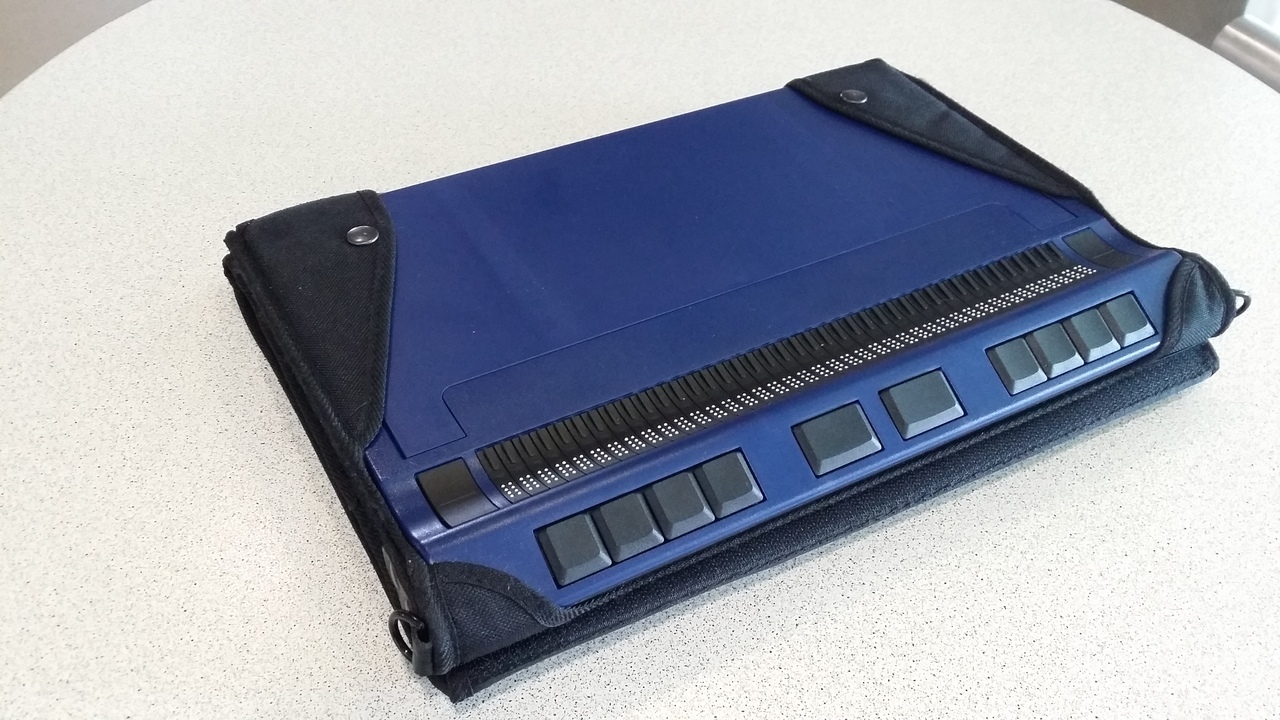
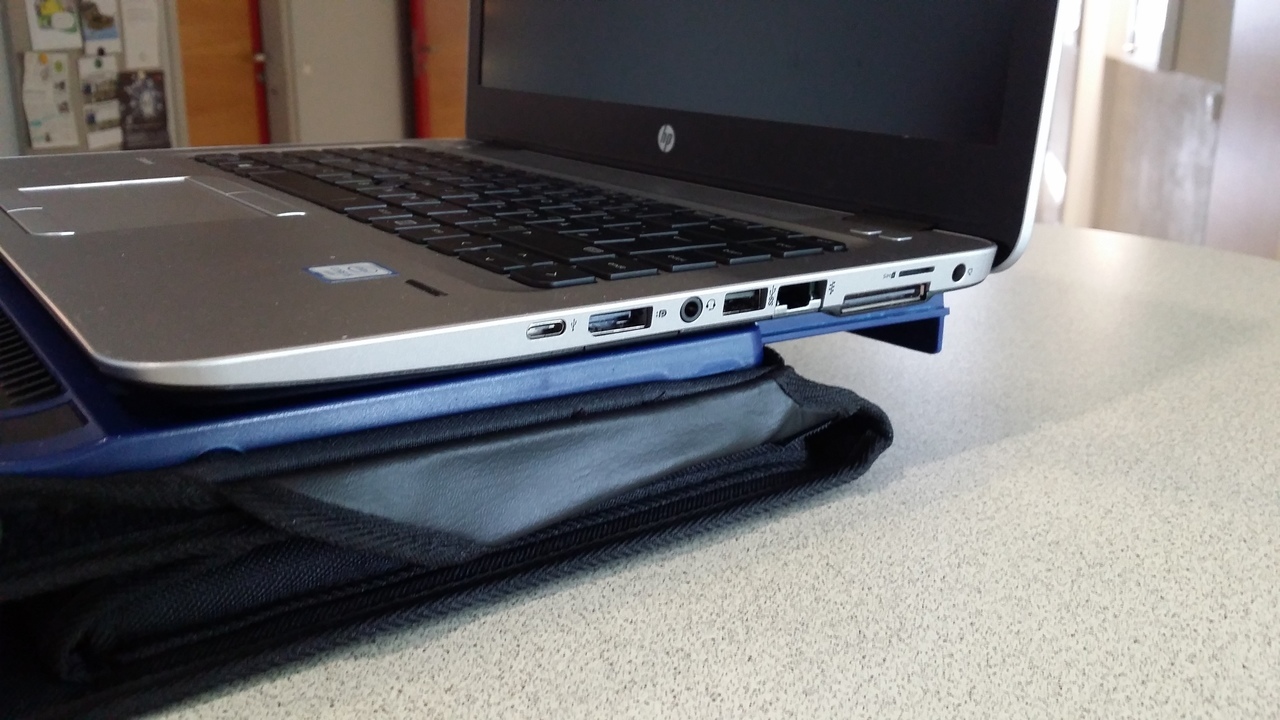
Some Background on Braille Display Form Factors Braille displays come in various sizes. There are models tailored for desktop use (with 60 cells or more), models tailored for portable use with a laptop (usually with 40 cells), and, nowadays, there are even models tailored for on-the-go use with a smartphone or similar (with something like 14 or 18 cells). Back in the old days, braille displays were rather massive. A 40-cell braille display was typically about the size of a 13" laptop. In modern times, manufacturers have managed to reduce the size of the internals such that a 40-cell display can be placed in front of a laptop or keyboard instead of placing the laptop on top of the braille display. While this is a nice achievement, I personally haven't found it to be very convenient because you now have to place two physically separate devices on your lap. It's OK if you have a real desk, but, at least in my opinion, if you try to use your laptop as its name suggests, it's actually inconvenient to use a small form factor, 40-cell display. For this reason, I've been waiting for a long-promised new model in the Handy Tech Star series. In 2002, they released the Handy Tech Braille Star 40, which is a 40-cell braille display with enough space to put a laptop directly on top of it. To accommodate larger laptop models, they even built in a little platform at the back that can be pulled out to effectively enlarge the top surface. Handy Tech has now released a new model, the Active Star 40, that has essentially the same layout but modernized internals. [picture: a plain Active Star 40] You can still pull out the little platform to increase the space that can be used to put something on top. [picture: an Active Star 40 with extended platform and a laptop on top] But, most conveniently, they've designed in an empty compartment, roughly the size of a modern smartphone, beneath the platform. The original idea was to actually put a smartphone inside, but this has turned out (at least to me) to not be very feasible. Fortunately, they thought about the need for electricity and added a Micro USB cable terminating within the newly created, empty compartment. My first idea was to put a conventional Raspberry Pi inside. When I received the braille display, however, we immediately noticed that a standard-sized rpi is roughly 3mm too high to fit into the empty compartment. Fortunately, though, a co-worker noticed that the Raspberry Pi Zero was available for order. The Raspberry Pi Zero is a lot thinner, and fits perfectly inside (actually, I think there's enough space for two, or even three, of them). So we ordered one, along with some accessories like a 64GB SDHC card, a Bluetooth dongle, and a Micro USB adapter cable. The hardware arrived a few days later, and was immediately bootstrapped with the assistance of very helpful friends. It works like a charm!
Technical Details The backside of the Handy Tech Active Star 40 features two USB host ports that can be used to connect devices such as a keyboard. A small form-factor, USB keyboard with a magnetic clip-on is included. When a USB keyboard is connected, and when the display is used via Bluetooth, the braille display firmware additionally offers the Bluetooth HID profile, and key press/release events received via the USB port are passed through to it. I use the Bluetooth dongle for all my communication needs. Most importantly, BRLTTY is used as a console screen reader. It talks to the braille display via Bluetooth (more precisely, via an RFCOMM channel). The keyboard connects through to Linux via the Bluetooth HID profile. Now, all that is left is network connectivity. To keep the energy consumption as low as possible, I decided to go for Bluetooth PAN. It appears that the tethering mode of my mobile phone works (albeit with a quirk), so I can actually access the internet as long as I have cell phone reception. Additionally, I configured a Bluetooth PAN access point on my desktop machines at home and at work, so I can easily (and somewhat more reliably) get IP connectivity for the rpi when I'm near one of these machines. I plan to configure a classic Raspberry Pi as a mobile Bluetooth access point. It would essentially function as a Bluetooth to ethernet adapter, and should allow me to have network connectivity in places where I don't want to use my phone.
BlueZ 5 and PAN It was a bit challenging to figure out how to actually configure Bluetooth PAN with BlueZ 5. I found the bt-pan python script (see below) to be the only way so far to configure PAN without a GUI. It handles both ends of a PAN network, configuring a server and a client. Once instructed to do so (via D-Bus) in client mode, BlueZ will create a new network device - bnep0 - once a connection to a server has been established. Typically, DHCP is used to assign IP addresses for these interfaces. In server mode, BlueZ needs to know the name of a bridge device to which it can add a slave device for each incoming client connection. Configuring an address for the bridge device, as well as running a DHCP server + IP Masquerading on the bridge, is usually all you need to do.
A Bluetooth PAN Access Point with Systemd I'm using systemd-networkd to configure the bridge device. /etc/systemd/network/pan.netdev:
[NetDev]
Name=pan
Kind=bridge
ForwardDelaySec=0
/etc/systemd/network/pan.network:
[Match]
Name=pan
[Network]
Address=0.0.0.0/24
DHCPServer=yes
IPMasquerade=yes
Now, BlueZ needs to be told to configure a NAP profile. To my surprise, there seems to be no way to do this with stock BlueZ 5.36 utilities. Please correct me if I'm wrong. Luckily, I found a very nice blog post, as well as an accommodating Python script that performs the required D-Bus calls. For convenience, I use a Systemd service to invoke the script and to ensure that its dependencies are met. /etc/systemd/system/pan.service:
[Unit]
Description=Bluetooth Personal Area Network
After=bluetooth.service systemd-networkd.service
Requires=systemd-networkd.service
PartOf=bluetooth.service
[Service]
Type=notify
ExecStart=/usr/local/sbin/pan
[Install]
WantedBy=bluetooth.target
/usr/local/sbin/pan:
#!/bin/sh
# Ugly hack to work around #787480
iptables -F
iptables -t nat -F
iptables -t mangle -F
iptables -t nat -A POSTROUTING -o eth0 -j MASQUERADE
exec /usr/local/sbin/bt-pan --systemd --debug server pan
This last file wouldn't be necessary if IPMasquerade= were supported in Debian right now (see #787480). After the obligatory systemctl daemon-reload and systemctl restart systemd-networkd, you can start your Bluetooth Personal Area Network with systemctl start pan.
Bluetooth PAN Client with Systemd Configuring the client is also quite easy to do with Systemd. /etc/systemd/network/pan-client.network:
[Match]
Name=bnep*
[Network]
DHCP=yes
/etc/systemd/system/pan@.service:
[Unit]
Description=Bluetooth Personal Area Network client
[Service]
Type=notify
ExecStart=/usr/local/sbin/bt-pan --debug --systemd client %I --wait
Now, after the usual configuration reloading, you should be able to connect to a specific Bluetooth access point with:
systemctl start pan@00:11:22:33:44:55
Pairing via the Command Line Of course, the server and client-side service configuration require a pre-existing pairing between the server and each of its clients. On the server, start bluetoothctl and issue the following commands:
power on
agent on
default-agent
scan on
scan off
pair XX:XX:XX:XX:XX:XX
trust XX:XX:XX:XX:XX:XX
Once you've set scan mode to on, wait a few seconds until you see the device you're looking for scroll by. Note its device address, and use it for the pair and (optional) trust commands. On the client, the sequence is essentially the same except that you don't need to issue the trust command. The server needs to trust a client in order to accept NAP profile connections from it without waiting for manual confirmation by the user. I'm actually not sure if this is the optimal sequence of commands. It might be enough to just pair the client with the server and issue the trust command on the server, but I haven't tried this yet.
Enabling Use of the Bluetooth HID Profile Essentially the same as above also needs to be done in order to use the Bluetooth HID profile of the Active Star 40 on Linux. However, instead of agent on, you need to issue the command agent KeyboardOnly. This explicitly tells bluetoothctl that you're specifically looking for a HID profile.
Configuring Bluetooth via the Command Line Feels Vague While I'm very happy that I actually managed to set all of this up, I must admit that the command-line interface to BlueZ feels a bit incomplete and confusing. I initially thought that agents were only for PIN code entry. Now that I've discovered that "agent KeyboardOnly" is used to enable the HID profile, I'm not sure anymore. I'm surprised that I needed to grab a script from a random git repository in order to be able to set up PAN. I remember, with earlier version of BlueZ, that there was a tool called pand that you could use to do all of this from the command-line. I don't seem to see anything like that for BlueZ 5 anymore. Maybe I'm missing something obvious?
Performance The data rate is roughly 120kB/s, which I consider acceptable for such a low power solution. The 1GHz ARM CPU actually feels sufficiently fast for a console/text-mode person like me. I'll rarely be using much more than ssh and emacs on it anyway.
Console fonts and screen dimensions The default dimensions of the framebuffer on the Raspberry Pi Zero are a bit unexpectedly strange. fbset reports that the screen dimension is 656x416 pixels (of course, no monitor connected). With a typical console font of 8x16, I got 82 columns and 26 lines. With a 40 cell braille display, the 82 columns are very inconvenient. Additionally, as a braille user, I would like to be able to view Unicode braille characters in addition to the normal charset on the console. Fortunately, Linux supports 512 glyphs, while most console fonts do only provide 256. console-setup can load and combine two 256-glyph fonts at once. So I added the following to /etc/default/console-setup to make the text console a lot more friendly to braille users:
SCREEN_WIDTH=80
SCREEN_HEIGHT=25
FONT="Lat15-Terminus16.psf.gz brl-16x8.psf"

Note

You need console-braille installed for brl-16x8.psf to be available.

Further Projects There's a 3.5mm audio jack inside the braille display as well. Unfortunately, there are no converters from Mini-HDMI to 3.5mm audio that I know of. It would be very nice to be able to use the sound card that is already built into the Raspberry Pi Zero, but, unfortunately, this doesn't seem possible at the moment. Alternatively, I'm looking at using a Micro USB OTG hub and an additional USB audio adapter to get sound from the Raspberry Pi Zero to the braille display's speakers. Unfortunately, the two USB audio adapters I've tried so far have run hot for some unknown reason. So I have to find some other chipset to see if the problem goes away. A little nuisance, currently, is that you need to manually power off the Raspberry, wait a few seconds, and then power down the braille display. Turning the braille display off cuts power delivery via the internal USB port. If this is accidentally done too soon then the Raspberry Pi Zero is shut down ungracefully (which is probably not the best way to do it). We're looking into connecting a small, buffering battery to the GPIO pins of the rpi, and into notifying the rpi when external power has dropped. A graceful, software-initiated shutdown can then be performed. You can think of it as being like a mini UPS for Micro USB.
The image If you are a happy owner of a Handy Tech Active Star 40 and would like to do something similar, I am happy to share my current (Raspbian Stretch based) image. In fact, if there is enough interest by other blind users, we might even consider putting a kit together that makes it as easy as possible for you to get started. Let me know if this could be of interest to you.
Thanks Thanks to Dave Mielke for reviewing the text of this posting. Thanks to Simon Kainz for making the photos for this article. And I owe a big thank you to my co-workers at Graz University of Technology who have helped me a lot to bootstrap really quickly into the rpi world.
P.S. My first tweet about this topic is just five days ago, and apart from the soundcard not working yet, I feel like the project is already almost complete! By the way, I am editing the final version of this blog posting from my newly created monitorless ARM-based Linux laptop via an ssh connection to my home machine.

11 June 2016

Shirish Agarwal: The road to debconf 2016, tourism and arts.

A longish blog post, please bear, a second part of the blog post would be published in few days from now. My fixed visa finally arrived, yeah:) But this story doesn t start here, it starts about a year back. While I have been contributing to Debian in my free time over the years, and sometimes paid time as well, I had never thought of going overseas as the experiences I knew from friends and relatives, it isn t easy to get all the permissions and paperwork done to say the least (bureaucracy @ work). But last year, when Debconf 15 was being launched, there are/were 2-3 friends of mine who are studying, doing their Ph.D. in some computer/web stuff, living in Germany currently that they goaded me to apply. The first few times I gave some standard excuses, but when they kept on for a while, just to shut them up I applied to the debconf team applying for food, accommodation and travel sponsorship. I didn t have high hopes as there obviously are many more talented peers around me who understand FOSS and Debian at a much more fundamental, philosophical as well as technical level than me. Much to my surprise though, about a month (and around two or three weeks just before the event was about to take place) I got the bursary/sponsorships for food, accommodation as well as travel. I was unsure that the remaining time was enough to get a visa hence declined that time around. That whole episode gave me the confidence that perhaps my application would be accepted if I applied again. Using my previous years understanding, decided to give it a shot again as this would also enable me to get a feel of visa bureaucracy as well as gain a bit of novice understanding about what factors go in choosing a flight and believe me the latter part proved to be pretty confusing. While the visa business seems easy, the form at least is easy and what they ask, it can be troublesome as far as visa-processing process is concerned. It took a better part of the month to get the visa which I needed. The in-between time is and can be a bit stressful as you have committed funds for travel i.e. the airline tickets and are in a limbo as you didn t know that if the visa is cancelled for some reason, your tickets would be refunded or not. A little history is needed and hopefully is helpful for anybody who s applying for a short-stay Visa in South Africa. Exactly, A month and day back I had applied for visa. The visa I had applied for is 17 days as the flights within my budget was for those days only. The visa I got was for 10 days only which was ending in the middle of the conference. I tried many avenues to get information and was told that I needed to write a correction letter telling/sharing the information about the correct time period and dates in BOLD with a heavier weight/point which is what I did and gave to VFS office without any further payment on my part. It took a bit more time than the first time around but the consulate co-operated. While I can understand the oversight as they probably get more visas requests along with special and urgent requests so such occurrences can happen. I am and was happy that there was a recourse rather than starting from scratch which probably would have made me more anxious due to the first experience . Apparently I was lucky that I had done with Qatar Airways as later came to know that there are other airways which don t refund money even after visa rejection . This information I got to know pretty late in the game otherwise I wouldn t have been much stressed. As had committed knew had to go the whole hog and whatever barriers are there, have overcome at least as far as the visa part/process is concerned. Now after few days, will probably start to worry about the actual travel, part nervousness, part excitement, nervousness as it will be an alien land, am obese so traveling economy on 787-8 and 777-300 ER will be tricky. The 787-8 will probably be a rough ride as it s a 9 hr. journey and the seat are a mere 18 , the cattle class as shared by one of our esteemed politicians. This blame has to do with Boeing 787 rather than anybody else. Hopefully, if there is a next time, would make better choices. Anyways,have selected an aisle seat so that will be able to walk every hr. or so to get the circulation in legs going as leg room in economy is not much from my domestic air travel experiences. If I do survive the travel, then will see South Africa and try to get some free time and explore South Africa and try to figure out how are they able to get one and half time tourists while we get around half figure for a whole year even though we are bigger (area-wise) to South Africa. I did find something positive for us as well, it s not all doldrums all around. Now, I had been thinking about if I know any South African music and movies. I had explored djembe while growing up in teens but other than that, not much. The only music I have heard is Harry Belafonte . So I hope to bring some Indian movies and music with me so that people if they have not explored Bollywood as well as Indian classical music could explore some of it, of course it will be pale imitation of what Sawai Gandharva Music Festival for instance gives. I also hope to hear and get some music and movies to learn more about South Africa.
Filed under: Miscellenous Tagged: #bollywood, #Debconf Germany 2015, #Debconf South Africa 2016, #Debconf15, #Debconf16, #djembe, #South-African consulate, music, tourism, visa

8 June 2016

Reproducible builds folks: Reproducible builds: week 58 in Stretch cycle

What happened in the Reproducible Builds effort between May 29th and June 4th 2016: Media coverage Ed Maste will present Reproducible Builds in FreeBSD at BDSCan 2016 in Ottawa, Canada on June 11th. GSoC and Outreachy updates Toolchain fixes Other upstream fixes Packages fixed The following 53 packages have become reproducible due to changes in their build-dependencies: angband blktrace code-saturne coinor-symphony device-tree-compiler mpich rtslib ruby-bcrypt ruby-bson-ext ruby-byebug ruby-cairo ruby-charlock-holmes ruby-curb ruby-dataobjects-sqlite3 ruby-escape-utils ruby-ferret ruby-ffi ruby-fusefs ruby-github-markdown ruby-god ruby-gsl ruby-hdfeos5 ruby-hiredis ruby-hitimes ruby-hpricot ruby-kgio ruby-lapack ruby-ldap ruby-libvirt ruby-libxml ruby-msgpack ruby-ncurses ruby-nfc ruby-nio4r ruby-nokogiri ruby-odbc ruby-oj ruby-ox ruby-raindrops ruby-rdiscount ruby-redcarpet ruby-redcloth ruby-rinku ruby-rjb ruby-rmagick ruby-rugged ruby-sdl ruby-serialport ruby-sqlite3 ruby-unicode ruby-yajl ruby-zoom thin The following packages have become reproducible after being fixed: Some uploads have addressed some reproducibility issues, but not all of them: Uploads with an unknown result because they fail to build: Patches submitted that have not made their way to the archive yet: Package reviews 45 reviews have been added, 25 have been updated and 25 have been removed in this week. 12 FTBFS bugs have been reported by Chris Lamb and Niko Tyni. diffoscope development strip-nondeterminism development Mattia uploaded strip-nondeterminism 0.018-1 which improved support for *.epub files. tests.reproducible-builds.org Misc. Last week we also learned about progress of reproducible builds in FreeBSD. Ed Maste announced a change to record the build timestamp during ports building, which is required for later reproduction. This week's edition was written by Reiner Herrman, Holger Levsen and Chris Lamb and reviewed by a bunch of Reproducible builds folks on IRC.

6 June 2016

Reproducible builds folks: Reprotest has a preliminary CLI and configuration file handling

Author: ceridwen This is the first draft of reprotest's interface, and I welcome comments on how to improve it. At the moment, reprotest's CLI takes two mandatory arguments, the build command to run and the build artifact file to test after running the build. If the build command or build artifact have spaces, they have to be passed as strings, e.g. "debuild -b -uc -us". For optional arguments, it has --variations, which accepts a list of possible build variations to test, one or more of 'captures_environment', 'domain_host', 'filesystem', 'home', 'kernel', 'locales', 'path', 'shell', 'time', 'timezone', 'umask', and 'user_group' (see variations for more information); --dont_vary, which makes reprotest not test any variations in the given list (the default is to run all variations); --source_root, which accepts a directory to run the build command in and defaults to the current working directory; and --verbose, which will eventually enable more detailed logging. To get help for the CLI, run reprotest -h or reprotest --help. The config file has one section, basics, and the same options as the CLI, except there's no dont_vary option, and there are build_command and artifact options. If build_command and/or artifact are set in the config file, reprotest can be run without passing those as command-line arguments. Command-line arguments always override config file options. Reprotest currently searches the working directory for the config file, but it will also eventually search the user's home directory. A sample config file is below.
[basics]
build_command = setup.py sdist
artifact = dist/reprotest-0.1.tar.gz
source_root = reprotest/
variations =
  captures_environment
  domain_host
  filesystem
  home
  host
  kernel
  locales
  path
  shell
  time
  timezone
  umask
  user_group
At the moment, the only build variations that reprotest actually tests are the environment variable variations: captures_environment, home, locales, and timezone. Over the next week, I plan to add the rest of the basic variations and accompanying tests. I also need to write tests for the CLI and the configuration file. After that, I intend to work on getting (s)chroot communication working, which will involve integrating autopkgtest code. Some of the variations require specific other packages to be installed: for instance, the locales variation currently requires the fr_CH.UTF-8 locale. Locales are a particular problem because I don't know of a way in Debian to specify that a given locale must be installed. For other packages, it's unclear to me whether I should specify them as depends or recommends: they aren't dependencies in a strict sense, but marking them as dependencies will make it easier to install a fully-functional reprotest. When reprotest runs with variations enabled that it can't test because it doesn't have the correct packages installed, I intend to have it print a warning but continue to run. tests.reproducible-builds.org also has different settings, such as different locales, for different architectures. I'm not clear on why this is. I'd prefer to avoid having to generate a giant list of variations based on architecture, but if necessary, I can do that. The prebuilder script contains variations specific to Linux, to Debian, and to pbuilder/cowbuilder. I'm not including Debian-specific variations until I get much more of the basic functionality implemented, and I'm not sure I'm going to include pbuilder-specific variations ever, because it's probably better for extensibility to other OSes, e.g. BSD, to add support for plugins or more complicated configurations. I implemented the variations by creating a function for each variation. Each function takes as input two build commands, two source trees, and two sets of environment variables and returns the same. At the moment, I'm using dictionaries for the environment variables, mutating them in-place and passing the references forward. I'm probably going to replace those at some point with an immutable mapping. While at the moment, reprotest only builds on the existing system, when I start extending it to other build environments, this will require double-dispatch, because the code that needs to be executed will depend on both the variation to be tested and the environment being built on. At the moment, I'm probably going to implement this with a dictionary with tuple keys of (build_environment, variation) or nested dictionaries. If it's necessary for code to depend on OS or architecture, too, this could end up becoming a triple or quadruple dispatch.

Scarlett Clark: Debian: Reproducible builds Week 2

This was a holiday week for me, so my time was rather crammed into a short space.
I still managed to make progress though. kapptemplate:
https://bugs.kde.org/show_bug.cgi?id=363448
I was given the green light to push this upstream. So this will eventually trickle down and all will benefit, not just debian.
I will leave bug open though as it will need to be applied to all the releases I expect.
https://bugs.debian.org/cgi-bin/bugreport.cgi?bug=825122 choqok:
https://bugs.debian.org/cgi-bin/bugreport.cgi?bug=825322
For this I was able to come up with a patch for kconfig_compiler to encode generated files to utf-8.
Review request is here:
https://git.reviewboard.kde.org/r/128102/ kxmlgui:
WIP this has been a steep learning curve, according to the notes it was an easy embedded kernel version, that was not the case! After grueling hours of
trying to sort out randomness in debug output I finally narrowed it down to cases where QStringLiteral was used and there were non letter characters eg. ( <") These were causing debug symbols to generate with ( lambda() ) which caused unreproducible symbol/debug files. It is now a case of fixing all of these in the code to use QString::fromUtf8 seems to fix this. I am working on a mega patch for upstream and it should be ready early in the week. Other items were minor and not notable enough to blog about  Have a great day.

5 June 2016

Ingo Juergensmann: Request for Adoption: Buildd.Net project

I've been running Buildd.Net for quite a long time. Buildd.Net is a project that focusses on the autobuilders, not the packages. It started back then when the m68k port had a small website running on kullervo, a m68k buildd. Kullervo was too loaded to deal with the increased load of that website, so together with Stephen Marenka we moved the page from kullervo to my server under the domain m68k.bluespice.org. Over time I got many requests if that page could do the same for other archs as well, so I started to hack the code to be able to deal with different archs: Buildd.Net was born. Since then many years passed by and Buildd.Net evolved into a rather complex project, being capable to deal with different archs and different releases, such as unstable, backports, non-free, etc. Sadly the wanna-build output changed over the years as well, but I didn't have the time anymore to keep up with the changes. Buildd.Net is based on:
  • some Bash scripts
  • some Python scripts
  • a PostgreSQL database
  • gnuplot for some graphs
  • some small Perl scripts
  • ... and maybe more...
As long as I was more deeply involved with the m68k autobuilders and others, I found Buildd.Net quite informative as I could get a quick overview how all of the buildds were performing. Based on the PostgreSQL database we could easily spot if a package was stuck on one of the buildds without directly watching the buildd logs. Storing the information from the buildds about the built packages in a SQL database can give you some benefit. Originally my plan was to use that kind of information for a better autobuilder setup. In the past it happened that large packages were built by buildds with, let's say, 64 MB of RAM and smaller packages were built on the buildds with 128 MB of RAM. Eventually this led to failed builds or excessive build times. Or m68k buildds like Apple Centris boxes or so suffered from slow disk I/O, while some Amiga buildds had reasonable disk speeds (consider 160 kB/s vs. 2 MB/s). As you can see there is/was a lot room for optimization of how packages can be distributed between buildds. This could have been done by analyzing the statistics and some scripting, but was never implemented because of missing skills and time on my side. The lack of time to keep up with the changes of the official wanna-build output (like new package states) is the main reason why I want to give Buildd.Net into good hands. If you are interested in this project, please contact me! I still believe that Buildd.Net can be beneficial to the Debian project. :-)
Kategorie:

Simon McVittie: Flatpak in Debian

Quite a lot has happened in xdg-app since last time I blogged about it. Most noticeably, it isn't called xdg-app any more, having been renamed to Flatpak. It is now available in Debian experimental under that name, and the xdg-app package that was briefly there has been removed. I'm currently in the process of updating Flatpak to the latest version 0.6.4. The privileged part has also spun off into a separate project, Bubblewrap, which recently had its first release (0.1.0). This is intended as a common component with which unprivileged users can start a container in a way that won't let them escalate privileges, like a more flexible version of linux-user-chroot. Bubblewrap has also been made available in Debian, maintained by Laszlo Boszormenyi (also maintainer of linux-user-chroot). Yesterday I sent a patch to update Laszlo's packaging for 0.1.0. I'm hoping to become a co-maintainer to upload that myself, since I suspect Flatpak and Bubblewrap might need to track each other quite closely. For the moment, Flatpak still uses its own internal copy of Bubblewrap, but I consider that to be a bug and I'd like to be able to fix it soon. At some point I also want to experiment with using Bubblewrap to sandbox some of the game engines that are packaged in Debian: networked games are a large attack surface, and typically consist of the sort of speed-optimized C or C++ code that is an ideal home for security vulnerabilities. I've already made some progress on jailing game engines with AppArmor, but making sensitive files completely invisible to the game engine seems even better than preventing them from being opened. Next weekend I'm going to be heading to Toronto for the GTK Hackfest, primarily to to talk to GNOME and Flatpak developers about their plans for sandboxing, portals and Flatpak. Hopefully we can make some good progress there: the more I know about the state of software security, the less happy I am with random applications all being equally privileged. Newer display technologies like Wayland and Mir represent an opportunity to plug one of the largest holes in typical application containerization, which is a major step in bringing sandboxes like Flatpak and Snap from proof-of-concept to a practical improvement in security. Other next steps for Flatpak in Debian:

3 June 2016

Gunnar Wolf: Stop it with those short PGP key IDs!

Debian is quite probably the project that most uses a OpenPGP implementation (that is, GnuPG, or gpg) for many of its internal operations, and that places most trust in it. PGP is also very widely used, of course, in many other projects and between individuals. It is regarded as a secure way to do all sorts of crypto (mainly, encrypting/decrypting private stuff, signing public stuff, certifying other people's identities). PGP's lineage traces back to Phil Zimmerman's program, first published in 1991 By far, not a newcomer PGP is secure, as it was 25 years ago. However, some uses of it might not be so. We went through several migrations related to algorithmic weaknesses (i.e. v3 keys using MD5; SHA1 is strongly discouraged, although not yet completely broken, and it should be avoided as well) or to computational complexity (as the migration away from keys smaller than 2048 bits, strongly prefering 4096 bits). But some vulnerabilities are human usage (that is, configuration-) related. Today, Enrico Zini gave us a heads-up in the #debian-keyring IRC channel, and started a thread in the debian-private mailing list; I understand the mail to a private list was partly meant to get our collective attention, and to allow for potentially security-relevant information to be shared. I won't go into details about what is, is not, should be or should not be private, but I'll post here only what's public information already. What are short and long key IDs? I'll start by quoting Enrico's mail:
there are currently at least 3 ways to refer to a gpg key: short key ID (last 8 hex digits of fingerprint), long key ID (last 16 hex digits) and full fingerprint. The short key ID used to be popular, and since 5 years it is known that it is computationally easy to generate a gnupg key with an arbitrary short key id. A mitigation to this is using "keyid-format long" in gpg.conf, and a better thing to do, especially in scripts, is to use the full fingerprint to refer to a key, or just ship the public key for verification and skip the key servers. Note that in case of keyid collision, gpg will download and import all the matching keys, and will use all the matching keys for verifying signatures.
So... What is this about? We humans are quite bad at recognizing and remembering randomly-generated strings with no inherent patterns in them. Every GPG key can be uniquely identified by its fingerprint, a 128-bit string, usually encoded as ten blocks of four hexadecimal characters (this allows for 160 bits; I guess there's space for a checksum in it). That is, my (full) key's signature is:
AB41 C1C6 8AFD 668C A045  EBF8 673A 03E4 C1DB 921F
However, it's quite hard to recognize such a long string, let alone memorize it! So, we often do what humans do: Given that strong cryptography implies a homogenous probability distribution, people compromised on using just a portion of the key the last portion. The short key ID. Mine is then the last two blocks (shown in boldface): C1DB921F. We can also use what's known as the long key ID, that's twice as long: 64 bits. However, while I can speak my short key ID on a single breath (and maybe even expect you to remember and note it down), try doing so with the long one (shown in italics above): 673A03E4C1DB921F. Nah. Too much for our little, analog brains. This short and almost-rememberable number has then 32 bits of entropy I have less than one in 4,000,000,000 chance of generating a new key with this same short key ID. Besides, key generation is a CPU-intensive operation, so it's quite unlikely we will have a collision, right? Well, wrong. Previous successful attacks on short key IDs Already five years ago, Asheesh Laroia migrated his 1024D key to a 4096R. And, as he describes in his always-entertaining fashion, he made his computer sweat until he was able to create a new key for which the short key ID collided with the old one. It might not seem like a big deal, as he did this non-maliciously, but this easily should have spelt game over for the usage of short key IDs. After all, being able to generate a collision is usually the end for cryptographic systems. Asheesh specifically mentioned in his posting how this could be abused. But we didn't listen. Short key IDs are just too convenient! Besides, they allow us to have fun, can be a means of expression! I know of at least two keys that would qualify as vanity: Obey Arthur Liu's 0x29C0FFEE (created in 2009) and Keith Packard's 0x00000011 (created in 2012). Then we got the Evil 32 project. They developed Scallion, started (AFAICT) in 2012. Scallion automates the search for a 32-bit collision using GPUs; they claim that it takes only four seconds to find a collision. So, they went through the strong set of the public PGP Web of Trust, and created a (32-bit-)colliding key for each of the existing keys. And what happened now? What happened today? We still don't really know, but it seems we found a first potentially malicious collision that is, the first "nonacademic" case. Enrico found two keys sharing the 9F6C6333 short ID, apparently belonging to the same person (as would be the case of Asheesh, mentioned above). After contacting Gustavo, though, he does not know about the second That is, it can be clearly regarded as an impersonation attempt. Besides, what gave away this attempt are the signatures it has: Both keys are signed by what appears to be the same three keys: B29B232A, F2C850CA and 789038F2. Those three keys are not (yet?) uploaded to the keyservers, though... But we can expect them to appear at any point in the future. We don't know who is behind this, or what his purpose is. We just know this looks very evil. Now, don't panic: Gustavo's key is safe. Same for his certifiers, Marga, Agust n and Maxy. It's just a 32-bit collision. So, in principle, the only parties that could be cheated to trust the attacker are humans, right? Nope. Enrico tested on the PGP pathfinder & key statistics service, a keyserver that finds trust paths between any two arbitrary keys in the strong set. Surprise: The pathfinder works on the short key IDs, even when supplied full fingerprints. So, it turns out I have three faked trust paths into our impostor. What next? There are several things this should urge us to do. And there are surely many other important recommendations. But this is a good set of points to start with. [update] I was pointed at Daniel Kahn Gillmor's 2013 blog post, OpenPGP Key IDs are not useful. Daniel argues, in short, that cutting a fingerprint in order to get a (32- or 64-bit) short key ID is the worst of all worlds, and we should rather target either always showing full fingerprints, or not showing it at all (and leaving all the crypto-checking bits to be done by the software, as comparing 160-bit strings is not natural for us humans). [update] This post was picked up by LWN.net. A very interesting discussion continues in their comments.

Joey Hess: electrum ssl vulnerabilities

The electrum bitcoin wallet seems to use SSL insecurely. Here are two bug reports I filed about it: ignores invalid ssl certs with CERT_NONE, allowing MITM fails to verify ssl cert hostname for cached certs
(update: Seems I was wrong about this bug) One full month after I filed these, there's been no activity, so I thought I'd make this a little more widely known. It's too hard to get CVEs assigned, and resgistering a snarky domain name is passe. I'm not actually using electrum myself currently, as I own no bitcoins. I only noticed these vulnerabilities when idly perusing the code. I have not tried to actually exploit them, and some of the higher levels of the SPV blockchain verification make them difficult to exploit. Or perhaps there are open wifi networks where all electrum connections get intercepted by a rogue server that successfully uses these security holes to pretend to be the entire electrum server network. I'm not particularly surprised to find code that's supposed to be securing a connection with SSL but actually fails to verify the SSL certificate. That's the common failure mode of SSL libraries. It is a bit surprising to find such mistakes in a bitcoin wallet though. And, electrum seems to go out of its way to complicate its SSL certificate handling, which directly led to these security holes. Kind of makes me wonder about the security of the rest of it.

Simon D saulniers: Google Summer Of Code

I am part of the group of students working with the Debian organization. You can see my profile on the Debian wiki here.

Improving distributed and secure communication using free software This the title of my project for this summer. It sounds good, but what am I going to really do? Well, since I m a student at Universit du Qu bec Montr al, I have had the opportunity to meet with the company Savoir-Faire Linux in Montreal last year and that s when I found out about their exciting project: Ring.
Ring is one of the few projects which bring communication confidentiality and freedom in the hands of the users.

OpenDHT Ring is divided in multiple components as explained here: https://ring.cx/en/about/technical. The component I work on is called OpenDHT. This is the distributed hash table which enables Ring users to communicate in a decentralized network. I have already been working on this project for a year now, so you won t see me posting reports where I say I have to find my way around in this project. In fact, I have contributed to rewriting a major part of the code for better maintainability. In the begining of last summer, I was able to be part of a research association between Savoir-Faire Linux and Universit du Qu bec Montr al. We have been working on adding two major features to OpenDHT.

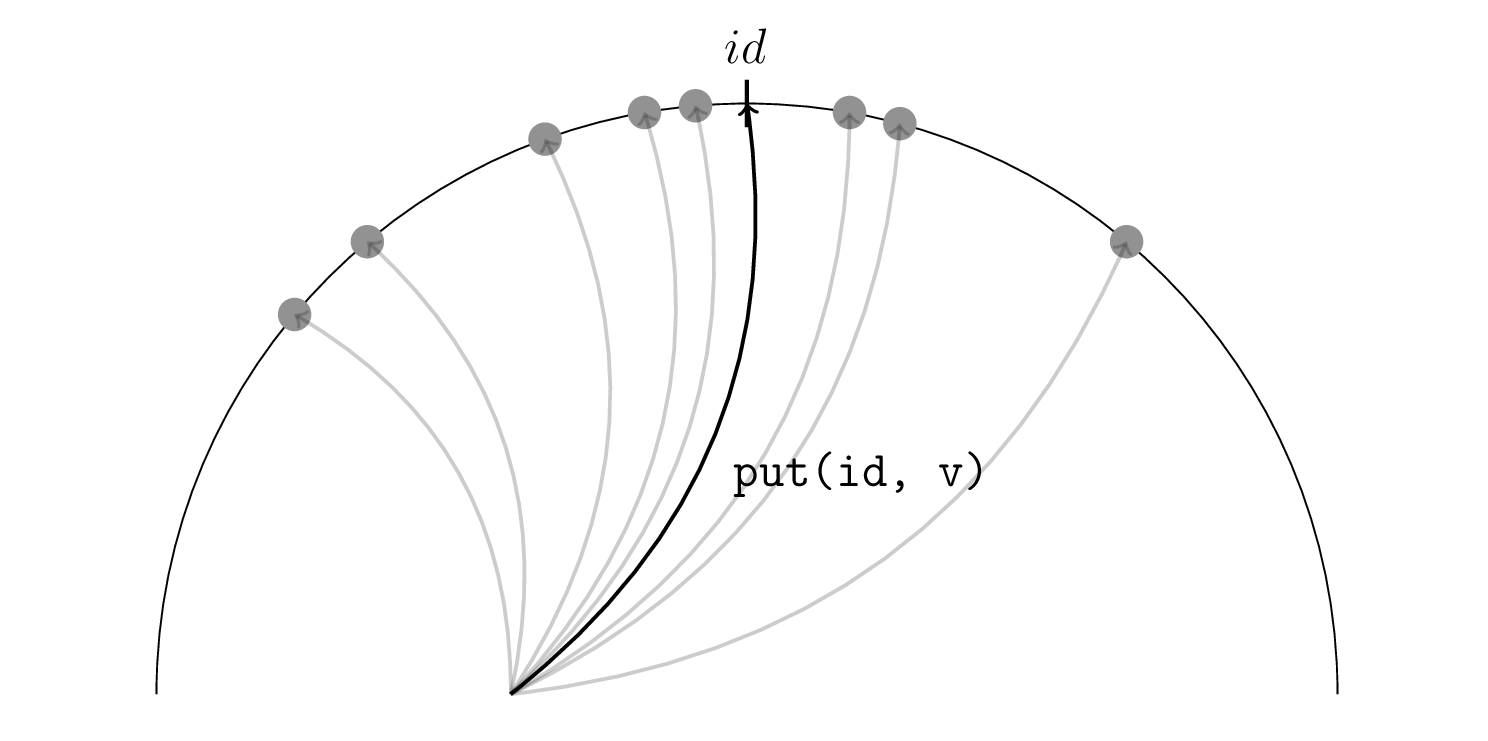
Short introduction to Distributed Hash Tables OpenDHT is based on the Kademlia design. If you know about DHTs, you are aware that they define the notion of distance using the XOR metric. This makes the tuple (H_n, xor) a metric space, where H_n is the space of identifier keys of length n. This way, you can find an identifier be the closest to a target hash than the rest of the nodes in the network.
In order to find some data that is associated with some hash h, you have to find the nodes in the network for which the distance between their hash identifier and the target hash h is minimized. The group of nodes which are the closest to the target hash (OpenDHT allows up to 8 nodes) will hold data for that hash.

Data persistence Let s say you ask a group of 8 nodes to hold some data for a hash and you want the data to hold the whole time until its expiration time as come. If the group of 8 nodes change because that for some reason those nodes leave or others just arrive and have an id that is closer to the target hash than the initial group of 8 nodes. The data would then not be found on the new group of 8 nodes. A first and simple solution was to count on the initial creator of the value to periodically announce the value to the group of 8 nodes. However, what if this node leaves? This is one of the main problem that I ve been working on solving since 2015. A first version of this was produced on September 2015. However, we experienced traffic issues and were forced to redesign the OpenDHT network requests engine. We are presently working on adding a Query feature that would enable filtering of data on remote nodes, hence substantially lowering the overall traffic produced by a response to a get request.

Indexation During the last year, I have also been working on the design of a solution for the use case of indexation. In a more technical way, this is the capability to find data by providing a map where its key is a string field and the mapped value is the value associated to that field, much like in a form. This could help find data for which you don t know the hash, but you have specific information about its content. In other words, this would be a search engine for OpenDHT. I have already created a working, but still in progress, version of this. You can find it on http://opendht.net, on the index branch. Now, Nicolas Reynaud (kaldoran) is contributing to this during the GSOC.

Roadmap As I explained on my page on the Debian Wiki, I am going to work on:
  1. Developing new functionalities in OpenDHT aiming at reducing overall generated traffic.
  2. Maintenance and optimization of the OpenDHT code in general.
  3. Optimizing data persistence solution over the distributed hash table.
  4. Merge (1) in the Ring daemon component in order to benefit from lower traffic in Ring.
  5. Make OpenDHT use TCP protocol instead of UDP. This is going to reduce code complexity and enhance robsutness of the DHT.
For further details, read my reports!

1 June 2016

Keerthana Krishnan: Changing your OS between two linux distros

Hi guys! Last week, I had installed Debian 8 with Fedora 22 over my then current system of a dual boot between Ubuntu 14.04 and Fedora 22. I had been using these two for a long time and the change was pretty difficult because of all the data I had lying around. This is all the wisdom I understood from it, and hopefully, this helps.
  1. Backup all your important data : Your home folder or any external partition will have tons of data if you have been using your OS for some time. Don t forget to double check all the folders such as your Desktop, localhost (/var/www/html/) and anything else you can think of.
  2. Keep a list of your favorite applications that you ve installed. I wouldn t recommed copying the lib files from the computer. There is a high chance of getting your files corrupted that way (from personal experience). Instead, go to your package manager to find your installed packages and make a note of all the applications that you would want in your new OS.
  3. Backup files from your browser. If you use Google Chrome (Or Chromium) be sure to sign in and save your settings. For firefox users, here s a guide to backup your profile. If your browser is something else, make sure to ask google for help with this,
  4. Download the .iso file of your new OS according to your requirement. I prefer to make a live usb for installation. Make sure you double check and download the right image file.
You re all done! Say your goodbyes to your old system, put in your USB and reboot your system to start installation of your new OS.

30 May 2016

Reproducible builds folks: Reproducible builds: week 57 in Stretch cycle

What happened in the Reproducible Builds effort between May 22nd and May 28th 2016: Media coverage Documentation update Toolchain fixes Packages fixed The following 18 packages have become reproducible due to changes in their build dependencies: canl-c configshell dbus-java dune-common frobby frown installation-guide jexcelapi libjsyntaxpane-java malaga octave-ocs paje.app pd-boids pfstools r-cran-rniftilib scscp-imcce snort vim-addon-manager The following packages have become reproducible after being fixed: Some uploads have fixed some reproducibility issues, but not all of them: Patches submitted that have not made their way to the archive yet: Package reviews 123 reviews have been added, 57 have been updated and 135 have been removed in this week. 21 FTBFS bugs have been reported by Chris Lamb and Santiago Vila. strip-nondeterminism development tests.reproducible-builds.org Misc. This week's edition was written by Reiner Herrmann and Holger Levsen and reviewed by a bunch of Reproducible builds folks on IRC.

Daniel Stender: My work for Debian in May

No double posting this time ;-) I've got not so much spare time this month to spend on Debian, but I could work on the following packages: This series of blog postings also includes little introductions of and into new packages in the archive. This month there is: Pyinfra Pyinfra is a new project which is currently still in development state. It has been already pointed out in an interesting German article1, and is now available as package maintained within the Python Applications Team. It's currently a one man production by Nick Barrett, and eagerly developed in the past weeks (we're currently at 0.1~dev24). Pyinfra is a remote server configuration/provisioning/service deployment tool which belongs in the same software category like Puppet or Ansible2. It's for provisioning one or an array of remote servers with software packages and to configure them. Pyinfra runs agentless like Ansible, that means for using it nothing special (like a daemon) has to run on targeted servers. It's written to be used for provisioning POSIX compatible Linux systems and has alternatives when it comes to special features like package managers (e.g. supports apt as well as yum). The documentation could be found in usr/share/doc/pyinfra/html/. Here's a little crash course on how to use Pyinfra: The pyinfra CLI tool is used on the command line like this, deploy scripts, single operations or facts (see below) could be used on a single server or a multitude of remote servers:
$ pyinfra -i <inventory script/single host> <deploy script>
$ pyinfra -i <inventory script/single host> --run <operation>
$ pyinfra -i <inventory script/single host> --facts <fact>
Remote servers which are operated on must provide a working shell and they must be reachable by SSH. For connecting, --port, --user, --password, --key/--key-password and --sudo flags are available, --sudo to gain superuser rights. Root access or sudo rights of course have to be already set up. By the way, localhost could be operated on the same way. Single operations are organized in modules like "apt", "files", "init", "server" etc. With the --run option they could be used individually on servers like follows, e.g. server.user adds a new user on a single targeted system (-v adds verbosity to the pyinfra run):
$ pyinfra -i 192.0.2.10 --run server.user sam --user root --key ~/.ssh/sshkey --key-password 123456 -v
Multiple servers can be grouped in inventories, which hold the targeted hosts and data associated with them, like e.g. an inventory file farm1.py would contain lists like this:
COMPUTE_SERVERS = ['192.0.2.10', '192.0.2.11']
DATABASE_SERVERS = ['192.0.2.20', '192.0.2.21']
Group designators must be all caps. A higher level of grouping are the file names of inventory scripts, thus COMPUTE_SERVERS and DATABASE_SERVERS can be referenced to at the same time by the group designator farm1. Plus, all servers are automatically added to the group all. And, inventory scripts should be stored in the subfolder inventory/ in the project directory. Inventory files then could be used instead of specific IP addresses like this, the single operation then gets performed on all given machines in farm1.py:
$ pyinfra -i inventory/farm1.py  --run server.user sam --user root --key ~/.ssh/sshkey --key-password=123456 -v
Deployment scripts could be used together with group data files in the subfolder group_data/ in the project directory. For example, a group_data/farm1.py designates all servers given in inventory/farm1.py (by the way, all.py designates all servers), and contains the random attribute user_name (attributes must be lowercase), next to authentication data for the whole inventory group:
user_name = 'sam'
ssh_user = 'root'
ssh_key = '~/.ssh/sshkey'
ssh_key_password = '123456'
The random attribute can be picked up by a deployment script using host.data() like follows, user_name could be used again for e.g. server.user(), like this:
from pyinfra import host
from pyinfra.modules import server
server.user(host.data.user_name)
This deploy, the ensemble of inventory file, group data file and deployment script (usually placed top level in the project folder) then could be run that way:
$ pyinfra -i inventory/farm1.py deploy.py
You have guessed it, since deployment scripts are Python scripts they are fully programmable (please regard that Pyinfra is build & runs on Python 3 on Debian), and that's the main advantage point with this piece of software. Quite handy for that come Pyinfra facts, functions which check different things on remote systems and return information as Python data. Like e.g. deb_packages returns a dictionary of installed packages from a remote apt based server:
$ pyinfra -i 192.0.2.10 --fact deb_packages --user root --key ~/.ssh/sshkey --key-password=123456
 
    "192.0.2.10":  
        "libdebconfclient0": "0.192",
        "python-debian": "0.1.27",
        "libavahi-client3": "0.6.31-5",
        "dbus": "1.8.20-0+deb8u1",
        "libustr-1.0-1": "1.0.4-3+b2",
        "sed": "4.2.2-4+b1",
Using facts, Pyinfra reveals its full potential. For example, a deployment script could go like this, linux.distribution() returns a dict containing the installed distribution:
from pyinfra import host
from pyinfra.modules import apt
if host.fact.linux_distribution['name'] == 'Debian':
   apt.packages(packages='gummi', present=True, update=True)
elif host.fact.linux_distribution['name'] == 'CentOS':
   pass
I'll spare more sophisticated examples to keep this introduction simple. Beyond fancy deployment scripts, Pyinfra features an own API by which it could be programmed from the outside, and much more. But maybe that's enough to introduce Pyinfra. That are the usage basics. Pyinfra is a brand new project and it remains to be seen whether the developer can keep on further developing the tool like he does these days. For a private project it's insane to attempt to become a contender for the established "big" free configuration management tools and frameworks, but, if Puppet has become too complex in the meanwhile or not3, I really don't think that's the point here. Pyinfra follows an own approach in being programmable the way which it is. And it's definitely not harm to have it in the toolbox already, not trying to replace nothing. Brainstorm After the first package has been in experimental, the Brainstorm library from Swiss AI research institute IDSIA4 is now available as python3-brainstorm in unstable. Brainstorm is a lean, easy-to-use library for setting up deep learning networks (multiple layered artificial neural networks) for machine learning applications like for image and speech recognition or natural language processing. To set up a working training network for a classifier for handwritten digits like the MNIST dataset (a usual "hello world") just takes a couple of lines, like an example demonstrates. The package is maintained within the Debian Python Modules Team. The Debian package ships a couple of examples in /usr/share/python3-brainstorm/examples (the data/ and examples/ folders of the upstream tarball are combined here). Among them there are5: The current documentation in /usr/share/doc/python3-brainstorm/html/ isn't complete yet (several chapters are under construction), but there's a walkthrough on the CIFAR-10 example. The MNIST example has been extended by Github user pinae, and has been explained in German C't recently6. What are the perspectives for further development? Like Zhou Mo confirmed, there are a couple of deep learning frameworks around having a rather poor outlook since there have been abandoned after being completed as PhD projects. There's really no point for thriving to have them all in Debian, like the ITP of Minerva has been given up partly for this reason, there weren't any commits since 08/2015 (and because cuDNN isn't available and most likely won't). Brainstorm, 0.5 have been released 05/2015, also was a PhD project as IDSIA. It's stated on Github that the project is "under active development", but the rather sparse project page on the other side expresses the "hope the community will help us to further improve Brainstorm". This sentence much often implies that the developers are not actively working on the project. But there are recent commits and it looks that upstream is active and could be reached when there are problems, and that the project is active. So I don't think we're riding a dead horse, here. The downside for Brainstorm in Debian is, it seems that the libraries which are needed for GPU accelerated processing can't be fully provided. Pycuda is available, but scikit-cuda (an additional library which provides wrappers for CUDA features like CUBLAS, CUFFT and CUSOLVER) is not and won't be, because the CULA Dense Toolkit (scikit-cuda also contains wrappers for also that) is not available freely as source. Because of that, a dependency against pycuda, not even as Suggests (it's non-free), has been spared. Without GPU acceleration, Brainstorm computes the matrices on openBLAS using a Cython wrapper on the NumpyHandler, and the PyCudaHandler couldn't be used. openBLAS makes pretty good use of the available hardware (it distributes over all available CPU cores), but it's not yet possible to run Brainstorm full throttle using available floating point devices to reduce training times, which becomes crucial when the projects are getting bigger. Brainstorm belongs to the number of deep learning frameworks already being or becoming available in Debian. Currently there is: I've checked over Microsoft's CNTK, but although it's also set free recently I have my doubts if that could be included. Apparently there are dependencies against non-free software and most likely other issues. So much for a little update on the state of deep learning in Debian, please excuse if my radar misses something.

  1. Tim Sch rmann: "Schlangen l: Automatisiertes Service-Deployment mit Pyinfra". In: IT-Administrator 05/2016, pp. 90-95.
  2. For a comparison of configuration management software like this, see B wetter/Johannsen/Steig: "Baukastensysteme: Konfigurationsmanagement mit Open-Source-Software". In: iX 04/2016, pp. 94-99 (please excuse the prevalence of German articles in the pointers, I've just have them at hand).
  3. On the points of critique on Puppet, see Martin Loschwitz: "David gegen Goliath Zwei Welten treffen aufeinander: Puppet und Ansible". In Linux-Magazin 01/2016, 50-54.
  4. See the interview with IDSIA's deep learning guru J rgen Schmidhuber in German C't 2014/09, p. 148
  5. The examples scripts need some more finetuning. To run the data creation scripts in place the environment variable BRAINSTORM_DATA_DIR could be set, but the trained networks are currently tried to write in place. So please copy the scripts into some workspace if you want to try them out. I'll patch the example scripts to run out-of-the-box, soon.
  6. Johannes Merkert: "Ziffernlerner. Ein k nstliches neuronales Netz selber gebaut". In: C't 2016/06, p. 142-147. Web: http://www.heise.de/ct/ausgabe/2016-6-Ein-kuenstliches-neuronales-Netz-selbst-gebaut-3118857.html.
  7. See Ramon Wartala: "Tiefensch rfe: Deep learning mit NVIDIAs Jetson-TX1-Board und dem Caffe-Framework". In: iX 06/2016, pp. 100-103
  8. https://lists.debian.org/debian-science/2016/03/msg00016.html

28 May 2016

Evgeni Golov: how to accidentally break DNS for 15 domains or why you maybe could not send mail to me

TL;DR: DNS for golov.de and other (14) domains hosted on my infra was flaky from 15th to 17th of May, which may have resulted in undelivered mail. Yeah, I know, I haven't blogged for quite some time. Even not after I switched the engine of my blog from WordPress to Nikola. Sorry! But this post is not about apologizing or at least not for not blogging. Last Tuesday, mika sent me a direct message on Twitter (around 13:00) that read problem auf deiner Seite? or problem on your side/page? . Given side and page are the same word in German, I thought he meant my (this) website, so I quickly fired up a browser, checked that the site loads (I even checked both, HTTP and HTTPS! :-)) and as everything seemed to be fine and I was at a customer I only briefly replied ? . A couple messages later we found out that mika tried to send a screenshot (from his phone) but that got lost somewhere. A quick protocol change later (yay, Signal!) and I got the screenshot. It said "<evgeni+grml@golov.de>: Host or domain name not found. Name service error for name=golov.de type=AAAA: Host found, but no data record of requested type". Well, yeah, that looks like an useful error message. And here the journey begins. For historical nonsense golov.de currently does not have any AAAA records, so it looked odd that Postfix tried that. Even odder was that dig MX golov.de and dig mail.golov.de worked just fine from my laptop. Still, the message looked worrying and I decided to dig deeper. golov.de is served by three nameservers: ns.die-welt.net, ns2.die-welt and ns.inwx.de and dig was showing proper replies from ns2.die-welt.net and ns.inwx.de but not from ns.die-welt.net, which is the master. That was weird, but gave a direction to look at, and explained why my initial tests were OK. Another interesting data-point was that die-welt.net was served just fine from all three nameservers. Let's quickly SSH into that machine and look what's happening Yeah, but I only have my work laptop with me, which does not have my root key (and I still did not manage to setup a Yubikey/Nitrokey/whatver). Thankfully my key was allowed to access the hypervisor, yay console! Now let's really look. golov.de is served from from the bind backend of my PowerDNS, while die-welt.net is served from the MySQL backend. That explains why one domain didn't work while the other did. The relevant zone file looked fine, but the zones.conf was empty. WTF?! That zones.conf is autogenerated by Froxlor and I had upgraded it during the weekend to get Let's Encrypt support. Oh well, seems I hit a bug, damn. A few PHP hacks later and I got my zones.conf generated properly again and all was good. But what had really happened?
  • On Saturday (around 17:00) I upgraded to Froxlor 0.9.35.1 to get Let's Encrypt support and hit Froxlor bug 1615 without noticing as PowerDNS re-reads zones.conf only when told.

  • On Sunday PowerDNS was restarted because of upgraded packages, thus re-reading zones.conf and properly logging:

    May 15 08:10:59 shokki pdns[2210]: [bindbackend] Parsing 0 domain(s), will report when done
    
  • On Tuesday the issue hit a friend who cared and notified me

  • On Tuesday the issue was fixed (first by a quick restore from etckeeper, later by fixing the generating code):

    May 17 14:56:08 shokki pdns[24422]: [bindbackend] Parsing 15 domain(s), will report when done
    
And the lessons learned?
  • Monitor all your domains, on all your nameservers. (I didn't)
  • Have emergency access to all you servers. (I did, but it was complicated)
  • Use etckeeper, it's easier to use than backups in such cases.
  • When hitting bugs, look in the bugtracker before solving the issue yourself. (I didn't)
  • Have friends who care :-)

25 May 2016

Petter Reinholdtsen: Isenkram with PackageKit support - new version 0.23 available in Debian unstable

The isenkram system is a user-focused solution in Debian for handling hardware related packages. The idea is to have a database of mappings between hardware and packages, and pop up a dialog suggesting for the user to install the packages to use a given hardware dongle. Some use cases are when you insert a Yubikey, it proposes to install the software needed to control it; when you insert a braille reader list it proposes to install the packages needed to send text to the reader; and when you insert a ColorHug screen calibrator it suggests to install the driver for it. The system work well, and even have a few command line tools to install firmware packages and packages for the hardware already in the machine (as opposed to hotpluggable hardware). The system was initially written using aptdaemon, because I found good documentation and example code on how to use it. But aptdaemon is going away and is generally being replaced by PackageKit, so Isenkram needed a rewrite. And today, thanks to the great patch from my college Sunil Mohan Adapa in the FreedomBox project, the rewrite finally took place. I've just uploaded a new version of Isenkram into Debian Unstable with the patch included, and the default for the background daemon is now to use PackageKit. To check it out, install the isenkram package and insert some hardware dongle and see if it is recognised. If you want to know what kind of packages isenkram would propose for the machine it is running on, you can check out the isenkram-lookup program. This is what it look like on a Thinkpad X230:
% isenkram-lookup 
bluez
cheese
fprintd
fprintd-demo
gkrellm-thinkbat
hdapsd
libpam-fprintd
pidgin-blinklight
thinkfan
tleds
tp-smapi-dkms
tp-smapi-source
tpb
%p
The hardware mappings come from several places. The preferred way is for packages to announce their hardware support using the cross distribution appstream system. See previous blog posts about isenkram to learn how to do that.

23 May 2016

Enrico Zini: I chipped in

I clicked on a random link and I found myself again in front of a wired.com popup that wanted to explain to me what I have to think about adblockers. This time I was convinced, and I took my wallet out. I finally donated $35 to AdBlock. (And then somebody pointed me to uBlock Origin and I switched to that.)

22 May 2016

Reproducible builds folks: Reproducible builds: week 56 in Stretch cycle

What happened in the Reproducible Builds effort between May 15th and May 21st 2016: Media coverage Blog posts from our GSoC and Outreachy contributors: Documentation update Ximin Luo clarified instructions on how to set SOURCE_DATE_EPOCH. Toolchain fixes Other upstream fixes Packages fixed The following 18 packages have become reproducible due to changes in their build dependencies: abiword angband apt-listbugs asn1c bacula-doc bittornado cdbackup fenix gap-autpgrp gerbv jboss-logging-tools invokebinder modplugtools objenesis pmw r-cran-rniftilib x-loader zsnes The following packages have become reproducible after being fixed: Some uploads have fixed some reproducibility issues, but not all of them: Patches submitted that have not made their way to the archive yet: Reproducibility-related bugs filed: Package reviews 51 reviews have been added, 19 have been updated and 15 have been removed in this week. 22 FTBFS bugs have been reported by Chris Lamb, Santiago Vila, Niko Tyni and Daniel Schepler. tests.reproducible-builds.org Misc. This week's edition was written by Reiner Herrmann and Holger Levsen and reviewed by a bunch of Reproducible builds folks on IRC.

Next.

Previous.