Search Results: "agi"

19 September 2017

Reproducible builds folks: Reproducible Builds: Weekly report #125

Here's what happened in the Reproducible Builds effort between Sunday September 10 and Saturday September 16 2017: Upcoming events Reproduciblity work in Debian devscripts/2.17.10 was uploaded to unstable, fixing #872514. This adds a script to report on reproducibility status of installed packages written by Chris Lamb. #876055 was opened against Debian Policy to decide the precise requirements we should have on a build's environment variables. Bugs filed: Non-maintainer uploads: Reproduciblity work in other projects Patches sent upstream: Reviews of unreproducible packages 16 package reviews have been added, 99 have been updated and 92 have been removed in this week, adding to our knowledge about identified issues. 1 issue type has been updated: diffoscope development reprotest development trydiffoscope development Version 65 was uploaded to unstable by Chris Lamb including these contributions: Reproducible websites development tests.reproducible-builds.org Misc. This week's edition was written by Ximin Luo, Bernhard M. Wiedemann, Chris Lamb, Holger Levsen and Daniel Shahaf & reviewed by a bunch of Reproducible Builds folks on IRC & the mailing lists.

18 September 2017

Carl Chenet: The Github threat

Many voices arise now and then against risks linked to the Github use by Free Software projects. Yet the infatuation for the collaborative forge of the Octocat Californian start-ups doesn t seem to fade away.

These recent years, Github and its services take an important role in software engineering as they are seen as easy to use, efficient for a daily workload with interesting functions in enterprise collaborative workflow or amid a Free Software project. What are the arguments against using its services and are they valid? We will list them first, then we ll examine their validity.

1. Critical points

1.1 Centralization

The Github application belongs to a single entity, Github Inc, a US company which manage it alone. So, a unique company under US legislation manages the access to most of Free Software application code sources, which may be a problem with groups using it when a code source is no longer available, for political or technical reason.

The Octocat, the Github mascot

This centralization leads to another trouble: as it obtained critical mass, it becomes more and more difficult not having a Github account. People who don t use Github, by choice or not, are becoming a silent minority. It is now fashionable to use Github, and not doing so is seen as out of date . The same phenomenon is a classic, and even the norm, for proprietary social networks (Facebook, Twitter, Instagram).

1.2 A Proprietary Software

When you interact with Github, you are using a proprietary software, with no access to its source code and which may not work the way you think it is. It is a problem at different levels. First, ideologically, but foremost in practice. In the Github case, we send them code we can control outside of their interface. We also send them personal information (profile, Github interactions). And mostly, Github forces any project which goes through the US platform to use a crucial proprietary tools: its bug tracking system.

Windows, the epitome of proprietary software, even if others took the same path

1.3 The Uniformization

Working with Github interface seems easy and intuitive to most. Lots of companies now use it as a source repository, and many developers leaving a company find the same Github working environment in the next one. This pervasive presence of Github in free software development environment is a part of the uniformization of said developers working space.

Uniforms always bring Army in my mind, here the Clone army

2 Critical points cross-examination

2.1 Regarding the centralization

2.1.1 Service availability rate

As said above, nowadays, Github is the main repository of Free Software source code. As such it is a favorite target for cyberattacks. DDOS hit it in March and August 2015. On December 15, 2015, an outage led to the inaccessibility of 5% of the repositories. The same occurred on November 15. And these are only the incident reported by Github itself. One can imagine that the mean outage rate of the platform is underestimated.
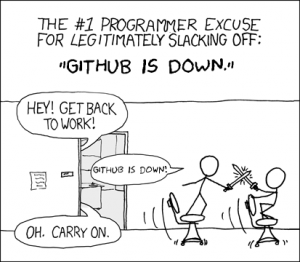
2.1.2 Chain reaction could block Free Software development

Today many dependency maintenance tools, as npm for javascript, Bundler for Ruby or even pip for Python can access an application source code directly from Github. Free Software projects getting more and more linked and codependents, if one component is down, all the developing process stop.

One of the best examples is the npmgate. Any company could legally demand that Github take down some source code from its repository, which could create a chain reaction and blocking the development of many Free Software projects, as suffered the Node.js community from the decisions of Npm, Inc, the company managing npm.

2.2 A historical precedent: SourceForge

Github didn t appear out of the blue. In his time, its predecessor, SourceForge, was also extremely popular.

Heavily centralized, based on strong interaction with the community, SourceForge is now seen as an aging SAAS (Software As A Service) and sees most of its customers fleeing to Github. Which creates lots of hurdles for those who stayed. The Gimp project suffered from spams and terrible advertising, which led to the departure of the VLC project, then from installers corrupted with adwares instead of the official Gimp installer for Windows. And finally, the Project Gimp s SourceForge account was hacked by SourceForge team itself!

These are very recent examples of what can do a commercial entity when it is under its stakeholders pressure. It is vital to really understand what it means to trust them with data and exchange centralization, where it could have tremendous repercussion on the day-to-day life and the habits of the Free Software and open source community.

2.3. Regarding proprietary software

2.3.1 One community, several opinions on proprietary software

Mostly based on ideology, this point deals with the definition every member of the community gives to Free Software and open source. Mostly about one thing: is it viral or not? Or GPL vs MIT/BSD.

Those on the side of the viral Free Software will have trouble to use a proprietary software as this last one shouldn t even exist. It must be assimilated, to quote Star Trek, as it is a connected black box, endangering privacy, corrupting for profit our uses and restrain our freedom to use as we re pleased what we own, etc.

Those on the side of complete freedom have no qualms using proprietary software as their very existence is a consequence of freedom without restriction. They even agree that code they developed may be a part of proprietary software, which is quite a common occurrence. This part of the Free Software community has no qualm using Github, which is well within their ideology parameters. Just take a look at the Janson amphitheater during Fosdem and check how many Apple laptops running on macOS are around.

FreeBSD, the main BSD project under the BSD license

2.3.2 Data loss and data restrictions linked to proprietary software use

Even without ideological consideration, and just focusing on Github infrastructure, the bug tracking system is a major problem by itself.

Bug report builds the memory of Free Software projects. It is the entrance point for new contributors, the place to find bug reporting, requests for new functions, etc. The project history can t be limited only to the code. It s very common to find bug reports when you copy and paste an error message in a search engine. Not their historical importance is precious for the project itself, but also for its present and future users.

Github gives the ability to extract bug reports through its API. What would happen if Github is down or if the platform doesn t support this feature anymore? In my opinion, not that many projects ever thought of this outcome. How could they move all the data generated by Github into a new bug tracking system? One old example now is Astrid, a TODO list bought by Yahoo a few years ago. Very popular, it grew fast until it was closed overnight, with only a few weeks for its users to extract their data. It was only a to-do list. The same situation with Github would be tremendously difficult to manage for several projects if they even have the ability to deal with it. Code would still be available and could still live somewhere else, but the project memory would be lost. A project like Debian has today more than 800,000 bug reports, which are a data treasure trove about problems solved, function requests and where the development stand on each. The developers of the Cpython project have anticipated the problem and decided not to use Github bug tracking systems.

Issues, the Github proprietary bug tracking system

Another thing we could lose if Github suddenly disappear: all the work currently done regarding the push requests (aka PRs). This Github function gives the ability to clone one project s Github repository, to modify it to fit your needs, then to offer your own modification to the original repository. The original repository s owner will then review said modification, and if he or she agrees with them will fuse them into the original repository. As such, it s one of the main advantages of Github, since it can be done easily through its graphic interface.

However reviewing all the PRs may be quite long, and most of the successful projects have several ongoing PRs. And this PRs and/or the proprietary bug tracking system are commonly used as a platform for comment and discussion between developers.

Code itself is not lost if Github is down (except one specific situation as seen below), but the peer review works materialized in the PRs and the bug tracking system is lost. Let s remember than the PR mechanism let you clone and modify projects and then generate PRs directly from its proprietary web interface without downloading a single code line on your computer. In this particular case, if Github is down, all the code and the work in progress is lost. Some also use Github as a bookmark place. They follow their favorite projects activity through the Watch function. This technological watch style of data collection would also be lost if Github is down.

Debian, one of the main Free Software projects with at least a thousand official contributors

2.4 Uniformization

The Free Software community is walking a thigh rope between normalization needed for an easier interoperability between its products and an attraction for novelty led by a strong need for differentiation from what is already there.

Github popularized the use of Git, a great tool now used through various sectors far away from its original programming field. Step by step, Git is now so prominent it s almost impossible to even think to another source control manager, even if awesome alternate solutions, unfortunately not as popular, exist as Mercurial.

A new Free Software project is now a Git repository on Github with README.md added as a quick description. All the other solutions are ostracized? How? None or very few potential contributors would notice said projects. It seems very difficult now to encourage potential contributors into learning a new source control manager AND a new forge for every project they want to contribute. Which was a basic requirement a few years ago. It s quite sad because Github, offering an original experience to its users, cut them out of a whole possibility realm. Maybe Github is one of the best web versioning control systems. But being the main one doesn t let room for a new competitor to grow. And it let Github initiate development newcomers into a narrow function set, totally unrelated to the strength of the Git tool itself.

3. Centralization, uniformization, proprietary software What s next? Laziness?

Fight against centralization is a main part of the Free Software ideology as centralization strengthens the power of those who manage it and who through it control those who are managed by it. Uniformization allergies born against main software companies and their wishes to impose a closed commercial software world was for a long time the main fuel for innovation thirst and intelligent alternative development. As we said above, part of the Free Software community was built as a reaction to proprietary software and their threat. The other part, without hoping for their disappearance, still chose a development model opposite to proprietary software, at least in the beginning, as now there s more and more bridges between the two.

The Github effect is a morbid one because of its consequences: at least centralization, uniformization, proprietary software usage as their bug tracking system. But some years ago the Dear Github buzz showed one more side effect, one I ve never thought about: laziness. For those who don t know what it is about, this letter is a complaint from several spokespersons from several Free Software projects which demand to Github team to finally implement, after years of polite asking, new functions. Since when Free Software project facing a roadblock request for clemency and don t build themselves the path they need? When Torvalds was involved in the Bitkeeper problem and the Linux kernel development team couldn t use anymore their revision control software, he developed Git. The mere fact of not being able to use one tool or functions lacking is the main motivation to seek alternative solutions and, as such, of the Free Software movement. Every Free Software community member able to code should have this reflex. You don t like what Github offers? Switch to Gitlab. You don t like it Gitlab? Improve it or make your own solution.

The Gitlab logo

Let s be crystal clear. I ve never said that every Free Software developers blocked should code his or her own alternative. We all have our own priorities, and some of us even like their beauty sleep, including me. But, to see that this open letter to Github has 1340 names attached to it, among them some spokespersons for major Free Software project showed me that need, willpower and strength to code a replacement are here. Maybe said replacement will be born from this letter, it would be the best outcome of this buzz.

In the end, Github usage is just another example of Internet usage massification. As Internet users are bound to go to massively centralized social network as Facebook or Twitter, developers are following the same path with Github. Even if a large fraction of developers realize the threat linked this centralized and proprietary organization, the whole community is following this centralization and uniformization trend. Github service is useful, free or with a reasonable price (depending on the functions you need) easy to use and up most of the time. Why would we try something else? Maybe because others are using us while we are savoring the convenience? The Free Software community seems to be quite sleepy to me.

The lion enjoying the hearth warm

About Me Carl Chenet, Free Software Indie Hacker, founder of the French-speaking Hacker News-like Journal du hacker. Follow me on social networks Translated from French by St phanie Chaptal. Original article written in 2015.

Russ Allbery: Consolidation haul

My parents are less fond than I am of filling every available wall in their house with bookshelves and did a pruning of their books. A lot of them duplicated other things that I had, or didn't sound interesting, but I still ended up with two boxes of books (and now have to decide which of my books to prune, since I'm out of shelf space). Also included is the regular accumulation of new ebook purchases. Mitch Albom Tuesdays with Morrie (nonfiction)
Ilona Andrews Clean Sweep (sff)
Catherine Asaro Charmed Sphere (sff)
Isaac Asimov The Caves of Steel (sff)
Isaac Asimov The Naked Sun (sff)
Marie Brennan Dice Tales (nonfiction)
Captain Eric "Winkle" Brown Wings on My Sleeve (nonfiction)
Brian Christian & Tom Griffiths Algorithms to Live By (nonfiction)
Tom Clancy The Cardinal of the Kremlin (thriller)
Tom Clancy The Hunt for the Red October (thriller)
Tom Clancy Red Storm Rising (thriller)
April Daniels Sovereign (sff)
Tom Flynn Galactic Rapture (sff)
Neil Gaiman American Gods (sff)
Gary J. Hudson They Had to Go Out (nonfiction)
Catherine Ryan Hyde Pay It Forward (mainstream)
John Irving A Prayer for Owen Meany (mainstream)
John Irving The Cider House Rules (mainstream)
John Irving The Hotel New Hampshire (mainstream)
Lawrence M. Krauss Beyond Star Trek (nonfiction)
Lawrence M. Krauss The Physics of Star Trek (nonfiction)
Ursula K. Le Guin Four Ways to Forgiveness (sff collection)
Ursula K. Le Guin Words Are My Matter (nonfiction)
Richard Matheson Somewhere in Time (sff)
Larry Niven Limits (sff collection)
Larry Niven The Long ARM of Gil Hamilton (sff collection)
Larry Niven The Magic Goes Away (sff)
Larry Niven Protector (sff)
Larry Niven World of Ptavvs (sff)
Larry Niven & Jerry Pournelle The Gripping Hand (sff)
Larry Niven & Jerry Pournelle Inferno (sff)
Larry Niven & Jerry Pournelle The Mote in God's Eye (sff)
Flann O'Brien The Best of Myles (nonfiction)
Jerry Pournelle Exiles to Glory (sff)
Jerry Pournelle The Mercenary (sff)
Jerry Pournelle Prince of Mercenaries (sff)
Jerry Pournelle West of Honor (sff)
Jerry Pournelle (ed.) Codominium: Revolt on War World (sff anthology)
Jerry Pournelle & S.M. Stirling Go Tell the Spartans (sff)
J.D. Salinger The Catcher in the Rye (mainstream)
Jessica Amanda Salmonson The Swordswoman (sff)
Stanley Schmidt Aliens and Alien Societies (nonfiction)
Cecilia Tan (ed.) Sextopia (sff anthology)
Lavie Tidhar Central Station (sff)
Catherynne Valente Chicks Dig Gaming (nonfiction)
J.E. Zimmerman Dictionary of Classical Mythology (nonfiction) This is an interesting tour of a lot of stuff I read as a teenager (Asimov, Niven, Clancy, and Pournelle, mostly in combination with Niven but sometimes his solo work). I suspect I will no longer consider many of these books to be very good, and some of them will probably go back into used bookstores after I've re-read them for memory's sake, or when I run low on space again. But all those mass market SF novels were a big part of my teenage years, and a few (like Mote In God's Eye) I definitely want to read again. Also included is a random collection of stuff my parents picked up over the years. I don't know what to expect from a lot of it, which makes it fun to anticipate. Fall vacation is coming up, and with it a large amount of uninterrupted reading time.

17 September 2017

Sean Whitton: Debian Policy call for participation -- September 2017

Here s a summary of the bugs against the Debian Policy Manual. Please consider getting involved, whether or not you re an existing contributor. Consensus has been reached and help is needed to write a patch #172436 BROWSER and sensible-browser standardization #273093 document interactions of multiple clashing package diversions #299007 Transitioning perms of /usr/local #314808 Web applications should use /usr/share/package, not /usr/share/doc/ #425523 Describe error unwind when unpacking a package fails #452393 Clarify difference between required and important priorities #476810 Please clarify 12.5, Copyright information #484673 file permissions for files potentially including credential informa #491318 init scripts should support start/stop/restart/force-reload - why #556015 Clarify requirements for linked doc directories #568313 Suggestion: forbid the use of dpkg-statoverride when uid and gid ar #578597 Recommend usage of dpkg-buildflags to initialize CFLAGS and al. #582109 document triggers where appropriate #587991 perl-policy: /etc/perl missing from Module Path #592610 Clarify when Conflicts + Replaces et al are appropriate #613046 please update example in 4.9.1 (debian/rules and DEB_BUILD_OPTIONS) #614807 Please document autobuilder-imposed build-dependency alternative re #628515 recommending verbose build logs #664257 document Architecture name definitions #682347 mark editor virtual package name as obsolete #685506 copyright-format: new Files-Excluded field #685746 debian-policy Consider clarifying the use of recommends #688251 Built-Using description too aggressive #749826 [multiarch] please document the use of Multi-Arch field in debian/c #757760 please document build profiles #759316 Document the use of /etc/default for cron jobs #761219 document versioned Provides #767839 Linking documentation of arch:any package to arch:all #770440 policy should mention systemd timers #773557 Avoid unsafe RPATH/RUNPATH #780725 PATH used for building is not specified #793499 The Installed-Size algorithm is out-of-date #810381 Update wording of 5.6.26 VCS-* fields to recommend encryption #823256 Update maintscript arguments with dpkg >= 1.18.5 #833401 virtual packages: dbus-session-bus, dbus-default-session-bus #835451 Building as root should be discouraged #838777 Policy 11.8.4 for x-window-manager needs update for freedesktop menus #845715 Please document that packages are not allowed to write outside thei #853779 Clarify requirements about update-rc.d and invoke-rc.d usage in mai #874019 Note that the -e argument to x-terminal-emulator works like #874206 allow a trailing comma in package relationship fields Wording proposed, awaiting review from anyone and/or seconds by DDs #515856 remove get-orig-source #542288 Versions for native packages, NMU s, and binary only uploads #582109 document triggers where appropriate #610083 Remove requirement to document upstream source location in debian/c #645696 [copyright-format] clearer definitions and more consistent License: #649530 [copyright-format] clearer definitions and more consistent License: #662998 stripping static libraries #682347 mark editor virtual package name as obsolete #683222 say explicitly that debian/changelog is required in source packages #688251 Built-Using description too aggressive #737796 copyright-format: support Files: paragraph with both abbreviated na #756835 Extension of the syntax of the Packages-List field. #786470 [copyright-format] Add an optional License-Grant field #810381 Update wording of 5.6.26 VCS-* fields to recommend encryption #835451 Building as root should be discouraged #845255 Include best practices for packaging database applications #850729 Documenting special version number suffixes #874090 Clarify wording of some passages #874095 copyright-format: Use the synopsis term established in the de Merged for the next release #661928 recipe for determining shlib package name #679751 please clarify package account and home directory location in policy #683222 say explicitly that debian/changelog is required in source packages #870915 [5.6.30] Testsuite: There are much more defined values #872893 Chapters, sections, appendices and numbering #872895 Include multi-page HTML in package #872896 An html.tar.gz has leaked into the .deb? #872900 Very generic info file name #872950 Too much indirection in info file menus #873819 upgrading-checklist.txt: typo pgpsignurlmangle in section 4.11 of V #874411 missing line breaks in summary of ways maintainers scripts are call

Russ Allbery: Free software log (July and August 2017)

I've wanted to start making one of these posts for a few months but have struggled to find the time. But it seems like a good idea, particularly since I get more done when I write down what I do, so you all get a rather belated one. This covers July and August; hopefully the September one will come closer to the end of September. Debian August was DebConf, which included a ton of Policy work thanks to Sean Whitton's energy and encouragement. During DebConf, we incorporated work from Hideki Yamane to convert Policy to reStructuredText, which has already made it far easier to maintain. (Thanks also to David Bremner for a lot of proofreading of the result.) We also did a massive bug triage and closed a ton of older bugs on which there had been no forward progress for many years. After DebConf, as expected, we flushed out various bugs in the reStructuredText conversion and build infrastructure. I fixed a variety of build and packaging issues and started doing some more formatting cleanup, including moving some footnotes to make the resulting document more readable. During July and August, partly at DebConf and partly not, I also merged wording fixes for seven bugs and proposed wording (not yet finished) for three more, as well as participated in various Policy discussions. Policy was nearly all of my Debian work over these two months, but I did upload a new version of the webauth package to build with OpenSSL 1.1 and drop transitional packages. Kerberos I still haven't decided my long-term strategy with the Kerberos packages I maintain. My personal use of Kerberos is now fairly marginal, but I still care a lot about the software and can't convince myself to give it up. This month, I started dusting off pam-krb5 in preparation for a new release. There's been an open issue for a while around defer_pwchange support in Heimdal, and I spent some time on that and tracked it down to an upstream bug in Heimdal as well as a few issues in pam-krb5. The pam-krb5 issues are now fixed in Git, but I haven't gotten any response upstream from the Heimdal bug report. I also dusted off three old Heimdal patches and submitted them as upstream merge requests and reported some more deficiencies I found in FAST support. On the pam-krb5 front, I updated the test suite for the current version of Heimdal (which changed some of the prompting) and updated the portability support code, but haven't yet pulled the trigger on a new release. Other Software I merged a couple of pull requests in podlators, one to fix various typos (thanks, Jakub Wilk) and one to change the formatting of man page references and function names to match the current Linux manual page standard (thanks, Guillem Jover). I also documented a bad interaction with line-buffered output in the Term::ANSIColor man page. Neither of these have seen a new release yet.

Iain R. Learmonth: Free Software Efforts (2017W37)

I d like to start making weekly reports again on my free software efforts. Part of the reason for these reports is for me to see how much time I m putting into free software. Hopefully I can keep these reports up.

Debian I have updated txtorcon (a Twisted-based asynchronous Tor control protocol implementation used by ooniprobe, magic-wormhole and tahoe-lafs) to its latest upstream version. I ve also added two new binary packages that are built by the txtorcon source package: python3-txtorcon and python-txtorcon-doc for Python 3 support and generated HTML documentation respectively. I have gone through the scapy (Python module for the forging and dissection of network packets) bugs and closed a couple that seem to have been silently fixed by new upstream releases and not been caught in the BTS. I ve uploaded a minor revision to include a patch that fixes the version number reported by scapy. I have prepared and uploaded a new package for measurement-kit (a portable C++11 network measurement library) from the Open Observatory of Network Interference, which at time of writing is still in the NEW queue. I have also updated ooniprobe (probe for the Open Observatory of Network Interference) to its latest upstream version. I have updated the Swedish debconf strings in the xastir (X Amateur Station Tracking and Information Reporting) package, thanks to the translators. I have updated the direwolf (soundcard terminal node controller for APRS) package to its latest upstream version and fixed the creation of the system user to run direwolf with systemd to happen at the time the package is installed. Unfortunately, it has been necessary to drop the PDF documentation from the package as I was unable to contact the upstream author and acquire the Microsoft Word sources for this release. I have reviewed and sponsored the uploads of the new packages comptext (GUI based tool to compare two text streams), comptty (GUI based tool to compare two radio teletype streams) and flnet (amateur radio net control station software) in the hamradio team. Thanks to Ana Custura for preparing those packages, comptext and comptty are now available in unstable. I have updated the Debian Hamradio Blend metapackages to include cubicsdr (a software defined radio receiver). This build also refreshes the list of packages that can now be included as they had not been packaged at the time of the last build. I have produced and uploaded an initial package for python-azure-devtools (development tools for Azure SDK and CLI for Python) and have updated python-azure (the Azure SDK for Python) to a recent git snapshot. Due to some issues with python-vcr it is currently not possible to run the test suite as part of the build process and I m watching the situation. I have also fixed the auto dependency generation for python3-azure, which had previously been broken. Bugs closed (fixed/wontfix): #873036, #871940, #869566, #873083, #867420, #861753, #855385, #855497, #684727, #683711

Tor Project I have been working through tickets for Atlas (a tool for looking up details about Tor relays and bridges) and have merged and deployed a number of fixes. Some highlights include: bandwidth sorting in search results is now semantically correct (not just an alphanumeric sort ignoring units), added when a relay was first seen to the details page along with the host name if a reverse DNS record has been found for the IP address of the relay and added support for the NoEdConsensus flag (although happily no relays had this flag at the time this support was added). The metrics team has been working on merging projects into the metrics team website to give a unified view of information about the Tor network. This week I have been working towards a prototype of a port of Atlas to the metrics website s style and this work has been published in my personal Atlas git repository. If you d like to have a click around, you can do so. A relay operators meetup will be happening in Montreal on the 14th of October. I won t be present, but I have taken this opportunity to ask operators if there s anything that they would like from Atlas that they are not currently getting. Some feedback has already been received and turned into code and trac tickets. I also attended the weekly metrics team meeting in #tor-dev. Bugs closed (fixed/wontfix): #6787, #9814, #21958, #21636, #23296, #23160

Sustainability I believe it is important to be clear not only about the work I have already completed but also about the sustainability of this work into the future. I plan to include a short report on the current sustainability of my work in each weekly report. I continue to be happy to spend my time on this work, however I do find myself in a position where it may not be sustainable when it comes to hardware. My desktop, a Sun Ultra 24, is now 10 years old and I m starting to see random reboots which so far have not been explained. It is incredibly annoying to have this happen during a long build. Further, the hard drives in my NAS which are used for the local backups and for my local Debian mirror are starting to show SMART errors. It is not currently within my budget to replace any of this hardware. Please contact me if you believe you can help.
This week's energy was provided by Club Mate

13 September 2017

Shirish Agarwal: Android, Android marketplace and gaming addiction.

This would be a longish piece so please bear and play with tea, coffee, beer or anything stronger that you desire while reading below  I had bought an Android phone, a Samsung J5 just before going to debconf 2016. It was more for being in-trend rather than really using it. The one which I shared is the upgraded version (recentish) the one I have is 2 GB for which I had paid around double of what the list price was. The only reason I bought the model is that it had removable battery at the price point I was willing to pay. I did see that Samsung has the same ham-handed issues with audio as previous Nokia devices use to, the speakers and microphone probably the cheapest you can get on the market. Nokia was same too, at least on the lower-end of the market, while Oppo has loud ringtones and loud music, perfect for those who are a bit hard of hearing (as yours truly is). I had been pleasantly surprised by the quality of photos Samsung J5 was churning even though I m less than average shooter, never been really into it so was a sort of wake-up call for where camera sensor technology is advancing. And of course with newer phones the kind of detail it can capture is mesmerizing to say the least, although wide-angle shots still would take some time to get right I guess. If memory serves me right, sometime back Laura Arjona Reina (who handles part of debian-publicity and part of debian-women among other responsibilities) shared a blog post on p.d.o. where she had shared the troubles she had while exporting data from the phone. While she shared that and I lack the time or the energy to try and find it ( the entry is really bookmarkable, at least that specific blog post). What was interesting though that I had gone few years ago to Bangalore, there is an organization which I like and admire CIS great for researchers. Anyways they had done a project getting between 10-20 phones from the market made of Chinese origin (almost all mobiles sold in India, the fabrication of CPU and APU etc. are done in China/Taiwan and then assembled here). Here what is done at the most is assembly which for all political purposes is called manufacturing . All the mobiles kept quite a bit of info. on the device even after you wiped them clean/put some other ROM on them. The CIS site is more than a bit cluttered otherwise would have shared the direct link. I do hope to send an e-mail to CIS and hopefully they will respond with the report and will share that here as and when. It would be interesting to know if after people flash a custom rom if the status quo is the same as it was before. I do suspect it would be the former as flashing ROMs on phones is still a bit of specialized subject at least here in India with even an average phone costing a month or two s salary or more and the idea of bricking the phone scares most people (including yours truly). Anyways, for a long time I was on bed and had the phone. I used 2 games from the android marketplace which both mum and I enjoy and enjoyed. Those are Real jigsaw and Jigsaw puzzle HD . The permissions dialog which Real jigsaw among other games has is horrible and part of me freaks that all such apps. have unrestricted access to my storage area. Ideally, what Android should have done is either partition or give functionality to the user to have private space for their photos and whatever media they have and the rest of the area is like a public park. If anybody has any thoughts on partitioning on Android phone would like to hear that. One game though which really hooked mumma and me is The Island Experiment . It reminded me of my younger days when gaming addiction was not treated as a disease but thankfully now is . I would call myself somewhat of a functional addict as in do my every day things, work etc. but do dream about the game as to what it will show me next. A part of it is the game is web-based (which means it needs constant internet connection) and web access is somewhat pricey, although with Reliance Jio an upcoming data network operator having bundles of money and promising the moon, network issues at least on low-bandwidth game which I and mum are playing hopefully will not have any issues. I haven t used tshark or any such tool to analyze the traffic but I guess it probably just sends short messages of number of clicks in a time period and things like that, all the rest (I guess) is happening on the mobile itself. I know at sometime I probably will try to put a custom rom on it but which one is the question as there are so many and also which is most compatible with my device. It seems I would have to do lot of homework before I can make any choices. Couple of months back, a friend of mine Akshat who has been using Android for few years enabled Developer Options which I didn t know about till he shared that info. with me. I do hope people do check Akshat s repo. as he has made/has quite a few useful scripts, especially if you are into digital photography. I have shared with him gimp scripting few days back so along with imagemagick you might see him doing some rough scripts in it. Of course, if people use it and give feedback he might clean the scripts a bit so it gives useful error messages and gives statement like gimp is not installed on your system, please install it or ask for specific version but as it works in free software it is somewhat directly proportional to the number of users, bugs and users behind it. A good example of what I mean is youtube-dl . I filed 873853 where I shared the upstream ticket. Apparently YouTube again changed few days back and while upstream has fixed it, the youtube-dl maintainer probably needs to find time and get the new version up. Apparently the issues lies in [$] dpkg -L youtube-dl grep youtube.py
/usr/lib/python3/dist-packages/youtube_dl/extractor/youtube.py
Hopefully somebody does the needful. Btw, I find f-droid extremely useful and especially osmand but sadly both of them are not shared or talked about by people  The reason I shared about Developer Options in Android is that few days back I noticed that the phone wonks off and has unpredictable behaviour such as not letting me browse the web, do additions or deletions using the google play store and alike . Things came to a head when few days back I saw a fibre-optic splicing operation being carried by some workers near my home by the state operator which elated me and wanted to shoot the video for it but the battery died/there was no power even though I hadn t used it much. I have deliberately shared the hindi version which tells how that knowledge is now coming to the masses. I had seen fibre-optic splicing more than a decade and a half back at some net conference where it was going to be in your neighbourhood soonish, hopefully it will happen soon  I had my suspicions for quite sometime all the issues with the phone were not due to proper charging. During course of my investigation, found out that in Developer Options there is an option called USB Configuration and changing that from the default MTP (Media Transfer Protocol) (which is basically used to put or take movies, music or any file from the phone to the computer or vice-versa improved much better behaviour on my android phone. But this caused an unexpected side-effect, I got pretty aggressive polling of the phone by the computer even after saying I do not want to share the phone details with the computer. This I filed as 874216 . The phone and I am guessing most Samsung phones today come with an adaptor with a USB male socket which goes in to the phone s usb port. There is the classical port for electricity but like most people heavily rely on usb charging even for deep fully powered down phone for full charging. One interesting project which I saw which came in Debian some days back is dummydroid. I did file a bug about it . I do hope that either the maintainer gives some more documentation. I am sure many people might use and add to the resource if the documentation was/is there. I did take a look at the package and the profile seems to be like an xml pair kind of database. Having more profiles shouldn t be hard if we knew what info. needs to be added and how do we find that info. Lastly, I am slowly transferring all the above knowledge to my mum as well, although in small doses. She, just like me has and had problems coming from resistive touchscreen to capacitive touchscreen. You can call me wrong but resistive touchscreen seemed to be superior and not as error-prone or liable to commit mistakes as is possible in capacitive touchscreens. There may be a setting to higher/lower the threshold for touching which I have not been able to find as of yet. Hope somebody finds something useful in there. I do hope that Debian does become a replacement to be used on such mobiles but then they would have to duplicate/also have some sort of mainstream content with editors to help people find stuff, something that Debian is not so good at currently. Also I m not sure Synaptic is good fit as a mobile store.
Filed under: Miscellenous Tagged: #Android, #capacitive touchscreen, #custom ROMs, #digital photography, #dummydroid, #f-droid, #fabrication, #flashing, #game addiction, #Google Play Store, #Mainstreaming Debian, #mobile connectivity, #Oppo, #osmand, #planet-debian, #resistive touchscreen, #Samsung Galaxy J5, #scripting, #USB charging, #USB configuration, #youtube-dl, gaming

10 September 2017

Joachim Breitner: Less parentheses

Yesterday, at the Haskell Implementers Workshop 2017 in Oxford, I gave a lightning talk titled syntactic musings , where I presented three possibly useful syntactic features that one might want to add to a language like Haskell. The talked caused quite some heated discussions, and since the Internet likes heated discussion, I will happily share these ideas with you

Context aka. Sections This is probably the most relevant of the three proposals. Consider a bunch of related functions, say analyseExpr and analyseAlt, like these:
analyseExpr :: Expr -> Expr
analyseExpr (Var v) = change v
analyseExpr (App e1 e2) =
  App (analyseExpr e1) (analyseExpr e2)
analyseExpr (Lam v e) = Lam v (analyseExpr flag e)
analyseExpr (Case scrut alts) =
  Case (analyseExpr scrut) (analyseAlt <$> alts)
analyseAlt :: Alt -> Alt
analyseAlt (dc, pats, e) = (dc, pats, analyseExpr e)
You have written them, but now you notice that you need to make them configurable, e.g. to do different things in the Var case. You thus add a parameter to all these functions, and hence an argument to every call:
type Flag = Bool
analyseExpr :: Flag -> Expr -> Expr
analyseExpr flag (Var v) = if flag then change1 v else change2 v
analyseExpr flag (App e1 e2) =
  App (analyseExpr flag e1) (analyseExpr flag e2)
analyseExpr flag (Lam v e) = Lam v (analyseExpr (not flag) e)
analyseExpr flag (Case scrut alts) =
  Case (analyseExpr flag scrut) (analyseAlt flag <$> alts)
analyseAlt :: Flag -> Alt -> Alt
analyseAlt flag (dc, pats, e) = (dc, pats, analyseExpr flag e)
I find this code problematic. The intention was: flag is a parameter that an external caller can use to change the behaviour of this code, but when reading and reasoning about this code, flag should be considered constant. But this intention is neither easily visible nor enforced. And in fact, in the above code, flag does change , as analyseExpr passes something else in the Lam case. The idiom is indistinguishable from the environment idiom, where a locally changing environment (such as variables in scope ) is passed around. So we are facing exactly the same problem as when reasoning about a loop in an imperative program with mutable variables. And we (pure functional programmers) should know better: We cherish immutability! We want to bind our variables once and have them scope over everything we need to scope over! The solution I d like to see in Haskell is common in other languages (Gallina, Idris, Agda, Isar), and this is what it would look like here:
type Flag = Bool
section (flag :: Flag) where
  analyseExpr :: Expr -> Expr
  analyseExpr (Var v) = if flag then change1 v else change2v 
  analyseExpr (App e1 e2) =
    App (analyseExpr e1) (analyseExpr e2)
  analyseExpr (Lam v e) = Lam v (analyseExpr e)
  analyseExpr (Case scrut alts) =
    Case (analyseExpr scrut) (analyseAlt <$> alts)
  analyseAlt :: Alt -> Alt
  analyseAlt (dc, pats, e) = (dc, pats, analyseExpr e)
Now the intention is clear: Within a clearly marked block, flag is fixed and when reasoning about this code I do not have to worry that it might change. Either all variables will be passed to change1, or all to change2. An important distinction! Therefore, inside the section, the type of analyseExpr does not mention Flag, whereas outside its type is Flag -> Expr -> Expr. This is a bit unusual, but not completely: You see precisely the same effect in a class declaration, where the type signature of the methods do not mention the class constraint, but outside the declaration they do. Note that idioms like implicit parameters or the Reader monad do not give the guarantee that the parameter is (locally) constant. More details can be found in the GHC proposal that I prepared, and I invite you to raise concern or voice support there. Curiously, this problem must have bothered me for longer than I remember: I discovered that seven years ago, I wrote a Template Haskell based implementation of this idea in the seal-module package!

Less parentheses 1: Bulleted argument lists The next two proposals are all about removing parentheses. I believe that Haskell s tendency to express complex code with no or few parentheses is one of its big strengths, as it makes it easier to visualy parse programs. A common idiom is to use the $ operator to separate a function from a complex argument without parentheses, but it does not help when there are multiple complex arguments. For that case I propose to steal an idea from the surprisingly successful markup language markdown, and use bulleted lists to indicate multiple arguments:
foo :: Baz
foo = bracket
          some complicated code
          that is evaluated first
          other complicated code for later
          even more complicated code
I find this very easy to visually parse and navigate. It is actually possible to do this now, if one defines ( ) = id with infixl 0 . A dedicated syntax extension (-XArgumentBullets) is preferable:
  • It only really adds readability if the bullets are nicely vertically aligned, which the compiler should enforce.
  • I would like to use $ inside these complex arguments, and multiple operators of precedence 0 do not mix. (infixl -1 would help).
  • It should be possible to nest these, and distinguish different nesting levers based on their indentation.

Less parentheses 1: Whitespace precedence The final proposal is the most daring. I am convinced that it improves readability and should be considered when creating a new language. As for Haskell, I am at the moment not proposing this as a language extension (but could be convinced to do so if there is enough positive feedback). Consider this definition of append:
(++) :: [a] -> [a] -> [a]
[]     ++ ys = ys
(x:xs) ++ ys = x : (xs++ys)
Imagine you were explaining the last line to someone orally. How would you speak it? One common way to do so is to not read the parentheses out aloud, but rather speak parenthesised expression more quickly and add pauses otherwise. We can do the same in syntax!
(++) :: [a] -> [a] -> [a]
[]   ++ ys = ys
x:xs ++ ys = x : xs++ys
The rule is simple: A sequence of tokens without any space is implicitly parenthesised. The reaction I got in Oxford was horror and disgust. And that is understandable we are very used to ignore spacing when parsing expressions (unless it is indentation, of course. Then we are no longer horrified, as our non-Haskell colleagues are when they see our code). But I am convinced that once you let the rule sink in, you will have no problem parsing such code with ease, and soon even with greater ease than the parenthesised version. It is a very natural thing to look at the general structure, identify compact chunks of characters , mentally group them, and then go and separately parse the internals of the chunks and how the chunks relate to each other. More natural than first scanning everything for ( and ), matching them up, building a mental tree, and then digging deeper. Incidentally, there was a non-programmer present during my presentation, and while she did not openly contradict the dismissive groan of the audience, I later learned that she found this variant quite obvious to understand and more easily to read than the parenthesised code. Some FAQs about this:
  • What about an operator with space on one side but not on the other? I d simply forbid that, and hence enforce readable code.
  • Do operator sections still require parenthesis? Yes, I d say so.
  • Does this overrule operator precedence? Yes! a * b+c == a * (b+c).
  • What is a token? Good question, and I am not not decided. In particular: Is a parenthesised expression a single token? If so, then (Succ a)+b * c parses as ((Succ a)+b) * c, otherwise it should probably simply be illegal.
  • Can we extend this so that one space binds tighter than two spaces, and so on? Yes we can, but really, we should not.
  • This is incompatible with Agda s syntax! Indeed it is, and I really like Agda s mixfix syntax. Can t have everything.
  • Has this been done before? I have not seen it in any language, but Lewis Wall has blogged this idea before.
Well, let me know what you think!

7 September 2017

Lior Kaplan: FOSScamp Syros 2017 day 3

The 3rd day should have started with a Debian sprint and then a LibreOffice one, taking advantage I m still attending, as that s my last day. But plans don t always work out and we started 2 hours later. When everybody arrive we got everyone together for a short daily meeting (scrum style). The people were divided to 3 teams for translating: Debian Installer, LibreOffice and Gnome. For each team we did a short list of what left and with what to start. And in the end how does what so there will be no toe stepping. I was really proud with this and felt it was time well spent. The current translation percentage for Albanian in LibreOffice is 60%. So my recommendation to the team is translate master only and do not touch the help translation. My plans ahead would be to improve the translation as much as possible for LibreOffice 6.0 and near the branching point (Set to November 20th by the release schedule) decide if it s doable for the 6.0 life time or to set the goal at 6.1. In the 2nd case, we might try to backport translation back to 6.0. For the translation itself, I ve mentioned to the team about KeyID language pack and referred them to the nightly builds. These tools should help with keeping the translation quality high. For the Debian team, after deciding who works on what, I ve asked Silva to do review for the others, as doing it myself started to take more and more of my time. It s also good that the reviewer know the target language and not like me, can catch more the syntax only mistakes. Another point, as she s available more easily to the team while I m leaving soon, so I hope this role of reviewer will stay as part of the team. With the time left I mostly worked on my own tasks, which were packaging the Albanian dictionary, resulting in https://packages.debian.org/sid/myspell-sq and making sure the dictionary is also part of LibreOffice resulting in https://gerrit.libreoffice.org/#/c/41906/ . When it is accepted, I want to upload it to the LibreOffice repository so all users can download and use the dictionary. During the voyage home (ferry, bus, plain and train), I mailed Sergio Durigan Junior, my NM applicant, with a set of questions. My first action as an AM (: Overall FOSScamp results for Albanian translation were very close to the goal I set (100%): That s the result of work by Silva Arapi, Eva Vranici, Redon Skikuli, Anisa Kuci and Nafie Shehu.
Filed under: Debian GNU/Linux, i18n & l10n, LibreOffice

6 September 2017

Mike Gabriel: MATE 1.18 landed in Debian testing

This is to announce that finally all MATE Desktop 1.18 components have landed in Debian testing (aka buster). Credits Again a big thanks to the packaging team (esp. Vangelis Mouhtsis and Martin Wimpress, but also to Jeremy Bicha for constant advice and Aron Xu for joining the Debian+Ubuntu MATE Packaging Team and merging all the Ubuntu zesty and artful branches back to master). Fully Available on all Debian-supported Architectures The very special thing about this MATE 1.18 release for Debian is that MATE is now available on all Debian hardware architectures. See "Buildd" column on our DDPO overview page [1]. Thanks to all the people from the Debian porters realm for providing feedback to my porting questions. References

4 September 2017

Alessio Treglia: MeteoSurf: a free App for the Mediterranean Sea

meteosurf

MeteoSurf is a free multi-source weather forecasting App designed to provide wind and wave conditions of the Mediterranean Sea. It is an application for smartphones and tablets, built as a Progressive Web App able to supply detailed and updated maps and data showing heights of sea waves (and other information) in the Central Mediterranean. It is mainly targeted for surfers and wind-surfers but anyone who needs to know the sea conditions will take advantage from this app.

Data can be displayed as animated graphical maps, or as detailed table data. The maps refer to the whole Mediterranean Sea, while the table data is able to provide specific information for any of the major surf spots in the Med.

As of current version, MeteoSurf shows data collecting them from 3 different forecasting systems Read More [by Fabio Marzocca]

Daniel Pocock: Spyware Dolls and Intel's vPro

Back in February, it was reported that a "smart" doll with wireless capabilities could be used to remotely spy on children and was banned for breaching German laws on surveillance devices disguised as another object. Would you trust this doll? For a number of years now there has been growing concern that the management technologies in recent Intel CPUs (ME, AMT and vPro) also conceal capabilities for spying, either due to design flaws (no software is perfect) or backdoors deliberately installed for US spy agencies, as revealed by Edward Snowden. In a 2014 interview, Intel's CEO offered to answer any question, except this one. The LibreBoot project provides a more comprehensive and technical analysis of the issue, summarized in the statement "the libreboot project recommends avoiding all modern Intel hardware. If you have an Intel based system affected by the problems described below, then you should get rid of it as soon as possible" - eerily similar to the official advice German authorities are giving to victims of Cayla the doll. All those amateur psychiatrists suggesting LibreBoot developers suffer from symptoms of schizophrenia have had to shut their mouths since May when Intel confirmed a design flaw (or NSA backdoor) in every modern CPU had become known to hackers. Bill Gates famously started out with the mission to put a computer on every desk and in every home. With more than 80% of new laptops based on an Intel CPU with these hidden capabilities, can you imagine the NSA would not have wanted to come along for the ride? Four questions everybody should be asking
  • If existing laws can already be applied to Cayla the doll, why haven't they been used to alert owners of devices containing Intel's vPro?
  • Are exploits of these backdoors (either Cayla or vPro) only feasible on a targeted basis, or do the intelligence agencies harvest data from these backdoors on a wholesale level, keeping a mirror image of every laptop owner's hard disk in one of their data centers, just as they already do with phone and Internet records?
  • How long will it be before every fast food or coffee chain with a "free" wifi service starts dipping in to the data exposed by these vulnerabilities as part of their customer profiling initiatives?
  • Since Intel's admissions in May, has anybody seen any evidence that anything is changing though, either in what vendors are offering or in terms of how companies and governments outside the US buy technology?
Share your thoughts This issue was recently raised on the LibrePlanet mailing list. Please feel free to join the list and click here to reply on the thread.

3 September 2017

Thorsten Alteholz: My Debian Activities in August 2017

FTP assistant This month I accepted 217 packages and rejected 16 uploads. Though this might seem to be a low number this month, I am very pleased about the total number of packages that have been accepted: 558. Debian LTS This was my thirty-eight month that I did some work for the Debian LTS initiative, started by Raphael Hertzog at Freexian. This month my all in all workload has been 20.25h. During that time I did LTS uploads of: I also did the upload and sent the DLA for [DLA 1061-1] newsbeuter security update Last but not least I also spent some time for frontdesk duties. Other stuff As announced last month I finished uploading all dependencies of glewlwyd and now we have an oauth2 server available in Debian. This month I am trying to really use it and will tell you about my experiences. As the severity of the gcc-7 bugs have been raised, I took care of: #853501, #853304, #853305, #853306, #853307, #853308 and #871088 I also uploaded a new version of duktape and now try to also provide a library that can be used in other packages. Last but not least my DOPOM of this month has been oysttyer. Actually it is a new package, but as ttytter has been abandonded upstream, this is the replacement. It is a fork so you should only get a new authorization key and simply use it as ttytter before.

2 September 2017

David Bremner: Indexing Debian's buildinfo

Introduction Debian is currently collecting buildinfo but they are not very conveniently searchable. Eventually Chris Lamb's buildinfo.debian.net may solve this problem, but in the mean time, I decided to see how practical indexing the full set of buildinfo files is with sqlite.

Hack
  1. First you need a copy of the buildinfo files. This is currently about 2.6G, and unfortunately you need to be a debian developer to fetch it.
     $ rsync -avz mirror.ftp-master.debian.org:/srv/ftp-master.debian.org/buildinfo .
    
  2. Indexing takes about 15 minutes on my 5 year old machine (with an SSD). If you index all dependencies, you get a database of about 4G, probably because of my natural genius for database design. Restricting to debhelper and dh-elpa, it's about 17M.
     $ python3 index.py
    
    You need at least python3-debian installed
  3. Now you can do queries like
     $ sqlite3 depends.sqlite "select * from depends where depend='dh-elpa' and depend_version<='0106'"
    
    where 0106 is some adhoc normalization of 1.6

Conclusions The version number hackery is pretty fragile, but good enough for my current purposes. A more serious limitation is that I don't currently have a nice (and you see how generous my definition of nice is) way of limiting to builds currently available e.g. in Debian unstable.

Antoine Beaupr : My free software activities, August 2017

Debian Long Term Support (LTS) This is my monthly Debian LTS report. This month I worked on a few major packages that took a long time instead of multiple smaller issues. Affected packages were Mercurial, libdbd-mysql-perl and Ruby.

Mercurial updates Mercurial was vulnerable to two CVEs: CVE-2017-1000116 (command injection on clients through malicious ssh URLs) and CVE-2017-1000115 (path traversal via symlink). The former is an issue that actually affects many other similar software like Git (CVE-2017-1000117), Subversion (CVE-2017-9800) and even CVS (CVE-2017-12836). The latter symlink issue is a distinct issue that came up during an internal audit. The fix, shipped as DLA-1072-1, involved a rather difficult backport, especially because the Mercurial test suite takes a long time to complete. This reminded me of the virtues of DEB_BUILD_OPTIONS=parallel=4, which sped up the builds considerably. I also discovered that the Wheezy build chain doesn't support sbuild's --source-only-changes flag which I had hardcoded in my sbuild.conf file. This seems to be simply because sbuild passes --build=source to dpkg-buildpackage, an option that is supported only in jessie or later.

libdbd-mysql-perl I have worked on fixing two issues with the libdbd-mysql-perl package, CVE-2017-10788 and CVE-2017-10789, which resulted in the DLA-1079-1 upload. Behind this mysteriously named package sits a critical piece of infrastructure, namely the mysql commandline client which is probably used and abused by hundreds if not thousands of home-made scripts, but also all of Perl's MySQL support, which is probably used by even a larger base of software. Through the Debian bug reports (Debian bug #866818 and Debian bug #866821), I have learned that the patches existed in the upstream tracker but were either ignored or even reverted in the latest 4.043 upstream release. It turns out that there are talks of forking that library because of maintainership issue. It blows my mind that such an important part of MySQL is basically unmaintained. I ended up backporting the upstream patches, which was also somewhat difficult because of the long-standing issues with SSL support in MySQL. The backport there was particularly hard to test, as you need to run that test suite by hand, twice: once with a server configured with a (valid!) SSL certificate and one without (!). I'm wondering how much time it is really worth spending on trying to fix SSL in MySQL, however. It has been badly broken forever, and while the patch is an improvement, I would actually still never trust SSL transports in MySQL over an untrusted network. The few people that I know use such transports wrap their connections around a simpler stunnel instead. The other issue was easier to fix so I submitted a pull request upstream to make sure that work isn't lost, although it is not clear what the future of that patch (or project!) will be at this point.

Rubygems I also worked on the rubygems issues, which, thanks to the "vendoring" practice of the Ruby community, also affects the ruby1.9 package. 4 distinct CVEs were triaged here (CVE-2017-0899, CVE-2017-0900, CVE-2017-0901 and CVE-2017-0902) and I determined the latter issue didn't affect wheezy as rubygems doesn't do its own DNS resolution there (later versions lookup SRV records). This is another package where the test suite takes a long time to run. Worse, the packages in Wheezy actually fails to build from source: the test suites just fail in various steps, particularly because of dh key too small errors for Rubygems, but also other errors for Ruby. I also had trouble backporting one test which I had to simply skip for Rubygems. I uploaded and announced test packages and hopefully I'll be able to complete this work soon, although I would certainly appreciate any help on this...

Triage I took a look at the sox, libvorbis and exiv2 issues. None had fixes available. sox and exiv2 were basically a list of fuzzing issues, which are often minor or at least of unknown severity. Those would have required a significant amount of work and I figured I would prioritize other work first. I also triaged CVE-2017-7506, which doesn't seem to affect the spice package in wheezy, after doing a fairly thorough audit of the code. The vulnerability is specifically bound to the reds_on_main_agent_monitors_config function, which is simply not present in our older version. A hostile message would fall through the code and not provoke memory allocation or out of bounds access, so I simply marked the wheezy version as not-affected, something which usually happens during the original triage but can also happen during the actual patching work, as in this case.

Other free software work This describes the volunteer work I do on various free software projects. This month, again, my internal reports show that I spent about the same time on volunteer and paid time, but this is probably a wrong estimate because I spent a lot of time at Debconf which I didn't clock in...

Debconf So I participated in the 17th Debian Conference in Montreal. It was great to see (and make!) so many friends from all over the world in person again, and I was happy to work on specific issues together with other Debian developers. I am especially thankful to David Bremner for fixing the syncing of the flagged tag when added to new messages (patch series). This allows me to easily sync the one tag (inbox) that is not statically assigned during notmuch new, by using flagged as a synchronization tool. This allows me to use notmuch more easily across multiple machines without having to sync all tags with dump/restore or using muchsync which wasn't working for me (although a new release came out which may fix my issues). The magic incantation looks something like this:
notmuch tag -inbox tag:inbox and not tag:flagged
notmuch tag +inbox not tag:inbox and tag:flagged
However, most of my time in the first week (Debcamp) was spent trying to complete the networking setup: configure switches, setup wiring and so on. I also configured an apt-cacher-ng proxy to serve packages to attendees during the conference. I configured it with Avahi to configure clients automatically, which led me to discover (and fix) issue Debian bug #870321) although there are more issues with the autodiscovery mechanism... I spent extra time to document the (somewhat simple) configuration of such a server in the Debian wiki because it was not the first time I had research that procedure... I somehow thought this was a great time to upgrade my laptop to stretch. Normally, I keep that device running stable because I don't use it often and I don't want to have major traumatizing upgrades every time I leave with it on a trip. But this time was special: there were literally hundreds of Debian developers to help me out if there was trouble. And there was, of course, trouble as it turns out! I had problems with the fonts on my display, because, well, I had suspended (twice) my laptop during the install. The fix was simply to flush the fontconfig cache, and I tried to document this in the fonts wiki page and my upgrades page. I also gave a short training called Debian packaging 101 which was pretty successful. Like the short presentation I made at the last Montreal BSP, the workshop was based on my quick debian development guide. I'm thinking of expanding this to a larger audience with a "102" course that would discuss more complex packaging problems. But my secret plan (well, secret until now I guess) is to make packaging procedures more uniform in Debian by training new Debian packagers using that same training for the next 2 decades. But I will probably start by just trying to do this again at the next Debconf, if I can attend.

Debian uploads I also sponsored two packages during Debconf: one was a "scratch an itch" upload (elpa-ivy) which I requested (Debian bug #863216) as part of a larger effort to ship the Emacs elisp packages as Debian packages. The other was an upload of diceware to build the documentation in a separate package and fix other issues I have found in the package during a review. I also uploaded a bunch of other fixes to the Debian archive:

Signing keys rotation I also started the process of moving my main OpenPGP certification key by adding a signing subkey. The subkey is stored in a cryptographic token so I can sign things on more than one machine without storing that critical key on all those devices physically. Unfortunately, this meant that I need to do some shenanigans when I want to sign content in my Debian work, because the new subkey takes time to propagate to the Debian archive. For example, I have to specify the primary key with a "bang" when signing packages (debsign -k '792152527B75921E!' ...) or use inline signatures in email sent for security announcement (since that trick doesn't work in Mutt or Notmuch). I tried to figure out how to better coordinate this next time by reading up documentation on keyring.debian.org, but there is no fixed date for key changes on the rsync interface. There are "monthly changes" so one's best bet is to look for the last change in their git repository.

GitLab.com and LFS migration I finally turned off my src.anarc.at git repository service by moving the remaining repos to GitLab. Unfortunately, GitLab removed support for git-annex recently, so I had to migrate my repositories to Git-LFS, which was an interesting experience. LFS is pretty easy to use, definitely simpler than git-annex. It also seems to be a good match for the use-case at hand, which is to store large files (videos, namely) as part of slides for presentations. It turns out that their migration guide could have been made much simpler. I tried to submit those changes to the documentation but couldn't fork the GitLab EE project to make a patch, so I just documented the issue in the original MR for now. While I was there I filed a feature request to add a new reference shortcut (GL-NNN) after noticing a similar token used on GitHub. This would be a useful addition because I often have numbering conflicts between Debian BTS bug numbers and GitLab issues in packages I maintain there. In particular, I have problems using GitLab issue numbers in Monkeysign, because commit logs end up in Debian changelogs and will be detected by the Debian infrastructure even though those are GitLab bug numbers. Using such a shortcut would avoid detection and such a conflict.

Numpy-stats I wrote a small tool to extract numeric statistics from a given file. I often do ad-hoc benchmarks where I store a bunch of numbers in a file and then try to make averages and so on. As an exercise in learning NumPy, I figured I would write such a simple tool, called numpy-stats, which probably sounds naive to seasoned Python scientists. My incentive was that I was trying to figure out what was the distribution of password length in a given password generator scheme. So I wrote this simple script:
for i in seq 10000 ; do
    shuf -n4 /usr/share/dict/words   tr -d '\n'
done > length
And then feed that data in the tool:
$ numpy-stats lengths 
 
  "max": 60, 
  "mean": 33.883293722913464, 
  "median": 34.0, 
  "min": 14, 
  "size": 143060, 
  "std": 5.101490225062775
 
I am surprised that there isn't such a tool already: hopefully I am wrong and will just be pointed towards the better alternative in the comments here!

Safe Eyes I added screensaver support to the new SafeEyes project, which I am considering as a replacement to the workrave project I have been using for years. I really like how the interruptions basically block the whole screen: way more effective than only blocking the keyboard, because all potential distractions go away. One feature that is missing is keystrokes and mouse movement counting and of course an official Debian package, although the latter would be easy to fix because upstream already has an unofficial build. I am thinking of writing my own little tool to count keystrokes, since the overlap between SafeEyes and such a counter isn't absolutely necessary. This is something that workrave does, but there are "idle time" extensions in Xorg that do not need to count keystrokes. There are already certain tools to count input events, but none seem to do what I want (most of them are basically keyloggers). It would be an interesting test to see if it's possible to write something that would work both for Xorg and Wayland at the same time. Unfortunately, preliminary research show that:
  1. in Xorg, the only way to implement this is to sniff all events, ie. to implement a keylogger
  2. in Wayland, this is completely unsupported. it seems some compositors could implement such a counter, but then it means that this is compositor specific, or, in other words, unportable
So there is little hope here, which brings to my mind "painmeter" as an appropriate name for this future programming nightmare.

Ansible I sent my first contribution to the ansible project with a small documentation fix. I had an eye opener recently when I discovered a GitLab ansible prototype that would manipulate GitLab settings. When I first discovered Ansible, I was frustrated by the YAML/Jinja DSL: it felt silly to write all this code in YAML when you are a Python developer. It was great to see reasonably well-written Python code that would do things and delegate the metadata storage (and only that!) to YAML, as opposed to using YAML as a DSL. So I figured I would look at the Ansible documentation on how this works, but unfortunately, the Ansible documentation is severly lacking in this area. There are broken links (I only fixed one page) and missing pieces. For example, the developing plugins page doesn't explain how to program a plugin at all. I was told on IRC that: "documentation around developing plugins is sparse in general. the code is the best documentation that exists (right now)". I didn't get a reply when asking which code in particular could provide good examples either. In comparison, Puppet has excellent documentation on how to create custom types, functions and facts. That is definitely a turn-off for a new contributor, but at least my pull request was merged in and I can only hope that seasoned Ansible contributors expand on this critical piece of documentation eventually.

Misc As you can see, I'm all over the place, as usual. GitHub tells me I "Opened 13 other pull requests in 11 repositories" (emphasis mine), which I guess means on top of the "9 commits in 5 repositories" mentioned earlier. My profile probably tells a more detailed story that what would be useful to mention here. I should also mention how difficult it is to write those reports: I basically do a combination of looking into my GitHub and GitLab profiles, the last 30 days of emails (!) and filesystem changes (!!). En vrac, a list of changes which may be of interest:
  • font-large (and its alias, font-small): shortcut to send the right escape sequence to rxvt so it changes its font
  • fix-acer: short script to hardcode the modeline (you remember those?!) for my screen which has a broken EDID pin (so autodetection fails, yay Xorg log files...)
  • ikiwiki-pandoc-quickie: fake ikiwiki renderer that (ab)uses pandoc to generate a HTML file with the right stylesheet to preview Markdown as it may look in this blog (the basic template is missing still)
  • git-annex-transfer: a command I've often been missing in git-annex, which is a way to transfer files between remotes without having to copy them locally (upstream feature request)
  • I linked the graphics of the Debian archive software architecture in the Debian wiki in the hope more people notice it.
  • I did some tweaks on my Taffybar to introduce a battery meter and hoping to have temperature sensors, which mostly failed. there's a pending pull request that may bring some sense into this, hopefully.
  • I made two small patches in Monkeysign to fix gpg.conf handling and multiple email output, a dumb bug I cannot believe anyone noticed or reported just yet. Thanks Valerie for the bug report! The upload of this in Debian is pending a review from the release team.

1 September 2017

Rapha&#235;l Hertzog: My Free Software Activities in August 2017

My monthly report covers a large part of what I have been doing in the free software world. I write it for my donors (thanks to them!) but also for the wider Debian community because it can give ideas to newcomers and it s one of the best ways to find volunteers to work with me on projects that matter to me. Debian LTS This month I was allocated 12h and during this time I did 4 days of front desk handling CVE triage (28 commits to the security tracker). I had a bit of time left and I opted to work on a package that had been lingering for a while: exiv2. It turns out the security researchers who requested the CVE did not even contact the upstream author so I opened 12 tickets on GitHub. The upstream author was unaware of those issues and is relatively unfamiliar with the general process of handling security updates. I started the work of reproducing each issue and so far they only affect the version 0.26 in experimental. Misc Debian/Kali work live-build and live-config. I pushed a few updates: dropping the useless xorriso hardlinks option (as discussed in https://bugs.kali.org/view.php?id=4109), adding a .disk/mkisofs file on request of Thomas Schmitt, fixing a severe issue with the handling of locales configuration that broke wayland sessions entirely. open-vm-tools and vmwgfx. The switch of GNOME to Wayland by default resulted in multiple regressions reported by Kali users, in particular for VMWare users where desktop resizing was no longer working. There was a patch available but it did not work for me, so I worked with Thomas Hellstrom (of VMWare) to identify the problems and he provided me an updated patch. I submitted this patch to Debian too (bug report, pull request). Linux 4.12 also showed another regression for VMWare users where the screen would not be refreshed/updated when you are using Wayland/KMS. I did multiple tests for Thomas and provided the requested data so that they could create a fix (which I incorporated into Kali and should come to Debian through the upstream stable tree). Packaging. I uploaded zim 0.67 to unstable. I fixed an RC bug on shiboken to get pyside and ubertooth back into testing. I had to hack the package to use gcc-6 on mips64el because that architecture is suffering from a severe gcc bug which probably broke a large part of the code compiled since the switch to gcc-7 (and which triggered a test failure in shiboken, fortunately) I wonder if anybody will make sure to recompile all packages that might have been misbuilt. Infrastructure. In a discussion on debian-devel, the topic of using tracker.debian.org to store who is maintaining what came up again. I responded to let know that this is something that I d like to see done and that I have already taken measures to go into this direction. I wanted to make an experiment with my zim package but quickly came on a problem with ftpmaster s lintian auto-rejects (which I submitted in #871575). The BTS is now linking to tracker.debian.org on its web interface. To continue and give a push to this move, I scanned all the files in the qa SVN repository and updated many occurrences of packages.qa.debian.org with tracker.debian.org. I also spotted a small problem in the way we handle autoremovals mails in tracker.debian.org, we often get them twice: I filed #871683 to get this fixed on release.debian.org. Bug reports. vmdebootstrap creates unbootable qemu image (#872999). bugs in udebs are not shown on view by source package (#872784). New upstream release of ethtool (#873692). Upstream bugreport on systemd: support a systemd.swap=no boot command-line option. I also shared some of my ideas/dreams in #859867 speaking of a helper tool to setup and maintain up-to-date build chroots and autopkgtest qemu images. More bug fixes and pull requests. I created a patch to fix a build failure of systemd when /tmp is an overlayfs (#854400, the pull request has been discarded). I fixed the RC bug #853570 on ncrack and forwarded my changes upstream (here and here). Thanks See you next month for a new summary of my activities.

No comment Liked this article? Click here. My blog is Flattr-enabled.

Dirk Eddelbuettel: RcppAnnoy 0.0.9

An new version 0.0.9 of RcppAnnoy, our Rcpp-based R integration of the nifty Annoy library by Erik, is now on CRAN. Annoy is a small and lightweight C++ template header library for very fast approximate nearest neighbours. This release corrects an issue for Windows users discovered by GitHub user 'khoran' who later also suggested the fix of binary mode. It upgrades to Annoy release 1.9.1 and brings its new Manhattan distance to RcppAnnoy. A number of unit tests were added as well, and we updated some packaging internals such as symbol registration. And I presume I had a good streak emailing with Uwe's robots as the package made it onto CRAN rather smoothly within ten minutes of submission:
RcppAnnou to CRAN
Changes in this version are summarized here:

Changes in version 0.0.9 (2017-08-31)
  • Synchronized with Annoy upstream version 1.9.1
  • Minor updates in calls and tests as required by annoy 1.9.1
  • New Manhattan distance modules along with unit test code
  • Additional unit tests from upstream test code carried over
  • Binary mode is used for save (as suggested by @khoran in #21)
  • A new file init.c was added with calls to R_registerRoutines() and R_useDynamicSymbols()
  • Symbol registration is enabled in useDynLib

Courtesy of CRANberries, there is also a diffstat report for this release.

This post by Dirk Eddelbuettel originated on his Thinking inside the box blog. Please report excessive re-aggregation in third-party for-profit settings.

31 August 2017

Chris Lamb: Free software activities in August 2017

Here is my monthly update covering what I have been doing in the free software world in August 2017 (previous month):
Reproducible builds

Whilst anyone can inspect the source code of free software for malicious flaws, most software is distributed pre-compiled to end users. The motivation behind the Reproducible Builds effort is to allow verification that no flaws have been introduced either maliciously or accidentally during this compilation process by promising identical results are always generated from a given source, thus allowing multiple third-parties to come to a consensus on whether a build was compromised. I have generously been awarded a grant from the Core Infrastructure Initiative to fund my work in this area. This month I:
  • Presented a status update at Debconf17 in Montr al, Canada alongside Holger Levsen, Maria Glukhova, Steven Chamberlain, Vagrant Cascadian, Valerie Young and Ximin Luo.
  • I worked on the following issues upstream:
    • glib2.0: Please make the output of gio-querymodules reproducible. (...)
    • gcab: Please make the output reproducible. (...)
    • gtk+2.0: Please make the immodules.cache files reproducible. (...)
    • desktop-file-utils: Please make the output reproducible. (...)
  • Within Debian:
  • Categorised a large number of packages and issues in the Reproducible Builds "notes" repository.
  • Worked on publishing our weekly reports. (#118, #119, #120, #121 & #122)

I also made the following changes to our tooling:
diffoscope

diffoscope is our in-depth and content-aware diff utility that can locate and diagnose reproducibility issues.

  • Use name attribute over path to avoid leaking comparison full path in output. (commit)
  • Add missing skip_unless_module_exists import. (commit)
  • Tidy diffoscope.progress and the XML comparator (commit, commit)

disorderfs

disorderfs is our FUSE-based filesystem that deliberately introduces non-determinism into directory system calls in order to flush out reproducibility issues.

  • Add a simple autopkgtest smoke test. (commit)


Debian
Patches contributed
  • openssh: Quote the IP address in ssh-keygen -f suggestions. (#872643)
  • libgfshare:
    • SIGSEGV if /dev/urandom is not accessible. (#873047)
    • Add bindnow hardening. (#872740)
    • Support nodoc build profile. (#872739)
  • devscripts:
  • memcached: Add hardening to systemd .service file. (#871610)
  • googler: Tidy long and short package descriptions. (#872461)
  • gnome-split: Homepage points to domain-parked website. (#873037)

Uploads
  • python-django 1:1.11.4-1 New upstream release.
  • redis:
    • 4:4.0.1-3 Drop yet more non-deterministic tests.
    • 4:4.0.1-4 Tighten systemd/seccomp hardening.
    • 4:4.0.1-5 Drop even more tests with timing issues.
    • 4:4.0.1-6 Don't install completions to /usr/share/bash-completion/completions/debian/bash_completion/.
    • 4:4.0.1-7 Don't let sentinel integration tests fail the build as they use too many timers to be meaningful. (#872075)
  • python-gflags 1.5.1-3 If SOURCE_DATE_EPOCH is set, either use that as a source of current dates or the UTC-version of the file's modification time (#836004), don't call update-alternatives --remove in postrm. update debian/watch/Homepage & refresh/tidy the packaging.
  • bfs 1.1.1-1 New upstream release, tidy autopkgtest & patches, organising the latter with Pq-Topic.
  • python-daiquiri 1.2.2-1 New upstream release, tidy autopkgtests & update travis.yml from travis.debian.net.
  • aptfs 2:0.10-2 Add upstream signing key, refer to /usr/share/common-licenses/GPL-3 in debian/copyright & tidy autopkgtests.
  • adminer 4.3.1-2 Add a simple autopkgtest & don't install the Selenium-based tests in the binary package.
  • zoneminder (1.30.4+dfsg-2) Prevent build failures with GCC 7 (#853717) & correct example /etc/fstab entries in README.Debian (#858673).

Finally, I reviewed and sponsored uploads of astral, inflection, more-itertools, trollius-redis & wolfssl.

Debian LTS

This month I have been paid to work 18 hours on Debian Long Term Support (LTS). In that time I did the following:
  • "Frontdesk" duties, triaging CVEs, etc.
  • Issued DLA 1049-1 for libsndfile preventing a remote denial of service attack.
  • Issued DLA 1052-1 against subversion to correct an arbitrary code execution vulnerability.
  • Issued DLA 1054-1 for the libgxps XML Paper Specification library to prevent a remote denial of service attack.
  • Issued DLA 1056-1 for cvs to prevent a command injection vulnerability.
  • Issued DLA 1059-1 for the strongswan VPN software to close a denial of service attack.

Debian bugs filed
  • wget: Please hash the hostname in ~/.wget-hsts files. (#870813)
  • debian-policy: Clarify whether mailing lists in Maintainers/Uploaders may be moderated. (#871534)
  • git-buildpackage: "pq export" discards text within square brackets. (#872354)
  • qa.debian.org: Escape HTML in debcheck before outputting. (#872646)
  • pristine-tar: Enable multithreaded compression in pristine-xz. (#873229)
  • tryton-meta: Please combine tryton-modules-* into a single source package with multiple binaries. (#873042)
  • azure-cli:
  • fwupd-tests: Don't ship test files to generic /usr/share/installed-tests dir. (#872458)
  • libvorbis: Maintainer fields points to a moderated mailing list. (#871258)
  • rmlint-gui: Ship a rmlint-gui binary. (#872162)
  • template-glib: debian/copyright references online source without quotation. (#873619)

FTP Team

As a Debian FTP assistant I ACCEPTed 147 packages: abiword, adacgi, adasockets, ahven, animal-sniffer, astral, astroidmail, at-at-clojure, audacious, backdoor-factory, bdfproxy, binutils, blag-fortune, bluez-qt, cheshire-clojure, core-match-clojure, core-memoize-clojure, cypari2, data-priority-map-clojure, debian-edu, debian-multimedia, deepin-gettext-tools, dehydrated-hook-ddns-tsig, diceware, dtksettings, emacs-ivy, farbfeld, gcc-7-cross-ports, git-lfs, glewlwyd, gnome-recipes, gnome-shell-extension-tilix-dropdown, gnupg2, golang-github-aliyun-aliyun-oss-go-sdk, golang-github-approvals-go-approval-tests, golang-github-cheekybits-is, golang-github-chzyer-readline, golang-github-denverdino-aliyungo, golang-github-glendc-gopher-json, golang-github-gophercloud-gophercloud, golang-github-hashicorp-go-rootcerts, golang-github-matryer-try, golang-github-opentracing-contrib-go-stdlib, golang-github-opentracing-opentracing-go, golang-github-tdewolff-buffer, golang-github-tdewolff-minify, golang-github-tdewolff-parse, golang-github-tdewolff-strconv, golang-github-tdewolff-test, golang-gopkg-go-playground-validator.v8, gprbuild, gsl, gtts, hunspell-dz, hyperlink, importmagic, inflection, insighttoolkit4, isa-support, jaraco.itertools, java-classpath-clojure, java-jmx-clojure, jellyfish1, lazymap-clojure, libblockdev, libbytesize, libconfig-zomg-perl, libdazzle, libglvnd, libjs-emojify, libjwt, libmysofa, libundead, linux, lua-mode, math-combinatorics-clojure, math-numeric-tower-clojure, mediagoblin, medley-clojure, more-itertools, mozjs52, openssh-ssh1, org-mode, oysttyer, pcscada, pgsphere, poppler, puppetdb, py3status, pycryptodome, pysha3, python-cliapp, python-coloredlogs, python-consul, python-deprecation, python-django-celery-results, python-dropbox, python-fswrap, python-hbmqtt, python-intbitset, python-meshio, python-parameterized, python-pgpy, python-py-zipkin, python-pymeasure, python-thriftpy, python-tinyrpc, python-udatetime, python-wither, python-xapp, pythonqt, r-cran-bit, r-cran-bit64, r-cran-blob, r-cran-lmertest, r-cran-quantmod, r-cran-ttr, racket-mode, restorecond, rss-bridge, ruby-declarative, ruby-declarative-option, ruby-errbase, ruby-google-api-client, ruby-rash-alt, ruby-representable, ruby-test-xml, ruby-uber, sambamba, semodule-utils, shimdandy, sjacket-clojure, soapysdr, stencil-clojure, swath, template-glib, tools-analyzer-jvm-clojure, tools-namespace-clojure, uim, util-linux, vim-airline, vim-airline-themes, volume-key, wget2, xchat, xfce4-eyes-plugin & xorg-gtest. I additionally filed 6 RC bugs against packages that had incomplete debian/copyright files against: gnome-recipes, golang-1.9, libdazzle, poppler, python-py-zipkin & template-glib.

27 August 2017

Andrew Cater: BBQ Cambridge 2017 - post 2

We were all up until about 0100 :) House full of folk talking about all sorts, a game of Mao. Garden full of people clustered round the barbeque or sitting chatting - I had a long chat about Debian, what it means and how it's often an easier world to deal with and move in than the world of work, office politics or whatever - being here is being at home.

Arguments in the kitchen over how far coffee "just happens" with the magic bean to cup machine, some folk are in the garden preparing for breakfast at noon.

I missed the significance of this week's date - the 26th anniversary of Linus' original announcement of Linux in 1991 fell on Friday. Probably the first user of Linux who installed it from scratch was Lars Wirzenius - who was here yesterday.

Debian's 24th birthday was just about ten days ago on 16th August, making it the second oldest distribution and I reckon I've been using it for twenty one of those years - I wouldn't change it for the world.

24 August 2017

Urvika Gola: Much awaited.. DebConf 17 in Montreal.

On 5th August I got a chance to attend, speak and experience DebConf 2017 at Montreal, Canada. The conference was stretch ed from 6 August to 12 August .
debconf_picture1Seasons of Debian Summer of Code & Winter of Outreachy
Pretty late for me to document my DebConf fun-learning-experiences, thanks to my delaying tactics.. I need to overcome.
But better late than ever, I had amazing time at DebConf. I got to meet and learn from my Outreachy Mentor, Daniel Pocock!
img_5634-e1503506917678.jpgPicture of Daniel and me captured by : Dorina Mosku
One thing about DebConf I loved was the amount of Diversity in Debian family! As a beginner, I got to get a big picture of what all projects are there. Daniel helped me a lot in getting started with packaging in Debian. I really appreciate the time he took out to guide me @DebConf and Pranav, remotely. One specific line I liked about Daniel s talk on Open Day, 5th August Free Communications with Free Software and Debian while talking about free RTC (Real Time Communication) is that, ..Instead of communication controlling the user, the user can control the communcation.. I talked about free RTC, my Project Lumicall and about my journey being an Outreachy Intern with Debian. I also covered my co-speaker s project work on Lumicall being a GSoC 2016 student.
IMG_0796Picture captured by Aigars Mahinovs
debconf_picture2Managing Debian s RTC services Daniel Pocock
Meeting the Outreachy family feels amaazzing! Karen Sandler, executive director of the Software Freedom Conservancy gave a talk on the Significance and Impact of Outreachy and Debian s support for the programme.
DG58B_gXUAA2GsAwith Karen Sandler and Outreachy alumini
DebConf 2017 has been a wonderful conference with the community being very welcoming and helpful

Next.

Previous.