Mark Brown: ASoC updates in 3.5
The big news for ASoC in 3.5 is the first two changes here which are pretty major features for the subsystem:
- Dynamic PCM support, allowing support for SoCs with internal routing through components with tight sequencing and formatting constraints within their internal paths or where there are multiple components connected with CPU managed DMA controllers inside the SoC.
- Greatly improved support for direct digital links between off-SoC devices, providing a much simpler way of connecting things like digital basebands to CODECs.
- Much more fine grained and robust locking, cleaning up some of the confusion that crept in with multi-component.
- CPU support for nVidia Tegra 30 I2S and audio hub controllers and ST-Ericsson MSP I2S controllers
- New CODEC drivers for Cirrus CS42L52, Freescale MC13783, LAPIS Semiconductor ML26124 and Texas Instruments LM49453.


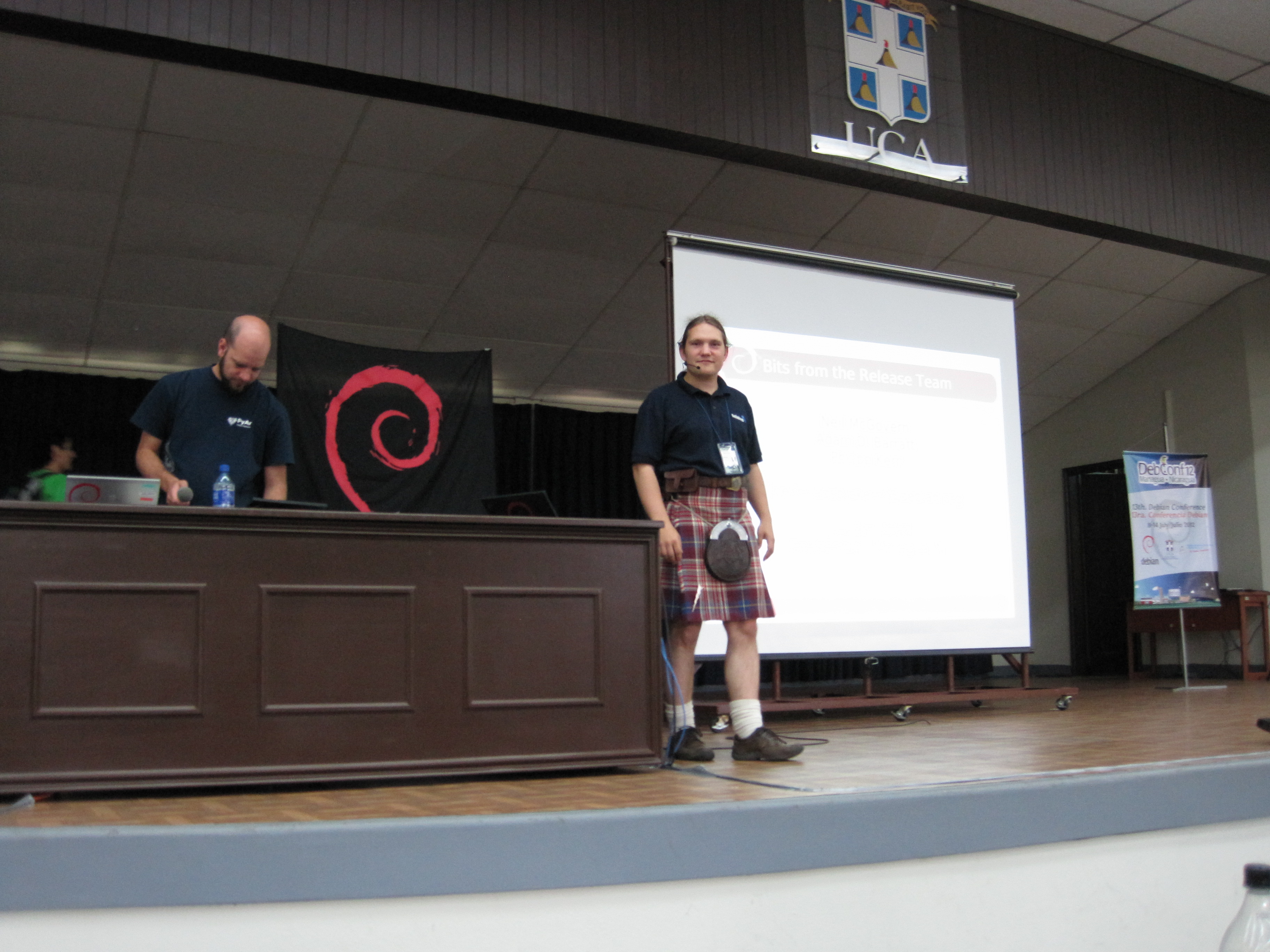


 Similar to


 Second day of
 I've finally published my Emacs configuration.
This took me a while, since I had personal information inside (like
passwords). Recently, I've been able to move them away and can now publish
everything in my
 I started to collect some

 If you have an M-Audio Audiophile 24/96 PCI sound card or anything else
using the "Envy24" chip, be aware: at present neither the GNOME3 "sound"
control panel applet nor the pulseaudio tool "pavucontrol" expose enough of
the card's controls to play any audio. You need to have

 At work, we have a rotation of who is on call at a given time. We
have few calls, but they do happen and so it's important to ensure
both that a person is available, but also that they're aware they are
on call (so they don't stray too far from their phone or a computer).
In the grand tradition of abusing spreadsheets, we are using google
docs for the roster. It's basically just two columns, one with date
and one with user name. Since the volume is so low, people tend to be
on call for about a week at a time, 24 hours a day.
Up until now, we've just had a pretty old and dumb phone that people
have carried around, but that's not really swish, so I have
implemented a small system which grabs the current data, looks up the
support person in LDAP and sends SMSes when people go on and off duty
as well as reminding the person who's on duty once a day.
If you're interested, you can look at the (slightly redacted)
