Search Results: "ag"

20 November 2011

Dirk Eddelbuettel: RcppArmadillo 0.2.30 (and 0.2.29)

A few days ago, Conrad Sanderson released the first pre-release version of what will be Armadillo 2.4.*, giving it the 2.3.91 release handle. We folded this into RcppArmadillo release 0.2.30, with Romain making a few adjustments to our template structure to accomodate Conrad's underlying changes in Armadillo itself. Armadillo is a wonderfully expressive (thanks to clever modern template programming), powerful yet simple-to-use C++ library for linear algebra, making expressions in C++ as easy as writing in Matlab or R. By deploying our seamless Rcpp glue between R and C++, RcppArmadillo brings this nice C++ library to R users. The CRAN page for RcppArmadillo now lists ten packages using the RcppArmadillo package. There was also an earlier bug-fix release 0.2.29 which I had not blogged about separately. The NEWS entries summarising the changes for both are below:
0.2.30  2011-11-19
    o   Upgraded to Armadillo test release 2.3.91 "Loco Lounge Lizard (Beta 1)"
          * added shorter forms of transposes: .t() and .st()
          * added optional use of 64 bit indices, allowing matrices to have
            more than 4 billion elements
          * added experimental support for C++11 initialiser lists
          * faster pinv()
          * faster inplace transpose
          * bugfixes for handling expressions with aliasing and submatrices
          * refactored code to eliminate warnings when using the Clang C++
            compiler
          * .print_trans() and .raw_print_trans() are deprecated 
0.2.29  2011-09-01
    o   Upgraded to Armadillo release 2.2.3
          * Release fixes a speed issue in the as_scalar() function.
Courtesy of CRANberries, there are also diffstat reports for 0.2.30 relative to 0.2.29 and for 0.2.29 relative to 0.2.28. As always, more detailed information is on the RcppArmadillo page. Questions, comments etc should go to the rcpp-devel mailing list off the R-Forge page.

Craig Small: procps-ng 3.3.0 Released

Tonight procps-ng, a fork of procps by developers from Debian, Fedora and SuSE was released. The main goal of the team for this release was to reduce the number of patches we all carry in our respective distributions and learn from each other. As an added bonus, we had one of the original authors of top, Jim, join the team and greatly enhance top. While the upstream version is now released, the debian package is not quite ready to go as it involves removing a lot of patches and adjusting some others. The build system is also now a reasonably standard (but different to previous) setup that means the packing scripts need adjusting. The best place to find out what is different is the procps NEWS file. The source code is available from Gitorious at https://gitorious.org/procps

Michael Casadevall: Possible GLX Bug in Ubuntu; feedback needed (affects Intel video cards 2D/3D acceleration)

So I've been recently screwing around with VirtualBox on a personal project, and I ran into an issue with not being able to enable 2D/3D acceleration on Ubuntu 11.10. After quite a bit of debugging and forum searching, the problem was that the NVIDIA GLX driver was being loaded instead of the standard MESA one, preventing any video acceleration from properly working on my Intel based video card.

I just recently reinstalled Kubuntu on this laptop, and since its a fairly stock install at the moment, I suspect that this is a general (K)ubuntu bug, and not something related to me screwing around with my system. In addition, since I switched to using Kubuntu full time, this is the first time I've seen transparency and other desktop effects, and system performance has improved dramatically. While I can't say for certian, I suspect that my system was also affected on its previous install. Part of the issue may be related to what packages are seeded per flavour, so this bug may only affect those who installed Kubuntu over say Xubuntu or Ubuntu; without more information, its impossible to say.

This is where you can help; if you are running any flavor of Ubuntu with an Intel based video card, you might be affected by this too.

Here's how to check; open a terminal, and type:

mcasadevall@daybreak:/var/log$ cat /var/log/Xorg.0.log

then find the section where the glx module is loaded. It looks something like this:

[236901.570] (II) LoadModule: "glx"
[236901.571] (II) Loading /usr/lib/xorg/modules/extensions/libglx.so
[236901.578] (II) Module glx: vendor="X.Org Foundation"
[236901.578] compiled for 1.10.4, module version = 1.0.0
[236901.578] ABI class: X.Org Server Extension, version 5.0

(this is on a machine where the Intel acceleration is properly working).

If it says 'ATi' or 'NVIDIA', you've run into the same issue I have. So dear readers, I ask that if you've had any issue with graphic performance, gaming, or simple UI lag and have an Intel video card, please post a comment with you video card, what flavor of Ubuntu you have installed, and the glx section of Xorg.0.log. If I get a few reports that confirm this, I'll file a proper bug in Launchpad, and then work to get this fixed.

Ben Hutchings: GNOME won't let you watch your videos in peace

Screensaver control on the Linux desktop is a total mess, but the xdg-screensaver command provided an interim cross-desktop solution by detecting and using the appropriate underlying interfaces. For GNOME, it depends on the gnome-screensaver-command --poke option, but that has been broken and then removed in favour of the cross-desktop D-Bus API org.freedesktop.ScreenSaver another GNOME-specific API which can't practically be used by xdg-screensaver. What's more, switching to the new API seems to have introduced various bugs in GNOME's own video player, Totem, such that it often failed to inhibit the screensaver in GNOME 2.32 and 3.0. Apparently everything is wonderful again in 3.2; here's hoping. (In case anyone asks where my bug report on the totem package is, I already looked at the bug list and it's clear that there's no point.) Updated: Well I said the GNOME Session D-Bus API couldn't practically be used in xdg-screensaver, but then set out to prove myself wrong. And with the aid of Perl, I may have succeeded.

19 November 2011

Miriam Ruiz: 3D Puzzle Game: Phlipple

You might remember the action puzzle game Zaz. Well, we now have a new puzzle game from the same author (Remigiusz mal1ce Dybka), called Phlipple. The goal of the game is to reduce a 3D shape to a single square in each level, removing squares by flipping edges around, like you would do in a cardboard box. The Free/Open source version of the game, including 50 levels, is now available in Debian, in case that you want to give it a chance. You can watch the promo video in Youtube if you want to have a better idea of what the game looks like. I hope that you like it, I do :) Here are some screenshots of the game: Screenshot of the gameScreenshot of the gameScreenshot of the game

Dominique Dumont: Debian SDL packaging team revival

Hello Most SDL packages are outdated, people are complaining in the BTS, and the team is mostly inactive. That s bad news for my project. What can I do ? Well, it s Debian project, I just have to step up. Thanks to Sam Hocevar, I m now admin on Debian Alioth SDL packaging project. I d like to revive the team. (Note that I don t have the bandwidth to be the team all by myself). Here are the first steps I plan (mostly inspired by the way Debian-perl team is working): Now, there are some ground rules I wish to push forward: If you don t agree with the above points, now is the time to say it. Feel free to join by:
  1. Creating an account on Alioth
  2. request to join sdl-team
  3. Last but not least, send a short introduction mail to pkg-sdl-maintainers AT lists.alioth.debian.org so we can know each other.
See you soon :-)

18 November 2011

Matthew Garrett: Clarifying the "secure boot attack"

Yesterday I wrote about an alleged attack on the Windows 8 secure boot implementation. As I later clarified, it turns out that the story was, to put it charitably, entirely wrong. The attack is a boot kit targeted towards BIOS-based boots. It lives in the MBR. It'll never be executed on any UEFI systems, let alone secure boot ones. In fact, this is precisely the kind of attack that secure boot is intended to protect against. So, context.

The MBR contains code that's executed by the BIOS at boot time. This code is unverifiable - it's permitted to have arbitrary functionality. There's only 440 bytes, but that's enough to jump to somewhere else and read code from elsewhere. There's no way for the BIOS to know that this code is malicious. And one thing this code can obviously do is load the normal boot code and modify it to behave differently. Any self-validation code in the loader can be patched out at this point. The modified loader will then load the kernel, and potentially also modify it. At this point, you've lost. Any attempts to validate the code can be redirected to the original code and so everything will look fine, up until the point where the user runs a specific application and suddenly your kernel is sending all your keystrokes over UDP to someone in Nigeria.

These attacks exist now. They're in the wild. In a normal UEFI world you'd do the same thing by just replacing the UEFI bootloader. But with secure boot you'll be able to validate that the bootloader is appropriately signed and if someone's modified it you'll drop into some remediation mode that recovers your files, from install media if necessary.

Obviously, this protection is based on all the components of secure boot (ie, everything that runs before ExitBootServices() is called) being perfect. As I said, if any of them accept untrusted input and misinterpret it in such a way that they can be tricked into running arbitrary code, you'll still have problems. But when discussing the pros and cons of secure boot, it's important to make sure that we're talking about reality rather than making provably false assertions.

comment count unavailable comments

Alexander Reichle-Schmehl: Release Critical Bug report for Week 46

The bug webinterface of the Ultimate Debian Database currently knows about the following release critical bugs:
In Total:1812
Affecting Wheezy:1161
Wheezy only:163
Remaining to be fixed in Wheezy:998
Of these 998 bugs, the following tags are set:
Pending in Wheezy:47
Patched in Wheezy:191
Duplicates in Wheezy:47
Can be fixed in a security Update:31
Contrib or non-free in Wheezy:16
Claimed in Wheezy:0
Delayed in Wheezy:4
Otherwise fixed in Wheezy:89
Ignoring all the above (multiple tags possible) 631 bugs need to be fixed by Debian Contributors to get Debian 7.0 Wheezy released. However, with the view of the Release Managers, 1053 need to be dealt with for the release to happen. Please see Interpreting the release critical bug statistics for an explanation of the different numbers.

Meike Reichle: Reminder: BSP in Hildesheim, Germany, 2-4 Dec 2011

We still have some free spaces in the Hildesheim BSP, which is scheduled in two weeks. (Friday 2nd to Sunday 4th of December). If you need any additional information or want to come by please check the wiki page.

Pau Garcia i Quiles: FOSDEM 2012 CrossDesktop DevRoom Call for Talks

FOSDEM is one of the largest gatherings of Free Software contributors in the world and happens each February in Brussels (Belgium). One of the developer rooms will be the CrossDesktop DevRoom, which will host Desktop-related talks. We are now inviting proposals for talks about Free/Libre/Open-source Software on the topics of Desktop development, Desktop applications and interoperativity amongst Desktop Environments. This is a unique opportunity to show novel ideas and developments to a wide technical audience. Topics accepted include, but are not limited to: Enlightenment, Gnome, KDE, XFCE, Windows, Mac OS X, general desktop matters, applications that enhance desktops and web (when related to desktop). Talks can be very specific, such as developing mobile applications with Qt Quick; or as general as predictions for the fusion of Desktop and web in 5 years time. Topics that are of interest to the users and developers of all desktop environments are especially welcome. The FOSDEM 2011 schedule might give you some inspiration. Please include the following information when submitting a proposal: your name, the title of your talk (please be descriptive, as titles will be listed with around 250 from other projects) and a short abstract of one or two paragraphs. The deadline for submissions is December 20th 2011. FOSDEM will be held on the weekend of 4-5 February 2012. Please submit your proposals to crossdesktop-devroom@lists.fosdem.org Also, if you are attending FOSDEM 2012, please add yourself to the KDE community wiki page so that we organize better. We need volunteers for the booth!

17 November 2011

Alastair McKinstry: Never Again

Never Again I grew up in the era of old men at Church, wearing poppies and their medals this time of year, in commemoration of their friends and neighbours who had died in the Great War. On the 11 November, they would remember the Armistice, those who had died, and with silence respect the promise that it be the War to End All Wars. Because for them this was not an ironical phrase, but a promise betrayed; that Never Again should this happen. As the last of those men have died, the commemorations of the Armistice have been insidiously hijacked, and using 'honouring our troops', those who never had to see their brothers drown in the mud at Passchendale have moved from 'Never Again' to 'Always Ready', always ready to fight, always read to go to war. As a pacifist I have always felt uneasy about war commemorations. But it is all too late that I realise why I never really had a problem with those who fought in the war, and never talked of its horrors. Its those for whom the commemoration is a time for fine speeches, then back to the office to prepare for the next war that I despise. Never again.

Matthew Garrett: GPT disks in a BIOS world

Starting with Fedora 16 we're installing using GPT disklabels by default, even on BIOS-based systems. This is worth noting because most BIOSes have absolutely no idea what GPT is, which you'd think would create some problems. And, unsurprisingly, it does. Shock. But let's have an overview.

GPT, or GUID Partition Table, is part of the UEFI specification. It defines a partition table format that allows up to 128 partitions per disk, with 64 bit start and end values allowing partitions up to 9.4ZB (assuming 512 byte blocks). This is great, because the existing MBR partitioning format only allows up to 2.2TB when using 512 byte blocks. But most BIOSes (and most older operating systems) don't understand GPT, so plugging in a GPT-partitioned disk would result in the system believing that the drive was uninitialised. This is avoided by specifying a protective MBR. This is a valid MBR partition table with a single partition covering the entire disk (or the first 2.2TB of the disk if it's larger than that) and the partition type set to 0xee ("GPT Protective"). GPT-unaware BIOSes and operating systems will see a partition they don't understand and simply ignore it.

But how do we boot a GPT-labelled disk with a protective MBR on a system that doesn't understand GPT? The key here is that BIOS is pretty dumb. Typically a BIOS will see a disk and just attempt to execute the code in the first sector. This MBR code knows how to do the rest of the boot, including parsing the partition table if necessary. The BIOS doesn't need to care at all.

Of course, some BIOSes choose to care. We've seen a small number of machines that, when exposed to a GPT disk, refuse to boot because they parse the MBR partition map and don't like what they see. This is typically accompanied by a message along the lines of "No operating system found". What we've found is that they're looking for a partition marked with the bootable flag, and if no partitions are marked bootable they assume that there's no OS. This is in contrast to the traditional use of the flag, which is merely a hint to the MBR as to which partition boot code it should execute.

So, should we set that flag? The UEFI specification specifically forbids it - table 15 states that the BootIndicator byte must be set to 0. Once again we're left in an unfortunate position where the specification and reality collide in an awkward way.

If this happens to you after a Fedora 16 install, you have two choices. The first is to reinstall with the "nogpt" boot argument. The installer will then set up a traditional MBR partition table. The second is to boot off a live CD and run fdisk against the boot disk. It'll give a bunch of scary warnings. Ignore them. Hit "a", then "1", then "w" to write it to disk. Things ought to work then. We'll figure out something better for F17.

comment count unavailable comments

Matthew Garrett: Making timeouts work with suspend

A reasonably common design for applications that want to run code at a specific time is something like:

time_t wakeup_time = get_next_event_time();
time_t now = time(NULL);
sleep(wakeup_time-now);

This works absolutely fine, except that sleep() ignores time spent with a suspended system. If you sleep(3600) and then immediately suspend for 45 minutes you'll wake up after 105 minutes, not 60. Which probably isn't what you want. If you want a timer that'll expire at a specific time (or immediately after resume if that time passed during suspend), use the POSIX timer family (timer_create, timer_settime and friends) with CLOCK_REALTIME. It's a signal-driven interface rather than a blocking one, so implementation may be a little more complicated, but it has the advantage of actually working.

comment count unavailable comments

Raphaël Hertzog: People Behind Debian: Mark Shuttleworth, Ubuntu s founder

I probably don t have to present Mark Shuttleworth he was already a Debian developer when he became millionaire after having sold Thawte to Verisign in 1999. Then in 2002 he became the first African (and first Debian developer) in space. 2 years later, he found another grandiose project to pursue: bring the Microsoft monopoly to an end with a new alternative operating system named Ubuntu (see bug #1). I have met Mark during Debconf 6 in Oaxtepec (Mexico), we were both trying to find ways to enhance the collaboration between Debian and Ubuntu. The least I can say is that Mark is opinionated but any leader usually is, and in particular the self-appointed ones! :-) Read on to discover his view on the Ubuntu-Debian relationship and much more. Raphael: Who are you? Mark: At heart I m an explorer, inventor and strategist. Change in technology, society and business is what fascinates me, and I devote almost all of my time and wealth to the catalysis of change in a direction that I hope improves society and the environment. I m 38, studied information systems and finance at the University of Cape Town. My hearts home is Cape Town, and I ve lived there and in Star City and in London, now I live in the Isle of Man with my girlfriend Claire and 14 precocious ducks. I joined Debian in around 1995 because I was helping to setup web servers for as many groups as possible, and I thought Debian s approach to packaging was very sensible but there was no package for Apache. In those days, the NM process was a little easier ;-) Raphael: What was your initial motivation when you decided to create Ubuntu 7 years ago? Mark: Ubuntu is designed to fulfill a dream of change; a belief that the potential of free software was to have a profound impact on the economics of software as well as its technology. It s obvious that the technology world is enormously influenced by Linux, GNU and the free software ecosystem, but the economics of software are still essentially unchanged. Before Ubuntu, we have a two-tier world of Linux: there s the community world (Debian, Fedora, Arch, Gentoo) where you support yourself, and the restricted, commercial world of RHEL and SLES/SLED. While the community distributions are wonderful in many regards, they don t and can t meet the needs of the whole of society; one can t find them pre-installed, one can t get certified and build a career around them, one can t expect a school to deploy at scale a platform which is not blessed by a wide range of institutions. And the community distributions cannot create the institutions that would fix that. Ubuntu brings those two worlds together, into one whole, with a commercial-grade release (inheriting the goodness of Debian) that is freely available but also backed by an institution. The key to that dream is economics, and as always, a change in economics; it was clear to me that the flow of money around personal software would change from licensing ( buying Windows ) to services ( paying for your Ubuntu ONE storage ). If that change was coming, then there might be room for a truly free, free software distribution, with an institution that could make all the commitments needed to match the commercial Linux world. And that would be the achievement of a lifetime. So I decided to dedicate a chunk of my lifetime to the attempt, and found a number of wonderful people who shared that vision to help with the attempt. It made sense to me to include Debian in that vision; I knew it well as both a user and insider, and believed that it would always be the most rigorous of the community distributions. I share Debian s values and those values are compatible with those we set for Ubuntu.
Debian would always be the most rigorous of the community distributions.
Debian on its own, as an institution, could not be a partner for industry or enterprise. The bits are brilliant, but the design of an institution for independence implies making it difficult to be decisive counterparty, or contractual provider. It would be essentially impossible to achieve the goals of pre-installation, certification and support for third-party hardware and software inside an institution that is designed for neutrality, impartiality and independence. However, two complementary institutions could cover both sides of this coin. So Ubuntu is the second half of a complete Debian-Ubuntu ecosystem. Debian s strengths complement Ubuntu s, Ubuntu can achieve things that Debian cannot (not because its members are not capable, but because the institution has chosen other priorities) and conversely, Debian delivers things which Ubuntu cannot, not because its members are not capable, but because it chooses other priorities as an institution. Many people are starting to understand this: Ubuntu is Debian s arrow, Debian is Ubuntu s bow. Neither instrument is particularly useful on its own, except in a museum of anthropology ;)
Ubuntu is Debian s arrow, Debian is Ubuntu s bow.
So the worst and most frustrating attitude comes from those who think Debian and Ubuntu compete. If you care about Debian, and want it to compete on every level with Ubuntu, you are going to be rather miserable; you will want Debian to lose some of its best qualities and change some of its most important practices. However, if you see the Ubuntu-Debian ecosystem as a coherent whole, you will celebrate the strengths and accomplishments of both, and more importantly, work to make Debian a better Debian and Ubuntu a better Ubuntu, as opposed to wishing Ubuntu was more like Debian and vice versa. Raphael: The Ubuntu-Debian relationship was rather hectic at the start, it took several years to mature . If you had to start over, would you do some things differently? Mark: Yes, there are lessons learned, but none of them are fundamental. Some of the tension was based on human factors that cannot really be altered: some of the harshest DD critics of Canonical and Ubuntu are folk who applied for but were not selected for positions at Canonical. I can t change that, and wouldn t change that, and would understand the consequences are, emotionally, what they are. Nevertheless, it would have been good to be wiser about the way people would react to some approaches. We famously went to DebConf 5 in Porto Allegre and hacked in a room at the conference. It had an open door, and many people popped a head in, but I think the not-a-cabal collection of people in there was intimidating and the story became one of exclusion. If we d wanted to be exclusive, we would have gone somewhere else! So I would have worked harder to make that clear at the time if I d known how many times that story would be used to paint Canonical in a bad light. As for engagement with Debian, I think the situation is one of highs and lows. As a high, it is generally possible to collaborate with any given maintainer in Debian on a problem in which there is mutual interest. There are exceptions, but those exceptions are as problematic within Debian as between Debian and outsiders. As a low, it is impossible to collaborate with Debian as an institution, because of the design of the institution.
It is generally possible to collaborate with any given maintainer [ ] [but] it is impossible to collaborate with Debian as an institution.
In order to collaborate, two parties must make and keep commitments. So while one Debian developer and one Ubuntu developer can make personal commitments to each other, Debian cannot make commitments to Ubuntu, because there is no person or body that can make such commitments on behalf of the institution, on any sort of agile basis. A GR is not agile ;-) . I don t say this as a critique of Debian; remember, I think Debian has made some very important choices, one of those is the complete independence of its developers, which means they are under no obligation to follow a decision made by anyone else. It s also important to understand the difference between collaboration and teamwork. When two people have exactly the same goal and produce the same output, that s just teamwork. When two people have different goals and produce different product, but still find ways to improve one anothers product, that s collaboration. So in order to have great collaboration between Ubuntu and Debian, we need to start with mutual recognition of the value and importance of the differences in our approach. When someone criticises Ubuntu because it exists, or because it does not do things the same way as Debian, or because it does not structure every process with the primary goal of improving Debian, it s sad. The differences between us are valuable: Ubuntu can take Debian places Debian cannot go, and Debian s debianness brings a whole raft of goodness for Ubuntu. Raphael: What s the biggest problem of Debian? Mark: Internal tension about the vision and goals of Debian make it difficult to create a harmonious environment, which is compounded by an unwillingness to censure destructive behaviour. Does Debian measure its success by the number of installs? The number of maintainers? The number of flamewars? The number of packages? The number of messages to mailing lists? The quality of Debian Policy? The quality of packages? The freshness of packages? The length and quality of maintenance of releases? The frequency or infrequency of releases? The breadth of derivatives? Many of these metrics are in direct tension with one another; as a consequence, the fact that different DD s prioritise all of these (and other goals) differently makes for interesting debate. The sort of debate that goes on and on because there is no way to choose between the goals when everyone has different ones. You know the sort of debate I mean :-) Raphael: Do you think that the Debian community improved in the last 7 years? If yes, do you think that the coopetition with Ubuntu partly explains it? Mark: Yes, I think some of the areas that concern me have improved. Much of this is to do with time giving people the opportunity to consider a thought from different perspectives, perhaps with the benefit of maturity. Time also allows ideas to flow and and of course introduces new people into the mix. There are plenty of DD s now who became DD s after Ubuntu existed, so it s not as if this new supernova has suddenly gone off in their galactic neighbourhood. And many of them became DD s because of Ubuntu. So at least from the perspective of the Ubuntu-Debian relationship, things are much healthier. We could do much better. Now that we are on track for four consecutive Ubuntu LTS releases, on a two-year cadence, it s clear we could collaborate beautifully if we shared a freeze date. Canonical offered to help with Squeeze on that basis, but institutional commitment phobia reared its head and scotched it. And with the proposal to put Debian s first planned freeze exactly in the middle of Ubuntu s LTS cycle, our alignment in interests will be at a minimum, not a maximum. Pure <facepalm />. Raphael: What would you suggest to people (like me) who do not feel like joining Canonical and would like to be paid to work on improving Debian? Mark: We share the problem; I would like to be paid to work on improving Ubuntu, but that s also a long term dream ;-) Raphael: What about using the earnings of the dormant Ubuntu Foundation to fund some Debian projects? Mark: The Foundation is there in the event of Canonical s failure to ensure that commitments, like LTS maintenance, are met. It will hopefully be dormant for good ;-) Raphael: The crowdfunding campaign for the Debian Administrator s Handbook is still going on and I briefly envisioned the possibility to create the Ubuntu Administrator s Handbook. What do you think of this project? Mark: Crowdfunding is a great match for free software and open content, so I hope this works out very well for you. I also think you d find a bigger market for an Ubuntu book, not because Ubuntu is any more important than Debian but because it is likely to appeal to people who are more inclined to buy or download a book than to dive into the source. Again, this is about understanding the difference in audiences, not judging the projects or the products. Raphael: Is there someone in Debian that you admire for their contributions? Mark: Zack is the best DPL since 1995; it s an impossible job which he handles with grace and distinction. I hope praise from me doesn t tarnish his reputation in the project!
Thank you to Mark for the time spent answering my questions. I hope you enjoyed reading his answers as I did.

Subscribe to my newsletter to get my monthly summary of the Debian/Ubuntu news and to not miss further interviews. You can also follow along on Identi.ca, Google+, Twitter and Facebook .

32 comments Liked this article? Click here. My blog is Flattr-enabled.

Timo Jyrinki: On discussing free software mobile phones

Since I think I just summarized a few thoughts of mine well at LWN, I'll copy-paste it here:
I can grumble about Android from time to time, but I do not say that it sucks. Extreme views are what are annoying. Android is what it is and it's great as it is, even though it could be different as well.

When it comes to discussing about free software and mobile phones, I'm especially annoyed by two types of comments:

1. People essentially saying that there is no value in an open project, ie. free software code dumps should be enough for everybody. I'm interested in the long term viability of free software projects, and it is hard to have successful projects without there being all sorts of factors that make up a good project - like transparency, inclusion, meritocracy. Even though the mobile projects have had little resources and a hard road, it's not useful to forget about these goal in the longer term. For example Debian, Mer, SHR, KDE Plasma Active have some of these in the mobile sector. I hope the best for them (and participate).

2. People complaining about something being not 100% free software, while not themselves actually even interested in it for other sake than complaining. When I've been talking about free software mobile phones, from time to time there is someone complaining about eg. not open GSM stack, wlan firmwares etc.. and to put it sharply probably writing the message from iPhone, while I'm reading it on Neo FreeRunner. If the complainer would be Harald Welte, I'd probably listen and agree with him.

So there. For more civilized discussion.

Alberto Garc a: 10 years

We have many reasons to be happy these days. 10 years rocking in the free world

Russell Coker: Cruises

It seems that in theory cruises can make for quite economical vacations. The cheapest prices tend to be around $100 per person per night for an inside cabin (IE no window) with two people (there is a significant extra fee for having a cabin with only one person). If you book a room in a half-decent hotel with a pool in some moderately desirable place then you will probably pay about $200 per night which might get you free breakfast but won t include lunch or dinner. Cruises include all the free food you can eat for at least 16 hours of the day with maybe an extra fee for getting food in the middle of the night. When a cruise ship stops at the port you can pay for an expensive shore trip arranged by the cruise company or have a cheap trip that involves walking on the beach or taking a taxi to somewhere local. Of course there are lots of extras that can make a cruise really expensive, but if you don t plan to eat at speciality restaurants or drink much alcohol then that shouldn t be a problem. I ve just booked a short luxury cruise, mostly as a trial of the cruise concept. The process of doing so was difficult enough that even if I hadn t previously needed a holiday then I d probably need one now. It would be interesting to compare the amount of time that a reasonable person would be likely to spend choosing a holiday and purchasing it for the different types of holiday, I expect that cruising would be a long way behind everything that involves flying to a foreign city and staying in a hotel. The Issues of Booking When booking a regular holiday you choose where to visit, then choose the time of year, the accommodation, and travel. While the order can vary it s generally a sequential process without too many variables at any stage. With a cruise one of the first decisions is to choose the cruise line, different lines cater to various market segments it s clear what Disney cruises aim for but often not so clear for others. Apart from Disney the other cruise lines don t seem to make clear statements about who they are and aren t targeting. Then there are a variety of ships run by each cruise line which in many cases offer different features, do you want 1 pool or 4? Do you want ice skating? The cruise lines that I have investigated don t offer clear comparisons of their ships. As a cruise ship is essentially a hotel, a collection of restaurants, and some other entertainment you can t just arbitrarily choose one the way you might choose a random hotel with a suitable price and rating. Now while you can choose a hotel and generally get a room when you want a cruise booking has to be made when the ship is in a convenient port. So your holiday needs to be scheduled around the availability of the ship. CruiseCritic.com is an excellent source of information on cruises and has a very active and useful advice forum [1]. The forum appears to be dominated by retirees, presumably because retirees have time to just wait for a ship they like to visit their local port while people who have to schedule holidays around work projects etc. When booking a hotel I have found that Wotif.com is really good for comparing hotels and finding a reasonably cheap one and they also have periodic mail-outs about special deals. I have made a couple of short vacations based on Wotif offering me unusually good prices on a hotel in a place that I was mildly interested in visiting. There are also special deals on cruises, but it s a lot more difficult to take them. Firstly as cruises aren t as interchangeable as hotels it s not as appealing to take an offer of a cruise you didn t previously consider because it s going cheap. The second factor is that according to cruise reviews there is more variation among cabins than there is among hotel rooms. The design of the ship that is needed to cram everything in the available space means that some cabins apparently have noise pollution from various activities on the ship while others are considered to have problems for people prone to sea-sickness. Discounts probably only apply after people who pay non-discount rates have had a chance to book what might be considered the better cabins. Of course it could be a good thing to have most of the ship booked out, CruiseCritic.com has some reviews of individual cabins and presumably there are people who compare hundreds of cabins to discover what is ideal for them. The Problem with Princess I have booked a Princess cruise. I chose it because it was going cheap, but the first two travel agents that advertised it were unable to take my order because Princess only allows US based agencies (which means the discount agents on the net) to sell to US customers I don t think that the people who run the Princess cruise company know what the Internet is about. So I booked the cruise through the Princess web site, they took my money, told me that a good chunk of that money would never be returned if I cancelled, and then sent me to the web page for providing all the information that they need which is a lot. The big problem was when their web site absolutely demanded a passport number and said that I would not be allowed to board without one even though their FAQ (and common sense) indicated that a cruise which doesn t involve any international travel has no need of a passport. Taking someone s money and then telling them that they can t attend due to not having a valid passport is one way of making a future passenger very unhappy. I called the support people (which was Carnival) and had to listen to some really strange hold music it was difficult to determine if the music was produced by someone with unusual tastes in electronic music vastly different from my own preference or whether the computer which manages the phone calls was producing noise instead of music. Eventually I got through to an operator who was very helpful and stored my drivers license number which was adequate. While on the topic of their web site, when booking a cruise with Princess they list which types of cabin (interior, balcony, etc) are available and list the price for the cheapest category of cabin in each price. However if the cheapest category is all sold out then it will still list that cheapest price and thus be advertising a price that can t be booked. This is misleading and annoying. Further Hassle But the difficulty doesn t end here. On a cruise you have to book in advance for which dinner seating you desire which is usually only early or late but some ships offer anytime . Then if you happen to be travelling with people who are in a separate cabin and paying separately (which one would expect to be fairly common) there is no obvious way of synchronising dinner preferences the ship people might assign people to different tables. I admit that I haven t fully explored the post-booking part of the Princess web site, maybe I can arrange a shared table but for the moment my pain threshold for the cruise booking process has been exceeded. Other Cruising Stuff Insight Cruises (formerly Geek Cruises) offers a variety of educational cruises including science, astronomy, chess, art, history, and some other things [2]. From a casual inspection of their web site it seems that the cruise prices are around $300 per night for a 2 person cabin and the registration fees for the conferences are between $1200 and $1500. Most readers of my blog will consider this to be unreasonably expensive as registration for a Linux conference tends to be a lot less than $1000. But when compared to typical for-profit conferences $1500 isn t anywhere near the high end of the range. Also while someone who is choosing a cruise holiday can easily get a cruise that costs less than $200 per day for a 2 person cabin, for commercial conferences it s not uncommon to spend more than $300 per night for two people on accommodation and food. So the only noteworthy part about the cost is that accommodation will be quite expensive if you aren t sharing a room. If you want to run a conference on a cruise there are companies which specialise in such things, Landry and Kling is one company that specialises in planning corporate events [3]. They do seem to aim for the high end of the market, including chartering a small cruise ship or half a large cruise ship that means ~1000 passengers. While there are some conferences with more than 1000 delegates it seems that most conferences top out at about 500 delegates. However I know that some conferences have limited the number of delegates to the maximum capacity of the biggest lecture hall available as some cruise ships have a theater with more than 1000 seats it seems that similar conferences could potentially arrange a half ship charter. A half ship charter apparently allows exclusive access to one of the theaters (at least when it s not needed for evening entertainment) and exclusive seating at the main dining room. It s a standard feature that cruise ships have all the equipment you might need to run a conference. Autism on the Seas is a brand used by the Alumni Cruise company for their holiday packages for special needs children [4]. They sell cruise tickets at the regular list price and the commission that they receive when acting as a travel agency is enough to hire staff to look after the kids while presumably still running at a profit. It seems to me that a similar model could be used for a computer conference, make a profit on cruise ticket sales and then have no extra costs for the conference for people sharing a room that would be cheaper than most Linux conferences I ve attended. For smaller conferences and un-conferences there is no minimum reservation size. One down-side for a computer conference is the cost of Internet access, according to Wikipedia a personal installation of satellite net access costs $5 per megabyte and ship pricing for their Internet access is up around $30-$100 per hour per person! But in the old days when attending a conference meant a week of no net access we survived somehow. It also seems to me that if a company had a small development team it could be productive to put everyone on a cruise ship with a server for testing and version control. They could do 9 hour days on board and still have lots of time for relaxation as it s only a few minutes walk to the pool. Of course this wouldn t work if some members of the team wanted to stay home due to slow and expensive net access.

Christian Perrier: New update about Debian Installer localization

Bosnian, Hindi, Marathi complete level 1. Slovak completes level 3. Full stats are here Status for D-I level 1 (core D-I files): Status for D-I level 2 (packages that have localized material that may appear during default installs, such as iso-codes, tasksel, etc.): Status for D-I level 3 (packages that have localized material that may appear during non-default installs, such as win32-loader) So, full 100% completeness (hall of fame) for: German (de), Persian (fa), French (fr), Portuguese (pt, Russian (ru)
15 November 2011

John Goerzen: A Parenting Dilemma

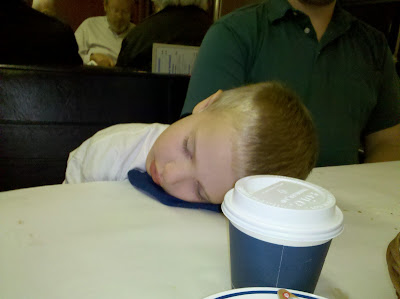
A few snippets so far from our train trip from Kansas to Portland. Terah, Jacob, Oliver, and I are on the trip, which is about 2.5 days on the train. The Parenting Dilemma So, if you are eating dinner, and your 5-year-old falls asleep with his head on the table, and you know he had been excitedly waiting for raspberry sorbet for dessert, and know there will be tears when he later realizes he missed it, what do you do? Let him sleep, or wake him up (with possible tears right then in the dining car?) As it turned out, I tried to quietly ask him if he wanted dessert. He woke up with a start, banged his head on the table, and then, yes, there were tears. I asked him if he wanted dessert or if he wanted to keep sleeping, and he gave a pathetic, sniffling, dessert. But by the time dessert arrived, he had fallen asleep again. I finally woke him up again, asked if he wanted to eat, and he just ignored me. I asked twice more and then he all of a sudden realized what he was being asked, sat bolt upright, and dug in. Graffiti Jacob noticed graffiti in Los Angeles. He called it silly words and kept commenting about it as we passed it. Bears Oliver always sleeps with a stuffed bear, which is his favorite comfort animal. But Oliver is 2, and when he says bear , it sounds more like beer . Plus, the boys still seem to be operating on Central Time. So at 4:15AM yesterday, Oliver awakened us saying: Beer! Beer! Beer! Where s beer? Where s beer? Need beer! Beeeeeer! Butterflies Jacob always sleeps with a stuffed butterfly, which he likes just like Oliver likes his bear. Jacob had this conversation with me this morning: Jacob: My butterfly knows all the people in the world. And all the animals, too! Me: Does butterfly even know Nash? (our cat) Jacob: Yeah, and he knows Sam and Edna too! (the cats across the road) Me: Wow. I think butterfly knows a lot more people and animals than I do. Jacob: *brief pause, then* Oh, silly dad! *collapses laughing*

Michael Casadevall: Secure Boot - its here and been here for quite awhile ...

There's been a lot of noise with Microsoft requiring Secure Boot for Windows 8 OEMs. For those of you unfamiliar with it, Secure Boot requires that the boot chain is signed, and this 'feature' must be enabled by default. Although I have been unable to find specific details, it appears that the chain of trust needs to extend from BIOS/UEFI all the way down to the kernel. Obviously, requiring a signed boot chain makes using FOSS platforms like Ubuntu or Debian an impossibility short of having the UEFI Platform Key and resigning the entire chain.

Steven Sinofsky's MSDN blog has a fairly good overview how it works. Canonical and Red Hat also have a good white paper on why secure boot is a serious problem for Linux distributions. Even if secure boot itself can be disabled, it *greatly* rises the bar for general end-users to successfully install Ubuntu on their machine. In addition, it is the responsibility of OEM and BIOS manufacturers to provide the option to disable it.

There already has been a long history of OEMs removing BIOS options or introducing DRM; for instance, locking out VTx on Sony laptops, or restricting laptops to only accept 'branded' wifi and 3G cards. Given this track record, can OEMs realistically be trusted to have this option available?

What most people don't realize is that secure boot itself is not a new concept; its simply part of the Trusted Computing initiative, and has been implemented on embedded platforms for many years. If you own any iPhone, or one of the vast majority of Android devices, you are using a device that either has the secure boot feature, or something very close. This especially painful in Android as Google's security system restricts users to a *very* limited shell and subset of utilities which can be used on non-rooted devices. WebOS, Maemo, and to my knowledge Meego give the end-user full unrestricted access to the boot chain and you can swap kernels and even the entire OS out if one was so motivated.

Although it is still an ongoing problem, several vendors such as HTC, Samsung, Motorola (kinda), and even Sony. In the Android community, having unlockable bootloaders has been a welcome middle ground in the traditionally restrictive and locked-down world of cellular devices.

While some may argue that such locks are necessary to protect consumers, it is perfectly feasible to create devices with unlocked bootloaders that are still secure. The Nook Color's is an Android powered eReader. It's stock firmware doesn't allow sideloaded applications or even access to a user shell via adb, but the BootROM on the device attempts to boot from the microSD card before eMMC, making it possible for enterprising users to easily modify the underlying OS (as well as making it physically impossible to brick the device due to a bad flash). Barnes and Nobles even sells a book on rooting the Nook Color; it was right next to the devices on display at the time. In addition, they've continued the tradition of easily modifiable devices with both the Nook Simple Touch, and the Nook Tablet.

One of the most impressive attributes is the possibility of running Ubuntu on it. The absolute poster child for this is the Toshiba AC100. For those of you unfamiliar, it ultralight netbook that shipped with Android 2.1/2.2 with easy access to the built in flash via the mini-USB port on the side of the device. Due to the valiant efforts of the AC100 community, Ubuntu was ported to this device, and became a supported platform with images available on cdimages.ubuntu.com. If you were an attendee at UDS, you likely saw several AC100s all running Ubuntu.

This brings me to the point that motivated me to write this post in the first place. One of the most impressive tablets I've seen to date is the ASUS eeePad Transformer, an Android tablet with fully dockable keyboard. I have one of these devices, and its one of the most impressive and usable Android tablets I own. Sadly, such a powerful device was hobbled from its true potential due to ASUS's decision to ship the device with a locked and encrypted bootloader. Surprisingly, the Secure Boot Key (SBK) was acquired and released to the wild, making it possible to reflash the device. Sadly, even with the SBK, the device's bootloader is still extremely hobbled compared to the AC100 making flashing a slow and difficult process.

In response, ASUS refreshed the eeePad's hardware to the new B70 SKU, which has a new Secure Boot. Despite this, a root exploit was recently found to allow people to circumvent these restrictions and install customs ROMs. It is however only a manor of time before ASUS responds and releases a new update that fixes this bug.

Steven Barker (lilstevie) on xda-developers successfully created a port of Ubuntu to the Transformer. Currently, installing Ubuntu on the Transformer requires nvflash access, so its not possible to use his image on the newly liberated B70 devices. I am certain that a new method of installing via an update.zip will be developed for those of us with hobbled devices.

It is a showcase of what is possible when you have open hardware, and also proves one indisputable point: any 'trusted boot' or DRM scheme can and will be defeated; at best you piss off your userbase, and at worst, you force users to exploit bugs to gain control of their device. As it is impossible to reflash these devices from the bootloader, a failed kernel flash WILL brick these devices, increasing warranty and support costs as users try to return their now broken devices.

In closing, while there have been some victories in ongoing war of open hardware vs. trusted comptuing, the road ahead still remains very murky. Victories in the mobile market have shown that there is a market for open devices. Google's own Nexus One was sold as a developers phone and as a way to encourage manufacturers to raise the bar. It sold well enough to recoup its development costs.. While there is no official statements, the Nokia N900 is suspected to have broken all sales expectations, backed up by the fact that Angry Birds sold extremely well on the Ovi Store for the N900.

From the article in question:
What reaction have you had in terms of sales and customer feedback?

Angry Birds had already been launched on App Store before it came out on Ovi Store, and it had a great review average from iPhone reviewers and users alike, so we expected a good reception from N900 users as well.

Even so, we were quite surprised by just how the N900 community immediately took the game to heart. The game obviously made many people very happy, and that is really the greatest achievement that anyone who creates entertainment for a living can hope for. Well, maybe the greatest achievement is huge bundles of cash, but making people happy comes a close second.

In the first week that Angry Birds has been on the Ovi Store, it has been downloaded almost as many times as the iPhone version in six weeks. Given that most N900 users have not even used Ovi Store yet, we are confident that there will be many more downloads in the months to come, and are sure that the N900 version will be very profitable.

That being said, with Microsoft pushing secure boot and trusted computing down everyone's throats with Windows 8, it is hard to say what the future might hold for those of us who want to own our devices.

Next.

Previous.