Search Results: "will"

23 September 2007

Jeff Bailey: Tour of Mountain View

We took a tour of Mountain View with Leslie yesterday. It was nice to look around and see what was actually around here for shopping / things to do / how to escape to somewhere else. It looks like the biggest redeeming feature of MTV is that one can leave. It reminds me of Coquitlam. It's the last place we're considering outside of the city - but considering that we're not going to really be out partying in the next year, the crime rate is very low, and rent is sometimes half of what we'd pay, it's definetly worth considering. It also will keep the commute down to something reasonable (probably 15 minutes on a bike, almost too short).

Weird American thing of the day: Apparently for everything you need your SSN here. At home, the only people who are allowed to ask for the Canadian equivalent (SIN) are people who are going to pay you money. So a credit check can't require it. Your health card can't require it. Your driver's license can't require it. Angie not having one is going to get sticky in a few cases.

I actually walked just under 10,000 steps on Friday. I didn't bike because I wasn't feeling well, and it seems that the walk to the commuter train is somewhere between 2 and 3 thousand steps.

Biella Coleman: Decoding Liberation, Book Launch Party

I am helping to kick off the Decoding Liberation Book Launch Party at the Brecht Forum in NYC. If you are in the area, and are into the politics of free software, do come along. Details also pasted below as their webpage is a little bit of an aesthetic jumble.
The Brecht Forum invites you to celebrate the release of Decoding Liberation: The Promise of Free and Open Source Software, by Samir Chopra and Scott Dexter, published by Routledge in their New Media and Cyberculture Series. October 3rd, 7:30 PM
451 West Street (between Bank & Bethune Streets, New York, NY 10014.
(212) 242-4201
brechtforum@brechtforum.org Suggested Donation: $6/$10/$15
Free for Brecht Forum Subscribers Featuring commentary by Gabriella Coleman and discussions with the authors
and audience. A reception will follow.
(more…)

Christian Perrier: RWC: ARG nearly in 1/4th, ENG wakes up

After the stunning match between RSA and Tonga, we watched an also very good England-Samoa (44-22). Even if their play was still far from perfect (lack of imagintation, mostly), the English players succeeded quite easily against Samoa who never gave up. Johny Wilkinson's come back is a success, imho, and England will then play against Tonga for qualification on Thursday. The winner of that match will end up 2nd of that pool (assuming that RSA wins over USA) and should logically play against Australia (while RSA will play against Wales or Fidji, this assuming that Australia wins over Fidji today). Argentina had to win against Namibia with the bonus point. They easily made it (63-3). As usual in such situations, Namibia resisted about 30 minutes (and were even leading 3-0 for a few minutes). However, the imprecision of their game (a disastrous kick play) left dozens of balls to the Argentinians who then could easily score lots of tries. The Argentinian were, at the end, obviously sparing their energy for the upcoming fight against Ireland next Sunday. In this pool everything can happen (even Argentina being eliminated, which is however not very probable). From what they showed, the Argentinians can definitely win over Ireland, which would then give them the first rank and an easier 1.4th final against Scotland or Italy. Two matches today: Australia-Fidji and Scotland-New Zealand. Australia and New Zealand have a strong advantage and I don't really expect any surprise here.

Miriam Ruiz: Burnout reloaded

Some time ago I blogged about burnout. Some of the factors that might cause it are an overwhelming workload and powerlessness to change something important to you. This means that you get emotionally very involved in developing something, and you feel that whatever you might do to achieve it just won’t be enough. I feel a bit powerless and also that whatever more I try to do just won’t improve the situation. Sometimes I have the feelings of being fighting against a big hard wall and that it’s not worth it, and that whatever big effort I might do just won’t be enough. Of course these feelings will probably fade a bit after sleeping and resting, but they’re sympthoms that are alerting me to slow down a bit and don’t get too emotionally involved in all the stuff I’m doing, and I should better not ignore them, if I want to prevent myself from burning out. It’ll be good to take an emotional rest from all this, but knowing myself I’d probably use the spare energy to get involved in yet more projects.

22 September 2007

Russell Coker: Context of /dev/xvc0

I have just converted a Fedora Core 5 server to a CentOS 5 Xen Dom0 with Fedora Core 5 as a DomU. The process took a little longer than expected because I didn’t have console or network access to the DomU initially. It turned out that /etc/modprobe.conf was configured to have the tg3 device for Ethernet while I really needed xennet to get networking going. The console problem was due to the fact that the device /dev/xvc0 is used for the console in DomU’s and the Fedora Core 5 image was configured for a non-Xen mode of operation. Incidentally it seems a little strange that a default install of CentOS as a DomU will get gettys for /dev/tty[1..6] when none of them seem accessible. After I changed the /etc/inittab file to get the correct name it still didn’t work. It seems that the SE Linux policy in Fedora Core 5 doesn’t have the correct context for the /dev/xvc0 device. semanage fcontext -a -f -c -s system_u -t tty_device_t /dev/xvc0 So I had to run the above semanage command to change the policy configuration, followed by restorecon /dev/xcv0 to apply the change (although once the change is configured it will apply after the next reboot).

Christian Perrier: RWC: RSA-TON, or why I love rugby

If you hadn't the occasion to see RSA-TON, just look around for it, find if it is broadcasted at a later time and watch it. The Tonga team just had 10 minutes of weakness, with South-Africa scoring three tries. But they never gave up, scored two tries and finally ended up 25-30, winning the defensive bonus point and really worrying South-Africa. For sure, the repeated failures of RSA on penalties also helped for this scenario, but Tonga became the stars of this pool and Finau Maka is the star of Tonga..:-) The Bollaert stadium in Lens is more used to the fights of the local soccer team than high level rugby but they supported the Tonga team the very same way they support the "Sang et Or". I think that the Tonga players will remember that one. England can *really* worry.

Christian Perrier: RWC: Wales quietly to the 1/4th, France still alive

Thursday featured Wales-Japan which we briefly watched. Easy win for the Welsh who begin to secure down their qualification for the 1/4th finals. They'll just need a victory over Fidji on Sept 29th to do so (but Fidji would qualify by winning so that match will be one of those to watch during last round). Nothing really interesting to say about WAL-JPN (72-10). The difference in the front lines was too obvious for Japan to get any chance to win. However, at least during the first half of the first half-time, the were even leading after scoring one of the best tries as of now in the tournament. Yesterday was a key day for the French team. Victory against Ireland was mandatory. They made it (25-3, two tries) which is by far the most important. That wasn't definitely an easy match but noone was hoping it to be one. The french game is still far from being perfect (sometimes strange kick play and weird decisions by the rear players, sometimes slow assistance to players in rucks and sometimes stupid fouls giving their opponents opportunities to kick penalties (or expelled players as Traille was at the end of the game). On the other hand, some parts of the game were good quality: scrums (two balls won), line-outs (4 or 5 balls won on opponents' throw: great Julien Bonnaire there) and the magic inspiration of Elissalde and Michalak on the two tries as well as Clerc scoring these tries. There is still room for progress for the French, definitely (the same play against New Zealand, Australia or South Africa would be a loss). They're however on a good way. Next step is winning over Georgia, hopefully scoring a bonus point (that may be harder than expected as Georgia showed good defense) and hope that the Irish team will win over Argentina. Again, this week-end will be busy:

David Welton: Erlang

As someone who tries to read a lot about my field, I feel I have my "ear to the ground", so to speak. And right now, I'm picking up a lot of hype-rumblings about the Erlang programming language. I have a little bit of experience with it, having used it briefly about 3 years, and having made a few minor contributions. Why are people interested in it? Picking up new programming languages is fun for some people, but in general, unless it's something backed by millions of dollars of marketing and development (Java, C#/.Net) there needs to be a 'killer feature' to drive adoption. Tk and Tcl, ease of developing simple dynamic web content with PHP, Rails and Ruby, and so on. Erlang, in many people's eyes:
  1. gets concurrency right, or at least is a big improvement over existing models (threads).
  2. Makes distributed computing easier and does it naturally.
  3. Is a solid base on which to construct reliable applications.
That appears to be enough to have nudged Erlang into a position where it has a chance at the big time. While I would highly encourage people to learn a bit of Erlang, and to seriously consider its use for the type of systems for which it was created, I have some doubts about it becoming that widespread. Please read the following as the thoughts of a critical mind, and keep in mind that it's far easier to zero in on defects than it is to create something from scratch, so do not misconstrue my writing as being "against" Erlang (I do use it, enjoy it, and recommend learning it!), but as an honest appraisal colored by my own view of the world, which might not be like yours. To begin with the superficial, its syntax is a bit odd. For a professional programmer, that shouldn't present much of an obstacle, and indeed isn't after a few days of using it, but there are a few things that I do find a bit annoying despite being used to the syntax, first and foremost being the use of . and , to separate lines of code, rather than a newline, or ; (which is used elsewhere). They're like little mouse droppings - hard to spot, and they get in your way when you swap out bits of code here and there. The last line of a function must end with a ., but other lines are separated with commas, so when you're cutting and pasting lines from here to there, you end up having to recheck the line endings each time. Erlang is a functional programming language. Once again, someone with a wide exposure to many programming styles will not find this difficult after a week or so of practice, to wrap your mind around a different way of thinking. However, I have some doubts as to whether a functional language will be able to bring on board the numbers necessary to be widely adopted (see Scaling Down). One of the benefits of wider adoption is, indeed, having a wider set of libraries - it's a "positive network externality" in terms of economics. Other people have written about the relative lack of Erlang libraries to do various things, but it's actually not one of the things I'm worried about - it's something that will take care of itself if the language grows in popularity. After being spoiled by Ruby's gems, what I really miss, though, is a nice, simple, easy distribution mechanism. Related to making it easier for J Q Programmer to adopt, the error messages are at times not the most helpful I've seen in the computing industry:
Error in process <0.29.0> with exit value:
 undef,[ shell_default,sfdsf,[] , erl_eval,do_apply,5 , shell,exprs,6 , shell,eval_loop,3 ] 
In English, that means that I tried to execute the function sfdsf(), which doesn't exist. It seems that there ought to be a way to keep the nice, computer parseable error messages, and add in something that humans would find just a bit easier. Other people have already covered the problems with Erlang's strings, so I won't belabor the point. Suffice it to say that, in my opinion, is_list([foo, bar, baz]) and is_list("hello") should probably not both be true. Which brings us to another issue. Erlang is a language used in big, reliable systems like telephony switches. That's not the sort of environment where you want to break things, so I doubt that Erlang will ever see big changes that introduce incompatibilities, like Python has recently done. This one is a tradeoff - stable, reliable and backwards compatible is simply not compatible with rapid development of the language - it's a zero-sum game, you want more of one, you get less of the other. Related, is the "open sourceness" of the language. It is open source, which for me is very nearly a prerequisite for dedicating my time to a language, but Ericsson appears to maintain firm control over it. This is another thing that's both good and bad. Having the backing of a large corporation means that developers are paid to work on and enhance Erlang, which is beneficial to everyone. On the other hand, as some people say, open source is just the start, open development is important too. Random thought: I bet Erlang would make a nice Apache project, but I'm sure the bureaucracy involved would be a nightmare. In terms of the language itself, beyond the syntax, it feels a little bit too verbose. Perhaps not as much as Java (that would be difficult, wouldn't it)... maybe I'm just used to Ruby, which is about as concise as I'm comfortable with while still being readable. Sometimes, though, there is a little bit more 'repeat yourself' than I would like to see. For instance, in this implementation of string_join (something else that ought to be in the standard library, but still isn't), it's necessary to create the same function, with different arity, simply to work around the fact that it's not possible to say the default separator should be " ":
string_join(Items) ->
    string_join(Items, " ").
string_join(Items, Sep) ->
    lists:flatten(lists:reverse(string_join1(Items, Sep, []))).
Which is a lot more typing than string_join(Items, Sep=" "). This is pure opinion, and very subjective, but Erlang to me feels like it falls more in the "systems programming language" category than "scripting language". It's a bit more verbose, it needs to be compiled to run it, modules need to have an entry point... it's not as suitable to quick throwaways as Ruby, Tcl or Python. Of course, it is certainly higher level than C, and leaner than Java, but still falls an the other side of an admittedly fuzzy line in my head. Its command line options reinforce that. Whereas "scripting" languages do the obvious thing first:
ruby foo/bar.rb
Erlang is a little bit more complex:
erl -noshell -pa foo/ -run bar
A minor detail, once you get used to it, but still, I prefer the "do the obvious thing first, and let the user have some say in the matter if they want to do something else" approach to systems design. One of the wonderful things about Ruby on Rails, is that it uses Ruby throughout, templates included. Without getting into the merits of using templates vs other systems, my own opinion is that Rails gets them right, and demonstrates the flexibility of Ruby by using it as the language for the templates, rather than inventing some other solution. I don't see the same flexibility in Erlang, which is unfortunate, as it blows Ruby out of the water in terms of being a very solid solution to deploy on a server (no fiddling with proxies and load balancers and single threaded mini-servers + hot code replacement = nice). Of course, there are lots of good things about Erlang, as mentioned at the beginning of this article - concurrency and distribution, but also language features like pattern matching that are a lot of fun to use, a pleasant syntax for dealing with binary data, list comprehensions, first class functions, tail recursion, and lots of other goodies. However, if I had to try and predict the future, I could easily imagine another language grabbing some of Erlang's good ideas and running with them, perhaps being more "conventional" in other respects - this isn't uncommon in the languages field, as we've seen with things like Lisp and Smalltalk. On the other hand, one of the reasons I *am* quite happy with Erlang is that it is most certainly not a proof of concept - it is a very practical language that excels at solving certain classes of problem, and does so in many commercial settings. If you're the kind of person who enjoys new things, check it out!

Randall Donald: 100.14.19 status

The 100.14.19 driver packages are well on their way to being done. Included are a few bug fixes. I've also changed maintainership over to the Debian NVIDIA packaging team. So this will be the first team release. An upload should be made tomorrow.

Theodore Ts'o: How to properly support writers/artists?

Russell Coker, commenting on my last blog, and apparently after exploring some of the links stemming from the SFWA kerfuflle, apparently stumbled on a post from former SFWA VP Howard V. Hendrix, where he took the amazing position (for a SF writer) that he hated the using the internet, and that people who posted their stories on the web for free download were web-scabs, has taken the position that since such comments were an attack on our (Open Source Developer’s) community, that he would resolve “to not buy any more Sci-Fi books until I have read all the freely available books that I want to read”. Obviously, that’s his choice, but while I don’t have much respect for SFWA the organization, and certainly not for their choice in past and current vice presidents, there’s another side of the story here. First of all, Dr. Hendrix comments are not the official position of the SFWA, and there are many others who are SFWA members who would very strongly disagree with both the attitudes of Dr. Hendrix as well as the ham-handed DMCA pseudo-invocation by Dr. Burt. In addition, to quote Rick Cook:
The first thing you ve got to understand about the Science Fiction and Fantasy Writers of America is that it isn t. Like the Holy Roman Empire, which in Voltaire s phrase was neither holy, Roman nor an empire, SFWA is not an organization of science fiction and fantasy writers. While some of the leading SF and Fantasy writers belong, the vast majority of the members are people who barely meet SFWA s extremely lax publication requirements. They are not professional SF or Fantasy writers in any meaningful sense of the term and many of them haven t published a word of either science fiction or fantasy in years.
Secondly, there are plenty of Science Fiction writers that do really understand this issue quite well. In addition Rick Cook, whom I recommended in my last post, another example of a Science Function writer who has penned a very cogent series of articles about copyright, science fiction, and the business issues of being a SFF writer is Eric Flint. I strongly recommend his series, “Salvos Against Big Brother”,which includes a back-to-the basics examination of copyright quoting and reprinting two speeches by British Parliamentarian Thomas McCauley in 1841. Definitely worth a read, and again a demonstration that there exists Science Fiction authors that aren’t stuck in the dark ages; few (at least it is to be hoped) are like Dr. Hendrix. Eric Flint is also a senior editor for Baen Books (read more about the founder, Jim Baen here). Baen makes all of its titles available in e-book form without DRM, and many of its authors have agreed to make their books available completely free of charge. Eric Flint does so for all or most of his books shortly after they are published in mass-market paperback form; others only make a few of their books available, typically the first or second books in a series (in the hopes you will buy the rest of their books) — a wise strategy, as he explains in one of his Salvos Against Big Brother columns. More importantly, I strongly believe that if we enjoy an artist’s works, we should support the artist. That’s why I’ve directly reached out and given money to musicians, authors, and Debian release engineers. (Yes, that last was controversial, but to me and personal ethics, it’s all of the same piece.) Is patronage the right way to support musicians? Well, it’s one way, and I’ve always been fond of the “distributed patronage” model where we use the Internet to allow a large number of people to each contribute to support an artist’s work. The Big Meow is a good example how it might work. (By the way, to people who are wondering what is happening with The Big Meow — I have very recently pinged Diane, and she’s working on it. Between health and family emergencies, the last 12 months have thrown a lot of delays into her writing schedule.) Are there other models other than patronage that might work? Well, there is the traditional one — just buying the author’s books. But what if we don’t want a dead-tree copy and just want to be able to read it on our Irex Iliad, and the book wasn’t published by Baen Books, or one of the few enlightened publishers who make non-DRM’d eBooks available? That’s a harder question. Personally, I don’t find “Copyright Theft” immoral per se. Illegal, yes, but immoral only if I haven’t done something to materially support the author. If I’ve purchased a new copy of a book, and the eBook version isn’t available via legal means, I don’t believe it is immoral to download it from a site like scribd so I can read it on my laptop. Of course, that brings up other questions, such as what if the book is out of print (because the publisher don’t think it’s commercially viable to reissue the books), the author is dead, and the widow needs money? Lots of hard questions, and no good answers…. But in any case, I think it is the right thing to do to support those authors we care about as we can, and boyotting all SFF books isn’t necessarily appropriate or helpful.

Andrew McMillan: Software of the week

This week has been a week of pictures for me. I was looking around on Wikipedia earlier in the week and decided that the articles around the Porirua area where I live was looking a little barren. So I've been out taking a few snaps to liven it up a little. The articles themselves don't look that great either so I'll see if I can't put some effort into improving them as well. As a result though, I've been playing with photographs and I'm finding that the graphics landscape on Linux has improved significantly since last time I was playing around with things. I've been using Hugin for making panoramas since someone pointed me to it at Debconf5 in Helsinki, but version 0.7beta4 with Panorama Tools 13 is an immense improvement. It seems that now if I take my photos the right way I can expect Hugin to create a panorama with only a couple of minutes of time, and no real effort to speak of. I built some Debian packages of Hugin 0.7beta4 and libpano13 which are here, if you're interested. Sadly, it seems that the current maintainer has not updated these packages for a long time. Something I've also been trying to do properly for some time is to produce decent HDR images. Although the tools have been around for a while they are somewhat inaccessible to people, taking a long time to gain any kind of intuitive understanding about how they work and what parameters a person should use. The answer, it turns out, is something like the Hugin one: provide a GUI front end. Well there now is one, and it's damn good. I've now started taking a few photos in triplicate so I can fiddle around with QtPfsGUI and learn to recognise the situations where HDR can make a better photo. It's not an addictive name, but it's great software and when I've managed to get my head around it I will create an HDR area on my gallery and put a few fun images in there. I've built some Debian packages of this also, but I've never had to deal with something using QMake before and it doesn't seem particularly friendly to packaging. Probably I'm just beating on it the wrong way. Anyway, here are some Debian QtPfsGui packages for anyone who is interested. Maybe if you know how better to drive qmake from a distribution point of view you could send me some tips. Something that I really like about both Hugin and QtPfsGui is the way that they are providing a GUI framework for some pre-existing command-line tools. The separation of UI from function is a classic application of the Unix model that will be familiar to anyone who has ever piped find into xargs, and it really does allow for the whole to be greater than the sum of the parts. What is interesting about the two above, seems to be that by providing the UI they have managed to breathe some new life into the underlying functions as well. The next thing that I'm really looking forward to is the upcoming 0.46 release of Inkscape SVG editor. This totally awesome program just gets better and better and a bunch of the upcoming enhancements come from the Google Summer of Code. Actually all of these programs are quite a bit better recently because of the sponsorship they have received from the GSoC. There have been a few Catalyst people mentoring some GSoC projects - mostly around Moodle, Lisp and Git - so a couple of the Catalyst folks will be off to the big meetup / review in a couple of weeks. I hope those lucky stiffs pass on my thanks to everyone involved.

21 September 2007

Mario Iseli: WesternDigital My Book network harddisk

Hello World, a tape streamer of one of our customers died two days ago and we haven’t anymore warranty on this device, a new infrastructure will be realized soon anyway. So, we needed a cheap temporary solution. We bought a WD network harddisk for home use and “remote access over the internet”, even if we only need local access to it. It’s a 500 GB harddisk and you find several short GPL references in the crappy 5-pages-manual. Ok, this sounded already interesting. I read the manual and see that only Windows 2000 and Windows XP are supported and that you have to install a very proprietary Windows tool to start using the harddisk. Later there would also be a webinterface available, after the initialization. Ok, so I wanted to know if it’s possible to access the drive also with other operating systems. I connected the RJ45 port of the harddisk with my ethernet card with a cross-over cable and started to sniff with ngrep on the interface. After waiting a while I got this message some strange from a APIPA address to a Multicast address. Ok, assigned my local interface an address in the APIPA range and connected with my browser to it: T 169.254.71.58:80 -> 169.254.71.57:56819 [A]
HTTP/1.1 200 OK.
Transfer-Encoding: chunked.
Date: Thu, 30 Nov 2006 23:12:51 GMT.
0: no-cache.
Content-Type: text/html; charset=UTF-8.
Server: lighttpd/1.4.3.
Very interesting… lighttpd :) The device asks for a password, I went to the website of WD to read the “full manual” (as the CDROM isn’t readable with Linux as it seems), in the support part I found something about “admin” and “123456″. With this information I could login on the device and saw that it does nothing else than Samba (3.0.14) and it’s also accessible via smbclient. Without the proprietary tool, without sending personal information to Westerndigital and getting stupid newsletters. Maybe I will remove the harddisk from the case later and install it on my workstation (it isn’t reachable except port 80 and the netbios stuff) to see what exactly is on it. At least I know that it’s an ext3 filesystem. I think vendors who use embedded Linux systems for their devices and use such proprietary clients, give not more information about it are just crap. It’s something like unfair for the free-software community. :( (even if it works unofficially with an uncommon way) [Update] A little codesnippet from the Webinterface… very useful ;) function moveArrow(ycord) // vert cord of layer

// ignore this function
//
// if(document.layers). //NN4+
//
// document.layers[”MenuArrow”].moveToAbsolute(xcord,ycord);
//
// else if(document.getElementById). //gecko(NN6) + IE 5+
//
// var obj = document.getElementById(”MenuArrow”);
//
obj.style.top = ycord;
//
// else if(document.all).// IE 4
//
// document.all[”MenuArrow”].style.top = ycord;
//

Holger Levsen: Democracy as you knew it is over

A new law is being made in germany, which will make consentual sex between minors a crime, which has to be punished with four years of prison at least, plus ending up in a sexual offenders database for life. I, for one, do not welcome our new taliban overlords.

These two articles explain the situation in full detail (in german).

In other news, it's 102 days until all electronic communication in germany (as in the EU) will be logged for half a year. (Until a terrorist attack happens which was planned for more than half a year...) This includes all emails sent, the location data of all mobile phones, every webpage visited and so on. From everybody. If you are in Berlin tomorrow, go demonstrate. I, for one, do not welcome George Orwells lack of imagination, 1984 looks really pale today. (But it's still a good read.)

My next blog post shall take place in teletubby land again and shall feature smileys as well. Sigh.

Russell Coker: Multiple DNS Names

There are many situations where multiple DNS names for a single IP address that runs a single service are useful. One common example is with business web servers that have both www.example.com and example.com being active, so whichever a customer hits they will get the right content (the last thing you want is for a potential customer to make some trivial mistake and then give up). Having both DNS names be equal and separate is common. One example of this is the way http://planet.ubuntulinux.org/ and http://planet.ubuntu.com/ both have the same content, it seems to me that planet.ubuntu.com is the more official name as the wiki for adding yourself to the Planet is wiki.ubuntu.com. Another example of this is the way http://planet.debian.org/ and http://planet.debian.net/ both have the same content. So far this month I have had 337 referrals to my blog from planet.debian.org and 147 from planet.debian.net. So even though I can’t find any official reason for preferring one over another the fact that more than 2/3 of the referrals from that planet come from the planet.debian.org address indicates that most people regard it as the canonical one. In times past there was no problem with such things, it was quite routine to have web servers with multiple names and no-one cared about this (until of course one name went away and a portion of the user-base had broken links). Now there are three main problems with having two names visible:

  1. Confusion for users. When a post on thedebianuser.org referred to my post about Planet Ubuntu it used a different URL to the one I had used. I was briefly worried that I had missed half (or more) of the content by getting my links from the wrong blog - but it turned out that the same content was on both addresses.

  2. More confusing web stats for the people who run sites that are referenced (primarily the bloggers in the case of a Planet installation). This also means a lower ranking as the counts are split. In my Webalizer logs planet.debian.org is in position #5 and planet.debian.net is in position #14. If they were combined they would get position #3. One thing to keep in mind is that the number of hits that you get has some impact on the content. If someone sees repeated large amounts of traffic coming from planet.debian.org then they are likely to write more content that appeals to those users.

  3. Problems with sites that have strange security policies. Some bloggers configure their servers to only serve images if the referrer field in the HTTP protocol has an acceptable value (to prevent bandwidth theft by unethical people who link to their pictures). My approach to this problem is reactive (I rename the picture to break the links when it happens) because I have not had it happen often enough to do anything else. But I can understand why some people want to do more. If we assume that an increasing number of bloggers do this, it would be good to not make things difficult for them by having the smallest possible number of referrer URLs. It would suck for the readers to find that planet.debian.org has the pictures but planet.debian.net doesn’t.

The solution to this is simple, one name should redirect to the other. Having something like the following in the Apache virtual host configuration (or the .htaccess) file for the least preferred name should redirect all access to the other name. RewriteCond % REQUEST_URI ^(.*$) [NC]
RewriteRule . http://planet.example.com/%1 [R=301,L] In my posts last night I omitted the URLs for the Planet Searches from the email version (by not making them human readable). Here they are:

Michael Prokop: grml-live - framework for building a live system

[Gnaaaaa, sorry Planet Debian for sending a german article to you a few hours ago. I just chose the wrong category for the article. I removed the tag already and the article disappeared from Planet Debian right now; so if you don’t know what I’m talking about just don’t care. ;-) To the german readers: it’s just the same article as my previous one, but this time in english. :-)] grml-live is a framework which lets you build a grml/Debian based Linux Live-CD with one single command. grml-live is based on FAI (Fully Automatic Installation) and uses its class based concept: Screenshot: grml-live In this example I built a full grml-ISO. All I did was setting the Debian-Mirror in /etc/grml/grml-live.conf to my local one (to save traffic and time) and invoking the following command:
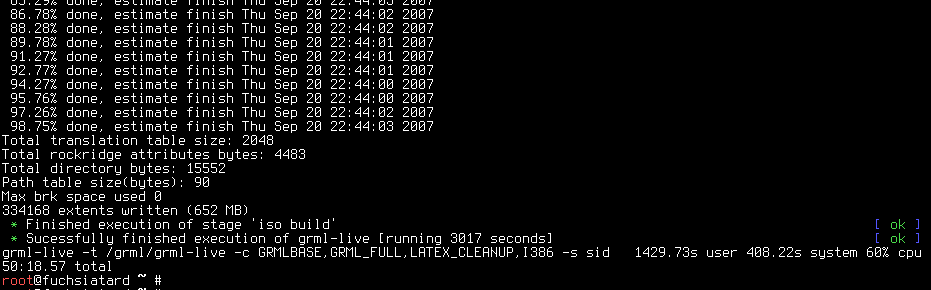
# grml-live -t /grml/grml-live -c GRMLBASE,GRML_FULL,LATEX_CLEANUP,I386 -s sid
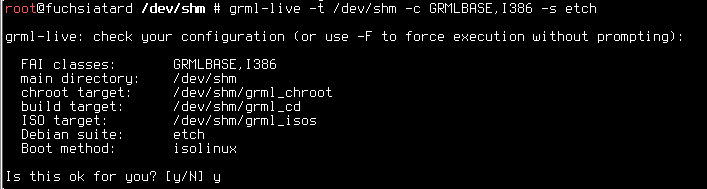
About 50 minutes later I have a grml-ISO inside grml_isos at directory /grml/grml-live/ (-t …). It was built using the classes (-c …) GRMLBASE (all the core, essential stuff), GRML_FULL (software selection like official grml provides), LATEX_CLEANUP (clean up some very big LaTeX directories) and I386 (x86-specific packages like kernel). Debian unstable/sid was used as the suite (-s). And that’s it. You want a smaller grml-version using Debian/stable? No problem, let’s do it in shared memory (being very fast, and with enough RAM and mountoptions rw,suid,dev no problem at all): Screenshot grml-live: the beginning A ‘grml-live -t /dev/shm -c GRMLBASE,I386 -s etch’ and not even 5(!) minutes later I’ve my 135MB small grml: Screenshot grml-live: done So using grml-live you can build your own, customized Linux Live-CD without having to deal with remastering in detail. Via creating a new class (or just editing an existing one) its easy to include the software you would like to get. So, will the official grml-ISOs become obsolet? No, definitely not. The goal of grml-live is to give the grml-team a buildsystem providing exactly what we need. It should give us the possibility to concentrate on the important and interesting tasks, like: testing, bugfixing, implementing new features, working on the kernel, quality assurance, documentation,… grml-live should work on every Debian based system. If you want to give it a try just grab the Debian package from grml’s repository. The source is available (as usual) via mercurial. Find more details on the grml-live-webpage. If you have any further questions that aren’t answered by the docs yet, have feature requests, bugreports or patches: please let me know.


Eddy Petri&#537;or: software for managing finances

Dear lazyweb,

I decided to track our (mine and my fince 's) expenses more closely and I am in search of some software for this task.

The requirements for the software:
I have never used such software before, so I am a total noob in this area. Please be gentile if I might have naively described the problem.

Thanks in advance!

20 September 2007

Russell Coker: Google Custom Search Engine

I’ve just been experimenting with Google Custom Search [1]. Below are two custom search engines I created to generate searches for Planet Debian and Planet Ubuntu (for each Planet it searches all the blogs that are syndicated - and doesn’t just get the category that is syndicated). It’s interesting to compare search terms such as “selinux” to get an idea for how much topics are being discussed in the two communities. I’m going to set up cron jobs to update these CSEs as the Planet subscription lists change. Also it would be quite easy for me to set up a custom search that covers both Debian and Ubuntu, and other planets as well. If nothing else this will save me from the problem of finding a blog post that has just scrolled off a Planet that I read. Planet Debian (homepage):
Google Custom Search
Planet Ubuntu (homepage):
Google Custom Search

19 September 2007

MJ Ray: Media-sponsored Forums - How to Kill a Community

I was asked for a story on good or bad media sponsored online conversations. I'd not really had much to do with them until this summer. itv is the UK's biggest commercial broadcaster and it had rights to show the Tour de France here this year. Its coverage was pretty good, with daily highlights and live coverage at weekends, mostly on the itv4 satellite/DTT channel. The end of every show plugged their web homepage, which had a prominent link to their forums. I've been on a couple of cycling forums for a while, so I signed up and tried to help explain things that I knew. After a while, I noticed that when I answered a question properly, with links to other authoritative sites like the race teams' own sites, my message was silently removed. This happened a few times. Then I found out that the forum terms of use prohibit linking to any other web sites! This is a big problem, because itv's cycling pages are pretty limited. As a result, the forum was full of hearsay and it's hard to verify anything anyone posts. To cap it all, itv closed the forums for a weekend for an upgrade. Then a weekend became a week, which became a month, which became six weeks. When they finally reopened it, at least they sent me an email, so I tried to login. My login doesn't work and I can't view the forum as a guest any more. I've emailed their support address and had no reply. I don't know if this is a general problem - I can't contact other forum members because I don't have their details. I only saw them on the web forum and members couldn't link their homepages. So, it'll be a long time before I spend much time participating on any media-sponsored sites again, except in a casual throw-away way. Now most of my sports messages will be posted to Cycling Fans and BuzzinFootball like my local news posts go to the community-run WSM Forum. The trouble with media-sponsored forums is that they just don't have the interest in any particular community to want to sustain it. Somewhere, there's a bean-counter saying "so what if we kill this community? We started it from scratch and we'll just do it again." Any messages you post to those forums are usually gone, out of your control, lost to you. Is it worth posting to them? I think Andrew Savory is also spot-on about the problems with forums for technical communities in Bagel Belly Blog: How Open is your Open Source project? He certainly seems in fine form so far this week. I know not all forums are that bad. I'm on a couple of phpbb-powered ones which work well, with added XML feeds and so on. Are any "old media" companies brave enough to run a liberal phpbb? Are there other examples of particularly good or bad forums that you'd like to tell me about?

Neil Williams: gpe-cash developments

If anyone was wondering why I've been quiet / claiming to be busy for the last week or so:
gpe-cash finally has a stable "main window" that supports creating new accounts along with the transactions and splits necessary to support an opening balance in the gnucash objects.
Current SVN requires current QOF CVS, accessible via the respective SourceForge repositories. gpe-cash is nowhere near release right now - the actual balances don't show up for one thing and I still need to write the window that will allow the creation of transactions within the accounts - but one step at a time. I'll see about some screenshots eventually but the gpe-cash main window is quite similar to that of gpe-expenses.
The main side-effect of all this is a much improved SQLite backend for QOF that is closer to being able to properly support double-entry financial data.
Note this does not mean that GnuCash itself will be able to use the QOF SQLite backend - the GnuCash currency/commodity handling is incompatible with QOF so gpe-cash uses the currency handling from gpe-expenses which in turn came from pilot-qof and the range of currencies supported by the Palm Expenses applet. The currencies are directly equivalent to the respective GnuCash currencies but not all GnuCash currencies are supported by pilot-qof, gpe-expenses or gpe-cash. The biggest change in gpe-cash is that this conversion is now working so that the gnucash code sees a gnucash currency when actually it is handling a pilot-qof currency.
gpe-cash is GPL-3+ and single-user (== single-file or single-book) as well as single-currency. Adding multi-currency support is possible but not a priority.
Once gpe-cash is closer to release, the codebase will be able to support gpe-invoice using the GnuCash business objects which will interface with gpe-cash to create invoices from other GPE data and store the payments and charges in gpe-cash.
If multi-currency support can be achieved, it would be possible to create "gpe-shares" as a different add-on to gpe-cash, although that is only theoretical at this stage.
The SQL-type query support inherent in QOF, together with perl support for the XML backend data via libxml-qofqsf-perl and XSL support for same XML backend via datafreedom-qsfxsl should make report generation trivial. I may also be able to add QOF support to the still experimental quicklist. I also plan to include support for import/export from all the datafreedom packages with HomeBank data which is returning to a NEW queue near you quite soon . . .
Overall, I'm getting closer to having a full range of individual applications that achieve a long term goal - the breakup of GnuCash source code into small, individual tools in the Unix tradition, all built on SQL-type queries, multiple backends and generic data handling. (See data-freedom.) Down with bloat!
:-)
<rant>
It's about time users had free financial data as well as merely free financial software. The lack of data interchange between existing free software "financial solutions" is a scandal, IMNSHO.
The rest of the "Office" dataset have a range of file formats and a range of filters. Financial data relies on the horribly broken QIF file that was never designed to be a standard and OFX where support is horribly patchy and doesn't provide data interchange between programs on the same machine.
</rant>

David Moreno Garza: RockBox / NYC PM / Long walk / Pics

So, I have just installed RockBox on my iPod and I have liberated it :) It’s nice to see people amazed on an iPod running something that’s different from the usual firmware. Now, both my iPod and PowerBook are not running Apple software, muahaha!
Since we are in NYC now, and even before, we’ve been looking for interesting activities in the area. Tomorrow, the New York City Perl Mongers will handle their monthly meeting. At 6:30 PM at d.b.a, 41 First Avenue (between 2nd and 3rd Streets), map: http://tinyurl.com/2yqg4d. Tomorrow, we were supposed to go see a prospective apartment in Bushwick, Brooklyn in the afternoon; I’ll see if we can still make it. Otherwise, if you are in the area, feel free to attend!

Yesterday, we went to the Yankee Stadium. Actually we only went outside it, since we didn’t carry any tickets, we just wanted to see the neighborhood. It was amazing, since there was a game and we witnessed thounds of people commuting to it to watch the game. It was a nice experience only watching the people and all the buzz around the stadium. After that, we got back to Manhattan on the subway and dropped off on the 57th and Madison Ave: From there, we walked around sixty freaking blocks to get to our apartment near Essex & Delancey St. After checking on Google maps, it was a ~6 kms walk! It only took us 2:30 hrs. Heh. On the good side, we happened to see lots of nice places of Lexington and other avenues.Tonight, we’ll be walking to Little Italy and Chinatown, although we already know those neighborhoods, since Alex took us there when were here last June.
So, we are uploading our pics to the NYC photo set of our flickr account, raquelydavid.

Next.

Previous.