Search Results: "tar"

23 April 2007

Russell Coker: the Right to Fork

Leon Brooks blogged about the Right to Fork (an essential right for free software development) but notes that governments of countries don't permit such a right.

One of the criteria for the existence of a state is the ability to control it's own territory. Lose control of the territory and you lose the state, lose some of the territory and the state is diminished. Therefore preventing a division of the territory (a split after a civil war) is the primary purpose of a state. The other criteria of a state are the ability to tax the population, impose civil order, and to administer all other aspects of government. All of these operations are essential to the government and lead to the destruction of the state if they are lost.

It's not that governments want to prevent forking, it's the fact that the existence of the state (on which the existence of the government depends) demands that it be prevented in all but the most extreme situations.

With free software forking is not a problem as multiple groups can work on similar software without interference. If someone else works on a slightly different version of your program then the worst that they can do is to get the interest of more developers than you get. This competition for developers leads to better code!

With proprietary software the desire to prevent forking is due to the tiny marginal cost of software. Most of the costs of running a software company are in the development. The amount of work involved in development does not vary much as the user-base is increased. So doubling the number of sales can always be expected to significantly more than double the company's profit.

One thing that would benefit the computer industry would be to have all the source to proprietary programs put in escrow and then released freely after some amount of time or some number of versions have been released. If Windows NT 4.0 was released freely today it would not take many sales from the more recent versions of Windows. But it would provide significant benefits for people who want to emulate older systems and preserve data. I expect that current versions of MS-Office wouldn't properly read files created on NT 4.0, I'm sure that this is a problem for some people and will become more of a problem as new machines that are currently being designed are not capable of booting such old versions of Windows.

22 April 2007

Gustavo Franco: Merge from Ubuntu, and do it now!

Well, I'm really tired of these comments on how Ubuntu doesn't contribute patches back for Debian and how some Ubuntu contributors tell that they do it and that everything is ok with the swirl side of the fence. The truth is, both sides are wrong or just lying!

The fact is that for quite some time Debian contributors can opt-in to receive Ubuntu patches by mail. It started with my scottwatcher script for utnubu that was sending mails for Debian's PTS (Package Tracking System), keyword derivatives. Ubuntu does it now, so scottwatcher was deprecated in favor of their infrastructure that also sends messages to ubuntu-patches mailing list. Dissatisfied? Go to: http://patches.ubuntu.com/

I'm sure that some will argue "well, why not wishlist bugs to our BTS then?". I would be glad to receive the reports, but a lot of Debian contributors, developers, whatever argued against that because "we've a lot of differences and I don't care about Ubuntu patches" or stuff like "I hate automatically generated bug reports, they should process them manually before sending, figuring out if it makes sense or not". It makes no sense! I would prefer the opt-out approach than opt-in, but blame some Debian lazy contributors, including me because the raw data is there. I can start pushing stuff from ubuntu-patches mailing list into our BTS. Do you want it?

Before you reply to my post, read every word at: https://wiki.ubuntu.com/UbuntuForDebianDevelopers . What's wrong with you? Aren't you a Debian zealot? Go there and apply what's needed for us, for a better Lenny release. Don't you love to argue how they do it all wrong? Redo their stuff right then!

Please never write again "I never received patches from Ubuntu for my package foo". You don't own a part of the Debian project, you're a maintainer, stop crying, go there and raise the bar again. Thanks in advance.

Biella Coleman: On Grading

Recently I stumbled on a relatively new blog Tenured Radical that I really dig for it provides a compelling and witty, (if not at times very disturbing) picture of what I am soon to face, being I am at the cusp of starting an academic job. Not only is writing a real pleasure to read but she has a lot of good things to say and it is worth checking out (well maybe only if you are a student, academic, or university administrator though I reckon it may have wider appeal). At first, she blogged anonymously but now she has come out under the sun revealing her identity. Her recent post on the problems of grading hit home, I guess because it seems like in the last week all my friends are talking/complaining about is grading given it is the end of the semester and all (I thankfully don’t have to worry about that till next year). Grades and granting them, have such a complex psychology and set of consequences for teachers and students alike and she gives a nice taste of what they are.

Masayuki Hatta: GNU a2ps 4.13c-rc4 released

GNU sysadmins gave me permission some days ago, so I uploaded my work to alpha.gnu.org for the first time. You can obtain it from:
ftp://alpha.gnu.org/gnu/a2ps/a2ps-4.13c-rc4.tar.gz
I uploaded new Debian a2ps package to ftp-master, too. Let's see what buildds are gonna say... BTW, it seems Gentoo people have already "released" 4.13c (for example, look here) somehow. Hmm...I might have to number the new one as 4.14.

Tag this post with del.icio.us!

Christian Perrier: Vote - 1st round

So, today is the first round of the French presidential election. I already explained where is my preference going, also who I fear the most and who I absolutely don't want ever (no link here: I will never give a link to this guy and his party's web site. You don't want to read the kind of crap they write, do you? This is of course Le Pen). For those reading this and not familiar with the French presidential eletion voting system, a few more hints: We have 12 candidates this year. on first round, a president may be elected if (s)he gets more than 50% of votes (not counting white and null votes). This is of course nearly impossible. The highest probability is thus for a second round. Here, the two best ranked candidates would stay and the president is elected among one of them two. That second round will happen on May 5th. Candidates are (non neutral comments!): Though choice, isn't it? Out of these 12, 4 have some chances to reach the second round: Bayrou, Royal, Le Pen and Sarkozy. It is pretty sure that Sarkozy will reach the second round (unfortunately, should I say). Bayrou and Royal have the best chances to be the second candidate (apparently the disaster of 2002 where Le Pen reached the second round will not happen, though still possible). So, let's vote and vote well...but, first of all, vote! See you at 20:01 +02:00.

Wichert Akkerman: Debian upgrade experience

With the recent release of Debian etch (usability note: why can't that URL be per-release? All the info on sarge suddenly is not reachable at the location people bookmarked anymore) I figured I would try upgrading some servers to it. Debian has always had excellent in-place migration handling, so this should be easy, right? If only.. I will stay with sarge for a while longer.

Michael Prokop: Booting from USB pen: troubleshooting and pitfalls

As grml supports booting from usb devices (harddisk installation via grml2hd as well as booting from usb pens via grml2usb) and I helped many people at debugging booting problems I think I stumbled upon every existing pitfall. 8-) There are several situations where booting might fail. So here we go with a summary of the most common pitfalls and possible solutions:
  1. The Bootsplash is displayed, the kernel loads but you very soon get a:
  2. ran out of input data
    System halted
    
    Reason: everything OK, except for the filesystem used on your usb device. So instead of fat16 you use for example fat32. Fix: use the appropriate filesystem (fat16 for usb pens usually).
  3. When trying to boot from USB you get something like:
  4. Invalid operating system
    
    Possible reason: the partition layout is not ok. Very probably there’s no primary partition or none has the flag ‘bootable’ set. (Read on for further details.)
  5. When trying to boot from USB you get something like:
  6. No operating system found.
    
    Possible reason: you forgot to set the boot-flag on the partition. Or you did not install an operating system at all. ;-)
  7. When trying to set up the partition(s) on the USB device cfdisk reports something like:
  8. FATAL ERROR: Bad primary partition 0: Partition ends in the final partial cylinder
    
    Reason: the partition layout is not ok. Either use fdisk (requires detailed knowledge about partition setup!) or better: use a fronted of libparted, like gparted. gparted does an excellent job at setting up an appropriate partition layout for booting from USB (read on for details about the correct setup). As long as cfdisk has problems with the layout - it will exit on errors - your usb pen very probably does not have a valid partition setup for booting. Please notice that fdisk very often uses defaults which are not OK, whereas gparted uses the appropriate heads, sectors/track and cylinders settings. So if you really want to use fdisk for setting up the appropriate partition layout you might have to enter the ‘extra functionality (experts only)’ menu of fdisk.
  9. The system never displays the bootsplash of the usb device at all? Checklist:
    • does your system support booting from USB at all? Check settings in BIOS.
    • do you use the correct USB mode in BIOS? Check BIOS again, usually you want to use USB-HDD mode. Not possible? See USB-ZIP mode.
    • is "booting from USB" in the appropriate order of the booting sequence? Check the "boot"-section in your BIOS.
    • is the bootable flag set on the boot-partition? Check for example with cfdisk.
    • is the partition used for booting the first partition and a primary one on your device? Check with cfdisk again.
    • is the partition layout ok? The first partition (the one used for booting) has to start at cylinder 1/sector 63, otherwise booting will fail on most (all?) x86 systems. Check with ‘cfdisk -P s /dev/..’ or ‘fdisk -l -u /dev/…’. Do *not* trust the output of ‘fdisk -l /dev/…’. Really.
  10. syslinux does not work on your system (b0rken BIOS for example)? Possible solution: use grub instead.
  11. Kernel boots but fails to find the root filesystem with something like:
  12. kernel-panic: unable to mount root-fs...
    
    Yes? Then the root= argument in your kernel commandline (specified in the bootloader, usually lilo, grub or isolinux/syslinux) is pointing to the wrong device. Solution: adjust the root=-option in your bootmanager’s configuration. Tip: use root=UUID instead of root=/dev/[hs]d…
  13. All of the above tips don’t work? Maybe your USB pen is even larger than 1GB?
  14. Possible reason: Some BIOSes offer different modes for USB booting. The proper mode to boot a USB stick is USB-HDD. If that doesn’t work or is not supported by your system, you need to format your USB-Stick as USB-ZIP. To do this, the syslinux source distribution contains an utility called mkdiskimage, which you can use to re-format your USB stick in USB-ZIP format. For more information refer to the USB-webpage in the grml-wiki and Bootable USB Key in the knoppix-wiki.
I mentioned the correct partition layout several times. Reminder: a first, primary partition with fat16 (as filesystem as well as partition’s system id!) with bootable-flag set. The partition should start behind MBR at 1st cylinder and 63rd sector (see www.ata-atapi.com/hiwmbr.htm and thestarman.pcministry.com/asm/mbr/index.html for more details about MBR). So how does a correct partition look like? Output in several formats as reference:
# fdisk -l -u /dev/sda
Disk /dev/sda: 1039 MB, 1039663104 bytes
255 heads, 63 sectors/track, 126 cylinders, total 2030592 sectors
Units = sectors of 1 * 512 = 512 bytes
   Device Boot      Start         End      Blocks   Id  System
/dev/sda1   *          63     2024189     1012063+   6  FAT16
# fdisk -l /dev/sda
Disk /dev/sda: 1039 MB, 1039663104 bytes
255 heads, 63 sectors/track, 126 cylinders
Units = cylinders of 16065 * 512 = 8225280 bytes
   Device Boot      Start         End      Blocks   Id  System
/dev/sda1   *           1         126     1012063+   6  FAT16
# sfdisk -d /dev/sda
# partition table of /dev/sda
unit: sectors
/dev/sda1 : start=       63, size=  2024127, Id= 6, bootable
/dev/sda2 : start=        0, size=        0, Id= 0
/dev/sda3 : start=        0, size=        0, Id= 0
/dev/sda4 : start=        0, size=        0, Id= 0
Tip: if you have a working stick, store your partition layout using ’sfdisk -d /dev/sda > sfdisk.sda’ for later restore (via ’sfdisk /dev/sda < sfdisk.sda’). This is also very useful for cloning a working setup to other devices (though you might have to adjust cylinder/units later on). And of course you can use it as backup if you ran [sc]fdisk-commands on the wrong device. ;-)

Simon Law: BarCamp Montr al 2


Happy camper
Originally uploaded by sfllaw.
BarCamp Montr al 2 is coming up soon. Yup, our second big full-day unconference is happening next Saturday at the SAT. We're bigger and better this time, and we'd love to have you show up. What is BarCamp Montr al? It's an unconference. It's a gathering of active, interesting people who want to get together and share our experiences. It's for individuals and groups, artists and technologists, young and old. Nominally, there's an Internet-technology feel because that's what BarCamps around the world have traditionally done. But because Montr al has such a vibrant arts scene, we've also got talks that are about anything and everything. So how do you participate? Well, you can't just be a spectator. Nope, unabashed consumption is not our way. Show up on Saturday and give a presentation on a project that you've been working on. Or show up a little early and help us set up. Or stay late and clean while chatting with the exciting people you've met. We want you to be part of our community. We've got fifteen-minute presentations ranging on exciting topics like: Have you got something to say? Or something to show? I hope so. Now that I have you convinced, you're going to want to know how you (and your interesting friends) can attend BarCamp Montr al 2
Saturday, 28 April 2007
9:30 18:00
Societ des arts technologiques
1195 boul. St-Laurent
Free admission
( Sign up Upcoming Google Maps ) See you there!

Randall Donald: Juast a quick FYI

Among other work I have to do I have started nvidia-graphics-drivers 1.0.9755 and nvidia-graphics-drivers-legacy-96xx 1.0.9631.
I'll be upgrading legacy-71xx to 7185 as well.

21 April 2007

Daniel Burrows: Wikified aptitude TODO list.

I've been able to crib more time lately for Debian, so I'm hoping that I can stop just keeping my head above water (barely) and start on the pile of new work that I'd like to do. For a while I've been accumulating a mental list of stuff that sucks in aptitude, but mental lists have the drawbacks that no-one else knows about them and that they never seem to be available when I want them.

I've now got a nice page in the Debian wiki holding aptitude's current TODO list. The entries range from changes that are trivial but will improve the user experience, to deep and difficult changes that no-one will notice. Since I don't expect a team of magic pixies to do the coding for me, I figure I might have the majority of the design and coding done in a year or so.

Maximilian Attems: Fun with Legend Annotations in Graphs

E\sT\N \f Symbol t\0 f
Once you start typing such strings blindly, you know that you have been generating lots of graphs with xmgrace. :)
LaTeX equivalent would be
E_T \tau f

Dirk Eddelbuettel: Boston Marathon 2007

So this Monday was the 111th running, as they call it, of the venerable Boston Marathon, and my first time there. After the fairly serious storm warnings -- and the corresponding health warnings, delivered through two emails from the race organizers and a handout at registration, we got very, very lucky as the rain more or less stopped shortly after the start. And there was relatively little wind, and mostly laterally, rather than the 'in your face' gusts at the projected 30 to 50 mph.
There were actually six of us running from our little informal group in River Forest / Oak Park, and fellow rookie Russ and I decided to 'take it easy' and just 'go for a long run'. I ended up with a fairly even pace between 7:45 and 8:10, averaging 7:57 for a total of 3:28:24, or a few seconds faster than my very first marathon in Chicago. Which is quite pleasant, given the conditions, and the hillier course. The race went pretty well for all six us, which is nice too. Given how we trained together, it is neat how we all ended up within seven minutes of each other. The race itself is quite stunning. With the required qualifying time comes a 'seeding' system for the start, so one tends to run most of the course with runners of fairly similar speed. That made for nice cameraderie on the course -- and for beautiful sights of nothing but runners rolling through the hills of Massachusetts. I think I'll be back next year.

20 April 2007

Jan Wagner: Is DNSSEC ready for wild life?

Today the RIPE DNS for LIRs Training Course did take place. (some not up to date course material can be found here)
Managing some thousands of zones inclusive nameserver infrastructure behind since several years, I thought it would be neat to provide a secure dns chain to our costumers.
After going deeper into the material within the course, I recognized the following impacts: Since the last issue isn’t solved (yet), it doesn’t make any sence for me to invest resources into setting up DNSSec infrastructur, cause the end user would not recognize if the communication with the resolving nameserver or the resolving nameserver itself is taken over. Any complaints and/or hint? Did I missed something? , , ,

Rodrigo Gallardo: New Passport

I’ve just returned from renewing my passport (an important step in getting to DC7). They asked for originals and copies of my previous passport, my military service card, my voter’s registration card and my birth certificate. They forbid you from signing the application until you’re right at the counter, take three prints of each index finger and ask for three recent photos, then take one themselves anyways. Sadly, they did not ask for my GPG fingerprint. It would have been cool.

Gustavo Franco: Lenny and my work on new tasks.

I've started Lenny related work on my tasksel branch, hopefully joeyh will merge some of that, until now the new stuff is:

* Add lamp-server task.
Linux + Apache + Mysql + PHP, Python and Perl (LAMP^3). In other words this th web-server task + mysql-server and phpmyadmin. Keep in mind that our database-server for Etch installs PostgreSQL so you can install lamp-server + database-server and go with a full LAMP stack and both mysql and pgsql.

* Add lightweight-web-server task.
lighttpd with php4 and php5 support, perl and python are side effects due to fastcgi.

* Reintroduce backup-server task.
Bacula and related tools, basically.

* Add ltsp-server task.
This experimental task doesn't install a complete ltsp system yet, you need to run ltsp-build-client manually. Actual work for a fresh install is being done into ltsp-client-builder udeb.

My goal for Lenny is if you select both desktop environment and ltsp server you will end with a system ready to provide GNOME (KDE or Xfce) for thin or fat clients on the LAN. We just need the task ready, polish ltsp-client-builder, and solve some pending stuff in other packages: I think I've sorted out the nfs-kernel-server export issue (thanks Steinar!), we're still missing dhcp and tftp configuration or the possibility to 'preseed' it (wishlist bugs opened) to have all this working out of the box. Once in place you will be able to impress your friends spreading Debian on the LAN using a usb keychain or live cd.

Get ready for some more server related work, but I'll keep up with the desktop stuff also. :-)

Adam Rosi-Kessel: Unwise Crowds?

Many of us who believe in Web 2.0 (the concept, not the buzzword) have come to accept the wisdom of crowds like an article of faith. The Frontal Cortex describes a Columbia University sociology experiment that might undermine our dogma (apparently I missed it in Science):
In our study, published last year in Science, more than 14,000 participants registered at our Web site, Music Lab (www.musiclab.columbia.edu), and were asked to listen to, rate and, if they chose, download songs by bands they had never heard of. Some of the participants saw only the names of the songs and bands, while others also saw how many times the songs had been downloaded by previous participants. This second group — in what we called the “social influence” condition — was further split into eight parallel “worlds” such that participants could see the prior downloads of people only in their own world. We didn’t manipulate any of these rankings — all the artists in all the worlds started out identically, with zero downloads — but because the different worlds were kept separate, they subsequently evolved independently of one another. This setup let us test the possibility of prediction in two very direct ways. First, if people know what they like regardless of what they think other people like, the most successful songs should draw about the same amount of the total market share in both the independent and social-influence conditions — that is, hits shouldn’t be any bigger just because the people downloading them know what other people downloaded. And second, the very same songs — the “best” ones — should become hits in all social-influence worlds. What we found, however, was exactly the opposite. In all the social-influence worlds, the most popular songs were much more popular (and the least popular songs were less popular) than in the independent condition. At the same time, however, the particular songs that became hits were different in different worlds, just as cumulative-advantage theory would predict. Introducing social influence into human decision making, in other words, didn’t just make the hits bigger; it also made them more unpredictable.
I don’t accept this one study as proof that the entire user-centric content rating system is a failure (or random), but it does highlight some of the perils of a “winner takes most” mode of cultural evolution.

19 April 2007

Miriam Ruiz: TTF Fonts in Debian

Fonts are usually a problem when packaging games. Many games seem to pick up fonts from somewhere in the web, which licenses allow only free redistribution, but not modification. Some others don’t even allow commercial use. Some game developers don’t mind at all about this, some others just don’t pay much attention to licenses. In any case, if we want those games in Debian main, we must replace the fonts in them. The problem is then trying to find appropiate fonts for the replacement. As there’s no easy way to have a visual look at all the fonts in the archive, I’vd developed a tiny script to generate some web pages with images of all the TrueType fonts in Debian SID. Lots of thanksgo to Jacobo Tarrio, you’ve helped me a lot!

Lars Wirzenius: Rant: On projects targetting mobile environments

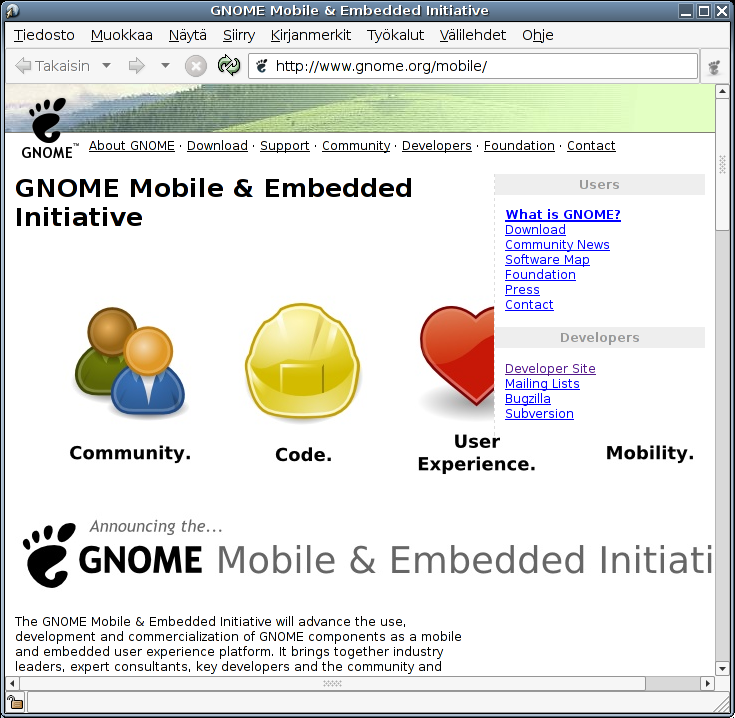
The GNOME project announced a GNOME Mobile & Embedded Initiative today. Here's a screenshot of the browser on my laptop of the web page:
screenshot
What's wrong with the above picture? The browser window is around 700 pixels wide, which about as wide as you'd get on, say, an N800 Internet tablet gadget. Significant parts of the web page are unreadable. I have to go to about a thousand pixels wide to get the whole page be visible. This is no way to design pages for a mobile environment. Other than that, it's obviously good. Not worth the hype, not worth keeping secret for months before the big revelation, but a good thing nevertheless.

MJ Ray: The Tragedy of Targets

I've started using the phrase "tragedy of targets" recently for those situations where someone does something stupid to meet an ill-specified target, instead of working towards the result in the way the target-setter expected. This gem was published by a Conservatives candidate over in my home county of Northamptonshire and was mentioned in today's Weston and Worle News
"an offender visited approximately 550 domestic properties in Weston-super-Mare with a fake comic relief sponsor form. This person obtained property by deception, (i.e. convinced them to part with money) from no less than 542 separate victims. Following good work from the police, he was caught, arrested, interviewed and I understand he will be cautioned for all the offences. My sources tell me that as a result of the arrest, the North Somerset District was or is planning to claim 542 'detections' for this one job. This will prove to be an amazing result for the bean-counters and has no doubt salvaged the whole 'performance target' result for the area in 2006. Indeed, the local Police Community Support Officers have spent the week going door to door in an attempt to locate every household that was conned, and get them to sign a pro-forma statement of complaint to bolster the clear-up rate"
Do you know other examples where setting a target has had unintended effects? Do you have a suggestion how to set better targets for the police here? Me, I like the suggestion of one anonymous commenter:
"The Police should be measured on the absence of crime not by detecting it."

Daniel Baumann: Debian Live and Google Summer of Code 2007

Debian is this year again part of Google's Summer of Code. Last week, the final decisions about the proposed projects were made and Google granted 9 slots in total for Debian. I am very glad to say that Chris 'lamby' Lambs proposal for Debian Live is amongst those. Here is the abstract from his proposal:
	Live-helper is a utility to build CD, DVD, netboot and USB-stick live
	images of Debian, a GNU/Linux operating system. It boasts support for
	multiple architectures, auto-building images, amongst many other
	features.
	Live-helper is extremely flexible, allowing interested parties to create
	their own system completely specific to their needs, including support
	for custom package lists, kernel parameters, encryption, additional
	commands to configure the live system etc.
	My proposal is to construct a graphical user interface that can be used
	in conjunction with live-helper to build Debian Live systems, allowing
	editing of existing configurations and including a 'wizard'-style
	walkthrough for the first-time user.
	Providing less experienced users with the opportunity to easily create
	live distributions will generate more exposure for live-helper,
	providing more valuable feedback for its developers and ultimately
	helping Debian's image as an extremely flexible and free operating
	system.
	The GUI will be written in Python using the pygtk GTK+ bindings.
The next step on the timeline begins at May 28th, where the students start coding on their projects. I am happily looking forward to it.

Next.

Previous.