Search Results: "sf"

19 October 2016

Reproducible builds folks: Reproducible Builds: week 77 in Stretch cycle

What happened in the Reproducible Builds effort between Sunday October 9 and Saturday October 15 2016: Media coverage Documentation update After discussions with HW42, Steven Chamberlain, Vagrant Cascadian, Daniel Shahaf, Christopher Berg, Daniel Kahn Gillmor and others, Ximin Luo has started writing up more concrete and detailed design plans for setting SOURCE_ROOT_DIR for reproducible debugging symbols, buildinfo security semantics and buildinfo security infrastructure. Toolchain development and fixes Dmitry Shachnev noted that our patch for #831779 has been temporarily rejected by docutils upstream; we are trying to persuade them again. Tony Mancill uploaded javatools/0.59 to unstable containing original patch by Chris Lamb. This fixed an issue where documentation Recommends: substvars would not be reproducible. Ximin Luo filed bug 77985 to GCC as a pre-requisite for future patches to make debugging symbols reproducible. Packages reviewed and fixed, and bugs filed The following updated packages have become reproducible - in our current test setup - after being fixed: The following updated packages appear to be reproducible now, for reasons we were not able to figure out. (Relevant changelogs did not mention reproducible builds.) Some uploads have addressed some reproducibility issues, but not all of them: Some uploads have addressed nearly all reproducibility issues, except for build path issues: Patches submitted that have not made their way to the archive yet: Reviews of unreproducible packages 101 package reviews have been added, 49 have been updated and 4 have been removed in this week, adding to our knowledge about identified issues. 3 issue types have been updated: Weekly QA work During of reproducibility testing, some FTBFS bugs have been detected and reported by: tests.reproducible-builds.org Debian: Openwrt/LEDE/NetBSD/coreboot/Fedora/archlinux: Misc. We are running a poll to find a good time for an IRC meeting. This week's edition was written by Ximin Luo, Holger Levsen & Chris Lamb and reviewed by a bunch of Reproducible Builds folks on IRC.

16 October 2016

Rémi Vanicat: Trying to install Debian on G752VM-GC006T

I'm trying to install Debian GNU/linux on my new ASUS G752VM-GC006T So what I've discovered: So I've a working linux. My problem are: And the question is: where to report those bug. First edit: rEFInd seem to find windows and Debian, thanks to blackcat77

Dirk Eddelbuettel: tint 0.0.3: Tint Is Not Tufte

The tint package, whose name stands for Tint Is Not Tufte , on CRAN offers a fresh take on the excellent Tufte-style for html and pdf presentations. It marks a milestone for me: I finally have a repository with more "stars" than commits. Gotta keep an eye on the big prize... Kidding aside, and as a little teaser, here is what the pdf variant looks like:
This release corrects one minor misfeature in the pdf variant. It also adds some spit and polish throughout, including a new NEWS.Rd file. We quote from it the entries for the current as well as previous releases:

Changes in tint version 0.0.3 (2016-10-15)
  • Correct pdf mode to no use italics in table of contents (#9 fixing #8); also added color support for links etc
  • Added (basic) Travis CI support (#10)

Changes in tint version 0.0.2 (2016-10-06)
  • In html mode, correct use of italics and bold
  • Html function renamed to tintHtml Roboto fonts with (string) formats and locales; this allow for adding formats; (PRs #6 and #7)
  • Added pdf mode with new function tintPdf(); added appropriate resources (PR #5)
  • Updated resource files

Changes in tint version 0.0.1 (2016-09-24)
  • Initial (non-CRAN) release to ghrr drat

Courtesy of CRANberries, there is a comparison to the previous release. More information is on the tint page. For questions or comments use the issue tracker off the GitHub repo.

This post by Dirk Eddelbuettel originated on his Thinking inside the box blog. Please report excessive re-aggregation in third-party for-profit settings.

14 October 2016

Antoine Beaupr : Managing good bug reports

Bug reporting is an art form that is too often neglected in software projects. Bug reports allow contributors to participate without deep technical knowledge and at the same time provide a crucial space for developers to be made aware of issues with their software that they could not have foreseen or found themselves, for lack of resources, variety or imagination.

Prior art Unfortunately, there are rarely good guidelines for submitting bug reports. Historically, people have pointed towards How to report bugs effectively or How to ask questions the smart way. While those guides can be useful for motivated people and may seem attractive references for project managers, they suffer from serious issues:
  • they are written by technical people, for non-technical people
  • as a result, they have a deeply condescending attitude such as calling people "stupid" or various animal names like "mongoose"
  • they are also very technical themselves: one starts with a copyright notice and a changelog, the other uses magic words like "Core dumps" and $Id$
  • they are too long: sgtatham's is about 3600 words long, esr's is even longer at about 11800 words. those texts will take about 20 to 60 minutes to read by an average reader, according to research
Individual projects have their own guides as well. Linux has the REPORTING_BUGS file that is a much shorter 1200 that can be read under 5 minutes, provided that you can understand the topic at hand. Interestingly, that guide refers to both esr's and sgtatham's guidelines, which means, in the degenerate case where the user hasn't had the "privilege" of reading esr's prose already, they will have an extra hour and a half of reading to do to have honestly followed the guidelines before reporting the bug. I often find good documentation in the Tails project. Their bug reporting guidelines are easily accessible and quick to read, although they still might be too technical. It could be argued that you need to get technical at some point to get that information out, of course. In the Monkeysign project, I have started a bug reporting guide that doesn't yet address all those issues. I am considering writing a new guide, but I figured I would look at other people's work and get feedback before writing my own standard.

What's the point? Why have those documents been written? Are people really expected to read them before seeking help? It seems to me unlikely that someone would:
  1. be motivated enough to do something about a broken part of their computer
  2. figure out they can do something about it
  3. read a fifteen thousand words novel about how to report a bug...
  4. just to finally write a 20-line bug report that has no warranty of support attached to it
And if I would be a paying customer, I wouldn't want to be forced to waste my time reading that prose either: it's your job to help me fix your broken things, not the reverse. As someone doing consulting these days: I totally understand: it's not you, the user, it's us, the developers, that have a problem. We have been socialized through computers, and it makes us weird and obtuse, but that's no excuse, and we need to clean up our act. Furthermore, it's surprising how often we get (and make!) bug reports that can be difficult to use. The Monkeysign project is very "technical" and I have expected that the bug reports I would get would be well written, with ways to reproduce and so on, but it happened that I received bug reports that were all over the place, didn't have any ways of reproducing or were simply incomplete. Those three bug reports were filed by people that I know to be very technically capable: one is a fellow Debian developer, the second had filed a good bug report 5 days before, and the third one is a contributor that sent good patches before. In all three cases, they knew what they were doing. Those three people probably read the guidelines mentioned in the past. They may have even read the Monkeysign bug reporting guidelines as well. I can only explain those bug reports by the lack of time: people thought the issue was obvious, that it would get fixed rapidly because, obviously, something is broken. We need a better way.

The takeaway What are those guides trying to tell us?
  1. ask questions in the right place
  2. search for similar questions and issues before reporting the bug
  3. try to make the developers reproduce the issues
  4. failing that, try to describe the issue as well as you can
  5. write clearly, be specific and verbose yet concise
There are obviously contradictions in there, like sgtatham telling us to be verbose and esr tells us to, basically, not be verbose. There is definitely a tension in there, and there are many, many more details about how great bug reports can be if done properly. I tend towards the side of terseness in our descriptions: people that will know how to be concise will be, people that don't will most likely not learn by reading a 12 000 words novel that, in itself, didn't manage to be parsimonious. But I am willing to allow for verbosity in bug reports: I prefer too many details instead of missing a key bit of information.

Issue trackers Step 1 is our job: we should send people in the right place, and give them the right tools. Monkeysign used to manage bugs with bugs-everywhere and this turned out to be a terrible idea: you had to understand git and bugs-everywhere to file any bug reports. As a result, there were exactly zero bug reports filed by non-developers during the whole time BE was used, although some bugs were filed in the Debian Bugtracker. So have a good bug tracker. A mailing list or email address is not a good bug tracker: you lose track of old issues, and it's hard for newcomers to search the archives. It does have the advantage of having a unified interface for the support forum and bug tracking, however. Redmine, Gitlab, Github and others are all decent-enough bug trackers. The key point is that the issue tracker should be publicly available, and users should be able to register easily to file new issues. You should also be able to mass-edit tickets and users should be able to discover the tracker's features easily. I am sorry to say that the Debian BTS somewhat falls short on those two features. Step 2 is a shared responsibility: there should be an easy way to search for issues, and we should help the user looking for similar issues. Stackexchange sites do an excellent job at this, by automatically searching for similar questions while you write your question, suggesting similar ones in an attempt to weed out duplicates. Duplicates still happen, but they can then clearly be marked and linked with a distinct mechanism. Most bug trackers do not offer such high level functionality, but should, so I feel the fault lies more on "our" end than at the user's end.

Reproducing the environment Step 3 and 4 are more or less the user's responsibility. We can detail in our documentation how to clearly share the environment where we reproduced the bug, for example, but in the end, the user decides if they want to share that information or not. In Monkeysign, I have finally implemented joeyh's suggestion of shipping the test suite with the program. I can now tell people to run the test suite in their environment to see if this is a regression that is specific to their environment - so a known bug, in a way - or a novel bug for which I can look at writing a new unit test. I also include way more information about the environment in the --version output, an idea I brought forward in the borg project to ease debugging. That way, people can just send the output of monkeysign --test and monkeysign --version, and I have a very good overview of what is happening on their end. Of course, Monkeysign also supports the usual --verbose and --debug flag that users should enable when reproducing issues. Another idea is to report bugs directly from the application. We have all seen Firefox or other software have automatic bug reporting tools, but somehow those seem unsatisfactory for a user: we have no feedback of where the report goes, if it's followed up on. It is useful for larger project to get statistical data, but not so useful for users in the short term. Monkeysign tries to handle exceptions in the code in a graceful way, but could do better. We use a small library to handle exceptions, but that library has since then been improved to directly file bugs against the Github project. This assumes the user is logged into Github, but it is nice to pre-populate bug reports with the relevant information up front.

Issue templates In the meantime, to make sure people provide enough information, I have now moved a lot of the bug reporting guidelines to a separate issue template. That issue template is available through the issue creation form now, although it is not enabled by default, a weird limitation of Gitlab. Issue templates are available in Gitlab and Github. Issue templates somewhat force users in a straight jacket: there is already something to structure their bug report. Those could be distinct form elements that had to be filled in, but I like the flexibility of the template, and the possibility for users to just escape the formalism and just plead for help in their own way.

Issue guidelines In the end, I opted for a short few paragraphs in the style of the Tails documentation, including a reference to sgtatham, as an optional future reference:
  • Before you report a new bug, review the existing issues in the online issue tracker and the Debian BTS for Monkeysign to make sure the bug has not already been reported elsewhere.
  • The first aim of a bug report is to tell the developers exactly how to reproduce the failure, so try to reproduce the issue yourself and describe how you did that.
  • If that is not possible, try to describe what went wrong in detail. Write down the error messages, especially if they have numbers.
  • Take the necessary time to write clearly and precisely. Say what you mean, and make sure it cannot be misinterpreted.
  • Include the output of monkeysign --test, monkeysign --version and monkeysign --debug in your bug reports. See the issue template for more details about what to include in bug reports.
If you wish to read more about issues regarding communication in bug reports, you can read How to Report Bugs Effectively, which takes around 20 to 30 minutes.
Unfortunately, short of rewriting sgtatham's guide, I do not feel there is much more we can do as a general guide. I find esr's guide to be too verbose and commanding, so sgtatham it will be for now.

The prose and literacy In the end, there is a fundamental issue with reporting bugs: it assumes our users are literate and capable of writing amazing prose that we will enjoy reading as the last J.K. Rowling novel (if you're into that kind of thing). It's just an unreasonable expectation: some of your users don't even speak the same language as you, let alone read or write it. This makes for challenging collaboration, to say the least. This is where automated reporting makes sense: it doesn't require user's intervention, and the communication is mediated by machines without human intervention and their pesky culture. But we should, as maintainers, "be liberal in what we accept and conservative in what we send". Be tolerant, and help your users in fixing their issues. It's what you are there for, after all. And in the end, we all fail the same way. In an attempt to improve the situation on bug reporting guides, I seem to have myself written a 2000 short story that will have taken up a hopefully pleasant 10 minutes of your time at minimum. Hopefully I will have succeeded at being clear, specific, verbose and concise all at once and look forward to your feedback on how to improve our bug reporting culture.

Jonathan Dowland: Hi-Fi Furniture

sadly obsolete sadly obsolete
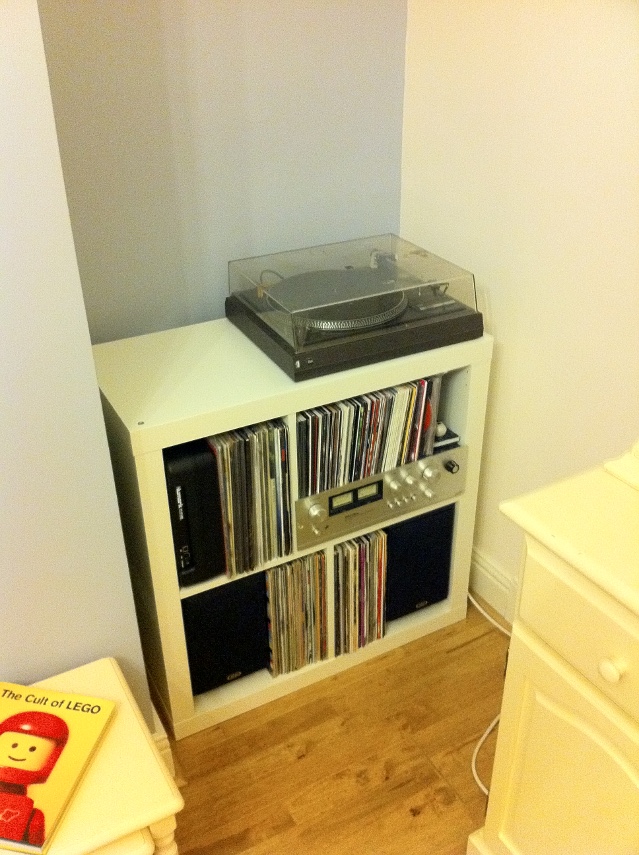
For the last four years or so, I've had my Hi-Fi and the vast majority of my vinyl collection stored in a self-contained, mildly-customized Ikea unit. Since moving house this has been in my dining room which we have always referred to as the "play room", since we have a second dining room in which we actually dine. The intention for the play room was for it to be the room within which all our future children would have their toys kept, in an attempt to keep the living room from being overrun with plastic. The time has thus come for my Hi-Fi to come out of there, so we've moved it to our living room. Unfortunately, there's not enough room in the living room for the Ikea unit: I need something narrower for the space available.
via IkeaHackers.net via IkeaHackers.net
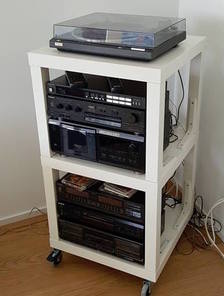
In the spirit of my original hack, I started looking at what others might have achieved with Ikea components. There are some great examples of open-style units built out of the (extremely cheap) Lack coffee tables, such as this ikeahackers article, but I'd prefer something more enclosed. One problem I've had with the Expedit unit was my cat trying to scratch the records. I ended up putting framed records at the front to cover the spines of the records within. If I were keeping the unit, I'd look at fitting hinges (another ikeahackers article) Asides from hacked Ikea stuff, there are a few companies offering traditional enclosed Hi Fi cabinets. I'm going to struggle to fit both the equipment and a subset of records into these, so I might have to look at storing them separately. In some ways that makes life easier: the records could go into a 1x4 Ikea KALLAX unit, leaving the amp and deck to home somewhere. Perhaps I could look at a bigger unit for under the TV. My parents have a nice Hi-Fi unit that pretends to be a chest of drawers. I'm fairly sure my Dad custom-built it, as it has a hinged top to provide access to the turntable and I haven't seen anything like that on the market. That brings me onto thinking about other AV things I'd like to achieve in the living room. I've always been interested in exploring surround sound, but my initial attempt in my prior flat did not go well, either because the room was not terribly suited accoustically, or because the Pioneer unit I bought was rubbish, or both. It seems that there aren't really AV receivers which are designed to satisfy both people wanting to use them in a Hi-Fi and a home cinema setting. I could stick to stereo and run the TV into my existing (or a new) amplifier, subject to some logistics around wiring. A previous house owner ran some phono cables under the hard-wood flooring from the TV alcove to the opposite side of the fire place, which might give me some options. There's also the world of wireless audio, Sonos etcetera. Realistically the majority of my music is digital nowadays, and it would be good to be able to listen to it conveniently in the house. I've heard good reports on the entry level Sonos stuff, but they seem to be Mono, and even the more high-end ones with lots of drivers have very small separation. I did buy a Chromecast Audio on a whim recently, but I haven't looked at it much yet: perhaps that's part of the solution. So, lots of stuff in the melting pot to figure out here!

11 October 2016

Vincent Sanders: The pine stays green in winter... wisdom in hardship.

In December 2015 I saw the kickstarter for the Pine64. The project seemed to have a viable hardware design and after my experience with the hikey I decided it could not be a great deal worse.

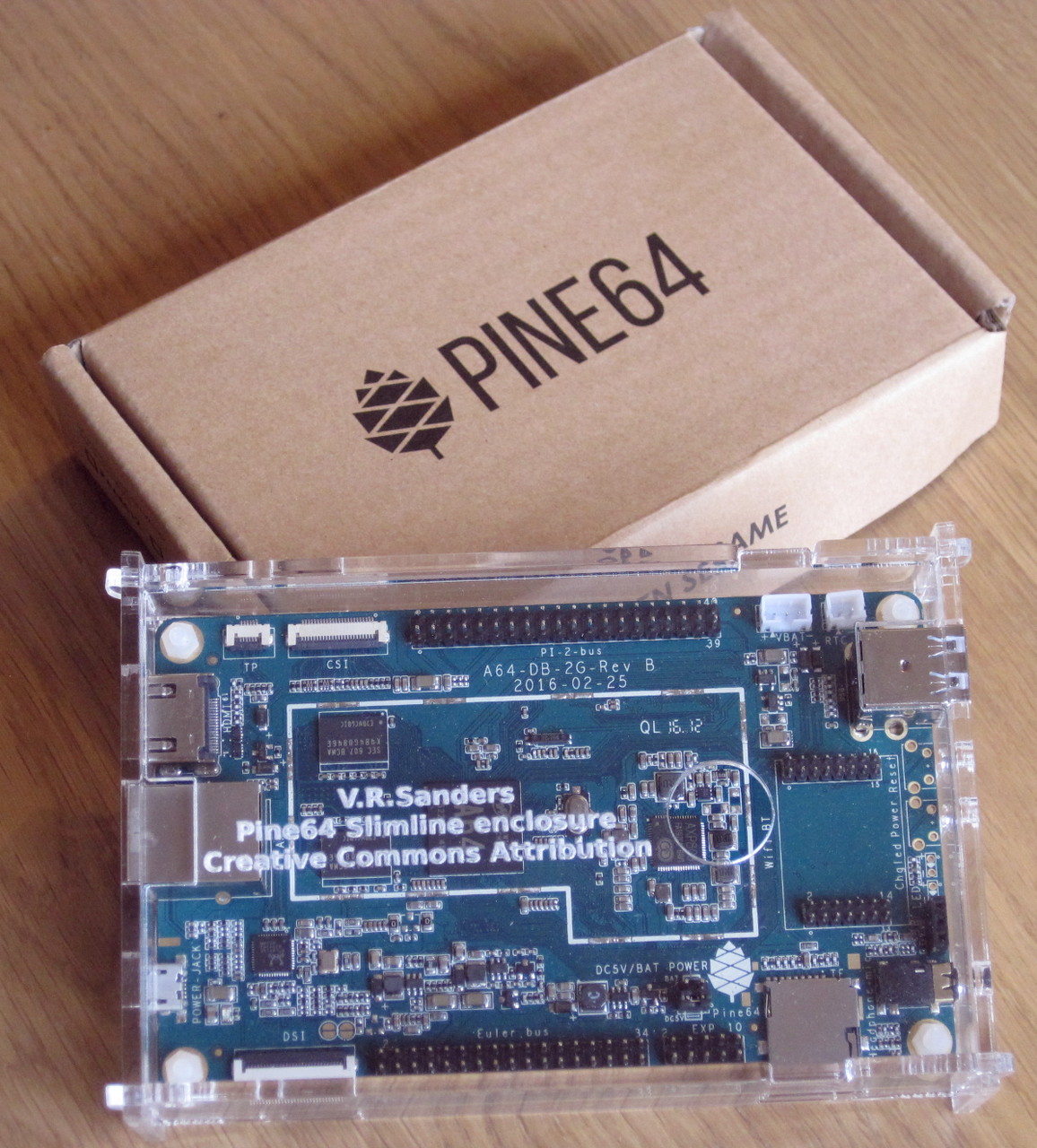
Pine64 board in my case design
The system I acquired comprises of:
Hardware based kickstarter projects are susceptible to several issues and the usual suspects occurred causing delays:
My personal view is that PINE 64 inc. handled it pretty well, much better than several other projects I have backed and as my Norman Douglas quotation suggests I think they have gained some wisdom from this.

I received my hardware at the beginning of April only a couple of months after their initial estimated shipping date which as these things go is not a huge delay. I understand some people who had slightly more complex orders were just receiving their orders in late June which is perhaps unfortunate but still well within kickstarter project norms.

As an aside: I fear that many people simply misunderstand the crowdfunding model for hardware projects and fail to understand that they are not buying a finished product, on the other side of the debate I think many projects need to learn expectation management much better than they do. Hyping the product to get interest is obviously the point of the crowdfunding platform, but over promising and under delivering always causes unhappy customers.

Pine64 board dimensions
Despite the delays in production and shipping the information available for the board was (and sadly remains) inadequate. As usual I wanted to case my board and there were no useful dimension drawings so I had to make my own from direct measurements together with a STL 3D model.

Also a mental sigh for "yet another poor form factor decision" so another special case size and design. After putting together a design and fabricating with the laser cutter I moved on to the software.

Once more this is where, once again, the story turns bleak. We find a very pretty website but no obvious link to the software (hint scroll to the bottom and find the "support" wiki link) once you find the wiki you will eventually discover that the provided software is either an Android 5.1.1 image (which failed to start on my board) or relies on some random guy from the forums who has put together his own OS images using a hacked up Allwinner Board Support Package (BSP) kernel.

Now please do not misunderstand me, I think the work by Simon Eisenmann (longsleep) to get a working kernel and Lenny Raposo to get viable OS images is outstanding and useful. I just feel that Allwinner and vendors like Pine64 Inc. should have provided something much, much better than they have. Even the efforts to get mainline support for this hardware are all completely volunteer community efforts and are are making slow progress as a result.

Assuming I wanted to run a useful OS on this hardware and not just use it as a modern work of art I installed a basic Debian arm64 using Lenny Raposo's pine64 pro site downloads. I was going to use the system for compiling and builds so used the "Debian Base" image to get a minimal setup. After generating unique ssh keys, renaming the default user and checking all the passwords and permissions I convinced myself the system was reasonably trustworthy.

The standard Debian Jessie OS runs as expected with few surprises. The main concern I have is that there are a number of unpackaged scripts installed (prefixed with pine64_) which perform several operations from reporting system health (using sysfs entries) to upgrading the kernel and bootloader.

While I understand these scripts have been provided for the novice users to reduce support burden, doing even more of the vendors job, I would much rather have had proper packages for these scripts, kernel and bootloader which apt could manage. This would have reduced image creation to a simple debootstrap giving much greater confidence in the images provenance.

The 3.10 based kernel is three years old at the time of writing and lacks a great number of features for the aarch64 ARM processors introduced since release. However I was pleasantly surprised at kvm apparently being available.

# dmesg grep -i kvm
[ 7.592896] kvm [1]: Using HYP init bounce page @b87c4000
[ 7.593361] kvm [1]: interrupt-controller@1c84000 IRQ25
[ 7.593778] kvm [1]: timer IRQ27
[ 7.593801] kvm [1]: Hyp mode initialized successfully

I installed the libvirt packages (and hence all their dependencies like qemu) and created a bridge ready for the virtual machines.

I needed access to storage for the host disc images and while I could have gone the route of using USB attached SATA as with the hikey I decided to try and use network attached storage instead. Initially I investigated iSCSI but it seems the Linux target (iSCSI uses initiator for client and target for server) support is either old, broken or unpackaged.

I turned to network block device (nbd) which is packaged and seems to have reasonable stability out of the box on modern distributions. This appeared to work well, indeed over the gigabit Ethernet interface I managed to get a sustained 40 megabytes a second read and write rate in basic testing. This is better performance than a USB 2.0 attached SSD on the hikey

I fired up the guest and perhaps I should have known better than to expect a 3.10 vendor kernel to cope. The immediate hard crashes despite tuning many variables convinced me that virtualisation was not viable with this kernel.

So abandoning that approach I attempted to run the CI workload directly on the system. To my dismay this also proved problematic. The processor has the bad habit of throttling due to thermal issues (despite a substantial heatsink) and because the storage is network attached throttling the CPU also massively impacts I/O.

The limitations meant that the workload caused the system to move between high performance and almost no progress on a roughly ten second cycle. This caused a simple NetSurf recompile CI job to take over fifteen minutes. For comparison the same task takes the armhf builder (CubieTruck) four minutes and a 64 bit x86 build which takes around a minute.

If the workload is tuned to a single core which does not trip thermal throttling the build took seven minutes. which is almost identical to the existing single core virtual machine instance running on the hikey.

In conclusion the Pine64 is an interesting bit of hardware with fatally flawed software offering. Without Simon and Lenny providing their builds to the community the device would be practically useless rather than just performing poorly. There appears to have been no progress whatsoever on the software offering from Pine64 in the six months since I received the device and no prospect of mainline Allwinner support for the SoC either.

Effectively I have spent around 50usd (40 for the board and 10 for the enclosure) on a failed experiment. Perhaps in the future the software will improve sufficiently for it to become useful but I do not hold out much hope that this will come from Pine64 themselves.

9 October 2016

Bits from Debian: Debian is participating in the next round of Outreachy!

Following the success of the last round of Outreachy, we are glad to announce that Debian will take part in the program for the next round, with internships lasting from the 6th of December 2016 to the 6th of March 2017. From the official website: Outreachy helps people from groups underrepresented in free and open source software get involved. We provide a supportive community for beginning to contribute any time throughout the year and offer focused internship opportunities twice a year with a number of free software organizations. Currently, internships are open internationally to women (cis and trans), trans men, and genderqueer people. Additionally, they are open to residents and nationals of the United States of any gender who are Black/African American, Hispanic/Latin@, American Indian, Alaska Native, Native Hawaiian, or Pacific Islander. If you want to apply to an internship in Debian, you should take a look at the wiki page, and contact the mentors for the projects listed, or seek more information on the (public) debian-outreach mailing-list. You can also contact the Outreach Team directly. If you have a project idea and are willing to mentor an intern, you can submit a project idea on the Outreachy wiki page. Here's a few words on what the interns for the last round achieved within Outreachy: Debian would not be able to participate in Outreachy without the help of the Software Freedom Conservancy, who provides administrative support for Outreachy, as well as the continued support of Debian's donors, who provide funding for the internships. If you want to donate, please get in touch with one of our trusted organizations. Debian is looking forward to welcoming new interns for the next few months, come join us!

8 October 2016

Joachim Breitner: T430s T460s

Earlier this week, I finally got my new machine that came with my new position at the University of Pennsylvania: A shiny Thinkpad T460s that now replaces my T430s. (Yes, there is a pattern. It continues with T400 and T41p.) I decided to re-install my Debian system from scratch and copy over only the home directory a bit of purification does not hurt. This blog post contains some random notes that might be useful to someone or alternative where I hope someone can tell me how to fix and improve things.

Installation The installation (using debian-installer from a USB drive) went mostly smooth, including LVM on an encrypted partition. Unfortunately, it did not set up grub correctly for the UEFI system to boot, so I had to jump through some hoops (using the grub on the USB drive to manually boot into the installed system, and installing grub-efi from there) until the system actually came up.

High-resolution display This laptop has a 2560 1440 high resolution display. Modern desktop environments like GNOME supposedly handle that quite nicely, but for reasons explained in an earlier post, I do not use a desktop envrionment but have a minimalistic setup based on Xmonad. I managed to get a decent setup now, by turning lots of manual knobs:
  • For the linux console, setting
    FONTFACE="Terminus"
    FONTSIZE="12x24"
    in /etc/default/console-setup yielded good results.
  • For the few GTK-2 applications that I am still running, I set
    gtk-font-name="Sans 16"
    in ~/.gtkrc-2.0. Similarly, for GTK-3 I have
    [Settings]
    gtk-font-name = Sans 16
    in ~/.config/gtk-3.0/settings.ini.
  • Programs like gnome-terminal, Evolution and hexchat refer to the System default document font and System default monospace font . I remember that it was possible to configure these in the GNOME control center, but I could not find any way of configuring these using command line tools, so I resorted to manually setting the font for these. With the help from Alexandre Franke I figured out that the magic incarnation here is:
    gsettings set org.gnome.desktop.interface monospace-font-name 'Monospace 16'
    gsettings set org.gnome.desktop.interface document-font-name 'Serif 16'
    gsettings set org.gnome.desktop.interface font-name 'Sans 16'
  • Firefox seemed to have picked up these settings for the UI, so that was good. To make web pages readable, I set layout.css.devPixelsPerPx to 1.5 in about:config.
  • GVim has set guifont=Monospace\ 16 in ~/.vimrc. The toolbar is tiny, but I hardly use it anyways.
  • Setting the font of Xmonad prompts requires the sytax
    , font = "xft:Sans:size=16"
    Speaking about Xmonad prompts: Check out the XMonad.Prompt.Unicode module that I have been using for years and recently submitted upstream.
  • I launch Chromium (or rather the desktop applications that I use that happen to be Chrome apps) with the parameter --force-device-scale-factor=1.5.
  • Libreoffice seems to be best configured by running xrandr --dpi 194 before hand. This seems also to be read by Firefox, doubling the effect of the font size in the gtk settings, which is annoying. Luckily I do not work with Libreoffice often, so for now I ll just set that manually when needed.
I am not quite satisfied. I have the impression that the 16 point size font, e.g. in Evolution, is not really pretty, so I am happy to take suggestions here. I found the ArchWiki page on HiDPI very useful here.

Trackpoint and Touchpad One reason for me to sticking with Thinkpads is their trackpoint, which I use exclusively. In previous models, I disabled the touchpad in the BIOS, but this did not seem to have an effect here, so I added the following section to /etc/X11/xorg.conf.d/30-touchpad.conf
Section "InputClass"
        Identifier "SynPS/2 Synaptics TouchPad"
        MatchProduct "SynPS/2 Synaptics TouchPad"
        Option "ignore" "on"
EndSection
At one point I left out the MatchProduct line, disabling all input in the X server. Had to boot into recovery mode to fix that. Unfortunately, there is something wrong with the trackpoint and the buttons: When I am moving the trackpoint (and maybe if there is actual load on the machine), mouse button press and release events sometimes get lost. This is quite annoying I try to open a folder in Evolution and accidentially move it. I installed the latest Kernel from Debian experimental (4.8.0-rc8), but it did not help. I filed a bug report against libinput although I am not fully sure that that s the culprit. Update: According to Benjamin Tissoires it is a known firmware bug and the appropriate people are working on a work-around. Until then I am advised to keep my palm of the touchpad. Also, I found the trackpoint too slow. I am not sure if it is simply because of the large resolution of the screen, or because some movement events are also swallowed. For now, I simply changed the speed by writing
SUBSYSTEM=="serio", DRIVERS=="psmouse", ATTRS speed ="120"
to /etc/udev/rules.d/10-trackpoint.rules.

Brightness control The system would not automatically react to pressing Fn-F5 and Fn-F6, which are the keys to adjust the brightness. I am unsure about how and by what software component it should be handled, but the solution that I found was to set
Section "Device"
        Identifier  "card0"
        Driver      "intel"
        Option      "Backlight"  "intel_backlight"
        BusID       "PCI:0:2:0"
EndSection
so that the command line tool xbacklight would work, and then use Xmonad keybinds to perform the action, just as I already do for sound control:
    , ((0, xF86XK_Sleep),       spawn "dbus-send --system --print-reply --dest=org.freedesktop.UPower /org/freedesktop/UPower org.freedesktop.UPower.Suspend")
    , ((0, xF86XK_AudioMute), spawn "ponymix toggle")
    , ((0, 0x1008ffb2  - xF86XK_AudioMicMute - ), spawn "ponymix --source toggle")
    , ((0, xF86XK_AudioRaiseVolume), spawn "ponymix increase 5")
    , ((0, xF86XK_AudioLowerVolume), spawn "ponymix decrease 5")
    , ((shiftMask, xF86XK_AudioRaiseVolume), spawn "ponymix increase 5 --max-volume 200")
    , ((shiftMask, xF86XK_AudioLowerVolume), spawn "ponymix decrease 5")
    , ((0, xF86XK_MonBrightnessUp), spawn "xbacklight +10")
    , ((0, xF86XK_MonBrightnessDown), spawn "xbacklight -10")
The T460s does not actually have a sleep button, that line is a reminiscence from my T430s. I suspend the machine by pressing the power button now, thanks to HandlePowerKey=suspend in /etc/systemd/logind.conf.

Profile Weirdness Something strange happend to my environment variables after the move. It is clearly not hardware related, but I simply cannot explain what has changed: All relevant files in /etc look similar enough. I use ~/.profile to extend the PATH and set some other variables. Previously, these settings were in effect in my whole X session, which is started by lightdm with auto-login, followed by xmonad-session. I could find no better way to fix that than stating . ~/.profile early in my ~/.xmonad/xmonad-session-rc. Very strange.

Norbert Preining: Debian/TeX update October 2016: all of TeX Live and Biber 2.6

Finally a new update of many TeX related packages: all the texlive-* including the binary packages, and biber have been updated to the latest release. This upload was delayed by my travels around the world, as well as the necessity to package a new Perl module (libdatetime-calendar-julian-perl) as required by new Biber. Also, my new job leaves me only the weekends for packaging. Anyway, the packages are now uploaded and should appear soon on your friendly local server. texlive2016-debian There are several highlights: The binaries have been patched with several upstream fixes (tex4ht and XeTeX compatibility, as well as various Japanese TeX engine fixes), updated biber and biblatex, and as usual loads of new and updated packages. Last but not least I want to thank one particular author: His package was removed from TeX Live due to the addition of a rather unusual clause in the license. Instead of simply uploading new packages to Debian with the rather important removed, I contacted the author and asked for clarification. And to my great pleasure he immediately answered with an update of the package with fixed license. All of us user of these many packages should be grateful to the authors of the packages who invest loads of their free time into supporting our community. Thanks! Enough now, here as usual the list of new and updated packages with links to their respective CTAN pages. Enjoy. New packages addfont, apalike-german, autoaligne, baekmuk, beamerswitch, beamertheme-cuerna, beuron, biblatex-claves, biolett-bst, cooking-units, cstypo, emf, eulerpx, filecontentsdef, frederika2016, grant, latexgit, listofitems, overlays, phonenumbers, pst-arrow, quicktype, revquantum, richtext, semantic-markup, spalign, texproposal, tikz-page, unfonts-core, unfonts-extra, uspace. Updated packages achemso, acmart, acro, adobemapping, alegreya, allrunes, animate, arabluatex, archaeologie, asymptote, attachfile, babel-greek, bangorcsthesis, beebe, biblatex, biblatex-anonymous, biblatex-apa, biblatex-bookinother, biblatex-chem, biblatex-fiwi, biblatex-gost, biblatex-ieee, biblatex-manuscripts-philology, biblatex-morenames, biblatex-nature, biblatex-opcit-booktitle, biblatex-phys, biblatex-realauthor, biblatex-science, biblatex-true-citepages-omit, bibleref, bidi, chemformula, circuitikz, cochineal, colorspace, comment, covington, cquthesis, ctex, drawmatrix, ejpecp, erewhon, etoc, exsheets, fancyhdr, fei, fithesis, footnotehyper, fvextra, geschichtsfrkl, gnuplottex, gost, gregoriotex, hausarbeit-jura, ijsra, ipaex, jfontmaps, jsclasses, jslectureplanner, latexdiff, leadsheets, libertinust1math, luatexja, markdown, mcf2graph, minutes, multirow, mynsfc, nameauth, newpx, newtxsf, notespages, optidef, pas-cours, platex, prftree, pst-bezier, pst-circ, pst-eucl, pst-optic, pstricks, pstricks-add, refenums, reledmac, rsc, shdoc, siunitx, stackengine, tabstackengine, tagpair, tetex, texlive-es, texlive-scripts, ticket, translation-biblatex-de, tudscr, turabian-formatting, updmap-map, uplatex, xebaposter, xecjk, xepersian, xpinyin. Enjoy.

6 October 2016

Reproducible builds folks: Reproducible Builds: week 75 in Stretch cycle

What happened in the Reproducible Builds effort between Sunday September 25 and Saturday October 1 2016: Statistics For the first time, we reached 91% reproducible packages in our testing framework on testing/amd64 using a determistic build path. (This is what we recommend to make packages in Stretch reproducible.) For unstable/amd64, where we additionally test for reproducibility across different build paths we are at almost 76% again. IRC meetings We have a poll to set a time for a new regular IRC meeting. If you would like to attend, please input your available times and we will try to accommodate for you. There was a trial IRC meeting on Friday, 2016-09-31 1800 UTC. Unfortunately, we did not activate meetbot. Despite this participants consider the meeting a success as several topics where discussed (eg changes to IRC notifications of tests.r-b.o) and the meeting stayed within one our length. Upcoming events Reproduce and Verify Filesystems - Vincent Batts, Red Hat - Berlin (Germany), 5th October, 14:30 - 15:20 @ LinuxCon + ContainerCon Europe 2016. From Reproducible Debian builds to Reproducible OpenWrt, LEDE & coreboot - Holger "h01ger" Levsen and Alexander "lynxis" Couzens - Berlin (Germany), 13th October, 11:00 - 11:25 @ OpenWrt Summit 2016. Introduction to Reproducible Builds - Vagrant Cascadian will be presenting at the SeaGL.org Conference In Seattle (USA), November 11th-12th, 2016. Previous events GHC Determinism - Bartosz Nitka, Facebook - Nara (Japan), 24th September, ICPF 2016. Toolchain development and fixes Michael Meskes uploaded bsdmainutils/9.0.11 to unstable with a fix for #830259 based on Reiner Herrmann's patch. This fixed locale_dependent_symbol_order_by_lorder issue in the affected packages (freebsd-libs, mmh). devscripts/2.16.8 was uploaded to unstable. It includes a debrepro script by Antonio Terceiro which is similar in purpose to reprotest but more lightweight; specific to Debian packages and without support for virtual servers or configurable variations. Packages reviewed and fixed, and bugs filed The following updated packages have become reproducible in our testing framework after being fixed: The following updated packages appear to be reproducible now for reasons we were not able to figure out. (Relevant changelogs did not mention reproducible builds.) Some uploads have addressed some reproducibility issues, but not all of them: Patches submitted that have not made their way to the archive yet: Reviews of unreproducible packages 77 package reviews have been added, 178 have been updated and 80 have been removed in this week, adding to our knowledge about identified issues. 6 issue types have been updated: Weekly QA work As part of reproducibility testing, FTBFS bugs have been detected and reported by: diffoscope development A new version of diffoscope 61 was uploaded to unstable by Chris Lamb. It included contributions from: Post-release there were further contributions from: reprotest development A new version of reprotest 0.3.2 was uploaded to unstable by Ximin Luo. It included contributions from: Post-release there were further contributions from: tests.reproducible-builds.org Misc. This week's edition was written by Ximin Luo, Holger Levsen & Chris Lamb and reviewed by a bunch of Reproducible Builds folks on IRC.

5 October 2016

Gustavo Noronha Silva: Web Engines Hackfest 2016!

I had a great time last week and the web engines hackfest! It was the 7th web hackfest hosted by Igalia and the 7th hackfest I attended. I m almost a local Galician already. Brazilian Portuguese being so close to Galician certainly helps! Collabora co-sponsored the event and it was great that two colleagues of mine managed to join me in attendance. It had great talks that will eventually end up in videos uploaded to the web site. We were amazed at the progress being made to Servo, including some performance results that blew our minds. We also discussed the next steps for WebKitGTK+, WebKit for Wayland (or WPE), our own Clutter wrapper to WebKitGTK+ which is used for the Apertis project, and much more.
Zan giving his talk on WPE (former WebKitForWayland)Zan giving his talk on WPE (former WebKitForWayland)
One thing that drew my attention was how many Dell laptops there were. Many collaborans (myself included) and igalians are now using Dells, it seems. Sure, there were thinkpads and macbooks, but there was plenty of inspirons and xpses as well. It s interesting how the brand make up shifted over the years since 2009, when the hackfest could easily be mistaken with a thinkpad shop. Back to the actual hackfest: with the recent release of Gnome 3.22 (and Fedora 25 nearing release), my main focus was on dealing with some regressions suffered by users experienced after a change that made putting the final rendering composited by the nested Wayland compositor we have inside WebKitGTK+ to the GTK+ widget so it is shown on the screen. One of the main problems people reported was applications that use WebKitGTK+ not showing anything where the content was supposed to appear. It turns out the problem was caused by GTK+ not being able to create a GL context. If the system was simply not able to use GL there would be no problem: WebKit would then just disable accelerated compositing and things would work, albeit slower. The problem was WebKit being able to use an older GL version than the minimum required by GTK+. We fixed it by testing that GTK+ is able to create GL contexts before using the fast path, falling back to the slow glReadPixels codepath if not. This way we keep accelerated compositing working inside WebKit, which gives us nice 3D transforms and less repainting, but take the performance hit in the final blit .
Introducing "WebKitClutterGTK+"Introducing WebKitClutterGTK+
Another issue we hit was GTK+ not properly updating its knowledge of the window s opaque region when painting a frame with GL, which led to some really interesting issues like a shadow appearing when you tried to shrink the window. There was also an issue where the window would not use all of the screen when fullscreen which was likely related. Both were fixed. Andr Magalh es also worked on a couple of patches we wrote for customer projects and are now pushing upstream. One enables the use of more than one frontend to connect to a remote web inspector server at once. This can be used to, for instance, show the regular web inspector on a browser window and also use IDE integration for setting breakpoints and so on. The other patch was cooked by Philip Withnall and helped us deal with some performance bottlenecks we were hitting. It improves the performance of painting scroll bars. WebKitGTK+ does its own painting of scrollbars (we do not use the GTK+ widgets for various reasons). It turns out painting scrollbars can be quite a hit when the page is being scrolled fast, if not done efficiently. Emanuele Aina had a great time learning more about meson to figure out a build issue we had when a more recent GStreamer was added to our jhbuild environment. He came out of the experience rather sane, which makes me think meson might indeed be much better than autotools.
Igalia 15 years cakeIgalia 15 years cake
It was a great hackfest, great seeing everyone face to face. We were happy to celebrate Igalia s 15 years with them. Hope to see everyone again next year =)

4 October 2016

Raphaël Hertzog: My Free Software Activities in September 2016

My monthly report covers a large part of what I have been doing in the free software world. I write it for my donators (thanks to them!) but also for the wider Debian community because it can give ideas to newcomers and it s one of the best ways to find volunteers to work with me on projects that matter to me. Debian LTS With the increasing number of paid contributors, easy fixes (CVE with patches available) tend to be processed rather quickly. All the package I worked on had issues that were open for a long time because they were hard to handle. I prepared DLA-613-1 fixing 3 CVE on roundcube. The fix required to manually backport the CRSF handling code which was not available in the wheezy version. I spent almost 8 hours on roundcube. Then I started to work on tiff3. I reviewed many CVE: CVE-2016-3658, CVE-2015-7313, CVE-2015-7554, CVE-2015-8668, CVE-2016-5318, CVE-2016-3625, CVE-2016-5319. I updated their status for tiff3 in wheezy, requested reproducer files to people who reported the CVE when the files were not publicly available and made sure that everything was recorded in the upstream bug tracker. The 4.25 hours I spent on the package were not enough to work on patches, so I put the package back in the work queue. GNOME 3.22 transition I uploaded a new gnome-shell-timer that would work with GNOME 3.21 that had been uploaded to sid. Unfortunately, that new GNOME (and GTK+) version caused many regressions that affected Debian Testing (and thus Kali) users in particular in gnome-control-center. I uploaded a new version fixing some of those issues and I reported a bunch of them to upstream too (#771515, #771517, #771696). Kali I worked on #836211 creating a dpkg patch to work-around the overlayfs limitation (we use it in Kali because persistence of live system relies on overlayfs) and I contacted the upstream overlayfs maintainer to hopefully get a proper fix on the overlayfs side instead. I uploaded radcli 1.2.6-2.1 to fix RC bug #825121 as the package was removed from testing and openvas depends on it in Kali. As part of the pkg-security team, I sponsored/uploaded acccheck and arp-scan for Marcos Fouces, and p0f 3.09b as well. Misc Debian work Distro Tracker. I tested, fixed and merged Paul Wise s patch integrating multiarch hints into tracker.debian.org (#833623). Debian Handbook. I enabled the new Vietnamese translation on debian-handbook.info and updated all translations with Weblate updates. systemd units for apache2. I prepared systemd units for apache2 which I submitted in #798430. With approval of Stefan Fritsch, I committed my work to the git repository and then uploaded the result in version 2.4.23-5. Hindsight packaging. I first packaged lua-sandbox (#838969) which is a dependency of Hindsight and then Hindsight itself (#838968). In this process, I opened a couple of upstream tickets. PIE by default. I uploaded a new version of cpputest compiled with -fPIC so shat executable linking to its static library can be compiled with -fPIE (#837363, forwarded upstream here). Bugs filed. Bad homepage link in haskell-dice-entropy-conduit. Inconsistent options --onlyscripts and --noscripts in debhelper. pidgin entry in security-support-limited is out of date in debian-security-support. New upstream version (2.0.2) in puppet-lint. Thanks See you next month for a new summary of my activities.

No comment Liked this article? Click here. My blog is Flattr-enabled.

Iain R. Learmonth: Decentralise (in a kind of centralised way)

Once a month I am involved in running an informal session, loosely affiliated with Open Rights Group and FSFE, called Cryptonoise. Cryptonoise explores methods for protecting your digital rights, with a leaning towards focusing on privacy, and provides a venue for like minded people to meet up and discuss the state of the digital landscape and those that may try to infringe on the rights of digital citizens. We ve all made it easy for large enterprises and governments to collect masses of data about our online activities because we perform most of those activities in the same place. Facebook, Google and Twitter spring to mind as examples of companies that have grown to dangerous sizes with little competition. This is not paranoia. This is real. We make it a lot more difficult when we spread out. Our meetups are held at 57North Hacklab and at the last meetup on the 29th September I set up a GNU Social instance for the members of 57North. GNU Social provides the same functionality as Twitter but as a decentralised federated network. Federation is a feature that is found in protocols like E-Mail, XMPP and SIP. It doesn t matter which server you re using, you can still talk to all the other users on all the other servers. While I m using social.57north.org.uk I can still follow FSF on status.fsf.org, for example, with no prior coordination with system administrators or anything complicated. It all just works. People have pointed out that I ve just introduced another point of centralisation but I don t see it necessarily as a bad thing. I think too many users in a single service starts to look dangerous but as long as user counts don t go too high I believe that the benefits of sharing the administrative workload (performing updates, monitoring, keeping the TLS cert current, etc.) far outweigh the effects of having a few extra users. I think 100 is probably about the maximum number I would be comfortable with, although I ll admit I ve not based this on anything and it s chosen arbitrarily. The jabber.ccc.de server is an example of a service that grew too large. It was set up by members of CCC and made available to all, but ended up becoming the de facto service for hackers. The jabber.ccc.de team have made appeals for others to set up their own servers, and you should. For a great overview and guide for setting up your own real-time commmunication servers, check out the RTC Quick Start Guide. This work was enabled by Shell who had previously set up a Central Authentication Service, which GNU Social already had a plugin to use as the authentication backend. No one likes to have a whole load of different passwords for different services and integration with this allows for identities to be consistent across the 57North services. She has also setup a Matrix homeserver, another step towards decentralisation and an end of reliance on centralised giants. If you have an account on a GNU Social instance, you can follow me here.

3 October 2016

Matthew Garrett: The importance of paying attention in building community trust

Trust is important in any kind of interpersonal relationship. It's inevitable that there will be cases where something you do will irritate or upset others, even if only to a small degree. Handling small cases well helps build trust that you will do the right thing in more significant cases, whereas ignoring things that seem fairly insignificant (or saying that you'll do something about them and then failing to do so) suggests that you'll also fail when there's a major problem. Getting the small details right is a major part of creating the impression that you'll deal with significant challenges in a responsible and considerate way.

This isn't limited to individual relationships. Something that distinguishes good customer service from bad customer service is getting the details right. There are many industries where significant failures happen infrequently, but minor ones happen a lot. Would you prefer to give your business to a company that handles those small details well (even if they're not overly annoying) or one that just tells you to deal with them?

And the same is true of software communities. A strong and considerate response to minor bug reports makes it more likely that users will be patient with you when dealing with significant ones. Handling small patch contributions quickly makes it more likely that a submitter will be willing to do the work of making more significant contributions. These things are well understood, and most successful projects have actively worked to reduce barriers to entry and to be responsive to user requests in order to encourage participation and foster a feeling that they care.

But what's often ignored is that this applies to other aspects of communities as well. Failing to use inclusive language may not seem like a big thing in itself, but it leaves people with the feeling that you're less likely to do anything about more egregious exclusionary behaviour. Allowing a baseline level of sexist humour gives the impression that you won't act if there are blatant displays of misogyny. The more examples of these "insignificant" issues people see, the more likely they are to choose to spend their time somewhere else, somewhere they can have faith that major issues will be handled appropriately.

There's a more insidious aspect to this. Sometimes we can believe that we are handling minor issues appropriately, that we're acting in a way that handles people's concerns, while actually failing to do so. If someone raises a concern about an aspect of the community, it's important to discuss solutions with them. Putting effort into "solving" a problem without ensuring that the solution has the desired outcome is not only a waste of time, it alienates those affected even more - they're now not only left with the feeling that they can't trust you to respond appropriately, but that you will actively ignore their feelings in the process.

It's not always possible to satisfy everybody's concerns. Sometimes you'll be left in situations where you have conflicting requests. In that case the best thing you can do is to explain the conflict and why you've made the choice you have, and demonstrate that you took this issue seriously rather than ignoring it. Depending on the issue, you may still alienate some number of participants, but it'll be fewer than if you just pretend that it's not actually a problem.

One warning, though: while building trust in this way enhances people's willingness to join your community, it also builds expectations. If a significant issue does arise, and if you fail to handle it well, you'll burn a lot of that trust in the process. The fact that you've built that trust in the first place may be what saves your community from disintegrating completely, but people will feel even more betrayed if you don't actively work to rebuild it. And if there's a pattern of mishandling major problems, no amount of getting the details right will matter.

Communities that ignore these issues are, long term, likely to end up weaker than communities that pay attention to them. Making sure you get this right in the first place, and setting expectations that you will pay attention to your contributors, is a vital part of building a meaningful relationship between your community and its members.

comment count unavailable comments

Kees Cook: security things in Linux v4.7

Previously: v4.6. Onward to security things I found interesting in Linux v4.7: KASLR text base offset for MIPS Matt Redfearn added text base address KASLR to MIPS, similar to what s available on x86 and arm64. As done with x86, MIPS attempts to gather entropy from various build-time, run-time, and CPU locations in an effort to find reasonable sources during early-boot. MIPS doesn t yet have anything as strong as x86 s RDRAND (though most have an instruction counter like x86 s RDTSC), but it does have the benefit of being able to use Device Tree (i.e. the /chosen/kaslr-seed property) like arm64 does. By my understanding, even without Device Tree, MIPS KASLR entropy should be as strong as pre-RDRAND x86 entropy, which is more than sufficient for what is, similar to x86, not a huge KASLR range anyway: default 8 bits (a span of 16MB with 64KB alignment), though CONFIG_RANDOMIZE_BASE_MAX_OFFSET can be tuned to the device s memory, giving a maximum of 11 bits on 32-bit, and 15 bits on EVA or 64-bit. SLAB freelist ASLR Thomas Garnier added CONFIG_SLAB_FREELIST_RANDOM to make slab allocation layouts less deterministic with a per-boot randomized freelist order. This raises the bar for successful kernel slab attacks. Attackers will need to either find additional bugs to help leak slab layout information or will need to perform more complex grooming during an attack. Thomas wrote a post describing the feature in more detail here: Randomizing the Linux kernel heap freelists. (SLAB is done in v4.7, and SLUB in v4.8.) eBPF JIT constant blinding Daniel Borkmann implemented constant blinding in the eBPF JIT subsystem. With strong kernel memory protections (CONFIG_DEBUG_RODATA) in place, and with the segregation of user-space memory execution from kernel (i.e SMEP, PXN, CONFIG_CPU_SW_DOMAIN_PAN), having a place where user-space can inject content into an executable area of kernel memory becomes very high-value to an attacker. The eBPF JIT was exactly such a thing: the use of BPF constants could result in the JIT producing instruction flows that could include attacker-controlled instructions (e.g. by directing execution into the middle of an instruction with a constant that would be interpreted as a native instruction). The eBPF JIT already uses a number of other defensive tricks (e.g. random starting position), but this added randomized blinding to any BPF constants, which makes building a malicious execution path in the eBPF JIT memory much more difficult (and helps block attempts at JIT spraying to bypass other protections). Elena Reshetova updated a 2012 proof-of-concept attack to succeed against modern kernels to help provide a working example of what needed fixing in the JIT. This serves as a thorough regression test for the protection. The cBPF JITs that exist in ARM, MIPS, PowerPC, and Sparc still need to be updated to eBPF, but when they do, they ll gain all these protections immediatley. Bottom line is that if you enable the (disabled-by-default) bpf_jit_enable sysctl, be sure to set the bpf_jit_harden sysctl to 2 (to perform blinding even for root). fix brk ASLR weakness on arm64 compat There have been a few ASLR fixes recently (e.g. ET_DYN, x86 32-bit unlimited stack), and while reviewing some suggested fixes to arm64 brk ASLR code from Jon Medhurst, I noticed that arm64 s brk ASLR entropy was slightly too low (less than 1 bit) for 64-bit and noticeably lower (by 2 bits) for 32-bit compat processes when compared to native 32-bit arm. I simplified the code by using literals for the entropy. Maybe we can add a sysctl some day to control brk ASLR entropy like was done for mmap ASLR entropy. LoadPin LSM LSM stacking is well-defined since v4.2, so I finally upstreamed a small LSM that implements a protection I wrote for Chrome OS several years back. On systems with a static root of trust that extends to the filesystem level (e.g. Chrome OS s coreboot+depthcharge boot firmware chaining to dm-verity, or a system booting from read-only media), it s redundant to sign kernel modules (you ve already got the modules on read-only media: they can t change). The kernel just needs to know they re all coming from the correct location. (And this solves loading known-good firmware too, since there is no convention for signed firmware in the kernel yet.) LoadPin requires that all modules, firmware, etc come from the same mount (and assumes that the first loaded file defines which mount is correct , hence load pinning ). That s it for v4.7. Prepare yourself for v4.8 next!

2016, Kees Cook. This work is licensed under a Creative Commons Attribution-ShareAlike 3.0 License.
Creative Commons License

2 October 2016

Russ Allbery: Review: Winds of Change

Review: Winds of Change, by Mercedes Lackey
Series: Mage Winds #2
Publisher: DAW
Copyright: August 1993
ISBN: 0-88677-563-9
Format: Mass market
Pages: 475
Winds of Change is a direct sequel to Winds of Fate. This is a more closely connected trilogy than the previous Valdemar books. It's not the sort of thing you want to read out of order. The events of Winds of Fate predictably left the multiple protagonists united and with some breathing space, but none of their problems are resolved. The Heartstone is still a mess; in fact, it may be getting worse. Elspeth needs to learn how to wield the magical power she apparently has. And there are a lot of interpersonal tensions, lingering hurt feelings, and (in the case of Elspeth and Darkwind) a truly prodigious quantity of whining that has to be worked through before the protagonists can feel safe and happy. Winds of Change is the training montage book, and wow did my memory paper over a lot of flaws in this series. This is 475 pages of not much happening, occasionally in very irritating ways. Yes, we do finally meander to a stronger conclusion than the last book, and there is much resolving of old hurts and awkward interactions, as well as a bit of discovery of true love (this is Lackey, after all). But far, far too much of the book is Elspeth and Darkwind sniping at each other, being immature, not communicating, and otherwise being obnoxious while all the people around them try to gently help. Lackey's main characterization flaw for me is that she tends to default into generating characters who badly need to be smacked upside the head, and then does so in ways and for things at odd angles to the reasons why I think they should be smacked. It can make for frustrating reading. The introduction of Firesong as a character about halfway through this book does not help. Firesong is a flamboyant, amazingly egotistical, and stunningly arrogant show-off who also happens to be a magical super-genius and hence has "earned" his arrogance. This is an intentional character design, not my idiosyncratic reaction to the character, since every other character in the book finds him insufferable as well at first. But he's also a deeply insightful healing Adept by, honestly, authorial fiat, so by the end of the novel he's helped patch up everyone's problems and the other characters have accepted his presentation as a character quirk. Sigh. So, okay, one doesn't read popcorn fantasy for its deep characterization or realistic grasp of human subtlety. But this is just way more than I can swallow. Lackey's concept of a healing Adept (which I like a great deal as a bit of world-building) necessarily involves both deep knowledge and deep empathy and connection with other people. Firesong is so utterly full of himself that there's simply no way that he could have the empathy required to do what he is shown to do here. (Lackey does try to explain this away in the book, but the explanation didn't work for me.) Every time he successfully intervenes in other people's emotional lives, he does so with a sudden personality change, some stunning insight that he previously showed no evidence of ability to understand, and somehow only enough arrogance in his presentation to prickle but not to close people's mind to whatever he's trying to say. That's not how this works. That's not how any of this works. Lackey always treats psychology as a bit of a blunt instrument, and one either learns to tolerate that or gives up on her series, but Firesong is flatly the most unbelievable emotional mentor figure in any of her books I've read. (One of the more satisfying, if slight, bits of this series comes up in the next book, where Firesong runs into someone else who can do the same thing but has actually earned the empathy the hard way, and is a bit taken aback by it.) My other complaint with this book is that Lackey adds more chapters from the viewpoint of the big bad of the series. These are deeply unpleasant, since he's a deeply unpleasant person, and seem largely unnecessary. It's vaguely interesting to follow the magical maneuverings from both sides, but there are more of these scenes than strictly necessary for that purpose, and the sheer unmitigated evil of Lackey's evil characters is a bit hard to take. Also, he somehow has vast resources of staff and assistants, and much suspension of disbelief is required to believe that anyone would continue working for this person. It's one thing to imagine people being drawn to a charismatic Hitler type; it's quite another when the boss is a brooding, imperious asshole who roams the hallways and tortures random people to death whenever he's bored. Fear and magic only go so far in maintaining a large following when you do that, and he generates dead bodies at a remarkable rate. The best characters in this series continue to be Nyara, Need, and the gryphons. I'd rather read a book just about them. Need does use a bit too much of Lackey's tough love technique (another recurring theme of this larger series), but from Need that's wholly believable; her gruff and dubious empathy is in line with her character and history and fits a talking sword extremely well. But they, despite having a bit of their own training montage, are a side story here. The climax of the story is moderately satisfying, but the book takes far too long to get to it. I remember liking this series when I first read it, and I still like some aspects of Lackey's world-building and a few of the characters, but it's much weaker than I had remembered. I can't really recommend it. Followed by Winds of Fury. Rating: 5 out of 10

1 October 2016

Kees Cook: security things in Linux v4.6

Previously: v4.5. The v4.6 Linux kernel release included a bunch of stuff, with much more of it under the KSPP umbrella. seccomp support for parisc Helge Deller added seccomp support for parisc, which including plumbing support for PTRACE_GETREGSET to get the self-tests working. x86 32-bit mmap ASLR vs unlimited stack fixed Hector Marco-Gisbert removed a long-standing limitation to mmap ASLR on 32-bit x86, where setting an unlimited stack (e.g. ulimit -s unlimited ) would turn off mmap ASLR (which provided a way to bypass ASLR when executing setuid processes). Given that ASLR entropy can now be controlled directly (see the v4.5 post), and that the cases where this created an actual problem are very rare, means that if a system sees collisions between unlimited stack and mmap ASLR, they can just adjust the 32-bit ASLR entropy instead. x86 execute-only memory Dave Hansen added Protection Key support for future x86 CPUs and, as part of this, implemented support for execute only memory in user-space. On pkeys-supporting CPUs, using mmap(..., PROT_EXEC) (i.e. without PROT_READ) will mean that the memory can be executed but cannot be read (or written). This provides some mitigation against automated ROP gadget finding where an executable is read out of memory to find places that can be used to build a malicious execution path. Using this will require changing some linker behavior (to avoid putting data in executable areas), but seems to otherwise Just Work. I m looking forward to either emulated QEmu support or access to one of these fancy CPUs. CONFIG_DEBUG_RODATA enabled by default on arm and arm64, and mandatory on x86 Ard Biesheuvel (arm64) and I (arm) made the poorly-named CONFIG_DEBUG_RODATA enabled by default. This feature controls whether the kernel enforces proper memory protections on its own memory regions (code memory is executable and read-only, read-only data is actually read-only and non-executable, and writable data is non-executable). This protection is a fundamental security primitive for kernel self-protection, so making it on-by-default is required to start any kind of attack surface reduction within the kernel. On x86 CONFIG_DEBUG_RODATA was already enabled by default, but, at Ingo Molnar s suggestion, I made it mandatory: CONFIG_DEBUG_RODATA cannot be turned off on x86. I expect we ll get there with arm and arm64 too, but the protection is still somewhat new on these architectures, so it s reasonable to continue to leave an out for developers that find themselves tripping over it. arm64 KASLR text base offset Ard Biesheuvel reworked a ton of arm64 infrastructure to support kernel relocation and, building on that, Kernel Address Space Layout Randomization of the kernel text base offset (and module base offset). As with x86 text base KASLR, this is a probabilistic defense that raises the bar for kernel attacks where finding the KASLR offset must be added to the chain of exploits used for a successful attack. One big difference from x86 is that the entropy for the KASLR must come either from Device Tree (in the /chosen/kaslr-seed property) or from UEFI (via EFI_RNG_PROTOCOL), so if you re building arm64 devices, make sure you have a strong source of early-boot entropy that you can expose through your boot-firmware or boot-loader. zero-poison after free Laura Abbott reworked a bunch of the kernel memory management debugging code to add zeroing of freed memory, similar to PaX/Grsecurity s PAX_MEMORY_SANITIZE feature. This feature means that memory is cleared at free, wiping any sensitive data so it doesn t have an opportunity to leak in various ways (e.g. accidentally uninitialized structures or padding), and that certain types of use-after-free flaws cannot be exploited since the memory has been wiped. To take things even a step further, the poisoning can be verified at allocation time to make sure that nothing wrote to it between free and allocation (called sanity checking ), which can catch another small subset of flaws. To understand the pieces of this, it s worth describing that the kernel s higher level allocator, the page allocator (e.g. __get_free_pages()) is used by the finer-grained slab allocator (e.g. kmem_cache_alloc(), kmalloc()). Poisoning is handled separately in both allocators. The zero-poisoning happens at the page allocator level. Since the slab allocators tend to do their own allocation/freeing, their poisoning happens separately (since on slab free nothing has been freed up to the page allocator). Only limited performance tuning has been done, so the penalty is rather high at the moment, at about 9% when doing a kernel build workload. Future work will include some exclusion of frequently-freed caches (similar to PAX_MEMORY_SANITIZE), and making the options entirely CONFIG controlled (right now both CONFIGs are needed to build in the code, and a kernel command line is needed to activate it). Performing the sanity checking (mentioned above) adds another roughly 3% penalty. In the general case (and once the performance of the poisoning is improved), the security value of the sanity checking isn t worth the performance trade-off. Tests for the features can be found in lkdtm as READ_AFTER_FREE and READ_BUDDY_AFTER_FREE. If you re feeling especially paranoid and have enabled sanity-checking, WRITE_AFTER_FREE and WRITE_BUDDY_AFTER_FREE can test these as well. To perform zero-poisoning of page allocations and (currently non-zero) poisoning of slab allocations, build with:
CONFIG_DEBUG_PAGEALLOC=n
CONFIG_PAGE_POISONING=y
CONFIG_PAGE_POISONING_NO_SANITY=y
CONFIG_PAGE_POISONING_ZERO=y
CONFIG_SLUB_DEBUG=y
and enable the page allocator poisoning and slab allocator poisoning at boot with this on the kernel command line:
page_poison=on slub_debug=P
To add sanity-checking, change PAGE_POISONING_NO_SANITY=n, and add F to slub_debug as slub_debug=PF . read-only after init I added the infrastructure to support making certain kernel memory read-only after kernel initialization (inspired by a small part of PaX/Grsecurity s KERNEXEC functionality). The goal is to continue to reduce the attack surface within the kernel by making even more of the memory, especially function pointer tables, read-only (which depends on CONFIG_DEBUG_RODATA above). Function pointer tables (and similar structures) are frequently targeted by attackers when redirecting execution. While many are already declared const in the kernel source code, making them read-only (and therefore unavailable to attackers) for their entire lifetime, there is a class of variables that get initialized during kernel (and module) start-up (i.e. written to during functions that are marked __init ) and then never (intentionally) written to again. Some examples are things like the VDSO, vector tables, arch-specific callbacks, etc. As it turns out, most architectures with kernel memory protection already delay making their data read-only until after __init (see mark_rodata_ro()), so it s trivial to declare a new data section ( .data..ro_after_init ) and add it to the existing read-only data section ( .rodata ). Kernel structures can be annotated with the new section (via the __ro_after_init macro), and they ll become read-only once boot has finished. The next step for attack surface reduction infrastructure will be to create a kernel memory region that is passively read-only, but can be made temporarily writable (by a single un-preemptable CPU), for storing sensitive structures that are written to only very rarely. Once this is done, much more of the kernel s attack surface can be made read-only for the majority of its lifetime. As people identify places where __ro_after_init can be used, we can grow the protection. A good place to start is to look through the PaX/Grsecurity patch to find uses of __read_only on variables that are only written to during __init functions. The rest are places that will need the temporarily-writable infrastructure (PaX/Grsecurity uses pax_open_kernel()/pax_close_kernel() for these). That s it for v4.6, next up will be v4.7!

2016, Kees Cook. This work is licensed under a Creative Commons Attribution-ShareAlike 3.0 License.
Creative Commons License

30 September 2016

Chris Lamb: Free software activities in September 2016

Here is my monthly update covering what I have been doing in the free software world (previous month):
Reproducible builds

Whilst anyone can inspect the source code of free software for malicious flaws, most Linux distributions provide binary (or "compiled") packages to end users. The motivation behind the Reproducible Builds effort is to allow verification that no flaws have been introduced either maliciously and accidentally during this compilation process by promising identical binary packages are always generated from a given source. My work in the Reproducible Builds project was also covered in our weekly reports #71, #72, #71 & #74. I made the following improvements to our tools:

diffoscope

diffoscope is our "diff on steroids" that will not only recursively unpack archives but will transform binary formats into human-readable forms in order to compare them.

  • Added a global Progress object to track the status of the comparison process allowing for graphical and machine-readable status indicators. I also blogged about this feature in more detail.
  • Moved the global Config object to a more Pythonic "singleton" pattern and ensured that constraints are checked on every change.

disorderfs

disorderfs is our FUSE filesystem that deliberately introduces nondeterminism into the results of system calls such as readdir(3).

  • Display the "disordered" behaviour we intend to show on startup. (#837689)
  • Support relative paths in command-line parameters (previously only absolute paths were permitted).

strip-nondeterminism

strip-nondeterminism is our tool to remove specific information from a completed build.

  • Fix an issue where temporary files were being left on the filesystem and add a test to avoid similar issues in future. (#836670)
  • Print an error if the file to normalise does not exist. (#800159)
  • Testsuite improvements:
    • Set the timezone in tests to avoid a FTBFS and add a File::StripNondeterminism::init method to the API to to set tzset everywhere. (#837382)
    • "Smoke test" the strip-nondeterminism(1) and dh_strip_nondeterminism(1) scripts to prevent syntax regressions.
    • Add a testcase for .jar file ordering and normalisation.
    • Check the stripping process before comparing file attributes to make it less confusing on failure.
    • Move to a lookup table for descriptions of stat(1) indices and use that for nicer failure messages.
    • Don't uselessly test whether the inode number has changed.
  • Run perlcritic across the codebase and adopt some of its prescriptions including explicitly using oct(..) for integers with leading zeroes, avoiding mixing high and low-precedence booleans, ensuring subroutines end with a return statement, etc.

I also submitted 4 patches to fix specific reproducibility issues in golang-google-grpc, nostalgy, python-xlib & torque.


Debian https://lamby-www.s3.amazonaws.com/yadt/blog.Image/image/original/28.jpeg

Patches contributed

Debian LTS

This month I have been paid to work 12.75 hours on Debian Long Term Support (LTS). In that time I did the following:
  • "Frontdesk" duties, triaging CVEs, etc.
  • Issued DLA 608-1 for mailman fixing a CSRF vulnerability.
  • Issued DLA 611-1 for jsch correcting a path traversal vulnerability.
  • Issued DLA 620-1 for libphp-adodb patching a SQL injection vulnerability.
  • Issued DLA 631-1 for unadf correcting a buffer underflow issue.
  • Issued DLA 634-1 for dropbear fixing a buffer overflow when parsing ASN.1 keys.
  • Issued DLA 635-1 for dwarfutils working around an out-of-bounds read issue.
  • Issued DLA 638-1 for the SELinux policycoreutils, patching a sandbox escape issue.
  • Enhanced Brian May's find-work --unassigned switch to take an optional "except this user" argument.
  • Marked matrixssl and inspircd as being unsupported in the current LTS version.

Uploads
  • python-django 1:1.10.1-1 New upstream release and ensure that django-admin startproject foo creates files with the correct shebang under Python 3.
  • gunicorn:
    • 19.6.0-5 Don't call chown(2) if it would be a no-op to avoid failure under snap.
    • 19.6.0-6 Remove now-obsolete conffiles and logrotate scripts; they should have been removed in 19.6.0-3.
  • redis:
    • 3.2.3-2 Call ulimit -n 65536 by default from SysVinit scripts to normalise the behaviour with systemd. I also bumped the Debian package epoch as the "2:" prefix made it look like we are shipping version 2.x. I additionaly backported this upload to Debian Jessie.
    • 3.2.4-1 New upstream release, add missing -ldl for dladdr(3) & add missing dependency on lsb-base.
  • python-redis (2.10.5-2) Bump python-hiredis to Suggests to sync with Ubuntu and move to a machine-readable debian/copyright. I also backported this upload to Debian Jessie.
  • adminer (4.2.5-3) Move mysql-server dependencies to default-mysql-server. I also backported this upload to Debian Jessie.
  • gpsmanshp (1.2.3-5) on behalf of the QA team:
    • Move to "minimal" debhelper style, making the build reproducible. (#777446 & #792991)
    • Reorder linker command options to build with --as-needed (#729726) and add hardening flags.
    • Move to machine-readable copyright file, add missing #DEBHELPER# tokens to postinst and prerm scripts, tidy descriptions & other debian/control fields and other smaller changes.

I sponsored the upload of 5 packages from other developers:

I also NMU'd:


FTP Team

As a Debian FTP assistant I ACCEPTed 147 packages: alljoyn-services-1604, android-platform-external-doclava, android-platform-system-tools-aidl, aufs, bcolz, binwalk, bmusb, bruteforce-salted-openssl, cappuccino, captagent, chrome-gnome-shell, ciphersaber, cmark, colorfultabs, cppformat, dnsrecon, dogtag-pki, dxtool, e2guardian, flask-compress, fonts-mononoki, fwknop-gui, gajim-httpupload, glbinding, glewmx, gnome-2048, golang-github-googleapis-proto-client-go, google-android-installers, gsl, haskell-hmatrix-gsl, haskell-relational-query, haskell-relational-schemas, haskell-secret-sharing, hindsight, i8c, ip4r, java-string-similarity, khal, khronos-opencl-headers, liblivemedia, libshell-config-generate-perl, libshell-guess-perl, libstaroffice, libxml2, libzonemaster-perl, linux, linux-grsec-base, linux-signed, lua-sandbox, lua-torch-trepl, mbrola-br2, mbrola-br4, mbrola-de1, mbrola-de2, mbrola-de3, mbrola-ir1, mbrola-lt1, mbrola-lt2, mbrola-mx1, mimeo, mimerender, mongo-tools, mozilla-gnome-keyring, munin, node-grunt-cli, node-js-yaml, nova, open-build-service, openzwave, orafce, osmalchemy, pgespresso, pgextwlist, pgfincore, pgmemcache, pgpool2, pgsql-asn1oid, postbooks-schema, postgis, postgresql-debversion, postgresql-multicorn, postgresql-mysql-fdw, postgresql-unit, powerline-taskwarrior, prefix, pycares, pydl, pynliner, pytango, pytest-cookies, python-adal, python-applicationinsights, python-async-timeout, python-azure, python-azure-storage, python-blosc, python-can, python-canmatrix, python-chartkick, python-confluent-kafka, python-jellyfish, python-k8sclient, python-msrestazure, python-nss, python-pytest-benchmark, python-tenacity, python-tmdbsimple, python-typing, python-unidiff, python-xstatic-angular-schema-form, python-xstatic-tv4, quilt, r-bioc-phyloseq, r-cran-filehash, r-cran-png, r-cran-testit, r-cran-tikzdevice, rainbow-mode, repmgr, restart-emacs, restbed, ruby-azure-sdk, ruby-babel-source, ruby-babel-transpiler, ruby-diaspora-prosody-config, ruby-haikunator, ruby-license-finder, ruby-ms-rest, ruby-ms-rest-azure, ruby-rails-assets-autosize, ruby-rails-assets-blueimp-gallery, ruby-rails-assets-bootstrap, ruby-rails-assets-bootstrap-markdown, ruby-rails-assets-emojione, ruby-sprockets-es6, ruby-timeliness, rustc, skytools3, slony1-2, snmp-mibs-downloader, syslog-ng, test-kitchen, uctodata, usbguard, vagrant-azure, vagrant-mutate & vim.

Bdale Garbee: Second Retirement

At the end of August 2012, I announced my Early Retirement from HP. Two years later, my friend and former boss Martin Fink successfully recruited me to return to what later became Hewlett Packard Enterprise, as an HPE Fellow working on open source strategy in his Office of the CTO. I'm proud of what I was was able to accomplish in the 25 months since then, but recent efforts to "simplify" HPE actually made things complicated for me. Between the announcement in late June that Martin intended to retire himself, and the two major spin-merger announcements involving Enterprise Services and Software... well... The bottom line is that today, 30 September 2016, is my last day at HPE. My plan is to "return to retirement" and work on some fun projects with my wife now that we are "empty nesters". I do intend to remain involved in the Free Software and open hardware worlds, but whether that might eventually involve further employment is something I'm going to try and avoid thinking about for a while... There is a rocket launch scheduled nearby this weekend, after all!

28 September 2016

Chris Lamb: Diffoscope progress bar

Diffoscope is a diff utility which recursively unpacks archives, ISOs, etc., transforming a wide variety of files into human-readable forms before comparison instead of simply showing the raw difference in hexadecimal. I recently added a progress bar when diffoscope is run on a terminal: https://i.imgur.com/LDe4FNS.gif Note that as diffoscope can, at any point, encounter an archive or format that requires unpacking, the progress will always be approximate and may even appear to go "backwards". The implementation, available in version 61, is simple (see #1, #2, #3 & #4) but takes into account of a number of subtleties by using context managers to correctly track the state throughout.
Next.

Previous.