Search Results: "pm"

11 November 2016

Jonathan Dowland: Vinyl is killing Vinyl (but that's ok)

I started buying vinyl records about 16 years ago, but recently I've become a bit uncomfortable being identified as a "vinyl lover". The market is ascendant, with vinyl album sales growing for 8 consecutive years, at least in the UK. So why am I uncomfortable about it? A quick word about audio fidelity/quality here. I don't subscribe to the school of thought that audio on vinyl is inherently better than digital audio, far from it. I'm aware of its limitations. For recordings that I love, I try to seek out the best quality version available, which is almost always digital. Some believe that vinyl is immune to the "loudness war" brickwall mastering plaguing some modern releases, but for some of the worst offenders (Depeche Mode's Playing The Angel; Red Hot Chili Pepper's Californication) I haven't found the vinyl masterings to sound any different. 16 years ago Let's go back to why I started buying vinyl. Back when I started, the world was a very different place to what it is today. You could not buy most music in a digital form: it was 3 more years before the iTunes Store was opened, and it was Mac-only at first, and the music it sold was DRM-crippled for the first 5 or so years afterwards. The iPod had not been invented yet and there was no real market for personal music players. Minidiscs were still around, but Net-MD (the only sanctioned way to get digital music onto them from a computer) was terrible.
old-ish LPs old-ish LPs
Buying vinyl 16 years ago was a way to access music that was otherwise much harder to reach. There were still plenty of albums, originally recorded and released before CDs, which either had not been re-issued digitally at all, or had been done so early, and badly. Since vinyl was not fashionable, the second hand market was pretty cheap. I bought quite a lot of stuff for pennies at markets and car boot sales. Some music such as b-sides and 12" mixes and other mixes prepared especially for the format remains unavailable and uncollected on CD. (I'm a big fan of the B-side culture that existed prior to CDs. I might write more about that one day.) 10 years ago
modern-ish 7 inches modern-ish 7 inches
Fast forward to around 10 years ago. Ephemeral digital music is now much more common, the iPod and PMPs are well established. High-street music stores start to close down, including large chains like MOS, Our Price, and Virgin. Streaming hasn't particularly taken off yet, attempts to set up digital radio stations are fought by the large copyright owners. Vinyl is still not particularly fashionable, but it is still being produced, in particular for singles for up-and-coming bands in 7" format. You can buy a 7" single for between 1 and 4, getting the b-side with it. The b-side is often exclusive to the 7" release as an incentive to collectors. I was very prepared to punt 1-2 on a single from a group I was not particularly familiar with just to see what they were like. I discovered quite a lot of artists this way. One of the songs we played at our wedding was such an exclusive: a recording of the Zutons' covering Jackie Wilson's "Higher and Higher", originally broadcast once on Colin Murray's Evening Session radio show. Now
Vangelis - Blade Runner OST An indulgence
So, where are we now? Vinyl album sales are a huge growth market. They are very fashionable. Many purchasers are younger people who are new to the format; it's believed many don't have the means to play the music on the discs. Many (most?) albums are now issued as 12" vinyl in parallel with digital releases. These are usually exactly the same product (track listing, mixes, etc.) and usually priced at exactly twice that of the CD (with digital prices normally a fraction under that). The second hand market for 12" albums has inflated enormously. Gone are the bargains that could be had, a typical second hand LP is now priced quite close to the digital price for a popular/common album in most places. The popularity of vinyl has caused a huge inflation in the price of most 7" singles, which average somewhere between 8- 10 each, often without any b-side whatsoever. The good news is from my observations the 2nd hand market for 7" singles hasn't been affected quite as much. I guess they are not as desirable to buyers. The less said about Record Store Day, the better. So, that's all quite frustrating. But most of the reasons I used to buy vinyl have gone away anyway. Many of the rushed-to-market CD masterings have been reworked and reissued, correcting the earlier problems. B-side compilations are much more common so there are far fewer obscure tracks or mixes, and when the transfer has been done right, you're getting those previously-obscure tracks in a much higher quality. Several businesses exist to sell 2nd hand CDs for rock bottom prices, so it's still possible to get popular music very cheaply. The next thing to worry about is probably streaming services.

10 November 2016

Matthew Garrett: Tor, TPMs and service integrity attestation

One of the most powerful (and most scary) features of TPM-based measured boot is the ability for remote systems to request that clients attest to their boot state, allowing the remote system to determine whether the client has booted in the correct state. This involves each component in the boot process writing a hash of the next component into the TPM and logging it. When attestation is requested, the remote site gives the client a nonce and asks for an attestation, the client OS passes the nonce to the TPM and asks it to provide a signed copy of the hashes and the nonce and sends them (and the log) to the remote site. The remoteW site then replays the log to ensure it matches the signed hash values, and can examine the log to determine whether the system is trustworthy (whatever trustworthy means in this context).

When this was first proposed people were (justifiably!) scared that remote services would start refusing to work for users who weren't running (for instance) an approved version of Windows with a verifiable DRM stack. Various practical matters made this impossible. The first was that, until fairly recently, there was no way to demonstrate that the key used to sign the hashes actually came from a TPM[1], so anyone could simply generate a set of valid hashes, sign them with a random key and provide that. The second is that even if you have a signature from a TPM, you have no way of proving that it's from the TPM that the client booted with (you can MITM the request and either pass it to a client that did boot the appropriate OS or to an external TPM that you've plugged into your system after boot and then programmed appropriately). The third is that, well, systems and configurations vary so much that outside very controlled circumstances it's impossible to know what a "legitimate" set of hashes even is.

As a result, so far remote attestation has tended to be restricted to internal deployments. Some enterprises use it as part of their VPN login process, and we've been working on it at CoreOS to enable Kubernetes clusters to verify that workers are in a trustworthy state before running jobs on them. While useful, this isn't terribly exciting for most people. Can we do better?

Remote attestation has generally been thought of in terms of remote systems requiring that clients attest. But there's nothing that requires things to be done in that direction. There's nothing stopping clients from being able to request that a server attest to its state, allowing clients to make informed decisions about whether they should provide confidential data. But the problems that apply to clients apply equally well to servers. Let's work through them in reverse order.We have no idea what expected "good" values areYes, and this is a problem. CoreOS ships with an expected set of good values, and we had general agreement at the Linux Plumbers Conference that other distributions would start looking at what it would take to do the same. But how do we know that those values are themselves trustworthy? In an ideal world this would involve reproducible builds, allowing anybody to grab the source code for the OS, build it locally and verify that they have the same hashes.

Ok. So we're able to verify that the booted OS was good. But how about the services? The rkt container runtime supports measuring each container into the TPM, which means we can verify which container images were started. If container images are also built in such a way that they're reproducible, users can grab the source code, rebuild the container locally and again verify that it has the same hashes. Users can then be sure that the remote site is running the code they're looking at.

Or can they? Not really - a general purpose OS has all kinds of ways to inject code into containers, so an admin could simply replace the binaries inside the container after it's been measured, or ptrace() the server, or modify rkt so it generates correct measurements regardless of the image or, well, there's lots they could do. So a general purpose OS is probably a bad idea here. Instead, let's imagine an immutable OS that does nothing other than bring up networking and then reads a config file that tells it which container images to download and run. This reduces the amount of code that needs to support reproducible builds, making it easier for a client to verify that the source corresponds to the code the remote system is actually running.

Is this sufficient? Eh sadly no. Even if we know the valid values for the entire OS and every container, we don't know the legitimate values for the system firmware. Any modified firmware could tamper with the rest of the trust chain, making it possible for you to get valid OS values even if the OS has been subverted. This isn't a solved problem yet, and really requires hardware vendor support. Let's handwave this for now, or assert that we'll have some sidechannel for distributing valid firmware values.Avoiding TPM MITMingThis one's more interesting. If I ask the server to attest to its state, it can simply pass that through to a TPM running on another system that's running a trusted stack and happily serve me content from a compromised stack. Suboptimal. We need some way to tie the TPM identity and the service identity to each other.

Thankfully, we have one. Tor supports running services in the .onion TLD. The key used to identify the service to the Tor network is also used to create the "hostname" of the system. I wrote a pretty hacky implementation that generates that key on the TPM, tying the service identity to the TPM. You can ask the TPM to prove that it generated a key, and that allows you to tie both the key used to run the Tor service and the key used to sign the attestation hashes to the same TPM. You now know that the attestation values came from the same system that's running the service, and that means you know the TPM hasn't been MITMed.How do you know it's a TPM at all?This is much easier. See [1].


There's still various problems around this, including the fact that we don't have this immutable minimal container OS, that we don't have the infrastructure to ensure that container builds are reproducible, that we don't have any known good firmware values and that we don't have a mechanism for allowing a user to perform any of this validation. But these are all solvable, and it seems like an interesting project.

"Interesting" isn't necessarily the right metric, though. "Useful" is. And I think this is very useful. If I'm about to upload documents to a SecureDrop instance, it seems pretty important that I be able to verify that it is a SecureDrop instance rather than something pretending to be one. This gives us a mechanism.

The next few years seem likely to raise interest in ensuring that people have secure mechanisms to communicate. I'm not emotionally invested in this one, but if people have better ideas about how to solve this problem then this seems like a good time to talk about them.

[1] More modern TPMs have a certificate that chains from the TPM's root key back to the TPM manufacturer, so as long as you trust the TPM manufacturer to have kept control of that you can prove that the signature came from a real TPM

comment count unavailable comments

7 November 2016

Daniel Pocock: Quickstart SDR with gqrx, GNU Radio and the RTL-SDR dongle

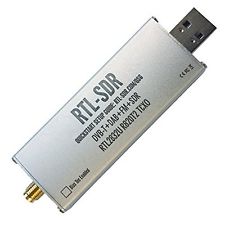
Software Defined Radio (SDR) provides many opportunities for both experimentation and solving real-world problems. It is not exactly a new technology but it has become significantly more accessible due to the increases in desktop computing power (for performing the DSP functions) and simultaneous reduction in the cost of SDR hardware. Thanks to the availability of a completely packaged gqrx and GNU Radio solution, you can now get up and running in less than half an hour and spending less than fifty dollars/pounds/euros. We provided a full demo of the Debian Hams gqrx solution at Mini DebConf Vienna (video) and hope to provide a similar demo at MiniDebConf Cambridge on the coming weekend of 12-13 November. gqrx is also available for Fedora users. Choosing hardware There are many different types of hardware, ranging from the low-cost RTL-SDR USB dongles to full duplex multi-transceiver systems. My recommendation is to start with an RTL-SDR dongle due to extremely low cost, this will give you an opportunity to reflect on the opportunities of this technology before putting money into one of the transceivers and their accessories. The RTL-SDR dongle also benefits from being a small self-contained solution that you can carry around and experiment with or demo just about anywhere. Important: Don't buy the cheapest generic RTL TV/radio receivers. It is absolutely essential to buy one of the units that has been explicitly promoted for SDR. These typically have a temperature compensated crystal oscillator (TCXO) which is absolutely essential for the reception of narrowband voice and digital signals. Without this, it is only possible to receive wideband broadcash FM radio and TV channels. For those who want to try it out with us at MiniDebConf Cambridge, Technofix has UK stock (online ordering), they are about 26. Getting gqrx up and running fast Note: to avoid the wrong kernel module being loaded automatically, it is recoemmended that you don't connect the RTL-SDR dongle before you install the packages. If you did already connect it, you may need to reboot or rmmod dvb_usb_rtl28xxu. If you are using a Debian jessie system, you can get all the necessary packages from jessie-backports. If you haven't already enabled backports, you can do so with a command like this:
$ sudo echo "deb http://ftp.ch.debian.org/debian jessie-backports main" >> /etc/apt/sources.list
Make sure your local index is updated and then install the necessary packages:
$ sudo apt-get update
$ sudo apt-get install -t jessie-backports gqrx-sdr rtl-sdr
Running it for the first time Once the packages are installed, connect the RTL-SDR dongle to the computer and then start the gqrx GUI from a terminal:
$ gqrx
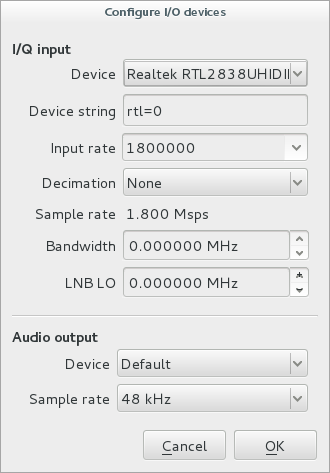
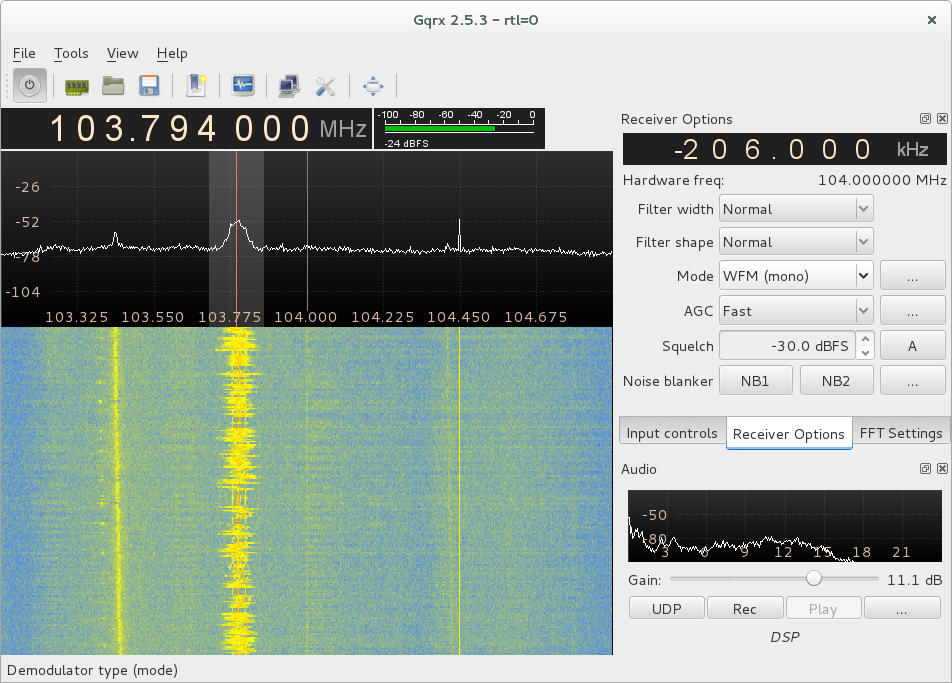
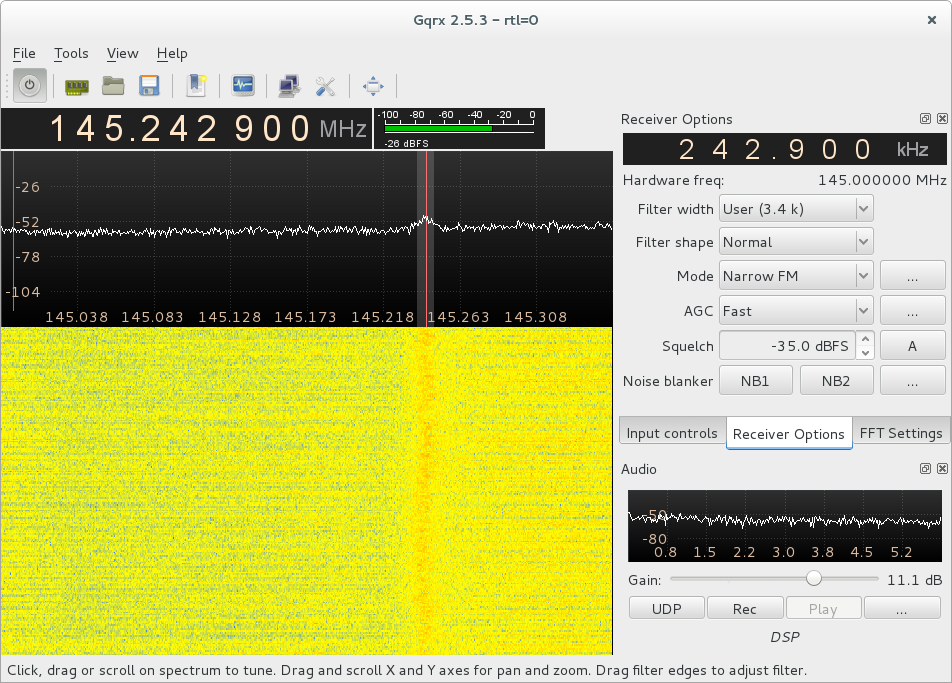
If the GUI fails to appear, look carefully at the error messages. It may be that the wrong kernel module has been loaded. The properties window appears, select the RTL-SDR dongle: Now the main screen will appear. Choose the wideband FM mode "WFM (mono)" and change the frequency to a value in the FM broadcast band such as 100MHz. Click the "Power on" button in the top left corner, just under the "File" menu, to start reception. Click in the middle of a strong signal to tune to that station. If you don't hear anything, check the squelch setting (it should be more negative than the signal strength value) and increase the Gain control at the bottom right hand side of the window. Looking for ham / amateur radio signals A popular band for hams is between 144 - 148 MHz (in some countries only a subset of this band is used). This is referred to as the two-meter band, as that is the wavelength at this frequency. Hams often use the narrowband FM mode in this band, especially with repeater stations. Change the "Mode" setting from "WFM" to "Narrow FM" and change the frequency to a value in the middle of the band. Look for signals in the radio spectrum and click on them to hear them. If you are not sure which part of the band to look in, search for the two-meter band plan for your country/region and look for the repeater output frequencies in the band plan.

Reproducible builds folks: Reproducible Builds: week 80 in Stretch cycle

What happened in the Reproducible Builds effort between Sunday October 30 and Saturday November 5 2016: Upcoming events Reproducible work in other projects Bugs filed Reviews of unreproducible packages 81 package reviews have been added, 14 have been updated and 43 have been removed in this week, adding to our knowledge about identified issues. 3 issue types have been updated: 1 issue type has been removed: 1 issue type has been updated: Weekly QA work During of reproducibility testing, some FTBFS bugs have been detected and reported by: diffoscope development buildinfo.debian.net development tests.reproducible-builds.org Reproducible Debian: Misc. Also with thanks to Profitbricks sponsoring the "hardware" resources, Holger created a 13 core machine with 24GB RAM and 100GB SSD based storage so that Ximin can do further tests and development on GCC and other software on a fast machine. This week's edition was written by Chris Lamb, Ximin Luo, Vagrant Cascadian, Holger Levsen and reviewed by a bunch of Reproducible Builds folks on IRC.

4 November 2016

Michal Čihař: Weblate 2.9

Slightly behind schedule (it should have been released in October), Weblate 2.9 is out today. This release brings Subversion support or improved zen mode. Full list of changes: If you are upgrading from older version, please follow our upgrading instructions. You can find more information about Weblate on https://weblate.org, the code is hosted on Github. If you are curious how it looks, you can try it out on demo server. You can login there with demo account using demo password or register your own user. Weblate is also being used on https://hosted.weblate.org/ as official translating service for phpMyAdmin, OsmAnd, Aptoide, FreedomBox, Weblate itself and many other projects. Should you be looking for hosting of translations for your project, I'm happy to host them for you or help with setting it up on your infrastructure. Further development of Weblate would not be possible without people providing donations, thanks to everybody who have helped so far! The roadmap for next release is just being prepared, you can influence this by expressing support for individual issues either by comments or by providing bounty for them.

Filed under: Debian English phpMyAdmin SUSE Weblate 4 comments

3 November 2016

Iain R. Learmonth: PATHspider Plugins

This post is cross-posted on the MAMI Project blog here. In today s Internet we see an increasing deployment of middleboxes. While middleboxes provide in-network functionality that is necessary to keep networks manageable and economically viable, any packet mangling whether essential for the needed functionality or accidental as an unwanted side effect makes it more and more difficult to deploy new protocols or extensions of existing protocols. For the evolution of the protocol stack, it is important to know which network impairments exist and potentially need to be worked around. While classical network measurement tools are often focused on absolute performance values, PATHspider performs A/B testing between two different protocols or different protocol extensions to perform controlled experiments of protocol-dependent connectivity problems as well as differential treatment. PATHspider 1.0.1 has been released today and is now available from GitHub, PyPI and Debian unstable. This is a small stable update containing a documentation fix for the example plugin. PATHspider now contains 3 built-in plugins for measuring path transparency to explicit congestion notification, DiffServ code points and TCP Fast Open. It s easy to write your own plugins, and if they re good enough, they may be included in the PATHspider distribution at the next feature release. We have a GitHub repository you can fork that has a premade directory structure for new plugins. You ll need to implement logic for performing the two connections, for the A and the B tests. Once you ve verified your connection logic is working with Wireshark, you can move on to writing Observer functions to analyse the connections made in real time as PATHspider runs. The final step is to merge the results of the connection logic (e.g. did the operating system report a timeout?) with the results of your observer functions (e.g. was ECN successfully negotiated?) and write out the final result. We have dedicated a section of the manual to the development of plugins and we really see plugins as first-class citizens in the PATHspider ecosystem. While future releases of PATHspider may contain new plugins, we re also making it easier to write plugins by providing reusable library functions such as the tcp_connect() function of the SynchronisedSpider that allows for easy A/B testing of TCP connections with any globally configured state set. We also provide reusable observer functions for simple tasks such as determining if a 3-way handshake completed or if there was an ICMP unreachable message received.
If you d like to check out PATHspider, you can find the website at https://pathspider.net/. Current development of PATHspider is supported by the European Union s Horizon 2020 project MAMI. This project has received funding from the European Union s Horizon 2020 research and innovation programme under grant agreement No 688421. The opinions expressed and arguments employed reflect only the authors view. The European Commission is not responsible for any use that may be made of that information.

Jan Wagner: Container Orchestration Thoughts

Container Orchestration ThoughtsSince some time everybody (read developer) want to run his new microservice stacks in containers. I can understand that building and testing an application is important for developers.
One of the benefits of containers is, that developer (in theory) can put their new version of applications into production on their own. This is the point where operations is affected and operations needs to evaluate, if that might evolve into better workflow. For yolo^WdevOps people there are some challenges that needs to be solved, or at least mitigated, when things needs to be done in large(r) scale.

Orchestration Engine Running Docker, which is actual the most preferred container solution, on a single host with docker command line client is something you can do, but there you leave the gap between dev and ops.

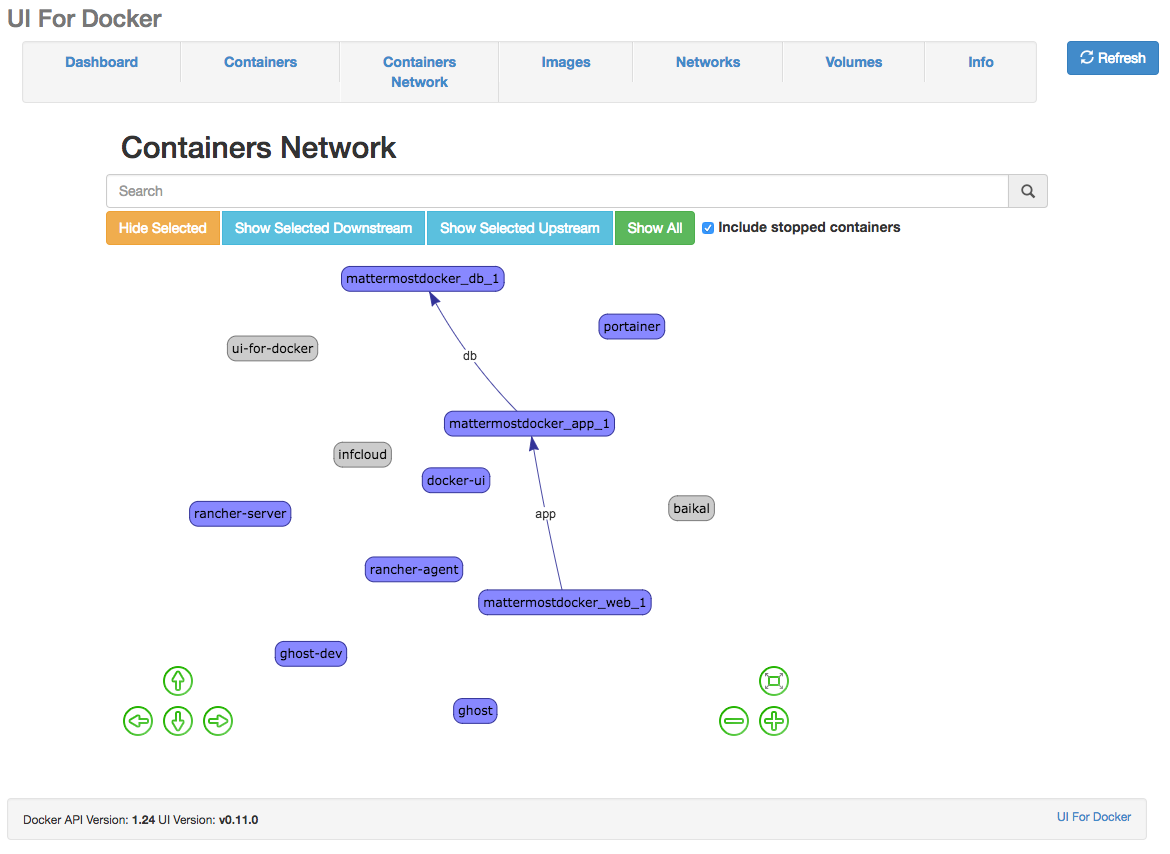
UI For Docker Since some time there is UI For Docker available for visualizing and managing containers on a single docker node. It's pretty awesome and the best feature so far is the Container Network view, which also shows the linked container. Container Orchestration Thoughts

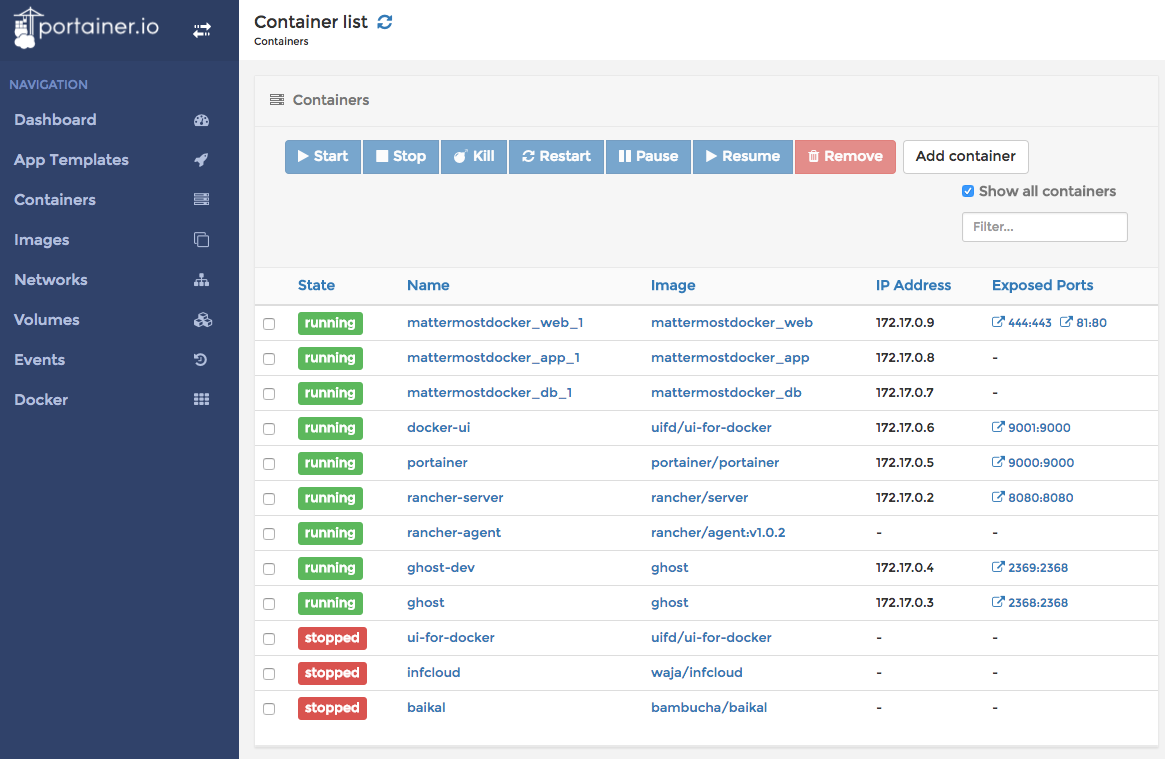
Portainer Portainer is pretty new and it can be deployed as easy as UI For Docker. But the (first) great advantage: it can handle Docker Swarm. Beside that it has many other great features. Container Orchestration Thoughts

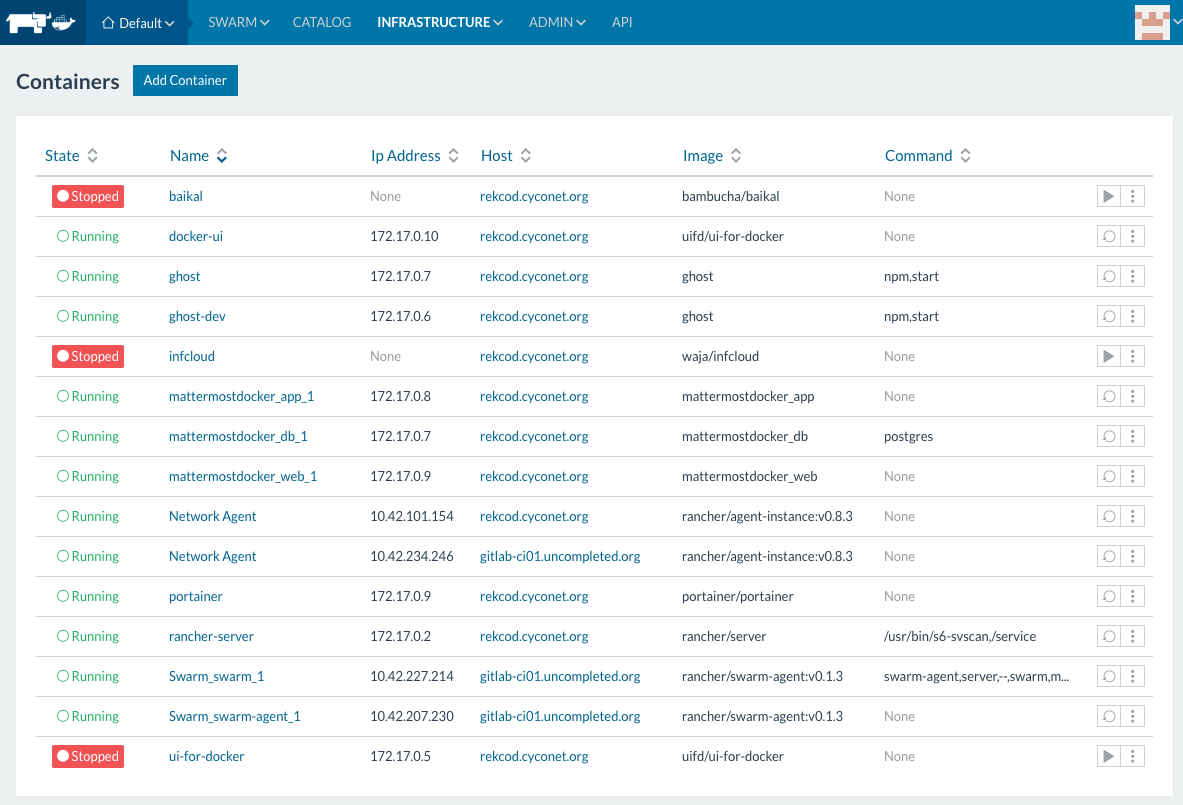
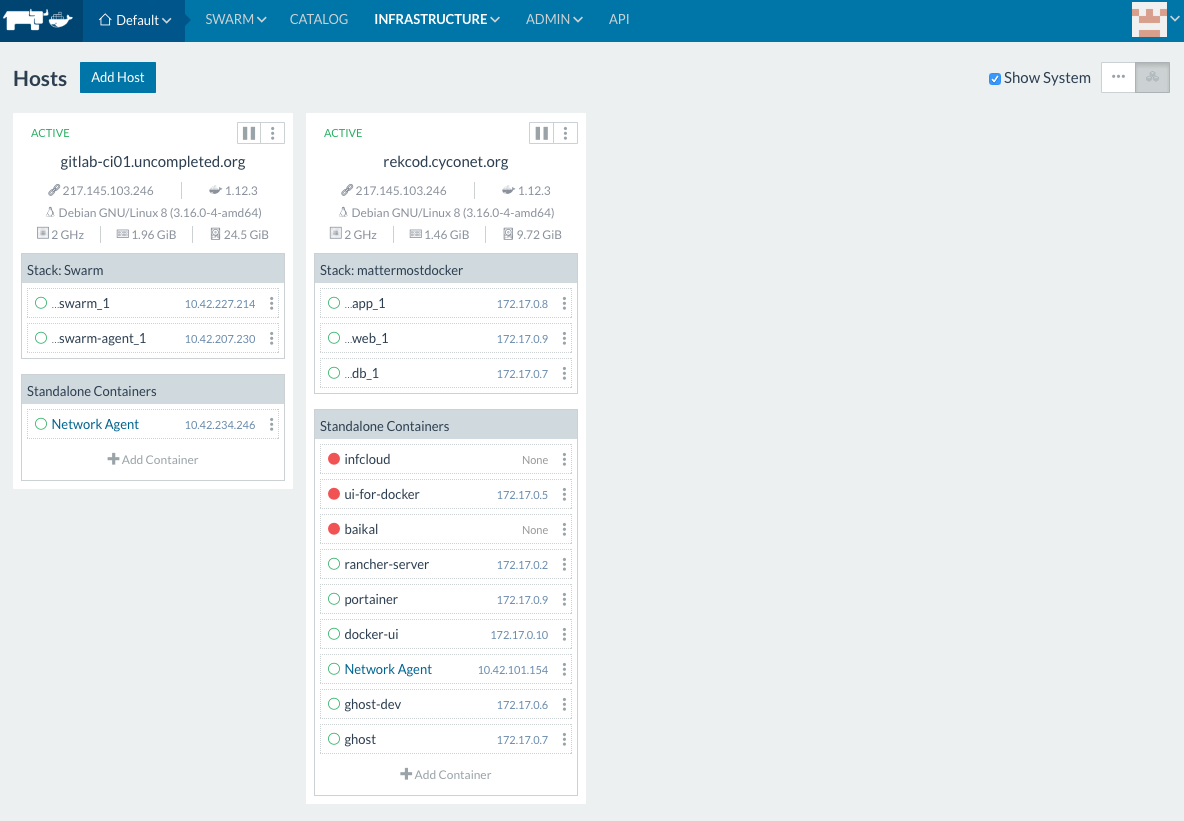
Rancher Rancher describes themselves as 'container management platform' that 'supports and manages all of your Kubernetes, Mesos, and Swarm clusters'. This is great because this are all of the relevant docker cluster orchestrations at the market actually. Container Orchestration Thoughts For the use cases, we are facing, Kubernetes and Mesos seems both like bloated beasts. Usman Ismail has written a really good comparison of Orchestration Engine options which goes into details. Container Orchestration Thoughts

Docker Swarm As there is actually no clear defacto standard/winner of the (container) orchestration wars, I would prevent to be in a vendor lock-in situation (yet). Docker swarm seems to be evolving and is getting more nice features other competitors doesn't provide.
Due the native integration into the docker framework and great community I believe Docker Swarm will be the Docker Orchestration of the choice on the long run. This should be supported by Rancher 1.2 which is not released yet.
From this point of view it looks very reasonable that Docker Swarm in combination with Rancher (1.2) might be a good strategy to maintain your container farms in the future. If you think to put Docker Swarm into production in the actual state, I recommend to read Docker swarm mode: What to know before going live on production by Panjamapong Sermsawatsri.

Persistent Storage While it is a best practice to use data volume container these days, providing persistent storage across multiple hosts for shared volumes seems to be tricky. In theory you can mount a shared-storage volume as a data volume and there are several volume plugins which supports shared storage. For example you can use the convoy plugin which gives you:
  • thin provisioned volumes
  • snapshots of volumes
  • backup of snapshots
  • restore volumes
As backend you can use:
  • Device Mapper
  • Virtual File System(VFS)/Network File System(NFS)
  • Amazon Elastic Block Store(EBS)
The good thing is, that convoy is integrated into Rancher. For more information I suggest to read Setting Up Shared Volumes with Convoy-NFS, which also mentions some limitations. If you want test Persistent Storage Service, Rancher provides some documentation. Actually I did not evaluate shared-storage volumes yet, but I don't see a solution I would love to use in production (at least on-premise) without strong downsides. But maybe things will go further and there might be a great solution for this caveats in the future.

Keeping base images up-to-date Since some time there are many projects that tries to detect security problems in your container images in several ways.
Beside general security considerations you need to deal somehow with issues in your base images that you build your applications on. Of course, even if you know you have a security issue in your application image, you need to fix it, which depends on the way how you based your application upon.

Ways to base your application image
  • You can build your application image entire from scratch, which leaves all the work to your development team and I wouldn't recommend it that way.
  • You also can create one (or more) intermediate image(s) that will be used by your development team.
  • The development team might ground their work on images in public available or private (for example the one bundled to your gitlab CI/CD solution) registries.

Whats the struggle with the base image? If you are using images being not (well) maintained by other people, you have to wait for them to fix your base image. Using external images might also lead into trust problems (can you trust those people in general?).
In an ideal world, your developers have always fresh base images with fixed security issues. This can probably be done by rebuilding every intermediate image periodically or when the base image changes.

Paradigm change Anyway, if you have a new application image available (with no known security issues), you need to deploy it to production. This is summarized by Jason McKay in his article Docker Security: How to Monitor and Patch Containers in the Cloud:
To implement a patch, update the base image and then rebuild the application image. This will require systems and development teams to work closely together.
So patching security issues in the container world changes workflow significant. In the old world operation teams mostly rolled security fixes for the base systems independent from development teams.
Now hitting containers the production area this might change things significant.

Bringing updated images to production Imagine your development team doesn't work steady on a project, cause the product owner consider it feature complete. The base image is provided (in some way) consistently without security issues. The application image is build on top of that automatically on every update of the base image.
How do you push in such a scenario the security fixes to production? From my point of view you have two choices:
  • Let the development team require to test the resulting application image and put it into production
  • Push the new application image without review by the development team into production
The first scenario might lead into a significant delay until the fixes hit production created by the probably infrequent work of the development team. The latter one brings your security fixes early to production by the notable higher risk to break your application. This risk can be reduced by implementing massive tests into CI/CD pipelines by the development team. Rolling updates provided by Docker Swarm might also reduce the risk of ending with a broken application. When you are implementing an update process of your (application) images to production, you should consider Watchtower that provides Automatic Updates for Docker Containers.

Conclusion Not being a product owner or the operations part of an application that is facing a widely adopted usage that would compensate the actual tradeoffs we are still facing I tend not to move large scale production projects into a container environment.
This means not that this might be a bad idea for others, but I'd like to sort out some of the caveats before. I'm still interested to put smaller projects into production, being not scared to reimplement or move them on a new stack.
For smaller projects with a small number of hosts Portainer looks not bad as well as Rancher with the Cattle orchestration engine if you just want to manage a couple of nodes. Things are going to be interesting if Rancher 1.2 supports Docker swarm cluster out of the box. Let's see what the future will bring us to the container world and how to make a great stack out of it.

Update I suggest to read Docker in Production: A History of Failure and the answer Docker in Production: A retort to understand the actual challenges when running Docker in larger scale production environments.

2 November 2016

Reproducible builds folks: Reproducible Builds: week 79 in Stretch cycle

What happened in the Reproducible Builds effort between Sunday October 23 and Saturday October 29 2016: Upcoming events The second Reproducible Builds World Summit will be held from December 13th-15th in Berlin! See the link for more details. Other events: Introduction to Reproducible Builds - Vagrant Cascadian will be presenting at the SeaGL.org Conference In Seattle, USA on November 12th, 2016. Reproducible Debian Hackathon - A small hackathon organized in Boston, USA on December 3rd and 4th. If you are interested in attending, contact Valerie Young - spectranaut in the #debian-reproducible IRC channel on irc.oftc.net. IRC meeting The next IRC meeting will be held on 2016-11-01 at 18:00 UTC. The meeting after that will be held on 2016-11-15 at 18:00 UTC. Reproducible work in other projects Ximin Luo has had his fix to bug 77985 accepted into GCC. This is needed to be able to write test cases for patches to make GCC produce debugging symbols that are reproducible regardless of the build path. There was continued discussion on the mailing list regarding our build path proposals. It has now been decided to use an environment variable SOURCE_PREFIX_MAP instead of the older proposal SOURCE_ROOT_DIR. This would be similar to GCC's existing -fdebug-prefix-map option, which allows for better disambiguation between paths from different packages. mandoc's makewhatis is now reproducible. It is used by all the BSDs, including FreeBSD, as well as Alpine Linux and Void Linux. Packages reviewed and fixed, and bugs filed Chris Lamb: Reiner Herrmann: Reviews of unreproducible packages 145 package reviews have been added, 608 have been updated and 94 have been removed in this week, adding to our knowledge about identified issues. 3 issue types have been updated: Weekly QA work During of reproducibility testing, some FTBFS bugs have been detected and reported by: tests.reproducible-builds.org Debian: General: diffoscope development Misc. This week's edition was written by Ximin Luo, Chris Lamb and Holger Levsen and reviewed by a bunch of Reproducible Builds folks on IRC.

31 October 2016

Chris Lamb: Free software activities in October 2016

Here is my monthly update covering what I have been doing in the free software world (previously):

Debian & Reproducible builds

Whilst anyone can inspect the source code of free software for malicious flaws, most GNU/Linux distributions provide binary (or "compiled") packages to end users. The motivation behind the Reproducible Builds effort is to allow verification that no flaws have been introduced either maliciously and accidentally during this compilation process by promising identical binary packages are always generated from a given source.

  • Presented a talk entitled "Reproducible Builds" talk at Software Freedom Kosova, in Prishtina, Republic of Kosovo.

  • I filed my 2,500th bug in the Debian BTS: #840972: golang-google-appengine: accesses the internet during build.

  • In order to build packages reproducibly, one not only needs identical sources but also some external and sharable definition of the environment used for a particular build, stipulating such things such as the version numbers of the required build-dependencies. It is not currently clear how to handle these .buildinfo files after the archive software has processed them and how to make them available to the world so I started development on a proof-of-concept server to see what issues arise in practice. It is available at buildinfo.debian.net.

  • Chaired an IRC meeting and ran a poll to determine a regular time .

  • Submitted two design proposals to our wiki page.

  • Improvements to our tests.reproducible-builds.org testing framework:

    • Move regular "Scheduled in..." messages to the #debian-reproducible-changes IRC channel.
    • Use our log_info method instead of manual echo calls.
    • Correct an "all sources packages" "all source packages" typo.
    • Submit .buildinfo files to buildinfo.debian.net.
    • Create GPG key on nodes for buildinfo.debian.net at deploy time, not "lazily".

My work in the Reproducible Builds project was also covered in our weekly reports. (#75, #76, #77 & #78).

I also submitted 14 patches to fix specific reproducibility issues in bio-eagle, cf-python, fastx-toolkit, fpga-icestorm, http-icons, lambda-align, mypy, playitslowly, seabios, stumpwm, sympa, tj3, wims-help & xotcl.
Debian LTS

This month I have been paid to work 13 hours on Debian Long Term Support (LTS). In that time I did the following:
  • Seven days of "frontdesk" duties, triaging CVEs, etc.
  • Issued DLA 647-1 for freeimage correcting an out-of-bounds write vulnerability in the XMP image handling functionality.
  • Issued DLA 649-1 for python-django fixing a possible CSRF protection bypass on sites that use Google Analytics.
  • Issued DLA 654-1 for libxfixes preventing an integer overflow when a malicious client sent INT_MAX as a "length".
  • Issued DLA 662-1 for quagga correcting a programming error where two constants were confused that could cause stack overrun in IPv6 routing code.
  • Issued DLA 688-1 for cairo to prevent a DoS attack where a malicious SVG could generate invalid pointers.

Uploads
  • gunicorn:
    • 19.6.0-7 Set supplementary groups when changing uid, add an example systemd .service file to gunicorn-examples, and expand README.Debian to make it clearer what to do now that /etc/gunicorn.d has been removed.
    • 19.6.0-8 Correct previous supplementary groups patch to be compatible with Python 3.
  • redis:
    • 3:3.2.4-2 Ensure that sentinel's configuration actually writes to a pidfile location so that systemd can detect that the daemon has started.
    • 3:3.2.5-1 New upstream release.
  • libfiu:
    • 0.94-8 Fix FTBFS under Bash due to lack of && in debian/rules.
    • 0.94-9 Ensure the build is reproducible by sorting injected modules.
  • aptfs (2:0.8-2) Minor cosmetic changes.

NMUs
  • libxml-dumper-perl (0.81-1.2) Move away from a unsupported debhelper compat level 4.
  • netatalk (2.2.5-1.1) Drop build-dependency on hardening-includes.

QA uploads
  • anon-proxy (00.05.38+20081230-4) Move to a supported debhelper compatibility level 9.
  • ara (1.0.32) Make the build reproducible.
  • binutils-m68hc1x (1:2.18-8) Make the build reproducible & move to a supported debhelper compatibility level.
  • fracplanet (0.4.0-5) Make the build reproducible.
  • libnss-ldap (265-5) Make the build reproducible.
  • python-uniconvertor (1.1.5-3) Fix an "option release requires an argument" FTBFS. (#839375)
  • ripole (0.2.0+20081101.0215-3) Actually include the ripole binary in package. (#839919) & enable hardening flags.
  • twitter-bootstrap (2.0.2+dfsg-10) Fix incorrect copyright formatting when building under Bash. (#824592)
  • zpaq (1.10-3) Make the build reproducible.


Debian FTP Team

As a Debian FTP assistant I ACCEPTed 147 packages: ace-link, amazon-s2n, avy, basez, bootstrap-vz, bucklespring, camitk, carettah, cf-python, debian-reference, dfcgen-gtk, efivar, entropybroker, fakesleep, gall, game-data-packager, gitano, glare, gnome-panel, gnome-shell-extension-dashtodock, gnome-shell-extension-refreshwifi, gnome-shell-extension-remove-dropdown-arrows, golang-github-gogits-go-gogs-client, golang-github-gucumber-gucumber, golang-github-hlandau-buildinfo, golang-github-hlandau-dexlogconfig, golang-github-hlandau-goutils, golang-github-influxdata-toml, golang-github-jacobsa-crypto, golang-github-kjk-lzma, golang-github-miekg-dns, golang-github-minio-sha256-simd, golang-github-nfnt-resize, golang-github-nicksnyder-go-i18n, golang-github-pointlander-compress, golang-github-pointlander-jetset, golang-github-pointlander-peg, golang-github-rfjakob-eme, golang-github-thecreeper-go-notify, golang-github-twstrike-gotk3adapter, golang-github-unknwon-goconfig, golang-gopkg-dancannon-gorethink.v1, golang-petname, haskell-argon2, haskell-binary-parsers, haskell-bindings-dsl, haskell-deriving-compat, haskell-hackage-security, haskell-hcwiid, haskell-hsopenssl-x509-system, haskell-megaparsec, haskell-mono-traversable-instances, haskell-prim-uniq, haskell-raaz, haskell-readable, haskell-readline, haskell-relational-record, haskell-safe-exceptions, haskell-servant-client, haskell-token-bucket, haskell-zxcvbn-c, irclog2html, ironic-ui, lace, ledger, libdancer2-plugin-passphrase-perl, libdatetime-calendar-julian-perl, libdbix-class-optimisticlocking-perl, libdbix-class-schema-config-perl, libgeo-constants-perl, libgeo-ellipsoids-perl, libgeo-functions-perl, libgeo-inverse-perl, libio-async-loop-mojo-perl, libmojolicious-plugin-assetpack-perl, libmojolicious-plugin-renderfile-perl, libparams-validationcompiler-perl, libspecio-perl, libtest-time-perl, libtest2-plugin-nowarnings-perl, linux, lua-scrypt, mono, mutt-vc-query, neutron, node-ansi-font, node-buffer-equal, node-defaults, node-formatio, node-fs-exists-sync, node-fs.realpath, node-is-buffer, node-jison-lex, node-jju, node-jsonstream, node-kind-of, node-lex-parser, node-lolex, node-loud-rejection, node-random-bytes, node-randombytes, node-regex-not, node-repeat-string, node-samsam, node-set-value, node-source-map-support, node-spdx-correct, node-static-extend, node-test, node-to-object-path, node-type-check, node-typescript, node-unset-value, nutsqlite, opencv, openssl1.0, panoramisk, perl6, pg-rage-terminator, pg8000, plv8, puppet-module-oslo, pymoc, pyramid-jinja2, python-bitbucket-api, python-ceilometermiddleware, python-configshell-fb, python-ewmh, python-gimmik, python-jsbeautifier, python-opcua, python-pyldap, python-s3transfer, python-testing.common.database, python-testing.mysqld, python-testing.postgresql, python-wheezy.template, qspeakers, r-cran-nleqslv, recommonmark, rolo, shim, swift-im, tendermint-go-clist, tongue, uftrace & zaqar-ui.

Antoine Beaupr : My free software activities, October 2016

Debian Long Term Support (LTS) This is my 7th month working on Debian LTS, started by Raphael Hertzog at Freexian, after a long pause during the summer. I have worked on the following packages and CVEs: I have also helped review work on the following packages:
  • imagemagick: reviewed BenH's work to figure out what was done. unfortunately, I forgot to officially take on the package and Roberto started working on it in the meantime. I nevertheless took time to review Roberto's work and outline possible issues with the original patchset suggested
  • tiff: reviewed Raphael's work on the hairy TIFFTAG_* issues, all the gory details in this email
The work on ImageMagick and GraphicsMagick was particularly intriguing. Looking at the source of those programs makes me wonder why were are still using them at all: it's a tangled mess of C code that is bound to bring up more and more vulnerabilities, time after time. It seems there's always an "Magick" vulnerability waiting to be fixed out there... I somehow hoped that the fork would bring more stability and reliability, but it seems they are suffering from similar issues because, fundamentally, they haven't rewritten ImageMagick... It looks this is something that affects all image programs. The review I have done on the tiff suite give me the same shivering sensation as reviewing the "Magick" code. It feels like all image libraries are poorly implemented and then bound to be exploited somehow... Nevertheless, if I had to use a library of the sort in my software, I would stay away from the "Magick" forks and try something like imlib2 first... Finally, I also did some minor work on the user and developer LTS documentation and some triage work on samba, xen and libass. I also looked at the dreaded CVE-2016-7117 vulnerability in the Linux kernel to verify its impact on wheezy users. I also looked at implementing a --lts flag for dch (see bug #762715). It was difficult to get back to work after such a long pause, but I am happy I was able to contribute a significant number of hours. It's a bit difficult to find work sometimes in LTS-land, even if there's actually always a lot of work to be done. For example, I used to be one of the people doing frontdesk work, but those duties are now assigned until the end of the year, so it's unlikely I will be doing any of that for the forseable future. Similarly, a lot of packages were assigned when I started looking at the available packages. There was an interesting discussion on the internal mailing list regarding unlocking package ownership, because some people had packages locked for weeks, sometimes months, without significant activity. Hopefully that situation will improve after that discussion. Another interesting discussion I participated in is the question of whether the LTS team should be waiting for unstable to be fixed before publishing fixes in oldstable. It seems the consensus right now is that it shouldn't be mandatory to fix issues in unstable before we fix security isssues in oldstable and stable. After all, security support for testing and unstable is limited. But I was happy to learn that working on brand new patches is part of our mandate as part of the LTS work. I did work on such a patch for tar which ended up being adopted by the original reporter, although upstream ended up implementing our recommendation in a better way. It's coincidentally the first time since I start working on LTS that I didn't get the number of requested hours, which means that there are more people working on LTS. That is a good thing, but I am worried it may also mean people are more spread out and less capable of focusing for longer periods of time on more difficult problems. It also means that the team is growing faster than the funding, which is unfortunate: now is a good time as any to remind you to see if you can make your company fund the LTS project if you are still running Debian wheezy.

Other free software work It seems like forever that I did such a report, and while I was on vacation, a lot has happened since the last report.

Monkeysign I have done extensive work on Monkeysign, trying to bring it kicking and screaming in the new world of GnuPG 2.1. This was the objective of the 2.1 release, which collected about two years of work and patches, including arbitrary MUA support (e.g. Thunderbird), config files support, and a release on PyPI. I have had to release about 4 more releases to try and fix the build chain, ship the test suite with the program and have a primitive preferences panel. The 2.2 release also finally features Tor suport! I am also happy to have moved more documentation to Read the docs, part of which I mentionned in in a previous article. The git repositories and issues were also moved to a Gitlab instance which will hopefully improve the collaboration workflow, although we still have issues in streamlining the merge request workflow. All in all, I am happy to be working on Monkeysign, but it has been a frustrating experience. In the last years, I have been maintaining the project largely on my own: although there are about 20 contributors in Monkeysign, I have committed over 90% of the commits in the code. New contributors recently showed up, and I hope this will release some pressure on me being the sole maintainer, but I am not sure how viable the project is.

Funding free software work More and more, I wonder how to sustain my contributions to free software. As a previous article has shown, I work a lot on the computer, even when I am not on a full-time job. Monkeysign has been a significant time drain in the last months, and I have done this work on a completely volunteer basis. I wouldn't mind so much except that there is a lot of work I do on a volunteer basis. This means that I sometimes must prioritize paid consulting work, at the expense of those volunteer projects. While most of my paid work usually revolves around free sofware, the benefits of paid work are not always immediately obvious, as the primary objective is to deliver to the customer, and the community as a whole is somewhat of a side-effect. I have watched with interest joeyh's adventures into crowdfunding which seems to be working pretty well for him. Unfortunately, I cannot claim the incredible (and well-deserved) reputation Joey has, and even if I could, I can't live with 500$ a month. I would love to hear if people would be interested in funding my work in such a way. I am hesitant in launching a crowdfunding campaign because it is difficult to identify what exactly I am working on from one month to the next. Looking back at earlier reports shows that I am all over the place: one month I'll work on a Perl Wiki (Ikiwiki), the next one I'll be hacking at a multimedia home cinema (Kodi). I can hardly think of how to fund those things short of "just give me money to work on anything I feel like", which I can hardly ask for of anyone. Even worse, it feels like the audience here is either friends or colleagues. It would make little sense for me to seek funding from those people: colleagues have the same funding problems I do, and I don't want to empoverish my friends... So far I have taken the approach of trying to get funding for work I am doing, bit by bit. For example, I have recently been told that LWN actually pays for contributed articles and have started running articles by them before publishing them here. This is looking good: they will publish an article I wrote about the Omnia router I have recently received. I give them exclusive rights on the article for two weeks, but I otherwise retain full ownership over the article and will publish them after the exclusive period here. Hopefully, I will be able to find more such projects that pays for the work I do on a day to day basis.

Open Street Map editing I have ramped up my OpenStreetMap contributions, having (temporarily) moved to a different location. There are lots of things to map here: trails, gaz stations and lots of other things are missing from the map. Sometimes the effort looks a bit ridiculous, reminding me of my early days of editing OSM. I have registered to OSM Live, a project to fund OSM editors that, I must admit, doesn't help much with funding my work: with the hundreds of edits I did in October, I received the equivalent of 1.80$CAD in Bitcoins. This may be the lowest hourly salary I have ever received, probably going at a rate of 10 per hour! Still, it's interesting to be able to point people to the project if someone wants to contribute to OSM mappers. But mappers should have no illusions about getting a decent salary from this effort, I am sorry to say.

Bounties I feel this is similar to the "bounty" model used by the Borg project: I claimed around $80USD in that project for what probably amounts to tens of hours of work, yet another salary that would qualify as "poor". Another example is a feature I would like to implement in Borg: support for protocols other than SSH. There is currently no bounty on this, but a similar feature, S3 support has one of the largest bounties Borg has ever seen: $225USD. And the claimant for the bounty hasn't actually implemented the feature, instead backing up to S3, the patch (to a third-party tool) actually enables support for Amazon Cloud Drive, a completely different API. Even at $225, I wouldn't be able to complete any of those features and get a decent salary. As well explained by the Snowdrift reviews, bounties just don't work at all... The ludicrous 10% fee charged by Bountysource made sure I would never do business with them ever again anyways.

Other work There are probably more things I did recently, but I am having difficulty keeping track of the last 5 months of on and off work, so you will forgive that I am not as exhaustive as I usually am.

29 October 2016

Lars Wirzenius: Obnam 1.20 released

I have just released version 1.20 of Obnam, my backup program. It's been nine months since the previous release, and that's a long time: I've had an exciting year, and not entirely in a good way. Unfortuntely that's eaten up a lot of my free time and enthusiasm for my hobby projects. See below for a snippet of NEWS, with a summary of the user-visible changes. A lot of the effort has gone into improving FORMAT GREEN ALBATROSS, but that isn't documented in the NEWS file. I've received patches and actionable bug reports from a number of people, and I'm grateful for those. I try to credit them by name in the NEWS file. Obnam NEWS This file summarizes changes between releases of Obnam. NOTE: Obnam has an EXPERIMENTAL repository format under development, called green-albatross-20160813. It is NOT meant for real use. It is likely to change in incompatible ways without warning. DO NOT USE it unless you're willing to lose your backup. Version 1.20, released 2016-10-29 Minor changes: Bug fixes:

27 October 2016

Russ Allbery: DocKnot 1.00

I'm a bit of a perfectionist about package documentation, and I'm also a huge fan of consistency. As I've slowly accumulated more open source software packages (alas, fewer new ones these days since I have less day-job time to work on them), I've developed a standard format for package documentation files, particularly the README in the package and the web pages I publish. I've iterated on these, tweaking them and messing with them, trying to incorporate all my accumulated wisdom about what information people need. Unfortunately, this gets very tedious, since I have dozens of packages at this point and rarely want to go through the effort of changing every one of them every time I come up with a better way of phrasing something or change some aspect of my standard package build configuration. I also have the same information duplicated in multiple locations (the README and the web page for the package). And there's a lot of boilerplate that's common for all of my packages that I don't want to keep copying (or changing when I do things like change all eyrie.org URLs to HTTPS). About three years ago, I started seriously brainstorming ways of automating this process. I made a start on it during one self-directed day at my old job at Stanford, but only got it far enough to generate a few basic files. Since then, I keep thinking about it, keep wishing I had it, and keep not putting the work into finishing it. During this vacation, after a week and a half of relaxing and reading, I finally felt like doing a larger development project and finally started working on this for long enough to build up some momentum. Two days later, and this is finally ready for an initial release. DocKnot uses metadata (which I'm putting in docs/metadata) that's mostly JSON plus some documentation fragments and generates README, the web page for the package (in thread, the macro language I use for all my web pages), and (the other thing I've wanted to do and didn't want to tackle without this tool) README.md, a Markdown version of README that will look nice on GitHub. The templates that come with the package are all rather specific to me, particularly the thread template which would be unusable by anyone else. I have no idea if anyone else will want to use this package (and right now the metadata format is entirely undocumented). But since it's a shame to not release things as free software, and since I suspect I may need to upload it to Debian since, technically, this tool is required to "build" the README file distributed with my packages, here it is. I've also uploaded it to CPAN (it's my first experiment with the App::* namespace for things that aren't really meant to be used as a standalone Perl module). You can get the latest version from the DocKnot distribution page (which is indeed generated with DocKnot). Also now generated with DocKnot are the rra-c-util and C TAP Harness distribution pages. Let me know if you see anything weird; there are doubtless still a few bugs.

26 October 2016

Steinar H. Gunderson: Why does software development take so long?

Nageru 1.4.0 is out (and on its way through the Debian upload process right now), so now you can do live video mixing with multichannel audio to your heart's content. I've already blogged about most of the interesting new features, so instead, I'm trying to answer a question: What took so long? To be clear, I'm not saying 1.4.0 took more time than I really anticipated (on the contrary, I pretty much understood the scope from the beginning, and there was a reason why I didn't go for building this stuff into 1.0.0); but if you just look at the changelog from the outside, it's not immediately obvious why multichannel audio support should take the better part of three months of develoment. What I'm going to say is of course going to be obvious to most software developers, but not everyone is one, and perhaps my experiences will be illuminating. Let's first look at some obvious things that isn't the case: First of all, development is not primarily limited by typing speed. There are about 9,000 lines of new code in 1.4.0 (depending a bit on how you count), and if it was just about typing them in, I would be done in a day or two. On a good keyboard, I can type plain text at more than 800 characters per minute but you hardly ever write code for even a single minute at that speed. Just as when writing a novel, most time is spent thinking, not typing. I also didn't spend a lot of time backtracking; most code I wrote actually ended up in the finished product as opposed to being thrown away. (I'm not as lucky in all of my projects.) It's pretty common to do so if you're in an exploratory phase, but in this case, I had a pretty good idea of what I wanted to do right from the start, and that plan seemed to work. This wasn't a difficult project per se; it just needed to be done (which, in a sense, just increases the mystery). However, even if this isn't at the forefront of science in any way (most code in the world is pretty pedestrian, after all), there's still a lot of decisions to make, on several levels of abstraction. And a lot of those decisions depend on information gathering beforehand. Let's take a look at an example from late in the development cycle, namely support for using MIDI controllers instead of the mouse to control the various widgets. I've kept a pretty meticulous TODO list; it's just a text file on my laptop, but it serves the purpose of a ghetto bugtracker. For 1.4.0, it contains 83 work items (a single-digit number is not ticked off, mostly because I decided not to do those things), which corresponds roughly 1:2 to the number of commits. So let's have a look at what the ~20 MIDI controller items went into. First of all, to allow MIDI controllers to influence the UI, we need a way of getting to it. Since Nageru is single-platform on Linux, ALSA is the obvious choice (if not, I'd probably have to look for a library to put in-between), but seemingly, ALSA has two interfaces (raw MIDI and sequencer). Which one do you want? It sounds like raw MIDI is what we want, but actually, it's the sequencer interface (it does more of the MIDI parsing for you, and generally is friendlier). The first question is where to start picking events from. I went the simplest path and just said I wanted all events anything else would necessitate a UI, a command-line flag, figuring out if we wanted to distinguish between different devices with the same name (and not all devices potentially even have names), and so on. But how do you enumerate devices? (Relatively simple, thankfully.) What do you do if the user inserts a new one while Nageru is running? (Turns out there's a special device you can subscribe to that will tell you about new devices.) What if you get an error on subscription? (Just print a warning and ignore it; it's legitimate not to have access to all devices on the system. By the way, for PCM devices, all of these answers are different.) So now we have a sequencer device, how do we get events from it? Can we do it in the main loop? Turns out it probably doesn't integrate too well with Qt, but it's easy enough to put it in a thread. The class dealing with the MIDI handling now needs locking; what mutex granularity do we want? (Experience will tell you that you nearly always just want one mutex. Two mutexes give you all sorts of headaches with ordering them, and nearly never gives any gain.) ALSA expects us to poll() a given set of descriptors for data, but on shutdown, how do you break out of that poll to tell the thread to go away? (The simplest way on Linux is using an eventfd.) There's a quirk where if you get two or more MIDI messages right after each other and only read one, poll() won't trigger to alert you there are more left. Did you know that? (I didn't. I also can't find it documented. Perhaps it's a bug?) It took me some looking into sample code to find it. Oh, and ALSA uses POSIX error codes to signal errors (like nothing more is available ), but it doesn't use errno. OK, so you have events (like controller 3 was set to value 47 ); what do you do about them? The meaning of the controller numbers is different from device to device, and there's no open format for describing them. So I had to make a format describing the mapping; I used protobuf (I have lots of experience with it) to make a simple text-based format, but it's obviously a nightmare to set up 50+ controllers by hand in a text file, so I had to make an UI for this. My initial thought was making a grid of spinners (similar to how the input mapping dialog already worked), but then I realized that there isn't an easy way to make headlines in Qt's grid. (You can substitute a label widget for a single cell, but not for an entire row. Who knew?) So after some searching, I found out that it would be better to have a tree view (Qt Creator does this), and then you can treat that more-or-less as a table for the rows that should be editable. Of course, guessing controller numbers is impossible even in an editor, so I wanted it to respond to MIDI events. This means the editor needs to take over the role as MIDI receiver from the main UI. How you do that in a thread-safe way? (Reuse the existing mutex; you don't generally want to use atomics for complicated things.) Thinking about it, shouldn't the MIDI mapper just support multiple receivers at a time? (Doubtful; you don't want your random controller fiddling during setup to actually influence the audio on a running stream. And would you use the old or the new mapping?) And do you really need to set up every single controller for each bus, given that the mapping is pretty much guaranteed to be similar for them? Making a guess bus button doesn't seem too difficult, where if you have one correctly set up controller on the bus, it can guess from a neighboring bus (assuming a static offset). But what if there's conflicting information? OK; then you should disable the button. So now the enable/disable status of that button depends on which cell in your grid has the focus; how do you get at those events? (Install an event filter, or subclass the spinner.) And so on, and so on, and so on. You could argue that most of these questions go away with experience; if you're an expert in a given API, you can answer most of these questions in a minute or two even if you haven't heard the exact question before. But you can't expect even experienced developers to be an expert in all possible libraries; if you know everything there is to know about Qt, ALSA, x264, ffmpeg, OpenGL, VA-API, libusb, microhttpd and Lua (in addition to C++11, of course), I'm sure you'd be a great fit for Nageru, but I'd wager that pretty few developers fit that bill. I've written C++ for almost 20 years now (almost ten of them professionally), and that experience certainly helps boosting productivity, but I can't say I expect a 10x reduction in my own development time at any point. You could also argue, of course, that spending so much time on the editor is wasted, since most users will only ever see it once. But here's the point; it's not actually a lot of time. The only reason why it seems like so much is that I bothered to write two paragraphs about it; it's not a particular pain point, it just adds to the total. Also, the first impression matters a lot if the user can't get the editor to work, they also can't get the MIDI controller to work, and is likely to just go do something else. A common misconception is that just switching languages or using libraries will help you a lot. (Witness the never-ending stream of software that advertises written in Foo or uses Bar as if it were a feature.) For the former, note that nothing I've said so far is specific to my choice of language (C++), and I've certainly avoided a bunch of battles by making that specific choice over, say, Python. For the latter, note that most of these problems are actually related to library use libraries are great, and they solve a bunch of problems I'm really glad I didn't have to worry about (how should each button look?), but they still give their own interaction problems. And even when you're a master of your chosen programming environment, things still take time, because you have all those decisions to make on top of your libraries. Of course, there are cases where libraries really solve your entire problem and your code gets reduced to 100 trivial lines, but that's really only when you're solving a problem that's been solved a million times before. Congrats on making that blog in Rails; I'm sure you're advancing the world. (To make things worse, usually this breaks down when you want to stray ever so slightly from what was intended by the library or framework author. What seems like a perfect match can suddenly become a development trap where you spend more of your time trying to become an expert in working around the given library than actually doing any development.) The entire thing reminds me of the famous essay No Silver Bullet by Fred Brooks, but perhaps even more so, this quote from John Carmack's .plan has struck with me (incidentally about mobile game development in 2006, but the basic story still rings true):
To some degree this is already the case on high end BREW phones today. I have a pretty clear idea what a maxed out software renderer would look like for that class of phones, and it wouldn't be the PlayStation-esq 3D graphics that seems to be the standard direction. When I was doing the graphics engine upgrades for BREW, I started along those lines, but after putting in a couple days at it I realized that I just couldn't afford to spend the time to finish the work. "A clear vision" doesn't mean I can necessarily implement it in a very small integral number of days.
In a sense, programming is all about what your program should do in the first place. The how question is just the what , moved down the chain of abstractions until it ends up where a computer can understand it, and at that point, the three words multichannel audio support have become those 9,000 lines that describe in perfect detail what's going on.

Daniel Pocock: FOSDEM 2017 Real-Time Communications Call for Participation

FOSDEM is one of the world's premier meetings of free software developers, with over five thousand people attending each year. FOSDEM 2017 takes place 4-5 February 2017 in Brussels, Belgium. This email contains information about:
  • Real-Time communications dev-room and lounge,
  • speaking opportunities,
  • volunteering in the dev-room and lounge,
  • related events around FOSDEM, including the XMPP summit,
  • social events (the legendary FOSDEM Beer Night and Saturday night dinners provide endless networking opportunities),
  • the Planet aggregation sites for RTC blogs
Call for participation - Real Time Communications (RTC) The Real-Time dev-room and Real-Time lounge is about all things involving real-time communication, including: XMPP, SIP, WebRTC, telephony, mobile VoIP, codecs, peer-to-peer, privacy and encryption. The dev-room is a successor to the previous XMPP and telephony dev-rooms. We are looking for speakers for the dev-room and volunteers and participants for the tables in the Real-Time lounge. The dev-room is only on Saturday, 4 February 2017. The lounge will be present for both days. To discuss the dev-room and lounge, please join the FSFE-sponsored Free RTC mailing list. To be kept aware of major developments in Free RTC, without being on the discussion list, please join the Free-RTC Announce list. Speaking opportunities Note: if you used FOSDEM Pentabarf before, please use the same account/username Real-Time Communications dev-room: deadline 23:59 UTC on 17 November. Please use the Pentabarf system to submit a talk proposal for the dev-room. On the "General" tab, please look for the "Track" option and choose "Real-Time devroom". Link to talk submission. Other dev-rooms and lightning talks: some speakers may find their topic is in the scope of more than one dev-room. It is encouraged to apply to more than one dev-room and also consider proposing a lightning talk, but please be kind enough to tell us if you do this by filling out the notes in the form. You can find the full list of dev-rooms on this page and apply for a lightning talk at https://fosdem.org/submit Main track: the deadline for main track presentations is 23:59 UTC 31 October. Leading developers in the Real-Time Communications field are encouraged to consider submitting a presentation to the main track. First-time speaking? FOSDEM dev-rooms are a welcoming environment for people who have never given a talk before. Please feel free to contact the dev-room administrators personally if you would like to ask any questions about it. Submission guidelines The Pentabarf system will ask for many of the essential details. Please remember to re-use your account from previous years if you have one. In the "Submission notes", please tell us about:
  • the purpose of your talk
  • any other talk applications (dev-rooms, lightning talks, main track)
  • availability constraints and special needs
You can use HTML and links in your bio, abstract and description. If you maintain a blog, please consider providing us with the URL of a feed with posts tagged for your RTC-related work. We will be looking for relevance to the conference and dev-room themes, presentations aimed at developers of free and open source software about RTC-related topics. Please feel free to suggest a duration between 20 minutes and 55 minutes but note that the final decision on talk durations will be made by the dev-room administrators. As the two previous dev-rooms have been combined into one, we may decide to give shorter slots than in previous years so that more speakers can participate. Please note FOSDEM aims to record and live-stream all talks. The CC-BY license is used. Volunteers needed To make the dev-room and lounge run successfully, we are looking for volunteers:
  • FOSDEM provides video recording equipment and live streaming, volunteers are needed to assist in this
  • organizing one or more restaurant bookings (dependending upon number of participants) for the evening of Saturday, 4 February
  • participation in the Real-Time lounge
  • helping attract sponsorship funds for the dev-room to pay for the Saturday night dinner and any other expenses
  • circulating this Call for Participation (text version) to other mailing lists
See the mailing list discussion for more details about volunteering. Related events - XMPP and RTC summits The XMPP Standards Foundation (XSF) has traditionally held a summit in the days before FOSDEM. There is discussion about a similar summit taking place on 2 and 3 February 2017. XMPP Summit web site - please join the mailing list for details. We are also considering a more general RTC or telephony summit, potentially in collaboration with the XMPP summit. Please join the Free-RTC mailing list and send an email if you would be interested in participating, sponsoring or hosting such an event. Social events and dinners The traditional FOSDEM beer night occurs on Friday, 3 February. On Saturday night, there are usually dinners associated with each of the dev-rooms. Most restaurants in Brussels are not so large so these dinners have space constraints and reservations are essential. Please subscribe to the Free-RTC mailing list for further details about the Saturday night dinner options and how you can register for a seat. Spread the word and discuss If you know of any mailing lists where this CfP would be relevant, please forward this email (text version). If this dev-room excites you, please blog or microblog about it, especially if you are submitting a talk. If you regularly blog about RTC topics, please send details about your blog to the planet site administrators:
Planet site Admin contact
All projects Free-RTC Planet (http://planet.freertc.org) contact planet@freertc.org
XMPP Planet Jabber (http://planet.jabber.org) contact ralphm@ik.nu
SIP Planet SIP (http://planet.sip5060.net) contact planet@sip5060.net
SIP (Espa ol) Planet SIP-es (http://planet.sip5060.net/es/) contact planet@sip5060.net
Please also link to the Planet sites from your own blog or web site as this helps everybody in the free real-time communications community. Contact For any private queries, contact us directly using the address fosdem-rtc-admin@freertc.org and for any other queries please ask on the Free-RTC mailing list. The dev-room administration team:

25 October 2016

Michal Čihař: New features on Hosted Weblate

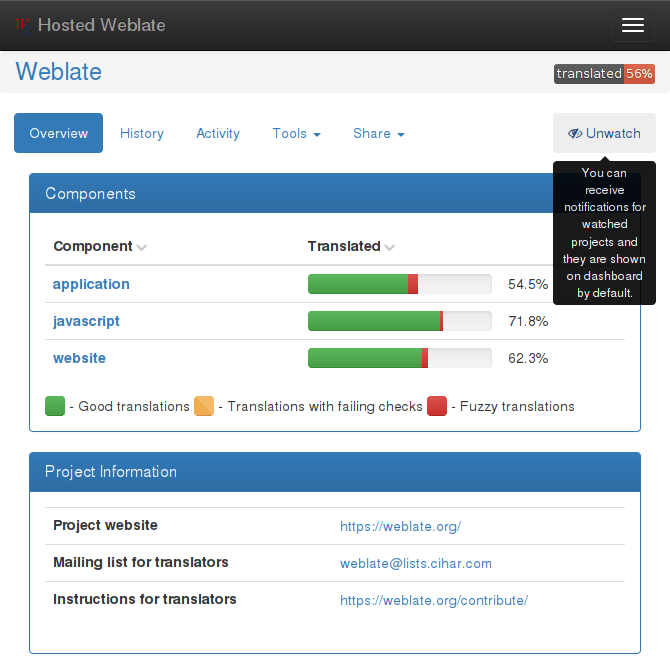
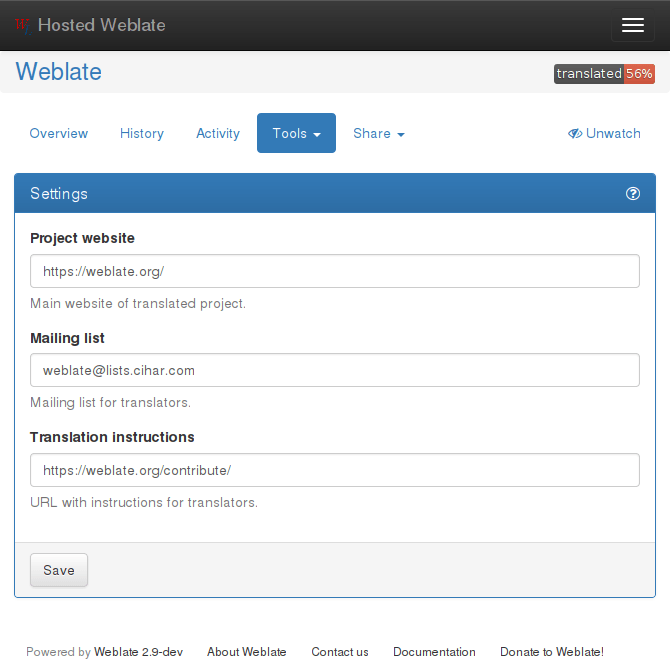
Today, new version has been deployed on Hosted Weblate. It brings many long requested features and enhancements. Adding project to watched got way simpler, you can now do it on the project page using watch button: Watch project Another feature which will be liked by project admins is that they can now change project metadata without contacting me. This works for both project and component level: Project settings And adding some fancy things, there is new badge showing status of translations into all languages. This is how it looks for Weblate itself: Translation status As you can see it can get pretty big for projects with many translations, but you get complete picture of the translation status in it. You can find all these features in upcoming Weblate 2.9 which should be released next week. Complete list of changes in Weblate 2.9 is described in our documentation.
Filed under: Debian English phpMyAdmin SUSE Weblate 0 comments

24 October 2016

Reproducible builds folks: Reproducible Builds: week 78 in Stretch cycle

What happened in the Reproducible Builds effort between Sunday October 16 and Saturday October 22 2016: Media coverage Upcoming events buildinfo.debian.net In order to build packages reproducibly, you not only need identical sources but also some external definition of the environment used for a particular build. This definition includes the inputs and the outputs and, in the Debian case, are available in a $package_$architecture_$version.buildinfo file. We anticipate the next dpkg upload to sid will create .buildinfo files by default. Whilst it's clear that we also need to teach dak to deal with them (#763822) its not actually clear how to handle .buildinfo files after dak has processed them and how to make them available to the world. To this end, Chris Lamb has started development on a proof-of-concept .buildinfo server to see what issues arise. Source Reproducible work in other projects Packages reviewed and fixed, and bugs filed Reviews of unreproducible packages 99 package reviews have been added, 3 have been updated and 6 have been removed in this week, adding to our knowledge about identified issues. 6 issue types have been added: Weekly QA work During of reproducibility testing, some FTBFS bugs have been detected and reported by: diffoscope development tests.reproducible-builds.org Misc. Our poll to find a good time for an IRC meeting is still running until Tuesday, October 25st; please reply as soon as possible. We need a logo! Some ideas and requirements for a Reproducible Builds logo have been documented in the wiki. Contributions very welcome, even if simply by forwarding this information. This week's edition was written by Chris Lamb & Holger Levsen and reviewed by a bunch of Reproducible Builds folks on IRC.

22 October 2016

Matthew Garrett: Fixing the IoT isn't going to be easy

A large part of the internet became inaccessible today after a botnet made up of IP cameras and digital video recorders was used to DoS a major DNS provider. This highlighted a bunch of things including how maybe having all your DNS handled by a single provider is not the best of plans, but in the long run there's no real amount of diversification that can fix this - malicious actors have control of a sufficiently large number of hosts that they could easily take out multiple providers simultaneously.

To fix this properly we need to get rid of the compromised systems. The question is how. Many of these devices are sold by resellers who have no resources to handle any kind of recall. The manufacturer may not have any kind of legal presence in many of the countries where their products are sold. There's no way anybody can compel a recall, and even if they could it probably wouldn't help. If I've paid a contractor to install a security camera in my office, and if I get a notification that my camera is being used to take down Twitter, what do I do? Pay someone to come and take the camera down again, wait for a fixed one and pay to get that put up? That's probably not going to happen. As long as the device carries on working, many users are going to ignore any voluntary request.

We're left with more aggressive remedies. If ISPs threaten to cut off customers who host compromised devices, we might get somewhere. But, inevitably, a number of small businesses and unskilled users will get cut off. Probably a large number. The economic damage is still going to be significant. And it doesn't necessarily help that much - if the US were to compel ISPs to do this, but nobody else did, public outcry would be massive, the botnet would not be much smaller and the attacks would continue. Do we start cutting off countries that fail to police their internet?

Ok, so maybe we just chalk this one up as a loss and have everyone build out enough infrastructure that we're able to withstand attacks from this botnet and take steps to ensure that nobody is ever able to build a bigger one. To do that, we'd need to ensure that all IoT devices are secure, all the time. So, uh, how do we do that?

These devices had trivial vulnerabilities in the form of hardcoded passwords and open telnet. It wouldn't take terribly strong skills to identify this at import time and block a shipment, so the "obvious" answer is to set up forces in customs who do a security analysis of each device. We'll ignore the fact that this would be a pretty huge set of people to keep up with the sheer quantity of crap being developed and skip straight to the explanation for why this wouldn't work.

Yeah, sure, this vulnerability was obvious. But what about the product from a well-known vendor that included a debug app listening on a high numbered UDP port that accepted a packet of the form "BackdoorPacketCmdLine_Req" and then executed the rest of the payload as root? A portscan's not going to show that up[1]. Finding this kind of thing involves pulling the device apart, dumping the firmware and reverse engineering the binaries. It typically takes me about a day to do that. Amazon has over 30,000 listings that match "IP camera" right now, so you're going to need 99 more of me and a year just to examine the cameras. And that's assuming nobody ships any new ones.

Even that's insufficient. Ok, with luck we've identified all the cases where the vendor has left an explicit backdoor in the code[2]. But these devices are still running software that's going to be full of bugs and which is almost certainly still vulnerable to at least half a dozen buffer overflows[3]. Who's going to audit that? All it takes is one attacker to find one flaw in one popular device line, and that's another botnet built.

If we can't stop the vulnerabilities getting into people's homes in the first place, can we at least fix them afterwards? From an economic perspective, demanding that vendors ship security updates whenever a vulnerability is discovered no matter how old the device is is just not going to work. Many of these vendors are small enough that it'd be more cost effective for them to simply fold the company and reopen under a new name than it would be to put the engineering work into fixing a decade old codebase. And how does this actually help? So far the attackers building these networks haven't been terribly competent. The first thing a competent attacker would do would be to silently disable the firmware update mechanism.

We can't easily fix the already broken devices, we can't easily stop more broken devices from being shipped and we can't easily guarantee that we can fix future devices that end up broken. The only solution I see working at all is to require ISPs to cut people off, and that's going to involve a great deal of pain. The harsh reality is that this is almost certainly just the tip of the iceberg, and things are going to get much worse before they get any better.

Right. I'm off to portscan another smart socket.

[1] UDP connection refused messages are typically ratelimited to one per second, so it'll take almost a day to do a full UDP portscan, and even then you have no idea what the service actually does.

[2] It's worth noting that this is usually leftover test or debug code, not an overtly malicious act. Vendors should have processes in place to ensure that this isn't left in release builds, but ha well.

[3] My vacuum cleaner crashes if I send certain malformed HTTP requests to the local API endpoint, which isn't a good sign

comment count unavailable comments

21 October 2016

Iain R. Learmonth: PATHspider 1.0.0 released!

In today s Internet we see an increasing deployment of middleboxes. While middleboxes provide in-network functionality that is necessary to keep networks manageable and economically viable, any packet mangling whether essential for the needed functionality or accidental as an unwanted side effect makes it more and more difficult to deploy new protocols or extensions of existing protocols. For the evolution of the protocol stack, it is important to know which network impairments exist and potentially need to be worked around. While classical network measurement tools are often focused on absolute performance values, PATHspider performs A/B testing between two different protocols or different protocol extensions to perform controlled experiments of protocol-dependent connectivity problems as well as differential treatment. PATHspider is a framework for performing and analyzing these measurements, while the actual A/B test can be easily customized. Late on the 21st October, we released version 1.0.0 of PATHspider and it s ready for production use (whatever that means for Internet research software). Our first real release of PATHspider was version 0.9.0 just in time for the presentation of PATHspider at the 2016 Applied Networking Research Workshop co-located with IETF 96 in Berlin earlier this year. Since this release we have made a lot of changes and I ll talk about some of the highlights here (in no particular order):

Switch from twisted.plugin to straight.plugin While we anticipate that some plugins may wish to use some features of Twisted, we didn t want to have Twisted as a core dependency for PATHspider. We found that straight.plugin was not just a drop-in replacement but it simplified the way in which 3rd-party plugins could be developed and it was worth the effort for that alone.

Library functions for the Observer PATHspider has an embedded flow-meter (think something like NetFlow but highly customisable). We found that even with the small selection of plugins that we had we were duplicating code across plugins for these customisations of the flow-meter. In this release we now provide library functions for common needs such as identifying TCP 3-way handshake completions or identifying ICMP Unreachable messages for flows.

New plugin: DSCP We ve added a new plugin for this release to detect breakage when using DiffServ code points to achieve differentiated services within a network.

Plugins are now subcommands Using the subparsers feature of argparse, all plugins including 3rd-party plugins will now appear as subcommands to the PATHspider command. This makes every plugin a first-class citizen and makes PATHspider truly generalised. We have an added benefit from this that plugins can also ask for extra arguments that are specific to the needs of the plugin, for example the DSCP plugin allows the user to select which code point to send for the experimental test.

Test Suite PATHspider now has a test suite! As the size of the PATHspider code base grows we need to be able to make changes and have confidence that we are not breaking code that another module relies on. We have so far only achieved 54% coverage of the codebase but we hope to improve this for the next release. We have focussed on the critical portions of data collection to ensure that all the results collected by PATHspider during experiments is valid.

DNS Resolver Utility Back when PATHspider was known as ECNSpider, it had a utility for resolving IP addresses from the Alexa top 1 million list. This utility has now been fully integrated into PATHspider and appears as a plugin to allow for repeated experiments against the same IP addresses even if the DNS resolver would have returned a different addresss.

Documentation Documentation is definitely not my favourite activity, but it has to be done. PATHspider 1.0.0 now ships with documentation covering commandline usage, input/output formats and development of new plugins.
If you d like to check out PATHspider, you can find the website at https://pathspider.net/. Debian packages will be appearing shortly and will find their way into stable-backports within the next 2 weeks (hopefully). Current development of PATHspider is supported by the European Union s Horizon 2020 project MAMI. This project has received funding from the European Union s Horizon 2020 research and innovation programme under grant agreement No 688421. The opinions expressed and arguments employed reflect only the authors view. The European Commission is not responsible for any use that may be made of that information.

20 October 2016

H ctor Or n Mart nez: Build a Debian package against Debian 8.0 using Download On Demand (DoD) service

In the previous post Open Build Service software architecture has been overviewed. In the current blog post, a tutorial on setting up a package build with OBS from Debian packages is presented. Steps: Generate a test environment by creating Stretch/SID VM Really, use whatever suits you best, but please create an untrusted test environment for this one. In the current tutorial it assumes $hostname is stretch , which should be stretch or sid suite. Be aware that copy & paste configuration files from current post might lead you into broken characters (i.e. ). Debian Stretch weekly netinst CD Enable experimental repository
# echo "deb http://httpredir.debian.org/debian experimental main" >> /etc/apt/sources.list.d/experimental.list
# apt-get update
Install and setup OBS server, api, worker and osc CLI packages
# apt-get install obs-server obs-api obs-worker osc
In the install process mysql database is needed, therefore if mysql server is not setup, a password needs to be provided.
When OBS API database obs-api is created, we need to pick a password for it, provide opensuse . The obs-api package will configure apache2 https webserver (creating a dummy certificate for stretch ) to serve OBS webui.
Add stretch and obs aliases to localhost entry in your /etc/hosts file.
Enable worker by setting ENABLED=1 in /etc/default/obsworker
Try to connect to the web UI https://stretch/
Login into OBS webui, default login credentials: Admin/opensuse).
From command line tool, try to list projects in OBS
 $ osc -A https://stretch ls
Accept dummy certificate and provide credentials (defaults: Admin/opensuse)
If the install proceeds as expected follow to the next step. Ensure all OBS services are running
# backend services
obsrun     813  0.0  0.9 104960 20448 ?        Ss   08:33   0:03 /usr/bin/perl -w /usr/lib/obs/server/bs_dodup
obsrun     815  0.0  1.5 157512 31940 ?        Ss   08:33   0:07 /usr/bin/perl -w /usr/lib/obs/server/bs_repserver
obsrun    1295  0.0  1.6 157644 32960 ?        S    08:34   0:07  \_ /usr/bin/perl -w /usr/lib/obs/server/bs_repserver
obsrun     816  0.0  1.8 167972 38600 ?        Ss   08:33   0:08 /usr/bin/perl -w /usr/lib/obs/server/bs_srcserver
obsrun    1296  0.0  1.8 168100 38864 ?        S    08:34   0:09  \_ /usr/bin/perl -w /usr/lib/obs/server/bs_srcserver
memcache   817  0.0  0.6 346964 12872 ?        Ssl  08:33   0:11 /usr/bin/memcached -m 64 -p 11211 -u memcache -l 127.0.0.1
obsrun     818  0.1  0.5  78548 11884 ?        Ss   08:33   0:41 /usr/bin/perl -w /usr/lib/obs/server/bs_dispatch
obsserv+   819  0.0  0.3  77516  7196 ?        Ss   08:33   0:05 /usr/bin/perl -w /usr/lib/obs/server/bs_service
mysql      851  0.0  0.0   4284  1324 ?        Ss   08:33   0:00 /bin/sh /usr/bin/mysqld_safe
mysql     1239  0.2  6.3 1010744 130104 ?      Sl   08:33   1:31  \_ /usr/sbin/mysqld --basedir=/usr --datadir=/var/lib/mysql --plugin-dir=/usr/lib/mysql/plugin --log-error=/var/log/mysql/error.log --pid-file=/var/run/mysqld/mysqld.pid --socket=/var/run/mysqld/mysqld.sock --port=3306
# web services
root      1452  0.0  0.1 110020  3968 ?        Ss   08:34   0:01 /usr/sbin/apache2 -k start
root      1454  0.0  0.1 435992  3496 ?        Ssl  08:34   0:00  \_ Passenger watchdog
root      1460  0.3  0.2 651044  5188 ?        Sl   08:34   1:46      \_ Passenger core
nobody    1465  0.0  0.1 444572  3312 ?        Sl   08:34   0:00      \_ Passenger ust-router
www-data  1476  0.0  0.1 855892  2608 ?        Sl   08:34   0:09  \_ /usr/sbin/apache2 -k start
www-data  1477  0.0  0.1 856068  2880 ?        Sl   08:34   0:09  \_ /usr/sbin/apache2 -k start
www-data  1761  0.0  4.9 426868 102040 ?       Sl   08:34   0:29 delayed_job.0
www-data  1767  0.0  4.8 425624 99888 ?        Sl   08:34   0:30 delayed_job.1
www-data  1775  0.0  4.9 426516 101708 ?       Sl   08:34   0:28 delayed_job.2
nobody    1788  0.0  5.7 496092 117480 ?       Sl   08:34   0:03 Passenger RubyApp: /usr/share/obs/api
nobody    1796  0.0  4.9 488888 102176 ?       Sl   08:34   0:00 Passenger RubyApp: /usr/share/obs/api
www-data  1814  0.0  4.5 282576 92376 ?        Sl   08:34   0:22 delayed_job.1000
www-data  1829  0.0  4.4 282684 92228 ?        Sl   08:34   0:22 delayed_job.1010
www-data  1841  0.0  4.5 282932 92536 ?        Sl   08:34   0:22 delayed_job.1020
www-data  1855  0.0  4.9 427988 101492 ?       Sl   08:34   0:29 delayed_job.1030
www-data  1865  0.2  5.0 492500 102964 ?       Sl   08:34   1:09 clockworkd.clock
www-data  1899  0.0  0.0  87100  1400 ?        S    08:34   0:00 /usr/bin/searchd --pidfile --config /usr/share/obs/api/config/production.sphinx.conf
www-data  1900  0.1  0.4 161620  8276 ?        Sl   08:34   0:51  \_ /usr/bin/searchd --pidfile --config /usr/share/obs/api/config/production.sphinx.conf
# OBS worker
root      1604  0.0  0.0  28116  1492 ?        Ss   08:34   0:00 SCREEN -m -d -c /srv/obs/run/worker/boot/screenrc
root      1605  0.0  0.9  75424 18764 pts/0    Ss+  08:34   0:06  \_ /usr/bin/perl -w ./bs_worker --hardstatus --root /srv/obs/worker/root_1 --statedir /srv/obs/run/worker/1 --id stretch:1 --reposerver http://obs:5252 --jobs 1
Create an OBS project for Download on Demand (DoD) Create a meta project file:
$ osc -A https://stretch:443 meta prj Debian:8 -e
<project name= Debian:8 >
<title>Debian 8 DoD</title>
<description>Debian 8 DoD</description>
<person userid= Admin role= maintainer />
<repository name= main >
<download arch= x86_64 url= http://deb.debian.org/debian/jessie/main repotype= deb />
<arch>x86_64</arch>
</repository>
</project>
Visit webUI to check project configuration Create a meta project configuration file:
$ osc -A https://stretch:443 meta prjconf Debian:8 -e
Add the following file, as found at build.opensuse.org
Repotype: debian
# create initial user
Preinstall: base-passwd
Preinstall: user-setup
# required for preinstall images
Preinstall: perl
# preinstall essentials + dependencies
Preinstall: base-files base-passwd bash bsdutils coreutils dash debconf
Preinstall: debianutils diffutils dpkg e2fslibs e2fsprogs findutils gawk
Preinstall: gcc-4.9-base grep gzip hostname initscripts insserv libacl1
Preinstall: libattr1 libblkid1 libbz2-1.0 libc-bin libc6 libcomerr2 libdb5.3
Preinstall: libgcc1 liblzma5 libmount1 libncurses5 libpam-modules
Preinstall: libpcre3 libsmartcols1
Preinstall: libpam-modules-bin libpam-runtime libpam0g libreadline6
Preinstall: libselinux1 libsemanage-common libsemanage1 libsepol1 libsigsegv2
Preinstall: libslang2 libss2 libtinfo5 libustr-1.0-1 libuuid1 login lsb-base
Preinstall: mount multiarch-support ncurses-base ncurses-bin passwd perl-base
Preinstall: readline-common sed sensible-utils sysv-rc sysvinit sysvinit-utils
Preinstall: tar tzdata util-linux zlib1g
Runscripts: base-passwd user-setup base-files gawk
VMinstall: libdevmapper1.02.1
Order: user-setup:base-files
# Essential packages (this should also pull the dependencies)
Support: base-files base-passwd bash bsdutils coreutils dash debianutils
Support: diffutils dpkg e2fsprogs findutils grep gzip hostname libc-bin 
Support: login mount ncurses-base ncurses-bin perl-base sed sysvinit 
Support: sysvinit-utils tar util-linux
# Build-essentials
Required: build-essential
Prefer: build-essential:make
# build script needs fakeroot
Support: fakeroot
# lintian support would be nice, but breaks too much atm
#Support: lintian
# helper tools in the chroot
Support: less kmod net-tools procps psmisc strace vim
# everything below same as for Debian:6.0 (apart from the version macros ofc)
# circular dependendencies in openjdk stack
Order: openjdk-6-jre-lib:openjdk-6-jre-headless
Order: openjdk-6-jre-headless:ca-certificates-java
Keep: binutils cpp cracklib file findutils gawk gcc gcc-ada gcc-c++
Keep: gzip libada libstdc++ libunwind
Keep: libunwind-devel libzio make mktemp pam-devel pam-modules
Keep: patch perl rcs timezone
Prefer: cvs libesd0 libfam0 libfam-dev expect
Prefer: gawk locales default-jdk
Prefer: xorg-x11-libs libpng fam mozilla mozilla-nss xorg-x11-Mesa
Prefer: unixODBC libsoup glitz java-1_4_2-sun gnome-panel
Prefer: desktop-data-SuSE gnome2-SuSE mono-nunit gecko-sharp2
Prefer: apache2-prefork openmotif-libs ghostscript-mini gtk-sharp
Prefer: glib-sharp libzypp-zmd-backend mDNSResponder
Prefer: -libgcc-mainline -libstdc++-mainline -gcc-mainline-c++
Prefer: -libgcj-mainline -viewperf -compat -compat-openssl097g
Prefer: -zmd -OpenOffice_org -pam-laus -libgcc-tree-ssa -busybox-links
Prefer: -crossover-office -libgnutls11-dev
# alternative pkg-config implementation
Prefer: -pkgconf
Prefer: -openrc
Prefer: -file-rc
Conflict: ghostscript-library:ghostscript-mini
Ignore: sysvinit:initscripts
Ignore: aaa_base:aaa_skel,suse-release,logrotate,ash,mingetty,distribution-release
Ignore: gettext-devel:libgcj,libstdc++-devel
Ignore: pwdutils:openslp
Ignore: pam-modules:resmgr
Ignore: rpm:suse-build-key,build-key
Ignore: bind-utils:bind-libs
Ignore: alsa:dialog,pciutils
Ignore: portmap:syslogd
Ignore: fontconfig:freetype2
Ignore: fontconfig-devel:freetype2-devel
Ignore: xorg-x11-libs:freetype2
Ignore: xorg-x11:x11-tools,resmgr,xkeyboard-config,xorg-x11-Mesa,libusb,freetype2,libjpeg,libpng
Ignore: apache2:logrotate
Ignore: arts:alsa,audiofile,resmgr,libogg,libvorbis
Ignore: kdelibs3:alsa,arts,pcre,OpenEXR,aspell,cups-libs,mDNSResponder,krb5,libjasper
Ignore: kdelibs3-devel:libvorbis-devel
Ignore: kdebase3:kdebase3-ksysguardd,OpenEXR,dbus-1,dbus-1-qt,hal,powersave,openslp,libusb
Ignore: kdebase3-SuSE:release-notes
Ignore: jack:alsa,libsndfile
Ignore: libxml2-devel:readline-devel
Ignore: gnome-vfs2:gnome-mime-data,desktop-file-utils,cdparanoia,dbus-1,dbus-1-glib,krb5,hal,libsmbclient,fam,file_alteration
Ignore: libgda:file_alteration
Ignore: gnutls:lzo,libopencdk
Ignore: gnutls-devel:lzo-devel,libopencdk-devel
Ignore: pango:cairo,glitz,libpixman,libpng
Ignore: pango-devel:cairo-devel
Ignore: cairo-devel:libpixman-devel
Ignore: libgnomeprint:libgnomecups
Ignore: libgnomeprintui:libgnomecups
Ignore: orbit2:libidl
Ignore: orbit2-devel:libidl,libidl-devel,indent
Ignore: qt3:libmng
Ignore: qt-sql:qt_database_plugin
Ignore: gtk2:libpng,libtiff
Ignore: libgnomecanvas-devel:glib-devel
Ignore: libgnomeui:gnome-icon-theme,shared-mime-info
Ignore: scrollkeeper:docbook_4,sgml-skel
Ignore: gnome-desktop:libgnomesu,startup-notification
Ignore: python-devel:python-tk
Ignore: gnome-pilot:gnome-panel
Ignore: gnome-panel:control-center2
Ignore: gnome-menus:kdebase3
Ignore: gnome-main-menu:rug
Ignore: libbonoboui:gnome-desktop
Ignore: postfix:pcre
Ignore: docbook_4:iso_ent,sgml-skel,xmlcharent
Ignore: control-center2:nautilus,evolution-data-server,gnome-menus,gstreamer-plugins,gstreamer,metacity,mozilla-nspr,mozilla,libxklavier,gnome-desktop,startup-notification
Ignore: docbook-xsl-stylesheets:xmlcharent
Ignore: liby2util-devel:libstdc++-devel,openssl-devel
Ignore: yast2:yast2-ncurses,yast2-theme-SuSELinux,perl-Config-Crontab,yast2-xml,SuSEfirewall2
Ignore: yast2-core:netcat,hwinfo,wireless-tools,sysfsutils
Ignore: yast2-core-devel:libxcrypt-devel,hwinfo-devel,blocxx-devel,sysfsutils,libstdc++-devel
Ignore: yast2-packagemanager-devel:rpm-devel,curl-devel,openssl-devel
Ignore: yast2-devtools:perl-XML-Writer,libxslt,pkgconfig
Ignore: yast2-installation:yast2-update,yast2-mouse,yast2-country,yast2-bootloader,yast2-packager,yast2-network,yast2-online-update,yast2-users,release-notes,autoyast2-installation
Ignore: yast2-bootloader:bootloader-theme
Ignore: yast2-packager:yast2-x11
Ignore: yast2-x11:sax2-libsax-perl
Ignore: openslp-devel:openssl-devel
Ignore: java-1_4_2-sun:xorg-x11-libs
Ignore: java-1_4_2-sun-devel:xorg-x11-libs
Ignore: kernel-um:xorg-x11-libs
Ignore: tetex:xorg-x11-libs,expat,fontconfig,freetype2,libjpeg,libpng,ghostscript-x11,xaw3d,gd,dialog,ed
Ignore: yast2-country:yast2-trans-stats
Ignore: susehelp:susehelp_lang,suse_help_viewer
Ignore: mailx:smtp_daemon
Ignore: cron:smtp_daemon
Ignore: hotplug:syslog
Ignore: pcmcia:syslog
Ignore: avalon-logkit:servlet
Ignore: jython:servlet
Ignore: ispell:ispell_dictionary,ispell_english_dictionary
Ignore: aspell:aspel_dictionary,aspell_dictionary
Ignore: smartlink-softmodem:kernel,kernel-nongpl
Ignore: OpenOffice_org-de:myspell-german-dictionary
Ignore: mediawiki:php-session,php-gettext,php-zlib,php-mysql,mod_php_any
Ignore: squirrelmail:mod_php_any,php-session,php-gettext,php-iconv,php-mbstring,php-openssl
Ignore: simias:mono(log4net)
Ignore: zmd:mono(log4net)
Ignore: horde:mod_php_any,php-gettext,php-mcrypt,php-imap,php-pear-log,php-pear,php-session,php
Ignore: xerces-j2:xml-commons-apis,xml-commons-resolver
Ignore: xdg-menu:desktop-data
Ignore: nessus-libraries:nessus-core
Ignore: evolution:yelp
Ignore: mono-tools:mono(gconf-sharp),mono(glade-sharp),mono(gnome-sharp),mono(gtkhtml-sharp),mono(atk-sharp),mono(gdk-sharp),mono(glib-sharp),mono(gtk-sharp),mono(pango-sharp)
Ignore: gecko-sharp2:mono(glib-sharp),mono(gtk-sharp)
Ignore: vcdimager:libcdio.so.6,libcdio.so.6(CDIO_6),libiso9660.so.4,libiso9660.so.4(ISO9660_4)
Ignore: libcdio:libcddb.so.2
Ignore: gnome-libs:libgnomeui
Ignore: nautilus:gnome-themes
Ignore: gnome-panel:gnome-themes
Ignore: gnome-panel:tomboy
Substitute: utempter
%ifnarch s390 s390x ppc ia64
Substitute: java2-devel-packages java-1_4_2-sun-devel
%else
 %ifnarch s390x
Substitute: java2-devel-packages java-1_4_2-ibm-devel
 %else
Substitute: java2-devel-packages java-1_4_2-ibm-devel xorg-x11-libs-32bit
 %endif
%endif
Substitute: yast2-devel-packages docbook-xsl-stylesheets doxygen libxslt perl-XML-Writer popt-devel sgml-skel update-desktop-files yast2 yast2-devtools yast2-packagemanager-devel yast2-perl-bindings yast2-testsuite
#
# SUSE compat mappings
#
Substitute: gcc-c++ gcc
Substitute: libsigc++2-devel libsigc++-2.0-dev
Substitute: glibc-devel-32bit
Substitute: pkgconfig pkg-config
%ifarch %ix86
Substitute: kernel-binary-packages kernel-default kernel-smp kernel-bigsmp kernel-debug kernel-um kernel-xen kernel-kdump
%endif
%ifarch ia64
Substitute: kernel-binary-packages kernel-default kernel-debug
%endif
%ifarch x86_64
Substitute: kernel-binary-packages kernel-default kernel-smp kernel-xen kernel-kdump
%endif
%ifarch ppc
Substitute: kernel-binary-packages kernel-default kernel-kdump kernel-ppc64 kernel-iseries64
%endif
%ifarch ppc64
Substitute: kernel-binary-packages kernel-ppc64 kernel-iseries64
%endif
%ifarch s390
Substitute: kernel-binary-packages kernel-s390
%endif
%ifarch s390x
Substitute: kernel-binary-packages kernel-default
%endif
%define debian_version 800
Macros:
%debian_version 800
Visit webUI to check project configuration Create an OBS project linked to DoD
$ osc -A https://stretch:443 meta prj test -e
<project name= test >
<title>test</title>
<description>test</description>
<person userid= Admin role= maintainer />
<repository name= Debian_8.0 >
<path project= Debian:8 repository= main />
<arch>x86_64</arch>
</repository>
</project>
Visit webUI to check project configuration Adding a package to the project
$ osc -A https://stretch:443 co test ; cd test
$ mkdir hello ; cd hello ; apt-get source -d hello ; cd - ; 
$ osc add hello 
$ osc ci -m "New import" hello
The package should go to dispatched state then get in blocked state while it downloads build dependencies from DoD link, eventually it should start building. Please check the journal logs to check if something went wrong or gets stuck. Visit webUI to check hello package build state OBS logging to the journal Check in the journal logs everything went fine:
$ sudo journalctl -u obsdispatcher.service -u obsdodup.service -u obsscheduler@x86_64.service -u obsworker.service -u obspublisher.service
Troubleshooting Currently we are facing few issues with web UI: And there are more issues that have not been reported, please do reportbug obs-api .

19 October 2016

Pau Garcia i Quiles: FOSDEM Desktops DevRoom 2017 all for Participation

FOSDEM is one of the largest (5,000+ hackers!) gatherings of Free Software contributors in the world and happens each February in Brussels (Belgium, Europe). Once again, one of the tracks will be the Desktops DevRoom (formerly known as CrossDesktop DevRoom ), which will host Desktop-related talks. We are now inviting proposals for talks about Free/Libre/Open-source Software on the topics of Desktop development, Desktop applications and interoperability amongst Desktop Environments. This is a unique opportunity to show novel ideas and developments to a wide technical audience. Topics accepted include, but are not limited to: Talks can be very specific, such as the advantages/disadvantages of distributing a desktop application with snap vs flatpak, or as general as using HTML5 technologies to develop native applications. Topics that are of interest to the users and developers of all desktop environments are especially welcome. The FOSDEM 2016 schedule might give you some inspiration. Submissions Please include the following information when submitting a proposal: How to submit All submissions are made in the Pentabarf event planning tool: https://penta.fosdem.org/submission/FOSDEM17 To submit your talk, click on Create Event , then make sure to select the Desktops devroom as the Track . Otherwise your talk will not be even considered for any devroom at all. If you already have a Pentabarf account from a previous year, even if your talk was not accepted, please reuse it. Create an account if, and only if, you don t have one from a previous year. If you have any issues with Pentabarf, please contact desktops-devroom@lists.fosdem.org. Deadline The deadline for submissions is December 5th 2016. FOSDEM will be held on the weekend of 4 & 5 February 2017 and the Desktops DevRoom will take place on Sunday, February 5th 2017. We will contact every submitter with a yes or no before December 11th 2016. Recording permission The talks in the Desktops DevRoom will be audio and video recorded, and possibly streamed live too. In the Submission notes field, please indicate that you agree that your presentation will be licensed under the CC-By-SA-4.0 or CC-By-4.0 license and that you agree to have your presentation recorded. For example:
If my presentation is accepted for FOSDEM, I hereby agree to license all recordings, slides, and other associated materials under the Creative Commons Attribution Share-Alike 4.0 International License. Sincerely, <NAME>.
If you want us to stop the recording in the Q & A part (should you have one), please tell us. We can do that but only for the Q & A part. More information The official communication channel for the Desktops DevRoom is its mailing list desktops-devroom@lists.fosdem.org. Use this page to manage your subscription: https://lists.fosdem.org/listinfo/desktops-devroom Organization The Desktops DevRoom 2017 is managed by a team representing the most notable open desktops: If you want to join the team, please contact desktops-devroom@lists.fosdem.org

Next.

Previous.