Search Results: "nion"

1 March 2008

Adam Rosi-Kessel: The Best Movie to Start at 11pm at the End of a Long Trial

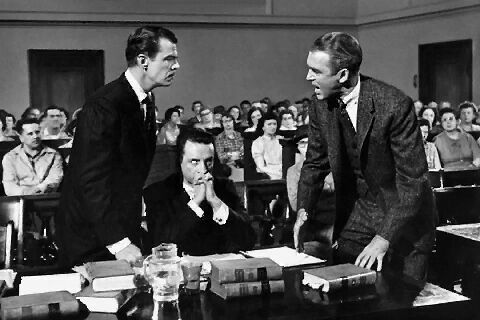
Anatomy of a Murder. David Denby put it best:
Otto Preminger s Anatomy of a Murder, from 1959, is still the best courtroom drama ever made in this country, and, in its occasional forays out of the court, among the finest evocations of place an Upper Peninsula Michigan resort area in the off-season, leafless, underpopulated, alcoholic, and forlorn. James Stewart, in one of his wonderful melancholy late performances, plays a former county prosecutor named Biegler, a lifelong bachelor who now spends his time with a non-practicing lawyer (Arthur O Connell) and an unpaid secretary (Eve Arden), who sticks around for the wisecracks. The movie is leisurely, detailed, realistic, intensely companionable; you get a sense of how people exist at the margins of a profession without losing their dignity.
Although there are some distinctions between a murder defense in the 1950’s in the Upper Peninsula of Michigan and modern-day patent litigation, the essence of trial technique is really not all that different. Highly recommended.
Prosecutor: Lieutenant Manion, wasn’t your action against Barney Quill much the same thing as your action against Miller or the Lieutenant you slapped at the cocktail party — all done in the heat of anger, with a willful, conscious desire to hurt or kill?
Defendant: I don’t remember my action against Quill.
Prosecutor: How long had you known your wife was stepping out with Quill?
Defendant: I never knew anything like that. I trust my wife.
Prosecutor: You just occasionally beat her up for the fun of it, I suppose?
Defense Counsel: There has been nothing established to permit a question like that. He keeps trying to insinuate without ever coming to the point. Let him ask the Lieutenant, did he ever beat his wife.
Judge: I will sustain the objection. Do you want to re-phrase your question, Mr. Dancer?
Prosecutor: No thank you, Your Honor. I’ve finished.
Technorati Tags: , ,

28 February 2008

MJ Ray: South-West MP Promotes Credit Unions as Reasonable Universal Credit

John Penrose said:
"[...] the credit union movement in this country is exactly the kind of excellent initiative that [...] fulfils many of the necessary and vital functions that she has mentioned and is aimed at those at the bottom of the income scale."
Source I've emailed him a thank-you and been told that ABCUL will explain to Fiona Mactaggart how they're working to increase coverage and capacity. I've noticed credit unions in the south-west expanding their areas, or merging in order to serve more members. I think we've also got a credit union rep on the board of Cooperatives-SW again. Yay. Now, back to coding.

21 February 2008

Clint Adams: The dysthm of the night

I was walking under Union Square, listening to Hank Williams, when suddenly Hank was completely drowned out by the blaring of Hypnotic Brass Ensemble. You have no idea how sad I am that I can identify Chicago street musicians.

MJ Ray: The Myth Of Deregulation

Russ Nelson: The Influence of Government writes:
"Larry Lessig proposes to lessen the influence of money on legislators. Unfortunately for him, he is trying to hide a symptom without curing the disease. The disease is that governments regulate businesses. The symptom is that businesses then have a profit motive in regulating governments. If you want a government which is free of corruption, you have to eliminate the motive for corrupting them."
which looks like utter bovine excrement to me. Corporations - and the overpowering profit motive of some corporations - are artificial things, created purely by regulations. If you free corporations from all regulations, you destroy them. If you only free them from taxes, you remove some of the few restraints on their bad behaviour in pursuit of profit. See Joel Bakan: The Corporation for a better approach. In summary:- Some of those may seem surprising, but if you read the book, you'll see why those conclusions make sense.

20 February 2008

Jeff Bailey: Met with the surgeon.

Angie, Leif and I met with one the two surgeons who will be doing the work. I s'pose it's good and bad that the co-director of the UCSF Spine Centre, Dr. Mummaneni is personally taking on the case. Good that I'll have the best possible care; Bad that I'm apparently interesting enough to warrant it.

Meeting with him was matter of fact. He talked about how he'll approach the surgery (from the back, since the placement of my aortic arch and innominant vein would make coming through the front problematic). It looks like I'll have rods and screws from T1-T6, with a cage replacing the vertebra at least at T3 and possibly at T4. People don't usually do that much movement in their thoracic back so, ongoing, his opinion was that I largely won't notice it.

In hospital-time will depend on whether or not the surgery can be done in one shot. Because of the trickiness of the area, it may not be possible to get it entirely from the back, and he'll do two surgeries rather than one if that can avoid me winding up in a wheelchair. Ideally, there's one surgery, and a week later I'm home and able to take care of myself. The way they take the tumor out in a couple pieces is known as "en bloc spondylectomy", but may not be possible with the way the spinal nerve is being pinched. He described the surgery itself, and the simple version is "remove one or two vertebra, replace them with cages, stabilize the surrounding area". Yay to the Black and Decker surgical division.

He'll be assisted by Dr. Chau for spinal cord monitoring and the rest of the surgery.

The last thing they did as I left the hospital last Saturday was a full body CT scan with contrast, and the radiologists have declared that that they see no additional tumors in the body. I'll visit with an oncologist to do some final tests, but consistently the answer is coming back that this isn't cancer, it's more likely an isolated mutation. Dr. Mummaneni doesn't feel that this is a side effect of sitting at a computer since I was 3 years old, any of the car accidents, or being hit across the back with a flute case in grade 9.

I did ask if I'll set off metal detectors at airports after this, and apparently the titanium used doesn't do that.

So, erm. What are the risks? Honestly, pretty consistently less than doing nothing. Having this thing would eventually result in paralysis anyway, and aside from the usually OMG-they're-cutting-me-open-anything-could-happen type of things that don't keep me from biking to work on a regular basis, all the other options are "And life improves from here". Informed consent means that I have statistics in my head that I'd rather not dwell on and a laundry list of things to panic about when I wake up in the middle of the night but those really are just nerves acting up and stress wanting to come out. Nothing wrong with any of that.

Surgery is booked for March 3rd. We'd hoped to go to Vancouver for Leif's birthday around then, but I've been asked not to fly. Rapid pressure changes apparently will aggravate what's there now.

I feel good about this. I'm back to pretty much 100% after the hospital time last week, and noticed that after the embolism that I'm moving a bit freer than I was before. That's enough to start the optimism going already. We've also twiddled my medicine for every 8 hours rather than 6, which will help me sleep better, and reduced it, which will help me feel better.

Having time-frames and knowing that I'm in good hands is a lovely place to be after all that.

16 February 2008

Philipp Kern: Python IDE wanted

Dear Lazyweb, is there a nice free and open Python IDE available? I was impressed by Eclipse's Java support when I had to code a project for my studies but I hate the language thoroughly. I also had a quick glance at NetBeans IDE which provides a Ruby IDE. It looked really nice with working code completion and refactoring support. Now I was a Ruby fanboy some time ago and switched to Python partly for (a bit) more performance and also because of better bindings to various libraries. Until now I coded Python in vim, but well, an IDE would be nice and I wonder why a language with as much drive as Python has lacks a nice free IDE. I also had to work with Visual Studio 2008 recently to port Gobby to Windows with proper C++ exceptions. The IntelliSense feature (their marketing speak for code completion) worked quite well with the given C++ code, but that IDE just got into my way. (Apart from the compiler having a different opinion about what real C++ is like, in contrast to gcc's opinion.) As my pyblosxom (heh) still lacks a comment plugin please mail me suggestions (if you have some) to my debian.org address. Uh, and a nice sticker: http://www.fosdem.org/2008/promo/going-to

15 February 2008

Andrew Pollock: [life] Worst. Recovery. Ever.

I wonder if things could go any worse if we actively tried? So despite going back to see the cardiologist on Monday afternoon, concerned about there possibly being still some sort of infection, and being told there wasn't, on Thursday morning, the top part of the incision was looking swollen. It looked even more so by the evening when I got home from work, and Sarah emailed a photo to the cardiologist, and he agreed it didn't look too crash hot, so he phoned a prescription for another, longer course of antibiotics through to the pharmacy, but too late to get filled last night. By bedtime it was looking even more ready to blow, and sure enough, around 1am (it's always 1am) it erupted everywhere. Fortunately (for me), I missed all the gory details, but I think there was a fair bit of fluid built up in there. So we went back to the clinic this morning, and they decided that they needed to open up part of the incision to let it drain and heal properly. They took another swab to run another culture, and then got a physician's assistant to take to her with a scalpel. I've seen my poor wife go through too many painful things in the last six months. Today's was no better. Most of the problem was the local anaesthetic injections, but watching them open up the incision again wasn't much fun either. No one should have to go through as much shit in a short time as what Sarah has had to. It's just not fair. She now has a gaping hole in her chest with some gauze packed in it, which has to be changed twice a day (by lucky old me). The idea is to let it heal from the bottom up, rather than the top down, as it seems an abscess had formed in the wound, and that was were all the trouble was. So by leaving it all open, it can drain properly, and heal from the bottom up. $DEITY only knows what sort of mess it's going to make of the incision area, but we can deal with that later. They reckon it'll take another 4-6 weeks to heal. I'm really hoping now that with it draining, and another course of antibiotics, Sarah will be in much less pain. I just did the evening gauze change. Fun. The opening in the incision is longer than I remembered them making this morning. It's about an inch long, and a centimetre deep, and there's a small hole in the bottom that presumably leads to the "interior". It's not as bad looking as I thought it might be. Packing the gauze in didn't seem to hurt Sarah too much, which is just as well. This really is the pits. I really hope this is the end of this, and the infection goes away for good, and the incision heals quickly. In terms of recovery, this is a pretty major setback in my opinion. From now on, we won't be relying on the cardiologist for surgical opinions, we'll be insisting a member of the surgical team checks Sarah out.

14 February 2008

Julian Andres Klode: Ubuntu: aufs with casper 1.118 / ndisgtk 0.8.1 / ndisgtk in main?


Colin Watson today uploaded casper 1.118, now supporting aufs. To use aufs in future Ubuntu disks built with casper 1.118 or newer, use union=aufs. Please test it. Another upload today was ndisgtk 0.8.1-1ubuntu1, bringing Ubuntu up-to-date with Debian and closing 3 bugs. BTW, I requested to include ndisgtk in main, see https://wiki.ubuntu.com/MainInclusionReportNdisgtk. Having ndisgtk on the Ubuntu disks would be very useful for users without linux network drivers available and without enough experiences to use ndiswrapper from the commandline.

5 February 2008

Jaldhar Vyas: Let Me Show You My Hegemons

New Jersey is one of the states holding presidential primaries on this Super Tuesday and since you asked, I voted for John McCain. The chief reason for my vote is of course the war against Islamic terrorism. Now that we are finally gaining the upper hand in Iraq, we can't afford to elect someone who will fail to see victory through. Mind you this isn't necessarily a reason not to vote Democrat. The anti-war wing of that party has been thoroughly marginalized. Hillary atleast has a commendable reputation for viciousness. Even Obama has made some encouraging remarks (ok that was probably a red herring but I have the audacity to hope you see.) But while the Democrats do not take the anti-war crowd seriously, they do depend on them for a great deal of their funding. A Democratic president might feel the need to throw them some bones inadvertantly screwing up things in the process. On the Republican side, Huckabee might leave tactical planning to Jesus. Romney would toe the line but there is no sign that he has any original thoughts on the matter. While I continue to support the President, it must be admitted that this whole war is stretching out as long as it is because mistakes were made. We need options beyond "staying the course" and "cutting and running" and McCain a military hero and early supporter of the surge could be the one to find them. The other big issue is supreme court appointments. One, possibly two justices may need to be replaced in the next four years. We need to ensure that the court does not veer leftward again as it will inevitably do during a Democratic administration. Here there is a big split in the Conservative establishment. Ideologues consider McCain to be insufficiently pure and worry he will end up appointing another Souter or O'Connor (both appointed by Republicans it should be noted.) Pragmatists point out that McCain is viewed more favorably than Romney or Huckabee amongst the independent and moderate voters who will be crucial to victory and that even the slight chance of a bad choice is better than the certainty of a bad choice if Clinton or Obama get to make it. Social issues are important to many Republican voters and in this area too there is some grumbling about McCain being too liberal. Some have even suggested that if McCain beats Huckabee or Romney, a Democratic victory and four years out of power would be preferable in order to bring the GOP back to the straight and narrow. Although this contingent is loud I frankly don't think they have the influence people think (As evidenced by the actual performance of Huckabee or previous champion Fred Thompson.) When push comes to shove, they will rally behind the party candidate especially if McCain makes a bona fide social conservative (Huckabee himself?) his vice-president. On economic issues, the president's job is to not interfere and let business run itself. I don't see any of the Republican candidates being much different in this regard. Or the Democrats for that matter. [Careful readers will have noticed I have avoided mentioning Ron Paul. Paulestinians, consider this carte blanche to send me your long, rambling, incoherent screeds about how Dr. Paul has the answers to everything. Because God knows I haven't read enough of them lately.] Update: Kevin asks what I think about the candidates in terms of "geek" issues such as net neutrality, DMCA etc. IMO there is not a whole lot of difference between the major candidates on these issues. Republicans one would think would be more beholden to corporations in general. Democrats on the other hand have a closer association with the media who are behind many of the sillier IP laws. Overall, I don't think it ought to be much of a factor in choosing the president even for Free Software types. Rather we should focus on the legislative branch (in Congress as well as the states) which holds the real power here and in the court of public opinion.

4 February 2008

Russell Coker: Party for U18s at LCA 2009

This year at Linux.Conf.Au there was a student party sponsored by Google. The party was held in a bar and lots of free drinks were provided. This was fine for the university students, but for school kids it was obviously lacking. Some people point out that it’s “quite legal” to run a party that excludes children, the point however is whether it’s desirable to exclude them. Also the concept of a state where laws dictate all aspects of your life to a degree such that obeying the law is the only possibility is fortunately restricted to science fiction. Another common fallacy is when people point out that we should be grateful for Google’s sponsorship. As far as I am aware Google doesn’t insist on any particular conditions for sponsoring a party. If the conference organisers were to request a party at a more child-friendly venue (for example a restaurant - which if licensed could serve alcohol to adults who desire it) then I doubt that Google would refuse. Being grateful for Google’s sponsorship is entirely unrelated to the issue of whether their sponsorship money was spent in the best possible manner. My interest in this topic started at LCA 2007 when I heard complaints from young delegates who were excluded from the Google party. This year the Google party (a different event from the “Google student party”) allowed everyone to attend and issued coloured wrist-bands to indicate whether the person had shown suitable ID to be served alcohol. The Google party was inviting for all and I believe that it was a significant improvement over last year (more attention was paid to serving food than alcohol). I have suggested that at future events some tables be reserved for people who aren’t drinking. As a general rule people enjoy being around people who have consumed a similar type and quantity of mind-altering substances (something I learned from my friends in Amsterdam). There is of course demand for serious drinking, and it seems impossible to satisfy people who want to do serious drinking at the same party as people who won’t or can’t drink at all. If there is not going to be an official party that is suitable for U18s then I’ll arrange it and pay for it myself. The consensus of opinion seems to be that less than six U18s are not worth catering for (one of the common objections to my suggestions is that there may be only four or five U18s). I can pay for a party for that many people which (in terms of food and non-alcoholic drinks) compares well with whatever Google might offer for the drinkers. The rough idea is that U18s will have free food and non-alcoholic drinks. The venue will be some suitable restaurant (is there a Pizza hut or similar near the next LCA?). The party will be open to parents and delegates who are >18 and don’t plan to drink (but I’m sorry I can’t afford to shout you). Opportunities to learn about cool Linux stuff will abound (I expect that a number of knowledgable Linux people who can teach some interesting things will be interested in attending). If I’m paying then children who aren’t delegates will also be welcome to attend, but their parents would have to pay for their food/drink. But this is merely a matter of budget, if it was to be an official event or there were other sponsors then this might not be the case. What I would like right now is expressions of interest from young people who plan to attend the conference and from parents (who plan to attend the conference or whose children will attend). If it looks like there will be a suitably large number of people interested in this then the conference organisers may decide to make it an official event. Also comments from adults who would prefer an alcohol free event (whether it be due to medical reasons, religion, or choice) would be of interest. It’s all about the number of people who will attend.

Wouter Verhelst: Movie: The prince and me, plus sequel

First of all: no, I'm not a huge fan of the genre. In fact, when I don't feel too good, I tend to avoid them, since they can depress me at times. But once in a while, a romantic comedy doesn't hurt, and I do kindof like them at times. Early last week, I picked up a DVD of the first movie at a low-price DVD shop nearby, and watched it. The prince and me isn't my favourite movie in the genre; the plot surely is interesting, but I can't shake the feeling that things work out too easily in the end. Compare with Notting Hill, for example, where the two protagonists need to go through (I believe) three cycles of relationship/no relationship before the end of the movie; this, in my opinion, makes for far more interesting cinema. But, all in all, it certainly was an interesting watch. I might think the plot could've used some improvement; but that doesn't mean it's bad. The entire visual aura of the movie is great; they went through quite some effort to make it look well. For instance, in a number of scenes it's obvious that they made the clothing of the characters blend in with the background; and yet they still managed to create diversity in those colors during scenes, by making the clothing differ just that tiny bit, and different parts of the background as well; the entire scene would be built up of one painting-like shot after another, yet all of them slightly different. Impressive. And then I haven't even mentioned the casting, which was magnificent. Anyway. Since I kindof liked the movie, and since the sequel DVD wasn't expensive, either, I got that DVD as well. Boy. I've never quite seen a movie's sequel be so completely and utterly out of touch with its original. What horror. Except for the male protagonist, not a single actor of the original cast returned for the sequel. They had good reason, so it seems. The plot is utterly stupid. It revolves around an ancient law that made it somehow illegal for the couple to get married. Hello? Do you really think a king wouldn't have the influence to convince parliament to get rid of that law? Of course not, but then you wouldn't have a plot anymore. Now if the rest of the movie would make up for this silliness, then it wouldn't be so bad. Except it doesn't. This movie is bad in... let me count the ways.
  1. The plot error, as explained above. Also, the plot was quite incoherent, for the most part.
  2. The casting is terrible. The original King Haraald, father of the male protagonist, managed to create a believable king, with that somewhat eccentric and strange flair that most European royals seem to have these days. The queen had a bit of an iciness over her, warming up to an interesting character once she started to like Paige. Even the minor roles were so well played. In the sequel, none of this returned. The queen was just tight; an empty shell. The new Paige had a problem with overacting in some of the scenes. In fact, that was a common issue; I don't think I've ever quite seen this much overacting in one movie. Also, King Haraald didn't even remotely look like the original; not physically, and not in his acting.
  3. Speaking of the King, and given the plot of the original movie, he shouldn't even have returned for the sequel; he abdicated because he was terribly ill; he should've been dead, for crying out loud!
  4. The CGI was horrible. In the original movie, there were a few scenes where I'll bet CGI was used; not because it showed, but because I don't think it were possible to create that scene otherwise. In the sequel, you could tell when CGI was used due to the utter lack of natural feeling. Ever heard of a randomizer? It's what you use to avoid having a full room of butterflies all shake their wings at the exact same speed. Shudder.
  5. The "painting" feeling and attention to detail of the original movie was nowhere to be found. In fact, at some point they show a castle which supposedly is in Denmark somewhere, but it shows the Czech flag, instead. Ugh.
  6. Some of the gags were funny, but not as intended; because they were so silly. I've seen 3-year-olds make better jokes.
... I guess I could go on forever, but then there isn't much point in boring my audience. The short version: the original "The prince and me" is an interesting watch, but please forget about the horrible sequel... ... I guess there's a reason why they put it directly on DVD and skipped the theatres.

2 February 2008

Nico Golde: security vs. private illustrated


[via tim]

Nico Golde: security vs. privacy illustrated


[via tim]

30 January 2008

Sylvain Le Gall: OCamlMeeting in Paris -- Debian summary

On January 26th 2008, the OCaml community has its first meeting in Europe. There was 5 different talks, including one from me. The meeting was pretty constructive and i think some great things should come out of it. In this post, i will focus on the Debian maintainer point of view. The meeting was organized by me, with the help of Garbriel Kerneis and Vincent Balat. I wish to thank Mme Turgis from ENST/ParisTech who has made possible all this to happen. Introduction: I announce the creation of OCamlCore, a SS2L. It will provide commercial support for OCaml and related products. It will also provide community with some resources (including a GForge, a planet, some SCM repository...) For now, i will open administration to Debian people who wish to help (for root rights) and from the whole community for other task (gforge and general administration). For now, i will choose alone who can administrate and who cannot... This is not a very open position, but this server is also for my company. Xavier Leroy give us a nice talk that has let us see some future direction: But above all, Xavier talked about the fact that there is a lack of manpower at INRIA and invited the community to build tools and other things (including a CPAN like distribution) to make the language more widespread. He also stated that a lot of things will stay in place in the name of backward compatibility. OCsigen Vincent Balat has given us a nice talk about OCsigen, a new framework for programming web application. This program is already in Debian and it is at the root of Debian discussion about moving .cm[ao] into libxxx-ocaml package. This new framework allows to program web application using continuation, which should ease a lot of aspect. It also features static type checking, including static verification of the generated HTML pages. GODI I was impressed to see G. Stolpmann coming to the meeting. Unfortunately, i cannot follow the whole talk, since i have some phone call to make, in order to book the restaurant. From what i have seen, it seems that GODI is growing, in term of manpower. They have some issues with OCaml 3.10, because of camlp4 and some packages. At the end of the conference, he was pushing for a more general use of GODIVA. In particular, it requires to have a very uniform way of building software. It should be the foundation of a build standard for OCaml software. In my humble opinion, i don't agree on this point. Basically, its proposal was based on configure/make all, which is too C style way of doing. It is not bad, but just exclude ocamlbuild enabled software. ocamlbuild Nicolas Pouillard has made an introduction on how to use ocamlbuild. I have discovered how it was working, since i didn't have time to work on this topic. It seems a good thing. I hope to be able to try it at some point. The conclusion was about modifying ocamlbuild to allow the use of multiple plugins. For now, the plugin is a separate file which is compiled first and then loaded, as a special case. Nicolas is looking for a full OCaml way to handle this for multiple plugins. OCaml in Debian I have spoken about different aspect of Debian packaging. After a short introduction and some history about OCaml in Debian, I come to some conclusions/problems: Talking with Xavier give me some additional informations: At the end of the presentation, there were some questions. I discover that many people are ignoring the ABI problem with OCaml and its libraries. They seem to discover that it requires regular rebuild of our packages. I also have a discussion about the fact that Debian binary distribution doesn't fit developers need. It seems that developers prefer to have the source of libraries they compile and also the most recent release. But at the same time, people avoid using GODI, which also have the problem of needing to wait for a particular library to be released... After some discussion, I point that some companies prefer to live in a frozen world, which Debian stable can provide. Living in a frozen world helps company developers to have the same environment from the beginning to the end of a project - which can last years. It also help to avoid build environment de-synchronization between company developers. There was also a question about interaction between installed OCaml package and GODI software. I cannot answer it, expect with a "patches are welcome". OCaml on a JVM using OCaml-Java Xavier Clerc explained us how he has achieved running a full OCaml environment on a JVM. This work was pretty impressive, because he was able to compile OCaml top level and provide it as an applet. This is something amazing (and working). He stated also that this should allow to do some binding with java graphical user interface from OCaml. I was pretty busy with a phone call (to a restaurant for the dinner), so i don't have attend the whole conference. Anyway, the project is promising, but it needs to recompile every library using its compiler. I think this is not suited for Debian for now. Workshop The workshop was shorter than it should have been. This is due to accumulated time shift during the day. However, it was pretty interesting, because everybody can talked almost freely. The initial discussion was about the "Unicode situation". This was a question about Unicode in Unison, but there is no real solution about it. For reader information, unison has problem with filename containing UTF-8 char. In particular when syncing two directories which are on two file system with a different encoding on each. Even if the file can be represented on the two file systems, the comparison (between UTF-8 and ISO8859-15) fails. This is because the comparison is a byte to byte comparison. We discuss further the idea of OSR (OCaml standard recommendation) which was briefly discussed in the morning. I think David Teller (who have also done a great part of the IRC retranscription) was very keen on this idea. I invited Nicolas Pouillard to discuss the three following subjects. About camlp4 documentation, Nicolas told people about the he set up. About ocamlfind and ocamlbuild, he went back to the multiple plugin problems. About ocamlbuild and GODI, Gerd, Nicolas and Xavier tried to build a list of what metadata can be shared. This includes list of files to be installed (PLIST in GODI). Concerning the "feedback from the Gallium", Xavier explains that he has done this in the morning (which is true). I think that Xavier implicitly agreed on the fact that if this kind of event happens again, he can do another talk about future of OCaml. Concerning Summer of Code, I just remind that people can write description of Google Summer of Code project in the cocan wiki. Another one remind about Jane St Capital summer of code. Points concerning common interfaces raise the discussion about OSR. The organization of next year events doesn't raise particular interest. I think people would be interested to have one next year, if something comes out of this meeting.

29 January 2008

Julian Andres Klode: Improved aufs support in Ubuntu, Debian


pre-compiled aufs modules for Ubuntu Hardy will be available soon. Today, the linux-ubuntu-modules git has seen the commit which adds the aufs module for generic and server kernels on the i386 and amd64 architectures. But this is not the only thing. 5 patches from the aufs source have been commited to Ubuntu Hardy’s kernel repo.
  1. Export __lookup_hash: and is needed for NFS
  2. Export put_filp: This patch exports put_filp and is needed for NFS.
  3. Export do_splice_from and do_splice_to:
  4. Export security_inode_permission(), also used by UnionFS, where it is currently disabled
  5. Export deny_write_access():
The aufs source package will see an update in Debian soon, which will be sync’ed into Ubuntu Hardy. This update uses the same code as the aufs code in linux-ubuntu-modules. This new code has improved XFS support, improved TMPFS support, improved support for lhash and put_filp patches. It’s also the first revision to support kernel 2.6.24. In the next days, we may see first disks using aufs. I’ll provide patches for the software tomorrow. If nothing goes wrong, Ubuntu Hardy disks may use aufs instead of UnionFS, which may still be provided as a fallback.

26 January 2008

Nico Golde: Debian Eeepc

Asus Eeepc 701 4G
Yesterday I got an Asus EeePC and I'm really impressed by it. One of the hardware pieces where I thought you get exactly what you pay for it.

So far I ripped off the Xandros installation. While it may fit some users it is a really stripped down installation, you can't actually do much with it. Instead I gave the DebianEeePC project a try. The installation was pretty straight forward like described in the wiki. Put the installer img on a USB stick together with the network driver and install :-)

Most things are working like they are supposed to work, even the webcam and suspend works. Yay!

However some things don't work yet. For example acpi reports the remaining capacity in percentage rather than a real capacity in mAh. You just have something like 100 mAh in your proc which means 100%. This is really annoying, while it works to show the remaining percentage you can't calculate the remaining time. An additional deficit of this is that it is only capable of reporting this in steps of 10 here (until you are under 10% then it gets a bit more precise). This seems to be a BIOS or a battery firmware problem.

Another thing is that nearly all special keys do not work with unmodified acpi-support because the event ids don't match :-(
For some strange reason asus-brn-up.sh is always executed no matter what fn key you use and even if another script like voldownbt.sh get executed as well.

Apart from this I am really happy with the device, I get a working X desktop with openbox in 25 seconds and even the often criticized small screen is not that small in my opinion. A bigger problem is the keyboard. If you have big fingers I think its not fun to type on it, the keys are extremely small.

So far, thanks to everyone for the efforts put in DebianEeepc to make this possible!

See tuxmobil for some other collected installation reports.

UPDATE: it takes like 3 hours to charge the battery while it's switched on which somehow sucks.

25 January 2008

MJ Ray: Links for 2008-01-25

Nick Leeson: The financial storm is not over yet
Surreal to see his byline on an article the same day as a rogue trader comes to light... "Cutting interest rates has stemmed the flow for now, but 2008 will see higher energy costs, higher food costs and higher importing costs which will damage consumer confidence. Right now we can only look to Davos and hope that the global economic leaders can keep positive and stop the markets from spiralling further downwards"
SFinfo TV Schedule for Sunday
SFinfo is carrying some of the Davos meeting live again (where corporations tell governments how to direct their populations). Only interesting thing left in my opinion is the Climate Change forum on Sunday morning. Watch and see where our glorious overlords will be taking us.
How to block all Facebook application and message spam
Practical freedom from Matt Lee's Exploring Freedom.
Valuing Users by Allowing Comments : David Lee King
It makes sense - you know it does.
Internet Psychology: Podcasting? That's old-fashioned - video is the online future by Graham Jones, Internet Psychologist
Maybe I just forgot the obvious, or maybe we haven't really seen what people can do with podcasting yet.
Gaba en San Pancho Blog Archive what things to check when buying an used car
Worst used car I ever saw had a split hose leaking petrol from the carb feed onto the engine block - switching that one off when I asked was the fastest I ever saw a car salesman move!
Modern Communicator: Imarco Activ-Media have been acquired
Personally, I find one of the benefits of working in cooperatives is that it's very difficult for us to be acquired and good collaboration is much more common than merging.
sab39 ... O noes, somebody I don't like did something I agree with!
I feel the point about the bozo bit is well-made. Is one of the few features of my weak memory a low probability that I keep the bozo bit set in the long term?
How You Can Fine-Tune Your Blogger Personality Perception
How do you repair a broken perception? Can you repair it, or is it time to delete the blog and start again at a new address? Can you start again, or does web.archive mean past mistakes will hurt you forever?
robmyers - My Ogg Player
I never succeeded in accessing anything besides basic file upload/removal on my YP-U2 and Samsung Support broke promises they made to me.
another blog is possible Give cyclists a break
"Those of you drive should read this article and change your behavior towards cyclists. You may not like cyclists in the road, but they have every right to be there."

Roger So: Input Method API Now (nearly) Standardised on Linux

With no standard ways of plugging input methods into Linux desktops, trying to develop one used to be difficult. No more — now there is an actual standard to address this small but important part of Linux, especially for East Asian users. Last week, I was in Beijing to chair the Input Method Sub-Working Group meeting for the 13th time over the past three years. The IMSWG is part of the larger Northeast Asia OSS Promotion Forum (NEAOSS), formed by the Chinese, Japanese and Korean governments for pushing open source software.
CESI
Over the past few years, every detail of how input methods should work were discussed and debated among participants from the three countries. All had strong opinions on the architecture of the system, and at times it seemed impossible for them to agree on the specification. We solved that by getting them to write software code instead — being programmers, we found they understood each other better in computer languages than in English. :)
SWG1 at work
Now, not only do we have an agreed specification, but we are also developing a reference implementation, IMBus, thanks to the hard work of all involved, which includes James Su of SCIM fame, and Hideki Hiura, the designer of XIM and IIIMF. James gave a nice talk about IMBus at last year’s LF Desktop Architects Meeting. I said “nearly” because the overhead of being a semi-government entity means the specification won’t be published until later this year. But all technical issues have been dealt with. With hope, this specification will work its way up to ISO and published as an ISO standard in future. ISO being ISO, this won’t happen anytime soon — I’ll talk more about that later. Update: this post now also up on the Outblaze blog.

Lucas Nussbaum: Re: a problem with tools

Joey has a problem with tools used over dpkg-dev’s core tools to help maintainers maintain their debian packages. I was wondering about the adoption of those tools, so I simply grepped the logs from my last rebuild for “^Setting up $TOOL “, which is more accurate than looking at build-deps, since someteam-pkg-tools could depend on cdbs, and hide cdbs usage. Results, with lists of packages “affected”:
Tool Packages
debhelper 11434 (95.8%)
cdbs 2665 (22.3%)
dpatch 1714 (14.4%)
quilt 935 (7.8%)
dbs 57 (0.47%)
yada 32 (0.27%)
debmake 2 (0.017%)
(if you want me to check the logs for another tool, just tell me) My personal opinion on this is that tools that make sense are slowly getting adopted (that probably includes debhelper, cdbs, dpatch and quilt). The main difference between debhelper and the other tools is that the other tools don’t try to solve a problem for everybody. cdbs perfectly makes sense for some packages: the simple ones, where you only have to modify 4-5 lines in the output from dh_make to build properly. Patch systems are also a good way to track changes made to upstream source, and probably encourage giving back patches to upstream. Note that my stats don’t include packages using cdbs’ simple-patchsys, so there are probably really close to 1/4 or 1/3 of our packages using some sort of patch system. How course, having simple-patchsys, dpatch and quilt sounds a bit stupid. But last time I checked, nobody took the time to blog a comparison of those tools, saying why quilt,dpatch is better than simple-patchsys,dpatch,quilt . Also, simple-patchsys probably makes a good-enough job for its users, so they don’t see the point in changing. Of course, it’s easier to bury your head in the sand, and ignore the fact that those tools solve real problems for so many people and packages, and make their lives easier. :-)

24 January 2008

Martin-Éric Racine: ThinCan + LinuxBIOS = cool LTSP hardware

At the dayjob, we're currently clearing our warehouse of previous hardware to make room for upcoming new models, so here's a shameless plug for those who want cool Linux hardware at a discount:
ThinCan DBE60 Hardware: AMD Geode SC2200, 64MB RAM, 32MB DiskOnChip Flash, 3x USB 1.1 ports, 1/8" audio out, Centronics port, VGA port, 10/100baseT network port. Firmware: Etherboot or WinCE 4.1 RDP client. Price: 50 EUR/each - less shipping costs - Minimum order: 10 pieces. PS: we also have about 50 pieces of DBE60 motherboards (without case) that can be used as embedded controllers. People with good soldering skills can add a CompactFlash socket to the unpopulated pads, as desired. ThinCan DBE61C Hardware: AMD Geode LX700 with CS5536 companion chip, 256MB RAM, 4x USB 2.0 ports, 1/8" audio in and out, VGA port, 10/100baseT network port. Firmware: Etherboot on LinuxBIOS. Supported natively since Ubuntu/Gutsy. Price: 150 EUR/each - less shipping costs - Minimum order: 2 pieces.
Interested parties can contact us via the request form.

Next.

Previous.