Search Results: "nic"

21 April 2022

Andy Simpkins: Firmware and Debian

There has been a flurry of activity on the Debian mailing lists ever since Steve McIntyre raised the issue of including non-free firmware as part of official Debian installation images. Firstly I should point out that I am in complete agreement with Steve s proposal to include non-free firmware as part of an installation image. Likewise I think that we should have a separate archive section for firmware. Because without doing so it will soon become almost impossible to install onto any new hardware. However, as always the issue is more nuanced than a first glance would suggest. Lets start by defining what is firmware? Firmware is any software that runs outside the orchestration of the operating system. Typically firmware will be executed on a processor(s) separate from the processor(s) running the OS, but this does not need to be the case. As Debian we are content that our systems can operate using fully free and open source software and firmware. We can install our OS without needing any non-free firmware. This is an illusion! Each and every PC platform contains non-free firmware It may be possible to run free firmware on some Graphics controllers, Wi-Fi chip-sets, or Ethernet cards and we can (and perhaps should) choose to spend our money on systems where this is the case. When installing a new system we might still be forced to hold our nose and install with non-free firmware on the peripheral before we are able to upgrade it to FLOSS firmware later if this is exists or is even possible to do so. However after the installation we are running a full FLOSS system in terms of software and firmware. We all (almost without exception) are running propitiatory firmware whether we like it or not. Even after carefully selecting graphics and network hardware with FLOSS firmware options we still haven t escaped from non-free-firmware. Other peripherals contain firmware too each keyboard, disk (SSDs and Spinning rust). Even your USB memory stick that you use to contain the Debian installation image contains a microcontroller and hence also contains firmware that runs on it.
  1. Much of this firmware can not even be updated.
  2. Some can be updated, but is stored in FLASH ROM and the hardware vendor has defeated all programming methods (possibly circumnavigated with a hardware mod).
  3. Some of it can be updated but requires external device programmers (and often the programming connections are a series of test points dotted around the board and not on a header in order to make programming as difficult as possible).
  4. Sometimes the firmware can be updated from within the host operating system (i.e. Debian)
  5. Sometimes, as Steve pointed out in his post, the hardware vendor has enough firmware on a peripheral to perform basic functions perhaps enough to install the OS, but requires additional firmware to enable specific feature (i.e. higher screen resolutions, hardware accelerated functions etc.)
  6. Finally some vendors don t even bother with any non-volatile storage beyond a basic boot loader and firmware must be loaded before the device can be used in any mode.
What about the motherboard? If we are lucky we might be able to run a FLOSS implementation of the UEFI subsystem (edk2/tianocore for example), indeed the non AMD64/i386 platforms based around ARM, MIPS architectures are often the most free when it comes to firmware. What about the microcode on the processor? Personally I wasn t aware that that this was updatable firmware until the Spectre and Meltdown classes of vulnerabilities arose a few years back. So back to Debian images including non-free firmware. This is specifically to address the last two use cases mentioned above, i.e. where firmware needs to be loaded to achieve a minimum functioning of a device. Although it could also include motherboard support, and microcode as well. As far as I can tell the proposal exists for several reasons: #1 Because some freely distributable firmware is required for more and more devices, in order to install Debian, or because whilst Debian can be installed a desktop environment can not be started or fully function #2 Because frankly it is less work to produce, test and maintain fewer installation images As someone who performs tests on our images, this clearly gets my vote :-) and perhaps most important of all.. #3 Because our least experienced users, and new users will download an official image and give up if things don t just work TM Steve s proposal option 5 would address theses issues and I fully support it. I would love to see separate repositories for firmware and firmware-none free. Additionally to accompany firmware non-free I would like to have information on what the firmware actually does. Can I run my hardware without it, what function(s) are limited without the firmware, better yet is there a FLOSS equivalent that I can load instead? Is this something that we can present in Debian installer? I would love not to require non-free firmware, but if I can t, I would love if DI would enable a user to make an informed choice as to what, if any, firmware is installed. Should we be requesting (requiring?) this information for any non-free firmware image that we carry in the archive? Finally lets consider firmware in the wider general case, not just the case where we need to load firmware from within Debian each and every boot. Personally I am annoyed whenever a hardware manufacturer has gone out of their way to prevent firmware updates. Lets face it software contains bugs, and we can assume that the software making up a firmware image will as well. Critical (security) vulnerabilities found in firmware, especially if this runs on the same processor(s) as the OS can impact on the wider system, not just the device itself. This will mean that, without updatable firmware, the hardware itself should be withdrawn from use whilst it would otherwise still function. By preventing firmware updates vendors are forcing early obsolescence in the hardware they sell, perhaps good for their bottom line, but certainly no good for users or the environment. Here I can practice what I preach. As an Electronic Engineer / Systems architect I have been beating the drum for In System Updatable firmware for ALL programmable devices in a system, be it a simple peripheral or a deeply embedded system. I can honestly say that over the last 20 years (yes I have been banging this particular drum for that long) I have had 100% success in arguing this case commercially. Having device programmers in R&D departments is one thing, but that is additional cost for production, and field service. Needing custom programming headers or even a bed of nails fixture to connect your target device to a programmer is more trouble than it is worth. Finally, the ability to update firmware in the field means that you can launch your product on schedule, make a sale and ship to a customer even if the first thing that you need to do is download an update. Offering that to any project manager will make you very popular indeed. So what if this firmware is non-free? As long as the firmware resides in non-volatile media without needing the OS to interact with it, we as a project don t need to carry it in our archives. And we as principled individuals can vote with our feet and wallets by choosing to purchase devices that have free firmware. But where that isn t an option, I ll take updatable but non-free firmware over non-free firmware that can not be updated any day of the week. Sure, the manufacture can choose to no longer support the firmware, and it is shocking how soon this happens often in the consumer market, the manufacture has withdrawn support for a product before it even reaches the end user (In which case we should boycott that manufacture in future until they either change their ways of go bust). But again if firmware can be updated in system that would at least allow the possibility of open firmware to arise. Indeed the only commercial case I have seen to argue against updatable firmware has been either for DRM, in which case good lets get rid of both, or for RF licence compliance, and even then it is tenuous because in this case the manufacture wants ISP for its own use right up until a device is shipped out the door, typically achived by blowing one time programmable fuse links .

20 April 2022

Russell Coker: Android Without Play

A while ago I was given a few reasonably high-end Android phones to give away. I gave two very nice phones to someone who looks after refugees so a couple of refugee families could make video calls to relatives. The third phone is a Huawei Nova 7i [1] which doesn t have the Google Play Store. The Nova 7i is a ridiculously powerful computer (8G of RAM in a phone!!!) but without the Google Play Store it s not much use to the average phone user. It has the HuaWei App Gallery which isn t as bad as most of the proprietary app stores of small players in the Android world, it has SnapChat, TikTok, Telegram, Alibaba, WeChat, and Grays auction (an app I didn t even know existed) along with many others. It also links to ApkPure (apparently a 3rd party app installer that obtains APK files for major commercial apps) for Facebook among others. The ApkPure thing might be Huawei outsourcing the violation of Facebook terms of service. For the moment I ve decided to only use free software on this phone and use my old phone for non-free stuff (Facebook, LinkedIn, etc). The eventual aim is that I can only carry a phone with free software for normal use and carry a second phone if I m active on LinkedIn or something. My recollection is that when I first got the phone (almost 2 years ago) it didn t have such a range of apps. The first thing to install was f-droid [2] as the app repository. F-droid has a repository of thousands of free software Android apps as well as some apps that are slightly less free which are tagged appropriately. You can install the F-Droid app from the web site. As an aside I had to go to settings and enable force old index format to get the list of packages, I don t know why as other phones had worked without it. Here are the F-Droid apps I installed: Future Plans The current main things I m missing are a calendar, a contact list, and a shared note taking system (like Google Keep). For calendaring and a contact list the CalDAV and CardDAV protocols seem best. The most common implementation on the server side appears to be DAViCal [5]. The Nextcloud system supports CalDAV, CardDAV, web editing of notes and documents (including LibreOffice if you install that plugin) [6]. But it is huge and demands write access to all it s own code (bad for security), and it s not packaged for Debian. Also in my tests it gave me an error 401 when I tried to authenticate to it from the Android Nextcloud client. I ve seen a positive review about Radicale, a simple CalDAV and CardDAV server that doesn t need a database [7]. I prefer the Unix philosophy of keeping things simple with file storage unless there s a real need for anything else. I don t think that anything I ever do with calendaring will require the PostgreSQL database that DAViCal uses. I ll give Radicale a go for CalDAV and CardDAV, but I still need something for shared notes (shopping lists etc). Suggestions welcome. Current Status Lack of a contacts list is a major loss of functionality in a phone. I could store contacts in the phone memory or on the SIM, but I would still have to get all my old contacts in there and also getting something half working reduces motivation for getting it working properly. Lack of a calendar is also a problem, again I could work around that by exporting all my Google calendars as iCal URLs but I d rather get it working correctly. The lack of shared notes may be a harder problem to solve given the failure of Nextcloud. For that I would consider just having the keep.google.com web site always open in Mozilla at least in the short term. At the moment I require two phones, my new Android phone without Google and the old one for my contacts list etc. Hopefully in a week or so I ll have my new phone doing contacts, calendaring, and notes. Then my old phone will just be for proprietary apps which I don t need most of the time and I can leave it at home when I don t need that sort of thing.

19 April 2022

Steve McIntyre: Firmware - what are we going to do about it?

TL;DR: firmware support in Debian sucks, and we need to change this. See the "My preference, and rationale" Section below. In my opinion, the way we deal with (non-free) firmware in Debian is a mess, and this is hurting many of our users daily. For a long time we've been pretending that supporting and including (non-free) firmware on Debian systems is not necessary. We don't want to have to provide (non-free) firmware to our users, and in an ideal world we wouldn't need to. However, it's very clearly no longer a sensible path when trying to support lots of common current hardware. Background - why has (non-free) firmware become an issue? Firmware is the low-level software that's designed to make hardware devices work. Firmware is tightly coupled to the hardware, exposing its features, providing higher-level functionality and interfaces for other software to use. For a variety of reasons, it's typically not Free Software. For Debian's purposes, we typically separate firmware from software by considering where the code executes (does it run on a separate processor? Is it visible to the host OS?) but it can be difficult to define a single reliable dividing line here. Consider the Intel/AMD CPU microcode packages, or the U-Boot firmware packages as examples. In times past, all necessary firmware would normally be included directly in devices / expansion cards by their vendors. Over time, however, it has become more and more attractive (and therefore more common) for device manufacturers to not include complete firmware on all devices. Instead, some devices just embed a very simple set of firmware that allows for upload of a more complete firmware "blob" into memory. Device drivers are then expected to provide that blob during device initialisation. There are a couple of key drivers for this change: Due to these reasons, more and more devices in a typical computer now need firmware to be uploaded at runtime for them to function correctly. This has grown: At the beginning of this timeline, a typical Debian user would be able to use almost all of their computer's hardware without needing any firmware blobs. It might have been inconvenient to not be able to use the WiFi, but most laptops had wired ethernet anyway. The WiFi could always be enabled and configured after installation. Today, a user with a new laptop from most vendors will struggle to use it at all with our firmware-free Debian installation media. Modern laptops normally don't come with wired ethernet now. There won't be any usable graphics on the laptop's screen. A visually-impaired user won't get any audio prompts. These experiences are not acceptable, by any measure. There are new computers still available for purchase today which don't need firmware to be uploaded, but they are growing less and less common. Current state of firmware in Debian For clarity: obviously not all devices need extra firmware uploading like this. There are many devices that depend on firmware for operation, but we never have to think about them in normal circumstances. The code is not likely to be Free Software, but it's not something that we in Debian must spend our time on as we're not distributing that code ourselves. Our problems come when our user needs extra firmware to make their computer work, and they need/expect us to provide it. We have a small set of Free firmware binaries included in Debian main, and these are included on our installation and live media. This is great - we all love Free Software and this works. However, there are many more firmware binaries that are not Free. If we are legally able to redistribute those binaries, we package them up and include them in the non-free section of the archive. As Free Software developers, we don't like providing or supporting non-free software for our users, but we acknowledge that it's sometimes a necessary thing for them. This tension is acknowledged in the Debian Free Software Guidelines. This tension extends to our installation and live media. As non-free is officially not considered part of Debian, our official media cannot include anything from non-free. This has been a deliberate policy for many years. Instead, we have for some time been building a limited parallel set of "unofficial non-free" images which include non-free firmware. These non-free images are produced by the same software that we use for the official images, and by the same team. There are a number of issues here that make developers and users unhappy:
  1. Building, testing and publishing two sets of images takes more effort.
  2. We don't really want to be providing non-free images at all, from a philosophy point of view. So we mainly promote and advertise the preferred official free images. That can be a cause of confusion for users. We do link to the non-free images in various places, but they're not so easy to find.
  3. Using non-free installation media will cause more installations to use non-free software by default. That's not a great story for us, and we may end up with more of our users using non-free software and believing that it's all part of Debian.
  4. A number of users and developers complain that we're wasting their time by publishing official images that are just not useful for a lot (a majority?) of users.
We should do better than this. Options The status quo is a mess, and I believe we can and should do things differently. I see several possible options that the images team can choose from here. However, several of these options could undermine the principles of Debian. We don't want to make fundamental changes like that without the clear backing of the wider project. That's why I'm writing this...
  1. Keep the existing setup. It's horrible, but maybe it's the best we can do? (I hope not!)
  2. We could just stop providing the non-free unofficial images altogether. That's not really a promising route to follow - we'd be making it even harder for users to install our software. While ideologically pure, it's not going to advance the cause of Free Software.
  3. We could stop pretending that the non-free images are unofficial, and maybe move them alongside the normal free images so they're published together. This would make them easier to find for people that need them, but is likely to cause users to question why we still make any images without firmware if they're otherwise identical.
  4. The images team technically could simply include non-free into the official images, and add firmware packages to the input lists for those images. However, that would still leave us with problem 3 from above (non-free generally enabled on most installations).
  5. We could split out the non-free firmware packages into a new non-free-firmware component in the archive, and allow a specific exception only to allow inclusion of those packages on our official media. We would then generate only one set of official media, including those non-free firmware packages. (We've already seen various suggestions in recent years to split up the non-free component of the archive like this, for example into non-free-firmware, non-free-doc, non-free-drivers, etc. Disagreement (bike-shedding?) about the split caused us to not make any progress on this. I believe this project should be picked up and completed. We don't have to make a perfect solution here immediately, just something that works well enough for our needs today. We can always tweak and improve the setup incrementally if that's needed.)
These are the most likely possible options, in my opinion. If you have a better suggestion, please let us know! I'd like to take this set of options to a GR, and do it soon. I want to get a clear decision from the wider Debian project as to how to organise firmware and installation images. If we do end up changing how we do things, I want a clear mandate from the project to do that. My preference, and rationale Mainly, I want to see how the project as a whole feels here - this is a big issue that we're overdue solving. What would I choose to do? My personal preference would be to go with option 5: split the non-free firmware into a special new component and include that on official media. Does that make me a sellout? I don't think so. I've been passionately supporting and developing Free Software for more than half my life. My philosophy here has not changed. However, this is a complex and nuanced situation. I firmly believe that sharing software freedom with our users comes with a responsibility to also make our software useful. If users can't easily install and use Debian, that helps nobody. By splitting things out here, we would enable users to install and use Debian on their hardware, without promoting/pushing higher-level non-free software in general. I think that's a reasonable compromise. This is simply a change to recognise that hardware requirements have moved on over the years. Further work If we do go with the changes in option 5, there are other things we could do here for better control of and information about non-free firmware:
  1. Along with adding non-free firmware onto media, when the installer (or live image) runs, we should make it clear exactly which firmware packages have been used/installed to support detected hardware. We could link to docs about each, and maybe also to projects working on Free re-implementations.
  2. Add an option at boot to explicitly disable the use of the non-free firmware packages, so that users can choose to avoid them.
Acknowledgements Thanks to people who reviewed earlier versions of this document and/or made suggestions for improvement, in particular:

16 April 2022

Petter Reinholdtsen: Playing and encoding AV1 in Debian Bullseye

Inspired by the recent news of AV1 hardware encoding support from Intel, I decided to look into the state of AV1 on Linux today. AV1 is a free and open standard as defined by Digistan without any royalty payment requirement, unlike its much used competitor encoding H.264. While looking, I came across an 5 year old question on askubuntu.com which in turn inspired me to check out how things are in Debian Stable regarding AV1. The test file listed in the question (askubuntu_test_aom.mp4) did not exist any more, so I tracked down a different set of test files on av1.webmfiles.org to test them with the various video tools I had installed on my machine. I was happy to discover that AV1 decoding and playback worked with almost every tool I tested:
mediainfo ok
dragonplayer ok
ffmpeg / ffplay ok
gnome-mplayer fail
mplayer ok
mpv ok
parole ok
vlc ok
firefox ok
chromium ok
AV1 encoding is available in Debian Stable from the aom-tools version 1.0.0.errata1-3 package, using the aomenc tool. The encoding using the package in Debian Stable is quite slow, with the frame rate for my 10 second test video at around 0.25 fps. My 10 second video test took 16 minutes and 11 seconds on my test machine. I tested by first running ffmpeg and then aomenc using the recipe provided by the askubuntu recipe above. I had to remove the '--row-mt=1' option, as it was not supported in my 1.0.0 version. The encoding only used a single thread, according to top.
ffmpeg -i some-old-video.ogv -t 10 -pix_fmt yuv420p video.y4m
aomenc --fps=24/1 -u 0 --codec=av1 --target-bitrate=1000 \
  --lag-in-frames=25 --auto-alt-ref=1 -t 24 --cpu-used=8 \
  --tile-columns=2 --tile-rows=2 -o output.webm video.y4m
As version 1.0.0 currently have several unsolved security issues in Debian Stable, and to see if the recent backport provided in Debian is any quicker, I ran apt -t bullseye-backports install aom-tools to fetch the backported version and re-encoded the video using the latest version. This time the '--row-mt=1' option worked, and the encoding was done in 46 seconds with a frame rate of around 5.22 fps. This time it seem to be using all my four cores to encode. Encoding speed is still too low for streaming and real time, which would require frame rates above 25 fps, but might be good enough for offline encoding. I am very happy to see AV1 playback working so well with the default tools in Debian Stable. I hope the encoding situation improve too, allowing even a slow old computer like my 10 year old laptop to be used for encoding. As usual, if you use Bitcoin and want to show your support of my activities, please send Bitcoin donations to my address 15oWEoG9dUPovwmUL9KWAnYRtNJEkP1u1b.

14 April 2022

Reproducible Builds: Supporter spotlight: Amateur Radio Digital Communications (ARDC)

The Reproducible Builds project relies on several projects, supporters and sponsors for financial support, but they are also valued as ambassadors who spread the word about the project and the work that we do. This is the third instalment in a series featuring the projects, companies and individuals who support the Reproducible Builds project. If you are a supporter of the Reproducible Builds project (of whatever size) and would like to be featured here, please let get in touch with us at contact@reproducible-builds.org. We started this series by featuring the Civil Infrastructure Platform project and followed this up with a post about the Ford Foundation. Today, however, we ll be talking with Dan Romanchik, Communications Manager at Amateur Radio Digital Communications (ARDC).
Chris Lamb: Hey Dan, it s nice to meet you! So, for someone who has not heard of Amateur Radio Digital Communications (ARDC) before, could you tell us what your foundation is about? Dan: Sure! ARDC s mission is to support, promote, and enhance experimentation, education, development, open access, and innovation in amateur radio, digital communication, and information and communication science and technology. We fulfill that mission in two ways:
  1. We administer an allocation of IP addresses that we call 44Net. These IP addresses (in the 44.0.0.0/8 IP range) can only be used for amateur radio applications and experimentation.
  2. We make grants to organizations whose work aligns with our mission. This includes amateur radio clubs as well as other amateur radio-related organizations and activities. Additionally, we support scholarship programs for people who either have an amateur radio license or are pursuing careers in technology, STEM education and open-source software development projects that fit our mission, such as Reproducible Builds.
Chris: How might you relate the importance of amateur radio and similar technologies to someone who is non-technical? Dan: Amateur radio is important in a number of ways. First of all, amateur radio is a public service. In fact, the legal name for amateur radio is the Amateur Radio Service, and one of the primary reasons that amateur radio exists is to provide emergency and public service communications. All over the world, amateur radio operators are prepared to step up and provide emergency communications when disaster strikes or to provide communications for events such as marathons or bicycle tours. Second, amateur radio is important because it helps advance the state of the art. By experimenting with different circuits and communications techniques, amateurs have made significant contributions to communications science and technology. Third, amateur radio plays a big part in technical education. It enables students to experiment with wireless technologies and electronics in ways that aren t possible without a license. Amateur radio has historically been a gateway for young people interested in pursuing a career in engineering or science, such as network or electrical engineering. Fourth and this point is a little less obvious than the first three amateur radio is a way to enhance international goodwill and community. Radio knows no boundaries, of course, and amateurs are therefore ambassadors for their country, reaching out to all around the world. Beyond amateur radio, ARDC also supports and promotes research and innovation in the broader field of digital communication and information and communication science and technology. Information and communication technology plays a big part in our lives, be it for business, education, or personal communications. For example, think of the impact that cell phones have had on our culture. The challenge is that much of this work is proprietary and owned by large corporations. By focusing on open source work in this area, we help open the door to innovation outside of the corporate landscape, which is important to overall technological resiliency.
Chris: Could you briefly outline the history of ARDC? Dan: Nearly forty years ago, a group of visionary hams saw the future possibilities of what was to become the internet and requested an address allocation from the Internet Assigned Numbers Authority (IANA). That allocation included more than sixteen million IPv4 addresses, 44.0.0.0 through 44.255.255.255. These addresses have been used exclusively for amateur radio applications and experimentation with digital communications techniques ever since. In 2011, the informal group of hams administering these addresses incorporated as a nonprofit corporation, Amateur Radio Digital Communications (ARDC). ARDC is recognized by IANA, ARIN and the other Internet Registries as the sole owner of these addresses, which are also known as AMPRNet or 44Net. Over the years, ARDC has assigned addresses to thousands of hams on a long-term loan (essentially acting as a zero-cost lease), allowing them to experiment with digital communications technology. Using these IP addresses, hams have carried out some very interesting and worthwhile research projects and developed practical applications, including TCP/IP connectivity via radio links, digital voice, telemetry and repeater linking. Even so, the amateur radio community never used much more than half the available addresses, and today, less than one third of the address space is assigned and in use. This is one of the reasons that ARDC, in 2019, decided to sell one quarter of the address space (or approximately 4 million IP addresses) and establish an endowment with the proceeds. This endowment now funds ARDC s a suite of grants, including scholarships, research projects, and of course amateur radio projects. Initially, ARDC was restricted to awarding grants to organizations in the United States, but is now able to provide funds to organizations around the world.

Chris: How does the Reproducible Builds effort help ARDC achieve its goals? Dan: Our aspirational goals include: We think that the Reproducible Builds efforts in helping to ensure the safety and security of open source software closely align with those goals.
Chris: Are there any specific success stories that ARDC is particularly proud of? Dan: We are really proud of our grant to the Hoopa Valley Tribe in California. With a population of nearly 2,100, their reservation is the largest in California. Like everywhere else, the COVID-19 pandemic hit the reservation hard, and the lack of broadband internet access meant that 130 children on the reservation were unable to attend school remotely. The ARDC grant allowed the tribe to address the immediate broadband needs in the Hoopa Valley, as well as encourage the use of amateur radio and other two-way communications on the reservation. The first nation was able to deploy a network that provides broadband access to approximately 90% of the residents in the valley. And, in addition to bringing remote education to those 130 children, the Hoopa now use the network for remote medical monitoring and consultation, adult education, and other applications. Other successes include our grants to:

Chris: ARDC supports a number of other existing projects and initiatives, not all of them in the open source world. How much do you feel being a part of the broader free culture movement helps you achieve your aims? Dan: In general, we find it challenging that most digital communications technology is proprietary and closed-source. It s part of our mission to fund open source alternatives. Without them, we are solely reliant, as a society, on corporate interests for our digital communication needs. It makes us vulnerable and it puts us at risk of increased surveillance. Thus, ARDC supports open source software wherever possible, and our grantees must make a commitment to share their work under an open source license or otherwise make it as freely available as possible.
Chris: Thanks so much for taking the time to talk to us today. Now, if someone wanted to know more about ARDC or to get involved, where might they go to look? To learn more about ARDC in general, please visit our website at https://www.ampr.org. To learn more about 44Net, go to https://wiki.ampr.org/wiki/Main_Page. And, finally, to learn more about our grants program, go to https://www.ampr.org/apply/

For more about the Reproducible Builds project, please see our website at reproducible-builds.org. If you are interested in ensuring the ongoing security of the software that underpins our civilisation and wish to sponsor the Reproducible Builds project, please reach out to the project by emailing contact@reproducible-builds.org.

13 April 2022

Jonathan Dowland: Another Green World

Brian Eno's classic 1975 album Another Green World, with the iconic cover crop from Tom Philip's After Raphael. This is a recent pressing. I try to avoid buying new vinyl, and I think I got this as part of a trade-in swap two years ago when I went to get one of my first Covid vaccinations in Newcastle. It was the first time I'd been anywhere near a record shop (which was adjacent to the temporary vaccine centre) in a year or more, and I took the opportunity to bring in some records to sell. I definitely left with fewer records than I went in with, at least
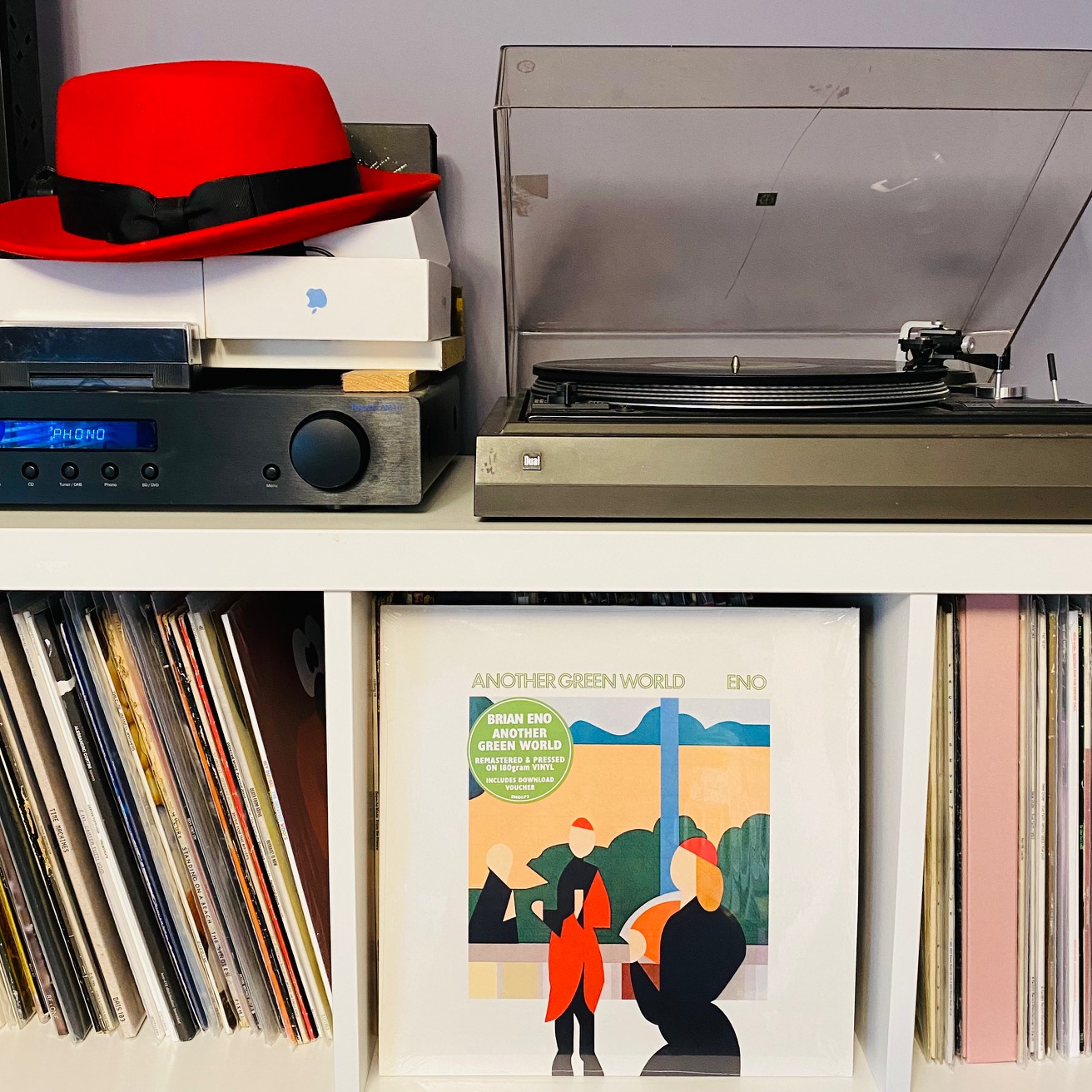
Another Green World on the turntable
What to say about this album? It's a classic, it's weirdly compelling, it dances over the line between engaging your attention and something you can have on in the background. Many of the tracks are quite short relative to the ideas they express: I imagine some remixer could have a lot of fun with it. The Big Ship is perhaps the standout, but I really like the title track, and opener Sky Saw too. It's probably the first album written using using the oblique strategies card system.
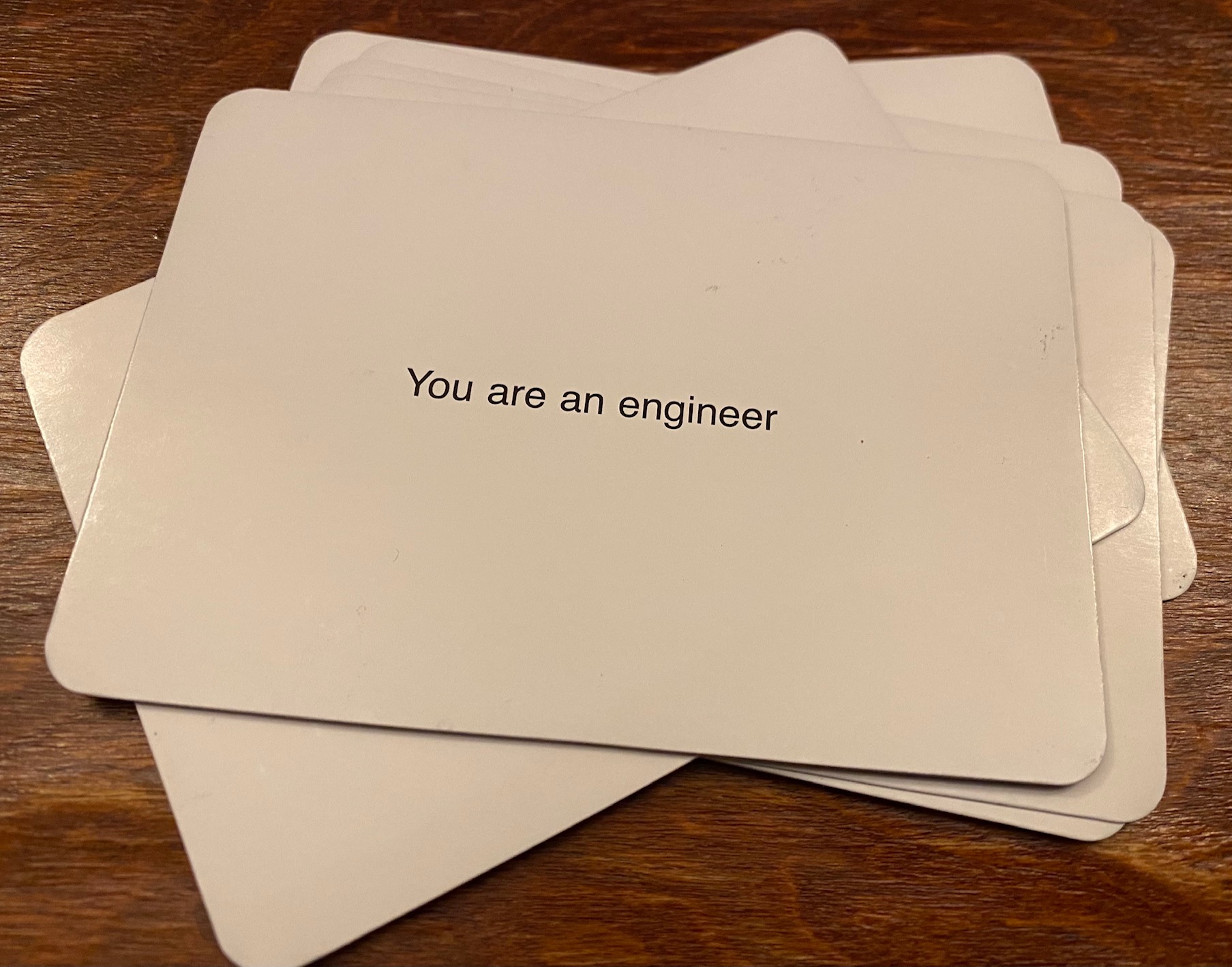
Card reading 'You are an Engineer'

12 April 2022

Sven Hoexter: Emulating Raspi2 like hardware with RaspiOS in 2022

Update of my notes from 2020.
# Download a binary device tree file and matching kernel a good soul uploaded to github
wget https://github.com/vfdev-5/qemu-rpi2-vexpress/raw/master/kernel-qemu-4.4.1-vexpress
wget https://github.com/vfdev-5/qemu-rpi2-vexpress/raw/master/vexpress-v2p-ca15-tc1.dtb
# Download the official Rasbian image without X
wget https://downloads.raspberrypi.org/raspios_lite_armhf/images/raspios_lite_armhf-2022-04-07/2022-04-04-raspios-bullseye-armhf-lite.img.xz
unxz 2022-04-04-raspios-bullseye-armhf-lite.img.xz
# Convert it from the raw image to a qcow2 image and add some space
qemu-img convert -f raw -O qcow2 2022-04-04-raspios-bullseye-armhf-lite.img rasbian.qcow2
qemu-img resize rasbian.qcow2 4G
# make sure we get a user account setup
echo "me:$(echo 'test123' openssl passwd -6 -stdin)" > userconf
sudo guestmount -a rasbian.qcow2 -m /dev/sda1 /mnt
sudo mv userconf /mnt
sudo guestunmount /mnt
# start qemu
qemu-system-arm -m 2048M -M vexpress-a15 -cpu cortex-a15 \
 -kernel kernel-qemu-4.4.1-vexpress -no-reboot \
 -smp 2 -serial stdio \
 -dtb vexpress-v2p-ca15-tc1.dtb -sd rasbian.qcow2 \
 -append "root=/dev/mmcblk0p2 rw rootfstype=ext4 console=ttyAMA0,15200 loglevel=8" \
 -nic user,hostfwd=tcp::5555-:22
# login at the serial console as user me with password test123
sudo -i
# enable ssh
systemctl enable ssh
systemctl start ssh
# resize partition and filesystem
parted /dev/mmcblk0 resizepart 2 100%
resize2fs /dev/mmcblk0p2
Now I can login via ssh and start to play:
ssh me@localhost -p 5555

11 April 2022

Paul Tagliamonte: k3xec.com/patty: Go bindings to patty

AX.25 is a tough protocol to use on UNIX systems. A lot of the support in Linux, specifically, is pretty hard to use, and tends to be built into the reptilian brain of the kernel. xan built a userland AX.25 stack called patty, for which I have now built some Go bindings on top of. Code needed to create AX.25 Sockets via Go can be found at github.com/k3xec/go-patty, and imported by Go source as k3xec.com/patty.
Overview Clint patty programs (including consumers of this Go library) work by communicating with a userland daemon (pattyd) via a UNIX named socket. That daemon will communicate with a particular radio using a KISS TNC serial device. The Go bindings implement as many standard Go library interfaces as is practical, allowing for the plug and play use of patty (and AX.25) in places where you would expect a network socket (such as TCP) to work, such as Go s http library.

Example
package main
import (
"fmt"
"log"
"net"
"os"
"time"
"k3xec.com/patty"
)
func main()  
callsign := "N0CALL-10"
client, err := patty.Open("patty.sock")
if err != nil  
panic(err)
 
l, err := client.Listen("ax25", callsign)
if err != nil  
panic(err)
 
for  
log.Printf("Listening for requests to %s", l.Addr())
conn, err := l.Accept()
if err != nil  
log.Printf("Error accepting: %s", err)
continue
 
go handle(conn)
 
 
func handle(c net.Conn) error  
defer c.Close()
log.Printf("New connection from %s (local: %s)", c.RemoteAddr(), c.LocalAddr())
fmt.Fprintf(c,  

Hello! This is Paul's experimental %s node. Feel free
to poke around. Let me know if you spot anything funny.

Five pings are to follow!

 , c.LocalAddr())
for i := 0; i < 5; i++  
time.Sleep(time.Second * 5)
fmt.Fprintf(c, "Ping!\n")
 
return nil
 

6 April 2022

Jonathan Dowland: Stanley Kubrick's A Clockwork Orange (Music From The Soundtrack)

I was reminded of this record over the weekend, as Radio 4's Front Row was discussing the 50th anniversary of Kubrick's movie. To me, the soundtrack has a strange, whimsical, almost cynical element to it (especially with the selection of things like Pomp and Circumstance), but I was familiar with the movie before the soundtrack and it might just be the association that triggers those feelings.
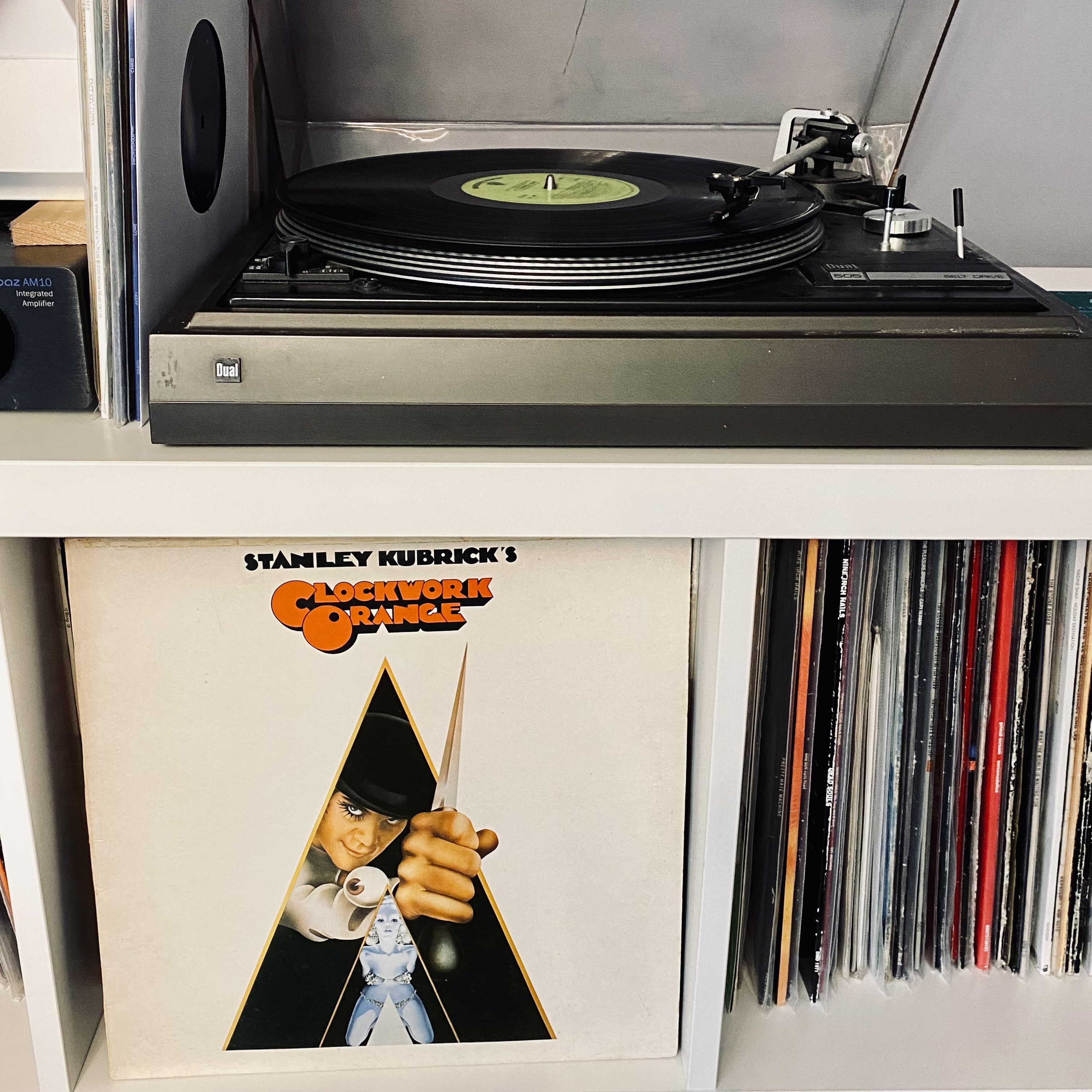
Picture of 'A Clockwork Orange' vinyl record playing on my turntable
I think I picked this up at Tynemouth Market when I lived close by, but I'm not sure. I am sure I didn't pay much for it. Mine is a UK re-pressing from 1971. The abridged (and sped-up) version of William Tell Overture is great for getting the kids to complete a task. Burgess's novel (now 60 years old) has been on my to-read pile for years. in 2018 Electronic Sound magazine featured a cover-mount CD "New Clockwork Music" of music inspired by this soundtrack: It's very good. I must dig that out

4 April 2022

Arturo Borrero Gonz lez: Wikimedia Toolforge and Grid Engine

Logos This post was originally published in the Wikimedia Tech blog, authored by Arturo Borrero Gonzalez. One of the most important and successful products provided by the Wikimedia Cloud Services team at the Wikimedia Foundation is Toolforge, a hosting service commonly known in the industry as Platform as a Service (PaaS). In particular, it is a platform that allows users and developers to run and use a variety of applications with the ultimate goal of helping the Wikimedia mission from the technical side. Toolforge is powered by two different backend engines, Kubernetes and Grid Engine. The two backends have traditionally offered different features for tool developers. But as time moves forward we ve learnt that Kubernetes is the future. Explaining why is the purpose of this blog post: we want to share more information and reasoning behind this mindset. There are a number of reasons that make Grid Engine poorly suitable to remain as execution backend in Toolforge: As mentioned above, our desire is to cover all our grid-like needs with Kubernetes, a technology which has several benefits: The relationship between Toolforge and Grid Engine has been interesting over the years. The grid has been used for quite a lot of time, we have plenty of documentation and established good practices. On the other hand, the grid is hard to maintain, imposes a heavy burden on the WMCS team and is a technology we must eventually discontinue. How to accommodate the two realities is a refreshing challenge, one that we hope to tackle together in the near future. A tradeoff exists here, but it is clear to us which option is best. So we will work on deprecating and removing Grid Engine and migrating use cases into Kubernetes. This deprecation, however, will be done with care, as we know our technical community relies on the grid for some import Toolforge tools. And some of these workflows will need some adaptation in order to be fully supported on Kubernetes. Stay tuned for more information on present and next works surrounding the Wikimedia Toolforge service. The next blog post will share more concrete details. This post was originally published in the Wikimedia Tech blog, authored by Arturo Borrero Gonzalez.

1 April 2022

Junichi Uekawa: I am more used to Rust.

I am more used to Rust. I can do simple string processing faster in Rust than say Python. It has enough things to make it more pleasant to work with than C++.

Russ Allbery: Review: Princess Floralinda and the Forty-Flight Tower

Review: Princess Floralinda and the Forty-Flight Tower, by Tamsyn Muir
Publisher: Subterranean Press
Copyright: 2020
ISBN: 1-59606-992-9
Format: Kindle
Pages: 111
A witch put Princess Floralinda at the top of a forty-flight tower, but it wasn't personal. This is just what witches do, particularly with princesses with butter-coloured curls and sapphire-blue eyes. Princes would come from miles around to battle up the floors of the tower and rescue the princess. The witch even helpfully provided a golden sword, in case a prince didn't care that much about princesses. Floralinda was provided with water and milk, two loaves of bread, and an orange, all of them magically renewing, to sustain her while she waited. In retrospect, the dragon with diamond-encrusted scales on the first floor may have been a mistake. None of the princely endeavors ever saw the second floor. The diary that Floralinda found in her room indicated that she may not be the first princess to have failed to be rescued from this tower. Floralinda finally reaches the rather astonishing conclusion that she might have to venture down the tower herself, despite the goblins she was warned were on the 39th floor (not to mention all the other monsters). The result of that short adventure, after some fast thinking, a great deal of luck, and an unforeseen assist from her magical food, is a surprising number of dead goblins. Also seriously infected hand wounds, because it wouldn't be a Tamsyn Muir story without wasting illness and body horror. That probably would have been the end of Floralinda, except a storm blew a bottom-of-the-garden fairy in through the window, sufficiently injured that she and Floralinda were stuck with each other, at least temporarily. Cobweb, the fairy, is neither kind nor inclined to help Floralinda (particularly given that Floralinda is not a child whose mother is currently in hospital), but it is an amateur chemist and finds both Floralinda's tears and magical food intriguing. Cobweb's magic is also based on wishes, and after a few failed attempts, Floralinda manages to make a wish that takes hold. Whether she'll regret the results is another question. This is a fairly short novella by the same author as Gideon the Ninth, but it's in a different universe and quite different in tone. This summary doesn't capture the writing style, which is a hard-to-describe mix of fairy tale, children's story, and slightly archaic and long-winded sentence construction. This is probably easier to show with a quote:
"You are displaying a very small-minded attitude," said the fairy, who seemed genuinely grieved by this. "Consider the orange-peel, which by itself has many very nice properties. Now, if you had a more educated brain (I cannot consider myself educated; I have only attempted to better my situation) you would have immediately said, 'Why, if I had some liquor, or even very hot water, I could extract some oil from this orange-peel, which as everyone knows is antibacterial; that may well do my hands some good,' and you wouldn't be in such a stupid predicament."
On balance, I think this style worked. It occasionally annoyed me, but it has some charm. About halfway through, I was finding the story lightly entertaining, although I would have preferred a bit less grime, illness, and physical injury. Unfortunately, the rest of the story didn't work for me. The dynamic between Floralinda and Cobweb turns into a sort of D&D progression through monster fights, and while there are some creative twists to those fights, they become all of a sameness. And while I won't spoil the ending, it didn't work for me. I think I see what Muir was trying to do, and I have some intellectual appreciation for the idea, but it wasn't emotionally satisfying. I think my root problem with this story is that Muir sets up a rather interesting world, one in which witches artistically imprison princesses, and particularly bright princesses (with the help of amateur chemist fairies) can use the trappings of a magical tower in ways the witch never intended. I liked that; it has a lot of potential. But I didn't feel like that potential went anywhere satisfying. There is some relationship and characterization work, and it reached some resolution, but it didn't go as far as I wanted. And, most significantly, I found the end point the characters reached in relation to the world to be deeply unsatisfying and vaguely irritating. I wanted to like this more than I did. I think there's a story idea in here that I would have enjoyed more. Unfortunately, it's not the one that Muir wrote, and since so much of my problem is with the ending, I can't provide much guidance on whether someone else would like this story better (and why). But if the idea of taking apart a fairy-tale tower and repurposing the pieces sounds appealing, and if you get along better with Muir's illness motif than I do, you may enjoy this more than I did. Rating: 5 out of 10

Antoine Beaupr : Salvaged my first Debian package

I finally salvaged my first Debian package, python-invoke. As part of ITS 964718, I moved the package from the Openstack Team to the Python team. The Python team might not be super happy with it, because it's breaking some of its rules, but at least someone (ie. me) is actively working (and using) the package.

Wait what People not familiar with Debian will not understand anything in that first paragraph, so let me expand. Know-it-all Debian developers (you know who you are) can skip to the next section. Traditionally, the Debian project (my Linux-based operating system of choice) has prided itself on the self-managed, anarchistic organisation of its packaging. Each package maintainer is the lord of their little kingdom. Some maintainers like to accumulate lots of kingdoms to rule over. (Yes, it really doesn't sound like anarchism when you put it like that. Yes, it's complicated: there's a constitution and voting involved. And yes, we're old.) Therefore, it's really hard to make package maintainers do something they don't want. Typically, when things go south, someone makes a complaint to the Debian Technical Committee (CTTE) which is established by the Debian constitution to resolve such conflicts. The committee is appointed by the Debian Project leader, elected each year (and there's an election coming up if you haven't heard). Typically, the CTTE will then vote and formulate a decision. But here's the trick: maintainers are still free to do whatever they want after that, in a sense. It's not like the CTTE can just break down doors and force maintainers to type code. (I won't go into the details of the why of that, but it involves legal issues and, I think, something about the Turing halting problem. Or something like that.) Anyways. The point is all that is super heavy and no one wants to go there... (Know-it-all Debian developers, I know you are still reading this anyways and disagree with that statement, but please, please, make it true.) ... but sometimes, packages just get lost. Maintainers get distracted, or busy with something else. It's not that they want to abandon their packages. They love their little fiefdoms. It's just there was a famine or a war or something and everyone died, and they have better things to do than put up fences or whatever. So clever people in Debian found a better way of handling such problems than waging war in the poor old CTTE's backyard. It's called the Package Salvaging process. Through that process, a maintainer can propose to take over an existing package from another maintainer, if a certain set of condition are met and a specific process is followed. Normally, taking over another maintainer's package is basically a war declaration, rarely seen in the history of Debian (yes, I do think it happened!), as rowdy as ours is. But through this process, it seems we have found a fair way of going forward. The process is basically like this:
  1. file a bug proposing the change
  2. wait three weeks
  3. upload a package making the change, with another week delay
  4. you now have one more package to worry about
Easy right? It actually is! Process! It's magic! It will cure your babies and resurrect your cat!

So how did that go? It went well! The old maintainer was actually fine with the change because his team wasn't using the package anymore anyways. He asked to be kept as an uploader, which I was glad to oblige. (He replied a few months after the deadline, but I wasn't in a rush anyways, so that doesn't matter. It was polite for him to answer, even if, technically, I was already allowed to take it over.) What happened next is less shiny for me though. I totally forgot about the ITS, even after the maintainer reminded me of its existence. See, the thing is the ITS doesn't show up on my dashboard at all. So I totally forgot about it (yes, twice). In fact, the only reason I remembered it was that got into the process of formulating another ITS (1008753, trocla) and I was trying to figure out how to write the email. Then I remembered: "hey wait, I think I did this before!" followed by "oops, yes, I totally did this before and forgot for 9 months". So, not great. Also, the package is still not in a perfect shape. I was able to upload the upstream version that was pending 1.5.0 to clear out the ITS, basically. And then there's already two new upstream releases to upload, so I pushed 1.7.0 to experimental as well, for good measure. Unfortunately, I still can't enable tests because everything is on fire, as usual. But at least my kingdom is growing.

Appendix Just in case someone didn't notice the hyperbole, I'm not a monarchist promoting feudalism as a practice to manage a community. I do not intend to really "grow my kingdom" and I think the culture around "property" of "packages" is kind of absurd in Debian. I kind of wish it would go away. (Update: It has also been pointed out that I might have made Debian seem more confrontational than it actually is. And it's kind of true: most work and interactions in Debian actually go fine, it's only a minority of issues that degenerate into conflicts. It's just that they tend to take up a lot of space in the community, and I find that particularly draining. And I think think our "package ownership" culture is part of at least some of those problems.) Team maintenance, the LowNMU process, and low threshold adoption processes are all steps in the good direction, but they are all opt in. At least the package salvaging process is someone a little more ... uh... coercive? Or at least it allows the community to step in and do the right thing, in a sense. We'll see what happens with the coming wars around the recent tech committee decision, which are bound to touch on that topic. (Hint: our next drama is called "usrmerge".) Hopefully, LWN will make a brilliant article to sum it up for us so that I don't have to go through the inevitable debian-devel flamewar to figure it out. I already wrecked havoc on the #debian-devel IRC channel asking newbie questions so I won't stir that mud any further for now. (Update: LWN, of course, did make an article about usrmerge in Debian. I will read it soon and can then tell you know if it's brilliant, but they are typically spot on.)

Paul Wise: FLOSS Activities March 2022

Focus This month I didn't have any particular focus. I just worked on issues in my info bubble.

Changes

Issues

Review
  • Spam: reported 3 Debian bug reports and 53 Debian mailing list posts
  • Debian wiki: RecentChanges for the month
  • Debian BTS usertags: changes for the month
  • Debian screenshots:

Administration
  • Debian servers: investigate wiki mail delivery issue, restart backup director
  • Debian wiki: unblock IP addresses, approve accounts

Communication
  • Forward python-plac test failure issue upstream
  • Participate in Debian Project Leader election discussions
  • Respond to queries from Debian users and contributors on the mailing lists and IRC

Sponsors The oci-python-sdk and plac work was sponsored. All other work was done on a volunteer basis.

31 March 2022

Matthew Garrett: ZTA doesn't solve all problems, but partial implementations solve fewer

Traditional network access controls work by assuming that something is trustworthy based on some other factor - for example, if a computer is on your office network, it's trustworthy because only trustworthy people should be able to gain physical access to plug something in. If you restrict access to your services to requests coming from trusted networks, then you can assert that it's coming from a trusted device.

Of course, this isn't necessarily true. A machine on your office network may be compromised. An attacker may obtain valid VPN credentials. Someone could leave a hostile device plugged in under a desk in a meeting room. Trust is being placed in devices that may not be trustworthy.

A Zero Trust Architecture (ZTA) is one where a device is granted no inherent trust. Instead, each access to a service is validated against some policy - if the policy is satisfied, the access is permitted. A typical implementation involves granting each device some sort of cryptographic identity (typically a TLS client certificate) and placing the protected services behind a proxy. The proxy verifies the device identity, queries another service to obtain the current device state (we'll come back to that in a moment), compares the state against a policy and either pass the request through to the service or reject it. Different services can have different policies (eg, you probably want a lax policy around whatever's hosting the documentation for how to fix your system if it's being refused access to something for being in the wrong state), and if you want you can also tie it to proof of user identity in some way.

From a user perspective, this is entirely transparent. The proxy is made available on the public internet, DNS for the services points to the proxy, and every time your users try to access the service they hit the proxy instead and (if everything's ok) gain access to it no matter which network they're on. There's no need to connect to a VPN first, and there's no worries about accidentally leaking information over the public internet instead of over a secure link.

It's also notable that traditional solutions tend to be all-or-nothing. If I have some services that are more sensitive than others, the only way I can really enforce this is by having multiple different VPNs and only granting access to sensitive services from specific VPNs. This obviously risks combinatorial explosion once I have more than a couple of policies, and it's a terrible user experience.

Overall, ZTA approaches provide more security and an improved user experience. So why are we still using VPNs? Primarily because this is all extremely difficult. Let's take a look at an extremely recent scenario. A device used by customer support technicians was compromised. The vendor in question has a solution that can tie authentication decisions to whether or not a device has a cryptographic identity. If this was in use, and if the cryptographic identity was tied to the device hardware (eg, by being generated in a TPM), the attacker would not simply be able to obtain the user credentials and log in from their own device. This is good - if the attacker wanted to maintain access to the service, they needed to stay on the device in question. This increases the probability of the monitoring tooling on the compromised device noticing them.

Unfortunately, the attacker simply disabled the monitoring tooling on the compromised device. If device state was being verified on each access then this would be noticed before too long - the last data received from the device would be flagged as too old, and the requests would no longer satisfy any reasonable access control policy. Instead, the device was assumed to be trustworthy simply because it could demonstrate its identity. There's an important point here: just because a device belongs to you doesn't mean it's a trustworthy device.

So, if ZTA approaches are so powerful and user-friendly, why aren't we all using one? There's a few problems, but the single biggest is that there's no standardised way to verify device state in any meaningful way. Remote Attestation can both prove device identity and the device boot state, but the only product on the market that does much with this is Microsoft's Device Health Attestation. DHA doesn't solve the broader problem of also reporting runtime state - it may be able to verify that endpoint monitoring was launched, but it doesn't make assertions about whether it's still running. Right now, people are left trying to scrape this information from whatever tooling they're running. The absence of any standardised approach to this problem means anyone who wants to deploy a strong ZTA has to integrate with whatever tooling they're already running, and that then increases the cost of migrating to any other tooling later.

But even device identity is hard! Knowing whether a machine should be given a certificate or not depends on knowing whether or not you own it, and inventory control is a surprisingly difficult problem in a lot of environments. It's not even just a matter of whether a machine should be given a certificate in the first place - if a machine is reported as lost or stolen, its trust should be revoked. Your inventory system needs to tie into your device state store in order to ensure that your proxies drop access.

And, worse, all of this depends on you being able to put stuff behind a proxy in the first place! If you're using third-party hosted services, that's a problem. In the absence of a proxy, trust decisions are probably made at login time. It's possible to tie user auth decisions to device identity and state (eg, a self-hosted SAML endpoint could do that before passing through to the actual ID provider), but that's still going to end up providing a bearer token of some sort that can potentially be exfiltrated, and will continue to be trusted even if the device state becomes invalid.

ZTA doesn't solve all problems, and there isn't a clear path to it doing so without significantly greater industry support. But a complete ZTA solution is significantly more powerful than a partial one. Verifying device identity is a step on the path to ZTA, but in the absence of device state verification it's only a step.

comment count unavailable comments

Russell Coker: AMT/MEBX on Debian

I ve just been playing with Intel s Active Management Technology (AMT) [1] which is also known as Management Engine Bios Extension (MEBX). Firstly a disclaimer, using this sort of technology gives remote access to your system at a level that allows in some ways overriding the OS. If this gets broken then you have big problems. Also all the code that matters is non-free. Please don t comment on this post saying that AMT is bad, take it as known that it has issues and that people are forced to use it anyway. I tested this out on a HP Z420 workstation. The first thing it to enable AMT via Intel MEBX , the default password is admin . On first use you are compelled to set a new password which must be 8+ characters containing upper and lower case, number, and punctuation characters. The Debian package amtterm (which needs the package libsoap-lite-perl ) has basic utilities for AMT. The amttool program connects to TCP port 16992 and the amtterm program connects to TCP port 16994. Note that these programs seem a little rough, you can get Perl errors (as opposed to deliberate help messages) if you enter bad command-line parameters. They basically work but could do with some improvement. If you use DHCP for the IP address the DHCP hostname will be DESKTOP-$AssetID and you can find the IP address by requesting an alert be sent to the sysadmin. Here are some examples of amttool usage:
# get AMT info
AMT_PASSWORD="$PASS" amttool $IP
# reset the system and redirect BIOS messages to serial over lan
AMT_PASSWORD="$PASS" amttool reset bios
# access serial over lan console
amtterm -p "$PASS" $IP
The following APT configuration enables the Ubuntu package wsmancli which had some features not in any Debian packages last time I checked.
deb http://us.archive.ubuntu.com/ubuntu/ bionic-updates universe
deb http://us.archive.ubuntu.com/ubuntu/ bionic universe
This Cyberciti article has information on accessing KVM over AMT [2], I haven t tried to do that yet.

30 March 2022

Ulrike Uhlig: How do kids conceive the internet?

I wanted to understand how kids between 10 and 18 conceive the internet. Surely, we have seen a generation that we call digital natives grow up with the internet. Now, there is a younger generation who grows up with pervasive technology, such as smartphones, smart watches, virtual assistants and so on. And only a few of them have parents who work in IT or engineering
Pervasive technology contributes to the idea that the internet is immaterial With their search engine website design, Google has put in place an extremely simple and straightforward user interface. Since then, designers and psychologists have worked on making user interfaces more and more intuitive to use. The buzzwords are usability and user experience design . Besides this optimization of visual interfaces, haptic interfaces have evolved as well, specifically on smartphones and tablets where hand gestures have replaced more clumsy external haptic interfaces such as a mouse. And beyond interfaces, the devices themselves have become smaller and slicker. While in our generation many people have experienced opening a computer tower or a laptop to replace parts, with the side effect of seeing the parts the device is physically composed of, the new generation of end user devices makes this close to impossible, essentially transforming these devices into black boxes, and further contributing to the idea that the internet they are being used to access with would be something entirely intangible.

What do kids in 2022 really know about the internet? So, what do kids of that generation really know about the internet, beyond purely using services they do not control? In order to find out, I decided to interview children between 10 and 18. I conducted 5 interviews with kids aged 9, 10, 12, 15 and 17, two boys and three girls. Two live in rural Germany, one in a German urban area, and two live in the French capital. I wrote the questions in a way to stimulate the interviewees to tell me a story each time. I also told them that the interview is not a test and that there are no wrong answers. Except for the 9 year old, all interviewees possessed both, their own smartphone and their own laptop. All of them used the internet mostly for chatting, entertainment (video and music streaming, online games), social media (TikTok, Instagram, Youtube), and instant messaging. Let me introduce you to their concepts of the internet. That was my first story telling question to them:

If aliens had landed on Earth and would ask you what the internet is, what would you explain to them? The majority of respondents agreed in their replies that the internet is intangible while still being a place where one can do anything and everything . Before I tell you more about their detailed answers to the above question, let me show you how they visualize their internet.

If you had to make a drawing to explain to a person what the internet is, how would this drawing look like? Each interviewee had some minutes to come up with a drawing. As you will see, that drawing corresponds to what the kids would want an alien to know about the internet and how they are using the internet themselves.

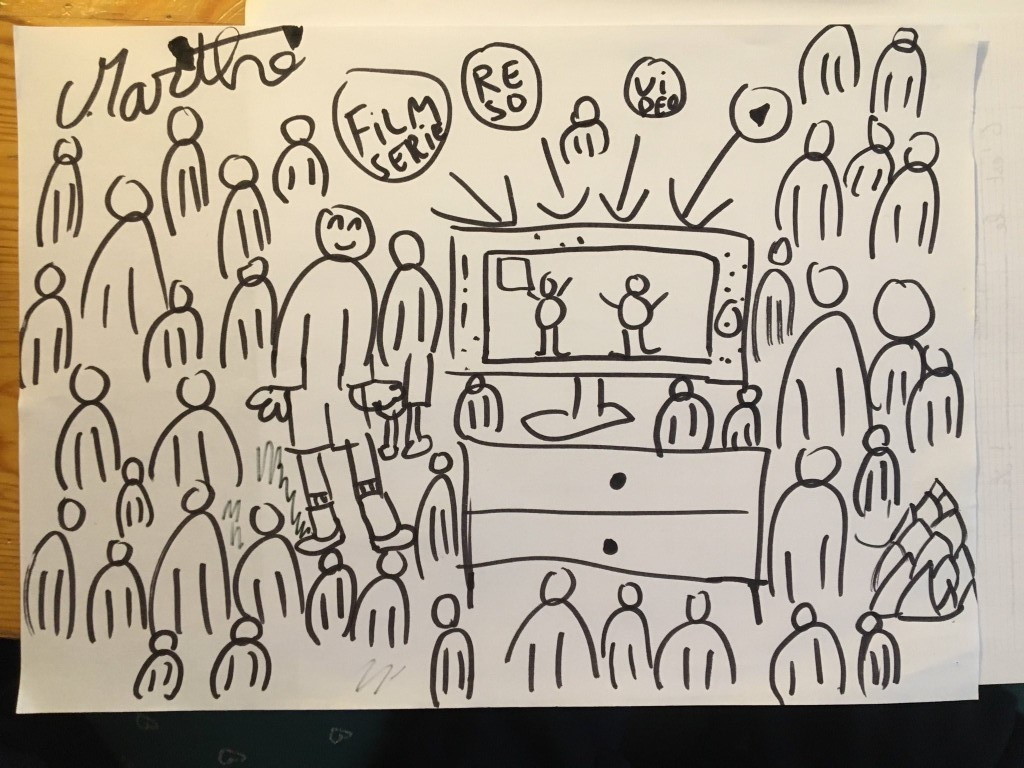
Movies, series, videos A child's drawing. In the middle, there is a screen, on the screen a movie is running. Around the screen there are many people, at least two dozens. The words 'film', 'series', 'network', 'video' are written and arrows point from these words to the screen. There's also a play icon. The youngest respondent, a 9 year old girl, drew a screen with lots of people around it and the words film, series, network, video , as well as a play icon. She said that she mostly uses the internet to watch movies. She was the only one who used a shared tablet and smartphone that belonged to her family, not to herself. And she would explain the net like this to an alien:
"Internet is a er one cannot touch it it s an, er [I propose the word idea ], yes it s an idea. Many people use it not necessarily to watch things, but also to read things or do other stuff."

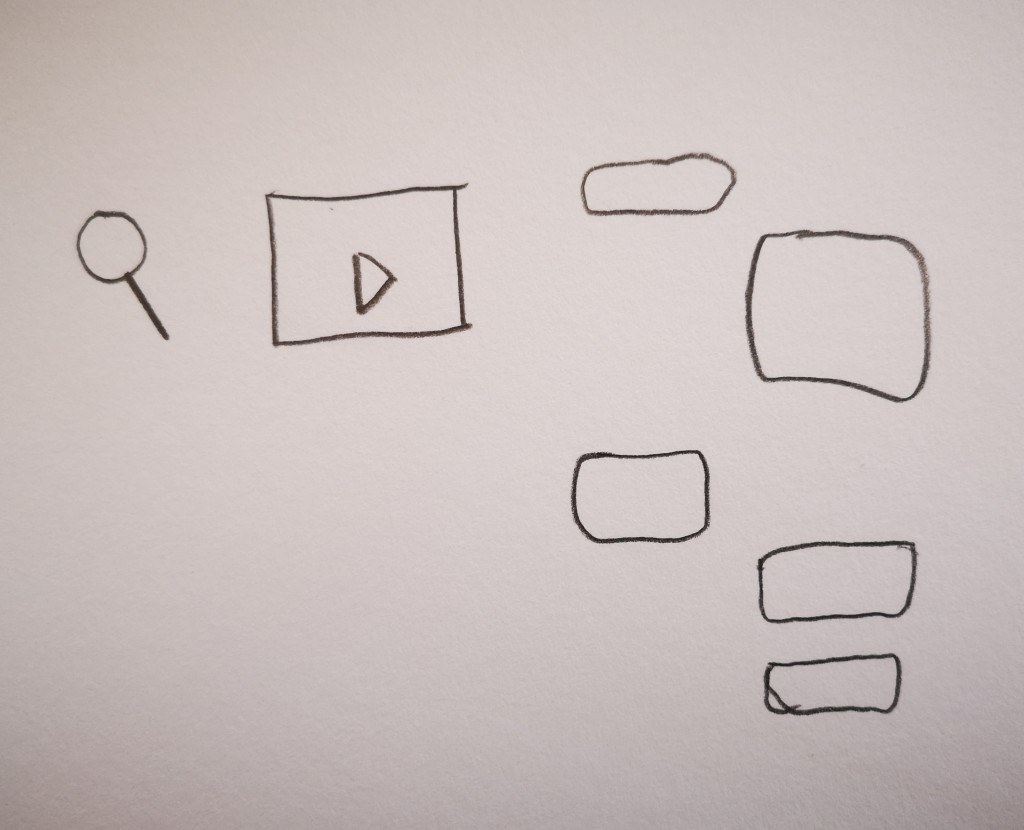
User interface elements There is a magnifying glass icon, a play icon and speech bubbles drawn with a pencil. A 10 year old boy represented the internet by recalling user interface elements he sees every day in his drawing: a magnifying glass (search engine), a play icon (video streaming), speech bubbles (instant messaging). He would explain the internet like this to an alien:
"You can use the internet to learn things or get information, listen to music, watch movies, and chat with friends. You can do nearly anything with it."

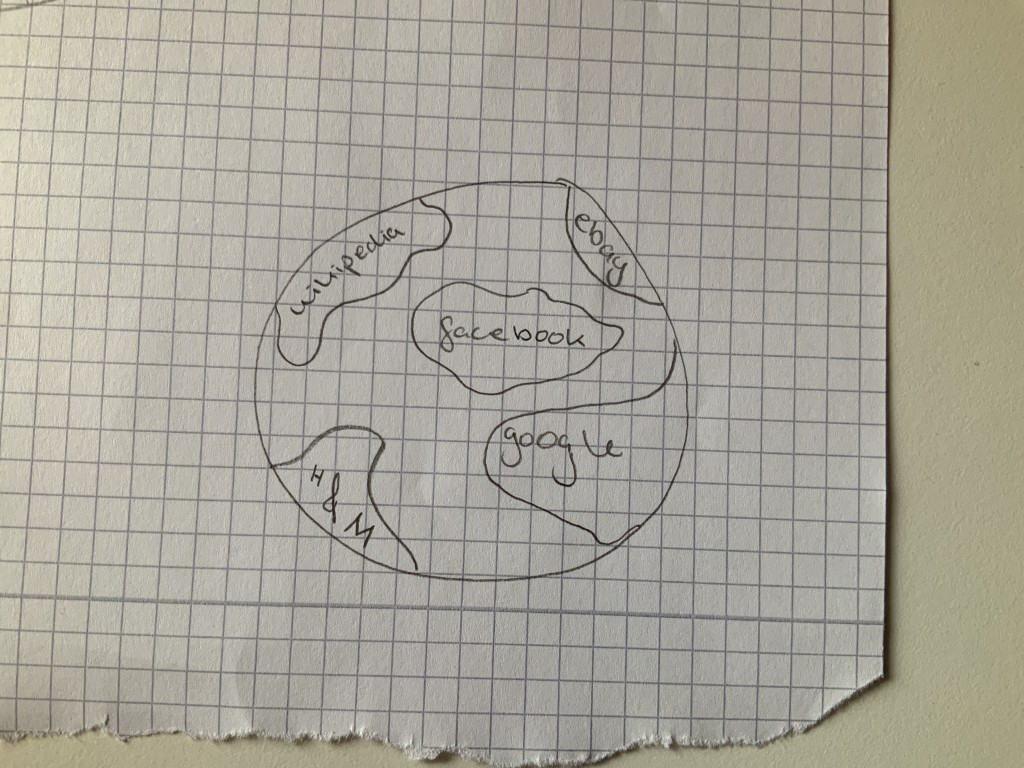
Another planet Pencil drawing that shows a planet with continents. The continents are named: H&M, Ebay, Google, Wikipedia, Facebook. A 12 year old girl imagines the internet like a second, intangible, planet where Google, Wikipedia, Facebook, Ebay, or H&M are continents that one enters into.
"And on [the] Ebay [continent] there s a country for clothes, and ,trousers , for example, would be a federal state in that country."
Something that was unique about this interview was that she told me she had an email address but she never writes emails. She only has an email account to receive confirmation emails, for example when doing online shopping, or when registering to a service and needing to confirm one s address. This is interesting because it s an anti-spam measure that might become outdated with a generation that uses email less or not at all.

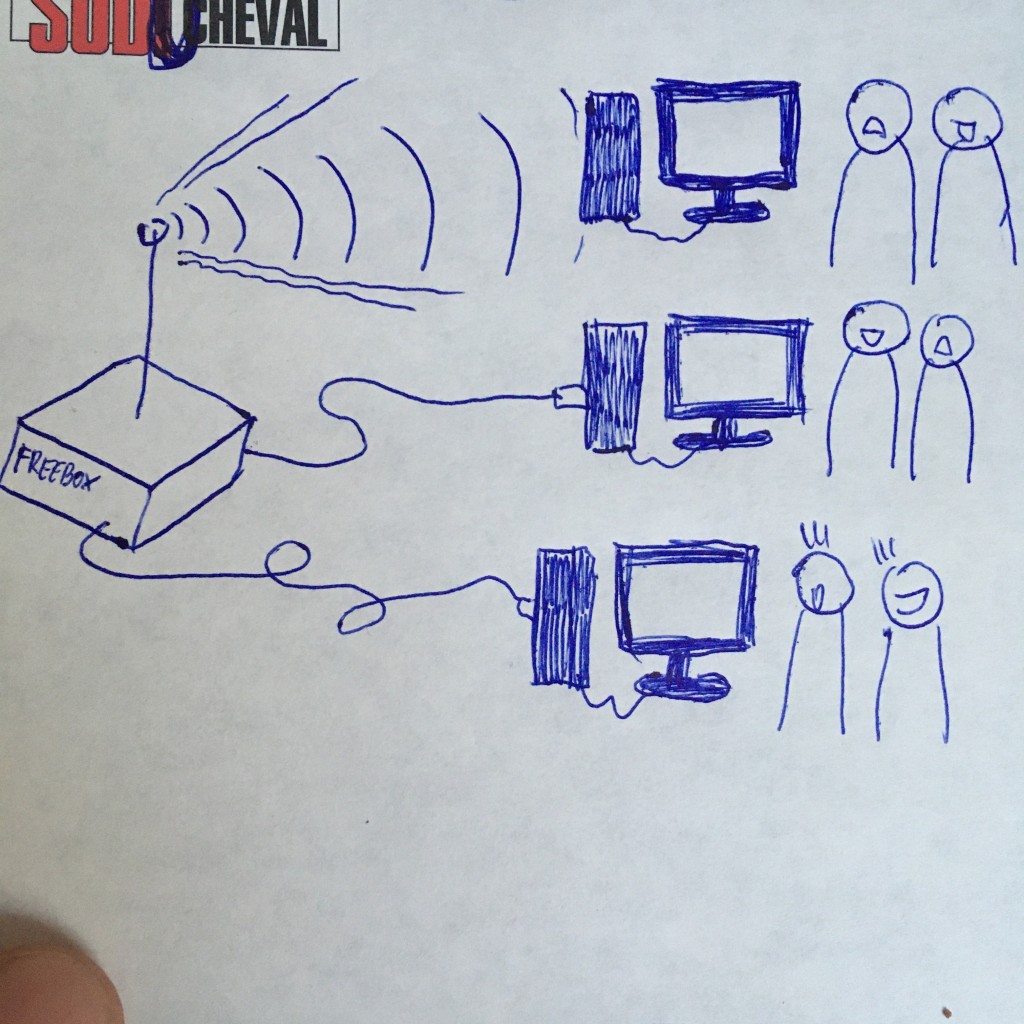
Home network Kid's drawing: there are three computer towers and next to each there are two people. The first couple is sad, the seconf couple is smiling, the last one is suprised. Each computer is connected to a router, two of them by cable, one by wifi. A 15 year old boy knew that his family s devices are connected to a home router (Freebox is a router from the French ISP Free) but lacked an imagination of the rest of the internet s functioning. When I asked him about what would be behind the router, on the other side, he said what s behind is like a black hole to him. However, he was the only interviewee who did actually draw cables, wifi waves, a router, and the local network. His drawing is even extremely precise, it just lacks the cable connecting the router to the rest of the internet.
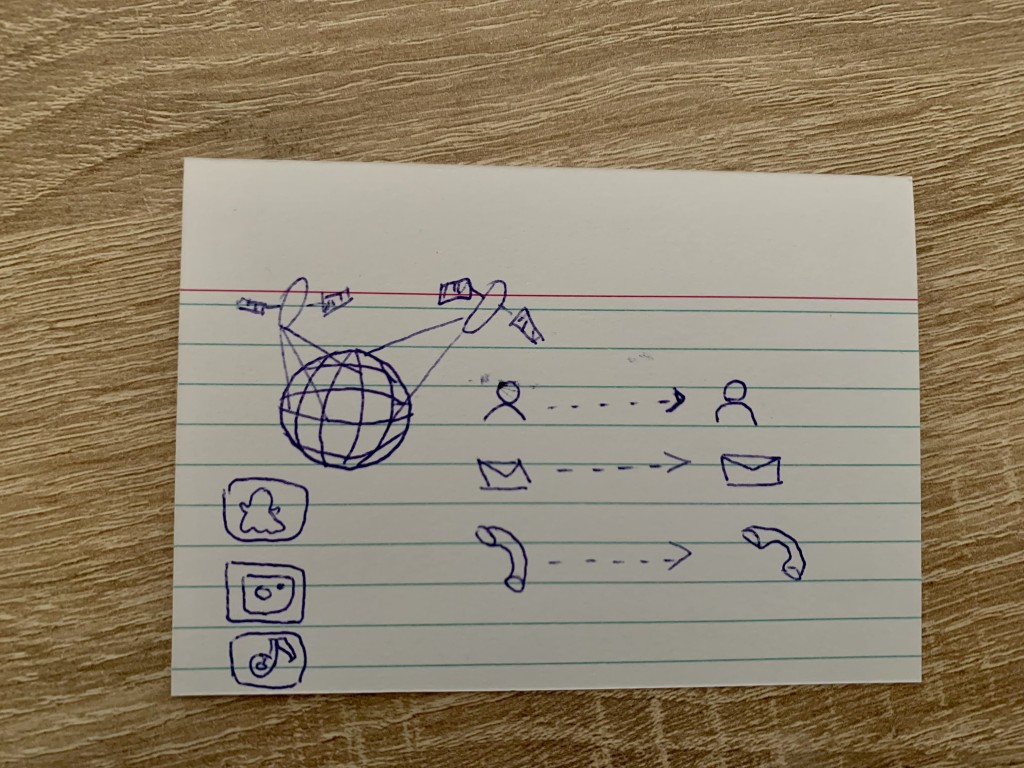
Satellite internet This is another very simple drawing: On top left, there's planet Earth an there are lines indicating that earth is a sphere. Around Earth there are two big satellites reaching most of Earth. on the left, below, there are three icons representing social media services on the internet: Snapchat, Instagram, TikTok. On the right, there are simplified drawings of possibilities which the internet offers: person to person connection, email (represented by envelopes), calls (represented by an old-style telephone set). A 17 year old girl would explain the internet to an alien as follows:
"The internet goes around the entire globe. One is networked with everyone else on Earth. One can find everything. But one cannot touch the internet. It s like a parallel world. With a device one can look into the internet. With search engines, one can find anything in the world, one can phone around the world, and write messages. [The internet] is a gigantic thing."
This interviewee stated as the only one that the internet is huge. And while she also is the only one who drew the internet as actually having some kind of physical extension beyond her own home, she seems to believe that internet connectivity is based on satellite technology and wireless communication.

Imagine that a wise and friendly dragon could teach you one thing about the internet that you ve always wanted to know. What would you ask the dragon to teach you about? A 10 year old boy said he d like to know how big are the servers behind all of this . That s the only interview in which the word server came up. A 12 year old girl said I would ask how to earn money with the internet. I always wanted to know how this works, and where the money comes from. I love the last part of her question! The 15 year old boy for whom everything behind the home router is out of his event horizon would ask How is it possible to be connected like we are? How does the internet work scientifically? A 17 year old girl said she d like to learn how the darknet works, what hidden things are there? Is it possible to get spied on via the internet? Would it be technically possible to influence devices in a way that one can listen to secret or telecommanded devices? Lastly, I wanted to learn about what they find annoying, or problematic about the internet.

Imagine you could make the internet better for everyone. What would you do first? Asked what she would change if she could, the 9 year old girl advocated for a global usage limit of the internet in order to protect the human brain. Also, she said, her parents spend way too much time on their phones and people should rather spend more time with their children. Three of the interviewees agreed that they see way too many advertisements and two of them would like ads to disappear entirely from the web. The other one said that she doesn t want to see ads, but that ads are fine if she can at least click them away. The 15 year old boy had different ambitions. He told me he would change:
"the age of access to the internet. More and more younger people access the internet ; especially with TikTok there is a recommendation algorithm that can influcence young people a lot. And influencing young people should be avoided but the internet does it too much. And that can be negative. If you don t yet have a critical spirit, and you watch certain videos you cannot yet moderate your stance. It can influence you a lot. There are so many things that have become indispensable and that happen on the internet and we have become dependent. What happens if one day it doesn t work anymore? If we connect more and more things to the net, that s not a good thing."

The internet - Oh, that s what you mean! On a sidenote, my first interview tentative was with an 8 year old girl from my family. I asked her if she uses the internet and she denied, so I abandoned interviewing her. Some days later, while talking to her, she proposed to look something up on Google, using her smartphone. I said: Oh, so you are using the internet! She replied: Oh, that s what you re talking about? I think she knows the word Google and she knows that she can search for information with this Google thing. But it appeared that she doesn t know that the Google search engine is located somewhere else on internet and not on her smartphone. I concluded that for her, using the services on the smartphone is as natural as switching on a light in the house: we also don t think about where the electricity comes from when we do that.

What can we learn from these few interviews? Unsurprisingly, social media, streaming, entertainment, and instant messaging are the main activities kids undertake on the internet. They are completely at the mercy of advertisements in apps and on websites, not knowing how to get rid of them. They interact on a daily basis with algorithms that are unregulated and known to perpetuate discrimination and to create filter bubbles, without necessarily being aware of it. The kids I interviewed act as mere service users and seem to be mostly confined to specific apps or websites. All of them perceived the internet as being something intangible. Only the older interviewees perceived that there must be some kind of physical expansion to it: the 17 year old girl by drawing a network of satellites around the globe, the 15 year old boy by drawing the local network in his home. To be continued

28 March 2022

Russell Coker: Hangouts Replacement

Google is currently in the process of killing Hangouts. Last year Hangouts was quite a nice IM system with integrated video chat and voice calling. Now they have decided to kill it and replace it with Google Chat and Google Meet both of which are integrated with the Gmail app on Android. To start getting people off the old platform they have disabled video and audio chats with more than 2 people in Hangouts. To do a video call you have to use Meet which has a worse user interface and isn t integrated with text chat, so if in a text discussion someone says let s have a video call you have to open a new app. Meet also doesn t appear to have a facility to notify group members that someone has joined a group call so it s required that Chat (or something else) is used to tell people they can join Meet. Many of my relatives use Hangouts because they are forced to have it installed on their Android phones and because it worked quite well. Now it doesn t work well and will soon be going away. So another option is needed. I m considering Matrix as a replacement. Matrix has a good feature set and is being worked on a lot. The video conferencing is through a connection to a Jitsi server and is well integrated giving functionality more like Hangouts than Chat/Meet. For the LUV Matrix server the URL https://luv.asn.au/.well-known/matrix/client has the following contents:
 
  "m.homeserver":  
    "base_url": "https://luv.asn.au"
   
  "jitsi":  
    "preferredDomain": "jitsi.perthchat.org"
   
  "im.vector.riot.jitsi":  
    "preferredDomain": "jitsi.perthchat.org"
   
 
This specifies the Jitsi server to be used for chats started from that Matrix server. The PerthChat.org people seem to be leading the way for self hosted Matrix in Australia. Note that other people shouldn t link to their Jitsi server without discussing it with them first. I only included real data because it s published on the web so there s no point in keeping it secret. The Flounder free software users group [1] uses Matrix a lot. We will probably discuss Matrix at the next meeting on Saturday. There is also Element Call [2] which is apparently more integrated with Matrix (and also newer and possibly buggier). Jitsi works and we can change to a different service easily enough at a later time.

27 March 2022

Russ Allbery: Review: A Song for a New Day

Review: A Song for a New Day, by Sarah Pinsker
Publisher: Berkley
Copyright: September 2019
ISBN: 1-9848-0259-3
Format: Kindle
Pages: 372
Luce Cannon was touring with a session band when the shutdown began. First came the hotel evacuation in the middle of the night due to bomb threats against every hotel in the state. Then came the stadium bombing just before they were ready to go on stage. Luce and most of the band performed anyway, with a volunteer crew and a shaken crowd. It was, people later decided, the last large stage show in the United States before the congregation laws shut down public gatherings. That was the end of Luce's expected career, and could have been the end of music, or at least public music. But Luce was stubborn and needed the music. Rosemary grew up in the aftermath: living at home with her parents well away from other people, attending school virtually, and then moving seamlessly into a virtual job for Superwally, the corporation that ran essentially everything. A good fix for some last-minute technical problems with StageHoloLive's ticketing system got her an upgraded VR hoodie and complimentary tickets to the first virtual concert she'd ever attended. She found the experience astonishing, prompting her to browse StageHoloLive job openings and then apply for a technical job and, on a whim, an artist recruiter role. That's how Rosemary found herself, quite nerve-wrackingly, traveling out into the unsafe world to look for underground musicians who could become StageHoloLive acts. A Song for a New Day was published in 2019 and had a moment of fame at the beginning of 2020, culminating in the Nebula Award for best novel, because it's about lockdowns, isolation, and the suppression of public performances. There's even a pandemic, although it's not a respiratory disease (it's some variety of smallpox or chicken pox) and is only a minor contributing factor to the lockdowns in this book. The primary impetus is random violence. Unfortunately, the subsequent two years have not been kind to this novel. Reading it in 2022, with the experience of the past two years fresh in my mind, was a frustrating and exasperating experience because the world setting is completely unbelievable. This is not entirely Pinsker's fault; this book was published in 2019, was not intended to be about our pandemic, and therefore could not reasonably predict its consequences. Still, it required significant effort to extract the premise of the book from the contradictory evidence of current affairs and salvage the pieces of it I still enjoyed. First, Pinsker's characters are the most astonishingly incurious and docile group of people I've seen in a recent political SF novel. This extends beyond the protagonists, where it could arguably be part of their characterization, to encompass the entire world (or at least the United States; the rest of the world does not appear in this book at all so far as I can recall). You may be wondering why someone bombs a stadium at the start of the book. If so, you are alone; this is not something anyone else sees any reason to be curious about. Why is random violence spiraling out of control? Is there some coordinated terrorist activity? Is there some social condition that has gotten markedly worse? Race riots? Climate crises? Wars? The only answer this book offers is a completely apathetic shrug. There is a hint at one point that the government may have theories that they're not communicating, but no one cares about that either. That leads to the second bizarre gap: for a book that hinges on political action, formal political structures are weirdly absent. Near the end of the book, one random person says that they have been inspired to run for office, which so far as I can tell is the first mention of elections in the entire book. The "government" passes congregation laws shutting down public gatherings and there are no protests, no arguments, no debate, but also no suppression, no laws against the press or free speech, no attempt to stop that debate. There's no attempt to build consensus for or against the laws, and no noticeable political campaigning. That's because there's no need. So far as one can tell from this story, literally everyone just shrugs and feels sad and vaguely compliant. Police officers exist and enforce laws, but changing those laws or defying them in other than tiny covert ways simply never occurs to anyone. This makes the book read a bit like a fatuous libertarian parody of a docile populace, but this is so obviously not the author's intent that it wouldn't be satisfying to read even as that. To be clear, this is not something that lasts only a few months in an emergency when everyone is still scared. This complete political docility and total incuriosity persists for enough years that Rosemary grows up within that mindset. The triggering event was a stadium bombing followed by an escalating series of random shootings and bombings. (The pandemic in the book only happens after everything is locked down and, apart from adding to Rosemary's agoraphobia and making people inconsistently obsessed with surface cleanliness, plays little role in the novel.) I lived through 9/11 and the Oklahoma City bombing in the US, other countries have been through more protracted and personally dangerous periods of violence (the Troubles come to mind), and never in human history has any country reacted to a shock of violence (or, for that matter, disease) like the US does in this book. At points it felt like one of those SF novels where the author is telling an apparently normal story and all the characters turn out to be aliens based on spiders or bats. I finally made sense of this by deciding that the author wasn't using sudden shocks like terrorism or pandemics as a model, even though that's what the book postulates. Instead, the model seems to be something implicitly tolerated and worked around: US school shootings, for instance, or the (incorrect but widespread) US belief in a rise of child kidnappings by strangers. The societal reaction here looks less like a public health or counter-terrorism response and more like suburban attitudes towards child-raising, where no child is ever left unattended for safety reasons but we routinely have school shootings no other country has at the same scale. We have been willing to radically (and ineffectually) alter the experience of childhood due to fears of external threat, and that's vaguely and superficially similar to the premise of this novel. What I think Pinsker still misses (and which the pandemic has made glaringly obvious) is the immense momentum of normality and the inability of adults to accept limitations on their own activities for very long. Even with school shootings, kids go to school in person. We now know that parts of society essentially collapse if they don't, and political pressure becomes intolerable. But by using school shootings as the model, I managed to view Pinsker's setup as an unrealistic but still potentially interesting SF extrapolation: a thought experiment that ignores countervailing pressures in order to exaggerate one aspect of society to an extreme. This is half of Pinsker's setup. The other half, which made less of a splash because it didn't have the same accident of timing, is the company Superwally: essentially "what if Amazon bought Walmart, Google, Facebook, Netflix, Disney, and Live Nation." This is a more typical SF extrapolation that left me with a few grumbles about realism, but that I'll accept as a plot device to talk about commercialization, monopolies, and surveillance capitalism. But here again, the complete absence of formal political structures in this book is not credible. Superwally achieves an all-pervasiveness that in other SF novels results in corporations taking over the role of national governments, but it still lobbies the government in much the same way and with about the same effectiveness as Amazon does in our world. I thought this directly undermined some parts of the end of the book. I simply did not believe that Superwally would be as benign and ineffectual as it is shown here. Those are a lot of complaints. I found reading the first half of this book to be an utterly miserable experience and only continued reading out of pure stubbornness and completionism. But the combination of the above-mentioned perspective shift and Pinsker's character focus did partly salvage the book for me. This is not a book about practical political change, even though it makes gestures in that direction. It's primarily a book about people, music, and personal connection, and Pinsker's portrayal of individual and community trust in all its complexity is the one thing the book gets right. Rosemary's character combines a sort of naive arrogance with self-justification in a way that I found very off-putting, but the pivot point of the book is the way in which Luce and her community extends trust to her anyway, as part of staying true to what they believe. The problem that I think Pinsker was trying to write about is atomization, which leads to social fragmentation into small trust networks with vast gulfs between them. Luce and Rosemary are both characters who are willing to bridge those gulfs in their own ways. Pinsker does an excellent job describing the benefits, the hurt, the misunderstandings, the risk, and the awkward process of building those bridges between communities that fundamentally do not understand each other. There's something deep here about the nature of solidarity, and how you need both people like Luce and people like Rosemary to build strong and effective communities. I've kept thinking about that part. It's also helpful for a community to have people who are curious about cause and effect, and who know how a bill becomes a law. It's hard to sum up this book, other than to say that I understand why it won a Nebula but it has deep world-building flaws that have become far more obvious over the past two years. Pinsker tries hard to capture the feeling of live music for both the listener and the performer and partly succeeded even for me, which probably means others will enjoy that part of the book immensely. The portrayal of the difficult dynamics of personal trust was the best part of the book for me, but you may have to build scaffolding and bracing for your world-building disbelief in order to get there. On the whole, I think A Song for a New Day is worth reading, but maybe not right now. If you do read it now, tell yourself at the start that this is absolutely not about the pandemic and that everything political in this book is a hugely simplified straw-man extrapolation, and hopefully you'll find the experience less frustrating than I found it. Rating: 6 out of 10

26 March 2022

Andrew Cater: Part way through testing Debian media images 20220326 1555UTC - Found a new useful utility

For various obscure reasons, I have a mirror of Debian in one room and the main laptop and so on I use in another. The mirror is connected to a fast Internet line - and has a 1Gb Ethernet cable into the back directly from the router, the laptop and everything else - not so much, everything is wired, but depends on a WiFi link across the property. One end is fast - one end runs like a snail.Steve suggested I use a different tool to make images directly on the mirror machine - jigit. Slightly less polished than jigdo but - if you're on the same machine - blazingly fast. I just used it to make the Blu-Ray sized .iso and was very pleasantly surprised. jigit-mkimage -j [jigdo file] -t [template file] -m Debian=[path to mirror of Debian] -o [output filename]
Another nice surprise for me - I have a horrible old Lenovo Ideapad. It's one of the Bay Trail Intel machines with a 32 bit UEFI and a 64 bit processor. I rescued it from the junk heap. Reinstalling it with an image today fixed an issue I had with slow boot and has turned it into an adequate machine for web browsing.All in all, I've done relatively few tests so far - but it's been a good day, as ever.More later.


Next.

Previous.