Search Results: "nate"

18 October 2020

Iustin Pop: Serendipity

To start off, let me say it again: I hate light pollution. I really, really hate it. I love the night sky where you look up and see thousands of stars, and constellations besides Ursa Major. As somebody said once, You haven t lived until you ve seen your shadow by the light of the Milky Way . But, ahem, I live in a large city, and despite my attempts using star trackers, special filters, etc. you simply can t escape it. So, whenever we go on vacation in the mountains, I m trying to think if I can do a bit of astro-photography (not that I m good at it). Which bring me to our recent vacation up in the mountains. I was looking forward to it, until in the week before, when the weather prognosis was switching between snow, rain and overcast for the entire week. No actual day or night with clear skies, so I didn t take a tripod, I didn t take a wide lens, and put night photography out of my mind. Vacation itself was good, especially the quietness of the place, so I usually went to be early-ish and didn t look outside. The weather was as forecasted - no new snow (but there was enough up in the mountains), but heavy clouds all the time, and the sun only showed itself for a few minutes at a time. One night I was up a bit longer than usual, working on the laptop and being very annoyed by a buzzing sound. At first I thought maybe I was imagining it, but from time to time it was stopping briefly, so it was a real noise; I started hunting for the source. Not my laptop, not the fridge, not the TV but it was getting stronger near the window. I open the door to the balcony, and bam! Very loud noise, from the hotel nearby, where at midnight the pool was being cleaned. I look at the people doing the work, trying to estimate how long it ll be until they finish, but it was looking like a long time. Fortunately with the door closed the noise was not bad enough to impact my sleep, so I debate getting angry or just resigned, and since it was late, I just sigh, roll my eyes not metaphorically, but actually roll my eyes and look up, and I can t believe my eyes. Completely clear sky, no trace of clouds anywhere, and stars. Lots of starts. I sit there, looking at the sky and enjoying the view, and I think to myself that it won t look that nice on the camera, for sure. Especially without a real trip, and without a fast lens. Nevertheless, I grab my camera and just for kicks take one handheld picture. To my surprise (and almost disbelief), blurry pixels aside, the photo does look like what I was seeing, so I grab my tiny tripod that I carried along, and (with only a 24-70 zoom lens), grab a photo. And another, and another and then I realise that if I can make the composition work, and find a good shutter speed, this can turn out a good picture. I didn t have a remote release, the tripod was not very stable and it cannot point the camera upwards (it s basically an emergency tripod), so it was quite sub-optimal; still, I try multiple shots (different compositions, different shutter speeds); they look on the camera screen and on the phone pretty good, so just for safety I take a few more, and, very happy, go to bed. Coming back from vacation, on the large monitor, it turns out that the first 28 out of the 30 pictures were either blurry or not well focused (as I was focusing manually), and the 29th was almost OK but still not very good. Only the last, the really last picture, was technically good and also composition-wise OK. Luck? Foresight? Don t know, but it was worth deleting 28 pictures to get this one. One of my best night shots, despite being so unprepared
Stars! Lots of stars! And mountains Stars! Lots of stars! And mountains
Of course, compared to other people s pictures, this is not special. But for me, it will be a keepsake of how a real night sky should look like. If you want to zoom in, higher resolution on flickr. Technically, the challenges for the picture were two-fold: Next time when travelling by car, I ll surely take a proper tripod Until next time, clear and dark skies

17 October 2020

Dirk Eddelbuettel: digest 0.6.26: Blake3 and Tuning

And a new version of digest is now on CRAN will go to Debian shortly. digest creates hash digests of arbitrary R objects (using the md5, sha-1, sha-256, sha-512, crc32, xxhash32, xxhash64, murmur32, spookyhash, and blake3 algorithms) permitting easy comparison of R language objects. It is a fairly widely-used package (currently listed at 896k monthly downloads, 279 direct reverse dependencies and 8057 indirect reverse dependencies, or just under half of CRAN) as many tasks may involve caching of objects for which it provides convenient general-purpose hash key generation. This release brings two nice contributed updates. Dirk Schumacher added support for blake3 (though we could probably push this a little harder for performance, help welcome). Winston Chang benchmarked and tuned some of the key base R parts of the package. Last but not least I flipped the vignette to the lovely minidown, updated the Travis CI setup using bspm (as previously blogged about in r4 #30), and added a package website using Matertial for MkDocs. My CRANberries provides the usual summary of changes to the previous version. For questions or comments use the issue tracker off the GitHub repo. If you like this or other open-source work I do, you can now sponsor me at GitHub. For the first year, GitHub will match your contributions.

This post by Dirk Eddelbuettel originated on his Thinking inside the box blog. Please report excessive re-aggregation in third-party for-profit settings.

15 October 2020

Gunnar Wolf: I am who I am and that's all that I am

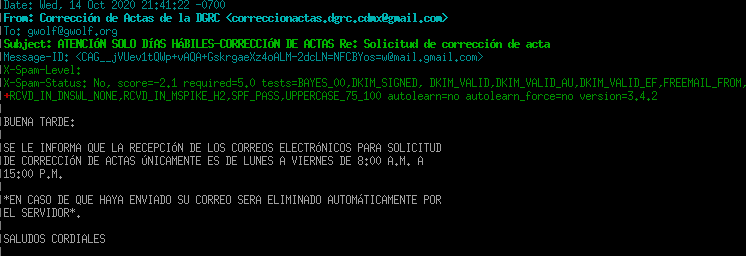
Mexico was one of the first countries in the world to set up a national population registry in the late 1850s, as part of the church-state separation that was for long years one of the national sources of pride. Forty four years ago, when I was born, keeping track of the population was still mostly a manual task. When my parents registered me, my data was stored in page 161 of book 22, year 1976, of the 20th Civil Registration office in Mexico City. Faithful to the legal tradition, everything is handwritten and specified in full. Because, why would they write 1976.04.27 (or even 27 de abril de 1976) when they could spell out d a veintisiete de abril de mil novecientos setenta y seis? Numbers seem to appear only for addresses. So, the State had record of a child being born, and we knew where to look if we came to need this information. But, many years later, a very sensible tecnification happened: all records (after a certain date, I guess) were digitized. Great news! I can now get my birth certificate without moving from my desk, paying a quite reasonable fee (~US$4). What s there not to like? Digitally certified and all! So great! But But Oh, there s a problem. Of course Making sense of the handwriting as you can see is somewhat prone to failure. And I cannot blame anybody for failing to understand the details of my record. So, my mother s first family name is Iszaevich. It was digitized as Iszaerich. Fortunately, they do acknowledge some errors could have made it into the process, and there is a process to report and correct errors. What s there not to like? Oh That they do their best to emulate a public office using online tools. I followed some links in that link to get the address to contact and yesterday night sent them the needed documents. Quite immediately, I got an answer that I must share with the world: Yes, the mailing contact is in the @gmail.com domain. I could care about them not using a @ .gob.mx address, but I ll let it slip. The mail I got says (uppercase and all):
GOOD EVENING,
WE INFORM YOU THAT THE RECEPTION OF E-MAILS FOR REQUESTING
CORRECTIONS IN CERTIFICATES IS ONLY ACTIVE MONDAY THROUGH FRIDAY,
8:00 TO 15:00.
*IN CASE YOU SENT A MAIL OUTSIDE THE WORKING HOURS, IT WILL BE
AUTOMATICALLY DELETED BY THE SERVER*
CORDIAL GREETINGS,
I would only be half-surprised if they were paying the salary of somebody to spend the wee hours of the night receiving and deleting mails from their GMail account.

Dirk Eddelbuettel: dang 0.0.12: Two new functions

A new release of the dang package is now on CRAN, roughly one year after the last release. The dang package regroups a few functions of mine that had no other home as for example lsos() from a StackOverflow question from 2009 (!!) is one, this overbought/oversold price band plotter from an older blog post is another. More recently added were helpers for data.table to xts conversion and a git repo root finder. This release adds two functions. One was mentioned just days ago in a tweet by Nathan and is a reworked version of something Colin tweeted about a few weeks ago: a little data wrangling off the kewl rtweet to find maximally spammy accounts per search topic. In other words those who include more than N hashtags for given search term. The other is something I, if memory serves, picked up a while back on one of the lists: a base R function to identify non-ASCII characters in a file. It is a C function that is not directly exported by and hence no accessible, so we put it here (with credits, of course). I mentioned it yesterday when announcing tidyCpp as I this C function was the starting point for the new tidyCpp wrapper around some C API of R functions. The (very short) NEWS entry follows.

Changes in version 0.0.12 (2020-10-14)
  • New functions muteTweets and checkPackageAsciiCode.
  • Updated CI setup.

Courtesy of CRANberries, there is a comparison to the previous release. For questions or comments use the issue tracker off the GitHub repo. If you like this or other open-source work I do, you can now sponsor me at GitHub. For the first year, GitHub will match your contributions.

This post by Dirk Eddelbuettel originated on his Thinking inside the box blog. Please report excessive re-aggregation in third-party for-profit settings.

14 October 2020

Thomas Goirand: The Gnocchi package in Debian

This is a follow-up from the blog post of Russel as seen here: https://etbe.coker.com.au/2020/10/13/first-try-gnocchi-statsd/. There s a bunch of things he wrote which I unfortunately must say is inaccurate, and sometimes even completely wrong. It is my point of view that none of the reported bugs are helpful for anyone that understand Gnocchi and how to set it up. It s however a terrible experience that Russell had, and I do understand why (and why it s not his fault). I m very much open on how to fix this on the packaging level, though some things aren t IMO fixable. Here s the details. 1/ The daemon startups First of all, the most surprising thing is when Russell claimed that there s no startup scripts for the Gnocchi daemons. In fact, they all come with both systemd and sysv-rc support: # ls /lib/systemd/system/gnocchi-api.service
/lib/systemd/system/gnocchi-api.service
# /etc/init.d/gnocchi-api
/etc/init.d/gnocchi-api Russell then tried to start gnocchi-api without the good options that are set in the Debian scripts, and not surprisingly, this failed. Russell attempted to do what was in the upstream doc, which isn t adapted to what we have in Debian (the upstream doc is probably completely outdated, as Gnocchi is unfortunately not very well maintained upstream). The bug #972087 is therefore, IMO not valid. 2/ The database setup By default for all things OpenStack in Debian, there are some debconf helpers using dbconfig-common to help users setup database for their services. This is clearly for beginners, but that doesn t prevent from attempting to understand what you re doing. That is, more specifically for Gnocchi, there are 2 databases: one for Gnocchi itself, and one for the indexer, which not necessarily is using the same backend. The Debian package already setups one database, but one has to do it manually for the indexer one. I m sorry this isn t well enough documented. Now, if some package are supporting sqlite as a backend (since most things in OpenStack are using SQLAlchemy), it looks like Gnocchi doesn t right now. This is IMO a bug upstream, rather than a bug in the package. However, I don t think the Debian packages are to be blame here, as they simply offer a unified interface, and it s up to the users to know what they are doing. SQLite is anyway not a production ready backend. I m not sure if I should close #971996 without any action, or just try to disable the SQLite backend option of this package because it may be confusing. 3/ The metrics UUID Russell then thinks the UUID should be set by default. This is probably right in a single server setup, however, this wouldn t work setting-up a cluster, which is probably what most Gnocchi users will do. In this type of environment, the metrics UUID must be the same on the 3 servers, and setting-up a random (and therefore different) UUID on the 3 servers wouldn t work. So I m also tempted to just close #972092 without any action on my side. 4/ The coordination URL Since Gnocchi is supposed to be setup with more than one server, as in OpenStack, having an HA setup is very common, then a backend for the coordination (ie: sharing the workload) must be set. This is done by setting an URL that tooz understand. The best coordinator being Zookeeper, something like this should be set by hand: coordination_url=zookeeper://192.168.101.2:2181/ Here again, I don t think the Debian package is to be blamed for not providing the automation. I would however accept contributions to fix this and provide the choice using debconf, however, users would still need to understand what s going on, and setup something like Zookeeper (or redis, memcache, or any other backend supported by tooz) to act as coordinator. 5/ The Debconf interface cannot replace a good documentation and there s not so much I can do at my package maintainer level for this. Russell, I m really sorry for the bad user experience you had with Gnocchi. Now that you know a little big more about it, maybe you can have another go? Sure, the OpenStack telemetry system isn t an easy to understand beast, but it s IMO worth trying. And the recent versions can scale horizontally

Dirk Eddelbuettel: tidyCpp 0.0.1: New package

A new package arrived on CRAN a few days ago. It offers a few headers files which wrap (parts) of the C API for R, but in a form that may be a little easier to use for C++ programmers. I have always liked how in Rcpp we offer good parts of the standalone R Math library in a namespace R::. While working recently with a particular C routine (for checking non-ASCII characters that will be part of the next version of the dang package which collecting various goodies in one place), I realized there may be value in collecting a few more such wrappers. So I started a few simple ones starting from simple examples. Currently we have five headers defines.h, globals.h, internals.h, math.h, and shield.h. The first four each correpond to an R header file of the same or similar name, and the last one brings a simple yet effective alternative to PROTECT and UNPROTECT from Rcpp (in a slightly simplified way). None of the headers are complete , for internals.h in particular a lot more could be added (as I noticed today when experimenting with another source file that may be converted). All of the headers can be accessed with a simple #include <tidyCpp> (which, following another C++ convention, does not have a .h or .hpp suffix). And a the package ships these headers, packages desiring to use them only need LinkingTo: tidyCpp. As usage examples, we (right now) have four files in the snippets/ directory of the package. Two of these, convolveExample.cpp and dimnamesExample.cpp both illustrate how one could change example code from Writing R Extensions. Then there are also a very simple defineExample.cpp and a shieldExample.cpp illustrating how much easier Shield() is compared to PROTECT and UNPROTECT. Finally, there is a nice vignette discussing the package motivation with two detailed side-by-side before and after examples that are the aforementioned convolution and dimnames examples. Over time, I expect to add more definitions and wrappers. Feedback would be welcome it seems to hit a nerve already as it currently has more stars than commits even though (prior to this post) I had yet to tweet or blog about it. Please post comments and suggestions at the GitHub repo. If you like this or other open-source work I do, you can now sponsor me at GitHub. For the first year, GitHub will match your contributions.

This post by Dirk Eddelbuettel originated on his Thinking inside the box blog. Please report excessive re-aggregation in third-party for-profit settings.

12 October 2020

Dirk Eddelbuettel: GitHub Streak: Round Seven

Six years ago I referenced the Seinfeld Streak used in an earlier post of regular updates to to the Rcpp Gallery:
This is sometimes called Jerry Seinfeld s secret to productivity: Just keep at it. Don t break the streak.
and then showed the first chart of GitHub streaking 366 days:
github activity october 2013 to october 2014
And five years ago a first follow-up appeared in this post about 731 days:
github activity october 2014 to october 2015
And four years ago we had a followup at 1096 days
github activity october 2015 to october 2016
And three years ago we had another one marking 1461 days
github activity october 2016 to october 2017
And two years ago another one for 1826 days
github activity october 2017 to october 2018
And last year another one bringing it to 2191 days
github activity october 2018 to october 2019
And as today is October 12, here is the newest one from 2019 to 2020 with a new total of 2557 days:
github activity october 2018 to october 2019
Again, special thanks go to Alessandro Pezz for the Chrome add-on GithubOriginalStreak.

This post by Dirk Eddelbuettel originated on his Thinking inside the box blog. Please report excessive re-aggregation in third-party for-profit settings.

Markus Koschany: My Free Software Activities in September 2020

Welcome to gambaru.de. Here is my monthly report (+ the first week in October) that covers what I have been doing for Debian. If you re interested in Java, Games and LTS topics, this might be interesting for you. Debian Games
warzone2100
Debian Java
pdfsam
Misc Debian LTS This was my 55. month as a paid contributor and I have been paid to work 31,75 hours on Debian LTS, a project started by Rapha l Hertzog. In that time I did the following: ELTS Extended Long Term Support (ELTS) is a project led by Freexian to further extend the lifetime of Debian releases. It is not an official Debian project but all Debian users benefit from it without cost. The current ELTS release is Debian 8 Jessie . This was my 28. month and I have been paid to work 15 hours on ELTS. Thanks for reading and see you next time.

Jonathan Dowland: Type design

I wanted to share Type design issue I hit recently with Striot. Within StrIoT you define a stream-processing program, which is a series of inter-connected operators, in terms of a trio of graph types: For some recent work I needed to define some additional properties for the operators: properties that would be used in a M/M/1 model (Jackson network) to represent the program do some cost modelling with. Initially we supplied this additional information in completely separate instances of types: e.g. lists of tuples, the first of a pair representing a vertexID, etc. This was mostly fine for totally novel code, but where I had existing code paths that operated in terms of Graph StreamVertex and now needed access to these parameters, it would have meant refactoring a lot of code. So instead, I added these properties directly to the types above. Some properties are appropriate for all node types, e.g. mean average service time. In that case, I added the parameter to the StreamVertex type:
data StreamVertex = StreamVertex
      vertexId   :: Int
     
    , serviceTime:: Double
     
Other parameters were only applicable to certain node types. Mean average arrival rate, for example., is only valid for Source node types; selectivity is appropriate only for filter types. So, I added these to the StreamOperator type:
data StreamOperator = Map
                      Filter Double -- selectivity
                     
                      Source Double -- arrival rate
                     
This works pretty well, and most of the code paths that already exist did not need to be updated in order for the model parameters to pass through to where they are needed. But it was not a perfect solution, because I now had to modify some other, unrelated code to account for the type changes. Mostly this was test code: where I'd defined instances of Graph StreamVertex to test something unrelated to the modelling work, I now had to add filter selectivities and source arrival rates. This was tedious but mostly solved with automatically with some editor macros. One area though, that was a problem, was equality checks and pattern matching. Before this change, I had a few areas of code like this
if Source == operator (head (vertexList sg))
 
if a /= b then  -- where a and b are instances of StreamOperator
I had to replace them with little helper routines like
cmpOps :: StreamOperator -> StreamOperator -> Bool
cmpOps (Filter _) (Filter _) = True
cmpOps (FilterAcc _) (FilterAcc _) = True
cmpOps x y = x == y
A similar problem was where I needed to synthesize a Filter, and I didn't care about the selectivity, indeed, it was meaningless for the way I was using the type. I have a higher-level function that handles "hoisting" an Operator through a Merge: So, before, you have some operator occurring after a merge operation, and afterwards, you have several instances of the operator on all of the input streams prior to the Merge. Invoking it now looks like this
filterMerge = pushOp (Filter 0)
It works, the "0" is completely ignored, but the fact I have to provide it, and it's unneeded, and there is no sensible value for it, is a bit annoying. I think there's some interesting things to consider here about Type design, especially when you have some aspects of a "thing" which are relevant only in some contexts and not others.

Russ Allbery: Review: Hand to Mouth

Review: Hand to Mouth, by Linda Tirado
Publisher: G.P. Putnam's Sons
Copyright: October 2014
ISBN: 0-698-17528-X
Format: Kindle
Pages: 194
The first time Linda Tirado came to the viral attention of the Internet was in 2013 when she responded to a forum question: "Why do poor people do things that seem so self-destructive?" Here are some excerpts from her virally popular five-page response, which is included in the first chapter:
I know how to cook. I had to take Home Ec. to graduate high school. Most people on my level didn't. Broccoli is intimidating. You have to have a working stove, and pots, and spices, and you'll have to do the dishes no matter how tired you are or they'll attract bugs. It is a huge new skill for a lot of people. That's not great, but it's true. And if you fuck it up, you could make your family sick. We have learned not to try too hard to be middle class. It never works out well and always makes you feel worse for having tried and failed yet again. Better not to try. It makes more sense to get food that you know will be palatable and cheap and that keeps well. Junk food is a pleasure that we are allowed to have; why would we give that up? We have very few of them.
and
I smoke. It's expensive. It's also the best option. You see, I am always, always exhausted. It's a stimulant. When I am too tired to walk one more step, I can smoke and go for another hour. When I am enraged and beaten down and incapable of accomplishing one more thing, I can smoke and I feel a little better, just for a minute. It is the only relaxation I am allowed. It is not a good decision, but it is the only one that I have access to. It is the only thing I have found that keeps me from collapsing or exploding.
This book is an expansion on that essay. It's an entry in a growing genre of examinations of what it means to be poor in the United States in the 21st century. Unlike most of those examinations, it isn't written by an outsider performing essentially anthropological field work. It's one of the rare books written by someone who is herself poor and had the combination of skill and viral fame required to get an opportunity to talk about it in her own words.
I haven't had it worse than anyone else, and actually, that's kind of the point. This is just what life is for roughly a third of the country. We all handle it in our own ways, but we all work in the same jobs, live in the same places, feel the same sense of never quite catching up. We're not any happier about the exploding welfare rolls than anyone else is, believe me. It's not like everyone grows up and dreams of working two essentially meaningless part-time jobs while collecting food stamps. It's just that there aren't many other options for a lot of people.
I didn't find this book back in 2014 when it was published. I found it in 2020 during Tirado's second round of Internet fame: when the police shot out her eye with "non-lethal" rounds while she was covering the George Floyd protests as a photojournalist. In characteristic fashion, she subsequently reached out to the other people who had been blinded by the police, used her temporary fame to organize crowdfunded support for others, and is planning on having "try again" tattooed over the scar. That will give you a feel for the style of this book. Tirado is blunt, opinionated, honest, and full speed ahead. It feels weird to call this book delightful since it's fundamentally about the degree to which the United States is failing a huge group of its citizens and making their lives miserable, but there is something so refreshing and clear-headed about Tirado's willingness to tell you the straight truth about her life. It's empathy delivered with the subtlety of a brick, but also with about as much self-pity as a brick. Tirado is not interested in making you feel sorry for her; she's interested in you paying attention.
I don't get much of my own time, and I am vicious about protecting it. For the most part, I am paid to pretend that I am inhuman, paid to cater to both the reasonable and unreasonable demands of the general public. So when I'm off work, feel free to go fuck yourself. The times that I am off work, awake, and not taking care of life's details are few and far between. It's the only time I have any autonomy. I do not choose to waste that precious time worrying about how you feel. Worrying about you is something they pay me for; I don't work for free.
If you've read other books on this topic (Emily Guendelsberger's On the Clock is still the best of those I've read), you probably won't get many new facts from Hand to Mouth. I think this book is less important for the policy specifics than it is for who is writing it (someone who is living that life and can be honest about it) and the depth of emotional specifics that Tirado brings to the description. If you have never been poor, you will learn the details of what life is like, but more significantly you'll get a feel for how Tirado feels about it, and while this is one individual perspective (as Tirado stresses, including the fact that, as a white person, there are other aspects of poverty she's not experienced), I think that perspective is incredibly valuable. That said, Hand to Mouth provides even more reinforcement of the importance of universal medical care, the absurdity of not including dental care in even some of the more progressive policy proposals, and the difficulties in the way of universal medical care even if we solve the basic coverage problem. Tirado has significant dental problems due to unrepaired damage from a car accident, and her account reinforces my belief that we woefully underestimate how important good dental care is to quality of life. But providing universal insurance or access is only the start of the problem.
There is a price point for good health in America, and I have rarely been able to meet it. I choose not to pursue treatment if it will cost me more than it will gain me, and my cost-benefit is done in more than dollars. I have to think of whether I can afford any potential treatment emotionally, financially, and timewise. I have to sort out whether I can afford to change my life enough to make any treatment worth it I've been told by more than one therapist that I'd be fine if I simply reduced the amount of stress in my life. It's true, albeit unhelpful. Doctors are fans of telling you to sleep and eat properly, as though that were a thing one can simply do.
That excerpt also illustrates one of the best qualities of this book. So much writing about "the poor" treats them as an abstract problem that the implicitly not-poor audience needs to solve, and this leads rather directly to the endless moralizing as "we" attempt to solve that problem by telling poor people what they need to do. Tirado is unremitting in fighting for her own agency. She has a shitty set of options, but within those options she makes her own decisions. She wants better options and more space in which to choose them, which I think is a much more productive way to frame the moral argument than the endless hand-wringing over how to help "those poor people." This is so much of why I support universal basic income. Just give people money. It's not all of the solution UBI doesn't solve the problem of universal medical care, and we desperately need to find a way to make work less awful but it's the most effective thing we can do immediately. Poor people are, if anything, much better at making consequential financial decisions than rich people because they have so much more practice. Bad decisions are less often due to bad decision-making than bad options and the balancing of objectives that those of us who are not poor don't understand. Hand to Mouth is short, clear, refreshing, bracing, and, as you might have noticed, very quotable. I think there are other books in this genre that offer more breadth or policy insight, but none that have the same feel of someone cutting through the bullshit of lazy beliefs and laying down some truth. If any of the above excerpts sound like the sort of book you would enjoy reading, pick this one up. Rating: 8 out of 10

8 October 2020

Dirk Eddelbuettel: RcppSimdJson 0.1.2: Upstream update

A new RcppSimdJson release arrived on CRAN yesterday bringing along the simdjson 0.5.0 release that happened a few weeks. RcppSimdJson wraps the fantastic and genuinely impressive simdjson library by Daniel Lemire and collaborators. Via very clever algorithmic engineering to obtain largely branch-free code, coupled with modern C++ and newer compiler instructions, it results in parsing gigabytes of JSON parsed per second which is quite mindboggling. The best-case performance is faster than CPU speed as use of parallel SIMD instructions and careful branch avoidance can lead to less than one cpu cycle per byte parsed; see the video of the talk by Daniel Lemire at QCon (also voted best talk). Beside the upstream update, not too much happened to our package itself since 0.1.1 though Brandon did help one user to seriously speed up his JSON processing. The (this time very short) NEWS entry follows.

Changes in version 0.1.2 (2020-10-07)
  • Upgraded to simdjson 0.5.0 (Dirk #49)

Courtesy of my CRANberries, there is also a diffstat report for this release. For questions, suggestions, or issues please use the issue tracker at the GitHub repo. If you like this or other open-source work I do, you can now sponsor me at GitHub. For the first year, GitHub will match your contributions.

This post by Dirk Eddelbuettel originated on his Thinking inside the box blog. Please report excessive re-aggregation in third-party for-profit settings.

Dirk Eddelbuettel: littler 0.3.12: Exciting updates

max-heap image The thirteenth release of littler as a CRAN package became available today (after a three day rest at CRAN for no real reason), following in the fourteen-ish year history as a package started by Jeff in 2006, and joined by me a few weeks later. littler is the first command-line interface for R as it predates Rscript. It allows for piping as well for shebang scripting via #!, uses command-line arguments more consistently and still starts faster. It also always loaded the methods package which Rscript only started to do in recent years. littler lives on Linux and Unix, has its difficulties on macOS due to yet-another-braindeadedness there (who ever thought case-insensitive filesystems as a default where a good idea?) and simply does not exist on Windows (yet the build system could be extended see RInside for an existence proof, and volunteers are welcome!). See the FAQ vignette on how to add it to your PATH. A few examples are highlighted at the Github repo, as well as in the examples vignette. This release brings five new example scripts and command wrappers: A number of commands were also extended or updated (see below for more). We have a new and very slick documentation website once again utilising Material for MkDocs. Last but not least the two included vignettes now use minidown and the fabulous water css theme which reduced the file sizes of the two vignettes from, respectively, 884kb and 873kb to 47kb and 15kb. Yes, that is correct. That alone brought the package file size down from 641kb to 116kb. Incredible. The NEWS file entry is below.

Changes in littler version 0.3.12 (2020-10-04)
  • Changes in examples
    • Updates to scripts tt.r, cos.r, cow.r, c4r.r, com.r
    • New script installDeps.r to install dependencies
    • Several updates tp script check.r
    • New script installBSPM.r and installRSPM.r for binary package installation (Dirk and I aki in #81)
    • New script cranIncoming.r to check in Incoming
    • New script urlUpdate.r validates URLs as R does
  • Changes in package
    • Travis CI now uses BSPM
    • A package documentation website was added
    • Vignettes now use minidown resulting in much reduced filesizes: from over 800kb to under 50kb (Dirk in #83)

My CRANberries provides a comparison to the previous release. Full details for the littler release are provided as usual at the ChangeLog page, and now also on the new package docs website. The code is available via the GitHub repo, from tarballs and now of course also from its CRAN page and via install.packages("littler"). Binary packages are available directly in Debian as well as soon via Ubuntu binaries at CRAN thanks to the tireless Michael Rutter. Comments and suggestions are welcome at the GitHub repo. If you like this or other open-source work I do, you can now sponsor me at GitHub. For the first year, GitHub will match your contributions.

This post by Dirk Eddelbuettel originated on his Thinking inside the box blog. Please report excessive re-aggregation in third-party for-profit settings.

6 October 2020

Iustin Pop: Late report for Nationalpark Bike Marathon 2020

I don t have to mention that 2020 is a special year, so all the normal race plan was out the window, and I was very happy and fortunate to be able to do even one race. And only delayed 3 weeks to write this race report :/ So, here s the story

Preparing for the race Because it was a special year, and everything was crazy, I actually managed to do more sports than usual, at least up to end of July. So my fitness, and even body weight, was relatively fine, so I subscribed to the mid-distance race (official numbers: 78km distance, 1570 meters altitude), and then off it went to a proper summer vacation in a hotel, even. And while I did do some bike rides during that vacation, from then on my training regime went just off? I did train, I did ride, I did get significant PRs, but it didn t click anymore. Plus, due to well, actually not sure what, work or coffee or something my sleep regime also got completely ruined On top of that, I didn t think about the fact that the race was going to be mid-September, and that high up in the mountains, the weather could have be bad enough (I mean, in 2018 the weather was really bad even in August ) such that I d need to seriously think about clothing.

Race week I arrive in Scuol two days before the race, very tired (I think I got only 6 hours of sleep the night before), and definitely not in a good shape. I was feeling bad enough that I was not quite sure I was going to race. At least weather was OK, such that normal summer clothing would suffice. But the race info was mentioning dangerous segments, to be very careful, etc. etc. so I was quite anxious. Note 1: my wife says, this was not the first time, and likely not the last time that two days before the race I feel like quitting. And as I m currently on-and-off reading the interesting The Brave Athlete: Calm the Fuck Down and Rise to the Occasion book (by Lesley Paterson and Simon Marshall; it s an interesting book, not sure if I recommend it or not), I am beginning to think that this is my reaction to races where I have overshot my usual distance. Or, in general, races where I fear the altitude gain. Not quite sure, but I think it is indeed the actual cause. So I spend Thursday evening feeling unwell, and thinking I ll see how Friday goes. Friday comes, and having slept reasonably well entire night, I pick up my race number, then I take another nap in the afternoon - in total, I ve slept around 13 hours that day. So I felt much better, and was looking forward to the race. Saturday morning comes, I manage to wake up early, and get ready in time; almost didn t panic at all that I m going to be late. Note 2: my wife also says that this is the usual way I behave. Hence, it must be most of it a mental issue, rather than real physical one

Race I reach the train station in time, I get on the train, and by the time the train reached Zernez, I fully calm down. There was am entire hour wait though before the race, and it was quite chilly. Of course I didn t bring anything beside what I was wearing, relying on temperature getting better later in the day. During the wait, there were two interesting things happening. First, we actually got there (in Zernez) before the first people from the long distance passed by, both men and women. Seeing them pass by was cool, thinking they already had ~1 200m altitude in just 30-ish kilometres. The second thing was, as this was the middle and not the shortest distance, the people in the group looked differently than in previous years. More precisely, they were looking very fit, and I was feeling fat. Well, I am overweight, so it was expected, but I was feeling it even more than usual. I think only one or two in ten people were looking as fit as me or less And of course, the pictures post-race show me even less fit-looking than I thought. Ah, self-deception is a sweet thing And yes, we all had to wear masks, up until the last minute. It was interesting, but not actually annoying - and small enough price for being able to race! Then the race starts, and as opposed to many other years, it starts slow. I didn t feel that rush of people starting fast, it was reasonable?

First part of the race (good) Thus started the first part of the race, on a new route that I was unfamiliar with. There was not too much climbing, to be honest, and there was some tricky single-trail through the woods, with lots of the roots. I actually had to get off the bike and push it, since it was too difficult to pedal uphill on that path. Other than that, I was managing so far to adjust my efforts well enough that my usual problems related to climbing (lower back pain) didn t yet appear, even as the overall climbed meters were increasing. I was quite happy at that, and had lots of reserves. To my (pleasant) surprise, two positive things happened:
  • I was never alone, a sign that I wasn t too far back.
  • I was passing/being passed by people, both on climbs but also on descents! It s rare, but I did overtake a few people on a difficult trail downhill.
With all the back and forth, a few people became familiar (or at least their kit), and it was fun seeing who is better uphill vs. downhill.

And second part (not so good) I finally get to (around) S-chanf, on a very nice but small descent, and on flat roads, and start the normal route for the short race. Something was off though - I knew from past years that these last ~47km have around 700-800m altitude, but I had already done around 1000m. So the promised 1571m were likely to be off, by at least 100-150m. I set myself a new target of 1700m, and adjust my efforts based on that. And then, like clockwork on the 3:00:00 mark, the route exited the forest, the sun got out of the clouds, and the temperature started to increase from 16-17 C to 26 +, with peaks of 31 C. I m not joking: at 2:58:43, temp was 16 , at 3:00:00, it was 18 , at 3:05:45, it was 26 . Heat and climbing are my two nemeses, and after having a pretty good race for the first 3 hours and almost exactly 1200m of climbing, I started feeling quite miserable. Well, it was not all bad. There were some nice stretches of flat, where I knew I can pedal strongly and keep up with other people, until my chain dropped, so I had to stop, re-set it, and lose 2 minutes. Sigh. But, at least, I was familiar with this race, or so I thought. I completely mis-remembered the last ~20km as a two-punch climb, Guarda and Ftan, whereas it is actually a three-punch one: Guarda, Ardez, and only then Ftan. Doesn t help that Ardez has the nice ruins that I was remembering and which threw me off. The saddest part of the day was here, on one of the last climbs - not sure if to Guarda or to Arddez, where a guy overtakes me, and tells me he s glad he finally caught up with me, he almost got me five or six times (!), but I always managed to break off. Always, until now. Now, this was sad (I was huffing and puffing like a steam locomotive now), but also positive, as I never had that before. One good, one bad? And of course, it was more than 1 700m altitude, it was 1 816m. And the descent to Scuol shorter and it didn t end as usual with the small but sharp climb which I just love, due to Covid changes. But, I finished, and without any actual issues, and no dangerous segments as far as I saw. I was anxious for no good reason

Conclusion (or confusion?) So this race was interesting: three hours (to the minute) in which I went 43.5km, climbed 1200m, felt great, and was able to push and push. And then the second part, only ~32km, climbed only 600m, but which felt quite miserable. I don t know if it was mainly heat, mainly my body giving up after that much climbing (or time?), or both. But it s clear that I can t reliably race for more than around these numbers: 3 hours, ~1000+m altitude, in >20 C temperature. One thing that I managed to achieve though: except due to the technically complex trail at the beginning where I pushed the bike, I did not ever stop and push the bike uphill because I was too tired. Instead, I managed (badly) to do the switch sitting/standing as much as I could motivate myself, and thus continue pushing uphill. This is an achievement for me, since mentally it s oh so easy to stop and push the bike, so I was quite glad. As to the race results, they were quite atrocious:
  • age category (men), 38 out of 52 finishers, 4h54m, with first finisher doing 3h09m, so 50% slower (!)
  • overall (men), 138 out of 173 finishers, with first finisher 2h53m.
These results clearly don t align with my feeling of a good first half of the race, so either it was purely subjective, or maybe in this special year, only really strong people registered for the race, or something else One positive aspect though, compared to most other years, was the consistency of my placement (age and overall):
  • Zuoz: 38 / 141
  • S-Chanf: 39 / 141
  • Zernez: 39 / 141
  • Guarda: 38 / 138
  • Ftan: 38 / 138
  • ( next - whatever this is): 38 / 138
  • Finish: 38 / 138
So despite all my ranting above, and all the stats I m pulling out of my own race, it looks like my position in the race was fully settled in the really first part, and I didn t gain nor lose practically anything afterwards. I did dip one place but then gained it back (on the climb to Guarda, even). The split times (per-segment rankings) are a bit more variable, and show that I was actually fast on the climbs but losing speed on the descents, which I really don t understand anymore:
  • Zernez-Zuoz (unclear type): 38 / 141
  • Zuoz-S-Chanf (unclear type): 40 / 141
  • S-Chanf-Zernez (mostly downhill): 39 / 143
  • Zernez-Guarda (mostly uphill): 37 / 136
  • Guarda-Ftan (mostly uphill): 37 / 131
  • Ftan-Scuol (mostly downhill): 43 / 156
The difference at the end is striking. I m visually matching the map positions to km and then use VeloViewer for computing the altitude gain, but Zernez to Guarda is 420m altitude, and Guarda to Ftan is 200m altitude gain, and yet on both, I was faster than my final place, and by quite a few places on overall, only to lose that on the descent (Ftan-Scuol), and by a large margin. So, amongst all the confusion here, I think the story overall is:
  • indeed I was quite fit for me, so the climbs were better than my place in the race (if that makes sense).
  • however, I m not actually good at climbing nor fit (watts/kg), so I m still way back in the pack (oops!).
  • and I do suck at descending, both me (skills) and possible my bike setup as well (too high tyre pressure, etc.) so I lose even more time here
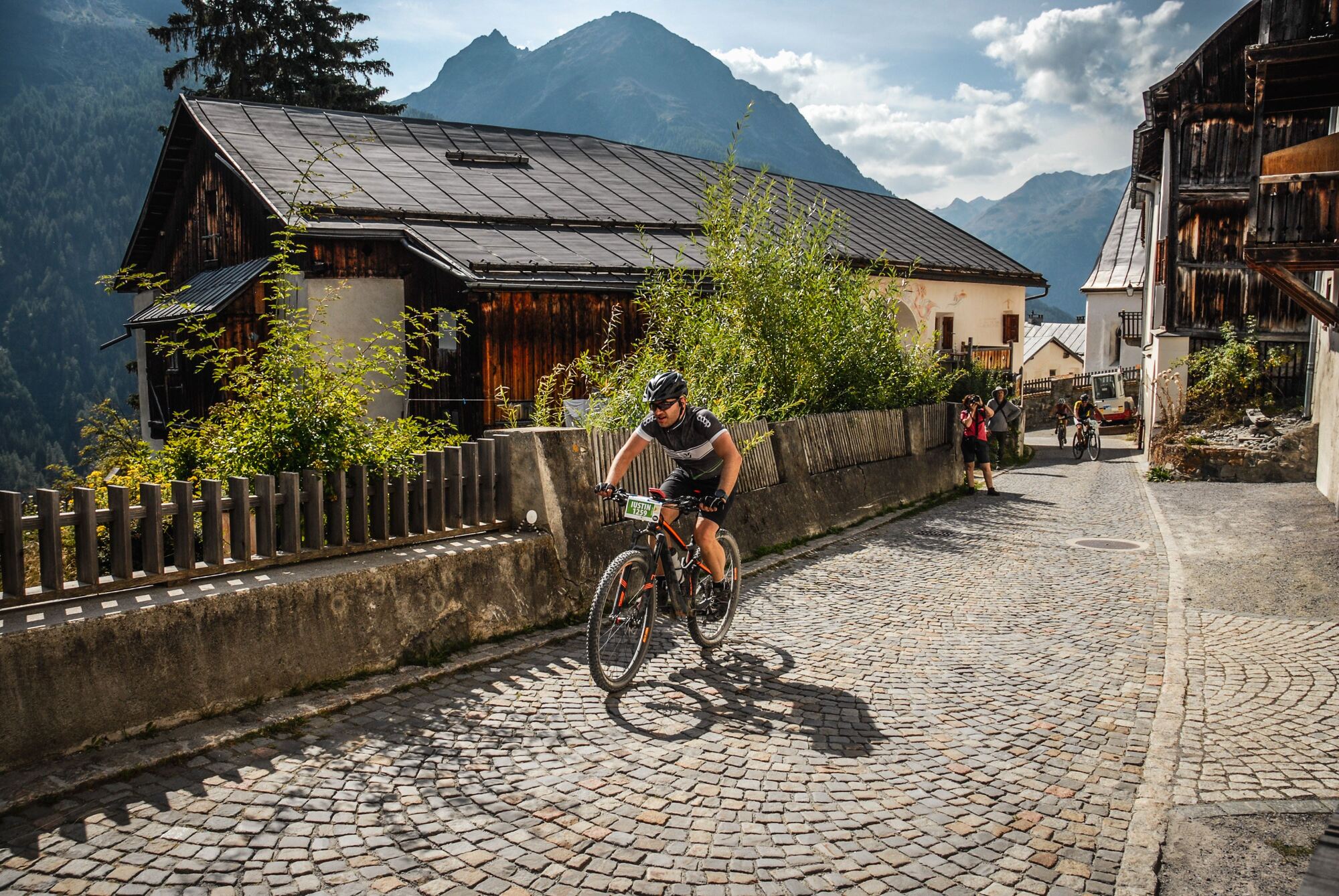
As usual, the final take-away points are: lose the extra weight that is not needed, get better skills, get better core to be better at climbing. I ll finish here with one pic, taken in Guarda (4 hours into the race, more or less):
Climbing in Guarda Climbing in Guarda
Until next year!

5 October 2020

Russ Allbery: California general election

As normal, probably of direct interest only to California residents and apologies to everyone else since my hand-rolled blog software doesn't do cut tags. I'm only going to cover propositions, since the state-wide elections aren't very interesting and I both don't have strong opinions about the local elections and would guess that almost no one cares. See the voter guide for the full details on each proposition. Propositions 16 through 19 were put on the ballot by the legislature and thus were written as well as our regular laws. The remaining propositions are initiatives, which means I default to voting against them because they're usually poorly-written crap. Proposition 14: NO. I reluctantly supported the original proposition to fund stem cell research with state bonds because it was in the middle of the George W. Bush administration and his weird obsession with ending stem cell research. It seemed worth the cost to maintain the research, and I don't regret doing this. But since then we've reached a compromise on ongoing research, and this proposition looks a lot more like pork spending than investment. I am in favor of government support of basic research, but I think that's best done by a single grant institution that can pursue a coherent agenda. The federal government, when sane, does a decent job of this, and the California agency created by the previous proposition looks dodgy. The support for this proposition also comes primarily from research institutions that benefit from it. On top of that, there are way higher priorities right now for public investment than a very specific and limited type of medical research that isn't even the most important type of medical research to do right now. There is nothing magic about stem cells other than the fact that they make a certain type of Republican lose their minds. It's time to stop funding this specific research specially and roll it into general basic research funding. Proposition 15: YES. Yes to anything that repeals Proposition 13 in whole or in part. Repealing it for commercial and industrial real estate is a good first step. A rare exception in my general rule to vote against initiatives. Proposition 16: YES. Reverses a bad law to outlaw affirmative action in California. I am in favor of actual reparations, so I am of course in favor of this, which is far, far more mild. Proposition 17: YES. Restores voting rights to felons after completion of their sentence. I think it's inexcusable that any US citizen cannot vote, including people who are currently incarcerated, so of course I'm in favor of this more mild measure. (You may notice a theme.) When we say everyone should be able to vote, that should mean literally everyone. Proposition 18: YES. Allows 17-year-olds to vote in California (but not federal) elections in some specific circumstances. I'm generally in favor of lowering the voting age, and this seems inoffensive. (And the arguments against it are stupid.) Proposition 19: YES. This is a complicated legislative compromise around property tax that strengthens property tax limits for seniors moving within California while removing exemptions against increases for inherited real estate not used as a primary home. Some progressives are opposed to this because it doesn't go far enough and increases exemptions for seniors. I agree that those exemptions aren't needed and shouldn't be added, but closing the inheritance loophole is huge and worth this compromise. It's a tepid improvement for the somewhat better, but it's still worth approving (and was written by the legislature, so it's somewhat better written than the typical initiative). Proposition 20: NO. Another pile of "anyone who has ever committed a crime deserves to be treated as subhuman" bullshit. Typical harsher sentences and harsher parole nonsense. No to everything like this, always. Proposition 21: YES. This is my other exception of voting for an initiative, and that's because the California state legislature is completely incapable of dealing with any housing problem. This is a proposition that overhauls an ill-conceived state-wide restriction on how rent control can be handled. The problem with rent control is that a sane solution to housing problems in this state requires both rent control and massive new construction, and we only get the former and not the latter because the NIMBYism is endemic. (There's a pile of NIMBY crap on my local ballot this year.) I would much rather be approving those things together, because either of them alone makes things worse for a lot of people. So yes, the opponents of this proposition are right: it will make the housing crisis worse, because everyone refuses to deal with the supply side. That said, we need rent control as part of a humane solution, and the current state-wide rules are bad. For example, they disallow rent control on every property newer than a certain date that's forever fixed. This initiative replaces that with a much saner 15-year rolling window for maximizing profit, which is a better balance. I hate voting for this because the legislature should have done their job and passed comprehensive housing reform. But since they didn't, this is part of what they should have passed, and I'll vote for it. Particularly since it's opposed by all the huge commercial landlords. Proposition 22: NO. The "exclude Uber and Lyft from labor law" proposition, which is just as bullshit as it sounds. They're spending all of their venture capital spamming the crap out of everyone in the state to try to get this passed by lying about it. Just stunningly evil companies. If your business model requires exploiting labor, get a better business model. Proposition 23: NO. So, this is another mess. It appears to be part of some unionization fight between dialysis clinic employees and the for-profit dialysis clinics. I hate everything about this situation, starting from the fact that we have such a thing as for-profit dialysis clinics, which is a crime against humanity. But this proposition requires some very dodgy things, such as having a doctor on staff at every clinic for... reasons? This is very reminiscent of the bullshit laws about abortion clinics, which are designed to make it more expensive to operate a clinic for no justifiable reason. I'm happy to believe there is a bit more justification here, but this sort of regulation is tricky and should be done by the legislature in a normal law-making process. Medical regulation by initiative is just a horrible idea in every way. So while I am doubtless politically on the side of the proponents of the proposition, this is the wrong tool. Take it to the legislature. Proposition 24: NO. A deceptively-written supposed consumer privacy law written by tech companies that actually weakens consumer privacy in some critical ways that are profitable for them. No thanks, without even getting to the point that this sort of thing shouldn't be done by initiative. Proposition 25: YES. Yes, we should eliminate cash bail, which is essentially imprisoning people for being poor. No, this doesn't create a system of government profiling; judges already set bail and can revoke bail for flight risks. (This is not legislation by initiative; the state government already passed this law, but we have a dumb law that lets people oppose legislative action via initiative, so we have to vote to approve the law that our representatives already passed and that should have already gone into effect.)

3 October 2020

Dirk Eddelbuettel: pinp 0.0.10: More Tweaks

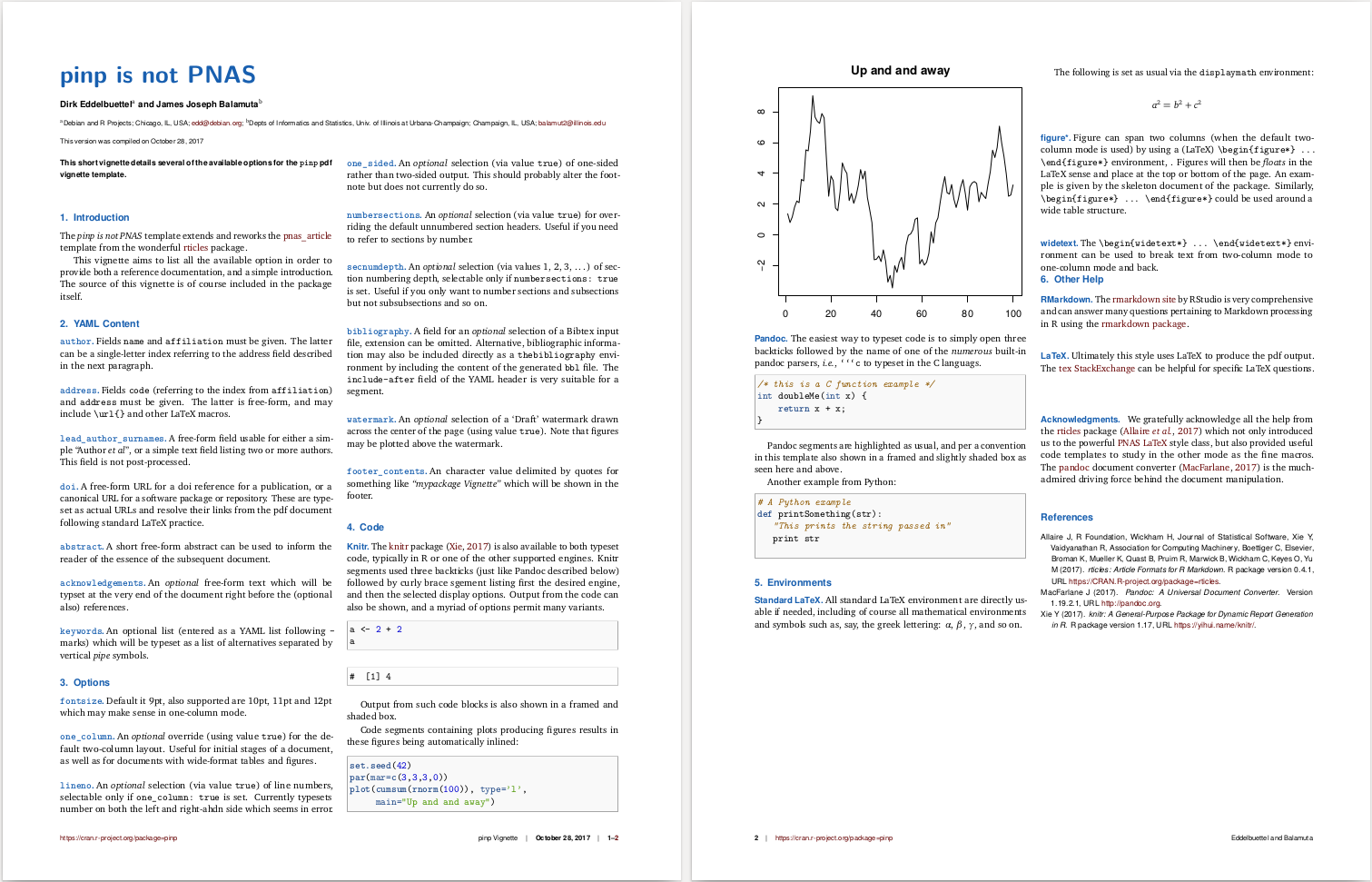
A new version of our pinp package arrived on CRAN two days ago, roughly one year after the previous release. The pinp package allows for snazzier one or two column Markdown-based pdf vignettes, and is now used by a few packages. A screenshot of the package vignette can be seen below. Additional screenshots are at the pinp page. pinp vignette This release adds another option for a customized date YAML variable suitable for e.g. a published at date thanks to Ilya Kashnitsky, has some tweaks to the README.md as well as support for pandoc columns mode (as a small extension of code from the nice repo by Grant McDermott). The NEWS entry for this release follows.

Changes in pinp version 0.0.10 (2020-10-01)
  • New document_date YAML variable to optionally set a 'Published at' or alike date (Ilya Kashnitsky in #85).
  • Small tweaks to README.md (Dirk)
  • Support pandoc columns mode (Dirk in #88)

Courtesy of my CRANberries, there is a comparison to the previous release. More information is on the tint page. For questions or comments use the issue tracker off the GitHub repo. If you like this or other open-source work I do, you can now sponsor me at GitHub. For the first year, GitHub will match your contributions.

This post by Dirk Eddelbuettel originated on his Thinking inside the box blog. Please report excessive re-aggregation in third-party for-profit settings.

Julian Andres Klode: Google Pixel 4a: Initial Impressions

Yesterday I got a fresh new Pixel 4a, to replace my dying OnePlus 6. The OnePlus had developed some faults over time: It repeatedly loses connection to the AP and the network, and it got a bunch of scratches and scuffs from falling on various surfaces without any protection over the past year.

Why get a Pixel? Camera: OnePlus focuses on stuffing as many sensors as it can into a phone, rather than a good main sensor, resulting in pictures that are mediocre blurry messes - the dreaded oil painting effect. Pixel have some of the best camera in the smartphone world. Sure, other hardware is far more capable, but the Pixels manage consistent results, so you need to take less pictures because they don t come out blurry half the time, and the post processing is so good that the pictures you get are just great. Other phones can shoot better pictures, sure - on a tripod. Security updates: Pixels provide 3 years of monthly updates, with security updates being published on the 5th of each month. OnePlus only provides updates every 2 months, and then the updates they do release are almost a month out of date, not counting that they are only 1st-of-month patches, meaning vendor blob updates included in the 5th-of-month updates are even a month older. Given that all my banking runs on the phone, I don t want it to be constantly behind. Feature updates: Of course, Pixels also get Beta Android releases and the newest Android release faster than any other phone, which is advantageous for Android development and being nerdy. Size and weight: OnePlus phones keep getting bigger and bigger. By today s standards, the OnePlus 6 at 6.18" and 177g is a small an lightweight device. Their latest phone, the Nord, has 6.44" and weighs 184g, the OnePlus 8 comes in at 180g with a 6.55" display. This is becoming unwieldy. Eschewing glass and aluminium for plastic, the Pixel 4a comes in at 144g.

First impressions

Accessories The Pixel 4a comes in a small box with a charger, USB-C to USB-C cable, a USB-OTG adapter, sim tray ejector. No pre-installed screen protector or bumper are provided, as we ve grown accustomed to from Chinese manufacturers like OnePlus or Xiaomi. The sim tray ejector has a circular end instead of the standard oval one - I assume so it looks like the o in Google? Google sells you fabric cases for 45 . That seems a bit excessive, although I like that a lot of it is recycled.

Haptics Coming from a 6.18" phablet, the Pixel 4a with its 5.81" feels tiny. In fact, it s so tiny my thumb and my index finger can touch while holding it. Cute! Bezels are a bit bigger, resulting in slightly less screen to body. The bottom chin is probably impracticably small, this was already a problem on the OnePlus 6, but this one is even smaller. Oh well, form over function. The buttons on the side are very loud and clicky. As is the vibration motor. I wonder if this Pixel thinks it s a Model M. It just feels great. The plastic back feels really good, it s that sort of high quality smooth plastic you used to see on those high-end Nokia devices. The finger print reader, is super fast. Setup just takes a few seconds per finger, and it works reliably. Other phones (OnePlus 6, Mi A1/A2) take like half a minute or a minute to set up.

Software The software - stock Android 11 - is fairly similar to OnePlus' OxygenOS. It s a clean experience, without a ton of added bloatware (even OnePlus now ships Facebook out of box, eww). It s cleaner than OxygenOS in some way - there are no duplicate photos apps, for example. On the other hand, it also has quite a bunch of Google stuff I could not care less about like YT Music. To be fair, those are minor noise once all 130 apps were transferred from the old phone. There are various things I miss coming from OnePlus such as off-screen gestures, network transfer rate indicator in quick settings, or a circular battery icon. But the Pixel has an always on display, which is kind of nice. Most of the cool Pixel features, like call screening or live transcriptions are unfortunately not available in Germany. The display is set to display the same amount of content as my 6.18" OnePlus 6 did, so everything is a bit tinier. This usually takes me a week or two to adjust too, and then when I look at the OnePlus again I ll be like Oh the font is huge , but right now, it feels a bit small on the Pixel. You can configure three colour profiles for the Pixel 4a: Natural, Boosted, and Adaptive. I have mine set to adaptive. I d love to see stock Android learn what OnePlus has here: the ability to adjust the colour temperature manually, as I prefer to keep my devices closer to 5500K than 6500K, as I feel it s a bit easier on the eyes. Or well, just give me the ability to load a ICM profile (though, I d need to calibrate the screen then - work!).

Migration experience Restoring the apps from my old phone only restore settings for a few handful out of 130, which is disappointing. I had to spent an hour or two logging in to all the other apps, and I had to fiddle far too long with openScale to get it to take its data over. It s a mystery to me why people do not allow their apps to be backed up, especially something innocent like a weight tracking app. One of my banking apps restored its logins, which I did not really like. KeePass2Android settings were restored as well, but at least the key file was not restored. I did not opt in to restoring my device settings, as I feel that restoring device settings when changing manufactures is bound to mess up some things. For example, I remember people migrating to OnePlus phones and getting their old DND schedule without any way to change it, because OnePlus had hidden the DND stuff. I assume that s the reason some accounts, like my work GSuite account were not migrated (it said it would migrate accounts during setup). I ve setup Bitwarden as my auto-fill service, so I could login into most of my apps and websites using the stored credentials. I found that often that did not work. Like Chrome does autofill fine once, but if I then want to autofill again, I have to kill and restart it, otherwise I don t get the auto-fill menu. Other apps did not allow any auto-fill at all, and only gave me the option to copy and paste. Yikes - auto-fill on Android still needs a lot of work.

Performance It hangs a bit sometimes, but this was likely due to me having set 2 million iterations on my Bitwarden KDF and using Bitwarden a lot, and then opening up all 130 apps to log into them which overwhelmed the phone a bit. Apart from that, it does not feel worse than the OnePlus 6 which was to be expected, given that the benchmarks only show a slight loss in performance. Photos do take a few seconds to process after taking them, which is annoying, but understandable given how much Google relies on computation to provide decent pictures.

Audio The Pixel has dual speakers, with the earpiece delivering a tiny sound and the bottom firing speaker doing most of the work. Still, it s better than just having the bottom firing speaker, as it does provide a more immersive experience. Bass makes this thing vibrate a lot. It does not feel like a resonance sort of thing, but you can feel the bass in your hands. I ve never had this before, and it will take some time getting used to.

Final thoughts This is a boring phone. There s no wow factor at all. It s neither huge, nor does it have high-res 48 or 64 MP cameras, nor does it have a ton of sensors. But everything it does, it does well. It does not pretend to be a flagship like its competition, it doesn t want to wow you, it just wants to be the perfect phone for you. The build is solid, the buttons make you think of a Model M, the camera is one of the best in any smartphone, and you of course get the latest updates before anyone else. It does not feel like a only 350 phone, but yet it is. 128GB storage is plenty, 1080p resolution is plenty, 12.2MP is you guessed it, plenty. The same applies to the other two Pixel phones - the 4a 5G and 5. Neither are particularly exciting phones, and I personally find it hard to justify spending 620 on the Pixel 5 when the Pixel 4a does job for me, but the 4a 5G might appeal to users looking for larger phones. As to 5G, I wouldn t get much use out of it, seeing as its not available anywhere I am. Because I m on Vodafone. If you have a Telekom contract or live outside of Germany, you might just have good 5G coverage already and it might make sense to get a 5G phone rather than sticking to the budget choice.

Outlook The big question for me is whether I ll be able to adjust to the smaller display. I now have a tablet, so I m less often using the phone (which my hands thank me for), which means that a smaller phone is probably a good call. Oh while we re talking about calls - I only have a data-only SIM in it, so I could not test calling. I m transferring to a new phone contract this month, and I ll give it a go then. This will be the first time I get VoLTE and WiFi calling, although it is Vodafone, so quality might just be worse than Telekom on 2G, who knows. A big shoutout to congstar for letting me cancel with a simple button click, and to @vodafoneservice on twitter for quickly setting up my benefits of additional 5GB per month and 10 discount for being an existing cable customer. I m also looking forward to playing around with the camera (especially night sight), and eSIM. And I m getting a case from China, which was handed over to the Airline on Sep 17 according to Aliexpress, so I guess it should arrive in the next weeks. Oh, and screen protector is not here yet, so I can t really judge the screen quality much, as I still have the factory protection film on it, and that s just a blurry mess - but good enough for setting it up. Please Google, pre-apply a screen protector on future phones and include a simple bumper case. I might report back in two weeks when I have spent some more time with the device.

2 October 2020

Ian Jackson: Mailman vs DKIM - a novel solution

tl;dr: Do not configure Mailman to replace the mail domains in From: headers. Instead, try out my small new program which can make your Mailman transparent, so that DKIM signatures survive. Background and narrative DKIM NB: This explanation is going to be somewhat simplified. I am going to gloss over some details and make some slightly approximate statements. DKIM is a new anti-spoofing mechanism for Internet email, intended to help fight spam. DKIM, paired with the DMARC policy system, has been remarkably successful at stemming the flood of joe-job spams. As usually deployed, DKIM works like this: When a message is originally sent, the author's MUA sends it to the MTA for their From: domain for outward delivery. The From: domain mailserver calculates a cryptographic signature of the message, and puts the signature in the headers of the message. Obviously not the whole message can be signed, since at the very least additional headers need to be added in transit, and sometimes headers need to be modified too. The signing MTA gets to decide what parts of the message are covered by the signature: they nominate the header fields that are covered by the signature, and specify how to handle the body. A recipient MTA looks up the public key for the From: domain in the DNS, and checks the signature. If the signature doesn't match, depending on policy (originator's policy, in the DNS, and recipient's policy of course), typically the message will be treated as spam. The originating site has a lot of control over what happens in practice. They get to publish a formal (DMARC) policy in the DNS which advises recipients what they should do with mails claiming to be from their site. As mentioned, they can say which headers are covered by the signature - including the ability to sign the absence of a particular headers - so they can control which headers downstreams can get away with adding or modifying. And they can set a normalisation policy, which controls how precisely the message must match the one that they sent. Mailman Mailman is, of course, the extremely popular mailing list manager. There are a lot of things to like about it. I choose to run it myself not just because it's popular but also because it provides a relatively competent web UI and a relatively competent email (un)subscription interfaces, decent bounce handling, and a pretty good set of moderation and posting access controls. The Xen Project mailing lists also run on mailman. Recently we had some difficulties with messages sent by Citrix staff (including myself), to Xen mailing lists, being treated as spam. Recipient mail systems were saying the DKIM signatures were invalid. This was in fact true. Citrix has chosen a fairly strict DKIM policy; in particular, they have chosen "simple" normalisation - meaning that signed message headers must precisely match in syntax as well as in a semantic sense. Examining the the failing-DKIM messages showed that this was definitely a factor. Applying my Opinions about email My Bayesian priors tend to suggest that a mail problem involving corporate email is the fault of the corporate email. However in this case that doesn't seem true to me. My starting point is that I think mail systems should not not modify messages unnecessarily. None of the DKIM-breaking modifications made by Mailman seemed necessary to me. I have on previous occasions gone to corporate IT and requested quite firmly that things I felt were broken should be changed. But it seemed wrong to go to corporate IT and ask them to change their published DKIM/DMARC policy to accomodate a behaviour in Mailman which I didn't agree with myself. I felt that instead I shoud put (with my Xen Project hat on) my own house in order. Getting Mailman not to modify messages So, I needed our Mailman to stop modifying the headers. I needed it to not even reformat them. A brief look at the source code to Mailman showed that this was not going to be so easy. Mailman has a lot of features whose very purpose is to modify messages. Personally, as I say, I don't much like these features. I think the subject line tags, CC list manipulations, and so on, are a nuisance and not really Proper. But they are definitely part of why Mailman has become so popular and I can definitely see why the Mailman authors have done things this way. But these features mean Mailman has to disassemble incoming messages, and then reassemble them again on output. It is very difficult to do that and still faithfully reassemble the original headers byte-for-byte in the case where nothing actually wanted to modify them. There are existing bug reports[1] [2] [3] [4]; I can see why they are still open. Rejected approach: From:-mangling This situation is hardly unique to the Xen lists. Many other have struggled with it. The best that seems to have been come up with so far is to turn on a new Mailman feature which rewrites the From: header of the messages that go through it, to contain the list's domain name instead of the originator's. I think this is really pretty nasty. It breaks normal use of email, such as reply-to-author. It is having Mailman do additional mangling of the message in order to solve the problems caused by other undesirable manglings! Solution! As you can see, I asked myself: I want Mailman not modify messages at all; how can I get it to do that? Given the existing structure of Mailman - with a lot of message-modifying functionality - that would really mean adding a bypass mode. It would have to spot, presumably depending on config settings, that messages were not to be edited; and then, it would avoid disassembling and reassembling the message at at all, and bypass the message modification stages. The message would still have to be parsed of course - it's just that the copy send out ought to be pretty much the incoming message. When I put it to myself like that I had a thought: couldn't I implement this outside Mailman? What if I took a copy of every incoming message, and then post-process Mailman's output to restore the original? It turns out that this is quite easy and works rather well! outflank-mailman outflank-mailman is a 233-line script, plus documentation, installation instructions, etc. It is designed to run from your MTA, on all messages going into, and coming from, Mailman. On input, it saves a copy of the message in a sqlite database, and leaves a note in a new Outflank-Mailman-Id header. On output, it does some checks, finds the original message, and then combines the original incoming message with carefully-selected headers from the version that Mailman decided should be sent. This was deployed for the Xen Project lists on Tuesday morning and it seems to be working well so far. If you administer Mailman lists, and fancy some new software to address this problem, please do try it out. Matters arising - Mail filtering, DKIM Overall I think DKIM is a helpful contribution to the fight against spam (unlike SPF, which is fundamentally misdirected and also broken). Spam is an extremely serious problem; most receiving mail servers experience more attempts to deliver spam than real mail, by orders of magnitude. But DKIM is not without downsides. Inherent in the design of anything like DKIM is that arbitrary modification of messages by list servers is no longer possible. In principle it might be possible to design a system which tolerated modifications reasonable for mailing lists but it would be quite complicated and have to somehow not tolerate similar modifications in other contexts. So DKIM means that lists can no longer add those unsubscribe footers to mailing list messages. The "new way" (RFC2369, July 1998), to do this is with the List-Unsubscribe header. Hopefully a good MUA will be able to deal with unsubscription semiautomatically, and I think by now an adequate MUA should at least display these headers by default. Sender: There are implications for recipient-side filtering too. The "traditional" correct way to spot mailing list mail was to look for Resent-To:, which can be added without breaking DKIM; the "new" (RFC2919, March 2001) correct way is List-Id:, likewise fine. But during the initial deployment of outflank-mailman I discovered that many subscribers were detecting that a message was list traffic by looking at the Sender: header. I'm told that some mail systems (apparently Microsoft's included) make it inconvenient to filter on List-Id. Really, I think a mailing list ought not to be modifying Sender:. Given Sender:'s original definition and semantics, there might well be reasonable reasons for a mailing list posting to have different From: and and then the original Sender: ought not to be lost. And a mailing list's operation does not fit well into the original definition of Sender:. I suspect that list software likes to put in Sender mostly for historical reasons; notably, a long time ago it was not uncommon for broken mail systems to send bounces to the Sender: header rather than the envelope sender (SMTP MAIL FROM). DKIM makes this more of a problem. Unfortunately the DKIM specifications are vague about what headers one should sign, but they pretty much definitely include Sender: if it is present, and some materials encourage signing the absence of Sender:. The latter is Exim's default configuration when DKIM-signing is enabled. Franky there seems little excuse for systems to not readily support and encourage filtering on List-Id, 20 years later, but I don't want to make life hard for my users. For now we are running a compromise configuration: if there wasn't a Sender: in the original, take Mailman's added one. This will result in (i) misfiltering for some messages whose poster put in a Sender:, and (ii) DKIM failures for messages whose originating system signed the absence of a Sender:. I'm going to mine the db for some stats after it's been deployed for a week or so, to see which of these problems is worst and decide what to do about it. Mail routing For DKIM to work, messages being sent From: a particular mail domain must go through a system trusted by that domain, so they can be signed. Most users tend to do this anyway: their mail provider gives them an IMAP server and an authenticated SMTP submission server, and they configure those details in their MUA. The MUA has a notion of "accounts" and according to the user's selection for an outgoing message, connects to the authenticated submission service (usually using TLS over the global internet). Trad unix systems where messages are sent using the local sendmail or localhost SMTP submission (perhaps by automated systems, or perhaps by human users) are fine too. The smarthost can do the DKIM signing. But this solution is awkward for a user of a trad MUA in what I'll call "alias account" setups: where a user has an address at a mail domain belonging to different people to the system on which they run their MUA (perhaps even several such aliases for different hats). Traditionally this worked by the mail domain forwarding incoming the mail, and the user simply self-declaring their identity at the alias domain. Without DKIM there is nothing stopping anyone self-declaring their own From: line. If DKIM is to be enabled for such a user (preventing people forging mail as that user), the user will have to somehow arrange that their trad unix MUA's outbound mail stream goes via their mail alias provider. For a single-user sending unix system this can be done with tolerably complex configuration in an MTA like Exim. For shared systems this gets more awkward and might require some hairy shell scripting etc.
edited 2020-10-01 21:22 and 21:35 and -02 10:50 +0100 to fix typos and 21:28 to linkify "my small program" in the tl;dr


comment count unavailable comments

1 October 2020

Russ Allbery: Review: Harrow the Ninth

Review: Harrow the Ninth, by Tamsyn Muir
Series: The Locked Tomb #2
Publisher: Tor
Copyright: 2020
ISBN: 1-250-31320-1
Format: Kindle
Pages: 510
Harrow the Ninth is a direct sequel to Gideon the Ninth and under absolutely no circumstances should you start reading here. You would be so lost. If you plan on reading this series, read the books as closely together as you can so that you can remember the details of the previous book. You may still resort to re-reading or searching through parts of the previous book as you go. Muir is doing some complex structural work with Harrow the Ninth, so it's hard to know how much to say about it without spoiling some aspect of it for someone. I think it's safe to say this much: As advertised by the title, we do get a protagonist switch to Harrowhark. However, unlike Gideon the Ninth, it's not a single linear story. The storyline that picks up after the conclusion of Gideon is interwoven with apparent flashbacks retelling the story of the previous book from Harrowhark's perspective. Or at least it might have been the story of the previous book, except that Ortus is Harrowhark's cavalier, Gideon does not appear, and other divergences from the story we previously read become obvious early on. (You can see why memory of Gideon the Ninth is important.) Oh, and one of those storylines is written in the second person. Unlike some books that use this as a gimmick, this is for reasons that are eventually justified and partly explained in the story, but it's another example of the narrative complexity. Harrow the Ninth is dropping a lot of clues (and later revelations) in both story events and story structure, many of which are likely to upend reader expectations from the first book. I have rarely read a novel that is this good at fulfilling the tricky role of the second book of a trilogy. Gideon the Ninth was, at least on the surface, a highly entertaining, linear, and relatively straightforward escape room mystery, set against a dying-world SF background that was more hinted at than fleshed out. Harrow the Ninth revisits and reinterprets that book in ways that add significant depth without feeling artificial. Bits of scenery in the first book take on new meaning and intention. Characters we saw only in passing get a much larger role (and Abigail is worth the wait). And we get a whole ton of answers: about the God Emperor, about Lyctors, about the world, about Gideon and Harrowhark's own pasts and backgrounds, and about the locked tomb that is at the center of the Ninth House. But there is still more than enough for a third book, including a truly intriguing triple cliffhanger ending. Harrow the Ninth is both satisfying in its own right and raises new questions that I'm desperate to see answered in the third book. Also, to respond to my earlier self on setting, this world is not a Warhammer 40K universe, no matter how much it may have appeared in the glimpses we got in Gideon. The God Emperor appears directly in this book and was not at all what I was expecting, if perhaps even more disturbing. Muir is intentionally playing against type, drawing a sharp contrast between the God Emperor and the dramatic goth feel of the rest of the universe and many of the characters, and it's creepily effective and goes in a much different ethical direction than I had thought. (That said, I will warn that properly untangling the ethical dilemmas of this universe is clearly left to the third book.) I mentioned in my review of Gideon the Ninth that I was happy to see more SF pulling unapologetically from fanfic. I'm going to keep beating that drum in this review in part because I think the influence may be less obvious to the uninitiated. Harrow the Ninth is playing with voice, structure, memory, and chronology in ways that I suspect the average reader unfamiliar with fanfic may associate more with literary fiction, but they would be wrongly underestimating fanfic if they did so. If anything, the callouts to fanfic are even clearer. There are three classic fanfic alternate universe premises that appear in passing, the story relies on the reader's ability to hold a canonical narrative and an alternate narrative in mind simultaneously, and the genre inspiration was obvious enough to me that about halfway through the novel I correctly guessed one of the fanfic universes in which Muir has written. (I'm not naming it here since I think it's a bit of a spoiler.) And of course there's the irreverence. There are some structural reasons why the narrative voice isn't quite as good as Gideon the Ninth at the start, but rest assured that Muir makes up for that by the end of the book. My favorite scenes in the series so far happen at the end of Harrow the Ninth: world-building, revelations, crunchy metaphysics, and irreverent snark all woven beautifully together. Muir has her characters use Internet meme references like teenagers, which is a beautiful bit of characterization because they are teenagers. In a world that's heavy on viscera, skeletons, death, and horrific monsters, it's a much needed contrast and a central part of how the characters show defiance and courage. I don't think this will work for everyone, but it very much works for me. There's a Twitter meme reference late in the book that had me laughing out loud in delight. Harrow the Ninth is an almost perfect second book, in that if you liked Gideon the Ninth, you will probably love Harrow the Ninth and it will make you like Gideon the Ninth even more. It does have one major flaw, though: pacing. This was also my major complaint about Gideon, primarily around the ending. I think Harrow the Ninth is a bit better, but the problem has a different shape. The start of the book is a strong "what the hell is going on" experience, which is very effective, and the revelations are worth the build-up once they start happening. In between, though, the story drags on a bit too long. Harrow is sick and nauseated at the start of the book for rather longer than I wanted to read about, there is one too many Lyctor banquets than I think were necessary to establish the characters, and I think there's a touch too much wandering the halls. Muir also interwove two narrative threads and tried to bring them to a conclusion at the same time, but I think she had more material for one than the other. There are moments near the end of the book where one thread is producing all the payoff revelations the reader has been waiting for, and the other thread is following another interminable and rather uninteresting fight scene. You don't want your reader saying "argh, no" each time you cut away to the other scene. It's better than Gideon the Ninth, where the last fifth of the book is mostly a running battle that went on way longer than it needed to, but I still wish Muir had tightened the story throughout and balanced the two threads so that we could stay with the most interesting one when it mattered. That said, I mostly noticed the pacing issues in retrospect and in talking about them with a friend who was more annoyed than I was. In the moment, there was so much going on here, so many new things to think about, and so much added depth that I devoured Harrow the Ninth over the course of two days and then spent the next day talking to other people who had read it, trading theories about what happened and what will happen in the third book. It was the most enjoyable reading experience I've had so far this year. Gideon the Ninth was fun; Harrow the Ninth was both fun and on the verge of turning this series into something truly great. I can hardly wait for Alecto the Ninth (which doesn't yet have a release date, argh). As with Gideon the Ninth, content warning for lots and lots of gore, rather too detailed descriptions of people's skeletons, restructuring bits of the body that shouldn't be restructured, and more about bone than you ever wanted to know. Rating: 9 out of 10

29 September 2020

Mike Gabriel: UBports: Packaging of Lomiri Operating Environment for Debian (part 03)

Before and during FOSDEM 2020, I agreed with the people (developers, supporters, managers) of the UBports Foundation to package the Unity8 Operating Environment for Debian. Since 27th Feb 2020, Unity8 has now become Lomiri. Recent Uploads to Debian related to Lomiri Over the past 4 months I worked on the following bits and pieces regarding Lomiri in Debian: The next two big projects / packages ahead are lomiri-ui-toolkit and qtmir. Credits Many big thanks go to Marius and Dalton for their work on the UBports project and being always available for questions, feedback, etc. Thanks to Ratchanan Srirattanamet for providing some of his time for debugging some non-thread safe unit tests (currently unsure, what package we actually looked at...). Thanks for Florian Leeber for being my point of contact for topcis regarding my cooperation with the UBports Foundation. Previous Posts about my Debian UBports Team Efforts

27 September 2020

Dirk Eddelbuettel: pkgKitten 0.2.0: Now with tinytest and new docs

kitten A new release 0.2.0 of pkgKitten just hit on CRAN today, or about eleven months after the previous release. This release brings support for tinytest by having pkgKitten::kitten() automagically call tinytest::puppy() if the latter package is installed (and the user did not opt out of calling it). So your newly created minimal package now also uses a wonderful yet tiny testing framework. We also added a new documentation site using the previously tweeted-about wrapper for Material for MkDocs I really dig. And last but not least we switched to BSPM-based Continued Integration (which I wrote about yesterday in R4 #30) and fixed one bug regarding the default NAMESPACE file.

Changes in version 0.2.0 (2020-09-27)
  • Continuous Integration uses the updated BSPM-based script on Travis and with GitHub Actions (Dirk in #11 plus earlier commits).
  • A new default NAMESPACE file is now installed (Dirk in #12).
  • A package documentation website was added (Dirk in #13).
  • Call tinytest::puppy if installed and not opted out (Dirk in #14).

More details about the package are at the pkgKitten webpage, the (new) pkgKitten docs site, and the pkgKitten GitHub repo. Courtesy of my CRANberries site, there is also a diffstat report for this release. If you like this or other open-source work I do, you can now sponsor me at GitHub. For the first year, GitHub will match your contributions.

This post by Dirk Eddelbuettel originated on his Thinking inside the box blog. Please report excessive re-aggregation in third-party for-profit settings.

Next.

Previous.