Search Results: "mt"

4 October 2010

Iustin Pop: ICFP 2010 short report

I've recently returned from ICFP 2010 (International conference on functional programming). This was the second time I went there, and like last year, it was a very interesting conference. This year, I've even managed to do one keysigning with a fellow Debian Developer (hello Sylvain!) While there were many talks, I only mention a few key ones, that I have found very cool. Note: I'm a layman in this field. The text below is my own interpretation of the talks and contains many errors and wrong facts corrections are welcome! Workshop on ML I wasn't present at this workshop, but other people pointed me to this very cool talk: Mirage project The abstract, to be found at http://www.cs.rit.edu/~mtf/ml2010/program.html#Program (search for Mirage), says:
Our framework, dubbed Mirage, extends the Objective Caml language with I/O extensions and a custom runtime to emit binaries that execute as a paravirtual operating system directly under Xen. The custom run-time is significantly simpler than a general-purpose operating system, with a static single-process 64-bit address space, and "zero-copy" I/O that works directly with the OCaml garbage collector. As a result, Mirage applications exhibit significant performance speedups for I/O and memory handling versus the same code running under Linux/Xen.
It's extremely interesting, IMHO. You write your code as a more-or-less normal OCaml program, but you compile it with this special tool-chain, and you boot it directly on ton of Xen, as a domU, without the intermediate OS. The project Git repo is at http://github.com/avsm/mirage, and that links a bit older presentation (http://anil.recoil.org/papers/2010-hotcloud-lamp.pdf) which IMHO is a required read for anyone interested in cloud-related stuff. ICFP proper ICFP, the main conference, is as usual, full of math, designed to scare people away. Err, I mean, designed to tell about new developments in this field. The papers are gathered in this reddit post: http://www.reddit.com/r/haskell/comments/dji4v/papers_from_icfp_2010/. XenServer The paper http://anil.recoil.org/papers/2010-icfp-xen.pdf describes the XenServer project, and more specifically the management interface, which is written entirely in OCaml, by a team of ~10 people. They also have a bit of bin-packing code (http://xenbits.xen.org/xapi/xen-api.hg?file/95b9e4f1b9dd/ocaml/xapi/binpack.ml), but much simpler than the ganeti-htools project on which I'm working (no balancing or similar). On the other hand, it is interesting to see that they committed themselves to write the entire management suite in OCaml, as opposed to our Python plus just a few bits of Haskell. I envy them, very much so ;) The fun tidbit was how stable they found the OCaml tool-chain. In three years, they had just one bug related to this (the tool-chain), a segfault due to wrong formatting code in the handling path of a seldom-triggered Python exception, which led to a %s to be translated as is to C code, which meant printf got the wrong specifiers. So in an OCaml project, a serious bug was due to lack of type checking in string formatting in a Python component :) Overall I have found interesting parallels between their experience and my own with Haskell; from is this language/tool-chain stable enough for use to concerns about using FP for a significant project (but of course, orders of magnitude difference between their case and mine). Super-compilation There were two papers on this topic; one at ICFP proper and one at the Haskell symposium. If I understood things right, super-compilation is the opposite of lazy evaluation. But let's start a bit back. First, programs written in a functional languages contain many pure function. Pure functions, being side-effect-free, exhibit many interesting properties, and one of them is that they permit decoupling of the computation of a value from the declaration of such computation. One technique derived from this is lazy computations. Lazy computation means that even though you write y = sin(x) + 1, the actual call to sin and the increment is not actually done until you need the actual value of y (not just for storing it in y, that is). Super-compilation is the opposite of this. While laziness postpones doing a computation to as late as possible, in the hope it won't be needed at all, super-compilation runs the actual computation way ahead of time, even before the program starts, that is at compile time. Since programs use input data at runtime, which is not known at compile time, the trick is to pre-compute as much as possible at this stage, given incomplete information; and the papers showed that it's possible to pre-compute much more than you'd usually believe. Optimising compilers already do some form of CAF (constant applicative form) optimisation, but the techniques presented in both papers are going beyond simple CAFs. The details are in the papers, and are complicated, but one simple example is converting this:
ones = map inc [1..]
(note that is an infinite list, and you don't want to fully compute that at any time, neither at compile nor at runtime), into:
ones = [2..]
The details on how this is done depend on the exact super-compilation implementation, and not all implementations can do the same optimisations, but in the presentations at this ICFP the idea was to split things into static/non-static parts, and build on that, or to do partial evaluation, etc. The result is that super-compilation shows significant increases in speed (in some synthetic benchmarks up to 80%), with a few benchmarks not being sped up at all, but most are. The downside is an explosion in code size, as many more things are pre-computed. Still, as a research topic, this is very interesting. My own paper Surprisingly, it seems I survived giving my talk (just an experience report, not actually fancy stuff like the rest). Either the people actually found it interesting (less likely), or they were very polite (more probably). Anyway, the paper is on the papers page (shameless self-promotion) (if you care). Haskell symposium This is co-located with ICFP, and is more practical than ICFP (which is, as I said, way too much math). The papers are again available on reddit: http://www.reddit.com/r/haskell/comments/dkzn4/papers_from_the_haskell_symposium_2010/. Orc: Concurrent Orchestration in Haskell How to easily write code for synchronising concurrent work? As an example, how complicated is to solve this problem:
[from the Orc literature] we might wish to contact two airlines simultaneously seeking price quotes. If either quote comes back below a threshold price, say $300, then let's buy a ticket immediately. On the other hand if both quotes exceed the threshold, then buy the cheapest ticket. Additionally, buy a ticket if the other airline does not give a timely quote, or notify the user if neither airline provides a timely quote.
Now, in my experience, this would require manual management and synchronisation of threads, and for example in Python the early abort of querying the price from airline B if airline A returned a good price would be non-trivial; in addition, adding two extra conditions would be again not a simple composition of rules. In Orc however, it takes all of 10 lines of code to do this, safely. I won't copy the code here, see the paper for details, or the API docs. And the best part is, this is just a cabal install orc away! I'll be very interested to see how I can use this in practice, as it is seems indeed a very powerful library. Nikola: Embedding Compiled GPU Functions in Haskell Interesting project. Using almost 100% Haskell code, and it marshalls the data to/from the GPU; in the example given, the performance is as good as hand-written CUDA code of course, this doesn't happen in all cases. It it's interesting how they manage to compile the GPU-related code to actual object code at Haskell compile time, which makes it transparent for the user. Given the prevalence of high-speed GPUs, this could be a nice way to utilise them without learning yet another language (or two, since NVidia and ATI have different stacks). They've also developed some interesting techniques (e.g. manual control of sharing, to prevent inlining) as part of their project. Scalable Event Handling for GHC This is a paper co-authored by Johan Tibell of Google Switzerland and Bryan O'Sullivan of Real World Haskell fame. Very interesting serving 20K QPS from a Haskell process while having 16K+ idle clients connected:
[ ] the performance of the epoll back end does not begin to fall off significantly until we have 50,000 idle connections open.
The talk started with the idea that we're on the path to serving 10 clients from a single machine, and how to improve Haskell's I/O manager to achieve (almost) 10 concurrent clients. The slides (which I don't have a link for) were a bit more cool on numbers than the paper. Oh, and this will come with GHC 7.0, for free :) An LLVM Backend For GHC The eternal fight to get better than the C backend in other words, to not have to translate Haskell to C It is interesting to see how many languages target LLVM nowadays, as opposed to plain old C via gcc. A fun trivia item was that, according to the author, there are many features in LLVM that are not actually used by 90% of the languages targeting it (e.g. the garbage collector) (if I heard correctly in the talk). The results are interesting, although not too much overall speedup is gained; this seems to be due to the hard-to-optimise Cmm intermediate language inside GHC. In any case, a few benchmarks get more than 10% speedup, even in the current form. This will also come in GHC 7.0, although not enabled by default; probably needs to mature some more Conclusion I've enjoyed this conference a lot, and I've learned a lot from it. Given that many of the talks are about research topics, it's harder to apply them in day-to-day work, but I think the pay-offs will be long term rather than immediate.

2 October 2010

Roland Mas: For a truly acentric Internet

For some time, I've had this idea brewing for how the 'net would work without DNS. Initially I was mostly thinking of how to get rid of the dark side of the registrar business, but it appears that maybe it could help with security in general too. It may not be feasible at all, or I may have forgotten extremely crucial points. I'm not a DNS guru, so bear with me and consider this as a thought experiment. This is, however, a proposal for how the Internet could be made truly decentralized, or acentric. Made so, because it currently is very centralized on at least two counts: the DNS is an inherently hierarchical structure of authority; and so is the situation with the SSL certificates used for securing websites. Let's start with DNS, if you will. Basically, the idea is to replace the current Domain Name System, which is centralised in nature (even if subdomains can be delegated) with a fully decentralised system with no central authority. The point of current DNS is to map names to IP addresses in a unique way. It currently works by registering a this name is managed by such-and-such server, ask for details at such-and-such IP address message. Of course, since there's only one namespace (or a limited number thereof, if you consider that TLDs are different namespaces), there needs to be a central authority to resolve conflicts, because some names will be more popular than others. I propose to start with a cryptographic key pair (think GPG key). Anyone can create their key pair; we assume that it's extremely unlikely for two people to generate the same keys, and that it's also very hard for two people to generate keys with the same fingerprint. By (being the only one) knowing the secret part of a key, I am the authority on what can be signed with it. I could for instance sign records that say that www points to this set of IP addresses, and smtp points to that other address. Within my area of authority, which is to say within my domain. Which is identified by the fingerprint of my key pair. What do we have so far? A mechanism that allows in a decentralised way to verify who's authoritative on the F5566852EB92BD779CF137190EA756B5144843F5 domain . In DNS terms, more probably F55...3F5.some-tld. Now let's publish the signed records on a decentralised peer-to-peer network. I'm not up to date with the latest trends in that domain, but I think something like Gnutella or Freenet would qualify, since it doesn't need central hubs but only an initial list of nodes, and it does automatic discovery of new nodes. Projects such as the FreedomBox (name likely to be changed) will probably help with that. Anyway, when looking up www.F55...3F5.some-tld, the resolver gets the signed record (and the public part of the key) from the P2P network, checks the signature, and uses the contents of the record to determine the IP address. No central or delegated registry involved at any point. Lesser risk of a single point of failure, which means better resilience against outages. Also, a better resilience against DNS-based censorship, be it promoted by non-democratic states or by greedy corporations. Of course, F5566852EB92BD779CF137190EA756B5144843F5 isn't a terribly easy name to remember or transmit. But the string of hex could be presented to the user in some other form easier to recognize for people without geek super-powers. My favourite would be the bibi-binary representation, but I'm told that the bubble-babble method works equally well. It would still be unreasonable to expect people to remember such names, and especially to type them into their web browsers or e-mail agents. A possible solution to that would be to use a short form, such as 144843F5 (or its bibi-binary equivalent), complemented by a visual representation of the full fingerprint such as the one SSH does. That pair could be displayed on business cards, email signatures, glossy brochures, advertisements and so on, and allow users to just type the strange word or flash the 2D barcode, check that the funny picture matches (in case the strange word returns several results), and get the website they want. Which they can of course bookmark under a name they can remember, probably even the same name that everyone else uses to bookmark that website. And nothing precludes convenient directories mapping names to full URLs (like search engines currently do) as long as users check that the visual representation of the site they go to matches what they've seen elsewhere. That elsewhere could, of course, take advantage of the natural web of trust that emerges in of GPG-using communities. If I'm directed at a website whose key I don't immediately recognize, then I can see who trusts that key to be legitimate (by checking the signatures), and who trusts them, and so on. Ultimately, the decision is mine to make, and mine only. In any case, once I know what URL I want to visit, I can be sure this DNS replacement will give me the right IP address (or addresses). DNS servers replying with advertisement sites instead of correct ones, and DNS-based filtering, will be things of the past. Of course, having the right IP address only solves the attacks on the DNS part. Eavesdropping can also happen by diverting traffic at the IP level. But we have a trustable way to know information related to a domain, so let's use it: the signed record can also contain the fingerprint of cryptographic keys (SSL or SSH or whatever). So we can be sure we're actually talking to the correct server, rather than to some man-in-the-middle spy. With the same guarantees of correctness as the ones for the DNS, backed by the web of trust and out-of-band validation. Again, we get rid of the hierarchy of certification authorities , some of which have been known for helping organizations get at the (supposedly secret) data people exchange over the net. To summarize: with this scheme, if I know the site I want to access is F55...3F5, then I can be certain that a) I get the right IP address for it and b) I'm actually talking to it. And nobody in-between can intercept the traffic, if the site is properly administrated and its private key is kept secure. And from the site admin's point of view, there's no need to trust DNS registrars and SSL certification authorities not to fool around with the data, or blackmail me into paying increasing fees for keeping my URL working or my SSL key certified. There's still the problem of the allocation for the IP addresses themselves, but two major parts of the centralized and hierarchical net can be gotten rid of. There are proposals attempting to fix part of the problems already, but they're incomplete. DNSSEC only solves the authentication of DNS records, not the centralisation problem. Monkeysphere aims at adding a web of trust to the SSL certificates system, but the CA chain problem seems to persist (although I must admit I'm not up to speed with the actual details). This is of course only a rough draft, full of technical considerations yet certainly not exhaustive. I've thought about it though, and I believe there are no theoretical problems with the implementation of such a scheme (apart for the handling of expiration and revocations, probably). The main obstacle to mass-adoption I can envision is the UI part, and the entrenched habit of just typing a keyword into a search engine and implicitly trusting its results, then blindly trusting the website itself; but even if mass-adoption isn't reached, I can't see anything wrong with giving those who want to be careful a more secure Internet.

26 September 2010

Leo 'costela' Antunes: Slight esmtp weirdness

Just so I don t forget it for a second time: esmtp can be pretty obscure when it comes to error messages.

When it encounters an .authenticate/ca.pem file with public permissions it connects to the server and only after seeing the extensions list does it tell you StartTLS extension not supported by MTA . Not exactly straightforward.

18 September 2010

Evgeni Golov: How to bypass DNS-based spam-filters using DNS

I ve been sitting on this one since more than a month. I ve contacted upstream on the 19.08.2010 and the Debian maintainer on the 02.09.2010. No reaction from them till today, and no, my spamfilter does not eat mail ;) Still, I won t tell you the name of the software (but you could easily guess or check ) So let s put the grey hat on and begin ;) Foreword: when I write spam-filter, I mean some DNSBL/SPF/blah filter, not SpamAssassin, crm114 or other content-based filters. common spam-filters There are plenty of spam-filters out there which work after the following schema:

for check in checks:
    if check(mail) == BAD:
        reject(mail)
        break
And the checks often look like this:
def check(mail):
    errors = False
    result = some_magic(mail)
    if not errors: return result
    else: return GOOD
Here some_magic is a function that do the actual checks (DNSBL lookups etc) and which stores possible happened errors in errors. If an error occurred, it s safer to say the mail was good (or at least not bad) than bad. the problem This looks like a sane approach on the first sight: iterate over all checks and execute them until a mail is found to be spam (and the corresponding check did not end up in an error (imagine some weird DNS error for DNSBL or SPF checks here)). But then the author realizes that the errors might be global , like with DNS: when the first check notices that it can t resolve anything (ie. it ran into a DNS timeout three times in a row), the second check (which also utilizes DNS queries) will most probably result in an error too. After this he adds a global counter for DNS errors and skips all the checks that use DNS if this counter is >=3. Great idea , you say, saving resources is good . Bad idea , I say The reason is simple: DNSError != DNSError. Why? The local resolver might be broken, then every DNS query will end up with an error and DNS-based checks should be really disabled. The first three (out of eg. ten) DNSBLs might be down, but that s not a reason to skip the other seven and the SPF check. Etc Now let s assume all configured DNSBLs are working properly, so is the local resolver and the checks are:
checks = [check_HELO, check_SPF, check_DNSBL]
How could one attack this filter? the attack Set up the following zone
spam.example.com IN NS ns1.example.com
spam.example.com IN NS ns2.example.com
spam.example.com IN NS ns3.example.com
spam2.example.com IN MX mx1.spam.example.com
spam2.example.com IN MX mx2.spam.example.com
spam2.example.com IN MX mx3.spam.example.com
spam2.example.com IN MX mx4.spam.example.com
ns1.example.com IN A 10.1.1.1
ns2.example.com IN A 10.2.2.2
ns3.example.com IN A 10.3.3.3
and greet the to-be-spammed-MTA with EHLO client1.spam.example.com
What happens? The spam-filter tries to resolve client1.spam.example.com in check_HELO to check whether the hostname matches the IP-address the connection is coming from, fails three times (there are no reachable DNS servers in 10.0.0.0/8) and continues with the next two checks, but these are skipped because of previous DNS errors. As no checks could identify the mail as being spam, the mail is delivered to the users mailbox. With some creativity this can also be used in SPF records (via spam2.example.com), sender-domains etc. conclusion If you want to save resources by skipping DNS-based checks after another (DNS-based) check failed don t! Think whether this is really the same error you are seeing Additionally this can be used as a sort of DoS against the not said software: according to the logs each of my tries needed between 30 and 36 seconds (!) to complete imagine some hundred simultaneous requests the end You think I did something wrong with that post? Throw the first stone then, I don t care.

17 September 2010

Joerg Jaspert: FTPMaster meeting, I

I announced it some while ago on debian-project, we have a FTPMaster meeting this weekend. It started out with a little workout session View image before we started discussing some things from our agenda. In the middle of the discussion we took a little sidestep, looking for a victim to promote to ftpmaster. So we selected someone not attending, he can t run away screaming. And for that: Send your condolences over to Torsten Werner. Or maybe congratulations, your call :) Right now Mark is fixing up our byhand processing and Alex is doing some other Debian work, while I m merging patches from Luca. Thats it for now, sometime soon we are going to eat, after which we put some more discussions on our agenda. Still two more days to go :)

15 September 2010

Martin Meredith: Freedom in Creativity

One of the things that I love about our Local LUG is the people. At our LUG, we have our resident geek artist, Antonio Roberts (aka hellocatfood) who, on the odd occasion, gets harassed into doing a talk for us. His talks are always fairly awesome. His previous talk about FLOSS + Art is the video with the highest views on our video archive, and tomorrow night, Thursday 16th September, at 19:30pm BST, he ll be delivering his next talk about his experience in the FLOSS community as an artist to us. Freedom in Creativity In his own words:-
This talk extends greatly on what was said and goes into issues of copyright and what experiences I ve had as an artist in the open source world
His previous talk was a bit of an eye-opener to me, as a pure geek with barely a trace of artistry in me, and it s always good to see the FLOSS world from the eyes of someone who doesn t exactly fit the stereotype of what you d normally expect to see. The video will be available after the event, at some point, but for those who re interested in gaining an insight into artistry and FLOSS, we ll be broadcasting the talk live over the interwebs. <script type="text/javascript"> var flattr_wp_ver = '0.9.11'; var flattr_uid = '34168'; var flattr_url = 'http://www.sourceguru.net/freedom-creativity/'; var flattr_btn = 'compact'; var flattr_hide = 0; var flattr_lng = 'en_GB'; var flattr_cat = 'text'; var flattr_tle = 'Freedom in Creativity'; var flattr_dsc = 'One of the things that I love about our Local LUG is the people. At our LUG, we have our resident geek artist, Antonio Roberts (aka hellocatfood) who, on the odd occasion, gets harassed into doing a talk for us. His talks are always fairly awesome. His previous talk about FLOSS + Art is the video with the highest views on our video archive, and tomorrow night, Thursday 16th September, at 19:30pm BST, he\'ll be delivering his next talk about his experience in the FLOSS community as an artist to us. In his own words:- This talk extends greatly on what was said and goes into issues of copyright and what experiences I ve had as an artist in the open source world His previous talk was a bit of an eye-opener to me, as a pure geek with barely a trace of artistry in me, and it\'s always good to see the FLOSS world from the eyes of someone who doesn\'t exactly fit the stereotype of what you\'d normally expect to see. The video will be available after the event, at some point, but for those who\'re interest'; var flattr_tag = 'art,artist,floss,lug,presentation,sblug birmingham lug,streaming,talk,video'; </script> <script src="http://api.flattr.com/button/load.js?v=0.2" type="text/javascript"></script>

9 September 2010

Rapha&#235;l Hertzog: Can Debian achieve world domination without being on Facebook?

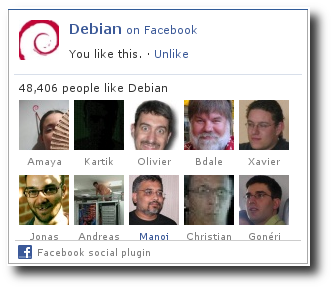
Debian Developers who like Debian on FacebookFacebook is not very popular among free software hackers. When I announced my Facebook page on identi.ca (see here) I got a few replies suggesting it was odd for me to use Facebook. Indeed there are many good reasons why Facebook should be avoided: it is a centralized and proprietary service that is not very privacy-friendly. But the truth is that lots of people are using it (even Debian developers, can you recognize them on the picture?) and some are using their Facebook news feed as their main source of news. You might wonder how many persons that represents, so here are the figures: the Debian Facebook page has 48,361 fans and the Ubuntu one has 247,932 fans. That s right, an announce put on the Debian facebook page would reach more persons than the most popular announce list that Debian is currently running (debian-announce@lists.debian.org has about 29,000 subscribers). Unfortunately that Debian Facebook page is empty and I don t even know who the administrator is. The Ubuntu page on the contrary is properly configured to relay news from The Fridge and Jono Bacon is posting some custom updates from time to time. Debian contributors regularly mention world domination as the ultimate goal of the universal operating system (I even feature this in my blog header banner! :-) ). But working towards world domination means in my opinion that we should communicate our ideals of freedom to as many people as possible, even if they are using a service that we don t want to promote. The Debian social contract acknowledges that some users have to use non-free software and we provide the non-free section for them. In the same spirit, I believe we must have a presence on Facebook. That does not mean that we endorse Facebook, and we should surely promote Joindiaspora once it s usable. But in the mean time we should reach out to Facebook users and allow them to follow us with the platform of their choice. That s the choice I recently made when I decided to setup a public facebook page featuring my free software work, my blog and my book. So if you are a Facebook user, click here to visit my page and click on Like if you want to follow this blog in your Facebook news feed. I also share interesting Debian or Ubuntu related articles that I discover while reading my RSS subscriptions. Below are the usual facebook widgets for the 3 pages quoted in this article (they might not show up if you read this article through an RSS feed):
<iframe allowtransparency="true" frameborder="0" scrolling="no" src="http://www.facebook.com/plugins/likebox.php?id=103161013077063&amp;width=292&amp;connections=0&amp;stream=false&amp;header=false&amp;height=62" style="border:none; overflow:hidden; width:292px; height:62px;"></iframe>
<iframe allowtransparency="true" frameborder="0" scrolling="no" src="http://www.facebook.com/plugins/likebox.php?id=9801962186&amp;width=292&amp;connections=0&amp;stream=false&amp;header=false&amp;height=62" style="border:none; overflow:hidden; width:292px; height:62px;"></iframe>
<iframe allowtransparency="true" frameborder="0" scrolling="no" src="http://www.facebook.com/plugins/likebox.php?id=6723083591&amp;width=292&amp;connections=0&amp;stream=false&amp;header=false&amp;height=62" style="border:none; overflow:hidden; width:292px; height:62px;"></iframe> Flattr this Share/Bookmark 14 comments Support my work

8 September 2010

Roland Mas: Gnus, Dovecot, OfflineIMAP, search: a HOWTO

A long time ago, when I was first introduced to email, I was using the Mail program from Unix. I quickly converted to Elm, then Mutt, which were both better in terms of interface. Then I found out about Gnus, and I wouldn't dream of letting it go now. However, Gnus has started showing its age several times, and several times have I needed to upgrade the way I was using it: first because I needed to sort and split email, then because I took the sorting out of Gnus and into Procmail for more advanced filtering (including spam filtering), then because I switched to storing the emails on an IMAP server so I could read them remotely from several computers. My setup as of a few days ago was functional, but since I have grown over time to splitting emails into several hundred folders, checking for new messages was becoming more and more boring. So it's time to jump in with all the cool kids and switch to a modern solution: still Gnus of course, but with Dovecot, OfflineIMAP for synchronisation, and let's add email searches into the mix while we're at it. My web searches didn't turn up a simple step-by-step HOWTO, but I assembled bits from different places, and here's my attempt at documenting my new setup. Goals Assumptions Dovecot setup We'll use Dovecot as a local IMAP server. And since we're lazy, we'll access it over a pipe, and dispense with the network part. OfflineIMAP setup OfflineIMAP is basically an optimised two-way synchronisation mechanism between two email repositories . We'll use it in IMAP-to-IMAP mode.
 [general]
 accounts = MyAccount
 pythonfile = .offlineimap.py
 [Account MyAccount]
 localrepository = LocalIMAP
 remoterepository = RemoteIMAP
 # autorefresh = 5
 # postsynchook = notmuch new
 [Repository LocalIMAP]
 type = IMAP
 preauthtunnel = MAIL=maildir:$HOME/Maildir /usr/lib/dovecot/imap
 holdconnectionopen = yes
 [Repository RemoteIMAP]
 type = IMAP
 remotehost = mail.example.com
 remoteuser = jsmith
 remotepass = swordfish
 ssl = yes
 nametrans = lambda name: re.sub('^INBOX.', '', name)
 # folderfilter = lambda name: name in [ 'INBOX.important', 'INBOX.work' ]
 # folderfilter = lambda name: not (name in [ 'INBOX.spam', 'INBOX.commits' ])
 # holdconnectionopen = yes
 maxconnections = 3
 # foldersort = lld_cmp
 # Propagate gnus-expire flag
 from offlineimap import imaputil
 def lld_flagsimap2maildir(flagstring):
   flagmap =  '\\seen': 'S',
              '\\answered': 'R',
              '\\flagged': 'F',
              '\\deleted': 'T',
              '\\draft': 'D',
              'gnus-expire': 'E' 
   retval = []
   imapflaglist = [x.lower() for x in flagstring[1:-1].split()]
   for imapflag in imapflaglist:
       if flagmap.has_key(imapflag):
           retval.append(flagmap[imapflag])
   retval.sort()
   return retval
 def lld_flagsmaildir2imap(list):
   flagmap =  'S': '\\Seen',
              'R': '\\Answered',
              'F': '\\Flagged',
              'T': '\\Deleted',
              'D': '\\Draft',
              'E': 'gnus-expire' 
   retval = []
   for mdflag in list:
       if flagmap.has_key(mdflag):
           retval.append(flagmap[mdflag])
   retval.sort()
   return '(' + ' '.join(retval) + ')'
 imaputil.flagsmaildir2imap = lld_flagsmaildir2imap
 imaputil.flagsimap2maildir = lld_flagsimap2maildir
 # Grab some folders first, and archives later
 high = ['^important$', '^work$']
 low = ['^archives', '^spam$']
 import re
 def lld_cmp(x, y):
   for r in high:
       xm = re.search (r, x)
       ym = re.search (r, y)
       if xm and ym:
           return cmp(x, y)
       elif xm:
           return -1
       elif ym:
           return +1
   for r in low:
       xm = re.search (r, x)
       ym = re.search (r, y)
       if xm and ym:
           return cmp(x, y)
       elif xm:
           return +1
       elif ym:
           return -1
   return cmp(x, y)
The first part of this file adds a new flag that OfflineIMAP will propagate back and forth. By default, only the standard IMAP flags are propagated; we also want to synchronize the gnus-expire flag that Gnus uses to mark expirable articles. It's a hack, but it works for now (maybe someday OfflineIMAP will propagate all the flags it finds?). The second part of that file can be dispensed with (and won't be used unless the foldersort option is uncommented in .offlineimaprc): it's only there to ensure that some important folders are propagated first, and some others go last. I don't know exactly how they are sorted by default, but I'd like the most important ones to come first, so I can start reading them while the archives and the spam are still being fetched. Gnus configuration
(require 'offlineimap)
(add-hook 'gnus-before-startup-hook 'offlineimap)
Bonus: email searches The simple way:
(require 'nnir)
This goes in your .gnus. Then your group buffer will get a new command. Mark some folders with #, then M-x gnus-group-make-nnir-group (or use the G G shortcut), and type in a set of keywords. This search is performed by the IMAP server (Dovecot), which may or may not be very efficient, especially if you select many folders. Bonus+: email searches, faster The real cool kids use Notmuch nowadays, at least for email indexing and searching. It's fast, it allows complex queries, and it's generally cool. The downside is that it uses up quite some disk space for its indices, in addition to the actual emails. For that reason I'll keep it to my main computer, and I'll stick to nnir on my laptop (which has the same setup apart from that).
(require 'notmuch)
(add-hook 'gnus-group-mode-hook 'lld-notmuch-shortcut)
(require 'org-gnus)
(defun lld-notmuch-shortcut ()
(define-key gnus-group-mode-map "GG" 'notmuch-search)
)
(defun lld-notmuch-file-to-group (file)
"Calculate the Gnus group name from the given file name.
"
(let ((group (file-name-directory (directory-file-name (file-name-directory file)))))
  (setq group (replace-regexp-in-string ".*/Maildir/" "nnimap+local:" group))
  (setq group (replace-regexp-in-string "/$" "" group))
  (if (string-match ":$" group)
      (concat group "INBOX")
    (replace-regexp-in-string ":\\." ":" group))))
(defun lld-notmuch-goto-message-in-gnus ()
"Open a summary buffer containing the current notmuch
article."
(interactive)
(let ((group (lld-notmuch-file-to-group (notmuch-show-get-filename)))
      (message-id (replace-regexp-in-string
                   "^id:" "" (notmuch-show-get-message-id))))
  (if (and group message-id)
      (progn 
  (switch-to-buffer "*Group*")
  (org-gnus-follow-link group message-id))
    (message "Couldn't get relevant infos for switching to Gnus."))))
(define-key notmuch-show-mode-map (kbd "C-c C-c") 'lld-notmuch-goto-message-in-gnus)
Wrap-up This setup can be replicated on several computers, of course. I have it on two, and there's no reason I couldn't have more. The flags do get propagated back and forth, including the Gnus-specific expirable flag. Accessing the local Dovecot is much faster than going through the DSL to the master IMAP server, and I'm pretty convinced that OfflineIMAP and its multi-threading is also faster than Gnus is, even talking to the same remote server. The email searching with Notmuch is a nice bonus, especially since they're fast too (and this despite my 8-year-old computer). There are a few minor glitches. I can live with them, but I should let you know anyway. Apart from that, I'm pretty happy with this new setup. So I hope this documentation will be useful to others, so I can spread the happiness around. Send your thanks to the authors of the software involved (Gnus, Dovecot, OfflineIMAP, offlineimap.el, Procmail, and so on). Let's see how many years I'll keep that system!

7 September 2010

C.J. Adams-Collier: Debian on Sheeva Plug internal NAND flash

After a bit of work, I got the sheeva plug working the way I wanted it to. First of all, I grabbed a spare 1G USB flash disk I had laying around and installed Debian squeeze to it by following tbm s instructions here: http://www.cyrius.com/debian/kirkwood/sheevaplug/install.html After debian was installed to the USB disk, I removed it from the plug and used dd on my laptop to create an image of the filesystem. I mounted the filesystem as a loopback device and created a jffs2 partition image from it after doing a bit of minor tweaking. I placed the USB disk back in the plug and booted to it. Using this intermediate filesystem and the mtd-tools package, I wrote the new jffs2 image to the NAND mtd device. I then modified the uboot environment to suit, saved, and now have a working setup. Detailed instructions are below. pre-requisites Connect the plug to your network with the rj-45/cat5 cable. Connect a USB flash drive to the plug. I used a 1G drive, but 512M should be sufficient. Install the tftpd package on a machine on your network. You ll also need screen on the machine that you use to connect to the plug s serial terminal. I ll assume these are the same host. You need the IP address of the tftp server. In this example, we will assume that the IP is 192.168.1.2 and that you will assign 192.168.1.200 to the plug. $ sudo apt-get install tftpd screen Place uImage, uInitrd, and uBoot in the /srv/tftp directory: $ sudo wget -O /srv/tftp/uImage http://www.cyrius.com/tmp/beta1/marvell/sheevaplug/uImage
$ sudo wget -O /srv/tftp/uInitrd http://www.cyrius.com/tmp/beta1/marvell/sheevaplug/uInitrd
$ sudo wget -O /srv/tftp/uBoot http://wp.colliertech.org/cj/wp-content/uploads/2010/09/07/uboot.bin Connecting to the serial console We are now ready to boot the plug. Note that you have to be quick with the screen command. I recommend you type it out and get ready to press the enter key. You have to interrupt the bootloader in order to enter the u-boot console. Attach the power and immediately enter the following command: $ screen -S sheeva /dev/ttyUSB0 cs8,ixoff,115200 If you did this right, you should see a prompt like this: Marvell>> update uboot As per tbm s instructions, you can now update the uboot if needed. Instructions for that are here: http://www.cyrius.com/debian/kirkwood/sheevaplug/uboot-upgrade.html I ll put them inline here for completeness.
Marvell>> setenv serverip 192.168.1.2 # IP of your TFTP server
Marvell>> setenv ipaddr 192.168.1.200 # IP of the plug
Marvell>> bubt uboot.bin
be sure to answer n to the question about env parameters. Now reset the device. Don t forget to interrupt the bootloader so we can get back to the prompt:
Marvell>> reset
Let the device know that you will be running a mainline kernel and set the arcNumber:
Marvell>> setenv mainlineLinux yes
Marvell>> setenv arcNumber 2097
Marvell>> saveenv
Marvell>> reset
Install Debian to the USB disk Interrupt the boot process once more. We are now ready to run the debian installer. I ll leave the details as an exercise for the reader. The following should put you into the installer, which you are probably quite familiar with by now. NB: I will assume that you will use a single ext3 partition for the entire system. This will make it easier to build a jffs2 image out of the resultant partition on the USB disk.
Marvell>> setenv serverip 192.168.1.2
Marvell>> setenv ipaddr 192.168.1.147
Marvell>> tftpboot 0x01100000 uInitrd
Marvell>> tftpboot 0x00800000 uImage
Marvell>> setenv bootargs console=ttyS0,115200n8 base-installer/initramfs-tools/driver-policy=most
Marvell>> bootm 0x00800000 0x01100000
build a jffs2 image Once the installation has completed, power down the plug and remove the USB disk. Put the USB disk in the machine you used to get the console on the plug and note what device the kernel assigns to it. In my case, it was given sdc, so debian is installed to /dev/sdc1. I will use these values for this example. If the filesystem was automatically mounted, unmount it. Create a disk image of the partition and mount it as a loopback device.
$ sudo umount /dev/sdc1
$ dd if=/dev/sdc1 of=/tmp/debian.img
$ mkdir /tmp/mnt
$ sudo mount -o loop /tmp/debian.img /tmp/mnt
You can now remove the USB disk and return it to the plug. Modify the /etc/fstab file. The root filesystem will be /dev/mtdblock2 and of fs type jffs2. My fstab file looks like the following:
proc            /proc           proc    defaults        0       0
/dev/mtdblock2 /               jffs2    errors=remount-ro 0       1
We can now create a jffs2 image from the mounted and altered fresh install:
$ sudo mkfs.jffs2 -l \
  -e 0x20000 \
  -X zlib \
  --eraseblock=128KiB \
  --pad \
  --output=/tmp/rootfs.jffs2 \
  --compression-mode=priority \
  -n \
  --squash \
  -r /tmp/mnt
write jffs2 to nand Now that we have an image to flash to the NAND, let s boot off of the USB disk. It should now be attached to the plug. Power on the plug and use screen to get a console. Interrupt the bootloader and enter the following commands:
Marvell>> setenv bootargs_console console=ttyS0,115200
Marvell>> setenv bootcmd_usb 'usb start; ext2load usb 0:1 0x01100000 /boot/uInitrd; ext2load usb 0:1 0x00800000 /boot/uImage'
Marvell>> setenv bootcmd 'setenv bootargs $(bootargs_console); run bootcmd_usb; bootm 0x00800000 0x01100000'
Marvell>> run bootcmd
Log in as root with the credentials you configured during the install. You will need to install a few packages in order to complete the nand flash. You can then ssh to the host on which you created the jffs2 image and cat it to stdout, piping this to nandwrite:
$ sudo apt-get install mtd-utils
$ ssh user@192.168.1.2 cat /tmp/rootfs.jffs2   sudo nandwrite /dev/mtd2 -p -
You now have a jffs2 image on the nand. Configure u-boot One more reboot to set u-boot s environment, and you will be done. Power down and remove the USB disk. Power on and get the serial console using screen. Break into the bootloader and enter the following commands:
Marvell>> setenv bootargs_console console=ttyS0,115200
Marvell>> setenv mtdpartitions mtdparts=orion_mtd:0x400000@0x100000(uImage),0x1fb00000@0x500000(rootfs)
Marvell>> setenv bootargs_root root=/dev/mtdblock2 rw rootfstype=jffs2
Marvell>> setenv bootcmd 'setenv bootargs $(bootargs_console) $(mtdpartitions) $(bootargs_root); nand read.e 0x00800000 0x00100000 0x00400000; bootm 0x00800000'
Marvell>> saveenv
Marvell>> reset
You should now be good to go.

6 September 2010

Ingo Juergensmann: Problems with IPv6 and Bridging/Xen

I've been using IPv6 on my rootserver for some time now. Last week I migrated to a new rootserver and copied my domU/VM instances over to the new hardware. Everything is working fine so far - except IPv6. The network setup is the same as on the old server: the external interface is eth0. The domU/VMs are hooked up to a bridge, called xenbr0. There's another bridge for internal communication: xenbr1. The dom0/Xen host itself seems reachable via IPv6. The /48 subnet is provided by Sixxs and is using a static 6-to-4 tunnel. But the VMs are not reliable reachable, although it is setup in the same way as it was on the old server and where it was working like a charme. The configs of the hosts are these:
Xen dom0
config old server new server
System Debian Etch
2.6.18-6-xen-amd64
linux-image-2.6.18-6-xen-amd64
linux-modules-2.6.18-6-xen-amd64
xen-hypervisor-3.0.3-1-amd64
xen-ioemu-3.0.3-1
xen-linux-system-2.6.18-6-xen-amd64
xen-tools
xen-utils-3.0.3-1
xen-utils-common
Debian Squeeze
2.6.32-5-xen-amd64
libxenstore3.0
linux-image-2.6.32-5-xen-amd64
xen-hypervisor-4.0-amd64
xen-linux-system-2.6.32-5-xen-amd64
xen-tools
xen-utils-4.0
xen-utils-common
xenstore-utils
xenwatch
/etc/sysctl.conf net.ipv4.ip_forward=1
net.ipv6.conf.all.forwarding=1
net.ipv4.conf.default.proxy_arp=1
net.ipv4.ip_forward=1
net.ipv4.ip_syncookies=1
net.ipv4.conf.all.rp_filter=1
net.ipv4.icmp_echo_ignore_broadcasts=1
/etc/xen/xend-config.sxp (network-script network-route)
(vif-script vif-bridge)
(dom0-min-mem 196)
(dom0-cpus 0)
(vif-script vif-bridge)
(network-script network-route)
(dom0-min-mem 196)
(enable-dom0-ballooning yes)
(total_available_memory 0)
(dom0-cpus 2)
(vncpasswd '')
/etc/network/interfaces # device: eth0
auto eth0
iface eth0 inet static
address 85.10.209.30
broadcast 85.10.209.31
netmask 255.255.255.224
up route add -net 85.10.209.0 netmask 255.255.255.224 gw 85.10.209.1 eth0 true
up ip route add 85.10.209.0/28 via 85.10.209.1 src 85.10.209.30 true
up route add default gw 85.10.209.1 true

auto xenbr0
iface xenbr0 inet static
address 85.10.209.30
netmask 255.255.255.224
pre-up brctl addbr xenbr0
up route add -net 78.47.85.144/29 dev xenbr0 true
up ip -6 r a 2001:6f8:90e:145::1/64 via 2001:6f8:90e:1:216:3eff:fe55:197c dev xenbr0 true
up ip -6 r a 2001:6f8:90e:146::1/64 via 2001:6f8:90e:1:216:3eff:fe2f:481d dev xenbr0 true
up ip -6 r a 2001:6f8:90e:147::1/64 via 2001:6f8:90e:1:216:3eff:fe60:68be dev xenbr0 true
up ip -6 r a 2001:6f8:90e:a100::1/64 via 2001:6f8:90e:1:216:3eff:fe70:be dev xenbr0 true

auto xenbr1
iface xenbr1 inet static
address 192.168.x.254
netmask 255.255.255.0
pre-up brctl addbr xenbr1
# some internal IPv4 routing


auto sixxs
iface sixxs inet6 v4tunnel
address 2001:6f8:900:c6e::2
netmask 64
endpoint 212.224.0.188
local 85.10.209.30
ttl 64
up ip link set mtu 1280 dev sixxs true
up ip route add default via 2001:6f8:900:c6e::1 dev sixxs true
up ip -6 route flush dev eth0 true
up ip -6 r a 2001:6f8:90e::/48 dev xenbr0 true
down ip -6 route flush dev sixxs true
# device: eth0
auto eth0
iface eth0 inet static
address 178.63.83.84
broadcast 178.63.83.127
netmask 255.255.255.192
gateway 178.63.83.65
# default route to access subnet
up route add -net 178.63.83.64 netmask 255.255.255.192 gw 178.63.83.65 eth0

auto xenbr0
iface xenbr0 inet static
address 178.63.83.84
netmask 255.255.255.192
pre-up brctl addbr xenbr0
up route add -host 178.63.83.104 dev xenbr0 true
up route add -host 178.63.83.105 dev xenbr0 true
up route add -host 178.63.83.106 dev xenbr0 true
up ip route add 178.63.123.128/26 dev xenbr0 true
up ip -6 r a 2001:6f8:90e:145::1/64 via 2001:6f8:90e:1:216:3eff:fe89:6c31 dev xenbr0 true
up ip -6 r a 2001:6f8:90e:146::1/64 via 2001:6f8:90e:1:216:3eff:fedc:af5f dev xenbr0 true
up ip -6 r a 2001:6f8:90e:147::1/64 via 2001:6f8:90e:1:216:3eff:fe08:8f40 dev xenbr0 true
up ip -6 r a 2001:6f8:90e:a100::1/64 via 2001:6f8:90e:1:216:3eff:fe70:be dev xenbr0 true
auto xenbr1
iface xenbr1 inet static
address 192.168.x.254
netmask 255.255.255.0
pre-up brctl addbr xenbr1
# some internal IPv4 routing
auto sixxs
iface sixxs inet6 v4tunnel
address 2001:6f8:900:c6e::2
netmask 64
endpoint 212.224.0.188
local 178.63.83.84
ttl 64
up ip link set mtu 1280 dev sixxs true
up ip route add default via 2001:6f8:900:c6e::1 dev sixxs true
up ip -6 route flush dev eth0 true
up ip -6 r a 2001:6f8:90e::/48 dev xenbr0 true
down ip -6 route flush dev sixxs true
The config of one of the Xen domUs is this:
sample domU config
config old server new server
system Debian Lenny
2.6.18-6-xen-amd64
Debian Lenny
2.6.32-5-xen-amd64
/etc/sysctl.conf net.ipv4.conf.default.rp_filter=1
net.ipv4.tcp_syncookies=1
net.ipv4.conf.default.forwarding=1
net.ipv6.conf.default.forwarding=1
net.ipv4.conf.eth0.proxy_arp=1
net.ipv4.conf.default.proxy_arp=1
kernel.shmmax=268435456
net.ipv4.conf.default.rp_filter=1
net.ipv4.tcp_syncookies=1
net.ipv4.conf.default.forwarding=1
net.ipv4.conf.all.forwarding=1
net.ipv6.conf.default.forwarding=1
net.ipv4.conf.eth0.proxy_arp=1
net.ipv4.conf.default.proxy_arp=1
kernel.shmmax=268435456
/etc/network/interfaces # The primary network interface
auto eth0
iface eth0 inet static
address 78.47.85.145
netmask 255.255.255.248
up ip route add 85.10.209.0/27 dev eth0
up route add default gw 85.10.209.30 dev eth0
up ip -6 address add 2001:6f8:90e:145::1/64 dev eth0 true
up ip -6 route add default via 2001:6f8:90e:1::1 true
up iptables -t nat -A POSTROUTING -s 192.168.x.96/27 -o eth0 -j MASQUERADE true

iface eth0 inet6 static
address 2001:6f8:90e:145::1
netmask 64
gateway 2001:6f8:90e:1::1 auto eth1
iface eth1 inet static
address 192.168.x.1
netmask 255.255.255.0
# The primary network interface
auto eth0
iface eth0 inet static
address 178.63.83.104
gateway 178.63.83.84
netmask 255.255.255.192
broadcast 178.63.83.127
up ip -6 address add 2001:6f8:90e:145::1/64 dev eth0 true
up ip -6 route add default via 2001:6f8:90e:1::1 src 2001:6f8:90e:1:216:3eff:fe89:6c31 true
up iptables -t nat -A POSTROUTING -s 192.168.x.96/27 -o eth0 -j MASQUERADE true

iface eth0 inet6 static
address 2001:6f8:90e:145::1
netmask 64
gateway 2001:6f8:90e:1::1

auto eth1
iface eth1 inet static
address 192.168.x.1
netmask 255.255.255.0
The dom0 seems to be reachable via IPv6 just perfectly fine. When trying to reach the domU I see packets going through the xenbr0 bridge and reaching the domU eth0 interface. The ICMP6 echo request packets (proto 58) are unanswered there, no echo replies. Strange enough it seems to work from time to time, but mostly not. I've also tried to set a generic default route like ip -6 route add default dev eth0, but still no improvement. Did I miss something when migrating to the new server? Is there any mistake in the configs? Any suggestions are appreciated! :-) UPDATE:
This is a tcpdump from the domU, doing a ping from dom0:
07:35:29.308261 IP6 fe80::e46d:25ff:fe1f:317b > ip6-allnodes: ICMP6, router advertisement, length 56
07:35:29.329411 IP6 gate-hro.ip6.windfluechter.net > vserv.windfluechter.net: ICMP6, echo request, seq 45, length 64
07:35:30.329439 IP6 gate-hro.ip6.windfluechter.net > vserv.windfluechter.net: ICMP6, echo request, seq 46, length 64
07:35:30.451991 IP6 2001:418:4001:3::c657:b0c5 > vserv.windfluechter.net: ICMP6, echo request, seq 52836, length 64
07:35:30.481124 IP6 fe80::e46d:25ff:fe1f:317b > ff02::1:ff70:be: ICMP6, neighbor solicitation, who has 2001:6f8:90e:1:216:3eff:fe70:be, length 32
07:35:31.329906 IP6 gate-hro.ip6.windfluechter.net > vserv.windfluechter.net: ICMP6, echo request, seq 47, length 64
07:35:31.481645 IP6 fe80::e46d:25ff:fe1f:317b > ff02::1:ff70:be: ICMP6, neighbor solicitation, who has 2001:6f8:90e:1:216:3eff:fe70:be, length 32
07:35:32.329284 IP6 gate-hro.ip6.windfluechter.net > vserv.windfluechter.net: ICMP6, echo request, seq 48, length 64
07:35:32.481114 IP6 fe80::e46d:25ff:fe1f:317b > ff02::1:ff70:be: ICMP6, neighbor solicitation, who has 2001:6f8:90e:1:216:3eff:fe70:be, length 32
07:35:33.329951 IP6 gate-hro.ip6.windfluechter.net > vserv.windfluechter.net: ICMP6, echo request, seq 49, length 64
07:35:34.329705 IP6 gate-hro.ip6.windfluechter.net > vserv.windfluechter.net: ICMP6, echo request, seq 50, length 64
UPDATE #2:
The issue is finally solved. The solution can be found here.

Craig Small: psmisc 22.13, gjay 0.3.1-2 and son 2.0

Debian OpenLogo

Image via Wikipedia

Two updates for Debian today.

I'm the upstream for psmisc and 22.13 finally got released, which also meant 22.13-1 Debian package got released too. There was some delay to it (see below why) but it is now out. Unless you run a mips or superH architecture, there is not really any exciting changes, but should make it compile for those two architectures and then at least get the mips buildd underway so the versions all line up.

Secondly, gjay had two minor bug fixes and was updated. If the analysis daemon kept playing music instead of looking at it or the vorbis files were not being recognised, then this new version will help there. The mpg123 command line patch will be rolled into the upstream too.

I'm also working on getting gjay to work with the Exaile player. If you want it to work with your player the easiest thing is to send me patches or code snippets that do the following:
Last of all, my second son was born last week. It's back to those night feeds again and is probably why I've not written as much code as I normally would; but I wouldn't change that either.


<script defer="defer" src="http://static.zemanta.com/readside/loader.js" type="text/javascript"></script>

30 August 2010

Mart&iacute;n Ferrari: Some LaTeX stuff

The last few weeks I have been using LaTex a lot, to write the final report for my master's course. During that period I found a couple of LaTeX goodies that might be interesting to share: the memoir class, gnuplot integration, and some stuff to help preparing cover pages. The memoir class is a kind of all-in-one package. It is meant to be used in place of the book and report classes, but it can also replace simpler environments, such as article. It provides many ready-to-use templates, and loads of commands to easily customize them. It seems to be specially tailored for dead-tree publication, dedicating an entire chapter in the manual to page layout. It also aims at removing the usual cruft you have to add into any medium sized project, it is macro-compatible with: abstract, appendix, array, booktabs, ccaption, chngcntr, chngpage, dcolumn, delarray, enumerate, epigraph, framed, ifmtarg, ifpdf, index, makeidx, moreverb, needspace, newfile, nextpage, parskip, patchcmd, setspace, shortvrb, showidx, tabularx, titleref , titling, tocbibind, tocloft, verbatim, and verse. Furthermore, it provides functionality equivalent to the following packages: crop, fancyhdr, geometry, sidecap, subfigure, titlesec. In the end, you have a project that only needs a couple of packages, and a few customisation commands, which is nice and also eases distribution. Other nice thing I have found is that there is not one, but many ways of merging gnuplot graphs into your text while having LaTeX typeset all the labels. There is some LaTeX packages aimed at this, but I have more success using a special gnuplot terminal. Again, there is more than one option: eepic, epslatex, latex, lua, mp, pslatex, pstex, pstricks, texdraw, and tpic. While I could not try them all, I tried a few and the easiest and prettiest was epslatex. This terminal creates two files: a EPS file, as would have been created with the usual postscript terminal, except that it does not contain any text; and a LaTeX snippet meant to be included with \input foo . Finally, I could generate graphs that match the rest of the document! To end this post, a couple of things about creating the dreaded cover page. First, a suggestion: don't fret too much about finding a ready-made template, once you understood the basics of how to insert arbitrary spaces around text, it is quite easy to roll your own cover! Having said that, the memoir manual has some sample cover pages that can be useful to use as a base, and there is another really useful resource I have found: titlepages.pdf, a collection of 40 sample title pages with source code for you to choose. Tags: Planet Debian, Planet Lugfi, latex

Russell Coker: Interesting Developments in Islamic Culture

Shereen El Feki gave an inspiring TED talk about Islamic youth culture [1]. She shows some interesting exerpts from the 4SHBAB TV network which is known as Islamic MTV , the music video from the US was of particularly high quality while I expect high quality videos to be made in the US I don t generally expect quality Islamic videos from the US (or anywhere else really). She also notes that the videos show a kinder gentler face of Islam . She contrasts that with a clip by Haifa Wehbe [2] a Lebanese pop star who appears to have a lot in common with Britney Spears (Shereen describes her as a pan-Arab pinup-girl ). She cites the comic The 99 which has Islamic super-heros who represent the 99 attributes of Allah. One thing that I found very interesting was that the 99 character Jemi is shown using what is obviously an OLPC. This seems to indicate some very positive trends for the interaction of Islamic culture with the European and American culture which is Christian and Atheist dominated. Kavita Ramdas gave an interesting TED talk about radical women embracing tradition [3]. She highlights a woman who teaches girls to read in Afghanistan based on the religious edict that every Muslim should read the Koran and a Croatian Lesbian choir that sings traditional folk songs. Naif al-Mutawa gave an interesting TED talk about the creation of The 99 [4]. He starts by comparing some of the characters in the Justice League of America to Christian traditions and then describes the back story behind his Islamic super-heroes. His major aim is to provide positive role models for Muslim children. Apparently a cross-over production involving characters from The 99 and the Justice League of America is being developed at the moment Wonder Woman wears clothing that is less revealing than usual though. It s worth noting that Naif is a practicing psychologist who s clients include victims of political torture, so he seems to have some insight into the problems that most people will never have.

29 August 2010

Steve Kemp: Proxies and Robots

I don't like repeating myself, but I'm very tempted to past my mini-review of the Roomba Vacuum Cleaner robot into this blog. Instead I will practise restraint and summerise: 250. Worth. Every. Penny. In more Debian-friendly news I've been fighting HTTP proxies today. I've noticed a lot of visitors to the various websites I host are logged as 127.0.0.1 - which is an irritation. My personal machine looks like this:
Internet -> Apache listening on *:80 -> thttpd on 127.0.0.1:xxxx
(This has been documented previously - primarily it is a security restriction. It means I can run per-UID web-servers.) I had previous added a patch to thttpd to honour the X-Forwarded-For: header - so that it would receive the correct remote address passed on from Apache. However the fact that so many visitors are logged as coming from 127.0.0.1 meant it wasn't working 100% correctly, and I wanted to understand why. Today I used ngrep to capture the incoming headers and the source of the problem became apparent:
skx:~# ngrep  -d lo  X-For ' port 1007'
..
T 127.0.0.1:41886 -> 127.0.0.1:1007 [AP]
  GET /about/ HTTP/1.1..Host: images.steve.org.uk..If-Modified-Since: Mon, 07
   Jun 2010 15:24:33 GMT..User-Agent: Mozilla/5.0 (X11; U; Linux x86_64; en-U
  S; rv:1.9.1.10) Gecko/20100701 Iceweasel/3.5.10 (like Firefox/3.5.10)..Acce
  pt: text/html,application/xhtml+xml,application/xml;q=0.9,*/*;q=0.8..Accept
  -Language: en-us,en;q=0.5..Accept-Encoding: gzip,deflate..Accept-Charset: I
  SO-8859-1,utf-8;q=0.7,*;q=0.7..Referer: http://images.steve.org.uk/2009/11/
  20/img_0471.html..X-Forwarded-For: 127.0.0.1, 11.22.33.123..Cache-Control:
  max-age=0..X-Forwarded-Host: images.steve.org.uk..X-Forwarded-Server: image
  s.steve.org.uk..Connection: Keep-Alive....
I bolded the important input; just in case that didn't jump out it was:
X-Forwarded-For: 127.0.0.1, 11.22.33.123
My patch to thttpd was making it read the first address, rather than the second - which meant that requests were being logged as coming from 127.0.0.1 and avoiding my efforts to track sources. Now I understand the problem - The X-Forwarded-Host header is being tweaked by a proxy server, such as Squid, upstream of my server. For the moment I've updated the thttpd patch to read:
        else if ( strncasecmp( buf, "X-Forwarded-For:", 16 ) == 0 )
            char *tmp = NULL;
            /* Jump to the header-value  */
            cp = &buf[16];
            cp += strspn( cp, " \t" );
            /*
             * If the first change is a 127.0.0.1, then we'll
             * jump over it.  Cope with Squid, et al.
             */
            if (  ( tmp = strstr( cp, "127.0.0.1, " ) ) != NULL )
              cp = tmp + strlen( "127.0.0.1, " );
            /* Parse the IP */
           inet_aton( cp, &(hc->client_addr.sa_in.sin_addr) );
         
That's not perfect, but the alternative would be: Or something equally hacky and security-by-obscurity-alike. Really I just want a simple way of always getting the correct remote IP. Shouldn't be so hard, should it? *pout*. ObQuote: "You don't mess with fate, Peanut. People die when they are meant to die. There's no discussion. There's no negotiation. When life's done, it's done." - Dead Like Me.

26 August 2010

David Paleino: gmtkbabel 0.1

Version 0.1 of gmtkbabel has just been released! :) It consists of a set of shell scripts, which use zenity to give a nice GUI over mtkbabel. gmtkbabel 0.1 Future improvements might include providing a Qt alternative (and the "g" in the name might just mean "GUI" instead of "GTK" then), and whatever users need. It might also become something more serious, written in a more complex language, who knows :) Many thank to Elena of Valhalla'' Grandi, who started this project to help some users on #osm-it@oftc.

24 August 2010

Ian Wienand: Split debugging info -- symbols

In a previous post I mentioned split debugging info. One addendum to this is how symbols are handled. Symbols are separate to debugging info (i.e. the stuff about variable names, types, etc you get when -g is turned on), but necessary for a good debugging experience. You have a choice, however, of where you leave the symbol files. You can leave them in your shipping binary/library so that users who don't have the full debugging info available will still get a back-trace that at least has function names. The cost is slightly larger files for everyone, even if the symbols are never used. This appears to be what Redhat does with it's system libraries, for example. The other option is to keep the symbols in the .debug files along-side the debug info. This results in smaller libraries, but really requires you to have the debug info files available to have workable debugging. This appears to be what Debian does. So, how do you go about this? Well, it depends on what tools you're using. For binutils strip, there is some asynchronicity between the --strip-debug and --only-keep-debug options. --strip-debug will keep the symbol table in the binary, and --only-keep-debug will also keep the symbol table.
$ gcc -g -o main main.c
$ readelf --sections ./main   grep symtab
  [36] .symtab           SYMTAB          00000000 000f48 000490 10     37  53  4
$ cp main main.debug
$ strip --only-keep-debug main.debug 
$ readelf --sections ./main.debug   grep symtab
  [36] .symtab           SYMTAB          00000000 000b1c 000490 10     37  53  4
$ strip --strip-debug ./main
$ readelf --sections ./main.debug   grep symtab
  [36] .symtab           SYMTAB          00000000 000b1c 000490 10     37  53  4
Of course, you can then strip (with no arguments) the final binary to get rid of the symbol table; but other than manually pulling out the .symtab section with objcopy I'm not aware of any way to remove it from the debug info file. Constrast with elfutils; more commonly used on Redhat based system I think. eu-strip's --strip-debug does the same thing; leaves the symtab section in the binary. However, it also has a -f option, which puts any removed sections during the strip into a separate file. Therefore, you can create any combination you wish; eu-strip -f results in an empty binary with symbols and debug data in the .debug file, while eu-strip -g -f results in debug data only in the .debug file, and symbol data retained in the binary. The only thing to be careful about is using eu-strip -g -f and then further stripping the binary, and consequently destroying the symbol table, but retaining debug info. This can lead to some strange things in backtraces:
$ gcc -g -o main main.c
$ eu-strip -g -f main.debug main
$ strip ./main
$ gdb ./main
GNU gdb (GDB) 7.1-debian
...
(gdb) break foo
Breakpoint 1 at 0x8048397: file main.c, line 2.
(gdb) r
Starting program: /home/ianw/tmp/symtab/main
Breakpoint 1, foo (i=100) at main.c:2
      2return i + 100;
(gdb) back
#0  foo (i=100) at main.c:2
#1  0x080483b1 in main () at main.c:6
#2  0x423f1c76 in __libc_start_main (main=Could not find the frame base for "__libc_start_main".
) at libc-start.c:228
#3  0x08048301 in ?? () 
Note one difference between strip and eu-strip is that binutils strip will leave the .gnu_debuglink section in, while eu-strip will not:
$ gcc -g -o main main.c
$ eu-strip -g -f main.debug main
$ readelf --sections ./main  grep debuglink
  [29] .gnu_debuglink    PROGBITS        00000000 000bd8 000010 00      0   0  4
$ eu-strip main
$ readelf --sections ./main  grep debuglink
$ gcc -g -o main main.c
$ eu-strip -g -f main.debug main
$ strip main
$ readelf --sections ./main  grep debuglink
  [27] .gnu_debuglink    PROGBITS        00000000 0005d8 000010 00      0   0  4

23 August 2010

Ingo Juergensmann: Converting AVCHD Videos

When we were going on holiday lately we took some 2-3 hours of videos. It's a Panasonic HDC-SD600 camcorder we bought for that matter. Usually I'm connecting the camera to my Mac and import the videos into iMovie or such. During the holiday I copied the clips to an external USB drive to save the space on the 16 GB SD card. The plan was to copy it back to the card and import it later. This usually works, but somehow it did not for one backup. Sadly iMovie is so dumb that it can't import directly from those file. So I needed another way to import the movies. Kdenlive is able to import the movies as well as Handbrake on OSX is able to convert them. In the end I used ffmpeg on Debian to convert the clips:
for i in *.MTS ; do echo $i ; ffmpeg -i $i -deinterlace -threads 4 -sameq /srv/video/iMovie/ffmpeg/$ i .mp4 ; done
This converts the MTS files from the camera into some MPEG4 format that iMovie is able to import by itself. The quality seems to be ok on a first quick view. Or do I miss something and there's a command switch that will result in better quality? Basically I want the same video and audio quality as the source files have.

4 August 2010

Tim Retout: For future reference

I have a relatively new laptop, and have spent some time today fixing some of the rough edges in my setup. (One day I'll throw all the config files into git, or something, but not yet.)

2 August 2010

John Goerzen: The Best Place of Ever

Jacob and Oliver have enjoyed our recent train trip, and our stay, from Kansas to New York City for Debconf. All told, that s a 40-hour trip, including the layover in Chicago. When we got on the train, in the middle of the night as usual, Jacob couldn t stop chattering about how great , fun , and exciting it is. He told us about all the lots of great things on the train, the fact that we were on a night train , and generally couldn t stop chattering. For an hour. At 3:30AM. This was a typical sight from Jacob: IMG_4284 It wasn t as relaxing as usual for Terah and me. Oliver is at the grabbing everything in sight stage. Which worked fine when Jacob was at the age, but with Jacob also along it was a bit more difficult to manage. I suspect that our next trip, when Oliver is a few months older, will go easier. A highlight for both boys, as usual, is the dining car. Oliver loves anything related to eating solid food it s still novel to him and Jacob loves anything relating to trains. What could go wrong? (Parents will probably identify the capability for two hyper-excited young boys to have plenty of things go wrong at a table in a restaurant here fortunately we didn t have anything go terribly wrong.) Oliver turned out to find the things outside the window to require intense concentration intense enough to stick out his tongue while he worked it all out. IMG_4296 And Jacob, of course, wanted to get the wrapper off his straw by himself. Which he can do, but takes a minute. IMG_4305 They also enjoyed the lounge car. IMG_4292 We were in a sleeper room on both trains. That was nice, and when we needed to go explore , we could. Jacob s favorite part of the trip was when I folded down the upper bunk during the day for him to play. I pointed out that it was like a train treehouse. His face sure lit up. He loved that he had his own window up there to look out of. He climbed up the ladder, and after awhile of playing, said, Dad, would you like to play with me up here? Of course I would it always makes me happy when he asks if I want to play with him. As I was playing with him, I asked him if he was having fun in his train treehouse. He gave me a sweet smile, and said, Dad, this is the best place of ever! IMG_4321 In Chicago, Jacob and I went outside and walked around. He enjoyed walking across the bridges over the canal by Union Station. I checked some work email when we got back, tried but failed to reach some local hams with my handheld, and then we got on the train for New York. The boys loved it too, and Jacob was very ready to be in New York when we got there. We got out at Penn Station which was, I think, pretty much what my mind had imagined of an underground station robbed of its former glory (especially having been in that part of Chicago Union Station). We found the connection to the 2 train uptown, bought some MetroCards for the subway, and got on. Jacob was very interested in the subway. He sat very, very still I thought he was scared but on asking him some questions, realized that he was just very interested and engrossed in it all. I had been trying out my HF antenna for my amateur radio setup a few days ago, and by some coincidence, kept making contact with people that grew up in New York. A guy from Fargo, ND a native of Brooklyn told me to make sure to get pretzels from a hot sauce vendor, Pastrami on rye or corned beef on rye from a Jewish deli (because they have the best meat), pizza from guys wearing red and white shirts, and don t be afraid of rats on the subway tracks, and that our boys will love to feed leftover bits of pretzels to pigeons and squirrels. He got so excited about NYC that he went on and on, saying, Man, you re making me hungry now. During times I m not at sessions at Debconf, we ve found some time to do some things as a family. We went to Grand Central Terminal, just to see it it is indeed still Grand. I knew there was a Jewish deli there, so I thought hey try out his advice. It was closed, and when I realized it was Saturday, I realized why. Oops. We hopped on another train to Brooklyn and checked out the New York Transit Museum, which is great and has a lot of exhibits about the history of the city s subway and bus systems. It s housed in a former subway station, and they have a lot of old subway cars down there dating back to 1905 most of which are open to go inside of. It s been nice to meet people at Debconf that I have only known via email or IRC. The organizers of this conference have done a fabulous job. I have every expectation that this will turn out to be the best conference I ve been to in at least 12 years this is my first Debconf. It doesn t skimp on the technical details, people are friendly, and there is a sense of common purpose. But just as important, while there is a set schedule, there is an easy way to add other ad-hoc sessions to the conference schedule. People can get together a group interested in a topic, and schedule an event about it for the next day very easily. I m quite impressed by that, and am looking forward to the virtualization discussion that grew out of a question to the mailing list. It was also neat to meet people that sort of knew our family from my blog posts. I had no idea that there were all that many people that actually read these things ;-) The Debconf kick-off was great. As I was walking across the campus of Columbia towards it, it was a nice temperature, with some light rain, and I heard bagpipes in the distance. Beautiful. And when I left after the evening sessions, I still heard bagpipes. So I went to check it out, and ran into Gabriella Coleman, one of the Debconf organizers and the person that gave the talk I just left on the way, with the same idea. The Columbia campus is beautiful and historic, and it is an excellent venue for the conference. New York is a great city and I m sure we ll be back. It is great to walk out of the hotel in the morning, buy a fresh peach or two from the street vendor 20 feet away, and then go buy a roll or two ($0.75 each) from the bakery down the street. I have been so missing rolls like that since we got back from Germany in March. These weren t quite like the German bakeries, but the closest I ve had to it. It is interesting to note how differently people from different places look at things. Terah has told several people how we live 6 miles from a town with 500 people in it, and people that stop to think about it realize how different it is from New York. It was a surprise to me to hear that some New Yorkers think of Columbia as country . It is beautifully landscaped, and feels different than the rest of the city. The numbers I ve seen suggest that a typical fall weekday has more people on the Columbia campus than in the entire county where we live. And that county is twice the size of New York City. That s not to say that there s anything wrong with New Yorkers thinking of it as country, any more than there is of me thinking of a town with 15,000 people as a pretty big town. It s a different perspective, and I enjoy different perspectives which is another thing I like about Debconf. There are so many people from all over the world there that different perspectives are inevitable.

1 August 2010

Clint Adams: No time

Some things I intended to work on last week but did not:

Next.

Previous.