Search Results: "edd"

14 March 2015

Dirk Eddelbuettel: littler 0.2.3

max-heap image A new minor release of littler is available now. It adds or extends a number of things: See the littler examples page for more details. Full details for the littler release are provided as usual at the ChangeLog page. The code is available via the GitHub repo, from tarballs off my littler page and the local directory here. A fresh package has gone to the incoming queue at Debian; Michael Rutter will probably have new Ubuntu binaries at CRAN in a few days too. Comments and suggestions are welcome via the mailing list or issue tracker at the GitHub repo.

This post by Dirk Eddelbuettel originated on his Thinking inside the box blog. Please report excessive re-aggregation in third-party for-profit settings.

13 March 2015

Dirk Eddelbuettel: Why Drat? A Guest Post by Steven Pav

Editorial Note: The following post was kindly contributed by Steven Pav.

Why Drat? After playing around with drat for a few days now, my impressions of it are best captured by Dirk's quote:
It just works.

Demo To get some idea of what I mean by this, suppose you are a happy consumer of R packages, but want access to, say, the latest, greatest releases of my distribution package, sadist. You can simply add the following to your .Rprofile file:
drat::add("shabbychef")
After this, you instantly have access to new releases in the github/shabbychef drat store via the package tools you already know and tolerate. You can use
install.package('sadists')
to install the sadists package from the drat store, for example. Similarly, if you issue
update.packages(ask=FALSE)
all the drat stores you have added will be checked for package updates, along with their dependencies which may well come from other repositories including CRAN.

Use cases The most obvious use cases are:
  1. Micro releases. For package authors, this provides a means to get feedback from the early adopters, but also allows one to push small changes and bug fixes without burning through your CRAN karma (if you have any left). My personal drat store tends to be a few minor releases ahead of my CRAN releases.
  2. Local repositories. In my professional life, I write and maintain proprietary packages. Pushing package updates used to involve saving the package .tar.gz to a NAS, then calling something like R CMD INSTALL package_name_0.3.1.9001.tar.gz. This is not something I wanted to ask of my colleagues. With drat, they can instead add the following stanza to .Rprofile: drat:::addRepo('localRepo','file:///mnt/NAS/r/local/drat'), and then rely on update.packages to do the rest.
I suspect that in the future, drat might be (ab)used in the following ways:
  1. Rolling your own vanilla CRAN mirror, though I suspect there are better existing ways to accomplish this.
  2. Patching CRAN. Suppose you found a bug in a package on CRAN (inconceivable!). As it stands now, you email the maintainer, and wait for a fix. Maybe the patch is trivial, but suppose it is never delivered. Now, you can simply make the patch yourself, pick a higher revision number, and stash it in your drat store. The only downside is that eventually the package maintainer might bump their revision number without pushing a fix, and you are stuck in an arms race of version numbers.
  3. Forgoing CRAN altogether. While some package maintainers might find this attractive, I think I would prefer a single huge repository, warts and all, to a landscape of a million microrepos. Perhaps some enterprising group will set up a CRAN-like drat store on github, and accept packages by pull request (whether github CDN can or will support the traffic that CRAN does is another matter), but this seems a bit too futuristic for me now.

My wish list In exchange for writing this blog post, I get to lobby Dirk for some features in drat:
  1. I shudder at the thought of hundreds of tiny drat stores. Perhaps there should be a way to aggregate addRepo commands in some way. This would allow curators to publish their suggested lists of repos.
  2. Drat stores are served in the gh-pages branch of a github repo. I wish there were some way to keep the index.html file in that directory reflect the packages present in the sources. Maybe this could be achieved with some canonical RMarkdown code that most people use.

This post by Dirk Eddelbuettel originated on his Thinking inside the box blog. Please report excessive re-aggregation in third-party for-profit settings.

12 March 2015

Bits from Debian: DebConf15: Call for Proposals

The DebConf Content team is pleased to announce the Call for Proposals for the DebConf15 conference, to be held in Heidelberg, Germany from the 15th through the 22nd of August, 2015. Submitting an Event In order to submit an event, you must be registered as an attendee of DebConf15. If you have any questions about the registration process, please check the related information on the conference website. Once registered, go to "Propose an event" and describe your proposal. Please note, events are not limited to traditional presentations or informal sessions (BoFs). We welcome submissions of tutorials, performances, art installations, debates, or any other format of event that you think would be beneficial to the Debian community. Please include a short title, suitable for a compact schedule, and an engaging description of the event. You should use the field "Notes for Content Team" to provide us information such as additional speakers, scheduling restrictions, or any special requirements we should consider for your event. Regular sessions may either be 20 or 45 minutes long (including time for questions) and will be followed by a 10 or 15 minutes break, respectively. Other kinds of sessions (like workshops) could have different durations. Please make sure to choose the most suitable duration for your event and justify any special requests. Timeline The first batch of accepted proposals will be announced in May. If you depend on having your proposal accepted in order to attend the conference, please submit it as soon as possible so that it can be considered during this first evaluation period. All proposals must be submitted before June 15th, 2015 to be evaluated for the official schedule. Topics and Tracks Though we invite proposals on any Debian or FLOSS related subject, we will have some broad topics arranged as tracks for which we encourage people to submit proposals. The currently proposed list is: If you have ideas for further tracks, or would like to volunteer as a track coordinator, please contact content@debconf.org. In order for a track to take place during DebConf15, we must have received a sufficient amount of proposals on that specific theme. Track coordinators will play an important role in inviting people to submit events. Video Coverage Providing video of sessions amplifies DebConf achievements and is one of the conference goals. Unless speakers opt-out, official events will be streamed live over the Internet to promote remote participation. Recordings will be published later under the DebConf license, as well as presentation slides and papers whenever available. Contact and Thanks to Sponsors DebConf would not be possible without the generous support of all our sponsors, especially our platinum sponsor HP. DebConf15 is still accepting sponsors; if you are interested, please get in touch! You are welcome to contact the Content Team with any concerns about your event, or with any ideas or questions ambout DebConf events in general. You can reach us at content@debconf.org. We hope to see you all in Heidelberg!

11 March 2015

Joey Hess: 7drl 2015 day 5 type directed spell system development

I want my 7drl game Scroll to have lots of interesting spells. So, as I'm designing its spell system, I've been looking at the types, and considering the whole universe of possible spells that fit within the constraints of the types. My first throught was that a spell would be a function from World -> World. That allows any kind of spell that manipulates the game map. Like, for instance a "whiteout" that projects a stream of whitespace from the player's mouth. Since Scroll has a state monad, I quickly generalized that; making spell actions a state monad M (), which lets spells reuse other monadic actions, and affect the whole game state, including the player. Now I could write a spell like "teleport", or "grow". But it quickly became apparent this was too limiting: While spells could change the World map, the player, and even change the list of supported spells, they had no way to prompting for input. I tried a few types of the Event -> M () variety, but they were all too limiting. Finally, I settled on this type for spell actions: M NextStep -> M NextStep. And then I spent 3 hours exploring the universe of spells that type allows! To understand them, it helps to see what a NextStep is:
type Step = Event -> M NextStep
data NextStep = NextStep View (Maybe Step)
Since NextStep is a continuation, spells take the original continuation, and can not only modify the game state, but can return an altered continuation. Such as one that prompts for input before performing the spell, and then calls the original continuation to get on with the game. That let me write "new", a most interesting spell, that lets the player add a new way to cast an existing spell. Spells are cast using ingredients, and so this prompts for a new ingredient to cast a spell. (I hope that "new farming" will be one mode of play to possibly win Scroll.) And, it lets me write spells that fail in game-ending ways. (Ie, "genocide @"). A spell can cause the game to end by returning a continuation that has Nothing as its next step. Even better, I could write spells that return a continuation that contains a forked background task, using the 66 line contiuation based threading system I built in day 3. This allows writing lots of fun spells that have an effect that lasts for a while. Things like letting the player quickly digest letters they eat, or slow down the speed of events. And then I thought of "dream". This spell stores the input continuation and game state, and returns a modified continuation that lets the game continue until it ends, and then restores from the point it saved. So, the player dreams they're playing, and wakes back up where they cast the spell. A wild spell, which can have different variants, like precognitive dreams where the same random numbers are used as will be used upon awaking, or dreams where knowledge carries back over to the real world in different ways. (Supports Inception too..) Look how easy it was to implement dreaming, in this game that didn't have any notion of "save" or "restore"!
runDream :: M NextStep -> M NextStep -> (S -> S) -> M NextStep
runDream sleepcont wakecont wakeupstate = go =<< sleepcont
   where
         go (NextStep v ms) = return $ NextStep v $ Just $
        maybe wake (go <=<) ms
         wake _evt = do
                 modify wakeupstate
                 wakecont
I imagine that, if I were not using Haskell, I'd have just made the spell be an action, that can do IO in arbitrary ways. Such a spell system can of course do everything I described above and more. But, I think that using a general IO action is so broad that it hides the interesting possibilities like "dream". By starting with a limited type for spells, and exploring toward more featureful types, I was able to think about the range of possibilities of spells that each type allowed, be inspired with interesting ideas, and implement them quickly. Just what I need when writing a roguelike in just 7 days!
Fun comment thread on reddit

6 March 2015

Eddy Petri&#537;or: Occasional Rsnapshot v1.3.1

I was writing in the previous post about Occasional Rsnapshot and how I ended up writing it.

Just before releasing v1.2.1 I realized it would make sense Semantic Versioning which, in just a few words means:
Given a version number MAJOR.MINOR.PATCH, increment the:
MAJOR version when you make incompatible API changes,
MINOR version when you add functionality in a backwards-compatible manner, and
PATCH version when you make backwards-compatible bug fixes.
I just released Occasional Rsnapshot v1.3.1 which mainly fixed issue 4:
When deciding to do a backup for interval INT, there should be a check that the oldest snapshot in INT-1 interval is older than the threshold for the INT interval. Otherwise the INT interval will be populated with backups more frequent than desired and it is possible older backups in INT interval to completely lost.
The condition should be:
ts(oldest(INT-1)) - ts(newest(INT)) >= threshold(INT)
For example:
  • if weekly.0 is from 15th of February and daily.6 is from 17th of February, weekly should not be triggered, but
  • if weekly.0 is from 15th of February and daily.6 is from 23rd of February, weekly shall be triggered
This extra check should probably added in can_backup_interval.
It was a small bug, but it might have lead to losing important older backups because newer and more frequent backups would be pushed from hourly, interval by interval up to the yearly interval, in spite of the fact that the distance between backups wouldn't have been respecting the upper interval minimum distance in time.

There was also a small syntax bugfix, but functionally nothing has changed because bash was doing the right thing even with that small error.

If you have started using Occasional Rsnapshot, you definitely want now Occasional Rsnapshot v1.3.1. If you haven't started and you don't have backups, please start doing backups, and while you're at it, you might want to try Occasional Rsnapshot (with Rsnapshot).

Dirk Eddelbuettel: Rcpp 0.11.5

The new release 0.11.5 of Rcpp just reached the CRAN network for GNU R, and a Debian package has also been be uploaded. Rcpp has become the most popular way of enhancing GNU R with C++ code. As of today, 345 packages on CRAN depend on Rcpp for making analyses go faster and further; BioConductor adds another 41 packages, and casual searches on GitHub suggests dozens mores. This release continues the 0.11.* release cycle, adding another large number of small bug fixes, polishes and enhancements. Since the previous release in January, we incorporated a number of pull requests and changes from several contributors. This time, JJ deserves a special mention as he is responsible for a metric ton of the changes listed below, making Rcpp Attributes even more awesome. As always, you can follow the development via the GitHub repo and particularly the Issue tickets and Pull Requests. And any discussions, questions, ... regarding Rcpp are always welcome at the rcpp-devel mailing list. See below for a detailed list of changes extracted from the NEWS file.
Changes in Rcpp version 0.11.5 (2015-03-04)
  • Changes in Rcpp API:
    • An error handler for tinyformat was defined to prevent the assert() macro from spilling.
    • The Rcpp::warning function was added as a wrapper for Rf_warning.
    • The XPtr class was extended with new checked_get and release functions as well as improved behavior (throw an exception rather than crash) when a NULL external pointer is dereferenced.
    • R code is evaluated within an R_toplevelExec block to prevent user interrupts from bypassing C++ destructors on the stack.
    • The Rcpp::Environment constructor can now use a supplied parent environment.
    • The Rcpp::Function constructor can now use a supplied environment or namespace.
    • The attributes_hidden macro from R is used to shield internal functions; the R_ext/Visibility.h header is now included as well.
    • A Rcpp::print function was added as a wrapper around Rf_PrintValue.
  • Changes in Rcpp Attributes:
    • The pkg_types.h file is now included in RcppExports.cpp if it is present in either the inst/include or src.
    • sourceCpp was modified to allow includes of local files (e.g. #include "foo.hpp"). Implementation files (.cc; .cpp) corresponding to local includes are also automatically built if they exist.
    • The generated attributes code was simplified with respect to RNGScope and now uses RObject and its destructor rather than SEXP protect/unprotect.
    • Support addition of the rng parameter in Rcpp::export to suppress the otherwise automatic inclusion of RNGScope in generated code.
    • Attributes code was made more robust and can e.g. no longer recurse.
    • Version 3.2 of the Rtools is now correctly detected as well.
    • Allow 'R' to come immediately after '***' for defining embedded R code chunks in sourceCpp.
    • The attributes vignette has been updated with documentation on new features added over the past several releases.
  • Changes in Rcpp tests:
    • On Travis CI, all build dependencies are installed as binary .deb packages resulting in faster tests.
  • Thanks to CRANberries, you can also look at a diff to the previous release As always, even fuller details are on the Rcpp Changelog page and the Rcpp page which also leads to the downloads page, the browseable doxygen docs and zip files of doxygen output for the standard formats. A local directory has source and documentation too. Questions, comments etc should go to the rcpp-devel mailing list off the R-Forge page.

    This post by Dirk Eddelbuettel originated on his Thinking inside the box blog. Please report excessive re-aggregation in third-party for-profit settings.

    5 March 2015

    Ian Wienand: On VMware and GPL

    I do not believe any of the current reporting around the announced case has accurately described the issue; which I see as a much more subtle question of GPL use across API layers. Of course I don't know what the real issue is, because the case is sealed and I have no inside knowledge. I do have some knowledge of the vmkernel, however, and what I read does not match with what I know. An overview of ESXi is shown below overview of vmkernel and vmkapi There is no question that ESXi uses a lot of Linux kernel code and drivers. The question as I see it is more around the interface. The vmkernel provides a well-described API known as vmkapi. You can write drivers directly to this API; indeed some do. You can download a SDK. A lot of Linux code has been extracted into vmkLinux; this is a shim between Linux drivers and the vmkapi interface. The intent here is to provide an environment where almost unmodified Linux drivers can interface to the proprietary vmkernel. This means vendors don't have to write two drivers, they can re-use their Linux ones. Of course, large parts of various Linux sub-systems' API are embedded in here. But the intent is that this code is modified to communicate to the vmkernel via the exposed vmkapi layer. It is conceivable that you could write a vmkWindows or vmkOpenBSD and essentially provide a shim-wrapper for drivers from other operating systems too. vmkLinux and all the drivers are GPL, and released as such. I do not think there could be any argument there. But they interface to vmkapi which, as stated, is an available API but part of the proprietary kernel. So, as I see it, this is a much more subtle question than "did VMware copy-paste a bunch of Linux code into their kernel". It goes to where the GPL crosses API boundaries and what is considered a derived work. If nothing else, this enforcement increasing clarity around that point would be good for everyone I think.

    4 March 2015

    Simon Josefsson: EdDSA and Ed25519 goes to IETF

    After meeting Niels M ller at FOSDEM and learning about his Ed25519 implementation in GNU Nettle, I started working on a simple-to-implement description of Ed25519. The goal is to help implementers of various IETF (and non-IETF) protocols add support for Ed25519. As many are aware, OpenSSH and GnuPG has support for Ed25519 in recent versions, and OpenBSD since the v5.5 May 2014 release are signed with Ed25519. The paper describing EdDSA and Ed25519 is not aimed towards implementers, and does not include test vectors. I felt there were room for improvement to get wider and more accepted adoption. Our work is published in the IETF as draft-josefsson-eddsa-ed25519 and we are soliciting feedback from implementers and others. Please help us iron out the mistakes in the document, and point out what is missing. For example, what could be done to help implementers avoid side-channel leakage? I don t think the draft is the place for optimized and side-channel free implementations, and it is also not the place for a comprehensive tutorial on side-channel free programming. But maybe there is a middle ground where we can say something more than what we can do today. Ideas welcome!

    1 March 2015

    Robert Edmonds: Converting to --upstream-vcs-tag

    Recently, the Google protobuf developers announced a migration of their project's source code from an svn repository to a git repository. Up until this point, the Debian protobuf package repository had only tracked upstream development by embedding upstream release tarballs using gbp import-orig with pristine-tar. It would be nice to smoothly migrate the packaging repository to additionally make use of the --upstream-vcs-tag option to gbp import-orig, the advantages of which have been well described by Russ Allbery. This turned out to be harder than expected, so for reference I documented the steps I took below. Note that this packaging repository uses the default gbp import-orig repository layout, where upstream sources are placed on a branch named upstream, and the Debian branch is named master. Add an upstream remote configured to track the upstream repository's master branch and tags.
    $ git remote add --tags --track master upstream https://github.com/google/protobuf.git
    
    The upstream remote shouldn't be confused with our upstream branch. Note that git-remotes are local to the repository, so the upstream remote should probably be documented in the debian/README.source file. Fetch the upstream branch and tags.
    $ git fetch upstream
    warning: no common commits
    remote: Counting objects: 5210, done.
    remote: Compressing objects: 100% (861/861), done.
    remote: Total 5210 (delta 3869), reused 5194 (delta 3855)
    Receiving objects: 100% (5210/5210), 3.57 MiB   1.43 MiB/s, done.
    Resolving deltas: 100% (3869/3869), done.
    From https://github.com/google/protobuf
     * [new branch]      master     -> upstream/master
     * [new tag]         v2.6.0     -> v2.6.0
    $
    
    We now have a git-remote upstream, a remote-tracking branch upstream/master which corresponds to the master branch that upstream makes releases from, and a release tag v2.6.0. Note that the remote-tracking branch upstream/master shouldn't be confused with our master branch. Up until this point, our upstream branch has been synthetically generated by importing upstream's release tarballs with gbp import-orig. We need to merge this synthetic history with upstream/master. Unfortunately, I couldn't find a way to do this without using a temporary branch.
    $ git checkout -b tmp upstream/master
    Branch tmp set up to track remote branch master from upstream.
    Switched to a new branch 'tmp'
    $ git merge -s ours -m \
      "Merge the original 'upstream' branch with upstream's new master branch" upstream
    Merge made by the 'ours' strategy.
    $ git checkout upstream
    Switched to branch 'upstream'
    Your branch is up-to-date with 'origin/upstream'.
    $ git merge --ff-only tmp
    Updating 7ed940b..9ba221e
    Fast-forward
     CHANGES.txt                                                          49 +-
     COPYING.txt => LICENSE                                                0
     Makefile.am                                                          64 +-
     Makefile.in                                                        1041 --
     README.txt => README.md                                              49 +-
    [...many more lines...]
    $ git branch -D tmp
    Deleted branch tmp (was 5f18f02).
    $
    
    There are now an additional 400 or so commits on our upstream branch, corresponding to the new git repository history published by upstream. Import the 2.6.0 release tarball against the upstream v2.6.0 tag, using the --upstream-vcs-tag option.
    $ git checkout master
    Switched to branch 'master'
    Your branch is up-to-date with 'origin/master'.
    $ gbp import-orig -u 2.6.0 --upstream-vcs-tag=v2.6.0 ~/debian/tarballs/protobuf_2.6.0.orig.tar.gz
    gbp:info: Importing '/home/edmonds/debian/tarballs/protobuf_2.6.0.orig.tar.gz' to branch 'upstream'...
    gbp:info: Source package is protobuf
    gbp:info: Upstream version is 2.6.0
    pristine-tar: committed protobuf_2.6.0.orig.tar.gz.delta to branch pristine-tar
    gbp:info: Merging to 'master'
    gbp:info: Successfully imported version 2.6.0 of /home/edmonds/debian/tarballs/protobuf_2.6.0.orig.tar.gz
    $
    
    The upstream branch now contains a mixture of the original series of release tarball content imported by plain gbp import-orig and the upstream/master branch as published by upstream. Updating the Debian packaging repository when new upstream releases occur only requires a git fetch to pull down upstream's updated git history and release tag and using the --upstream-vcs-tag option when importing the release tarball with gbp import-orig.

    Dirk Eddelbuettel: drat 0.0.2: Improved Support for Lightweight R Repositories

    A few weeks ago we introduced the drat package. Its name stands for drat R Archive Template, and it helps with easy-to-create and easy-to-use repositories for R packages. Two early blog posts describe drat: First Steps Towards Lightweight Repositories, and Publishing a Package. A new version 0.0.2 is now on CRAN. It adds several new features: Courtesy of CRANberries, there is a comparison to the previous release. More detailed information is on the drat page.

    This post by Dirk Eddelbuettel originated on his Thinking inside the box blog. Please report excessive re-aggregation in third-party for-profit settings.

    28 February 2015

    Dirk Eddelbuettel: RcppEigen 0.3.2.4.0

    A new release of RcppEigen is now on CRAN and in Debian. It synchronizes the Eigen code with the 3.2.4 upstream release, and updates the RcppEigen.package.skeleton() package creation helper to use the kitten() function from pkgKitten for enhanced package creation. The NEWS file entry follows.
    Changes in RcppEigen version 0.3.2.4.0 (2015-02-23)
    • Updated to version 3.2.4 of Eigen
    • Update RcppEigen.package.skeleton() to use pkgKitten if available
    Courtesy of CRANberries, there is also a diffstat report for the most recent release.

    This post by Dirk Eddelbuettel originated on his Thinking inside the box blog. Please report excessive re-aggregation in third-party for-profit settings.

    27 February 2015

    Dirk Eddelbuettel: RcppArmadillo 0.4.650.1.1 (and also 0.4.650.2.0)

    A new Armadillo release 4.650.1 was released by Conrad a few days ago. Armadillo is a powerful and expressive C++ template library for linear algebra aiming towards a good balance between speed and ease of use with a syntax deliberately close to a Matlab. It turned out that this release had one shortcoming with respect to the C++11 RNG initializations in the R use case (where we need to protect the users from the C++98 RNG deemed unsuitable by the CRAN gatekeepers). And this lead to upstream release 4.650.1 which we wrapped into RcppArmadillo 0.4.650.1.1. As before this, was tested against all 107 reverse dependencies of RcppArmadillo on the CRAN repo. This version is now on CRAN, and was just uploaded to Debian. Its changes are summarized below based on the NEWS.Rd file.
    Changes in RcppArmadillo version 0.4.650.1.1 (2015-02-25)
    • Upgraded to Armadillo release Version 4.650.1 ("Intravenous Caffeine Injector")
      • added randg() for generating random values from gamma distributions (C++11 only)
      • added .head_rows() and .tail_rows() to submatrix views
      • added .head_cols() and .tail_cols() to submatrix views
      • expanded eigs_sym() to optionally calculate eigenvalues with smallest/largest algebraic values fixes for handling of sparse matrices
    • Applied small correction to main header file to set up C++11 RNG whether or not the alternate RNG (based on R, our default) is used
    Now, it turns out that another small fix was needed for the corner case of a submatrix within a submatrix, ie V.subvec(1,10).tail(5). I decided not to re-release this to CRAN given the CRAN Repository Policy preference for releases no more than every 1 2 months . But fear not, for we now have drat. I created a drat package repository in the RcppCore account (to not put a larger package into my main drat repository often used via a fork to initialize a drat). So now with these two simple commands
    ## if needed, first install 'drat' via:   install.packages("drat")
    drat:::add("RcppCore")
    update.packages()
    you will get the newest RcppArmadillo via this drat package repository. And course install.packages("RcppArmadillo") would also work, but takes longer to type :) Lastly, courtesy of CRANberries, there is also a diffstat report for the most recent CRAN release. As always, more detailed information is on the RcppArmadillo page. Questions, comments etc should go to the rcpp-devel mailing list off the R-Forge page.

    This post by Dirk Eddelbuettel originated on his Thinking inside the box blog. Please report excessive re-aggregation in third-party for-profit settings.

    25 February 2015

    Eddy Petri&#537;or: Occasional Rsnapshot v1.3.0

    It is almost exactly 1 year and a half since I came up with the idea of having a way of making backups using Rsnapshot automatically triggered by my laptop when I have the backup media connected to my laptop. This could mean connecting a USB drive directly to the laptop or mounting a NFS/sshfs share in my home network. Today I tagged Occasional Rsnapshot the v1.3.0 version, the first released version that makes sure even when you connect your backup media occasionally, your Rsnapshot backups are done if and when it makes sense to do it, according to the rsnapshot.conf file and the status of the existing backups on the backup media.

    Quoting from the README, here is what Occasional Rsnapshot does:

    This is a tool that allows automatic backups using rsnapshot when the external backup drive or remote backup media is connected.

    Although the ideal setup would be to have periodic backups on a system that is always online, this is not always possible. But when the connection is done, the backup should start fairly quickly and should respect the daily/weekly/... schedules of rsnapshot so that it accurately represents history.

    In other words, if you backup to an external drive or to some network/internet connected storage that you don't expect to have always connected (which is is case with laptops) you can use occasional_rsnapshot to make sure your data is backed up when the backup storage is connected.

    occasional_rsnapshot is appropriate for:
    • laptops backing up on:
      • a NAS on the home LAN or
      • a remote or an internet hosted storage location
    • systems making backups online (storage mounted locally somehow)
    • systems doing backups on an external drive that is not always connected to the system
    The only caveat is that all of these must be mounted in the local file system tree somehow by any arbitrary tool, occasional_rsnapshot or rsnapshot do not care, as long as the files are mounted.

    So if you find yourself in a simillar situation, this script might help you to easily do backups in spite of the occasional availability of the backup media, instead of no backups at all. You can even trigger backups semi-automatically when you remember to or decide is time to backup, by simply pulging in your USB backup HDD.

    But how did I end up here, you might ask?

    In December 2012 I was asking about suggestions for backup solutions that would work for my very modest setup with Linux and Windows so I can backup my and my wife's system without worrying about loss of data.

    One month later I was explaining my concept of a backup solution that would not trust the backup server, and leave to the clients as much as possible the decision to start the backup at their desired time. I was also pondering on the problems I might encounter.

    From a security PoV, what I wanted was that:
    1. clients would be isolated from each other
    2. even in the case of a server compromise:
        • the data would not be accessible since they would be already encrypted before leaving the client
        • the clients could not be compromised


      The general concept was sane and supplemental security measures such as port knocking and initiation of backups only during specific time frames could be added.

      The problem I ran to was that when I set up this in my home network a sigle backup cycle would take more than a day, due to the fact that I wanted to do backup of all of my data and my server was a humble Linksys NSLU2 with a 3TB storage attached on USB.

      Even when the initial copy was done by attaching the USB media directly to the laptop, so the backup would only copy changed data, the backup with the HDD attached to the NSLU2 was not finished even after more than 6 hours.

      The bottleneck was the CPU speed and the USB speed. I tried even mounting the storage media over sshfs so the tiny xscale processor in the NSLU2 would not be bothered by any of the rsync computation. This proved to an exercise in futility, any attempt to put the NSLU2 anywhere in the loop resulted in an unacceptable and impractically long backup time.

      All these attempts, of course, took time, but that meant that I was aware I still didn't have appropriate backups and I wasn't getting closer to the desired result.

      So this brings us August 2013, when I realized I was trying to manually trigger Rsnapshot backups from time to time, but having to do all sorts of mental gymnastics and manual listing to evaluate if I needed to do monthly, weekly and daily backups or if weekly and daily was due.

      This had to stop.
      Triggering a backup should happen automatically as soon as the backup media is available, without any intervention from the user.
      I said.

      Then I came up with the basic concept for Occasional Rsnapshot: a very silent script that would be called from cron every 5 minutes, would check if the backup media is mounted, if is not, exit silently to not generate all sorts of noise in cron emails, but if mounted, compute which backup intervals should be triggered, and trigger them, if the appropriate amount of time passed since the most recent backup in that backup interval.

      Occasional Rsnapshot version v1.3.0 is the 8th and most recent release of the script. Even if I used Occasional Rsnapshot since the day 1, v1.3.0 is the first one I can recommend to others, without fearing they might lose data due to it.

      The backup media can be anything, starting from your regular USB mounted HDD, your sshfs mounted backup partition on the home NAS server to even a remote storage such as Amazon S3 online storage, and there are even brief instructions on how to do encrypted backups for the cases where you don't trust the remote storage.

      So if you think you might find anything that I described remotely interesting, I recommend downloading the latest release of Occasional Rsnapshot, go through the README and trying it out.

      Feedback and bug reports are welcome.
      Patches are welcomed with a 'thank you'.
      Pull requests are eagerly waited for :) .

      23 February 2015

      Dirk Eddelbuettel: drat Tutorial: Publishing a package

      Introduction The drat package was released earlier this month, and described in a first blog post. I received some helpful feedback about what works and what doesn't. For example, Jenny Bryan pointed out that I was not making a clear enough distinction between the role of using drat to publish code, and using drat to receive/install code. Very fair point, and somewhat tricky as R aims to blur the line between being a user and developer of statistical analyses, and hence packages. Many of us are both. Both the main point is well taken, and this note aims to clarify this issue a little by focusing on the former. Another point make by Jenny concerns the double use of repository. And indeed, I conflated repository (in the sense of a GitHub code repository) with repository for a package store used by a package manager. The former, a GitHub repository, is something we use to implement a personal drat with: A GitHub repository happens to be uniquely identifiable just by its account name, and given an (optional) gh-pages branch also offers a stable and performant webserver we use to deliver packages for R. A (personal) code repository on the other hand is something we implement somewhere---possibly via drat which supports local directories, possibly on a network share, as well as anywhere web-accessible, e.g. via a GitHub repository. It is a little confusing, but I will aim to make the distinction clearer.

      Just once: Setting up a drat repository So let us for the remainder of this post assume the role of a code publisher. Assume you have a package you would like to make available, which may not be on CRAN and for which you would like to make installation by others easier via drat. The example below will use an interim version of drat which I pushed out yesterday (after fixing a bug noticed when pushing the very new RcppAPT package). For the following, all we assume (apart from having a package to publish) is that you have a drat directory setup within your git / GitHub repository. This is not an onerous restriction. First off, you don't have to use git or GitHub to publish via drat: local file stores and other web servers work just as well (and are documented). GitHub simply makes it easiest. Second, bootstrapping one is trivial: just fork my drat GitHub repository and then create a local clone of the fork. There is one additional requirement: you need a gh-pages branch. Using the fork-and-clone approach ensures this. Otherwise, if you know your way around git you already know how to create a gh-pages branch. Enough of the prerequisities. And on towards real fun. Let's ensure we are in the gh-pages branch:
      edd@max:~/git/drat(master)$ git checkout gh-pages
      Switched to branch 'gh-pages'
      Your branch is up-to-date with 'origin/gh-pages'.
      edd@max:~/git/drat(gh-pages)$ 

      Publish: Run one drat command to insert a package Now, let us assume you have a package to publish. In my case this was version 0.0.1.2 of drat itself as it contains a fix for the very command I am showing here. So if you want to run this, ensure you have this version of drat as the CRAN version is currently behind at release 0.0.1 (though I plan to correct that in the next few days). To publish an R package into a code repository created via drat running on a drat GitHub repository, just run insertPackage(packagefile) which we show here with the optional commit=TRUE. The path to the package can be absolute are relative; the easists is often to go up one directory from the sources to where R CMD build ... has created the package file.
      edd@max:~/git$ Rscript -e 'library(drat); insertPackage("drat_0.0.1.2.tar.gz", commit=TRUE)'
      [gh-pages 0d2093a] adding drat_0.0.1.2.tar.gz to drat
       3 files changed, 2 insertions(+), 2 deletions(-)
       create mode 100644 src/contrib/drat_0.0.1.2.tar.gz
      Counting objects: 7, done.
      Delta compression using up to 8 threads.
      Compressing objects: 100% (7/7), done.
      Writing objects: 100% (7/7), 7.37 KiB   0 bytes/s, done.
      Total 7 (delta 1), reused 0 (delta 0)
      To git@github.com:eddelbuettel/drat.git
         206d2fa..0d2093a  gh-pages -> gh-pages
      edd@max:~/git$ 
      You can equally well run this as insertPackage("drat_0.0.1.2.tar.gz"), then inspect the repo and only then run the git commands add, commit and push. Also note that future versions of drat will most likely support git operations directly by relying on the very promising git2r package. But this just affect package internals, the user-facing call of e.g. insertPackage("drat_0.0.1.2.tar.gz", commit=TRUE) will remain unchanged. And in a nutshell that really is all there is to it. With the newly drat-ed package pushed to your GitHub repository with a single function call), it is available via the automatically-provided gh-pages webserver access to anyone in the world. All they need to do is to point R's package management code (which is built into R itself and used for e.g._ CRAN and BioConductor R package repositories) to the new repo---and that is also just a single drat command. We showed this in the first blog post and may expand on it again in a follow-up. So in summary, that really is all there is to it. After a one-time setup / ensuring you are on the gh-pages branch, all it takes is a single function call from the drat package to publish your package to your drat GitHub repository.

      This post by Dirk Eddelbuettel originated on his Thinking inside the box blog. Please report excessive re-aggregation in third-party for-profit settings.

      21 February 2015

      Dirk Eddelbuettel: RcppAPT 0.0.1

      Over the last few days I put together a new package RcppAPT which interfaces the C++ library behind the awesome apt, apt-get, apt-cache, ... commands and their GUI-based brethren. The package currently implements two functions which permit search for package information via a regular expression, as well as a (vectorised) package name-based check. More to come, and contributions would be very welcome. A few examples just to illustrate follow.
      R> hasPackages(c("r-cran-rcpp", "r-cran-rcppapt"))
         r-cran-rcpp r-cran-rcppapt 
                TRUE          FALSE 
      This shows that Rcpp is (of course) available as a binary, but this (very new) package is (unsurprisingly) not yet available pre-built. We can search by regular expression:
      R> library(RcppAPT)
      R> getPackages("^r-base-c.")
                Package      Installed       Section
      1 r-base-core-dbg 3.1.2-1utopic0 universe/math
      2 r-base-core-dbg           <NA> universe/math
      3     r-base-core 3.1.2-1utopic0 universe/math
      4     r-base-core           <NA> universe/math
      R> 
      With the (default) expression catching everything, we see a lot of packages:
      R> dim(getPackages())
      [1] 104431      3
      R> 
      A bit more information is on the package page here as well as as the GitHub repo.

      This post by Dirk Eddelbuettel originated on his Thinking inside the box blog. Please report excessive re-aggregation in third-party for-profit settings.

      10 February 2015

      Dirk Eddelbuettel: RPushbullet 0.2.0

      A new releases of the RPushbullet package (interfacing the neat Pushbullet service) arrived on CRAN today. It brings several weeks of extensions, corrections and cleanups---with key contributions by Mike Birdgeneau and Henrik Bengtsson. RPushbullet now has support for channels (a reasonably new feature upstream). Setup, initialization and tests all got improved as well. Changes are summarized below based in the extract from the NEWS.Rd file.
      Changes in version 0.2.0 (2015-02-07)
      • Added support for Pushbullet 'channels' (once again thanks to Mike Birdgeneau for the initial push on this)
      • Support for pushes was solidified: proper choices of either device, email or channel should work in all cases
      • S3 methods are now properly exports (thanks to Henrik Bengtsson)
      • File transfer mode has been improved / corrected (thanks to Mike Birdgeneau)
      • The regression test suite was expanded and robustified
      • This NEWS file was added. Better late than never.
      Courtesy of CRANberries, there is also a diffstat report for this release. More details about the package are at the RPushbullet webpage and the RPushbullet GitHub repo.

      This post by Dirk Eddelbuettel originated on his Thinking inside the box blog. Please report excessive re-aggregation in third-party for-profit settings.

      9 February 2015

      Eddy Petri&#537;or: uClibc based toolchain using Gentoo for NSLU2

      I was asked in the previous post why I didn't used the Debian armel port for my NSLU2.

      My intention was to create a uclibc based system (and a uclibc based toolchain) for my NSLU2. This was not obvious in the post because building the uclibc based toolchain resulted in this error:
      crossdev armv5-softfloat-linux-uclibceabi
      [..]/var/tmp/portage/cross-armv5-softfloat-linux-uclibceabi/gcc-4.9.2/work/gcc-4.9.2/libsanitizer/sanitizer_common/sanitizer_platform_limits_posix.cc:67:21: fatal error: wordexp.h: No such file or directory
      #include
      ^
      compilation terminated.
      Makefile:416: recipe for target 'sanitizer_platform_limits_posix.lo' failed
      make[4]: *** [sanitizer_platform_limits_posix.lo] Error 1
      make[4]: *** Waiting for unfinished jobs....

      So, yesterday, to not forget what I did, I tried building a glibc based toolchain and posted that.

      Today, after looking at the offending error, it seems gcc 4.9.2 assumes wordexp.h is always available on non-Android platforms and Gentoo does not make that file availble when installing uclibc.


      I think the problem was introduced in gcc in 2013 with this commit, but I haven't cheked in detail. What I know for sure is that gcc 4.8.3 works at this moment with uclibc and the buildroot guys are still using gcc 4.8.4 in their default uClibc based toolchain. So here it is the command that generated the uClibc based toolchain:

      crossdev --g 4.8.3 armv5-softfloat-linux-uclibceabi

      I hope this helps other people. Yes, I know I should report the issue to GCC/Gentoo after further investigation.

      8 February 2015

      Gregor Herrmann: RC bugs 2015/04-06

      my small contributions around RC bugs during the last weeks:

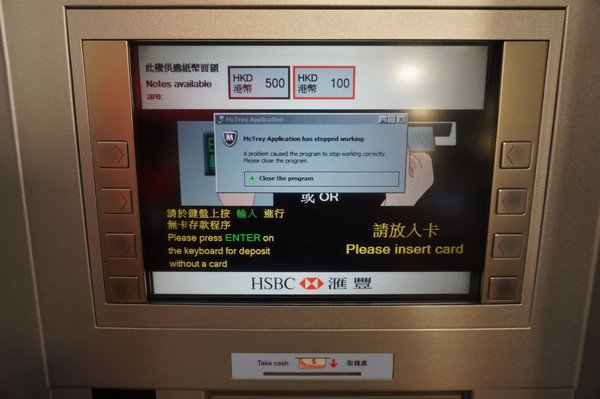
      Steve McIntyre: Yet another reason to not use Windows on your embedded devices...

      Seen on an ATM in Hong Kong airport.

      Broken ATM

      Dirk Eddelbuettel: rfoaas 0.1.3

      A brand new version of rfoaas is now on CRAN. It shadows the 0.1.3 release of FOAAS just how an earlier 0.1.2 had done (but there was something not quite right at the server backend which we coded around with an interim release 0.1.2.1; neither one of these was ever released to CRAN). The rfoaas package provides an interface for R to the most excellent FOAAS service--which provides a modern, scalable and RESTful web service for the frequent need to tell someone to f$#@ off. Release 0.1.3 of FOAAS brings support for filters which the initial support going to the absolutely outstanding shoutcloud.io service. This can be enabled by adding filter="shoutcloud" as an argument to any of the access functions. And thanks to shoutcloud.io, the result will be LOUD AND CLEAR. As usual, CRANberries provides a diff to the previous CRAN release. Questions, comments etc should go to the GitHub issue tracker.

      This post by Dirk Eddelbuettel originated on his Thinking inside the box blog. Please report excessive re-aggregation in third-party for-profit settings.

      Next.

      Previous.