
Search Results: "angel"

24 July 2008

John Goerzen: First 2 Days of OSCon

I'm really enjoying OSCon this year. I've been here two days and just Tuesday afternoon actually went to what I had planned to go to. There's an XMPP summit here (wasn't on the schedule), and I dropped in there a few times. Got one of the XMPP developers to look at my system and figure out why Empathy isn't doing video chat with the N810 right.

Had an OSCon moment yesterday. I was sitting at a table with my laptop, trying to meet up with someone I had only met online before. We were chatting over Jabber. And I realized that person was about 20 feet away. This pattern has repeated itself several times now.

We went to McCormick and Schmick's for dinner. Great seafood and everybody there seemed to really enjoy Jacob too.

The People for Geeks talk was fun. They talked about how geeks tend to apply the tact filter in input, and everybody else on the output, which causes frustration for everyone. Though somebody in the audience asked why that applies to computer geeks but not theater geeks -- an interesting question, and one I wish they had probed a bit more.

I keep running in to interesting people here. One day I was talking to someone about alternatives to cfengine (he suggested parrot). This morning I was talking to someone that works for IBM, who is involved with their project to convert desktop machines to Linux and was interested in how we fared. I've met several people that spot my Haskell ribbon and are interested. One of them told me at breakfast that he heard there is this new Haskell book coming out that's about using Haskell in the real world. Another OSCON momemt when I told him I'm one of the authors of that book. The surprise was fun.

Damian Conway had a great talk Monday night on "how to give a great OSCON talk." I haven't found his slides anywhere.

19 July 2008

Luciano Bello: Exploiting DSA-1571: How to break PFS in SSL with EDH

( I love acronyms :-D )

At this point, all of you should know and see how the H D Moore s toys work. Those toys attack SSH public-key authentication using clone keys and online brute force.

Furthermore, many of you know that there are other effects produced by a biased PRNG besides this one.

Strangely, I could not find more of those toys exploiting these aspects. So, I would like to show you a Wireshark patch which attacks Perfect Forward Secrecy (PFS) provided by Ephemeral Diffie Hellman (EDH).
Introduction to EDHLet s put it in plain words (if you know what we are talking about, ignore this and jump to the next heading):
In an insecure communications channel the parties agree a common key to cipher their dialog. This is what happens in SSL (in most of the cases, depending on the cipher suite):
The exploit If an eavesdropper can explore the complete private key space (the all possible numbers for Xc or Xs), he/she will be able to get access to the shared secret. With it all the communication can be deciphered. That s what this patch can do.

A Wireshark with this patch and a list of possible private keys will try to brute force the share secret. If one of the parties is using the vulnerable OpenSSL package the communication is totally insecure and will be decrypted.


The patch was submitted in order to be committed on the Wireshark trunk. There you can find the patch against the on-develop source revision 25765.
Issues that can be improvedWe (the other developers and myself) detected few things to be improved. But we will do nothing for them. So, if you want to contribute with some code, start from these items and submit the patches to the Wireshark s bugzilla:CreditsPaolo Abeni <paolo.abeni at email.it>
Luciano Bello <luciano at debian.org>
Maximiliano Bertacchini <mbertacchini at citefa.gov.ar>

This work was partially supported by Si6 Labs at CITEFA, Argentina.

UPDATE Jul. 21st: See more and updated info here, especially this.

Luciano Bello: Exploiting DSA-1571: How to break PFS in SSL with EDH

( I love acronyms :-D )

At this point, all of you should know and see how the H D Moore s toys work. Those toys attack SSH public-key authentication using clone keys and online brute force.

Furthermore, many of you know that there are other effects produced by a biased PRNG besides this one.

Strangely, I could not find more of those toys exploiting these aspects. So, I would like to show you a Wireshark patch which attacks Perfect Forward Secrecy (PFS) provided by Ephemeral Diffie Hellman (EDH).
Introduction to EDHLet s put it in plain words (if you know what we are talking about, ignore this and jump to the next tittle):
In an insecure communications channel the parties agree a common key to cipher their dialog. This is what happens in SSL (in most of the cases, depending on the cipher suite):
The exploit If an eavesdropper can explore the complete private key space (the all possible numbers for Xc or Xs), he/she will be able to get access to the share secret. With it all the communication can be deciphered. That s what this patch can do.

A Wireshark with this patch and a list of possible private keys will try to brute force the share secret. If one of the parties is using the vulnerable OpenSSL package the communication is totally insecure and will be decrypted.


The patch was submitted in order to be committed on the Wireshark trunk. There you can find the patch against the on-develop source revision 25765.
Issues that can be improvedWe (the other developers and myself) detected few things to be improved. But we will do nothing for them. So, If you want to contribute with some code, start from these items and submit the patches to the Wireshark s bugzilla:CreditsPaolo Abeni <paolo.abeni at email.it>
Luciano Bello <luciano at debian.org>
Maximiliano Bertacchini <mbertacchini at citefa.gov.ar>

This work was partially supported by Si6 Labs at CITEFA, Argentina.

16 July 2008

Chris Lamb: BTS bot improvements

A little while ago I completely rewrote the #debian-devel-changes IRC bot so it was actually maintainable. At the same time I added some commands suitable for developers, but I didn’t really advertise them anywhere. Here goes.
!bug <bug-number>
Print a one-line synopsis of the specified bug. The parser is fuzzy and will find the bug number embedded in URLs, etc.
!madison <source-package>
Print a colourful rmadison output for the specified package.
!qa <source-package>
!overview <source-package>
Prints the URL of the Debian PTS entry for the specified package.
!changelog <source-package>
Prints a URL containing the most recent debian/changelog file for the specified package.
!copyright <source-package>
Prints a URL containing the most recent debian/copyright file for the specified package.
!bug_graph <source-package>
!buggraph <source-package>
Prints the URL of the bug graph for the specified package.
!buildd <source-package>
Prints the URL of the non-experimental buildd status of the specified package.
!popcon <source-package>
Prints the URL which contains the popularity-contest data for the specified package.
!dehs <source-package>
Prints the URL which contains the Debian External Health Status of the specified package.
Some notes: As always, patches and suggestions welcome. (Source).

Wouter Verhelst: No more 'government'

So apparently the Belgian 'government' has failed to meet its deadline; and as a result, the prime minister has handed in the 'government's resignation to the King. I say 'government', because these people have been doing quite a lot of things—all except governing... I must say I can't be surprised. I never liked Leterme; not before the elections, and not after. Now that more than a year has passed since his winning the elections, they have managed to accomplish exactly nothing. Well, that's not exactly true. There's a pattern here: And even after that horrible track record, CD&V/N-VA is still not willing to put Leterme aside as a candidate for the prime ministry. Now I'm sure some people will tell me that Leterme did indeed, accomplish something, such as the budget agreement of a few days ago. Well, here's a news flash: if you want to get a government set up, then not accomplishing that is pretty critical; something routine and simple as a budget is hardly noteworthy, then. The one thing I do not understand, have never understood, and will not ever understand, is why the larger parties in Belgium feel so compelled to create "cartels" with small extremist fringe parties. They all fell into that trap; VLD (liberals) with Vivant (economic strangelings); CD&V (catholic democrats) with N-VA (flemish nationalists), and SP.A (socialists) with Spirit (left-wing something). I have no trouble understanding why the fringe parties want to do this (gives them power where occasionally they wouldn't have any), but the large parties? It only causes trouble (as the CD&V/N-VA cartel has now proven beyond any doubt); and I seriously doubt it causes them a net win in votes. I could say that some other things about the past deb cle also puzzle me, such as the insistence of some people to get an unconditional split of BHV, thereby destroying all chances of even remotely reaching a compromise; but given the idiocy explained in the previous paragraph, I should hardly be surprised. Sigh. I wish I had some decent politicians in this country; but the people I voted for lost seriously, and were not part of the negotiations. I guess that should mean I have to say: told you so; but then, that's not very productive either. Here's for hoping they can still find some way out of this mess...

John Goerzen: Bicycling to Work Update

Back in May, I wrote about starting to bicycle to work. My plan was to do that 3 days a week. My ride is 10 miles each way, with the first 2.3 miles on dirt, gravel, and sand roads.

It's been going well. Yesterday was the first day that the ride really felt easy. It's been getting more and more fun, too.

And I've been getting faster. My worst time lately was 49 minutes, also yesterday morning. I really was riding slower than I felt normal, just taking it easy. But I had a headwind, and when I started my normal time in calm conditions was 60 minutes or more. That's almost a 20% improvement already.

Due to vacations, holidays, and weather, I haven't been able to average 3 days a week. When it's raining, or has rained recently, our roads get muddy and pretty much impassible on bicycle. Though some days, my ride is 2 miles longer because the short route is too muddy but the long route isn't.

So, overall, I've been enjoying bicycling, and plan to keep doing it.

12 July 2008

John Goerzen: Kernel interrupt weirdness?

I've had a problem with recent kernels. (I think it's the kernel that's doing this.) When my workstation is doing heavy I/O, it repeats keystrokes. For instance, while I was typing this paragraph, audacity was writing audio to disk, and I got this word:

heavvvvvvvvvvvy

It seems as if it thinks I haven't let up on the keys.

I've seen this on two different machines and it seems to have started with 2.6.24 or 2.6.25.

Has anyone else seen this? Any ideas where I'd go to fix it? Incidentally, I'm in X when this happens. I don't use the console much when there would be a chance for it to happen.

This is such a weird problem I've struck out googling, and I'm not even sure which mailing list to take it to.

10 July 2008

John Goerzen: My DNS happiness is complete

I have been using Gandi as my preferred register for some years now. They have probably the most customer-friendly AUP out there, are reliable, and good decent folks. I have liked everything about them.

Except the fact that they don't have whois privacy. But now they do! Woohoo! They did have whois spam protection all along, but your address and phone number was visible to everyone.

Whois privacy services are something that you have to keep a close eye on. What you want is for your name to still show up in the public whois database, but just nothing else. Some whois privacy services put *their* name there, which means technically they own the domain. I wouldn't trust that. Gandi is better about it. Your name, their address and phone number.

Of course, you still have to give Gandi your real contact info, and there are some situations in which it will be revealed. But all in all, I am very happy to see them doing this.

I had looked at other registrars that provided whois privacy, and never liked them for various reasons. Many happened to also have quite restrictive terms of service (hello Dynadot), maybe were good people but had restrictive ToS and crappy interface (register4less), etc.

Now I get to stick with Gandi and get the features I want. I'm very happy with that.

8 July 2008

Russell Coker: Label vs UUID vs Device

Someone asked on a mailing list about the issues related to whether to use a label, UUID, or device name for /etc/fstab. The first thing to consider is where the names come from. The UUID is assigned automatically by mkfs or mkswap, so you have to discover it after the filesystem or swap space has been made (or note it during the mkfs/mkswap process). For the ext2/3 filesystems the command “tune2fs -l DEVICE” will display the UUID and label (strangely mke2fs uses the term “label” while the output of tune2fs uses the term “volume name“). For a swap space I don’t know of any tool that can extract the UUID and name. On Debian (Etch and Unstable) the file command does not display the UUID for swap spaces or ext2/3 filesystems and does not display the label for ext2/3 filesystems. After I complete this blog post I will file a bug report. If you are using a version of Debian earlier than Lenny (or a version of Unstable with this bug fixed) then you will be able to easily determine the label and UUID of a filesystem or swap space. Other than that the inconvenience of determining the UUID and label will be a reason for not using them in /etc/fstab (keep in mind that sys-admin work sometimes needs to be done at 3AM). One problem with mounting by UUID or label is that it doesn’t work well with snapshots and block device backups. If you have a live filesystem on /dev/sdc and an image from a backup on /dev/sdd then there is a lot of potential for excitement when mounting by UUID or label. Snapshots can be made by a volume manager (such as LVM), a SAN, or an iSCSI server. Another problem is that if a file-based backup is made (IE tar or cpio) then you lose the UUID and label. tune2fs allows setting the UUID, but that seems like a potential recipe for disaster. So this means that if mounting by UUID then you would potentially need to change /etc/fstab after doing a full filesystem restore from a file-based backup, this is not impossible but might not be what you desire. Setting the label is not difficult, but it may be inconvenient. When using old-style IDE disks the device names were of the form /dev/hda for the first disk on the first controller (cable) and /dev/hdd for the second disk on the second controller. This was quite unambiguous, adding an extra disk was never going to change the naming. With SCSI disks the naming issue has always been more complex, and which device gets the name /dev/sda was determined by the order in which the SCSI HAs were discovered. So if a SCSI HA which had no disks attached suddenly had a disk installed then the naming of all the other disks would change on the next boot! To make things more exciting Fedora 9 is using the same naming scheme for IDE devices as for SCSI devices, I expect that other distributions will follow soon and then even with IDE disks permanent names will not be available. In this situation the use of UUIDs or LABELS is required for the use of partitions. However a common trend is towards using LVM for all storage, in this case LVM manages labels and UUIDs internally (with some excitement if you do a block device backup of an LVM PV). So LV names such as /dev/vg0/root then become persistent and there is no need for mounting via UUID or label. The most difficult problem then becomes the situation where a FC SAN has the ability to create snapshots and make them visible to the same machine. UUID or label based mounting won’t work unless you can change them when creating the snapshot (which is not impossible but is rather difficult when you use a Windows GUI to create snapshots on a FC SAN for use by Linux systems). I have had some interesting challenges with this in the past when using a FC based SAN with Linux blade servers, and I never devised a good solution. When using iSCSI I expect that it would be possible to force an association between SCSI disk naming and names on the server, but I’ve never had time to test it out. Update: I have submitted Debian bug #489865 with a suggested change to the magic database. Below are /etc/magic entries for displaying the UUID and label on swap spaces and ext2/3 filesystems:
The following magic entry will display the UUID of a swap space as well as displaying the label in the same manner as the mkswap program:
# according to man page of mkswap (8) March 1999
# volume label and UUID Russell Coker
# http://etbe.coker.com.au/2008/07/08/label-vs-uuid-vs-device/
4086 string SWAPSPACE2 Linux/i386 swap file (new style),
>0×400 long x version %d (4K pages),
>0×404 long x size %d pages,
>1052 string \0 no label,
>1052 string >\0 LABEL=%s,
>0×40c belong x UUID=%x
>0×410 beshort x \b-%x
>0×412 beshort x \b-%x
>0×414 beshort x \b-%x
>0×416 belong x \b-%x
>0×41a beshort x \b%x The following magic entry will display the UUID and label (AKA volume name) of an ext2/3/4 filesystem:
# ext2/ext3 filesystems - Andreas Dilger <adilger@dilger.ca>
# ext4 filesystem - Eric Sandeen <sandeen@sandeen.net>
# volume label and UUID Russell Coker
# http://etbe.coker.com.au/2008/07/08/label-vs-uuid-vs-device/
0×438 leshort 0xEF53 Linux
>0×44c lelong x rev %d
>0×43e leshort x \b.%d
# No journal? ext2
>0×45c lelong ^0×0000004 ext2 filesystem data
>>0×43a leshort ^0×0000001 (mounted or unclean)
# Has a journal? ext3 or ext4
>0×45c lelong &0×0000004
# and small INCOMPAT?
>>0×460 lelong <0×0000040
# and small RO_COMPAT?
>>>0×464 lelong <0×0000008 ext3 filesystem data
# else large RO_COMPAT?
>>>0×464 lelong >0×0000007 ext4 filesystem data
# else large INCOMPAT?
>>0×460 lelong >0×000003f ext4 filesystem data
>0×468 belong x \b, UUID=%x
>0×46c beshort x \b-%x
>0×46e beshort x \b-%x
>0×470 beshort x \b-%x
>0×472 belong x \b-%x
>0×476 beshort x \b%x
>0×478 string >0 \b, volume name "%s"
# General flags for any ext* fs
>0×460 lelong &0×0000004 (needs journal recovery)
>0×43a leshort &0×0000002 (errors)
# INCOMPAT flags
>0×460 lelong &0×0000001 (compressed)
#>0×460 lelong &0×0000002 (filetype)
#>0×460 lelong &0×0000010 (meta bg)
>0×460 lelong &0×0000040 (extents)
>0×460 lelong &0×0000080 (64bit)
#>0×460 lelong &0×0000100 (mmp)
#>0×460 lelong &0×0000200 (flex bg)
# RO_INCOMPAT flags
#>0×464 lelong &0×0000001 (sparse super)
>0×464 lelong &0×0000002 (large files)
>0×464 lelong &0×0000008 (huge files)
#>0×464 lelong &0×0000010 (gdt checksum)
#>0×464 lelong &0×0000020 (many subdirs)
#>0×463 lelong &0×0000040 (extra isize)

6 July 2008

Russell Coker: Awful Computers for Kids

I have just observed demonstration units of the V-Smile system [1]. They have “educational games” aimed at ages 3-5, 4-7, and some similar ranges. The first thing I noticed was that children who were able to correctly play the games were a lot older than the designated ages. For example 10yo children were playing the Scooby-Doo addition game (supposedly teaching children to add single-digit numbers) and apparently finding the non-addition part of the game challenging (I tried it myself and found catching flying hamburgers while dodging birds to be challenging enough that it was difficult to find numbers). For children who were in the suggested age-range (and a suitable age for learning the basic lessons contained in the games) the only ones who actually managed to achieve the goals were the ones who were heavily directed by their father. So my observation is that the games will either be used by children who are too old for the basic lessons or be entirely directed by parents (I didn’t observe any mother giving the amount of assistance necessary for a 5yo to complete the games but assume that it happens sometimes). I doubt that there are many children who have the coordination needed for a platform game who have not yet learned to recognise printed letters (as supposedly taught in the Winnie the Pooh game). The Thomas the Tank Engine spelling game had a UI that was strange to say the least (using a joystick not to indicate which direction to go but instead to move a cursor between possible tracks) and I doubt that it does any good at teaching letter recognition. There was also a game that involved using a stylus for tracing the outline of a letter, as I had great difficulty in doing this (due to the poor interface and the low resolution of the touch-pad) it seems very unlikely that a young child who is just learning to write letters would gain anything from it. Strangely there was a game that involved using the touch-pad to indicate matching colors. Recognising matching colors is even easier than recognising letters and I don’t think that a child who can’t recognise the colors would be able to manage the touch-pad. The V-Smile system seems to primarily consist of a console designed for connection to a TV but also has hand-held units that take the same cartridges. The same company produces “laptops” which sell for $50 and have a very low resolution screen and only the most basic functionality (and presumably other useless games). Sometimes the old-fashioned methods are best. It seems that crayons are among the best tools for teaching letter recognition and writing. But if there is a desire to use a computer for teaching, then a regular PC or laptop should do. Letter recognition can be taught by reading the text menus needed to launch games. The variety of computer poker games can be used for recognising matching colors and numbers as can the Mahjong series of games. Counting can be taught through the patience games, and the GIMP can be used for teaching computer graphics and general control of the mouse and the GUI. NB I’m not advocating that all education be done on a computer, merely noting the fact that it can be done better with free software on an open platform than on the proprietary systems which are supposedly designed for education. Finally with a PC children can take it apart! I believe that an important part of learning comes from disassembling and re-building toys. While it’s obvious that a PC is not going to compare with a Lego set, I think it’s good for children (and adults) to know that a computer is not a magic box, it’s a machine that they can understand (to a limited extent) and which is comprised of a number of parts that they could also understand if they wanted to learn the details. This idea is advocated by Gever Tulley advocates such disassembly of household items in his TED talk “5 dangerous things you should let your kids do” [2]. Gever runs The Tinkering School [3] which teaches young children how to make and break things. Finally I just checked some auction sites and noticed that I can get reasonably new second-hand laptops for less than $300. A laptop for $250 running Linux should not be much more expensive than a proprietary laptop that starts at $50 once you include the price of all the extra games. For an older laptop (P3) the price is as low as $100 on an auction with an hour to go. Then of course for really cheap laptops you would buy from a company that is getting new machines for their staff. It’s not uncommon for companies to sell old laptops to employees for $50 each. At a recent LUG meeting I gave away a Thinkpad with a 233MHz Pentium-MMX CPU, 96M of RAM, and a 800*600 color display - by most objective criteria such a machine would be much more capable than one of those kids computers (either V-Smile or a competitor). Of course the OLPC [4] is the ideal solution to such problems. It’s a pity that they are not generally available. I have previously written about the planned design for future OLPC machines [5] which makes it a desirable machine for my own personal use.

John Goerzen: Look out Nebraska, Here Comes Jacob!

img_5195.jpg

This weekend, the three of us got in the car and drove up to Tekamah, NE for Blogstock 08 at Cliff's. That's Jacob when we were stopped at a park halfway there. Sure looks like he's about to do something ornery, doesn't it? I think he looks even more ornery than the photo of Cliff. That's saying something.

We all really enjoyed Blogstock. Ralph, Cliff, and the rest of the Morrows sure know how to have an event. Ralph said that Cliff's BBQ smoked chicken is the best we'll ever have, and he may just have been right.

I'm going to include a few of my photos in this post; you can see all of my 200+ Blogstock photos on Flickr. (In case anyone else uploads Blogstock photos, you might tag them blogstock08).

Jacob had a blast, and I think he took special pleasure in keeping Terah and me busy. I recall saying something like this, all strung together:

"Jacob, please stop throwing dirt at the cat. That cat doesn't like to have dirt thrown on it. Jacob, stop throwing grass on the cat. Jacob, stop hitting the cat. The cat doesn't like to be hit. Can you pet the cat gently like this? Good job! Jacob, stop sitting on the cat. That hurts the cat. Stop throwing dirt at the cat. Would you like to go play in the corn?"

The Morrow cat was the most tolerant cat I've ever seen, and didn't really seem to mind having a toddler sit on its head. However, we noticed this morning that Jacob's legs mysteriously have some scratches that look very much like cat scratches. We didn't see anything happen, and Jacob didn't come crying to us or anything. I suspect the cat found a way to communicate that it doesn't very much like to have someone sit on it. I also suspect that Jacob understood the message.

img_4996.jpg

As for corn -- Jacob loves corn. He first noticed it within the past week or two, and always gets excited when we drove past some. He calls it "koh!", and particularly tall corn is "koh-koh" or "ah-koh". Cliff has tall corn, and when I first asked Jacob if he wanted to see it, he immediately stopped pestering the cat, yelled "KOOHHHHH!!! KOH KOH KOH KOH!!!" and started running towards it. He started by carefully inspecting the corn from the edge of the field. (I can't help but thinking he looks a bit like is great-grandpa Yoder in this picture.) I can almost hear him saying "yep, this corn looks pretty good" in a couple of years.

img_5051.jpg

The real fun begins when you get into the corn, apparently. With a little bit of holding my hand to balance while walking over the rows of dirt, he'd get between the rows of corn and have a blast. That means mainly picking up a full handful of dirt, running to another random corn plant somewhere, throwing the dirt in the general direction of the corn, and cackling like this was the best thing ever. I had to watch out with the camera, because I didn't really care for it to be hit by dirt, and well, I was in the general direction of corn, too.

img_5062.jpg

And, in case you didn't know, having fun in the corn is serious business.

Now, what can a toddler possibly do after playing in the corn, eating some cherries off a tree, and smearing some dirt on his face with cherry juice?

img_5088.jpg

Well, plan his next activity, of course! From the look on his face, it will be another one to keep Terah and me busy.

Jacob seemed to get along really well with everyone. But Ralph said that everytime he came close, Jacob would give him a nasty glare. Here's Ralph holding Jacob. Was this the look, Ralph?
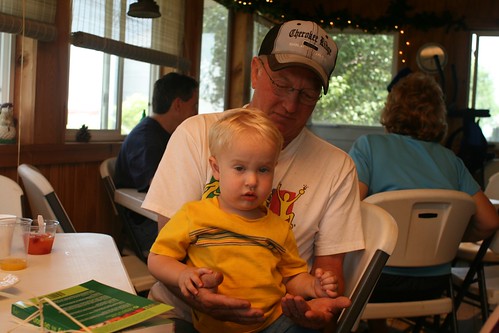
img_5078.jpg

Or maybe it was this:

img_5116.jpg

Friday evening, Cliff and Ralph made up some great hamburgers, hot dogs, and sausages. We all ate under the big tent, and had a nice time visiting. It was sort of an unusual thing -- meeting people you already know for the first time -- but very nice. We left somewhere around 8. Jacob enjoyed the hotel room, too.

img_5027r.jpg

That's Jacob talking on the telephone. Well, I would normally use it as a TV remote, but to Jacob it looks like a phone, so a phone it is. (I can see his point.) This is Jacob answering the phone by saying Hi! Jacob's word for a phone, by the way, is "hi." He'll find a remote by the TV in the room, point to it, and yell "hi!"

Jacob's usual bedtime is 6:30PM. He normally falls asleep fairly easily and sleeps soundly until 6:30AM. Well, we got him in bed well after 6:30PM. Then he made the discovery that the hotel crib/playpen has a mattress that is not attached to the bottom like our mattresses at home are. This was good for at least an hour of excited playing. As Terah and I were trying to sleep, we'd hear these cackles from Jacob's crib, and the noises of a very active boy. I'd peek around and see him using the mattress as a tent, as a peek-a-boo toy, or just as something to throw. I think he fell asleep at about 11.

And woke up promptly at 6:30 on Saturday, just like clockwork, ready to make some phone calls and start the day.

Now, just a tidbit for anyone that doesn't have kids: a toddler, low on sleep, and endless excitement all combine to make for busy parents. Jacob did pretty well, and got in a good long nap in the afternoon. We did take several trips to the corn field.

For most of us, Saturday was a day for brunch, for sitting around and visiting under the tent, for horse rides, and maybe a massage for those that wanted it. Terah got to ride a horse, and Jacob got to ride a pony, too.

For Jacob, it was a day to make new friends, too.
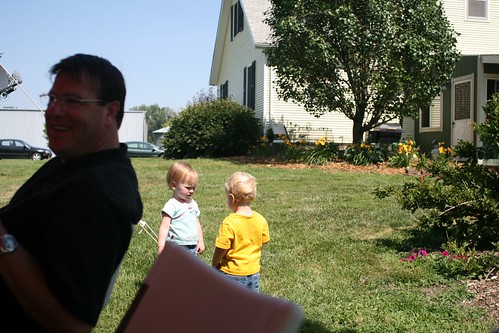
img_5095.jpg

I took this picture just a second after she had given him a hug. I was just a little too slow whipping out the camera.

But when it comes to cherry picking, it's all serious business once again.

img_5098.jpg

Jacob loved eating these sour cherries. At first, he would pick one cherry off the tree, run over to the tent, give it to Terah for her to get the pit out, eat it, then go back to the tree for another one. He must have decided this was inefficient not long after I did. After a few roundtrips, he started trying to get the closest adult, whoever that might be, to pit the cherry for him. When he found one that would do it, he'd keep bringing cherries back to that person.

And then he was under the tree for a long time. Terah and I noticed, and had a conversation about just how many cherry pits it's OK to swallow. But when I checked it out, I found out that Jacob had figured out how to pit cherries himself. He did lose about half a cherry each time he did it, but I guess that was more efficient than pestering adults to do it for him. Though it may have also worked to carry two cherries to the tent at a time.
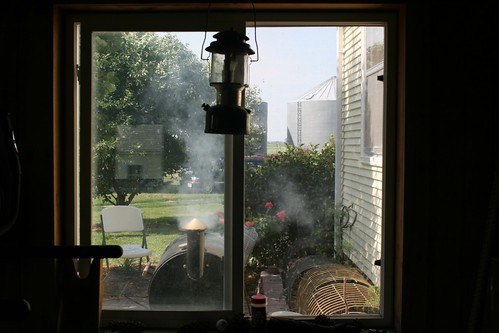
img_5123.jpg

Late in the afternoon, Cliff started up the smoker for the chicken. He had rented a big smoker for the occasion, but it wasn't working, so he made do with his regular smoker, ovens for the corn, and an array of dutch ovens or side grills for everything else. I couldn't keep track of it all, and I was just watching, but somehow it all turned out perfect.
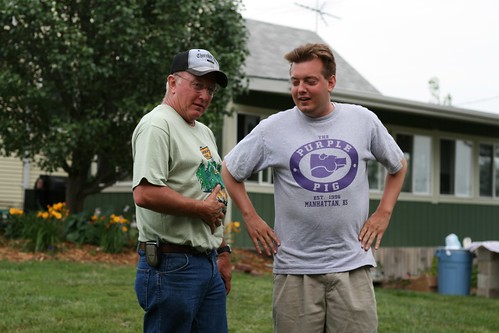
img_5140.jpg

While the chicken was cooking, Ralph and son-of-Ralph (SOR) were having a conversation and patting their bellies. I couldn't hear, and didn't ask questions, so I'm choosing to believe that they were discussing how many pieces of chicken they could eat. When they heard my camera click, Ralph said, "He didn't just take a photo, did he?" Thereby guaranteeing a spot on my blog.

I had the distinction, I think, of being the least-read blogger at Blogstock. I can't quite remember how many times I'd meet someone, and they'd say, "Oh, you're the computer guy, right? I tried reading your blog, but I didn't understand it, sorry!" Completely understandable, I assure you!

After dinner Saturday, we talked about how we got started blogging (hi, Marty and Andy if you're reading), why we were there. Cliff said some very kind things about Terah and me, which really meant a lot.

Later, Cliff told me how Terah showed up in the kitchen with her tray of deviled eggs. Cliff saw them, and said, "Terah, I love you." Later, Cliff said "I love you" to someone else. From the next room, Terah piped up, "What food did she bring?"

Saturday evening, Terah took her horse ride. Jacob was quite tired by that point, and threw a tantrum about not being able to go with mom and ride a horse, too. We were talking about it when Rachel came over. Jacob asked her to pick him up, she did, and he instantly stopped fussing. Maybe it was a "so there" to me, since I had been holding him a minute before, and he took the opportunity to scream in my ear. But in any case, Jacob loved Rachel. She let him sit on a pony, carried him all around the yard, and he managed to hold it together until Terah came back at 9:30.

Saturday evening it was time for goodbyes. We all had a blast and I'm sure we'll do this again. If you weren't there, here's what Blogstock looks like:
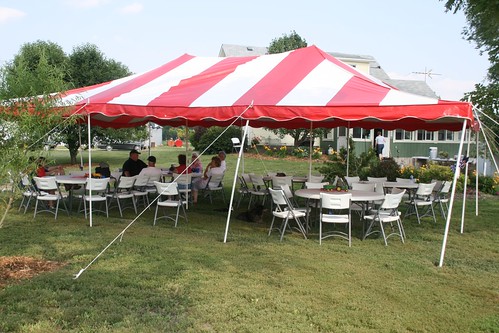
img_4991.jpg

A bunch of friends sitting around chatting under a tent pretty well sums it up.

(There was a full tent of people; some were just elsewhere when this particular photo was taken.)

Jacob shared his thoughts on the whole trip on the way home, too. Well put, Jacob.

img_5202.jpg

3 July 2008

MJ Ray: End of LugRadio!

Just read on Farewell LUGRadio? [theangryangel] and Ashes to ashes, dust to dust... Lugradio is at an end [sungate] that the most famous UK Free Software podcast is ending at the end of this year. I don't know the reasons yet, but it seems a shame. I've been listening again since they proved me wrong and sorted out the dumb licensing terms so it's clearly legal to cut the shows up and only copy the bits that interest me, and Season 5 seems more interesting than previous ones. Then again, I enjoyed Red Dwarf VIII, so what do I know? (but VI and VII did drag a lot) Maybe I will go to Lugradio Live 2008 in Wolverhampton on 19-20 July now I know when it is! (Why is the date only as a large slow graphic on the event page? D'oh! (Yeah I know I should have emailed them, but I had an unfun experience with the show, so I'd rather shout this in public. Wow. I guess I'm still unhappy about them regressing to school playground name-calling.)) There are some suggested alternatives on theangryangel, but most are more Ubuntu-centric (which wasn't a good thing about LR), non-Ogg and/or non-European, so it looks like I'll give LinuxOutlaws a try. Any other recommendations?

John Goerzen: Video uploading sites?

I'm working on switching from using a Mac to using Linux for editing video. I have a mini-DV camcorder that a bought a few years back, and I've been looking at capture and editing software for Linux.

Along with that, I want to post some videos online for family to be able to see I want to preserve the original quality as much as possible, offer the option to download the video, and be able to share some videos with family only (not the entire Internet).

I've been looking at various reviews of video sites (such as this PCWorld one) and decided to look at blip.tv and Vimeo in more detail.

Blip seems to have lots of controls, options, etc. And, they seem to really care about end users, respond fast, and care about freedom. There's an impressive response from their support team concerning Ogg Theora out there. They offer FTP uploads (which are a huge improvement over HTTP POST uploading, in my opinion, and easily scriptable). They can also automatically post your video to archive.org or about a dozen other video or blogging sites.

But what I want to do is not really what they are aiming at. They are set up for "channels" (you can apparently only have one channel per user), and for more professional users. Most notably, you can't make videos private or restricted without paying for their $100/year or so "pro" account.

Vimeo looks very much like the Flickr of video. They do offer various options for restricting who can see a video. When they transcode video to Flash, they have the option of preserving it in HD, which blip.tv doesn't (both go 640x480 or so by default, and blip maximizes out that that). Though both offer the option to download the full, unmodified original. Vimeo has only one option for uploading, and it doesn't seem to work well with Firefox. They have little detail about anything in their docs. Maybe it's more the Photobucket of video than the Flickr of video. (Oh, who am I kidding -- that's Youtube).

Of course, there is Youtube. Maxes out at 320x240, doesn't offer the original for downloading. Doesn't make me think all that positively about them.

I could also use Flickr. I'm not sure if they offer the original, but there's a 90-second limit on uploads there.

Any other thoughts?

1 July 2008

John Goerzen: Linux on the Desktop

Later this month, I will be giving a talk at OSCon about Linux on the corporate desktop -- something we have done where I work. I've been alloted a 45-minute timeslot. I will, of course, be posting my slides online and I think OSCon also posts videos of these things.

I'm wondering if readers of my blog would like to leave me some comments on what you'd like to see. What would you like to know about Linux on the corporate desktop? Is there anything that you'd like to make sure I discuss?

28 June 2008

John Goerzen: A response to "7 Ways Religion is Detrimental to Science"

I read 7 Ways Religion is Detrimental to Science, and thought it would be an interesting read. It was, but I don't think it really made sense. Let's look at the 7 ways they highlighted:

1. Faith and the Scientific Method are Opposites

The article states:

Faith is a belief in an idea regardless of the evidence for or against it.


Actually, that's not true at all, at least for traditional Christianity. (Note that traditional Christianity is not the same as fundamentalism). Marcus J. Borg describes faith in four ways:

Fiducia -- trusting in God. Borg says, "Faith . . . [means] we trust in God as the one upon whom we rely, as our support and foundation and ground, as our safe place."

Fidelitas -- loyalty, or "the comment of the self at its deepest level, the commitment of the 'heart'. Faith as fidelitas does not mean faithfulness to statements about God. . . Fidelitas refers to a radical centering in God."

Visio -- a way of seeing -- "a way of seeing the whole, a way of seeing 'what is'. . . the ability to love and to be present to the moment. It generates a 'willingness to spend and be spent' for the sake of a vision that goes beyond ourselves."

Assensus -- perhaps the closest to what the author meant, is "faith as belief." Borg goes on to add:

The notion that Christian faith is primarily . . . about belief, about a "head" matter, is recent. . . For many, Christian faith began to mean believing questionable things to be true. . . this is the most widespread contemporary understanding of "belief".

This is very different from what faith as assensus meant. . . A deep but humble (and therefore imprecise) understanding of Christian faith as assensus, as involving affirmation of the centrality of God as known in the Bible and Jesus, is very close to faith as vision. It is a way of seeing reality.


As a Christian, I do not find the scientific method to be a problem. I find it to be enlightening in all sorts of matters, including even the history of religion in some instances. Christian faith is not about believing in certain ideas (such as the world being created in 6 literal 24-hour days), though there are those that distort it to be so. Rather, Christian faith is about living your life a certain way, about the meaning of life, about our duties to make the world a better place.

2. People Vote Base on Religious Ideas

The author says that "Stem Cells weren t the first time a body of research didn t get proper funding because some religious wack-jobs." Well, I agree that that was a problem. Non-religious people can vote in odd ways too. I argue that the rejection of stem-cell research goes against Christian teaching; after all, we are to help the least among us, and do not people with Alzheimer's qualify?

I think the author's point should have been "exremists have odd views." Extremists can be atheist, Christian, Muslim, Buddhist, or other religions. Religion does not have a monopoly on them.

3. Religion Removes the Need For Science

The author says:

When people are content to believe in something that explains why they are here, even if it is wrong, they become less interested in other ideas. Religion often leads people to believe that they have all the answers. Science is self-correcting in that nobody assumes they are absolutely correct.


That is incorrect on several levels. First, science cannot explain why we are here. It can explain some of the mechanics. As an example, let us take for granted that modern scientific thought on the origin of humanity is correct: that there was a Big Bang, that single-celled creatures evolved on earth, and that human life eventually evolved through a complex process of evolution and natural selection. Fine; this does not contradict religion in any way. Science and religion answer different questions. Science answers "how". Religion answers "why". Science cannot answer the question "Why was there a big bang?" or "Did the evolution of humanity serve a larger purpose?"

Moreover, religion should not assume that they have all the answers, either. The canonical Christian Bible was mostly fixed within a few centuries AD. Life in 200AD was a lot different from life today. Part of the reason there are many different groups of Christians is the complexity of applying the stories in the Bible to modern life. The ideas in any given denomination evolve over time, too. I think it would be the height of hubris for anyone, religious or not, to claim that he or she had all the answers. Again, I know that some religious people act that way, but then so do some atheists or agnostics.

4. People Lean on Religion, When They Could Benefit From Science

The author of "7 Ways" cites the quite rare case where a child dies of a curable disease while his/her parents pray, refusing medical care. This is an extreme position that is not shared by the vast majority of religious people. Most religious people are perfectly content to use the latest medical care.

Meditation or prayer does not replace medical care; it supplements it. Scientific studies have even demonstrated its effectiveness.

5. The Church Takes Up Natural Resources

The original author states that "The land that churches take up around the world could be used to build schools, homes, recreational buildings and commercial operations." This is perhaps the most frivolous of arguments. Putting aside the fact that many churches operate schools, churches are often one of the few ways that modern city dwellers have to form a sense of community. They are not just places to engage in religion. They are places to meditate, to get away from it all, to meet your neighbors, to vote.

6. The Church Takes Up Monetary Resources

The original author says "if people donated to scientific advancement like they did to the church, imagine where we would be today." It's not a pleasant picture. Religion, and institutions supported primarily because of the teaching of religion, are the people that feed the hungry after natural disasters, that operate food pantries (our church operates the only one in our community, and it's open to anyone without any questions or talk about religion), that operate schools in disadvantaged areas, that have spread the whole idea of fair trade for third-world artisans, etc.

It is true that acts of evil have been committed in the name of the church, too. It is also unquestionably true that some church groups spend money more carefully than others. As with any donation, people should be careful where they give. Government-operated research studies are not necessarily a good use of money, either.

7. Religion is A Strong Meme

The author of the original story seems to be responding to a particular brand of Christianity: what Borg calls "literal-factual" religion. There are quite a few people that take that stand. They are sometimes inaccurately referred to as "evangelicals" or the "religious right"; while there is some overlap between the groups, they are not one and the same. The people with the literal-factual view are not representative of the whole.

More interestingly, Borg points out that the literal-factual view was actually a response to the development of the scientific method during the Enlightenment. As the modern idea of truth moved to literal, factual, provable truth, some Christians grew defensive about their faith, and started to look for "scientific" ways to prove that the world was created in 6 days, etc. in an attempt to show the world that Christianity fit their new notion of truth.

That makes a compelling argument that the scientific method is the stronger meme in today's Western world -- so strong that the author of the rant against religion has apparently forgotten the more prevalant -- both throughout history and today -- view of Christianity that is "more than" Science, not at odds with science.

27 June 2008

John Goerzen: Troops

Back in 1997, long before the days of Youtube, there was a film short called Troops. Troops is about 10 minutes long, and an absolutely hilarious piece of work. It's done in the style of Cops, but set on Tatooine in the Star Wars universe. Many people today credit it with kickstarting the fan film genre and inspiring what has evolved into stars of Youtube.

I remember giving a talk at the Air Capitol Linux Users Group (Wichita, KS). I brought with me my laptop, and had downloaded Troops onto it. I played it for the group. This was at a time when being able to play video on a laptop was something new and interesting, and under Linux no less, even more so. Also, at a time when video of this size may have taken a day to download. Everyone there loved it. I think I used xanim to play it (remember that?)

Anyhow, you can still download that same original file from theforce.net. Or, for the less patient, just watch it here:

26 June 2008

Russell Coker: Kernel Security vs Uptime

For best system security you want to apply kernel security patches ASAP. For an attacker gaining root access to a machine is often a two step process, the first step is to exploit a weakness in a non-root daemon or take over a user account, the second step is to compromise the kernel to gain root access. So even if a machine is not used for providing public shell access or any other task which involves giving user access to potential hostile people, having the kernel be secure is an important part of system security. One thing that gets little consideration is the overall effect of applying security updates on overall uptime. Over the last year there have been 14 security related updates (I count a silent data loss along with security issues) to the main Debian Etch kernel package. Of those 14, it seems that if you don’t use DCCP, NAT for CIFS or SNMP, IA64, the dialout group, then you will only need to patch for issues 2, 3 (for SMP machines), 4, 5, 7 (sound drivers get loaded on all machines by default), 9, 10, 11, 12, 13, and 14. This means 11 reboots a year for SMP machines and 10 a year for uni-processor machines. If a reboot takes three minutes (which is an optimistic assumption) then that would be 30 or 33 minutes of downtime a year due to kernel upgrades. In terms of uptime we talk about the number of “nines”, where the ideal is generally regarded as “five nines” or 99.999% uptime. 33 minutes of downtime a year for kernel upgrades means that you get 99.993% uptime (which is “four nines”). If a reboot takes six minutes (which is not uncommon for servers) then it’s 99.987% uptime (”thee nines”). While it doesn’t seem likely to affect the number of “nines” you get, not using SMP has the potential to avoid future security issues. So it seems that when using a Xen (or other virtualisation technology) assigning only one CPU to the DomUs that don’t need any more could improve uptime for them. For Xen Dom0’s which don’t have local users or daemons, don’t use DCCP, NAT for CIFS or SNMP, wireless, CIFS, JFFS2, PPPoE, bluetooth, H.323 or SCTP connection tracking, then only issue 11 applies. However for “five nines” you need to have 5 minutes of downtime a year or less. It seems unlikely that a busy Xen server can be rebooted in 5 minutes as all the DomUs need to have their memory saved to disk (writing out the data to disk and reading it back in after a reboot will probably take at least a couple of minutes) or they need to be shutdown and booted again after the Dom0 is rebooted (which is a good procedure if the security fix affects both Dom0 and DomU use), and such shutdowns and reboots of DomU’s will take a lot of time. Based on the past year, it seems that a system running as a basic server might get “four nines” if configured for a fast boot (it’s surprising that no-one seems to be talking about recent improvements to the speed of booting as high-availability features) and if the boot is slower then you are looking at “three nines”. For a Xen server unless you have some sort of cluster it seems that “five nines” is unattainable due to reboot times if there is one issue a year, but “four nines” should be easy to get. Now while the 14 issues over the last year for the kernel seems likely to be a pattern that will continue, the one issue which affects Xen may not be representative (small numbers are not statistically significant). I feel confident in predicting a need for between 5 and 20 kernel updates next year due to kernel security issues, but I would not be prepared to bet on whether the number of issues affecting Xen will be 0, 1, or 4 (it seems unlikely that there would be 5 or more). I will write a future post about some strategies for mitigating these issues. Here is my summary of the Debian kernel linux-image-2.6.18-6-686 (Etch kernel) security updates according to it’s changelog, they are not in chronological order, it’s the order of the changelog file:


  1. 05 Jun 2008: CVE-2008-2358 for DCCP and CVE-2008-1673 for ASN.1 (NAT for CIFS and SNMP).

  2. 23 May 2008: CVE-2008-2136 memory leak in IPv6 over IPv4 tunnels, CVE-2007-6712 timer related bugs, CVE-2008-1615 ptrace on AMD64 architecture, and CVE-2008-2137 “Validate address ranges regardless of MAP_FIXED”.

  3. 07 May 2008: CVE-2008-1669 SMP race

  4. 11 Apr 2008: CVE-2007-6694 PPC only, CVE-2008-0007 Add VM_DONTEXPAND to vm_flags in drivers that register a fault handler but do not bounds check the offset argument, CVE-2008-1294 prevent user escape from RLIMIT_CPU, and CVE-2008-1375 fix dnotify race.

  5. 10 Feb 2008: CVE-2008-0010 and CVE-2008-0600 Fix missing access check in vmsplice.

  6. 25 Jan 2008: Not a security issue, but silent data loss on IA64.

  7. 22 Jan 2008: CVE-2007-6151 ISDN memory overrun, CVE-2008-0001 something related to checking the access to a directory, CVE-2007-2878 FAT filesystem related, CVE-2007-4571 ALSA bug that allows user to read kernel memory.

  8. 17 Sep 2007: Fix minor DOS attack for slightly privileged users (EG members of dialout group).

  9. 18 Dec 2007: CVE-2007-6063 overflows in ISDN subsystem, CVE-2007-6206 core dumping over an existing file can get the wrong ownership (should be possible to use kernel.core_pattern to work around this [1]), CVE-2007-5966 timer issue, CVE-2006-6058 Minix fs DOS attack via corrupted fs, and CVE-2007-6417 tmpfs memory leak.

  10. 29 Nov 2007: CVE-2007-3104 local kernel DOS attack (Oops), CVE-2007-4997 malicious frame on wireless interface crashes system, CVE-2007-5500 potential system hang, and CVE-2007-5904 CIFS overflows from server sending corrupt data.

  11. 02 Oct 2007: CVE-2007-4573 Xen 64bit with 32bit DomU, CVE-2006-5755 Xen, CVE-2007-4133 memory management DOS, and CVE-2007-5093 DOS when unplugging a webcam that is in use.

  12. 25 Sep 2007: CVE-2007-3731 ptrace causing Oops, CVE-2007-3739 memory management Oops, CVE-2007-3740 CIFS not honoring umask, CVE-2007-4573 ptrace of 32bit process on AMD64 bug, and CVE-2007-4849 JFFS2 (flash media) filesystem bug.

  13. 27 Aug 2007: CVE-2007-2172 IPv4 memory related issue (local DOS or compromise?), CVE-2007-2875 local user can read kernel memory if cpuset filesystem is mounted, CVE-2007-3105 buffer overflow in random number generator, CVE-2007-3843 CIFS, and CVE-2007-4308 AAC RAID.

  14. 11 Aug 2007: CVE-2007-1353 bluetooth, CVE-2007-3513 usblcd, CVE-2007-2525 PPPoE, CVE-2007-3642 H.323 connection tracking, CVE-2007-2172 IPv4 local exploit, CVE-2007-2453 slightly less random numbers, CVE-2007-2876 SCTP connection tracking, CVE-2007-3851 i965 batch buffer usage, and CVE-2007-3848 potential privilege escalation.

Neil Williams: Migrating Emdebian changes into Debian, not Ubuntu

During the Emdebian Worksession at TCl, various improvements were made to dpkg-cross, apt-cross and emdebian-tools packages. After a few delays caused by (what turned out to be) a 4 extension cable that blew up 300 of equipment, I'm finally merging those changes into the Debian packages - yet I don't have any control over the same changes in Ubuntu.

I really don't like Launchpad (I have quite enough web-logins thank you very much) or the PTS link that shows Ubuntu bugs that I cannot close from Debian. Lucas' assurance that "I don't expect Debian maintainers to reply to bugs on launchpad", makes it even harder to see the point of the bug listed in the emdebian-tools PTS.


Makes me wonder if a Not-For-Ubuntu field could be used in debian/control to force the removal of Debian packages from Ubuntu Universe where the Ubuntu setup is simply incompatible with the Debian package. This isn't something that the MOTD can "patch-up" in Ubuntu - it is a fundamental difference between Debian and Ubuntu that goes right back to the roots of why Ubuntu was created in the first place.

Yes, I can ignore Ubuntu (already do) but it is still annoying that there are bugs that simply cannot be fixed (and that the Debian PTS reminds me of that fact).

Maybe if someone who does care about such things and has a Ubuntu launchpad login wants to close the bug as "wontfix" or equivalent . . .
https://bugs.launchpad.net/ubuntu/+source/emdebian-tools/+bug/121369 - just to clear it off my radar?

(Oh and why does LP insist on https??? I'm not logged in, that's the entire POINT!) Bah.

20 June 2008

Cameron Dale: DebTorrent 0.1.7: Long-Lived Torrents for Testing/Unstable

This new version of DebTorrent finalizes the work I previously uploaded to experimental. This new version is the first in unstable to use unique piece numbers to create long-lived torrents for testing and unstable. It also comes with a new version of the apt-transport-debtorrent package, which can now tell APT not to cache any package files downloaded with DebTorrent, which should save some disk space for some people. The locations of the long-lived torrent files and piece files that DebTorrent uses has also changed, as they are now hosted on my merkel page and should be more up to date. However, I was not able to get the ssh trigger for the sync from ftp-master setup, nor am I able to access the projectb database through pygresql. If anyone knows how I can get those working, please email me. Here is the changelog for debtorrent: And for apt-transport-debtorrent:

11 June 2008

Russell Coker: Perpetual Motion

It seems that many blog posts related to fuel use (such as my post from yesterday about record oil prices [1]) are getting adverts about perpetual motion [2]. Note that the common usage of the term “Perpetual Motion” does not actually require something to move. A battery that gives out electricity forever would be regarded as fitting the description, as does any power source which doesn’t have an external source of energy. The most common examples of this are claims about Oxyhydrogen [3], this is a mixture of hydrogen and oxygen in a 2:1 ratio. The wikipedia page is interesting, apparently oxyhydrogen is used for welding metals, glass, and plastics, and it was also used to heat lime to provide theatrical lighting (”lime light”). So a mixture of hydrogen and oxygen does have real-world uses. The fraud comes in the issue of the claims about magnecules [4]. Magnecules are supposedly the reason for the “atomic” power of HHO gas (AKA Oxyhydrogen) which are repeated on many web sites. In brief, one mad so-called scientist (of course if he was a real scientist he would have experimental evidence to support his claims and such experiments would be repeatable) has invented entirely new areas of science, one of which involves magnetic bonds between atoms. He claims that such chemical species can be used to obtain free energy. The idea is that you start with water, end with water plus energy - then reuse the water in a closed system. Strangely the web sites promoting water fueled cars don’t seem to mention magnecules and just leave the “atomic energy” claim with no support - maybe magnecules are simply too crazy for them. The water fuelled car wikpedia page is interesting - it lists five different ways that water can actually be used in a car engine (which are based on sound scientific principles and which have been tested) and compares them to the various water fueled car frauds [5]. I’m not accepting any more comments on my blog about perpetual motion solutions to the petrol crisis (they just take up valuable space and distract people who want to discuss science). I’ll allow some comments about such things on this post though.

Next.

Previous.