Search Results: "agi"

5 October 2017

Ross Gammon: My FOSS activities for August & September 2017

I am writing this from my hotel room in Bologna, Italy before going out for a pizza. After a successful Factory Acceptance Test today, I might also allow myself to celebrate with a beer. But anyway, here is what I have been up to in the FLOSS world for the last month and a bit. Debian
  • Uploaded gramps (4.2.6) to stretch-backports & jessie-backports-sloppy.
  • Started working on the latest release of node-tmp. It needs further work due to new documentation being included etc.
  • Started working on packaging the latest goocanvas-2.0 package. Everything is ready except for producing some autopkgtests.
  • Moved node-coffeeify experimental to unstable.
  • Updated the Multimedia Blends Tasks with all the latest ITPs etc.
  • Reviewed doris for Antonio Valentino, and sponsored it for him.
  • Reviewed pyresample for Antonio Valentino, and sponsored it for him.
  • Reviewed a new parlatype package for Gabor Karsay, and sponsored it for him.
Ubuntu
  • Successfully did my first merge using git-ubuntu for the Qjackctl package. Thanks to Nish for patiently answering my questions, reviewing my work, and sponsoring the upload.
  • Refreshed the gramps backport request to 4.2.6. Still no willing sponsor.
  • Tested Len s rewrite of ubuntustudio-controls, adding a CPU governor option in particular. There are a couple of minor things to tidy up, but we have probably missed the chance to get it finalised for Artful.
  • Tested the First Beta release of Ubuntu Studio 17.10 Artful and wrote the release notes. Also drafted my first release announcement on the Ubunti Studio website which Eylul reviewed and published.
  • Refreshed the ubuntustudio-meta package and requested sponsorship. This was done by Steve Langasek. Thanks Steve.
  • Tested the Final Beta release of Ubuntu Studio 17.10 Artful and wrote the release notes.
  • Started working on a new Carla package, starting from where V ctor Cuadrado Juan left it (ITP in Debian).

Wouter Verhelst: Patching Firefox

At work, I help maintain a smartcard middleware that is provided to Belgian citizens who want to use their electronic ID card to, e.g., log on to government websites. This middleware is a piece of software that hooks into various browsers and adds a way to access the smartcard in question, through whatever APIs the operating system and the browser in question provide for that purpose. The details of how that is done differ between each browser (and in the case of Google Chrome, for the same browser between different operating systems); but for Firefox (and Google Chrome on free operating systems), this is done by way of a PKCS#11 module. For Firefox 57, mozilla decided to overhaul much of their browser. The changes are large and massive, and in some ways revolutionary. It's no surprise, therefore, that some of the changes break compatibility with older things. One of the areas in which breaking changes were made is in the area of extensions to the browser. Previously, Firefox had various APIs available for extensions; right now, all APIs apart from the WebExtensions API are considered "legacy" and support for them will be removed from Firefox 57 going forward. Since installing a PKCS#11 module manually is a bit complicated, and since the legacy APIs provided a way to do so automatically provided the user would first install an add-on (or provided the installer of the PKCS#11 module sideloads it), most parties who provide a PKCS#11 module for use with Firefox will provide an add-on to automatically install it. Since the alternative involves entering the right values in a dialog box that's hidden away somewhere deep in the preferences screen, the add-on option is much more user friendly. I'm sure you can imagine my dismay when I found out that there was no WebExtensions API to provide the same functionality. So, after asking around a bit, I filed bug 1357391 to get a discussion started. While it took some convincing initially to get people to understand the reasons for wanting such an API, eventually the bug was assigned the "P5" priority -- essentially, a "we understand the need and won't block it, but we don't have the time to implement it. Patches welcome, though" statement. Since having an add-on was something that work really wanted, and since I had the time, I got the go-ahead from management to look into implementing the required code myself. I made it obvious rather quickly that my background in Firefox was fairly limited, though, and so was assigned a mentor to help me through the process. Having been a Debian Developer for the past fifteen years, I do understand how to develop free software. Yet, the experience was different enough that still learned some new things about free software development, which was somewhat unexpected. Unfortunately, the process took much longer than I had hoped, which meant that the patch was not ready by the time Firefox 57 was branched off mozilla's "central" repository. The result of that is that while my patch has been merged into what will eventually become Firefox 58, it looks strongly as though it won't make it into Firefox 57. That's going to cause some severe headaches, which I'm not looking forward to; and while I can certainly understand the reasons for not wanting to grant the exception for the merge into 57, I can't help but feeling like this is a missed opportunity. Anyway, writing code for the massive Open Source project that mozilla is has been a load of fun, and in the process I've learned a lot -- not only about Open Source development in general, but also about this weird little thing that Javascript is. That might actually be useful for this other project that I've got running here. In closing, I'd like to thank Tomislav 'zombie' Jovanovic for mentoring me during the whole process, without whom it would have been doubtful if I would even have been ready by now. Apologies for any procedural mistakes I've made, and good luck in your future endeavours! :-)

4 October 2017

Steve Kemp: Tracking aircraft in real-time, via software-defined-radio

So my last blog-post was about creating a digital-radio, powered by an ESP8266 device, there's a joke there about wireless-control of a wireless. I'm not going to make it. Sticking with a theme this post is also about radio, software-defined radio. I know almost nothing about SDR, except that it can be used to let your computer "do stuff" with radio. The only application I've ever read about that seemed interesting was tracking aircraft. This post is about setting up a Debian GNU/Linux system to do exactly that, show aircraft in real-time above your head! This was almost painless to setup. So I bought this USB device from AliExpress for the grand total of 8.46. I have no idea if that URL is stable, but I suspect it is probably not. Good luck finding something similar if you're living in the future! Once I connected the Antenna to the USB stick, and inserted it into a spare slot it showed up in the output of lsusb:
  $ lsusb
  ..
  Bus 003 Device 043: ID 0bda:2838 Realtek Semiconductor Corp. RTL2838 DVB-T
  ..
In more detail I see the major/minor numbers:
  idVendor           0x0bda Realtek Semiconductor Corp.
  idProduct          0x2838 RTL2838 DVB-T
So far, so good. I installed the development headers/library I needed:
  # apt-get install librtlsdr-dev libusb-1.0-0-dev
Once that was done I could clone antirez's repository, and build it:
  $ git clone https://github.com/antirez/dump1090.git
  $ cd dump1090
  $ make
And run it:
  $ sudo ./dump1090 --interactive --net
This failed initially as a kernel-module had claimed the device, but removing that was trivial:
  $ sudo rmmod dvb_usb_rtl28xxu
  $ sudo ./dump1090 --interactive --net
Once it was running I'd see live updates on the console, every second:
  Hex    Flight   Altitude  Speed   Lat       Lon       Track  Messages Seen       .
  --------------------------------------------------------------------------------
  4601fc          14200     0       0.000     0.000     0     11        1 sec
  4601f2          9550      0       0.000     0.000     0     58        0 sec
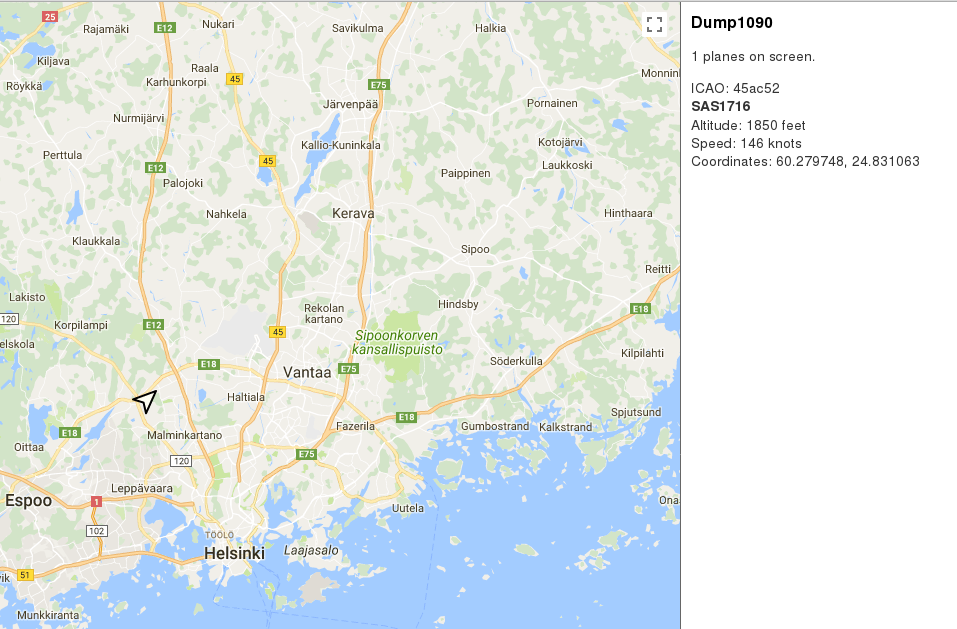
  45ac52 SAS1716  2650      177     60.252    24.770    47    26        1 sec
And opening a browser pointing at http://localhost:8080/ would show that graphically, like so: NOTE: In this view I'm in Helsinki, and the airport is at Vantaa, just outside the city. Of course there are tweaks to be made:

3 October 2017

Reproducible builds folks: Reproducible Builds: Weekly report #127

Here's what happened in the Reproducible Builds effort between Sunday September 24 and Saturday September 30 2017: Development and fixes in key packages Kai Harries did an initial packaging of the Nix package manager for Debian. You can track his progress in #877019. Uploads in Debian: Packages reviewed and fixed, and bugs filed Patches sent upstream: Reproducible bugs (with patches) filed in Debian: QA bugs filed in Debian: Reviews of unreproducible packages 103 package reviews have been added, 153 have been updated and 78 have been removed in this week, adding to our knowledge about identified issues. Weekly QA work During our reproducibility testing, FTBFS bugs have been detected and reported by: diffoscope development Mattia Rizzolo uploaded version 87 to stretch-backports. strip-nondeterminism development reprotest development tests.reproducible-builds.org reproducible-website development Misc. This week's edition was written by Ximin Luo, Bernhard M. Wiedemann, Holger Levsen and Chris Lamb & reviewed by a bunch of Reproducible Builds folks on IRC & the mailing lists.

Dimitri John Ledkov: An interesting bug - network-manager, glibc, dpkg-shlibdeps, systemd, and finally binutils

Not so long ago I went to effectively recompile NetworkManager and fix up minor bug in it. It built fine across all architectures, was considered to be installable etc. And I was expecting it to just migrate across. At the time, glibc was at 2.26 in artful-proposed and NetworkManager was built against it. However release pocket was at glibc 2.24. In Ubuntu we have a ProposedMigration process in place which ensures that newly built packages do not regress in the number of architectures built for; installable on; and do not regress themselves or any reverse dependencies at runtime.

Thus before my build of NetworkManager was considered for migration, it was tested in the release pocket against packages in the release pocket. Specifically, since package metadata only requires glibc 2.17 NetworkManager was tested against glibc currently in the release pocket, which should just work fine....
autopkgtest [21:47:38]: test nm: [-----------------------
test_auto_ip4 (__main__.ColdplugEthernet)
ethernet: auto-connection, IPv4 ... FAIL ----- NetworkManager.log -----
NetworkManager: /lib/x86_64-linux-gnu/libc.so.6: version GLIBC_2.25' not found (required by NetworkManager)
At first I only saw failing tests, which I thought is transient failure. Thus they were retried a few times. Then I looked at the autopkgtest log and saw above error messages. Perplexed, I have started a lxd container with ubuntu artful, enabled proposed and installed just network-manager from artful-proposed and indeed a simple NetworkManager --help failed with above error from linker.

I am too young to know what dependency-hell means, since ever since I used Linux (Ubuntu 7.04) all glibc symbols were versioned, and dpkg-shlibdeps would generate correct minimum dependencies for a package. Alas in this case readelf confirmed that indeed /usr/sbin/NetworkManager requires 2.25 and dpkg depends is >= 2.17.

Further reading readelf output I checked that all of the glibc symbols used are 2.17 or lower, and only the "Version needs section '.gnu.version_r'" referenced GLIBC_2.25 symbol. Inspecting dpkg-shlibdeps code I noticed that it does not parse that section and only searches through the dynamic symbols used to establish the minimum required version.

Things started to smell fishy. On one hand, I trust dpkg-shlibdeps to generate the right dependencies. On the other hand I also trust linker to not tell lies either. Hence I opened a Debian BTS bug report about this issue.

At this point, I really wanted to figure out where the reference to 2.25 comes from. Clearly it was not from any private symbols as then the reference would be on 2.26. Checking glibc abi lists I found there were only a handful of symbols marked as 2.25
$ grep 2.25 ./sysdeps/unix/sysv/linux/x86_64/64/libc.abilist
GLIBC_2.25 GLIBC_2.25 A
GLIBC_2.25 __explicit_bzero_chk F
GLIBC_2.25 explicit_bzero F
GLIBC_2.25 getentropy F
GLIBC_2.25 getrandom F
GLIBC_2.25 strfromd F
GLIBC_2.25 strfromf F
GLIBC_2.25 strfroml F
Blindly grepping for these in network-manager source tree I found following:
$ grep explicit_bzero -r configure.ac src/
configure.ac: explicit_bzero],
src/systemd/src/basic/string-util.h:void explicit_bzero(void *p, size_t l);
src/systemd/src/basic/string-util.c:void explicit_bzero(void *p, size_t l)
src/systemd/src/basic/string-util.c: explicit_bzero(x, strlen(x));
First of all it seems like network-manager includes a partial embedded copy of systemd. Secondly that code is compiled into a temporary library and has autconf detection logic to use explicit_bzero. It also has an embedded implementation of explicit_bzero when it is not available in libc, however it does not have FORTIFY_SOURCES implementation of said function (__explicit_bzero_chk) as was later pointed out to me. And whilst this function is compiled into an intermediary noinst library, no functions that use explicit_bzero are used in the end by NetworkManger binary. To proof this, I've dropped all code that uses explicit_bzero, rebuild the package against glibc 2.26, and voila it only had Version reference on glibc 2.17 as expected from the end-result usage of shared symbols.

At this point toolchain bug was a suspect. It seems like whilst explicit_bzero shared symbol got optimised out, the version reference on 2.25 persisted to the linked binaries. At this point in the archive a snapshot version of binutils was in use. And in fact forcefully downgrading bintuils resulted in correct compilation / versions table referencing only glibc 2.17.

Mathias then took over a tarball of object files and filed upstream bug report against bintuils: "[2.29 Regression] ld.bfd keeps a version reference in .gnu.version_r for symbols which are optimized out". The discussion in that bug report is a bit beyond me as to me binutils is black magic. All I understood there was "we moved sweep and pass to another place due to some bugs", doing that introduced this bug, thus do multiple sweep and passes to make sure we fix old bugs and don't regress this either. Or something like that. Comments / Better description of the bintuils fix are welcomed.

Binutils got fixed by upstream developers, cherry-picked into debian, and ubuntu, network-manager got rebuild and everything is wonderful now. However, it does look like unused / deadend code paths tripped up optimisations in the toolchain which managed to slip by distribution package dependency generation and needless require a higher up version of glibc. I guess the lesson here is do not embed/compile unused code. Also I'm not sure why network-manager uses networkd internals like this, and maybe systemd should expose more APIs or serialise more state into /run, as most other things query things over dbus, private socket, or by establishing watches on /run/systemd/netif. I'll look into that another day.

Thanks a lot to Guillem Jover, Matthias Klose, Alan Modra, H.J. Lu, and others for getting involved. I would not be able to raise, debug, or fix this issue all by myself.

2 October 2017

James McCoy: Monthly FLOSS activity - 2017/09 edition

Debian devscripts Before deciding to take an indefinite hiatus from devscripts, I prepared one more upload merging various contributed patches and a bit of last minute cleanup. I also setup integration with Travis CI to hopefully catch issues sooner than "while preparing an upload", as was typically the case before. Anyone with push access to the Debian/devscripts GitHub repo can take advantage of this to test out changes, or keep the development branches up to date. In the process, I was able to make some improvements to travis.debian.net, namely support for DEB_BUILD_PROFILES and using a separate, minimal docker image for running autopkgtests. unibilium neovim Oddly, the mips64el builds were in BD-Uninstallable state, even though luajit's buildd status showed it was built. Looking further, I noticed the libluajit-5.1 ,-dev binary packages didn't have the mips64el architecture enabled, so I asked for it to be enabled. msgpack-c There were a few packages left which would FTBFS if I uploaded msgpack-c 2.x to unstable. All of the bug reports had either trivial work arounds (i.e., forcing use of the v1 C++ API) or trivial patches. However, I didn't want to continue waiting for the packages to get fixed since I knew other people had expressed interest in the new msgpack-c. Trying to avoid making other packages insta-buggy, I NMUed autobahn-cpp with the v1 work around. That didn't go over well, partly because I didn't send a finalized "Hey, I'd like to get this done and here's my plan to NMU" email. Based on that feedback, I decided to bump the remaining bugs to "serious" instead of NMUing and upload msgpack-c. Thanks to Jonas Smedegaard for quickly integrating my proposed fix for libdata-messagepack-perl. Hopefully, upstream has some time to review the PR soon. vim subversion

neovim

1 October 2017

Paul Wise: FLOSS Activities September 2017

Changes

Issues

Review

Administration
  • icns: merged patches
  • Debian: help guest user with access, investigate/escalate broken network, restart broken stunnels, investigate static.d.o storage, investigate weird RAID mails, ask hoster to investigate power issue,
  • Debian mentors: lintian/security updates & reboot
  • Debian wiki: merged & deployed patch, redirect DDTSS translator, redirect user support requests, whitelist email addresses, update email for accounts with bouncing email,
  • Debian derivatives census: merged/deployed patches
  • Debian PTS: debugged cron mails, deployed changes, reran scripts, fixed configuration file
  • Openmoko: debug reboot issue, debug load issues

Communication

Sponsors The samba bug was sponsored by my employer. All other work was done on a volunteer basis.

30 September 2017

Chris Lamb: Free software activities in September 2017

Here is my monthly update covering what I have been doing in the free software world in September 2017 (previous month):
Reproducible builds

Whilst anyone can inspect the source code of free software for malicious flaws, most software is distributed pre-compiled to end users. The motivation behind the Reproducible Builds effort is to allow verification that no flaws have been introduced either maliciously or accidentally during this compilation process by promising identical results are always generated from a given source, thus allowing multiple third-parties to come to a consensus on whether a build was compromised. I have generously been awarded a grant from the Core Infrastructure Initiative to fund my work in this area. This month I:
  • Published a short blog post about how to determine which packages on your system are reproducible. [...]
  • Submitted a pull request for Numpy to make the generated config.py files reproducible. [...]
  • Provided a patch to GTK upstream to ensure the immodules.cache files are reproducible. [...]
  • Within Debian:
    • Updated isdebianreproducibleyet.com, moving it to HTTPS, adding cachebusting as well as keeping the number up-to-date.
    • Submitted the following patches to fix reproducibility-related toolchain issues:
      • gdk-pixbuf: Make the output of gdk-pixbuf-query-loaders reproducible. (#875704)
      • texlive-bin: Make PDF IDs reproducible. (#874102)
    • Submitted a patch to fix a reproducibility issue in doit.
  • Categorised a large number of packages and issues in the Reproducible Builds "notes" repository.
  • Chaired our monthly IRC meeting. [...]
  • Worked on publishing our weekly reports. (#123, #124, #125, #126 & #127)


I also made the following changes to our tooling:
reproducible-check

reproducible-check is our script to determine which packages actually installed on your system are reproducible or not.

  • Handle multi-architecture systems correctly. (#875887)
  • Use the "restricted" data file to mask transient issues. (#875861)
  • Expire the cache file after one day and base the local cache filename on the remote name. [...] [...]
I also blogged about this utility. [...]
diffoscope

diffoscope is our in-depth and content-aware diff utility that can locate and diagnose reproducibility issues.

  • Filed an issue attempting to identify the causes behind an increased number of timeouts visible in our CI infrastructure, including running a number of benchmarks of recent versions. (#875324)
  • New features:
    • Add "binwalking" support to analyse concatenated CPIO archives such as initramfs images. (#820631).
    • Print a message if we are reading data from standard input. [...]
  • Bug fixes:
    • Loosen matching of file(1)'s output to ensure we correctly also match TTF files under file version 5.32. [...]
    • Correct references to path_apparent_size in comparators.utils.file and self.buf in diffoscope.diff. [...] [...]
  • Testing:
    • Make failing some critical flake8 tests result in a failed build. [...]
    • Check we identify all CPIO fixtures. [...]
  • Misc:
    • No need for try-assert-except block in setup.py. [...]
    • Compare types with identity not equality. [...] [...]
    • Use logging.py's lazy argument interpolation. [...]
    • Remove unused imports. [...]
    • Numerous PEP8, flake8, whitespace, other cosmetic tidy-ups.

strip-nondeterminism

strip-nondeterminism is our tool to remove specific non-deterministic results from a completed build.

  • Log which handler processed a file. (#876140). [...]

disorderfs

disorderfs is our FUSE-based filesystem that deliberately introduces non-determinism into directory system calls in order to flush out reproducibility issues.


Debian My activities as the current Debian Project Leader are covered in my monthly "Bits from the DPL" email to the debian-devel-announce mailing list.
Lintian I made a large number of changes to Lintian, the static analysis tool for Debian packages. It reports on various errors, omissions and general quality-assurance issues to maintainers: I also blogged specifically about the Lintian 2.5.54 release.

Patches contributed
  • debconf: Please add a context manager to debconf.py. (#877096)
  • nm.debian.org: Add pronouns to ALL_STATUS_DESC. (#875128)
  • user-setup: Please drop set_special_users hack added for "the convenience of heavy testers". (#875909)
  • postgresql-common: Please update README.Debian for PostgreSQL 10. (#876438)
  • django-sitetree: Should not mask test failures. (#877321)
  • charmtimetracker:
    • Missing binary dependency on libqt5sql5-sqlite. (#873918)
    • Please drop "Cross-Platform" from package description. (#873917)
I also submitted 5 patches for packages with incorrect calls to find(1) in debian/rules against hamster-applet, libkml, pyferret, python-gssapi & roundcube.

Debian LTS

This month I have been paid to work 15 hours on Debian Long Term Support (LTS). In that time I did the following:
  • "Frontdesk" duties, triaging CVEs, etc.
  • Documented an example usage of autopkgtests to test security changes.
  • Issued DLA 1084-1 and DLA 1085-1 for libidn and libidn2-0 to fix an integer overflow vulnerabilities in Punycode handling.
  • Issued DLA 1091-1 for unrar-free to prevent a directory traversal vulnerability from a specially-crafted .rar archive. This update introduces an regression test.
  • Issued DLA 1092-1 for libarchive to prevent malicious .xar archives causing a denial of service via a heap-based buffer over-read.
  • Issued DLA 1096-1 for wordpress-shibboleth, correcting an cross-site scripting vulnerability in the Shibboleth identity provider module.

Uploads
  • python-django:
    • 1.11.5-1 New upstream security release. (#874415)
    • 1.11.5-2 Apply upstream patch to fix QuerySet.defer() with "super" and "subclass" fields. (#876816)
    • 2.0~alpha1-2 New upstream alpha release of Django 2.0, dropping support for Python 2.x.
  • redis:
    • 4.0.2-1 New upstream release.
    • 4.0.2-2 Update 0004-redis-check-rdb autopkgtest test to ensure that the redis.rdb file exists before testing against it.
    • 4.0.2-2~bpo9+1 Upload to stretch-backports.
  • aptfs (0.11.0-1) New upstream release, moving away from using /var/lib/apt/lists internals. Thanks to Julian Andres Klode for a helpful bug report. (#874765)
  • lintian (2.5.53, 2.5.54) New upstream releases. (Documented in more detail above.)
  • bfs (1.1.2-1) New upstream release.
  • docbook-to-man (1:2.0.0-39) Tighten autopkgtests and enable testing via travis.debian.net.
  • python-daiquiri (1.3.0-1) New upstream release.

I also made the following non-maintainer uploads (NMUs):

Debian bugs filed
  • clipit: Please choose a sensible startup default in "live" mode. (#875903)
  • git-buildpackage: Please add a --reset option to gbp pull. (#875852)
  • bluez: Please default Device "friendly name" to hostname without domain. (#874094)
  • bugs.debian.org: Please explicitly link to packages,tracker .debian.org. (#876746)
  • Requests for packaging:
    • selfspy log everything you do on the computer. (#873955)
    • shoogle use the Google API from the shell. (#873916)

FTP Team

As a Debian FTP assistant I ACCEPTed 86 packages: bgw-replstatus, build-essential, caja-admin, caja-rename, calamares, cdiff, cockpit, colorized-logs, comptext, comptty, copyq, django-allauth, django-paintstore, django-q, django-test-without-migrations, docker-runc, emacs-db, emacs-uuid, esxml, fast5, flake8-docstrings, gcc-6-doc, gcc-7-doc, gcc-8, golang-github-go-logfmt-logfmt, golang-github-google-go-cmp, golang-github-nightlyone-lockfile, golang-github-oklog-ulid, golang-pault-go-macchanger, h2o, inhomog, ip4r, ldc, libayatana-appindicator, libbson-perl, libencoding-fixlatin-perl, libfile-monitor-lite-perl, libhtml-restrict-perl, libmojo-rabbitmq-client-perl, libmoosex-types-laxnum-perl, libparse-mime-perl, libplack-test-agent-perl, libpod-projectdocs-perl, libregexp-pattern-license-perl, libstring-trim-perl, libtext-simpletable-autowidth-perl, libvirt, linux, mac-fdisk, myspell-sq, node-coveralls, node-module-deps, nov-el, owncloud-client, pantomime-clojure, pg-dirtyread, pgfincore, pgpool2, pgsql-asn1oid, phpliteadmin, powerlevel9k, pyjokes, python-evdev, python-oslo.db, python-pygal, python-wsaccel, python3.7, r-cran-bindrcpp, r-cran-dotcall64, r-cran-glue, r-cran-gtable, r-cran-pkgconfig, r-cran-rlang, r-cran-spatstat.utils, resolvconf-admin, retro-gtk, ring-ssl-clojure, robot-detection, rpy2-2.8, ruby-hocon, sass-stylesheets-compass, selinux-dbus, selinux-python, statsmodels, webkit2-sharp & weston. I additionally filed 4 RC bugs against packages that had incomplete debian/copyright files against: comptext, comptext, ldc & python-oslo.concurrency.

Iain R. Learmonth: Breaking RSS Change in Hugo

My website and blog are managed by the static site generator Hugo. I ve found this to be a stable and flexible system, but at the last upgrade a breaking change has occurred that broken the syndication of my blog on various planets. At first I thought perhaps with my increased posting rate the planets were truncating my posts but this was not the case. The problem was in Hugo pull request #3129 where for some reason they have changed the RSS feed to contain only a lead instead of the full article. I ve seen other content management systems offer a similar option but at least they point out that it s truncated and offer a read more link. Here it just looks like I m publishing truncated unfinished really short posts. If you take a look at the post above, you ll see that the change is in an embedded template and it took a little reading the docs to work out how to revert the change. The steps are actually not that difficult, but it s still annoying that the change occurred. In a Hugo site, you will have a layouts directory that will contain your overrides from your theme. Create a new file in the path layouts/_default/rss.xml (you may need to create the _default directory) with the following content:
<rss version="2.0" xmlns:atom="http://www.w3.org/2005/Atom">
  <channel>
    <title>  if eq  .Title  .Site.Title   .Site.Title   else   with .Title  .  on   end   .Site.Title   end  </title>
    <link>  .Permalink  </link>
    <description>Recent content   if ne  .Title  .Site.Title   with .Title  in  .    end   end  on   .Site.Title  </description>
    <generator>Hugo -- gohugo.io</generator>  with .Site.LanguageCode  
    <language> . </language> end  with .Site.Author.email  
    <managingEditor> .  with $.Site.Author.name   ( . ) end </managingEditor> end  with .Site.Author.email  
    <webMaster> .  with $.Site.Author.name   ( . ) end </webMaster> end  with .Site.Copyright  
    <copyright> . </copyright> end  if not .Date.IsZero  
    <lastBuildDate>  .Date.Format "Mon, 02 Jan 2006 15:04:05 -0700"   safeHTML  </lastBuildDate>  end  
      with .OutputFormats.Get "RSS"  
          printf "<atom:link href=%q rel=\"self\" type=%q />" .Permalink .MediaType   safeHTML  
      end  
      range .Data.Pages  
    <item>
      <title>  .Title  </title>
      <link>  .Permalink  </link>
      <pubDate>  .Date.Format "Mon, 02 Jan 2006 15:04:05 -0700"   safeHTML  </pubDate>
        with .Site.Author.email  <author> .  with $.Site.Author.name   ( . ) end </author> end 
      <guid>  .Permalink  </guid>
      <description>  .Content   html  </description>
    </item>
      end  
  </channel>
</rss>
If you like my new Hugo theme, please let me know and I ll bump tidying it up and publishing it further up my todo list.

29 September 2017

Iain R. Learmonth: Tor Metrics Team Meeting in Berlin

We had a meeting of the Metrics Team in Berlin yesterday to organise a roadmap for the next 12 months. This roadmap isn t yet finalised as it will now be taken to the main Tor developers meeting in Montreal where perhaps there are things we thought were needed but aren t, or things that we had forgotten. Still we have a pretty good draft and we were all quite happy with it. We have updated tickets in the Metrics component on the Tor trac to include either metrics-2017 or metrics-2018 in the keywords field to identify tickets that we expect to be able to resolve either by the end of this year or by the end of next year (again, not yet finalised but should give a good idea). In some cases this may mean closing the ticket without fixing it, but only if we believe that either the ticket is out of scope for the metrics team or that it s an old ticket and no one else has had the same issue since. Having an in-person meeting has allowed us to have easy discussion around some of the more complex tickets that have been sitting around. In many cases these are tickets where we need input from other teams, or perhaps even just reassigning the ticket to another team, but without a clear plan we couldn t do this. My work for the remainder of the year will be primarily on Atlas where we have a clear plan for integrating with the Tor Metrics website, and may include some other small things relating to the website. I will also be triaging the current Compass tickets as we look to shut down compass and integrate the functionality into Atlas. Compass specific tickets will be closed but some tickets relating to desirable functionality may be moved to Atlas with the fix implemented there instead.

Sven Hoexter: Last rites to the lyx and elyxer packaging

After having been a heavy LyX user from 2005 to 2010 I've continued to maintain LyX more or less till now. Finally I'm starting to leave that stage and removed myself from the Uploaders list. The upload with some other last packaging changes is currently sitting in the git repo. Mainly because lintian on ftp-master currently rejects 'pakagename@packages.d.o' maintainer addresses (the alternative to the lists.alioth.d.o maintainer mailinglists). For elyxer I filled a request for removal. It hasn't seen any upstream activity for a while and the LyX build in HTML export support improved. My hope is that if I step away far enough someone else might actually pick it up. I had this strange moment when I lately realized that xchat got reintroduced to Debian after mapreri and myself spent some time last year to get it removed before the stretch release.

28 September 2017

Sean Whitton: Debian Policy 4.1.1.0 released

I just released Debian Policy version 4.1.1.0. There are only two normative changes, and neither is very important. The main thing is that this upload fixes a lot of packaging bugs that were found since we converted to build with Sphinx. There are still some issues remaining; I hope to submit some patches to the www-team s scripts to fix those.

Russell Coker: Process Monitoring

Since forking the Mon project to etbemon [1] I ve been spending a lot of time working on the monitor scripts. Actually monitoring something is usually quite easy, deciding what to monitor tends to be the hard part. The process monitoring script ps.monitor is the one I m about to redesign. Here are some of my ideas for monitoring processes. Please comment if you have any suggestions for how do do things better. For people who don t use mon, the monitor scripts return 0 if everything is OK and 1 if there s a problem along with using stdout to display an error message. While I m not aware of anyone hooking mon scripts into a different monitoring system that s going to be easy to do. One thing I plan to work on in the future is interoperability between mon and other systems such as Nagios. Basic Monitoring
ps.monitor tor:1-1 master:1-2 auditd:1-1 cron:1-5 rsyslogd:1-1 dbus-daemon:1- sshd:1- watchdog:1-2
I m currently planning some sort of rewrite of the process monitoring script. The current functionality is to have a list of process names on the command line with minimum and maximum numbers for the instances of the process in question. The above is a sample of the configuration of the monitor. There are some limitations to this, the master process in this instance refers to the main process of Postfix, but other daemons use the same process name (it s one of those names that s wrong because it s so obvious). One obvious solution to this is to give the option of specifying the full path so that /usr/lib/postfix/sbin/master can be differentiated from all the other programs named master. The next issue is processes that may run on behalf of multiple users. With sshd there is a single process to accept new connections running as root and a process running under the UID of each logged in user. So the number of sshd processes running as root will be one greater than the number of root login sessions. This means that if a sysadmin logs in directly as root via ssh (which is controversial and not the topic of this post merely something that people do which I have to support) and the master process then crashes (or the sysadmin stops it either accidentally or deliberately) there won t be an alert about the missing process. Of course the correct thing to do is to have a monitor talk to port 22 and look for the string SSH-2.0-OpenSSH_ . Sometimes there are multiple instances of a daemon running under different UIDs that need to be monitored separately. So obviously we need the ability to monitor processes by UID. In many cases process monitoring can be replaced by monitoring of service ports. So if something is listening on port 25 then it probably means that the Postfix master process is running regardless of what other master processes there are. But for my use I find it handy to have multiple monitors, if I get a Jabber message about being unable to send mail to a server immediately followed by a Jabber message from that server saying that master isn t running I don t need to fully wake up to know where the problem is. SE Linux One feature that I want is monitoring SE Linux contexts of processes in the same way as monitoring UIDs. While I m not interested in writing tests for other security systems I would be happy to include code that other people write. So whatever I do I want to make it flexible enough to work with multiple security systems. Transient Processes Most daemons have a second process of the same name running during the startup process. This means if you monitor for exactly 1 instance of a process you may get an alert about 2 processes running when logrotate or something similar restarts the daemon. Also you may get an alert about 0 instances if the check happens to run at exactly the wrong time during the restart. My current way of dealing with this on my servers is to not alert until the second failure event with the alertafter 2 directive. The failure_interval directive allows specifying the time between checks when the monitor is in a failed state, setting that to a low value means that waiting for a second failure result doesn t delay the notification much. To deal with this I ve been thinking of making the ps.monitor script automatically check again after a specified delay. I think that solving the problem with a single parameter to the monitor script is better than using 2 configuration directives to mon to work around it. CPU Use Mon currently has a loadavg.monitor script that to check the load average. But that won t catch the case of a single process using too much CPU time but not enough to raise the system load average. Also it won t catch the case of a CPU hungry process going quiet (EG when the SETI at Home server goes down) while another process goes into an infinite loop. One way of addressing this would be to have the ps.monitor script have yet another configuration option to monitor CPU use, but this might get confusing. Another option would be to have a separate script that alerts on any process that uses more than a specified percentage of CPU time over it s lifetime or over the last few seconds unless it s in a whitelist of processes and users who are exempt from such checks. Probably every regular user would be exempt from such checks because you never know when they will run a file compression program. Also there is a short list of daemons that are excluded (like BOINC) and system processes (like gzip which is run from several cron jobs). Monitoring for Exclusion A common programming mistake is to call setuid() before setgid() which means that the program doesn t have permission to call setgid(). If return codes aren t checked (and people who make such rookie mistakes tend not to check return codes) then the process keeps elevated permissions. Checking for processes running as GID 0 but not UID 0 would be handy. As an aside a quick examination of a Debian/Testing workstation didn t show any obvious way that a process with GID 0 could gain elevated privileges, but that could change with one chmod 770 command. On a SE Linux system there should be only one process running with the domain init_t. Currently that doesn t happen in Stretch systems running daemons such as mysqld and tor due to policy not matching the recent functionality of systemd as requested by daemon service files. Such issues will keep occurring so we need automated tests for them. Automated tests for configuration errors that might impact system security is a bigger issue, I ll probably write a separate blog post about it.

Russ Allbery: Review: The Seventh Bride

Review: The Seventh Bride, by T. Kingfisher
Publisher: 47North
Copyright: 2015
ISBN: 1-5039-4975-3
Format: Kindle
Pages: 225
There are two editions of this book, although only one currently for sale. This review is of the second edition, released in November of 2015. T. Kingfisher is a pen name for Ursula Vernon when she's writing for adults. Rhea is a miller's daughter. She's fifteen, obedient, wary of swans, respectful to her parents, and engaged to Lord Crevan. The last was a recent and entirely unexpected development. It's not that she didn't expect to get married eventually, since of course that's what one does. And it's not that Lord Crevan was a stranger, since that's often how it went with marriage for people like her. But she wasn't expecting to get married now, and it was not at all clear why Lord Crevan would want to marry her in particular. Also, something felt not right about the entire thing. And it didn't start feeling any better when she finally met Lord Crevan for the first time, some days after the proposal to her parents. The decidedly non-romantic hand kissing didn't help, nor did the smug smile. But it's not like she had any choice. The miller's daughter doesn't say no to a lord and a friend of the viscount. The miller's family certainly doesn't say no when they're having trouble paying the bills, the viscount owns the mill, and they could be turned out of their livelihood at a whim. They still can't say no when Lord Crevan orders Rhea to come to his house in the middle of the night down a road that quite certainly doesn't exist during the day, even though that's very much not the sort of thing that is normally done. Particularly before the marriage. Friends of the viscount who are also sorcerers can get away with quite a lot. But Lord Crevan will discover that there's still a limit to how far he can order Rhea around, and practical-minded miller's daughters can make a lot of unexpected friends even in dire circumstances. The Seventh Bride is another entry in T. Kingfisher's series of retold fairy tales, although the fairy tale in question is less clear than with The Raven and the Reindeer. Kirkus says it's a retelling of Bluebeard, but I still don't quite see that in the story. I think one could argue equally easily that it's an original story. Nonetheless, it is a fairy tale: it has that fairy tale mix of magical danger and practical morality, and it's about courage and friendships and their consequences. It also has a hedgehog. This is an T. Kingfisher story, so it's packed full of bits of marvelous phrasing that I want to read over and over again. It has wonderful characters, the hedgehog among them, and it has, at its heart, a sort of foundational decency and stubborn goodness that's deeply satisfying for the reader. The Seventh Bride is a lot closer to horror than the other T. Kingfisher books I've read, but it never fell into my dislike of the horror genre, despite a few gruesome bits. I think that's because neither Rhea nor the narrator treat the horrific aspects as representative of the true shape of the world. Rhea instead confronts them with a stubborn determination and an attempt to make the best of each moment, and with a practical self-awareness that I loved reading about.
The problem with crying in the woods, by the side of a white road that leads somewhere terrible, is that the reason for crying isn't inside your head. You have a perfectly legitimate and pressing reason for crying, and it will still be there in five minutes, except that your throat will be raw and your eyes will itch and absolutely nothing else will have changed.
Lord Crevan, when Rhea finally reaches him, toys with her by giving her progressively more horrible puzzle tasks, threatening her with the promised marriage if she fails at any of them. The way this part of the book finally resolves is one of the best moments I've read in any book. Kingfisher captures an aspect of moral decisions, and a way in which evil doesn't work the way that evil people expect it to work, that I can't remember seeing an author capture this well. There are a lot of things here for Rhea to untangle: the nature of Crevan's power, her unexpected allies in his manor, why he proposed marriage to her, and of course how to escape his power. The plot works, but I don't think it was the best part of the book, and it tends to happen to Rhea rather than being driven by her. But I have rarely read a book quite this confident of its moral center, or quite as justified in that confidence. I am definitely reading everything Vernon has published under the T. Kingfisher name, and quite possibly most of her children's books as well. Recommended, particularly if you liked the excerpt above. There's an entire book full of paragraphs like that waiting for you. Rating: 8 out of 10

26 September 2017

Colin Watson: A mysterious bug with Twisted plugins

I fixed a bug in Launchpad recently that led me deeper than I expected. Launchpad uses Buildout as its build system for Python packages, and it s served us well for many years. However, we re using 1.7.1, which doesn t support ensuring that packages required using setuptools setup_requires keyword only ever come from the local index URL when one is specified; that s an essential constraint we need to be able to impose so that our build system isn t immediately sensitive to downtime or changes in PyPI. There are various issues/PRs about this in Buildout (e.g. #238), but even if those are fixed it ll almost certainly only be in Buildout v2, and upgrading to that is its own kettle of fish for other reasons. All this is a serious problem for us because newer versions of many of our vital dependencies (Twisted and testtools, to name but two) use setup_requires to pull in pbr, and so we ve been stuck on old versions for some time; this is part of why Launchpad doesn t yet support newer SSH key types, for instance. This situation obviously isn t sustainable. To deal with this, I ve been working for some time on switching to virtualenv and pip. This is harder than you might think: Launchpad is a long-lived and complicated project, and it had quite a number of explicit and implicit dependencies on Buildout s configuration and behaviour. Upgrading our infrastructure from Ubuntu 12.04 to 16.04 has helped a lot (12.04 s baseline virtualenv and pip have some deficiencies that would have required a more complicated bootstrapping procedure). I ve dealt with most of these: for example, I had to reorganise a lot of our helper scripts (1, 2, 3), but there are still a few more things to go. One remaining problem was that our Buildout configuration relied on building several different environments with different Python paths for various things. While this would technically be possible by way of building multiple virtualenvs, this would inflate our build time even further (we re already going to have to cope with some slowdown as a result of using virtualenv, because the build system now has to do a lot more than constructing a glorified link farm to a bunch of cached eggs), and it seems like unnecessary complexity. The obvious thing to do seemed to be to collapse these into a single environment, since there was no obvious reason why it should actually matter if txpkgupload and txlongpoll were carefully kept off the path when running most of Launchpad: so I did that. Then our build system got very sad. Hmm, I thought. To keep our test times somewhat manageable, we run them in parallel across 20 containers, and we randomise the order in which they run to try to shake out test isolation bugs. It s not completely unknown for there to be some oddities resulting from that. So I ran it again. Nope, but slightly differently sad this time. Furthermore, I couldn t reproduce these failures locally no matter how hard I tried. Oh dear. This was obviously not going to be a good day. In fact I spent a while on various different guesswork-based approaches. I found bug 571334 in Ampoule, an AMP-based process pool implementation that we use for some job runners, and proposed a fix for that, but cherry-picking that fix into Launchpad didn t help matters. I tried backing out subsets of my changes and determined that if both txlongpoll and txpkgupload were absent from the Python module path in the context of the tests in question then everything was fine. I tried running strace locally and staring at the output for some time in the hope of enlightenment: that reminded me that the two packages in question install modules under twisted.plugins, which did at least establish a reason they might affect the environment that was more plausible than magic, but nothing much more specific than that. On Friday I was fiddling about with this again and trying to insert some more debugging when I noticed some interesting behaviour around plugin caching. If I caused the txpkgupload plugin to raise an exception when loaded, the Twisted plugin system would remove its dropin.cache (because it was stale) and not create a new one (because there was now no content to put in it). After that, running the relevant tests would fail as I d seen in our buildbot. Aha! This meant that I could also reproduce it by doing an even cleaner build than I d previously tried to do, by removing the cached txpkgupload and txlongpoll eggs and allowing the build system to recreate them. When they were recreated, they didn t contain dropin.cache, instead allowing that to be created on first use. Based on this clue I was able to get to the answer relatively quickly. Ampoule has a specialised bootstrapping sequence for its worker processes that starts by doing this:
from twisted.application import reactors
reactors.installReactor(reactor)
Now, twisted.application.reactors.installReactor calls twisted.plugin.getPlugins, so the very start of this bootstrapping sequence is going to involve loading all plugins found on the module path (I assume it s possible to write a plugin that adds an alternative reactor implementation). If dropin.cache is up to date, then it will just get the information it needs from that; but if it isn t, it will go ahead and import the plugin. If the plugin happens (as Twisted code often does) to run from twisted.internet import reactor at some point while being imported, then that will install the platform s default reactor, and then twisted.application.reactors.installReactor will raise ReactorAlreadyInstalledError. Since Ampoule turns this into an info-level log message for some reason, and the tests in question only passed through error-level messages or higher, this meant that all we could see was that a worker process had exited non-zero but not why. The Twisted documentation recommends generating the plugin cache at build time for other reasons, but we weren t doing that. Fixing that makes everything work again. There are still a few more things needed to get us onto pip, but we re now pretty close. After that we can finally start bringing our dependencies up to date.

Russ Allbery: Review: Artemis Fowl

Review: Artemis Fowl, by Eoin Colfer
Series: Artemis Fowl #1
Publisher: Disney-Hyperion
Copyright: 2001
ISBN: 1-4231-2452-9
Format: Kindle
Pages: 281
Artemis Fowl is the heir to the Fowl criminal empire and a child prodigy. He's also one of the few humans to know of the existence of fairies, who are still present in the world, hiding from humans and living by their own rules. As the book opens, he's in search of those rules: a copy of the book that governs the lives of fairies. With that knowledge, he should be able to pull off a heist worthy of his family's legacy. Captain Holly Short is a leprechaun... or, more correctly, a LEPrecon. She's one of the fairy police officers that investigate threats to the fairies who are hiding in a vast underground civilization. The fairies have magic, but they also have advanced (and miniaturized) technology, maintained in large part by a grumpy and egotistical centaur (named Foaly, because it's that sort of book). She's also the fairy unlucky enough to be captured by Artemis's formidable personal bodyguard their first attempt to kidnap a hostage for their ransom demands. This is the first book of a long series of young adult novels that has also spawned graphic novels and a movie currently in production. It has that lean and clear feeling of the younger side of young adult writing: larger-than-life characters who are distinctive and easy to remember, a short introductory setup that dives directly into the main plot, and a story that neatly pulls together every element raised in the story. The world-building is its strongest point, particularly the mix of tongue-in-cheek technology ships that ride magma plumes, mechanical wings, and helmet-mounted lights to blind trolls and science-tinged magic that the fairies build their police and army on. Fairies are far beyond humans in capability, and can be deadly and ruthless, but they have to follow a tightly constrained set of rules that are often not convenient. Sadly, the characters don't live up to the world-building. I did enjoy a few of them, particularly Artemis's loyal bodyguards and the dwarf Mulch Diggums. But Holly, despite being likable, is a bit of a blank slate: the empathetic, overworked trooper who is mostly indistinguishable from other characters in similar stories. The gruff captain, the sarcastic technician Foaly, and the various other LEP agents all felt like they were taken straight from central casting. And then there's Artemis himself. Artemis is the protagonist of the story, in that he's the one who initiates all of the action and the one who has the most interesting motivations. The story is about him, as the third-person narrator in the introduction makes clear. He's trying very hard to be a criminal genius with the deductive abilities of Sherlock Holmes and the speaking style of a Bond villain, but he's also twelve, his father has disappeared, and his mother is going slowly insane. I picked this book up on the recommendation of another reader who found that contrast compelling. Unfortunately, I thought Artemis was just an abusive jerk. Yes, yes, family tragedy, yes, he's trapped in his conception of himself, but he's arrogant, utterly uncaring about how his actions affect other people, and dismissive and cruel even to his bodyguards (who are much better friends than he deserves). I think liking this book requires liking Artemis at least well enough to consider him an anti-hero, and I can squint and see that appeal if you have that reaction. But I just wanted him to lose. Not in the "you will be slowly redeemed over the course of a long series" way, but in the "you are a horrible person and I hope you get what's coming to you" way. The humor of the fairy parts of the book was undermined too much by the fact that many of them would like to kill Artemis for real, and I mostly wanted them to succeed. This may or may not have to do with my low tolerance for egotistical smart-asses who order other people to do things that they refuse to explain. Without some appreciation for Artemis, this is a story with some neat world-building, a fairly generic protagonist in Holly, and a plot in which the bad guys win. To make matters worse, I thought the supposedly bright note at the end of the story was just creepy, as was everything else involving Artemis's mother. The review I read was of the first three books, so it's entirely possible that this series gets better as it goes along, but there wasn't enough I enjoyed in the first book for me to keep reading. Followed by Artemis Fowl: The Arctic Incident. Rating: 5 out of 10

24 September 2017

Iain R. Learmonth: Free Software Efforts (2017W38)

Here s my weekly report for week 38 of 2017. This week has not been a great week as I saw my primary development machine die in a spectacular reboot loop. Thanks to the wonderful community around Debian and free software (that if you re reading this, you re probably part of), I should be back up to speed soon. A replacement workstation is currently moving towards me and I ve received a number of smaller donations that will go towards video converters and upgrades to get me back to full productivity.

Debian I ve prepared and tested backports for 3 packages in the tasktools packaging team: tasksh, bugwarrior and powerline-taskwarrior. Unfortunately I am not currently in the backports ACLs and so I can t upload these but I m hoping this to be resolved soon. Once these are uploaded, the latest upstream release for all packages in the tasktools team will be available either in the stable suite or in the stable backports suite. In preparation for the shutdown of Alioth mailing lists, I ve set up a new mailing list for the tasktools team and have already updated the maintainer fields for all the team s packages in git. I ve subscribed the old mailing list s user to the new mailing list in DDPO so there will still be a comprehensive view there during the migration. I am currently in the process of reaching out to the admins of git.tasktools.org with a view to moving our git repositories there. I ve also continued to review the scapy package and have closed a couple more bugs that were already fixed in the latest upstream release but had been missed in the changelog. Bugs closed (fixed/wontfix): #774962, #850570

Tor Project I ve deployed a small fix to an update from last week where the platform field on Atlas had been pulled across to the left column. It has now been returned to the right hand column and is not pushed down the page by long family lists. I ve been thinking about the merge of Compass functionality into a future Atlas and this is being tracked in #23517. Tor Project has approved expenses (flights and hotel) for me to attend an in-person meeting of the Metrics Team. This meeting will occur in Berlin on the 28th September and I will write up a report detailing outcomes relevant to my work after the meeting. I have spent some time this week preparing for this meeting. Bugs closed (fixed/wontfix): #22146, #22297, #23511

Sustainability I believe it is important to be clear not only about the work I have already completed but also about the sustainability of this work into the future. I plan to include a short report on the current sustainability of my work in each weekly report. The loss of my primary development machine was a setback, however, I have been donated a new workstation which should hopefully arrive soon. The hard drives in my NAS can now also be replaced as I have budget available for this now. I do not see any hardware failures being imminent at this time, however should they occur I would not have budget to replace hardware, I only have funds to replace the hardware that has already failed.

21 September 2017

Enrico Zini: Systemd Truelite course

These are the notes of a training course on systemd I gave as part of my work with Truelite. There is quite a lot of material, so I split them into a series of posts, running once a day for the next 9 days. Units Everything managed by systemd is called a unit (see man systemd.unit), and each unit is described by a configuration in ini-style format. For example, this unit continuously plays an alarm sound when the system is in emergency or rescue mode:
[Unit]
Description=Beeps when in emergency or rescue mode
DefaultDependencies=false
StopWhenUnneeded=true
[Install]
WantedBy=emergency.target rescue.target
[Service]
Type=simple
ExecStart=/bin/sh -ec 'while true; do /usr/bin/aplay -q /tmp/beep.wav; sleep 2; done'
Units can be described by configuration files, which have different extensions based on what kind of thing they describe: System unit files can be installed in: Unit files in /etc/ override unit files in /lib/. Note that while Debian uses /lib/, other distributions may use /usr/lib/ instead. If there is a directory with the same name as the unit file plus a .d suffix, any file *.conf it contains is parsed after the unit, and can be used to add or override configuration options. For example: Similarly, a unitname.wants/ or unitname.requires/ directory can be used to extend Wants= and Requires= dependencies on other units, by placing symlinks to other units in them. See also:

19 September 2017

Sylvain Beucler: dot-zed extractor

Following last week's .zed format reverse-engineered specification, Lo c Dachary contributed a POC extractor!
It's available at http://www.dachary.org/loic/zed/, it can list non-encrypted metadata without password, and extract files with password (or .pem file).
Leveraging on python-olefile and pycrypto, only 500 lines of code (test cases excluded) are enough to implement it :)

Next.

Previous.
