Search Results: "ads"

24 December 2023

Russ Allbery: Review: Liberty's Daughter

Review: Liberty's Daughter, by Naomi Kritzer
Publisher: Fairwood Press
Copyright: November 2023
ISBN: 1-958880-16-7
Format: Kindle
Pages: 257
Liberty's Daughter is a stand-alone near-future science fiction fix-up novel. The original stories were published in Fantasy and Science Fiction between 2012 and 2015. Beck Garrison lives on New Minerva (Min), one of a cluster of libertarian seasteads 220 nautical miles off the coast of Los Angeles. Her father brought her to Min when she was four, so it's the only life she knows. As this story opens, she's picked up a job for pocket change: finding very specific items that people want to buy. Since any new goods have to be shipped in and the seasteads have an ambiguous legal status, they don't get Amazon deliveries, but there are enough people (and enough tourists who bring high-value goods for trade) that someone probably has whatever someone else is looking for. Even sparkly high-heeled sandals size eight. Beck's father is high in the informal power structure of the seasteads for reasons that don't become apparent until very late in this book. Beck therefore has a comfortable, albeit cramped, life. The social protections, self-confidence, and feelings of invincibility that come with that wealth serve her well as a finder. After the current owner of the sandals bargains with her to find a person rather than an object, that privilege also lets her learn quite a lot before she starts getting into trouble. The political background of this novel is going to require some suspension of disbelief. The premise is that one of those harebrained libertarian schemes to form a freedom utopia has been successful enough to last for 49 years and attract 80,000 permanent residents. (It's a libertarian seastead so a lot of those residents are indentured slaves, as one does in libertarian philosophy. The number of people with shares, like Beck's father, is considerably smaller.) By the end of the book, Kritzer has offered some explanations for why the US would allow such a place to continue to exist, but the chances of the famously fractious con artists and incompetents involved in these types of endeavors creating something that survived internal power struggles for that long seem low. One has to roll with it for story reasons: Kritzer needs the population to be large enough for a plot, and the history to be long enough for Beck to exist as a character. The strength of this book is Beck, and specifically the fact that Beck is a second-generation teenager who grew up on the seastead. Unlike a lot of her age peers with their Cayman Islands vacations, she's never left and has no experience with life on land. She considers many things to be perfectly normal that are not at all normal to the reader and the various reader surrogates who show up over the course of the book. She also has the instinctive feel for seastead politics of the child of a prominent figure in a small town. And, most importantly, she has formed her own sense of morality and social structure that matches neither that of the reader nor that of her father. Liberty's Daughter is told in first-person by Beck. Judging the authenticity of Gen-Z thought processes is not one of my strengths, but Beck felt right to me. Her narration is dryly matter-of-fact, with only brief descriptions of her emotional reactions, but her personality shines in the occasional sarcasm and obstinacy. Kritzer has the teenage bafflement at the stupidity of adults down pat, as well as the tendency to jump head-first into ideas and make some decisions through sheer stubbornness. This is not one of those fix-up novels where the author has reworked the stories sufficiently that the original seams don't show. It is very episodic; compared to a typical novel of this length, there's more plot but less character growth. It's a good book when you want to be pulled into a stream of events that moves right along. This is not the book for deep philosophical examinations of the basis of a moral society, but it does have, around the edges, is the humans build human societies and develop elaborate social conventions and senses of belonging no matter how stupid the original philosophical foundations were. Even societies built on nasty exploitation can engender a sort of loyalty. Beck doesn't support the worst parts of her weird society, but she wants to fix it, not burn it to the ground. I thought there was a profound observation there. That brings me to my complaint: I hated the ending. Liberty's Daughter is in part Beck's fight for her own autonomy, both moral and financial, and the beginnings of an effort to turn her home into the sort of home she wants. By the end of the book, she's testing the limits of what she can accomplish, solidifying her own moral compass, and deciding how she wants to use the social position she inherited. It felt like the ending undermined all of that and treated her like a child. I know adolescence comes with those sorts of reversals, but I was still so mad. This is particularly annoying since I otherwise want to recommend this book. It's not ground-breaking, it's not that deep, but it was a thoroughly enjoyable day's worth of entertainment with a likable protagonist. Just don't read the last chapter, I guess? Or have more tolerance than I have for people treating sixteen-year-olds as if they're not old enough to make decisions. Content warnings: pandemic. Rating: 7 out of 10

22 December 2023

Gunnar Wolf: Pushing some reviews this way

Over roughly the last year and a half I have been participating as a reviewer in ACM s Computing Reviews, and have even been honored as a Featured Reviewer. Given I have long enjoyed reading friends reviews of their reading material (particularly, hats off to the very active Russ Allbery, who both beats all of my frequency expectations (I could never sustain the rythm he reads to!) and holds documented records for his >20 years as a book reader, with far more clarity and readability than I can aim for!), I decided to explicitly share my reviews via this blog, as the audience is somewhat congruent; I will also link here some reviews that were not approved for publication, clearly marking them so. I will probably work on wrangling my Jekyll site to display an (auto-)updated page and RSS feed for the reviews. In the meantime, the reviews I have published are:

Joachim Breitner: The Haskell Interlude Podcast

It was pointed out to me that I have not blogged about this, so better now than never: Since 2021 I am together with four other hosts producing a regular podcast about Haskell, the Haskell Interlude. Roughly every two weeks two of us interview someone from the Haskell Community, and we chat for approximately an hour about how they came to Haskell, what they are doing with it, why they are doing it and what else is on their mind. Sometimes we talk to very famous people, like Simon Peyton Jones, and sometimes to people who maybe should be famous, but aren t quite yet. For most episodes we also have a transcript, so you can read the interviews instead, if you prefer, and you should find the podcast on most podcast apps as well. I do not know how reliable these statistics are, but supposedly we regularly have around 1300 listeners. We don t get much feedback, however, so if you like the show, or dislike it, or have feedback, let us know (for example on the Haskell Disourse, which has a thread for each episode). At the time of writing, we released 40 episodes. For the benefit of my (likely hypothetical) fans, or those who want to train an AI voice model for nefarious purposes, here is the list of episodes co-hosted by me: Can t decide where to start? The one with Ryan Trinkle might be my favorite. Thanks to the Haskell Foundation and its sponsors for supporting this podcast (hosting, editing, transscription).

Russ Allbery: Review: Wintersmith

Review: Wintersmith, by Terry Pratchett
Series: Discworld #35
Publisher: Clarion Books
Copyright: 2006
Printing: 2007
ISBN: 0-06-089033-9
Format: Mass market
Pages: 450
Wintersmith is the 35th Discworld novel and the 3rd Tiffany Aching novel. You could probably start here, since understanding the backstory isn't vital for following the plot, but I'm not sure why you would. Tiffany is now training with Miss Treason, a 113-year-old witch who is quite different in her approach from Miss Level, Tiffany's mentor in A Hat Full of Sky. Miss Level was the unassuming and constantly helpful glue that held the neighborhood together. Miss Treason is the judge; her neighbors are scared of her and proud of being scared of her, since that means they have a proper witch who can see into their heads and sort out their problems. On the surface, they're quite different; part of the story of this book is Tiffany learning to see the similarities. First, though, Miss Treason rushes Tiffany to a strange midnight Morris Dance, without any explanation. The Morris Dance usually celebrates the coming of spring and is at the center of a village party, so Tiffany is quite confused by seeing it danced on a dark and windy night in late autumn. But there is a hole in the dance where the Fool normally is, and Tiffany can't keep herself from joining it. This proves to be a mistake. That space was left for someone very different from Tiffany, and now she's entangled herself in deep magic that she doesn't understand. This is another Pratchett novel where the main storyline didn't do much for me. All the trouble stems from Miss Treason being maddeningly opaque, and while she did warn Tiffany, she did so in that way that guarantees a protagonist of a middle-grade novel will ignore. The Wintersmith is a boring, one-note quasi-villain, and the plot mainly revolves around elemental powers being dumber than a sack of hammers. The one thing I will say about the main plot is that the magic Tiffany danced into is entangled with courtship and romance, Tiffany turns thirteen over the course of this book, and yet this is not weird and uncomfortable reading the way it would be in the hands of many other authors. Pratchett has a keen eye for the age range that he's targeting. The first awareness that there is such a thing as romance that might be relevant to oneself pairs nicely with the Wintersmith's utter confusion at how Tiffany's intrusion unbalanced his dance. This is a very specific age and experience that I think a lot of authors would shy away from, particularly with a female protagonist, and I thought Pratchett handled it adroitly. I personally found the Wintersmith's awkward courting tedious and annoying, but that's more about me than about the book. As with A Hat Full of Sky, though, everything other than the main plot was great. It is becoming obvious how much Tiffany and Granny Weatherwax have in common, and that Granny Weatherwax recognizes this and is training Tiffany herself. This is high-quality coming-of-age material, not in the traditional fantasy sense of chosen ones and map explorations, but in the sense of slowly-developing empathy and understanding of people who think differently than you do. Tiffany, like Granny Weatherwax, has very little patience with nonsense, and her irritation with stupidity is one of her best characteristics. But she's learning how to blunt it long enough to pay attention, and to understand how people she doesn't like can still be the right people for specific situations. I particularly loved how Granny carries on with a feud at the same time that Tiffany is learning to let go of one. It's not a contradiction or hypocrisy; it's a sign that Tiffany is entitled to her judgments and feelings, but has to learn how to keep them in their place and not let them take over. One of the great things about the Tiffany Aching books is that the villages are also characters. We don't see that much of the individual people, but one of the things Tiffany is learning is how to see the interpersonal dynamics and patterns of village life. Somehow the feelings of irritation and exasperation fade once you understand people's motives and see more sides to their character. There is a lot more Nanny Ogg in this book than there has been in the last few, and that reminded me of how much I love her character. She has a completely different approach than Granny Weatherwax, but it's just as effective in different ways. She's also the perfect witch to have around when you've stumbled into a stylized love story that you don't want to be a part of, and yet find oddly fascinating. It says something about the skill of Pratchett's characterization that I could enjoy a book this much while having no interest in the main plot. The Witches have always been great characters, but somehow they're even better when seen through Tiffany's perspective. Good stuff; if you liked any of the other Tiffany Aching books, you will like this as well. Followed by Making Money in publication order. The next Tiffany Aching novel is I Shall Wear Midnight. Rating: 8 out of 10

21 December 2023

Russ Allbery: Review: The Box

Review: The Box, by Marc Levinson
Publisher: Princeton University Press
Copyright: 2006, 2008
Printing: 2008
ISBN: 0-691-13640-8
Format: Trade paperback
Pages: 278
The shipping container as we know it is only about 65 years old. Shipping things in containers is obviously much older; we've been doing that for longer than we've had ships. But the standardized metal box, set on a rail car or loaded with hundreds of its indistinguishable siblings into an enormous, specially-designed cargo ship, became economically significant only recently. Today it is one of the oft-overlooked foundations of global supply chains. The startlingly low cost of container shipping is part of why so much of what US consumers buy comes from Asia, and why most complex machinery is assembled in multiple countries from parts gathered from a dizzying variety of sources. Marc Levinson's The Box is a history of container shipping, from its (arguable) beginnings in the trailer bodies loaded on Pan-Atlantic Steamship Corporation's Ideal-X in 1956 to just-in-time international supply chains in the 2000s. It's a popular history that falls on the academic side, with a full index and 60 pages of citations and other notes. (Per my normal convention, those pages aren't included in the sidebar page count.) The Box is organized mostly chronologically, but Levinson takes extended detours into labor relations and container standardization at the appropriate points in the timeline. The book is very US-centric. Asian, European, and Australian shipping is discussed mostly in relation to trade with the US, and Africa is barely mentioned. I don't have the background to know whether this is historically correct for container shipping or is an artifact of Levinson's focus. Many single-item popular histories focus on something that involves obvious technological innovation (paint pigments) or deep cultural resonance (salt) or at least entertaining quirkiness (punctuation marks, resignation letters). Shipping containers are important but simple and boring. The least interesting chapter in The Box covers container standardization, in which a whole bunch of people had boring meetings, wrote some things done, discovered many of the things they wrote down were dumb, wrote more things down, met with different people to have more meetings, published a standard that partly reflected the fixations of that one guy who is always involved in standards discussions, and then saw that standard be promptly ignored by the major market players. You may be wondering if that describes the whole book. It doesn't, but not because of the shipping containers. The Box is interesting because the process of economic change is interesting, and container shipping is almost entirely about business processes rather than technology. Levinson starts the substance of the book with a description of shipping before standardized containers. This was the most effective, and probably the most informative, chapter. Beyond some vague ideas picked up via cultural osmosis, I had no idea how cargo shipping worked. Levinson gives the reader a memorable feel for the sheer amount of physical labor involved in loading and unloading a ship with mixed cargo (what's called "breakbulk" cargo to distinguish it from bulk cargo like coal or wheat that fills an entire hold). It's not just the effort of hauling barrels, bales, or boxes with cranes or raw muscle power, although that is significant. It's also the need to touch every piece of cargo to move it, inventory it, warehouse it, and then load it on a truck or train. The idea of container shipping is widely attributed, including by Levinson, to Malcom McLean, a trucking magnate who became obsessed with the idea of what we now call intermodal transport: using the same container for goods on ships, railroads, and trucks so that the contents don't have to be unpacked and repacked at each transfer point. Levinson uses his career as an anchor for the story, from his acquisition of Pan-American Steamship Corporation to pursue his original idea (backed by private equity and debt, in a very modern twist), through his years running Sea-Land as the first successful major container shipper, and culminating in his disastrous attempted return to shipping by acquiring United States Lines. I am dubious of Great Man narratives in history books, and I think Levinson may be overselling McLean's role. Container shipping was an obvious idea that the industry had been talking about for decades. Even Levinson admits that, despite a few gestures at giving McLean central credit. Everyone involved in shipping understood that cargo handling was the most expensive and time-consuming part, and that if one could minimize cargo handling at the docks by loading and unloading full containers that didn't have to be opened, shipping costs would be much lower (and profits higher). The idea wasn't the hard part. McLean was the first person to pull it off at scale, thanks to some audacious economic risks and a willingness to throw sharp elbows and play politics, but it seems likely that someone else would have played that role if McLean hadn't existed. Container shipping didn't happen earlier because achieving that cost savings required a huge expenditure of capital and a major disruption of a transportation industry that wasn't interested in being disrupted. The ships had to be remodeled and eventually replaced; manufacturing had to change; railroad and trucking in theory had to change (in practice, intermodal transport; McLean's obsession, didn't happen at scale until much later); pricing had to be entirely reworked; logistical tracking of goods had to be done much differently; and significant amounts of extremely expensive equipment to load and unload heavy containers had to be designed, built, and installed. McLean's efforts proved the cost savings was real and compelling, but it still took two decades before the shipping industry reconstructed itself around containers. That interim period is where this history becomes a labor story, and that's where Levinson's biases become somewhat distracting. In the United States, loading and unloading of cargo ships was done by unionized longshoremen through a bizarre but complex and long-standing system of contract hiring. The cost savings of container shipping comes almost completely from the loss of work for longshoremen. It's a classic replacement of labor with capital; the work done by gangs of twenty or more longshoreman is instead done by a single crane operator at much higher speed and efficiency. The longshoreman unions therefore opposed containerization and launched numerous strikes and other labor actions to delay use of containers, force continued hiring that containers made unnecessary, or win buyouts and payoffs for current longshoremen. Levinson is trying to write a neutral history and occasionally shows some sympathy for longshoremen, but they still get the Luddite treatment in this book: the doomed reactionaries holding back progress. Longshoremen had a vigorous and powerful union that won better working conditions structured in ways that look absurd to outsiders, such as requiring that ships hire twice as many men as necessary so that half of them could get paid while not working. The unions also had a reputation for corruption that Levinson stresses constantly, and theft of breakbulk cargo during loading and warehousing was common. One of the interesting selling points for containers was that lossage from theft during shipping apparently decreased dramatically. It's obvious that the surface demand of the longshoremen unions, that either containers not be used or that just as many manual laborers be hired for container shipping as for earlier breakbulk shipping, was impossible, and that the profession as it existed in the 1950s was doomed. But beneath those facts, and the smoke screen of Levinson's obvious distaste for their unions, is a real question about what society owes workers whose jobs are eliminated by major shifts in business practices. That question of fairness becomes more pointed when one realizes that this shift was massively subsidized by US federal and local governments. McLean's Sea-Land benefited from direct government funding and subsidized navy surplus ships, massive port construction in New Jersey with public funds, and a sweetheart logistics contract from the US military to supply troops fighting the Vietnam War that was so generous that the return voyage was free and every container Sea-Land picked up from Japanese ports was pure profit. The US shipping industry was heavily government-supported, particularly in the early days when the labor conflicts were starting. Levinson notes all of this, but never draws the contrast between the massive support for shipping corporations and the complete lack of formal support for longshoremen. There are hard ethical questions about what society owes displaced workers even in a pure capitalist industry transformation, and this was very far from pure capitalism. The US government bankrolled large parts of the growth of container shipping, but the only way that longshoremen could get part of that money was through strikes to force payouts from private shipping companies. There are interesting questions of social and ethical history here that would require careful disentangling of the tendency of any group to oppose disruptive change and fairness questions of who gets government support and who doesn't. They will have to wait for another book; Levinson never mentions them. There were some things about this book that annoyed me, but overall it's a solid work of popular history and deserves its fame. Levinson's account is easy to follow, specific without being tedious, and backed by voluminous notes. It's not the most compelling story on its own merits; you have to have some interest in logistics and economics to justify reading the entire saga. But it's the sort of history that gives one a sense of the fractal complexity of any area of human endeavor, and I usually find those worth reading. Recommended if you like this sort of thing. Rating: 7 out of 10

20 December 2023

Ulrike Uhlig: How volunteer work in F/LOSS exacerbates pre-existing lines of oppression, and what that has to do with low diversity

This is a post I wrote in June 2022, but did not publish back then. After first publishing it in December 2023, a perfectionist insecure part of me unpublished it again. After receiving positive feedback, i slightly amended and republish it now. In this post, I talk about unpaid work in F/LOSS, taking on the example of hackathons, and why, in my opinion, the expectation of volunteer work is hurting diversity. Disclaimer: I don t have all the answers, only some ideas and questions.

Previous findings In 2006, the Flosspols survey searched to explain the role of gender in free/libre/open source software (F/LOSS) communities because an earlier [study] revealed a significant discrepancy in the proportion of men to women. It showed that just about 1.5% of F/LOSS community members were female at that time, compared with 28% in proprietary software (which is also a low number). Their key findings were, to name just a few:
  • that F/LOSS rewards the producing code rather than the producing software. It thereby puts most emphasis on a particular skill set. Other activities such as interface design or documentation are understood as less technical and therefore less prestigious.
  • The reliance on long hours of intensive computing in writing successful code means that men, who in general assume that time outside of waged labour is theirs , are freer to participate than women, who normally still assume a disproportionate amount of domestic responsibilities. Female F/LOSS participants, however, seem to be able to allocate a disproportionate larger share of their leisure time for their F/LOSS activities. This gives an indication that women who are not able to spend as much time on voluntary activities have difficulties to integrate into the community.
We also know from the 2016 Debian survey, published in 2021, that a majority of Debian contributors are employed, rather than being contractors, and rather than being students. Also, 95.5% of respondents to that study were men between the ages of 30 and 49, highly educated, with the largest groups coming from Germany, France, USA, and the UK. The study found that only 20% of the respondents were being paid to work on Debian. Half of these 20% estimate that the amount of work on Debian they are being paid for corresponds to less than 20% of the work they do there. On the other side, there are 14% of those who are being paid for Debian work who declared that 80-100% of the work they do in Debian is remunerated.

So, if a majority of people is not paid, why do they work on F/LOSS? Or: What are the incentives of free software? In 2021, Louis-Philippe V ronneau aka Pollo, who is not only a Debian Developer but also an economist, published his thesis What are the incentive structures of free software (The actual thesis was written in French). One very interesting finding Pollo pointed out is this one:
Indeed, while we have proven that there is a strong and significative correlation between the income and the participation in a free/libre software project, it is not possible for us to pronounce ourselves about the causality of this link.
In the French original text:
En effet, si nous avons prouv qu il existe une corr lation forte et significative entre le salaire et la participation un projet libre, il ne nous est pas possible de nous prononcer sur la causalit de ce lien.
Said differently, it is certain that there is a relationship between income and F/LOSS contribution, but it s unclear whether working on free/libre software ultimately helps finding a well paid job, or if having a well paid job is the cause enabling work on free/libre software. I would like to scratch this question a bit further, mostly relying on my own observations, experiences, and discussions with F/LOSS contributors.

Volunteer work is unpaid work We often hear of hackathons, hack weeks, or hackfests. I ve been at some such events myself, Tails organized one, the IETF regularly organizes hackathons, and last week (June 2022!) I saw an invitation for a hack week with the Torproject. This type of event generally last several days. While the people who organize these events are being paid by the organizations they work for, participants on the other hand are generally joining on a volunteer basis. Who can we expect to show up at this type of event under these circumstances as participants? To answer this question, I collected some ideas:
  • people who have an employer sponsoring their work
  • people who have a funder/grant sponsoring their work
  • people who have a high income and can take time off easily (in that regard, remember the Gender Pay Gap, women often earn less for the same work than men)
  • people who rely on family wealth (living off an inheritance, living on rights payments from a famous grandparent - I m not making these situations up, there are actual people in such financially favorable situations )
  • people who don t need much money because they don t have to pay rent or pay low rent (besides house owners that category includes people who live in squats or have social welfare paying for their rent, people who live with parents or caretakers)
  • people who don t need to do care work (for children, elderly family members, pets. Remember that most care work is still done by women.)
  • students who have financial support or are in a situation in which they do not yet need to generate a lot of income
  • people who otherwise have free time at their disposal
So, who, in your opinion, fits these unwritten requirements? Looking at this list, it s pretty clear to me why we d mostly find white men from the Global North, generally with higher education in hackathons and F/LOSS development. ( Great, they re a culture fit! ) Yes, there will also always be some people of marginalized groups who will attend such events because they expect to network, to find an internship, to find a better job in the future, or to add their participation to their curriculum. To me, this rings a bunch of alarm bells.

Low diversity in F/LOSS projects a mirror of the distribution of wealth I believe that the lack of diversity in F/LOSS is first of all a mirror of the distribution of wealth on a larger level. And by wealth I m referring to financial wealth as much as to social wealth in the sense of Bourdieu: Families of highly educated parents socially reproducing privilege by allowing their kids to attend better schools, supporting and guiding them in their choices of study and work, providing them with relations to internships acting as springboards into well paid jobs and so on. That said, we should ask ourselves as well:

Do F/LOSS projects exacerbate existing lines of oppression by relying on unpaid work? Let s look again at the causality question of Pollo s research (in my words):
It is unclear whether working on free/libre software ultimately helps finding a well paid job, or if having a well paid job is the cause enabling work on free/libre software.
Maybe we need to imagine this cause-effect relationship over time: as a student, without children and lots of free time, hopefully some money from the state or the family, people can spend time on F/LOSS, collect experience, earn recognition - and later find a well-paid job and make unpaid F/LOSS contributions into a hobby, cementing their status in the community, while at the same time generating a sense of well-being from working on the common good. This is a quite common scenario. As the Flosspols study revealed however, boys often get their own computer at the age of 14, while girls get one only at the age of 20. (These numbers might be slightly different now, and possibly many people don t own an actual laptop or desktop computer anymore, instead they own mobile devices which are not exactly inciting them to look behind the surface, take apart, learn, appropriate technology.) In any case, the above scenario does not allow for people who join F/LOSS later in life, eg. changing careers, to find their place. I believe that F/LOSS projects cannot expect to have more women, people of color, people from working class backgrounds, people from outside of Germany, France, USA, UK, Australia, and Canada on board as long as volunteer work is the status quo and waged labour an earned privilege.

Wait, are you criticizing all these wonderful people who sacrifice their free time to work towards common good? No, that s definitely not my intention, I m glad that F/LOSS exists, and the F/LOSS ecosystem has always represented a small utopia to me that is worth cherishing and nurturing. However, I think we still need to talk more about the lack of diversity, and investigate it further.

Some types of work are never being paid Besides free work at hacking events, let me also underline that a lot of work in F/LOSS is not considered payable work (yes, that s an oxymoron!). Which F/LOSS project for example, has ever paid translators a decent fee? Which project has ever considered that doing the social glue work, often done by women in the projects, is work that should be paid for? Which F/LOSS projects pay the people who do their Debian packaging rather than relying on yet another already well-paid white man who can afford doing this work for free all the while holding up how great the F/LOSS ecosystem is? And how many people on opensourcedesign jobs are looking to get their logo or website done for free? (Isn t that heart icon appealing to your altruistic empathy?) In my experience even F/LOSS projects which are trying to do the right thing by paying everyone the same amount of money per hour run into issues when it turns out that not all hours are equal and that some types of work do not qualify for remuneration at all or that the rules for the clocking of work are not universally applied in the same way by everyone.

Not every interaction should have a monetary value, but Some of you want to keep working without being paid, because that feels a bit like communism within capitalism, it makes you feel good to contribute to the greater good while not having the system determine your value over money. I hear you. I ve been there (and sometimes still am). But as long as we live in this system, even though we didn t choose to and maybe even despise it - communism is not about working for free, it s about getting paid equally and adequately. We may not think about it while under the age of 40 or 45, but working without adequate financial compensation, even half of the time, will ultimately result in not being able to care for oneself when sick, when old. And while this may not be an issue for people who inherit wealth, or have an otherwise safe economical background, eg. an academic salary, it is a huge problem and barrier for many people coming out of the working or service classes. (Oh and please, don t repeat the neoliberal lie that everyone can achieve whatever they aim for, if they just tried hard enough. French research shows that (in France) one has only 30% chance to become a class defector , and change social class upwards. But I managed to get out and move up, so everyone can! - well, if you believe that I m afraid you might be experiencing survivor bias.)

Not all bodies are equally able We should also be aware that not all of us can work with the same amount of energy either. There is yet another category of people who are excluded by the expectation of volunteer work, either because the waged labour they do already eats all of their energy, or because their bodies are not disposed to do that much work, for example because of mental health issues - such as depression-, or because of physical disabilities.

When organizing events relying on volunteer work please think about these things. Yes, you can tell people that they should ask their employer to pay them for attending a hackathon - but, as I ve hopefully shown, that would not do it for many people, especially newcomers. Instead, you could propose a fund to make it possible that people who would not normally attend can attend. DebConf is a good example for having done this for many years.

Conclusively I would like to urge free software projects that have a budget and directly pay some people from it to map where they rely on volunteer work and how this hurts diversity in their project. How do you or your project exacerbate pre-existing lines of oppression by granting or not granting monetary value to certain types of work? What is it that you take for granted? As always, I m curious about your feedback!

Worth a read These ideas are far from being new. Ashe Dryden s well-researched post The ethics of unpaid labor and the OSS community dates back to 2013 and is as important as it was ten years ago.

Ryan Kavanagh: Battery charge start and stop threshold on OpenBSD

I often use my laptops as portable desktops: they are plugged into AC power and an external monitor/keyboard 95% of time. Unfortunately, continuous charging is hard on the battery. To mitigate this, ThinkPads have customizable start and stop charging thresholds, such that the battery will only start charging if its level falls below the start threshold, and it will stop charging as soon as it reaches the stop threshold. Suggested thresholds from Lenovo s battery team can be found in this comment. You can set these thresholds on Linux using tlp-stat(8), and you can make the values persist across reboots by setting START_CHARGE_THRESH_BAT0 and STOP_CHARGE_THERSH_BAT0 in /etc/tlp.conf. I recently installed OpenBSD on my work ThinkPad, but struggled to find any information on how to set the thresholds under OpenBSD. After only finding a dead-end thread from 2021 on misc@, I started digging around on how to implement it myself. The acpithinkpad and acpibat drivers looked promising, and a bit of Google-fu lead me to the following small announcement in the OpenBSD 7.4 release notes:
New sysctl(2) nodes for battery management, hw.battery.charge*. Support them with acpithinkpad(4) and aplsmc(4).
Lo and behold, setting the start and stop threshold in OpenBSD is simply a matter of setting hw.battery.chargestart and hw.battery.chargestop with sysctl. The documentation was not committed in time for the 7.4 release, but you can read it in -CURRENT s sysctl(2). I personally set the following values in /etc/sysctl.conf:
hw.battery.chargestart=40
hw.battery.chargestop=60

19 December 2023

Matthew Garrett: Making SSH host certificates more usable

Earlier this year, after Github accidentally committed their private RSA SSH host key to a public repository, I wrote about how better support for SSH host certificates would allow this sort of situation to be handled in a user-transparent way without any negative impact on security. I was hoping that someone would read this and be inspired to fix the problem but sadly that didn't happen so I've actually written some code myself.

The core part of this is straightforward - if a server presents you with a certificate associated with a host key, then make the trust in that host be whoever signed the certificate rather than just trusting the host key. This means that if someone needs to replace the host key for any reason (such as, for example, them having published the private half), you can replace the host key with a new key and a new certificate, and as long as the new certificate is signed by the same key that the previous certificate was, you'll trust the new key and key rotation can be carried out without any user errors. Hurrah!

So obviously I wrote that bit and then thought about the failure modes and it turns out there's an obvious one - if an attacker obtained both the private key and the certificate, what stops them from continuing to use it? The certificate isn't a secret, so we basically have to assume that anyone who possesses the private key has access to it. We may have silently transitioned to a new host key on the legitimate servers, but a hostile actor able to MITM a user can keep on presenting the old key and the old certificate until it expires.

There's two ways to deal with this - either have short-lived certificates (ie, issue a new certificate every 24 hours or so even if you haven't changed the key, and specify that the certificate is invalid after those 24 hours), or have a mechanism to revoke the certificates. The former is viable if you have a very well-engineered certificate issuing operation, but still leaves a window for an attacker to make use of the certificate before it expires. The latter is something SSH has support for, but the spec doesn't define any mechanism for distributing revocation data.

So, I've implemented a new SSH protocol extension that allows a host to send a key revocation list to a client. The idea is that the client authenticates to the server, receives a key revocation list, and will no longer trust any certificates that are contained within that list. This seems simple enough, but a naive implementation opens the client to various DoS attacks. For instance, if you simply revoke any key contained within the received KRL, a hostile server could revoke any certificates that were otherwise trusted by the client. The easy way around this is for the client to ensure that any revoked keys are associated with the same CA that signed the host certificate - that way a compromised host can only revoke certificates associated with that CA, and can't interfere with anyone else.

Unfortunately that still means that a single compromised host can still trigger revocation of certificates inside that trust domain (ie, a compromised host a.test.com could push a KRL that invalidated the certificate for b.test.com), because there's no way in the KRL format to indicate that a given revocation is associated with a specific hostname. This means we need a mechanism to verify that the KRL update is legitimate, and the easiest way to handle that is to sign it. The KRL format specifies an in-band signature but this was deprecated earlier this year - instead KRLs are supposed to be signed with the sshsig format. But we control both the server and the client, which means it's easy enough to send a detached signature as part of the extension data.

Putting this all together: you ssh to a server you've never contacted before, and it presents you with a host certificate. Instead of the host key being added to known_hosts, the CA key associated with the certificate is added. From now on, if you ssh to that host and it presents a certificate signed by that CA, it'll be trusted. Optionally, the host can also send you a KRL and a signature. If the signature is generated by the CA key that you already trust, any certificates in that KRL associated with that CA key will be incorporated into local storage. The expected flow if a key is compromised is that the owner of the host generates a new keypair, obtains a new certificate for the new key, and adds the old certificate to a KRL that is signed with the CA key. The next time the user connects to that host, they receive the new key and new certificate, trust it because it's signed by the same CA key, and also receive a KRL signed with the same CA that revokes trust in the old certificate.

Obviously this breaks down if a user is MITMed with a compromised key and certificate immediately after the host is compromised - they'll see a legitimate certificate and won't receive any revocation list, so will trust the host. But this is the same failure mode that would occur in the absence of keys, where the attacker simply presents the compromised key to the client before trust in the new key has been created. This seems no worse than the status quo, but means that most users will seamlessly transition to a new key and revoke trust in the old key with no effort on their part.

The work in progress tree for this is here - at the point of writing I've merely implemented this and made sure it builds, not verified that it actually works or anything. Cleanup should happen over the next few days, and I'll propose this to upstream if it doesn't look like there's any showstopper design issues.

comment count unavailable comments

Jonathan Dowland: William Basinski, Gateshead, 2022

I was looking over the list of live music I'd seen this year and realised that avante-garde composer William Basinski was actually last year and I had forgotten to write about it! In November 2022, Basinski headlined a night of performances which otherwise featured folk from the venue's "Arists in Residence" programme, with some affiliation to Newcastle's DIY music scene. Unfortunately we arrived too late to catch any of the other acts: partly because of the venue's sometimes doggiest insistence that people can only enter or leave the halls during intervals, and partly because the building works surrounding it had made the southern entrance effectively closed, so we had to walk to the north side of the building to get in1. Basinski was performing work from Lamentations. Basinski himself presented very unexpectedly to how I imagined him: he's got the Texas drawl, mediated through a fair amount of time spent in New York; very camp, in a glittery top; he kicked off the gig complaining about how tired he was, before a mini rant about the state of the world, riffing on a title from the album: Please, This Shit Has Got To Stop. We were in Hall 1, the larger of the two, and it was sparsely attended; a few people walked out mid performance. My gig-buddy Rob (a useful barometer for me on how things have gone) remarked that it was one of the most unique and unusual gigs he'd been to. I recognised snatches of the tracks from the album, but I'm hard-placed to name or sequence them, and they flowed into each other. I don't know how much of what we were hearing was "live" or what, if anything, was being decided during the performance, but Basinski's set-up included what looked like archaic tape equipment, with exposed loops of tape running between spools that could be interfered with by other tools. The encore was a unique, unreleased mix of Melancholia (II), which (making no apologies) Basinski hit play on before retiring backstage. I didn't take any photos. From memory, I think the venue had specifically stated filming or photos were not allowed for this performance. People at prior shows in New York and London filmed some of their shows; which were substantially similar: I've included embeds of them above. Lots of Basinski's work is on Bandcamp; the three pieces I particularly enjoy are Lamentations, Lamentations by William Basinski On Time Out of Time, On Time Out of Time by William Basinski and his best-known work, The Disintegration Loops. The Disintegration Loops by William Basinski

  1. I don't want to speak ill of the venue, though: The Sage, as it was, and the Glasshouse, as it is now known, has ended up being the venue I've attended most this year (2023), and it's such a civilised place: plenty of bars, great drinks selection (both alcoholic and not, hot and cold), loads of clean toilets, a free cloakroom, fantastic accoustics, polite staff; the list goes on.

Antoine Beaupr : (Re)introducing screentest

I have accidentally rewritten screentest, an old X11/GTK2 program that I was previously using to, well, test screens.

Screentest is dead It was removed from Debian in May 2023 but had already missed two releases (Debian 11 "bullseye" and 12 "bookworm") due to release critical bugs. The stated reason for removal was:
The package is orphaned and its upstream is no longer developed. It depends on gtk2, has a low popcon and no reverse dependencies.
So I had little hope to see this program back in Debian. The git repository shows little activity, the last being two years ago. Interestingly, I do not quite remember what it was testing, but I do remember it to find dead pixels, confirm native resolution, and various pixel-peeping. Here's a screenshot of one of the screentest screens: screentest screenshot showing a white-on-black checkered background, with some circles in the corners, shades of gray and colors in the middle Now, I think it's safe to assume this program is dead and buried, and anyways I'm running wayland now, surely there's something better? Well, no. Of course not. Someone would know about it and tell me before I go on a random coding spree in a fit of procrastination... riiight? At least, the Debconf video team didn't seem to know of any replacement. They actually suggested I just "invoke gstreamer directly" and "embrace the joy of shell scripting".

Screentest reborn So, I naively did exactly that and wrote a horrible shell script. Then I realized the next step was to write an command line parser and monitor geometry guessing, and thought "NOPE, THIS IS WHERE THE SHELL STOPS", and rewrote the whole thing in Python. Now, screentest lives as a ~400-line Python script, half of which is unit test data and command-line parsing.

Why screentest Some smarty pants is going to complain and ask why the heck one would need something like that (and, well, someone already did), so maybe I can lay down a list of use case:
  • testing color output, in broad terms (answering the question of "is it just me or this project really yellow?")
  • testing focus and keystone ("this looks blurry, can you find a nice sharp frame in that movie to adjust focus?")
  • test for native resolution and sharpness ("does this projector really support 4k for 30$? that sounds like bullcrap")
  • looking for dead pixels ("i have a new monitor, i hope it's intact")

What does screentest do? Screentest displays a series of "patterns" on screen. The list of patterns is actually hardcoded in the script, copy-pasted from this list from the videotestsrc gstreamer plugin, but you can pass any pattern supported by your gstreamer installation with --patterns. A list of patterns relevant to your installation is available with the gst-inspect-1.0 videotestsrc command. By default, screentest goes through all patterns. Each pattern runs indefinitely until the you close the window, then the next pattern starts. You can restrict to a subset of patterns, for example this would be a good test for dead pixels:
screentest --patterns black,white,red,green,blue
This would be a good sharpness test:
screentest --patterns pinwheel,spokes,checkers-1,checkers-2,checkers-4,checkers-8
A good generic test is the classic SMPTE color bars and is the first in the list, but you can run only that test with:
screentest --patterns smpte
(I will mention, by the way, that as a system administrator with decades of experience, it is nearly impossible to type SMPTE without first typing SMTP and re-typing it again a few times before I get it right. I fully expect this post to have numerous typos.)
Here's an example of the SMPTE pattern from Wikipedia: SMPTE color bars For multi-monitor setups, screentest also supports specifying which output to use as a native resolution, with --output. Failing that, it will try to look at the outputs and use the first it will find. If it fails to find anything, you can specify a resolution with --resolution WIDTHxHEIGHT. I have tried to make it go full screen by default, but stumbled a bug in Sway that crashes gst-launch. If your Wayland compositor supports it, you can possibly enable full screen with --sink waylandsink fullscreen=true. Otherwise it will create a new window that you will have to make fullscreen yourself. For completeness, there's also an --audio flag that will emit the classic "drone", a sine wave at 440Hz at 40% volume (the audiotestsrc gstreamer plugin. And there's a --overlay-name option to show the pattern name, in case you get lost and want to start with one of them again.

How this works Most of the work is done by gstreamer. The script merely generates a pipeline and calls gst-launch to show the output. That both limits what it can do but also makes it much easier to use than figuring out gst-launch. There might be some additional patterns that could be useful, but I think those are better left to gstreamer. I, for example, am somewhat nostalgic of the Philips circle pattern that used to play for TV stations that were off-air in my area. But that, in my opinion, would be better added to the gstreamer plugin than into a separate thing. The script shows which command is being ran, so it's a good introduction to gstreamer pipelines. Advanced users (and the video team) will possibly not need screentest and will design their own pipelines with their own tools. I've previously worked with ffmpeg pipelines (in another such procrastinated coding spree, video-proxy-magic), and I found gstreamer more intuitive, even though it might be slightly less powerful. In retrospect, I should probably have picked a new name, to avoid crashing the namespace already used by the project, which is now on GitHub. Who knows, it might come back to life after this blog post; it would not be the first time. For now, the project lives along side the rest of my scripts collection but if there's sufficient interest, I might move it to its own git repositories. Comments, feedback, contributions are as usual welcome. And naturally, if you know something better for this kind of stuff, I'm happy to learn more about your favorite tool! So now I have finally found something to test my projector, which will likely confirm what I've already known all along: that it's kind of a piece of crap and I need to get a proper one.

Dirk Eddelbuettel: tinythemes 0.0.1 at CRAN: New Package

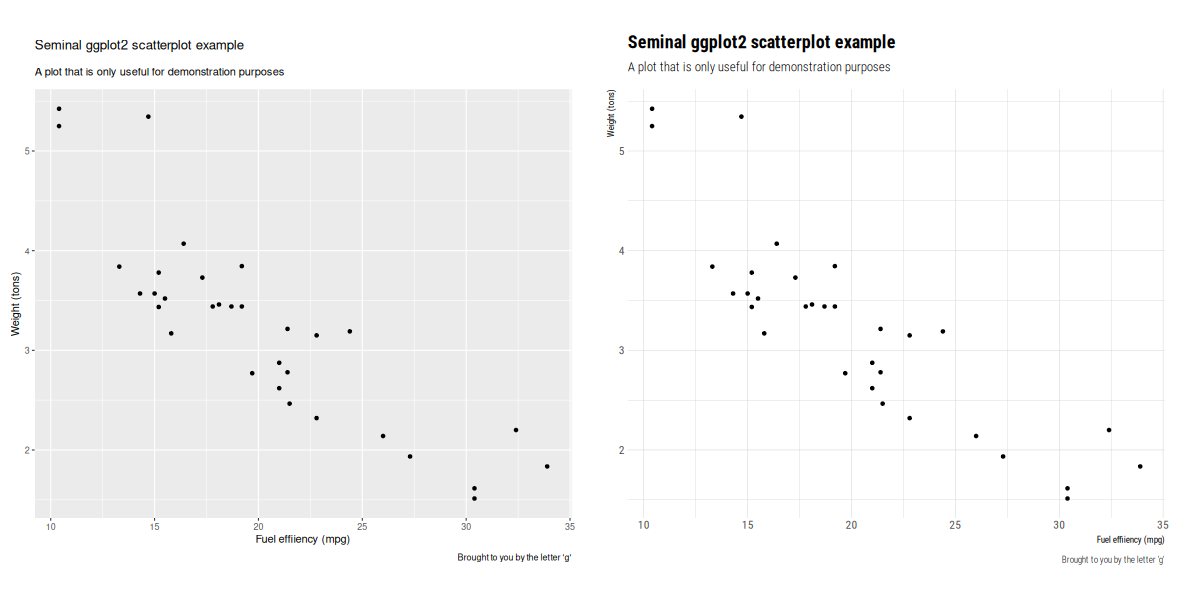
Delighted to announce a new package that arrived on CRAN today: tinythemes. It repackages the theme_ipsum_rc() function by Bob Rudis from his hrbrthemes package in a zero (added) dependency way. A simple example is (also available as a demo inside the packages in the next update) contrasts the default style (on left) with the one added by this package (on the right): The GitHub repo also shows this little example: total dependencies of hrbrthemes over what ggplot2 installs:
> db <- tools::CRAN_package_db()
> deps <- tools::package_dependencies(c("ggplot2", "hrbrthemes"), recursive=TRUE, db=db
> Filter(\(x) x != "ggplot2", setdiff(deps[[2]], deps[[1]]))
 [1] "extrafont"         "knitr"             "rmarkdown"         "htmltools"        
 [5] "tools"             "gdtools"           "extrafontdb"       "Rttf2pt1"         
 [9] "Rcpp"              "systemfonts"       "gfonts"            "curl"             
[13] "fontquiver"        "base64enc"         "digest"            "ellipsis"         
[17] "fastmap"           "evaluate"          "highr"             "xfun"             
[21] "yaml"              "bslib"             "fontawesome"       "jquerylib"        
[25] "jsonlite"          "stringr"           "tinytex"           "cachem"           
[29] "memoise"           "mime"              "sass"              "fontBitstreamVera"
[33] "fontLiberation"    "shiny"             "crul"              "crayon"           
[37] "stringi"           "cpp11"             "urltools"          "httpcode"         
[41] "fs"                "rappdirs"          "httpuv"            "xtable"           
[45] "sourcetools"       "later"             "promises"          "commonmark"       
[49] "triebeard"        
>
Comments and suggestions are welcome at the GitHub repo. If you like this or other open-source work I do, you can sponsor me at GitHub.

This post by Dirk Eddelbuettel originated on his Thinking inside the box blog. Please report excessive re-aggregation in third-party for-profit settings.

17 December 2023

Dirk Eddelbuettel: littler 0.3.19 on CRAN: Several Updates

max-heap image The twentieth release of littler as a CRAN package landed a few minutes ago, following in the now seventeen year history (!!) as a package started by Jeff in 2006, and joined by me a few weeks later. littler is the first command-line interface for R as it predates Rscript. It allows for piping as well for shebang scripting via #!, uses command-line arguments more consistently and still starts faster. It also always loaded the methods package which Rscript only began to do in recent years. littler lives on Linux and Unix, has its difficulties on macOS due to yet-another-braindeadedness there (who ever thought case-insensitive filesystems as a default were a good idea?) and simply does not exist on Windows (yet the build system could be extended see RInside for an existence proof, and volunteers are welcome!). See the FAQ vignette on how to add it to your PATH. A few examples are highlighted at the Github repo:, as well as in the examples vignette. This release contains a fair number of small changes and improvements to some of the example scripts is run daily. The full change description follows.

Changes in littler version 0.3.19 (2023-12-17)
  • Changes in examples scripts
    • The help or usage text display for r2u.r, ttt.r, check.r has been improved, expanded or corrected, respectively
    • installDeps.r has a new argument for dependency selection
    • An initial 'single test file' runner tttf.r has been added
    • r2u.r has two new options for setting / varying the Debian build version of package that is built, and one for BioConductor builds, one for a 'dry run' build, and a new --compile option
    • installRSPM.r, installPPM.r, installP3M.r have been updates to reflect the name changes
    • installRub.r now understands 'package@universe' too
    • tt.r flips the default of the --effects switch

My CRANberries service provides a comparison to the previous release. Full details for the littler release are provided as usual at the ChangeLog page, and also on the package docs website. The code is available via the GitHub repo, from tarballs and now of course also from its CRAN page and via install.packages("littler"). Binary packages are available directly in Debian as well as (in a day or two) Ubuntu binaries at CRAN thanks to the tireless Michael Rutter. Comments and suggestions are welcome at the GitHub repo. If you like this or other open-source work I do, you can sponsor me at GitHub.

This post by Dirk Eddelbuettel originated on his Thinking inside the box blog. Please report excessive re-aggregation in third-party for-profit settings.

16 December 2023

Thomas Lange: Adding a writeable data partition to an ISO image

Some years ago a customer needed a live ISO containing a customized FAI environment (not for installing but for extended hardware stress tests), but on an USB stick with the possibility to store the logs of the tests on the USB stick. But an ISO file system (iso9660) remains read-only, even when put onto an USB stick. I had the idea to add another partition onto the USB stick after the ISO was written to it (using cp or dd). You can use fdisk with an ISO file, add a new partition, loop mount the ISO and format this partition. That's all. This worked perfect for my customer. I forgot this idea for a while but a few weeks ago I remembered it. What could be possible when my FAI (Fully Automatic Installation) image would also provide such a partition? Which things could be provided on this partition? Could I provide a FAI ISO and my users would be able to easily put their own .deb package onto it without remastering the ISO or building an ISO on their own? Now here's the shell script, that extends an ISO or an USB stick with an ext4 or exFAT partition and set the file system label to MY-DATA. https://github.com/faiproject/fai/blob/master/bin/mk-data-partition Examples how to use mk-data-partition
Add a data partition of size 1G to the Debian installer ISO using an ext4 partition
# mk-data-partition -s 1G debian-12.2.0-amd64-netinst.iso
Create the data partition using an exFAT file system on USB named /dev/sdb.
First copy (or dd) the ISO onto the USB stick. Then add the data partition
to the USB stick.
# cp faicd64-large_6.0.3.iso /dev/sdb
# mk-data-partition -F /dev/sdb
Create the data partition and copy directories A and B to it
# mk-data-partition -c debian-12.2.0-amd64-netinst.iso A B
The next FAI version will use this in different parts of an installation. A blog post about this will follow. A new idea for our Debian installer ISO Here are my ideas how the Debian installer could use such a partition if it automatically detects and mounts it (by it's file system label): The advantage of this approach is that there's no need for the user to remaster the official Debian installer ISO, which is not easy for end users. We only have to extend the installer to use files from this data partition in some portions of the installation. Additional udebs, packages or firmware could automatically be used by the installer. Companies could easily create an OEM installer of Debian. What do you think about this idea? Please send feedback to lange@debian.org

15 December 2023

Scarlett Gately Moore: KDE: Snaps, KDEneon, Debian and my future.

First I want to thank KDE for this wonderful write up on LinkedIn. https://www.linkedin.com/posts/kde_akademy-2023-over-a-million-reasons-why-activity-7139965489153208320-PNem?utm_source=share&utm_medium=member_desktop It made my heart explode with happiness as I prepped for my interview on Monday. I didn t get the job ( Just the usual we were very impressed with your experience, but we went with another candidate ). I think the cosmos is determined for me to hold out for the project even though it is only part time work, it is work and if I have learned nothing else this year, I have learned how to live on a very tight budget! It turns out many of the things we think we need, we don t. So with hard work of Kevin Ottens ( Thank you!!!! ), this should be finalized after the first of the year. This plan also allows me time for KDEneon and Debian work. I am happy with it and look forward to the coming year and the exciting things to come. My holiday plans are to help the Debian KDE team with the KF6 packaging, On-going KDEneon efforts, and continue to make sure the snaps Qt6 transition is a painless as possible. I will also be working on the qt6 kde-neon extension. In closing, despite my terrible luck with job-hunting, I am in an amazing community and I am truly grateful to each and every one of you. It has been a great year and I have added many new things to my skillset and I look forward to many more next year. As usual, it is that time of month where I have not raised enough to pay my internet bill ( phone company taking an extra 200.00 didn t help ) If you can spare any change ( any amount helps! ) please consider a donation https://gofund.me/b74e4c6f Thank you! I hope everyone has a wonderful <insert your holiday here> !!!!! ~ Scarlett

14 December 2023

Arturo Borrero Gonz lez: OpenTofu: handcrafted include-file mechanism with YAML

Post logo I recently started playing with Terraform/OpenTofu almost on a daily basis. The other day I was working with Amazon Managed Prometheus (or AMP), and wanted to define prometheus alert rules on YAML files. I decided that I needed a way to put the alerts on a bunch of files, and then load them by the declarative code, on the correct AMP workspace. I came up with this code pattern that I m sharing here, for my future reference, and in case it is interesting to someone else. The YAML file where I specify the AMP workspace, and where the alert rule files live:
---
alert_files:
  my_alerts_production:
    amp:
      workspace: "production"
    files: "alert_rules/production/*.yaml"
  my_alerts_staging:
    amp:
      workspace: "staging"
    files: "alert_rules/staging/*.yaml"
Note the files entry contains a file pattern. I will later expand the pattern using the fileset() function. Each rule file would be something like this:
---
name: "my_rule_namespace"
rule_data:  
  # this is prometheus-specific config
  groups:
    - name: "example_alert_group"
      rules:
      - alert: Example_Alert_Cpu
        # just arbitrary values, to produce an example alert
        expr: avg(rate(ecs_cpu_seconds_total container=~"something" [2m])) > 1
        for: 10s
        annotations:
          summary: "CPU usage is too high"
          description: "The container average CPU usage is too high."
I m interested in the data structure mutating into something similar to this:
---
alert_files:
  my_alerts_production:
    amp:
      workspace: "production"
    alerts_data:
      - name: rule_namespace_1
        rule_data:  
          # actual alert definition here
          [..]
      - name: rule_namespace_2
        rule_data:  
          # actual alert definition here
          [..]
  my_alerts_staging:
    amp:
      workspace: "staging"
    alerts_data:
      - name: rule_namespace_1
        rule_data:  
          # actual alert definition here
          [..]
      - name: rule_namespace_2
        rule_data:  
          # actual alert definition here
          [..]
This is the algorithm that does the trick:
locals  
  alerts_config =  
    for x, y in  
      for k, v in local.config.alert_files :
      k =>  
        amp : (v.amp),
        files : fileset("", v.files)
       
        : x =>  
      amp : (y.amp),
      alertmanager_data : [
        for z in(y.files) :
        yamldecode(file(z))
      ]


Because the declarative nature of the Terraform/OpenTofu language, I needed to implement 3 different for loops. Each loop reads the map and transforms it in some way, passing the result into the next loop. A bit convoluted if you ask me. To explain the logic, I think it makes more sense to read it from inside out. First loop:
    for k, v in local.config.alert_files :
    k =>  
        amp : (v.amp),
        files : fileset("", v.files)
     
This loop iterates the input YAML map in key-value pairs, remapping each amp entry, and expanding the file globs using the fileset() into a temporal files entry. Second loop:
    for x, y in  
        # previous fileset() loop
        : x =>  
      amp : (y.amp),
      alertmanager_data : [
        # yamldecode() loop
      ]
     
This intermediate loop is responsible for building the final data structure. It iterates the previous fileset() loop to remap it calling the next loop, the yamldecode() one. Note how the amp entry is being rebuilt in each remap (first loop and this one), otherwise we would lose it! Third loop:
    alertmanager_data : [
        for z in(y.files) :
        yamldecode(file(z))
    ]
And finally, this is maybe the easiest loop of the 3, we iterate the temporal file entry that was created in the first loop, calling yamldecode() for each of the file names generated by fileset(). The resulting data structure should allow you to easily create resources later in a for_each loop.

Dirk Eddelbuettel: RProtoBuf 0.4.21 on CRAN: Updated Upstream Support!

An exciting new release 0.4.21 of RProtoBuf arrived on CRAN earlier today. RProtoBuf provides R with bindings for the Google Protocol Buffers ( ProtoBuf ) data encoding and serialization library used and released by Google, and deployed very widely in numerous projects as a language and operating-system agnostic protocol. ProtoBuf development, following what seemed like a multi-year lull, all of a sudden picked up again with a vengeance a little while ago. And the library releases we rely on for convenience and provided by the Linux distributions are lagging. So last summer we received an excellent, and focussed, pull request #93 offering to update the package to the newer ProtoBuf 22.0 and beyond. (Aside: When a library ditches its numbering scheme you know changes are for real . My Ubuntu 23.10 box is still at 3.21 in a different counting scheme .) But it wasn t until last weekend the issue ticket #95 by Sebastian ran into the same issue, but recognized it and contained a container recipe! So now all of a sudden we were able to build under a newer ProtoBuf which made accepting the PR #93 much easier! We added this as an additional continuous unit test, and made a few other smaller updates to documentation and style. The following section from the NEWS.Rd file has full details.

Changes in RProtoBuf version 0.4.21 (2022-12-13)
  • Package now builds with ProtoBuf >= 22.x thanks to Matteo Gianella (#93 addressing #92).
  • An Alpine 3.19-based workflow was added to test this in continuous integration thanks to a suggestion by Sebastian Meyer.
  • A large number of old-style .Call were updated (#96).
  • Several packaging, dcoumentation and testing items were updated.

Thanks to my CRANberries, there is a diff to the previous release. The RProtoBuf page has copies of the (older) package vignette, the quick overview vignette, and the pre-print of our JSS paper. Questions, comments etc should go to the GitHub issue tracker off the GitHub repo. If you like this or other open-source work I do, you can sponsor me at GitHub.

This post by Dirk Eddelbuettel originated on his Thinking inside the box blog. Please report excessive re-aggregation in third-party for-profit settings.

13 December 2023

Jonathan Dowland: equivalence problems with StreamGraph

I've been tackling an equivalence problem with rewritten programs in StrIoT, our proof-of-concept stream-processing system. The StrIoT Logical Optimiser applies a set of rewrite rules to a stream-processing program, generating a set of variants that can be reasoned about, ranked, and deployed. The problem I've been tackling is that a variant may appear to be semantically equivalent to another, but compare (with ==) as distinct. The issue relates to the design of our data-type representing programs, in particular, a consequence of our choice to outsource the structural aspect to a 3rd-party library (Algebra.Graph). The Graph library deems nodes that compare as equivalent (again with ==) to be the same. Since a stream-processing program may contain many operators which are equivalent, but distinct, we needed to add a field to our payload type to differentiate them: so we opted for an Integer field, vertexId (something I've described as a "wart" elsewhere) Here's a simplified example of our existing payload type, StreamVertex:
data StreamVertex = StreamVertex
      vertexId   :: Int
    , operator   :: StreamOperator
    , parameters :: [ExpQ]
    , intype     :: String
    , outtype    :: String
     
A rewrite rule might introduce or eliminate operators from a stream-processing program. For example, consider the rule which "hoists" a filter upstream from a merge operator. In pseudo-Haskell,
streamFilter p . streamMerge [a , b, ...]
=>
streamMerge [ streamFilter p a
            , streamFilter p b
            , ...]
The original streamFilter is removed, and new streamFilters are introduced, one per stream arriving at streamMerge. In general, rules may need to synthesise new operators, and thus new vertexIds. Another rewrite rule might perform the reverse operation. But the individual rules operate in isolation: and so, the program variant that results after applying a rule and then applying an inverse rule may not have the same vertexIds, or the same order of vertexIds, as the original program. I thought of the outline of two possible solutions to this. "well-numbered" StreamGraphs The first was to encode (and enforce) some rules about how vertexIds are used. If they always began from (say) 1, and were strictly-ascending from the source operator(s), and rewrite rules guaranteed that a "well numbered" input would be "well numbered" after rewriting, this would be sufficient to rule out a rewritten-but-semantically-equivalent program being considered distinct. The trouble with this approach is using properties of a numerical system built around vertexId as a stand-in for the real structural problem. I was not sure I could prove both that the stand-in system was sound and that it was a proper analogue for the underlying structural issue. It feels to me more that the choice to use an external library to encode the structure of a stream-processing program was the issue: the structure itself is a fundamental part of the semantics of the program. What if we had encoded the structure of programs within the same data-type? alternative data-type StrIoT programs are trees. The root is the sink node: there is always exactly one. There can be multiple source (leaf nodes), but they always converge. Operators can have multiple inputs (including zero). The root node has no output, but all other operators have exactly one. I explored transforming StreamVertex into a tree by adding a field representing incoming streams, and dispensing with Graph and vertexId. Something like this
data StreamProg = StreamProg StreamOperator [Exp] String String [StreamProg]
A uni-directional transformation from Graph StreamVertex to StreamProg is all that's needed to implement something like ==, so we don't need to keep track of vertexId mappings. Unfortunately, we can't fix the actual Eq (Graph StreamVertex) implementation this way: it delegates to Eq StreamVertex, and we just don't have enough information to fix the problem at that level. But, we can write a separate graphEq and use that instead where we need to. could I go further? Spoiler: I haven't. But I've been sorely tempted. We still have a separate StreamOperator type, which it would be nice to fold in; and we still have to use a list around the incoming nodes, since different operators accept different numbers of incoming streams. It would be better to encode the correct valences in the type. In 2020 I explored iteratively reducing the StreamVertex data-type to try and get it as close as possible to the ideal end-user API: simple functions. I wrote about one step along that path in Template Haskell and Stream-processing programs, but concluded that, since this was not my main PhD focus, I wouldn't go further. But it was nagging at my subconcious ever since. I allowed myself a couple of days exploring some advanced concepts including typed Template Haskell (that has had some developments since 2020), generalised abstract data types (GADTs) and more generic programming to see what could be achieved. I'll summarise all that in the next blog post.

Melissa Wen: 15 Tips for Debugging Issues in the AMD Display Kernel Driver

A self-help guide for examining and debugging the AMD display driver within the Linux kernel/DRM subsystem. It s based on my experience as an external developer working on the driver, and are shared with the goal of helping others navigate the driver code. Acknowledgments: These tips were gathered thanks to the countless help received from AMD developers during the driver development process. The list below was obtained by examining open source code, reviewing public documentation, playing with tools, asking in public forums and also with the help of my former GSoC mentor, Rodrigo Siqueira.

Pre-Debugging Steps: Before diving into an issue, it s crucial to perform two essential steps: 1) Check the latest changes: Ensure you re working with the latest AMD driver modifications located in the amd-staging-drm-next branch maintained by Alex Deucher. You may also find bug fixes for newer kernel versions on branches that have the name pattern drm-fixes-<date>. 2) Examine the issue tracker: Confirm that your issue isn t already documented and addressed in the AMD display driver issue tracker. If you find a similar issue, you can team up with others and speed up the debugging process.

Understanding the issue: Do you really need to change this? Where should you start looking for changes? 3) Is the issue in the AMD kernel driver or in the userspace?: Identifying the source of the issue is essential regardless of the GPU vendor. Sometimes this can be challenging so here are some helpful tips:
  • Record the screen: Capture the screen using a recording app while experiencing the issue. If the bug appears in the capture, it s likely a userspace issue, not the kernel display driver.
  • Analyze the dmesg log: Look for error messages related to the display driver in the dmesg log. If the error message appears before the message [drm] Display Core v... , it s not likely a display driver issue. If this message doesn t appear in your log, the display driver wasn t fully loaded and you will see a notification that something went wrong here.
4) AMD Display Manager vs. AMD Display Core: The AMD display driver consists of two components:
  • Display Manager (DM): This component interacts directly with the Linux DRM infrastructure. Occasionally, issues can arise from misinterpretations of DRM properties or features. If the issue doesn t occur on other platforms with the same AMD hardware - for example, only happens on Linux but not on Windows - it s more likely related to the AMD DM code.
  • Display Core (DC): This is the platform-agnostic part responsible for setting and programming hardware features. Modifications to the DC usually require validation on other platforms, like Windows, to avoid regressions.
5) Identify the DC HW family: Each AMD GPU has variations in its hardware architecture. Features and helpers differ between families, so determining the relevant code for your specific hardware is crucial.
  • Find GPU product information in Linux/AMD GPU documentation
  • Check the dmesg log for the Display Core version (since this commit in Linux kernel 6.3v). For example:
    • [drm] Display Core v3.2.241 initialized on DCN 2.1
    • [drm] Display Core v3.2.237 initialized on DCN 3.0.1

Investigating the relevant driver code: Keep from letting unrelated driver code to affect your investigation. 6) Narrow the code inspection down to one DC HW family: the relevant code resides in a directory named after the DC number. For example, the DCN 3.0.1 driver code is located at drivers/gpu/drm/amd/display/dc/dcn301. We all know that the AMD s shared code is huge and you can use these boundaries to rule out codes unrelated to your issue. 7) Newer families may inherit code from older ones: you can find dcn301 using code from dcn30, dcn20, dcn10 files. It s crucial to verify which hooks and helpers your driver utilizes to investigate the right portion. You can leverage ftrace for supplemental validation. To give an example, it was useful when I was updating DCN3 color mapping to correctly use their new post-blending color capabilities, such as: Additionally, you can use two different HW families to compare behaviours. If you see the issue in one but not in the other, you can compare the code and understand what has changed and if the implementation from a previous family doesn t fit well the new HW resources or design. You can also count on the help of the community on the Linux AMD issue tracker to validate your code on other hardware and/or systems. This approach helped me debug a 2-year-old issue where the cursor gamma adjustment was incorrect in DCN3 hardware, but working correctly for DCN2 family. I solved the issue in two steps, thanks for community feedback and validation: 8) Check the hardware capability screening in the driver: You can currently find a list of display hardware capabilities in the drivers/gpu/drm/amd/display/dc/dcn*/dcn*_resource.c file. More precisely in the dcn*_resource_construct() function. Using DCN301 for illustration, here is the list of its hardware caps:
	/*************************************************
	 *  Resource + asic cap harcoding                *
	 *************************************************/
	pool->base.underlay_pipe_index = NO_UNDERLAY_PIPE;
	pool->base.pipe_count = pool->base.res_cap->num_timing_generator;
	pool->base.mpcc_count = pool->base.res_cap->num_timing_generator;
	dc->caps.max_downscale_ratio = 600;
	dc->caps.i2c_speed_in_khz = 100;
	dc->caps.i2c_speed_in_khz_hdcp = 5; /*1.4 w/a enabled by default*/
	dc->caps.max_cursor_size = 256;
	dc->caps.min_horizontal_blanking_period = 80;
	dc->caps.dmdata_alloc_size = 2048;
	dc->caps.max_slave_planes = 2;
	dc->caps.max_slave_yuv_planes = 2;
	dc->caps.max_slave_rgb_planes = 2;
	dc->caps.is_apu = true;
	dc->caps.post_blend_color_processing = true;
	dc->caps.force_dp_tps4_for_cp2520 = true;
	dc->caps.extended_aux_timeout_support = true;
	dc->caps.dmcub_support = true;
	/* Color pipeline capabilities */
	dc->caps.color.dpp.dcn_arch = 1;
	dc->caps.color.dpp.input_lut_shared = 0;
	dc->caps.color.dpp.icsc = 1;
	dc->caps.color.dpp.dgam_ram = 0; // must use gamma_corr
	dc->caps.color.dpp.dgam_rom_caps.srgb = 1;
	dc->caps.color.dpp.dgam_rom_caps.bt2020 = 1;
	dc->caps.color.dpp.dgam_rom_caps.gamma2_2 = 1;
	dc->caps.color.dpp.dgam_rom_caps.pq = 1;
	dc->caps.color.dpp.dgam_rom_caps.hlg = 1;
	dc->caps.color.dpp.post_csc = 1;
	dc->caps.color.dpp.gamma_corr = 1;
	dc->caps.color.dpp.dgam_rom_for_yuv = 0;
	dc->caps.color.dpp.hw_3d_lut = 1;
	dc->caps.color.dpp.ogam_ram = 1;
	// no OGAM ROM on DCN301
	dc->caps.color.dpp.ogam_rom_caps.srgb = 0;
	dc->caps.color.dpp.ogam_rom_caps.bt2020 = 0;
	dc->caps.color.dpp.ogam_rom_caps.gamma2_2 = 0;
	dc->caps.color.dpp.ogam_rom_caps.pq = 0;
	dc->caps.color.dpp.ogam_rom_caps.hlg = 0;
	dc->caps.color.dpp.ocsc = 0;
	dc->caps.color.mpc.gamut_remap = 1;
	dc->caps.color.mpc.num_3dluts = pool->base.res_cap->num_mpc_3dlut; //2
	dc->caps.color.mpc.ogam_ram = 1;
	dc->caps.color.mpc.ogam_rom_caps.srgb = 0;
	dc->caps.color.mpc.ogam_rom_caps.bt2020 = 0;
	dc->caps.color.mpc.ogam_rom_caps.gamma2_2 = 0;
	dc->caps.color.mpc.ogam_rom_caps.pq = 0;
	dc->caps.color.mpc.ogam_rom_caps.hlg = 0;
	dc->caps.color.mpc.ocsc = 1;
	dc->caps.dp_hdmi21_pcon_support = true;
	/* read VBIOS LTTPR caps */
	if (ctx->dc_bios->funcs->get_lttpr_caps)  
		enum bp_result bp_query_result;
		uint8_t is_vbios_lttpr_enable = 0;
		bp_query_result = ctx->dc_bios->funcs->get_lttpr_caps(ctx->dc_bios, &is_vbios_lttpr_enable);
		dc->caps.vbios_lttpr_enable = (bp_query_result == BP_RESULT_OK) && !!is_vbios_lttpr_enable;
	 
	if (ctx->dc_bios->funcs->get_lttpr_interop)  
		enum bp_result bp_query_result;
		uint8_t is_vbios_interop_enabled = 0;
		bp_query_result = ctx->dc_bios->funcs->get_lttpr_interop(ctx->dc_bios, &is_vbios_interop_enabled);
		dc->caps.vbios_lttpr_aware = (bp_query_result == BP_RESULT_OK) && !!is_vbios_interop_enabled;
	 
Keep in mind that the documentation of color capabilities are available at the Linux kernel Documentation.

Understanding the development history: What has brought us to the current state? 9) Pinpoint relevant commits: Use git log and git blame to identify commits targeting the code section you re interested in. 10) Track regressions: If you re examining the amd-staging-drm-next branch, check for regressions between DC release versions. These are defined by DC_VER in the drivers/gpu/drm/amd/display/dc/dc.h file. Alternatively, find a commit with this format drm/amd/display: 3.2.221 that determines a display release. It s useful for bisecting. This information helps you understand how outdated your branch is and identify potential regressions. You can consider each DC_VER takes around one week to be bumped. Finally, check testing log of each release in the report provided on the amd-gfx mailing list, such as this one Tested-by: Daniel Wheeler:

Reducing the inspection area: Focus on what really matters. 11) Identify involved HW blocks: This helps isolate the issue. You can find more information about DCN HW blocks in the DCN Overview documentation. In summary:
  • Plane issues are closer to HUBP and DPP.
  • Blending/Stream issues are closer to MPC, OPP and OPTC. They are related to DRM CRTC subjects.
This information was useful when debugging a hardware rotation issue where the cursor plane got clipped off in the middle of the screen. Finally, the issue was addressed by two patches: 12) Issues around bandwidth (glitches) and clocks: May be affected by calculations done in these HW blocks and HW specific values. The recalculation equations are found in the DML folder. DML stands for Display Mode Library. It s in charge of all required configuration parameters supported by the hardware for multiple scenarios. See more in the AMD DC Overview kernel docs. It s a math library that optimally configures hardware to find the best balance between power efficiency and performance in a given scenario. Finding some clk variables that affect device behavior may be a sign of it. It s hard for a external developer to debug this part, since it involves information from HW specs and firmware programming that we don t have access. The best option is to provide all relevant debugging information you have and ask AMD developers to check the values from your suspicions.
  • Do a trick: If you suspect the power setup is degrading performance, try setting the amount of power supplied to the GPU to the maximum and see if it affects the system behavior with this command: sudo bash -c "echo high > /sys/class/drm/card0/device/power_dpm_force_performance_level"
I learned it when debugging glitches with hardware cursor rotation on Steam Deck. My first attempt was changing the clock calculation. In the end, Rodrigo Siqueira proposed the right solution targeting bandwidth in two steps:

Checking implicit programming and hardware limitations: Bring implicit programming to the level of consciousness and recognize hardware limitations. 13) Implicit update types: Check if the selected type for atomic update may affect your issue. The update type depends on the mode settings, since programming some modes demands more time for hardware processing. More details in the source code:
/* Surface update type is used by dc_update_surfaces_and_stream
 * The update type is determined at the very beginning of the function based
 * on parameters passed in and decides how much programming (or updating) is
 * going to be done during the call.
 *
 * UPDATE_TYPE_FAST is used for really fast updates that do not require much
 * logical calculations or hardware register programming. This update MUST be
 * ISR safe on windows. Currently fast update will only be used to flip surface
 * address.
 *
 * UPDATE_TYPE_MED is used for slower updates which require significant hw
 * re-programming however do not affect bandwidth consumption or clock
 * requirements. At present, this is the level at which front end updates
 * that do not require us to run bw_calcs happen. These are in/out transfer func
 * updates, viewport offset changes, recout size changes and pixel
depth changes.
 * This update can be done at ISR, but we want to minimize how often
this happens.
 *
 * UPDATE_TYPE_FULL is slow. Really slow. This requires us to recalculate our
 * bandwidth and clocks, possibly rearrange some pipes and reprogram
anything front
 * end related. Any time viewport dimensions, recout dimensions,
scaling ratios or
 * gamma need to be adjusted or pipe needs to be turned on (or
disconnected) we do
 * a full update. This cannot be done at ISR level and should be a rare event.
 * Unless someone is stress testing mpo enter/exit, playing with
colour or adjusting
 * underscan we don't expect to see this call at all.
 */
enum surface_update_type  
UPDATE_TYPE_FAST, /* super fast, safe to execute in isr */
UPDATE_TYPE_MED,  /* ISR safe, most of programming needed, no bw/clk change*/
UPDATE_TYPE_FULL, /* may need to shuffle resources */
 ;

Using tools: Observe the current state, validate your findings, continue improvements. 14) Use AMD tools to check hardware state and driver programming: help on understanding your driver settings and checking the behavior when changing those settings.
  • DC Visual confirmation: Check multiple planes and pipe split policy.
  • DTN logs: Check display hardware state, including rotation, size, format, underflow, blocks in use, color block values, etc.
  • UMR: Check ASIC info, register values, KMS state - links and elements (framebuffers, planes, CRTCs, connectors). Source: UMR project documentation
15) Use generic DRM/KMS tools:
  • IGT test tools: Use generic KMS tests or develop your own to isolate the issue in the kernel space. Compare results across different GPU vendors to understand their implementations and find potential solutions. Here AMD also has specific IGT tests for its GPUs that is expect to work without failures on any AMD GPU. You can check results of HW-specific tests using different display hardware families or you can compare expected differences between the generic workflow and AMD workflow.
  • drm_info: This tool summarizes the current state of a display driver (capabilities, properties and formats) per element of the DRM/KMS workflow. Output can be helpful when reporting bugs.

Don t give up! Debugging issues in the AMD display driver can be challenging, but by following these tips and leveraging available resources, you can significantly improve your chances of success. Worth mentioning: This blog post builds upon my talk, I m not an AMD expert, but presented at the 2022 XDC. It shares guidelines that helped me debug AMD display issues as an external developer of the driver. Open Source Display Driver: The Linux kernel/AMD display driver is open source, allowing you to actively contribute by addressing issues listed in the official tracker. Tackling existing issues or resolving your own can be a rewarding learning experience and a valuable contribution to the community. Additionally, the tracker serves as a valuable resource for finding similar bugs, troubleshooting tips, and suggestions from AMD developers. Finally, it s a platform for seeking help when needed. Remember, contributing to the open source community through issue resolution and collaboration is mutually beneficial for everyone involved.

12 December 2023

Freexian Collaborators: Monthly report about Debian Long Term Support, November 2023 (by Roberto C. S nchez)

Like each month, have a look at the work funded by Freexian s Debian LTS offering. Some notable fixes which were made in LTS during the month of November include the gnutls28 cryptographic library and the freerdp2 Remote Desktop Protocol client/server implementation. The gnutls28 update was prepared by LTS contributor Markus Koschany and dealt with a timing attack which could be used to compromise a cryptographic system, while the freerdp2 update was prepared by LTS contributor Tobias Frost and is the result of work spanning 3 months to deal with dozens of vulnerabilities. In addition to the many ordinary LTS tasks which were completed (CVE triage, patch backports, package updates, etc), there were several contributions by LTS contributors for the benefit of Debian stable and old-stable releases, as well as for the benefit of upstream projects. LTS contributor Abhijith PA uploaded an update of the puma package to unstable in order to fix a vulnerability in that package while LTS contributor Thosten Alteholz sponsored an upload to unstable of libde265 and himself made corresponding uploads of libde265 to Debian stable and old-stable. LTS contributor Bastien Roucari s developed patches for vulnerabilities in zbar and audiofile which were then provided to the respective upstream projects. Updates to packages in Debian stable were made by Markus Koschany to deal with security vulnerabilities and by Chris Lamb to deal with some non-security bugs. As always, the LTS strives to provide high quality updates to packages under the direct purview of the LTS team while also rendering assistance to maintainers, the stable security team, and upstream developers whenever practical.

Debian LTS contributors In November, 18 contributors have been paid to work on Debian LTS, their reports are available:
  • Abhijith PA did 7.0h (out of 0h assigned and 14.0h from previous period), thus carrying over 7.0h to the next month.
  • Adrian Bunk did 15.0h (out of 14.0h assigned and 9.75h from previous period), thus carrying over 8.75h to the next month.
  • Anton Gladky did 10.0h (out of 9.5h assigned and 5.5h from previous period), thus carrying over 5.0h to the next month.
  • Bastien Roucari s did 16.0h (out of 18.25h assigned and 1.75h from previous period), thus carrying over 4.0h to the next month.
  • Ben Hutchings did 12.0h (out of 16.5h assigned and 12.25h from previous period), thus carrying over 16.75h to the next month.
  • Chris Lamb did 18.0h (out of 17.25h assigned and 0.75h from previous period).
  • Emilio Pozuelo Monfort did 15.5h (out of 23.5h assigned and 0.25h from previous period), thus carrying over 8.25h to the next month.
  • Guilhem Moulin did 13.0h (out of 12.0h assigned and 8.0h from previous period), thus carrying over 7.0h to the next month.
  • Lee Garrett did 14.5h (out of 16.75h assigned and 7.0h from previous period), thus carrying over 9.25h to the next month.
  • Markus Koschany did 30.0h (out of 30.0h assigned).
  • Ola Lundqvist did 6.5h (out of 8.25h assigned and 15.5h from previous period), thus carrying over 17.25h to the next month.
  • Roberto C. S nchez did 5.5h (out of 12.0h assigned), thus carrying over 6.5h to the next month.
  • Santiago Ruano Rinc n did 3.25h (out of 13.62h assigned and 2.375h from previous period), thus carrying over 12.745h to the next month.
  • Sean Whitton did 3.25h (out of 10.0h assigned), thus carrying over 6.75h to the next month.
  • Sylvain Beucler did 10.0h (out of 13.5h assigned and 10.25h from previous period), thus carrying over 13.75h to the next month.
  • Thorsten Alteholz did 14.0h (out of 14.0h assigned).
  • Tobias Frost did 12.0h (out of 12.0h assigned).
  • Utkarsh Gupta did 0.0h (out of 6.0h assigned and 17.75h from previous period), thus carrying over 23.75h to the next month.

Evolution of the situation In November, we have released 35 DLAs.

Thanks to our sponsors Sponsors that joined recently are in bold.

11 December 2023

Jonathan Dowland: Talks: why?

I'd planned to write some private mail on the subject of preparing and delivering conference talks. However, each time I try to write that mail, I've managed to somehow contrive to lose it. So I thought I'd try as a blog post instead, to break the curse. The first aspect I wanted to write about is the pre-planning phase, or, the bit where you decide to give a talk in the first place. But first a bit about me. I don't talk all that regularly. I think I'm averaging one talk a year. I don't consider myself to be a natural talk-giver: I don't particularly enjoy it and I still get quite nervous. So the first question is: why do it? One motivation is that you want to attend a particular conference, and presenting at it makes it much easier to get institutional support for doing so (i.e., travel and accommodation covered). At the moment, I've written some talk proposals for FOSDEM because I want to attend, and it increases my chances if I'm delivering a talk. Another reason, pertinent to academia, is you wish to have a paper published. Last year I attended a conference in Portland that I had a paper accepted to. A condition of the paper being accepted is you attend and do a presentation about it. Obviously, the presentation itself is a useful form of dissemination for your work, but the paper has the potential to reach more people. You may wish to promote what you're talking about: academic work, but perhaps a piece of open source software that would benefit from wider awareness, more adoption, more bug reports, testing, and patches. You may wish to support the venue. There are a some of small-scale conferences that I enjoy participating in which don't receive a lot of submissions and so I tend to send one or more in order to help make sure there are enough possible talks to keep the whole thing viable. Finally, you may wish to promote yourself: certainly, some Software Engineers I've met seem to spend as much time on talks and travelling as writing software. It's a good way to see a lot of the world, and might be a good way to get your name known and increase your employment prospects. I feel lucky I haven't had to rely on this.

Next.

Previous.