Bartosz Feński: New radiotray
 I would really like to avoid publishing this post but I don t know how to check Debian Planet s aggregation otherwise, so forgive me.
I sponsored the upload of new version of radiotray package.
I would really like to avoid publishing this post but I don t know how to check Debian Planet s aggregation otherwise, so forgive me. I would really like to avoid publishing this post but I don t know how to check Debian Planet s aggregation otherwise, so forgive me. (original post)
> If Ubuntu 12.04 if a LTS release, and Ruby 1.8.7 goes out of support in June of

master during this
merge window. Which is
what happened,
a few days before Christmas.
The other components involved in XI2.2 (aka. multitouch ) were
packaged in experimental while the server side was getting prepared:
Given we reached the
1.12 RC1
stage, it s a good idea to start building drivers against the new
server to make it possible for users to perform some tests. And as
usual, a new server means bumped input and video ABI, meaning a
rebuild for the drivers to pick new dependencies. Some of them also
needed a few fixes to make them build against the new server. Nothing
that can t be fixed with a few merges from upstream master branches.
The usual set of major drivers was uploaded to experimental:
xserver-xorg-input-evdevxserver-xorg-input-keyboardxserver-xorg-input-mousexserver-xorg-input-synapticsxserver-xorg-input-voidxserver-xorg-video-atixserver-xorg-video-dummyxserver-xorg-video-nouveauxserver-xorg-video-fbdevxserver-xorg-video-intelxserver-xorg-video-vesamaster branch was created, and packaged
with SNA support enabled. SandyBridge's
New Acceleration has apparently reached a point where it can be
published to the masses, so here we go. Some details about it can be
found in the
initial commit.
Also, for those wondering about the xorg-server FTBFS on some
architectures,
fixes are pending.
Happy new year.
 I've been informed by a couple of people that the Debian Administration site is down. Sadly it is; at the moment the host isn't showing anything on the serial console and remotely power-cycling it isn't showing any signs of life.
At this time of year I don't want to drag anybody in to take care of it, so ETA on recovery/replacement hardware is Monday/Tuesday.
In other news I've made it to year five of the KVM hosting sub-project/thing. Originally started as a Xen host its been running happily for quite some time. I suspect next year, or the year after that the price/specification ratio will end up losing out and we'll cancel the whole thing - but there are no immediate reasons to make any change.
Finally I knocked up a simple tool to validate my TinyDNS records prior to uploading them. It is simplistic, but adequate to catch the kind of mistakes I make:
Honestly it probably wants to be rationalised a little more - and check records more carefully. e.g. Ensure that the host a CNAME refers to itself exists, and making sure that the nameservers specified are valid.
I just wanted to make something quick after accidentally uploading a zonefile where I'd managed to fat-finger several important records. le sigh.
Oddly enough asking on serverfault.com showed no real suggestions - other than actually running tinydns locally and doing a zone-xfer to validate records. Overkill and harder than I'd like.
Happy New year if you care about such things..
"I finished growing up, L on. I just get older. " - Leon
 I started this blog over a decade ago. Over time, my priorities have changed family, work, home, etc. Many other avenues for online self-expression have also developed in the interim. I m done for now. Old entries remain online, but do not necessarily reflect any of my current views, and certainly do not reflect any views of any of my employers.
 I got a beer bread kit from Mum for Christmas this year.
 It seems pretty easy, so for a pre-new-year treat, I gave it a
go.

 Of course, for the beer I'm using one of my first batch of home
brewed beer that I made just before the holidays.


 Chuck it in
 Mix it for around 30 seconds.
 Discover there is no bread tin here, so use cake tins
instead.
 Flatter than it should be, but otherwise YUM YUM YUM

 I've been at the cabin, on solar power, for a year now. I have a year of
data!
 Everything went pretty well until last month. There was an April rainy
spell where power felt slightly tight. Then over the summer, plenty of
power, no need to conserve. The last month though had what seemed like
weeks of continual grey clouds, where I never saw the sun.
 |
 I can t work out the logic behind the above advert for Energy Watch which was on a billboard near Ringwood Station in Melbourne, Australia. The only thing that it clear is that it spreads bad ideas about mental illness and psychiatric treatment. It doesn t make me want to do business with them.
 The above picture is a shop-front for the Antons clothing store (I m not sure if they are a tailor or if they sell ready to wear). It was taken on Lonsdale St, Melbourne where the store apparently used to be, now they are in Melbourne Central.

 The above pictures show more detail. Unfortunately the combination of lighting and my camera (Xperia X10 phone camera) wasn t adequate to show the apparent ethnic differences between the two men. It seems that the most likely Australian interpretation of the ethnic groups that are represented are African (maybe Afro-American), Southern-European or maybe American Hispanic, North-Western European, and Japanese. It s good to have mannequins representing the fact that not everyone in Australia is white, but different facial expressions for different races seems a strange choice (admittedly it might be a choice made by mannequin manufacturers). Also the Japanese woman with fan idea is rather outdated.
I ve just started reading You May Ask Yourself: An Introduction to Thinking Like a Sociologist (Second Edition)
 by Dalton Conley. I ve only read the first chapter, but that was good enough that the entire book has to be good enough to recommend.
 A minor new release of the
RcppExamples
package is now on
CRAN.
RcppExamples
contains a few illustrations of how to use
Rcpp. It grew out
of documentation for the classic API (now in its own package RcppClassic), and
while we added a few more functions documenting how to do the same with the
new API, the package is still nowhere near completion.
The two ChangeLog entries since the last release are below. One new example
was added, and some things were changed in order to make
R CMD
check
(and the CRAN gate keepers) happy.
2011-12-28  Dirk Eddelbuettel  <edd>
        * DESCRIPTION: Release 0.1.3
        * src/newRcppDateExample.cpp: switch from std::cout to the new
        Rcpp::Rcout device available since Rcpp 0.9.8
        * src/classicRcppDateExample.cpp: idem
        * DESCRIPTION: Depends on Rcpp (>= 0.9.9) for Rcpp::Rcout
2011-04-08  Dirk Eddelbuettel  <edd>
        * R/RcppDataFrame.R: Added new example for Rcpp::DataFrame
        * src/RcppDataFrame.cpp: C++ source for new example
        * man/RcppDataFrame.Rd: Documentation
        * man/RcppParams.Rd: Small change to suppres a warning
Thanks to
CRANberries, you can also look at a
diff to the previous release 0.1.2.
Questions, comments etc should go to the
rcpp-devel mailing list
off the R-Forge page
 The bug webinterface of the
Ultimate Debian Database
currently knows about the following release critical bugs:
| In Total: | 1586 |
|---|---|
| Affecting Wheezy: | 960 |
| Wheezy only: | 163 |
| Remaining to be fixed in Wheezy: | 797 |
| Pending in Wheezy: | 49 |
|---|---|
| Patched in Wheezy: | 117 |
| Duplicates in Wheezy: | 50 |
| Can be fixed in a security Update: | 26 |
| Contrib or non-free in Wheezy: | 9 |
| Claimed in Wheezy: | 0 |
| Delayed in Wheezy: | 8 |
| Otherwise fixed in Wheezy: | 49 |
Wheezyreleased. However, with the view of the Release Managers, 862 need to be dealt with for the release to happen. Please see
Interpreting the release critical bug statisticsfor an explanation of the different numbers.
 * Some months back, we (Mark Hills is main culprit here) decided to fork xosview codebase and released new version 1.9.0. I had no luck contacting main authors and there were 23 Debian patches pending. Mark did amazing job here and we ve one major and one minor releases in two months. Kudos to him again.
You can always grab latest Debian packages from unstable and code from Mark s Github xosview project page. Temporary homepage until we take over SF.net project is here.
Feel free to send patches!
(This post is bought to you by myself that this blog exists
 )


 Backups are something I don't do well. I hope to write a more thorough
article about them at some point. For now, here are some tips.
Like most home users, I don't have access to a tape drive or jukebox for
backups. I'm therefore looking for a solution that backs up to a local
block device. I haven't ruled out a solution that backs up to DVD-Rs,
but I haven't found a suitable one.
I first tried rsnapshot, which uses hard link trees to
represent increments. I found that this resulted in enormous filesystem
metadata, sufficient to cause the machine I was running it on (an embedded ARM
system) to slow to a crawl. I'd recommend to avoid anything using this
technique.
I more recently have been using
rdiff-backup. This has appeared to work
quite well for a number of years. However, it does not gracefully handle the
backup volume being full, spewing python backtraces. This is compounded with
some confusing use of temporary directies and not honouring
$TMPDIR. This
has been known about for years
(1,
2). I've just
independently discovered these problems for the second
time. Aside from
that, because it does not de-duplicate files, it is sensitive to large files
being moved around in the source being backed up. It also cannot do a dry-run
estimate of the disk space required for the next increment. So: time to move
on.
Back in 2010 I discovered bup, an intriguing
backup tool that used a git-style backing store. It's interesting enough
that I packaged it and use it
in a few situations, but I wouldn't rely on it for my main backups, for two
reasons: one, it's not tried-and-tested enough yet (but that is rapidly being
resolved), two: you can't get rid of old increments, so your backup volume will
always increase in size over time, and never throw away old data. So, for now:
move on.
Next on my list to try is Lars Wirzenius' obnam.
 Hello, World!
Today s hacks come remotely, on the first day of my long trek to Cleveland. As many debian readers know, debian URLs are usually transmitted over IRC or email with some snappy abbreviations. Usually, you ll see something like:
Feel free to check out information about frob at wiki.d.o/Frobor something like:
I have uploaded package bar onto mentors.d.n for reviewWhat bugs me most about this is that I have to expand URLs by hand. Which is lame. Enter
libolla (a fitting name as well as a graceful nod to my alma mater John Carroll University s crest).
When LD_PRELOAD d, it ll intercept and expand calls to getaddrinfo transparently. It seems to work fine on SSH, and chrome (but I can t test well, since I m not on a real line).
This was all hacked up in a few hours I had to spare, and without any sort of internet love, so I m willing to bet there are some bits that can be cleaned up (after all, the name of the blog is Peace, Love and C++ , not Peace, Love and C - I don t clam to be a c expert ;) )
So, feel free to fork the project on github (or as I can now do - http://g.c/paultag/libolla)
Now, I just need to find a way to globally pre-load this for apps that I start in my DE. Should be easy enough fiddling with some env-var files.
 So there are two servers; let's call them srv1 and srv2. Srv1
contains a bunch of subversion repositories, but these are to be
migrated to srv2. Since the repositories are not (just) used for
ascii-only files, they're fairly big (several tens of gigabytes,
altogether), so copying them from one server to the other would take a
while. In order to make sure this would happen quickly, we had already
copied them over to the new server, so that on the final switch would be
quick (an rsync that would copy over just the new done
transactions).
That final switch was today. Only I didn't know that instead of just
testing, the customer had already started using one of the repositories
(and they'd forgotten to remind me), so the subversion repository
suddenly jumped backwards in time. In addition, the new server wasn't
being backed up yet (at least not for the subversion bits), so restoring
from backups wasn't an option. Oops.
Luckily the solution is fairly simple. You see, fsfs stores each
revision in a unique file; that means that as long as nobody has
committed to the repository yet (which they couldn't, since system users
aren't the same on both servers, so the webserver didn't have write
permissions on the repository after the rsync), nothing is lost. One
only needs to manually change the repository so that whatever subversion
thinks is the latest commit, actually is the latest commit.
That information is stored in a file called db/current
inside the repository. What's in that file depends on the repository
version, which is stored in a file called db/format in the
repository. For versions 1 and 2, the format is a single line with three
space-separated values, of which the first is the last revision number
used in the repository. The other two are counters that are used to give
transactions unique names; and they, too, need to be up-to-date. For
version 3 and above, the file contains only the revision number; there,
the other two are derived from that instead of having their own unique
number.
Figuring out the last used revision number in an fsfs repository is
ridiculously easy:
ls -v db/revs tail -n1So if you've got a repository of fsfs version 3 or above, just change the revision number in the db/current file (after taking backups and making sure nobody can access the repository while you're doing this, of course), and you're all set. Unfortunately, in my case, the repository was still in fsfs version 2, which meant I could not change just the revision number and not expect trouble. I suppose it should've been possible to figure out what the last transaction numbers are, somehow, so that I could fix the current file completely, but I reasoned that upgrading to a newer repository format might have other advantages too, so I just dumped the repository and reloaded it, and everything worked at that point.
 I only had an issue with StatusNet due to the default behavior of spawn-cgi to not spawn any PHP child except if told otherwise. I also had to fix the OpenID plugin for WordPress, as per this commit.
For now, I keep apache running for the DSPAM Web UI, which requires suexec. I know I can easily run the CGI through a different user, but still have to polish my setup for FastCGI.
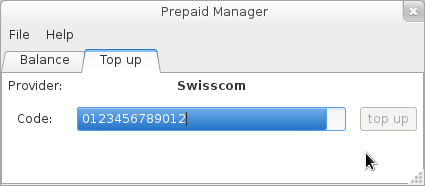
 A recent trip to Switzerland made me dig out my prepaid card for UMTS usage
again. This resulted in some minor enhancements for Prepaid Manager. The new
release handles disabled and missing modems more reliably. It also has some
visual feedback if we know the length of the top up code:
 This blog is flattr enabled.
Next.