Search Results: "will"

5 November 2007

Raphael Geissert: First outputs of a more or less functional DeBaBaReTools

Finally after fixing a lot of code (errors caused specially because of the different behaviour used on shell scripts) here are some of the first outputs generated by the scripts.

This post should give a better idea of how DeBaBaReTools work.

Test packages:


$ ls /home/raphael/Deb/repository/pub/UploadQueue/
kcheckgmail_0.5.7.2-0+etch1.diff.gz php5-htscanner_0.8.1-1_i386.deb
kcheckgmail_0.5.7.2-0+etch1.dsc php-htscanner_0.8.1-1.diff.gz
kcheckgmail_0.5.7.2-0+etch1_i386.changes php-htscanner_0.8.1-1.dsc
kcheckgmail_0.5.7.2-0+etch1_i386.deb php-htscanner_0.8.1-1_i386.changes
kcheckgmail_0.5.7.2-0+etch1_source.changes php-htscanner_0.8.1-1_source.changes
kcheckgmail_0.5.7.2-0+sarge1.diff.gz php-htscanner_0.8.1.orig.tar.gz
kcheckgmail_0.5.7.2-0+sarge1.dsc zend-framework_1.0.2-1.diff.gz
kcheckgmail_0.5.7.2-0+sarge1_i386.changes zend-framework_1.0.2-1.dsc
kcheckgmail_0.5.7.2-0+sarge1_i386.deb zend-framework_1.0.2-1_source.changes
kcheckgmail_0.5.7.2-0+sarge1_source.changes zend-framework_1.0.2.orig.tar.gz
kcheckgmail_0.5.7.2.orig.tar.gz


I've included the already built binary packages (built by a previous, functional, version of wannaBuild) because I'm recreating my repository from scratch.

So let's run processIncoming:

$ DEBUG=1 EXTRA_PROBE_DIRS=$PWD/backends VERBOSE=1 ./processIncoming 2> /tmp/log
processIncoming v0.1 started.
Processing /home/raphael/Deb/repository/pub/UploadQueue/php-htscanner_0.8.1-1_i386.changes...
Processing /home/raphael/Deb/repository/pub/UploadQueue/zend-framework_1.0.2-1_source.changes...
Processing /home/raphael/Deb/repository/pub/UploadQueue/kcheckgmail_0.5.7.2-0+sarge1_i386.changes...
Processing /home/raphael/Deb/repository/pub/UploadQueue/php-htscanner_0.8.1-1_source.changes...
Processing /home/raphael/Deb/repository/pub/UploadQueue/kcheckgmail_0.5.7.2-0+sarge1_source.changes...
Processing /home/raphael/Deb/repository/pub/UploadQueue/kcheckgmail_0.5.7.2-0+etch1_source.changes...
Processing /home/raphael/Deb/repository/pub/UploadQueue/kcheckgmail_0.5.7.2-0+etch1_i386.changes...
mv'ing "/home/raphael/Deb/repository/pub/UploadQueue/kcheckgmail_0.5.7.2-0+etch1.diff.gz" to "/home/raphael/Deb/repository/incoming/accepted/"
mv'ing "/home/raphael/Deb/repository/pub/UploadQueue/kcheckgmail_0.5.7.2-0+etch1.dsc" to "/home/raphael/Deb/repository/incoming/accepted/"
mv'ing "/home/raphael/Deb/repository/pub/UploadQueue/kcheckgmail_0.5.7.2-0+etch1_i386.changes" to "/home/raphael/Deb/repository/incoming/accepted/"
mv'ing "/home/raphael/Deb/repository/pub/UploadQueue/kcheckgmail_0.5.7.2-0+etch1_i386.deb" to "/home/raphael/Deb/repository/incoming/accepted/"
mv'ing "/home/raphael/Deb/repository/pub/UploadQueue/kcheckgmail_0.5.7.2-0+etch1_source.changes" to "/home/raphael/Deb/repository/incoming/accepted/"
mv'ing "/home/raphael/Deb/repository/pub/UploadQueue/kcheckgmail_0.5.7.2-0+sarge1.diff.gz" to "/home/raphael/Deb/repository/incoming/accepted/"
mv'ing "/home/raphael/Deb/repository/pub/UploadQueue/kcheckgmail_0.5.7.2-0+sarge1.dsc" to "/home/raphael/Deb/repository/incoming/accepted/"
mv'ing "/home/raphael/Deb/repository/pub/UploadQueue/kcheckgmail_0.5.7.2-0+sarge1_i386.changes" to "/home/raphael/Deb/repository/incoming/accepted/"
mv'ing "/home/raphael/Deb/repository/pub/UploadQueue/kcheckgmail_0.5.7.2-0+sarge1_i386.deb" to "/home/raphael/Deb/repository/incoming/accepted/"
mv'ing "/home/raphael/Deb/repository/pub/UploadQueue/kcheckgmail_0.5.7.2-0+sarge1_source.changes" to "/home/raphael/Deb/repository/incoming/accepted/"
mv'ing "/home/raphael/Deb/repository/pub/UploadQueue/kcheckgmail_0.5.7.2.orig.tar.gz" to "/home/raphael/Deb/repository/incoming/accepted/"
mv'ing "/home/raphael/Deb/repository/pub/UploadQueue/php5-htscanner_0.8.1-1_i386.deb" to "/home/raphael/Deb/repository/incoming/accepted/"
mv'ing "/home/raphael/Deb/repository/pub/UploadQueue/php-htscanner_0.8.1-1.diff.gz" to "/home/raphael/Deb/repository/incoming/accepted/"
mv'ing "/home/raphael/Deb/repository/pub/UploadQueue/php-htscanner_0.8.1-1.dsc" to "/home/raphael/Deb/repository/incoming/accepted/"
mv'ing "/home/raphael/Deb/repository/pub/UploadQueue/php-htscanner_0.8.1-1_i386.changes" to "/home/raphael/Deb/repository/incoming/accepted/"
mv'ing "/home/raphael/Deb/repository/pub/UploadQueue/php-htscanner_0.8.1-1_source.changes" to "/home/raphael/Deb/repository/incoming/accepted/"
mv'ing "/home/raphael/Deb/repository/pub/UploadQueue/php-htscanner_0.8.1.orig.tar.gz" to "/home/raphael/Deb/repository/incoming/accepted/"
mv'ing "/home/raphael/Deb/repository/pub/UploadQueue/zend-framework_1.0.2-1.diff.gz" to "/home/raphael/Deb/repository/incoming/accepted/"
mv'ing "/home/raphael/Deb/repository/pub/UploadQueue/zend-framework_1.0.2-1.dsc" to "/home/raphael/Deb/repository/incoming/accepted/"
mv'ing "/home/raphael/Deb/repository/pub/UploadQueue/zend-framework_1.0.2-1_source.changes" to "/home/raphael/Deb/repository/incoming/accepted/"
mv'ing "/home/raphael/Deb/repository/pub/UploadQueue/zend-framework_1.0.2.orig.tar.gz" to "/home/raphael/Deb/repository/incoming/accepted/"


The DEBUG=1 var makes the scripts (it works on all the scripts of DeBaBaReTools) set -x.

$ cat /tmp/log wc -l
2542

:)

Now, let's see what happens when an unsigned file is in the upload queue.
For this I've copied zend-framework_1.0.2-1_source.changes again to UploadQueue and stripped the signature information (note that it is only the .changes file):

$ DEBUG=1 EXTRA_PROBE_DIRS=$PWD/backends VERBOSE=1 ./processIncoming 2> /tmp/log
processIncoming v0.1 started.
Processing /home/raphael/Deb/repository/pub/UploadQueue/zend-framework_1.0.2-1_source.changes...
gpgv: no valid OpenPGP data found.
gpgv: the signature could not be verified.
Please remember that the signature file (.sig or .asc)
should be the first file given on the command line.
mv'ing "/home/raphael/Deb/repository/pub/UploadQueue/zend-framework_1.0.2-1_source.changes" to "/home/raphael/Deb/repository/incoming/rejected/"
processIncoming v0.1 stopped.


$ wc -l < /tmp/log
374


$ ls /home/raphael/Deb/repository/incoming/rejected
zend-framework_1.0.2-1_source.changes


Nice :D

So, let's continue with needsBuild:

$ DEBUG=1 EXTRA_PROBE_DIRS=$PWD/backends VERBOSE=1 ./needsBuild 2> /tmp/log
needsBuild v0.2 started.
Architectures: i386 amd64 all
Now processing /home/raphael/Deb/repository/incoming/accepted/kcheckgmail_0.5.7.2-0+etch1_i386.changes
mv'ing "/home/raphael/Deb/repository/incoming/accepted/kcheckgmail_0.5.7.2-0+etch1_i386.deb" to "/home/raphael/Deb/repository/incoming"
mv'ing "/home/raphael/Deb/repository/incoming/accepted/kcheckgmail_0.5.7.2-0+etch1_i386.changes" to "/home/raphael/Deb/repository/incoming"
Now processing /home/raphael/Deb/repository/incoming/accepted/kcheckgmail_0.5.7.2-0+etch1_source.changes
NOT Adding kcheckgmail to be built in i386 for the etch distribution (already listed)
Adding kcheckgmail to be built in amd64 for the etch distribution
mv'ing "/home/raphael/Deb/repository/incoming/accepted/kcheckgmail_0.5.7.2-0+etch1.dsc" to "/home/raphael/Deb/repository/incoming"
mv'ing "/home/raphael/Deb/repository/incoming/accepted/kcheckgmail_0.5.7.2.orig.tar.gz" to "/home/raphael/Deb/repository/incoming"
mv'ing "/home/raphael/Deb/repository/incoming/accepted/kcheckgmail_0.5.7.2-0+etch1.diff.gz" to "/home/raphael/Deb/repository/incoming"
mv'ing "/home/raphael/Deb/repository/incoming/accepted/kcheckgmail_0.5.7.2-0+etch1_source.changes" to "/home/raphael/Deb/repository/incoming"
Now processing /home/raphael/Deb/repository/incoming/accepted/kcheckgmail_0.5.7.2-0+sarge1_i386.changes
mv'ing "/home/raphael/Deb/repository/incoming/accepted/kcheckgmail_0.5.7.2-0+sarge1_i386.deb" to "/home/raphael/Deb/repository/incoming"
mv'ing "/home/raphael/Deb/repository/incoming/accepted/kcheckgmail_0.5.7.2-0+sarge1_i386.changes" to "/home/raphael/Deb/repository/incoming"
Now processing /home/raphael/Deb/repository/incoming/accepted/kcheckgmail_0.5.7.2-0+sarge1_source.changes
NOT Adding kcheckgmail to be built in i386 for the sarge distribution (already listed)
Adding kcheckgmail to be built in amd64 for the sarge distribution
mv'ing "/home/raphael/Deb/repository/incoming/accepted/kcheckgmail_0.5.7.2-0+sarge1.dsc" to "/home/raphael/Deb/repository/incoming"
mv'ing "/home/raphael/Deb/repository/incoming/accepted/kcheckgmail_0.5.7.2-0+sarge1.diff.gz" to "/home/raphael/Deb/repository/incoming"
mv'ing "/home/raphael/Deb/repository/incoming/accepted/kcheckgmail_0.5.7.2-0+sarge1_source.changes" to "/home/raphael/Deb/repository/incoming"
Now processing /home/raphael/Deb/repository/incoming/accepted/php-htscanner_0.8.1-1_i386.changes
mv'ing "/home/raphael/Deb/repository/incoming/accepted/php5-htscanner_0.8.1-1_i386.deb" to "/home/raphael/Deb/repository/incoming"
mv'ing "/home/raphael/Deb/repository/incoming/accepted/php-htscanner_0.8.1-1_i386.changes" to "/home/raphael/Deb/repository/incoming"
Now processing /home/raphael/Deb/repository/incoming/accepted/php-htscanner_0.8.1-1_source.changes
NOT Adding php-htscanner to be built in i386 for the sid distribution (already listed)
Adding php-htscanner to be built in amd64 for the sid distribution
mv'ing "/home/raphael/Deb/repository/incoming/accepted/php-htscanner_0.8.1-1.dsc" to "/home/raphael/Deb/repository/incoming"
mv'ing "/home/raphael/Deb/repository/incoming/accepted/php-htscanner_0.8.1.orig.tar.gz" to "/home/raphael/Deb/repository/incoming"
mv'ing "/home/raphael/Deb/repository/incoming/accepted/php-htscanner_0.8.1-1.diff.gz" to "/home/raphael/Deb/repository/incoming"
mv'ing "/home/raphael/Deb/repository/incoming/accepted/php-htscanner_0.8.1-1_source.changes" to "/home/raphael/Deb/repository/incoming"
Now processing /home/raphael/Deb/repository/incoming/accepted/zend-framework_1.0.2-1_source.changes
Adding zend-framework to be built in all for the sid distribution
mv'ing "/home/raphael/Deb/repository/incoming/accepted/zend-framework_1.0.2-1.dsc" to "/home/raphael/Deb/repository/incoming"
mv'ing "/home/raphael/Deb/repository/incoming/accepted/zend-framework_1.0.2.orig.tar.gz" to "/home/raphael/Deb/repository/incoming"
mv'ing "/home/raphael/Deb/repository/incoming/accepted/zend-framework_1.0.2-1.diff.gz" to "/home/raphael/Deb/repository/incoming"
mv'ing "/home/raphael/Deb/repository/incoming/accepted/zend-framework_1.0.2-1_source.changes" to "/home/raphael/Deb/repository/incoming"
needsBuild v0.2 stopped.


$ wc -l < /tmp/log
1983


And a quick look at sid's needsBuild list:
$ cat /home/raphael/Deb/repository/build/data/needsBuild.sid
php-htscanner_0.8.1-1 i386 built
php-htscanner_0.8.1-1 amd64 needsBuild
zend-framework_1.0.2-1 all needsBuild


So, next time processIncoming is run all those files will be installed in the repository :yes:

(of course, I first have to fix my reprepro setup :s)

4 November 2007

Lior Kaplan: Lazarus and fpc in Debian

A friend involved in the Lazarus and Free Pascal Compiler projects told me that they maintain a private repository for their packages. And .deb files for newer versions for Lazarus and fpc are available on SF.net. It’s funny to read the Lazarus Ubuntu repository while Ubuntu is using the Debian packages through the Universe section. And as far as I noticed these are the same packages. Anyway, I don’t think ignoring Debian gives us motivation regarding these packages (at least to myself as I’m not involved with these packages). It seems there’s a good will by Carlos Laviola, the fpc package maintainer and Mazen Neifer from freepascal.org to build the new version for Debian. I think that working tighter may result in better packages for the project. Looking at the Mazen’s changelog reveals that the new version closes 3 bug reports in Debian. But without releasing the source package (or at least the diff.gz file), we can’t really see all the changes done by you. From the changelog, I can also see the private packages don’t use changes done in Debian. Meaning they probably have some bugs already fixed in Debian. I see both people are members of the http://bollin.googlecode.com/svn/fpc/trunk/ repository, so what is the problem? It seems to me that a win-win situation is in our grasp with a little effort which will result in better packages for the fpc community.

Lucas Nussbaum: Some numbers about Debian s history

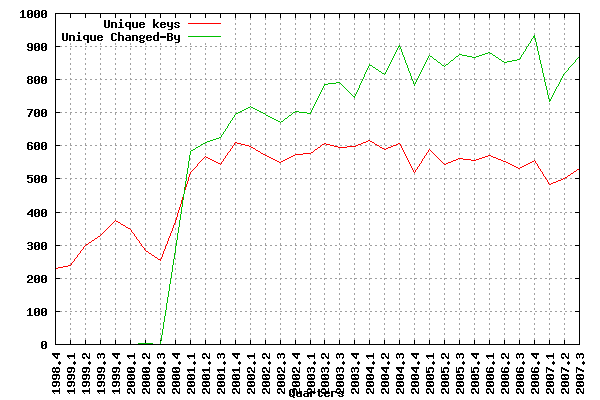
There’s an interesting article on LWN.net about Gentoo: Who made Gentoo Linux, and when? A commit analysis I was wondering how Debian compared, so I made some stats using the debian-devel-changes archives. First, the number of source uploads per quarter:
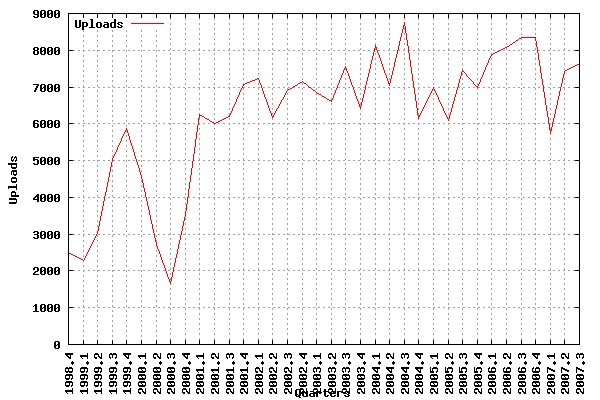
It’s interesting to note that, while the number of packages in Debian increased a lot, the number of uploads basically stayed the same since 2001. Then, I wondered about the number of active developers in Debian. So I counted: I can provide the raw data on demand, if someone else want to work on this. There’s probably a lot of other interesting things to do!

Ross Burton: GUADEC 2008?

I don't suppose anyone knows when GUADEC 2008 will be, or who I can ask? I'm planning a holiday in July, and obviously don't want to clash...

MJ Ray: Alt.Satellite.TV.Europe FAQ: Loft Dishes and British TV

These questions came in as comments this week, but I think they're worth a whole post. Peter Swan asked:
"This may seem like a dumb question, but I have not seen anywhere the answer to it. Can a satellite dish be mounted in a loft space or must it be mounted outside?"
There are few dumb questions. DIY dish info is still rather hard to find. You can install a dish behind a window and I've read about special tiles which allow satellite frequencies through on analoguesat's pages about hiding dishes but I don't know anyone using them. A more usual solution is either a hidden location such as a flat roof with baffle boards (dishes only need to see the Clarke belt, which is an elevation of about 20 degrees in England) or to use a non-dish antenna like the digiglobe or the LX2000 pipe. I think it's a really good idea to put the dish somewhere that you can fix it easily. Even the best dish seems to age eventually. I suspect some "professional" installers put the dishes at tops of walls to encourage repair call-outs. Marcus asked:
"Is it possible to receive British satellite television in other countries? I am living in Finland and I was considering purchasing a sky system from the UK and installing it over here. Would it work? Also would I be able to connect a sky set-top box to a different dish?"
Yes, you can get British TV in other countries. Getting external TV like BBC World is easy, but BBC UK services are on Astra 2D, which is focused on the UK. Coverage maps are available on many sites and it looks like Finland isn't well-covered. You'd need a colossal dish. You can connect Sky boxes to other dishes. Sky dishes and Sky LNBs need to go together, sometimes called Skyware, but dishes and boxes are interchangeable. A Sky system will work in Finland, but will only receive services on the other beams like 2A and I doubt Sky will register you at a non-UK address (anyone know for sure?). Also, Sky boxes are horribly crippled for anything other than Sky services and hopefully BBC Freesat will make BBC UK services easier-to-use with standard boxes.

Daniel Burrows: Lessig at the University of Washington

On Friday 2007-11-02, I watched Larry Lessig give a presentation at the University of Washington entitled Is Google (2008) Microsoft (1998)? Since it was Lessig, the talk was articulate and thought-provoking, and he used his slides very well (unlike many presenters who just read bullet points).

The argument he made is that Google is like Microsoft in some ways (and so are other companies like Facebook). In his analysis, the problem with Microsoft was that so many companies made themselves Microsoft-dependent, which both forced other companies to follow suit (due to network effects) and gave Microsoft leverage they could use against everyone in their ecosystem (e.g., Netscape). According to Lessig, Microsoft was not evil to use this leverage, but you have to recognize that Microsoft will do what is best for Microsoft, and this may not be what is best for you. He then suggested that we should be aware of the potential for the same thing to happen; in support of this point, he quoted excerpts from the terms of service from the APIs of Google and Facebook, which contain typical statements like we reserve the right to terminate your use of this service for any reason or for no reason, and asked: What if Microsoft had written this license agreement?

But it seemed to me that this wasn't his main point. He was using this observation as a springboard to talk about issues revolving around competition and public policy. Specifically, he feels that we should work towards a more just model of interaction between companies and users whose work makes the company more valuable (by contributing to a software ecosystem, by posting content on the Web site, etc). But the correct way to do this (he says) is not via competition, after-the-fact litigation, or voluntary codes of conduct: competition may not be around to enforce good behavior (as we've seen with Microsoft), litigation may be too late and ineffective (again, see Microsoft), and voluntary codes of conduct will disappear as soon as they get in the way of the bottom line. The correct approach, he argued, is across-the-board regulation so that all the companies have to play by the same rules.

From there he went on to talk about governmental corruption. He said (quoting Robert Reich's book Supercapitalism) that the reason we consistently look for solutions in the market and in voluntary compliance is that our governmental system is broken and does not effectively regulate corporations in the public interest. But Lessig is optimistic that we can change things (he joked that his publisher was unhappy with this point of view, because his brand has been built on pessimism). In his view, the politicians in Washington, by and large, want to be honest and do good, but they aren't able to within the current political system. For instance, on the few occassions that he managed to get access to lawmakers to discuss copyright issues, it was often the first time they had heard that there was more than one side to the argument. He thinks we need a national political movement that will shame politicians into being less corrupt.

This is all a simplification of what he said, of course; unfortunately, I wasn't able to find a recording of this talk on Lessig's Web site, or I'd point you at primary source material. I don't know if this is because he chose not to post it, or because it just hasn't been made available yet.

My view

In general, I thought that the speech was very interesting and well thought out. But as much as I'd like to buy into his optimism that we can fix our system, I don't think it's well-founded, for two reasons.

First, he argued that competition will resolve some of these problems (that was before and after he said we can't rely on competition, which I found confusing and may indicate that I misunderstood something). His evidence for this seemed to be that when Microsoft was dominating the world, users responded by reducing their dependence on Microsoft products and by switching to alternatives such as Linux. But, in fact, although more people may be using Linux than in the past, virtually everyone is still only using Windows, it's still almost impossible to find a programming job that isn't Windows-only, and Microsoft is still raking in money hand over fist; indeed, they're doing so well that they're planning to expand their workforce by a third. To take just one data point of many: I ride the bus to Seattle and back, and I regularly see other people using laptops as they commute. Virtually all the laptops run Windows. Occasionally I'll see a Mac, and every few months I'll see a guy running Linux on his laptop; I say "a guy" because it's the same guy every single time. So by my estimation, use of Linux on laptops in buses on the 545 route from Redmond to Seattle is way below 1%, with Macintoshes somewhere around 5%.

To broaden my point, I think Lessig has fallen into a trap that highly intelligent people, particularly those in academia, tend to fall into. In academia, you are surrounded by people who value learning and thinking deeply about the world. These are people who will give serious and unbiased consideration to questions like what is the social effect of my acceptance of the Facebook Terms of Service? and If I become dependent on this service, will that possibly affect me in five years if the company decides to act against my interests? The problem with this is that these people are not representative of the population at large. The population at large thinks why is this check-box getting in the way of me sending pictures to my friends? And I have no doubt that any kid who, e.g., refuses to sign up for Facebook as a protest against their TOS will be roundly mocked in their social circles for being a weird antisocial nonconformist. (of course, this may not apply to the small minority of people like myself whose social circles consist of weird antisocial nonconformists)

Second, Lessig's optimism about the political system seemed to be based on his observation that the people in government are, by and large, not venally corrupt: they want to do good, but the system is constructed in a way that makes this impossible. To me, that's a tremendously disheartening statement. If our problem were simply a few, or even many, corrupt politicians, this would be a solvable problem: even nowadays, Americans have some ability to choose who gets elected, and I believe that a sufficiently well-coordinated campaign could replace bad politicians with good ones.

But if the problem is that the system is corrupt even when the individuals are honest, it's a much deeper problem and frankly one that I don't know how to solve. While individuals have some direct control over who gets elected, we have no way to directly change the system that produces the corruption; the levers to do this are in the hands of the politicians elected through that broken system. It's unlikely that the politicians themselves will fix the problem, because they've benefited deeply from it: if the system is left as it is, well over 90% of Congress members will keep
their jobs
in the next election cycle, and any effective change seems likely (by definition) to disrupt this cushy arrangement.

On the other hand, running new candidates for office will not fix the problem. After all, if the problem is that the system is corrupt even when the participants are honest, then putting more honest people into government will have no effect. In order to get elected, these new politicians will have to become just as corrupt as the old ones, because that's how the system is set up. So we might change the faces, but we'll have the same old problems.

I recall two specific concrete proposals that Lessig made to make the system more responsive. First, he suggested shaming politicians who engage in corrupt behavior -- presumably taking large donations from interested parties. I don't see how this will help. Americans generally have a very low regard for the political class as it is; will pointing out particular examples of politicians taking money really make a difference when it comes to votes? And if it doesn't, will it really produce any change in their behavior? Politicians are motivated by votes the same way corporations are motivated by money; unless they stand a chance of losing their job (which is virtually impossible in any event), there's no reason for them to change how they behave.

His second proposal was for a system of contributions where it's impossible for any individual to prove they had donated a particular amount of money to a particular candidate. Even assuming it could be implemented perfectly, I don't think this will really solve the problem, for two reasons. First, it's not generally a secret what moneyed interests want. Politicians who want to attract large donations can just take positions that they know will appeal to donors of that sort. The donors themselves can make this easier on the candidates by, e.g., posting public position statements on issues of the day. Secondly, and this is far more insidious, even if politicians honestly represent their positions, then because success in running for office is so tied to the amount of money the candidate can raise, only candidates who hold opinions favorable to large corporations and wealthy individuals will be able to get elected. In fact, for all I know this is what happens already!

But with all that said, it was a really interesting talk and Lessig tied together some things you might not think would go together. If a video or Flash presentation becomes available, I would recommend watching through it. And hopefully my pessimistic predictions will be wrong; it's certainly happened before.

Raphael Geissert: too bored

I'm just too bored that everytime I try to write a blog post I end up closing the tab and get back working on something.


Not even the fact that DeBaBaReTools is *almost* functional now (at least on my local PC, it will be for the rest of the world as soon as I commit the changes) except for all the hardcoded stuff in wannaBuild.

And not even the fact that there's a new DSA (weasel) stops my boredom (maybe if he could take care of a RT... that would let me spend some time spaming the BTS with over 800 bug reports from DEHS :D).

3 November 2007

Rapha&#235;l Hertzog: Unexpected move on the DSA front

One should never loose hope apparently. After my previous posts on the topic, Sam put some more pressure and expressed strongly his disappointment in the lack of progress on the DSA front and warned that he might have to look for more radical solution. Phil Hands (who was really quiet in the discussions) decided that the situation had lasted long enough already and proposed to add Peter Palfrader (weasel@debian.org) to the team if nobody expressed any opposition in 24 hours. And this morning, Phil added weasel to the “adm” group… which make of Peter a full DSA member! :-) I really didn’t expect this outcome after so many months of negociations and discussions. But I’m really relieved to see some new blood in the DSA team. I wish him good luck and I’ll hope he will be able to foster cooperation with non-DSA people like I tried since the beginning of the year. Thank you Phil! Partagez cet article / Share This

Biella Coleman: On Bats, The Suckage of American Health Insurance and Paperwork Warfare

Two nights ago I was having dinner with a colleague who recounted a truly horrible experience he had with the modern-day American health care “system.” While in Montana over the summer, he got bit by a bat and well, as a result, he and his entire family had to get rabies shots. These shots are hard to get and priceeeeeeeeeeeeeeeeeeey. The final bill was $ 20,000 and his NYU based health insurance, United Health Care is claiming they are not responsible!### Like getting bit by a bat and the possibility of rabies are not bad enough. Isn’t the point of health insurance to take care of the unexpected?? Someone also pointed me to The Daily Kos’ wrangle with BCBS of California and well, they picked the wrong guy to mess with given there are so many many many many eyeballs tuned to his blog, everyday (just check out the number of comments). I wonder if the public relations director will contact him as they did with me after I blogged about my trials and tribulations. I certainly don’t have the audience and readers he does, so I am always surprised they ever contacted me in the first place. The Daily Kos also provided a link for a site that I was thinking of creating if my problems with BCBS were not solved (glad to see someone else has) called Sick of Blue Cross. I personally like the name I came up with a little better Blue Cross No Shield but the important thing is that a site like that exists and it is very good site, design and content wise. There should be a site created for every health insurance company and they should federate and pool resources to gain more visiblity. While I am not hopeful that the health insurance industry will change within, I think mounting and steady consumer pressure can do a lot to force the industry to change their awful ways. And while I think the bad publicity is a key part to putting pressure on the health insurance to change, I actually think that the power of the consumers also can come from elsewhere, and this elsewhere is overwhelming the administrative channels within and outside of the health insurance. The gist is if they send us a lot of (useless) paperwork, send them A LOT of paperwork back. On the Daily Kos, a lot of people noted that things got moving when they complained to the Department of Banking and Insurance. While my own complaint to that department did not produce any immediate fruit, it did get the ball moving for the appeal process, which eventually panned out for me. That is, I learned a lot and started to get decent customer service. Doors opened. Now, it took me weeks to find out that I could complain to the Department of Banking and Insurance and I am sure many find themselves in that situation of walking in a no man’s land of confusion and frustration. If more and more people know that you can file a complaint to these Departments (and why are doctor’s offices not relaying this information??!!), they and the health insurance companies will get inundated with that which they love to inflict on us, paperwork. This may slow things down for you but at a certain point, state governments will get the message that something is deeply wrong. So, people MUST use these channels and overwhelm these agencies with complaints, faxes, emails as this is a powerful and very material message that something is deeply wrong and broken and must be fixed. Also, send faxes and letters to various departments in your health insurance company (appeals, customer service, medical director’s office, public relations office…) get people’s email’s and send them emails. Inundate them with a barrage of administrative paperwork. If they are not being helpful, send a fax or two a day concerning your case until you get clear answers. While individual faxes won’t make much of a difference, imagine if there are 300 a day coming in or 3000…. This can work with the numbers are there and I have a feeling that the numbers Are There. So spread the word for housebreaking your health insurance and push the paperwork back on them.

Thijs Kinkhorst: NWERC preparations going well

Two weeks from now, the NW-European Programming Contest (NWERC) of the ACM ICPC will have started here in Utrecht. Things are going well - the problem set is ready - but, as always, a lot of small things are still to do: ordering t-shirts and balloons, finalizing food and buildings, etc. However, I think if we would halt all preparations now we would at least have a basic contest in two weeks. Registration is almost over, and the list of teams shows that we have participants from nine countries representing 26 institutions distributed over 51 teams.

Joerg Jaspert: Mouse onXclick selection in xterm

Switching from aterm to xterm I found it annoying that xterm didn’t select a full url when i did a double-click somewhere on it, like aterm did. Now, doing a little search on it I found something way stronger. Take a url like http://foo.bar/baz for the following example. If you now put something like the following into your .Xdefaults (and load it with xrdb -load .Xdefaults), you get xterms selection in a more useful way. A double click on foo will select foo.bar, clicking three times it selects the full url (well, better speak is to say it selects everything separated by whitespace). Click four times and it selects everything up to the start of the prompt (default prompt that is). 5 clicks selects the whole line.
XTerm*on2Clicks:  regex [^/@ \n]+
XTerm*on3Clicks:  regex [^ \n]+
XTerm*on4Clicks:  regex [^#$]+
XTerm*on5Clicks:  line

2 November 2007

Wouter Verhelst: Vim vs Emacs

John Goerzen blogs about his experience of using vim for about 8 months. Having been an emacs user a few years back, I understand both editors on a basic level, and can relate to some of the things he says. I have to disagree with one particular bit, though:
It starts faster. I'm not sure if that really was true even when I switched, but it certainly isn't true on any of my machines today. Both Vim and Emacs have had major version upgrades (v7 and v22, respectively) since I started using Vim. People seem to say that Emacs 22 feels faster, though I don't know if that's true. The startup times of the two, if they're different, are imperceptible.
Sorry, but that just isn't true. Using my very non-scientific method of measuring startup times ("click on the icon, watch the clock, and start counting until the editor is ready to use"), I can tell that gvim on my hardware takes less than a second to start, whereas emacs requires approximately 5 seconds to do the same. For reference, this is on my laptop, a 1.3Ghz PowerPC G4. In any case, I'm not a fan of either editor. There are things that vi does well, and there are things that emacs does well. On emacs' end, I like M-x gdb, I slightly prefer its M-x compile over vim's :make, and I just love psgml. I've also occasionally used gnus for news reading (never for mail, though). On vim's end, I find regex search & replace easier (as you mention in your blog post), and I prefer its syntax highlighting (I've seen emacs get confused because the first line in the output window started in the middle of a string. Such things will never happen to vim: if it gets confused once on a given file, it will always be confused on the same file. While annoying, at least you know it's there). All in all, I don't think it matters much. I've seen people who use an editor as an operating system, both in the vim and in the emacs camp, by having a ~/.vimrc or ~/.emacs that's larger than my collection of pictures[1]. I'm not one of them; to me, an editor that doesn't properly work in its defaults shouldn't exist. [1] okay, that's an exaggeration. Still.

Wouter Verhelst: Beid updates

There've been some posts on Planet Grep about using the Belgian electronic ID card in Ubuntu, recently. As the one who's responsible for making that possible, I felt I had to comment. First, yes, it's possible to do crypto stuff with plain OpenSC rather than the belpic-patched versions; in fact, the tools required to sign plain text files aren't shipped anymore as part of belpic since (I believe) version 2.5.9, which is currently in Debian. However, if you're going to write your own software that somehow uses the eID, I strongly recommend you use the beid-patched versions, since they have support for a feature of which I can't remember the name currently but which means that you need to send your PIN to the card on every signature operation; plain OpenSC is not aware of this possiblity, so does not have support for it, may end up in a confused state when the card refuses to sign, and you may end up locking your card if you keep going on. You have been warned. Second, there is a README.Debian file in libbeidlibopensc2 which explains some of the idiosynchracies in the packaging, and tells you which packages you need and which ones you don't. If you're interested in using the eID, I suggest you read it. Finally, I'm currently working on packages of 2.6.0, which was released on 2007-08-30. They're mostly ready; I have a rather large changelog currently and a two-item TODO list—one of which reads "test&upload"; if all goes well, I should be able to upload them this weekend. Occasionally, this upload includes a small patch that was communicated to me through some mandriva developer which will make one of the aforementioned idiosynchracies—the fact that you have to install the -dev packages if you want to use the mozilla plugin—obsolete.

Jordi Mallach: Valencian children and foreign languages

Recently, GozRita unveiled the names of our two Falleretes majors for 2008's Falles festivities. All the free newspapers did some extensive coverage, with reports on who they are and what they do. Qu Valencia interviewed the little Fallera major, and then posted this:


Little Victoria learns Valencian So, Victoria Bl zquez speaks English and Valencian "nearly perfectly". Great! I think having newspapers treat Valencian as if it were just another foreign language that students are forced to learn is a great example of the dark future our language will face in just a few generations.

Russell Coker: Increasing Efficiency through Less Work

I have just read an interesting article titled Why Crunch Mode Doesn’t Work [1] which documents the research on efficiency vs amount of time spent working (and by inference amount of time spent on leisure activities and sleep). It shows that a 40 hour working week was chosen by people who run factories (such as Henry Ford) not due to being nice for the workers but due to the costs of inefficient work practices and errors that damage products and equipment. Now these results can only be an indication of what works best by today’s standards. The military research is good but only military organisations get to control workers to that degree (few organisations try to control how much sleep their workers get or are even legally permitted to do so), companies can only give their employees appropriate amounts of spare time to get enough sleep and hope for the best. Much of the research dates from 80+ years ago. I suspect that modern living conditions where every house has electric lights and entertainment devices such as a TV to encourage staying awake longer during the night will change things, as would ubiquitous personal transport by car. It could be that for modern factory workers the optimum amount of work is not 40 hours a week, it could be as little as 30 or as much as 50 (at a guess). Also the type of work being done certainly changes things. The article notes that mental tasks are affected more than physical tasks by lack of sleep (in terms of the consequences of being over-tired), but no mention is made about whether the optimum working hours change. If the optimum amount of work in a factory is 40 hours per week might the optimum for a highly intellectual task such as computer programming be less, perhaps 35 or 30? The next factor is the issue of team-work. In an assembly-line it’s impossible to have one person finish work early while the rest keep working, so the limit will be based on the worker who can handle the least hours. Determining which individuals will work more slowly when they work longer hours is possible (but it would be illegal to refuse to hire such people in many jurisdictions) and determining which individuals might be more likely to cause industrial accidents may be impossible. So it seems to me that the potential for each employee to work their optimal hours is much greater in the computer industry than in most sectors. I have heard a single anecdote of an employee who determined that their best efficiency came from 5 hours work a day and arranged with their manager to work 25 hours a week, apart from that I have not heard any reports of anyone trying to tailor the working hours to the worker. Some obvious differences in capacity for working long hours without losing productivity seem related to age and general health, obligations outside work (EG looking after children or sick relatives), and enjoyment of work (the greater the amount of work time that can be regarded as “fun” the less requirement there would be for recreation time outside work). It seems likely to me that parts of the computer industry that are closely related to free software development could have longer hours worked due to the overlap between recreation and paid work. If the amount of time spent working was to vary according to the capacity of each worker then the company structures for management and pay would need to change. Probably the first step towards this would be to try to pay employees according to the amount of work that they do, one problem with this is the fact that managers are traditionally considered to be superior to workers and therefore inherently worthy of more pay. As long as the pay of engineers is restricted to less than the pay of middle-managers the range between the lowest and highest salaries among programmers is going to be a factor of at most five or six, while the productivity difference between the least and most skilled programmers will be a factor of 20 for some boring work and more than 10,000 for more challenging work (assuming that the junior programmer can even understand the task). I don’t expect that a skillful programmer will get a salary of $10,000,000 any time soon (even though it would be a bargain compared to the number of junior programmers needed to do the same work), but a salary in excess of $250,000 would be reasonable. If pay was based on the quality and quantity of work done (which as the article mentions is difficult to assess) then workers would have an incentive to do what is necessary to improve their work - and with some guidance from HR could adjust their working hours accordingly. Another factor that needs to be considered is that ideally the number of working hours would vary according to the life situation of the worker. Having a child probably decreases the work capacity for the next 8 years or so. These are just some ideas, please read the article for the background research. I’m going to bed now. ;)

John Goerzen: A little more on Vim and Emacs file handling

Yesterday's post about switching back to Emacs saw quite a few comments from people (most of them useful, even). I learned a few things.

My biggest gripe about Vim was that for the file types I worked with most, its indentation and syntax highlighting was inferior to that of Emacs. I'd like to illustrate that with an example.

Let's consider one of those file types: XML containing DocBook markup.

Vim has a DocBook mode. It doesn't autodetect DocBook files, so I have this at the top of each one:

<!-- vim: set filetype=docbkxml shiftwidth=2 autoindent expandtab tw=77 : -->

Now, why should Vim need a separate DocBook mode? DocBook is just XML or SGML, and these things have a well-formed nature. Well, part of the reason is that /usr/share/vim/vim71/syntax/docbk.vim has a ton of lines like this:

syn keyword docbkKeyword chapter citation citerefentry citetitle city contained

Yes, they are hard-coding all the DocBook element names into the editing mode. It's probably used for completion, highlighting, maybe indentation. I'm not sure, really. I remember that editing these files without the DocBook mode was much more painful anyway, but that was 8 months ago and I can't quite remember why.

Now, what about Emacs? I don't know if Emacs even has a DocBook mode, mainly because I don't have to care. The Emacs psgml mode actually parses the DTD for your XML or SGML files. It knows exactly what the valid tags are from doing so. This means it has full functionality not just for DocBook, but for any XML or SGML file with a DTD.

Not only that, but it knows more about the files than Vim does. For instance, both Emacs and Vim can do completion of various things. Vim </ C-x C-o (ooo, sounds like Emacs!) can complete my closing tags. But it can't autocomplete my opening tags, and it certainly isn't aware

Not only can Emacs autocomplete opening and closing tags, but it knows exactly what tags are valid at a given place in the document (thanks to the DTD) and will only consider those tags for completion. Moreover, depending on how you have configured it, it could also insert spots for you to add any required attributes. So, for instance, if you're editing XHTML and autocompletion gives you an <img> tag, it would add src="" in it for you, as a reminder that src is required.

There are a host of other smart things that Emacs can do with XML or SGML documents. For instance, you can get a list of all tags valid at the current point with C-c C-t or Shift-RightClick -- useful if you've forgotten the name of a tag for a moment.

The difference isn't as great with everything. But it sure is noticable as I work with XML and Haskell files.

1 November 2007

Andrew McMillan: DAViCal and support for Apple's CalDAV client in OS 10.5

Quite a few people seem impressed with the new release of Leopard, and are now looking for a CalDAV server to use with their shiny new iCal app. Unfortunately it seems that Apple wrote this primarily to work with their own (free, open-source) calendar server, which has the side effect that it doesn't work with DAViCal. Part of the "doesn't work" is due to DAViCal not implementing some areas of the CalDAV specification, which is fair enough. Part of it is due to DAViCal not implementing some draft extensions to the CalDAV specification, which I can also understand, since it allows them to provide some useful features that those extensions are designed to support. There also seem to be some parts of the "doesn't work" which are due to a dependence on extensions beyond either of these cases, which is a little more disappointing - and quite a bit harder to implement. So far I have made some fixes to the first point, and some additions towards parts of the second, but as of today it still does not work. This is complicated by my not having access to a Mac. Things are looking up, however, because Tom Robinson has kindly agreed to loan me a Mac running Leopard from next week. In order to "clear the slate" for that, I will be releasing a 0.9.2 over the weekend with the various minor enhancements and fixes that have been applied over the last week. So although this upcoming release will let you add your DAViCal account to iCal 3, it still won't actually work with it. I'm hoping that ready access to the application will enable me to correct that fairly quickly. Also waiting in the wings (and which unfortunately won't be in 0.9.2 either) Maxime Delorme has been working on SyncML support, and is nearly ready with a patch, so we can look forward to that addition fairly soon also.

Russell Coker: Load Average

Other Unix systems apparently calculate the load average differently to Linux. According to the Wikipedia page about Load(computing) [1] most Unix systems calculate it based on the average number of processes that are using a CPU or available for scheduling on a CPU while Linux also includes the count of processes that are blocked on disk IO (uninterruptible sleep). There are three load average numbers, the first is for the past minute, the second is for the past 5 minutes, and the third is for the past 15 minutes. In most cases you will only be interested in the first number. What is a good load average depends on the hardware. For a system with a single CPU core a load average of 1 or greater from CPU use will indicate that some processes may perform badly due to lack of CPU time - although a long-running background process with a high “nice” value can increase the load average without interfering with system performance in most cases. As a general rule if you want snappy performance then the load average component from CPU use should be less than the number of CPU cores (not hyper-threads). For example a system with two dual-core CPUs can be expected to perform really well with a load average of 3.5 from CPU use but might perform badly with a load average of 5. The component of the load average that is due to disk IO is much more difficult to interpret in a sensible manner. A common situation is to have the load average increased by a NFS server with a network problem. A user accesses a file on the NFS server and gets no response (thus giving a load average of 1), they then open another session and use “ls” to inspect the state of the file - ls is blocked and gives a system load average of 2. A single user may launch 5 or more processes before they realise that they are not going to succeed. If there are 20 active users on a multi-user system then a load average of 100 from a single NFS server that has a network problem is not uncommon. While this is happening the system will perform very well for all tasks that don’t involve the NFS server, the processes that are blocked on disk IO can be paged out so they don’t use any RAM or CPU time. For regular disk IO you can have load average incremented by 1 for each non-RAID disk without any significant performance problems. For example if you have two users who each have a separate disk for their home directory (not uncommon with certain systems where performance is required and cooperation between users is low) then each could have a single process performing disk IO at maximum speed with no performance problems for the entire system. A system which has four CPU cores and two hard drives used for separate tasks could have a load average slightly below 6 and the performance for all operations would be quite good if there were four processes performing CPU intensive tasks and two processes doing disk intensive tasks on different disks. The same system with six CPU intensive programs would under-perform (each process would on average get 2/3 of a CPU), and if it had six disk intensive tasks that all use the same disk then performance would be terrible (especially if one of the six was an interactive task). The fact that a single load average number can either mean that the system is busy but performing well, under a bit of load, or totally overloaded means that the load average number is of limited utility in diagnosing performance problems. It is useful as a quick measure, if your server usually has a load average of 0.5 and it suddenly gets a load average of 10 then you know that something is wrong. Then the typical procedure for diagnosing it starts with either running “ps aux grep D” (to get a list of D state processes - processes that are blocked on disk IO) or running top to see the percentages of CPU time idle and in IO-wait states. Cpu(s): 15.0%us, 35.1%sy,  0.0%ni, 49.9%id,  0.0%wa,  0.0%hi,  0.0%si,  0.0%st   PID USER      PR  NI  VIRT  RES  SHR S %CPU %MEM    TIME+  COMMAND
7331 rjc      25  0  2868  640  312 R  100  0.0  0:21.57 gzip Above is a section of the output of top showing a system running gzip -9 < /dev/urandom > /dev/null. Gzip is using one CPU core (100% CPU means 100% of one core - a multi-threaded program can use more than one core and therefore more than 100% CPU) and the overall system statistics indicate 49.9% idle (the other core is almost entirely idle). Cpu(s):  1.3%us,  3.2%sy,  0.0%ni, 50.7%id, 44.4%wa,  0.0%hi,  0.3%si,  0.0%st   PID USER      PR  NI  VIRT  RES  SHR S %CPU %MEM    TIME+  COMMAND
7425 rjc      17  0  4036  872  588 R    4  0.1  0:00.20 find Above is a section of the output of top showing the same system running find /. The system is registering 44% IO wait and 50.7% idle. The IO wait is the percentage of time that CPU core is waiting on IO, so 44% of the total system CPU time (or 88% of one CPU core) is idle while the system is waiting for disk IO to complete. A common mistake is to think that if the IO was faster then more CPU time would be used, in this case with the find program using 4% of one CPU core if all the IO was instantaneous (EG in cache) then the command would complete 25 times faster with 100% CPU use. But if the disk IO performance was doubled (a realistic possibility given that the system has a pair of cheap SATA disks in a RAID-1) then find would probably use 8% of CPU time. Really the only use for load average is for getting an instant feel for whether there are any performance problems related to CPU use or disk IO. If you know what the normal number is then a significant change will stand out. Dr. Neil Gunther has written some interesting documentation on the topic [2], which goes into more technical detail including kernel algorithms used for calculating the load average. My aim in this post is to educate Unix operators as to the basics of the load average. His book The Practical Performance Analyst gives some useful insights into the field. One thing I learned from his book is the basics of queueing theory. One important aspect of this is that as the rate at which work arrives approaches the rate at which work can be done the queue length starts to increase exponentially, and if work keeps arriving at the same rate when the queue is full and the system can’t perform the work fast enough the queue will grow without end. This means that as the load average approaches the theoretical maximum the probability of the system dramatically increasing it’s load average increases. A machine that’s bottlenecked on disk IO for a task where there is a huge number of independent clients (such as a large web server) may have it’s load average jump from 3 to 100 in a matter of one minute. Of course this won’t mean that you actually need to be able to serve 30 times the normal load, merely slightly more than the normal load to keep the queues short. I recommend reading the book, he explains it much better than I do.

John Goerzen: So long, Vim. I'm returning to Emacs

I'd been using Emacs for quite awhile, and about 8 months ago I decided I would try using Vim. I'd only used vi for system emergency work, but knew a number of people that swore by it for regular work. So I decided I would learn Vim and use it for my regular work. I figure that with things like this, I don't get a real feel for how well they work unless I use them for all my work. So I haven't really opened Emacs at all in the past 8 months.

Yesterday I finally decided that Vim was not living up to my expectations and I'm in the process of switching back to Emacs. I thought I ought to write down why I'm doing that, for my own future reference... and since nobody has ever written about Emacs vs. Vim, I might as well post it where everyone can see it.

So here we are.

Original Reasons for Using Vim

It would lead to more comfortable typing. Lots of Vim users mention that you don't have to hold down keys while hitting other keys as much in Vim as in Emacs, and that the movement keys are all on the home row. That's true, but I didn't find it to be that big of an improvement, since Esc is a farther reach than anything in Emacs, and let me tell you, you're hitting Esc all the time in Vim. I found that removing the armrests from my chair made my hands happier than Vim ever did, and swapping Ctrl and CapsLock in Emacs will probably help there too.

It starts faster. I'm not sure if that really was true even when I switched, but it certainly isn't true on any of my machines today. Both Vim and Emacs have had major version upgrades (v7 and v22, respectively) since I started using Vim. People seem to say that Emacs 22 feels faster, though I don't know if that's true. The startup times of the two, if they're different, are imperceptible.

Vim would use less RAM. Frankly, these days, both Emacs and Vim are way down on the list of things that use up RAM. Heck, kmail has 141MB resident, and each of its two IMAP processes is using more than 30MB. Emacs in X right after start has 16MB resident, 10MB of which is shared, and 25MB VSS. gvim right after start has 8MB resident, 5MB of which is shared, and a 43MB VSS. Emacs tends to use fewer processes for things that vim. So they're not all that different, and Emacs could come out smaller in certain situations. But the difference is irrelevant on today's machines, and modern Gnome and KDE apps are many times larger than both of them.

It will make me more comfortable in rescue environments where I have only traditional vi available. Actually, the vi on AIX is so different from modern Vim that this didn't really help.

It would make me more productive. There are some editing commands that did, but as you'll see below, it was more than balanced out by other problems.

Things I Liked about Vim

The commands dt, dT, df, dF. Wonderful little things those. Emacs now has M-z (Zap), which is similar to df but can actually go to other lines (a nice addition). And there are easy ways to bind keys to the others as well, though that doesn't make it a pervasive convention like it is in Vim.

Antialiased fonts. It's crazy that Emacs doesn't have this yet. But not a showstopper; I still like good ole 10x20 just fine.

Regexp search-and-replace. Emacs actually has this now, and maybe it had it back then too. M-C-%. Apparently in Emacs22 the replacement expression can also have lisp code in it, which sounds really slick but I can't see myself using it regularly.

Annoying Things in Vim

Syntax highlighting. The syntax highlighting for most languages in Vim felt like it was about as smart as it was in Emacs about 10 years ago. Strings like "Hello!\"" (in languages where \" inserts a literal ") often confused it. Sometimes quotes within comments confused it. Sometimes it would be confused permanently. Other times, just until I scrolled around in the file or reloaded it.

Indentation. This is much more annoying than the syntax highlighting, really. In many languages -- and especially the two modes I've used most recently, XML and Haskell -- it really, really stinks. The indentation there isn't aware of syntax, or not very much. Sometimes it is smart enough to know that if an XML line starts with </ that it moves left and if it starts with an opening tag, that the next line moves right. But it's not smart enough to do this reliably. Not only that, but indentation is not handled with consistent configuration between languages. And even though Vim ships with a ton of language modes, the central docs only cover indentation for C.

I've asked Vim experts about this, and have tried all sorts of various tweaks, have read through Vim indentation mode source files, etc. There is just no way to get it anywhere near the intelligence of Emacs for most languages, short of writing my own mode, it appears. This is even worse because when using the backspace key in insert mode, for awhile it deletes individual spaces, and then all of a sudden deletes a big chunk of whitespace back to the beginning of the line. (And no, the insertion of Tab characters is disabled.) Indentation is my #1 complaint about Vim, and something that shows no progress towards being fixed any time soon.

And forget about anything like Emacs M-x reindent-region. This is a syntax-aware indenter. You can write out an entire source file with no indentation whatsoever, and it will indent the entire thing according to the indentation rules you've defined and the syntax of the language you're using. The best I've seen in Vim are commands that add or remove space at the beginning of every line in a region.

In short, Emacs seems to "understand" the file format on a much deeper level than Vim, and can automate things to a much better extent because of it.

Too many things disrupt the paste buffer. I can use Y or y to yank some text in Vim, and it's really, really easy to overwrite that buffer with other things. Yes, I know that I can yank it into a named buffer, but that's inconvenient and I don't usually know in advance that I'll have that need. In Emacs, only C-k and other "large area" commands disrupt it.

Vim doesn't like you having lots of files open at once. It's surprisingly convoluted to do this. If you use the basic documented command to edit another file, :e, it closes the file you're working on. The normal way to open multiple files at once is to use split windows. Well, I don't like split windows all that well, and often just want to make a quick change in one file -- in full screen -- and then go back to another. Even though I use set hidden in my ~/.vimrc, it still is annoying and more convoluted than it should be.

Vim can't create new top-level X windows. In Emacs, I can press C-x 5 2, and poof, I have a second Emacs window in X, and it's tied to the same editing session and Emacs process. Not a new process, with a different set of files, its own buffers, etc. The same process, same set of files. Just like a split window, but with a new top-level X window instead. gvim simply has no way to do that. This is also a large annoyance.

gqap stinks. This has burned me more than once. I'll be editing an XML document, and insert some text in the middle of a paragraph. Now I have a really wide line. So I type gqap to reformat the paragraph. My cursor is near the bottom of the screen, so I don't really see much past the current line. I then save the document and exit. Later I discover that vim considered the entire rest of the document part of the single paragraph, and removed all the different indentation levels at </para> and the like, so it's completely messed up. Emacs is smart enough to know what is a paragraph in XML mode, and M-q does the right thing. Oh, and Emacs reindent-region can fix the Vim gqap-induced mess.

Steve Kemp: It's been seven hours and fifteen days

I made a new release of the Chronicle blog compiler the other day, which seems to be getting a suprising number of downloads from my apt repository. The apt repository will be updated shortly to drop support for Sarge, since in practise I've not uploaded new things there for a while. In other news I made some new code for the Debian Administration website! The site now has the notion of a "read-only" state. This state forbids new articles from being posted, new votes being cast, and new comments being posted. The read-only state is mostly designed for emergencies, and for admin work upon the host system (such as when I'm tweaking the newly installed search engine). In more coding news I've been updating the xen-shell a little recently, so it will shortly have the ability to checksum the filesystem of Xen guests - and later validate them. This isn't a great security feature because it assumes you trust dom0 - and more importantly to checksum files your guest must be shutdown. However as a small feature I believe the suggestion was an interesting one. Finally I've been thinking about system exploitation via temporary file abuse. There are a couple of cases that are common: Exploiting the first to go from user to root access is trivial. But how would you exploit the last two? Denial Of Service attacks are trivial via the creation/truncation of /etc/nologin, /etc/shadow, (or even /boot/grub/menu.lst! But gaining privileges? I can't quite see how. Comments welcome!

Next.

Previous.