Search Results: "zed"

13 June 2015

Gunnar Wolf: Almost free Some experiences with the Raspberry Pi, CI20, BananaPi, CuBox-i... And whatever will follow

I know very little about hardware. I think I have a good understanding on many aspects of what happens inside a computer, but my knowledge is clearly firmer on what happens once an operating system is already running. And even then, my understanding of the lower parts of reality is shaky at most At least according to my self-evaluation, of course, comparing to people I'm honored to call "my peers". During the last ~18 months, my knowledge of this part of reality, while still far from complete, has increased quite a bit Maybe mostly showing that I'm basically very cheap: As I have come across very cheap (or even free for me!) hardware, I have tried to understand and shape what happens in levels below those where I dwell. I have been meaning to do a writeup on the MIPS Creator CI20, which was shipped to me for free (thanks++!) by Imagination Technologies; I still want to get more familiar with the board and have better knowledge before reporting on it. Just as a small advance, as this has been keeping me somewhat busy: I got this board after their offer to Debian Developers, and prompted because I'll be teaching some modules on the Embedded Linux diploma course dictated by Facultad de Ingenier a, UNAM Again, I'll blog about that later. My post today follows Riku's, titled Dystopia of things, where he very clearly finds holes in the Internet of Things offering of one specific product and one specific company, but allows for generalizations on what we will surely see as the model. Riku says:
Today, the GPL sources for hub are available - at least the kernel and a patch for busybox. The proper GPL release is still only through written offer. The sources appeared online April this year while Hub has been sold for two years already. Even if I ordered the GPL CD, it's unlikely I could build a modified system with it - too many proprietary bits. The whole GPL was invented by someone who couldn't make a printer do what he wanted. The dystopian today where I have to rewrite the whole stack running on a Linux-based system if I'm not happy what's running there as provided by OEM.
This is not exactly the situation on the boards/products (it's a disservice to call the cute CuBox-i just a board!) I mention I'm using, but it's neither too far. Being used to the easy x86 world, I am used to bitching on specific hardware that does not get promptly recognized by the Linux kernel But even with the extra work UEFI+SecureBoot introduces, getting the kernel to boot is something we just take for granted. In the MIPS and ARM worlds, this is not so much of a given; I'm still treating the whole SPL and DeviceTree world as a black box, but that's where a lot of the work happens. The boards I am working on try to make a point they are Open Hardware. The CI20 is quite impressive in this regard, as not only it has a much more complete set of on-board peripherials than any other, but a wealth of schematics, datasheets and specifications for the different parts of its components. And, of course, the mere availability of the MIPSfpga program to universities worldwide is noteworthy Completely outside of my skillset, but looks most interesting. However... Despite being so much almost-Free-with-a-capital-F, all those boards fail our definitions of freedom in several ways. And yes, they lead us to a situation similar to what Riku describes, to what Stallman feared... To a situation not really better to where we stand on openly closed-source, commodity x86 hardware: Relying on binary blobs and on non-free portions of code to just use our hardware, or at least to use many of the features that would be available to us otherwise. As an example, both the CI20 and the CuBox-i vendors provide system images able to boot what they describe as a Debian 7 system, based on a 3.0 Linux kernel (which Debian never used; IIRC the CuBox-i site said it was derived from a known-good Android kernel)... Only that it's an image resulting of somebody else installing and configuring it. Why should we trust their image to be sane? Yes, the resulting installation is quite impressive (i.e. the CI20's 3D demos are quite impressive for a system that feels otherwise sluggish, and out of my ARM experience, I'd wager it feels sluggish mostly because of a slow SSD)... I have managed to do clean Debian installs on most of my ARM machines (the CuBox-i as described in my previous blog post; this post from Elena of Valhalla'' prompted me into trying the already well documented way of running the official Debian Installer, which worked like a charm and gave me a very nice and responsive Debian 8 install Modulo yes, the Banana's non-free video interface, which AFAICT uses the non-free Mail binary driver... And which I haven't had the time to play with yet. Of course, my CuBox is in a similar situation, where it works like a charm as a personal server, but is completely worthless as a set-top box. So, with those beautiful, small, cheap SoC systems, we are close to where we stood twenty years ago with x86 Linux: Good support for a small set of peripherials, but a far cry from having a functional system with exclusively free software. ,
Despite claims of being open source, this is not open source hardware. If you are thinking of getting this device, you should also try looking into the hardware from our Community instead.
Still... Playing with these boards has taught me a lot, and has clearly taught me I'm still standing on the first steps of the n00b level. I have a lot to learn to be able to responsibly teach my part of the diploma course, and I'm very thankful for the differences in hardware (and, of course, for the hardware manufacturers, specially for the MIPS Creator CI20 and the Lemaker Banana Pi for giving me boards to work on!) I shall keep posting on this topic.

12 June 2015

Riku Voipio: Dystopia of Things

The Thing on Internet
I've now had an "Internet of Things" device for about a year. It is Logitech Harmony HUB, an universal remote controller. It comes with a traditional remote, but the interesting part is that it allows me to use my smartphone/tablet as remote over WiFi. With the android app it provides a rather nice use experience, yet I can see the inevitable end in anger. Bare minimum GPL respectToday, the GPL sources for hub are available - at least the kernel and a patch for busybox. The proper GPL release is still only through written offer. The sources appeared online April this year while Hub has been sold for two years already. Even if I ordered the GPL CD, it's unlikely I could build a modified system with it - too many proprietary bits. The whole GPL was invented by someone who couldn't make a printer do what he wanted. The dystopian today where I have to rewrite the whole stack running on a Linux-based system if I'm not happy what's running there as provided by OEM.App onlyThe smartphone app is mandatory. The app is used to set up the hub. There is no HTML5 interface or any other way to control to the hub - just the bundled remote and phone apps. Fully proprietary apps, with limited customization options. And if app store update removes a feature you have used.. well you can't get it from anywhere anymore. The dystopian today where "Internet of Things" is actually "Smartphone App of Things".Locked APIMaybe instead of modifying the official app you could write your own UI? Like one screen with only the buttons you ever use when watching TV? There *is* an API with delightful headline "Better home experiences, together". However, not together with me, the owner of the harmony hub. The official API is locked to selected partners. And the API is not to control the hub - it's to let the hub connect to other IoT devices. Of course, for talented people, locked api is usually just undocumented api. People have reverse engineered how the app talks to the hub over wifi. Curiously it is actually Jabber based with some twists like logging credentials through Logitech servers. The dystopian today where I can't write programs to remotely control the internet connected thing I own without reverse engineering protocols.Central ServerDid someone say Logitech servers? Ah yes, all configuring of the remote happens via myharmony servers, where the database of remote controllers lives. There is some irony in calling the service *my* harmony when it's clearly theirs. The communication with cloud servers leaks at minimum back to Logitech what hardware I control with my hub. At the worst, it will become an avenue of exploits. And how long will Logitech manage these servers? The moment they are gone, harmony hub becomes a semi-brick. It will still work, but I can't change any configuration anymore. The dystopian future where the Internet of Thing will stop working *when* cloud servers get sunsetWhat nowThis is not just the Harmony hub - this is a pattern that many IoT products follow - Linux based gadget, smartphone app, cloud services, monetized apis. After the gadget is bought, the vendor has little incentive to provide any updates. After all, the next chance I'll carry them money is when the current gadget gets obsolete. I can see two ways out. The easy way is to get IoT gadgets as monthly paid service. Now the gadget vendor has the right incentive - instead of trying to convince me to buy their next gadget, their incentive is to keep me happily paying the monthly bill. The polar opposite is to start making open competing IoT's, and market to people the advantage of being yourself in control. I can see markets for both options. But half-way between is just pure dystopy.

James Bromberger: Logical Volume Management with Debian on Amazon EC2

The recent AWS introduction of the Elastic File System gives you an automatic grow-and-shrink capability as an NFS mount, an exciting option that takes away the previous overhead in creating shared block file systems for EC2 instances. However it should be noted that the same auto-management of capacity is not true in the EC2 instance s Elastic Block Store (EBS) block storage disks; sizing (and resizing) is left to the customer. With current 2015 EBS, one cannot simply increase the size of an EBS Volume as the storage becomes full; (as at June 2015) an EBS volume, once created, has fixed size. For many applications, that lack of resize function on its local EBS disks is not a problem; many server instances come into existence for a brief period, process some data and then get Terminated, so long term managment is not needed. However for a long term data store on an instance (instead of S3, which I would recommend looking closely at from a durability and pricing fit), and where I want to harness the capacity to grow (or shrink) disk for my data, then I will need to leverage some slightly more advanced disk management. And just to make life interesting, I wish to do all this while the data is live and in-use, if possible. Enter: Logical Volume Management, or LVM. It s been around for a long, long time: LVM 2 made a debut around 2002-2003 (2.00.09 was Mar 2004) and LVM 1 was many years before that so it s pretty mature now. It s a powerful layer that sits between your raw storage block devices (as seen by the operating system), and the partitions and file systems you would normally put on them. In this post, I ll walk through the process of getting set up with LVM on Debian in the AWS EC2 environment, and how you d do some basic maintenance to add and remove (where possible) storage with minimal interruption. Getting Started First a little prep work for a new Debian instance with LVM. As I d like to give the instance its own ability to manage its storage, I ll want to provision an IAM Role for EC2 Instances for this host. In the AWS console, visit IAM, Roles, and I ll create a new Role I ll name EC2-MyServer (or similar), and at this point I ll skip giving it any actual privileges (later we ll update this). As at this date, we can only associate an instance role/profile at instance launch time. Now I launch a base image Debian EC2 instance launched with this IAM Role/Profile; the root file system is an EBS Volume. I am going to put data that I ll be managing on a separate disk from the root file system. First, I need to get the LVM utilities installed. It s a simple package to install: the lvm2 package. From my EC2 instance I need to get root privileges (sudo -i) and run:
apt update && apt install lvm2
After a few moments, the package is installed. I ll choose a location that I want my data to live in, such as /opt/. I want a separate disk for this task for a number of reasons:
  1. Root EBS volumes cannot currently be encrypted using Amazon s Encrypted EBS Volumes at this point in time. If I want to also use AWS encryption option, it ll have to be on a non-root disk. Note that instance-size restrictions also exist for EBS Encrypted Volumes.
  2. It s possibly not worth make a snapshot of the Operating System at the same time as the user content data I am saving. The OS install (except the /etc/ folder) can almost entirely be recreated from a fresh install. so why snapshot that as well (unless that s your strategy for preserving /etc, /home, etc).
  3. The type of EBS volume that you require may be different for different data: today (Apr 2015) there is a choice of Magnetic, General Purpose 2 (GP2) SSD, and Provisioned IO/s (PIOPS) SSD, each with different costs; and depending on our volume, we may want to select one for our root volume (operating system), and something else for our data storage.
  4. I may want to use EBS snapshots to clone the disk to another host, without the base OS bundled in with the data I am cloning.
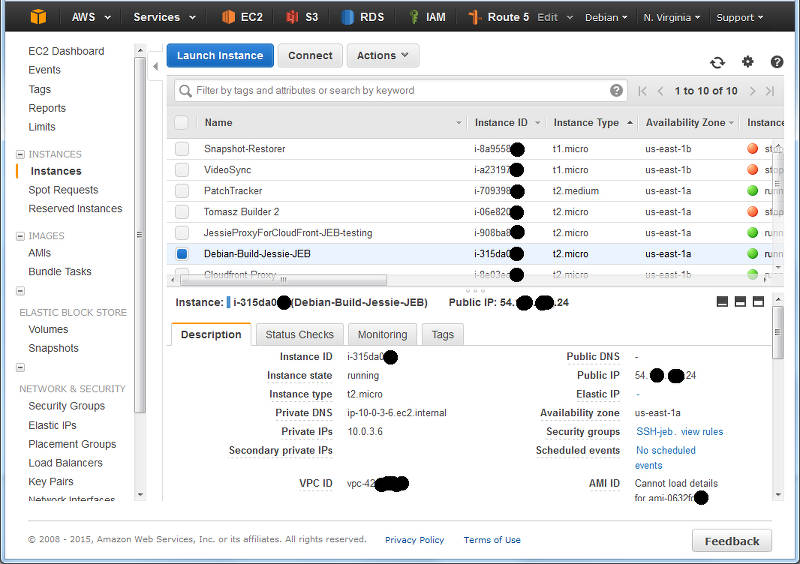
I will create this extra volume in the AWS console and present it to this host. I ll start by using a web browser (we ll use CLI later) with the EC2 console. The first piece of information we need to know is where my EC2 instance is running. Specifically, the AWS Region and Availability Zone (AZ). EBS Volumes only exist within the one designated AZ. If I accidentally make the volume(s) in the wrong AZ, then I won t be able to connect them to my instance. It s not a huge issue, as I would just delete the volume and try again. I navigate to the Instances panel of the EC2 Console, and find my instance in the list:
EC2 instance listA (redacted) list of instance from the EC2 console.
Here I can see I have located an instance and it s running in US-East-1A: that s AZ A in Region US-East-1. I can also grab this with a wget from my running Debian instance by asking the MetaData server:
wget -q -O - http://169.254.169.254/latest/meta-data/placement/availability-zone
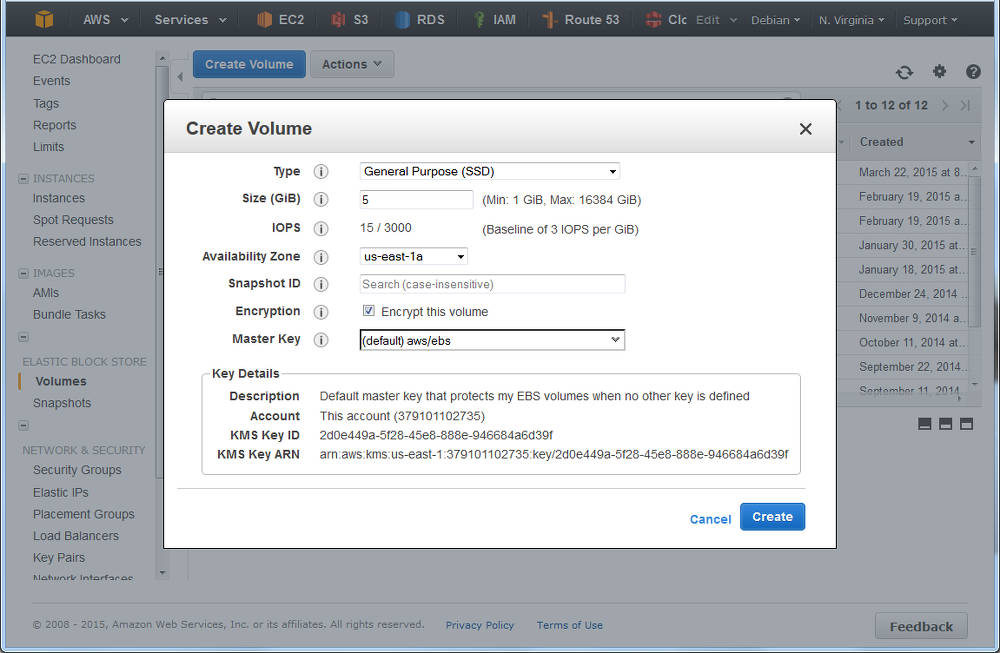
The returned text is simply: us-east-1a . Time to navigate to Elastic Block Store , choose Volumes and click Create :
Creating a volume in AWS EC2: ensure the AZ is the same as your instanceCreating a volume in AWS EC2: ensure the AZ is the same as your instance
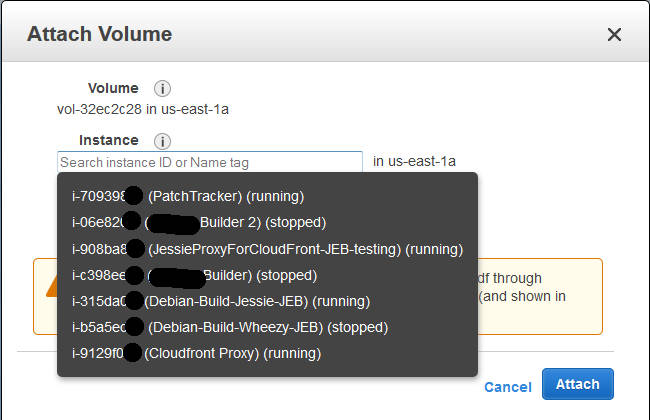
You ll see I selected that I wanted AWS to encrypt this and as noted above, at this time that doesn t include the t2 family. However, you have an option of using encryption with LVM where the customer looks after the encryption key see LUKS. What s nice is that I can do both have AWS Encrypted Volumes, and then use encryption on top of this, but I have to manage my own keys with LUKS, and should I lose them, then I can keep all the cyphertext! I deselected this for my example (with a t2.micro), and continue; I could see the new volume in the list as creating , and then shortly afterwards as available . Time to attach it: select the disk, and either right-click and choose Attach , or from the menu at the top of the list, chose Actions -> Attach (both do the same thing).
Attach volumeAttaching a volume to an instance: you ll be prompted for the compatible instances in the same AZ.
At this point in time your EC2 instance will now notice a new disk; you can confirm this with dmesg tail , and you ll see something like:
[1994151.231815]  xvdg: unknown partition table
(Note the time-stamp in square brackets will be different). Previously at this juncture you would format the entire disk with your favourite file system, mount it in the desired location, and be done. But we re adding in LVM here between this raw device, and the filesystem we are yet to make . Marking the block device for LVM Our first operation with LVM is to put a marker on the volume to indicate it s being use for LVM so that when we scan the block device, we know what it s for. It s a really simple command:
pvcreate /dev/xvdg
The device name above (/dev/xvdg) should correspond to the one we saw from the dmesg output above. The output of the above is rather straight forward:
  Physical volume "/dev/xvdg" successfully created
Checking our EBS Volume We can check on the EBS volume which LVM sees as a Physical Volume using the pvs command.
# pvs
  PV  VG  Fmt  Attr PSize PFree
  /dev/xvdg  lvm2 ---  5.00g 5.00g
Here we see the entire disk is currently unused. Creating our First Volume Group Next step, we need to make an initial LVM Volume Group which will use our Physical volume (xvdg). The Volume Group will then contain one (or more) Logical Volumes that we ll format and use. Again, a simple command to create a volume group by giving it its first physical device that it will use:
# vgcreate  OptVG /dev/xvdg
  Volume group "OptVG" successfully created
And likewise we can check our set of Volume Groups with vgs :
# vgs
  VG  #PV #LV #SN Attr  VSize VFree
  OptVG  1  0  0 wz--n- 5.00g 5.00g
The Attribute flags here indicate this is writable, resizable, and allocating extents in normal mode. Lets proceed to make our (first) Logical Volume in this Volume Group:
# lvcreate -n OptLV -L 4.9G OptVG
  Rounding up size to full physical extent 4.90 GiB
  Logical volume "OptLV" created
You ll note that I have created our Logical Volume as almost the same size as the entire Volume Group (which is currently one disk) but I left some space unused: the reason for this comes down to keeping some space available for any jobs that LVM may want to use on the disk and this will be used later when we want to move data between raw disk devices. If I wanted to use LVM for Snapshots, then I d want to leave more space free (unallocated) again. We can check on our Logical Volume:
# lvs
  LV  VG  Attr  LSize Pool Origin Data%  Meta%  Move Log Cpy%Sync Convert
  OptLV OptVG -wi-a----- 4.90g
The attribytes indicating that the Logical Volume is writeable, is allocating its data to the disk in inherit mode (ie, as the Volume Group is doing), and that it is active. At this stage you may also discover we have a device /dev/OptVG/OptLV, and this is what we re going to format and mount. But before we do, we should review what file system we ll use.
Filesystems
Popular Linux file systems
Name Shrink Grow Journal Max File Sz Max Vol Sz
btrfs Y Y N 16 EB 16 EB
ext3 Y off-line Y Y 2 TB 32 TB
ext4 Y off-line Y Y 16 TB 1 EB
xfs N Y Y 8 EB 8 EB
zfs* N Y Y 16 EB 256 ZB
For more details see Wikipedia comparison. Note that ZFS requires 3rd party kernel module of FUSE layer, so I ll discount that here. BTRFS only went stable with Linux kernel 3.10, so with Debian Jessie that s a possibility; but for tried and trusted, I ll use ext4. The selection of ext4 also means that I ll only be able to shrink this file system off-line (unmounted). I ll make the filesystem:
# mkfs.ext4 /dev/OptVG/OptLV
mke2fs 1.42.12 (29-Aug-2014)
Creating filesystem with 1285120 4k blocks and 321280 inodes
Filesystem UUID: 4f831d17-2b80-495f-8113-580bd74389dd
Superblock backups stored on blocks:
  32768, 98304, 163840, 229376, 294912, 819200, 884736
Allocating group tables: done
Writing inode tables: done
Creating journal (32768 blocks): done
Writing superblocks and filesystem accounting information: done
And now mount this volume and check it out:
# mount /dev/OptVG/OptLV /opt/
# df -HT /opt
Filesystem  Type  Size  Used Avail Use% Mounted on
/dev/mapper/OptVG-OptLV ext4  5.1G  11M  4.8G  1% /opt
Lastly, we want this to be mounted next time we reboot, so edit /etc/fstab and add the line:
/dev/OptVG/OptLV /opt ext4 noatime,nodiratime 0 0
With this in place, we can now start using this disk. I selected here not to update the filesystem every time I access a file or folder updates get logged as normal but access time is just ignored. Time to expand After some time, our 5 GB /opt/ disk is rather full, and we need to make it bigger, but we wish to do so without any downtime. Amazon EBS doesn t support resizing volumes, so our strategy is to add a new larger volume, and remove the older one that no longer suits us; LVM and ext4 s online resize ability will allow us to do this transparently. For this example, we ll decide that we want a 10 GB volume. It can be a different type of EBS volume to our original we re going to online-migrate all our data from one to the other. As when we created the original 5 GB EBS volume above, create a new one in the same AZ and attach it to the host (perhaps a /dev/xvdh this time). We can check the new volume is visible with dmesg again:
[1999786.341602]  xvdh: unknown partition table
And now we initalise this as a Physical volume for LVM:
# pvcreate /dev/xvdh
  Physical volume "/dev/xvdh" successfully created
And then add this disk to our existing OptVG Volume Group:
# vgextend OptVG /dev/xvdh
  Volume group "OptVG" successfully extended
We can now review our Volume group with vgs, and see our physical volumes with pvs:
# vgs
  VG  #PV #LV #SN Attr  VSize  VFree
  OptVG  2  1  0 wz--n- 14.99g 10.09g
# pvs
  PV  VG  Fmt  Attr PSize  PFree
  /dev/xvdg  OptVG lvm2 a--  5.00g 96.00m
  /dev/xvdh  OptVG lvm2 a--  10.00g 10.00g
There are now 2 Physical Volumes we have a 4.9 GB filesystem taking up space, so 10.09 GB of unallocated space in the VG. Now its time to stop using the /dev/xvgd volume for any new requests:
# pvchange -x n /dev/xvdg
  Physical volume "/dev/xvdg" changed
  1 physical volume changed / 0 physical volumes not changed
At this time, our existing data is on the old disk, and our new data is on the new one. Its now that I d recommend running GNU screen (or similar) so you can detach from this shell session and reconnect, as the process of migrating the existing data can take some time (hours for large volumes):
# pvmove /dev/sdb1 /dev/sdd1
  /dev/xvdg: Moved: 0.1%
  /dev/xvdg: Moved: 8.6%
  /dev/xvdg: Moved: 17.1%
  /dev/xvdg: Moved: 25.7%
  /dev/xvdg: Moved: 34.2%
  /dev/xvdg: Moved: 42.5%
  /dev/xvdg: Moved: 51.2%
  /dev/xvdg: Moved: 59.7%
  /dev/xvdg: Moved: 68.0%
  /dev/xvdg: Moved: 76.4%
  /dev/xvdg: Moved: 84.7%
  /dev/xvdg: Moved: 93.3%
  /dev/xvdg: Moved: 100.0%
During the move, checking the Monitoring tab in the AWS EC2 Console for the two volumes should show one with a large data Read metric, and one with a large data Write metric clearly data should be flowing off the old disk, and on to the new. A note on disk throughput The above move was a pretty small, and empty volume. Larger disks will take longer, naturally, so getting some speed out of the process maybe key. There s a few things we can do to tweak this: Back to the move Upon completion I can see that the disk in use is the new disk and not the old one, using pvs again:
# pvs
  PV  VG  Fmt  Attr PSize  PFree
  /dev/xvdg  OptVG lvm2 ---  5.00g 5.00g
  /dev/xvdh  OptVG lvm2 a--  10.00g 5.09g
So all 5 GB is now unused (compare to above, where only 96 MB was PFree). With that disk not containing data, I can tell LVM to remove the disk from the Volume Group:
# vgreduce OptVG /dev/xvdg
  Removed "/dev/xvdg" from volume group "OptVG"
Then I cleanly wipe the labels from the volume:
# pvremove /dev/xvdg
  Labels on physical volume "/dev/xvdg" successfully wiped
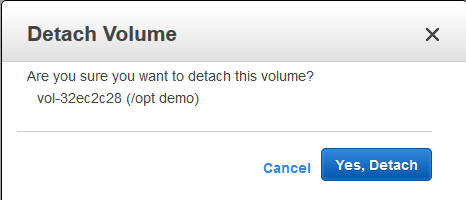
If I really want to clean the disk, I could choose to use shred(1) on the disk to overwrite with random data. This can take a lng time Now the disk is completely unused and disassociated from the VG, I can return to the AWS EC2 Console, and detach the disk:
Detatch volume dialog boxDetach an EBS volume from an EC2 instance
Wait for a few seconds, and the disk is then shown as available ; I then chose to delete the disk in the EC2 console (and stop paying for it). Back to the Logical Volume it s still 4.9 GB, so I add 4.5 GB to it:
# lvresize -L +4.5G /dev/OptVG/OptLV
  Size of logical volume OptVG/OptLV changed from 4.90 GiB (1255 extents) to 9.40 GiB (2407 extents).
  Logical volume OptLV successfully resized
We now have 0.6GB free space on the physical volume (pvs confirms this). Finally, its time to expand out ext4 file system:
# resize2fs /dev/OptVG/OptLV
resize2fs 1.42.12 (29-Aug-2014)
Filesystem at /dev/OptVG/OptLV is mounted on /opt; on-line resizing required
old_desc_blocks = 1, new_desc_blocks = 1
The filesystem on /dev/OptVG/OptLV is now 2464768 (4k) blocks long.
And with df we can now see:
# df -HT /opt/
Filesystem  Type  Size  Used Avail Use% Mounted on
/dev/mapper/OptVG-OptLV ext4  9.9G  12M  9.4G  1% /opt
Automating this The IAM Role I made at the beginning of this post is now going to be useful. I ll start by adding an IAM Policy to the Role to permit me to List Volumes, Create Volumes, Attach Volumes and Detach Volumes to my instance-id. Lets start with creating a volume, with a policy like this:
 
  "Version": "2012-10-17",
  "Statement": [
   
  "Sid": "CreateNewVolumes",
  "Action": "ec2:CreateVolume",
  "Effect": "Allow",
  "Resource": "*",
  "Condition":  
  "StringEquals":  
  "ec2:AvailabilityZone": "us-east-1a",
  "ec2:VolumeType": "gp2"
   ,
  "NumericLessThanEquals":  
  "ec2:VolumeSize": "250"


  ]
 
This policy puts some restrictions on the volumes that this instance can create: only within the given Availability Zone (matching our instance), only GP2 SSD (no PIOPs volumes), and size no more than 250 GB. I ll add another policy to permit this instance role to tag volumes in this AZ that don t yet have a tag called InstanceId:
 
  "Version": "2012-10-17",
  "Statement": [
   
  "Sid": "TagUntaggedVolumeWithInstanceId",
  "Action": [
  "ec2:CreateTags"
  ],
  "Effect": "Allow",
  "Resource": "arn:aws:ec2:us-east-1:1234567890:volume/*",
  "Condition":  
  "Null":  
  "ec2:ResourceTag/InstanceId": "true"


  ]
 
Now that I can create (and then tag) volumes, this becomes a simple procedure as to what else I can do to this volume. Deleting and creating snapshots of this volume are two obvious options, and the corresponding policy:
 
  "Version": "2012-10-17",
  "Statement": [
   
  "Sid": "CreateDeleteSnapshots-DeleteVolume-DescribeModifyVolume",
  "Action": [
  "ec2:CreateSnapshot",
  "ec2:DeleteSnapshot",
  "ec2:DeleteVolume",
  "ec2:DescribeSnapshotAttribute",
  "ec2:DescribeVolumeAttribute",
  "ec2:DescribeVolumeStatus",
  "ec2:ModifyVolumeAttribute"
  ],
  "Effect": "Allow",
  "Resource": "*",
  "Condition":  
  "StringEquals":  
  "ec2:ResourceTag/InstanceId": "i-123456"


  ]
 
Of course it would be lovely if I could use a variable inside the policy condition instead of the literal string of the instance ID, but that s not currently possible. Clearly some of the more important actions I want to take are to attach and detach a volume to my instance:
 
  "Version": "2012-10-17",
  "Statement": [
     
      "Sid": "Stmt1434114682836",
      "Action": [
        "ec2:AttachVolume"
      ],
      "Effect": "Allow",
      "Resource": "arn:aws:ec2:us-east-1:123456789:volume/*",
      "Condition":  
        "StringEquals":  
          "ec2:ResourceTag/InstanceID": "i-123456"
         
       
     ,
     
      "Sid": "Stmt1434114745717",
      "Action": [
        "ec2:AttachVolume"
      ],
      "Effect": "Allow",
      "Resource": "arn:aws:ec2:us-east-1:123456789:instance/i-123456"
     
  ]
 
Now with this in place, we can start to fire up the AWS CLI we spoke of. We ll let the CLI inherit its credentials form the IAM Instance Role and the polices we just defined.
AZ= wget -q -O - http://169.254.169.254/latest/meta-data/placement/availability-zone 
Region= wget -q -O - http://169.254.169.254/latest/meta-data/placement/availability-zone rev cut -c 2- rev 
InstanceId= wget -q -O - http://169.254.169.254/latest/meta-data/instance-id
VolumeId= aws ec2 --region $ Region  create-volume --availability-zone $ AZ  --volume-type gp2 --size 1 --query "VolumeId" --output text 
aws ec2 --region $ Region  create-tags --resource $ VolumeID  --tags Key=InstanceId,Value=$ InstanceId 
aws ec2 --region $ Region  attach-volume --volume-id $ VolumeId  --instance-id $ InstanceId 
and at this stage, the above manipulation of the raw block device with LVM can begin. Likewise you can then use the CLI to detach and destroy any unwanted volumes if you are migrating off old block devices.

11 June 2015

John Goerzen: Roundup of remote encrypted deduplicated backups in Linux

Since I wrote last about Linux backup tools, back in a 2008 article about BackupPC and similar toools and a 2011 article about dedpulicating filesystems, I ve revisited my personal backup strategy a bit. I still use ZFS, with my tool simplesnap that I wrote about in 2014 to perform local backups to USB drives, which get rotated offsite periodically. This has the advantage of being very fast and very secure, but I also wanted offsite backups over the Internet. I began compiling criteria, which ran like this: So, how did things stack up? Didn t meet criteria A lot of popular tools didn t meet the criteria. Here are some that I considered: Obnam and Attic/Borg Backup Obnam and Attic (and its fork Borg Backup) are both programs that have a similar concept at their heart, which is roughly this: the backup repository stores small chunks of data, indexed by a checksum. Directory trees are composed of files that are assembled out of lists of chunks, so if any given file matches another file already in the repository somewhere, the added cost is just a small amount of metadata. Obnam was eventually my tool of choice. It has built-in support for sftp, but its reliance on local filesystem semantics is very conservative and it works fine atop davfs2 (and, I d imagine, other S3-backed FUSE filesystems). Obnam s repository format is carefully documented and it is very conservatively designed through and through clearly optimized for integrity above all else, including speed. Just what a backup program should be. It has a lot of configurable options, including chunk size, caching information (dedup tables can be RAM-hungry), etc. These default to fairly conservative values, and the performance of Obnam can be significantly improved with a few simple config tweaks. Attic was also a leading contender. It has a few advantages over Obnam, actually. One is that it uses an rsync-like rolling checksum method. This means that if you add 1 byte at the beginning of a 100MB file, Attic will upload a 1-byte chunk and then reference the other chunks after that, while Obnam will have to re-upload the entire file, since its chunks start at the beginning of the file in fixed sizes. (The only time Obnam has chunks smaller than its configured chunk size is with very small files or the last chunk in a file.) Another nice feature of Attic is its use of packs , where it groups chunks together into larger pack files. This can have significant performance advantages when backing up small files, especially over high-latency protocols and links. On the downside, Attic has a hardcoded fairly small chunksize that gives it a heavy metadata load. It is not at all as configurable as Obnam, and unlike Obnam, there is nothing you can do about this. The biggest reason I avoided it though was that it uses a single monolithic index file that would have to be uploaded from scratch after each backup. I calculated that this would be many GB in size, if not even tens of GB, for my intended use, and this is just not practical over the Internet. Attic assumes that if you are going remote, you run Attic on the remote so that the rewrite of this file doesn t have to send all the data across the network. Although it does work atop davfs2, this support seemed like an afterthought and is clearly not very practical. Attic did perform much better than Obnam in some ways, largely thanks to its pack support, but the monolothic index file was going to make it simply impractical to use. There is a new fork of Attic called Borg that may, in the future, address some of these issues. Brief honorable mentions: bup, zbackup, syncany There are a few other backup tools that people are talking about which do dedup. bup is frequently mentioned, but one big problem with it is that it has no way to delete old data! In other words, it is more of an archive than a backup tool. zbackup is a really neat idea it dedups anything you feed at it, such as a tar stream or zfs send stream, and can encrypt, too. But it doesn t (yet) support removing old data either. syncany is fundamentally a syncing tool, but can also be used from the command line to do periodic syncs to a remote. It supports encryption, sftp, webdave, etc. natively, and runs on quite a number of platforms easily. However, it doesn t store a number of POSIX attributes, such as hard links, uid/gid owner, ACL, xattr, etc. This makes it impractical for use for even backing up my home directory; I make fairly frequent use of ln, both with and without -s. If there were some tool to create/restore archives of metadata, that might work out better.

2 June 2015

Julien Danjou: Get back up and try again: retrying in Python

I don't often write about tools I use when for my daily software development tasks. I recently realized that I really should start to share more often my workflows and weapons of choice. One thing that I have a hard time enduring while doing Python code reviews, is people writing utility code that is not directly tied to the core of their business. This looks to me as wasted time maintaining code that should be reused from elsewhere. So today I'd like to start with retrying, a Python package that you can use to retry anything. It's OK to fail
Often in computing, you have to deal with external resources. That means accessing resources you don't control. Resources that can fail, become flapping, unreachable or unavailable. Most applications don't deal with that at all, and explode in flight, leaving a skeptical user in front of the computer. A lot of software engineers refuse to deal with failure, and don't bother handling this kind of scenario in their code. In the best case, applications usually handle simply the case where the external reached system is out of order. They log something, and inform the user that it should try again later. In this cloud computing area, we tend to design software components with service-oriented architecture in mind. That means having a lot of different services talking to each others over the network. And we all know that networks tend to fail, and distributed systems too. Writing software with failing being part of normal operation is a terrific idea. Retrying
In order to help applications with the handling of these potential failures, you need a plan. Leaving to the user the burden to "try again later" is rarely a good choice. Therefore, most of the time you want your application to retry. Retrying an action is a full strategy on its own, with a lot of options. You can retry only on certain condition, and with the number of tries based on time (e.g. every second), based on a number of tentative (e.g. retry 3 times and abort), based on the problem encountered, or even on all of those. For all of that, I use the retrying library that you can retrieve easily on PyPI. retrying provides a decorator called retry that you can use on top of any function or method in Python to make it retry in case of failure. By default, retry calls your function endlessly until it returns rather than raising an error.
import random
from retrying import retry

@retry
def pick_one():
if random.randint(0, 10) != 1:
raise Exception("1 was not picked")

This will execute the function pick_one until 1 is returned by random.randint. retry accepts a few arguments, such as the minimum and maximum delays to use, which also can be randomized. Randomizing delay is a good strategy to avoid detectable pattern or congestion. But more over, it supports exponential delay, which can be used to implement exponential backoff, a good solution for retrying tasks while really avoiding congestion. It's especially handy for background tasks.
@retry(wait_exponential_multiplier=1000, wait_exponential_max=10000)
def wait_exponential_1000():
print "Wait 2^x * 1000 milliseconds between each retry, up to 10 seconds, then 10 seconds afterwards"
raise Exception("Retry!")

You can mix that with a maximum delay, which can give you a good strategy to retry for a while, and then fail anyway:
# Stop retrying after 30 seconds anyway
>>> @retry(wait_exponential_multiplier=1000, wait_exponential_max=10000, stop_max_delay=30000)
... def wait_exponential_1000():
... print "Wait 2^x * 1000 milliseconds between each retry, up to 10 seconds, then 10 seconds afterwards"
... raise Exception("Retry!")
...
>>> wait_exponential_1000()
Wait 2^x * 1000 milliseconds between each retry, up to 10 seconds, then 10 seconds afterwards
Traceback (most recent call last):
File "<stdin>", line 1, in <module>
File "/usr/local/lib/python2.7/site-packages/retrying.py", line 49, in wrapped_f
return Retrying(*dargs, **dkw).call(f, *args, **kw)
File "/usr/local/lib/python2.7/site-packages/retrying.py", line 212, in call
raise attempt.get()
File "/usr/local/lib/python2.7/site-packages/retrying.py", line 247, in get
six.reraise(self.value[0], self.value[1], self.value[2])
File "/usr/local/lib/python2.7/site-packages/retrying.py", line 200, in call
attempt = Attempt(fn(*args, **kwargs), attempt_number, False)
File "<stdin>", line 4, in wait_exponential_1000
Exception: Retry!

A pattern I use very often, is the ability to retry only based on some exception type. You can specify a function to filter out exception you want to ignore or the one you want to use to retry.
def retry_on_ioerror(exc):
return isinstance(exc, IOError)

@retry(retry_on_exception=retry_on_ioerror)
def read_file():
with open("myfile", "r") as f:
return f.read()

retry will call the function passed as retry_on_exception with the exception raised as first argument. It's up to the function to then return a boolean indicating if a retry should be performed or not. In the example above, this will only retry to read the file if an IOError occurs; if any other exception type is raised, no retry will be performed. The same pattern can be implemented using the keyword argument retry_on_result, where you can provide a function that analyses the result and retry based on it.
def retry_if_file_empty(result):
return len(result) <= 0

@retry(retry_on_result=retry_if_file_empty)
def read_file():
with open("myfile", "r") as f:
return f.read()

This example will read the file until it stops being empty. If the file does not exist, an IOError is raised, and the default behavior which triggers retry on all exceptions kicks-in the retry is therefore performed. That's it! retry is really a good and small library that you should leverage rather than implementing your own half-baked solution!

1 June 2015

Russ Allbery: Review: Hild

Review: Hild, by Nicola Griffith
Series: Hild #1
Publisher: Farrar, Straus and Giroux
Copyright: 2013
ISBN: 0-374-28087-8
Format: Hardcover
Pages: 539
Hild was born in seventh-century Britain, daughter of Hereric (would-be king of Daria) and Breguswith. Born, her mother said, to be a light to the land. This much is documented by the Venerable Bede, in The Ecclesiastical History of the English Nation, along with Hild's later rise to become one of the most powerful abbesses in British history. But nearly all of Hild's early life is a cipher. Hild fills in some of that gap with fiction. Specifically, it takes Hild from a child of three, learning her father has been killed, to a young woman, an advisor of Edwin king. It's a coming of age story in part, following her maturation both physically and mentally, her training in when to speak and how, and the dangers of being close to royalty in a fractious, political, and war-torn land. It's also the story of endless maneuvering and care, initially by her mother Breguswith and then by Hild herself sometimes in opposition to her mother, sometimes in alliance as her mother attempts to make a safe place for her daughter and herself in a treacherous court of shifting dangers. But Hild is also a story about Britain. It's a novel about how it felt and how it sounded. How it was organized, primarily among the high-born but with snippets of perspective from the lower classes. And it's a story about women: about weaving, about medicine, about friendships and partnerships and alliances among women, about the politics of marriage and childbirth, but also about the places women held and made in a time when surviving official history is all about the men. Hild is a painstakingly-researched, sprawling, lush, and sensual immersion in a part of history that gets little formal attention: after the Romans, before what we think of as medieval, before England as a country. I've been waiting for a new Nicola Griffith novel for quite a while, since Always in 2007. Hild doesn't disappoint, but it's also different than Griffith's previous writing. It has less of the strong narrative drive and clarity of either her SF or Aud Torvingen stories. Instead, the goal of Hild is to immerse and transport you, to help you feel the shape of Hild's world, to understand her days and tasks, her dreams and dangers. Like all of Griffith's work, it's beautifully written. Griffith puts description at the fore, in the sharp eyes of an observant girl who loves the outdoors, and who has been taught to watch for signs of weather and tools of healing. From early on, Hild's mother sets her up as a seer and prophetess as a way of establishing her value to war leaders and kings, and while some of it is drama and cryptic words, so much of it is careful observation, networks of information-gathering, and sharp deduction about the motives and politics of surrounding kings. Hild is very good at what she does because she has a sharp, quick mind that has been carefully trained, and because she has the aid of her mother's networks and then aid in building her own. Griffith does a wonderful job showing the reader what Hild sees, how she appreciates the world both for its own beauty and for the information she can gather from it, and how to build influence by navigating tense and dangerous moments: waiting for just the right moment and the right word, and taking sudden, impulsive risks and accepting their consequences. Unfortunately for me, this setting is also rich in complex politics and numerous actors, with older and unfamiliar names, and I got lost. Constantly. That's the drawback to immersion: Griffith doesn't hold the reader's hand. We get Hild's thoughts and analysis, and the reader has to keep up. Sometimes I did; sometimes I didn't. There's a dizzying flurry of names here, both personal and place, and while there is a map and a single family tree, neither helped me as much as I wanted them to. At several points, I found myself skimming through the latest shift in the balance between various petty kings because, while I knew I'd seen all the names before, they had come adrift from their context in the story. That was my major frustration with this book. It was all interesting enough that I would have kept thumbing back to a detailed dramatis personae, and indeed I kept checking the family tree, but there just wasn't enough detail there. Even better would have been a brief factual history of the political and military conflicts Hild was living through, keyed by chapter. Hild is startlingly intelligent, leaping from insight to insight, which is wonderful for building character, but which occasionally leaves the reader scrambling to catch up with the connections between her thoughts. I felt like, had I the broader context, I could have understood her insight more readily. All this information is likely available, since Griffith is playing off of documented history, but I'm not the sort of reader who likes doing Internet research while engrossed in a book. So, that's the downside, at least for me. But this book has many strengths, even if you're lost much of the time. Hild as written by Griffith is a fascinating character, full of sharp edges and difficult moods and a powerful belief in what she feels is right. Griffith is at the height of her writing ability when describing Hild making hard choices and taking on burdens that seem too large for her to bear. There are two sections of the book, where Hild is forced by circumstances to lead men in violence, that I think are two of the best bits of writing Griffith has ever published not just because of those scenes themselves, but because of the aftermath, the lingering echos, the way that they shape and inform everything Hild does afterwards. The mingling of reward and loss, maturation and trauma, the sense that the world has shifted both inside and out and it's nearly impossible to say whether the change is for the better or worse. Griffith also knows when not to say too much, and while I found that frustrating for the politics, it does wonders for the characters. Hild's complex and fraught relationship with Gwaldus is the best example. We never know exactly what Gwaldus is thinking; Hild can only guess, and at times one is fairly sure that she guesses wrong. But that doesn't lead to sudden revelations, where the characters finally understand each other. Instead, they both adjust, they maneuver around each other, they find space and understanding where they can, and sometimes they just close off. This book is full of relationships like this: loves that are too complicated for words, bonds that are too dangerous to acknowledge, and characters who can't relax even though they wish the best for each other. At times, it's exhausting reading, but it gives Hild a tension that one wouldn't expect from a sprawling novel full of description and scene-building. Hild is clearly the first book of a series, and leaves quite a lot unresolved. If you want closure in relationships and in politics, there's a lot here that you may find frustrating. And if, like me, you struggle to keep names and politics straight, you're probably going to get lost. But it's well worth the effort for the description, for Hild's thought processes, and for a few haunting scenes that I will be replaying in my head for a very long time. Expect to take your time with this, and wait until you're in the mood for immersion and puzzling out context as you go, but recommended. I suspect it would be even better on a second reading. Rating: 8 out of 10

27 May 2015

Vincent Bernat: Live patching QEMU for VENOM mitigation

CVE-2015-3456, also known as VENOM, is a security vulnerability in QEMU virtual floppy controller:
The Floppy Disk Controller (FDC) in QEMU, as used in Xen [ ] and KVM, allows local guest users to cause a denial of service (out-of-bounds write and guest crash) or possibly execute arbitrary code via the FD_CMD_READ_ID, FD_CMD_DRIVE_SPECIFICATION_COMMAND, or other unspecified commands.
Even when QEMU has been configured with no floppy drive, the floppy controller code is still active. The vulnerability is easy to test1:
#define FDC_IOPORT 0x3f5
#define FD_CMD_READ_ID 0x0a
int main()  
    ioperm(FDC_IOPORT, 1, 1);
    outb(FD_CMD_READ_ID, FDC_IOPORT);
    for (size_t i = 0;; i++)
        outb(0x42, FDC_IOPORT);
    return 0;
 
Once the fix installed, all processes still have to be restarted for the upgrade to be effective. It is possible to minimize the downtime by leveraging virsh save. Another possibility would be to patch the running processes. The Linux kernel attracted a lot of interest in this area, with solutions like Ksplice (mostly killed by Oracle), kGraft (by Red Hat) and kpatch (by Suse) and the inclusion of a common framework in the kernel. The userspace has far less out-of-the-box solutions2. I present here a simple and self-contained way to patch a running QEMU to remove the vulnerability without requiring any sensible downtime. Here is a short demonstration:

Proof of concept First, let s find a workaround that would be simple to implement through live patching: while modifying running code text is possible, it is easier to modify a single variable.

Concept Looking at the code of the floppy controller and the patch, we can avoid the vulnerability by not accepting any command on the FIFO port. Each request would be answered by Invalid command (0x80) and a user won t be able to push more bytes to the FIFO until the answer is read and the FIFO queue reset. Of course, the floppy controller would be rendered useless in this state. But who cares? The list of commands accepted by the controller on the FIFO port is contained in the handlers[] array:
static const struct  
    uint8_t value;
    uint8_t mask;
    const char* name;
    int parameters;
    void (*handler)(FDCtrl *fdctrl, int direction);
    int direction;
  handlers[] =  
      FD_CMD_READ, 0x1f, "READ", 8, fdctrl_start_transfer, FD_DIR_READ  ,
      FD_CMD_WRITE, 0x3f, "WRITE", 8, fdctrl_start_transfer, FD_DIR_WRITE  ,
    /* [...] */
      0, 0, "unknown", 0, fdctrl_unimplemented  , /* default handler */
 ;
To avoid browsing the array each time a command is received, another array is used to map each command to the appropriate handler:
/* Associate command to an index in the 'handlers' array */
static uint8_t command_to_handler[256];
static void fdctrl_realize_common(FDCtrl *fdctrl, Error **errp)
 
    int i, j;
    static int command_tables_inited = 0;
    /* Fill 'command_to_handler' lookup table */
    if (!command_tables_inited)  
        command_tables_inited = 1;
        for (i = ARRAY_SIZE(handlers) - 1; i >= 0; i--)  
            for (j = 0; j < sizeof(command_to_handler); j++)  
                if ((j & handlers[i].mask) == handlers[i].value)  
                    command_to_handler[j] = i;


    /* [...] */
 
Our workaround is to modify the command_to_handler[] array to map all commands to the fdctrl_unimplemented() handler (the last one in the handlers[] array).

Testing with gdb To check if the workaround works as expected, we test it with gdb. Unless you have compiled QEMU yourself, you need to install a package with debug symbols. Unfortunately, on Debian, they are not available, yet3. On Ubuntu, you can install the qemu-system-x86-dbgsym package after enabling the appropriate repositories. The following function for gdb maps every command to the unimplemented handler:
define patch
  set $handler = sizeof(handlers)/sizeof(*handlers)-1
  set $i = 0
  while ($i < 256)
   set variable command_to_handler[$i++] = $handler
  end
  printf "Done!\n"
end
Attach to the vulnerable process (with attach), call the function (with patch) and detach of the process (with detach). You can check that the exploit is not working anymore. This could be easily automated.

Limitations Using gdb has two main limitations:
  1. It needs to be installed on each host to be patched.
  2. The debug packages need to be installed as well. Moreover, it can be difficult to fetch previous versions of those packages.

Writing a custom patcher To overcome those limitations, we can write a customer patcher using the ptrace() system call without relying on debug symbols being present.

Finding the right memory spot Before being able to modify the command_to_handler[] array, we need to know its location. The first clue is given by the symbol table. To query it, use readelf -s:
$ readelf -s /usr/lib/debug/.build-id/09/95121eb46e2a4c13747ac2bad982829365c694.debug   \
>   sed -n -e 1,3p -e /command_to_handler/p
Symbol table '.symtab' contains 27066 entries:
   Num:    Value          Size Type    Bind   Vis      Ndx Name
  8485: 00000000009f9d00   256 OBJECT  LOCAL  DEFAULT   26 command_to_handler
This table is usually stripped out of the executable to save space, like shown below:
$ file -b /usr/bin/qemu-system-x86_64   tr , \\n
ELF 64-bit LSB shared object
 x86-64
 version 1 (SYSV)
 dynamically linked
 interpreter /lib64/ld-linux-x86-64.so.2
 for GNU/Linux 2.6.32
 BuildID[sha1]=0995121eb46e2a4c13747ac2bad982829365c694
 stripped
If your distribution provides a debug package, the debug symbols are installed in /usr/lib/debug. Most modern distributions are now relying on the build ID4 to map an executable to its debugging symbols, like the example above. Without a debug package, you need to recompile the existing package without stripping debug symbols in a clean environment5. On Debian, this can be done by setting the DEB_BUILD_OPTIONS environment variable to nostrip. We have now two possible cases:
  • the easy one, and
  • the hard one.

The easy case On x86, here is the standard layout of a regular Linux process in memory6: Memory layout of a regular process on x86 The random gaps (ASLR) are here to prevent an attacker from reliably jumping to a particular exploited function in memory. On x86-64, the layout is quite similar. The important point is that the base address of the executable is fixed. The memory mapping of a process is also available through /proc/PID/maps. Here is a shortened and annotated example on x86-64:
$ cat /proc/3609/maps
00400000-00401000         r-xp 00000000 fd:04 483  not-qemu [text segment]
00601000-00602000         r--p 00001000 fd:04 483  not-qemu [data segment]
00602000-00603000         rw-p 00002000 fd:04 483  not-qemu [BSS segment]
[random gap]
02419000-0293d000         rw-p 00000000 00:00 0    [heap]
[random gap]
7f0835543000-7f08356e2000 r-xp 00000000 fd:01 9319 /lib/x86_64-linux-gnu/libc-2.19.so
7f08356e2000-7f08358e2000 ---p 0019f000 fd:01 9319 /lib/x86_64-linux-gnu/libc-2.19.so
7f08358e2000-7f08358e6000 r--p 0019f000 fd:01 9319 /lib/x86_64-linux-gnu/libc-2.19.so
7f08358e6000-7f08358e8000 rw-p 001a3000 fd:01 9319 /lib/x86_64-linux-gnu/libc-2.19.so
7f08358e8000-7f08358ec000 rw-p 00000000 00:00 0
7f08358ec000-7f083590c000 r-xp 00000000 fd:01 5138 /lib/x86_64-linux-gnu/ld-2.19.so
7f0835aca000-7f0835acd000 rw-p 00000000 00:00 0
7f0835b08000-7f0835b0c000 rw-p 00000000 00:00 0
7f0835b0c000-7f0835b0d000 r--p 00020000 fd:01 5138 /lib/x86_64-linux-gnu/ld-2.19.so
7f0835b0d000-7f0835b0e000 rw-p 00021000 fd:01 5138 /lib/x86_64-linux-gnu/ld-2.19.so
7f0835b0e000-7f0835b0f000 rw-p 00000000 00:00 0
[random gap]
7ffdb0f85000-7ffdb0fa6000 rw-p 00000000 00:00 0    [stack]
With a regular executable, the value given in the symbol table is an absolute memory address:
$ readelf -s not-qemu   \
>   sed -n -e 1,3p -e /command_to_handler/p
Symbol table '.dynsym' contains 9 entries:
   Num:    Value          Size Type    Bind   Vis      Ndx Name
    47: 0000000000602080   256 OBJECT  LOCAL  DEFAULT   25 command_to_handler
So, the address of command_to_handler[], in the above example, is just 0x602080.

The hard case To enhance security, it is possible to load some executables at a random base address, just like a library. Such an executable is called a Position Independent Executable (PIE). An attacker won t be able to rely on a fixed address to find some helpful function. Here is the new memory layout: Memory layout of a PIE process on x86 With a PIE process, the value in the symbol table is now an offset from the base address.
$ readelf -s not-qemu-pie   sed -n -e 1,3p -e /command_to_handler/p
Symbol table '.dynsym' contains 17 entries:
   Num:    Value          Size Type    Bind   Vis      Ndx Name
    47: 0000000000202080   256 OBJECT  LOCAL  DEFAULT   25 command_to_handler
If we look at /proc/PID/maps, we can figure out where the array is located in memory:
$ cat /proc/12593/maps
7f6c13565000-7f6c13704000 r-xp 00000000 fd:01 9319  /lib/x86_64-linux-gnu/libc-2.19.so
7f6c13704000-7f6c13904000 ---p 0019f000 fd:01 9319  /lib/x86_64-linux-gnu/libc-2.19.so
7f6c13904000-7f6c13908000 r--p 0019f000 fd:01 9319  /lib/x86_64-linux-gnu/libc-2.19.so
7f6c13908000-7f6c1390a000 rw-p 001a3000 fd:01 9319  /lib/x86_64-linux-gnu/libc-2.19.so
7f6c1390a000-7f6c1390e000 rw-p 00000000 00:00 0
7f6c1390e000-7f6c1392e000 r-xp 00000000 fd:01 5138  /lib/x86_64-linux-gnu/ld-2.19.so
7f6c13b2e000-7f6c13b2f000 r--p 00020000 fd:01 5138  /lib/x86_64-linux-gnu/ld-2.19.so
7f6c13b2f000-7f6c13b30000 rw-p 00021000 fd:01 5138  /lib/x86_64-linux-gnu/ld-2.19.so
7f6c13b30000-7f6c13b31000 rw-p 00000000 00:00 0
7f6c13b31000-7f6c13b33000 r-xp 00000000 fd:04 4594  not-qemu-pie [text segment]
7f6c13cf0000-7f6c13cf3000 rw-p 00000000 00:00 0
7f6c13d2e000-7f6c13d32000 rw-p 00000000 00:00 0
7f6c13d32000-7f6c13d33000 r--p 00001000 fd:04 4594  not-qemu-pie [data segment]
7f6c13d33000-7f6c13d34000 rw-p 00002000 fd:04 4594  not-qemu-pie [BSS segment]
[random gap]
7f6c15c46000-7f6c15c67000 rw-p 00000000 00:00 0     [heap]
[random gap]
7ffe823b0000-7ffe823d1000 rw-p 00000000 00:00 0     [stack]
The base address is 0x7f6c13b31000, the offset is 0x202080 and therefore, the location of the array is 0x7f6c13d33080. We can check with gdb:
$ print &command_to_handler
$1 = (uint8_t (*)[256]) 0x7f6c13d33080 <command_to_handler>

Patching a memory spot Once we know the location of the command_to_handler[] array in memory, patching it is quite straightforward. First, we start tracing the target process:
/* Attach to the running process */
static int
patch_attach(pid_t pid)
 
    int status;
    printf("[.] Attaching to PID %d...\n", pid);
    if (ptrace(PTRACE_ATTACH, pid, NULL, NULL) == -1)  
        fprintf(stderr, "[!] Unable to attach to PID %d: %m\n", pid);
        return -1;
     
    if (waitpid(pid, &status, 0) == -1)  
        fprintf(stderr, "[!] Error while attaching to PID %d: %m\n", pid);
        return -1;
     
    assert(WIFSTOPPED(status)); /* Tracee may have died */
    if (ptrace(PTRACE_GETSIGINFO, pid, NULL, &si) == -1)  
        fprintf(stderr, "[!] Unable to read siginfo for PID %d: %m\n", pid);
        return -1;
     
    assert(si.si_signo == SIGSTOP); /* Other signals may have been received */
    printf("[*] Successfully attached to PID %d\n", pid);
    return 0;
 
Then, we retrieve the command_to_handler[] array, modify it and put it back in memory7.
static int
patch_doit(pid_t pid, unsigned char *target)
 
    int ret = -1;
    unsigned char *command_to_handler = NULL;
    size_t i;
    /* Get the table */
    printf("[.] Retrieving command_to_handler table...\n");
    command_to_handler = ptrace_read(pid,
                                     target,
                                     QEMU_COMMAND_TO_HANDLER_SIZE);
    if (command_to_handler == NULL)  
        fprintf(stderr, "[!] Unable to read command_to_handler table: %m\n");
        goto out;
     
    /* Check if the table has already been patched. */
    /* [...] */
    /* Patch it */
    printf("[.] Patching QEMU...\n");
    for (i = 0; i < QEMU_COMMAND_TO_HANDLER_SIZE; i++)  
        command_to_handler[i] = QEMU_NOT_IMPLEMENTED_HANDLER;
     
    if (ptrace_write(pid, target, command_to_handler,
           QEMU_COMMAND_TO_HANDLER_SIZE) == -1)  
        fprintf(stderr, "[!] Unable to patch command_to_handler table: %m\n");
        goto out;
     
    printf("[*] QEMU successfully patched!\n");
    ret = 0;
out:
    free(command_to_handler);
    return ret;
 
Since ptrace() only allows to read or write a word at a time, ptrace_read() and ptrace_write() are wrappers to read or write arbitrary large chunks of memory8. Here is the code for ptrace_read():
/* Read memory of the given process */
static void *
ptrace_read(pid_t pid, void *address, size_t size)
 
    /* Allocate the buffer */
    uword_t *buffer = malloc((size/sizeof(uword_t) + 1)*sizeof(uword_t));
    if (!buffer) return NULL;
    /* Read word by word */
    size_t readsz = 0;
    do  
        errno = 0;
        if ((buffer[readsz/sizeof(uword_t)] =
                ptrace(PTRACE_PEEKTEXT, pid,
                       (unsigned char*)address + readsz,
                       0)) && errno)  
            fprintf(stderr, "[!] Unable to peek one word at address %p: %m\n",
                    (unsigned char *)address + readsz);
            free(buffer);
            return NULL;
         
        readsz += sizeof(uword_t);
      while (readsz < size);
    return (unsigned char *)buffer;
 

Putting the pieces together The patcher is provided with the following information:
  • the PID of the process to be patched,
  • the command_to_handler[] offset from the symbol table, and
  • the build ID of the executable file used to get this offset (as a safety measure).
The main steps are:
  1. Attach to the process with ptrace().
  2. Get the executable name from /proc/PID/exe.
  3. Parse /proc/PID/maps to find the address of the text segment (it s the first one).
  4. Do some sanity checks:
    • check there is a ELF header at this location (4-byte magic number),
    • check the executable type (ET_EXEC for regular executables, ET_DYN for PIE), and
    • get the build ID and compare with the expected one.
  5. From the base address and the provided offset, compute the location of the command_to_handler[] array.
  6. Patch it.
You can find the complete patcher on GitHub.
$ ./patch --build-id 0995121eb46e2a4c13747ac2bad982829365c694 \
>         --offset 9f9d00 \
>         --pid 16833
[.] Attaching to PID 16833...
[*] Successfully attached to PID 16833
[*] Executable name is /usr/bin/qemu-system-x86_64
[*] Base address is 0x7f7eea912000
[*] Both build IDs match
[.] Retrieving command_to_handler table...
[.] Patching QEMU...
[*] QEMU successfully patched!

  1. The complete code for this test is on GitHub.
  2. An interesting project seems to be Katana. But there are also some insightful hacking papers on the subject.
  3. Some packages come with a -dbg package with debug symbols, some others don t. Fortunately, a proposal to automatically produce debugging symbols for everything is near completion.
  4. The Fedora Wiki contains the rationale behind the build ID.
  5. If the build is incorrectly reproduced, the build ID won t match. The information provided by the debug symbols may or may not be correct. Debian currently has a reproducible builds effort to ensure that each package can be reproduced.
  6. Anatomy of a program in memory is a great blog post explaining in more details how a program lives in memory.
  7. Being an uninitialized static variable, the variable is in the BSS section. This section is mapped to a writable memory segment. If it wasn t the case, with Linux, the ptrace() system call is still allowed to write. Linux will copy the page and mark it as private.
  8. With Linux 3.2 or later, process_vm_readv() and process_vm_writev() can be used to transfer data from/to a remote process without using ptrace() at all. However, ptrace() would still be needed to reliably stop the main thread.

26 May 2015

Julien Danjou: OpenStack Summit Liberty from a Ceilometer & Gnocchi point of view

Last week I was in Vancouver, BC for the OpenStack Summit, discussing the new Liberty version that will be released in 6 months. I've attended the summit mainly to discuss and follow-up new developments on Ceilometer, Gnocchi and Oslo. It has been a pretty good week and we were able to discuss and plan a few interesting things. Ops feedback
We had half a dozen Ceilometer sessions, and the first one was dedicated to getting feedbacks from operators using Ceilometer. We had a few operators present, and a few of the Ceilometer team. We had constructive discussion, and my feeling is that operators struggles with 2 things so far: scaling Ceilometer storage and having Ceilometer not killing the rest of OpenStack. We discussed the first point as being addressed by Gnocchi, and I presented a bit Gnocchi itself, as well as how and why it will fix the storage scalability issue operators encountered so far. Ceilometer putting down the OpenStack installation is more interesting problem. Ceilometer pollsters request information from Nova, Glance to gather statistics. Until Kilo, Ceilometer used to do that regularly and at fixed interval, causing high pike load in OpenStack. With the introduction of jitter in Kilo, this should be less of a problem. However, Ceilometer hits various endpoints in OpenStack that are poorly designed, and hitting those endpoints of Nova or other components triggers a lot of load on the platform. Unfortunately, this makes operators blame Ceilometer rather than blaming the components being guilty of poor designs. We'd like to push forward improving these components, but it's probably going to take a long time. Componentisation
When I started the Gnocchi project last year, I pretty soon realized that we would be able to split Ceilometer itself in different smaller components that could work independently, while being able to leverage each others. For example, Gnocchi can run standalone and store your metrics even if you don't use Ceilometer nor even OpenStack itself. My fellow developer Chris Dent had the same idea about splitting Ceilometer a few months ago and drafted a proposal. The idea is to have Ceilometer split in different parts that people could assemble together or run on their owns. Interestingly enough, we had three 40 minutes sessions planned to talk and debate about this division of Ceilometer, though we all agreed in 5 minutes that this was the good thing to do. Five more minutes later, we agreed on which part to split. The rest of the time was allocated to discuss various details of that split, and I engaged to start doing the work with Ceilometer alarming subsystem. I wrote a specification on the plane bringing me to Vancouver, that should be approved pretty soon now. I already started doing the implementation work. So fingers crossed, Ceilometer should have a new components in Liberty handling alarming on its own. This would allow users for example to only deploys Gnocchi and Ceilometer alarm. They would be able to feed data to Gnocchi using their own system, and build alarms using Ceilometer alarm subsystem relying on Gnocchi's data. Gnocchi
We didn't have a Gnocchi dedicated slot mainly because I indicated I didn't feel we needed one. We anyway discussed a few points around coffee, and I've been able to draw a few new ideas and changes I'd like to see in Gnocchi. Mainly changing the API contract to be more asynchronously so we can support InfluxDB more correctly, and improve Carbonara (the library we created to manipulate timeseries) based drivers to be faster. All of those should plus a few Oslo tasks I'd like to tackle should keep me busy for the next cycle!

20 May 2015

Norbert Preining: Shishiodoshi or Us and They On the perceived exclusivity of Japanese

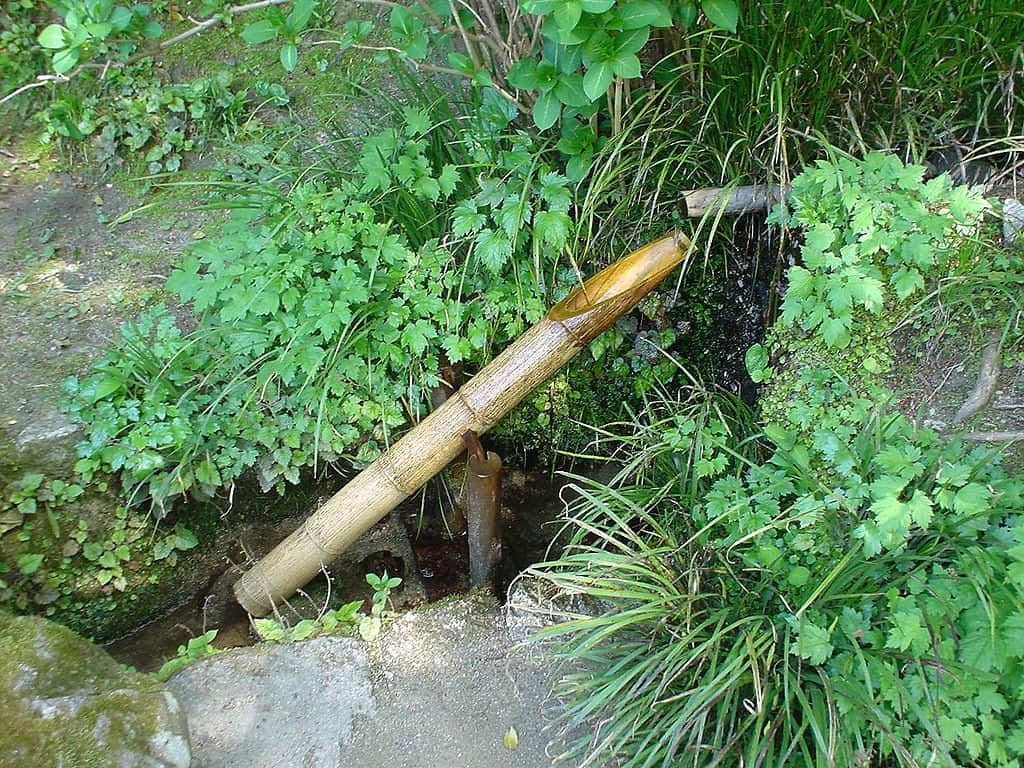
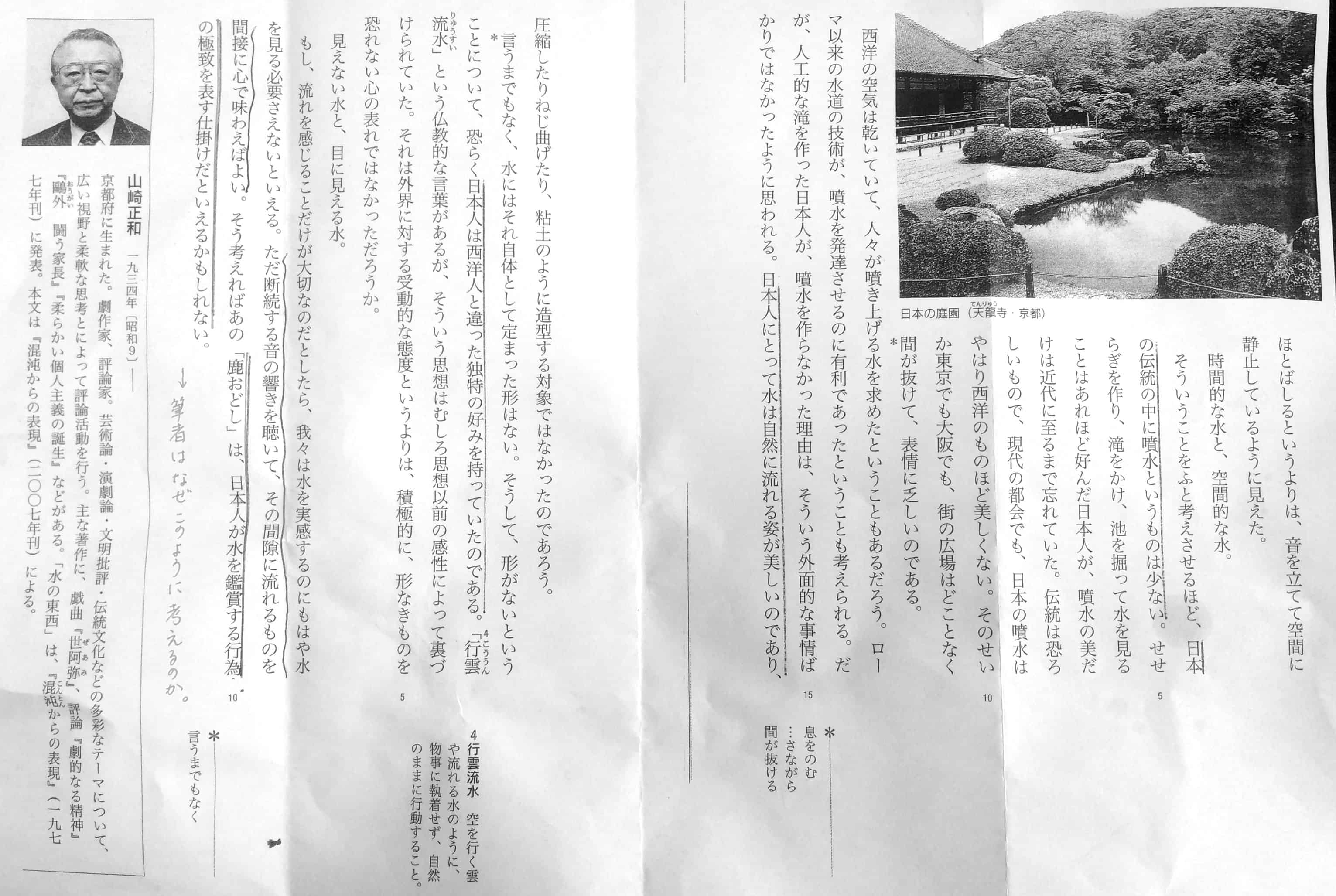
The other day I received from my Japanese teacher an interesting article by Yamazaki Masakazu comparing garden styles, and in particular the attitude towards and presentation of water in Japanese and European gardens (page 1, page 2). The author s list of achievements is long, various professorships, dramatist, literature critique, recognized as Person of Cultural Merit, just to name a view. I was looking forward to an interesting and high quality article! The article itself introduces the reader to Shishiodoshi, one of the standard ingredients of a Japanese garden: It is a device where water drips into a bamboo tube that is also a seesaw. At some point the water in the bamboo tube makes the seesaw switch over and the water pours out, after which the seesaw returns to the original position and a new cycle begins. Shishiodoshi The author describes his feelings and thoughts about the shishiodoshi, in particular connects human life (stress and relieve, cycles), the flow of time, and some other concepts with the shishiodoshi. Up to here it is a wonderful article providing interesting insights into the way the author thinks. Unfortunately, then the author tries to underline his ideas by comparing the Japanese shishiodoshi with European style water fountains, describing the former with all favorable properties and full of deep meaning, while the latter is qualified as beautiful and nice, but bare of any deeper meaning. I don t go into details that the whole comparison is anyway a bad one, as he is comparing Baroque style fountains, a very limited period, and furthermore ignores the fact that water fountains are not genuinely European (isn t there one in the Kenrokuen, one of the three most famous gardens in Japan!?), nor does he consider any other water-installation that might be available. What really destroys the in principle very nice article is the tone: The general tone of the article then can be summarized into: The shishiodoshi is rich on meaning, connects to the life of humans, instigates philosophical reflections, represents nature, the flow of time etc. The water fountain is beautiful and gorgeous, but that is all. I don t think that this separation, or this negative undertone, was created on purpose by the author. A person of his stature is supposedly above this level of primitive comparison. I believe that it is nothing else but a consequence of upbringing and the general attitude that permeates the whole society with this feeling of separateness. Us and They Repeatedly providing sentences like Japanese people and Western people have different tastes.. ( ). About 10 times in this short article expressions like Japanese and Westerner appear, leaving the reader with a bitter taste of an author that considers first the Japanese a people (what about Ainu, Ryukyu, etc?), and second that the Japanese are exclusive in the sense that they are set apart from the rest of the world in their way of thinking, living, being. What puzzles me is that this is not only a singular opinion, but a very general straight in the Japanese media, TV, radio, newspaper, books. Everyone considers Japan and Japanese as something that is fundamentally and profoundly different from everyone else in the world. There is We the Japanese (and that doesn t mean nationality of passport, but blood line!), and there are They the Rest or, as the way of writing and and description on many occasion suggestions, They the Barbarians . A short anecdote will underly this: One of the favorite TV talk show / pseudo-documentary style is about Japanese living abroad. That day a lady married in Paris was interviewed. What followed was a guided tour through Paris showing: Dirt in the gutter, street cleaning cars, waste disposal places. Yes, that was all. Just about the dirt . Of course, at length the (unfortunately only apparent) cleanliness of Japanese cities and neighborhoods are mentioned and shown to remind everyone how wonderful Japan is and how dirty the Barbarians. I don t want to say that I consider Japan more dirty than most other countries just the visible part is clean, the moment you step a bit aside and around the corner, there are the worst trash just thrown away without consideration. Anyway. To return to the topic of Us and They I consider us all humans, first and foremost, and nationality, birthplace, and all that are just by chance. I do NOT reject cultural differences, they are here, of course. But cultural differences are one thing, separating one self and one s perceived people from the rest of the world is another. Conclusion I repeat, I don t think that the author had any ill intentions, but it would have been nicer if the article wouldn t make such a stark distinction. He could have written about Shishiodoshi and water fountains without using the Us They categorization. He could have compared other water installations, could have discussed the long tradition of small ponds in European gardens, just to name a few things. But the author choose to highlight differences instead of commonalities. It is the Us against Them feeling that often makes life in Japan for a foreigner difficult. Japanese are not special, Austrians, too, are not special, nor are Americans, Russians, Tibetans, or any other nationality. No nationality is special, we are all humans. Maybe at some point this will arrive also in the Japanese society and thinking.
Email this to someonePrint this pageShare on FacebookShare on Google+Tweet about this on TwitterShare on LinkedInFlattr the author

19 May 2015

Gunnar Wolf: Feeling somewhat special

Today I feel more special than I have ever felt. Or... Well, or something like that. Thing is, there is no clear adjective for this But I successfully finished my Specialization degree! Yes, believe it or not, today I can formally say I am Specialist in Informatic Security and Information Technologies (Especialista en Seguridad Inform tica y Tecnolog as de la Informaci n), as awarded by the Higher School of Electric and Mechanic Engineering (Escuela Superior de Ingenier a Mec nica y El ctrica) of the National Polytechnical Institute (Instituto Polit cnico Nacional). In Mexico and most Latin American countries, degrees are usually incorporated to your name as if they were a nobiliary title. Thus, when graduating from Engineering studies (pre-graduate universitary level), I became "Ingeniero Gunnar Wolf". People graduating from further postgraduate programs get to introduce themselves as "Maestro Foobar Baz" or "Doctor Quux Noox". And yes, a Specialization is a small posgraduate program (I often say, the smallest possible posgraduate). And as a Specialist... What can I brag about? Can say I am Specially Gunnar Wolf? Or Special Gunnar Wolf? Nope. The honorific title for a Specialization is a pointer to null, and when casted into a char* it might corrupt your honor-recognizing function. So I'm still Ingeniero Gunnar Wolf, for information security reasons. So that's the reason I am now enrolled in the Masters program. I hope to write an addenda to this message soonish (where soonish 18 months) saying I'm finally a Maestro. As a sidenote, many people asked me: Why did I take on the specialization, which is a degree too small for most kinds of real work recognition? Because it's been around twenty years since I last attended a long-term scholar program as a student. And my dish is quite full with activities and responsabilities. I decided to take a short program, designed for 12 months (I graduated in 16, minus two months that the university was on strike... Quite good, I'd say ;-) ) to see how I fared on it, and only later jumping on the full version. Because, yes, to advance my career at the university, I finally recognized and understood that I do need postgraduate studies. Oh, and what kind of work did I do for this? Besides the classes I took, I wrote a thesis on a model for evaluating covert channels for establishing secure communications.

10 May 2015

Eduard Sanou: Reproducible builds on Debian for GSoC 2015

This is the first blog post of a series I will be writing about my experiences contributing to Debian for Google Summer of Code 2015.

A bit about myself I m a Spanish student doing a master s in Computer Science in Barcelona. I graduated on Electrical Engineering (we call it Telecommunications here). I ve always been interested in computing and programming and I have worked on several projects on my own using C, python and go. My main interests in the field are programming languages, security, cryptography, distributed and decentralized systems and embedded systems. I m an advocate of free software, I try to use it as much as I m able to in my devices and also try to convince my friends and family of its benefits. I have been using GNU/Linux for nearly ten years as my main operating system and I have tried several *BSD s recently. One of my latest personal projects is a gameboy emulator written in C (still work in progress) which already plays many games (without sound though) . You can find other minor projects in my github page (I try to publish all the code I write online, under free software licence) After so many years of using free software and benefiting from it, I thought it was about time to contribute back! That s why I gave GSoC a try and applied to work on the Reproducible Builds project for Debian :) And I got accepted!

Reproducible Builds The idea behind this project is that currently many packages aren t built in a reproducible manner; that is, they contain timestamps, building machine name, unique IDs, and results from other processes that happen differently between machines, like file ordering in compressed files. The project aims to patch all the Debian packages / the building scripts in order to generate the same binary (bit by bit) independently of the machine, timezone, etc where it is built. This way, a cryptographic hash of the built package can be distributed and many people can rebuild the package to verify that the binary in the repositories indeed corresponds to the right source code by means of comparing the hash.

Motivation One of the main advantages of the free software is that source code is available for peer review. This makes it easier for users to trust their software, as they can check the source to verify that the program is not doing anything bad. Even if the user doesn t do that, they can trust the wider community with that task. But many distributions serve packages in binary form, so how do we know that the binary comes from the publicly available source code? The current solution is that the developers who build the packages sign them cryptographically; but this lands all the trust to the developer and the machines used for building. I became interested in this topic with a very nice talk given at 31c3 by Mike Perry from Tor and Seth Schoen from the EFF. They focused on reproducible builds applied to the tor browser bundle, showing a small demo of how a building machine could be compromised to add hidden functionalities when compiling code (so that the developer could be signing a compromised package without their knowledge).

Benefits There are two main groups who benefit with reproducible builds:

For users The user can be more secure when installing packages in binary form since they don t need to trust a specific developer or building machine. Even if they don t rebuild the package by themselves to verify it, there would be others doing so, who will easily alert the community when the binary doesn t match the source code.

For developers The developer no longer has the responsibility of using his identity to sign the package for wide distribution, nor is that much responsible of the damage to users if their machine is compromised to alter the building process, since the community will easily detect it and alert them. This later point is specially useful with secure and privacy aware software. The reason is that there are many powerful organizations around the world with interest on having backdoors in widely used software, be it to spy on users or to target specific groups of people. Considering the amount of money these organizations have for such purposes, it s not hard to imagine that they could try to blackmail developers into adding such backdoors on the built packages. Or they could try to compromise the building machine. With reproducible builds the developer is safer, as such attack is no longer useful.

Reproducible Builds in Debian The project kicked-off at Debian at mid 2013 , leaded by Lunar and soon followed by many other developers (h01ger, deki, mapreri, ). Right now about 80% of the packages in the unstable branch of Debian can be built reproducibly. The project is very active, with many developers sending patches every week. A machine running Jenkins (which was set up at the end of 2012 for other purposes) is being used since late 2014 to continuously build packages in different settings to check if they are built reproducibly or not. In order to analyze why packages fail to build reproducibly, a tool called debbindiff has been developed, which is able to output in text or html form a smart diff of two builds. Another tool called strip-nondeterminism has been developed to remove non-determinism from files during the building process. For this GSoC I plan on helping improving these tools (mainly debbindiff), write many patches to achieve reproducibility in more packages and write documentation about it. Some of the packages fail to build reproducibly due to specifics of their building processes, whereas others fail due to the usage of toolchains that add non-determinism. I ll focus more on the later ones in order to improve the state more packages. akira will also be working on this project for this GSoC. Finally, I just want to add that I m looking forward to contribute to Debian, meet the community and learn more about the internals of this awesome distribution!

9 May 2015

Daniel Silverstone: Kimchi Trial 1 - Part 1

I have spent today making my first ever batch of Kimchi. I have been documenting it in photos as I go, but thought I'd write up what I did so that if anyone else fancies having a go too, we can compare results. For a start, this recipe is nowhere near "traditional" because I don't have access to certain ingredients such as glutinous rice flour. I'm sure if I searched in many of the asian supermarkets around the city centre I could find it, but I'm lazy so I didn't even try. I am not writing this up as a traditional recipe because I'm kinda making it up as I go along, with hints from various sources including the great and wonderful Maangchi whose YouTube channel I follow. Observant readers or followers of Maangchi will recognise the recipe as being close to her Easy Kimchi recipe, however since I'm useless, it won't be exact. If this batch turns out okay then I'll write it up as a proper recipe for you to follow. I started off with three Chinese Leaf cabbages which seemed to be about 1.5kg or so once I'd stripped the less nice outer leaves, cored and chopped them. Chopped up cabbage I then soaked and drained the cabbage in cold water... Soaking cabbage ...before sprinkling a total of one third of a cup of salt over the cabbage and mixing it to distribute the salt. Salted Cabbage Then I returned to the cabbage every 30 minutes to re-mix it a total of three times. After the cabbage had been salted for perhaps 1h45m or so, I rinsed it out. Maangchi recommends washing the cabbage three times so that's what I did before setting it out to drain in a colander. Drained salted cabbage 1h45m later Maangchi then calls for the creation of a porridge made from sweet rice flour which it turns out is very glutinous. Since I lack the ability to get that flour easily I substituted cornflour which I hope will be okay and then continued as before. One cup of water, one third of a cup of cornflour was heated until it started to bubble and then one sixth of a cup of sugar was added. Stirred throughout, once it went translucent I turned the heat off and proceeded. Porridge thingy One half of a red onion, a good thumb (once peeled) of ginger, half a bulb of garlic and one third of a cup of fish sauce went into a mini-zizzer. I then diagonal-chopped about five spring onions, and one leek, before cutting a fair sized carrot into inch long pieces before halving and then thinly slicing it. Maangchi calls for julienned carrots but I am not that patient. Veggybits Into the cooled porridge I put two thirds of a cup of korean hot pepper flakes (I have the coarse, but a mix of coarse and fine would possibly be better), the zizzed onion/garlic/ginger/fish mix and the vegetables... All in the pan ...before mixing that thoroughly with a spatula. Mixed vegetables Next came the messy bit (I put latex gloves on, and thoroughly washed my gloved hands for this). Into my largest mixing bowl I put a handful of the drained cabbage into the bowl and a handful of the pepper mix. Thoroughly mixing this before adding another handful of cabbage and pepper mix I repeated until all the cabbage and hot pepper mixed vegetables are well combined. I really got your arms into it, squishing it around, separating the leek somewhat, etc. Bowl of kimchi As a final task, I scooped the kimchi into a clicklok type box, pressing it down firmly to try and remove all the air bubbles, before sealing it in for a jolly good fermenting effort. I will have to remove a little tonight for our dinner (beef strips marinated in onion, ginger and garlic, with kimchi on rice) but the rest will then sit to ferment for a bit. Expect a part-2 with the report from tonight's dinner and a part-3 with the results after fermentation. Box of kimchi
As an aside, I got my hot pepper flakes from Sous Chef who, it turns out, also stock glutinous rice flour -- I may have to get some more from them in the future. (#notsponsored)

7 May 2015

Benjamin Mako Hill: DRM on Streaming Services

For the 2015 International Day Against DRM, I wrote a short essay on DRM for streaming services posted on the Defective by Design website. I m republishing it here. Between 2003 and 2009, most music purchased through Apple s iTunes store was locked using Apple s FairPlay digital restrictions management (DRM) software, which is designed to prevent users from copying music they purchased. Apple did not seem particularly concerned by the fact that FairPlay was never effective at stopping unauthorized distribution and was easily removed with publicly available tools. After all, FairPlay was effective at preventing most users from playing their purchased music on devices that were not made by Apple. No user ever requested FairPlay. Apple did not build the system because music buyers complained that CDs purchased from Sony would play on Panasonic players or that discs could be played on an unlimited number of devices (FairPlay allowed five). Like all DRM systems, FairPlay was forced on users by a recording industry paranoid about file sharing and, perhaps more importantly, by technology companies like Apple, who were eager to control the digital infrastructure of music distribution and consumption. In 2007, Apple began charging users 30 percent extra for music files not processed with FairPlay. In 2009, after lawsuits were filed in Europe and the US, and after several years of protests, Apple capitulated to their customers complaints and removed DRM from the vast majority of the iTunes music catalog. Fundamentally, DRM for downloaded music failed because it is what I ve called an antifeature. Like features, antifeatures are functionality created at enormous cost to technology developers. That said, unlike features which users clamor to pay extra for, users pay to have antifeatures removed. You can think of antifeatures as a technological mob protection racket. Apple charges more for music without DRM and independent music distributors often use DRM-free as a primary selling point for their products. Unfortunately, after being defeated a half-decade ago, DRM for digital music is becoming the norm again through the growth of music streaming services like Pandora and Spotify, which nearly all use DRM. Impressed by the convenience of these services, many people have forgotten the lessons we learned in the fight against FairPlay. Once again, the justification for DRM is both familiar and similarly disingenuous. Although the stated goal is still to prevent unauthorized copying, tools for stripping DRM from services continue to be widely available. Of course, the very need for DRM on these services is reduced because users don t normally store copies of music and because the same music is now available for download without DRM on services like iTunes. We should remember that, like ten years ago, the real effect of DRM is to allow technology companies to capture value by creating dependence in their customers and by blocking innovation and competition. For example, DRM in streaming services blocks third-party apps from playing music from services, just as FairPlay ensured that iTunes music would only play on Apple devices. DRM in streaming services means that listening to music requires one to use special proprietary clients. For example, even with a premium account, a subscriber cannot listen to music from their catalog using an alternative or modified music player. It means that their television, car, or mobile device manufacturer must cut deals with their service to allow each paying customer to play the catalog they have subscribed to. Although streaming services are able to capture and control value more effectively, this comes at the cost of reduced freedom, choice, and flexibility for users and at higher prices paid by subscribers. A decade ago, arguments against DRM for downloaded music focused on the claim that users should have control over the music they purchase. Although these arguments may not seem to apply to subscription services, it is worth remembering that DRM is fundamentally a problem because it means that we do not have control of the technology we use to play our music, and because the firms aiming to control us are using DRM to push antifeatures, raise prices, and block innovation. In all of these senses, DRM in streaming services is exactly as bad as FairPlay, and we should continue to demand better.

1 May 2015

Miriam Ruiz: Sexualized depiction of women in SuperTuxKart 0.9

It has been recently discussed in Debian-Women and Debian-Games mailing lists, but for all of you who don t read those mailing lists and might have kids or use free games with kids in the classroom, or stuff like that, I thought it might be good to talk about it here. SuperTuxKart is a free 3D kart racing game, similar to Mario Kart, with a focus on having fun over realism. The characters in the game are the mascots of free and open source projects, except for Nolok, who does not represent a particular open source project, but was created by the SuperTux Game Team as the enemy of Tux. On April 21, 2015, version 0.9 (not yet in Debian) was released which used the Antarctica graphics engine (a derivative of Irrlicht) and enabled better graphics appearance and features such as dynamic lighting, ambient occlusion, depth of field, and global illumination. Along with this new engine comes a poster with a sexualized white woman is wearing an outfit that can be depicted as a mix of Native american clothes from different nation and a halo of feathers, as well as many models of her in a bikini swim suit, all along the game, even in the hall of the airport. They say an image is worth more than a thousand words, don t they?

26 April 2015

Petter Reinholdtsen: First Jessie based Debian Edu beta release

I am happy to report that the Debian Edu team sent out this announcement today:
the Debian Edu / Skolelinux project is pleased to announce the first
*beta* release of Debian Edu "Jessie" 8.0+edu0~b1, which for the first
time is composed entirely of packages from the current Debian stable
release, Debian 8 "Jessie".
(As most reading this will know, Debian "Jessie" hasn't actually been
released by now. The release is still in progress but should finish
later today ;)
We expect to make a final release of Debian Edu "Jessie" in the coming
weeks, timed with the first point release of Debian Jessie. Upgrades
from this beta release of Debian Edu Jessie to the final release will
be possible and encouraged!
Please report feedback to debian-edu@lists.debian.org and/or submit
bugs: http://wiki.debian.org/DebianEdu/HowTo/ReportBugs
Debian Edu - sometimes also known as "Skolelinux" - is a complete
operating system for schools, universities and other
organisations. Through its pre- prepared installation profiles
administrators can install servers, workstations and laptops which
will work in harmony on the school network.  With Debian Edu, the
teachers themselves or their technical support staff can roll out a
complete multi-user, multi-machine study environment within hours or
days.
Debian Edu is already in use at several hundred schools all over the
world, particularly in Germany, Spain and Norway. Installations come
with hundreds of applications pre-installed, plus the whole Debian
archive of thousands of compatible packages within easy reach.
For those who want to give Debian Edu Jessie a try, download and
installation instructions are available, including detailed
instructions in the manual explaining the first steps, such as setting
up a network or adding users.  Please note that the password for the
user your prompted for during installation must have a length of at
least 5 characters!
== Where to download ==
A multi-architecture CD / usbstick image (649 MiB) for network booting
can be downloaded at the following locations:
    http://ftp.skolelinux.org/skolelinux-cd/debian-edu-8.0+edu0~b1-CD.iso
    rsync -avzP ftp.skolelinux.org::skolelinux-cd/debian-edu-8.0+edu0~b1-CD.iso . 
The SHA1SUM of this image is: 54a524d16246cddd8d2cfd6ea52f2dd78c47ee0a
Alternatively an extended DVD / usbstick image (4.9 GiB) is also
available, with more software included (saving additional download
time):
    http://ftp.skolelinux.org/skolelinux-cd/debian-edu-8.0+edu0~b1-USB.iso
    rsync -avzP ftp.skolelinux.org::skolelinux-cd/debian-edu-8.0+edu0~b1-USB.iso 
The SHA1SUM of this image is: fb1f1504a490c077a48653898f9d6a461cb3c636
Sources are available from the Debian archive, see
http://ftp.debian.org/debian-cd/8.0.0/source/ for some download
options.
== Debian Edu Jessie manual in seven languages ==
Please see https://wiki.debian.org/DebianEdu/Documentation/Jessie/ for
the English version of the Debian Edu jessie manual.
This manual has been fully translated to German, French, Italian,
Danish, Dutch and Norwegian Bokm l. A partly translated version exists
for Spanish.  See http://maintainer.skolelinux.org/debian-edu-doc/ for
online version of the translated manual.
More information about Debian 8 "Jessie" itself is provided in the
release notes and the installation manual:
- http://www.debian.org/releases/jessie/releasenotes
- http://www.debian.org/releases/jessie/installmanual
== Errata / known problems ==
    It takes up to 15 minutes for a changed hostname to be updated via
    DHCP (#780461).
    The hostname script fails to update LTSP server hostname (#783087). 
Workaround: run update-hostname-from-ip on the client to update the
hostname immediately.
Check https://wiki.debian.org/DebianEdu/Status/Jessie for a possibly
more current and complete list.
== Some more details about Debian Edu 8.0+edu0~b1 Codename Jessie released 2015-04-25 ==
=== Software updates ===
Everything which is new in Debian 8 Jessie, e.g.:
 * Linux kernel 3.16.7-ctk9; for the i386 architecture, support for
   i486 processors has been dropped; oldest supported ones: i586 (like
   Intel Pentium and AMD K5).
 * Desktop environments KDE Plasma Workspaces 4.11.13, GNOME 3.14,
   Xfce 4.12, LXDE 0.5.6
   * new optional desktop environment: MATE 1.8
   * KDE Plasma Workspaces is installed by default; to choose one of
     the others see the manual.
 * the browsers Iceweasel 31 ESR and Chromium 41
 * LibreOffice 4.3.3
 * GOsa 2.7.4
 * LTSP 5.5.4
 * CUPS print system 1.7.5
 * new boot framework: systemd
 * Educational toolbox GCompris 14.12
 * Music creator Rosegarden 14.02
 * Image editor Gimp 2.8.14
 * Virtual stargazer Stellarium 0.13.1
 * golearn 0.9
 * tuxpaint 0.9.22
 * New version of debian-installer from Debian Jessie.
 * Debian Jessie includes about 43000 packages available for installation.
 * More information about Debian 8 Jessie is provided in its release
   notes and the installation manual, see the link above.
=== Installation changes ===
    Installations done via PXE now also install firmware automatically
    for the hardware present.
=== Fixed bugs ===
A number of bugs have been fixed in this release; the most noticeable
from a user perspective:
 * Inserting incorrect DNS information in Gosa will no longer break
   DNS completely, but instead stop DNS updates until the incorrect
   information is corrected (710362)
 * shutdown-at-night now shuts the system down if gdm3 is used (775608). 
=== Sugar desktop removed ===
As the Sugar desktop was removed from Debian Jessie, it is also not
available in Debian Edu jessie.
== About Debian Edu / Skolelinux ==
Debian Edu, also known as Skolelinux, is a Linux distribution based on
Debian providing an out-of-the box environment of a completely
configured school network. Directly after installation a school server
running all services needed for a school network is set up just
waiting for users and machines being added via GOsa , a comfortable
Web-UI. A netbooting environment is prepared using PXE, so after
initial installation of the main server from CD or USB stick all other
machines can be installed via the network. The provided school server
provides LDAP database and Kerberos authentication service,
centralized home directories, DHCP server, web proxy and many other
services.  The desktop contains more than 60 educational software
packages and more are available from the Debian archive, and schools
can choose between KDE, GNOME, LXDE, Xfce and MATE desktop
environment.
== About Debian ==
The Debian Project was founded in 1993 by Ian Murdock to be a truly
free community project. Since then the project has grown to be one of
the largest and most influential open source projects. Thousands of
volunteers from all over the world work together to create and
maintain Debian software. Available in 70 languages, and supporting a
huge range of computer types, Debian calls itself the universal
operating system.
== Thanks ==
Thanks to everyone making Debian and Debian Edu / Skolelinux happen!
You rock.

25 April 2015

Patrick Schoenfeld: WordPress(ed) again.

I just migrated my blog(s) to WordPress. Just recently I decided to put more time into blogging again. I wasn t entirely happy with Movable Type anymore, especially since the last update broke my customized theme and I struggled with the installation of another theme, which basically just were never found, no matter which path I put it into. What I wanted is just more blogging, not all that technical stuff. And since the Movable Type makers also seem to have gone crazy (their Getting started site tells users to head over to movabletype.com to get a 999$ license) I decided to get back to WordPress. There were reasons, why I haven t chosen WordPress back when I migrated from blogger to MT, but one has to say anyway, that things have moved a lot since then. And WordPress is as easy as it can be and has a prosper community, something I cannot say about MovableType. The migration went okay, although there were some oddities in the blog entries exported by MT (e.g. datetime strings with EM and FM at the EOL) and I needed to figure out how the multisite feature in WordPress works. But now I have exactly what I want.

21 April 2015

Manuel A. Fernandez Montecelo: About the Debian GNU/Linux port for OpenRISC or1k

In my previous post I mentioned my involvement with the OpenRISC or1k port. It was the technical activity in which I spent most time during 2014 (Debian and otherwise, day job aside). I thought that it would be nice to talk a bit about the port for people who don't know about it, and give an update for those who do know and care. So this post explains a bit how it came to be, details about its development, and finally the current status. It is going to be written as a rather personal account, for that matter, since I did not get involved enough in the OpenRISC community at large to learn much about its internal workings and aspects that I was not directly involved with. There is not much information about all of this elsewhere, only bits and pieces scattered here and there, but specially not much public information at all about the development of the Debian port. There is an OpenRISC entry in the Debian wiki, but it does not contain much information yet. Hopefully, this piece will help a bit to preserve history and give an insight for future porters. First Things First I imagine that most people reading this post will be familiar with the terminology, but just in case, to create a new Debian port means to get a Debian system (GNU/Linux variant, in this case) to run in the OpenRISC or1k computer architecture. Setting to one side all differences between hardware and software, and as described in their site:
The aim of the OpenRISC project is to create free and open source computing platforms
It is therefore a good match for the purposes of Debian and Free Software world in general. The processor has not been produced in silicon, or not available for the masses in any case. People with the necessary know-how can download the hardware description (Verilog) and synthesise it in a FPGA, or otherwise use simulators. It is not some piece of hardware that people can purchase yet, and there are no plans to mass-produce it in the near future either. The two people (including me) involved in this Debian port did not have the hardware, so we created the port entirely through cross-compiling from other architectures, and then compiling inside Qemu. In a sense, we were creating a Debian port for hardware that "does not [phisically] exist". The software that we built was tested by people who had hardware available in FPGA, though, so it was at least usable. I understand that people working in the arm64 port had to work similarly in the initial phases, working in the dark without access to real hardware to compile or test. The Spark The first time that I heard about the initiative to create the port was in late February of 2014, in a post which appeared in Linux Weekly News (sent by Paul Wise) and Slashdot. The original post announcing it was actually from late January, from Christian Svensson (blueCmd):
Some people know that I've been working on porting Glibc and doing some toolchain work. My evil master plan was to make a Debian port, and today I'm a happy hacker indeed! Below is a link to a screencast of me installing Debian for OpenRISC, installing python2.7 via apt-get (which you shouldn't do in or1ksim, it takes ages! (but it works!)) and running a small Python script. http://asciinema.org/a/7362
So, now, what can a Debian Hacker do when reading this? (Even if one's Hackery Level is not that high, as it is my case). And well, How Hard Can It Be? I mean, Really? Well, in my own defence, I knew that the answer to the last two questions would be a resounding Very . But for some reason the idea grabbed me and I couldn't help but think that it would be a Really Exciting Project, and that somehow I would like to get involved. So I wrote to Christian offering my help after considering it for a few days, around mid March, and he welcomed me aboard. The Ball Was Already Rolling Christian had already been in contact with the people behind DebianBootstrap, and he had already created the repository http://openrisc.debian.net/ with many packages of the base system and beyond (read: packages name_version_or1k.deb available to download and install). Still nowadays the packages are not signed with proper keys, though, so use your judgement if you want to try them. After a few weeks, I got up to speed with the status of the project and got my system working with the necessary tools. This meant basically sbuild/schroot to compile new packages, with the base system that Christian already got working, installed in a chroot, probably with the help of debootstrap, and qemu-system-or1k to simulate the system. Only a few of the packages were different from the version in Debian, like gcc, binutils or glibc -- they had not been upstreamed yet. sbuild ran through qemu-system-or1k, so the compilation of new packages could happen "natively" (running inside Qemu) rather than cross-compiling the packages, pulling _or1k.deb packages for dependencies from the repository that he had prepared, and _all.deb packages from snapshots.debian.org. I started by trying to get the packages that I [co-]maintain in Debian compiled for this architecture, creating the corresponding _or1k.deb. For most of them, though, I needed many dependencies compiled before I could even compile my packages. The GNU autotools / autoreconf Problem Since very early, many of the packages failed to build with messages such as:
Invalid configuration 'or1k-linux-gnu': machine 'or1k' not recognized
configure: error: /bin/bash ../config.sub or1k-linux-gnu failed
This means that software packages based on GNU autotools and using configure scripts need recent versions of the files config.sub and config.guess that they ship in their root directory, to be able to detect the architecture and generate the code accordingly. This is counter-intuitive, having into account that GNU autotools were designed to help with portability. Yet, in the case of creating new Debian ports, it meant that unless upstream had very recent versions of config. guess,sub , it would prevent the package to compile straight away in the new architectures -- even if invoking gcc without ado would have worked without problems in most cases for native compilation. Of course this did not only affect or1k, and there was already the autoreconf effort underway as a way to update these files automatically when building Debian packages, pushed by people porting Debian to the new architectures added in 2013/2014 (mips64el, arm64, ppc64el), which encountered the same roadblock. This affected around a thousand source packages in unstable. A Royal Pain. Also, all of their reverse dependencies (packages that depended on those to be built) could not be compiled straight away. The bugs were not Release Critical, though (none of these architectures were officially accepted at the time), so for people not concerned with the new ports there was no big incentive to get them fixed. This problem, which conceptually is easily solvable, prevented new ports to even attempt compile vast portions of the archive straight away (cleanly, without modifications to the package or to the host system), for weeks or months. The GNU autotools / autoreconf Solution We tackled this problem mainly in two ways. First, more useful for Debian in general, was to do as other porters were doing and submit bug reports and patches to Debian packages requesting them to use autoreconf, and NMUing packages (uploading changes to the archive without the official maintainers' intervention). A few NMUs were made for packages which had bug reports with patches available for a while, that were in the critical path to get many other packages compiled, and that were orphan or had almost no maintainer activity. The people working in the other new ports, and mainly Ubuntu people which helped with some of those ports and wanted to support them, had submitted a large amount of requests since late 2013, so there was no shortage of NMUs to be made. Some porters, not being Debian Developers, could not easily get the changes applied; so I also helped a bit the porters of other architectures, specially later on before the freeze of Jessie, to get as many packages compiled in those architectures as possible. The second way was to create dpkg-buildpackage hooks that updated unconditionally config. guess,sub before attempting to build the package in the local build system. This local and temporary solution allowed us in the or1k port to get many _or1k.deb packages in the experimental repository, which in turn would allow many more packages to compile. After a few weeks, I set up many sbuilds in a multi-core machine attempting to build uninterruptedly packages that were not previously built and which had their dependencies available. Every now and then (typically several times per day in peak times) I pushed the resulting _or1k.deb files to the repository, so more packages would have the necessary dependencies ready to attempt to build. Christian was doing something similar, and by April at peak times, among the two of us, we were compiling some days more than a hundred packages -- a huge amount of packages did not need any change other than up-to-date config. guess,sub files. At some point, late April, Christian set up wanna-build in a few hosts to do this more elegantly and smartly than my method, and more effectively as well. Ugly Hacks, Bugs and Shortcomings in the Toolchain and Qemu Some packages are extremely important because many other packages need them to compile (like cmake, Qt or GTK+), and they are themselves very complex and have dependency loops. They had deeper problems than the autoreconf issue and needed some seriously dirty hacking to get them built. To try to get as many packages compiled as possible, we sometimes compiled these important packages with some functionality disabled, disabling some binary packages (e.g. Java bindings) or specially disabling documentation (using DEB_BUILD_OPTIONS=nodoc when possible, and more aggressively when needed by removing chunks of debian/rules). I tried to use the more aggressive methods in as few packages as possible, though, about a dozen in total. We also used DEB_BUILD_OPTIONS=nocheck for speeding up compilation and avoiding build failures -- many packages' tests failed due to qemu-system-or1k not supporting multi-threading, which we could do nothing about at the time, but otherwise the packages mostly passed tests fine. Due to bugs and shortcomings in Qemu and the toolchain --like the compiler lacking atomics, missing functionality in glibc, Qemu entering in endless loops, or programs segfaulting (especially gettext, used by many packages and causing the packages failing to build)--, we had to resort to some very creative ways or time-consuming dull work to edit debian/rules, or to create wrappers of the real programs avoiding or forcing certain options (like gcc -O0, since -O2 made buggy binaries too often). To avoid having a mix of cleanly compiled and hacked packages in the same repository, Christian set up a two-tiered repository system -- the clean one and the dirty one. In the dirty one we dumped all of the packages that we got built, no matter how. The packages in the clean one could use packages from the dirty one to build, but they themselves were compiled without any hackery. Of course this was not a completely airtight solution, since they could contain code injected at build time from the "dirty repository" (e.g. by static linking), and perhaps other quirks. We hoped to get rid of these problems later by rebuilding all packages against clean builds of all their dependencies. In addition, Christian also spent significant amounts of time working inside the OpenRISC community, debugging problems, testing and recompiling special versions of the toolchain that we could use to advance in our compilation of the whole archive. There were other people in the OpenRISC community implementing the necessary bits in the toolchain, but I don't know the details. Good Progress Olof Kindgren wrote the OpenRISC health report April 2014 (actually posted in May), explaining the status at the time of projects in the broad OpenRISC community, and talking about the software side, Debian port included. Sadly, I think that there have been no more "health reports" since then. There was also a new post in Slashdot entitled OpenRISC Gains Atomic Operations and Multicore Support shortly thereafter. In the side of the Debian port, from time to time new versions of packages entered unstable and we started to use those newer versions. Some of them had nice fixes, like the autoreconf updates, so they did not require local modifications. In other cases, the new versions failed to build when old ones had worked (e.g. because the newer versions added support and dependencies of new versions of gnutls, systemd or other packages not yet available for or1k), and we had to repeat or create more nasty hacks to get the packages built again. But in general, progress was very good. There were about 10k arch-dependent packages in Debian at the time, and we got about half of them compiled by the beginning of May, counting clean and dirty. And, if I recall correctly, there were around the same number of arch=all (which can be installed in any architecture, after the package is built in one of them). Counting both, it meant that systems using or1k got about 15k packages available, or 75% of the whole Debian archive (at least "main", we excluded "contrib" and "non-free"). Not bad. By the middle to end of May, we had about 6k arch-dependent packages compiled, and 4k to go. The count of packages eventually reached ~6.6k at its peak (I think that in June/July). Many had been built with hacks and not rebuilt cleanly yet, but everything was fine until the amount of packages built plateaued. Plateauing There were multiple reasons for that. One of them is that after having fixed the autoreconf issue locally in some packages, new versions were uploaded to Debian without fixing that problem (in many cases there was no bug report or patch yet, so it was understandable; in other cases the requests were ignored). The wanna-build for the clean repository set up by Christian rightly considered the package out-of-date and prepared to build the more recent version, that failed. Then, other packages entering the unstable archive and build-depending on newer versions of those could not be built ("BD-Uninstallable"), until we built the newer versions of the dependencies in the dirty repository with local hacks. Consequently, the count of cleanly built packages went back-and-forth, when not backwards. More challenging was the fact that when creating a new port, language compilers which are written in that same language need to be built for that architecture first. Sometimes it is not the compiler, but compile-time or run-time support for modules of a language are not ported yet. Obviously, as with other dependencies, large amounts of packages written in those languages are bound to remain uncompiled for a long time. As Colin Watson explained in porting Haskell's GHC to arm64 and ppc64el, untangling some of the chicken-and-egg problems of language compilers for new ports is extremely challenging. Perl and Python are pretty much a pre-requisite of the base Debian system, and Christian got them working early on. But for example in May, 247 packages depended on r-base-dev (GNU R) for building, and 736 on ghc, and we did not have these dependencies compiled. Just counting those two, 1k source packages of the remaining 4k to 5k to be compiled for the new architecture would have to wait for a long time. Then there was Java, Mono, etc... Even more worrying problems were the pending issues with the toolchain, like atomics in glibc, or make check failing for some packages in the clean repository built with wanna-build. Christian continued to work on the toolchain and liasing with the rest of the OpenRISC community, I continued to request more changes to the Debian archive through a few requests to use autoreconf, and pushing a few more NMUs. Though many requests were attended, I soon got negative replies/reactions and backed off a bit. In the meantime, the porters of other new architectures at the time were mostly submitting requests to support them and not NMUing much either. Upstreaming Things continued more or less in the same state until the end of the summer. The new ports needed as many packages built as possible before the evaluation of which official ports to accept (in early September, I think, the final decision around the time of the freeze). Porters of the other new architectures (and maintainers, and other helpful Debian Developers) were by then more active in pushing for changes, specially remaining autoreconf issues, many of which benefited or1k. As I said before, I also kept pushing NMUs now and then, specially during summer, for packages which were not of immediate benefit for our port but helped the others (e.g. ppc64el needed updates to ltmain.sh for libtool which were not necessary for or1k, in addition to config. guess,sub ). In parallel in the or1k camp, there were patches that needed changes to be sent upstream, like for example Python's NumPy, that I submitted in May to the Debian package and upstream, and was uploaded to Debian in September with a new upstream release. Similar paths were followed between May and September for packages such as jemalloc, ocaml, gstreamer0.10, libgc, mesa, X.org's cf module and cmake (patch created by Christian). In April, Christian had reached the amazing milestone of tracking and getting all of the contributors of the port of GNU binutils to assign copyright to the Free Software Foundation (FSF), all of the work was refreshed and upstreamed. In July or August, he started to gather information about the contributors of the GCC port, which had started more than a decade ago. After that, nothing much happened (from the outside) until the end of the year, when Christian sent a message about the status of upstreaming GCC to the OpenRISC community. There was only one remaining person to assign the copyright to the FSF, but it was a blocker. In addition, there was the need to find one or more maintainers to liaise with upstream, review the patches, fix the remaining failures in the test suite and keeping the port in good shape. A few months after that and from what I could gather, the status remains the same. Current Status, and The Future? In terms of the Debian port, there have not been huge visible changes since the end of the summer, and not only because of the Jessie freeze. It seems that for this effort to keep going forward and be sustainable, sorting out the issues with GCC and Glibc is essential. That means having the toolchain completely pushed upstream and in good shape, and particularly completing the copyright assignment. Debian will not accept private forks of those essential packages without a very good reason even in unofficially supported ports; and from the point of view of porters, working in the remaining not-yet-built packages with continuing problems in the toolchain is very frustrating and time-consuming. Other than that, there is already a significant amount of software available that could run in an or1k system, so I think that overall the project has achieved a significant amount of success. Granted, KDE and LibreOffice are not available yet, neither are the tools depending on Haskell or Java. But a lot of software is available (including things high in the stack, like XFCE), and in many aspects it should provide a much more functional system that the one available in Linux (or other free software) systems in the late 1990s. If the blocking issues are sorted out in the near future, the effort needed to get a very functional port, on par with the unofficial Debian ports, should not be that big. In my opinion, and looking at the big picture, not bad at all for an architecture whose hardware implementation is not easy to come by, and in which the port was created almost solely with simulators. That it has been possible to get this far with such meagre resources, it's an amazing feat of Free Software and Debian in particular. As for the future, time will tell, as usual. I will try to keep you posted if there is any significant change in the future.

19 April 2015

Wouter Verhelst: Youn Sun Nah 5tet: Light For The People

About a decade ago, I played in the (now defunct) "Jozef Pauly ensemble", a flute choir connected to the musical academy where I was taught to play the flute. At the time, this ensemble had the habit of goin on summer trips every year; sometimes these trips were large international concert tours (like our 2001 trip to Australia), but that wasn't always the case; there have also been smaller trips, like the 2002 one to the French Ardennes. While there, we went on a day trip to the city of Reims. As a city close to the front in the first world war, it has a museum dedicated to that subject that I remembered going to. But the fondest memory of that day was going to a park where a podium was set up, with a few stacks of fold-up chairs standing nearby. I took one and listened to the music. That was the day when I realized that I kindof like jazz. I had come into contact with Jazz before, but it had always been something to be used as a kind of musical wallpaper; something you put on, but don't consciously listen to. Watching this woman sing, however, was a different kind of experience altogether. I'm still very fond of her rendition of "Besame Mucho". After having listened to the concert for about two hours, they called it quits, but did tell us that there was a record which you could buy. Of course, after having enjoyed the afternoon so much, I couldn't imagine not buying it, so that happened. Fast forward several years, in the move from my apartment above my then-office to my current apartment (just around the corner), the record got put into the wrong box, and when I unpacked things again it got lost; permanently, I thought. Since I also hadn't digitized it yet at the time, I haven't listened to it anymore in quite a while. But that time came to an end today. The record which I thought I'd lost wasn't, it was just in a weird place, and while cleaning yesterday, I found it sitting among a bunch of old stuff that I was going to throw out. Putting on the record today made me realize again how good it really is, and I thought that I might want to see if she was still active, and if she might perhaps have made another album. It was great to find out that not only had she made six more albums since the one I bought, she'd also become a lot more known in the Jazz world (which I must admit I don't really follow all that well), and won a number of awards. At the time, Youn Sun Nah was just a (fairly) recent graduate from a particular Jazz school in Paris. Today, she appears to be so much more...

15 April 2015

Michal &#268;iha&#345;: Packaging python-gammu

After Monday release of separate Gammu and python-gammu, the obvious task was to get the new package to distributions. First I've started with Debian packages, what was quite easy as from quite complex CMake + Python package it is now purely CMake and it was mostly about removing stuff. Soon the updated Gammu package was uploaded to experimental. Once having that ready, I've also update the backports for Ubuntu and these are available in Gammu PPA. Creating new python-gammu package was a bit harder as this is the first Python 3 compatible package I've created, but it's now ready and sitting in the NEW queue. While working on python-gammu package, I've realized that some of the data used in testsuite are missing in the tarball. While not being critical, this is definitely not nice, so I've decided to release python-gammu 2.1 today. It also includes fixes for some corner cases found by coverity. For openSUSE the packaging was quite easy as well, stripping out unneeded parts of Gammu package went smoothly and it's now in hardware project, SR to Factory is pending. With python-gammu it turned out to be much harder as the testsuite had failed there with some strange error coming out of libdbi. After looking deeper into it, the problem is in new return type available in Git snapshot openSUSE is shipping. Fortunately producing fix was quite easy, so next Gammu upstream will handle that properly and package in hardware project is already patched. You can now use python-python-gammu from devel:languages:python and SR to Factory is pending as well.

Filed under: Debian English Gammu python-gammu SUSE Wammu 0 comments

Rapha&#235;l Hertzog: Looking back at the Debian Long Term Support project

On Sunday I gave a talk about Debian LTS during the Mini-DebConf in Lyon. Obviously I presented the project and the way it s organized, but I also took the opportunity to compute some statistics. You can watch the presentation (thanks to the video team!) or have a look at the slides to learn more. Here are some extracts of the statistics I collected: The number of the uploads per affiliation (known affiliations are recorded in the LTS/Team wiki page) is displayed on the graph below. None corresponds to packages maintainers taking care of their own packages, Debian Security corresponds to members of the security team who also contributed to LTS, Debian LTS corresponds to individual members of the LTS team without any explicit affiliation. Freexian represents in fact 29 financial sponsors (see detail here). Debian LTS uploads over time Top 12 contributors (in number of uploads): The talk also contains explanations about the current funding setup. Hopefully this clears things up for people who were still wondering how the LTS project is working.

One comment Liked this article? Click here. My blog is Flattr-enabled.

Next.

Previous.