Our Debian User Group met on November 2nd after a somewhat longer summer hiatus
than normal. It was lovely to see a bunch of people again and to be able to
dedicate a whole day to hacking :)
Here is what we did:
lavamind:
puppetdb FTBFS #1084038 and reported the issue upstreampgpainless (1.6.8-1)ruby-moneta (1.6.0-3)lintian merge requests, clearing out most of the
queuelintian release (1.120.0)lintian.debian.org (many thanks to
anarcat and pkern)python-ulidfuzzel 1.11.1+ds-2 upload, resolving a FTBFS on non-x86 archessigal packaging forward a little, failing in obscure
pybuild landruby-necromancerruby-pathspec
In basically every engineering organization I ve ever regarded as particularly
high functioning, I ve sat through one specific recurring conversation which is
not a conversation about complexity . Things are good or bad because they
are or aren t complex, architectures needs to be redone because it s too
complex some refactor of whatever it is won t work because it s too complex.
You may have even been a part of some of these conversations or even been
the one advocating for simple light-weight solutions. I ve done it. Many times.
Rarely, if ever, do we talk about complexity within its rightful context
complexity for whom. Is a solution complex because it s complex for the
end user? Is it complex if it s complex for an API consumer? Is it complex if
it s complex for the person maintaining the API service? Is it complex if it s
complex for someone outside the team maintaining it to understand?
Complexity within a problem domain I ve come to believe, is fairly zero-sum
there s a fixed amount of complexity in the problem to be solved, and you can
choose to either solve it, or leave it for those downstream of you
to solve that problem on their own.
That being said, while I believe there is a lower bound in complexity to
contend with for a problem, I do not believe there is an upper bound to the
complexity of solutions possible. It is always possible, and in fact, very
likely that teams create problems for themselves while trying to solve a
problem. The rest of this post is talking to the lower bound. When getting
feedback on an early draft of this blog post, I ve been informed that Fred
Brooks coined a term for what I call lower bound complexity Essential
Complexity , in the paper

No Silver Bullet Essence and Accident in Software Engineering ,
which is a better term and can be used interchangeably.
#thoughtleadership believe that an AWS hosted EKS k8s cluster running
images built by CI talking to an AWS hosted PostgreSQL RDS is not complex.
They re right. Mostly right. This is less complex less complex for them.
It s not, however, without complexity and its own tradeoffs it s just
complexity that they do not have to deal with. Now they don t have to
maintain machines that have pesky operating systems or hard drive failures.
They don t have to deal with updating the version of k8s, nor ensuring the
backups work. No one has to push some artifact to prod manually. Deployments
happen unattended. You click a button and get a cluster.
On the other hand, developers outside the ops function need to deal with
troubleshooting CI, debugging access control rules encoded in turing complete
YAML, permissions issues inside the cluster due to whatever the fuck a service
mesh is, everyone needs to learn how to use some k8s tools they only actually
use during a bad day, likely while doing some x.509 troubleshooting to
connect to the cluster (an internal only endpoint; just port forward it) not
to mention all sorts of rules to route packets to their project (a single
repo s binary being run in 3 containers on a single vm host).
Beyond that, there s the invisible complexity complexity on the interior of
a service you depend on. I think about the dozens of teams maintaining the EKS
service (which is either run on EC2 instances, or alternately, EC2 instances in
a trench coat, moustache and even more shell scripts), the RDS service (also
EC2 and shell scripts, but this time accounting for redundancy, backups,
availability zones), scores of hypervisors pulled off the shelf (xen, kvm)
smashed together with the ones built in-house (firecracker, nitro, etc)
running on hardware that has to be refreshed and maintained continuously. Every
request processed by network ACL rules, AWS IAM rules, security group rules,
using IP space announced to the internet wired through IXPs directly into ISPs.
I don t even want to begin to think about the complexity inherent in how those
switches are designed. Shitloads of complexity to solve problems you may or
may not have, or even know you had.
What s more complex? An app running in an in-house 4u server racked in the
office s telco closet in the back running off the office Verizon line, or an
app running four hypervisors deep in an AWS datacenter? Which is more complex
to you? What about to your organization? In total? Which is more prone to
failure? Which is more secure? Is the complexity good or bad? What type of
Complexity can you manage effectively? Which threaten the system? Which
threaten your users?
flux-system flux kustomization as the
root to add more flux kustomizations to their kubernetes cluster.
Here all of that is living in a monorepo, and as we're all humans people figure
out different ways to break it, which brings the reconciliation of the flux controllers down.
Thus we set out to do some pre-flight validations.
Note1: We do not use flux variable substitutions for those root kustomizations, so
if you use those, you've to put additional work into the validation and pipe things through
flux envsubst.
First Iteration: Just Run kustomize Like Flux Would Do It
With a folder structure where we've a cluster folder with
subfolders per cluster, we just run a for loop over all of them:
for CLUSTER in $ CLUSTERS ; do
pushd clusters/$ CLUSTER
# validate if we can create and build a flux-system like kustomization file
kustomize create --autodetect --recursive
if ! kustomize build . -o /dev/null 2> error.log; then
echo "Error building flux-system kustomization for cluster $ CLUSTER "
cat error.log
fi
popd
done
Second Iteration: Make Sure Our Workload Subfolder Have a kustomization.yaml
Next someone figured out that you can delete some yaml files from a workload subfolder,
including the kustomization.yaml, but not all of them. That left around a resource
definition which lacks some other referenced objects, but is still happily included into
the root kustomization by kustomize create and flux, which of course did not work.
Thus we started to catch that as well in our growing for loop:
for CLUSTER in $ CLUSTERS ; do
pushd clusters/$ CLUSTER
# validate if we can create and build a flux-system like kustomization file
kustomize create --autodetect --recursive
if ! kustomize build . -o /dev/null 2> error.log; then
echo "Error building flux-system kustomization for cluster $ CLUSTER "
cat error.log
fi
# validate if we always have a kustomization file in folders with yaml files
for CLFOLDER in $(find . -type d); do
test -f $ CLFOLDER /kustomization.yaml && continue
test -f $ CLFOLDER /kustomization.yml && continue
if [[ $(find $ CLFOLDER -maxdepth 1 \( -name '*.yaml' -o -name '*.yml' \) -type f wc -l) != 0 ]]; then
echo "Error Cluster $ CLUSTER folder $ CLFOLDER lacks a kustomization.yaml"
fi
done
popd
done
Note2: I shortened those snippets to the core parts. In our case some things are a bit
specific to how we implemented the execution of those checks in GitHub action workflows.
Hope that's enough to transport the idea of what to check for.
In 2004, I was living in London, and decided it was time I had my own little virtual private server somewhere online. As a Debian developer since the start of 2000, it had to be Debian, and it still is This was before cloud as we know it today. Virtual Private Servers (VPS) was a Continue reading "My own little server"

Like each month, have a look at the work funded by Freexian s Debian LTS offering.
Version 0.0.19 of RcppSpdlog arrived
on CRAN early this morning and
has been uploaded to Debian. RcppSpdlog
bundles spdlog, a
wonderful header-only C++ logging library with all the bells and
whistles you would want that was written by Gabi Melman, and also includes fmt by Victor Zverovich. You can learn
more at the nice package
documention site.
This releases updates the code to the version 1.15.0 of spdlog which was released on
Saturday, and contains fmt
11.0.2. It also contains a contributed PR which allows use
std::format under C++20, bypassing fmt (with
some post-merge polish too), and another PR correcting a documentation
double-entry.
The NEWS entry for this release follows.
Courtesy of my CRANberries, there is also a diffstat report. More detailed information is on the RcppSpdlog page, or the package documention site. If you like this or other open-source work I do, you can sponsor me at GitHub.Changes in RcppSpdlog version 0.0.19 (2024-11-10)
- Support use of
std::formatunder C++20 via opt-in define instead offmt(Xanthos Xanthopoulos in #19)- An erroneous duplicate log=level documentation level was removed (Contantinos Giachalis in #20)
- Upgraded to upstream release spdlog 1.15.0 (Dirk in #21)
- Partially revert / simplify
src/formatter.cppaccomodating both #19 and previous state (Dirk in #21)
This post by Dirk Eddelbuettel originated on his Thinking inside the box blog. Please report excessive re-aggregation in third-party for-profit settings.
This post is a review for Computing Reviews for Why academics under-share research data - A social relational theory , a article published in Journal of the Association for Information Science and TechnologyAs an academic, I have cheered for and welcomed the open access (OA) mandates that, slowly but steadily, have been accepted in one way or another throughout academia. It is now often accepted that public funds means public research. Many of our universities or funding bodies will demand that, with varying intensities sometimes they demand research to be published in an OA venue, sometimes a mandate will only prefer it. Lately, some journals and funder bodies have expanded this mandate toward open science, requiring not only research outputs (that is, articles and books) to be published openly but for the data backing the results to be made public as well. As a person who has been involved with free software promotion since the mid 1990s, it was natural for me to join the OA movement and to celebrate when various universities adopt such mandates. Now, what happens after a university or funder body adopts such a mandate? Many individual academics cheer, as it is the right thing to do. However, the authors observe that this is not really followed thoroughly by academics. What can be observed, rather, is the slow pace or feet dragging of academics when they are compelled to comply with OA mandates, or even an outright refusal to do so. If OA and open science are close to the ethos of academia, why aren t more academics enthusiastically sharing the data used for their research? This paper finds a subversive practice embodied in the refusal to comply with such mandates, and explores an hypothesis based on Karl Marx s productive worker theory and Pierre Bourdieu s ideas of symbolic capital. The paper explains that academics, as productive workers, become targets for exploitation: given that it s not only the academics sharing ethos, but private industry s push for data collection and industry-aligned research, they adapt to technological changes and jump through all kinds of hurdles to create more products, in a result that can be understood as a neoliberal productivity measurement strategy. Neoliberalism assumes that mechanisms that produce more profit for academic institutions will result in better research; it also leads to the disempowerment of academics as a class, although they are rewarded as individuals due to the specific value they produce. The authors continue by explaining how open science mandates seem to ignore the historical ways of collaboration in different scientific fields, and exploring different angles of how and why data can be seen as under-shared, failing to comply with different aspects of said mandates. This paper, built on the social sciences tradition, is clearly a controversial work that can spark interesting discussions. While it does not specifically touch on computing, it is relevant to Computing Reviews readers due to the relatively high percentage of academics among us.
dial tcp: lookup proxy.golang.org on [::1]:53:
connection refused.
pkgs : pkgs.stdenv.mkDerivation name = "caddy-with-xcaddy"; nativeBuildInputs = with pkgs; [ go xcaddy cacert ]; unpackPhase = "true"; buildPhase = '' xcaddy build --with github.com/caddy-dns/powerdns@v1.0.1 ''; installPhase = '' mkdir -p $out/bin cp caddy $out/bin '';
fetchurl function produces a fixed-output derivation:
stdenv, fetchurl : stdenv.mkDerivation rec pname = "hello"; version = "2.12.1"; src = fetchurl url = "mirror://gnu/hello/hello-$ version .tar.gz"; hash = "sha256-jZkUKv2SV28wsM18tCqNxoCZmLxdYH2Idh9RLibH2yA="; ;
outputHash
attribute. The example below shows how to output Caddy s source
code, with some plugin enabled, as a fixed-output derivation using xcaddy and
go mod vendor.
pkgs.stdenvNoCC.mkDerivation rec pname = "caddy-src-with-xcaddy"; version = "2.8.4"; nativeBuildInputs = with pkgs; [ go xcaddy cacert ]; unpackPhase = "true"; buildPhase = '' export GOCACHE=$TMPDIR/go-cache export GOPATH="$TMPDIR/go" XCADDY_SKIP_BUILD=1 TMPDIR="$PWD" \ xcaddy build v$ version --with github.com/caddy-dns/powerdns@v1.0.1 (cd buildenv* && go mod vendor) ''; installPhase = '' mv buildenv* $out ''; outputHash = "sha256-F/jqR4iEsklJFycTjSaW8B/V3iTGqqGOzwYBUXxRKrc="; outputHashAlgo = "sha256"; outputHashMode = "recursive";
xcaddy to not compile the program and keep the source code,3src attribute in pkgs.caddy:
pkgs.caddy.overrideAttrs (prev: src = pkgs.stdenvNoCC.mkDerivation /* ... */ ; vendorHash = null; subPackages = [ "." ]; );
github:vincentbernat/caddy-nix as an overlay:
inputs = nixpkgs.url = "nixpkgs"; flake-utils.url = "github:numtide/flake-utils"; caddy.url = "github:vincentbernat/caddy-nix"; ; outputs = self, nixpkgs, flake-utils, caddy : flake-utils.lib.eachDefaultSystem (system: let pkgs = import nixpkgs inherit system; overlays = [ caddy.overlays.default ]; ; in packages = default = pkgs.caddy.withPlugins plugins = [ "github.com/caddy-dns/powerdns@v1.0.1" ]; hash = "sha256-F/jqR4iEsklJFycTjSaW8B/V3iTGqqGOzwYBUXxRKrc="; ; ; );
Update (2024-11)
This flake won t work with Nixpkgs 24.05 or older because
it relies on this
commit
to properly override the vendorHash attribute.
xcaddy changes,
the hash would change and the build would fail.
A new release of the inline package got
to CRAN today marking the first
release in three and half years. inline facilitates
writing code in-line in simple string expressions or short
files. The package was used quite extensively by Rcpp in the very early days before Rcpp
Attributes arrived on the scene providing an even better alternative
for its use cases. inline is still
used by rstan and
a number of other packages.
This release was tickled by changing in r-devel just this week, and
the corresponding please fix or else email I received this morning.
R_NO_REMAP is now the default in r-devel, and while we had
already converted most (old-style) calls into the API to using the now
mandatory Rf_ prefix, the package contained few remaining
cases in examples as well as one in code generation. The release also
contains a helpful contributed PR making an error message a little
clearer, plus several small and common maintenance changed around
continuous integration, package layout and the repository.
The NEWS extract follows and details the changes some
more.
Thanks to my CRANberries, you can also look at a diff to the previous release Questions, comments etc should go to the rcpp-devel mailing list off the R-Forge page. Bugs reports are welcome at the GitHub issue tracker as well (where one can also search among open or closed issues). If you like this or other open-source work I do, you can sponsor me at GitHub.Changes in inline version 0.3.20 (2024-11-10)
- Error message formatting is improved for
compileCode(Alexis Derumigny in #25)- Switch to using Authors@R, other general packaging maintenance for continuous integration and repository
- Use
Rf_in a handful of cases as R-devel now mandates it
This post by Dirk Eddelbuettel originated on his Thinking inside the box blog. Please report excessive re-aggregation in third-party for-profit settings.
Welcome to the October 2024 report from the Reproducible Builds project.
Our reports attempt to outline what we ve been up to over the past month, highlighting news items from elsewhere in tech where they are related. As ever, if you are interested in contributing to the project, please visit our Contribute page on our website.
Table of contents:
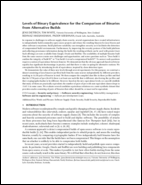
Jens Dietrich, Tim White, of Victoria University of Wellington, New Zealand along with Behnaz Hassanshahi and Paddy Krishnan of Oracle Labs Australia published a paper entitled Levels of Binary Equivalence for the Comparison of Binaries from Alternative Builds :
The availability of multiple binaries built from the same sources creates new challenges and opportunities, and raises questions such as: Does build A confirm the integrity of build B? or Can build A reveal a compromised build B? . To answer such questions requires a notion of equivalence between binaries. We demonstrate that the obvious approach based on bitwise equality has significant shortcomings in practice, and that there is value in opting for alternative notions. We conceptualise this by introducing levels of equivalence, inspired by clone detection types.A PDF of the paper is freely available.
On Friday 8th November, Vagrant Cascadian will present a talk entitled Two Ways to Trustworthy at SeaGL in Seattle, WA.
Founded in 2013, SeaGL is a free, grassroots technical summit dedicated to spreading awareness and knowledge about free source software, hardware and culture. Vagrant s talk:
[ ] delves into how two project[s] approaches fundamental security features through Reproducible Builds, Bootstrappable Builds, code auditability, etc. to improve trustworthiness, allowing independent verification; trustworthy projects require little to no trust. Exploring the challenges that each project faces due to very different technical architectures, but also contextually relevant social structure, adoption patterns, and organizational history should provide a good backdrop to understand how different approaches to security might evolve, with real-world merits and downsides.
the D8 Java to DEX compiler (part of the Android toolchain) eliminated a redundant field load if running the class s static initialiser was known to be free of side effects, which ended up accidentally depending on the sharding of the input, which is dependent on the number of CPU cores used during the build.To make it easier to understand the bug and the patch, Fay also made a small example to illustrate when and why the optimisation involved is valid.
CONFIG_MODULE_SIG and the unreproducible Linux Kernel to add: I wonder whether it would be possible to use the Linux kernel s Integrity Policy Enforcement to deploy a policy that would prevent loading of anything except a set of expected kernel modules. [ ]
diffoscope is our in-depth and content-aware diff utility that can locate and diagnose reproducibility issues. This month, Chris Lamb made the following changes, including preparing and uploading versions 279, 280, 281 and 282 to Debian:
.ar archives (#1085257). [ ]systemd-ukify in the Debian stable distribution. [ ]Depends on the deprecated python3-pkg-resources (#1083362). [ ]
The IzzyOnDroid project has reached a good milestone by reaching over 25% of the ~1,200 Android apps provided by their repository (of official APKs built by the original application developers) having been confirmed to be reproducible by a rebuilder.
In Debian this month:
devscripts version 2.24.2, including many changes to the debootsnap, debrebuild and reproducible-check scripts. This is the first time that debrebuild actually works (using sbuild s unshare backend). As part of this, Holger also fixed an issue in the reproducible-check script where a typo in the code led to incorrect results [ ]
The new server has no problems keeping up with importing the full archives on every update, as each run finishes comfortably in time before it s time to run again. [While] the new server is the one doing all the importing of updated archives, the HTTP interface is being served by both the new server and one of the VM s at LeaseWeb.The entry list a number of specific updates surrounding the API endpoints and rate limiting.
Elsewhere in distribution news, Zbigniew J drzejewski-Szmek performed another rebuild of Fedora 42 packages, with the headline result being that 91% of the packages are reproducible. Zbigniew also reported a reproducibility problem with QImage.
Finally, in openSUSE, Bernhard M. Wiedemann published another report for that distribution.
There were an enormous number of improvements made to our website this month, including:
hulkoba
README page for building the website under NixOS. [ ][ ][ ][ ][ ]
The Reproducible Builds project operates a comprehensive testing framework running primarily at tests.reproducible-builds.org in order to check packages and other artifacts for reproducibility. In October, a number of changes were made by Holger Levsen, including:
index.html for rebuilderd. [ ]nginx.conf configuration file for rebuilderd. [ ]riscv64 architecture. [ ]rebuilderd-related TODO. [ ]inos5 node [ ] and Vagrant Cascadian brought 4 virt nodes back online [ ].
The Open Source Summit EU took place recently, and covered plenty of topics related to supply-chain security, including:
apache-ivy (.zip modification time)ccache (build failure)colord (CPU)efivar (CPU/march=native)gsl (no check)libcamera (date/copyright year)libreoffice (possible rpm/build toolchain corruption bug)moto (.gz modification time)openssl-1_1 (date-related issue)python-pygraphviz (benchmark)sphinx/python-pygraphviz (benchmark)python-panel (package.lock has random port)python-propcache (random temporary path)python314 (.gz-related modification time)rusty_v8 (random .o files)scapy (date)wine (parallelism)ibmtss (FTBFS-2026)pymol (date)pandas (ASLR)linutil (drop date)lsof (also filed in openSUSE: uname -r in LSOF_VSTR)schily (also filed in openSUSE: uname -r)superlu (nocheck)util (random test failure)ceph (year-2038 variation from embedded boost)distro-info.calibre (two sort issues) [ ][ ]#reproducible-builds on irc.oftc.net.
rb-general@lists.reproducible-builds.org
I was interested in learning about htmx, so I
used it to improve the experience of posting comments on my blog.
It seems much of modern web development is structured around having
a JavaScript program on the front-end (browser) which exchanges data
encoded in JSON asynchronously with the back-end servers. htmx uses a
novel (or throwback) approach: it asynchronously fetches snippets of
HTML from the back-end, and splices the results into the live page.
For example, a htmx-powered button may request a URI on the server,
receive HTML in response, and then the button itself would be
replaced by the resulting HTML, within the page.
I experimented with incorporating it into an existing,
old-school CGI web
app: IkiWiki, which I became a co-maintainer of this
year, and powers my blog.
Throughout this project I referred to the excellent book Server-Driven Web Apps with
htmx.
Comment posting workflow
I really value blog comments, but the UX for posting them on my
blog was a bit clunky. It went like this:
hx-get="<CGI ENDPOINT GOES HERE>"hx-select=".editcomment form"hx-swap=beforeend and hx-target=".addcomment"beforeend) the form into the source page after the "add
comment" anchor tag (.addcomment)page.tmpl, the template used for all pages. I needed to
add a new empty div tag in order to have a "hook" to target with the
previewed comment.
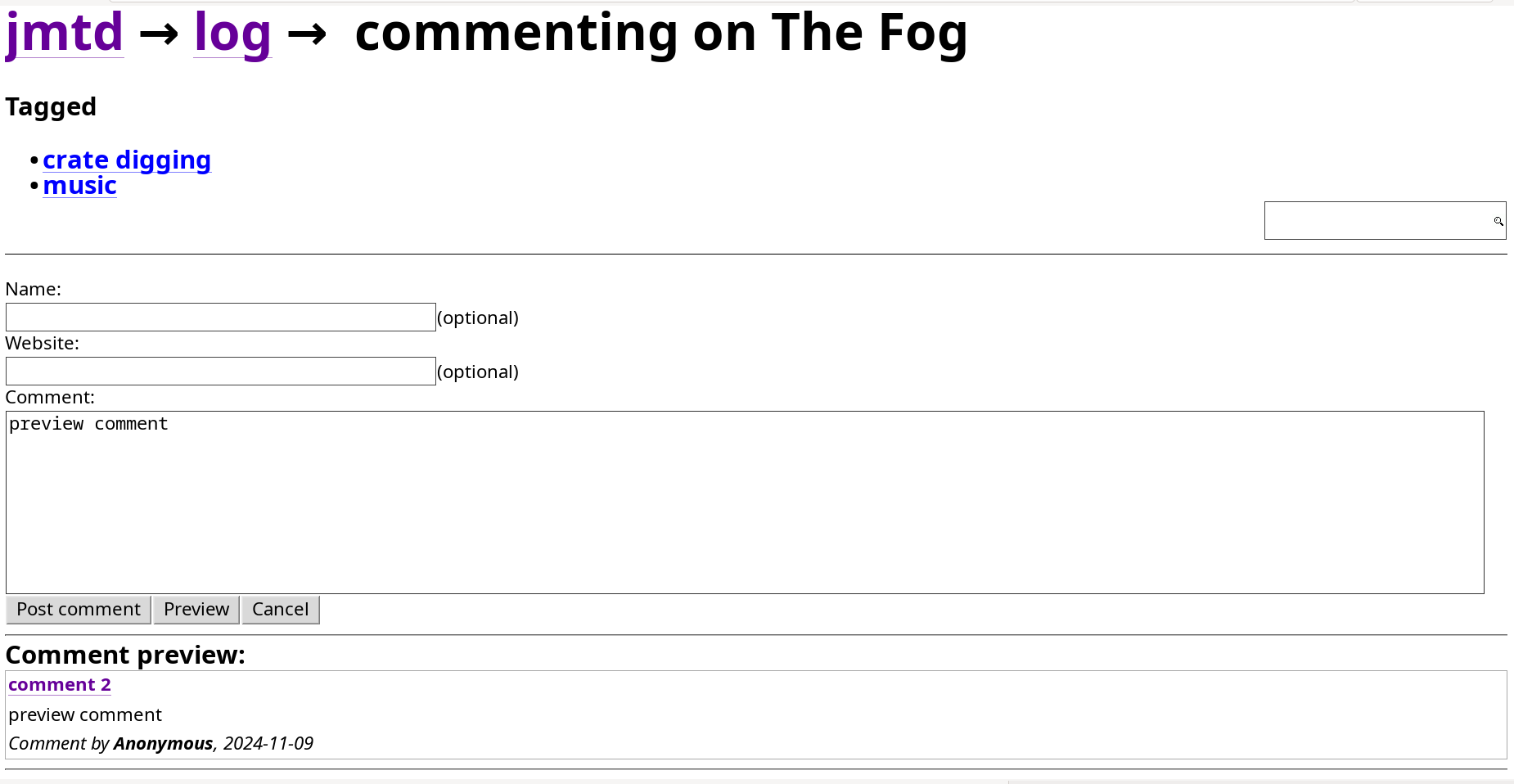
The rest of this was achieved with htmx attributes on the "Preview"
button, similar to in the last step: hx-post to define a target URI
when you click the button (and specify HTTP POST); hx-select to filter
the resulting HTML and extract the comment; hx-target to specify where
to insert it.
Now, clicking "Preview" does not leave the current page, but fetches a
rendering of your comment-in-progress, and splices it into the comment
list, appropriately marked up to be clear it's a preview.
Third step: handling submitted comments
IkiWiki is highly configurable, and many different things could happen
once you post a comment.
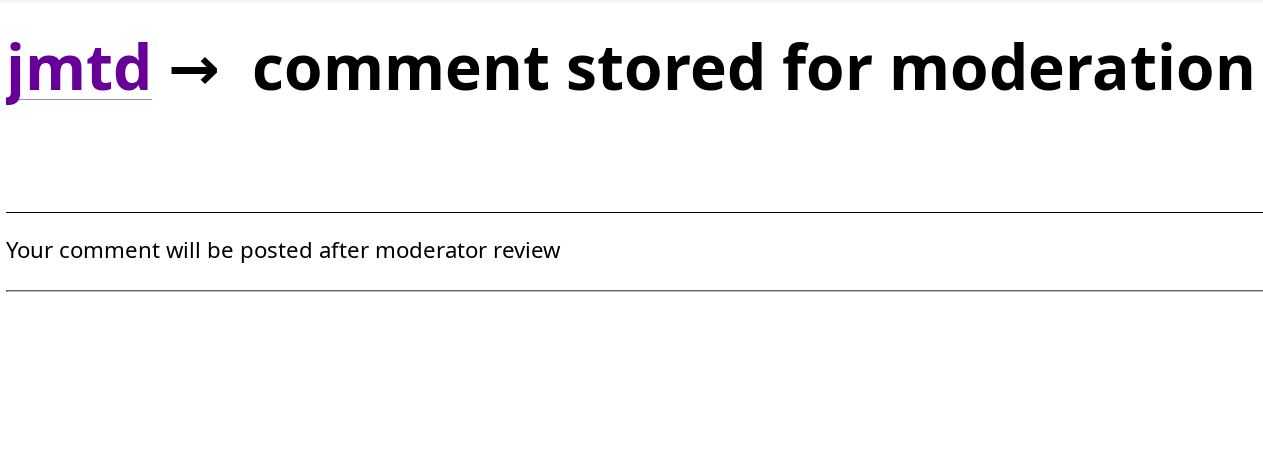
On my personal blog, all comments are held for moderation before they are
published. The page you were served after submitting a comment was rather
bare-bones, a status message "Your comment will be posted after moderator
review", without the original page content or comments.
I wanted your comment to appear in the page immediately, albeit marked up
to indicate it was awaiting review. Since the traditional workflow didn't
render or present your comment to you, I had to cheat.
handling moderated comments
One of my goals with this project was not to modify IkiWiki itself.
I had to break this rule for moderated comments. When returning the "comment
is moderated" page, IkiWiki uses HTTP status code 200, the same as for other
scenarios. I wrote a tiny patch
to return HTTP 202 (Accepted, but not processed) instead.
I now have to write some actual JavaScript. htmx emits the htmx:beforeSwap
event after an AJAX call returns, but before the corresponding swap is
performed. I wrote a function that is triggered on this event, filters for
HTTP 202 responses, triggers the "Preview" button, and then alters the
result to indicate a moderated, rather than previewed, comment. (That's why I
bothered to implement previews).
You can read the full function here: jon.js.
Summary
I've done barely any front-end web development for years and I found
working with htmx to be an enjoyable experience.
You can leave a comment on this very blog post if you want to see it in action.
I couldn't resist adding an easter egg: Brownie points if you can figure out
what it is.
Adding htmx to an existing CGI-based website let me improve one of the
workflows in a gracefully-degrading way (without JavaScript, the old method
will continue to work fine) without modifying the existing
application itself (well, almost) and without having to write very much
code of my own at all: nearly all of the configuration was declarative.
The topic of this posting already tells you that an old Unix guy tells
stories about old techniques.
I'm a happy NIS (formerly YP) user since 30+ years. I started using it
with SunOS 4.0, later using it with Solaris and with Linux since 1999.
In the past, a colleague wasn't happyly using NIS+ when he couldn't
log in as root after a short time because of some well known bugs and wrong
configs. NIS+ was also much slower than my NIS setup. I know
organisations using NIS for more than 80.000 user accounts in 2024.
I know the security implications of NIS but I can live with them,
because I manage all computers in the network that have access to the
NIS maps. And NIS on Linux offers to use shadow maps, which are only
accessible to the root account. My users are forced to use very
long passwords.
Unfortunately NIS support for the PAM modules was removed in Debian
in pam 1.4.0-13, which means Debian 12 (bookworm) is
lacking NIS support in PAM, but otherwise it is still supported.
This only affects changing the NIS password via passwd. You can still
authenticate users and use other NIS maps.
But yppasswd is deprecated and you should not use it!

If you use yppasswd it may generate a new password hash by using the
old DES crypt algorithm, which is very weak and only uses the first 8
chars in your password. Do not use yppasswd any more!
yppasswd only detects DES, MD5, SHA256 and SHA512 hashes, but for me
and some colleagues it only creates weak DES hashes after a password
change. yescrypt hashes which are the default in Debian 12 are not
supported at all. The solution is to use the plain passwd program.
On the NIS master, you should setup your NIS configuration to use
/etc/shadow and /etc/passwd even if your other NIS maps are in
/var/yp/src or similar. Make sure to have these lines in your
/var/yp/Makefile:
PASSWD = /etc/passwd
SHADOW = /etc/shadow
Call make once, and it will generate the shadow and passwd map.
You may want to set the variable MINUID which defines which entries
are not put into the NIS maps.
On all NIS clients you still need the entries (for passwd, shadow,
group,...) that point to the nis service. E.g.:
passwd: files nis systemd
group: files nis systemd
shadow: files nis
You can remove all occurences of "nis" in your /etc/pam.d/common-password file.
Then you can use the plain passwd program to change your password on
the NIS master. But this does not call make in /var/yp for updating
the NIS shadow map.
Let's use inotify(7) for that. First, create a small shell script
/usr/local/sbin/shadow-change:
#! /bin/sh
PATH=/usr/sbin:/usr/bin
# only watch the /etc/shadow file
if [ "$2" != "shadow" ]; then
exit 0
fi
cd /var/yp exit 3
sleep 2
make
Then install the package incron.
# apt install incron
# echo root >> /etc/incron.allow
# incrontab -e
Add this line:
/etc IN_MOVED_TO /usr/local/sbin/shadow-change $@ $# $%
It's not possible to use IN_MODIFY or watch other events on
/etc/shadow directly, because the passwd command creates a /etc/nshadow file,
deletes /etc/shadow and then moves nshadow to shadow. inotify on a
file does not work after the file was removed.
You can see the logs from incrond by using:
# journalctl _COMM=incrond
e.g.
Oct 01 12:21:56 kueppers incrond[6588]: starting service (version 0.5.12, built on Jan 27 2023 23:08:49)
Oct 01 13:43:55 kueppers incrond[6589]: table for user root created, loading
Oct 01 13:45:42 kueppers incrond[6589]: PATH (/etc) FILE (shadow) EVENT (IN_MOVED_TO)
Oct 01 13:45:42 kueppers incrond[6589]: (root) CMD ( /usr/local/sbin/shadow-change /etc shadow IN_MOVED_TO)
I've disabled the execution of yppasswd using dpkg-divert
# dpkg-divert --local --rename --divert /usr/bin/yppasswd-disable /usr/bin/yppasswd
chmod a-rwx /usr/bin/yppasswd-disable
Do not forget to limit the access to the shadow.byname map in
ypserv.conf and general access to NIS in ypserv.securenets.
I've also discovered the package pamtester, which is a nice package
for testing your pam configs.
283. This version includes the following changes:
[ Martin Abente Lahaye ]
* Fix crash when objdump is missing when checking .EFI files.
libpng1.6 would fail to cross build on musl architectures whereas it would succeed on other ones failing to locate zlib. Adding --debug-find to the cmake invocation eventually revealed that it would fail to search in /usr/lib/<triplet>, which is the default library path. This turned out to be a bug in cmake assuming that all linux systems use glibc. libpng1.6 also gained a baseline violation for powerpc and ppc64 by enabling the use of AltiVec there.
The newt package would fail to cross build for many 32-bit architectures whereas it would succeed for armel and armhf due to -Wincompatible-pointer-types. It turns out that this flag was turned into -Werror and it was compiling with a warning earlier. The actual problem is a difference in signedness between wchar_t and FriBidChar (aka uint32_t) and actually affects native building on i386.
mkdocs-macros-plugin, which required packaging a new Python package for Debian, python-super-collections (now in NEW review).
Dear Debian community,
this is Bits from DPL for October. In addition to a summary of my
recent activities, I aim to include newsworthy developments within
Debian that might be of interest to the broader community. I believe
this provides valuable insights and foster a sense of connection across
our diverse projects. Also, I welcome your feedback on the format and
focus of these Bits, as community input helps shape their value.
Ada Lovelace Day 2024
As outlined in my platform, I'm committed to increasing the diversity of
Debian developers. I hope the recent article celebrating Ada Lovelace
Day 2024 featuring interviews with women in Debian will serve as an
inspiring motivation for more women to join our community.
MiniDebConf Cambridge
This was my first time attending the MiniDebConf in Cambridge,
hosted at the ARM building. I thoroughly enjoyed the welcoming
atmosphere of both MiniDebCamp and MiniDebConf. It was wonderful to
reconnect with people who hadn't made it to the last two DebConfs, and,
as always, there was plenty of hacking, insightful discussions, and
valuable learning.
If you missed the recent MiniDebConf, there's a great opportunity to
attend the next one in Toulouse. It was recently decided to
include a MiniDebCamp beforehand as well.
FTPmaster accepts MRs for DAK
At the recent MiniDebConf in Cambridge, I discussed potential
enhancements for DAK to make life easier for both FTP Team members and
developers. For those interested, the document "Hacking on DAK"
provides guidance on setting up a local DAK instance and developing
patches, which can be submitted as MRs.
As a perfectly random example of such improvements some older MR,
"Add commands to accept/reject updates from a policy queue" might give
you some inspiration.
At MiniDebConf, we compiled an initial list of features that could
benefit both the FTP Team and the developer community. While I had
preliminary discussions with the FTP Team about these items, not all
ideas had consensus. I aim to open a detailed, public discussion to
gather broader feedback and reach a consensus on which features to
prioritize.
Accept + Bug Report This option would allow a package to enter Debian (in unstable or experimental) with an automatically filed RC bug report. The RC bug would prevent the package from migrating to testing until the issues are addressed. To ensure compatibility with the BTS, which only accepts bug reports for existing packages, a delayed job (24 hours post-acceptance) would file the bug.
a) the DAK removal tooling to remove the entire dependency tree
after prompting the bug report author for confirmation, or
b) the system to auto-generate corresponding bug reports for all
packages in the dependency tree.
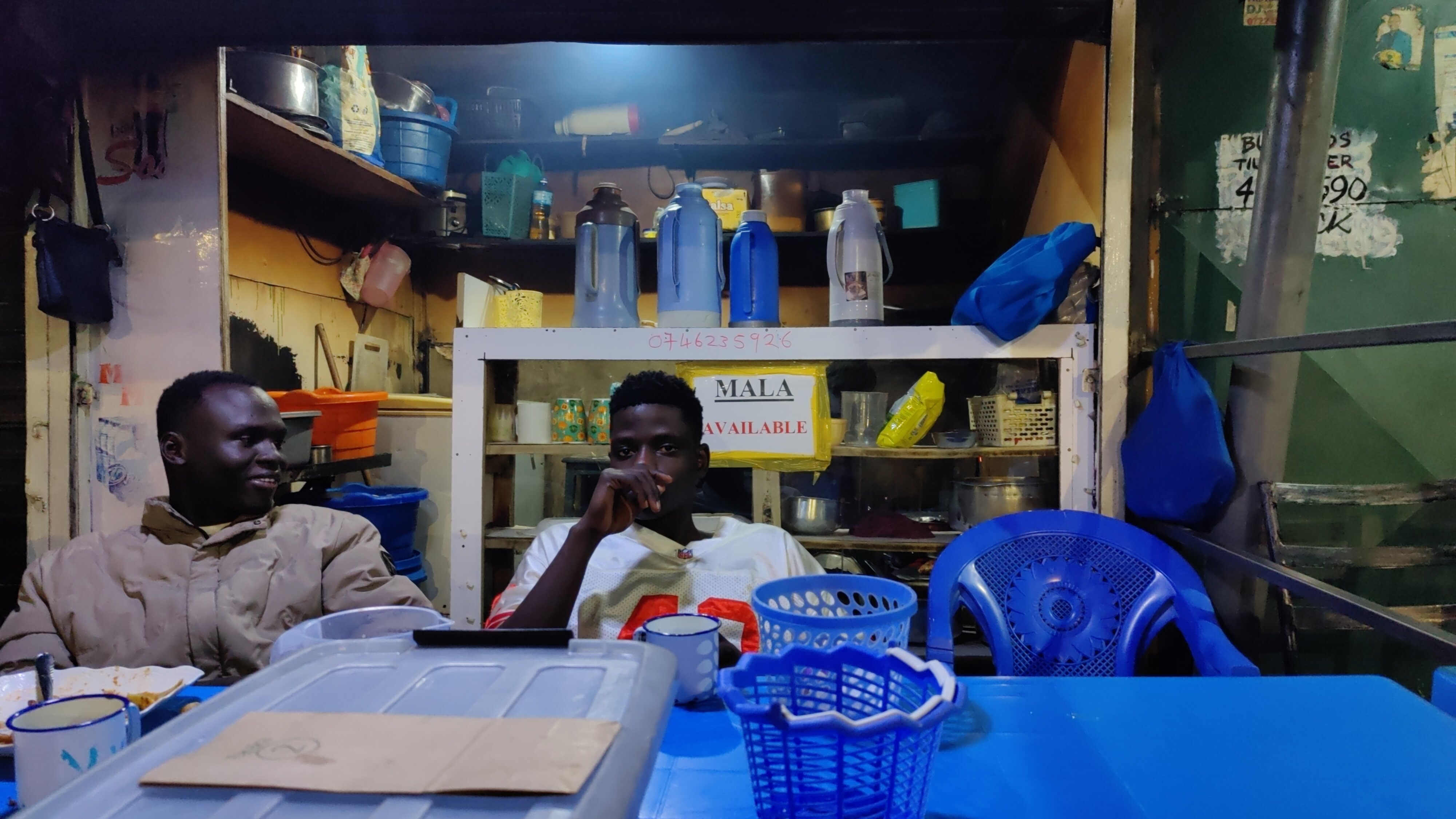
The coffee shop Ibtehal and me used to visit during the midnight
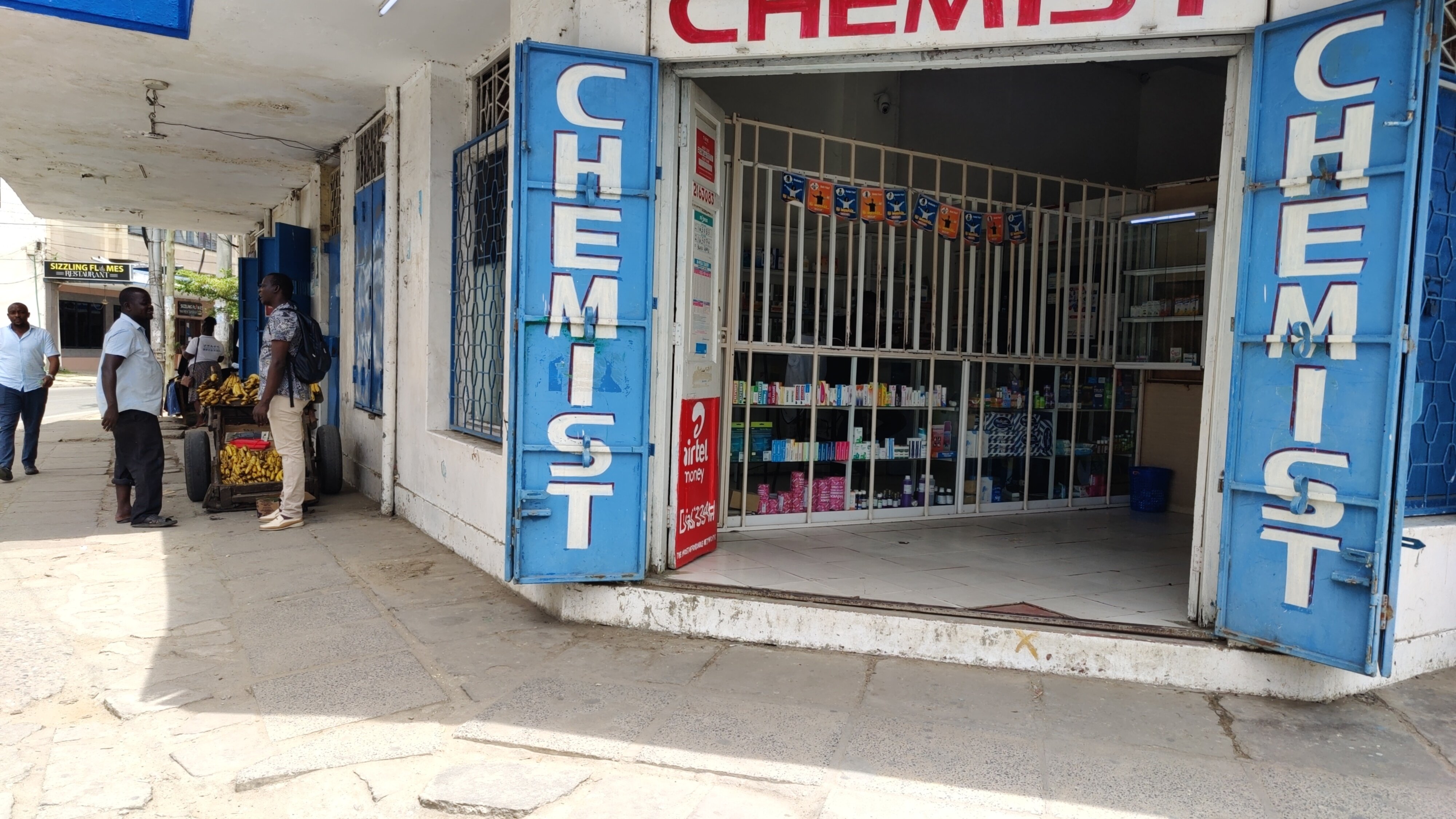
Grating at a chemist shop in Mombasa, Kenya
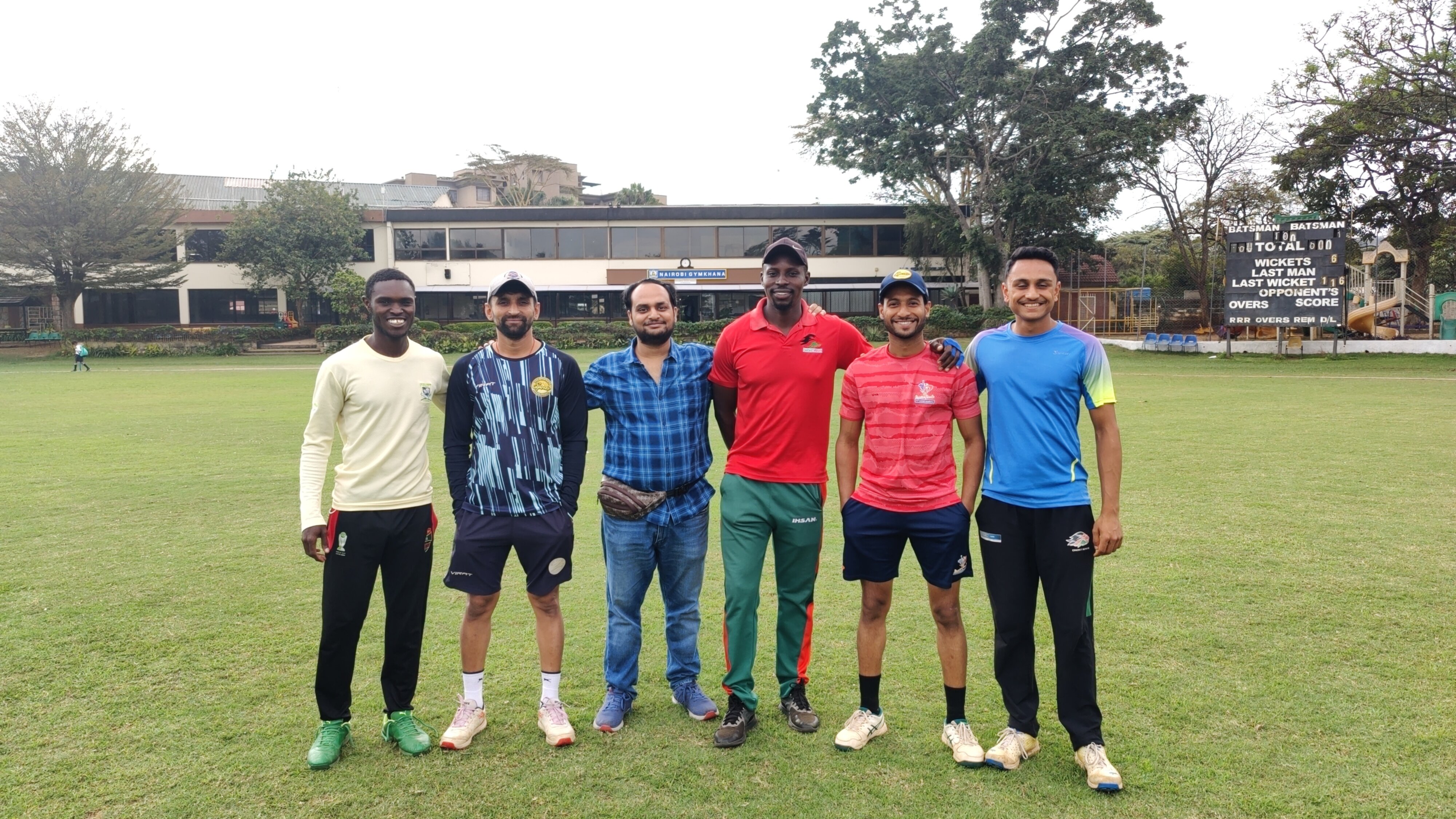
Me with players at the Nairobi Gymkhana Club
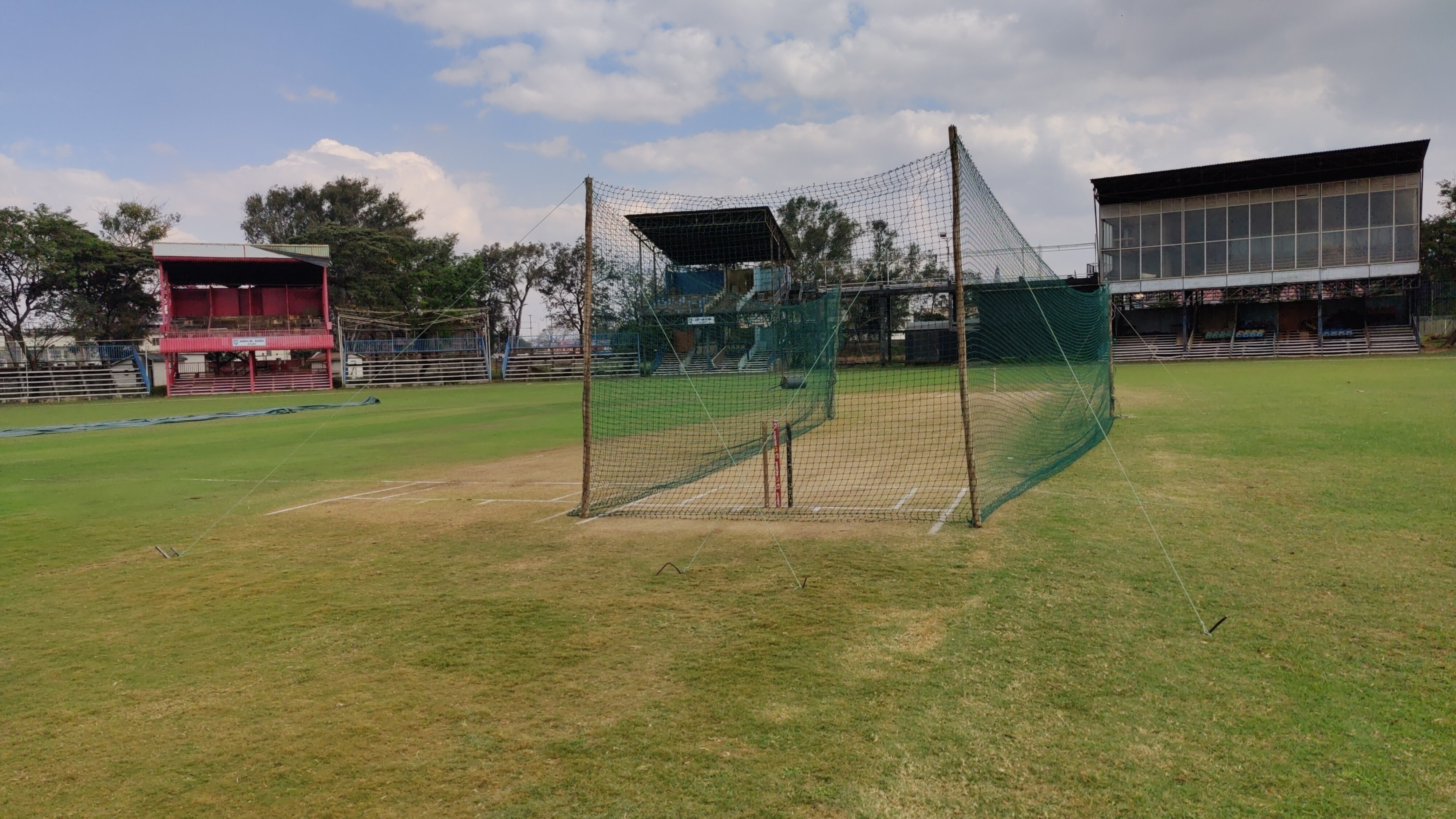
Cricket pitch at the Nairobi Gymkhana Club

A view of the cricket ground inside the Nairobi Gymkhana Club
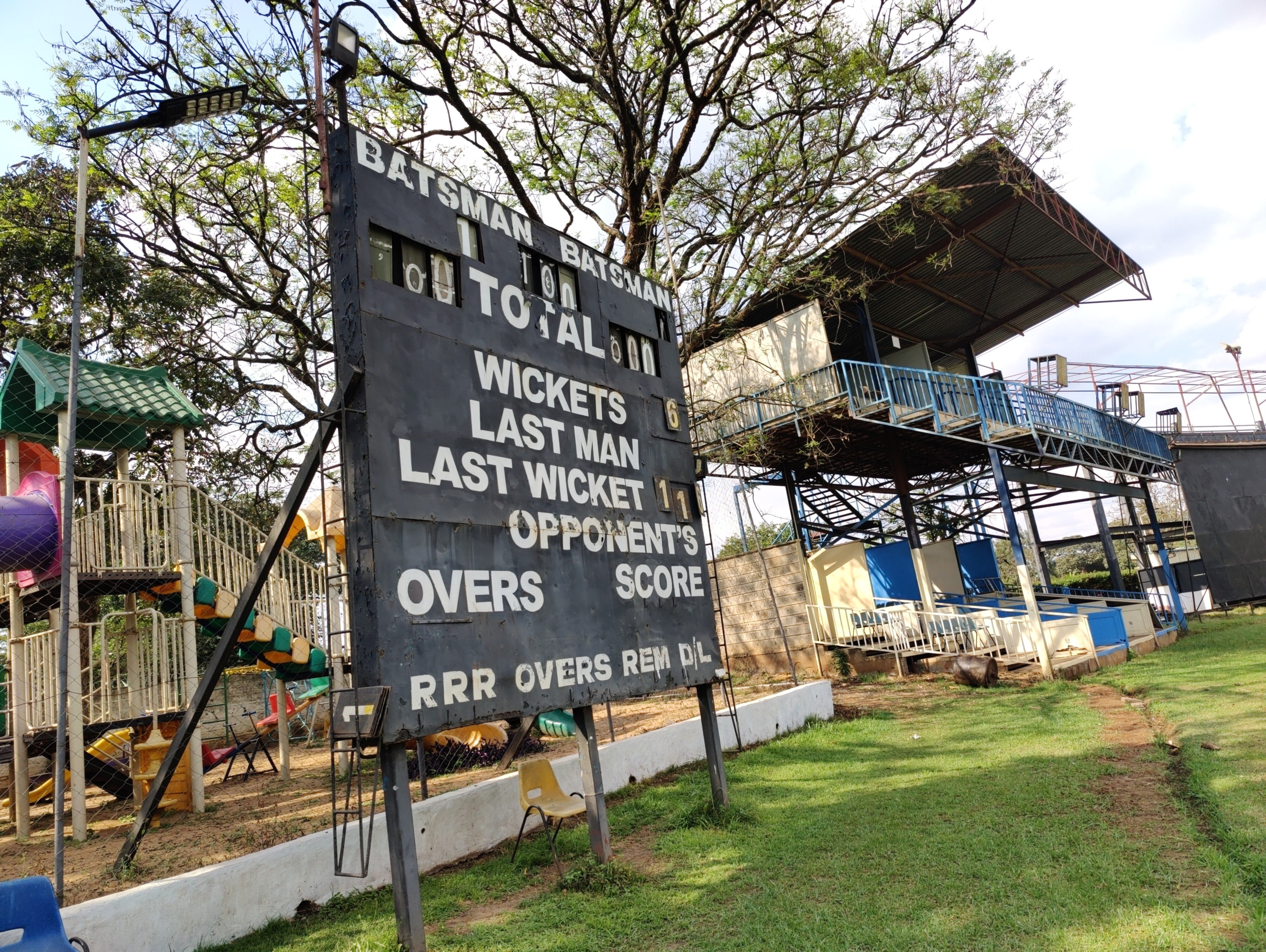
Scoreboard at the Nairobi Gymkhana cricket ground

A matatu with a Notorious BIG portrait.

Inside the Giraffe Center
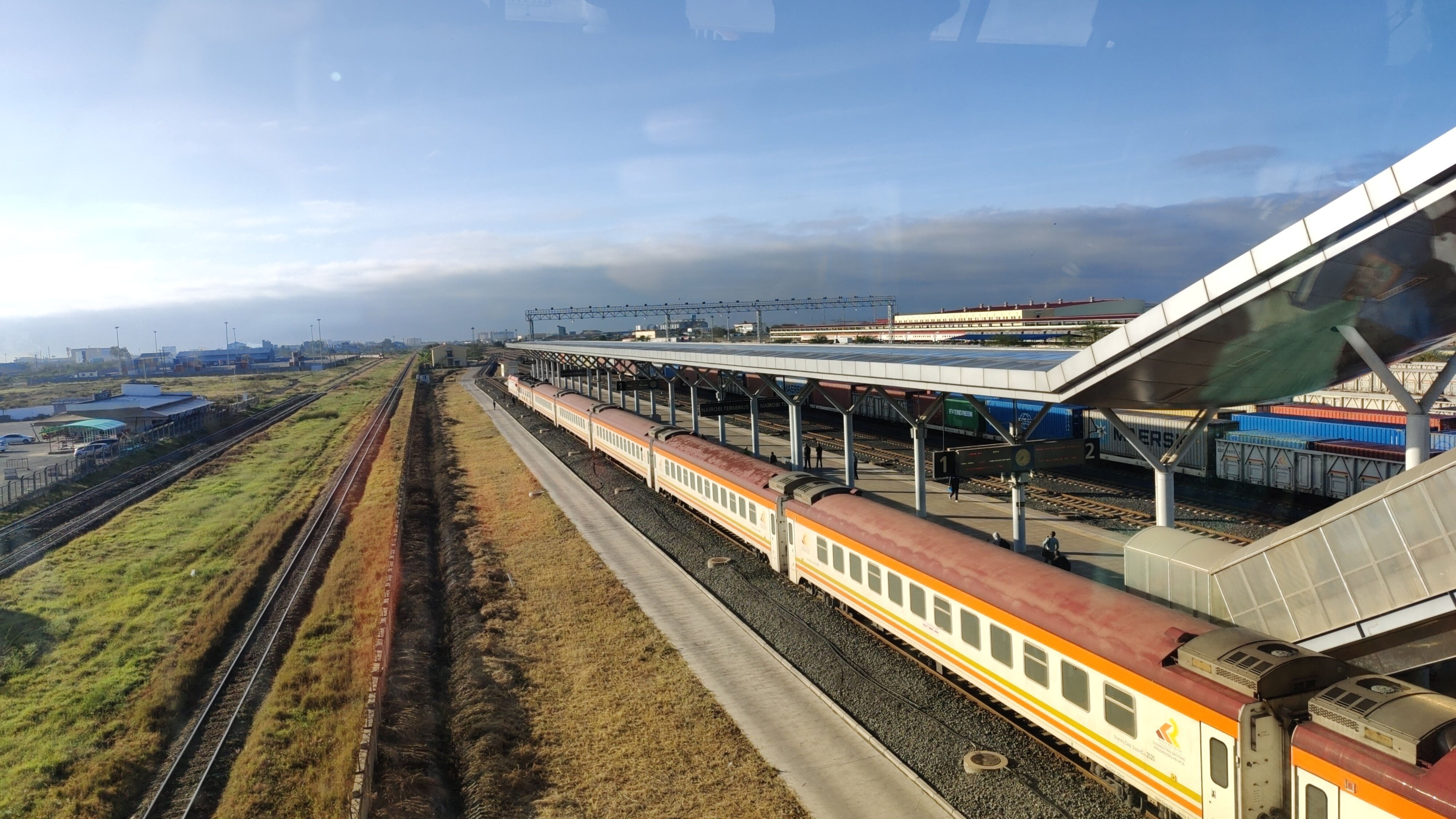
SGR train at Nairobi Terminus.
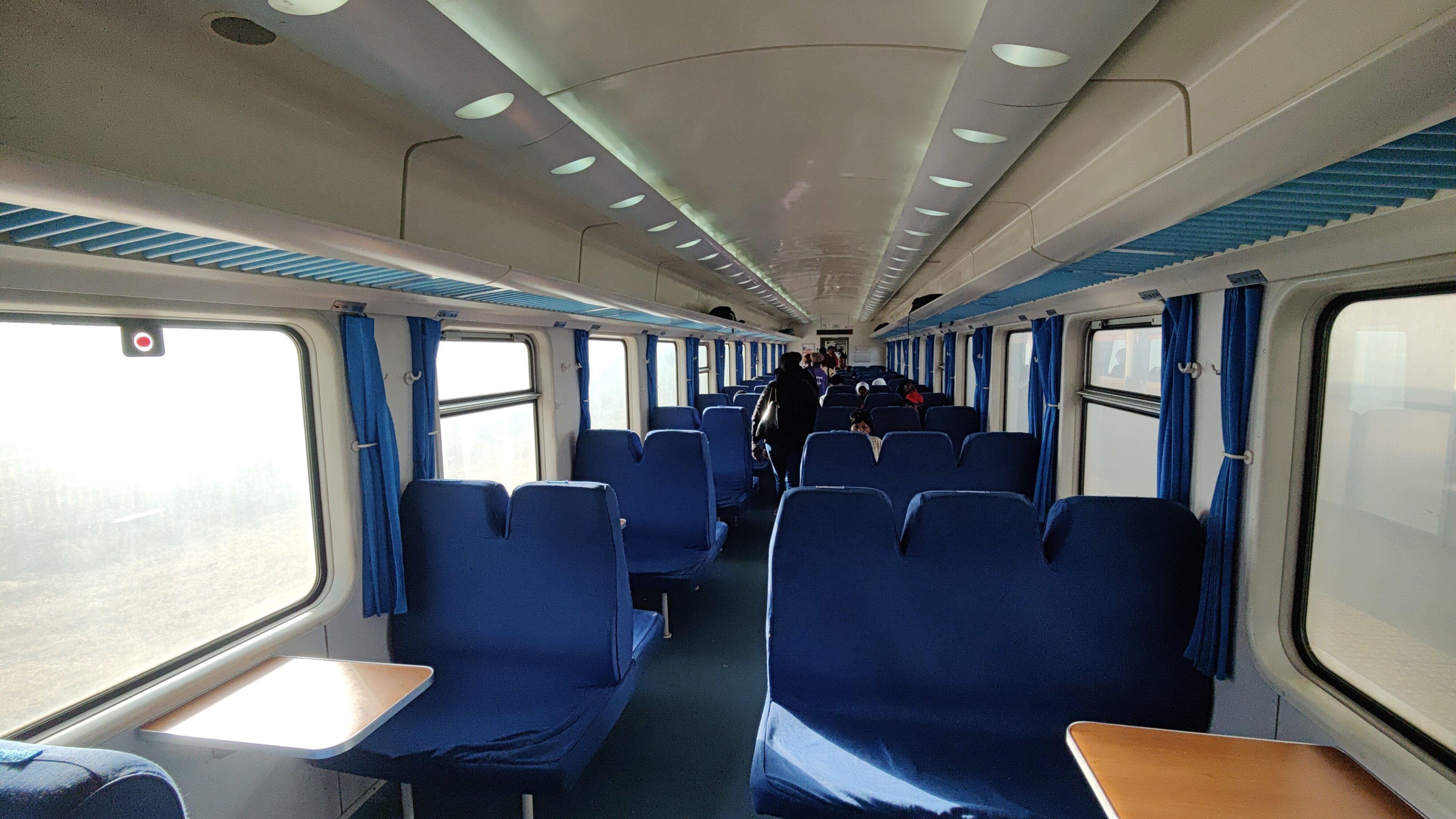
Interior of the SGR train

Mombasa Terminus station.

The balcony at Tulia Backpackers Hostel had a nice view of the ocean.
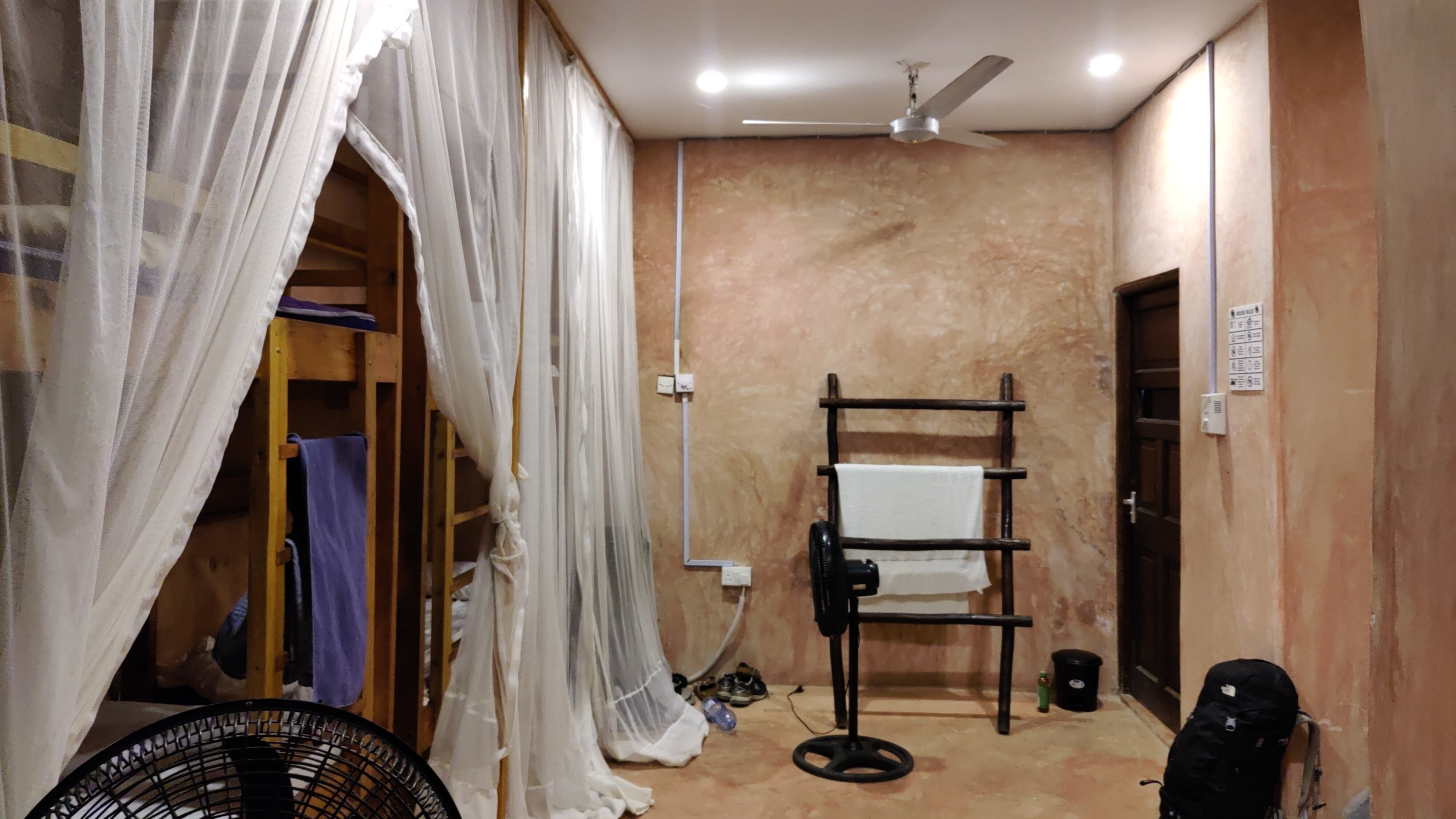
A room inside the hostel with fans and mosquito nets on the beds

Nyali beach is a white sand beach

This is the ferry service for crossing the river.

Diani beach is a popular beach in Kenya. It is a white sand beach.

Selfie with truck drivers who gave me the free ride

Newspapers at a stand in Kenya covering news on the airport closure

Spanish Omelette served in breakfast at Nairobi Transit Hotel
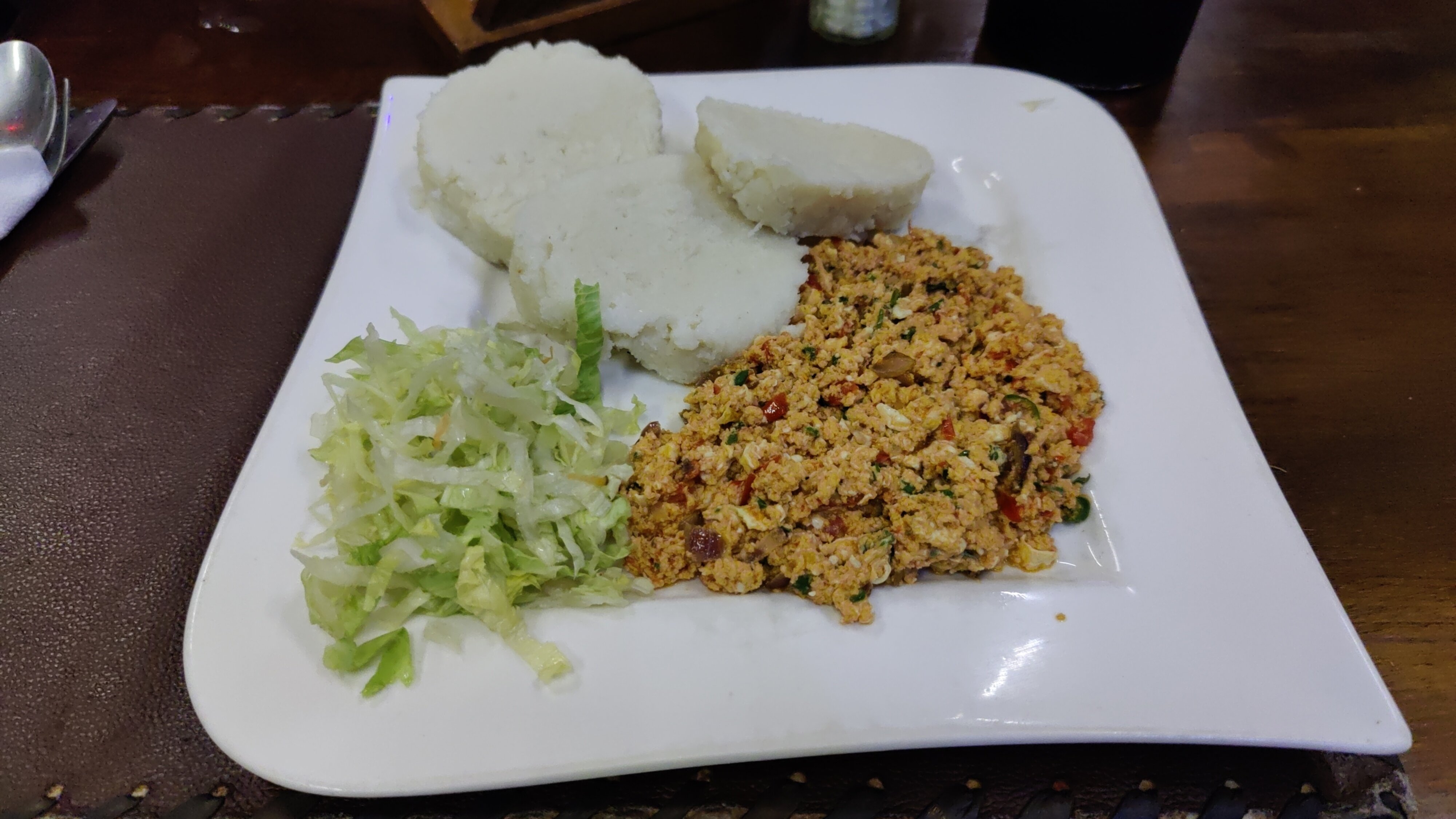
Ugali with eggs.

Another short status update of what happened on my side last month. Besides a phosh bugfix release improving text input and selection
was a prevalent pattern again resulting in improvements in the compositor, the OSK and some apps.
phosh
ctrl and alt in the shortcuts bar (MRGtk H,V Separator when migrating UI files to GTK4 (MR)-o option and add help output (MR)Next.