Search Results: "tg"

16 January 2008

Anand Kumria: We're back. And, we won.

Actually I never went away, yes 22 months is a long time between blog entries, I just got distracted by travelling and working at AwayPhone. I'm still there and we are looking for one or two developers, principally in the US (Washington state) — but as a global company, not necessarily — so let us know (ASCII only, spell-checked, coherent English, etc.) if you are interested. I've been on (technically) holidays for the past few weeks, but I find myself awake, reviewing code at 02:45 (now 03:30) and trying to catch up on emails. I'm reminded of a friend of mine who always used to shout “RELAX!” whenever we went bar-hopping. I've been trying to apply that to a broader area of life than just bars but it appears that it just isn't how I'm wired to operate; for better or worse. That means, that whilst in Australia, I'm also rebuilding my mothers' IT infrastructure at her publishing company. I want it all to survive without any intervention for at least 2 years. So, I've been evaluating various pieces of kit. My conclusions:
NetGear
Switches, Modems (ADSL) and Wireless access points
Western Digital
Linux NAS boxes (they have Samba, rsync and SSH on pre-installed. I'd expect a firmware update from the makers to incorporate iSCSI and allow you to join a domain shortly).
HP
Desktops and Servers. Although I wish Bdale has some influence within HP and I did not have to taint the kernel of my servers. Seriously, it is because of that I re-do a price/functionality check everything time I go to purchase a machine. HP only just get it right.
Linksys / Cisco - snom
VoIP handsets. To be honest, this category is still being evaluated; but I'm leaning towards snom.
I realise everyone has probably been burnt but some of the vendors mentioned above but this is my experience of them. You'll notice nothing about laptops. I'm looking around for a decent vendor, I'll let you know if I find one. If you have been following along, you will notice that the Netgear ADSL modems (DM111P) runs Linux. The WD MyBook World Editions II's, run Linux (and I'd expect that they could be coaxed very easily into running generic Debian). The HP stuff (mostly) runs Linux. As does the Linksys and snom handsets. We won. Now, I've got to figure out how to setup Clonezilla so that the desktop Windows machines can be replaced when they fail. And I have less than 144 hours to do so. There is nothing like a deadline to concentrate your mind. P.S. I do have some half-finished entries for the intervening 22 months, I will clean them up and post them under their original dates in the next few weeks

Russell Coker: Differences between Distribution Kernels

It is not uncommon to run a Linux system with a kernel that was compiled for another distribution. One reason for doing this is the difficulty in compiling and testing a kernel to make sure it will do what you require. It’s not THAT difficult for someone who knows what they are doing, but if someone else has already done the work then it seems like a waste to re-invent the wheel. Sometimes it’s an issue of a driver that one distribution supports but not another, copying the entire kernel package from another distribution may be easier than compiling a new kernel with the extra driver. Sometimes it’s a kernel bug, if distribution A has fixed the bug and distribution B hasn’t, then it’s often easier to install a kernel package from distribution A when running distribution B. Another reason for running different distributions with the same kernel is Xen. If you have a Dom0 which hosts instances for different distributions as DomU’s then running the same kernel on all of them can make it easier to manage. Unfortunately it’s not uncommon for different distributions to have different kernel feature sets. One example I’m currently dealing with is the fact that the Debian/Etch kernel is compiled with CONFIG_AUDITSYSCALL disabled while RHEL and CentOS require it. So if you run a RHEL or CentOS system with a Debian kernel (EG running a Debian Xen server with a RHEL or CentOS DomU) then you see messages such as the following in your logs. crond[7824]: pam_loginuid(crond:session): set_loginuid failed opening loginuid The loginuid feature allows login and equivalent programs (which includes xdm and other graphical login programs, cron and every other program that runs a program on behalf of another user) to set the loginuid. This loginuid will be stored by the kernel, inherited across fork() and exec, and not be changed by running setuid or setgid programs. Therefore if you see some strange entries in your audit log indicating an attempted attack you can determine the original login UID of the person responsible. In terms of security features it’s not a really high priority. But it is really annoying when programs that work on RHEL don’t work properly with a Debian kernel and put many unwanted messages in the log files. For people who have less background knowledge about these things it may be more than annoying, and may even force them to change their deployment plans to make the message go away (not everyone knows which messages can be ignored or where to ask about such things). The fact that Etch has no user-space support for the auditing features in question (auditing system calls or setting the loginuid) was never a good reason for not enabling this feature (IMHO). Using the auditing system calls was simply a matter of copying the auditctl program from a RHEL, Fedora, or CentOS system (for those who didn’t feel inclined to compile the source). The loginuid required changes to PAM to enable it, but is actually a small part of the auditing layer. As a general rule minimising the differences between distribution kernels is going to benefit most people. Some people complain about kernel bloat, but there are worse candidates for that accusation and given that it seems impossible to buy a machine with less than 512M of RAM and a 900MHz CPU (the specs of the ASUS EeePC) adding a few extra kernel features seems unlikely to hurt anyone. It is of course always possible to compile your own kernel for the smallest machines. Finally I am in the process of back-porting SE Linux code and related security features to Etch, and having this already enabled in the kernel would make my work easier. I won’t do a 7 year support cycle for it unless someone pays, but supporting Etch past the release of Lenny with the latest SE Linux features (and the current features working properly) is my aim.

28 December 2007

Russell Coker: Twilight of the Books?

I’ve just read an interesting article in the New Yorker titled “Twilight of the Books” [1]. It started with some depressing statistics about literacy. One comment that I couldn’t figure out concerned “the panic that takes hold of humanists when the decline of reading is discussed“. The decline in literacy concerns me because I want to live in a society where everyone can contribute as equals and where all voters have the possibility of becoming well informed about the issues that affect their vote. If literacy declines far enough then fascism seems to be the inevitable result. I’m not sure whether that makes me a humanist according to the author. Below in the second part of this post (not included in the feed) I include my dictionary definition of the word, #4 is the definition most commonly used today (which is a reasonable match for my beliefs). There is some interesting information regarding basic research on the mental abilities of literate and illiterate people which suggests that people who an read are better at handling abstract concepts and hypothetical situations. The article notes that spending time on the net increases academic scores for children. It also makes the interesting claim that visiting pr0n sites increases grades, I find that difficult to believe. I wonder whether there is a difference between readers and writers in this regard. Does the typical serious net user who averages writing more than 3650 messages a year for fun (in addition to whatever email may need to be written for work) plus some blog posts and writing other web pages have different mental abilities to someone who just reads what others write? Does blogging (and other writing on your choice of topic) change your brain? What about programmers, does spending 8 hours a day writing formal rules for hypothetical mathematical situations (which is essentially what programming is about) change your brain? Are programmers going to have greater abilities for managing abstract concepts and hypothetical situations than people who have not had such experience? NB It will be difficult to determine this as people who have such skills will find programming easier and more fun so therefore a career in programming computers is self-selecting for people with such abilities. Another interesting fact is the results of research into the comprehension of a PowerPoint presentation. People who read it without an audio-visual accompanying it learned more and rated it as more interesting. Based on this my plan is that in future when attending conferences I will try and read papers which are presented BEFORE attending the lectures. Unfortunately most conferences which have papers presented seem based on the idea that you give a lecture about a topic as a teaser for your paper and assume that the audience knows nothing about it (conferences which don’t have papers outnumber the ones that do). Most Linux conferences seem based on the idea that almost no-one reads papers at all, they attend lectures and visit web sites and IRC channels afterwards. NB this comment is based on talking to people who attend conferences and my observations on attending conferences - it is not a criticism of any conferences merely an observation on cultural attitudes. Based on this information it seems reasonable to provide copies of lecture notes to the audience before the lecture. For example for a typical talk that I give to a LUG I could blog the lecture notes before the meeting and email the LUG mailing-list with the URL, people who really want to learn would hear me talk AFTER reading the notes and hopefully get the best of both forms of learning. I had been considering producing some YouTube [2] videos with instructions on how to use SE Linux. But it seems that might not be such a good idea (at least not a good enough idea to justify the amount of effort I would have to spend). The author seems to misunderstand YouTube, it is NOT about making the Internet resemble TV (where millions of mindless drones watch content created for the lowest common denominator in the audience). The AtGoogleTalks on YouTube [3] and www.ted.com are examples of high-quality free content (comparable to the best TV documentaries - the type of content which is cited as increasing the academic results of children) and the culture of creation and discussion must be a good thing. Most TV is bad because it’s one-way communication and the quality of the content is low. YouTube videos are widely discussed in email, blogs, and other written forums. The creation of the best (and often most viewed) videos would surely involve some writing. I wonder whether the benefits attributed to reading can be obtained without reading fiction. The nature of work is changing to require an increasing amount of reading and writing. The most menial work requires reading instruction manuals. Most of the best paid jobs involve a lot of reading and writing. If reading fiction isn’t required then it seems that there is little risk in the immediate future. (more…)

25 December 2007

Gregor Herrmann: dynamic blacklisting with exim & postgresql

finally I found the time to write down the configuration we use on our server to blacklist hosts that try to send emails to pre-defined nonexistent mail addresses. it uses only exim & postgresql & is (except for adding the "triggering" recipient email address patterns to the respective table) rather self-contained.

the documentation can be found in the article dynamic blacklisting with exim & postgresql. feel free to use/improve/comment/... the ideas!

20 December 2007

Michal Čihař: Gammu stable version 1.17.0

I wanted to make 1.16.0 last release this year, but unfortunately one bug preventing reading of all SMS messages from some AT phones sneaked in, so I decided to make another quick release. Changelog is really short: Other change is that I started to produce additional binary build for Windows - it does not use any external libraries (so no MySQL, PostgreSQL or Gettext support) and links statically. So you can just copy single binary and it should work anywhere. You can download from usual place: http://cihar.com/gammu/

15 December 2007

Lars Wirzenius: Unperish 2.2

Unperish is my little script for automating the process of releasing software. I just pushed out version 2.2, which fixes the --pbuilder-basetgz option. I have not mentioned 2.1 anywhere, since my web log wasn't working at the time, so I'll mention it here, too: it adds Subversion support, plus hides internal options from the --help output. Some day soon I hope to add Git support, too, but first I'll have to learn Git.

13 December 2007

Raphael Geissert: HOWTO create and maintain a repository using reprepro and DeBaBaReTools

DeBaBaReTools seems to work good enough that writing an early-stage HOW TO seems to worth the time :)

The first thing to do is of course fetch the sources:
$ svn export https://neo.yahostme.com/svn/DeBaBaReTools/trunk/ DeBaBaReTools


Build and install the package:
$ cd DeBaBaReTools; dpkg-buildpackage -b; dpkg -i ../debabaretools_0.2_all.deb


$ dpkg -L debabaretools
/.
/etc
/etc/DeBaBaReTools
/etc/DeBaBaReTools/common.conf
/usr
/usr/bin
/usr/bin/wannaBuild
/usr/bin/needsBuild
/usr/bin/needsReBuild
/usr/bin/buildQueue
/usr/bin/checkSums
/usr/bin/wannaUpload
/usr/bin/processIncoming
/usr/share
/usr/share/doc
/usr/share/doc/debabaretools
/usr/share/doc/debabaretools/copyright
/usr/share/doc/debabaretools/ENV
/usr/share/doc/debabaretools/changelog.gz
/usr/share/doc/debabaretools/TODO
/usr/share/DeBaBaReTools
/usr/share/DeBaBaReTools/backends
/usr/share/DeBaBaReTools/backends/config
/usr/share/DeBaBaReTools/backends/config/reprepro.sh
/usr/share/DeBaBaReTools/backends/probe.sh
/usr/share/DeBaBaReTools/backends/fetch
/usr/share/DeBaBaReTools/backends/fetch/dget.sh
/usr/share/DeBaBaReTools/backends/verbosity.sh
/usr/share/DeBaBaReTools/backends/lock
/usr/share/DeBaBaReTools/backends/lock/default.sh
/usr/share/DeBaBaReTools/backends/setDefault.sh
/usr/share/DeBaBaReTools/backends/buildQueue
/usr/share/DeBaBaReTools/backends/buildQueue/plaintext.sh
/usr/share/DeBaBaReTools/backends/signature
/usr/share/DeBaBaReTools/backends/signature/gpgv.sh
/usr/share/DeBaBaReTools/backends/check
/usr/share/DeBaBaReTools/backends/check/default.sh
/usr/share/DeBaBaReTools/backends/build
/usr/share/DeBaBaReTools/backends/build/pbuilder.sh
/usr/share/DeBaBaReTools/backends/upload
/usr/share/DeBaBaReTools/backends/upload/dput.sh
/usr/share/DeBaBaReTools/backends/parsers
/usr/share/DeBaBaReTools/backends/parsers/default.sh
/usr/share/DeBaBaReTools/backends/repository
/usr/share/DeBaBaReTools/backends/repository/shared.sh
/usr/share/DeBaBaReTools/backends/repository/reprepro.sh
/usr/share/DeBaBaReTools/backends/misc.sh
/usr/share/DeBaBaReTools/backends/codenamesTable
/usr/share/DeBaBaReTools/backends/codenamesTable/release.sh
/usr/share/DeBaBaReTools/backends/codenamesTable/reprepro.sh
/usr/share/DeBaBaReTools/backends/config/default.sh
/usr/share/DeBaBaReTools/backends/fetch/default.sh
/usr/share/DeBaBaReTools/backends/buildQueue/default.sh
/usr/share/DeBaBaReTools/backends/signature/default.sh
/usr/share/DeBaBaReTools/backends/build/default.sh
/usr/share/DeBaBaReTools/backends/upload/default.sh
/usr/share/DeBaBaReTools/backends/repository/default.sh
/usr/share/DeBaBaReTools/backends/codenamesTable/default.sh


Now you have to create a base reprepro repository. I strongly recommend setting the REPREPRO_BASE_DIR ENV variable if possible.

A recommended repository structure is (in repoitory/):
.:
./build:
./build/cache:
./build/data:
./build/data/logs:
./build/tmp:
./conf:
distributions
incoming
options
tiffany.py
uploaders
./db:
./debian:
./debian/dists:
etch
oldstable
sarge
sid
stable
testing
unstable
./debian/dists/...
./debian/pool/...
./incoming:
./incoming/accepted:
./incoming/new:
./incoming/rejected:
./pub:
./pub/UploadQueue:

Note that the build/, incoming/ and pub/ directory structures are DeBaBaReTools' defaults, if you want to change them you will have to set some variables at the configuration file ($HOME/.DeBaBaReToolsrc).

The distributions file must at least contain the Codename, Suite and Architectures entries for DeBaBaReTools to work correctly. Note that the current code used to correlate the suites with the codenames greps for the given codename/suite including two lines before and two after the match, so the entry must be on that scope.
E.g.
$ cat conf/distributions
Codename: sid
Suite: unstable
Architectures: i386 amd64 source
Components: main contrib non-free
Uploaders: uploaders
DebIndices: Packages Release .bz2 .gz .
DscIndices: Sources Release . .gz .bz2
Contents: .bz2 .gz .
Tracking: minimal includechanges keepsources


conf/incoming must name at least one rule. This is because when installing, DeBaBaReTools will grep for all the rule names and execute them one by one.
The rest of reprepro's setup is trivial.

When building packages with pbuilder, DeBaBaReTools expects the basetgz's to be named like $PBUILDER_CACHE/$CODENAME.tgz where $PBUILDER_CACHE is an environment variable defaulting to /var/cache/pbuilder.

Tweaking DeBaBaReTools:
Because we are using reprepro and pbuilder we'll give some hints to DeBaBaReTools so it uses a reprepro-specific and/or pbuilder-specific backend where possible.

$ echo 'HINT_ALL="reprepro pbuilder"' > $HOME/.DeBaBaReToolsrc


The .DeBaBaReToolsrc file is sourced by all scripts, so you might even set variables like $REPREPRO_BASE_DIR there.

/usr/share/doc/debabaretools/ENV documents only some of the multiple environment variables that can be specified to customise DeBaBaReTools' behaviour. It is important to say that variables which are empty will be filled with a default value.

You may now want to modify .dput.cf by adding a 'local' target for your repository:
[local]
fqdn = localhost
method = local
incoming = /home/raphael/Deb/repository/pub/UploadQueue
allow_unsigned_uploads = 0
run_dinstall = 0


So let the fun begin! :)

To make sure everything is ok let's run processIncoming in verbose mode:
VERBOSE=1 processIncoming
processIncoming v0.1 started.
processIncoming v0.1 stopped.

Not getting that output means something is not ok.

All the scripts will try to source a file called $HOME/.$ APP_NAME rc, where $APP_NAME is the name of the script, e.g. processIncoming. This can be used to customise them even more.

Tweaking the scripts behaviour:

processIncoming offer some options such as:


wannaBuild:


When you should call which DeBaBaReTools script:
processIncoming takes care of accepting package uploads and installing them when told to do so.
needsBuild processes the .changes files accepted by processIncoming and tells the build queue manager that a given package needs to be built, or when the binary package is also uploaded, or is already built.
wannaBuild only takes care of building source packages (note that arch: all-onnly packages WON'T be built, they must be uploaded together with the source package).

So the workflow is:
processIncoming -> needsBuild -> INSTALL=1 processIncoming

A package won't be installed in the repository if it isn't handled before by needsBuild.

Here's a demonstration (note the usage of VERBOSE=1):
$ dput local kcometen3_1.1-1_source.changes
Checking Signature on .changes
...
Uploading to local (via local to localhost):
Successfully uploaded packages.
Not running dinstall.
sh: /usr/bin/mini-dinstall: No such file or directory
Error while executing command.
Continuing...

The package is now at pub/UploadQueue

$ VERBOSE=1 processIncoming
processIncoming v0.1 started.
Processing /home/raphael/Deb/repository/pub/UploadQueue/kcometen3_1.1-1_source.changes...
mv'ing "/home/raphael/Deb/repository/pub/UploadQueue/kcometen3_1.1-1.diff.gz" to "/home/raphael/Deb/repository/incoming/accepted/"
mv'ing "/home/raphael/Deb/repository/pub/UploadQueue/kcometen3_1.1-1.dsc" to "/home/raphael/Deb/repository/incoming/accepted/"
mv'ing "/home/raphael/Deb/repository/pub/UploadQueue/kcometen3_1.1-1_source.changes" to "/home/raphael/Deb/repository/incoming/accepted/"
mv'ing "/home/raphael/Deb/repository/pub/UploadQueue/kcometen3_1.1.orig.tar.gz" to "/home/raphael/Deb/repository/incoming/accepted/"
processIncoming v0.1 stopped.

After checking sums and signature, the upload is accepted.

$ VERBOSE=1 needsBuild
needsBuild v0.2 started.
Architectures: i386 amd64 all
Now processing /home/raphael/Deb/repository/incoming/accepted/kcometen3_1.1-1_source.changes
Adding kcometen3 to be built in i386 for the sid distribution
Adding kcometen3 to be built in amd64 for the sid distribution
mv'ing "/home/raphael/Deb/repository/incoming/accepted/kcometen3_1.1-1.dsc" to "/home/raphael/Deb/repository/incoming"
mv'ing "/home/raphael/Deb/repository/incoming/accepted/kcometen3_1.1.orig.tar.gz" to "/home/raphael/Deb/repository/incoming"
mv'ing "/home/raphael/Deb/repository/incoming/accepted/kcometen3_1.1-1.diff.gz" to "/home/raphael/Deb/repository/incoming"
mv'ing "/home/raphael/Deb/repository/incoming/accepted/kcometen3_1.1-1_source.changes" to "/home/raphael/Deb/repository/incoming"
needsBuild v0.2 stopped.

The package is now marked to be built on i386 and amd64 for sid (note that distro to codename conversion is performed) and moved to incoming/ so processIncoming is able to install it.

$ VERBOSE=1 processIncoming
processIncoming v0.1 started.
processIncoming v0.1 stopped.

There's nothing under pub/UploadQueue and nothing is installed (do you remember the INSTALL=0 option? :))

$ INSTALL=1 VERBOSE=1 processIncoming
processIncoming v0.1 started.
No distribution found for 'kcometen3_1.1-1_source.changes'!
There have been errors!
No distribution found for 'kcometen3_1.1-1_source.changes'!
There have been errors!
No distribution found for 'kcometen3_1.1-1_source.changes'!
There have been errors!
making diffs between /home/raphael/Deb/repository/debian/dists/sid/main/source/Sources and /home/raphael/Deb/repository/debian/dists/sid/main/source/Sources.new:
generating diff
Exporting indices...
processIncoming v0.1 stopped.

The errors can be safely ignored, it is just that reprepro couldn't install kcometen3_1.1-1_source.changes for the specified install rule (I've one for each distro, that's why).

$ VERBOSE=1 wannaBuild
wannaBuild v0.1 started.
Fetching list of packages to be built for unstable
Fetching source package kcometen3 v1.1-1
Use of uninitialized value in string eq at /usr/bin/dget line 377.
cat: /home/raphael/Deb/repository/build/data/needsBuild.unstable: No such file or directory
Starting build backend...
Executing sudo pbuilder --update --basetgz /var/cache/pbuilder/unstable.tgz
Starting build process
Verifying signature of /home/raphael/Deb/repository/build/kcometen3jb3362/kcometen3_1.1-1_i386.changes...
gpgv: no valid OpenPGP data found.
gpgv: the signature could not be verified.
Please remember that the signature file (.sig or .asc)
should be the first file given on the command line.
Fetching list of packages to be built for testing
Fetching list of packages to be built for stable
Fetching list of packages to be built for oldstable
wannaBuild v0.1 stopped.

There are still some things that need to be fixed (e.g. the no such file or directory message).
Other than that, the output is just fine: the package wasn't automatically signed so when trying to check the signature it failed to find it thereby not uploading the package automatically.

Now we cd to build/kcometen3jb3362/, review the build log, the .changes file, and we finally sign it.
Afterwards, we upload the package and install it:

$ VERBOSE=1 processIncoming
processIncoming v0.1 started.
Processing /home/raphael/Deb/repository/pub/UploadQueue/kcometen3_1.1-1_i386.changes...
mv'ing "/home/raphael/Deb/repository/pub/UploadQueue/kcometen3_1.1-1_i386.changes" to "/home/raphael/Deb/repository/incoming/accepted/"
mv'ing "/home/raphael/Deb/repository/pub/UploadQueue/kcometen3_1.1-1_i386.deb" to "/home/raphael/Deb/repository/incoming/accepted/"
processIncoming v0.1 stopped.

$ VERBOSE=1 needsBuild
needsBuild v0.2 started.
Architectures: i386 amd64 all
Now processing /home/raphael/Deb/repository/incoming/accepted/kcometen3_1.1-1_i386.changes
mv'ing "/home/raphael/Deb/repository/incoming/accepted/kcometen3_1.1-1_i386.deb" to "/home/raphael/Deb/repository/incoming"
mv'ing "/home/raphael/Deb/repository/incoming/accepted/kcometen3_1.1-1_i386.changes" to "/home/raphael/Deb/repository/incoming"
needsBuild v0.2 stopped.


$ INSTALL=1 VERBOSE=1 processIncoming
processIncoming v0.1 started.
No distribution found for 'kcometen3_1.1-1_i386.changes'!
There have been errors!
No distribution found for 'kcometen3_1.1-1_i386.changes'!
There have been errors!
No distribution found for 'kcometen3_1.1-1_i386.changes'!
There have been errors!
making diffs between /home/raphael/Deb/repository/debian/dists/sid/main/binary-i386/Packages and /home/raphael/Deb/repository/debian/dists/sid/main/binary-i386/Packages.new:
generating diff
Exporting indices...
processIncoming v0.1 stopped.


done :)

We can now setup some cronjobs:
*/10 * * * * processIncoming
*/5 * * * * needsBuild
@daily INSTALL=1 processIncoming

needsReBuild and uploadQueue still need to be written, so don't expect them to do anything right now.

I hope people start using it so I receive more feedback :D

Wouter Verhelst: Whoa

I'm not into tattoos, but this is an interesting concept. Note: this is a "design probe". The movie isn't real, it's an idea that may or may not eventually be made possible. But it sure is interesting. (via) (afterthought: Actually I am into tattoos, just not on my own body :-)

11 December 2007

Chris Lamb: Claws Mail transparent subject rewriting

I use Claws-Mail (née Sylpheed-Claws) for my email. One nice feature I found a couple of months ago was subject-line rewriting: A number of mailing lists I subscribe to add a totally obnoxious prefix on each outgoing message. I’ve yet to think of a good reason to do this - I can only assume it’s for far less capable mail clients. Or something. This results in much cleaner message list. You can probably do this in procmail, but having it in the presentation layer has the advantage that the rewrite is non-destructive - pressing Reply constructs a subject line from the original.

8 December 2007

Adeodato Sim : mlocate, a better locate

Looking purely by chance at the front package of Freshmeat the other day, I discovered mlocate, a new implementation of locate whose main feature is that it reuses the existing updatedb database when creating a new one, which makes updatedb faster and less intensive on the hard drive. (I suppose it stores an mtime of each directory, and only re-reads directory contents if the filesystem is newer.) As with slocate, mlocate’s updatedb is meant to be run as root, and the created database is mode 0640 root:mlocate, with the locate binary being setgid mlocate then. After some discussion in debian-devel, it was decided that mlocate was suitable for Priority: standard, once findutils’ locate was split out to a separate pakcage. So, give it a go.

Raphael Geissert: DeBaBaReTools: finally something functional...

...but a lot of code still needs to be written.

Let's give a try to the last changes...

processIncoming
$ VERBOSE=1 processIncoming
processIncoming v0.1 started.
Processing /home/raphael/Deb/repository/pub/UploadQueue/php-timezonedb_2007.10-1_source.changes...
mv'ing "/home/raphael/Deb/repository/pub/UploadQueue/php-timezonedb_2007.10-1.diff.gz" to "/home/raphael/Deb/repository/incoming/accepted/"
mv'ing "/home/raphael/Deb/repository/pub/UploadQueue/php-timezonedb_2007.10-1.dsc" to "/home/raphael/Deb/repository/incoming/accepted/"
mv'ing "/home/raphael/Deb/repository/pub/UploadQueue/php-timezonedb_2007.10-1_source.changes" to "/home/raphael/Deb/repository/incoming/accepted/"
mv'ing "/home/raphael/Deb/repository/pub/UploadQueue/php-timezonedb_2007.10.orig.tar.gz" to "/home/raphael/Deb/repository/incoming/accepted/"
processIncoming v0.1 stopped.


needsBuild
$ VERBOSE=1 needsBuild
needsBuild v0.2 started.
Architectures: i386 amd64 all
Now processing /home/raphael/Deb/repository/incoming/accepted/php-timezonedb_2007.10-1_source.changes
Adding php-timezonedb to be built in i386 for the sid distribution
Adding php-timezonedb to be built in amd64 for the sid distribution
mv'ing "/home/raphael/Deb/repository/incoming/accepted/php-timezonedb_2007.10-1.dsc" to "/home/raphael/Deb/repository/incoming"
mv'ing "/home/raphael/Deb/repository/incoming/accepted/php-timezonedb_2007.10.orig.tar.gz" to "/home/raphael/Deb/repository/incoming"
mv'ing "/home/raphael/Deb/repository/incoming/accepted/php-timezonedb_2007.10-1.diff.gz" to "/home/raphael/Deb/repository/incoming"
mv'ing "/home/raphael/Deb/repository/incoming/accepted/php-timezonedb_2007.10-1_source.changes" to "/home/raphael/Deb/repository/incoming"
needsBuild v0.2 stopped.


wannaBuild
$ VERBOSE=1 wannaBuild
wannaBuild v0.1 started.
Fetching list of packages to be built for unstable
Fetching source package php-timezonedb v2007.10-1
Use of uninitialized value in string eq at /usr/bin/dget line 377.
cat: /home/raphael/Deb/repository/build/data/needsBuild.unstable: No such file or directory
Starting build backend...
Executing sudo pbuilder --update --basetgz /var/cache/pbuilder/unstable.tgz
Starting build process
Could not find /home/raphael/Deb/repository/build/php-timezonedbx10525/*.changes, build failed
Fetching list of packages to be built for testing
Fetching list of packages to be built for stable
Fetching list of packages to be built for oldstable
wannaBuild v0.1 stopped.

Yikes!
$ c=/home/raphael/Deb/repository/build/php-timezonedbx10525/*.changes; echo $c
/home/raphael/Deb/repository/build/php-timezonedbx10525/php-timezonedb_2007.10-1_i386.changes

wth?:
#!/bin/bash
#... some code
set +f
#... some code
CHANGES=$workingDir/*.changes
#
# Make sure we got something
#
if [ ! -f "$CHANGES" ]; then
Say "\t\tCould not find $CHANGES, build failed"
buildQueue "$ENTRY" "$buildingForArchs" "failed"
continue
fi

no globbing? :(
this works:
#!/bin/bash
#... some code
set +f
#... some code
CHANGES=$workingDir/*.changes
#
# Make sure we got something
#
if [ ! -f $CHANGES ]; then
Say "\t\tCould not find $CHANGES, build failed"
buildQueue "$ENTRY" "$buildingForArchs" "failed"
continue
fi

(note that $CHANGES is not between quotation marks in the functional piece of code)

but how can I get file globbing to make $CHANGES actually store the globbed path? :confused:

5 December 2007

Miguel Gea: Vim (2)

I've been using vim for long time. Last weeks I've been improving my configuration, and now I have:

* Integration with quilt
* Navigate into deb files
* It shows C functions prototypes
* auto-completion of C structures
* auto-completion of known strings
* Project management
* syntax correction
* translate documents with apertium
* doxygen function auto-comment
* extended shell scripts support (snippets insertion, syntax correction, parameters control...)
* highlight current line
* show unified diff for local file changes

And now: I must to program in java. I don't like it, and the worst is that the better I found to program in java is Eclipse. It's powerful but it needs a lot of processor, memory...

Recently I've discovered eclim, a vim plugin that integrates Eclipse on it!!! The only "problem" I found on it is that it need eclipse 3.3 and in Debian we only have 3.2. I've downloaded and old eclim version (1.2.3) and it seems to work nice in Debian.

3 December 2007

Roland Mas: More GForge progress

I'm on a roll... Plans for the near future include continuing to clean up upstream code and maintainer scripts, making sure the installation process is as simple as possible (even for other subpackages), splitting out a few plugins into their own packages. And the big placeholders-in-prepared-SQL-queries audit I mentioned last time, but it may happen progressively rather than in one big go.

26 November 2007

Andrew Pollock: [life/americania] Thanksgiving below zero

We got home from our week in Arizona late last night. We decided to drive non-stop yesterday, and get home in a day, rather than split it over two days like we did getting there. It ended up taking around 15 hours (we had an unexpected delay at Lost Hills because we found a stray dog (we initially thought it to be injured to boot) and Sarah was trying to get hold of some local animal control people to do something about it), otherwise it'd have taken closer to 14 hours. The drive to Phoenix was pretty uneventful. We took our time leaving Mountain View on Sunday (we had an early Thanksgiving dinner with all of our neighbours on Saturday night), and decided to call it a night at Cabazon. For about the same price that we stayed in a crappy motel last time we went this way, we stayed at the Morongo Casino, which was really nice. We were in a "Canyon View" room, and, well this is what the view looked like... We arrived at Craig and Sarah's place at about 5pm on Monday afternoon. Their new place is really nice. It's huge, with a huge yard, and a nice view of the hills. I've found suburban Phoenix (well Peoria to be precise) to be the closest looking thing to what I consider "normal Australian suburbia" that I've seen so far in the US. Granted, Peoria's a bit upmarket (at least the part that Craig and Sarah live in). So we spent a day and a half vegging out at Craig and Sarah's place, then on Wednesday afternoon, we headed off to Woods Canyon Lake, in the Sitgreaves National Forests. I rode most of the way with Craig in their new motor home, and then swapped to drive our car after we got close to our destination. It turns out that the headlights in RVs are universally crap, so it was better for the Prius to be out front lighting the way on the gravel road. I'd always associated Arizona with cacti and sand, but as it turns out, the majority of the state is forest. We arrived at the campsite after nightfall, and set up shop. We met some of Craig and Sarah's friends that night, who were all very friendly towards us. It was ridiculously cold that night. We went to bed rather under-dressed for the temperature, and absolutely froze. The next day (Thursday), we all drove from the campsite (Craig towed their Jeep behind the RV) to Woods Canyon Lake itself, and went fishing. Arizona fishing licences for non-Arizona residents were a bit on the expensive side, so Sarah and I just hung out on the rocks and chatted to people and took photos. The collective haul of trout from about 5 hours fishing was pretty impressive. I'm not quite sure why, but Friday was the group Thanksgiving dinner. Everyone pitched in, and cooked up a storm. They deep-fried three turkeys (which came out very nice and looking much less like KFC than I expected), and we had way more food than we needed. We all ate outdoors at around 3:30pm, and it was about 33°F (0.55°C). The only downside of this (aside from it being bloody cold) was the leftovers went cold almost instantly, so going back for seconds was a bit of a disappointment. Everyone gravitated back to the fire pretty quickly afterwards. It got pretty cold that night. I think it was down around -4°C when we went to bed that night. We left a bit before 8am the next morning, and the car thought it was -7°C outside. One of the other campers told Sarah his thermometer was reading something closer to -14°C. I'm not sure how cold it was when we were in New York in January, but I didn't think it was that cold. It was a good week away. The mix of camping and not camping was about just right. Now it's back to work for two weeks before we head off to Australia. Photos from the trip are here.

24 November 2007

Joerg Jaspert: Removals stuff

Seems like my latest script was something people wanted to have, lots of people do seem to like it. At least I guess that from the reactions I got. Today I’ve done a few modifications to it, making the information displayed more accurate. It was initially written to run on a host which doesn’t have a projectb (the postgresql database that has all knowledge about the Debian archive, iow. the source of archive-related information), and as such the script had to get its data from elsewhere. I had another little ruby script using the GzipReader going over Sources.gz and all Packages.gz, building up a datastructure consisting of some very nested Hashes and Array. Which takes (on ries, a pretty big machine) about 23 minutes to run, using 100% of one CPU. Which I did not like, especially as I would have to run this 80 line monster two times a day. But hey, we have projectb there. So I decided to rewrite my html generation script using postgres directly instead of loading 844605 lines of (YAML-format) data dump (dump of experimental, stable, testing and unstable, with the data needed for the removals.html). The old version, using the data dumps, did use some 10 seconds at full CPU load to generate the html page, the new version using postgres now uses 2 seconds with some 33% CPU load. Nice improvement. (Both times subtracting the time the SOAP interface for bugs.debian.org takes to reply to my query, which varies between 3 and 15 seconds when I ask it for all open bugs against ftp.debian.org). Added benefit: The data about the packages shown is “live” data, not one thats outdated for up to 12 hours. :)

23 November 2007

Aigars Mahinovs: TurboGears widget errors

I am making a small project with TurboGears and I am just loving the widgets and the identity framework. There are some rough spots, like the documentation, but luckily for the most pars you can just launch an ipython interpreter and use tab completion to look at what functions are available. But then I got this error:
Traceback (most recent call last):
File "./start-foo.py", line 23, in
from foo.controllers import Root
File “…Foo/foo/controllers.py”, line 22, in
action=”save_settings”
File “/var/lib/python-support/python2.5/turbogears/widgets/meta.py”, line 169, in widget_init
validator = generate_schema(self.validator, widgets)
File “/var/lib/python-support/python2.5/turbogears/widgets/meta.py”, line 277, in generate_schema
if widget.is_named:
AttributeError: type object ‘SettingsFields’ has no attribute ‘is_named’

And I could not find any help on this. Luckily I found Lucas manual and by comparing the code I found that in this part of the code:
settings_form = widgets.TableForm(
fields=SettingsFields,
action="save_settings"
)
Instead of passing the whole SettingsFields class, an instance of it needs to be passed ( as in “fields=SettingsFields(),” ). Cann’t wait to see all the goodies they are making now in TG 2.0, but considering my experience, I will wait until they update the documentation for it before diving in.

22 November 2007

Russell Coker: Internet and an Election

Before the election was called the Howard government (being unethical in every way) started using public money to campaign. Part of this election campaign was two documents sent out to every home (AFAIK) coupled with a media campaign, one was about children and drugs, the other was about children and the Internet. I have to wonder how many people were fooled by this, including a picture of John Howard on the first page after the index made it pretty clear what the purpose was. Before I analyse the content of the documents one thing to keep in mind is the cost of the Iraq war, which the Sydney Morning Herald [1] estimates at $3,000,000,000. Note that this doesn’t include the life-long medical and psychiatric care that some veterans will require or the cost to the economy of such people not being productive tax-payers. It does note that 121 employees of the Australian military have been discharged on medical grounds. If each of those 121 people was disabled in a way that significantly impacted their life then the cost could be as much as $242,000,000. Let’s not assume that everyone who is currently serving and regarded as completely fit will be fine in 10 years time either. The Prime Minister gives a personal introduction to each document, the “NetAlert” document states that $189,000,000 is being spent to protect children on the Internet. The “Talking with your kids about drugs” document states that “more than $1.4 billion” has been spent to combat illicit drug use, I’m not sure what time period that covers - it seems to be his entire 10 years as PM so that would be $140,000,000 per annum. Obviously declaring a war of aggression against Saddam Hussein is something that he considers to be more important than protecting Australian children. Now the content of the NetAlert document. It starts with $84,800,000 to provide access to “the best available internet filtering technology“. I have to wonder, how much would it cost to develop some new Internet filtering software from scratch, or what the opportunity cost might be to re-assign resources from organisations such as CSIRO to the task. I expect that in either case the total would be a lot less than $84,800,000. Developing free software for the task would be a much better use of resources and would also allow cooperation with similar programs in other countries. In the unlikely event that $40,000,000 was required to develop such free software it probably wouldn’t be difficult to get a few other governments to kick in some money and make it $10,000,000 per country. Of course saving $70,000,000 doesn’t sound like much (a mere $3 per person in the country), but it is significantly more than the Free Trade Agreement with the US [2] was supposed to bring in (from memory it was promoted as improving the economic position of the country by $50,000,000 but the best available information is that it made our balance of trade worse). $43,500,000 in additional funding for the police to combat online child sex exploitation is small but OK (it would be better if some of that $84,800,000 had been saved on filtering software and allowed greater expenditure in this area). But it should be noted how child rape in Aboriginal communities is used as a political issue and nothing constructive is done about the problem [3]. I believe that protecting children against rape is far more important than controlling illegal porn (which is where the majority of that $43,500,000 will go). Another possible avenue of research would be on more secure computer systems for Australian homes. It’s all very well to install some filtering software, but if the PC running the software in question is hacked then it’s immediately turned off. Attacks that involve turning web cameras on without the knowledge or consent of the owner are not uncommon either, it’s not unreasonable for a child to get out of bed and then do some homework on their computer before getting dressed - with an insecure computer and a web-cam connected this could be a bad thing… If the Australian government was to mandate that all government data be stored in open formats and that all communication with government computer systems can be done with free software (as a matter of principle you should not have to buy expensive software to communicate with your government) then the incidence of insecure desktop OSs would decrease. The document does recommend some basic OS security mechanisms, but if you use an OS that is insecure by design it’s not going to work. The core message of NetAlert is that children should be supervised when using the net. There is one significant problem with this, full supervision of children requires that at least one parent is not working full-time. In a previous post I compared median house prices and median incomes [4] with the conclusion that even with both parents working it’s difficult to afford a house. It would be difficult for a single income that is below the median to be used to pay the rent on a decent house. So it seems that a significant portion (maybe the vast majority) of Australian families will be forced to do what the government would consider to be a compromise of the Internet safety of their children by having both parents working full-time jobs to pay off a large mortgage (or in some cases merely to pay rent). I believe that making houses more affordable would improve the protection of children and provide other significant benefits for society. If you look at chart 1 and chart 2 on the House Prices research note from the Australian Parliamentary Library [5] you can see a significant increase in the difference between CPI increases and house prices increases since 1996 (when John Howard became Prime Minister) and a significant increase in the ratio of house prices to average income. The charts only include data up to 2006 so don’t show the effects of the Howard government’s “workplace reform” which lowers wages for many people who are below the median income. John Howard is responsible for houses being less affordable and parents being forced to spend more time working and less time supervising their children, I find it offensive that he now tells people to spend more time supervising their children. The document does have some good basic advice about how to supervise children and what level of supervision is necessary. The problem is that children from an early age know more than the typical parents. I doubt the ability of typical Australian parents to implement some of the supervision suggestions on 12yo children. I have been considering writing my own documents on how to filter and monitor child Internet access but the main problem is determining ways of doing so that can be implemented by someone who is not a computer expert. In summary, the Howard government is responsible for reducing the supervision of children and therefore exacerbating the problems that they are claiming to solve. Their NetAlert program provides some information that can’t be implemented by the majority of Australians and entirely skips some of the most sensible steps such as using only secure OSs on machines that will be used on the Internet. I believe that Fedora and CentOS should be recommended by the government in this regard because of the combination of good security by default (of which SE Linux is only one component) and the ease of use. Computers are cheap enough that most families with good Internet connections (the ones at risk in this regard) have multiple computers so no extra cost would be incurred.

Antti-Juhani Kaijanaho: Planet Debian RSS 2.0 feed is broken

Tollef Fog Heen asks:
Also, why does bloglines link to the completely wrong place on dburrow’s posts? It links to http://planet.debian.org/tag:blogger.com,1999:blog-$blah rather than the real URL.
I think I know why. I don’t know which Planet feed Tollef is reading, but a look at the Planet Debian RSS 2.0 feed is illuminating. Looking up Daniel’s entry, we can find the following sub-element:
<guid>tag:blogger.com,1999:blog-12729767.post-4989856010680867140</guid>
Looking at the RSS 2.0 specification, we can find the following note:
If the guid element has an attribute named “isPermaLink” with a value of true, the reader may assume that it is a permalink to the item, that is, a url that can be opened in a Web browser, that points to the full item described by the element. An example: <guid isPermaLink=”true”>http://inessential.com/2002/09/01.php#a2</guid> isPermaLink is optional, its default value is true. If its value is false, the guid may not be assumed to be a url, or a url to anything in particular.
Thus the Planet RSS 2.0 feed claims that tag:blogger.com,1999:blog-12729767.post-4989856010680867140 is a valid URL. There is no basis for this claim in Daniel’s Atom feed, as that string only occurs inside an id element, and RFC 4287 specifies that the string cannot be assumed to be dereferencable.

21 November 2007

Dirk Eddelbuettel: Several new Rmetrics packages

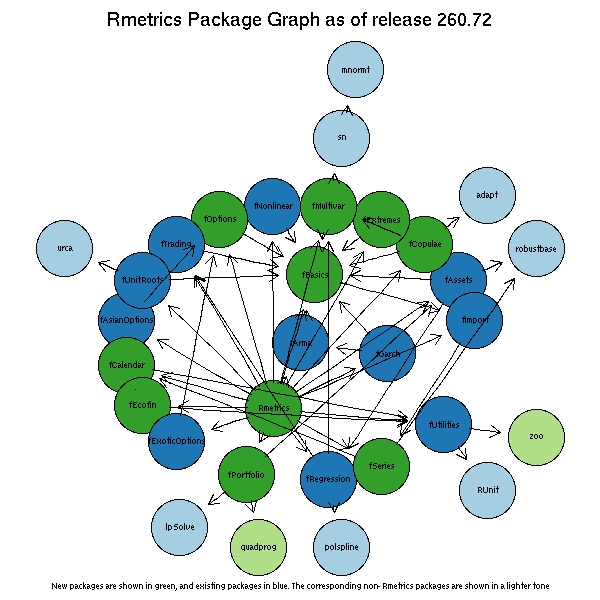
Debian has provided Rmetrics packages for financial engineering and computational finance since the Rmetrics release for R 1.9.0 in the summer of 2004. Over the years, Rmetrics has gotten more granular and changed from a handful of packages to two handfuls --- and the most recent release extended this trend even further to almost two dozen packages as shown in this chart. Dependency chart for Rmetrics packages Rmetrics now comprosises over twenty individual packages. Eleven new packages were added in the 260.72 release for R 2.6.0, and they required eight other new packages from CRAN. While I would have preferred a more spread-out approach than the shotgun approach of having to introduce all these new packages at once (which took the last four weeks), I am in support of the reorganisation which should make maintenance more easy going forward. So to get all of these packages onto a Debian box, a quick sudo apt-get install r-cran-rmetrics is all it takes. Currently supported only in the always-fresh unstable flavour, but hopefully soon in testing too. A big Thank You goes to the Debian FTPmasters. Of the 20-some packages that I added to Debian during this Rmetrics expansion, many were added within a day or two. Lastly, thanks also to Florian Hahne, Robert Gentleman and Elijah Wright for much appreciated help with R's Rgraphviz and graph packages to create the chart above. It only takes a handful of lines to create the basic graph, and another few lines for the colours and titles. The code is available on request, of course, but you need the current development versions of the BioConductor packages Rgraphviz and graph (which are not in Debian yet).

16 November 2007

Guido Trotter: LISA: done!

LISA’07 is over, and just concluded with a great talk about “Cooking at the Keyboard”, which of course I liked a lot, being this one of my favorite hobbies! This was my first LISA conference, and I had an all-round experience, giving an invited talk, hosting a BoF and speaking during the Hit The Ground Running track. Of those three the most fun has been the HTGR talk, in which I quickly summarized the Ganeti platform in 10′ and was able to answer a few questions in the last 5′. I definitely liked giving the invited talk, and I think the idea my teammates had to not just talk but actually give a live demo of our platform was very successful, even if it took some time and effort to prepare. The BoF was nice because it gave people chance to give more feedback and to talk about their ideas, it’s probably the session I learned more from. The slides for the talk are on the conference page, and the ones for HTGR will be soon! Globally it’s been a very intense week of talks, sessions, hallway chats, work and fun, and I definitely hope to be at LISA’08, next November in San Diego (it’s a bit like going back home, isnt it?)! I’m really glad to have come and want really to thank all the people who made this possible and all the people I met here, who made this event so good!

Next.

Previous.