Search Results: "sten"

28 December 2014

Ian Donnelly: New Release and Farewell to Planet Debian

Hi Everyone, So first I want to say, that I appreciate all the interest in our project from the folks who read our posts at Planet Debian. This will be our last post there for now, I hope you enjoyed the posts about my Google Summer of Code project and other info about Elektra we posted there. To stay informed about Elektra s releases, please subscribe to this RSS feed. Today I want to thank you all and tell you about the latest exciting Elektra news, our newest release 0.8.10! This new release brings many exciting updates and features, since I didn t to a post for Elektra 0.8.9, this post will cover changes and additions from Elektra 0.8.8 to 0.8.10. First of all, there is now a new gui for KDB! A big thanks goes out to Raffael Pancheri for developing this GUI! Once included in your Elektra build, this gui can be run using the command kdb qt-gui. It is very important to note that the gui is in version 0.0.2, meaning it is an alpha project and shouldn t be considered stable yet! This GUI is a convenient tool that lets you mount, unmount, search, import and export configurations. We are very excited about this tool and we hope it makes Elektra more accessible to all users. Check out the screenshot below to see this new GUI in action:
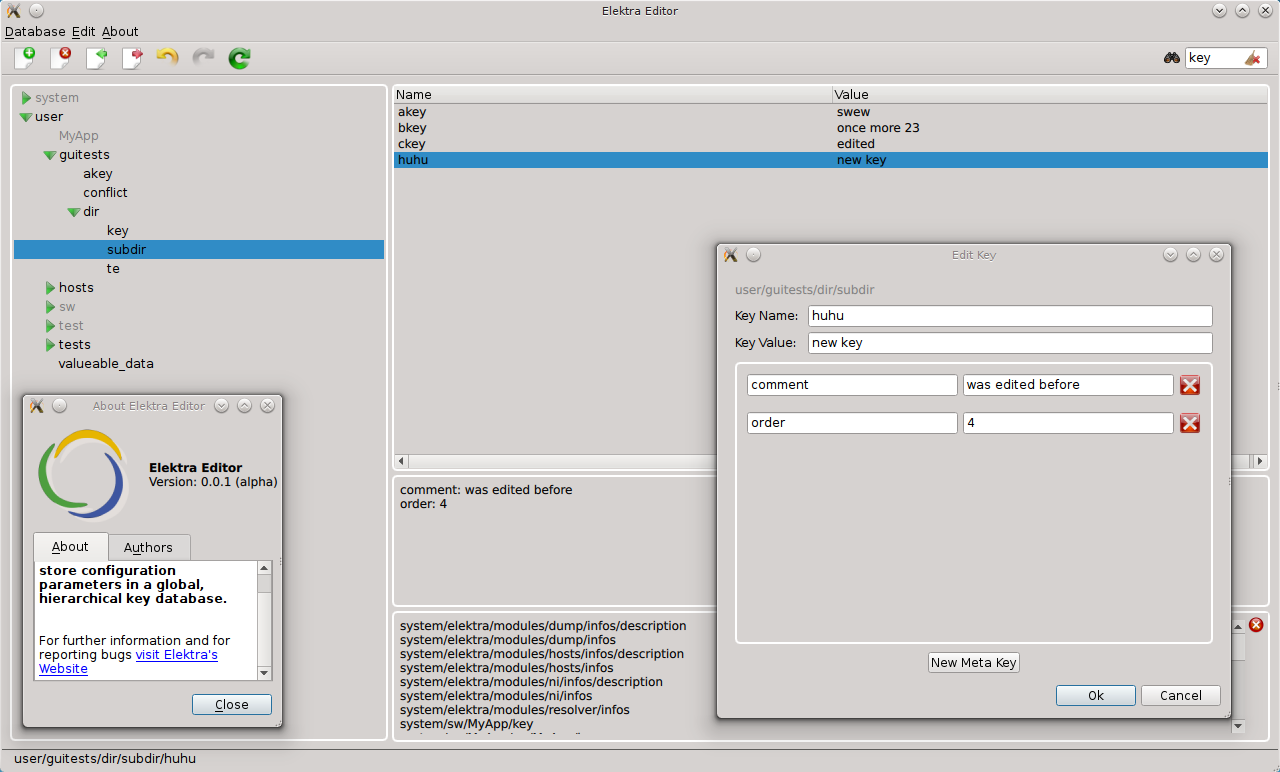
A screenshot of the new qt-gui tool

A few other new features are that Felix added support for multi-line into the ini plugin. Users are able to turn this feature on or off for each configuration. Additionally, Kai-Uwe added support for Windows 7 to Elektra! The Windows 7 port relies on a new resolver called wresolver which is a simpler version of the regular resolver which is compatible with Windows. Additionally, there is a new Java binding, so now Elektra is compatible with applications and plugins written in Java! On top of these features, a new hosts plugin and a new rename plugin have been written. The new hosts in conjunction with improvements to the ini plugin allows for multiple styles of comments (because some ini dialects allow ; and # to be used to differentiate comments) to be used and preserved in configuration files. Additionally, this new hosts plugin is compatible with and differentiates between ipv4 and ipv6 entries. There have also been a huge number of under-the-hood improvements, changes, and fixes; there have been so many in-fact that I am going to list them: There are many more new changes that I could not mention here. Please keep up-to-date with Elektra news and releases by subscribing to this RSS feed and following our news page on GitHub. As always feel free to comment on our posts and I will get back to you as soon as possible. Again, thanks for reading our blog, enjoy the new release! Sincerely,
Ian S. Donnelly P.S. Happy New Year to everybody!

26 December 2014

Ritesh Raj Sarraf: Linux Desktop in 2014

We are almost at the end of 2014. While 2014 has been a year with many mixed experiences, I think it does warrant one blog entry ;-) Recently, I've again started spending more time on Linux products / solutions, than spending time focused on a specfic subsystem. This change has been good. It has allowed me to re-cap all the advancements that have happened in the Linux world, umm... in the last 5 years. Once upon a time, the Linux kernel sucked on the Desktop. It led to many desktop improvement related initiatives. Many accepted in kernel, while others stood as it is (out-of-tree) still as of today. Over the years, there are many people that advocate for such out-of-tree features, for example the -ck patchset, claiming it has better performance. Most of the times, these are patches not carried by your distribution vendor, which leads you to alternate sources, if you want to try. Having some spare time, I tried the Alternative Kernel project. It is nothing but a bunch of patchsets, on top of the stock kernel. After trying it out, I must say that these patchsets are out-of-tree, for good. I hardly could make out any performance gain. But I did notice a considerable increase in the power consumption. On my stock Debian kernel, the power consumption lies around 15-18 W. That increased to 20+ W on the alternate kernels. I guess most advocates for the out-of-tree patchsets, only measure the 1-2% performance gain, where as completely neglect the fact that that kernel sleeps less often. But back to the generic Linux kernel performance problem...... Recently, in the last 2 years, the performance suckiness of the Linux kernel is hardly noticed. So what changed ? The last couple of years have seen a rise in high capacity RAM, at affordable consumer price. 8 - 16 GiB of RAM is common on laptops these days. If you go and look at the sucky bug report linked above, it is marked as closed, justified Working as Designed. The core problem with the bug reported, has to do with slow media. The Linux scheduler is (in?)efficient. It works hard to give you the best throughput and performance (for server workloads). I/O threads are a high priority task in the Linux kernel. Now map this scene to the typical Linux desktop. If you end up with doing too much buffered I/O, thus exhausting all your available cache, and trigger paging, you are in for some sweet experience. Given that the kernel highly priotizes I/O tasks, and if your underneath persistent storage device is slow (which is common if you have an external USB disk, or even an internal rotating magnetic disk), you end up blocking all your CPU cycles against the slow media. Which further leads to no available CPU cycles for your other desktop tasks. Hence, when you do I/O at such level, you find your desktop go terribly sluggish. It is not that your CPU is slow or in-capable. It is just that all your CPU slices are blocked. Blocked waiting for your write() to report a completion. So what exactly changed that we don't notice that problem any more ????
  1. RAM - Increase in RAM has led to more I/O be accommodated in cache. The best way to see this in action is to do a copy of a large file, something almost equivalent to the amount of RAM you have. But make sure it is less than the overall amount. For example, if you have 4 GiB of RAM, try copying a file of size 3.5 GiB in your graphical file manager. And at the same time, on the terminal, keep triggering the sync command. Check how long does it take for the sync to complete. By being able to cache large amount of data, the Linux kernel has been better at improving the overall performance in the eyes of the user.
  2. File System - But RAM is not alone. The file system has played a very important role too. Earlier, with ext3 file system, we had a commit interval of (5?) 30 seconds. That led to the above mentioned sync equivalent to get triggered every 30 secs. It was a safety measure to ensure, that at worst, you lose 30 secs worth of data. But it did hinder performance. With ext4, came delayed allocation. Delayed Allocation allowed the write() to return immediate while the data was in cache, and deferred the task of actual write() to the file system. This allowed for the allocator to find the best contiguous slot for the data to be written. Thus it improved the file system. It also brough corruption for some of the apps. :-)
  3. Solid State Drives - The file system and RAM alone aren't the sole factors that led to the drastic improvement in the overall experience of the Linux desktop. If you read through the bug report linked in this article, you'll find the core root cause to be slow persistent storage devices. Could the allocator have been improved (like Windows) to not be so pressing of the Linux desktop ? Maybe, yes. But that was a decision for the kernel devs and they believed (and believe) to keep those numbers to minimum. Thus for I/O, as for today, you have 3 schedulers and for CPU, just 1. What dramatically improved the overall Linux Desktop performance was the general availability of solid state devices. These device are real fast, which in effect made the write() calls return immediate, and did not block the CPU.
So, it was the advancement in both hardware and software that led to better overall desktop performance. Does the above mentioned bug still exist ? Yes. Its just that it is much harder to trigger it now. You'll have to ensure that you max out your cache and trigger paging. And then try to do ask for some CPU cycles. But it wasn't that back then we didn't use Linux on the desktop / laptop. It sure did suck more than, say, Windows. But hey, sometimes we have to eat our own dog food. Even then, there sure were some efforts to overcome the then limitations. The first and obvious one is the out-of-tree patchset. But ther were also some other efforts to improve the situation. The first such effort, that I can recollect, was ulatency. With Linux adding support for Control Groups, there were multiple avenues open on how to tackle and tame the resource starvation problem. The crux of the problem was that Linux gave way too much priority to the I/O tasks. I still wish Linux has a profile mechanism, where in on the kernel command line, we could specify what profile should Linux boot into. Anyways, with ulatency, we saw improvements in the Linux Desktop experience. ulatency had in-built policies to whitelist / blacklist a set of profiles. For example, KDE was a profile. Thus, ulatency would club all KDE processes into a group and give that group a higher precedence to ensure that it had its fair share of CPU cycles. Today, at almost the end of 2014, there are many more consumer of Linux's control groups. Prominent names would be: LXC and systemd. ulatency has hardly seen much development in the last year. Probably it is time for systemd to take over. systemd is expected to bring lots of features to the Linux world, thus bridging the (many) gap Linux has had on the desktop. It makes extensive use of Control Groups for a variety of (good) reasons, which has led it to be a linux-only product. I think it should have never marketed itself as the init daemon. It rather fits better when called as the System Management Daemon. The path to Linux Desktop looks much brighter in 2015 and beyond thanks to all the advancements that have happened so far. The other important players, who should be thanked are Mobile and Low Latency products (Android, ChromeBook), whose engagement to productize Linux has led to better features overall.

Categories:

Keywords:

18 December 2014

Mario Lang: deluXbreed #2 is out!

The third installment of my crossbreed digital mix podcast is out! This time, I am featuring Harder & Louder and tracks from Behind the Machine and the recently released Remixes.
  1. Apolloud - Nagazaki
  2. Apolloud - Hiroshima
  3. SA+AN - Darksiders
  4. Im Colapsed - Cleaning 8
  5. Micromakine & Switch Technique - Ascension
  6. Micromakine - Cyberman (Dither Remix)
  7. Micromakine - So Good! (Synapse Remix)
How was DarkCast born and how is it done? I always loved 175BPM music. It is an old thing that is not going away soon :-). I recently found that there is a quite active culture going on, at least on BandCamp. But single tracks are just that, not really fun to listen to in my opinion. This sort of music needs to be mixed to be fun. In the past, I used to have most tracks I like/love as vinyl, so I did some real-world vinyl mixing myself. But these days, most fun music is only available digitally, at least easily. Some people still do vinyl releases, but they are actually rare. So for my personal enjoyment, I started to digitally mix tracks I really love, such that I can listen to them without "interruption". And since I am an iOS user since three years now, using the podcast format to get stuff onto my devices was quite a natural choice. I use SoX and a very small shell script to create these mixes. Here is a pseudo-template:
sox --combine mix-power \
" sox \" sox 1.flac -p\" \" sox 3.flac -p speed 0.987 delay 2:28.31 2:28.31\" -p" \
" sox \" sox 2.flac -p delay 2:34.1 2:34.1\" -p" \
mix.flac
As you can imagine, it is quite a bit of fiddling to get these scripts to do what you want. But it is a non-graphical method to get things done. If you know of a better tool, possibly with a bit of real-time controls, to get the same job done, wihtout having to resort to a damn GUI, let me know.

17 December 2014

Keith Packard: MST-monitors

Multi-Stream Transport 4k Monitors and X I'm sure you've seen a 4k monitor on a friends desk running Mac OS X or Windows and are all ready to go get one so that you can use it under Linux. Once you've managed to acquire one, I'm afraid you'll discover that when you plug it in, you're limited to 30Hz refresh rates at the full size, unless you're running a kernel that is version 3.17 or later. And then... Good Grief! What Is My Computer Doing! Ok, so now you're running version 3.17 and when X starts up, it's like you're using a gigantic version of Google Cardboard. Two copies of a very tall, but very narrow screen greets you. Welcome to MST island. In order to drive these giant new panels at full speed, there isn't enough bandwidth in the display hardware to individually paint each pixel once during each frame. So, like all good hardware engineers, they invented a clever hack. This clever hack paints the screen in parallel. I'm assuming that they've got two bits of display hardware, each one hooked up to half of the monitor. Now, each paints only half of the pixels, avoiding costly redesign of expensive silicon, at least that's my surmise. In the olden days, if you did this, you'd end up running two monitor cables to your computer, and potentially even having two video cards. Today, thanks to the magic of Display Port Multi-Stream Transport, we don't need all of that; instead, MST allows us to pack multiple cables-worth of data into a single cable. I doubt the inventors of MST intended it to be used to split a single LCD panel into multiple "monitors", but hardware engineers are clever folk and are more than capable of abusing standards like this when it serves to save a buck. Turning Two Back Into One We've got lots of APIs that expose monitor information in the system, and across which we might be able to wave our magic abstraction wand to fix this:
  1. The KMS API. This is the kernel interface which is used by all graphics stuff, including user-space applications and the frame buffer console. Solve the problem here and it works everywhere automatically.
  2. The libdrm API. This is just the KMS ioctls wrapped in a simple C library. Fixing things here wouldn't make fbcons work, but would at least get all of the window systems working.
  3. Every 2D X driver. (Yeah, we're trying to replace all of these with the one true X driver). Fixing the problem here would mean that all X desktops would work. However, that's a lot of code to hack, so we'll skip this.
  4. The X server RandR code. More plausible than fixing every driver, this also makes X desktops work.
  5. The RandR library. If not in the X server itself, how about over in user space in the RandR protocol library? Well, the problem here is that we've now got two of them (Xlib and xcb), and the xcb one is auto-generated from the protocol descriptions. Not plausible.
  6. The Xinerama code in the X server. Xinerama is how we did multi-monitor stuff before RandR existed. These days, RandR provides Xinerama emulation, but we've been telling people to switch to RandR directly.
  7. Some new API. Awesome. Ok, so if we haven't fixed this in any existing API we control (kernel/libdrm/X.org), then we effectively dump the problem into the laps of the desktop and application developers. Given how long it's taken them to adopt current RandR stuff, providing yet another complication in their lives won't make them very happy.
All Our APIs Suck Dave Airlie merged MST support into the kernel for version 3.17 in the simplest possible fashion -- pushing the problem out to user space. I was initially vaguely tempted to go poke at it and try to fix things there, but he eventually convinced me that it just wasn't feasible. It turns out that all of our fancy new modesetting APIs describe the hardware in more detail than any application actually cares about. In particular, we expose a huge array of hardware objects: Each of these objects exposes intimate details about the underlying hardware -- which of them can work together, and which cannot; what kinds of limits are there on data rates and formats; and pixel-level timing details about blanking periods and refresh rates. To make things work, some piece of code needs to actually hook things up, and explain to the user why the configuration they want just isn't possible. The sticking point we reached was that when an MST monitor gets plugged in, it needs two CRTCs to drive it. If one of those is already in use by some other output, there's just no way you can steal it for MST mode. Another problem -- we expose EDID data and actual video mode timings. Our MST monitor has two EDID blocks, one for each half. They happen to describe how they're related, and how you should configure them, but if we want to hide that from the application, we'll have to pull those EDID blocks apart and construct a new one. The same goes for video modes; we'll have to construct ones for MST mode. Every single one of our APIs exposes enough of this information to be dangerous. Every one, except Xinerama. All it talks about is a list of rectangles, each of which represents a logical view into the desktop. Did I mention we've been encouraging people to stop using this? And that some of them listened to us? Foolishly? Dave's Tiling Property Dave hacked up the X server to parse the EDID strings and communicate the layout information to clients through an output property. Then he hacked up the gnome code to parse that property and build a RandR configuration that would work. Then, he changed to RandR Xinerama code to also parse the TILE properties and to fix up the data seen by application from that. This works well enough to get a desktop running correctly, assuming that desktop uses Xinerama to fetch this data. Alas, gtk has been "fixed" to use RandR if you have RandR version 1.3 or later. No biscuit for us today. Adding RandR Monitors RandR doesn't have enough data types yet, so I decided that what we wanted to do was create another one; maybe that would solve this problem. Ok, so what clients mostly want to know is which bits of the screen are going to be stuck together and should be treated as a single unit. With current RandR, that's some of the information included in a CRTC. You pull the pixel size out of the associated mode, physical size out of the associated outputs and the position from the CRTC itself. Most of that information is available through Xinerama too; it's just missing physical sizes and any kind of labeling to help the user understand which monitor you're talking about. The other problem with Xinerama is that it cannot be configured by clients; the existing RandR implementation constructs the Xinerama data directly from the RandR CRTC settings. Dave's Tiling property changes edit that data to reflect the union of associated monitors as a single Xinerama rectangle. Allowing the Xinerama data to be configured by clients would fix our 4k MST monitor problem as well as solving the longstanding video wall, WiDi and VNC troubles. All of those want to create logical monitor areas within the screen under client control What I've done is create a new RandR datatype, the "Monitor", which is a rectangular area of the screen which defines a rectangular region of the screen. Each monitor has the following data: There are three requests to define, delete and list monitors. And that's it. Now, we want the list of monitors to completely describe the environment, and yet we don't want existing tools to break completely. So, we need some way to automatically construct monitors from the existing RandR state while still letting the user override portions of it as needed to explain virtual or tiled outputs. So, what I did was to let the client specify a list of outputs for each monitor. All of the CRTCs which aren't associated with an output in any client-defined monitor are then added to the list of monitors reported back to clients. That means that clients need only define monitors for things they understand, and they can leave the other bits alone and the server will do something sensible. The second tricky bit is that if you specify an empty rectangle at 0,0 for the pixel geometry, then the server will automatically compute the geometry using the list of outputs provided. That means that if any of those outputs get disabled or reconfigured, the Monitor associated with them will appear to change as well. Current Status Gtk+ has been switched to use RandR for RandR versions 1.3 or later. Locally, I hacked libXrandr to override the RandR version through an environment variable, set that to 1.2 and Gtk+ happily reverts back to Xinerama and things work fine. I suspect the plan here will be to have it use the new Monitors when present as those provide the same info that it was pulling out of RandR's CRTCs. KDE appears to still use Xinerama data for this, so it "just works". Where's the code As usual, all of the code for this is in a collection of git repositories in my home directory on fd.o:
git://people.freedesktop.org/~keithp/randrproto master
git://people.freedesktop.org/~keithp/libXrandr master
git://people.freedesktop.org/~keithp/xrandr master
git://people.freedesktop.org/~keithp/xserver randr-monitors
RandR protocol changes Here's the new sections added to randrproto.txt
                   
1.5. Introduction to version 1.5 of the extension
Version 1.5 adds monitors
   A 'Monitor' is a rectangular subset of the screen which represents
   a coherent collection of pixels presented to the user.
   Each Monitor is be associated with a list of outputs (which may be
   empty).
   When clients define monitors, the associated outputs are removed from
   existing Monitors. If removing the output causes the list for that
   monitor to become empty, that monitor will be deleted.
   For active CRTCs that have no output associated with any
   client-defined Monitor, one server-defined monitor will
   automatically be defined of the first Output associated with them.
   When defining a monitor, setting the geometry to all zeros will
   cause that monitor to dynamically track the bounding box of the
   active outputs associated with them
This new object separates the physical configuration of the hardware
from the logical subsets  the screen that applications should
consider as single viewable areas.
1.5.1. Relationship between Monitors and Xinerama
Xinerama's information now comes from the Monitors instead of directly
from the CRTCs. The Monitor marked as Primary will be listed first.
                   
5.6. Protocol Types added in version 1.5 of the extension
MONITORINFO   name: ATOM
          primary: BOOL
          automatic: BOOL
          x: INT16
          y: INT16
          width: CARD16
          height: CARD16
          width-in-millimeters: CARD32
          height-in-millimeters: CARD32
          outputs: LISTofOUTPUT  
                   
7.5. Extension Requests added in version 1.5 of the extension.
 
    RRGetMonitors
    window : WINDOW
      
    timestamp: TIMESTAMP
    monitors: LISTofMONITORINFO
 
    Errors: Window
    Returns the list of Monitors for the screen containing
    'window'.
    'timestamp' indicates the server time when the list of
    monitors last changed.
 
    RRSetMonitor
    window : WINDOW
    info: MONITORINFO
 
    Errors: Window, Output, Atom, Value
    Create a new monitor. Any existing Monitor of the same name is deleted.
    'name' must be a valid atom or an Atom error results.
    'name' must not match the name of any Output on the screen, or
    a Value error results.
    If 'info.outputs' is non-empty, and if x, y, width, height are all
    zero, then the Monitor geometry will be dynamically defined to
    be the bounding box of the geometry of the active CRTCs
    associated with them.
    If 'name' matches an existing Monitor on the screen, the
    existing one will be deleted as if RRDeleteMonitor were called.
    For each output in 'info.outputs, each one is removed from all
    pre-existing Monitors. If removing the output causes the list of
    outputs for that Monitor to become empty, then that Monitor will
    be deleted as if RRDeleteMonitor were called.
    Only one monitor per screen may be primary. If 'info.primary'
    is true, then the primary value will be set to false on all
    other monitors on the screen.
    RRSetMonitor generates a ConfigureNotify event on the root
    window of the screen.
 
    RRDeleteMonitor
    window : WINDOW
    name: ATOM
 
    Errors: Window, Atom, Value
    Deletes the named Monitor.
    'name' must be a valid atom or an Atom error results.
    'name' must match the name of a Monitor on the screen, or a
    Value error results.
    RRDeleteMonitor generates a ConfigureNotify event on the root
    window of the screen.
                   

15 December 2014

Gustavo Noronha Silva: Web Engines Hackfest 2014

For the 6th year in a row, Igalia has organized a hackfest focused on web engines. The 5 years before this one were actually focused on the GTK+ port of WebKit, but the number of web engines that matter to us as Free Software developers and consultancies has grown, and so has the scope of the hackfest. It was a very productive and exciting event. It has already been covered by Manuel Rego, Philippe Normand, Sebastian Dr ge and Andy Wingo! I am sure more blog posts will pop up. We had Martin Robinson telling us about the new Servo engine that Mozilla has been developing as a proof of concept for both Rust as a language for building big, complex products and for doing layout in parallel. Andy gave us a very good summary of where JS engines are in terms of performance and features. We had talks about CSS grid layouts, TyGL a GL-powered implementation of the 2D painting backend in WebKit, the new Wayland port, announced by Zan Dobersek, and a lot more. With help from my colleague ChangSeok OH, I presented a description of how a team at Collabora led by Marco Barisione made the combination of WebKitGTK+ and GNOME s web browser a pretty good experience for the Raspberry Pi. It took a not so small amount of both pragmatic limitations and hacks to get to a multi-tab browser that can play youtube videos and be quite responsive, but we were very happy with how well WebKitGTK+ worked as a base for that. One of my main goals for the hackfest was to help drive features that were lingering in the bug tracker for WebKitGTK+. I picked up a patch that had gone through a number of iterations and rewrites: the HTML5 notifications support, and with help from Carlos Garcia, managed to finish it and land it at the last day of the hackfest! It provides new signals that can be used to authorize notifications, show and close them. To make notifications work in the best case scenario, the only thing that the API user needs to do is handle the permission request, since we provide a default implementation for the show and close signals that uses libnotify if it is available when building WebKitGTK+. Originally our intention was to use GNotification for the default implementation of those signals in WebKitGTK+, but it turned out to be a pain to use for our purposes. GNotification is tied to GApplication. This allows for some interesting features, like notifications being persistent and able to reactivate the application, but those make no sense in our current use case, although that may change once service workers become a thing. It can also be a bit problematic given we are a library and thus have no GApplication of our own. That was easily overcome by using the default GApplication of the process for notifications, though. The show stopper for us using GNotification was the way GNOME Shell currently deals with notifications sent using this mechanism. It will look for a .desktop file named after the application ID used to initialize the GApplication instance and reject the notification if it cannot find that. Besides making this a pain to test our test browser would need a .desktop file to be installed, that would not work for our main API user! The application ID used for all Web instances is org.gnome.Epiphany at the moment, and that is not the same as any of the desktop files used either by the main browser or by the web apps created with it. For the future we will probably move Epiphany towards this new era, and all users of the WebKitGTK+ API as well, but the strictness of GNOME Shell would hurt the usefulness of our default implementation right now, so we decided to stick to libnotify for the time being. Other than that, I managed to review a bunch of patches during the hackfest, and took part in many interesting discussions regarding the next steps for GNOME Web and the GTK+ and Wayland ports of WebKit, such as the potential introduction of a threaded compositor, which is pretty exciting. We also tried to have Bastien Nocera as a guest participant for one of our sessions, but it turns out that requires more than a notebook on top of a bench hooked up to a TV to work well. We could think of something next time ;D. I d like to thank Igalia for organizing and sponsoring the event, Collabora for sponsoring and sending ChangSeok and myself over to Spain from far away Brazil and South Korea, and Adobe for also sponsoring the event! Hope to see you all next year!

Web Engines Hackfest 2014 sponsors: Adobe, Collabora and Igalia

Web Engines Hackfest 2014 sponsors: Adobe, Collabora and Igalia

14 December 2014

Enrico Zini: html5-sse

HTML5 Server-sent events I have a Django view that runs a slow script server-side, and streams the script output to Javascript. This is the bit of code that runs the script and turns the output into a stream of events:
def stream_output(proc):
    '''
    Take a subprocess.Popen object and generate its output, line by line,
    annotated with "stdout" or "stderr". At process termination it generates
    one last element: ("result", return_code) with the return code of the
    process.
    '''
    fds = [proc.stdout, proc.stderr]
    bufs = [b"", b""]
    types = ["stdout", "stderr"]
    # Set both pipes as non-blocking
    for fd in fds:
        fcntl.fcntl(fd, fcntl.F_SETFL, os.O_NONBLOCK)
    # Multiplex stdout and stderr with different prefixes
    while len(fds) > 0:
        s = select.select(fds, (), ())
        for fd in s[0]:
            idx = fds.index(fd)
            buf = fd.read()
            if len(buf) == 0:
                fds.pop(idx)
                if len(bufs[idx]) != 0:
                    yield types[idx], bufs.pop(idx)
                types.pop(idx)
            else:
                bufs[idx] += buf
                lines = bufs[idx].split(b"\n")
                bufs[idx] = lines.pop()
                for l in lines:
                    yield types[idx], l
    res = proc.wait()
    yield "result", res
I used to just serialize its output and stream it to JavaScript, then monitor onreadystatechange on the XMLHttpRequest object browser-side, but then it started failing on Chrome, which won't trigger onreadystatechange until something like a kilobyte of data has been received. I didn't want to stream a kilobyte of padding just to work-around this, so it was time to try out Server-sent events. See also this. This is the Django view that sends the events:
class HookRun(View):
    def get(self, request):
        proc = run_script(request)
        def make_events():
            for evtype, data in utils.stream_output(proc):
                if evtype == "result":
                    yield "event:  \ndata:  \n\n".format(evtype, data)
                else:
                    yield "event:  \ndata:  \n\n".format(evtype, data.decode("utf-8", "replace"))
        return http.StreamingHttpResponse(make_events(), content_type='text/event-stream')
    @method_decorator(never_cache)
    def dispatch(self, *args, **kwargs):
        return super().dispatch(*args, **kwargs)
And this is the template that renders it:
 % extends "base.html" % 
 % load i18n % 
 % block head_resources % 
 block.super 
<style type="text/css">
.out  
    font-family: monospace;
    padding: 0;
    margin: 0;
 
.stdout  
.stderr   color: red;  
.result  
.ok   color: green;  
.ko   color: red;  
</style>
 # Polyfill for IE, typical... https://github.com/remy/polyfills/blob/master/EventSource.js # 
<script src="  STATIC_URL  js/EventSource.js"></script>
<script type="text/javascript">
$(function()  
    // Manage spinners and other ajax-related feedback
    $(document).nav();
    $(document).nav("ajax_start");
    var out = $("#output");
    var event_source = new EventSource(" % url 'session_hookrun' name=name % ");
    event_source.addEventListener("open", function(e)  
      //console.log("EventSource open:", arguments);
     );
    event_source.addEventListener("stdout", function(e)  
      out.append($("<p>").attr("class", "out stdout").text(e.data));
     );
    event_source.addEventListener("stderr", function(e)  
      out.append($("<p>").attr("class", "out stderr").text(e.data));
     );
    event_source.addEventListener("result", function(e)  
      if (+e.data == 0)
          out.append($("<p>").attr("class", "result ok").text(" % trans 'Success' % "));
      else
          out.append($("<p>").attr("class", "result ko").text(" % trans 'Script failed with code' %  " + e.data));
      event_source.close();
      $(document).nav("ajax_end");
     );
    event_source.addEventListener("error", function(e)  
      // There is an annoyance here: e does not contain any kind of error
      // message.
      out.append($("<p>").attr("class", "result ko").text(" % trans 'Error receiving script output from the server' % "));
      console.error("EventSource error:", arguments);
      event_source.close();
      $(document).nav("ajax_end");
     );
 );
</script>
 % endblock % 
 % block content % 
<h1> % trans "Processing..." % </h1>
<div id="output">
</div>
 % endblock % 
It's simple enough, it seems reasonably well supported besides needing a polyfill for IE and, astonishingly, it even works!

12 December 2014

Thorsten Glaser: WTF is Jessie; PA4 paper size

My personal APT repository now has a jessie suite currently just a clone of the sid suite, but so, people can get on the correct upgrade channel already. Besides that, the usual small updates to my metapackages, bugfixes, etc. You might have noticed that it s now on a (hopefully permanent) location. I ve put a donated eee-pc from my father to good use and am now running a Debian system at home. (Fun, as I m emeritus now, officially, and haven t had one during my time as active uploading DD.) I ve created a couple of cowbuilder chroots (pbuilderrc to achieve that included in the repo) and can build packages, but for i386 only (amd64 is still done on the x32 desktop at work), but, more importantly, I can build, sign and publish the repo, so it may grow. (popcon data is interesting. More than double the amount of machines I have installed that stuff on.) Update: I ve started writing a NEWS file and cobbled together an RSS 2.0 feed from that still plaintext content, but at least signalling in feedreaders upon updates.
Installing gimp and inkscape, I m asked for a default paper size by libpaper1. PA4 is still not an option, I wonder why. I also haven t managed to get MirPorts GNU groff and Artifex Ghostscript to use that paper size, so the various PDF manpages I produce are still using DIN ISO A4, rendering e.g. Mexicans unable to print them. Help welcome.

Daniel Kahn Gillmor: a10n for l10n

The abbreviated title above means "Appreciation for Localization" :) I wanted to say a word of thanks for the awesome work done by debian localization teams. I speak English, and my other language skills are weak. I'm lucky: most software I use is written by default in a language that I can already understand. The debian localization teams do great work in making sure that packages in debian gets translated into many other languages, so that many more people around the world can take advantage of free software. I was reminded of this work recently (again) with the great patches submitted to GnuPG and related packages. The changes were made by many different people, and coordinated with the debian GnuPG packaging team by David Pr vot. This work doesn't just help debian and its users. These localizations make their way back upstream to the original projects, which in turn are available to many other people. If you use debian, and you speak a language other than english, and you want to give back to the community, please consider joining one of the localization teams. They are a great way to help out our project's top priorities: our users and free software. Thank you to all the localizers! (this post was inspired by gregoa's debian advent calendar. i won't be posting public words of thanks as frequently or as diligently as he does, any more than i'll be fixing the number of RC bugs that he fixes. This are just two of the ways that gregoa consistently leads the community by example. He's an inspiration, even if living up to his example is a daunting challenge.)

11 December 2014

Rapha&#235;l Hertzog: Freexian s fourth report about Debian Long Term Support

Like each month, here comes a report about the work of paid contributors to Debian LTS. Individual reports In November 42.5 work hours have been equally split among 3 paid contributors. Their reports are available: New paid contributors Last month we mentioned the possibility to recruit more paid contributors to better share the work load and this has already happened: Ben Hutchings and Mike Gabriel join the list of paid contributors. Ben, as a kernel maintainer, will obviously take care of releasing Linux security updates. We are glad to have him on board because backporting kernel fixes really need some skills that nobody else had within the team of paid contributors. Evolution of the situation Compared to last month, the number of paid work hours has almost not increased (we are at 45.7 hours per month) but we are in the process of adding a few more sponsors: Roche Diagnostics International AG, Misal-System, Bitfolk LTD. And we are still in contact with a couple of other companies which have announced their willingness to contribute but which are waiting the new fiscal year. But even with those new sponsors, we still have some way to go to reach our minimal goal of funding the equivalent of a half-time position. So consider asking your company representative to join this project! In terms of security updates waiting to be handled, the situation looks better than last month: the dla-needed.txt file lists 27 packages awaiting an update (6 less than last month), the list of open vulnerabilities in Squeeze shows about 58 affected packages in total. Like last month, we re a bit behind in terms of CVE triaging and there are still many packages using SSLv3 where we have no clear plan (in response to the POODLE issues). The good side is that even though the kernel update spent a large chunk of time to Holger and Rapha l, we still managed to further reduce the backlog of security issues. Thanks to our sponsors

No comment Liked this article? Click here. My blog is Flattr-enabled.

9 December 2014

Joey Hess: podcasts that don't suck, 2014 edition

Also, out of the podcasts I listed previously, I still listen to and enjoy Free As In Freedom, Off the Hook, and the Long Now Seminars. PS: A nice podcatcher, for the technically inclined is git-annex importfeed. Featuring list of feeds in a text file, and distributed podcatching!

Thorsten Glaser: The colon in the shell: corrigenda

Bernhard s article on Pl net Debian about the colon command in the shell could use a clarification and a security-relevant correcture. There is, indeed, no difference between the : and true built-in commands. St phane Chazelas points out that writing : $ VARNAME:=default is bad, : "$ VARNAME:=default " is correct. Reason: someone could preset $VARNAME with, for example, /*/*/*/*/../../../../*/*/*/*/../../../../*/*/*/* which will exhaust during globbing. Besides that, the article is good. Thanks Bernhard for posting it! PS: I sometimes use the colon as comment leader in the last line of a script or function, because it, unlike the octothorpe, sets $? to 0, which can be useful. Update: As jilles pointed out in IRC, colon ( : ) is a POSIX special built-in (most importantly, it keeps assignments), whereas true is a regular built-in utility.

7 December 2014

Sven Hoexter: Failing with F5: Implementing HTTP session persistence

In the old days people deployed the Apache HTTPD together with mod_jk and mod_balancer in front of Apache Tomcat instances to achieve scalability and resilience. That sooner or later turns out to not provide features you nowadays would like to have to run a service 24/7. So it happened that I had to jump into the sometimes cold sea of managing services fronted by F5 BigIP devices, a somewhat common load balancing solution. Soon after you start to introduce loadbalancing, because you grow beyond the "one fat webserver" state, you'll have the requirement to implement some way of session persistence. In the old days you might have added a unique jvmRoute value to your mod_balancer pool and to your tomcat configuration to match the connection to the right pool member. If you're clever you've set it on the Tomcat as a variable that automatically builds up the jvmRoute based on the hostname, so you can add new instances without having to touch the Tomcat configuration. In case you were not that clever (like we were when we started) you might have added placeholders in the server.xml to set the jvmRoute value in your deployment script. I think in a somewhat better world your first step usually is to introduce a shared session store, be it the php session handler backed by a memcached or Hazelcast for the Java afficionados, to avoid the persistence requirement on your balancer. But if you grow even bigger the requirement will soon reappear because you might have to add some form of sharding and now have to sent users to the same cluster serving a specific shard. In the end all of that is not cool and your developers have to be aware of those issues. For all cases where fault tolerance within the session is not a priority we aimed for something that we can enable or disable on the balancer without application code changes. The "let the box do its job" solution The nicest solution from our point of view is letting the F5 inject a cookie that points the device on subsequent requests to the right pool node. If you like you can define the cookie name, a timeout, force the injection on replies and some other tunables. Take a look at the help for ltm persistence cookie if you'd like to have a look at the details. The "let's do it by hand but on the box" solution Most Java frameworks provide a session cookie called JSESSIONID. Why not use that one and add a persistence table entry on the BigIP with the cookie as the lookup key? As always if there's no solution provided out of the box you can implement an iRule for it. Kind of an F5 mantra. There are many examples out there, here is what we ended up with:
when HTTP_REQUEST  
    if   [HTTP::cookie "JSESSIONID"] ne ""  
        persist uie [string tolower [HTTP::cookie "JSESSIONID"]] 1800 
     
 
when HTTP_RESPONSE  
    if   [HTTP::cookie "JSESSIONID"] ne ""  
        persist add uie [string tolower [HTTP::cookie "JSESSIONID"]] 1800
     
 
And here is where I failed Now imagine you're running an application that so far handles only machine to machine traffic without session persistence. A few month later you're approached to enable session persistence, because someone introduced a management console for the application as a web user interface. Without further ado you jump on board and provide - showcasing the flexibility of the new balancer - session persistence based on cookies injected by the BigIP. You've done it before, you enable it for the test environment, everything looks fine, you enable it for the production setup. Everything is fine (at least for now ...), the WUI workes fine, sessions are persistent to the node the user hit first. A month or two later someone from the development team approaches you again, this time asking if the balancing setup has some issues because over 90% of the live traffic hit one of the two machines in the pool until it wents down due to a crash or a deployment. Then about 90% hit the other node, even after the crashed one is resurrected. But every time the developer tests the balancing with a "while true" loop sending several hundred requests via curl the balancing is perfectly equal. After beeing puzzled by the behaviour myself we started to look at the live traffic with tcpdump and suddenly it was all clear when I saw the BigIP cookie beeing passed around. Actually everything behaved as we configured it. The application used a proper HTTP library and that one implemented cookies: If you receive one you're polite and pass it back to the sender. The original sender of course also implements HTTP with cookie support and now, due to the natur of the traffic, we have long living connections between two applications passing around the same cookie. On every single HTTP request sent through this connection. And every time the balancer will look at the cookie and happily base the routing decision on the pool member noted in this cookie. When we tested with curl we did not have the usage of cookies on our mind. Because our false assumption was that the applications do not create cookies for machine to machine traffic. Nobody, including myself, actively remembered the decision to base the session persistence on cookies injected by the balancer. We went on and switched to the iRule mentioned above. Luckily we already had that one implemented and tested for a different use case with the requirement to not inject additional cookies.
  1. Can we maybe improve the change process for the balancer to handle a mixed traffic scenario?
  2. Do we need monitoring to monitor the balancing of requests?
  3. Is it a wise idea to mix machine2machine and user2machine traffic on the same port?
  4. Should we maybe, if we seperate properly, place management applications on a different system?
  5. Is our documentation sufficient?
Combine 3. and 4. and ask yourself how resilient you are if someone tries to exhaust the memory of the balancer with a lot of connection attempts that have random JSESSIONID cookies? Or is it even possible to exhaust ressource with faked BigIP cookies you inject? Maybe it's even a vector for something like http://events.ccc.de/congress/2011/Fahrplan/attachments/2007_28C3_Effective_DoS_on_web_application_platforms.pdf? Quite some questions left to think about and draft answers for.

5 December 2014

Michal &#268;iha&#345;: Weblate 2.1

Weblate 2.1 has been released today. It comes with native Mercurial support, user interface cleanup and various other fixes. Full list of changes for 2.1: You can find more information about Weblate on http://weblate.org, the code is hosted on Github. If you are curious how it looks, you can try it out on demo server. You can login there with demo account using demo password or register your own user. Ready to run appliances will be soon available in SUSE Studio Gallery. Weblate is also being used https://hosted.weblate.org/ as official translating service for phpMyAdmin, Gammu, Weblate itself and others. If you are free software project which would like to use Weblate, I'm happy to help you with set up or even host Weblate for you. Further development of Weblate would not be possible without people providing donations, thanks to everybody who have helped so far!

Filed under: English phpMyAdmin SUSE Weblate 0 comments Flattr this!

Michael Meskes: Conferences in Q4

Together with members of almost all credativ offices world-wide I travelled to Madrid in October to attend PGConf Europe, the most important European PostgreSQL event. The conference, as usual, was greatly organized and had a lot of interesting presentations and thus, was rightfully sold-out. It again brought together a lot of the PostgreSQL community. My non-technical presentation about whether Open Source is a blessing or a curse attracted a sizeable audience despite starting early. Also we got into a good discussion about some of the points raised which again showed that Open Source in general and PostgreSQL in particular are more and more considered because of their strategic importance.Then in November I was invited to do a presentation at Open Source India Days 2014 in Bangalore or as it nowadays is called again Bengaluru. I was able to conveniently combine the trip to the conference with a scheduled visit to our office there.The conference was a very pleasant surprise. Despite being called the largest Open-Source conference in Asia I never made it there before. And, frankly, I was impressed about the size. Maybe not so surprisingly the conference was dominated by presentations about cloud solutions and technology.I, however, talked about the importance of community for businesses in particular pointing to Debian and PostgreSQL as very successful community projects. And again a large audience listened ini showing again the interest in strategic aspects of Open Source. Due to time constraints we weren't able to do a discussion during the presentation, or even allow questions/answers at the end, but a lot of people caught me afterwards to discuss points or make valuable remarks.Both events are very worthy entries for next year's schedule.

Russell Coker: BTRFS Status Dec 2014

My last problem with BTRFS was in August [1]. BTRFS has been running mostly uneventfully for me for the last 4 months, that s a good improvement but the fact that 4 months of no problems is noteworthy for something as important as a filesystem is a cause for ongoing concern. A RAID-1 Array A week ago I had a minor problem with my home file server, one of the 3TB disks in the BTRFS RAID-1 started giving read errors. That s not a big deal, I bought a new disk and did a btrfs replace operation which was quick and easy. The first annoyance was that the output of btrfs device stats reported an error count for the new device, it seems that btrfs device replace copies everything from the old disk including the error count. The solution is to use btrfs device stats -z to reset the count after replacing a device. I replaced the 3TB disk with a 4TB disk (with current prices it doesn t make sense to buy a new 3TB disk). As I was running low on disk space I added a 1TB disk to give it 4TB of RAID-1 capacity, one of the nice features of BTRFS is that a RAID-1 filesystem can support any combination of disks and use them to store 2 copies of every block of data. I started running a btrfs balance to get BTRFS to try and use all the space before learning from the mailing list that I should have done btrfs filesystem resize to make it use all the space. So my balance operation had configured the filesystem to configure itself for 2*3TB+1*1TB disks which wasn t the right configuration when the 4TB disk was fully used. To make it even more annoying the btrfs filesystem resize command takes a devid not a device name. I think that when BTRFS is more stable it would be good to have the btrfs utility warn the user about such potential mistakes. When a replacement device is larger than the old one it will be very common to want to use that space. The btrfs utility could easily suggest the most likely btrfs filesystem resize to make things easier for the user. In a disturbing coincidence a few days after replacing the first 3TB disk the other 3TB disk started giving read errors. So I replaced the second 3TB disk with a 4TB disk and removed the 1TB disk to give a 4TB RAID-1 array. This is when it would be handy to have the metadata duplication feature and copies= option of ZFS. Ctree Corruption 2 weeks ago a basic workstation with a 120G SSD owned by a relative stopped booting, the most significant errors it gave were BTRFS: log replay required on RO media and BTRFS: open_ctree failed . The solution to this is to run the command btrfs-zero-log , but that initially didn t work. I restored the system from a backup (which was 2 months old) and took the SSD home to work on it. A day later btrfs-zero-log worked correctly and I recovered all the data. Note that I didn t even try mounting the filesystem in question read-write, I mounted it read-only to copy all the data off. While in theory the filesystem should have been OK I didn t have a need to keep using it at that time (having already wiped the original device and restored from backup) and I don t have confidence in BTRFS working correctly in that situation. While it was nice to get all the data back it s a concern when commands don t operate consistently. Debian and BTRFS I was concerned when the Debian kernel team chose 3.16 as the kernel for Jessie (the next Debian release). Judging by the way development has been going I wasn t confident that 3.16 would turn out to be stable enough for BTRFS. But 3.16 is working reasonably well on a number of systems so it seems that it s likely to work well in practice. But I m still deploying more ZFS servers. The Value of Anecdotal Evidence When evaluating software based on reports from reliable sources (IE most readers will trust me to run systems well and only report genuine bugs) bad reports have a much higher weight than good reports. The fact that I ve seen kernel 3.16 to work reasonably well on ~6 systems is nice but that doesn t mean it will work well on thousands of other systems although it does indicate that it will work well on more systems than some earlier Linux kernels which had common BTRFS failures. But the annoyances I had with the 3TB array are repeatable and will annoy many other people. The ctree coruption problem MIGHT have been initially caused by a memory error (it s a desktop machine without ECC RAM) but the recovery process was problematic and other users might expect problems in such situations.

2 December 2014

Daniel Leidert: WISO Steuer-Sparbuch unter Debian Linux

Ich bin begeistert, denn meine USB-Stick Installation vom WISO Steuer-Sparbuch l sst sich ganz einfach unter Debian Linux mit Wine nutzen:
wine32 /media/pfad/mein/stick/WISO/Steuersoftware\ 2014/usbstart.exe
Es gab berhaupt keine Probleme w hrend der mehrst ndigen Arbeit!! Die Update-Funktion werde ich bei Gelegenheit noch testen, genauso wie die Installation auf den USB-Stick unter Wine. F r letzteres hatte ich noch auf Windows zur ckgegriffen. Genial :)

Sven Hoexter: Out of the comfort zone: Backporting net-snmp from CentOS 7 to CentOS 5 and 6

Lately I faced the requirement to create a backport of net-snmp 5.7.2, which is part of CentOS 7, to a largely CentOS 5 and 6 based infrastructure. Due to some prior adventures in the rpm world I already knew about Mock (the Fedora equivalent to pbuilder). The easy part was the backporting to CentOS 6. Here the major objectiv is ripping out the newly added systemd support. That boils down to just ripping out a patch, removing a configure flag, some %post, %preun, %postun script snippets and the corresponding %install magic from the spec file. Builds fine but leaves us with the issue that the init script ships in a package net-snmp-sysvinit but the whole chkconfig registration magic is gone. I put that aside for a moment and moved on to CentOS 5. It did not even start to build.
  1. There is no tcp_wrappers-devel in CentOS 5.
  2. The perl libraries are in the main perl package and not in perl-devel.
  3. lm_sensors-devel is not at version 3.
I lowered the versioned build-dep on lm_sensors, disabled via a spec file toggle the tcp-wrapper support and changed the perl build-dep. This time it failed in the configure script due to DTLS support issues with the ancient openssl in CentOS 5. Decided to drop that one as well from the list of configure flags since we do not use it. Tried to build it again, now it failed somewhere down the road post compilation when assembling the package. Not cool. At that time we pushed a few other ideas back and forth. We found an isolated patch for net-snmp 5.6 that could fix our most pressing issue and someone had a look if that could be backported to CentOS 5 easily. Nope, internal structure of net-snmp changed a lot in between. So back to backporting. After staring long enough at the build log I could understand that the variable % RPM_BUILD_ROOT is empty in the CentOS 5 world. And indeed the BuildRoot stanza is also gone from the spec file. So I reintroduced that one and later even found documentation in the Fedora Wiki about this issue. If you know it it's easy to work around it, so I just defined it by hand:
BuildRoot: % _tmppath /% name -% version -% release -root
%global RPM_BUILD_ROOT % buildroot 
About ten minutes later I had a set of rpm files for CentOS 5. Tried to install it, failed due to a depedency on libmysqlclient15 which is part of the mysql package in CentOS 5. Yes, eight years back RedHat did not split off the lib packages and that would mean for us to install a mysql database on every system. So no, we won't do it and we just removed the mysql support. Left with only the init script setup missing I tried to be clever and failed miserable. Be warned, this would've also been a bad idea in the Debian world. Since we have the init script in a seperate binary package I thought I could just use something like
Requires: net-snmp-sysvinit
in the main net-snmp package and re-add the old %post, %preun and %postun magic. Of course that failed at install time for a good reason. In the second (desperate) try to work around it I tried something similar to "PreDepends"
Requires(post): net-snmp-sysvinit 
That works at install time but still breaks on a removal/update. So I think I did the right thing in the end (after reading some more documentation) and just added the scripts to the net-snmp-sysvinit package. It's just about adding the package name to the %post macro invocation. My initial plan included the wish to have one spec file that is usable to build on CentOS 5 and 6 but now I'm left with a number of special cases for CentOS 5. I already knew about the %if %endif conditional macro you can use in rpm spec files, so what was missing was a proper variable to base my decisions on. Every CentOS release ships with a "/etc/rpm/" directory that includes several macro file. Within those one can find the % rhel variable that defines an int we can use.
%if % rhel  <= 5
BuildRequires: perl
%else
BuildRequires: perl-devel
%endif
And finally I could build from one spec file a backport for CentOS 5 and 6. My diff against the CentOS 7 spec is at https://sven.stormbind.net/centos/netsnmp-bp-el56/net-snmp-backport.from_el7.diff Drawbacks of the resulting packages:
  1. No tcp-wrapper support, we don't care but that should be just another package name issue for the conditional Requires, simililar to the perl isssue.
  2. No mysql support. We do not care, one could change that and/or make it conditional or build against newer mysql releases where the -lib package is split.
  3. No DTLS support on CentOS 5. We do not care and that is not easy to fix.
  4. You've to install the net-snmp-sysvinit script to get back the usual setup you'd expect.
  5. We ripped out the systemd support, I did not investigate yet if it's possible to keep that included and just not enable it.
By now CentOS 5 is old. It's painful to backport to it. But it's still possible. Another strategy someone tried was packaging the current net-snmp upstream release based on the CentOS 5 spec file. That would've meant throwing away all 106 patches RedHat includes in that package at the moment and to depend on new upstream releases for your own security support. In case we start using CentOS 7 we would also diverge on the version of snmpd we use. So we decided to stick with the RedHat sources and keep the version consistent on our infrastructure even if we can not keep feature parity. After all the issues one encounters while backporting packages in the rpm world are similar to those in the dpkg world. Still it feels different if you're not familar with the toolchain. For example
  1. If you build a src.rpm with mock you've to copy it out of the result directory before you rebuild it with mock to create the binary package. Mock deletes everything from the result directory when starting a new build. So I guess parallel builds for the same chroot will not work.
  2. Depedencies on files instead of packages are a strange thing.
  3. How on earth do you maintain a patchset of over a hundred patches without something like quilt? I guess you always have to apply them in a for loop on your source directory and then you create a copy of that to implement your modifications and create another patch. I'm pretty sure eight years ago Fedora was far away from using git so I would rule out patch branches in a VCS for the moment. Not sure what they invented inside RedHat to keep track of it.

1 December 2014

Iustin Pop: SSD adventures

SSD adventures and fun times! TL;DR: Oh boy. Things work now, but I'm not sure exactly what happened :( When it all worked fine almost In June, I bought a new laptop, and a new SSD for it. I used that model of SSD before (Samsung 840 Evo), although not for a long time, so I wasn't expecting anything unusual. Since the laptop is a slower one, I installed Debian as follows: connect SSD to my workstation, do an install on it (via Virtualbox connected to the raw device), disconnect and install in the laptop. First sign of trouble was that the SSD didn't boot reliably. I said - maybe my Virtualbox method (new method) wasn't right - so I reinstalled on the laptop, and everything was mostly OK. Mostly OK because rarely the laptop had issues with seeing the SSD. Maybe not cold booting, requiring a restart, or giving some ATA errors on boot (bot nothing afterwards). I didn't use the laptop too much - I mostly use it when travelling - so I didn't investigate further. Trouble begins Fast forward to two weeks ago: I was preparing to leave on a trip, so I booted the laptop (everything OK), apt-get dist-upgrade, synced my git trees, etc. Everything was fine. The next day, in the airport between two flights, the laptop doesn't boot - doesn't see the SSD at all. I tried rebooting a gazillion times, nothing. I was quite upset - at the hardware, and at me for not paying attention to the unreliability signs before. Once I arrived at the destination, I opened the laptop, tried re-seating the SSD, nothing. I bought a SATA-to-USB bridge, and surprise! Boots from the first, no issues. Diagnosis A: Laptop SATA connector has issues. I work with this SATA-to-USB bridge for a couple of days, but it was quite slow (~20MB/s), so I buy a SATA-to-USB3 cradle, which should be much faster. But the SSD was not visible in this cradle. Not only that, but it was causing the laptop to hang in the POST screen - reliably. Turn the cradle off, the laptop passes POST, turn it on, the laptop took 2 minutes to pass the POST. OK, the cradle is broken. Connect the SSD back to the USB2 thing not booting For about five minutes, it was like "dead". After that, it booted and behaved normally. I didn't know what to think, I just put it aside. So worked for the rest of the week on the USB2 bridge, with no issues (once it the SSD dropped off, but I think that was just USB being USB). So at the end of the week, diagnosis (A) still was the main contender. On the flight back home, I worked from the plane for a good number of hours, again no issue. Laptop/SSD were fully powered off before the flight, powered with no issues, worked fine. At the end of the flight I completely shut down my laptop. Diagnosis A still on top. Real trouble now After getting home and sleeping a bit, I wanted to power up the laptop just to transfer the code I wrote on the plane. But it didn't power up. No problem, I said, now I actually have access to running Linux machines and I can check what's happening. And to my surprise, the SSD was behaving erratically: The looked like this (when connected over SATA):
20:22:57 kernel: ata2.00: ATA-9: Samsung SSD 840 EVO 500GB, EXT0BB6Q, max UDMA/133
20:22:57 kernel: ata2.00: 976773168 sectors, multi 1: LBA48 NCQ (depth 31/32), AA
20:22:57 kernel: ata2.00: configured for UDMA/133
20:22:57 kernel: scsi 3:0:0:0: Direct-Access     ATA      Samsung SSD 840  EXT0 PQ: 0 ANSI: 5
20:22:57 kernel: sd 3:0:0:0: [sdc] 488397168 512-byte logical blocks: (250 GB/232 GiB)
20:22:57 kernel: sd 3:0:0:0: [sdc] Write Protect is off
20:22:57 kernel: sd 3:0:0:0: [sdc] Mode Sense: 00 3a 00 00
20:22:57 kernel: sd 3:0:0:0: [sdc] Write cache: enabled, read cache: enabled, doesn't support DPO or FUA
20:22:57 kernel: ata2.00: exception Emask 0x0 SAct 0x2 SErr 0x400001 action 0x6 frozen
20:22:57 kernel: ata2: SError:   RecovData Handshk  
20:22:57 kernel: ata2.00: failed command: READ FPDMA QUEUED
20:22:57 kernel: ata2.00: cmd 60/08:08:68:01:00/00:00:00:00:00/40 tag 1 ncq 4096 in
20:22:57 kernel:         res 40/00:00:00:00:00/00:00:00:00:00/00 Emask 0x4 (timeout)
20:22:57 kernel: ata2.00: status:   DRDY  
20:22:57 kernel: ata2: hard resetting link
20:22:57 kernel: ata2: SATA link up 6.0 Gbps (SStatus 133 SControl 300)
20:22:57 kernel: ata2.00: failed to get NCQ Send/Recv Log Emask 0x1
20:22:57 kernel: ata2.00: configured for UDMA/133
20:22:57 kernel: ata2.00: device reported invalid CHS sector 0
20:22:57 kernel: ata2: EH complete
20:22:57 kernel: ata2.00: exception Emask 0x0 SAct 0x400000 SErr 0x400001 action 0x6
20:22:57 kernel: ata2.00: irq_stat 0x44000008
20:22:57 kernel: ata2: SError:   RecovData Handshk  
20:22:57 kernel: ata2.00: failed command: READ FPDMA QUEUED
20:22:57 kernel: ata2.00: cmd 60/08:b0:08:03:00/00:00:00:00:00/40 tag 22 ncq 4096 in
20:22:57 kernel:         res 41/84:00:08:03:00/00:00:00:00:00/00 Emask 0x410 (ATA bus error) <F>
20:22:57 kernel: ata2.00: status:   DRDY ERR  
20:22:57 kernel: ata2.00: error:   ICRC ABRT  
20:22:57 kernel: ata2: hard resetting link
20:22:57 kernel: ata2: SATA link up 6.0 Gbps (SStatus 133 SControl 300)
20:22:57 kernel: ata2.00: failed to get NCQ Send/Recv Log Emask 0x1
20:22:57 kernel: ata2.00: configured for UDMA/133
20:22:57 kernel: ata2: EH complete
Note that all of the messages were in short order (during boot, they show the same timestamp but I don't think it was actually the same second). I tried connecting the SSD over USB2 (partially working), over USB3 (not working!), and directly over SATA (initially not working). I connected another SSD I had around (same model, just smaller capacity) over all three, it worked (so the USB3 bridge was working, at least). Diagnosing (A) was out the door now, and the situation was very clear: SSD dying/dead/almost gone. So I connected both broken SSD and empty SSD to my workstation over SATA, and started copying data (once I managed to boot with the old one being visible and working). During the data copy, I saw that the "broken" SSD behaved erratically indeed: it was copying data off it with either ~40MB/s, ~70MB/s, and ~160MB/s. Not other speed, at least not for long time, just cycling between these three; and this is a very slow speed for this SSD model. And then I remembered that there is, for this model (Samsung 840 Evo), an advisory/firmware fix that old data gets harder to access (slower and slower), due to how TLC cells levels are read/etc. I don't know exactly what "old" means, but since the partition table was written only once, it should be the oldest thing written, which would make it the most susceptible to the slowdown, and could explain the cfdisk slowness. So after the data copy, I tested this: So yes, it is something related to this, probably. Diagnosis B: "just" the Samsung Evo bug. So I proceed to (try to) upgrade the firmware: Uh oh, so it's more than this - the SSD seems to be actually broken. I don't have much experience with SSDs, I used for many years an Intel X25-M and more recently I have a couple of Samsung 840 Pro, but I never had issues until now, so maybe the cheap Evo is just cheap and fast Note that during all this drama, SMART gives good info about SSD, and SMART tests are perfect (short/long). Just a number of UDMA CRC errors so thanks for nothing. I try to the firmware upgrade a few times, I give up. Diagnosis C: SSD is just plain broken. I'll send the SSD for a replacement/fix, so (even though it's encrypted), let's try to erase it first (as I can still read/write to it). And since just dd if=/dev/zero of=/dev/sdX is too common, let's try a builtin (ATA) erase! After fighting with hdparm and the fact that my BIOS does indeed "security freeze" on the drives (so you can't change the security settings nor erase the drives), and finding an article on the net that gives a few workaround, I manage to "unfreeze" it by not only live unplugging the SATA cable, but also the power cable, and plugging them back in. Time to erase. Side-note here: So, especially given the very fast ENHANCED erase, I now believe the SSD is truly broken. Diagnosis C rules. And finally, just confusion After the SSD erase, reading (the zeros) from the SSD is really fast: more than 500MB/s, as expected. I also try once more to upgrade the firmware for the Evo bug, and it works flawlessly this time. Even rebooting the machine many times works without problems, the SSD is seen every single time. I still can't make it work well over the USB3 bridge (but I'm not very convinced that device work well, since Linux does apply quirks when it detects it). But it doesn't give any ATA errors this time, and it works (read and write) consistently fast (as per the Evo specs). I still have to let it go through a long burnin with verification, but a short one works fine, so at this point I'm just very confused as what was (is?) the actual problem with this device, and why it behaves so strange Was the laptop broken? Clearly no. Was the SSD broken, or just impacted by the slowdown issue? Time will tell. I'll put it through the paces, and see. But unless I replace it, I'll keep this just for "fast cache" use cases, and not to hold real data. Yep, computers are fun!

30 November 2014

Thorsten Alteholz: My Debian Activities in November 2014

FTP assistant In contrast to the last month, this month has been rather quiet and I really liked that :-) . The stress has moved to the next team. So all in all I marked 101 packages for accept and had to reject 27 packages. As I mostly reviewed really new packages, I didn t have to file any RC bug this month. Squeeze LTS This was my fifth month that I did some work for the Squeeze LTS initiative, started by Raphael Hertzog at Freexian. This month I got assigned a workload of 14.25h and I spent these hours to upload new versions of: I also uploaded [DLA 85-1] libxml-security-java security update, but as nobody of the LTS sponsors had any interest in this package, I did this in my spare time. A package with security in its name should not be affected by security issues. This month my failure of the month has been the binutils package. Although the security team prepared the way for finding the correct patches for all those CVEs, I somehow managed to not find them. This is embarassing I am also a bit disappointed by current LTS users. All important packages have been made available for testing before uploading them to the archive. Apart from some brave fellow DDs, no other feedback was reported on debian-lts. Complaints arrived only when the packages have been finally uploaded. Do admins have enough time nowadays and don t need to use some kind of testbed? Times are changing Other packages This month I even found some time to sponsor uploads, so please welcome a new version of fastaq in experimental and patiently wait for aegaen and kmc to pass NEW. At this point I also want to mention the Debian Med Advent Calendar, which was announced in this email and already mentioned by Andreas in his latest Debian Med bits. Everybody is invited to take care of as much as possible poor souls. Support If you would like to support my Debian work you could either be part of the Freexian initiative (see above) or consider to send some bitcoins to 1JHnNpbgzxkoNexeXsTUGS6qUp5P88vHej. Contact me at donation@alteholz.eu if you prefer another way to donate. Every kind of support is most appreciated.

Johannes Schauer: simple email setup

I was unable to find a good place that describes how to create a simple self-hosted email setup. The most surprising discovery was, how much already works after:
apt-get install postfix dovecot-imapd
Right after having finished the installation I was able to receive email (but only in in /var/mail in mbox format) and send email (bot not from any other host). So while I expected a pretty complex setup, it turned out to boil down to just adjusting some configuration parameters.

Postfix The two interesting files to configure postfix are /etc/postfix/main.cf and /etc/postfix/master.cf. A commented version of the former exists in /usr/share/postfix/main.cf.dist. Alternatively, there is the ~600k word strong man page postconf(5). The latter file is documented in master(5).

/etc/postfix/main.cf I changed the following in my main.cf
@@ -37,3 +37,9 @@
mailbox_size_limit = 0
recipient_delimiter = +
inet_interfaces = all
+
+home_mailbox = Mail/
+smtpd_recipient_restrictions = permit_mynetworks reject_unauth_destination permit_sasl_authenticated
+smtpd_sasl_type = dovecot
+smtpd_sasl_path = private/auth
+smtp_helo_name = my.reverse.dns.name.com
At this point, also make sure that the parameters smtpd_tls_cert_file and smtpd_tls_key_file point to the right certificate and private key file. So either change these values or replace the content of /etc/ssl/certs/ssl-cert-snakeoil.pem and /etc/ssl/private/ssl-cert-snakeoil.key. The home_mailbox parameter sets the default path for incoming mail. Since there is no leading slash, this puts mail into $HOME/Mail for each user. The trailing slash is important as it specifies qmail-style delivery'' which means maildir. The default of the smtpd_recipient_restrictions parameter is permit_mynetworks reject_unauth_destination so this just adds the permit_sasl_authenticated option. This is necessary to allow users to send email when they successfully verified their login through dovecot. The dovecot login verification is activated through the smtpd_sasl_type and smtpd_sasl_path parameters. I found it necessary to set the smtp_helo_name parameter to the reverse DNS of my server. This was necessary because many other email servers would only accept email from a server with a valid reverse DNS entry. My hosting provider charges USD 7.50 per month to change the default reverse DNS name, so the easy solution is, to instead just adjust the name announced in the SMTP helo.

/etc/postfix/master.cf The file master.cf is used to enable the submission service. The following diff just removes the comment character from the appropriate section.
@@ -13,12 +13,12 @@
#smtpd pass - - - - - smtpd
#dnsblog unix - - - - 0 dnsblog
#tlsproxy unix - - - - 0 tlsproxy
-#submission inet n - - - - smtpd
-# -o syslog_name=postfix/submission
-# -o smtpd_tls_security_level=encrypt
-# -o smtpd_sasl_auth_enable=yes
-# -o smtpd_client_restrictions=permit_sasl_authenticated,reject
-# -o milter_macro_daemon_name=ORIGINATING
+submission inet n - - - - smtpd
+ -o syslog_name=postfix/submission
+ -o smtpd_tls_security_level=encrypt
+ -o smtpd_sasl_auth_enable=yes
+ -o smtpd_client_restrictions=permit_sasl_authenticated,reject
+ -o milter_macro_daemon_name=ORIGINATING
#smtps inet n - - - - smtpd
# -o syslog_name=postfix/smtps
# -o smtpd_tls_wrappermode=yes

Dovecot Since above configuration changes made postfix store email in a different location and format than the default, dovecot has to be informed about these changes as well. This is done in /etc/dovecot/conf.d/10-mail.conf. The second configuration change enables postfix to authenticate users through dovecot in /etc/dovecot/conf.d/10-master.conf. For SSL one should look into /etc/dovecot/conf.d/10-ssl.conf and either adapt the parameters ssl_cert and ssl_key or store the correct certificate and private key in /etc/dovecot/dovecot.pem and /etc/dovecot/private/dovecot.pem, respectively. The dovecot-core package (which dovecot-imapd depends on) ships tons of documentation. The file /usr/share/doc/dovecot-core/dovecot/documentation.txt.gz gives an overview of what resources are available. The path /usr/share/doc/dovecot-core/dovecot/wiki contains a snapshot of the dovecot wiki at http://wiki2.dovecot.org/. The example configurations seem to be the same files as in /etc/ which are already well commented.

/etc/dovecot/conf.d/10-mail.conf The following diff changes the default email location in /var/mail to a maildir in ~/Mail as configured for postfix above.
@@ -27,7 +27,7 @@
#
# <doc/wiki/MailLocation.txt>
#
-mail_location = mbox:~/mail:INBOX=/var/mail/%u
+mail_location = maildir:~/Mail

# If you need to set multiple mailbox locations or want to change default
# namespace settings, you can do it by defining namespace sections.

/etc/dovecot/conf.d/10-master.conf And this enables the authentication socket for postfix:
@@ -93,9 +93,11 @@


# Postfix smtp-auth
- #unix_listener /var/spool/postfix/private/auth
- # mode = 0666
- #
+ unix_listener /var/spool/postfix/private/auth
+ mode = 0660
+ user = postfix
+ group = postfix
+

# Auth process is run as this user.
#user = $default_internal_user

Aliases Now Email will automatically put into the '~/Mail' directory of the receiver. So a user has to be created for whom one wants to receive mail...
$ adduser josch
...and any aliases for it to be configured in /etc/aliases.
@@ -1,2 +1,4 @@
-# See man 5 aliases for format
-postmaster: root
+root: josch
+postmaster: josch
+hostmaster: josch
+webmaster: josch
After editing /etc/aliases, the command
$ newaliases
has to be run. More can be read in the aliases(5) man page.

Finishing up Everything is done and now postfix and dovecot have to be informed about the changes. There are many ways to do that. Either restart the services, reboot or just do:
$ postfix reload
$ doveadm reload
Have fun!

Next.

Previous.