Search Results: "rra"

16 August 2012

Russ Allbery: Review: Getting Started with Dwarf Fortress

Review: Getting Started with Dwarf Fortress, by Peter Tyson
Publisher: O'Reilly
Copyright: May 2012
ISBN: 1-4493-1494-5
Format: Trade paperback
Pages: 219
If you're unfamiliar with Dwarf Fortress, you're in good company. Most people are, even people who play video games regularly. It was heavily inspired by roguelike games: games such as Hack and Rogue and their more recent variations, which have been around since the 1970s and are still frequently played with simple character graphics on 2D maps. Dwarf Fortress even has a roguelike gameplay mode, but the core of the game (and the only part of the game covered in this book) is the fortress mode, where the player controls a band of dwarfs in an attempt to construct and maintain a fortress. All of this is done (by default, at least) in a simulated-text interface filled with a barrage of strange characters and symbols. A Dwarf Fortress game in progress is almost incomprehensible to the uninitiated. (There are graphical tile sets available, but all the illustrations in this book assume the default display mode.) Dwarf Fortress gains its cult popularity (sufficient to support the primary developer solely through voluntary donations; the game is free) from the incredible depth and richness of the world. Almost everything is modeled in startling detail, down to the individual items of clothing that each dwarf wears, their personalities and history, and a considerable part of the industrial lifecycle of any goods that the fortress needs to produce (such as food and all-important alcohol). That's where this book comes in. The game is so massive and involves so many variables, industries, needs, requirements, and perils that the first-time player is likely to see their first games collapse due to resource problems they have no idea how to address. Getting Started with Dwarf Fortress walks the player through the initial fortress setup, the resource cycles, and the fundamentals of the various parts of the game one has to monitor. The fact that this discussion takes over 200 pages should give you an idea of the depth of the game. I should stop here and warn that, similar to my RPG sourcebook reviews, I read this book somewhat against its intended purpose. I haven't played Dwarf Fortress and don't currently intend to. It's not quite my game type: I don't like open world construction games in which it's possible to lose (and thereby lose all the things that one has built). But the idea of the game, the way it's developed, and the fact that O'Reilly would publish a book about it is so delightfully strange that I wanted to get a feel for the game without investing the time required to learn it. Thankfully, while the book is designed to be a tutorial, it also does an excellent job at conveying the feel of a game. Getting Started with Dwarf Fortress is divided into eleven chapters. After a chapter of introduction, it goes over site selection, some of the options for your initial party, and recommended settings for both. It then provides some advice for the initial rooms and initial fortress layout to get started. Subsequent chapters are more topic-oriented, covering food, merchants, resource management (including Strange Moods), digging, and the various chains of industry. The final chapters cover some of the more intricate details of dwarven life, such as justice, vampires, and hospitals, and then provide an introduction to the military and to dwarven engineering. The engineering chapter, in particular, makes it clear that vast complexity and possibility is left unexamined. One drawback of the printed version of the book (I don't know if this also applies to the ebook) is that all of the screen shots here are black and white. This makes Dwarf Fortress's already-forbidding presentation even more difficult to understand. At times, I had a hard time picking out features that were described in the text. A look at on-line screenshots quickly shows that color is massively helpful in making sense of all the little glyphs. I'm sure color printing would have made the printed version prohibitively expensive, but it is a loss. The text, though, is excellent. Not only is it clear and helpful (although with the caveat that I've not personally tested it), it captures much of the humor and feel of the game. Dwarf Fortress incorporates computer-generated storytelling that narrates the events of the game (and the backstory of the world), which has sparked a tradition of delightfully wry commentary on games, game mechanics, and events in the game (particularly the ones that cause the cascading destruction of the whole fortress). Tyson captures that tone brilliantly, weaving it throughout his descriptions. This is a tutorial that's genuinely fun to read. (Although the Tim Denee comics ending chapters sadly didn't work for me.) It's certainly possible to get started with Dwarf Fortress without this book. There are other tutorials on-line, as well as an impressively huge wiki. But this is a great introduction and is entertainment in its own right. If you've thought about playing the game, or if, like me, you want a good feel for what it's like without investing the time in actually playing it, I recommend it. I should probably note that this book covers Dwarf Fortress up to 0.34.07, and the dead tree version that I have obviously won't be further updated. O'Reilly does note on the back cover that if you purchase the ebook edition, it will receive free updates for the "life of the edition" (however long that is). If you're worried about subsequent changes in the game making the book obsolete (given the ongoing active development, this is something of a worry, although this book mostly covers fundamentals), you may want to grab the electronic version. Rating: 8 out of 10

15 August 2012

Gintautas Miliauskas: Why Software Engineering Is Not Politics

A recent post by Steve Yegge has made quite a splash. The main thesis of his post is:

Software engineering has its own political axis, ranging from conservative to liberal.

Software engineering, like any other social enterprise, does have a political aspect, but I do not think this thesis is apt. The essential property of politics is that you can not have it both ways. A political problem is a coordination problem, and political decisions by its nature apply for an entire political body. Software engineering as a whole does not have these properties. There is absolutely no reason why any two engineering projects have to follow the same ideals and guidelines. Politics in engineering only appears within boundaries of a project (or, at a slightly higher level, a company), at which point it does not really warrant the name of politics, but rather character traits or personal preferences. If Johnny goes for the puck more often than Louie, that does not really warrant a label of a "liberal".

The fundamental quality that Steve is looking at is actually risk aversiveness, as he noted himself. He should have stopped there. Making that next step of conceptualization in political language does not bring any new insights and just muddles the matter.

It seems that the political labels of "liberal" and "conservative" were picked not for their meaning, but rather for their connotations, as political views are perceived to be 1) very stable, part of a person's self-identity and (therefore) hard to change, 2) inherently polarizing, and 3) difficult or impossible to evaluate objectively. Again, these do not apply to software engineering. For example, probably like many engineers, I am clearly a liberal on personal and small projects, and a conservative on larger and more fundamental ones; so much for the idea of a core identity. As for polarization, it may be prevalent in internet echo chambers, but I have not seen much of that in my professional life, especially when working with experienced engineers. When they do have objections, those objections are grounded in engineering. This leads to the third point, claiming that the approaches can not be compared objectively. This one is the most pernicious of all, because it provides an escape hatch from arguments with substance on what is an engineering decision.

Here is my, admittedly less catchy and impressive, counter thesis: Conservativeness of a software engineering project is an objective decision to be based on circumstances. TL;DR: It depends. (Very original, isn't it?) It is a risk management decision, and those are very tricky, but not subjective.

One thing to note is that the architecture of the system should correspond to the implementation style. Schemaless, heavy on magic, untyped approaches are suited for modular systems where each individual module is of limited complexity, and where the modules are isolated from each other and can recover from failures. The more complex the individual modules (and sometimes the complexity is inherent to the problem), the more benefits from "conservative" techniques. (By the way, this lines up nicely with Steve being liberal and a proponent of service-oriented architectures). If you have the freedom to pick between these two approaches, the decision making does get a bit more ideological. However, neither the "liberal" and "conservative" labels, nor risk averseness by itself is enough for a decision here. Say, if you are developing a service, what is more risky: having a "traditional", monolithic service that is inevitably sensitive to failures and is likely to scale poorly, or a cluster of components that are generally more resistant, but have more complicated aggregate behavior?

Despite the criticisms, I have to give fat credit to Steve. His post was thought-provoking, and it brought attention to the subjective side of engineering, one which is often overlooked. That side should not be left to grow - on the contrary - but the only way to reduce its domain it is to be aware of it. I know I will think twice before making another gut decision where risk averseness plays an important factor.

11 August 2012

Russ Allbery: Review: Design Patterns

Review: Design Patterns, by Erich Gamma, et al.
Author: Erich Gamma
Author: Richard Helm
Author: Ralph Johnson
Author: John Vlissides
Publisher: Addison-Wesley
Copyright: 1995
Printing: September 1999
ISBN: 0-201-63361-2
Format: Hardcover
Pages: 374
Design Patterns: Elements of Reusable Object-Oriented Software by the so-called "Gang of Four" (Gamma, Helm, Johnson, and Vlissides) is one of the best-known books ever written about software design, and one of the most widely cited. The language introduced here, including the names of specific design patterns, is still in widespread use in the software field, particularly with object-oriented languages. I've had a copy for years, on the grounds that it's one of those books one should have a copy of, but only recently got around to reading it. The goal of this book is to identify patterns of design that are widely used, and widely useful, for designing object-oriented software. It's specific to the object-oriented model; while some of the patterns could be repurposed for writing OO-style programs in non-OO languages, they are about inheritance, encapsulation, and data hiding and make deep use the facilities of object-oriented design. The patterns are very general, aiming for a description that's more general than any specific domain. They're also high-level, describing techniques and methods for constructing a software system, not algorithms. You couldn't encapsulate the ideas here in a library and just use them; they're ideas about program structure that could be applied to any program with the relevant problem. With the benefit of seventeen years of hindsight, I think the primary impact of this book has been on communication within the field. The ideas in here are not new to this book. Every pattern in Design Patterns was already in use in the industry before it was published; the goal was taxonomy, not innovation. One would not come to Design Patterns to learn how to program, although most introductory texts on object-oriented programming now borrow much of the pattern terminology. Rather, Design Patterns is as influential as it is because it introduced a shared terminology and a rigor around that terminology, allowing writers and programmers to put a name to specific program structures and thus talk about them more clearly. This also allows one to take a step back and see a particular structure in multiple programs, compare and contrast how it's used, and draw some general conclusions about where it would be useful. I have the feeling that the authors originally hoped the book would serve as a toolbox, but I think it's instead become more of a dictionary. The pattern names standardized here are widely used even by people who have never read this book, but I doubt many people regularly turn to this book for ideas for how to structure programs. Design Patterns is divided into two parts: a general introduction to and definition of a software pattern followed by a case study, and then a catalog of patterns. The catalog is divided into creational patterns (patterns for creating objects), structural patterns (patterns for composing objects into larger structures), and behavioral patterns (patterns for interactions between objects). Each pattern in turn follows a very rigid presentation structure consisting of the pattern name and high-level classification, its basic intent, other common names, a scenario that motivates the pattern, comments on the applicability of the pattern, the structure and classes or objects that make up the pattern, how those participants collaborate, how the pattern achieves its goals, comments on implementation issues, sample code, known uses of the pattern in real-world software, and related patterns. As with a dictionary, the authors go to great lengths to keep the structure, terminology, and graphical representations uniform throughout, and the cross-referencing is comprehensive (to the point of mild redundancy). As for the patterns themselves, their success, both as terminology and as useful design elements, varies. Some have become part of the core lexicon of object-oriented programming (Factory Method, Builder, Singleton), sometimes to the point of becoming syntactic elements in modern OO languages (Iterator). These are terms that working programmers use daily. Others aren't quite as widespread, but are immediately recognizable as part of the core toolkit of object-oriented programming (Adapter, Decorator, Proxy, Observer, Strategy, Template Method). In some cases, the technique remains widespread, but the name hasn't caught on (Command, for example, which will be immediately familiar but which I rarely hear called by that name outside of specific uses inside UI toolkits due to ambiguity of terms). Other patterns are abstract enough that it felt like a bit of a reach to assign a name to them (Bridge, Composite, Facade), and I don't think use of those names is common, but the entries are still useful for definitional clarity and for comparing similar approaches with different implications. Only one pattern (Interpreter) struck me as insufficiently generic to warrant recording in a catalog of this type. So far, so good, but the obvious question arises: if you've not already read this book, should you read it? I think the answer to that is debatable. The largest problem with Design Patterns is that it's old. It came late enough in the development of object-oriented programming that it does capture much of the foundation, but OO design has continued to change and grow, and some patterns have either been developed subsequently or have become far more important. For example, Model-View-Controller is conspicuous by its absence, mentioned only in passing in the discussion of the Observer pattern. Any pattern catalog written today would have an extensive discussion. Similarly absent are Inversion of Control and Data Access Object, which are much more central to the day-to-day world of the modern programmer than, say, Memento or Visitor. One could easily go on: Lazy Initialization, Mock Object, Null Object... everyone will have their own list. A related problem is that all the implementation examples are shown in either C++ or Smalltalk (occasionally both). Those were probably the best languages to use at the time, but it's doubtful a modern rewrite would choose them. Smalltalk, in particular, I found nearly incomprehensible for the uninitiated, to the point where I ignored the code and only read the surrounding English description. C++ fares better, but Design Patterns occasionally drifts off into tedious discussions of how to work around C++'s limitations in ways that are irrelevant to the pattern itself and would not be necessary in, say, Java or Python. (This is ameliorated by the fact that C++, unlike Smalltalk, is still in widespread use, so those discussions remain moderately helpful for some readers.) Design Patterns is not, therefore, a very good source for a working knowledge of the most common patterns in use today. It has also become somewhat obsolete via its own success: the concept of a design pattern has become so popular that nearly all introductory texts include at least a basic discussion of design patterns and an introduction to the most notable and useful patterns. I think that's a more comfortable and more efficient way to pick up the basics than reading through this book, which is somewhat dense and which expects from the reader a reasonably good working knowledge of object-oriented programming. And, once you have the basics, MVC, DAO, and similar design patterns are probably more important than the more subtle design patterns presented here. That said, I think the rigor of description and the comparisons and discussions here still have some value. Design Patterns encourages the reader to look at patterns from a higher-level perspective, to think about meta-patterns such as the balance between data hiding and access, or between structure designed for the present purpose and structure that's adaptable to future needs. It's also mildly interesting from a historical standpoint; one can see the inspiration for future language designers in how problems are described here, and see how many of the implementation issues and negative consequences have been corrected or simplified by richer language designs. Overall, I would hesitate to recommend buying this book today, particularly at new textbook prices. But if you're a working object-oriented software designer or programmer, I think it's worth checking out from a library (and, thanks to its influence, any library with a decent software design section will almost certainly have a copy). Read the overall discussion, skim the catalog, and read the discussion of the patterns that strike your interest. It may help provide some additional structure and perspective to how you think about OO design. Rating: 6 out of 10

10 August 2012

Dirk Eddelbuettel: RProtoBuf 0.2.5

A new release 0.2.5 of RProtoBuf is now on CRAN. RProtoBuf provides GNU R bindings for the Google Protobuf data encoding library used and released by Google. This release once again contains a number of patches kindly contributed by Murray Stokely, as well as some updates to conform to CRAN Policy changes. The NEWS file entry follows below:
Changes in version 0.2.5 (2012-08-08)
  • Applied patches by Murray to
    • correctly deal with nested Protocol Buffer definitions, and also add new unit test for this
    • test a a protocol buffer for missing required fields before serializing it, also add a unit test
    • add a small stylistic fix and examples to the 'add.Rd' manual page
  • Moved inst/doc/ to vignettes/ per newer CRAN Policy
CRANberries also provides a diff to the previous release 0.243. More information is at the RProtoBuf page which has a draft package vignette, a 'quick' overview vignette and a unit test summary vignette. Questions, comments etc should go to the rprotobuf mailing list off the RProtoBuf page at R-Forge.

Benjamin Mako Hill: A Model of Free Software Success

Last week I helped organize the Open and User Innovation Conference at Harvard Business School. One of many interesting papers presented there was an essay on Institutional Change and Information Production by Fabio Landini from the University of Siena. At the core of the paper is an economic model of the relationship between rights protection and technologies that affects the way that cognitive labor can be divided and aggregated. Although that may sound very abstract (and it is in the paper), it is basically a theory that tries to explain the growth of free software. The old story about free software and free culture (at least among economists and many other academics) is that the movements surged to prominence over the last decade because improvements in communication technology made new forms of mass-collaboration -- like GNU/Linux and Wikipedia -- possible. "Possible", for these types of models, usually means profit-maximizing for rational, profit-seeking, actors like capitalist firms. You can basically think of these attempts as trying to explain why open source claims that free licensing leads to "better quality, higher reliability, more flexibility, lower cost" are correct: new technology makes possible an open development process which leads to collaboration which leads to higher quality work which leads to profit. Landini suggests there are problems with this story. One problem is that it treats technology as being taken for granted and technological changes as effectively being dropped in from outside (i.e., exogenous). Landini points out that software businesses build an enormous amount of technology to help organize their work and to help themselves succeed in what they see as their ideal property rights regime. The key feature of Landini's alternate model is that it considers this possibility. What comes out the other end of the model is a prediction for a multiple equilibrium system -- a situation where there are several strategies that can be stable and profitable. This can help explain why, although free software has succeeded in some areas, its success has hardly been total and usually has not led to change within existing proprietary software firms. After all, there are still plenty of companies selling proprietary software. In Landini's model, free is just one of several winning options. But Landini's model raises what might be an even bigger question. If free software can be as efficient as proprietary software, how would anybody ever find out? If all the successful software companies out there are doing proprietary software, which greedy capitalist is going to take the risk of seeing if they could also be successful by throwing exclusive rights out the window? In the early days, new paths are always unclear, unsure, and unproven. Landini suggests that ethically motivated free software hackers provide what he calls a "cultural subsidy." Essentially, a few hackers are motivated enough by the ethical principles behind free software that they are willing to contribute to it even when it isn't clearly better than proprietary alternatives. And in fact, historically speaking, many free software hackers were willing to contribute to free software even when they thought it was likely less profitable than the proprietary alternative models. As Landini suggests, this group was able to build technological platforms and find new social and business arrangements where the free model actually is competitive. I think that the idea of an "cultural subsidy" is a nice way to think about the important role that ethical arguments play in movements like free software and free culture. "Open source" style efficiency arguments persuade a lot of people. Especially when they are true. But those arguments are only ever true because a group of ethically motivated people fought to find a way to make them true. Free software didn't start out as competitive with proprietary software. It became so only because a bunch of ethically motivated hackers were willing to "subsidize" the movement with their with their failed, and successful, attempts at free software and free culture projects and businesses. Of course, the folks attracted by "open source" style superiority arguments can find the ethical motivated folks shrill, off-putting, and annoying. The ethically motivated folks often think the "efficiency" group is shortsighted and mercenary. But as awkward as this marriage might be, it has some huge upsides. In Landini's model, the ethical folks can build their better world without convincing everyone else that they are right and by relying, at least in part, on the self-interest of others who don't share their principles. Just as the free software movement has done. I think that Landini's paper is a good description of the critically important role that the free software movement, and the FSF in particular, can play. The influence and importance of individuals motivated by principles can go far beyond the groups of people who take an ethical stand. They can make involvement possible for large groups of people who do not think that taking a stand on a particular ethical issue is even a good idea.

8 August 2012

Russell Coker: Hard Drives for Backup

The general trend seems to be that cheap hard drives are increasing in capacity faster than much of the data that is commonly stored. Back in 1998 I had a 3G disk in my laptop and about 800M was used for my home directory. Now I have 6.2G used for my home directory (and another 2G in ~/src) out of the 100G capacity in my laptop. So my space usage for my home directory has increased by a factor of about 8 while my space available has increased by a factor of about 30. When I had 800M for my home directory I saved space by cropping pictures for my web site and deleting the originals (thus losing some data I would rather have today) but now I just keep everything and it s still doesn t take up much of my hard drive. Similar trends apply to most systems that I use and that I run for my clients. Due to the availability of storage people are gratuitously using a lot of disk space. A relative recently took 10G of pictures on a holiday, her phone has 12G of internal storage so there was nothing stopping her. She might decide that half the pictures aren t that great if she had to save space, but that space is essentially free (she couldn t buy a cheaper phone with less storage) so there s no reason to delete any pictures. When considering backup methods one important factor is the ability to store all of one type of data on one backup device. Having a single backup span multiple disks, tapes, etc has a dramatic impact on the ease of recovery and the potential for data loss. Currently 3TB SATA disks are really cheap and 4TB disks are available but rather expensive. Currently only one of my clients has more than 4TB of data used for one purpose (IE a single filesystem) so apart from that client a single SATA disk can backup anything that I run. Benefits of Hard Drive Backup When using a hard drive there is an option to make it a bootable disk in the same format as the live disk. I haven t done this, but if you want the option of a quick recovery from a hardware failure then having a bootable disk with all the data on it is a good option. For example a server with software RAID-1 could have a backup disk that is configured as a degraded RAID-1 array. The biggest benefit is the ability to read a disk anywhere. I ve read many reports of tape drives being discovered to be defective at the least convenient time. With a SATA disk you can install it in any PC or put it in a USB bay if you have USB 3.0 or the performance penalty of USB 2.0 is bearable a USB 2.0 bay is great if you want to recover a single file, but if you want terabytes in a hurry then it won t do. A backup on a hard drive will typically use a common filesystem. For backing up Linux servers I generally use Ext3, at some future time I will move to BTRFS as having checksums on all data is a good feature for a backup. Using a regular filesystem means that I can access the data anywhere without needing any special software, I can run programs like diff on the backup, and I can export the backup via NFS or Samba if necessary. You never know how you will need to access your backup so it s best to keep your options open. Hard drive backups are the best solution for files that are accidentally deleted. You can have the first line of backups on a local server (or through a filesystem like BTRFS or ZFS that supports snapshots) and files can be recovered quickly. Even a SATA disk in a USB bay is very fast for recovering a single file. LTO tapes have a maximum capacity of 1.5TB at the moment and tape size has been increasing more slowly than disk size. Also LTO tapes have an expected lifetime of only 200 reads/writes of the entire tape. It seems to me that tapes don t provide a great benefit unless you are backing up enough data to need a tape robot. Problems with a Hard Drive Backup Hard drives tend not to survive being dropped so posting a hard drive for remote storage probably isn t a good option. This can be solved by transferring data over the Internet if the data isn t particularly big or doesn t change too much (I have a 400G data set backed up via rsync to another country because most of the data doesn t change over the course of a year). Also if the data is particularly small then solid state storage (which costs about $1 per GB) is a viable option, I run more than a few servers which could be entirely backed up to a 200G SSD. $200 for a single backup of 200G of data is a bit expensive, but the potential for saving time and money on the restore means that it can be financially viable. Some people claim that tape storage will better survive a Carrington Event than hard drives. I m fairly dubious about the benefits of this, if a hard drive in a Faraday Cage (such as a regular safe that is earthed) is going to be destroyed then you will probably worry about security of the food supply instead of your data. Maybe I should just add a disclaimer this backup system won t survive a zombie apocalypse . ;) It s widely regarded that tape storage lasts longer than hard drives. I doubt that this provides a real benefit as some of my personal servers are running on 20G hard drives from back when 20G was big. The fact that drives tend to last for more than 10 years combined with the fact that newer bigger drives are always being released means that important backups can be moved to bigger drives. As a general rule you should assume that anything which isn t regularly tested doesn t work. So whatever your backup method you should test it regularly and have multiple copies of the data to deal with the case when one copy becomes corrupt. The process of testing a backup can involve moving it to newer media. I ve seen it claimed that a benefit of tape storage is that part of the data can be recovered from a damaged tape. One problem with this is that part of a database often isn t particularly useful. Another issue is that in my experience hard drives usually don t fail entirely unless you drop them, drives usually fail a few sectors at a time. How to Implement Hard Drive Backup The most common need for backups is when someone deletes the wrong file. It s usually a small restore and you want it to be an easy process. The best solution to this is to have a filesystem with snapshots such as BTRFS or ZFS. In theory it shouldn t be too difficult to have a cron job manage snapshots, but as I ve only just started putting BTRFS and ZFS on servers I haven t got around to changing my backups. Snapshots won t cover more serious problems such as hardware, software, or user errors that wipe all the disks in a server. For example the only time I lost a significant amount of data from a hosted server was when the data center staff wiped it, so obviously good off-site backups are needed. The easiest way to deal with problems that wipe a server is to have data copied to another system. For remote backups you can rsync to a local system and then use cp -rl or your favorite snapshot system to make a hard linked copy of the tree. A really neat feature is the ZFS ability to send a filesystem snapshot (or the diff between two snapshots) to a remote system [1]. Once you have regular backups on local storage you can then copy them to removable disks as often as you wish, I think I ll have to install ZFS on some of my servers for the sole purpose of getting the send feature! There are NAS devices that provide similar functionality to the ZFS send/receive (maybe implemented with ZFS), but I m not a fan of cheap NAS devices [2]. It seems that the best way to address the first two needs of backup (fast local restore and resilience in the face of site failure) is to use ZFS snapshots on the server and ZFS send/receive to copy the data to another site. The next issue is that the backup server probably won t be big enough for all the archives and you want to be able to recover from a failure on the backup server. This requires some removable storage. The simplest removable backup is to use a SATA drive bay with eSATA and USB connectors. You use a regular filesystem like Ext3 and just copy the files on. It s easy, cheap, and requires no special skill or software. Requiring no special skill is important, you never know who will be called on to recover from backups. When a server is backing up another server by rsync (whether it s in the same rack or another country) you want the backup server to be reliable. However there is no requirement for a single reliable server and sometimes having multiple backup servers will be cheaper. At current purchase prices you can buy two cheap tower systems with 4*3TB disks for less money than a single server that has redundant PSUs and other high end server features. Having two cheap servers die at once seems quite unlikely so getting two backup servers would be the better choice. For filesystems that are bigger than 4TB a disk based backup would require backup software that handles multi part archives. One would hope that any software that is designed for tape backup would work well for this (consider a hard drive as a tape with a very fast seek), but often things don t work as desired. If anyone knows of a good Linux backup program that supports multiple 4TB SATA disks in eSATA or USB bays then please let me know. Conclusion BTRFS or ZFS snapshots are the best way of recovering from simple mistakes. ZFS send/receive seems to be the best way of synchronising updates to filesystems to other systems or sites. ZFS should be used for all servers. Even if you don t currently need send/receive you never know what the future requirements may be. Apart from needing huge amounts of RAM (one of my servers had OOM failures when it had a mere 4G of RAM) there doesn t seem to be any down-side to ZFS. I m unsure of whether to use BTRFS for removable backup disks. The immediate up-sides are checksums on all data and meta-data and the possibility of using built-in RAID-1 so that a random bad sector is unlikely to lose data. There is also the possibility of using snapshots on a removable backup disk (if the disk contains separate files instead of an archive). The down-sides are lack of support on older systems and the fact that BTRFS is fairly new. Have I missed anything? Related posts:
  1. New Storage Developments Eweek has an article on a new 1TB Seagate drive....
  2. IDE hard drives I just lent two 80G IDE drives to a friend,...
  3. Hot-swap Storage I recently had to decommission an old Linux server and...

Martín Ferrari: Debian whois: a proposal to increase visibility and recognition of contributors

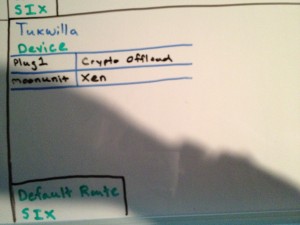
Another great DebConf is over. Two weeks ago, I was lingering a little longer in Nicaragua, enjoying some tropical holidays, and having a few To as with some fellow debconfers in Granada, and I exposed some rough ideas I've been incubating in the back of my head for some days. Since it had a positive initial reaction from the table (Gregor already volunteered to help!), I want to show it to a larger audience, in the hopes of getting some useful feedback, ideas, and maybe even some volunteers! The trigger was Zack's Bits from the DPL talk, and Enrico's post on the same topic. We need to recognise more what people is doing in the project, much valuable work is done in the shadows, and it is in our interest to make the people doing that work feel acknowledged, feel they are part of the project. The core of my idea is to create a web service that, for each person known to the project (let's say, http://whois.debian.net/tincho), shows a simple page with information about the person, optionally a mugshot/hackergotchi, what are they working on, maybe some stats and links (the Debian portfolio stuff, for example), and the core of this idea badges of merit, and attribution for their contributions. What I picture is having badges that say: Closed X RC bugs , Active translator for Esperanto , #1 video team camera operator in DC12 , Created 100 bugs .. You get the idea. In this ugly mock I created with my null designing skills, the idea might be a little more clear.
An important feature of the project is that it will be just a collector of information distributed in different places: This way, every team or project in Debian that wants to give recognition to its volunteers would easily do it, without needing to dive into the details of the code, or dealing with much bureaucracy. Just a signed mail with the pointer to the source of the data would be sufficient. I think the more complex part of this project would be matching different identities to real persons, in a way similar to carnivore, so we can match between different email addresses, a name, a Debian or alioth user-id (if applicable), IRC nickname, or any other identification that might be used to distinguish a person inside Debian. This might sound scary, but I don't plan on exposing or crawling any identities that are not currently publicly exposed, I just want to be able to see in a single page all the information associated both with my debian.org email address and with my gmail one. I have some basic design ideas, but I don't want to make this post even longer than what it is now. Please get in touch if you have comments, ideas, or if you want to flame me. Tags: Planet Debian

6 August 2012

Mike Hommey: Building a Linux kernel module without the exact kernel headers

Imagine you have a Linux kernel image for an Android phone, but you don t have the corresponding source, nor do you have the corresponding kernel headers. Imagine that kernel has module support (fortunately), and that you d like to build a module for it to load. There are several good reasons why you can t just build a new kernel from source and be done with it (e.g. the resulting kernel lacks support for important hardware, like the LCD or touchscreen). With the ever-changing Linux kernel ABI, and the lack of source and headers, you d think you re pretty much in a dead-end. As a matter of fact, if you build a kernel module against different kernel headers, the module will fail to load with errors depending on how different they are. It can complain about bad signatures, bad version or other different things. But more on that later. Configuring a kernel The first thing is to find a kernel source for something close enough to the kernel image you have. That s probably the trickiest part with getting a proper configuration. Start from the version number you can read from /proc/version. If, like me, you re targeting an Android device, try Android kernels from Code Aurora, Linaro, Cyanogen or Android, whichever is closest to what is in your phone. In my case, it was msm-3.0 kernel. Note you don t necessarily need the exact same version. A minor version difference is still likely to work. I ve been using a 3.0.21 source, which the kernel image was 3.0.8. Don t however try e.g. using a 3.1 kernel source when the kernel you have is 3.0.x. If the kernel image you have is kind enough to provide a /proc/config.gz file, you can start from there, otherwise, you can try starting from the default configuration, but you need to be extra careful, then (although I won t detail using the default configuration because I was fortunate enough that I didn t have to, there will be some details further below as to why a proper configuration is important). Assuming arm-eabi-gcc is in your PATH, and that you have a shell opened in the kernel source directory, you need to start by configuring the kernel and install headers and scripts:
$ mkdir build
$ gunzip -c config.gz > build/.config # Or whatever you need to prepare a .config
$ make silentoldconfig prepare headers_install scripts ARCH=arm CROSS_COMPILE=arm-eabi- O=build KERNELRELEASE= adb shell uname -r 
The silentoldconfig target is likely to ask you some questions about whether you want to enable some things. You may want to opt for the default, but that may also not work properly. You may use something different for KERNELRELEASE, but it needs to match the exact kernel version you ll be loading the module from. A simple module To create a dummy module, you need to create two files: a source file, and a Makefile. Place the following content in a hello.c file, in some dedicated directory:
#include <linux/module.h>       /* Needed by all modules */
#include <linux/kernel.h>       /* Needed for KERN_INFO */
#include <linux/init.h>         /* Needed for the macros */
static int __init hello_start(void)
 
  printk(KERN_INFO "Hello world\n");
  return 0;
 
static void __exit hello_end(void)
 
  printk(KERN_INFO "Goodbye world\n");
 
module_init(hello_start);
module_exit(hello_end);
Place the following content in a Makefile under the same directory:
obj-m = hello.o
Building such a module is pretty straightforward, but at this point, it won t work yet. Let me enter some details first. The building of a module When you normally build the above module, the kernel build system creates a hello.mod.c file, which content can create several kind of problems:
MODULE_INFO(vermagic, VERMAGIC_STRING);
VERMAGIC_STRING is derived from the UTS_RELEASE macro defined in include/generated/utsrelease.h, generated by the kernel build system. By default, its value is derived from the actual kernel version, and git repository status. This is what setting KERNELRELEASE when configuring the kernel above modified. If VERMAGIC_STRING doesn t match the kernel version, loading the module will lead to the following kind of message in dmesg:
hello: version magic '3.0.21-perf-ge728813-00399-gd5fa0c9' should be '3.0.8-perf'
Then, there s the module definition.
struct module __this_module
__attribute__((section(".gnu.linkonce.this_module"))) =  
 .name = KBUILD_MODNAME,
 .init = init_module,
#ifdef CONFIG_MODULE_UNLOAD
 .exit = cleanup_module,
#endif
 .arch = MODULE_ARCH_INIT,
 ;
In itself, this looks benign, but the struct module, defined in include/linux/module.h comes with an unpleasant surprise:
struct module
 
        (...)
#ifdef CONFIG_UNUSED_SYMBOLS
        (...)
#endif
        (...)
        /* Startup function. */
        int (*init)(void);
        (...)
#ifdef CONFIG_GENERIC_BUG
        (...)
#endif
#ifdef CONFIG_KALLSYMS
        (...)
#endif
        (...)
(... plenty more ifdefs ...)
#ifdef CONFIG_MODULE_UNLOAD
        (...)
        /* Destruction function. */
        void (*exit)(void);
        (...)
#endif
        (...)
 
This means for the init pointer to be at the right place, CONFIG_UNUSED_SYMBOLS needs to be defined according to what the kernel image uses. And for the exit pointer, it s CONFIG_GENERIC_BUG, CONFIG_KALLSYMS, CONFIG_SMP, CONFIG_TRACEPOINTS, CONFIG_JUMP_LABEL, CONFIG_TRACING, CONFIG_EVENT_TRACING, CONFIG_FTRACE_MCOUNT_RECORD and CONFIG_MODULE_UNLOAD. Start to understand why you re supposed to use the exact kernel headers matching your kernel? Then, the symbol version definitions:
static const struct modversion_info ____versions[]
__used
__attribute__((section("__versions"))) =  
	  0xsomehex, "module_layout"  ,
	  0xsomehex, "__aeabi_unwind_cpp_pr0"  ,
	  0xsomehex, "printk"  ,
 ;
These come from the Module.symvers file you get with your kernel headers. Each entry represents a symbol the module requires, and what signature it is expected to have. The first symbol, module_layout, varies depending on what struct module looks like, i.e. depending on which of the config options mentioned above are enabled. The second, __aeabi_unwind_cpp_pr0, is an ARM ABI specific function, and the last, is for our printk function calls. The signature for each function symbol may vary depending on the kernel code for that function, and the compiler used to compile the kernel. This means that if you have a kernel you built from source, modules built for that kernel, and rebuild the kernel after modifying e.g. the printk function, even in a compatible way, the modules you built initially won t load with the new kernel. So, if we were to build a kernel from the hopefully close enough source code, with the hopefully close enough configuration, chances are we wouldn t get the same signatures as the binary kernel we have, and it would complain as follows, when loading our module:
hello: disagrees about version of symbol symbol_name
Which means we need a proper Module.symvers corresponding to the binary kernel, which, at the moment, we don t have. Inspecting the kernel Conveniently, since the kernel has to do these verifications when loading modules, it actually contains a list of the symbols it exports, and the corresponding signatures. When the kernel loads a module, it goes through all the symbols the module requires, in order to find them in its own symbol table (or other modules symbol table when the module uses symbols from other modules), and check the corresponding signature. The kernel uses the following function to search in its symbol table (in kernel/module.c):
bool each_symbol_section(bool (*fn)(const struct symsearch *arr,
                                    struct module *owner,
                                    void *data),
                         void *data)
 
        struct module *mod;
        static const struct symsearch arr[] =  
                  __start___ksymtab, __stop___ksymtab, __start___kcrctab,
                  NOT_GPL_ONLY, false  ,
                  __start___ksymtab_gpl, __stop___ksymtab_gpl,
                  __start___kcrctab_gpl,
                  GPL_ONLY, false  ,
                  __start___ksymtab_gpl_future, __stop___ksymtab_gpl_future,
                  __start___kcrctab_gpl_future,
                  WILL_BE_GPL_ONLY, false  ,
#ifdef CONFIG_UNUSED_SYMBOLS
                  __start___ksymtab_unused, __stop___ksymtab_unused,
                  __start___kcrctab_unused,
                  NOT_GPL_ONLY, true  ,
                  __start___ksymtab_unused_gpl, __stop___ksymtab_unused_gpl,
                  __start___kcrctab_unused_gpl,
                  GPL_ONLY, true  ,
#endif
         ;
        if (each_symbol_in_section(arr, ARRAY_SIZE(arr), NULL, fn, data))
                return true;
        (...)
The struct used in this function is defined in include/linux/module.h as follows:
struct symsearch  
        const struct kernel_symbol *start, *stop;
        const unsigned long *crcs;
        enum  
                NOT_GPL_ONLY,
                GPL_ONLY,
                WILL_BE_GPL_ONLY,
          licence;
        bool unused;
 ;
Note: this kernel code hasn t changed significantly in the past four years. What we have above is three (or five, when CONFIG_UNUSED_SYMBOLS is defined) entries, each of which contains the start of a symbol table, the end of that symbol table, the start of the corresponding signature table, and two flags. The data is static and constant, which means it will appear as is in the kernel binary. By scanning the kernel for three consecutive sequences of three pointers within the kernel address space followed by two integers with the values from the definitions in each_symbol_section, we can deduce the location of the symbol and signature tables, and regenerate a Module.symvers from the kernel binary. Unfortunately, most kernels these days are compressed (zImage), so a simple search is not possible. A compressed kernel is actually a small bootstrap binary followed by a compressed stream. It is possible to scan the kernel zImage to look for the compressed stream, and decompress it from there. I wrote a script to do decompression and extraction of the symbols info automatically. It should work on any recent kernel, provided it is not relocatable and you know the base address where it is loaded. It takes options for the number of bits and endianness of the architecture, but defaults to values suitable for ARM. The base address, however, always needs to be provided. It can be found, on ARM kernels, in dmesg:
$ adb shell dmesg   grep "\.init"
<5>[01-01 00:00:00.000] [0: swapper]      .init : 0xc0008000 - 0xc0037000   ( 188 kB)
The base address in the example above is 0xc0008000. If like me you re interested in loading the module on an Android device, then what you have as a binary kernel is probably a complete boot image. A boot image contains other things besides the kernel, so you can t use it directly with the script. Except if the kernel in that boot image is compressed, in which case the part of the script that looks for the compressed image will find it anyways. If the kernel is not compressed, you can use the unbootimg program as outlined in this old post of mine to get the kernel image out of your boot image. Once you have the kernel image, the script can be invoked as follows:
$ python extract-symvers.py -B 0xc0008000 kernel-filename > Module.symvers
Symbols and signature info could also be extracted from binary modules, but I was not interested in that information so the script doesn t handle that. Building our module Now that we have a proper Module.symvers for the kernel we want to load our module in, we can finally build the module: (again, assuming arm-eabi-gcc is in your PATH, and that you have a shell opened in the kernel source directory)
$ cp /path/to/Module.symvers build/
$ make M=/path/to/module/source ARCH=arm CROSS_COMPILE=arm-eabi- O=build modules
And that s it. You can now copy the resulting hello.ko onto the device and load it. and enjoy
$ adb shell
# insmod hello.ko
# dmesg   grep insmod
<6>[mm-dd hh:mm:ss.xxx] [id: insmod]Hello world
# lsmod
hello 586 0 - Live 0xbf008000 (P)
# rmmod hello
# dmesg   grep rmmod
<6>[mm-dd hh:mm:ss.xxx] [id: rmmod]Goodbye world

5 August 2012

Gregor Herrmann: RC bugs 2012/31

this was my first week at work after my vacations, & also the first week of "normal" RC bug work. here's my short report:
31 July 2012

Russell Coker: Cheap SATA Disks in a Dell PowerEdge T410

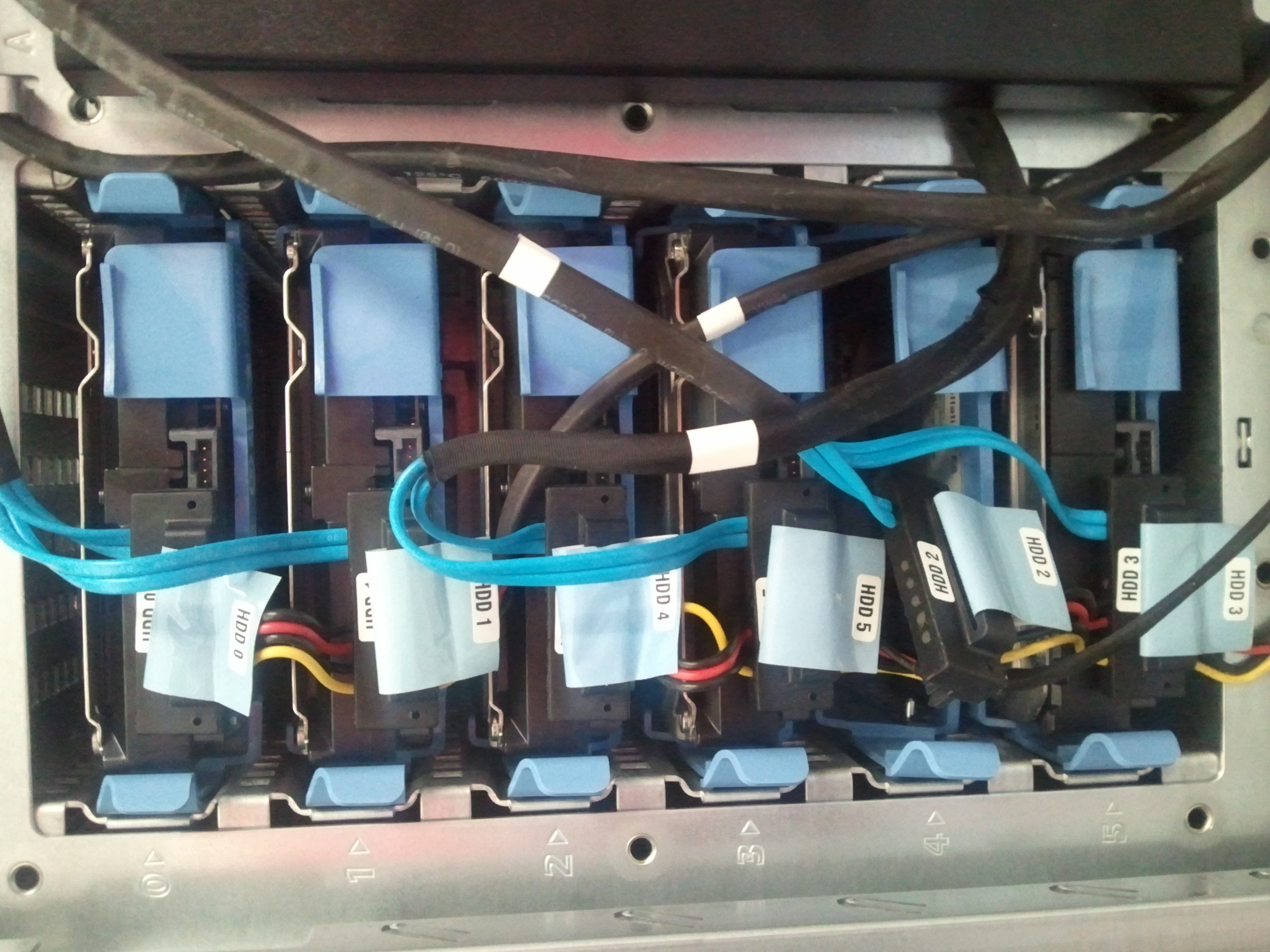
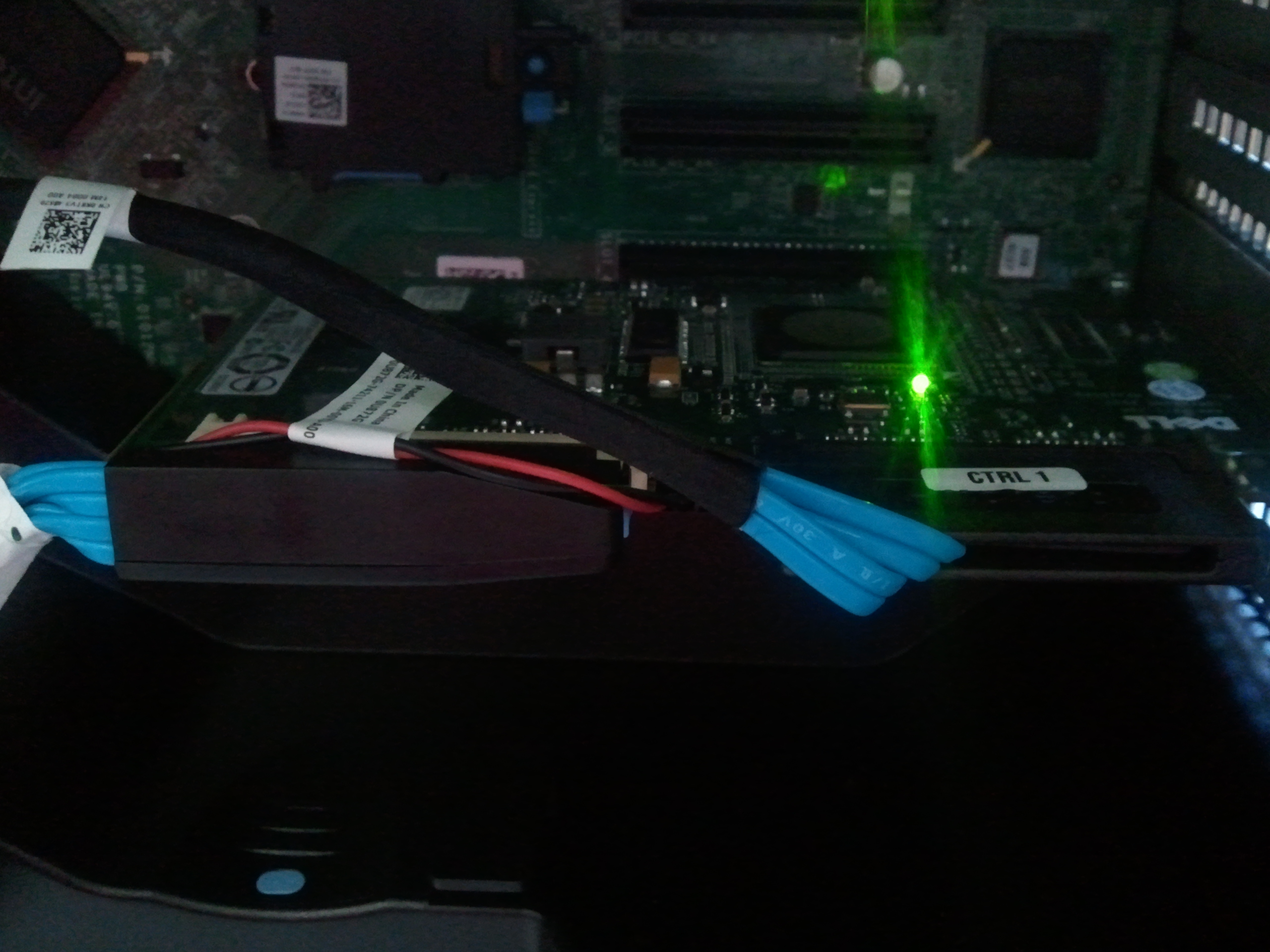
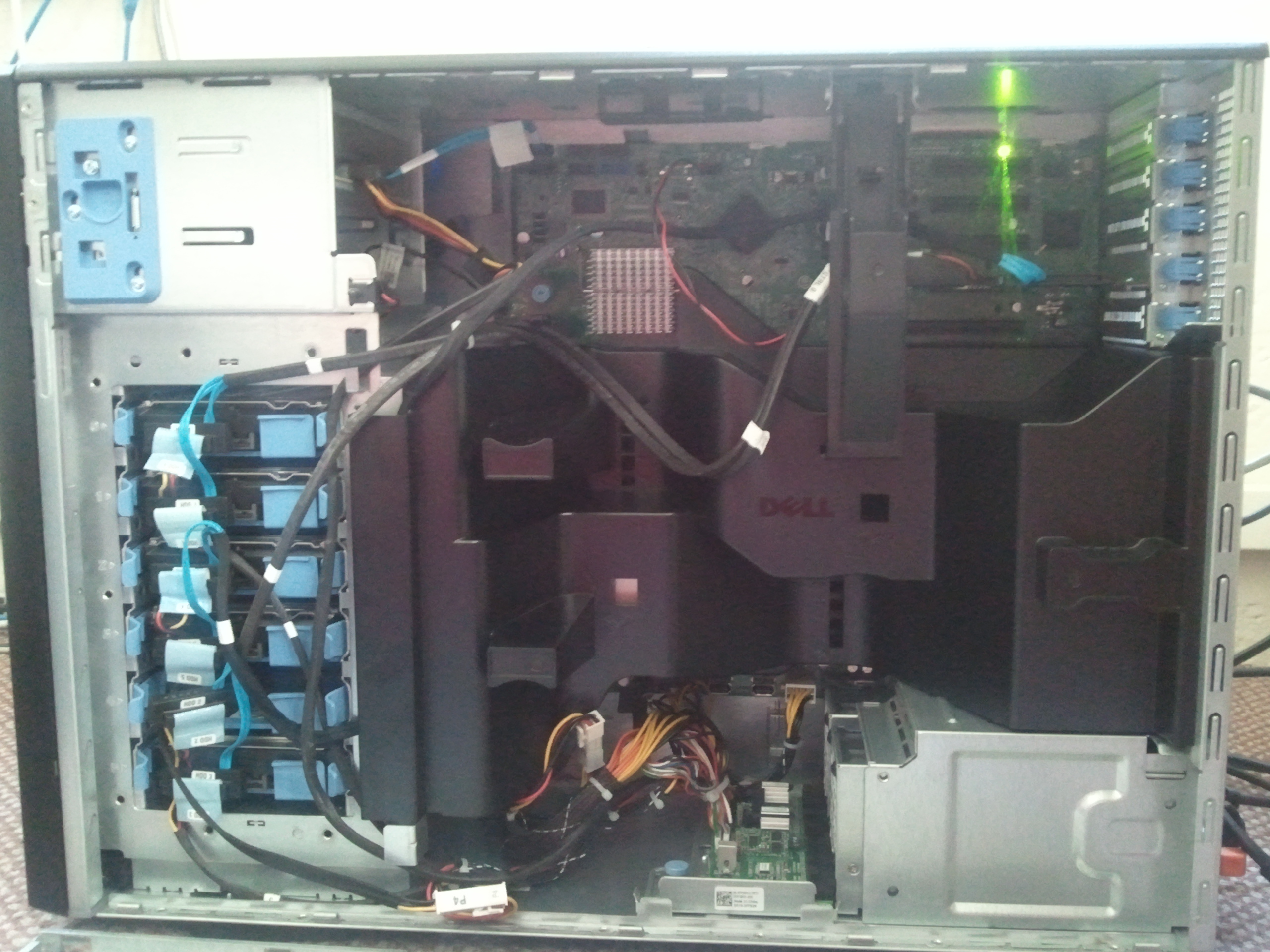
A non-profit organisation I support has just bought a Dell PowerEdge T410 server to be mainly used as a file server. We need a reasonable amount of space and really good reliability features because the system may have periods without being actively monitored, it also has to be relatively cheap. Dell servers are quite cheap, but disks are not cheap at all when Dell sells them. I get the impression that disks and RAM are major profit centers for Dell and that the profit margins on the basic servers are quite small. So naturally we decided to buy some SATA disks from a local store, one advantage of this is that Dell sells nothing bigger than 2TB while 3TB disks are available cheaply everywhere else. So we bought 4 cheap 3TB (2.7TiB) SATA disks, connected them to the server, and found that only 2TiB was accessible. The Dell Tech Center says that some of the RAID controllers don t support anything larger than 2TiB [1]. Obviously we have one of the older models. There s lots of SATA sockets on the motherboard that could be used, however there is one problem. View of the open side of a PowerEdge T410 The above picture is the side view of the T410, it was taken with a Samsung Galaxy S so the quality is a little poor (click for the original picture). The server is quite neat, not many cables for a system with 6 disks, not the 12 separate cables you would get in a typical white-box system. Disks in a PowerEdge T410 The above picture shows the disk enclosure. You can see that each disk has a single connector for power and data, also the disks aren t separate, multiple disks have the same power wires and the data cables are paired. SAS controller in a PowerEdge T410 Above you can see the SAS controller, it has two large connectors that can each handle the data cables for 4 disks, nothing like the standard cables. It s easy to buy SATA data cables and connect them, but there are no spare power cables in the box. The connector that supplies power to all the disks appears to be something proprietary to Dell which goes straight to the double-connectors on each disk that supply power and data. This setup makes cabling very neat but also provides no good option for cabling regular disks. I m sure I could make my own cables and if I hunted around the net enough I could probably buy some matching power cables, but it would be a hassle and the result wouldn t be neat. So the question was then whether to go to more effort, expense, and possibly risk the warranty to get the full 3TB or to just use the SAS controller and get 2TiB (2.2TB) per disk. One factor we considered is the fact that the higher sector numbers typically give much slower access times due to being on shorter tracks (see my ZCAV results page for test results from past disks [2]). We decided that 2.2TB (2TiB) out of 3TB (2.7TiB) was adequate capacity and that losing some of the slow parts of the disk wasn t a big deal. I ve now setup a RAID-Z2 array on the disks, and ZFS reports 3.78TiB available capacity, which isn t a lot considering that we have 4*3TB disks in the array. But the old server had only 200G of storage, so it s a good improvement in capacity, performance, and RAID-Z2 should beat the hell out of RAID-6 for reliability. Related posts:
  1. Dell PowerEdge T105 Today I received a Dell PowerEDGE T105 for use by...
  2. ZFS vs BTRFS on Cheap Dell Servers I previously wrote about my first experiences with BTRFS [1]....
  3. How I Partition Disks Having had a number of hard drives fail over the...

Russell Coker: ZFS on Debian/Wheezy

As storage capacities increase the probability of data corruption increases as does the amount of time required for a fsck on a traditional filesystem. Also the capacity of disks is increasing a lot faster than the contiguous IO speed which means that the RAID rebuild time is increasing, for example my first hard disk was 70M and had a transfer rate of 500K/s which meant that the entire contents could be read in a mere 140 seconds! The last time I did a test on a more recent disk a 1TB SATA disk gave contiguous transfer rates ranging from 112MB/s to 52MB/s which meant that reading the entire contents took 3 hours and 10 minutes, and that problem is worse with newer bigger disks. The long rebuild times make greater redundancy more desirable. BTRFS vs ZFS Both BTRFS and ZFS checksum all data to cover the case where a disk returns corrupt data, they don t need a fsck program, and the combination of checksums and built-in RAID means that they should have less risk of data loss due to a second failure during rebuild. ZFS supports RAID-Z which is essentially a RAID-5 with checksums on all blocks to handle the case of corrupt data as well as RAID-Z2 which is a similar equivalent to RAID-6. RAID-Z is quite important if you don t want to have half your disk space taken up by redundancy or if you want to have your data survive the loss or more than one disk, so until BTRFS has an equivalent feature ZFS offers significant benefits. Also BTRFS is still rather new which is a concern for software that is critical to data integrity. I am about to install a system to be a file server and Xen server which probably isn t going to be upgraded a lot over the next few years. It will have 4 disks so ZFS with RAID-Z offers a significant benefit over BTRFS for capacity and RAID-Z2 offers a significant benefit for redundancy. As it won t be upgraded a lot I ll start with Debian/Wheezy even though it isn t released yet because the system will be in use without much change well after Squeeze security updates end. ZFS on Wheezy Getting ZFS to basically work isn t particularly hard, the ZFSonLinux.org site has the code and reasonable instructions for doing it [1]. The zfsonlinux code doesn t compile out of the box on Wheezy although it works well on Squeeze. I found it easier to get a the latest Ubuntu working with ZFS and then I rebuilt the Ubuntu packages for Debian/Wheezy and they worked. This wasn t particularly difficult but it s a pity that the zfsonlinux site didn t support recent kernels. Root on ZFS The complication with root on ZFS is that the ZFS FAQ recommends using whole disks for best performance so you can avoid alignment problems on 4K sector disks (which is an issue for any disk large enough that you want to use it with ZFS) [2]. This means you have to either use /boot on ZFS (which seems a little too experimental for me) or have a separate boot device. Currently I have one server running with 4*3TB disks in a RAID-Z array and a single smaller disk for the root filesystem. Having a fifth disk attached by duct-tape to a system that is only designed for four disks isn t ideal, but when you have an OS image that is backed up (and not so important) and a data store that s business critical (but not needed every day) then a failure on the root device can be fixed the next day without serious problems. But I want to fix this and avoid creating more systems like it. There is some good documentation on using Ubuntu with root on ZFS [3]. I considered using Ubuntu LTS for the server in question, but as I prefer Debian and I can recompile Ubuntu packages for Debian it seems that Debian is the best choice for me. I compiled those packages for Wheezy, did the install and DKMS build, and got ZFS basically working without much effort. The problem then became getting ZFS to work for the root filesystem. The Ubuntu packages didn t work with the Debian initramfs for some reason and modules failed to load. This wasn t necessarily a show-stopper as I can modify such things myself, but it s another painful thing to manage and another way that the system can potentially break on upgrade. The next issue is the unusual way that ZFS mounts filesystems. Instead of having block devices to mount and entries in /etc/fstab the ZFS system does things for you. So if you want a ZFS volume to be mounted as root you configure the mountpoint via the zfs set mountpoint command. This of course means that it doesn t get mounted if you boot with a different root filesystem and adds some needless pain to the process. When I encountered this I decided that root on ZFS isn t a good option. So for this new server I ll install it with an Ext4 filesystem on a RAID-1 device for root and /boot and use ZFS for everything else. Correct Alignment After setting up the system with a 4 disk RAID-1 (or mirror for the pedants who insist that true RAID-1 has only two disks) for root and boot I then created partitions for ZFS. According to fdisk output the partitions /dev/sda2, /dev/sdb2 etc had their first sector address as a multiple of 2048 which I presume addresses the alignment requirement for a disk that has 4K sectors. Installing ZFS deb http://www.coker.com.au wheezy zfs I created the above APT repository (only AMD64) for ZFS packages based on Darik Horn s Ubuntu packages (thanks for the good work Darik). Installing zfs-dkms, spl-dkms, and zfsutils gave a working ZFS system. I could probably have used Darik s binary packages but I think it s best to rebuild Ubuntu packages to use on Debian. The server in question hasn t gone live in production yet (it turns out that we don t have agreement on what the server will do). But so far it seems to be working OK. Related posts:
  1. Discovering OS Bugs and Using Snapshots I m running Debian/Unstable on an EeePC 701, I ve got an...
  2. Starting with BTRFS Based on my investigation of RAID reliability [1] I have...
  3. ZFS vs BTRFS on Cheap Dell Servers I previously wrote about my first experiences with BTRFS [1]....

28 July 2012

Vincent Bernat: Switching to the awesome window manager

I have happily used FVWM as my window manager for more than 10 years. However, I recently got tired of manually arranging windows and using the mouse so much. A window manager is one of the handful pieces of software getting in your way at every moment which explains why there are so many of them and why we might put so much time in it. I decided to try a tiling window manager. While i3 seemed pretty hot and powerful (watch the screencast!), I really wanted something configurable and extensible with some language. So far, the common choices are: I chose awesome, despite the fact that StumpWM vote for Lisp seemed a better fit (but it is more minimalist). I hope there is some parallel universe where I enjoy StumpWM. Visually, here is what I got so far: awesome dual screen setup

Awesome configuration Without a configuration file, awesome does nothing. It does not come with any hard-coded behavior: everything needs to be configured through its Lua configuration file. Of course, a default one is provided but you can also start from scratch. If you like to control your window manager, this is somewhat wonderful. awesome is well documented. The wiki provides a FAQ, a good introduction and the API reference is concise enough to be read from the top to the bottom. Knowing Lua is not mandatory since it is quite easy to dive into such a language. I have posted my configuration on GitHub. It should not be used as is but some snippets may be worth to be stolen and adapted into your own configuration. The following sections put light on some notable points.

Keybindings Ten years ago was the epoch of scavanger hunts to recover IBM Model M keyboards from waste containers. They were great to type on and they did not feature the infamous Windows keys. Nowadays, this is harder to get such a keyboard. All my keyboards now have Windows keys. This is a major change with respect to configure a window manager: the left Windows key is mapped to Mod4 and is usually unused by most applications and can therefore be dedicated to the window manager. The main problem with the ability to define many keybindings is to remember the less frequently used one. I have monkey-patched awful.key module to be able to attach a documentation string to a keybinding. I have documented the whole process on the awesome wiki. awesome online help

Quake console A Quake console is a drop-down terminal which can be toggled with some key. I was heavily relying on it in FVWM. I think this is still a useful addition to any awesome configuration. There are several possible solutions documented in the awesome wiki. I have added my own1 which works great for me. Quake console

XRandR XRandR is an extension which allows to dynamically reconfigure outputs: you plug an external screen to your laptop and you issue some command to enable it:
$ xrandr --output VGA-1 --auto --left-of LVDS-1
awesome detects the change and will restart automatically. Laptops usually come with a special key to enable/disable an external screen. Nowadays, this key does nothing unless configured appropriately. Out of the box, it is mapped to XF86Display symbol. I have associated this key to a function that will cycle through possible configurations depending on the plugged screens. For example, if I plug an external screen to my laptop, I can cycle through the following configurations:
  • only the internal screen,
  • only the external screen,
  • internal screen on the left, external screen on the right,
  • external screen on the left, internal screen on the right,
  • no change.
The proposed configuration is displayed using naughty, the notification system integrated in awesome. Notification of screen reconfiguration

Widgets I was previously using Conky to display various system-related information, like free space, CPU usage and network usage. awesome comes with widgets that can fit the same use. I am relying on vicious, a contributed widget manager, to manage most of them. It allows one to attach a function whose task is to fetch values to be displayed. This is quite powerful. Here is an example with a volume widget:
local volwidget = widget(  type = "textbox"  )
vicious.register(volwidget, vicious.widgets.volume,
         '<span font="Terminus 8">$2 $1%</span>',
        2, "Master")
volwidget:buttons(awful.util.table.join(
             awful.button(   , 1, volume.mixer),
             awful.button(   , 3, volume.toggle),
             awful.button(   , 4, volume.increase),
             awful.button(   , 5, volume.decrease)))
You can also use a function to format the text as you wish. For example, you can display a value in red if it is too low. Have a look at my battery widget for an example. Various widgets

Miscellaneous While I was working on my awesome configuration, I also changed some other desktop-related bits.

Keyboard configuration I happen to setup all my keyboards to use the QWERTY layout. I use a compose key to input special characters like . I have also recently use Caps Lock as a Control key. All this is perfectly supported since ages by X11 I am also mapping the Pause key to XF86ScreenSaver key symbol which will in turn be bound to a function that will trigger xautolock to lock the screen. Thanks to a great article about extending the X keyboard map with xkb, I discovered that X was able to switch from one layout to another using groups2. I finally opted for this simple configuration:
$ setxkbmap us,fr '' compose:rwin ctrl:nocaps grp:rctrl_rshift_toggle
$ xmodmap -e 'keysym Pause = XF86ScreenSaver'
I switch from us to fr by pressing both left Control and left Shift keys.

Getting rid of most GNOME stuff Less than one year ago, to take a step forward to the future, I started to heavily rely on some GNOME components like GNOME Display Manager, GNOME Power Manager, the screen saver, gnome-session, gnome-settings-daemon and others. I had numerous problems when I tried to setup everything without pulling the whole GNOME stack. At each GNOME update, something was broken: the screensaver didn t start automatically anymore until a full session restart or some keybindings were randomly hijacked by gnome-settings-daemon. Therefore, I have decided to get rid of most of those components. I have replaced GNOME Power Manager with system-level tools like sleepd and the PM utilities. I replaced the GNOME screensaver with i3lock and xautolock. GDM has been replaced by SLiM which now features ConsoleKit support3. I use ~/.gtkrc-2.0 and ~/.config/gtk-3.0/settings.ini to configure GTK+. The future will wait.

Terminal color scheme I am using rxvt-unicode as my terminal with a black background (and some light transparency). The default color scheme is suboptimal on the readability front. Sharing terminal color schemes seems a popular activity. I finally opted for the derp color scheme which brings a major improvement over the default configuration. Comparison of terminal color schemes I have also switched to Xft for font rendering using DejaVu Sans Mono as my default font (instead of fixed) with the following configuration in ~/.Xresources:
Xft.antialias: true
Xft.hinting: true
Xft.hintstyle: hintlight
Xft.rgba: rgb
URxvt.font: xft:DejaVu Sans Mono-8
URxvt.letterSpace: -1
The result is less crisp but seems a bit more readable. I may switch back in the future. Comparison of terminal fonts

Next steps My reliance to the mouse has been greatly reduced. However, I still need it for casual browsing. I am looking at luakit a WebKit-based browser extensible with Lua for this purpose.

  1. The console gets its own unique name. This allows awesome to reliably detect when it is spawned, even on restart. It is how the Quake console works in the mod of FVWM I was using.
  2. However, the layout is global, not per-window. If you are interested by a per-window layout, take a look at kbdd.
  3. Nowadays, you cannot really survive without ConsoleKit. Many PolicyKit policies do not rely on groups any more to grant access to your devices.

25 July 2012

Diego Escalante Urrelo: A Coru a, d a uno

You can follow the latest GUADEC updates from @guadec and @diegoe.

Isa, Alejo, Laura, and Germ n stealing a mug.

GUADEC just started. Or at least, the arrangements for GUADEC.

The local team is hard at work at the GUADEC HQ of the Facultade de Inform tica, they are really working really hard to make sure that there is a proper wired network setup (yes, you read that right!), a great video setup to record all the talks and publish them as soon as possible and setting up the final details of rooms, info desk, accommodation

If you are staying at the Rialta, you can take the hourly bus to the Facultade (just ask the driver). The bus departs from the frontis of Block 3. Ask the driver to let you know when to get off the bus. He is aware of GUADEC so your gringo-spanish should suffice.

We will be holding a pre-registration party tonight at 21:00 (9pm) just outside the Rialta cafeteria. If you are already here drop by for the Queimada by Alejo, our galician wizard.

23 July 2012

Michal &#268;iha&#345;: Weblate hacking #1

The first day of Hackweek VIII is about to end for me and it's time to share some of the results. As planned, I've started hacking on Weblate. The most prominent feature from today are email notifications. You can now monitor the translation in various ways - be informed about new strings to translate, new contributor, added suggestion or simply watch all translations. Another bigger change is rearranging of main page, which now provides instant access to per language stats, which were quite hidden before. Rest of time was spent on adding some sort of spam protection (need to deploy this to demo to see how successful it is) and one more promoting widget (88x31 pixels). There are 6 open issues targeted for 1.2 release, so there is still something to do in next days :-).

Filed under: English Suse Weblate 0 comments Flattr this!

21 July 2012

Andrew Pollock: [life] Sarah sans gallbladder

I can't remember exactly when, it was either pre-Zoe heart-related diagnostic imaging or during her pregnancy with Zoe, that it became apparent that Sarah had gall stones. Apparently it's not uncommon for women to develop them after pregnancy, and it turns out that Sarah is slightly more genetically predisposed to getting them to boot. So it wasn't terribly surprising when she started having some pain recently. She had another ultrasound to confirm it, and went off to see a surgeon. Apparently they care more about the symptoms than the number of stones in the gallbladder, and they don't bother removing the stones and keeping the gallbladder, so she was booked in for a cholecystectomy last Thursday. It was a pretty straightforward procedure, she was out of the operating room in just under an hour, and awake a bit over an hour after that. I've had a few friends need to have a cholecystectomy, and the photos on Wikipedia have always fascinated me, particularly this one. It seems so freaky to have a gallbladder full of that much gravel. It can't be comfortable. We're going to be able to pick up Sarah's stones on Monday, so it'll be interesting to see what they look like. Sarah's recovering now. It's one of the few surgeries she's had under general anaesthesia where she hasn't been sick afterwards, so that was a good start. The procedure was done laparoscopically, using four incisions, and to give themselves room to work, they inflate the body with carbon dioxide gas, which then has to work its way out of her body over the following days. So she's dealing with some bloating, bruising and swelling at the moment, but not doing too badly. Apparently if you're vertical for too long, the gas can work its way up to your diaphragm, which causes some shoulder pain, so the trick has been to walk around a bit, then lie down for a bit, and then rinse and repeat. She's not allowed to lift Zoe for 3-4 weeks, which presents a few challenges for us, but nothing insurmountable (hopefully). We converted Zoe's crib to a toddler bed a week before the surgery, and Zoe thought that was just the best thing ever, and has taken to it really well. I'm around at home for breakfast and dinner, so I can take care of the lifting into and out of the high chair for those meals, and Zoe can eat lunch at her little table. Zoe's also pretty good about getting into and out of the car by herself (not that Sarah can drive until she's off the painkillers) and she's normally in daycare two days a week. She's in daycare again on Monday, so Sarah won't have to deal with Zoe on her own until Tuesday, and we have backup daycare arrangements we can fall back on if need be. Zoe's been very good about Sarah not being able to pick her up, and been very gentle. It helped with the explanation that Sarah could show her all of her "owwies". The surgeon was saying that only 1 in 400 people need to alter their diet after removing their gallbladder, so we're hopeful that Sarah will do just fine without it. She'll certainly be more comfortable in the long run.

17 July 2012

Luciano Bello: there is no cabal.. but, what s a cabal?

In my long trip to Nicaragua I made progress in my reading: Quicksilver, by Neal Stephenson. In the Spanish edition the title is Azogue. But I m assuming that you are not a Spanish speaker. Here is a small fragment (in English) I found there:
You must remember that the planters are short-sighted. They re all desperate to get out of Jamaica they wake up every day expecting to find themselves, or their children, in the grip of some tropical fever. To import female Neegers would cost nearly as much as to import males, but the females cannot produce as much sugar particularly when they are breeding. Daniel had finally recognized this voice as belonging to Sir Richard Apthorp the second A in the CABAL.
It s a bit embarrassing when I discovered myself realizing where the word cabal comes from. And I m posting this as a head-up for everyone who know there is no cabal in Debian; but they don t know which is the origin of the word cabal. Stephenson changed the name of the historic cabal, a group of high councillers of King Charles II of England, Scotland and Ireland, in 1668. In the novel, they are: John Comstock (Earl of Epsom), Louis Anglesey (Duke of Gunfleet), Knott Bolstrood (Count Penistone), Sir Richard Apthorp and Hugh Lewis (Duke of Tweed). In the real world they had been:
Thomas Clifford, 1st Baron Clifford of Chudleigh (1630-1673). Henry Bennet, 1st Earl of Arlington (1618-1685). George Villiers, 2nd Duke of Buckingham (1628-1687). Anthony Ashley Cooper, 1st Baron Ashley of Wimborne St Giles (1621-1683). John Maitland, 1st Duke of Lauderdale (1616-1682).
This group shared the effective power in a royal council rather than the King.

Ritesh Raj Sarraf: Reporting bugs with Apport - II

This is a follow up to the previous post regarding Reporting bugs with ApportApport, version 2.2.3-2, has been pushed to experimental. There were some nice feedback that led to some more changes that I will talk here.Opt out: As a developer, if you see the volume of reports to be annoying, you have the option to opt out of apport reports. To do this, you should specify the XBS-Apport: No field in your package's control file. When your application crashes, apport first checks for that field in your package's description and acts based on what you chose.Following image is that the user sees for packages where the developer has opted out.opt outRepetition: Repetition of the same crash could lead to multiple reports on the same buggy behavior. For this, apport, if senses that you have already filed a bug, it provides you with the option to further ignore all crashes for that particular type.Following image should explain it better.ignore report My initial thought regarding defaults was to make apport a default opt out tool for the entire archive and only file reports for packages where the developer has manually enabled to opt-in for apport reports. But that'd have been very slow in terms of adoption, hence, for now, instead, the version in experimental does it the other way around. It will file bug reports for all packages. If you need to opt out, you will have to add the above expalined control field. That's it for this post. Please provide feedback once you spend some time with apport.PS: Please take conscious steps when filing bug reports with apport. I think it is a great tool. It just needs great users. :-)

Categories:
Keywords:

14 July 2012

Christian Perrier: Debconf 12 work

As already written, even though it seems, I didn't spend my time running at Debconf12. Or eating cheese... Or (tentatively) hiking volcanoes... Or helping people to kill each other with socks... Or drinking beers... Not *only* all of these (some of them at the same time, though hiking a volcano while eating cheese and drinking beers is not particularly easy)....but also some Debian work. So, I uploaded a backport of samba to squeeze backports and our squeeze users should now have the same samba version than wheezy ones. I also stopped several cronjobs on i18n.debian.net and moved some material there as links have been (or should be) moved to the brand new i18n.debian.org (and its alias l10n.debian.org). I did a major cleanup in tasksel, committed several fixes, proposed others for review (mostly to Joey Hess). All this in preparation for a soon-to-come upload, probably after D-I beta1 which has been prepared by Cyril Brulebois while he was.....not attending Debconf12.. I also followed the integration of Sorina Sandu's work on netcfg for link detection and network ESSID choice in Debian Installer. Sorina is doing well in her GSOC work, because she's clearly someone with great capabilities who we will, I hope, be able to keep contributing to Debian. We can also thank the mentoring work of Gaudenz Steinlin to guide Sorina through D-I's arcanes. I also went through the current status of debconf translation completeness in testing for the 7 languages that target 100% (Czech, German, Spanish, French, Portuguese, Russian, Swedish). Here, the point is mostly taking care that fixes are either: I can we have good chances to achieve this goal for at least 6 of these 7 languages (Czech might be more tricky as several translations are not yet made). Finally, I also did most of my regular Debian work (which usually takes 1-2 hours every day)...and bits of my paid work (sorry for those people who I shared the table at breakfast, but that was my only common time window with my team at work). So, well, quite productive weeks, once again.

13 July 2012

C.J. Adams-Collier: New whiteboarding

I should also sketch out the physical and virtual circuits at and between each PoP as well as the vast array of Virtual Machines provisioned on the hypervisors.
12 July 2012

Ritesh Raj Sarraf: Reporting bugs with Apport

So yet another bug reporting tool. :-)When I prepared Apport for Debian, I wasn't sure how it will look going forward. If you look at the current one lying in experimental, it just detects your crashes and pops up in your systray. It doesn't have the mechanism to interact with BTS.So, like the title of this post says, this is the first worthy feature for Apport in the context of Debian.Apport Detail ReportNothing special here. You would have seen a similar window before if you have installed apport. What changes with this release is, that now, when you check the Send an error report to help fix this problem, it will really file a bug report on the BTS.Here's what the emailed bug report will look like:
Package: leafnode
Version: 2.0.0.alpha20090406a-1
=============================
ProblemType: Crash
Architecture: amd64
Date: Tue Jul  3 00:08:02 2012
Dependencies:
 adduser 3.113+nmu3
 base-passwd 3.5.24
 cron 3.0pl1-123
 debconf 1.5.44
 debianutils 4.3.1
 dpkg 1.16.4.3
 gcc-4.7-base 4.7.1-2
 libbz2-1.0 1.0.6-3
 libc-bin 2.13-33
 libc6 2.13-33
 libclass-isa-perl 0.36-3
 libdb5.1 5.1.29-4
 libfile-copy-recursive-perl 0.38-1
 libgcc1 1:4.7.1-2
 libgdbm3 1.8.3-11
 liblzma5 5.1.1alpha+20120614-1
 libpam-modules 1.1.3-7.1
 libpam-modules-bin 1.1.3-7.1
 libpam-runtime 1.1.3-7.1
 libpam0g 1.1.3-7.1
 libpcre3 1:8.30-5
 libpopt0 1.16-7
 libselinux1 2.1.9-5
 libsemanage-common 2.1.6-6
 libsemanage1 2.1.6-6
 libsepol1 2.1.4-3
 libswitch-perl 2.16-2
 libustr-1.0-1 1.0.4-3
 libwrap0 7.6.q-23
 logrotate 3.8.1-4
 lsb-base 4.1+Debian7 [modified: lib/lsb/init-functions]
 multiarch-support 2.13-33
 netbase 5.0
 openbsd-inetd 0.20091229-2
 passwd 1:4.1.5.1-1
 perl 5.14.2-12
 perl-base 5.14.2-12
 perl-modules 5.14.2-12
 sensible-utils 0.0.7
 tar 1.26-4
 tcpd 7.6.q-23
 update-inetd 4.43
 zlib1g 1:1.2.7.dfsg-13
Disassembly:
 => 0x7f8e69738475 <*__GI_raise+53>:	cmp    $0xfffffffffffff000,%rax
    0x7f8e6973847b <*__GI_raise+59>:	ja     0x7f8e69738492 <*__GI_raise+82>
    0x7f8e6973847d <*__GI_raise+61>:	repz retq 
    0x7f8e6973847f <*__GI_raise+63>:	nop
    0x7f8e69738480 <*__GI_raise+64>:	test   %eax,%eax
    0x7f8e69738482 <*__GI_raise+66>:	jg     0x7f8e69738465 <*__GI_raise+37>
    0x7f8e69738484 <*__GI_raise+68>:	test   $0x7fffffff,%eax
    0x7f8e69738489 <*__GI_raise+73>:	jne    0x7f8e697384a2 <*__GI_raise+98>
    0x7f8e6973848b <*__GI_raise+75>:	mov    %esi,%eax
    0x7f8e6973848d <*__GI_raise+77>:	nopl   (%rax)
    0x7f8e69738490 <*__GI_raise+80>:	jmp    0x7f8e69738465 <*__GI_raise+37>
    0x7f8e69738492 <*__GI_raise+82>:	mov    0x34e97f(%rip),%rdx        # 0x7f8e69a86e18
    0x7f8e69738499 <*__GI_raise+89>:	neg    %eax
    0x7f8e6973849b <*__GI_raise+91>:	mov    %eax,%fs:(%rdx)
    0x7f8e6973849e <*__GI_raise+94>:	or     $0xffffffff,%eax
    0x7f8e697384a1 <*__GI_raise+97>:	retq
DistroRelease: Debian 7.0
ExecutablePath: /usr/sbin/fetchnews
ExecutableTimestamp: 1265584779
Package: leafnode 2.0.0.alpha20090406a-1
PackageArchitecture: amd64
ProcCmdline: /usr/sbin/fetchnews
ProcCwd: /
ProcEnviron:
 LANGUAGE=en_US:en
 LC_TIME=en_IN.UTF-8
 LC_MONETARY=en_IN.UTF-8
 PATH=(custom, no user)
 LC_ADDRESS=en_IN.UTF-8
 LANG=en_US.UTF-8
 LC_TELEPHONE=en_IN.UTF-8
 LC_NAME=en_IN.UTF-8
 SHELL=/bin/sh
 LC_MEASUREMENT=en_IN.UTF-8
 LC_NUMERIC=en_IN.UTF-8
 LC_PAPER=en_IN.UTF-8
ProcMaps:
 00400000-00421000 r-xp 00000000 08:06 4464934                            /usr/sbin/fetchnews
 00621000-00622000 rw-p 00021000 08:06 4464934                            /usr/sbin/fetchnews
 00622000-00623000 rw-p 00000000 00:00 0 
 00be4000-00c05000 rw-p 00000000 00:00 0                                  [heap]
 7f8e68edc000-7f8e68eef000 r-xp 00000000 08:06 1179776                    /lib/x86_64-linux-gnu/libresolv-2.13.so
 7f8e68eef000-7f8e690ee000 ---p 00013000 08:06 1179776                    /lib/x86_64-linux-gnu/libresolv-2.13.so
 7f8e690ee000-7f8e690ef000 r--p 00012000 08:06 1179776                    /lib/x86_64-linux-gnu/libresolv-2.13.so
 7f8e690ef000-7f8e690f0000 rw-p 00013000 08:06 1179776                    /lib/x86_64-linux-gnu/libresolv-2.13.so
 7f8e690f0000-7f8e690f2000 rw-p 00000000 00:00 0 
 7f8e690f2000-7f8e690f7000 r-xp 00000000 08:06 1180036                    /lib/x86_64-linux-gnu/libnss_dns-2.13.so
 7f8e690f7000-7f8e692f6000 ---p 00005000 08:06 1180036                    /lib/x86_64-linux-gnu/libnss_dns-2.13.so
 7f8e692f6000-7f8e692f7000 r--p 00004000 08:06 1180036                    /lib/x86_64-linux-gnu/libnss_dns-2.13.so
 7f8e692f7000-7f8e692f8000 rw-p 00005000 08:06 1180036                    /lib/x86_64-linux-gnu/libnss_dns-2.13.so
 7f8e692f8000-7f8e692fa000 r-xp 00000000 08:06 1183392                    /lib/libnss_mdns4_minimal.so.2
 7f8e692fa000-7f8e694f9000 ---p 00002000 08:06 1183392                    /lib/libnss_mdns4_minimal.so.2
 7f8e694f9000-7f8e694fa000 rw-p 00001000 08:06 1183392                    /lib/libnss_mdns4_minimal.so.2
 7f8e694fa000-7f8e69505000 r-xp 00000000 08:06 1180055                    /lib/x86_64-linux-gnu/libnss_files-2.13.so
 7f8e69505000-7f8e69704000 ---p 0000b000 08:06 1180055                    /lib/x86_64-linux-gnu/libnss_files-2.13.so
 7f8e69704000-7f8e69705000 r--p 0000a000 08:06 1180055                    /lib/x86_64-linux-gnu/libnss_files-2.13.so
 7f8e69705000-7f8e69706000 rw-p 0000b000 08:06 1180055                    /lib/x86_64-linux-gnu/libnss_files-2.13.so
 7f8e69706000-7f8e69883000 r-xp 00000000 08:06 1179700                    /lib/x86_64-linux-gnu/libc-2.13.so
 7f8e69883000-7f8e69a83000 ---p 0017d000 08:06 1179700                    /lib/x86_64-linux-gnu/libc-2.13.so
 7f8e69a83000-7f8e69a87000 r--p 0017d000 08:06 1179700                    /lib/x86_64-linux-gnu/libc-2.13.so
 7f8e69a87000-7f8e69a88000 rw-p 00181000 08:06 1179700                    /lib/x86_64-linux-gnu/libc-2.13.so
 7f8e69a88000-7f8e69a8d000 rw-p 00000000 00:00 0 
 7f8e69a8d000-7f8e69a95000 r-xp 00000000 08:06 1180031                    /lib/x86_64-linux-gnu/libcrypt-2.13.so
 7f8e69a95000-7f8e69c94000 ---p 00008000 08:06 1180031                    /lib/x86_64-linux-gnu/libcrypt-2.13.so
 7f8e69c94000-7f8e69c95000 r--p 00007000 08:06 1180031                    /lib/x86_64-linux-gnu/libcrypt-2.13.so
 7f8e69c95000-7f8e69c96000 rw-p 00008000 08:06 1180031                    /lib/x86_64-linux-gnu/libcrypt-2.13.so
 7f8e69c96000-7f8e69cc4000 rw-p 00000000 00:00 0 
 7f8e69cc4000-7f8e69cc6000 r-xp 00000000 08:06 1180047                    /lib/x86_64-linux-gnu/libdl-2.13.so
 7f8e69cc6000-7f8e69ec6000 ---p 00002000 08:06 1180047                    /lib/x86_64-linux-gnu/libdl-2.13.so
 7f8e69ec6000-7f8e69ec7000 r--p 00002000 08:06 1180047                    /lib/x86_64-linux-gnu/libdl-2.13.so
 7f8e69ec7000-7f8e69ec8000 rw-p 00003000 08:06 1180047                    /lib/x86_64-linux-gnu/libdl-2.13.so
 7f8e69ec8000-7f8e69ed5000 r-xp 00000000 08:06 1179893                    /lib/x86_64-linux-gnu/libpam.so.0.83.0
 7f8e69ed5000-7f8e6a0d4000 ---p 0000d000 08:06 1179893                    /lib/x86_64-linux-gnu/libpam.so.0.83.0
 7f8e6a0d4000-7f8e6a0d5000 r--p 0000c000 08:06 1179893                    /lib/x86_64-linux-gnu/libpam.so.0.83.0
 7f8e6a0d5000-7f8e6a0d6000 rw-p 0000d000 08:06 1179893                    /lib/x86_64-linux-gnu/libpam.so.0.83.0
 7f8e6a0d6000-7f8e6a112000 r-xp 00000000 08:06 1182916                    /lib/x86_64-linux-gnu/libpcre.so.3.13.1
 7f8e6a112000-7f8e6a312000 ---p 0003c000 08:06 1182916                    /lib/x86_64-linux-gnu/libpcre.so.3.13.1
 7f8e6a312000-7f8e6a313000 rw-p 0003c000 08:06 1182916                    /lib/x86_64-linux-gnu/libpcre.so.3.13.1
 7f8e6a313000-7f8e6a333000 r-xp 00000000 08:06 1180134                    /lib/x86_64-linux-gnu/ld-2.13.so
 7f8e6a503000-7f8e6a507000 rw-p 00000000 00:00 0 
 7f8e6a530000-7f8e6a532000 rw-p 00000000 00:00 0 
 7f8e6a532000-7f8e6a533000 r--p 0001f000 08:06 1180134                    /lib/x86_64-linux-gnu/ld-2.13.so
 7f8e6a533000-7f8e6a534000 rw-p 00020000 08:06 1180134                    /lib/x86_64-linux-gnu/ld-2.13.so
 7f8e6a534000-7f8e6a535000 rw-p 00000000 00:00 0 
 7fffbc06e000-7fffbc08f000 rw-p 00000000 00:00 0                          [stack]
 7fffbc1ff000-7fffbc200000 r-xp 00000000 00:00 0                          [vdso]
 ffffffffff600000-ffffffffff601000 r-xp 00000000 00:00 0                  [vsyscall]
ProcStatus:
 Name:	fetchnews
 State:	S (sleeping)
 Tgid:	6872
 Pid:	6872
 PPid:	6871
 TracerPid:	0
 Uid:	9	9	9	9
 Gid:	9	9	9	9
 FDSize:	64
 Groups:	9 
 VmPeak:	   21440 kB
 VmSize:	   21276 kB
 VmLck:	       0 kB
 VmPin:	       0 kB
 VmHWM:	     984 kB
 VmRSS:	     984 kB
 VmData:	     380 kB
 VmStk:	     136 kB
 VmExe:	     132 kB
 VmLib:	    2132 kB
 VmPTE:	      64 kB
 VmSwap:	       0 kB
 Threads:	1
 SigQ:	0/23227
 SigPnd:	0000000000000000
 ShdPnd:	0000000000000000
 SigBlk:	0000000000000000
 SigIgn:	0000000000000000
 SigCgt:	0000000000000000
 CapInh:	0000000000000000
 CapPrm:	0000000000000000
 CapEff:	0000000000000000
 CapBnd:	ffffffffffffffff
 Cpus_allowed:	f
 Cpus_allowed_list:	0-3
 Mems_allowed:	00000000,00000001
 Mems_allowed_list:	0
 voluntary_ctxt_switches:	6
 nonvoluntary_ctxt_switches:	1
Registers:
 rax            0x0	0
 rbx            0x0	0
 rcx            0xffffffffffffffff	-1
 rdx            0x6	6
 rsi            0x1ad8	6872
 rdi            0x1ad8	6872
 rbp            0x0	0x0
 rsp            0x7fffbc08d4f8	0x7fffbc08d4f8
 r8             0x7f8e6a504700	140249645729536
 r9             0x6d6f642064656966	7885631562835126630
 r10            0x8	8
 r11            0x246	582
 r12            0x0	0
 r13            0x7fffbc08d920	140736348084512
 r14            0x0	0
 r15            0x0	0
 rip            0x7f8e69738475	0x7f8e69738475 <*__GI_raise+53>
 eflags         0x246	[ PF ZF IF ]
 cs             0x33	51
 ss             0x2b	43
 ds             0x0	0
 es             0x0	0
 fs             0x0	0
 gs             0x0	0
Signal: 6
SourcePackage: leafnode
Stacktrace:
 #0  0x00007f8e69738475 in *__GI_raise (sig=<optimized out>) at ../nptl/sysdeps/unix/sysv/linux/raise.c:64
         pid = <optimized out>
         selftid = <optimized out>
 #1  0x00007f8e6973b6f0 in *__GI_abort () at abort.c:92
         act =  __sigaction_handler =  sa_handler = 0x7f8e69850d3d, sa_sigaction = 0x7f8e69850d3d , sa_mask =  __val =  140736348083740, 140249634747968, 0, 0, 140736348084512, 140249631083424, 140249645738440, 0, 4294967295, 206158430232, 1, 6427272, 0, 0, 0, 0 , sa_flags = 1781664242, sa_restorer = 0x1 
         sigs =  __val =  32, 0 <repeats 15 times> 
 #2  0x0000000000416292 in ?? ()
 No symbol table info available.
 #3  0x0000000000411c80 in ?? ()
 No symbol table info available.
 #4  0x0000000000406952 in ?? ()
 No symbol table info available.
 #5  0x00007f8e69724ead in __libc_start_main (main=<optimized out>, argc=<optimized out>, ubp_av=<optimized out>, init=<optimized out>, fini=<optimized out>, rtld_fini=<optimized out>, stack_end=0x7fffbc08d918) at libc-start.c:228
         result = <optimized out>
         unwind_buf =  cancel_jmp_buf =  jmp_buf =  0, 498162418289285118, 4206480, 140736348084512, 0, 0, -498021567843461122, -435434157313288194 , mask_was_saved = 0 , priv =  pad =  0x0, 0x0, 0x418360, 0x7fffbc08d928 , data =  prev = 0x0, cleanup = 0x0, canceltype = 4293472 
         not_first_call = <optimized out>
 #6  0x0000000000402fb9 in ?? ()
 No symbol table info available.
 #7  0x00007fffbc08d918 in ?? ()
 No symbol table info available.
 #8  0x000000000000001c in ?? ()
 No symbol table info available.
 #9  0x0000000000000001 in ?? ()
 No symbol table info available.
 #10 0x00007fffbc08ee96 in ?? ()
 No symbol table info available.
 #11 0x0000000000000000 in ?? ()
 No symbol table info available.
StacktraceTop:
 ?? ()
 ?? ()
 ?? ()
 __libc_start_main (main=<optimized out>, argc=<optimized out>, ubp_av=<optimized out>, init=<optimized out>, fini=<optimized out>, rtld_fini=<optimized out>, stack_end=0x7fffbc08d918) at libc-start.c:228
 ?? ()
ThreadStacktrace:
 .
 Thread 1 (LWP 6872):
 #0  0x00007f8e69738475 in *__GI_raise (sig=<optimized out>) at ../nptl/sysdeps/unix/sysv/linux/raise.c:64
         pid = <optimized out>
         selftid = <optimized out>
 #1  0x00007f8e6973b6f0 in *__GI_abort () at abort.c:92
         act =  __sigaction_handler =  sa_handler = 0x7f8e69850d3d, sa_sigaction = 0x7f8e69850d3d , sa_mask =  __val =  140736348083740, 140249634747968, 0, 0, 140736348084512, 140249631083424, 140249645738440, 0, 4294967295, 206158430232, 1, 6427272, 0, 0, 0, 0 , sa_flags = 1781664242, sa_restorer = 0x1 
         sigs =  __val =  32, 0 <repeats 15 times> 
 #2  0x0000000000416292 in ?? ()
 No symbol table info available.
 #3  0x0000000000411c80 in ?? ()
 No symbol table info available.
 #4  0x0000000000406952 in ?? ()
 No symbol table info available.
 #5  0x00007f8e69724ead in __libc_start_main (main=<optimized out>, argc=<optimized out>, ubp_av=<optimized out>, init=<optimized out>, fini=<optimized out>, rtld_fini=<optimized out>, stack_end=0x7fffbc08d918) at libc-start.c:228
         result = <optimized out>
         unwind_buf =  cancel_jmp_buf =  jmp_buf =  0, 498162418289285118, 4206480, 140736348084512, 0, 0, -498021567843461122, -435434157313288194 , mask_was_saved = 0 , priv =  pad =  0x0, 0x0, 0x418360, 0x7fffbc08d928 , data =  prev = 0x0, cleanup = 0x0, canceltype = 4293472 
         not_first_call = <optimized out>
 #6  0x0000000000402fb9 in ?? ()
 No symbol table info available.
 #7  0x00007fffbc08d918 in ?? ()
 No symbol table info available.
 #8  0x000000000000001c in ?? ()
 No symbol table info available.
 #9  0x0000000000000001 in ?? ()
 No symbol table info available.
 #10 0x00007fffbc08ee96 in ?? ()
 No symbol table info available.
 #11 0x0000000000000000 in ?? ()
 No symbol table info available.
Title: fetchnews crashed with SIGABRT in __libc_start_main()
Uname: Linux 3.4-trunk-amd64 x86_64
UserGroups: 
The first 2 lines should be enough for the BTS server to file the bug report to the correct package and against the correct version.If you paid attention in the screen shot and the email report, you will notice that the email report does not include the CoreDump section. This was knocked off intentionally as we currently might not need it. If there is a need, the data is always available on the user's apport database, and the dev/user and seek it on a need basis. But in case, if a day comes when we really want it, that too is possible. The same email report will have the CoreDump seciton with a section like the following:
CoreDump: base64 
H4sICAAAAAAC/0NvcmVEdW1wAOx9C0AU1f7/7LLAggirouF7VDQ0xcVXWGqLoq4Kur6KMmV5CoqwwqJYVquggYqhlVm3B3mt7OWlbnXtZeubHtfobc9Lb6xUemiU5f7PmfkcmBl3VMzbvff3Px89fPb7nfOeM2fOOfOdMzeNT5pgNBgEBpMwRmiRBMEmnA6bEC8MbfYvI6eN4BePBfvX0zQC6Q9RJyULY6NKpuGC6A8rO56uE07wH44lI7YynINlc6cmnFE3n1L5nNB7j+Ssv8lPelbDaeEkuBCu8ag6HENjz9PCmZTh6sNz/aanVz4PS6+V4aoQTohQhxM1rK2XGoQTI/yn5xD814sX4VyacGerFxbOObh15atj6Z17OKl89Qjn0Qkn6pSvEeGqB59z+YKU4aqmtS6fQgDS0wlXo5NPC8I5HK07DyyczdW68yCy9FytK58V4Zw64eou8l8+G8JZy/2Xj51Abfmaw21Th7Np+LTrD+Fc21p5/SGcRxPOoX8dye0T4ep00vPotU92Hh5u3Xln4Wwvt6587A7jaGU4C8I5X/afz3qd/pqFs73WuutWZOm91rr20hzuu9aVz4pwru9adz3YEM6jE65Op3wOdh6OtO68s3C2tgtaVT4nS+/cw0nlc7H61AnnDfBfPg/Cie0WnOv5C1KFi2tdPqsQzqoTTtAZ91SzcI4Frepf6tlIbeaCc71PyyECcXxm686fBeGsrQwnIpytleGsCFcX9IJPVT6jmrXnwRHM2q863NnOn5MNbJ0+irOFo2EcBjn8uGkzxgvN/ZuMID8t7lAXQXiPuHfhLjTE983qMmswAVVmhpydm5UpZhYsEiaq254PCFLkW8nfQF9cViT1HUM18Te9LefjEhahJv6zgV3DtI7LMaJhdSzMwMFo+cIIgdPWbXaWOyMnP2tpEbwPLi4qHFyUnps/uPmI+EfqOhBD/SBF3nq19J1S+VmT8Z389iVVm8CBdhAzwQHNl 7xNNReLV6SpPH/NUzH0OWZNHkPAVYPl+Npo9GEaua1GDtfIF2ni7wz+5QP5fOOOIXxxTJYjWPgP/bfLQHSLRkUd3hTgv749PWm7FP7r0FcDP15U/cmO9fL4jLFNgzkaiBr4zwWL//QaYtey3vH/NtBrxEbbBHFJk6bOTuFt4v9cmwj4N/vn4ODg4ODg4ODg4OD4/wE3aZ7/G/H8n60B2aDfFmVs9kOf/5vJ325CV2n+HSgol59tKvYiasZmxRzNJCeIhG0q7gY1Y4OCA1UlsKl4b5hRxWxhu2Vdmq0Dp6vYi8UxS5SgCmdEuBiEi4F

Now, Is this going to be useful? Will we get flooded with bug reports?
 
Usefulness: I think this will uncover many bugs that might be getting unnoticed today. Take this example itself. This bug was detect against the leafnode package's fetchnews binary. That binary does a quiet job in the background, fetching news. I never was aware that it had been crashing. As a system-wide monitoring tool, apport was able to detect, trap and inform the user of the crash. So I think this will be useful and improve the overall quality.
Abuse/Flood: This is something I can't predict. Perhaps it will bring in challenges if people just blindly click on the Send Report button. One option can be to have the "Send Report" checkbox unchecked by default. That'll hopefully lower down the possibilities.
 
What do you think? Let me know your comments.
This change will soon be pushed to apport in experimental. Hopefully this weekend.
 
I want to wrap up this post with a Thank You note to Martin Pitt and his team who created Apport, and with such simplicity. It took me 30 lines of code to adapt it to Debian. My intent with Apport is to keep the changes to the minimum so that we can always leverage new features and fixes that Apport brings in. So, as far as I'll try, there will be no drift from its original shape.
Categories:
Keywords:

Next.

Previous.