Search Results: "reg"

12 September 2021

Russ Allbery: DocKnot 5.00

This release is the culmination of a project that I've been wanting to do for two years, but nearly all the work was done in the past week. That experience made me rethink some of my skepticism, but I'll get to that part of the story later. In March of 1999, I got tired of writing HTML by hand and wrote a small program called spin that implemented a macro language that translated into HTML. This makes it one of the oldest programs for which I have a continuous development history, predating podlators by three months. I think only News::Gateway (now very dormant) and Term::ANSIColor (still under active development but very stable) are older, as long as I'm not counting orphaned packages like newsyslog. I've used spin continuously ever since. It's grown features and an ecosystem of somewhat hackish scripts to do web publishing things I've wanted over the years: journal entries like this one, book reviews, a simple gallery (with some now-unfortunate decisions about maximum image size), RSS feeds, and translation of lots of different input files into HTML. But the core program itself, in all those years, has been one single Perl script written mostly in my Perl coding style from the early 2000s before I read Perl Best Practices. My web site is long overdue for an overhaul. Just to name a couple of obvious problems, it looks like trash on mobile browsers, and I'm using URL syntax from the early days of the web that, while it prompts some nostalgia for tildes, means all the URLs are annoyingly long and embed useless information such as the fact each page is written in HTML. Its internals also use a lot of ad hoc microformats (a bit of RFC 2822 here, a text-based format with significant indentation there, a weird space-separated database) and are supported by programs that extract meaning from human-written pages and perform automated updates to them rather than having a clear separation between structure and data. This will be a very large project, but it's the sort of quixotic personal project that I enjoy. Maintaining my own idiosyncratic static site generator is almost certainly not an efficient use of my time compared to, say, converting everything to Hugo. But I have 3,428 pages (currently) written in the thread macro language, plus numerous customizations that cater to my personal taste and interests, and, most importantly, I like having a highly customized system that I know exactly how to automate. The blocker has been that I didn't want to work on spin as it existed. It badly needed a structural overhaul and modernization, and even more badly needed a test suite since every release involved tedious manual testing by pouring over diffs between generations of the web site. And that was enough work to be intimidating, so I kept putting it off. I've separately been vaguely aware that I have been spending too much time reading Twitter (specifically) and the news (in general). It would be one thing if I were taking in that information to do something productive about it, but I haven't been. It's just doomscrolling. I've been thinking about taking a break for a while but it kept not sticking, so I decided to make a concerted effort this week. It took about four days to stop wanting to check Twitter and forcing myself to go do something else productive or at least play a game instead. Then I managed to get started on my giant refactoring project, and holy shit, Twitter has been bad for my attention span! I haven't been able to sustain this level of concentration for hours at a time in years. Twitter's not the only thing to blame (there are a few other stressers that I've fixed in the past couple of years), but it's obviously a huge part. Anyway, this long personal ramble is prelude to the first release of DocKnot that includes my static site generator. This is not yet the full tooling from my old web tools page; specifically, it's missing faq2html, cl2xhtml, and cvs2xhtml. (faq2html will get similar modernization treatment, cvs2xhtml will probably be rewritten in Perl since I have some old, obsolete scripts that may live in CVS forever, and I may retire cl2xhtml since I've stopped using the GNU ChangeLog format entirely.) But DocKnot now contains the core of my site generation system, including the thread macro language, POD conversion (by way of Pod::Thread), and RSS feeds. Will anyone else ever use this? I have no idea; realistically, probably not. If you were starting from scratch, I'm sure you'd be better off with one of the larger and more mature static site generators that's not the idiosyncratic personal project of one individual. It is packaged for Debian because it's part of the tool chain for generating files (specifically README.md) that are included in every package I maintain, and thus is part of the transitive closure of Debian main, but I'm not sure anyone will install it from there for any other purpose. But for once making something for someone else isn't the point. This is my quirky, individual way to maintain web sites that originated in an older era of the web and that I plan to keep up-to-date (I'm long overdue to figure out what they did to HTML after abandoning the XHTML approach) because it brings me joy to do things this way. In addition to adding the static site generator, this release also has the regular sorts of bug fixes and minor improvements: better formatting of software pages for software that's packaged for Debian, not assuming every package has a TODO file, and ignoring Autoconf 2.71 backup files when generating distribution tarballs. You can get the latest version of DocKnot from CPAN as App-DocKnot, or from its distribution page. I know I haven't yet updated my web tools page to reflect this move, or changed the URL in the footer of all of my pages. This transition will be a process over the next few months and will probably prompt several more minor releases.

Vincent Bernat: Short feedback on Cisco pyATS and Genie Parser

Cisco pyATS is a framework for network automation and testing. It includes, among other things, an open-source multi-vendor set of parsers and models, Genie Parser. It features 2700 parsers for various commands over many network OS. On the paper, this seems a great tool!
>>> from genie.conf.base import Device
>>> device = Device("router", os="iosxr")
>>> # Hack to parse outputs without connecting to a device
>>> device.custom.setdefault("abstraction",  )["order"] = ["os", "platform"]
>>> cmd = "show route ipv4 unicast"
>>> output = """
... Tue Oct 29 21:29:10.924 UTC
...
... O    10.13.110.0/24 [110/2] via 10.12.110.1, 5d23h, GigabitEthernet0/0/0/0.110
... """
>>> device.parse(cmd, output=output)
 'vrf':  'default':  'address_family':  'ipv4':  'routes':  '10.13.110.0/24':  'route': '10.13.110.0/24',
       'active': True,
       'route_preference': 110,
       'metric': 2,
       'source_protocol': 'ospf',
       'source_protocol_codes': 'O',
       'next_hop':  'next_hop_list':  1:  'index': 1,
          'next_hop': '10.12.110.1',
          'outgoing_interface': 'GigabitEthernet0/0/0/0.110',
          'updated': '5d23h' 
First deception: pyATS is closed-source with some exceptions. This is quite annoying if you run into some issues outside Genie Parser. For example, although pyATS is using the ssh command, it cannot leverage my ssh_config file: pyATS resolves hostnames before providing them to ssh. There is no plan to open source pyATS. Then, Genie Parser has two problems:
  1. The data models used are dependent on the vendor and OS, despite the documentation saying otherwise. For example, the data model used for IPv4 interfaces is different between NX-OS and IOS-XR.
  2. The parsers rely on line-by-line regular expressions to extract data and some Python code as glue. This is fragile and may break silently.
To illustrate the second point, let s assume the output of show ipv4 vrf all interface is:
  Loopback10 is Up, ipv4 protocol is Up
    Vrf is default (vrfid 0x60000000)
    Internet protocol processing disabled
  Loopback30 is Up, ipv4 protocol is Down [VRF in FWD reference]
    Vrf is ran (vrfid 0x0)
    Internet address is 203.0.113.17/32
    MTU is 1500 (1500 is available to IP)
    Helper address is not set
    Directed broadcast forwarding is disabled
    Outgoing access list is not set
    Inbound  common access list is not set, access list is not set
    Proxy ARP is disabled
    ICMP redirects are never sent
    ICMP unreachables are always sent
    ICMP mask replies are never sent
    Table Id is 0x0
Because the regular expression to parse an interface name does not expect the extra data after the interface state, Genie Parser ignores the line starting the definition of Loopback30 and parses the output to this structure:1
 
  "Loopback10":  
    "int_status": "up",
    "oper_status": "up",
    "vrf": "ran",
    "vrf_id": "0x0",
    "ipv4":  
      "203.0.113.17/32":  
        "ip": "203.0.113.17",
        "prefix_length": "32"
       ,
      "mtu": 1500,
      "mtu_available": 1500,
      "broadcast_forwarding": "disabled",
      "proxy_arp": "disabled",
      "icmp_redirects": "never sent",
      "icmp_unreachables": "always sent",
      "icmp_replies": "never sent",
      "table_id": "0x0"


While this bug is simple to fix, this is an uphill battle. Any existing or future slight variation in the output of a command could trigger another similar undetected bug, despite the extended test coverage. I have reported and fixed several other silent parsing errors: #516, #529, and #530. A more robust alternative would have been to use TextFSM and to trigger a warning when some output is not recognized, like Batfish, a configuration analysis tool, does. In the future, we should rely on YANG for data extraction, but it is currently not widely supported. SNMP is still a valid possibility but much information is not accessible through this protocol. In the meantime, I would advise you to only use Genie Parser with caution.

  1. As an exercise, the astute reader is asked to write the code to extract the IPv4 from this structure.

Russ Allbery: Pod::Thread 3.00

This Perl module converts POD documents to thread, the macro language I use for my static site builder (about which, more in another software release coming up shortly). This release fixes a whole ton of long-standing problems. In brief, a lot of the POD implementation was previously done by chasing bugs rather than testing comprehensively, as reflected by the 65% code coverage in the previous release. The test suite now achieves about 95% code coverage (most of the rest is obscure error handling around encoding) and cleans up a bunch of long-standing problems with internal links. I had previously punted entirely on section links containing markup, and as a result the section links shown in the navigation bar or table of contents were missing the markup and headings containing thread metacharacters were mangled beyond recognition. That was because I was trying to handle resolving links using regexes (after I got rid of the original two-pass approach that required a driver script). This release uses Text::Balanced instead, the same parsing module used by my static site generator, to solve the problem (mostly) correctly. (I think there may still be a few very obscure edge cases, but I probably won't encounter them.) The net result should hopefully be better conversion of my software documentation, including INN documentation, when I regenerate my site (which will be coming soon). You can get the latest release from CPAN or from the Pod::Thread distribution page.

9 September 2021

Dirk Eddelbuettel: RcppSMC 0.2.5 on CRAN: Build Update

A week after the 0.2.5 release bringing the recent Google Summer of Code for RcppSMC to CRAN, we have a minor bug-fix release consistently, essentially, of one line. Everybody s favourite OS and toolchain did not know what to make of pow(), and I seemingly failed to test there, so shame on me. But now all is good thanks to proper use of std::pow(). RcppSMC provides Rcpp-based bindings to R for the Sequential Monte Carlo Template Classes (SMCTC) by Adam Johansen described in his JSS article. Sequential Monte Carlo is also referred to as Particle Filter in some contexts. The package now features the Google Summer of Code work by Leah South in 2017, and by Ilya Zarubin in 2021. This release is summarized below.

Changes in RcppSMC version 0.2.5 (2021-09-09)
  • Compilation under Solaris is aided via std::pow use (Dirk in #65 fixing #64)

Courtesy of my CRANberries, there is a diffstat report for this release. More information is on the RcppSMC page. Issues and bugreports should go to the GitHub issue tracker. If you like this or other open-source work I do, you can now sponsor me at GitHub.

This post by Dirk Eddelbuettel originated on his Thinking inside the box blog. Please report excessive re-aggregation in third-party for-profit settings.

Bits from Debian: DebConf21 online closes

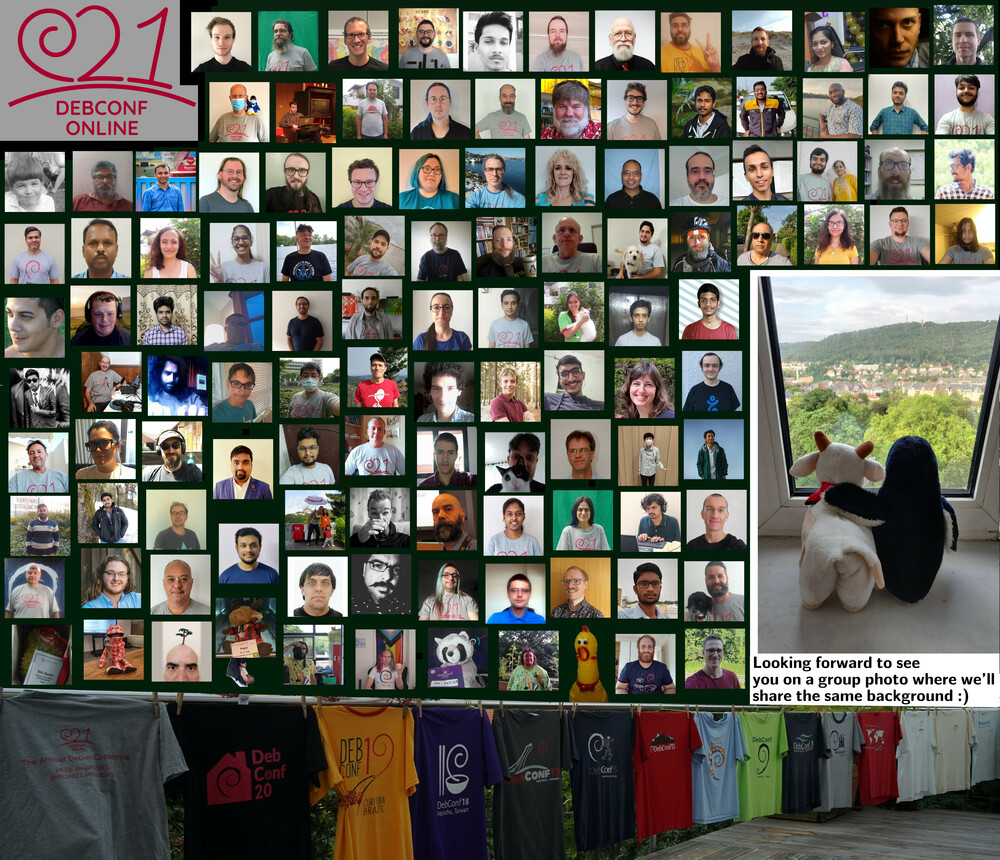
DebConf21 group photo - click to enlarge On Saturday 28 August 2021, the annual Debian Developers and Contributors Conference came to a close. DebConf21 has been held online for the second time, due to the coronavirus (COVID-19) disease pandemic. All of the sessions have been streamed, with a variety of ways of participating: via IRC messaging, online collaborative text documents, and video conferencing meeting rooms. With 740 registered attendees from more than 15 different countries and a total of over 70 event talks, discussion sessions, Birds of a Feather (BoF) gatherings and other activities, DebConf21 was a large success. The setup made for former online events involving Jitsi, OBS, Voctomix, SReview, nginx, Etherpad, a web-based frontend for voctomix has been improved and used for DebConf21 successfully. All components of the video infrastructure are free software, and configured through the Video Team's public ansible repository. The DebConf21 schedule included a wide variety of events, grouped in several tracks: The talks have been streamed using two rooms, and several of these activities have been held in different languages: Telugu, Portuguese, Malayalam, Kannada, Hindi, Marathi and English, allowing a more diverse audience to enjoy and participate. Between talks, the video stream has been showing the usual sponsors on the loop, but also some additional clips including photos from previous DebConfs, fun facts about Debian and short shout-out videos sent by attendees to communicate with their Debian friends. The Debian publicity team did the usual live coverage to encourage participation with micronews announcing the different events. The DebConf team also provided several mobile options to follow the schedule. For those who were not able to participate, most of the talks and sessions are already available through the Debian meetings archive website, and the remaining ones will appear in the following days. The DebConf21 website will remain active for archival purposes and will continue to offer links to the presentations and videos of talks and events. Next year, DebConf22 is planned to be held in Prizren, Kosovo, in July 2022. DebConf is committed to a safe and welcome environment for all participants. During the conference, several teams (Front Desk, Welcome team and Community team) have been available to help so participants get their best experience in the conference, and find solutions to any issue that may arise. See the web page about the Code of Conduct in DebConf21 website for more details on this. Debian thanks the commitment of numerous sponsors to support DebConf21, particularly our Platinum Sponsors: Lenovo, Infomaniak, Roche, Amazon Web Services (AWS) and Google. About Debian The Debian Project was founded in 1993 by Ian Murdock to be a truly free community project. Since then the project has grown to be one of the largest and most influential open source projects. Thousands of volunteers from all over the world work together to create and maintain Debian software. Available in 70 languages, and supporting a huge range of computer types, Debian calls itself the universal operating system. About DebConf DebConf is the Debian Project's developer conference. In addition to a full schedule of technical, social and policy talks, DebConf provides an opportunity for developers, contributors and other interested people to meet in person and work together more closely. It has taken place annually since 2000 in locations as varied as Scotland, Argentina, and Bosnia and Herzegovina. More information about DebConf is available from https://debconf.org/. About Lenovo As a global technology leader manufacturing a wide portfolio of connected products, including smartphones, tablets, PCs and workstations as well as AR/VR devices, smart home/office and data center solutions, Lenovo understands how critical open systems and platforms are to a connected world. About Infomaniak Infomaniak is Switzerland's largest web-hosting company, also offering backup and storage services, solutions for event organizers, live-streaming and video on demand services. It wholly owns its datacenters and all elements critical to the functioning of the services and products provided by the company (both software and hardware). About Roche Roche is a major international pharmaceutical provider and research company dedicated to personalized healthcare. More than 100.000 employees worldwide work towards solving some of the greatest challenges for humanity using science and technology. Roche is strongly involved in publicly funded collaborative research projects with other industrial and academic partners and have supported DebConf since 2017. About Amazon Web Services (AWS) Amazon Web Services (AWS) is one of the world's most comprehensive and broadly adopted cloud platform, offering over 175 fully featured services from data centers globally (in 77 Availability Zones within 24 geographic regions). AWS customers include the fastest-growing startups, largest enterprises and leading government agencies. About Google Google is one of the largest technology companies in the world, providing a wide range of Internet-related services and products such as online advertising technologies, search, cloud computing, software, and hardware. Google has been supporting Debian by sponsoring DebConf for more than ten years, and is also a Debian partner sponsoring parts of Salsa's continuous integration infrastructure within Google Cloud Platform. Contact Information For further information, please visit the DebConf21 web page at https://debconf21.debconf.org/ or send mail to press@debian.org.

8 September 2021

Dirk Eddelbuettel: RcppSimdJson 0.1.6 on CRAN: New Upstream 1.0.0 !!

The RcppSimdJson team is happy to share that a new version 0.1.6 arrived on CRAN earlier today. Its release coincides with release 1.0.0 of simdjson itself, which is included in this release too! RcppSimdJson wraps the fantastic and genuinely impressive simdjson library by Daniel Lemire and collaborators. Via very clever algorithmic engineering to obtain largely branch-free code, coupled with modern C++ and newer compiler instructions, it results in parsing gigabytes of JSON parsed per second which is quite mindboggling. The best-case performance is faster than CPU speed as use of parallel SIMD instructions and careful branch avoidance can lead to less than one cpu cycle per byte parsed; see the video of the talk by Daniel Lemire at QCon (also voted best talk). This version brings the new upstream release, thanks to a comprehensive pull request by Daniel Lemire. The short NEWS entry follows.

Changes in version 0.1.6 (2021-09-07)
  • The C++17 dependency was stated more clearly in the DESCRIPTION file (Dirk)
  • The simdjson version was updated to release 1.0.0 (Daniel Lemire in #70)

We should point out that the package still has a dependency on C++17 even though simdjson no longer does. Some of our earlier wrapping code uses it, this could be changed. If you, dear reader, would like to work on this please get in touch. Courtesy of my CRANberries, there is also a diffstat report for this release. For questions, suggestions, or issues please use the issue tracker at the GitHub repo. If you like this or other open-source work I do, you can now sponsor me at GitHub.

This post by Dirk Eddelbuettel originated on his Thinking inside the box blog. Please report excessive re-aggregation in third-party for-profit settings.

7 September 2021

Joachim Breitner: A Candid explainer: Opt is special

This is the third post in a series about the interface description language Candid.

The record extension problem Initially, the upgrade rules of Candid were a straight-forward application of the canonical subtyping rules. This worked and was sound, but it forbid one very commonly requested use case: Extending records in argument position. The subtyping rule for records say that
   record   old_field : nat; new_field : int  
<: record   old_field : nat  
or, in words, that subtypes can have more field than supertypes. This makes intuitive sense: A user of a such a record value that only expects old_field to be there is not bothered if suddenly a new_field appears. But a user who expects new_field to be there is thrown off if it suddenly isn t anymore. Therefore it is ok to extend the records returned by a service with new fields, but not to extend the record in your methods s argument types. But users want to extend their record types over time, also in argument position! In fact, they often want to extend them in both positions. Consider a service with the following interface, where the CUser record appears both in argument and result position:
type CUser = record   login : text; name : text  ;
service C :  
  register_user : (CUser) -> ();
  get_user_data : (text) -> (CUser);
 
It seems quite natural to want to extend the record with a new field (say, the age of the user). But simply changing the definition of CUser to
type CUser = record   login : text; name : text; age : nat  
is not ok, because now register_user requires the age field, but old clients don t provide it. So how can we allow developers to make changes like this (because they really really want that), while keeping the soundness guarantees made by Candid (because we really really want that)? This question has bothered us for over two years, and we even created a meta issue that records the dozen approached we considered, discussed and eventually ditched.

Dynamic subtyping checks in opt I will spare you the history lesson, though, and explain the solution we eventually came up with. In the example above it seems unreasonable to let the developer add a field age of type nat. Since there may be old clients around, the service unavoidably has to deal with records that don t have an age field. If the code expects an age value, what should it do in that case? But one can argue that changing the record type to
type CUser = record   login : text; name : text; age : opt nat  
could work: If the age field is present, use the value. If the field is absent, inject a null value during decoding. In the first-order case, this rather obvious solution would work just fine, and we d be done. But Candid aims to solve the higher order case, and I said things get tricky here, didn t I? Consider another, independent service D with the following interface:
type DUser = record   login : text; name : text  ;
service D :  
  on_user_added : (func (DUser) -> ()) -> ()
 
This service has a method that takes a method reference, presumably with the intention of calling it whenever a new user was added to service D. And because the types line up nicely, we can compose these two services, by once calling D.on_user_added(C.register_user), so that from now on D calls C.register_user( ). These kind of service mesh-ups are central to the vision of the Internet Computer! But what happens if the services now evolve their types in different ways, e.g. towards
type CUser = record   login : text; name : text; age : opt nat  
and
type DUser = record   login : text; name : text; age : opt variant   under_age; adult  
Individually, these are type changes that we want to allow. But now the call from D to C may transmit a value of record ; age = opt variant under_age when C expects a natural number! This is precisely what we want to prevent by introducing types, and it seems we have lost soundness. The best solution we could find is to make the opt type somewhat special, and apply these extra rules when decoding at an expected type of opt t.
  • If this was a record field, and the provided record value doesn t even have a field of that name, don t fail but instead treat this as null. This handles the first-order example above.
  • If there is a value, look at its type (which, in Candid, is part of the message).
    • If it is opt t' and t' <: t, then decode as normal.
    • If it is opt t' but t' <: t does not hold, then treat that as null. This should only happen in these relatively obscure higher-order cases where services evolved differently and incompatibly, and makes sure that the calls that worked before the upgrades will continue to work afterwards. It is not advisable to actually use that rule when changing your service s interface. Tools that assist the developer with an upgrade check should prevent or warn about the use of this rule.
  • Not strictly required here, but since we are making opt special anyways: If its type t' is not of the form opt , pretend it was opt t', and also pretend that the given value was wrapped in opt. This allows services to make record field in arguments that were required in the old version optional in a new version, e.g. as a way to deprecated them. So it is mildly useful, although I can report that it makes the meta-theory and implementation rather complex, in particular together with equirecursion and beasts like type O = opt O. See this discussion for a glimpse of that.
In the above I stress that we look at the type of the provided value, and not just the value. For example, if the sender sends the value opt vec at type opt vec nat, and the recipient expects opt vec bool, then this will decode as null, even though one could argue that the value opt vec could easily be understood at type opt vec bool. We initially had that, but then noticed that this still breaks soundness when there are references inside, and we have to do a full subtyping check in the decoder. This is very unfortunate, because it makes writing a Candid decoder a noticeably harder task that requires complicated graph algorithms with memoization (which I must admit Motoko has not implemented yet), but it s the least bad solution we could find so far.

Isn t that just dynamic typing? You might have noticed that with these rules, t <: opt t' holds for all types t and t'. In other words, every opt is a top type (like reserved), thus all optional types are equivalent. One could argue that we are throwing all of the benefits of static typing over board this way. But it s not quite as bad: It s true that decoding Candid values now involves a dynamic check inserting null values in certain situations, but as long as everyone plays by the rules (i.e. upgrades their services according to the Candid safe upgrade rules, and heeds the warning alluded to above), these certain situations will only happen in the obscurest of cases. It is, by the way, not material to this solution that the special subtyping behavior is applied to the opt type, and a neighboring point in the design space would be a dedicated upgraded t type constructor. That would allow developers to use the canonical opt type with the usual subtyping rules and communicate their intent ( clients should consider this field optional vs. old clients don t know about this field, but new clients should use it ) more cleanly at the expense of having more non-canonical types in the type system. To see why it is convenient if Candid has mostly just the normal types, read the next post, which will describe how Candid can be integrated into a host language.

6 September 2021

Jelmer Vernooij: Web Hooks for the Janitor

The Debian Janitor is an automated system that commits fixes for (minor) issues in Debian packages that can be fixed by software. It gradually started proposing merges in early December. The first set of changes sent out ran lintian-brush on sid packages maintained in Git. This post is part of a series about the progress of the Janitor. As covered in my post from last week, the Janitor now regularly tries to import new upstream git snapshots or upstream releases into packages in Sid.

Moving parts There are about 30,000 packages in sid, and it usually takes a couple of weeks for the janitor to cycle through all of them. Generally speaking, there are up to three moving targets for each package:
  • The packaging repository; vcswatch regularly scans this for changes, and notifies the janitor when a repository has changed. For salsa repositories it is instantly notified through a web hook
  • The upstream release tarballs; the QA watch service regularly polls these, and the janitor scans for changes in the UDD tables with watch data (used for fresh-releases)
  • The upstream repository; there is no service in Debian that watches this at the moment (used for fresh-snapshots)
When the janitor notices that one of these three targets has changed, it prioritizes processing of a package - this means that a push to a packaging repository on salsa usually leads to a build being kicked off within 10 minutes. New upstream releases are usually noticed by QA watch within a day or so and then lead to a build. Now commits in upstream repositories don t get noticed today. Note that there are no guarantees; the scheduler tries to be clever and not e.g. rebuild the same package over and over again if it s constantly changing and takes a long time to build. Packages without priority are processed with a scoring system that takes into account perceived value (based on e.g. popcon), cost (based on wall-time duration of previous builds) and likelihood of success (whether recent builds were successful, and how frequently the repositories involved change).
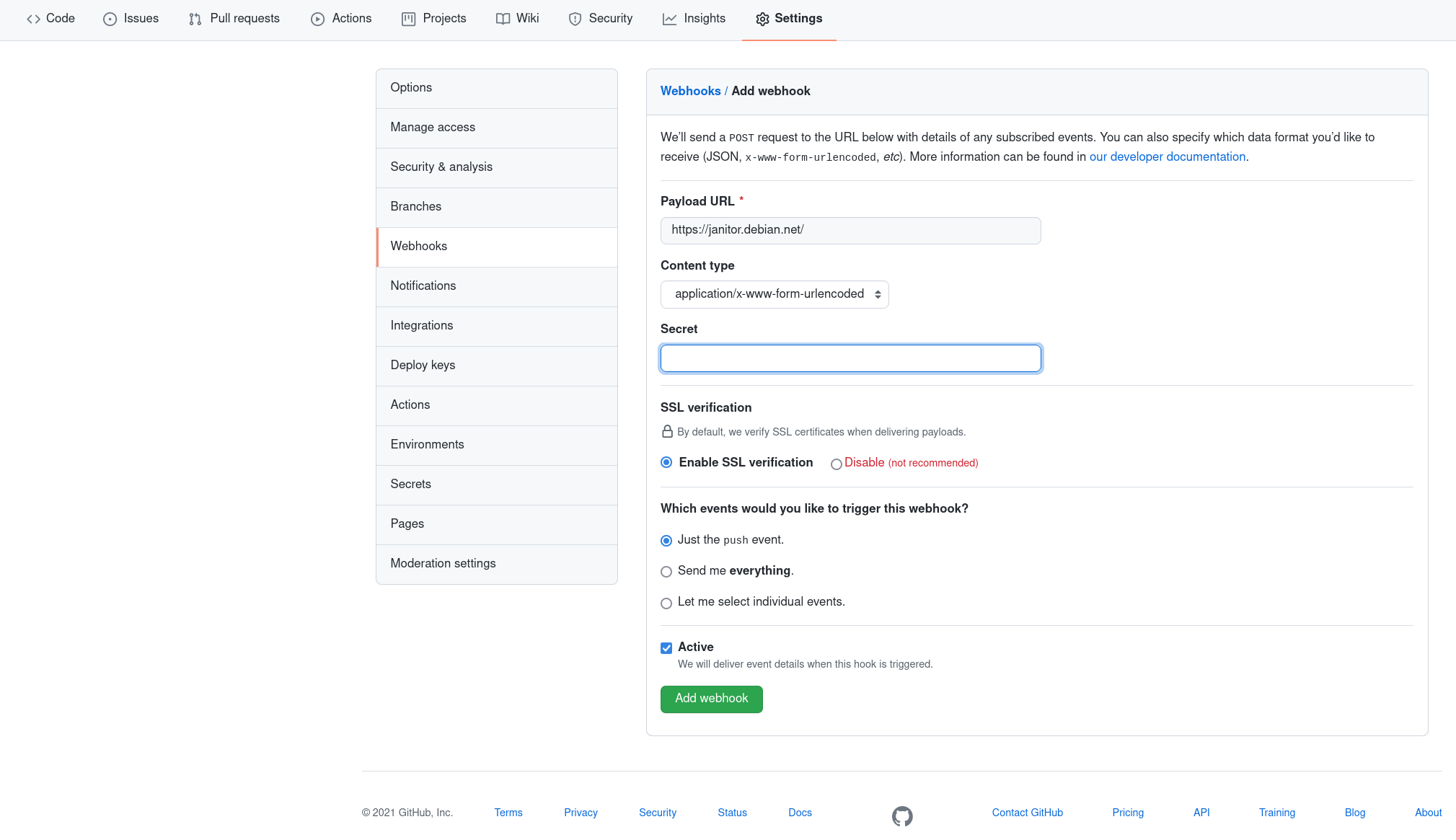
webhooks for upstream repositories At the moment there is no service in Debian (yet - perhaps this is something that vcswatch or a sibling service could also do?) that scans upstream repositories for changes. However, if you maintain an upstream package, you can use a webhook to notify the janitor that commits have been made to your repository, and it will create a new package in fresh-snapshots. Webhooks from the following hosting site software are currently supported: You can simply use the URL https://janitor.debian.net/ as the target for hooks. There is no need to specify a secret, and the hook can either use a JSON or form encoding payload. The endpoint should tell you whether it understood a webhook request, and whether it took any action. It s fine to submit webhooks for repositories that the janitor does not (yet) know about.
GitHub For GitHub, you can do so in the Webhooks section of the Settings tab. Fill the form as shown below and click on Add webhook:
GitLab On GitLab instances, you can find the Webhooks tab under the Settings menu for each repository (under the gear symbol). Fill the form in as shown below and click Add Webhook:
Launchpad For Launchpad, go to the repository (for Git) web view and click Manage Webhooks. From there, you can add a new webhook; fill the form in as shown below and click Add Webhook:

Dirk Eddelbuettel: tidyCpp 0.0.4 on CRAN: Adding a Simple Numeric Vector Class

Another release of the tidyCpp package arrived on CRAN earlier today. The packages offers a clean C++ layer on top of the C API for R which aims to make its use a little easier and more consistent. The vignette has been extended once more with a new example, and added a table of contents. The package now supports a (truly minimal) C++ class for a numeric vector which is the most likely use case. The NEWS entry follows and includes the 0.0.3 release earlier in the year which did not get the usual attention of post-release blog post.

Changes in tidyCpp version 0.0.4 (2021-09-05)
  • Minor updates to DESCRIPTION
  • New snippet rollminmaxExample with simple vector use
  • New class NumVec motivated from rolling min/max example
  • Expand the vignette with C++ example based on NumVec
  • Add a table of contents to the vignette

Changes in tidyCpp version 0.0.3 (2021-03-07)
  • Switch CI use to r-ci
  • Protect nil object definition

Thanks to my CRANberries, there is also a diffstat report for this release. For questions, suggestions, or issues please use the issue tracker at the GitHub repo. If you like this or other open-source work I do, you can now sponsor me at GitHub.

This post by Dirk Eddelbuettel originated on his Thinking inside the box blog. Please report excessive re-aggregation in third-party for-profit settings.

3 September 2021

Dirk Eddelbuettel: RQuantLib 0.4.13: Routine Update

A new release 0.4.13 of RQuantLib arrived on CRAN yesterday, and has been uploaded to Debian as well. QuantLib is a very comprehensice free/open-source library for quantitative finance; RQuantLib connects it to the R environment and language. This updates RQuantLib to a few now-deprecated (daycount convention) interfaces in QuantLib release 1.23. As the last release was sixteen months ago, we also updated a few standard packaging aspects (such as use of r-ci), updated README.md and DESCRIPTION and fixed an old typo. No other changes, no new interfaces.

Changes in RQuantLib version 0.4.13 (2021-09-02)
  • Changes in RQuantLib code:
    • Small updates to DESCRIPTION and README.md
    • Switch CI use to r-ci
    • An eleven-year old typo was correct in a manual page (Dirk in #156 fixing #155 with thanks to @klin133)
    • Daycount convention calls deprecated in QuantLib 1.23 were updated (Dirk in #157)
    • Updated remaining http:// URLs in documentation to https://

Courtesy of my CRANberries, there is also a diffstat report for the this release. As always, more detailed information is on the RQuantLib page. Questions, comments etc should go to the new rquantlib-devel mailing list. Issue tickets can be filed at the GitHub repo. If you like this or other open-source work I do, you can now sponsor me at GitHub.

This post by Dirk Eddelbuettel originated on his Thinking inside the box blog. Please report excessive re-aggregation in third-party for-profit settings.

Dirk Eddelbuettel: RcppSMC 0.2.4 on CRAN: Even More GSoC !!

A brand new release 0.2.4 of the RcppSMC package arrived on CRAN earlier today, with a dual delay for CRAN closing for a well-earned break, and then being overwhelmed when reopening. Other than that the processing was again versy smooth. RcppSMC provides Rcpp-based bindings to R for the Sequential Monte Carlo Template Classes (SMCTC) by Adam Johansen described in his JSS article. Sequential Monte Carlo is also referred to as Particle Filter in some contexts. The package started when I put some Rcpp bindings together based on Adam s paper and library. It grew when Adam and I supervised Leah South during the 2017 iteration of the Google Summer of Code. And now it grew again as we have Adam, Leah and myself looking over the shoulders of Ilya Zarubin who did very fine work during the 2021 iteration of the Google Summer of Code that just concluded! So we are now GSoC squared! This release is effectively all work by Ilya and summarized below.

Changes in RcppSMC version 0.2.4 (2021-09-01)
  • Multiple Sequential Monte Carlo extensions (Ilya Zarubin as part of Google Summer of Code 2021)
    • Provide informative user output (convergence diagnostics) for PMMH example #50 (Ilya in #50 and #52 addressing #25, bullet point 5)
    • Support for tracking of ancestral lines for base sampler class (Ilya in #56)
    • Support for conditional SMC via derived conditionalSampler class (Ilya in #60)
  • Add URL and BugReports to DESCRIPTION (Dirk in #53)

Courtesy of my CRANberries, there is a diffstat report for this release. More information is on the RcppSMC page. Issues and bugreports should go to the GitHub issue tracker. If you like this or other open-source work I do, you can now sponsor me at GitHub.

This post by Dirk Eddelbuettel originated on his Thinking inside the box blog. Please report excessive re-aggregation in third-party for-profit settings.

2 September 2021

Eddy Petri&#537;or: Stretch to Buster upgrade issues: "Grub error: symbol grub_is_lockdown not found", missing RTL8111/8168/8411 Ethernet driver and RTL8821CE Wireless adapter on Linux Kernel 5.10 (and 4.19)

I have been Debian Stretch running on my HP Pavilion 14-ce0000nq laptop since buying it back in April 2019, just before my presence at Oxidizeconf where I presented "How to Rust When Standards Are Defined in C".Debian Buster (aka Debian 10) was released about 4 months later and I've been postponing the upgrade as my free time isn't what it used to be. I also tend to wait for the first or even second update of the release to avoid any sharp edges.As this laptop has a Realtek 8821CE wireless card that wasn't officially supported in the Linux kernel, I had to use an out-of-tree hacked driver to have the wireless work on Stretch kernels such as 4.19, it didn't even got along with DKMS, so all compilations and installations of it, I did them manually. More reason to wait for a newer release that would contain a driver inside the official kernel.I was waiting for the inevitable and dreading the wireless issues, but since mid-august Bullseye became stable, turning Stretch into oldoldstable, I decided that I had to do the upgrade, at least to buster.The Grub error and the fix

Everything went quite smooth, except that after the reboot, the laptop failed to boot with this Grub error:

error: symbol grub_is_lockdown not found
I looked for a solution and it seemed everyone was stuck or the solution was unclear.There is even a bug report in Debian about this error, bug #984760.
Adding to the pile of confusion my own confused solution: I tried supergrubdisk2/rescatux, it didn't work for me, it might have been a combination of me using LVM and grub-efi-amd64. I also tried to boot in rescue mode the Buster first DVD (to avoid the need for network), I was able to enter the partition, mount the EFI partition, too, but since I didn't want to mess the setup even more or depend on an external USB stick, I didn't know where should I try to write the Grub EFI config - the root partition is on an NVME storage.When buying the laptop it had FreeDOS installed on it and some HP rescue app, which I did not wipe when installing Debian. I even forgot where or how was the EFI installed on the disk and EFI, even if it should be more reliable and simpler, I never got the hang of it.
In the end, I realized that I could via BIOS actually select manually which EFI executable should be booted into, so I was able to boot with some manual intervention during boot into the regular system.I tried regenerating the grub configuration, installing it and also tried restoring the default proper boot sequence (and I even installed refind in the system during my fumbling), but I think somewhere between grub-efi-amd64 reconfiguration and its reinstallation I managed to do the right thing, as the default boot screen is the Grub one now.Hints for anyone reading this in the hope to fix the same issue, hopefully it will make things better, not worse (see the text below):1) regenerate the grub config:
update-grub2
2) reinstall grub-efi-amd64 and make Debian the default
dpkg-reconfigure -plow grub-efi-amd64
When reinstalling grub-efi-amd64 onto the disk, I think the scariest questions were to these:

Force extra installation to the EFI removable media path?

Some EFI-based systems are buggy and do not handle new bootloaders correctly. If you force an extra installation of GRUB to the EFI removable media path, this should ensure that this system will boot Debian correctly despite such a problem. However, it may remove the ability to boot any other operating systems that also depend on this path. If so, you will need to make sure that GRUB is configured successfully to be able to boot any other OS installations correctly.

and
Update NVRAM variables to automatically boot into Debian?

GRUB can configure your platform's NVRAM variables so that it boots into Debian automatically when powered on. However, you may prefer to disable this behavior and avoid changes to your boot configuration. For example, if your NVRAM variables have been set up such that your system contacts a PXE server on every boot, this would preserve that behavior.

I think the first can be safely answered "No" if you don't plan on booting via a removable USB stick, while the second is the one that does the restoring.The second question is probably safe if you don't use PXE boot or other boot method, at least that's what I understand. But if you do, I suspect by installing refind, by playing with the multiple efi* named packages and tools, you can restore that, or it might be that your BIOS allows that directly.
I just did a walk through of these 2 steps again on my laptop and answered "No" to the removable media question as it leads to errors when the media was not inserted (in my case the internal SD card reader), and "Yes" to making Debian the default.It seems that for me this broke the FreeDOS and HP utilities boot entries from Grub, but I still can boot via the BIOS options and my goal was to have Debian boot correctly by default.
Fixing the missing RTL811/8168/8411 Ethernet card issue
As a side note for people with computers having Realtek RTL8111/8168/8411 Gigabit Ethernet Controller and upgrading to Buster or switching to a newer kernel, please note that you might end up having the unpleasant surprise even your Ethernet card to disappear because the r8169 driver is not loader by default.I had to add it to /etc/modules so is loaded by default:
eddy@aptonia:/ $ cat /etc/modules
# /etc/modules: kernel modules to load at boot time.
#
# This file contains the names of kernel modules that should be loaded
# at boot time, one per line. Lines beginning with "#" are ignored.
r8169

The 5.10 compatible driver for RTL8821CE wireless adapterAfter the upgrade to Buster, the oldstable version of the kernel, 4.19, the hacked version of the driver I've been using on Stretch on 4.9 kernels was no longer compatible - failed to compile due to missing symbols.The fix for me was to switch to the DKMS compatible driver from https://github.com/tomaspinho/rtl8821ce, as this seems to work for both 4.19 and 5.10 kernels (installed from backports).
I installed it via a modification of the manual install method only for the 4.19 and 5.10 kernels, leaving the legacy 4.9 kernels working with the hacked driver. You can do the same if instead of running the provided script, you do its steps manually and you install only for the kernel versions you want, instead of the default to install for all:I looked inside the dkms-install.sh script to do the required steps:Copy the driver, add it to the dkms set of known drivers:
DRV_NAME=rtl8821ce
DRV_VERSION=v5.5.2_34066.20200325

cp -r . /usr/src/$ DRV_NAME -$ DRV_VERSION

dkms add -m $ DRV_NAME -v $ DRV_VERSION
But you just build and install them only for the select kernel versions of your choice:
dkms build -m $ DRV_NAME -v $ DRV_VERSION -k 5.10.0-0.bpo.8-amd64
dkms install -m $ DRV_NAME -v $ DRV_VERSION -k 5.10.0-0.bpo.8-amd64
Or, without the variables:
dkms build rtl8821ce/v5.5.2_34066.20200325 -k 4.19.0-17-amd64
dkms install rtl8821ce/v5.5.2_34066.20200325 -k 4.19.0-17-amd64
dkms status should confirm everything is in place and I think you need to update grub2 again after this.
Please note this driver is no longer maintained and the 5.10 tree should support the RTL8821CE wireless card with the rtw88 driver from the kernel, but for me it did not. I'll probably try this at a later time, or after I upgrade to the current Debian stable, Bullseye.

1 September 2021

Holger Levsen: 20210901-Debian-Reunion-Hamburg-2021

Debian Reunion Hamburg 2021 Moin! I'm glad to finally be able to send out this invitation for the "Debian Reunion Hamburg 2021" taking place at the venue of the 2018 & 2019 MiniDebConfs! The event will run from Monday, Sep 27 2021 until Friday Oct 1 2021, with Sunday, Sep 26 2021 as arrival day. IOW, Debian people meet again in Hamburg. The exact format is less defined and structured than previous years, probably we will just be hacking from Monday to Wednesday, have talks on Thursday and a nice day trip on Friday. Please read https://wiki.debian.org/DebianEvents/de/2021/DebianReunionHamburg if you intend to attend, especially Probably having some video coverage would be very nice to have, though due to this very late announcement I'm not sure we'll really have talks and the need for video. The event is in 3.5 weeks and will take place, either as a very small hack meeting, or somewhat bigger. We certainly want videoing if we have talks - and if you could help with this that would be very great! Last and definitly not least, financial sponsors for the event would be great. If you can support the "Debian Reunion Hamburg 2021", please contact me directly! Now, late, after weeks of wondering if and how to do this event, I'm finally and very much looking forward to it, to meet some Debian folks at least & for some shared Debian hacking. Definitly not the 2021 event I had in mind after the 2019 one, but something I feel I can responsibly do & enjoy. So, hoping to see some of you soon & most of you later! ;-) Sad but true, and at least something for some people. We should all do more local events. And more online events too, eg I think this is a great idea too: https://wiki.debian.org/DebianEvents/internet/2021/MiniDebConfOnlineBookworm See you!

Utkarsh Gupta: FOSS Activites in August 2021

Here s my (twenty-third) monthly but brief update about the activities I ve done in the F/L/OSS world.

Debian
This was my 32nd month of actively contributing to Debian. I became a DM in late March 2019 and a DD on Christmas 19! \o/ Tough month but I mostly spent on it churning through the immense backlog. But that somewhat backfired and I have even more backlog than ever. :D Anyway, I did the following stuff in Debian:

Uploads and bug fixes:
  • ruby3.0 (3.0.0-2) - Upload to unstable! \o/

Other $things:
  • Mentoring for newcomers.
  • Moderation of -project mailing list.

Ubuntu
This was my 7th month of actively contributing to Ubuntu. Now that I ve joined Canonical to work on Ubuntu full-time, there s a bunch of things I do! \o/ I mostly worked on different things, I guess. But mostly on packaging keylime and some Google Agents upload(s) and SRU(s). Also did a lot of reviewing, et al. I was too lazy to maintain a list of things I worked on so there s no concrete list atm. Maybe I ll get back to this section later or will start to list stuff from next month onward, as I ve been doing before. :D

Debian (E)LTS
Debian Long Term Support (LTS) is a project to extend the lifetime of all Debian stable releases to (at least) 5 years. Debian LTS is not handled by the Debian security team, but by a separate group of volunteers and companies interested in making it a success. And Debian Extended LTS (ELTS) is its sister project, extending support to the Jessie release (+2 years after LTS support). This was my twenty-third month as a Debian LTS and eleventh month as a Debian ELTS paid contributor.
I was assigned 23.75 hours for LTS and 40.00 hours for ELTS and worked on the following things:
(however, I only worked for 23.75h on ELTS work, thereby, carrying the rest to next month)

LTS CVE Fixes and Announcements:

ELTS CVE Fixes and Announcements:

Other (E)LTS Work:
  • Front-desk duty from 26-07 until 01-08 and from 30-08 until 05-09 for both LTS and ELTS.
  • Triaged haproxy, ntfs-3g, and cyrus-imapd, and exiv2, ffmpeg, git, gpac, inetutils, mc, modsecurity-crs, node-object-path, php-pear, systemd-cron, node-tar, ruby2.3, gst-plugins-bad0.10, jsoup, libxstream-java, qemu, tomcat7, ruby2.1, prototypejs, pillow, cpio, and qtbase-opensource-src, and amd64-microcode.
  • Mark CVE-2021-39240/haproxy as not-affected for stretch and jessie.
  • Mark CVE-2021-39241/haproxy as not-affected for stretch and jessie.
  • Mark CVE-2021-39242/haproxy as not-affected for stretch and jessie.
  • Mark CVE-2021-33582/cyrus-imapd as no-dsa for stretch.
  • Mark CVE-2020-18771/exiv2 as no-dsa for exiv2 for stretch.
  • Mark CVE-2020-18899/exiv2 as no-dsa for exiv2 for stretch.
  • Mark CVE-2021-38171/ffmpeg as postponed for stretch.
  • Mark CVE-2021-40330/git as no-dsa for stretch and jessie.
  • Mark CVE-2020-19481/gpac as ignored for stretch.
  • Mark CVE-2021-40491/inetutils as no-dsa for stretch.
  • Mark CVE-2021-36370/mc as no-dsa for stretch and jessie.
  • Mark CVE-2021-35368/modsecurity-crs as no-dsa for stretch.
  • Mark CVE-2021-23434/node-object-path as end-of-life for stretch.
  • Mark CVE-2021-32610/php-pear as no-dsa for stretch.
  • Mark CVE-2017-9525/systemd-cron as no-dsa for stretch.
  • Mark CVE-2021-37701/node-tar as end-of-life for stretch.
  • Mark CVE-2021-37712/node-tar as end-of-life in stretch.
  • Mark CVE-2021-3750/qemu as postponsed for jessie.
  • Mark CVE-2021-27511/prototypejs as postponsed for jessie.
  • Mark CVE-2021-23437/pillow as postponed for stretch and jessie.
  • Auto EOL ed gpac, cacti, openscad, cgal, cyrus-imapd-2.4, libsolv, mosquitto, atomicparsley, gtkpod, node-tar, libapache2-mod-auth-openidc, neutron, inetutils and linux for jessie.
  • Drop cpio from ela-needed; open issues don t warrant an ELA.
  • Attended monthly Debian LTS meeting.
  • Answered questions (& discussions) on IRC (#debian-lts and #debian-elts).
  • General and other discussions on LTS private and public mailing list.

Until next time.
:wq for today.

28 August 2021

Anton Gladky: 2021/08, FLOSS activity

LTS This is my sixth month of working for LTS. I was assigned 12 hrs and worked all of them.

Released DLAs
  1. DLA 2742-1 ffmpeg_7:3.2.15-0+deb9u3
    • CVE-2020-22036: A heap-based Buffer Overflow vulnerability in filter_intra at libavfilter/vf_bwdif.c, which might lead to memory corruption and other potential consequences.
    • CVE-2020-22032: A heap-based Buffer Overflow vulnerability in gaussian_blur, which might lead to memory corruption and other potential consequences.
    • CVE-2020-22031: A Heap-based Buffer Overflow vulnerability in filter16_complex_low, which might lead to memory corruption and other potential consequences.
    • CVE-2020-22028: Buffer Overflow vulnerability in filter_vertically_8 at libavfilter/vf_avgblur.c, which could cause a remote Denial of Service.
    • CVE-2020-22026: Buffer Overflow vulnerability exists in the config_input function at libavfilter/af_tremolo.c, which could let a remote malicious user cause a Denial of Service.
    • CVE-2020-22025: A heap-based Buffer Overflow vulnerability exists in gaussian_blur at libavfilter/vf_edgedetect.c, which might lead to memory corruption and other potential consequences.
    • CVE-2020-22023: A heap-based Buffer Overflow vulnerabililty exists in filter_frame at libavfilter/vf_bitplanenoise.c, which might lead to memory corruption and other potential consequences.
    • CVE-2020-22022: A heap-based Buffer Overflow vulnerability exists in filter_frame at libavfilter/vf_fieldorder.c, which might lead to memory corruption and other potential consequences.
    • CVE-2020-22021: Buffer Overflow vulnerability at filter_edges function in libavfilter/vf_yadif.c, which could let a remote malicious user cause a Denial of Service.
    • CVE-2020-22020: Buffer Overflow vulnerability in the build_diff_map function in libavfilter/vf_fieldmatch.c, which could let a remote malicious user cause a Denial of Service.
    • CVE-2020-22016: A heap-based Buffer Overflow vulnerability at libavcodec/get_bits.h when writing .mov files, which might lead to memory corruption and other potential consequences.
    • CVE-2020-22015: Buffer Overflow vulnerability in mov_write_video_tag due to the out of bounds in libavformat/movenc.c, which could let a remote malicious user obtain sensitive information, cause a Denial of Service, or execute arbitrary code.
    • CVE-2020-21041: Buffer Overflow vulnerability exists via apng_do_inverse_blend in libavcodec/pngenc.c, which could let a remote malicious user cause a Denial of Service
    • CVE-2021-3566: The tty demuxer did not have a read_probe function assigned to it. By crafting a legitimate ffconcat file that references an image, followed by a file the triggers the tty demuxer, the contents of the second file will be copied into the output file verbatim (as long as the -vcodec copy option is passed to ffmpeg).
    • CVE-2021-38114: libavcodec/dnxhddec.c does not check the return value of the init_vlc function. Crafted DNxHD data can cause unspecified impact.
  2. DLA 2742-2 ffmpeg_7:3.2.15-0+deb9u4 During the backporting of one of patches in CVE-2020-22021 one line was wrongly interpreted and it caused the regression during the deinterlacing process. Thanks to Jari Ruusu for the reporting the issue and for the testing of prepared update.

LTS-Meeting
  • I attended the Debian LTS team Jitsi-meeting (though the connection was extremely bad).
  • Partly participated in preparation of Debconf21 BoF Funding Projects to Improve Debian .

Debian Science Team
  • Partly participated in Debconf21 Debian Science BoF.

Other FLOSS activities
  • Reviewed many merge requests in Yade open source project, merge some of them.

Andrew Cater: "If you do it twice, it's tradition" - says nattie

Thanks to all who've made Debconf 21 such a good place to be.

A song for Debconf21 ["What shall we do with the drunken sailor"]


What shall we do with the online Debconf?What shall we do with the online Debconf?What shall we do with the online Debconf?

Earl-y in the morning

Close it up as we agreed it

Save each script in case we need it

Work out how we best live-feed itNext year s Debconf s dawning

Next year s Kosovo and Pristina

This virtual Debconf needs no cleaner

Hope when COVID s gone we re keener

To meet up every morning


Thanks to the Debconf orga team

Thanks to those who Loopy meme

Things are not always as they seeem

In virtual Debconf s morning

Bullseye s out its share is rising

Debconf s fun and quite surprising

Linux 30 :)

Yours and my thing - Debian s 28

Thanks to all who video d sessions

Debconf T-shirts - prized possessions

Debcamp bug-fixed some regressions

Now onto next year!


A closing song for Debconf 21 [Frere Jacques/Brueder Martin]

DebConf21

Virtual DebConf s

Now all through

Closed for you

Kosovo is next year

See you in Pristina!!

DebConf 22

Twenty twenty-two

25 August 2021

Jelmer Vernooij: Thousands of Debian packages updated from their upstream Git repository

The Debian Janitor is an automated system that commits fixes for (minor) issues in Debian packages that can be fixed by software. It gradually started proposing merges in early December. The first set of changes sent out ran lintian-brush on sid packages maintained in Git. This post is part of a series about the progress of the Janitor. Linux distributions like Debian fulfill an important function in the FOSS ecosystem - they are system integrators that take existing free and open source software projects and adapt them where necessary to work well together. They also make it possible for users to install more software in an easy and consistent way and with some degree of quality control and review. One of the consequences of this model is that the distribution package often lags behind upstream releases. This is especially true for distributions that have tighter integration and standardization (such as Debian), and often new upstream code is only imported irregularly because it is a manual process - both updating the package, but also making sure that it still works together well with the rest of the system. The process of importing a new upstream used to be (well, back when I started working on Debian packages) fairly manual and something like this:

Ecosystem Improvements However, there have been developments over the last decade that make it easier to import new upstream releases into Debian packages.
Uscan and debian QA watch Uscan and debian/watch have been around for a while and make it possible to find upstream tarballs. A debian watch file usually looks something like this:
1
2
version=4
http://somesite.com/dir/filenamewithversion.tar.gz
The QA watch service regularly polls all watch locations in the archive and makes the information available, so it s possible to know which packages have changed without downloading each one of them.
Git Git is fairly ubiquitous nowadays, and most upstream projects and packages in Debian use it. There are still exceptions that do not use any version control system or that use a different control system, but they are becoming increasingly rare. [1]
debian/upstream/metadata DEP-12 specifies a file format with metadata about the upstream project that a package was based on. In particular relevant for our case is the fact it has fields for the location of the upstream version control location. debian/upstream/metadata files look something like this:
1
2
3
---
Repository: https://www.dulwich.io/code/dulwich/
Repository-Browse: https://www.dulwich.io/code/dulwich/
While DEP-12 is still a draft, it has already been widely adopted - there are about 10000 packages in Debian that ship a debian/upstream/metadata file with Repository information.
Autopkgtest The Autopkgtest standard and associated tooling provide a way to run a defined set of tests against an installed package. This makes it possible to verify that a package is working correctly as part of the system as a whole. ci.debian.net regularly runs these tests against Debian packages to detect regressions.
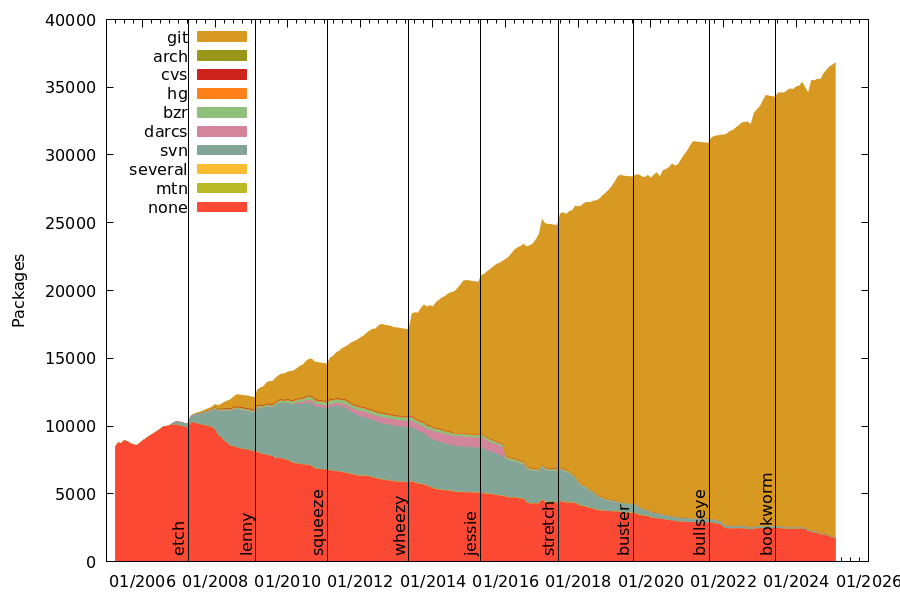
Vcs-Git headers The Vcs-Git headers in debian/control are the equivalent of the Repository field in debian/upstream/metadata, but for the packaging repositories (as opposed to the upstream ones). They ve been around for a while and are widely adopted, as can be seen from zack s stats: The vcswatch service that regularly polls packaging repositories to see whether they have changed makes it a lot easier to consume this information in usable way.
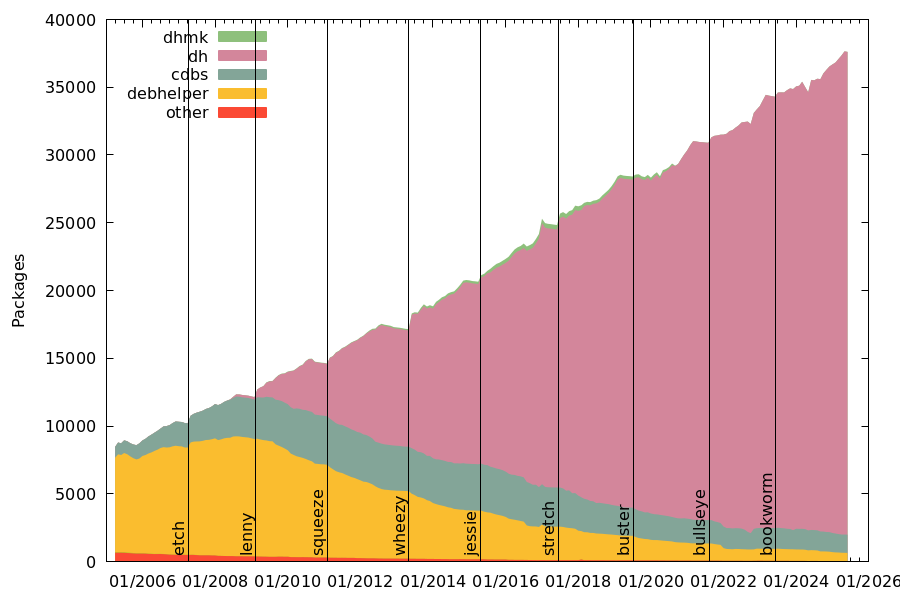
Debhelper adoption Over the last couple of years, Debian has slowly been converging on a single build tool - debhelper s dh interface. Being able to rely on a single build tool makes it easier to write code to update packaging when upstream changes require it.
Debhelper DWIM Debhelper (and its helpers) increasingly can figure out how to do the Right Thing in many cases without being explicitly configured. This makes packaging less effort, but also means that it s less likely that importing a new upstream version will require updates to the packaging. With all of these improvements in place, it actually becomes feasible in a lot of situations to update a Debian package to a new upstream version automatically. Of course, this requires that all of this information is available, so it won t work for all packages. In some cases, the packaging for the older upstream version might not apply to the newer upstream version. The Janitor has attempted to import a new upstream Git snapshot and a new upstream release for every package in the archive where a debian/watch file or debian/upstream/metadata file are present. These are the steps it uses:
  • Find new upstream version
    • If release, use debian/watch - or maybe tagged in upstream repository
    • If snapshot, use debian/upstream/metadata s Repository field
    • If neither is available, use guess-upstream-metadata from upstream-ontologist to guess the upstream Repository
  • Merge upstream version into packaging repository, possibly importing tarballs using pristine-tar
  • Update the changelog file to mention the new upstream version
  • Run some checks to ensure there are no unintentional changes, e.g.:
    • Scan diff between old and new for surprising license changes
      • Today, abort if there are any - in the future, maybe update debian/copyright
    • Check for obvious compatibility breaks - e.g. sonames changing
  • Attempt to update the packaging to reflect upstream changes
    • Refresh patches
  • Attempt to build the package with deb-fix-build, to deal with any missing dependencies
  • Run the autopkgtests with deb-fix-build to deal with missing dependencies, and abort if any tests fail
Results When run over all packages in unstable (sid), this process works for a surprising number of them.
Fresh Releases For fresh-releases (aka imports of upstream releases), processing all packages maintained in Git for which QA watch reports new releases (about 11,000): That means about 2300 packages updated, and about 4000 unchanged.
Fresh Snapshots For fresh-snapshots (aka imports of latest Git commit from upstream), processing all packages maintained in Git (about 26,000): Or 5100 packages updated and 2100 for which there was nothing to do, i.e. no upstream commits since the last Debian upload. As can be seen, this works for a surprising fraction of packages. It s possible to get the numbers up even higher, by both improving the tooling, the autopkgtests and the metadata that is provided by packages.

Using these packages All the packages that have been built can be accessed from the Janitor APT repository. More information can be found at https://janitor.debian.net/fresh, but in short - run:
1
2
3
4
5
6
echo deb "[arch=amd64 signed-by=/usr/share/keyrings/debian-janitor-archive-keyring.gpg]" \
    https://janitor.debian.net/ fresh-snapshots main   sudo tee /etc/apt/sources.list.d/fresh-snapshots.list
echo deb "[arch=amd64 signed-by=/usr/share/keyrings/debian-janitor-archive-keyring.gpg]" \
    https://janitor.debian.net/ fresh-releases main   sudo tee /etc/apt/sources.list.d/fresh-releases.list
sudo curl -o /usr/share/keyrings/debian-janitor-archive-keyring.gpg https://janitor.debian.net/pgp_keys
apt update
And then you can install packages from the fresh-snapshots (upstream git snapshots) or fresh-releases suites on a case-by-case basis by running something like:
1
apt install -t fresh-snapshots r-cran-roxygen2
Most packages are updated based on information provided by vcswatch and qa watch, but it s also possible for upstream repositories to call a web hook to trigger a refresh of a package. These packages were built against unstable, but should in almost all cases also work for testing.
Caveats Of course, since these packages are built automatically without human supervision it s likely that some of them will have bugs in them that would otherwise have been caught by the maintainer.
[1]I m not saying that a monoculture is great here, but it does help distributions.

Bits from Debian: DebConf21 welcomes its sponsors!

DebConf21 logo DebConf21 is taking place online, from 24 August to 28 August 2021. It is the 22nd Debian conference, and organizers and participants are working hard together at creating interesting and fruitful events. We would like to warmly welcome the 19 sponsors of DebConf21, and introduce them to you. We have five Platinum sponsors. Our first Platinum sponsor is Lenovo. As a global technology leader manufacturing a wide portfolio of connected products, including smartphones, tablets, PCs and workstations as well as AR/VR devices, smart home/office and data center solutions, Lenovo understands how critical open systems and platforms are to a connected world. Our next Platinum sponsor is Infomaniak. Infomaniak is Switzerland's largest web-hosting company, also offering backup and storage services, solutions for event organizers, live-streaming and video on demand services. It wholly owns its datacenters and all elements critical to the functioning of the services and products provided by the company (both software and hardware). Roche is our third Platinum sponsor. Roche is a major international pharmaceutical provider and research company dedicated to personalized healthcare. More than 100,000 employees worldwide work towards solving some of the greatest challenges for humanity using science and technology. Roche is strongly involved in publicly funded collaborative research projects with other industrial and academic partners and has supported DebConf since 2017. Amazon Web Services (AWS) is our fourth Platinum sponsor. Amazon Web Services is one of the world's most comprehensive and broadly adopted cloud platform, offering over 175 fully featured services from data centers globally (in 77 Availability Zones within 24 geographic regions). AWS customers include the fastest-growing startups, largest enterprises and leading government agencies. Google is our fifth Platinum sponsor. Google is one of the largest technology companies in the world, providing a wide range of Internet-related services and products such as online advertising technologies, search, cloud computing, software, and hardware. Google has been supporting Debian by sponsoring DebConf for more than ten years, and is also a Debian partner sponsoring parts of Salsa's continuous integration infrastructure within Google Cloud Platform. Our Gold sponsor is the Matanel Foundation. The Matanel Foundation operates in Israel, as its first concern is to preserve the cohesion of a society and a nation plagued by divisions. The Matanel Foundation also works in Europe, in Africa and in South America. Our Silver sponsors are: arm: the World s Best SoC Design Portfolio, Arm powered solutions have been supporting innovation for more than 30 years and are deployed in over 160 billion chips to date, Hudson-Trading, a company researching and developing automated trading algorithms using advanced mathematical techniques, Ubuntu the Operating System delivered by Canonical, Globo, the largest media conglomerate in Brazil, founded in Rio de Janeiro in 1925 and distributing high-quality content across multiple platforms, Two Sigma, rigorous inquiry, data analysis, and invention to help solve the toughest challenges across financial services and GitLab, an open source end-to-end software development platform with built-in version control, issue tracking, code review, CI/CD, and more. Bronze sponsors: Univention, Gandi.net, daskeyboard, InterFace AG and credativ. And finally, our Supporter level sponsor, ISG.EE. Thanks to all our sponsors for their support! Their contributions make it possible for a large number of Debian contributors from all over the globe to work together, help and learn from each other in DebConf21. Participating in DebConf21 online The 22nd Debian Conference is being held online, due to COVID-19, from August 24 to 28, 2021. Talks, discussions, panels and other activities run from 12:00 to 02:00 UTC. Visit the DebConf21 website at https://debconf21.debconf.org to learn about the complete schedule, watch the live streaming and join the different communication channels for participating in the conference.

23 August 2021

Vincent Bernat: ThinkPad X1 Carbon (Gen 7): 2 years later

Two years ago, I replaced my ThinkPad X1 Carbon 2014 with the latest generation. The new configuration embeds an Intel Core i7-8565U, 16 Gib of RAM, a 1 Tib NVMe disk, and a WQHD display (2560 1440). I did not ask for a WWAN card. I think it is easier and more reliable to use the wifi hotspot feature of a phone instead: no unreliable firmware and unsupported drivers.1 Here is my opinion on this model.
ThinkPad X1 Carbon 7th Gen with the lid closed
ThinkPad X1 Carbon with its lid closed
While the second generation got a very odd keyboard, this one got a classic one with a full row of function keys. I don t know if my model was defective, but the keyboard skips one keypress from time to time. I have got used to it, but the space key still has a hard time registering when hitting it with my right thumb. The travel course is also shorter and it is less comfortable to type on it than it was on the 2014 version. The trackpoint2 works well. The physical buttons are a welcome addition. I am only using the trackpad for scrolling with the two-finger gesture.
Keyboard of the X1 Carbon 7th Gen
Keyboard with an ANSI QWERTY layout (aka English EU for Lenovo). The LEDs on the speaker and microphone keys work out of the box on Linux.
The screen does not suffer from ghosting effects like the one in my previous ThinkPad. To avoid leaving marks on the screen, I use a piece of cloth on top of the keyboard when closing the laptop. The 720p webcam has a built-in mechanical cover. Its quality is not great, but it does the job.
X1 Carbon 7th Gen
ThinkPad X1 Carbon with its lid opened
Battery life effortlessly reaches about 8 hours on a full charge. This is the main reason this laptop feels like a solid upgrade compared to the previous one: no need to carry a power brick during the day. This is the first Lenovo model with a sound card requiring the Sound Open Firmware. Without the appropriate firmware and the related userspace components (ALSA UCM and PulseAudio), the microphone does not work. If everything is set up correctly, the speakers produce a very decent sound, better than the 2014 model. It should now work out-of-the-box with Debian Bullseye. Just install the firmware-sof-signed package.3 The BIOS can be updated directly from Linux, thanks to the Linux Vendor Firmware Service. I was using the ThinkPad USB-C Dock Gen 2 as a docking station. Everything works out-of-the-box. However, from time to time, I got issues reliably getting an image on the two screens. I was using a couple of 10-year LG monitors with DVI connectors, so I relied on DP HDMI DVI adapters. This may have been the source of some of the problems.
ThinkPad USB-C Dock Gen 2
ThinkPad USB-C Dock Gen 2 with network, keyboard, mouse, power and two screens plugged

In summary, this is a fine laptop plagued with a bad keyboard. I did appreciate the good battery life and the fact there is still one HDMI and two USB-A ports, so I didn t need to travel with dongles. I was disappointed by how small the performance gap was with my 5-year older laptop. I am unsure to get a Lenovo for the next one: HiDPI screens are mostly unavailable and current prices are high. Other possibilities include: Until then, I am using my previous ThinkPad.

  1. The seventh generation moved from Sierra Wireless to Fibocom. While Linux support for modems is good, thanks to ModemManager, they are usually driven over the USB bus. The Fibocom L850-GL can use either the USB bus or the PCI bus but Lenovo s BIOS blacklists the former. It took quite some time to find how to switch it to USB after booting. A PCI driver is in progress.
  2. I did replace the trackpoint with a low-profile one from SaotoTech.
  3. The package is in non-free, despite being open-source: many platforms require the firmware to be signed by Intel.

Bits from Debian: Lenovo, Infomaniak, Roche, Amazon Web Services (AWS) and Google, Platinum Sponsors of DebConf21

We are very pleased to announce that Lenovo, Infomaniak, Roche, Amazon Web Services (AWS) and Google, have committed to supporting DebConf21 as Platinum sponsors. lenovologo As a global technology leader manufacturing a wide portfolio of connected products, including smartphones, tablets, PCs and workstations as well as AR/VR devices, smart home/office and data center solutions, Lenovo understands how critical open systems and platforms are to a connected world. infomaniaklogo Infomaniak is Switzerland's largest web-hosting company, also offering backup and storage services, solutions for event organizers, live-streaming and video on demand services. It wholly owns its datacenters and all elements critical to the functioning of the services and products provided by the company (both software and hardware). rochelogo Roche Roche is a major international pharmaceutical provider and research company dedicated to personalized healthcare. More than 100.000 employees worldwide work towards solving some of the greatest challenges for humanity using science and technology. Roche is strongly involved in publicly funded collaborative research projects with other industrial and academic partners and have supported DebConf since 2017. AWSlogo Amazon Web Services (AWS) is one of the world's most comprehensive and broadly adopted cloud platform, offering over 175 fully featured services from data centers globally (in 77 Availability Zones within 24 geographic regions). AWS customers include the fastest-growing startups, largest enterprises and leading government agencies. Googlelogo Google is one of the largest technology companies in the world, providing a wide range of Internet-related services and products such as online advertising technologies, search, cloud computing, software, and hardware. Google has been supporting Debian by sponsoring DebConf for more than ten years, and is also a Debian partner sponsoring parts of Salsa's continuous integration infrastructure within Google Cloud Platform. With these commitments as Platinum Sponsors, Lenovo, Infomaniak, Roche, Amazon Web Services and Google are contributing to make possible our annual conference, and directly supporting the progress of Debian and Free Software, helping to strengthen the community that continues to collaborate on Debian projects throughout the rest of the year. Thank you very much for your support of DebConf21! Participating in DebConf21 online The 22nd Debian Conference is being held Online, due to COVID-19, from August 22nd to 28th, 2021. There are 8 days of activities, running from 10:00 to 01:00 UTC. Visit the DebConf21 website at https://debconf21.debconf.org to learn about the complete schedule, watch the live streaming and join the different communication channels for participating in the conference.

Next.

Previous.