Search Results: "pm"

6 December 2016

Sylvain Le Gall: Release of OASIS 0.4.8

I am happy to announce the release of OASIS v0.4.8. Logo OASIS small OASIS is a tool to help OCaml developers to integrate configure, build and install systems in their projects. It should help to create standard entry points in the source code build system, allowing external tools to analyse projects easily. This tool is freely inspired by Cabal which is the same kind of tool for Haskell. You can find the new release here and the changelog here. More information about OASIS in general on the OASIS website. Pull request for inclusion in OPAM is pending. Here is a quick summary of the important changes: Thanks to Edwin T r k, Yuri D. Lensky and Gerd Stolpmann for their contributions.

5 December 2016

Reproducible builds folks: Reproducible Builds: week 84 in Stretch cycle

What happened in the Reproducible Builds effort between Sunday November 27 and Saturday December 3 2016: Reproducible work in other projects Media coverage, etc. Bugs filed Chris Lamb: Clint Adams: Dafydd Harries: Daniel Shahaf: Reiner Herrmann: Valerie R Young: Reviews of unreproducible packages 15 package reviews have been added, 4 have been updated and 26 have been removed in this week, adding to our knowledge about identified issues. 2 issue types have been added: Weekly QA work During our reproducibility testing, some FTBFS bugs have been detected and reported by: diffoscope development Is is available now in Debian, Archlinux and on PyPI. strip-nondeterminism development reprotest development tests.reproducible-builds.org Misc. This week's edition was written by Chris Lamb, Valerie Young, Vagrant Cascadian, Holger Levsen and reviewed by a bunch of Reproducible Builds folks on IRC.

4 December 2016

Ben Hutchings: Linux Kernel Summit 2016, part 2

I attended this year's Linux Kernel Summit in Santa Fe, NM, USA and made notes on some of the sessions that were relevant to Debian. LWN also reported many of the discussions. This is the second and last part of my notes; part 1 is here. Kernel Hardening Kees Cook presented the ongoing work on upstream kernel hardening, also known as the Kernel Self-Protection Project or KSPP. GCC plugins The kernel build system can now build and use GCC plugins to implement some protections. This requires gcc 4.5 and the plugin headers installed. It has been tested on x86, arm, and arm64. It is disabled by CONFIG_COMPILE_TEST because CI systems using allmodconfig/allyesconfig probably don't have those installed, but this ought to be changed at some point. There was a question as to how plugin headers should be installed for cross-compilers or custom compilers, but I didn't hear a clear answer to this. Kees has been prodding distribution gcc maintainers to package them. Mark Brown mentioned the Linaro toolchain being widely used; Kees has not talked to its maintainers yet. Probabilistic protections These protections are based on hidden state that an attacker will need to discover in order to make an effective attack; they reduce the probability of success but don't prevent it entirely. Kernel address space layout randomisation (KASLR) has now been implemented on x86, arm64, and mips for the kernel image. (Debian enables this.) However there are still lots of information leaks that defeat this. This could theoretically be improved by relocating different sections or smaller parts of the kernel independently, but this requires re-linking at boot. Aside from software information leaks, the branch target predictor on (common implementations of) x86 provides a side channel to find addresses of branches in the kernel. Page and heap allocation, etc., is still quite predictable. struct randomisation (RANDSTRUCT plugin from grsecurity) reorders members in (a) structures containing only function pointers (b) explicitly marked structures. This makes it very hard to attack custom kernels where the kernel image is not readable. But even for distribution kernels, it increases the maintenance burden for attackers. Deterministic protections These protections block a class of attacks completely. Read-only protection of kernel memory is either mandatory or enabled by default on x86, arm, and arm64. (Debian enables this.) Protections against execution of user memory in kernel mode are now implemented in hardware on x86 (SMEP, in Intel processors from Skylake onward) and on arm64 (PXN, from ARMv8.1). But Skylake is not available for servers and ARMv8.1 is not yet implemented at all! s390 always had this protection. It may be possible to 'emulate' this using other hardware protections. arm (v7) and arm64 now have this, but x86 doesn't. Linus doesn't like the overhead of previously proposed implementations for x86. It is possible to do this using PCID (in Intel processors from Sandy Bridge onward), which has already been done in PaX - and this should be fast enough. Virtually mapped stacks protect against stack overflow attacks. They were implemented as an option for x86 only in 4.9. (Debian enables this.) Copies to or from user memory sometimes use a user-controlled size that is not properly bounded. Hardened usercopy, implemented as an option in 4.8 for many architectures, protects against this. (Debian enables this.) Memory wiping (zero on free) protects against some information leaks and use-after-free bugs. It was already implemented as debug feature with non-zero poison value, but at some performance cost. Zeroing can be cheaper since it allows allocator to skip zeroing on reallocation. That was implemented as an option in 4.6. (Debian does not currently enable this but we might do if the performance cost is low enough.) Constification (with the CONSTIFY gcc plugin) reduces the amount of static data that can be written to. As with RANDSTRUCT, this is applied to function pointer tables and explicitly marked structures. Instances of some types need to be modified very occasionally. In PaX/Grsecurity this is done with pax_ open,close _kernel() which globally disable write protection temporarily. It would be preferable to override write protection in a more directed way, so that the permission to write doesn't leak into any other code that interrupts this process. The feature is not in mainline yet. Atomic wrap detction protects against reference-counting bugs which can result in a use-after-free. Overflow and underflow are trapped and result in an 'oops'. There is no measurable performance impact. It would be applied to all operations on the atomic_t type, but there needs to be an opt-out for atomics that are not ref-counters - probably by adding an atomic_wrap_t type for them. This has been implemented for x86, arm, and arm64 but is not in mainline yet. Kernel Freezer Hell For the second year running, Jiri Kosina raised the problem of 'freezing' kthreads (kernel-mode threads) in preparation for system suspend (suspend to RAM, or hibernation). What are the semantics? What invariants should be met when a kthread gets frozen? They are not defined anywhere. Most freezable threads don't actually need to be quiesced. Also many non-freezable threads are pointlessly calling try_to_freeze() (probably due to copying code without understanding it)). At a system level, what we actually need is I/O and filesystem consistency. This should be achieved by: The system suspend code should not need to directly freeze threads. Kernel Documentation Jon Corbet and Mauro Carvalho presented the recent work on kernel documentation. The kernel's documentation system was a house of cards involving DocBook and a lot of custom scripting. Both the DocBook templates and plain text files are gradually being converted to reStructuredText format, processed by Sphinx. However, manual page generation is currently 'broken' for documents processed by Sphinx. There are about 150 files at the top level of the documentation tree, that are being gradually moved into subdirectories. The most popular files, that are likely to be referenced in external documentation, have been replaced by placeholders. Sphinx is highly extensible and this has been used to integrate kernel-doc. It would be possible to add extensions that parse and include the MAINTAINERS file and Documentation/ABI/ files, which have their own formats, but the documentation maintainers would prefer not to add extensions that can't be pushed to Sphinx upstream. There is lots of obsolete documentation, and patches to remove those would be welcome. Linus objected to PDF files recently added under the Documentation/media directory - they are not the source format so should not be there! They should be generated from the corresponding SVG or image files at build time. Issues around Tracepoints Steve Rostedt and Shuah Khan led a discussion about tracepoints. Currently each maintainer decides which tracepoints to create. The cost of each added tracepoint is minimal, but the cost of very many tracepoints is more substantial. So there is such a thing as too many tracepoints, and we need a policy to decide when they are justified. They advised not to create tracepoints just in case, since kprobes can be used for tracing (almost) anywhere dynamically. There was some support for requiring documentation of each new tracepoint. That may dissuade introduction of obscure tracepoints, but also creates a higher expectation of stability. Tools such as bcc and IOVisor are now being created that depend on specific tracepoints or even function names (through kprobes). Should we care about breaking them? Linus said that we should strive to be polite to developers and users relying on tracepoints, but if it's too painful to maintain a tracepoint then we should go ahead and change it. Where the end users of the tool are themselves developers it's more reasonable to expect them to upgrade the tool and we should care less about changing it. In some cases tracepoints could provide dummy data for compatibility (as is done in some places in procfs).

Jo Shields: A quick introduction to Flatpak

Releasing ISV applications on Linux is often hard. The ABI of all the libraries you need changes seemingly weekly. Hence you have the option of bundling the world, or building a thousand releases to cover a thousand distribution versions. As a case in point, when MonoDevelop started bundling a C Git library instead of using a C# git implementation, it gained dependencies on all sorts of fairly weak ABI libraries whose exact ABI mix was not consistent across any given pair of distro releases. This broke our policy of releasing works on anything .deb and .rpm packages. As a result, I pretty much gave up on packaging MonoDevelop upstream with version 5.10. Around the 6.1 release window, I decided to take re-evaluate question. I took a closer look at some of the fancy-pants new distribution methods that get a lot of coverage in the Linux press: Snap, AppImage, and Flatpak. I started with AppImage. It s very good and appealing for its specialist areas (no external requirements for end users), but it s kinda useless at solving some of our big areas (the ABI-vs-bundling problem, updating in general). Next, I looked at Flatpak (once xdg-app). I liked the concept a whole lot. There s a simple 3-tier dependency hierarchy: Applications, Runtimes, and Extensions. An application depends on exactly one runtime. Runtimes are root-level images with no dependencies of their own. Extensions are optional add-ons for applications. Anything not provided in your target runtime, you bundle. And an integrated updates mechanism allows for multiple branches and multiple releases parallel-installed (e.g. alpha & stable, easily switched). There s also security-related sandboxing features, but my main concerns on a first examination were with the dependency and distribution questions. That said, some users might be happier running Microsoft software on their Linux desktop if that software is locked up inside a sandbox, so I ve decided to embrace that functionality rather than seek to avoid it. I basically stopped looking at this point (sorry Snap!). Flatpak provided me with all the functionality I wanted, with an extremely helpful and responsive upstream. I got to work on trying to package up MonoDevelop. Flatpak (optionally!) uses a JSON manifest for building stuff. Because Mono is still largely stuck in a Gtk+2 world, I opted for the simplest runtime, org.freedesktop.Runtime, and bundled stuff like Gtk+ into the application itself. Some gentle patching here & there resulted in this repository. Every time I came up with an exciting new edge case, upstream would suggest a workaround within hours or failing that, added new features to Flatpak just to support my needs (e.g. allowing /dev/kvm to optionally pass through the sandbox). The end result is, as of the upcoming 0.8.0 release of Flatpak, from a clean install of the flatpak package to having a working MonoDevelop is a single command: flatpak install --user --from https://download.mono-project.com/repo/monodevelop.flatpakref For the current 0.6.x versions of Flatpak, the user also needs to flatpak remote-add --user --from gnome https://sdk.gnome.org/gnome.flatpakrepo first this step will be automated in 0.8.0. This will download org.freedesktop.Runtime, then com.xamarin.MonoDevelop; export icons n stuff into your user environment so you can just click to start. There s some lingering experience issues due the sandbox which are on my radar. Run on external console doesn t work, for example, or open containing folder . There are people working on that (a missing DBus# feature to allow breaking out of the sandbox). But overall, I m pretty happy. I won t be entirely satisfied until I have something approximating feature equivalence to the old .debs. I don t think that will ever quite be there, since there s just no rational way to allow arbitrary /usr stuff into the sandbox, but it should provide a decent basis for a QA-able, supportable Linux MonoDevelop. And we can use this work as a starting point for any further fancy features on Linux. Gtk# app development in Flatpak MonoDevelop Editing MonoDevelop in MonoDevelop. *Inception noise*

30 November 2016

Chris Lamb: Free software activities in November 2016

Here is my monthly update covering what I have been doing in the free software world (previous month):
Reproducible builds

Whilst anyone can inspect the source code of free software for malicious flaws, most software is distributed pre-compiled to end users. The motivation behind the Reproducible Builds effort is to permit verification that no flaws have been introduced either maliciously or accidentally during this compilation process by promising identical results are always generated from a given source, thus allowing multiple third-parties to come to a consensus on whether a build was compromised.

This month:

My work in the Reproducible Builds project was also covered in our weekly reports. (#80, #81, #82 #83.

Toolchain issues I submitted the following patches to fix reproducibility-related toolchain issues with Debian:

strip-nondeterminism

strip-nondeterminism is our tool to remove specific non-deterministic results from a completed build.


jenkins.debian.net

jenkins.debian.net runs our comprehensive testing framework.

  • buildinfo.debian.net has moved to SSL. (ac3b9e7)
  • Submit signing keys to keyservers after generation. (bdee6ff)
  • Various cosmetic changes, including
    • Prefer if X not in Y over if not X in Y. (bc23884)
    • No need for a dictionary; let's just use a set. (bf3fb6c)
    • Avoid DRY violation by using a for loop. (4125ec5)

I also submitted 9 patches to fix specific reproducibility issues in apktool, cairo-5c, lava-dispatcher, lava-server, node-rimraf, perlbrew, qsynth, tunnelx & zp.

Debian

Debian LTS This month I have been paid to work 11 hours on Debian Long Term Support (LTS). In that time I did the following:
  • "Frontdesk" duties, triaging CVEs, etc.
  • Issued DLA 697-1 for bsdiff fixing an arbitrary write vulnerability.
  • Issued DLA 705-1 for python-imaging correcting a number of memory overflow issues.
  • Issued DLA 713-1 for sniffit where a buffer overflow allowed a specially-crafted configuration file to provide a root shell.
  • Issued DLA 723-1 for libsoap-lite-perl preventing a Billion Laughs XML expansion attack.
  • Issued DLA 724-1 for mcabber fixing a roster push attack.

Uploads
  • redis:
    • 3.2.5-2 Tighten permissions of /var/ lib,log /redis. (#842987)
    • 3.2.5-3 & 3.2.5-4 Improve autopkgtest tests and install upstream's MANIFESTO and README.md documentation.
  • gunicorn (19.6.0-9) Adding autopkgtest tests.
  • libfiu:
    • 0.94-1 Add autopkgtest tests.
    • 0.95-1, 0.95-2 & 0.95-3 New upstream release and improve autopkgtest coverage.
  • python-django (1.10.3-1) New upstream release.
  • aptfs (0.8-3, 0.8-4 & 0.8-5) Adding and subsequently improving the autopkgtext tests.


I performed the following QA uploads:


Finally, I also made the following non-maintainer uploads:
  • libident (0.22-3.1) Move from obsolete Source-Version substvar to binary:Version. (#833195)
  • libpcl1 (1.6-1.1) Move from obsolete Source-Version substvar to binary:Version. (#833196)
  • pygopherd (2.0.18.4+nmu1) Move from obsolete Source-Version substvar to $ source:Version . (#833202)


RC bugs


I also filed 59 FTBFS bugs against arc-gui-clients, asyncpg, blhc, civicrm, d-feet, dpdk, fbpanel, freeciv, freeplane, gant, golang-github-googleapis-gax-go, golang-github-googleapis-proto-client-go, haskell-cabal-install, haskell-fail, haskell-monadcatchio-transformers, hg-git, htsjdk, hyperscan, jasperreports, json-simple, keystone, koji, libapache-mod-musicindex, libcoap, libdr-tarantool-perl, libmath-bigint-gmp-perl, libpng1.6, link-grammar, lua-sql, mediatomb, mitmproxy, ncrack, net-tools, node-dateformat, node-fuzzaldrin-plus, node-nopt, open-infrastructure-system-images, open-infrastructure-system-images, photofloat, ppp, ptlib, python-mpop, python-mysqldb, python-passlib, python-protobix, python-ttystatus, redland, ros-message-generation, ruby-ethon, ruby-nokogiri, salt-formula-ceilometer, spykeviewer, sssd, suil, torus-trooper, trash-cli, twisted-web2, uftp & wide-dhcpv6.

FTP Team

As a Debian FTP assistant I ACCEPTed 70 packages: bbqsql, coz-profiler, cross-toolchain-base, cross-toolchain-base-ports, dgit-test-dummy, django-anymail, django-hstore, django-html-sanitizer, django-impersonate, django-wkhtmltopdf, gcc-6-cross, gcc-defaults, gnome-shell-extension-dashtodock, golang-defaults, golang-github-btcsuite-fastsha256, golang-github-dnephin-cobra, golang-github-docker-go-events, golang-github-gogits-cron, golang-github-opencontainers-image-spec, haskell-debian, kpmcore, libdancer-logger-syslog-perl, libmoox-buildargs-perl, libmoox-role-cloneset-perl, libreoffice, linux-firmware-raspi3, linux-latest, node-babel-runtime, node-big.js, node-buffer-shims, node-charm, node-cliui, node-core-js, node-cpr, node-difflet, node-doctrine, node-duplexer2, node-emojis-list, node-eslint-plugin-flowtype, node-everything.js, node-execa, node-grunt-contrib-coffee, node-grunt-contrib-concat, node-jquery-textcomplete, node-js-tokens, node-json5, node-jsonfile, node-marked-man, node-os-locale, node-sparkles, node-tap-parser, node-time-stamp, node-wrap-ansi, ooniprobe, policycoreutils, pybind11, pygresql, pysynphot, python-axolotl, python-drizzle, python-geoip2, python-mockupdb, python-pyforge, python-sentinels, python-waiting, pythonmagick, r-cran-isocodes, ruby-unicode-display-width, suricata & voctomix-outcasts. I additionally filed 4 RC bugs against packages that had incomplete debian/copyright files against node-cliui, node-core-js, node-cpr & node-grunt-contrib-concat.

29 November 2016

Reproducible builds folks: Reproducible Builds: week 83 in Stretch cycle

What happened in the Reproducible Builds effort between Sunday November 20 and Saturday November 26 2016: Reproducible work in other projects Bugs filed Chris Lamb: Daniel Shahaf: Reiner Herrmann: Reviews of unreproducible packages 63 package reviews have been added, 73 have been updated and 41 have been removed in this week, adding to our knowledge about identified issues. 4 issue types have been added: Weekly QA work During our reproducibility testing, some FTBFS bugs have been detected and reported by: strip-nondeterminism development debrepatch development Continuous integration: tests.reproducible-builds.org Debian: Since the stretch freeze is getting closer, Holger made the following changes: Misc. This week's edition was written by Ximin Luo, Holger Levsen & Chris Lamb and reviewed by a bunch of Reproducible Builds folks on IRC.

28 November 2016

Michal Čihař: phpMyAdmin security issues

You might wonder why there is so high number of phpMyAdmin security announcements this year. This situations has two main reasons and I will comment a bit on those. First of all we've got quite a lot of attention of people doing security reviews this year. It has all started with Mozilla SOS Fund funded audit. It has discovered few minor issues which were fixed in the 4.6.2 release. However this was really just the beginning of the story and the announcement has attracted quite some attention to us. In upcoming weeks the security@phpmyadmin.net mailbox was full of reports and we really struggled to handle such amount. Handling that amount actually lead to creating more formalized approach to handling them as we clearly were no longer able to deal with them based on email only. Anyway most work here was done by Emanuel Bronshtein, who is really looking at every piece of our code and giving useful tips to harden our code base and infrastructure. Second thing which got changed is that we release security announcements for security hardening even when there might not be any practical attack possible. Typical example here might be PMASA-2016-61, where using hash_equals is definitely safer, but even if the timing attack would be doable here, the practical result of figuring out admin configured allow/deny rules is usually not critical. Many of the issues also cover quite rare setups (or server misconfigurations, which we've silently fixed in past) like PMASA-2016-54 being possibly caused by server executing shell scripts shipped together with phpMyAdmin. Overall phpMyAdmin indeed got safer this year. I don't think that there was any bug that would be really critical, on the other side we've made quite a lot of hardenings and we use current best practices when dealing with sensitive data. On the other side, I'm pretty sure our code was not in worse shape than any similarly sized projects with 18 years of history, we just become more visible thanks to security audit and people looked deeper into our code base. Besides security announcements this all lead to generic hardening of our code and infrastructure, what might be not that visible, but are important as well:

Filed under: Debian English phpMyAdmin SUSE 0 comments

Pau Garcia i Quiles: Desktops DevRoom @ FOSDEM 2017: you are still on time to submit a talk

FOSDEM 2016 is going to be great (again!) and you still have the chance to be one of the stars. Have you submitted your talk to the Desktops DevRoom yet? No? Remember: we will only accept proposals until December 5th. After that, the Organization Team will get busy and vote and choose the talks. Here is the full Call for Participation, in case you need to check the details on how to submit: FOSDEM Desktops DevRoom 2017 Call for Participation Topics include anything related to the Desktop: desktop environments, software development for desktop/cross-platform, applications, UI, etc

25 November 2016

Julian Andres Klode: Starting the faster, more secure APT 1.4 series

We just released the first beta of APT 1.4 to Debian unstable (beta here means that we don t know any other big stuff to add to it, but are still open to further extensions). This is the release series that will be released with Debian stretch, Ubuntu zesty, and possibly Ubuntu zesty+1 (if the Debian freeze takes a very long time, even zesty+2 is possible). It should reach the master archive in a few hours, and your mirrors shortly after that. Security changes APT 1.4 by default disables support for repositories signed with SHA1 keys. I announced back in January that it was my intention to do this during the summer for development releases, but I only remembered the Jan 1st deadline for stable releases supporting that (APT 1.2 and 1.3), so better late than never. Around January 1st, the same or a similar change will occur in the APT 1.2 and 1.3 series in Ubuntu 16.04 and 16.10 (subject to approval by Ubuntu s release team). This should mean that repository provides had about one year to fix their repositories, and more than 8 months since the release of 16.04. I believe that 8 months is a reasonable time frame to upgrade a repository signing key, and hope that providers who have not updated their repositories yet will do so as soon as possible. Performance work APT 1.4 provides a 10-20% performance increase in cache generation (and according to callgrind, we went from approx 6.8 billion to 5.3 billion instructions for my laptop s configuration, a reduction of more than 21%). The major improvements are: We switched the parsing of Deb822 files (such as Packages files) to my perfect hash function TrieHash. TrieHash which generates C code from a set of words is about equal or twice as fast as the previously used hash function (and two to three times faster than gperf), and we save an additional 50% of that time as we only have to hash once during parsing now, instead of during look up as well. APT 1.4 marks the first time TrieHash is used in any software. I hope that it will spread to dpkg and other software at a later point in time.vendors. Another important change was to drop normalization of Description-MD5 values, the fields mapping a description in a Packages files to a translated description. We used to parse the hex digits into a native binary stream, and then compared it back to hex digits for comparisons, which cost us about 5% of the run time performance. We also optimized one of our hash functions the VersionHash that hashes the important fields of a package to recognize packages with the same version, but different content to not normalize data to a temporary buffer anymore. This buffer has been the subject of some bugs (overflow, incompleteness) in the recent past, and also caused some slowdown due to the additional writes to the stack. Instead, we now pass the bytes we are interested in directly to our CRC code, one byte at a time. There were also some other micro-optimisations: For example, the hash tables in the cache used to be ordered by standard compare (alphabetical followed by shortest). It is now ordered by size first, meaning we can avoid data comparisons for strings of different lengths. We also got rid of a std::string that cannot use short string optimisation in a hot path of the code. Finally, we also converted our case-insensitive djb hashes to not use a normal tolower_ascii(), but introduced tolower_ascii_unsafe() which just sets the lowercase bit ( 0x20) in the character. Others For a more complete overview of all changes, consult the changelog.
Filed under: Debian, Ubuntu

24 November 2016

Ritesh Raj Sarraf: SAN Updates for Debian Stretch

Now that we prepare for the next Debian Stable release (Stretch), it is time to provide some updates on what the current state of some of the (storage related) packages in Debian is. This is not an update on the complete list of packages related to storage, but it does cover some of them. REMOVALS
  • iscsitarget - The iscsitarget stood as a great SCSI target for the Linux kernel. It seems to have had a good user base not just in Linux but also with VMWare users. But this storage target was always out-of-tree. With LIO having gotten merged as the default in-kernel SCSI Target, development on iscsitarget seems to have stalled. In Debian, for Stretch, there will be no iscsitarget. The package is already removed from Debian Testing and Debian Unstable, and nobody has volunteered to take over it.
  • system-storage-manager - This tool intended to be a simple unified storage tool, through which one could work with various storage technologies like LVM, BTRFS, cryptsetup, SCSI etc. But the upstream development hasn't really been much lately. For Debian Stable, it shouldn't be part of it, given it has some bugs.
  • libstoragemgmt - libstoragemgmt is a universal storage client-side library to talk to remote Storage Arrays. The project is active upstream. For Debian, the package is out-of-date and, now, also needs a maintainer. Unless someone picks up this package, it will not be part of Debian Stretch.
UPDATES
  • open-iscsi - This is the default iSCSI Initiator for Linux distributions. After a long slow development, upstream recently did a new release. This new release accomplished an important milestone; Hardware Offloading for QLogic cards. A special thanks to Frank Fegert, who helped with many aspects of the new iscsiuio package. And thanks to Christian Seiler, who is now co-maintaining the package, it is in great shape. We have fixed some long outstanding bugs and open-iscsi now has much much better integration with the whole system. For Jessie too, we have the up-to-date open-iscsi pacakges (including the new iscsiuio package, with iSCSI Offload) available through jessie-packports
  • open-isns - iSNS is the Naming Service for Storage. This is a new package in Debian Stretch. For users on Debian Jessie, Christian's efforts have made the open-isns package available in jessie-backports too.
  • multipath-tools - After years of slow development, multipath-tools too saw some active development this year, thanks to Xose and Christophe. The Debian version is up-to-date with the latest upstream release. For Debian Stretch, multipath-tools should have good integration with systemd.
  • sg3-utils - sg3 provides simple tools to query, using SCSI commands. The package is up-to-date and in good shape for Debian Stretch.
  • LIO Target - This is going to be the big entry for Debian Stretch. LIO is the in-kernel SCSI Target for Linux. For various reasons, we did not have LIO in Jessie. For Stretch, thanks to Christian Seiler and Christophe Vu-Brugier, we now have the well maintained -fb fork into Debian, which will replace the initial packages from the pre-fork upstream. The -fb fork is maintained by Andy Grover, and now, seems to have users from many other distributions and the kernel community. And given that LIO -fb branch is also part of the RHEL product family, we hope to see a well maintained project and an active upstream. The older packages: targetcli, python-rtslib and python-configshell shall be removed from the archive soon.
Debian users and derivatives, using these storage tools, may want to test/report now. Because once Stretch is released, getting new fixes in may not be easy enough. So please, if you have reliance on these tools, please test and report bugs, now.

Categories:

Keywords:

Like:

23 November 2016

Joachim Breitner: microG on Jolla

I am a incorrigibly in picking non-mainstream, open smartphones, and then struggling hard. Back then in 2008, I tried to use the OpenMoko FreeRunner, but eventually gave up because of hardware glitches and reverted to my good old Siemens S35. It was not that I would not be willing to put up with inconveniences, but as soon as it makes live more difficult for the people I communicate with, it becomes hard to sustain. Two years ago I tried again, and got myself a Jolla phone, running Sailfish OS. Things are much nicer now: The hardware is mature, battery live is good, and the Android compatibility layer enables me to run many important apps that are hard to replace, especially the Deutsche Bahn Navigator and various messengers, namely Telegram, Facebook Messenger, Threema and GroupMe. Some apps that require Google Play Services, which provides a bunch of common tasks and usually comes with the Google Play store would not run on my phone, as Google Play is not supported on Sailfish OS. So far, the most annoying ones of that sort were Uber and Lyft, making me pay for expensive taxis when others would ride cheaper, but I can live with that. I tried to install Google Play Services from shady sources, but it would regularly crash.

Signal on Jolla Now in Philadelphia, people urged me to use the Signal messenger, and I was convinced by its support for good end-to-end crypto, while still supporting offline messages and allowing me to switch from my phone to my desktop and back during a conversation. The official Signal app uses Google Cloud Messaging (GCM, part of Google Play Services) to get push updates about new posts, and while I do not oppose this use of Google services (it really is just a ping without any metadata), this is a problem on Sailfish OS. Luckily, the Signal client is open source, and someone created a LibreSignal edition that replaced the use of GCM with websockets, and indeed, this worked on my phone, and I could communicate. Things were not ideal, though: I would often have to restart the app to get newly received messages; messages that I send via Signal Desktop would often not show up on the phone and, most severe, basically after every three messages, sending more messages from Desktop would stop working for my correspondents, which freaked them out. (Strangely it continued working from their phone app, so we coped for a while.) So again, my choice of non-standard devices causes inconveniences to others. This, and the fact that the original authors of Signal and the maintainers of LibreSignal got into a fight that ended LibreSignal discontinued, meant that I have to change something about this situation. I was almost ready to give in and get myself a Samsung S7 or something boring of the sort, but then I decided to tackle this issue once more, following some of the more obscure instructions out there, trying to get vanilla Signal working on my phone. About a day later, I got it, and this is how I did it.

microG So I need Google Play Services somehow, but installing the real thing did not seem to be very promising (I tried, and regularly got pop-ups telling me that Play Services has crashed.) But I found some references to a project called microG , which is an independent re-implementation of (some of) of the play services, in particular including GCM. Installing microG itself was easy, as you can add their repository to F-Droid. I installed the core services, the services framework and the fake store apps. If this had been all that was to do, things would be easy!

Play Store detection work arounds But Signal would still complain about the lack of Google Play Services. It asks Android if an app with a certain name is installed, and would refuse to work if this app does not exist. For some reason, the microG apps cannot just have the names of the real Google apps. There seem to be two ways of working around this: Patching Signal, or enabling Signature Spoofing. The initially most promising instructions (which are in a README in a tarball on a fishy file hoster linked from an answer on the Jolla support forum ) suggested patching Signal, and actually came both with a version of an app called Lucky Patcher as well as a patched Android package, but both about two years old. I tried a recent version of the Lucky Patcher, but it failed to patch the current version of Signal.

Signature Spoofing So on to Signature Spoofing. This is a feature of some non-standard Android builds that allow apps (such as microG) to fake the existence of other apps (the Play Store), and is recommended by the microG project. Sailfish OS s Android compatibility layer Alien Dalvik does not support it out of the box, but there is a tool tingle that adds this feature to existing Android systems. One just has to get the /system/framework/framework.jar file, put it into the input folder of this project, run python main.py, select 2, and copy the framework.jar from output/ back. Great.

Deodexing Alien Dalvik Only that it only works on deodexed files. I did not know anything about odexed Android Java classes (and did not really want to know), but there was not way around. Following this explanation I gathered that one finds files foo.odex in the Android system folder, runs some tool on them to create a classes.dex file, and adds that to the corresponding foo.jar or foo.apk file, copies this back to the phone and deletes the foo.odex file. The annoying this is that one does not only have to do it for framework.jar in order to please tingle, because if one does it to one odex file, one has to do to all! It seems that for people using Windows, the Universal Deodexer V5 seems to be a convenient tool, but I had to go more manually. So I first fetched smali , compiled it using ./gradlew build. Then I fetched the folders /opt/alien/system/framework and /opt/alien/system/app from the phone (e.g. using scp). Keep a backup of these in case something breaks. Then I ran these commands (disclaimer: I fetched these from my bash history and slightly cleaned them up. This is not a fire-and-forget script! Use it when you know what it and you are doing):
cd framework
for file in *.odex
do
  java -jar ~/build/smali/baksmali/build/libs/baksmali.jar deodex $file -o out
  java -jar ~/build/smali/smali/build/libs/smali.jar a out -o classes.dex
  zip -u $(basename $file .odex).jar classes.dex
  rm -rf out classes.dex $file
done
cd ..
cd app
for file in *.odex
do
  java -jar ~/build/smali/baksmali/build/libs/baksmali.jar deodex -d ../framework $file -o out
  java -jar ~/build/smali/smali/build/libs/smali.jar a out -o classes.dex
  zip -u $(basename $file .odex).apk classes.dex
  rm -rf out classes.dex $file
done
cd ..
The resulting framework.jar can now be patched with tingle:
mv framework/framework.jar ~/build/tingle/input
cd ~/build/tingle
./main.py
# select 2
cd -
mv ~/build/tingle/output/framework.jar framework/framework.jar
Now I copy these framework and app folders back on my phone, and restart Dalvik:
devel-su systemctl restart aliendalvik.service
It might start a bit slower than usually, but eventually, all the Android apps should work as before. The final bit that was missing in my case was that I had to reinstall Signal: If it is installed before microG is installed, it does not get permission to use GCM, and when it tries (while registering: After generating the keys) it just crashes. I copied /data/data/org.thoughtcrime.secretsms/ before removing Signal and moved it back after (with cp -a to preserve permissions) so that I could keep my history. And now, it seems, vanilla Signal is working just fine on my Jolla phone!

What s missing Am I completely happy with Signal? No! An important feature that it is lacking is a way to get out all data (message history including media files) in a file format that can be read without Signal; e.g. YAML files or clean HTML code. I do want to be able to re-read some of the more interesting conversations when I am 74 or 75, and I doubt that there will be a Signal App, or even Android, then. I hope that this becomes available in time, maybe in the Desktop version. I would also hope that pidgin gets support to the Signal protocol, so that I conveniently use one program for all my messaging needs on the desktop. Finally it would be nice if my Signal identity was less tied to one phone number. I have a German and a US phone number, and would want to be reachable under both on all my clients. (If you want to contact me on Signal, use my US phone number.)

Alternatives Could I have avoided this hassle by simply convincing people to use something other than Signal? Tricky, at the moment. Telegram (which works super reliable for me, and has a pidgin plugin) has dubious crypto and does not support crypto while using multiple clients. Threema has no desktop client that I know of. OTR on top of Jabber does not support offline messages. So nothing great seems to exist right now. In the long run, the best bet seems to be OMEMO (which is, in essence, the Signal protocol) on top of Jabber. It is currently supported by one Android Jabber client (Conversations) and one Desktop application (gajim, via a plugin). I should keep an eye on pidgin support for OMEMO and other development around this.

21 November 2016

Mike Gabriel: Please Welcome D0n1elT to the FLOSS World

TL;DR; If you run a FLOSS development project and you notice D0n1elT appearing on your IRC channel, please give him a warm welcome. D0n1elT is a young man highy talented in various FLOSS related topics already. He probably needs some guidance at the beginning and I hope he won't be too shy to ask for it. But you can be sure: your channel has been joined by someone you should consider as a future resource. The Long Story During the last two weeks I had the great pleasure of supervising a fine young man (very young, still, indeed) in all sorts of IT topics. This young man turned out to be so skilled and interested in various FLOSS related areas, I really want to introduce him to all of you. The young man's real name is Daniel Teichmann. On IRC he may appear under his nick: D0n1elT. His GnuPG Fingerprint is: 6C6E 7F8F F7E8 B22E FC76 E9F7 8A79 028F DA56 7C6C. Daniel goes to a local school here in Nothern Germany, near where I live. He attends the 9th grade at his school, and as common for students of his age and grade, practical training was scheduled for the last two weeks. Daniel had originally applied for practical training at some other business near his place of living (which is quite far off from the school, actually). However, that company cancelled his training position two work days before the training was supposed to start. Daniel's teacher rang me up and asked for help. He advertised Daniel as someone who is far advanced in IT topics compared to his co-students. "He even writes his own programs (in Java and C++)." Spontaneously, Andreas Buchholz (CEO of LOGO EDV-Systeme GmbH) and I decided to accept Daniel as a trainee. Without having met him, with no application interview beforehand. The deal was: Daniel comes to Andreas business location in Kiel (40-50km away from Daniel's place of living) and I (working as freelancer for LOGO on a regular basis) do the supervising part. On day one and two, as a warm-up, Daniel installed a Debian Edu Main Server, worked himself through GOsa, LDAP, SSH, GnuPG, Jabber and IRC and configured two routers. All topics were new to him and I could hardly think of new tasks to give to him. As means of communication we set up a Jabber account, then an IRC account (as backup). However, it turned out that Daniel really got a hang of IRC over the next couple of days, so we used that as primary communication channel. Daniel had already programmed various projects in Java (whereas I have never touched Java, so far :-( ). He has written plugins for Minecraft servers. He knows well how to implement object oriented coding models. His coding style looks very good and clean (esp. for someone who has never head a nitpicking code reviewer). He started coding at the age of 9. Instead of diving into Java (where I would not have been of much help, anyway) I decided to provide him with some really basic and Unix-like knowledge: Bash scripting. I wanted to see how he handles another "language" and how he applies his Java knowledge to a lower level, syntactically weaker language. Guess what, he managed that assignment very well. Working on Impressive Display At Daniel's school we run substitute teacher info screens based on a fancy Bash script, named impressive-display, and the impressive PDF viewer. The Impressive Display tool is available in Debian testing/unstable under the same name. So over the next couple of days we worked on Impressive Display. Daniel contributed so many new code passages, conceptual ideas and security concerns, that I decided to make him co-copyright holder. Every change contributed by him received intensive testing before committing to Git. While working on Impressive Display, collaborating with Daniel via Git was a mere pleasure. In his spare time Daniel likes watching Github tutorials. Quite extraordinary. The result is a new major release of Impressive Display: Version 0.3.1 (bumped up from 0.2.3). We added the feature of handling info screen farms based on PXE boot images. It is now possible to configure as many different info screens as needed within the same PXE bootable chroot. Furthermore, Impressive Display now has a PDF presentation (written in LaTeX Beamer) that documents how to setup your own info screens. The PDF presentation is the default PDF that comes up when you start Impressive Display directly after installation. Investigating other Realms We also took a deeper look at remote desktop stuff, one of my most favourite topics. By that impulse Daniel set up his first Vserver machine at some hosting provider. He figured out how to run X2Go Server on that machine with an XFCE desktop. Next step was to run the irssi instance from his notebook inside a screen session on the Vserver. Some days later, Daniel PM'ed me: "I have an IRC bouncer now...". Quintessence It was a great pleasure meeting this young, highly curious and already highly skilled young man over the past two weeks. Daniel, it was an asset to me working with you. You are such a fast learner when it comes to getting accustomed to new working environments, it is amazing. I cannot deny having observed the tendency of preferring rather geeky tools. I was highly delighted, that What's-That and Facebook are nothing that rocks you so much. Unfortunately, all of the above makes you quite unique and non-mainstream among people of your age. My wish for you (and the FLOSS world) is that you start getting in touch with other (FLOSS) developers, maybe of your age, maybe older, and that you (if this is what you want) become an asset to the world of Free Software. The Free Software world can be a world where technical, political and spiritual work become one with friendship among people. Take care and farewell! I am sure, we will meet again. light+love Mike Gabriel (aka sunweaver on IRC and debian.org)

Reproducible builds folks: Reproducible Builds: week 82 in Stretch cycle

What happened in the Reproducible Builds effort between Sunday November 13 and Saturday November 19 2016: Media coverage Elsewhere in Debian Documentation update Packages reviewed and fixed, and bugs filed Reviews of unreproducible packages 43 package reviews have been added, 4 have been updated and 12 have been removed in this week, adding to our knowledge about identified issues. 2 issue types have been updated: 4 issue types have been added: Weekly QA work During our reproducibility testing, some FTBFS bugs have been detected and reported by: strip-nondeterminism development disorderfs development debrebuild development debrebuild is new tool proposed by HW42 and josch (see #774415: "From srebuild sbuild-wrapper to debrebuild"). debrepatch development debrepatch is a set of scripts that we're currently developing to make it easier to track unapplied patches. We have a lot of those and we're not always sure if they still work. The plan is to set up jobs to automatically apply old reproducibility patches to newer versions of packages and notify the right people if they don't apply and/or no longer make the package reproducible. debpatch is a component of debrepatch that applies debdiffs to Debian source packages. In other words, it is to debdiff(1) what patch(1) is to diff(1). It is a general tool that is not specific to Reproducible Builds. This week, Ximin Luo worked on making it more "production-ready" and will soon submit it for inclusion in devscripts. reprotest development Ximin Luo significantly improved reprotest, adding presets and auto-detection of which preset to use. One can now run e.g. reprotest auto . or reprotest auto $pkg_$ver.dsc instead of the long command lines that were needed before. He also made it easier to set up build dependencies inside the virtual server and made it possible to specify pre-build dependencies that reprotest itself needs to set up the variations. Previously one had to manually edit the virtual server to do that, which was not very usable to humans without an in-depth knowledge of the building process. These changes will be tested some more and then released in the near future as reprotest 0.4. tests.reproducible-builds.org Misc. This week's edition was written by Chris Lamb, Holger Levsen, Ximin Luo and reviewed by a bunch of Reproducible Builds folks on IRC.

20 November 2016

Steinar H. Gunderson: Nageru documentation

Even though the World Chess Championship takes up a lot of time these days, I've still found some time for Nageru, my live video mixer. But this time it doesn't come in form of code; rather, I've spent my time writing documentation. I spent some time fretting over what technical solution I wanted. I explicitly wanted end-user documentation, not developer documentation I rarely find HTML-rendered versions of every member function in a class the best way to understand a program anyway. Actually, on the contrary: Having all sorts of syntax interwoven in class comments tends to be more distracting than anything else. Eventually I settled on Sphinx, not because I found it fantastic (in particular, ReST is a pain with its bizarre variable punctuation-based syntax), but because I'm convinced it has all the momentum right now. Just like git did back in the day, the fact that the Linux kernel has chosen it means it will inevitably grow a quite large ecosystem, and I won't be ending up having to maintain it anytime soon. I tried finding a balance between spending time on installation/setup (only really useful for first-time users, and even then, only a subset of them), concept documentation (how to deal with live video in general, and how Nageru fits into a larger ecosystem of software and equipment) and more concrete documentation of all the various features and quirks of Nageru itself. Hopefully, most people will find at least something that's not already obvious to them, without drowning in detail. You can read the documentation at https://nageru.sesse.net/doc/, or if you want to send patches, the right place to patch is the git repository.

17 November 2016

Reproducible builds folks: Reproducible Builds: week 81 in Stretch cycle

What happened in the Reproducible Builds effort between Sunday November 6 and Saturday November 12 2016: Media coverage Matthew Garrett blogged about Tor, TPMs and service integrity attestation and how reproducible builds are the base for systems integrity. The Linux Foundation announced renewed funding for us as part of the Core Infrastructure Initiative. Thank you! Outreachy updates Maria Glukhova has been accepted into the Outreachy winter internship and will work with us the Debian reproducible builds team. To quote her words
siamezzze: I've been accepted to #outreachy winter internship - going to
work with Debian reproducible builds team. So excited about that! <3
Debian
Toolchain development and fixes dpkg: debrebuild: Bugs filed Chris Lamb: Daniel Shahaf: Niko Tyni: Reiner Herrman: Reviews of unreproducible packages 136 package reviews have been added, 5 have been updated and 7 have been removed in this week, adding to our knowledge about identified issues. 3 issue types have been updated: Weekly QA work During of reproducibility testing, some FTBFS bugs have been detected and reported by: diffoscope development A new version of diffoscope 62~bpo8+1 was uploaded to jessie-backports by Mattia Rizzolo. Meanwhile in git, Ximin Luo greatly improved speed by fixing a O(n2) lookup which was causing diffs of large packages such as GCC and glibc to take many more hours than was necessary. When this commit is released, we should hopefully see full diffs for such packages again. Currently we have 197 source packages which - when built - diffoscope fails to analyse. buildinfo.debian.net development tests.reproducible-builds.org Debian: reproducible-builds.org website F-Droid was finally added to our list of partner projects. (This was an oversight and they had already been working with us for some time.) Misc. This week's edition was written by Ximin Luo and Holger Levsen and reviewed by a bunch of Reproducible Builds folks on IRC.

15 November 2016

Antoine Beaupr : The Turris Omnia router: help for the IoT mess?

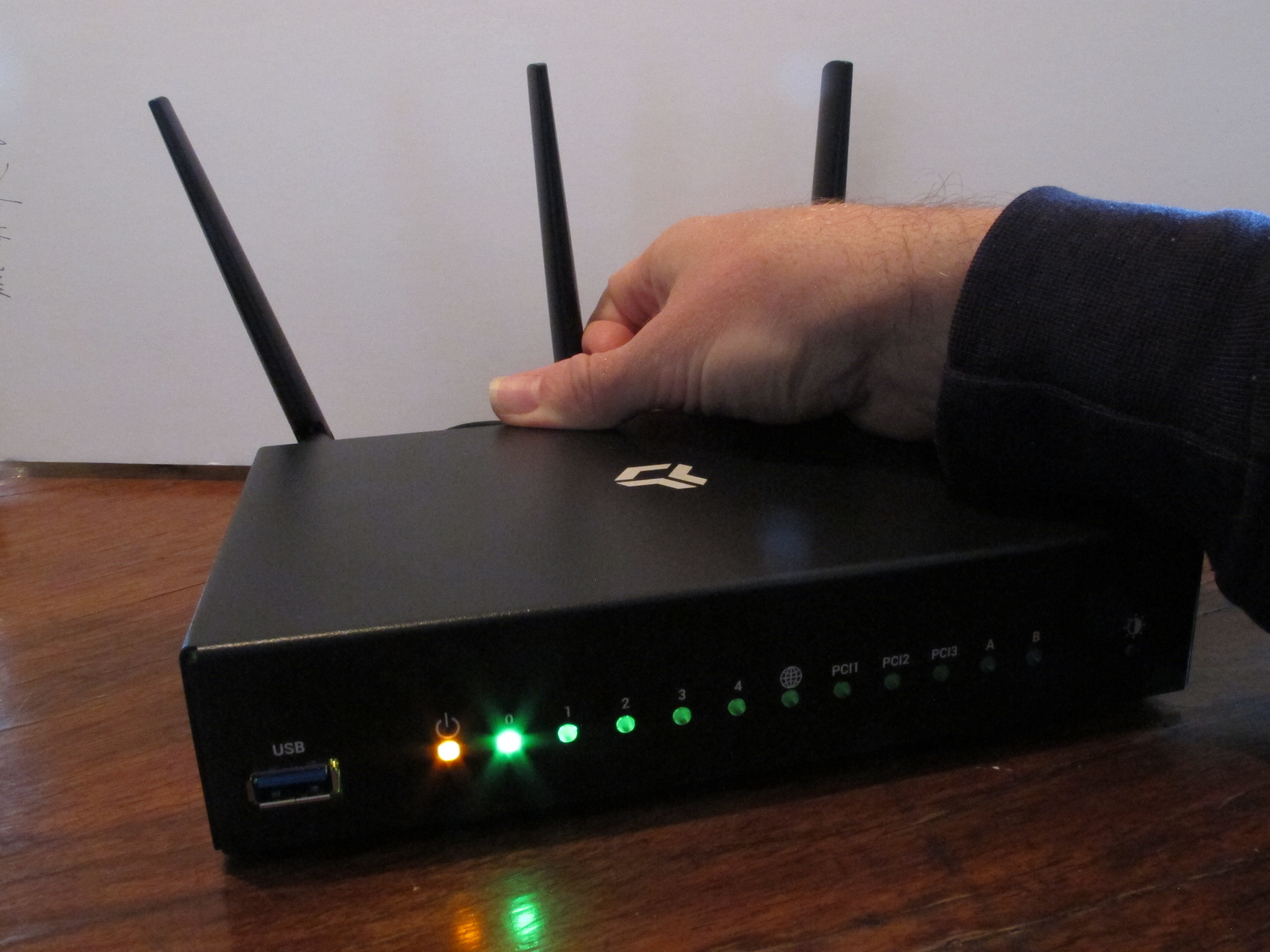
The Turris Omnia router is not the first FLOSS router out there, but it could well be one of the first open hardware routers to be available. As the crowdfunding campaign is coming to a close, it is worth reflecting on the place of the project in the ecosystem. Beyond that, I got my hardware recently, so I was able to give it a try.

A short introduction to the Omnia project The Turris Omnia Router The Omnia router is a followup project on CZ.NIC's original research project, the Turris. The goal of the project was to identify hostile traffic on end-user networks and develop global responses to those attacks across every monitored device. The Omnia is an extension of the original project: more features were added and data collection is now opt-in. Whereas the original Turris was simply a home router, the new Omnia router includes:
  • 1.6GHz ARM CPU
  • 1-2GB RAM
  • 8GB flash storage
  • 6 Gbit Ethernet ports
  • SFP fiber port
  • 2 Mini-PCI express ports
  • mSATA port
  • 3 MIMO 802.11ac and 2 MIMO 802.11bgn radios and antennas
  • SIM card support for backup connectivity
Some models sold had a larger case to accommodate extra hard drives, turning the Omnia router into a NAS device that could actually serve as a multi-purpose home server. Indeed, it is one of the objectives of the project to make "more than just a router". The NAS model is not currently on sale anymore, but there are plans to bring it back along with LTE modem options and new accessories "to expand Omnia towards home automation". Omnia runs a fork of the OpenWRT distribution called TurrisOS that has been customized to support automated live updates, a simpler web interface, and other extra features. The fork also has patches to the Linux kernel, which is based on Linux 4.4.13 (according to uname -a). It is unclear why those patches are necessary since the ARMv7 Armada 385 CPU has been supported in Linux since at least 4.2-rc1, but it is common for OpenWRT ports to ship patches to the kernel, either to backport missing functionality or perform some optimization. There has been some pressure from backers to petition Turris to "speedup the process of upstreaming Omnia support to OpenWrt". It could be that the team is too busy with delivering the devices already ordered to complete that process at this point. The software is available on the CZ-NIC GitHub repository and the actual Linux patches can be found here and here. CZ.NIC also operates a private GitLab instance where more software is available. There is technically no reason why you wouldn't be able to run your own distribution on the Omnia router: OpenWRT development snapshots should be able to run on the Omnia hardware and some people have installed Debian on Omnia. It may require some customization (e.g. the kernel) to make sure the Omnia hardware is correctly supported. Most people seem to prefer to run TurrisOS because of the extra features. The hardware itself is also free and open for the most part. There is a binary blob needed for the 5GHz wireless card, which seems to be the only proprietary component on the board. The schematics of the device are available through the Omnia wiki, but oddly not in the GitHub repository like the rest of the software.

Hands on I received my own router last week, which is about six months late from the original April 2016 delivery date; it allowed me to do some hands-on testing of the device. The first thing I noticed was a known problem with the antenna connectors: I had to open up the case to screw the fittings tight, otherwise the antennas wouldn't screw in correctly. Once that was done, I simply had to go through the usual process of setting up the router, which consisted of connecting the Omnia to my laptop with an Ethernet cable, connecting the Omnia to an uplink (I hooked it into my existing network), and go through a web wizard. I was pleasantly surprised with the interface: it was smooth and easy to use, but at the same time imposed good security practices on the user. Install wizard performing automatic updates For example, the wizard, once connected to the network, goes through a full system upgrade and will, by default, automatically upgrade itself (including reboots) when new updates become available. Users have to opt-in to the automatic updates, and can chose to automate only the downloading and installation of the updates without having the device reboot on its own. Reboots are also performed during user-specified time frames (by default, Omnia applies kernel updates during the night). I also liked the "skip" button that allowed me to completely bypass the wizard and configure the device myself, through the regular OpenWRT systems (like LuCI or SSH) if I needed to. The Omnia router about to rollback to latest snapshot Notwithstanding the antenna connectors themselves, the hardware is nice. I ordered the black metal case, and I must admit I love the many LED lights in the front. It is especially useful to have color changes in the reset procedure: no more guessing what state the device is in or if I pressed the reset button long enough. The LEDs can also be dimmed to reduce the glare that our electronic devices produce. All this comes at a price, however: at \$250 USD, it is a much higher price tag than common home routers, which typically go for around \$50. Furthermore, it may be difficult to actually get the device, because no orders are being accepted on the Indiegogo site after October 31. The Turris team doesn't actually want to deal with retail sales and has now delegated retail sales to other stores, which are currently limited to European deliveries.

A nice device to help fight off the IoT apocalypse It seems there isn't a week that goes by these days without a record-breaking distributed denial-of-service (DDoS) attack. Those attacks are more and more caused by home routers, webcams, and "Internet of Things" (IoT) devices. In that context, the Omnia sets a high bar for how devices should be built but also how they should be operated. Omnia routers are automatically upgraded on a nightly basis and, by default, do not provide telnet or SSH ports to run arbitrary code. There is the password-less wizard that starts up on install, but it forces the user to chose a password in order to complete the configuration. Both the hardware and software of the Omnia are free and open. The automatic update's EULA explicitly states that the software provided by CZ.NIC "will be released under a free software licence" (and it has been, as mentioned earlier). This makes the machine much easier to audit by someone looking for possible flaws, say for example a customs official looking to approve the import in the eventual case where IoT devices end up being regulated. But it also makes the device itself more secure. One of the problems with these kinds of devices is "bit rot": they have known vulnerabilities that are not fixed in a timely manner, if at all. While it would be trivial for an attacker to disable the Omnia's auto-update mechanisms, the point is not to counterattack, but to prevent attacks on known vulnerabilities. The CZ.NIC folks take it a step further and encourage users to actively participate in a monitoring effort to document such attacks. For example, the Omnia can run a honeypot to lure attackers into divulging their presence. The Omnia also runs an elaborate data collection program, where routers report malicious activity to a central server that collects information about traffic flows, blocked packets, bandwidth usage, and activity from a predefined list of malicious addresses. The exact data collected is specified in another EULA that is currently only available to users logged in at the Turris web site. That data can then be turned into tweaked firewall rules to protect the overall network, which the Turris project calls a distributed adaptive firewall. Users need to explicitly opt-in to the monitoring system by registering on a portal using their email address. Turris devices also feature the Majordomo software (not to be confused with the venerable mailing list software) that can also monitor devices in your home and identify hostile traffic, potentially leading users to take responsibility over the actions of their own devices. This, in turn, could lead users to trickle complaints back up to the manufacturers that could change their behavior. It turns out that some companies do care about their reputations and will issue recalls if their devices have significant enough issues. It remains to be seen how effective the latter approach will be, however. In the meantime, the Omnia seems to be an excellent all-around server and router for even the most demanding home or small-office environments that is a great example for future competitors.
Note: this article first appeared in the Linux Weekly News.

H ctor Or n Mart nez: Open Build Service in Debian needs YOU!

Open Build Service is a generic system to build and distribute packages from sources in an automatic, consistent and reproducible way.
openSUSE distributions build system is based on a generic framework named Open Build Service (OBS), I have been using these tools in my work environment, and I have to say, as Debian developer, that it is a great tool. In the current blog post I plan for you to learn the very basics of such tool and provide you with a tutorial to get, at least, a Debian package building.

Fig 1 Open Build Service Architecture

The figure above shows Open Build Service, from now on OBS, software architecture. There are several parts which we should differenciate: Each one of the above packages can be installed in separated machines as a distributed architecture, it is very easy to split the system into several machines running the services, however in the tutorial below everything installs in one machine.
BACKEND The backend is composed of several scripts written either in shell or Perl. There are several services running in the backend: The backend manages source packages (any format such RPM, DEB, ) and schedules them for a build in the worker. Once the package is built it can be published in a repository for the wider audience or kept unpublished and used by other builds.
WORKER System can have several worker machines which are encharged to perform the package builds. There are different options that can be configured (see /etc/default/obsworker) such enabling switch, number of worker instances, jobs per instance. This part of the system is written in shell and/or Perl language.
WEB UI / API The frontend allows in a clickable way to get around most options OBS provides: setup projects, upload/branch/delete packages, submit review requests, etc. As an example, you can see a live instance running at https://build.opensuse.org/ The frontend parts are really a Ruby-on-rails web application, we (mainly thanks to Andrew Lee with ruby team help) have tried to get it nicely running, however we have had lots of issues due to javascripts or rubygems malfunctioning. Current webui is visible and provides some package status, however most actions do not work properly, or configurations cannot be applied as editor does not save changes, projects or packages in a project are not listed either. If you are a Ruby-on-rails expert or if you are able to help us out with some of the webui issues we get at Debian that would be really appreciated from our side.
OSC CLI OSC is a managing command line tool, written in Python, that interfaces with OBS API to be able to perform actions, edit configurations, do package reviews, etc.
Now that we have done a general overview of the system, let me introduce you to OBS with a practical tutorial. TUTORIAL: Build a Debian package against Debian 8.0 using Download On Demand (DoD) service.

Keith Packard: AltOS-Lisp

A Tiny Lisp for AltOS I took a bit of a diversion over the last week or so when I wondered how small a lisp interpreter I could write, and whether I could fit that into one of the processors that AltOS runs on. It turns out, you can write a tiny lisp interpreter that fits in about 25kB of ram with a 3kB heap for dynamic data. I decided to target our ChaosKey boards; they're tiny, and I've got a lot of them. That processor offers 28kB of usable flash space (after the 4kB boot loader) and 6kB of ram with the processor running at a steaming 48MHz. I'm not at all sure this is useful, but I always enjoy doing language implementations, and this one presented some 'interesting' challenges: Iterative Compacting Allocator I'm betting someone has built one of these before, but I couldn't find one, so I wrote my own. The basic strategy is to walk the heap to find a subset of the active objects which are allocated sequentially in memory with only unused storage between them. These objects are then compacted in-place, and then the heap is walked again to update all references to the moved objects. Then, the process is restarted to find another subset and move them. By looking for these subsets starting at the bottom of the heap, and working upwards towards the top, the whole heap can be compacted into a contiguous chunk at the bottom of memory. Allocation involves moving a pointer along at the top of active memory; when it gets to the top of the heap, collect and see if there's space now. As always, the hardest part was to make sure all active memory was tied down. The second hardest part was to make sure that all active pointers were updated after any allocation, in case a collect moved the underlying object. That was just bookkeeping, but did consume much of the development time. One additional trick was to terminate the recursion during heap walking by flagging active cons cell locations in a global bitmap and then walking that separately, iterating until that bitmap is empty. Nested lambdas form another recursion which should probably get the same approach, but I haven't done that yet. An unexpected "benefit" of the tiny heap is that the collector gets called a lot, so any referencing bugs will have a good chance of being uncovered in even a short program execution. ROM-able Lisp Instead of implementing all of the language in C, I wanted to be able to implement various pieces in Lisp itself. Because of the complex nature of the evaluation process, adding things like 'let' or even 'defun' turn out to be dramatically simpler in Lisp. However, I didn't want to consume bunches of precious RAM to hold these basic functions. What I did was to create two heaps, one in ROM and the other in RAM. References are be tagged as to which heap they're in. 16-bit Values Lisp programs use a pile of references. Using a full 32 bits for each one would mean having a lot less effective storage. So, instead, I use an offset from the base of the heap. The top bit of the offset is used to distinguish between the ROM heap and the RAM heap. I needed a place to store type information, so I settled on using the bottom two bits of the references. This allows for four direct type values. One of these values is used to indicate an indirect type, where the type is stored in the first byte of the object. The direct types are:
ValueType
0Cons cell
114-bit int
2String
3Other
With 2 tag bits, the allocator needs to work in 32-bit units as the references couldn't point to individual bytes. Finally, I wanted 0 to be nil, so I add four to the offsets within the heaps. The result is that the ROM and RAM heaps can each cover up to 32k - 4 bytes. Note that ints are not stored in the heap; instead they are immediate values stored in 14 bits, providing a range of -8192 to 8191. One can imagine wanting more range in ints at some point. Heap-based Evaluator A simple lisp implementation uses the fact that eval is re-entrant and do the operation on the C stack:
val eval(val exprs)  
    val vals;
    while (exprs)  
        vals = append(vals, eval(car(exprs)));
        exprs = exprs->cdr;
     
    return execute (car(vals), cdr(vals));
 
This makes things really simple and provides for a clean framework for implementing various bits of lisp, including control flow and macros. However, it rapidly consumes all of the available memory for a stack, while also requiring separate bookkeeping for the in-use memory in each frame. I replaced this design with one which keeps the lisp stack on the heap, and then performs eval with a state machine with all state stored in global variables so that the memory manager can reference them directly. Each eval operation is performed in a separate 'stack' context, which holds the entire eval state except for the current value, which lives in a separate global variable and is used to pass values out of one stack frame and into another. When the last stack context is finished, the evaluation terminates and the value is returned to the caller. There are nine states in the state machine, each of which is implemented in a separate function, making the state machine a simple matter of pulling the current state from the top of the stack and invoking the associated function:
while (ao_lisp_stack)  
    if (!(*evals[ao_lisp_stack->state])()   ao_lisp_exception)  
        ao_lisp_stack_clear();
        return AO_LISP_NIL;
     
 
return ao_lisp_v;
Because there's no C recursion involved, catching exceptions is a simple matter of one test at this level. Primitives like progn, while, cond and eval all take special magic in the state machine to handle; getting all of that working took several attempts before I found the simple loop shown above. Lexical Scoping The last time I did a lisp interpreter, I implemented dynamic scoping. Atoms were all global and had values associated directly with them. Evaluating a lambda started by saving all of the existing global values for the parameter atoms and then binding the new values. When finished, the previous values would be restored. This is almost correct, but provides surprising results for things like:
> (setq baz 1)
> (def foo (lambda (bar) (+ baz bar)))
> (def bletch (lambda (baz) (foo baz)))
> (bletch 2)
4
The value that foo gets for 'baz' is 2 instead of 1 under dynamic scoping, which most people find surprising. This time, I was determined to use lexical scoping, and it turned out to be surprisingly easy. The first trick was to separate the atoms from their 'value'; each atom can have a different value in different lexical scopes. So, each lexical scope gets a 'frame' object, those contain the value for each atom defined in that scope. There's a global scope which holds all of the globally defined values (like baz, foo and bletch above). Each frame points to its enclosing scope, so you can search upwards to find the right value. The second trick was to realize that the lexical scope of a lambda is the scope in which the lambda itself is evaluated, and that the evaluation of a lambda expression results in a 'function' object, which contains the lambda and its enclosing scope:
> (def foo (lambda (bar bletch)
       ((lambda (baz)
          (+ baz bar))
        bletch)))
> (foo 2 3)
5
In this case, the inner lambda in foo can 'see' the value of bar from the enclosing lambda. More subtly, even if the inner lambda were executed multiple times, it would see the same baz, and could even change it. This can be used to implement all kinds of craziness, including generators:
> (defun make-inc (add)
  ((lambda (base)
     (lambda ()
       (progn
     (setq base (+ base add))
     base)))
   0)
  )
> (setq plus2 (make-inc 2))
> (plus2)
2
> (plus2)
4
The current implementation of each frame is a simple array of atom/value pairs, with a reference to the parent frame to form the full scope. There are dramatically faster implementations of this same concept, but the goal here was small and simple. A Tiny Allocator Optimization With eval consuming heap space for stacks, frames and argument lists, the interpreter was spending a lot of time in the collector. As a simple optimization, I added some free lists for stack frames and cons cells. Stack frames are never referenced when they're finished, so they can always go on the free list. Cons cells used to construct argument lists for functions are usually free. Builtin functions have a bit which indicates whether they might hold on to a reference to the argument list. Interpreted lambdas can't get the list while nlambdas, lexprs and macros do. Each lambda execution creates a new frame, and while it would be possible to discover if that frame 'escapes' the lambda, I decided to not attempt to cache free ones yet. Save and Restore To make the lisp interpreter more useful in tiny computers, I added the ability to save and restore the entire heap to flash. This requires leaving enough space in the flash to preserve the heap, further constraining the amount of flash available for the application. Code All of this code is in the 'lisp' branch of my AltOS repository: AltOS The lisp interpreter is independent from the rest of AltOS and could be re-purposed for another embedded operating system. It runs fine on ChaosKey hardware, and also on the STM32F042 Nucleo-32 board There's also a test framework which runs on Linux, and is how I developed almost all of the code. That's in the src/test directory in the above repository, and is called 'ao_lisp_test'. Towers of Hanoi Here's an implementation of the classic recursive Towers of Hanoi game; it shows most of the current features of the language.
;
; Towers of Hanoi
;
; Copyright   2016 Keith Packard <keithp@keithp.com>
;
; This program is free software; you can redistribute it and/or modify
; it under the terms of the GNU General Public License as published by
; the Free Software Foundation, either version 2 of the License, or
; (at your option) any later version.
;
; This program is distributed in the hope that it will be useful, but
; WITHOUT ANY WARRANTY; without even the implied warranty of
; MERCHANTABILITY or FITNESS FOR A PARTICULAR PURPOSE.  See the GNU
; General Public License for more details.
;
; ANSI control sequences
(defun move-to (col row)
  (patom "\033[" row ";" col "H" nil)
  )
(defun clear ()
  (patom "\033[2J" nil)
  )
(defun display-string (x y str)
  (move-to x y)
  (patom str)
  )
; Here's the pieces to display
(setq stack '("*" "**" "***" "****" "*****" "******" "*******"))
(setq top (+ (length stack) 3))
;
; Here's all of the stacks of pieces
; This is generated when the program is run
;
(setq stacks nil)
; Display one stack, clearing any
; space above it
(defun display-stack (x y clear stack)
  (cond ((= 0 clear)
     (cond (stack (progn
            (display-string x y (car stack))
            (display-stack x (1+ y) 0 (cdr stack))
            )
              )
           )
     )
    (t (progn
         (display-string x y "          ")
         (display-stack x (1+ y) (1- clear) stack)
         )
       )
    )
  )
; This should probably be included in the rom image...
(defun length (list)
  (cond (list (1+ (length (cdr list))))
    (0)
    )
  )
; Position of the top of the stack on the screen
; Shorter stacks start further down the screen
(defun stack-pos (y stack)
  (- y (length stack))
  )
; Display all of the stacks, spaced 20 columns apart
(defun display-stacks (x y stacks)
  (cond (stacks (progn
          (display-stack x 0 (stack-pos y (car stacks)) (car stacks))
          (display-stacks (+ x 20) y (cdr stacks)))
        )
    )
  )
; Display all of the stacks, then move the cursor
; out of the way and flush the output
(defun display ()
  (display-stacks 0 top stacks)
  (move-to 1 21)
  (flush)
  )
; Reset stacks to the starting state, with
; all of the pieces in the first stack and the
; other two empty
(defun reset-stacks ()
  (setq stacks (list stack nil nil))
  (length stack)
  )
; more functions which could usefully
; be in the rom image
(defun min (a b)
  (cond ((< a b) a)
    (b)
    )
  )
(defun nth (list n)
  (cond ((= n 0) (car list))
    ((nth (cdr list) (1- n)))
    )
  )
; Replace a stack in the list of stacks
; with a new value
(defun replace (list pos member)
  (cond ((= pos 0) (cons member (cdr list)))
    ((cons (car list) (replace (cdr list) (1- pos) member)))
    )
  )
; Move a piece from the top of one stack
; to the top of another
(defun move-piece (from to)
  (let ((from-stack (nth stacks from))
    (to-stack (nth stacks to))
    (piece (car from-stack)))
    (setq from-stack (cdr from-stack))
    (setq to-stack (cons piece to-stack))
    (setq stacks (replace stacks from from-stack))
    (setq stacks (replace stacks to to-stack))
    (display)
    (delay 100)
    )
  )
; The implementation of the game
(defun _hanoi (n from to use)
  (cond ((= 1 n)
     (progn
      (move-piece from to)
      nil)
     )
    (t
     (progn
      (_hanoi (1- n) from use to)
      (_hanoi 1 from to use)
      (_hanoi (1- n) use to from)
      )
     )
    )
  )
; A pretty interface which
; resets the state of the game,
; clears the screen and runs
; the program
(defun hanoi ()
  (setq len (reset-stacks))
  (clear)
  (_hanoi len 0 1 2)
  )

14 November 2016

Mike Gabriel: Debian Edu development sprint in Oslo from Nov 25th - Nov 27th 2016

For those of you, who already thought about joining us in Oslo for our Debian Edu sprint, here comes your short reminder for signing up on this wiki page and then book your travel. For those of you, who have learned about our upcoming sprint just now, feel heartily invited to meet and join the Debian Edu team (and friends) in Oslo. Check with your family and friends, if they may let you go. Do that now, put your name onto our wiki page and and book your journey. Those of you, who cannot travel to Oslo, but feel like being interested in Debian and educational topics around Free Software, put a note into your calendar, so you don't forget to join us on IRC over that weekend (and any other time if you like): #debian-edu on irc.debian.org. Looking forward to meeting you at end of November,
Mike (aka sunweaver)

13 November 2016

Gregor Herrmann: RC bugs 2016/40-45

time for a quick update, I guess. here's the list of release-critical bugs in debian I've worked on during the last couple of weeks.

Next.

Previous.