Search Results: "jr"

18 January 2006

MJ Ray: On the GPLv3

So the GPLv3 is out. Somehow, I can't motivate myself to wade through pages of legalese and make sensible comments until I feel happy that this won't be a repeat of the FDL "keep them in chains, hoping for freedom" discussion farce, or the WGIG "divide and conquer" that the process seems to be modelled on. I posted two to the GPLv3 wiki as a starter:
  • Who are the mysterious committees A, B, C, D and E at present?
  • Why has the GPLv3 Process been modelled on the terrible processes of the WGIG, instead of harnessing the free-software-friendly organisations already existing around the world?
While doing so, I noticed a cute trick: the FSF considers any posts to the GPLv3 Wiki as being released under the GPL-incompatible FDL 1.2. I muttered "Sod that!" and added a note granting more freedom.

Brett Parker: GNU date...

Hmmm, MJ Ray asks about date and locales... I *think* (though without grabbing the source I can't confirm) that the default date format of "date" is the legacy format that it's always been... if you want to get a shiny locale based date format from it use, use +"%c". Here's the output from my laptop:
brettp@pitr:~$ locale
LANG=en_GB.UTF-8
LC_CTYPE="en_GB.UTF-8"
LC_NUMERIC="en_GB.UTF-8"
LC_TIME=en_GB.UTF-8
LC_COLLATE="en_GB.UTF-8"
LC_MONETARY="en_GB.UTF-8"
LC_MESSAGES="en_GB.UTF-8"
LC_PAPER="en_GB.UTF-8"
LC_NAME="en_GB.UTF-8"
LC_ADDRESS="en_GB.UTF-8"
LC_TELEPHONE="en_GB.UTF-8"
LC_MEASUREMENT="en_GB.UTF-8"
LC_IDENTIFICATION="en_GB.UTF-8"
LC_ALL=
brettp@pitr:~$ date
Wed Jan 18 08:34:52 GMT 2006
brettp@pitr:~$ date +"%c"
Wed 18 Jan 2006 08:34:55 GMT
brettp@pitr:~$ 
I wonder why date doesn't use "%c" by default... weird.

17 January 2006

MJ Ray: locales

Why does GNU date output
Tue Jan 17 14:55:35 GMT 2006
instead of the English
Tue 17 Jan 2006 14:55:35 GMT
? My LANG is en_GB.UTF-8. Setting LC_TIME and LC_ALL changes nothing. locale's output looks fine - what's wrong here? Replies to mjr at phonecoop.coop please.

13 January 2006

MJ Ray: Interesting times in CSS

We've barely got CSS 2 support in many browsers and we're on the road to CSS 3. The W3C have released a Selectors paper, which describes ways of addressing parts of xhtml available in CSS 1 and 2, as well as those suggested for 3. There's also a first public working draft of CSS 3's Advanced Layout Module, which will add a grid layout model to the current absolute and flow models and proposed cascade and multi-column ones. For more, see the W3C CSS Homepage.

11 January 2006

MJ Ray: Phone Companies and bad selling

Martyn is having trouble with Orange and their minions over his mobile phone. I've had trouble with British Telecom (and again) following leaving them in 2004. I'm not writing more about it yet, because it's still ongoing, but I'm also having trouble with the company I moved to after BT, who used a similar sharp contract renewal practice to the one troubling Martyn, as far as I can tell. I do have a good solution for fixed lines and I'll write more here once it's ready. My advice to anyone who finds themselves on the receiving end of these bad contract attempts: Get leaflet OFT 143 on Unfair Contract Terms from the Office of Fair Trading web site. If you've never had details of the minimum term of the contact, it's probably void. Finally, if you want a better mobile phone deal, try the Consumer Association's Switch with Which site.

MJ Ray: The Walks and Cycling

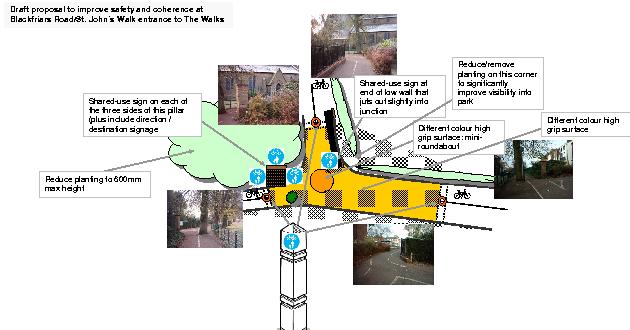
The Walks Management Forum meets on Thursday 12th January at 6pm at the council's main offices meeting room 1. I think it's open to public viewing (like most council meetings), but the public can't speak (like most council meetings - grrr), only members. Send me any comments that you have on: Internal Drainage Board works on the Gaywood River; landscaping works in St James Park; bat "mitigation" measures; or foundation design for the new kiosk and footbridge; and I'll pass them on. As part of the Walks project, I'm trying to get the potholed, overgrown and sometimes awkward cycleways brought up to standard. The Walks has three long off-road paths which offer vital "greenway" connections from residential and industrial areas to parts of the town centre, including the rail and bus stations, cinema and library. Here's the last draft I have for a current tricky junction: St John's/Blackfriars cycleway junction proposal The "mini-roundabout" effect will probably be lost, to use the effect of missing markings to make people slow down. If you have comments on this, especially if it links to Sustrans advice, please email it to me (follow permalink for address).

MJ Ray: Hallenfu ball and the FA Cup

England's football fans had the pleasure of random football scores last weekend: the FA Cup. Why is there so much expectation of upsets? I think it's partly because the match is at an ideal time to help level things out, especially if it's at a non-league ground:
League clubs
  • usually full-time
  • 4 or 5 games over the holidays
  • mostly still negotiating new players
  • some of their players seem to expect it to be easy
  • usually play on expensive, well-kept pitches
Non-league clubs
  • often part-time
  • 3 games over the holidays
  • often introduce new players in the cup match
  • many of their players relish playing a top club
  • probably have a pitch more damaged by winter
Meanwhile, the German Bundesliga closed before Christmas for a winter break until the end of January. During the break, Bundesliga teams take part in indoor football tournaments, some of which can be seen on DSF. It developed independently on demand and so the rules are a bit different to 5-a-side, powerleague or futsal. I still don't understand them all, but it plays like a cross between ice hockey and football. I found a bit about its history in a discontinued Bundesliga FAQ. Once the Bundesliga restarts, I expect it'll be back on Sgorio. Finally, watch English league cup (which isn't FA Cup) semi-finals free-to-air on German DSF...

10 January 2006

MJ Ray: debian-legal Package Lists Oct-Dec 2005

I've just been looking at this post about vigra, gnuboy, coq, sex and barnyard and now I wonder whether this post will have any entertaining side-effects when syndicated. Even though hot-babe was mentioned on-list, it didn't make this post ;-) I've finished typing up my index of packages that debian-legal looked at during the last few months of 2005. If you're interested in these packages, check that month's index for comments with links to discussions and bugs:
October
acpica-unix bittorrent celestia jdk1.5 kfreebsd-5 kiax iaxclient kleansweep mozilla-* libmysqlclient newmat pcsx (various php-pear packages) libselinux sex vigra www.debian.org xserver-xorg
November
dh-make glk gnat icc-profiles kernel-modules-intel537ep kleansweep mozilla-firefox octave (various php-pear packages) rar sugarcrm sword-text-kjv ttf-gentium
December
bioapi coq display-dhammpedia feedparser gngb gnuboy icc-profiles ispell-et kaid kleansweep libpreludedb (various php-pear packages) python-pymedia sancp barnyard sguil tiffio

8 January 2006

MJ Ray: How boycotts work: one view

The problem of free software graphics hardware drivers was being discussed and it was suggested that we should only buy from friendly companies, which provoked a common sceptical claim that there's no point boycotting a product or company or country unless everyone else does. I think that may be assuming the aim is to bankrupt them rather than to change a bad decision. Since when has a boycott needed to be total in order to change a supplier's mind? You only need enough people to support it, not everyone. The value of "enough" changes for each thing: there are examples of relatively limited boycotts succeeding (Shell Brent Spar) and relatively long/large ones not yet succeeding (Nestl Baby Milk Action). Boycotts are consumers doing judo on corporations: Most corporations aim to maximise their profit. Boycotts are an overt way of linking lost sales to a particular issue. In theory, if it looks like it's costing more profit to suffer the boycott than to address the cause, the executives should fix it or the shareholders should replace them with some who will. So, it is helpful to boycott harmful companies noisily. (Full article continues on my site...)

MJ Ray: People who move blogs: please don't break links!

Seeing as Brett has made it a blog a grumble day: It's a bit annoying when people move their blog feed without announcing it in the old one. Please don't break your links. Brownie points to David for doing it right (well, nearly... I continue with RDF, not the advertised RSS2). Really, I don't care that much. I'm watching The Living Daylights, so it's all cool. Sort of odd to see the Brosnan Bond's CIA pal as the villan - Die Another Day was shown only last Wednesday.

7 January 2006

MJ Ray: slef-reflection, re-reflected

Someone commented that the last post had a 2005 permalink despite being posted in 2006. Well, behind the scenes, there's been a bit of a change for the new year which wasn't quite ready in time.
Old production method
I fed email to a script that added it to the html page, then another script added that to the RSS feeds.
New production method
I make the html for the post (usually with an editor, but I could render an email or whatever) and then a script builds the RSS from the index.
As far as the outside world is concerned, the only changes should be from .html# to a simple / in the permalinks. Old posts stay where they are for now, until I get around to sorting and archiving them. (Update: ho ho, first upload was a bit wrong in two ways, but this one is better.) (Update 2: ho ho, planet keeps displaying items after they've been deleted from the feed, unlike other aggregators. Sorry, planet debian.)

MJ Ray: From the bit-bucket

No structured article ready to go today, so here's a random round-up of links from the last month: (links are on my page...)

MJ Ray: From the bit-bucket

No structured article ready to go today, so here's a round-up of links from the last month:

MJ Ray: slef-reflection, re-reflected

Someone commented that the last post had a 2005 permalink despite being posted in 2006. Well, behind the scenes, there's been a bit of a change for the new year.
Old production method
I fed email to a script that added it to the html page, then another script added that to the RSS feeds.
New production method
I make the html for the post (usually with an editor, but I could render an email or whatever) and then a script builds the RSS from the index.
As far as the outside world is concerned, the only changes should be from .html# to a simple / in the permalinks. Old posts stay where they are for now, until I get around to sorting and archiving them.

3 January 2006

MJ Ray: GR to break promises and ignore copyright

Anthony Towns notes I didn't vote in the debian general resolution. I didn't vote for two reasons: the vote was held at a very bad time, when many of us have more fun things to do than debug misbehaving "holiday" mail systems, and I think the proposed worst outcome wasn't legal anyway, so the vote was irrelevant for years, any road up. I'm not delighted about the outcome, but it's better than it could have been.

20 December 2005

MJ Ray: If a user attacks another computer, is their sysadmin responsible?

Only if the attack's for the benefit of the sysadmin or their employer, as far as I can tell. All-party Parliamentary Internet Group had links to legislation/regulation: The British and Irish Legal Information Institute didn't let me find any cases with computer misuse AND supervision. Using "lack of supervision" alone finds common sense use only. So it seems to hinge on supervision. I hope that you have to do something pretty obviously daft to fall foul of a court on that. I guess that you shouldn't let a server managed by you run totally unattended, but if you take normal precautions (firewall, logcheck, intrusion detection and so on and actually review them), the admin should be OK whatever. If someone's just using your computer as a jumping-off point for random attacks, I don't see how that's for your benefit either. I think that wording might be to discourage evil businesses having teams trying to deface competitor sites and so on. There's probably a bigger danger from copyright and trademark infringement accusations IMO. I am not a lawyer. Check the above yourself or consult a lawyer about it. If you do and have updates, can you let me know, please?

16 December 2005

MJ Ray: Revision Control Systems

"All revision control systems suck. This one just sucks less."
That's roughly what I'll say when I find one worth it. I've used rcs, cvs, svn, prcs, tla, arx, monotone and probably some I've forgotten. They all suck, in different ways. I'm now really reluctant to install a new revision control system unless there's a clear benefit. Matthew Palmer:
"Subversion is the One True Revision Control System and we should all just Stop Worrying and Learn To Love The Handcuffs"
Current target of my wrath is subversion, the lardy cake of revision controls. Over 5 times the footprint of CVS gets you atomic commits, but similar design problems with centralised servers and corruptable roots. Server choice is either a pserver-look one or an apache server with all the trimmings. The licence isn't even GPL-compatible, so forget about neat integration into some editors and development tools. Finally, if CVS is "extremely dead" despite its last release in October 2005, then SVN must be buried and rotting because it hasn't released since August. I tend to prefer distributed systems, especially when done well with standard protocols so that I can copy the archive somewhere close to me and work with it at relatively high speed, or off-line. It also gives the benefit that I merge when I want to, rather than being forced to choose between commit and branch. Centralised systems seem to make branching needlessly fiddly. Beyond that, I strongly prefer a system which can generate tarballs and patches (as far as possible) so that the rest of the world doesn't have to install the binaries (even if they can). That's about the base level of compatibility for now and any new tool should at least try to support it, even if the export loses some information. (I'm currently using a small shell script which just automates tarballs and patches, to help me move between my two computers here. I know it's only a 90% solution, but it's one I understand and can put some faith in. I need to have faith in my RCS. I like little less than losing work. Next step is to automate updates and merges, rather than doing them by hand.)

13 December 2005

MJ Ray: More on GPLv3

Well, Georg Greve says he's heard my concerns about the GPLv3. Georg's a good guy. I wonder whether FSF will act on them and open up the GPLv3 process. I note Georg's urging people to Say No to Vienna Manipulations which is interesting, given the structural similarities between the Vienna and GPLv3 processes...

9 December 2005

MJ Ray: Bureaucracy, debian and the web

Reading old email can be entertaining sometimes:
"I've done this before, in various forms, and most of the time it follows the same predictable route: 25% of the time you get a really good committee and it's a blast for all involved; 25% you get a diabolical committee and it stands a chance of dying; half the time you get an average committee and it continues as it was before. The whole "committee" idea has some fairly major pitfalls to avoid: cliques, irrelevance and legality to name but three. [...] I think we should NOT form a committee."
-- Me, to alug, in April 1999 which makes all the crap from Debian-UK Society zealots like:
"While people like MJ Ray like bureaucratic bondage[0], it was felt by everyone else that the best constitution would be the simplest possible."
-- Scott James Remnant, to debian-project, in August 2005 even more obviously laughable. I didn't want a complicated constitution. I want either a minimally-complete constitution, or not to join it. They allow neither. Annoyingly, the Debian-UK Society is still claiming many DDs became members without consenting (which violates article 20 of the universal declaration of human rights), still seem to have permission to use the "Debian" trademark and still seem to be a business selling CDs and t-shirts. Violating a human right may mean they're breaking our Human Rights Act - quite remarkable for a small club. Also, I've seen nothing that suggests that they have notified the Inland Revenue, which I think can get them fined lots, so donations may be at risk. Tomorrow is International Human Rights Day (which centres this year on torture). DUS is a piffling matter, so it should be easy to deal with, but there seems to be lies, bigotry and ignorance in the way. Freedom to associate is one of the most practical human rights. It lets us act on our support or opposition to things. Defend it. I support debian but I oppose the way it's doing business in the UK. Do you support attempted conscription into an odd-looking UK business?

8 December 2005

MJ Ray: Business Truths

I smiled at "Things I thought" from Bagel Belly Blog more than I have for a while. Much truth there. The Bagel Belly is back on form. Sam Hocevar asks "Is there a task organiser that does not suck?" which I think is interesting - the program is not the organiser. The user is the organiser. The program can only help (or hinder!) not organise. Sometimes obvious is just plain wrong. I used to think it was obvious to answer my messages at the start of the day. I found I lost whole chunks of the day that way. For me, long reading is usually an evening activity, so I guess my mind associated it with going to sleep afterwards. I didn't notice that reading personal email is fine, when I reply to a high proportion of it and act on it. That starts my day with action and I continue being active through the day. Reading mailing lists and newsgroups isn't fine, as I read most of that and don't reply. I switched to reading only personal email in the morning and leaving lists and newsgroups until later in the day, unless there's something obviously interesting. It's made a big difference. Is there a need to rethink email? Bob Geldof rails against emails:
"Geldof said he dreaded seeing lots of e-mails in his inbox, as they imposed an agenda on him, and disrupted his own plans for the day."
This doesn't surprise me in general (is there a less likely email fan?) but does he have a point? Over time, I've moved to treating emails as letters, essays or at least office memos. It's easy to treat them as conversations, but they are not, in so many ways. You can say things in conversations that will haunt you if you ever write them down. In conversation, people accept that sometimes you'll make comments without proper review and reflection, but it's assumed that you have considered your emails, even though most people don't seem to. This is part of why I think the Debian private email "declassification" proposal is unethical if applied to past messages. People didn't expect to have such a wide audience. Similar musings from techdirt, the Register, the Inquirer and Business Week Maybe see also thread patterns from see shy jo which could help you skip though low priority email sooner, and Online forum usage and other addictions, from Steve Pavlina. I wondered if the problems were new to online. Forums can be a bit like newspapers, but while you get a whole day to read a newspaper and there's one hell of a lag on the letters page, you can get a forum update by clicking at any time (even though new editions may be smaller) and your talk-back appears instantly on most forums. - Then someone reminded me about "news junkies" who buy all the newspapers and watch or listen to rolling news. Maybe this isn't a new problem. How was it solved in the past?

Next.

Previous.