Introduction
If you use SteamOS and you like to install third-party tools or modify the system-wide configuration some of your changes might be lost after an OS update. Read on for details on why this happens and what to do about it.
As you all know SteamOS uses an immutable root filesystem and users are not expected to modify it because all changes are lost after an OS update.
However this does not include configuration files: the /etc directory is not part of the root filesystem itself. Instead, it s a writable overlay and all modifications are actually stored under /var (together with all the usual contents that go in that filesystem such as logs, cached data, etc).
/etc contains important data that is specific to that particular machine like the configuration of known network connections, the password of the main user and the SSH keys. This configuration needs to be kept after an OS update so the system can keep working as expected. However the update process also needs to make sure that other changes to /etc don t conflict with whatever is available in the new version of the OS, and there have been issues due to some modifications unexpectedly persisting after a system update.
SteamOS 3.6 introduced a new mechanism to decide what to to keep after an OS update, and the system now keeps a list of configuration files that are allowed to be kept in the new version. The idea is that only the modifications that are known to be important for the correct operation of the system are applied, and everything else is discarded1.
However, many users want to be able to keep additional configuration files after an OS update, either because the changes are important for them or because those files are needed for some third-party tool that they have installed. Fortunately the system provides a way to do that, and users (or developers of third-party tools) can add a configuration file to /etc/atomic-update.conf.d, listing the additional files that need to be kept.
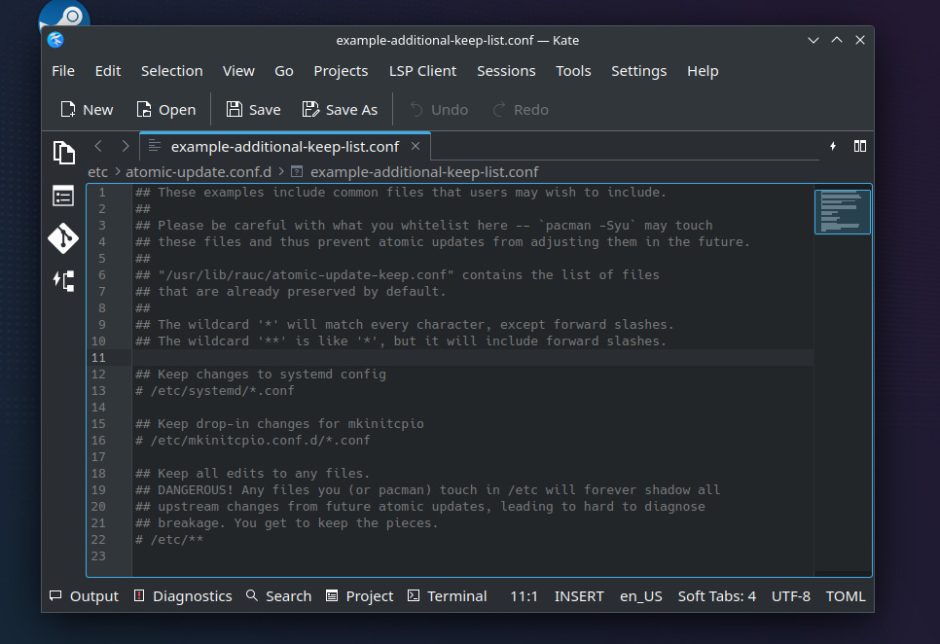
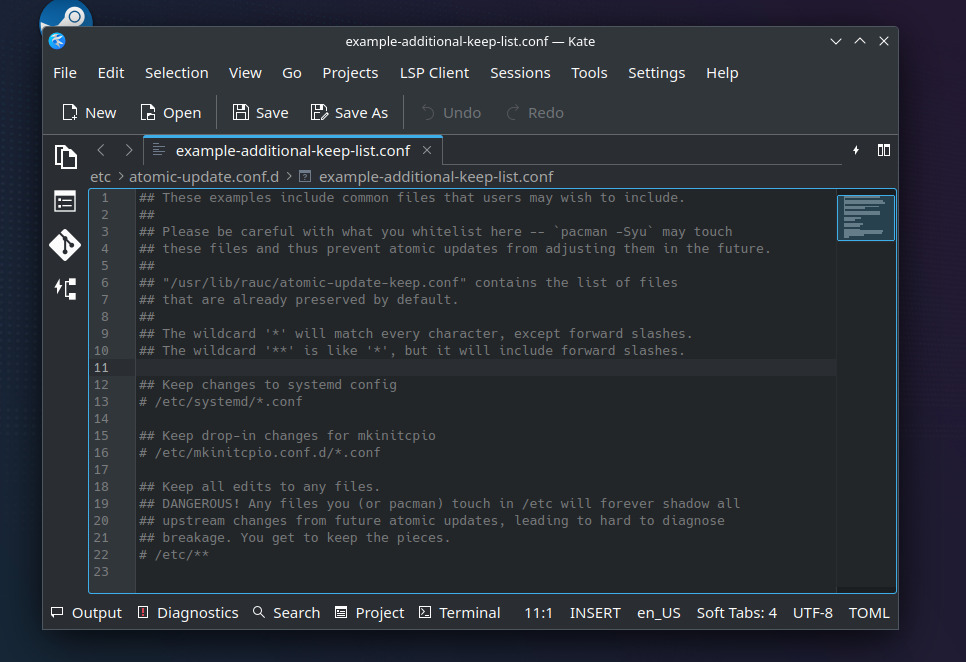
There is an example in /etc/atomic-update.conf.d/example-additional-keep-list.conf that shows what this configuration looks like.
Sample configuration file for the SteamOS updater
Developers who are targeting SteamOS can also use this same method to make sure that their configuration files survive OS updates. As an example of an actual third-party project that makes use of this mechanism you can have a look at the DeterminateSystems Nix installer:
https://github.com/DeterminateSystems/nix-installer/blob/v0.34.0/src/planner/steam_deck.rs#L273
As usual, if you encounter issues with this or any other part of the system you can check the SteamOS issue tracker. Enjoy!
A copy is actually kept under /etc/previous to give the user the chance to recover files if necessary, and up to five previous snapshots are kept under /var/lib/steamos-atomupd/etc_backup
Welcome to the first report in 2025 from the Reproducible Builds project!
Our monthly reports outline what we ve been up to over the past month and highlight items of news from elsewhere in the world of software supply-chain security when relevant. As usual, though, if you are interested in contributing to the Reproducible Builds project, please visit our Contribute page on our website.
Table of contents:
reproduce.debian.net
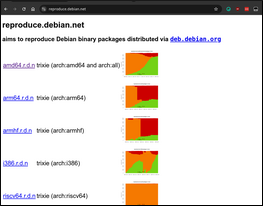
The last few months saw the introduction of reproduce.debian.net. Announced at the recent Debian MiniDebConf in Toulouse, reproduce.debian.net is an instance of rebuilderd operated by the Reproducible Builds project. Powering that is rebuilderd, our server designed monitor the official package repositories of Linux distributions and attempt to reproduce the observed results there.
This month, however, we are pleased to announce that in addition to the existing amd64.reproduce.debian.net and i386.reproduce.debian.net architecture-specific pages, we now build for a three more architectures (for a total of five) arm64armhf and riscv64.
Two new academic papers
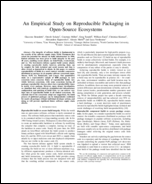
Giacomo Benedetti, Oreofe Solarin, Courtney Miller, Greg Tystahl, William Enck, Christian K stner, Alexandros Kapravelos, Alessio Merlo and Luca Verderame published an interesting article recently. Titled An Empirical Study on Reproducible Packaging in Open-Source Ecosystem, the abstract outlines its optimistic findings:
[We] identified that with relatively straightforward infrastructure configuration and patching of build tools, we can achieve very high rates of reproducible builds in all studied ecosystems. We conclude that if the ecosystems adopt our suggestions, the build process of published packages can be independently confirmed for nearly all packages without individual developer actions, and doing so will prevent significant future software supply chain attacks.
In this work, we perform the first large-scale study of bitwise reproducibility, in the context of the Nix functional package manager, rebuilding 709,816 packages from historical snapshots of the nixpkgs repository[. We] obtain very high bitwise reproducibility rates, between 69 and 91% with an upward trend, and even higher rebuildability rates, over 99%. We investigate unreproducibility causes, showing that about 15% of failures are due to embedded build dates. We release a novel dataset with all build statuses, logs, as well as full diffoscopes: recursive diffs of where unreproducible build artifacts differ.
As above, the entire PDF of the article is available to view online.
Distribution work
There as been the usual work in various distributions this month, such as:
10+ reviews of Debian packages were added, 11 were updated and 10 were removed this month adding to our knowledge about identified issues. A number of issue types were updated also.
The FreeBSD Foundation announced that a planned project to deliver zero-trust builds has begun in January 2025 . Supported by the Sovereign Tech Agency, this project is centered on the various build processes, and that the primary goal of this work is to enable the entire release process to run without requiring root access, and that build artifacts build reproducibly that is, that a third party can build bit-for-bit identical artifacts. The full announcement can be found online, which includes an estimated schedule and other details.
Following-up to a substantial amount of previous work pertaining the Sphinx documentation generator, James Addison asked a question pertaining to the relationship between SOURCE_DATE_EPOCH environment variable and testing that generated a number of replies.
Adithya Balakumar of Toshiba asked a question about whether it is possible to make ext4 filesystem images reproducible. Adithya s issue is that even the smallest amount of post-processing of the filesystem results in the modification of the Last mount and Last write timestamps.
FUSE (Filesystem in USErspace) filesystems such as disorderfs do not delete files from the underlying filesystem when they are deleted from the overlay. This can cause seemingly straightforward tests for example, cases that expect directory contents to be empty after deletion is requested for all files listed within them to fail.
Upstream patches
The Reproducible Builds project detects, dissects and attempts to fix as many currently-unreproducible packages as possible. We endeavour to send all of our patches upstream where appropriate. This month, we wrote a large number of such patches, including:
diffoscopediffoscope is our in-depth and content-aware diff utility that can locate and diagnose reproducibility issues. This month, Chris Lamb made the following changes, including preparing and uploading versions 285, 286 and 287 to Debian:
Security fixes:
Validate the --css command-line argument to prevent a potential Cross-site scripting (XSS) attack. Thanks to Daniel Schmidt from SRLabs for the report. []
Prevent XML entity expansion attacks. Thanks to Florian Wilkens from SRLabs for the report.. [][]
Print a warning if we have disabled XML comparisons due to a potentially vulnerable version of pyexpat. []
Bug fixes:
Correctly identify changes to only the line-endings of files; don t mark them as Ordering differences only. []
When passing files on the command line, don t call specialize( ) before we ve checked that the files are identical or not. []
Do not exit with a traceback if paths are inaccessible, either directly, via symbolic links or within a directory. []
Don t cause a traceback if cbfstool extraction failed.. []
Use the surrogateescape mechanism to avoid a UnicodeDecodeError and crash when any decoding zipinfo output that is not UTF-8 compliant. []
Testsuite improvements:
Don t mangle newlines when opening test fixtures; we want them untouched. []
Move to assert_diff in test_text.py. []
Misc improvements:
Drop unused subprocess imports. [][]
Drop an unused function in iso9600.py. []
Inline a call and check of Config().force_details; no need for an additional variable in this particular method. []
Remove an unnecessary return value from the Difference.check_for_ordering_differences method. []
Remove unused logging facility from a few comparators. []
Update copyright years. [][]
In addition, fridtjof added support for the ASAR.tar-like archive format. [][][][] and lastly, Vagrant Cascadian updated diffoscope in GNU Guix to version 285 [][] and 286 [][].
strip-nondeterminism is our sister tool to remove specific non-deterministic results from a completed build. This month version 1.14.1-1 was uploaded to Debian unstable by Chris Lamb, making the following the changes:
Clarify the --verbose and non --verbose output of bin/strip-nondeterminism so we don t imply we are normalizing files that we are not. []
Bump Standards-Version to 4.7.0. []
Website updates
There were a large number of improvements made to our website this month, including:
Update the website s README to make the setup command copy & paste friendly. []
Reproducibility testing framework
The Reproducible Builds project operates a comprehensive testing framework running primarily at tests.reproducible-builds.org in order to check packages and other artifacts for reproducibility. In January, a number of changes were made by Holger Levsen, including:
Disable debug output for FreeBSD rebuilding jobs. []
Upgrade to FreeBSD 14.2 [] and document that bmake was installed on the underlying FreeBSD virtual machine image [].
Misc:
Update the real year to 2025. []
Don t try to install a Debian bookworm kernel from backports on the infom08 node which is running Debian trixie. []
Don t warn about system updates for systems running Debian testing. []
Fix a typo in the ZOMBIES definition. [][]
In addition:
Ed Maste modified the FreeBSD build system to the clean the object directory before commencing a build. []
Gioele Barabucci updated the rebuilder stats to first add a category for network errors [] as well as to categorise failures without a diffoscope log [].
Jessica Clarke also made some FreeBSD-related changes, including:
Ensuring we clean up the object directory for second build as well. [][]
Updating the sudoers for the relevant rm -rf command. []
Update the cleanup_tmpdirs method to to match other removals. []
Rework and simplify the generation of statistics linked from reproduce.debian.net. [][][][]
Roland Clobus:
Update the reproducible_debstrap job to call Debian s debootstrap with the full path [] and to use eatmydata as well [][].
Make some changes to deduce the CPU load in the debian_live_build job. []
Lastly, both Holger Levsen [] and Vagrant Cascadian [] performed some node maintenance.
If you are interested in contributing to the Reproducible Builds project, please visit our Contribute page on our website. However, you can get in touch with us via:
Hi
In my last blog, I explained how we resolved a throttling issue involving Azure storage API. In the end, I mentioned that I was not sure of the root cause of the throttling issue.
Even though we no longer had any problem in dev and preprod cluster, we still faced throttling issue with prod. The main difference between these 2 environments is that we have about 80 PVs in prod versus 15 in the other environments. Given that we manage 1500 pods in prod, 80 PVs does not look like a lot.
To continue the investigation, I ve modified k8s-scheduled-volume-snapshotter to limit the number of snaphots done in a single cron run (see add maxSnapshotCount parameter pull request).
In prod, we used the modified snapshotter to trigger snapshots one by one.
Even with all previous snapshots cleaned up, we could not trigger a single new snapshot without being throttled. I guess that, in the cron job, just checking the list of PV to snapshot was enough to exhaust our API quota.
Azure doc mention that a leaky bucket algorithm is used for throttling. A full bucket holds tokens for 250 API calls, and the bucket gets 25 new tokens per second. Looks like that not enough.
I was puzzled and out of ideas .
I looked for similar problems in AKS issues on GitHub where I found this comment that recommend using useDataPlaneAPI parameter in the CSI file driver. That was it!
I was flabbergasted by this parameter: why is CSI file driver able to use 2 APIs ? Why is one on them so limited ? And more importantly, why is the limited API the default one ?
Anyway, setting useDataPlaneAPI: "true" in our VolumeSnapshotClass manifest was the right solution. This indeed solved the throttling issue in our prod cluster.
But not the snaphot issue . Amongst the 80 PV, I still had 2 snaphots failing.
Fortunately, the error was mentioned in the description of the failed snapshots: we had too many (200) snapshots for these shared volumes.
What ?? All these snapshots were cleaned up last week.
I then tried to delete these snaphots through azure console. But the console failed to delete these snapshot due to API throttling. Looks like Azure console is not using the right API.
Anyway, I went back to the solution explained in my previous blog, I listed all snapshots with az command. I indeed has a lot of snaphots, a lot of them dated Jan 19 and 20. There was often a new bogus snaphot created every minute.
These were created during the first attempt at fixing the throttling issue. I guess that even though CSI file driver was throttled, a snaphot was still created in the storage account, but the CSI driver did not see it and retried a minute later. What a mess.
Anyway, I ve cleaned up again these bogus snapshot , and now, snaphot creation is working fine .
For now.
All the best.
Posted on February 4, 2025
Tags: madeof:atoms, madeof:bits
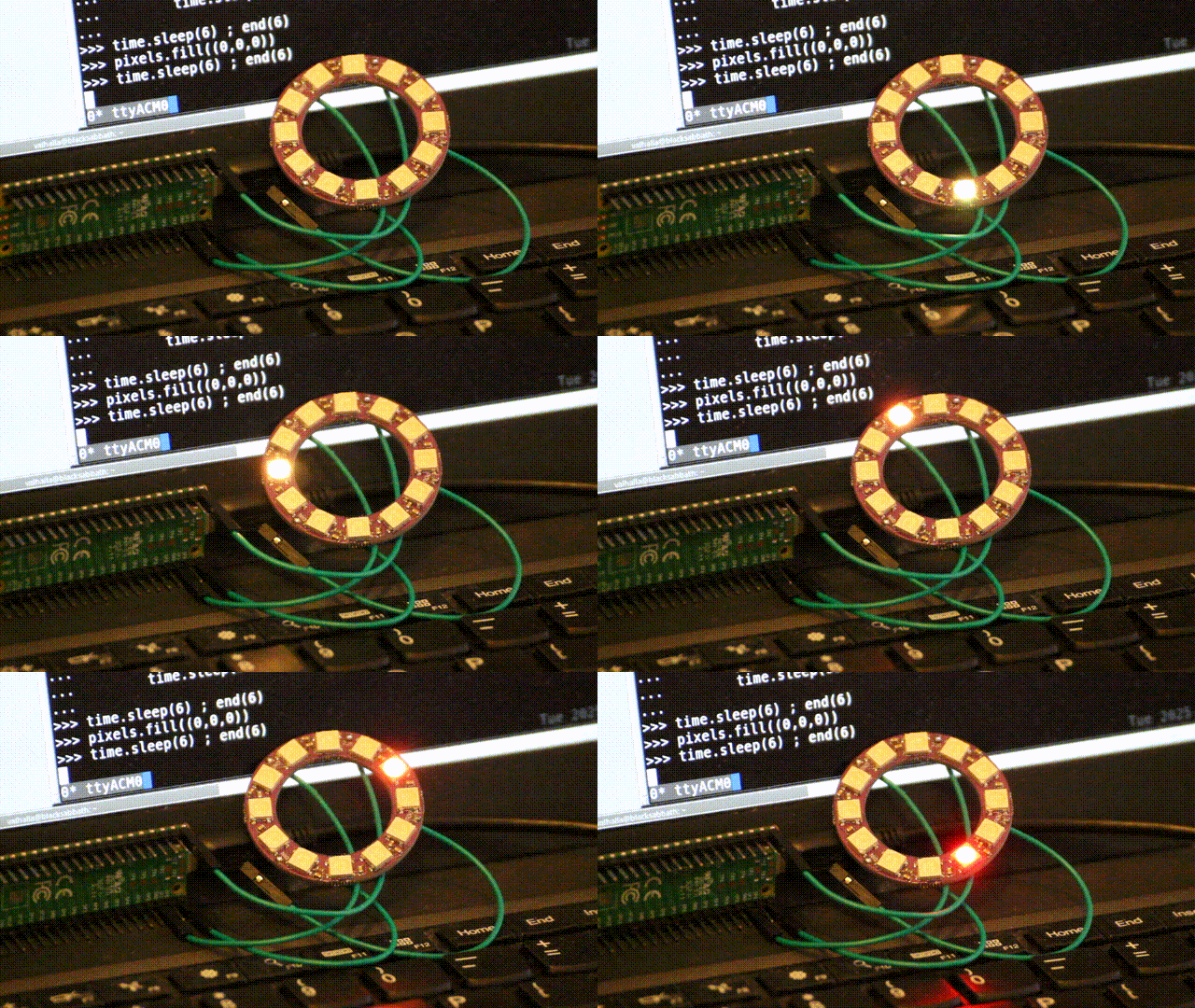
A few ago I may have accidentally bought a ring of 12 RGB LEDs; I soldered
temporary leads on it, connected it to a CircuitPython supported board
and played around for a while.
They we had a couple of friends come over to remote FOSDEM together, and
I had talked with one of them about WS2812 / NeoPixels, so I brought
them to the living room, in case there was a chance to show them in
sort-of-use.
Then I was dealing with playing the various streams as we moved from one
room to the next, which lead to me being called video team , which lead
to me wearing a video team shirt (from an old DebConf, not FOSDEM, but
still video team), which lead to somebody asking me whether I also had
the sheet with the countdown to the end of the talk, and the answer was
sort-of-yes (I should have the ones we used to use for our Linux Day),
but not handy.
But I had a thing with twelve things in a clock-like circle.
A bit of fiddling on the CircuitPython REPL resulted, if I remember
correctly, in something like:
import board
import neopixel
import time
num_pixels = 12
pixels = neopixel.NeoPixel(board.GP0, num_pixels)
pixels.brightness = 0.1
def end(min):
    pixels.fill((0, 0, 0))
    for i in range(12):
        pixels[i] = (127 + 10 * i, 8 * (12 - i), 0)
        pixels[i-1] = (0, 0, 0)
        time.sleep(min * 5)  # min * 60 / 12
Now, I wasn t very consistent in running end, especially since I
wasn t sure whether I wanted to run it at the beginning of the talk with
the full duration or just in the last 5 - 10 minutes depending of the
length of the slot, but I ve had at least one person agree that the
general idea has potential, so I m taking these notes to be able to work
on it in the future.
One thing that needs to be fixed is the fact that with the ring just
attached with temporary wires and left on the table it isn t clear which
LED is number 0, so it will need a bit of a case or something, but
that s something that can be dealt with before the next fosdem.
And I should probably add some input interface, so that it is
self-contained and not tethered to a computer and run from the REPL.
(And then I may also have a vague idea for putting that ring into some
wearable thing: good thing that I actually bought two :D )
Dear Debian community,
this is bits from DPL for January.
Sovereign Tech Agency
I was recently pointed to Technologies and Projects supported by the
Sovereign Tech Agency which is financed by the German Federal
Ministry for Economic Affairs and Climate Action. It is a subsidiary of
the Federal Agency for Disruptive Innovation, SPRIND GmbH.
It is worth sending applications there for distinct projects as that is
their preferred method of funding. Distinguished developers can also
apply for a fellowship position that pays up to 40hrs / week (32hrs when
freelancing) for a year. This is esp. open to maintainers of larger
numbers of packages in Debian (or any other Linux distribution).
There might be a chance that some of the Debian-related projects
submitted to the Google Summer of Code that did not get funded could be
retried with those foundations. As per the FAQ of the project:
"The Sovereign Tech Agency focuses on securing and strengthening open
and foundational digital technologies. These communities working on
these are distributed all around the world, so we work with people,
companies, and FOSS communities everywhere."
Similar funding organizations include the Open Technology Fund and
FLOSS/fund. If you have a Debian-related project that fits these
funding programs, they might be interesting options. This list is by no
means exhaustive just some hints I ve received and wanted to share. More
suggestions for such opportunities are welcome.
Year of code reviews
On the debian-devel mailing list, there was a long thread titled
"Let's make 2025 a year when code reviews became common in Debian".
It initially suggested something along the lines of:
"Let's review MRs in Salsa." The discussion quickly expanded to
include patches that have
been sitting in the BTS for years, which deserve at least the same
attention. One idea I'd like to emphasize is that associating BTS bugs
with MRs could be very convenient. It s not only helpful for
documentation but also the easiest way to apply patches.
I d like to emphasize that no matter what workflow we use BTS, MRs, or a
mix it is crucial to uphold Debian s reputation for high quality.
However, this reputation is at risk as more and more old issues
accumulate. While Debian is known for its technical excellence,
long-standing bugs and orphaned packages remain a challenge. If we don t
address these, we risk weakening the high standards that Debian is
valued for. Revisiting old issues and ensuring that unmaintained
packages receive attention is especially important as we prepare for the
Trixie release.
Debian Publicity Team will no longer post on X/Twitter
The Press Team has my full support in its decision to stop posting on X.
As per the Publicity delegation:
The team is in charge of deciding the most suitable publication
venue or venues for announcements and when they are published.
the team once decided to join Twitter, but circumstances have since
changed. The current Press delegates have the institutional authority to
leave X, just as their predecessors had the authority to join. I
appreciate that the team carefully considered the matter, reinforced by
the arguments developed on the debian-publicity list, and communicated
its reasoning openly.
Kind regards,
Andreas.
The RcppUUID package
on CRAN has been providing
UUIDs (based on the underlying Boost
library) for several years. Written by Artem Klemsov and maintained
in this gitlab
repo, the package is a very nice example of clean and
straightforward library binding.
When we did our annual
BH upgrade to 1.87.0 and check reverse dependencies, we noticed the
RcppUUID
needed a small and rather minor update which we showed as a short diff
in an
issue filed. Neither I nor CRAN heard from Artem, so the
packaged ended up being archived last week. Which in turn lead me to
make this minimal update to 1.1.2 to resurrect it, which CRAN processed more or less like a
regular update given this explanation and so it arrived last Friday.
Courtesy of my CRANberries, there
is also a a
new package note (no diffstat report yet). More detailed
information is on the RcppUUID
page, or the github repo.
This was originally posted on SOTA
Forums.
It s here for completeness of my writing.
To Quote @MM0EFI and the GM0ESS gang, today was a particularly Amateur showing!
Having spent all weekend locked in the curling rink ruining my knees and inflicting mild liver damage in the Aberdeen City Open competition, I needed some outside time away from people to stretch the legs and loosen my knees.
With my teammates/guests shipped off early on account of our quality performance and the days fair drawin out now, I found myself with a free afternoon to have a quick run up something nearby before a 1640 sunset! Up the back of Bennachie is a quick steady ascent and in 13 years of living up here I ve never summited the big hill! Now is as good a time as any. In SOTA terms, this hill is GM/ES-061. In Geographical terms, it s around 20 miles inland from Aberdeen city here.
I ve been experimenting with these Aliexpress whips since the end of last year and the forecast wind was low enough to take one into the hills. I cut and terminated 8x 2.5m radials for an effective ground plane last week and wanted to try that against the flat ribbon that it came with.
The ascent was pleasant enough, got to the summit in good time, and out came my Quansheng radio to get the GM/ES-Society on 2m. First my Nagoya whip - called CQ and heard nothing, with general poor reports in WhatsApp I opted to get the slim-g up my aliexpress fibreglass mast.
In an amateur showing last week, I broke the tip of the mast on Cat Law helping 2M0HSK do his first activation due to the wind, and had forgotten this until I summited this week. Squeezing my antenna on was tough, and after many failed attempts to get it up (the mast kept collapsing as I was rushing and not getting the friction hold on each section correctly) and still not hearing anything at all, I changed location and tried again.
In my new position, I received 2M0RVZ 4/4 at best, but he was hearing my 5/9. Similarly GM5ALX and GM4JXP were patiently receiving me loud and clear but I couldn t hear them at all. I fiddled with settings and decided the receive path of the Quansheng must be fried or sad somehow, but I don t yet have a full set of diagnostics run.
I ll take my Anytone on the next hill and compare them against each other I think.
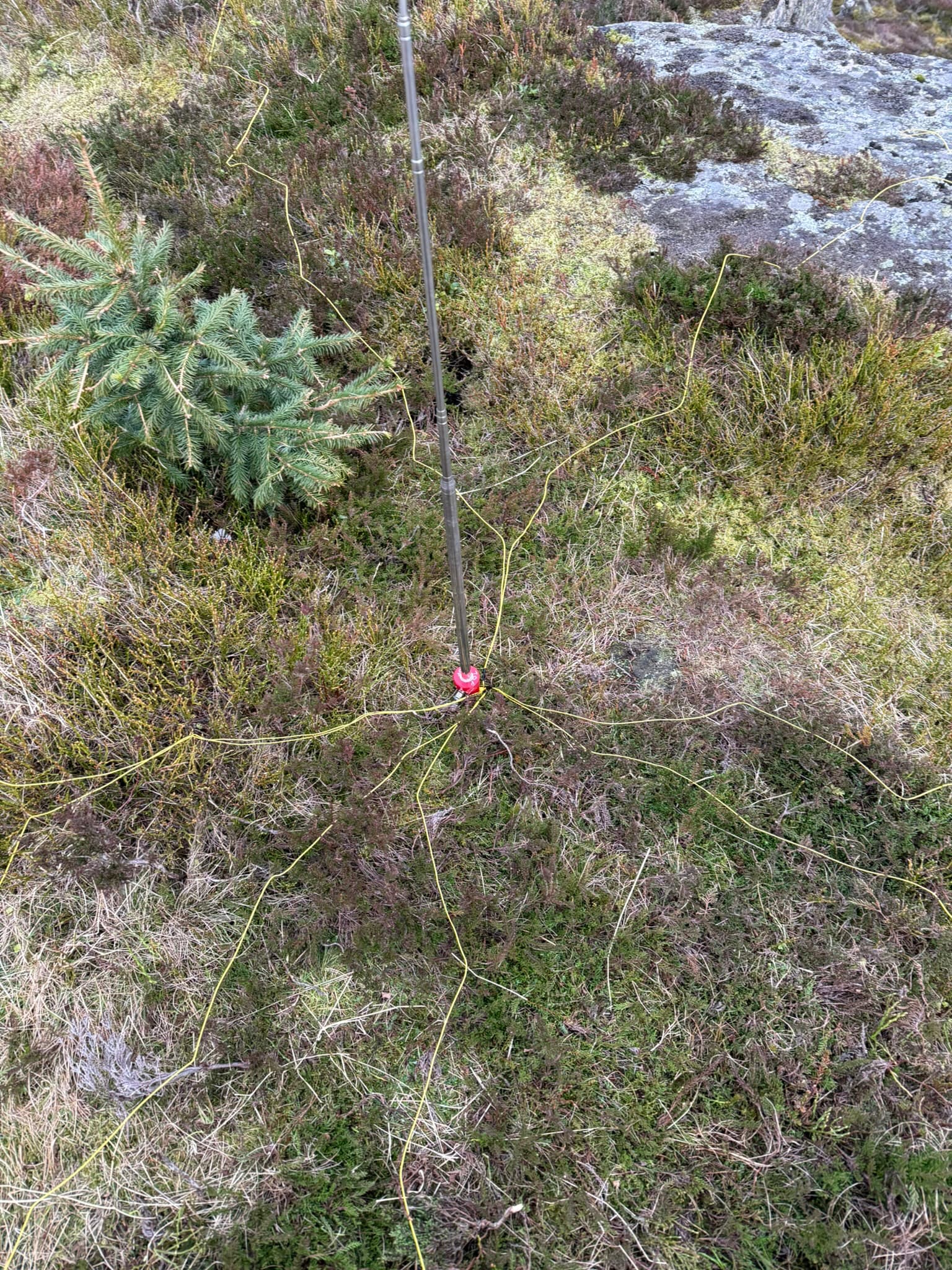
I gave up and moved to HF, getting my whip and new radials into the ground:
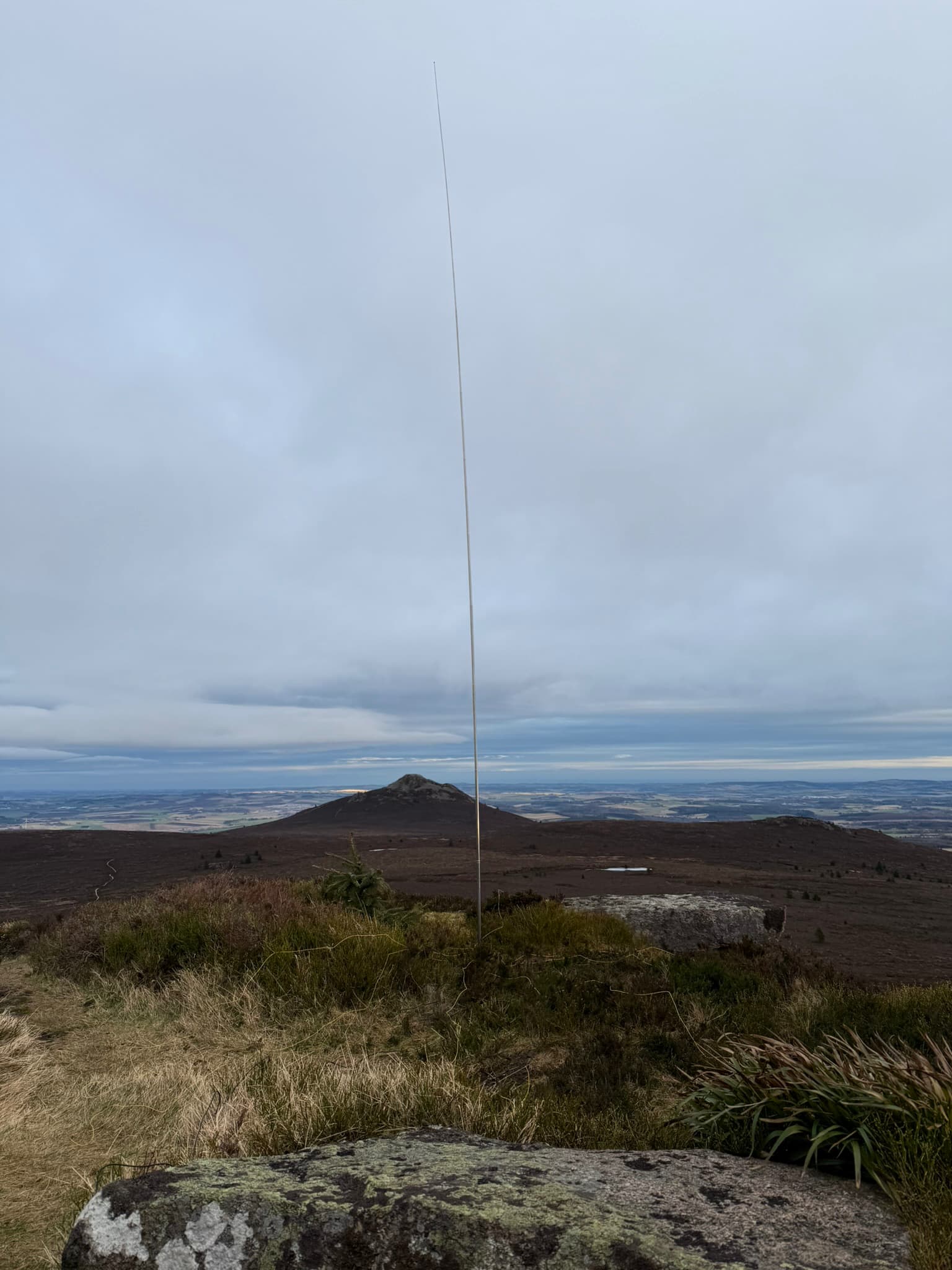
Quick to deploy which is what I was after. My new 5m of coax with a choke fitted attached to the radio and we were off to the races - A convenient thing of beauty when it s up:
I ve made a single guy with a sotabeams top insulator to brace against wind if need be, but that didn t need to be used today.
I hit tune, and the G90 spent ages clicking away. In fact, tuning to 14.074, I could only see the famed FT8 signals at S2.
What could be wrong here? Was it my new radials? the whip has behaved before Minutes turned into tens of minutes playing with everything, and eventually I worked out what was up - my coax only passed signal when I the PL259 connector at the antenna juuuust right. Once I did that, I could take the tuner out the system and work 20 spectacularly well. Until now, I d been tuning the coax only.
Another Quality Hibby Build Job . That s what s wrong!
I managed to struggle my way through a touch of QRM and my wonky cable woes to make enough contacts with some very patient chasers and a summit to summit before my frustration at the situation won out, and down the hill I went after a quick pack up period. I managed to beat the sunset - I think if the system had worked fine, I d have stayed on the hill for sunset.
I think it s time for a new mast and a coax retermination!
Most of my Debian contributions this month were
sponsored by
Freexian. If you appreciate this sort of work and are at a company that
uses Debian, have a look to see whether you can pay for any of
Freexian s services; as well as the direct
benefits, that revenue stream helps to keep Debian development sustainable
for me and several other lovely
people.
You can also support my work directly via
Liberapay.
Python team
We finally made Python 3.13 the default version in testing! I fixed various
bugs that got in the way of this:
I ported python-pypump to IPython 8.0.
I fixed python-datamodel-code-generator to handle isort 6, and contributed
that
upstream.
I fixed some packages to tolerate future versions of dh-python that will
drop their dependency on python3-setuptools:
I removed the old python-celery-common transitional
package from celery, since nothing in
Debian needs it any more.
I fixed or helped to fix various other build/test failures:
For many years I wished I had a setup that would allow me to work (that is, code) productively outside in the bright sun. It s winter right now, but when its summer again it s always a bit. this weekend I got closer to that goal.
TL;DR: Using code-server on a beefy machine seems to be quite neat.
Passively lit coding
Personal history
Looking back at my own old blog entries I find one from 10 years ago describing how I bought a Kobo eBook reader with the intent of using it as an external monitor for my laptop. It seems that I got a proof-of-concept setup working, using VNC, but it was tedious to set up, and I never actually used that. I subsequently noticed that the eBook reader is rather useful to read eBooks, and it has been in heavy use for that every since.
Four years ago I gave this old idea another shot and bought an Onyx BOOX Max Lumi. This is an A4-sized tablet running Android and had the very promising feature of an HDMI input. So hopefully I d attach it to my laptop and it just works . Turns out that this never worked as well as I hoped: Even if I set the resolution to exactly the tablet s screen s resolution I got blurry output, and it also drained the battery a lot, so I gave up on this. I subsequently noticed that the tablet is rather useful to take notes, and it has been in sporadic use for that.
Going off on this tangent: I later learned that the HDMI input of this device appears to the system like a camera input, and I don t have to use Boox s monitor app but could other apps like FreeDCam as well. This somehow managed to fix the resolution issues, but the setup still wasn t as convenient to be used regularly.
I also played around with pure terminal approaches, e.g. SSH ing into a system, but since my usual workflow was never purely text-based (I was at least used to using a window manager instead of a terminal multiplexer like screen or tmux) that never led anywhere either.
VSCode, working remotely
Since these attempts I have started a new job working on the Lean theorem prover, and working on or with Lean basically means using VSCode. (There is a very good neovim plugin as well, but I m using VSCode nevertheless, if only to make sure I am dogfooding our default user experience).
My colleagues have said good things about using VSCode with the remote SSH extension to work on a beefy machine, so I gave this a try now as well, and while it s not a complete game changer for me, it does make certain tasks (rebuilding everything after a switching branches, running the test suite) very convenient. And it s a bit spooky to run these work loads without the laptop s fan spinning up.
In this setup, the workspace is remote, but VSCode still runs locally. But it made me wonder about my old goal of being able to work reasonably efficient on my eInk tablet. Can I replicate this setup there?
VSCode itself doesn t run on Android directly. There are project that run a Linux chroot or in termux on the Android system, and then you can VNC to connect to it (e.g. on Andronix) but that did not seem promising. It seemed fiddly, and I probably should take it easy on the tablet s system.
code-server, running remotely
A more promising option is code-server. This is a fork of VSCode (actually of VSCodium) that runs completely on the remote machine, and the client machine just needs a browser. I set that up this weekend and found that I was able to do a little bit of work reasonably.
Access
With code-server one has to decide how to expose it safely enough. I decided against the tunnel-over-SSH option, as I expected that to be somewhat tedious to set up (both initially and for each session) on the android system, and I liked the idea of being able to use any device to work in my environment.
I also decided against the more involved reverse proxy behind proper hostname with SSL setups, because they involve a few extra steps, and some of them I cannot do as I do not have root access on the shared beefy machine I wanted to use.
That left me with the option of using a code-server s built-in support for self-signed certificates and a password:
With trust-on-first-use this seems reasonably secure.
Update: I noticed that the browsers would forget that I trust this self-signed cert after restarting the browser, and also that I cannot install the page (as a Progressive Web App) unless it has a valid certificate. But since I don t have superuser access to that machine, I can t just follow the official recommendation of using a reverse proxy on port 80 or 431 with automatic certificates. Instead, I pointed a hostname that I control to that machine, obtained a certificate manually on my laptop (using acme.sh) and copied the files over, so the configuration now reads as follows:
(I am using nix as a package manager on a Debian system there, hence the additional PATH and complex ExecStart. If you have a more conventional setup then you do not have to worry about Environment and can likely use ExecStart=code-server.
For this to survive me logging out I had to ask the system administrator to run loginctl enable-linger joachim, so that systemd allows my jobs to linger.
Git credentials
The next issue to be solved was how to access the git repositories. The work is all on public repositories, but I still need a way to push my work. With the classic VSCode-SSH-remote setup from my laptop, this is no problem: My local SSH key is forwarded using the SSH agent, so I can seamlessly use that on the other side. But with code-server there is no SSH key involved.
I could create a new SSH key and store it on the server. That did not seem appealing, though, because SSH keys on Github always have full access. It wouldn t be horrible, but I still wondered if I can do better.
I thought of creating fine-grained personal access tokens that only me to push code to specific repositories, and nothing else, and just store them permanently on the remote server. Still a neat and convenient option, but creating PATs for our org requires approval and I didn t want to bother anyone on the weekend.
So I am experimenting with Github s git-credential-manager now. I have configured it to use git s credential cache with an elevated timeout, so that once I log in, I don t have to again for one workday.
To login, I have to https://github.com/login/device on an authenticated device (e.g. my phone) and enter a 8-character code. Not too shabby in terms of security. I only wish that webpage would not require me to press Tab after each character
This still grants rather broad permissions to the code-server, but at least only temporarily
Android setup
On the client side I could now open https://host.example.com:8080 in Firefox on my eInk Android tablet, click through the warning about self-signed certificates, log in with the fixed password mentioned above, and start working!
I switched to a theme that supposedly is eInk-optimized (eInk by Mufanza). It s not perfect (e.g. git diffs are unhelpful because it is not possible to distinguish deleted from added lines), but it s a start. There are more eInk themes on the official Visual Studio Marketplace, but because code-server is a fork it cannot use that marketplace, and for example this theme isn t on Open-VSX.
For some reason the F11 key doesn t work, but going fullscreen is crucial, because screen estate is scarce in this setup. I can go fullscreen using VSCode s command palette (Ctrl-P) and invoking the command there, but Firefox often jumps out of the fullscreen mode, which is annoying. I still have to pay attention to when that s happening; maybe its the Esc key, which I am of course using a lot due to me using vim bindings.
A more annoying problem was that on my Boox tablet, sometimes the on-screen keyboard would pop up, which is seriously annoying! It took me a while to track this down: The Boox has two virtual keyboards installed: The usual Google ASOP keyboard, and the Onyx Keyboard. The former is clever enough to stay hidden when there is a physical keyboard attached, but the latter isn t. Moreover, pressing Shift-Ctrl on the physical keyboard rotates through the virtual keyboards. Now, VSCode has many keyboard shortcuts that require Shift-Ctrl (especially on an eInk device, where you really want to avoid using the mouse). And the limited settings exposed by the Boox Android system do not allow you configure that or disable the Onyx keyboard! To solve this, I had to install the KISS Launcher, which would allow me to see more Android settings, and in particular allow me to disable the Onyx keyboard. So this is fixed.
I was hoping to improve the experience even more by opening the web page as a Progressive Web App (PWA), as described in the code-server FAQ. Unfortunately, that did not work. Firefox on Android did not recognize the site as a PWA (even though it recognizes a PWA test page). And I couldn t use Chrome either because (unlike Firefox) it would not consider a site with a self-signed certificate as a secure context, and then code-server does not work fully. Maybe this is just some bug that gets fixed in later versions.
Now that I use a proper certificate, I can use it as a Progressive Web App, and with Firefox on Android this starts the app in full-screen mode (no system bars, no location bar). The F11 key still does t work, and using the command palette to enter fullscreen does nothing visible, but then Esc leaves that fullscreen mode and I suddenly have the system bars again. But maybe if I just don t do that I get the full screen experience. We ll see.
I did not work enough with this yet to assess how much the smaller screen estate, the lack of colors and the slower refresh rate will bother me. I probably need to hide Lean s InfoView more often, and maybe use the Error Lens extension, to avoid having to split my screen vertically.
I also cannot easily work on a park bench this way, with a tablet and a separate external keyboard. I d need at least a table, or some additional piece of hardware that turns tablet + keyboard into some laptop-like structure that I can put on my, well, lap. There are cases for Onyx products that include a keyboard, and maybe they work on the lap, but they don t have the Trackpoint that I have on my ThinkPad TrackPoint Keyboard II, and how can you live without that?
Conclusion
After this initial setup chances are good that entering and using this environment is convenient enough for me to actually use it; we will see when it gets warmer.
A few bits could be better. In particular logging in and authenticating GitHub access could be both more convenient and more safe I could imagine that when I open the page I confirm that on my phone (maybe with a fingerprint), and that temporarily grants access to the code-server and to specific GitHub repositories only. Is that easily possible?
DeepSeek R1, the new entrant to the Large Language Model wars has created quite a splash over the last few weeks. Its entrance into a space dominated by the Big Corps, while pursuing asymmetric and novel strategies has been a refreshing eye-opener.GPT AI improvement was starting to show signs of slowing down, and has been observed to be reaching a point of diminishing returns as it runs out of data and compute required to train, fine-tune increasingly large models. This has turned the focus towards building "reasoning" models that are post-trained through reinforcement learning, techniques such as inference-time and test-time scaling and search algorithms to make the models appear to think and reason better. OpenAI&aposs o1-series models were the first to achieve this successfully with its inference-time scaling and Chain-of-Thought reasoning.
Intelligence as an emergent property of Reinforcement Learning (RL)Reinforcement Learning (RL) has been successfully used in the past by Google&aposs DeepMind team to build highly intelligent and specialized systems where intelligence is observed as an emergent property through rewards-based training approach that yielded achievements like AlphaGo (see my post on it here - AlphaGo: a journey to machine intuition).DeepMind went on to build a series of Alpha* projects that achieved many notable feats using RL:
AlphaGo, defeated the world champion Lee Seedol in the game of Go
AlphaZero, a generalized system that learned to play games such as Chess, Shogi and Go without human input
AlphaStar, achieved high performance in the complex real-time strategy game StarCraft II.
AlphaFold, a tool for predicting protein structures which significantly advanced computational biology.
AlphaCode, a model designed to generate computer programs, performing competitively in coding challenges.
AlphaDev, a system developed to discover novel algorithms, notably optimizing sorting algorithms beyond human-derived methods.
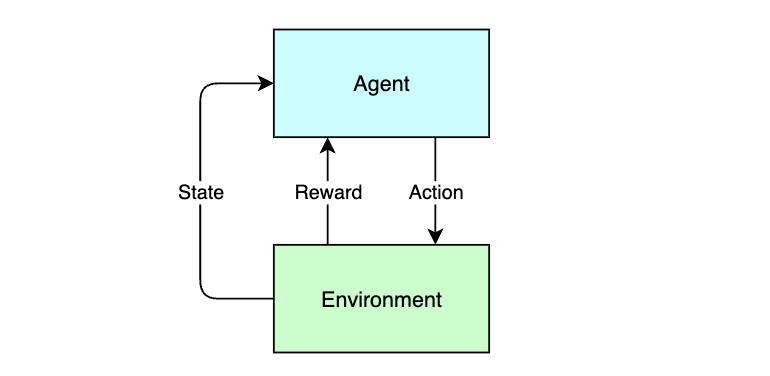
All of these systems achieved mastery in its own area through self-training/self-play and by optimizing and maximizing the cumulative reward over time by interacting with its environment where intelligence was observed as an emergent property of the system.The RL feedback loopRL mimics the process through which a baby would learn to walk, through trial, error and first principles.
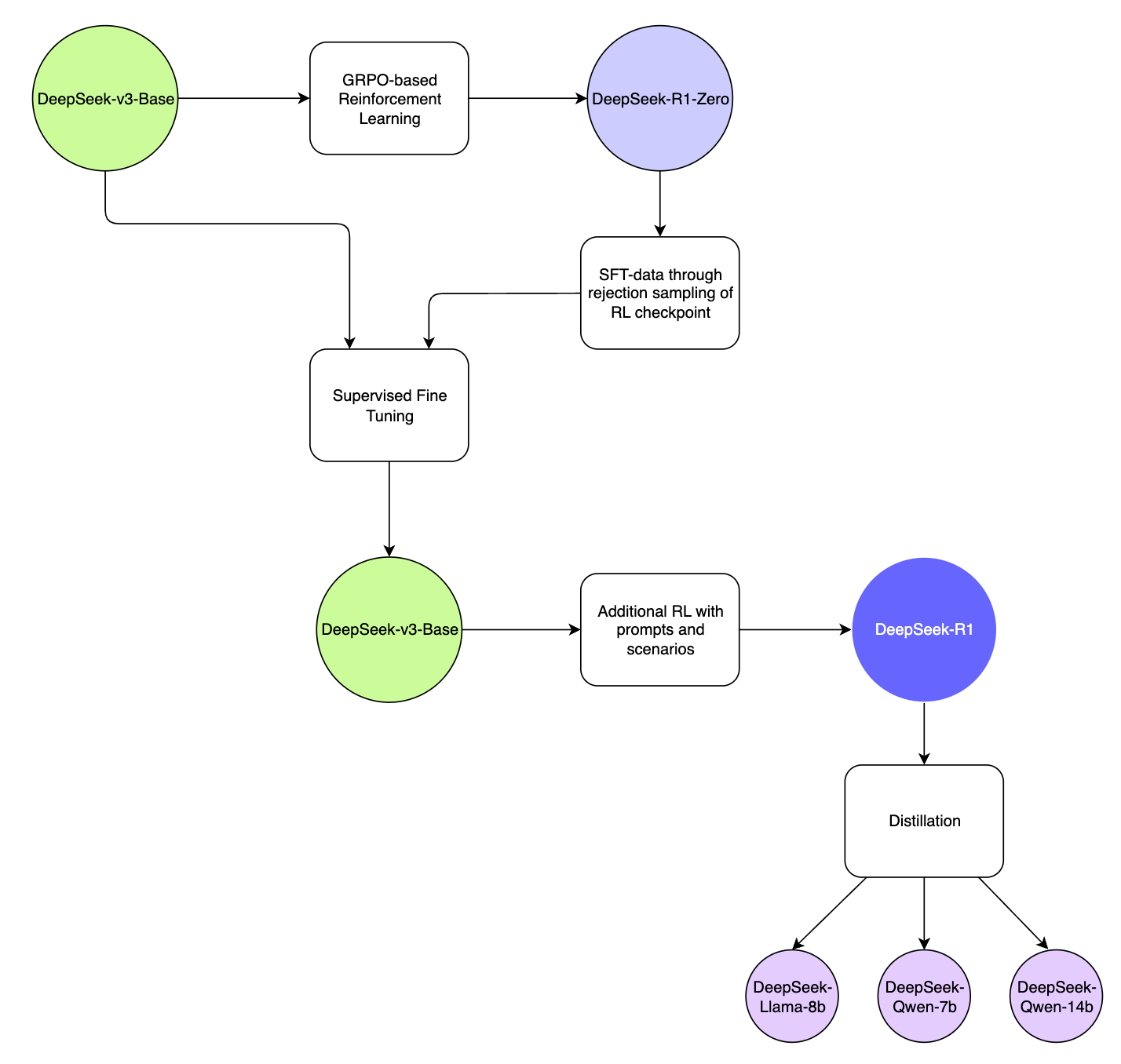
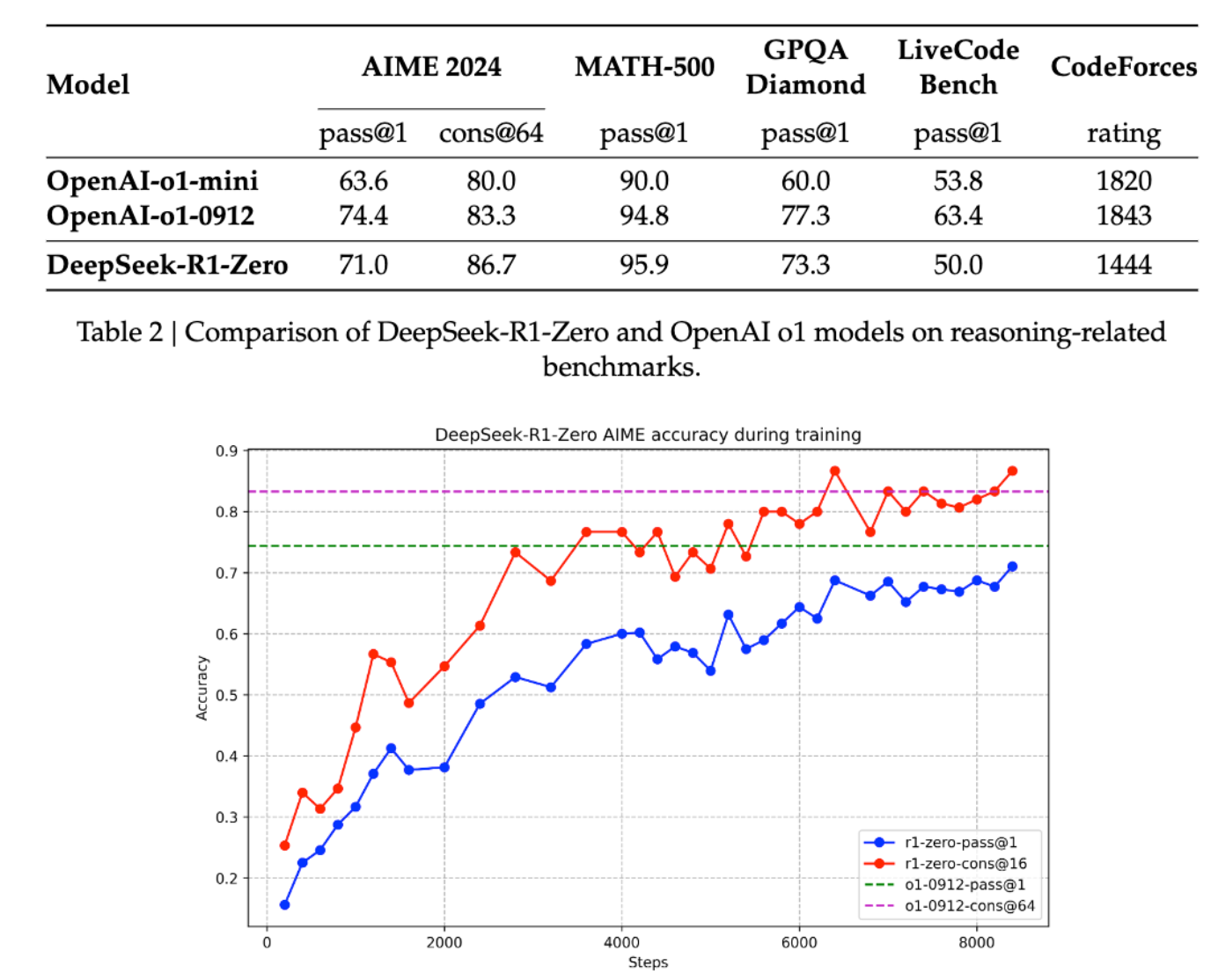
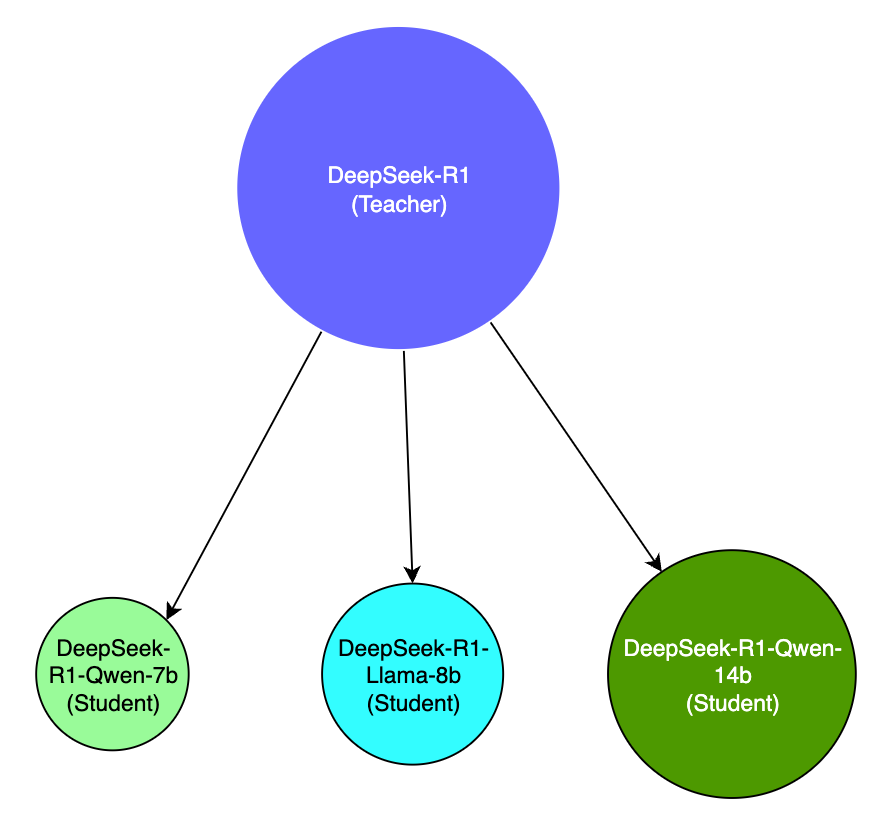
R1 model training pipelineAt a technical level, DeepSeek-R1 leverages a combination of Reinforcement Learning (RL) and Supervised Fine-Tuning (SFT) for its training pipeline:DeepSeek-R1 Model Training PipelineUsing RL and DeepSeek-v3, an interim reasoning model was built, called DeepSeek-R1-Zero, purely based on RL without relying on SFT, which demonstrated superior reasoning capabilities that matched the performance of OpenAI&aposs o1 in certain benchmarks such as AIME 2024.The model was however affected by poor readability and language-mixing and is only an interim-reasoning model built on RL principles and self-evolution.DeepSeek-R1-Zero was then used to generate SFT data, which was combined with supervised data from DeepSeek-v3 to re-train the DeepSeek-v3-Base model.The new DeepSeek-v3-Base model then underwent additional RL with prompts and scenarios to come up with the DeepSeek-R1 model.The R1-model was then used to distill a number of smaller open source models such as Llama-8b, Qwen-7b, 14b which outperformed bigger models by a large margin, effectively making the smaller models more accessible and usable.
Key contributions of DeepSeek-R1
RL without the need for SFT for emergent reasoning capabilities
R1 was the first open research project to validate the efficacy of RL directly on the base model without relying on SFT as a first step, which resulted in the model developing advanced reasoning capabilities purely through self-reflection and self-verification.Although, it did degrade in its language capabilities during the process, its Chain-of-Thought (CoT) capabilities for solving complex problems was later used for further RL on the DeepSeek-v3-Base model which became R1. This is a significant contribution back to the research community.The below analysis of DeepSeek-R1-Zero and OpenAI o1-0912 shows that it is viable to attain robust reasoning capabilities purely through RL alone, which can be further augmented with other techniques to deliver even better reasoning performance.Source: https://github.com/deepseek-ai/DeepSeek-R1Its quite interesting, that the application of RL gives rise to seemingly human capabilities of "reflection", and arriving at "aha" moments, causing it to pause, ponder and focus on a specific aspect of the problem, resulting in emergent capabilities to problem-solve as humans do.
Model distillation
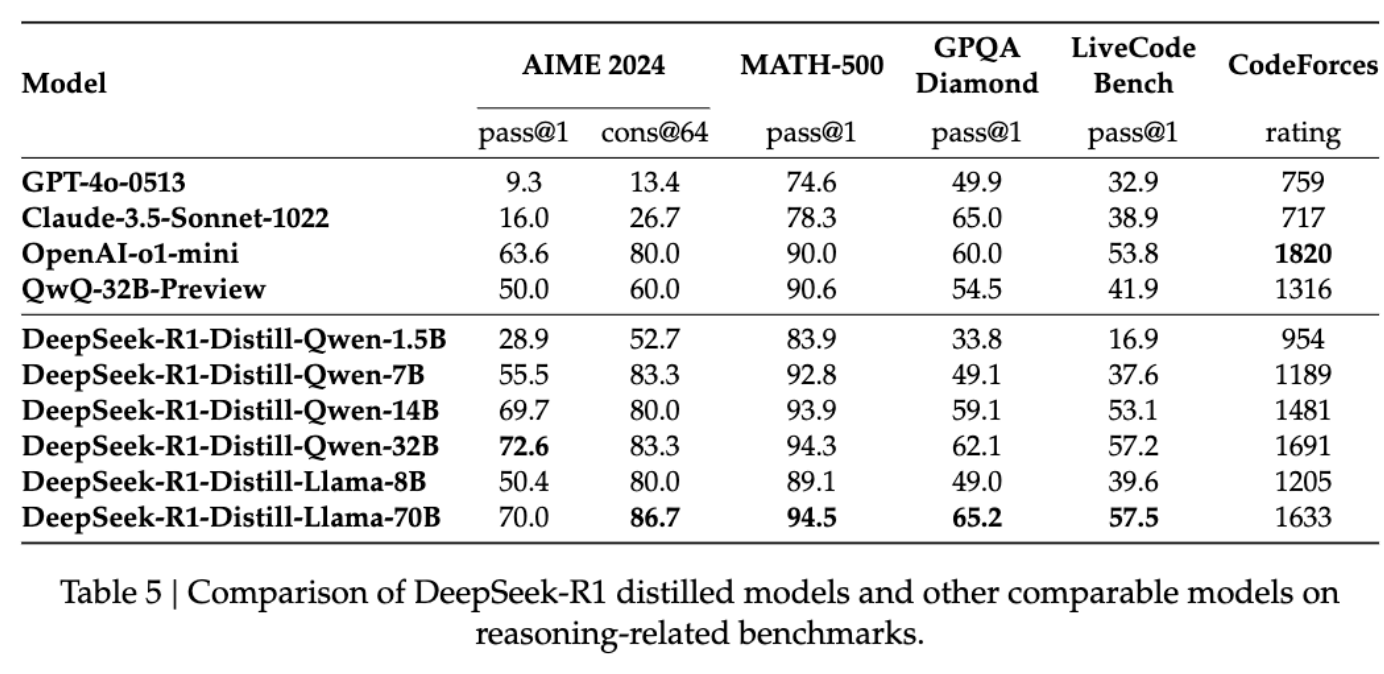
DeepSeek-R1 also demonstrated that larger models can be distilled into smaller models which makes advanced capabilities accessible to resource-constrained environments, such as your laptop. While its not possible to run a 671b model on a stock laptop, you can still run a distilled 14b model that is distilled from the larger model which still performs better than most publicly available models out there. This enables intelligence to be brought closer to the edge, to allow faster inference at the point of experience (such as on a smartphone, or on a Raspberry Pi), which paves way for more use cases and possibilities for innovation.Source: https://github.com/deepseek-ai/DeepSeek-R1Distilled models are very different to R1, which is a massive model with a completely different model architecture than the distilled variants, and so are not directly comparable in terms of capability, but are instead built to be more smaller and efficient for more constrained environments. This technique of being able to distill a larger model&aposs capabilities down to a smaller model for portability, accessibility, speed, and cost will bring about a lot of possibilities for applying artificial intelligence in places where it would have otherwise not been possible. This is another key contribution of this technology from DeepSeek, which I believe has even further potential for democratization and accessibility of AI.
Why is this moment so significant?DeepSeek-R1 was a pivotal contribution in many ways.
The contributions to the state-of-the-art and the open research helps move the field forward where everybody benefits, not just a few highly funded AI labs building the next billion dollar model.
Open-sourcing and making the model freely available follows an asymmetric strategy to the prevailing closed nature of much of the model-sphere of the larger players. DeepSeek should be commended for making their contributions free and open.
It reminds us that its not just a one-horse race, and it incentivizes competition, which has already resulted in OpenAI o3-mini a cost-effective reasoning model which now shows the Chain-of-Thought reasoning. Competition is a good thing.
We stand at the cusp of an explosion of small-models that are hyper-specialized, and optimized for a specific use case that can be trained and deployed cheaply for solving problems at the edge. It raises a lot of exciting possibilities and is why DeepSeek-R1 is one of the most pivotal moments of tech history.
Version 0.0.20 of RcppSpdlog arrived
on CRAN early this morning and
has been uploaded to Debian. RcppSpdlog
bundles spdlog, a
wonderful header-only C++ logging library with all the bells and
whistles you would want that was written by Gabi Melman, and also includes fmt by Victor Zverovich. You can learn
more at the nice package
documention site.
This release updates the code to the version 1.15.1 of spdlog which was released
this morning as well. It also contains a contributed PR which
illustrates logging in a multithreaded context.
The NEWS entry for this release follows.
Changes in
RcppSpdlog version 0.0.20 (2025-02-01)
New multi-threaded logging example (Young Geun Kim and Dirk via
#22)
Another short status update of what happened on my side last
month. Mostly focused on quality of life improvements in phosh and
cleaning up and improving phoc this time around (including catching up
with wlroots git) but some improvements for other things like
phosh-osk-stub happened on the side line too.
phosh
Fix crash when switching bitween some fractional scales (MR)
Make layer surface code more flexible and fade in system modal dialogs (MR)
Allow events to override the sound feedback with custom sounds
(MR). Allows
desktop/mobile shells like phosh to honour application prefs for notifications.
udev regression affecting gmobile (Bug). Many thanks to Yu Watanabe
for providing the fix so quickly
Reviews
This is not code by me but reviews on other peoples code. The list is
incomplete, but I hope to improve on this in the upcoming
months. Thanks for the contributions!
As people around the world understand how LLMs behave, more and more people
wonder as to why these models hallucinate, and what can be done about to
reduce it. This provocatively named article by Michael Townsen Hicks, James
Humphries and Joe Slater bring is an excellent primer to better understanding
how LLMs work and what to expect from them.
As humans carrying out our relations using our language as the main tool, we are
easily at awe with the apparent ease with which ChatGPT (the first widely
available, and to this day probably the best known, LLM-based automated
chatbot) simulates human-like understanding and how it helps us to easily
carry out even daunting data aggregation tasks. It is common that people ask
ChatGPT for an answer and, if it gets part of the answer wrong, they justify it
by stating that it s just a hallucination. Townsen et al. invite us to switch
from that characterization to a more correct one: LLMs are bullshitting. This
term is formally presented by Frankfurt [1]. To Bullshit is not the same as to
lie, because lying requires to know (and want to cover) the truth. A
bullshitter not necessarily knows the truth, they just have to provide a
compelling description, regardless of what is really aligned with truth.
After introducing Frankfurt s ideas, the authors explain the fundamental ideas
behind LLM-based chatbots such as ChatGPT; a Generative Pre-trained Transformer
(GPT) s have as their only goal to produce human-like text, and it is carried
out mainly by presenting output that matches the input s high-dimensional
abstract vector representation, and probabilistically outputs the next token
(word) iteratively with the text produced so far. Clearly, a GPT s ask is not to
seek truth or to convey useful information they are built to provide a
normal-seeming response to the prompts provided by their user. Core data are not
queried to find optimal solutions for the user s requests, but are generated on
the requested topic, attempting to mimic the style of document set it was
trained with.
Erroneous data emitted by a LLM is, thus, not equiparable with what a person
could hallucinate with, but appears because the model has no understanding of
truth; in a way, this is very fitting with the current state of the world, a
time often termed as the age of post-truth [2]. Requesting an LLM to provide
truth in its answers is basically impossible, given the difference between
intelligence and consciousness: Following Harari s definitions [3], LLM
systems, or any AI-based system, can be seen as intelligent, as they have the
ability to attain goals in various, flexible ways, but they cannot be seen as
conscious, as they have no ability to experience subjectivity. This is, the
LLM is, by definition, bullshitting its way towards an answer: their goal is
to provide an answer, not to interpret the world in a trustworthy way.
The authors close their article with a plea for literature on the topic to adopt
the more correct bullshit term instead of the vacuous, anthropomorphizing
hallucination . Of course, being the word already loaded with a negative
meaning, it is an unlikely request.
This is a great article that mixes together Computer Science and Philosophy, and
can shed some light on a topic that is hard to grasp for many users.
[1] Frankfurt, Harry (2005). On Bullshit. Princeton University Press.
[2] Zoglauer, Thomas (2023). Constructed truths: truth and knowledge in a
post-truth world. Springer.
[3] Harari, Yuval Noah (2023. Nexus: A Brief History of Information Networks
From the Stone Age to AI. Random House.
Thrilled to announce a new package: zigg. It arrived
on CRAN today after a few days
of review in the newbies queue. zigg provides
the Ziggurat
pseudo-random number generator for Normal, Exponential and Uniform draws
proposed by Marsaglia and
Tsang (JSS, 2000),
and extended by Leong et al. (JSS, 2005).
I had picked up their work in package RcppZiggurat
and updated its code for the 64-buit world we now live in. That package
alredy provided the Normal generator along with several competing
implementations which it compared rigorously and timed them. As one of
the generators was based on the GNU GSL via the
implementation of Voss, we always ended
up with a run-time dependency on the GSL too. No more: this new package
is zero-depedency, zero-suggsts and hence very easy to deploy.
Moreover, we also include a demonstration of four distinct ways of
accessing the compiled code from another R package: pure and straight-up
C, similarly pure C++, inclusion of the header in C++ as well as via Rcpp.
The other advance is the resurrection of the second generator for the
Exponential distribution. And following Burkardt we expose the
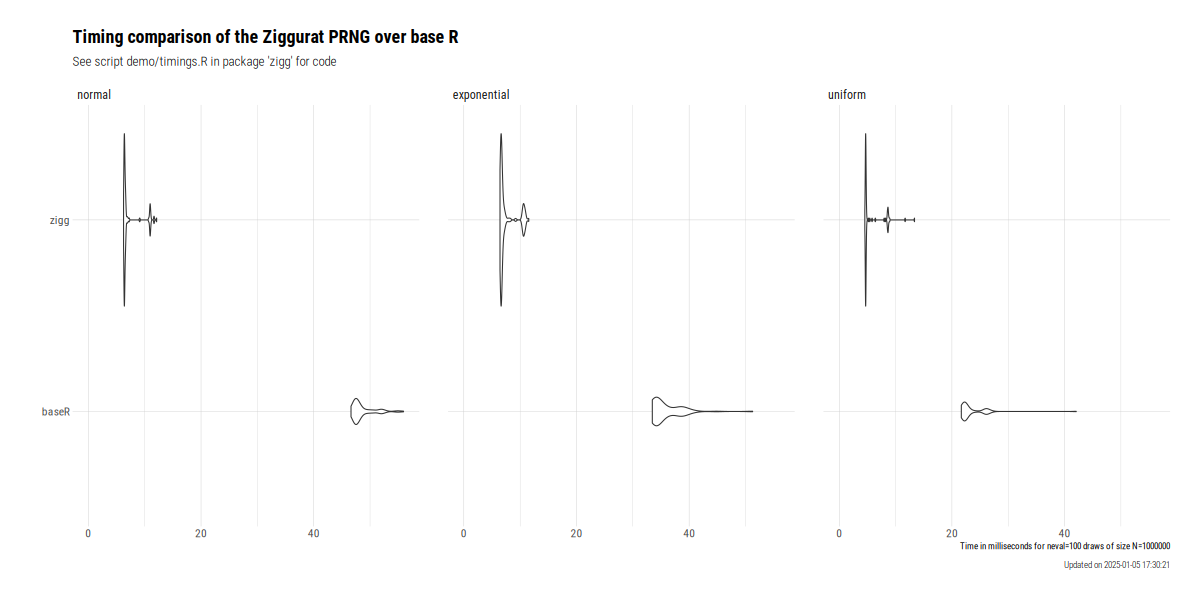
Uniform too. The main upside of these generators is their excellent
speed as can be seen in the comparison the default R generators
generated by the example script timings.R:
Needless to say, speed is not everything. This PRNG comes the time of
32-bit computing so the generator period is likely to be shorter than
that of newer high-quality generators. If in doubt, forgo speed and
stick with the high-quality default generators.
The short NEWS entry follows.
Apparently somebody managed to resell Seagate hard disks that have 2-5 years of operations on them as brand new.
They did this by using some new shrink wrap bags and resetting the used hard disk SMART attributes to factory-new values.
Luckily Seagate has a proprietary extension "Seagate FARM (Field Access Reliability Metrics)" implemented in their disks that ... the crooks did not reset.
Luckily ... because other manufacturers do not have that extension. And you think the crooks only re-sell used Seagate disks? Lol.
The get access to the Seagate FARM extension, you need smartctl from smartmontools v7.4 or later.
For Debian 12 (Bookworm) you can add the backports archive and then install with
apt install smartmontools/bookworm-backports.
For Debian 11 (Bullseye) you can use a backport we created at my company:
You can also download static builds from https://builds.smartmontools.org/ which keeps the latest CI builds of the current development branch (v7.5 at the time of writing).
To check the state of your drives, compare the output from smartctl -x and smartctl -l farm. Double checking Power_On_Hours vs. "Power on Hours" is the obvious. But the other values around "Head Flight Hours" and "Power Cycle Count" should also roughly match what you expect from a hard disk of a certain age. All near zero, of course, for a factory-new hard disk.
This is what it looks like for a hard disk that has gracefully serviced 4 years and 8 months so far. The smartctl -x and smartctl -l farm data match within some small margins:
$ smartctl -x/dev/sda
smartctl 7.42023-08-01 r5530 [x86_64-linux-6.1.0-30-amd64](local build) Copyright (C)2002-23, Bruce Allen, Christian Franke, www.smartmontools.org
My journey in CS has always been driven by curiosity, determination, and a deep love for understanding software solutions at its tiniest, most complex levels.
Taking ALX Africa Software Engineer track after High school was where it all started for me. During the 1-year intensive bootcamp, I delved into the intricacies of Linux programming and low-level programming with C, which solidified my foundational knowledge. This experience not only enhanced my technical skills but also taught me the importance of adaptability and self-directed learning. I discovered how to approach challenges with curiosity, igniting a passion for exploring software solutions in their most intricate forms. Each module pushed me to think critically and creatively, transforming my understanding of technology and its capabilities.
Let s just say that I have always been drawn to asking, How does this happen?" And I just go on and on until I find an answer eventually and sometimes I don t but that s okay. That curiosity, combined with a deep commitment to learning, has guided my journey.
Debian Webmaster
My drive has led me to get involved in open-source contributions, where I can put my knowledge to the test while helping my community. Engaging with real-world experts and learning from my mistakes has been invaluable. One of the highlights of this journey was joining the Debian Webmasters team as an intern through Outreachy. Here, I have the honor of working on redesigning and migrating the old Debian webpages to make them more user-friendly. This experience not only allows me to apply my skills in a practical setting but also deepens my understanding of collaborative software development.
Building My Skills: The Foundation of My Experience
Throughout my academic and professional journey, I have taken on many roles that have shaped my skills and prepared me for what s ahead I believe. I am definitely not a one-trick pony, and maybe not completely a jack of all trade either but I am a bit diverse I d like to think.
Here are the key roles that have defined my journey so far:
Volunteer Developer at Yoris Africa (June 2022 - August 2023)
I began my career by volunteering at Yoris, where I collaborated with a talented team to design and build the frontend for a mobile app. My contributions extended beyond just the frontend; I also worked on backend solutions and microservices, gaining hands-on experience in full-stack development. This role was instrumental in shaping my understanding of software architecture, allowing me to contribute meaningfully to projects while learning from experienced developers in a dynamic environment.
Freelance Academics Software Developer (September 2023 - October 2024)
I freelanced as an academic software developer, where I pitched and developed software solutions for universities in my community. One of my most notable projects was creating a Computer-Based Testing (CBT) software for a medical school, which featured a unique questionnaire and scoring system tailored to their specific needs. This experience not only allowed me to apply my technical skills in a real-world setting but also deepened my understanding of educational software requirements and user experience, ultimately enhancing the learning process for students.
Open Source Intern at Debian Webmaster Team (November 2024 -)
Perhaps the most transformative experience has been my role as an intern at Debian Webmasters. This opportunity allowed me to delve into the fascinating world of open source. As an intern, I have the chance to work on a project where we are redesigning and migrating the Debian webpages to utilize a new and faster technology: Go templates with Hugo.
For a detailed look at the work and progress I made during my internship, as well as information on this project and how to get involved, you can check out the wiki.
My ultimate goal with this role is to build a vibrant community for Debian in Africa and, if given the chance, to host a debian-cd mirror for faster installations in my region.
You can connect with me through LinkedIn, or X (formerly Twitter), or reach out via email.
 Sample configuration file for the SteamOS updater
 Sample configuration file for the SteamOS updater






 To continue the investigation, I ve modified
 . I guess that, in the cron job, just checking the list of PV to snapshot was enough to exhaust our API quota.
 Azure
 I was puzzled
 and out of ideas
 .
I looked for similar problems in
 I was flabbergasted
 by this parameter: why is CSI file driver able to use 2 APIs ? Why is one on them so limited ? And more importantly, why is the limited API the default one ?
Anyway, setting
 But not the snaphot issue
 . Amongst the 80 PV, I still had 2 snaphots failing.
 Fortunately, the error was mentioned in the description of the failed snapshots: we had too many (200) snapshots for these shared volumes.
What ??
 All these snapshots were cleaned up last week.
I then tried to delete these snaphots through azure console. But the console failed to delete these snapshot due to API throttling. Looks like Azure console is not using the right API.
 Anyway, I went back to the solution explained in my previous blog, I listed all snapshots with
 . What a mess.
Anyway, I ve cleaned up again these bogus snapshot
 , and now, snaphot creation is working fine
 .
For now.
All the best.
 A few ago I may have accidentally bought a
 Dear Debian community,
this is bits from DPL for January.
Sovereign Tech Agency
I was recently pointed to Technologies and Projects supported by the
 The
 Quick to deploy which is what I was after. My new 5m of coax with a choke fitted attached to the radio and we were off to the races - A convenient thing of beauty when it s up:
 I ve made a single guy with a sotabeams
 Most of my Debian contributions this month were
 For many years I wished I had a setup that would allow me to work (that is, code) productively outside in the bright sun. It s winter right now, but when its summer again it s always a bit. this weekend I got closer to that goal.
TL;DR: Using
 Passively lit coding
 DeepSeek R1, the new entrant to the Large Language Model wars has created quite a splash over the last few weeks. Its entrance into a space dominated by the Big Corps, while pursuing asymmetric and novel strategies has been a refreshing eye-opener.GPT AI improvement was starting to show signs of slowing down, and has been observed to be reaching a point of diminishing returns as it runs out of data and compute required to train, fine-tune increasingly large models. This has turned the focus towards building "reasoning" models that are post-trained through reinforcement learning, techniques such as inference-time and test-time scaling and search algorithms to make the models appear to think and reason better. OpenAI&aposs o1-series models were the first to achieve this successfully with its inference-time scaling and Chain-of-Thought reasoning.
 February. This is entrance exam season for Tokyo Junior High Schools. Good luck to those who are going through it now.
 Another short status update of what happened on my side last
month. Mostly focused on quality of life improvements in phosh and
cleaning up and improving phoc this time around (including catching up
with wlroots git) but some improvements for other things like
phosh-osk-stub happened on the side line too.

 Needless to say, speed is not everything. This PRNG comes the time of
32-bit computing so the generator period is likely to be shorter than
that of newer high-quality generators. If in doubt, forgo speed and
stick with the high-quality default generators.
The short NEWS entry follows.
 Apparently somebody managed to
 Luckily Seagate has a proprietary extension "Seagate FARM (Field Access Reliability Metrics)" implemented in their disks that ... the crooks did not reset.
Luckily ... because other manufacturers do not have that extension. And you think the crooks only re-sell used Seagate disks? Lol.
The get access to the Seagate FARM extension, you need