
Search Results: "eric"

20 August 2010

Gerfried Fuchs: Screenshots on packages.debian.org

People often want to know what an application looks like before they install it. This is one of the reason why Christoph Haas started with the screenshots.debian.net service. People can upload screenshots for their favorite applications for others to take a look at. Finally, as convenience feature, they are now added on packages.debian.org. When you click on the screenshot of a package you can see the list of all of the available ones. In the case when no screenshot is available yet the page will show a placeholder image which gives you a convenience link to the screenshots page of the package where you can submit one for the benefit of all. Please make sure that you are following the guidelines for submissions, otherwise your upload might get rejected. On a not totally unrelated topic, the packages.ubuntu.com site finally will also show you packages in maverick. It doesn't show screenshots yet if you think adding support for screenshots in there would be a good thing too, please let me know! Enjoy!

/debian permanent link Comments: 5 Flattr this

12 August 2010

Olivier Berger: My report after the BOF on distributed bugtrackers at DebConf

Here are my notes about the very insteresting BOF on distributed bugtrackers held at DebConf This is just some elements of report (some taken from the gobby edits, and written down by me after watching the video (unfortunately missing 2 mins of sound in the beginning of the video stream/recording)). This is not a full report of all the discussions, as some discussed elements weren t of interest IMHO. You ll find here many ideas of mine, links and pointers (resulting of our work in the context of the Helios project on similar topics), so this is in no way a report of what was said exactly during the BOF. Aspects of interest: Note that these topics may in principle be discussed on the Distributed bug trackers mailing list: http://kitenet.net/cgi-bin/mailman/listinfo/dist-bugs Tools / implementation ideas : Storage of repositories / databases of remote bugs : About such storage, and the RDF store option, here s a prototype of ours that exposes UDD s bug facts through a SPARQL interface, allowing to publish bug facts as RDF (setup in the frame of the Helios project). It includes both Debian and Ubuntu bugs, and allows interlinking them in a standard way (with Semantically described links in RDF). See http://testforge.int-evry.fr/d2r-server/resource/spackage/evolution for an example. The problem is not how to distribute (distributed database systems exist), but the semantics of bug properties, and the different implementations of interfaces of different tools : which standard to implement, or how many converters are necessary if no standard ? We believe that navigation/referencing/tracking of external bugs would be much easier if bugs were LinkedData citizens, i.e. they would be exposed with (standard) formats like Semantic Web ontologies served with Semantic Web standards (like RDF). The worst case is currently to have to perform web scraping on bugtracker interfaces. How to avoiding scraping ? A solution could be to publish RDFa / microformats using common standard semantics, directly from the bugtracker pages at bugs URLs (see my wishlist for debbugs on that subject : 590931: Would be great to integrate RDFa metadata into debbugs pages). Now some pointers to historical details on the same subject and Debian (old posts by Lars Wirzenius) : Overall, the discussion was quite interesting, but didn t reach any sensitive progress regarding the state of the art. Much needs to be worked on, mainly on standardizing APIs, semantic descriptions of bugs, and implementation in tools like SD for instance. Stay tuned for more progress.

Alessio Treglia: Manage your font collection with Font Manager

Already available in both Maverick and Debian sid, it provides many interesting features. I m talkin about Font Manager, a small application written in C and Python by Jerry Casiano, which allows users to easily install, remove and compare font files on own system. Here are few nice screenshots:

To install the application, as usual type:

sudo apt-get install font-manager

Let me know what you think! ;)

Links

30 July 2010

Lucas Nussbaum: Debcamp+Debconf again!

As I did since 2007, I will be attending Debconf again this year. I have been quite busy recently, and am lagging behind in some of my Debian work, so I plan to use Debconf to get stuff done, not just socialize and attend talks. Here is my TODO list, basically by order of willingness to do the work . It s probably too much for 9 days, so don t hesitate to talk to me if you want to help with some items.

29 July 2010

Gintautas Miliauskas: Python course projects

This spring I read a course on Python in Vilnius University, Department of Mathematics and informatics. The course was not mandatory, which I suspect is one of the reasons why my students were quite a bright and motivated bunch. I began the course with a brief introduction to the Python language and the standard library, then dedicated a few lectures to Django and in the remainder I covered various libraries (GUI toolkits, Pygame) and techniques (testing, debugging, optimization). One of the major tasks of the course (and the deciding factor in the final valuation) was to develop a project using Python. The students were given complete freedom over the topic of the project and the tools used, as long as Python was involved. The quality of the result varied, of course; had I given concrete tasks, the low bar would definitely have been higher. However, I am happy with how things turned out. Probably the best-executed project was 1000 Online, an online multiplayer card game (see rules). It was developed by Vytautas Karpavi ius. Vytautas apparently had prior experience with Python and Django, nevertheless, the quality of the app (and the code behind it) is impressive. Among the other projects, Gegute.lt, a Lithuanian clone of Reddit is still up and running. It's nothing too fancy, but looks quite clean for a university project. Other projects perhaps were not perfectly executed, but were very interesting conceptually. Jonas Keturka developed a bot (BitBucket) for the online strategy game Travian. Marius Damarackas developed a web-based guess-the-song game. He used YouTube for the song material and Last.fm (IIRC) to make you guess among similar songs, so that it would not be too easy. Andrius Chamentauskas developed a Puyo Pop clone (GitHub) with PyGame, complete with multiplayer and an AI. Paulius Budzinskas worked towards his course paper by developing a bacteria movement modelling and visualisation app (GitHub; Lithuanian only). David Abdurachmanov developed a spell-checker bot for WikiAnswers.com, with a really baroque and sophisticated architecture. I believe he has applied to Google Summer of Code with that project; I wonder how that is working out. For reference, you can find links to all student repositories on GitHub/BitBucket in this list. Beware: some of them may be documented/commented in Lithuanian. Another interesting effect of the course was that people started using Python in other related courses, for example in Mathematical Modelling and Numeric Methods. I even heard that the lecturer was impressed and expressed interest in learning Python. Another lecturer, this time a statistician, was interested in teaching and using SAGE at lab practice. Feeling such 'ripples' going through the department sure felt nice. By the way, the university also offers lectures on Ruby, read by Saulius Grigaitis. I took some inspiration from him for the course form and content.

25 July 2010

Russell Coker: Links July 2010

David Byrne gave an interesting TED talk about how changes to architecture drove changes to musical styles [1]. I think he does stretch the point a little. To a certain extent people develop the most complex instruments and the largest music halls that can be supported by the level of technology in their society people with a hunter-gatherer civilisation play drums because they can build them and can carry them. The NY Times has an interesting article about paternity leave in Sweden [2]. The Swedish government pays for a total of 13 months leave that can be split between parents for every child. Of those 13 months 2 months can only be taken by the father and that is likely to increase to a minimum of 4 months of paternity leave after the next election. Dan Meyer gave an interesting TEDX talk about how the current math curriculum in the US (as well as Australia and lots of other countries that do the same thing) is totally wrong [3]. His main point is that maths problems should be based on real-world use cases where not all needed data is immediately available and there is also useless data that must be discarded. He believes that the most important thing is developing mathematical problem solving skills basically the things that I did for fun when I was in primary school are skills that need to be taught to high-school students The Atlantic magazine has an amusing article by Daniel Byman and Christine Fair about the incompetent Islamic terrorists [4]. In Afghanistan half the suicide bombers kill only themselves and the US government has a lot of evidence of Taliban soldiers practicing bestiality and collecting porn. Islamic extremist groups are staffed by people who are bad soldiers and bad Muslims. Jon Masters wrote an interesting post titled What Would Jesus Buy about ethical purchasing decisions [5]. Jon references The Church of Stop Shopping which isn t a real religious organisation but a street theatre activist group. ZeroHedga has an insightful article comparing corporations and the US government to street gangs [6]. The conclusion is that when gangs take over a neighbourhood everyone has to join a gang for their own protection. Hillel Cooperman gave an interesting TED talk about being obsessed with Lego [7]. He compares Lego fans to Furries and makes a good case for this comparison. Marian Bantjes gave an interesting TED talk about her graphic art / graphic design work [8]. I ve never seen anything quite like this. Business Insider has an interesting article about oil cleanup, it seems that most people who worked on the Exxon Valdez disaster are now dead [9], s opposed to most people who worked in almost every other occupation at that time who are either still working or enjoying their retirement. The current gulf disaster is bigger, will require more workers for the cleanup, and can be expected to have a higher death toll. Some people claim that measures to reduce oil efficiency will impact the economy, how will millions of people who are chronically ill for the rest of their lives impact the economy? The NY Times has an interesting article on circle lenses [10], contact lenses designed to make the eyes look larger. It s illegal to sell contact lenses in the US without a prescription, but the latest trend is for women to buy them online in a variety of colors. The FDA should probably approve them, it would be better to have the quality controls you expect from a medical supply company instead of having people rely on Malaysian mail-order companies for the safety of their eyes. Don Marti has written an interesting article about the economic decline in the US, he suggests making pension funds invest in local jobs [11]. Companies are supposed to act on behalf of their stock-holders, but US companies often have the majority of their stock owned by the pension funds of workers but they act on behalf of a small number of rich people who own a minority of the stock. Don s article was inspired by Andy Grove s article in Bloomberg about the stagnation in technological development that has been caused by off-shoring the manufacturing [12]. Neil Brown has completed a test release of a new Linux software RAID feature for arrays with multiple redundancy that have bad sectors [13]. When a disk gets a bad sector the current behavior is to kick it out of the array, if you have two such errors on a 3 disk RAID-1 or a RAID-6 array then you lose all redundancy and are at risk of catastrophic failure even though in most cases both disks will still mostly work. With this patch some regions of the disk may be excluded but it can provide redundancy for other stripes. Thanks Neil for your great work here, and all your previous work over the last 10+ years! The RSPCA has a new campaign titled Close the Puppy Factories [14]. Dogs are kept in very poor conditions and forced to churn out puppies for their entire lives to supply pet stores. The RSPCA recommends that people buy puppies from registered dog breeders (not registered dog breeding companies ) and ask to see the dog s parents. They also recommend not buying from classified adverts or pet stores. Animal shelters have to euthenise huge numbers of unwanted animals, you can buy a pet dog or cat from an animal shelter for a small fee that covers the expenses related to housing and spaying it and save that animal from being euthenised! Maureen Dowd criticises the Catholic Church properly in an article for the New York Times [15]. The Catholic Church officially regards ordaining a woman and raping a child to be equally bad offenses. Frank Rich wrote an interesting column for the New York Times about Mel Gibson [16]. He describes the destruction of Mel Gibson s reputation as a symptom of changes in the culture in the US and also links it to the fall of Ted Haggard (who supported Gibson s most notorious movie The Passion of the Christ).

22 July 2010

Erich Schubert: Dropbox revisited

Like one or two years ago, I got myself a free Dropbox account. I use it occasionally to exchange files with some friends. It does an excellent job at that. Basically, it works like any network folder. Except it is not within a local network, but over the internet.Dropbox serves me as an occasional replacement for both email and USB pen drive. Instead of sending a modified file by email or bringing around a dozen of photos on a USB stick, I just put them into the shared folder. This also very useful for files such as flyers, templates. They may easily grow to big to be sensibly sent by email.For all my use, a regular free Dropbox account is more than enough. As in, I have less than 1 GB in use, and I could easily free some of that space. You start at 2 GB, and can currently get up to 10 GB free (+250 MB for each referrer; if you use the link above you'll already start at 2.25 GB). But for my use, this is already a lot.Note that there are a couple of alternatives around. For Linux (only) there is Ubuntu One, and there is Zumo Drive and Box.net just to name a few. I havn't tried them, given that Dropbox works for me well enough.

John Goerzen: Once, We Were Makers

I saw an article on Wired today: The Lost Tribes of RadioShack. It is well worth the read even if you re not into electronics. A key quote:
[H]is shop is a lone outpost; in a single generation, the American who built, repaired, and tinkered with technology has evolved into an entirely new species: the American who prefers to slip that technology out of his pocket and show off its killer apps. Once, we were makers. Now most of us are users.
I remember as a kid eagerly awaiting each year s new RadioShack catalog. I d read them pretty much cover to cover for fun. And who wouldn t? The catalogs had fun things like radios, telephone gadgets, calculators, tape recorders, electronic lab kits , books, components, LEDs I loved the catalogs and loved the store. My parents bought me a electronic kit (if memory serves 20 years later, it s the deluxe 160-project electronic kit from page 156 of the 1988 catalog, though it may have been purchased a different year). I had endless fun with that thing. It had resistors, diode, capacitors, oscillator, speaker, LED, relay, etc plenty to make a bunch of kid-friendly projects. Just looking at the catalog makes me excited even today. On the next page from the kit I had is a $5 crystal radio kit which needs no power source Solderless. With earphone, instructions, theory. On page 28 there was a revolving red light, and some microcassette recorders on p. 36 (I had one of those for awhile). I had enthusiasm for building and figuring out things for a long time. My dad let me take apart an old lawn mower for fun once I m sure he knew ahead of time it would never be back together. One of his friends from work built homemade contraptions out of things like an old vacuum cleaner (attach a cardboard tube to the exhaust and you get a great tennis ball shooter). And there was always all sorts of fun junk to discover up in the barn. I eventually shifted to a different sort of making things : programming. It has kept me busy for quite a number of years. But the Wired article has a point. RadioShack is struggling. Many people have no interest in making or fixing things anymore. The best-selling smartphone in the world comes sealed in a metal case where not even the battery can be replaced, the software is dictated by a company in California, and good luck trying to program for it without signing your life away first. A far cry from the first computer I used, a TRS-80 Color Computer II, bought, yes, at RadioShack. Turn it on, and in a few seconds you get a BASIC prompt. Can t really use it without programming. Being able to read its manual was an early motivation for me to work at learning to read. It is sad that so many devices can t be worked on anymore, and that so many people don t care. It is difficult for me to give Jacob (and later, Oliver) the sort of experience I had as a child. Companies would love to sell us $50 DVD sets, $300 educational game systems, $40 educational games, and any number of $30 plastic toys (some of which we have and the boys enjoy). I d rather give him a $10 bag of resistors, capacitors, wire, battery holders, LEDs, and a book, and see what he can come up with (when he s a bit older, of course). And, in fact, he and I built his first computer together. We installed the ultimate in operating systems for tinkering: Linux. This all brings me back to RadioShack. I ve been working on ham radio lately, with an eye to that being a project for Jacob (age 3.5), Oliver (just turned 1), and me to enjoy in the future. I needed some cable, and had been told by many people to visit the RadioShack in Derby, KS. It s like the one mentioned in the Wired article: huge, selling everything from washing machines to bulk cable, except this one specializes in amateur radio. I asked Jacob if he would like to come with me to a radio store. Dad, I would LOVE that! He brought his little semi-broken walkie-talkies with him to use during the hour drive there. At one point, he was concerned that a radio store is like a library and he might have to leave them on a shelf. I assured him he could keep them. We got to the RadioShack and he loved it. He couldn t even really contain his excitement. He ran back and forth along the bright green stripe running down the middle of the carpet. He excitedly watched them measure out 60ft of RG-8 coax for me. He pushed buttons on the demo clothes dryer, looked at all the antennas, and just had a great time. And he s been interested in my radio, too. When I was talking to somebody on it the other day, he said, I think he is at the radio store. He is having fun there. Right now, everybody I talk to on the radio is at the radio store to him. Jacob loves the fact that the backlight on my FT-857D can change colors, and often comes into the office just so I can put it into setup mode and let him spin the big wheel to change the colors. He enjoys opening boxes of components, and came out to help (and run around) while I suspended a dipole from some trees last Friday. I had told Jacob when we got to the store that This radio store is called RadioShack. He obviously took that to heart, because now if he hears me talking about a radio store , he will say, Dad, actually it is radio SHACK. So I say thank you to the Derby RadioShack for keeping the magic of making things with your dad alive for another generation.

20 July 2010

Russell Coker: Digital Video Cameras

I ve just done some quick research on Digital Video Cameras for some relatives. It seems to me that the main feature that is necessary is Full HD (1920*1080) resolution as everyone seems to be getting 1920*1080 resolution monitors (getting smaller doesn t save enough money to be worth-while). Resolutions higher than 1920*1080 will probably available in affordable monitors in the next few years, so the ability of programs like mplayer to zoom videos will probably be required even for Full HD video soon. Saving maybe $300 on a video camera while getting a lower resolution doesn t seem like a good idea. The next feature is optical zoom, most cameras are advertised with features such as advanced zoom to try and trick customers, cameras which advertise 60* or better zoom often turn out to only have 20* zoom. I think that about 20* optical zoom should be considered the minimum, not that there is anything special about 20* zoom, it s just that there is a good range of cameras with better zoom capacity. Image stabilisation is a required feature, no-one can keep their hand perfectly steady and the typically a DVC only gets hand-held use most people who own them don t even own a tripod! Digital image stabilisation is apparently not nearly as good as optical image stabilisation, and image stabilisation that involves moving the CCD is apparently somewhere in between. Finally it s good to have the ability to take quality photos as few people will want to carry a Digital Camera and a Digital Video Camera. I did a search for DVCs on the web site of Ted s Camera store (a chain of camera stores in Australia that generally provide good service at a competitive price but not the cheapest price). The best of the Ted s options seems to be the Panasonic SD60 HD Video [1] which does 25* optical zoom, 1920*1080i video, 5 megapixel still photography, and optical image stabilisation it costs $750 from Ted s. The next best option seems to be the Sony Handycam HDR-CX110 HD [2] which does 25* optical zoom, 1920*1080i video, 3.1 megapixel 2048*1536 still photography, and digital image stabilisation. The Panasonic seems to be a better option due to having optical image stabilisation and a higher resolution for still photographs. It is also $750 from Ted s. Now there s the issue of how well the cameras work on Linux. A quick Google search indicated that the Sony cameras present themselves as USB card readers and can be mounted on a Linux system, I couldn t discover anything about the Panasonic. If I was going to buy one I would take my Netbook to the store and do a quick test. I don t have enough information to recommend either of those cameras, they may have some awful defects that are only apparent when you use them. But in terms of features they seem pretty good. The Panasonic SD60 HD Video should be a good benchmark when comparing cameras in the store. If nothing else the camera store staff seem to not be very helpful if asked generic questions such as which camera is best , but if asked questions such as how is this other camera better than the one I m looking at they can usually give good answers. If anyone has any other advice for purchasing a DVC then please let me know. Either generic advice or specific examples of Linux-friendly DVCs that have been purchased recently.

12 July 2010

Matthew Garrett: Power management at Plumbers

I'm running a power management track at the Linux Plumbers Conference again this November. Unlike most conferences which focus on presenting completed work, Plumbers is an opportunity to focus on unsolved problems and throw around as many half-baked solutions as you want in order to try to find one that seems to stick. The suspend/resume problem in Linux is mostly solved[1], which means that it's time for us to focus on runtime power management and quality of service.

This has been an especially interesting year in the field. We've landed the infrastructure for generic runtime power management, glued that into PCI and started implementing that at the driver level. pm_qos is being reworked to improve performance and scalability as we start seeing more drivers that need to express their own constraints. And, of course, we had the wakelock/suspend blockers conversation that didn't end in a terribly satisfactory manner, although Rafael is now working on an implementation that presents equivalent functionality with a different userspace API. Runtime full-system suspend isn't solved yet either - the current cpuidle-based solution doesn't work well on multicore systems. And maybe we could be more aggressive still by looking at reclocking more system components on the fly even if the existing interfaces don't allow that. Do we have all the hooks we need to identify which system resources are being used? Are we doing the best we can in terms of avoiding trading off performance for power savings?

So if you'd like to talk about any of these things, or if there's any other problems that you don't think have been solved yet, head on over to the call for submissions and help make sure that we can make Linux the most power-efficient OS possible.

[1] Yes, some machines are broken, but those tend to be individual weird bugs which we're gradually tracking down rather than fundamental issues in our core code, so they're not really in the scope of Plumbers

9 July 2010

Julian Andres Klode: Build systems

In the past weeks, I was looking at several build systems. As it turned out, there is not a single sane generic build system out there. Autotools: Autotools are ugly, slow, and require an immense amount of code copies in the source tree. WAF: WAF is not as ugly as autools and it s faster and does not generate Makefiles or stuff like this. But it has serious issues: It requires one to copy it to the source tarball, has no stable API, and requires Python for building. Furthermore, support for unit testing is broken: It runs the unit tests, but does not abort the build process if the tests fail and does not display why the tests fail. CMake: The syntax is ugly, it generates Makefiles, and support for pkg-config seems to be very very basic. So how should a build system look like? So, why is there no sane build system?
Filed under: General

8 July 2010

Biella Coleman: Debian in the World: Buidling an Institution vs Managing a Crowd

So there are times that I think of course anyone remotely interested in Free Software, virtual projects, and similar endeavors knows about Debian and its strange rituals. I am pretty mistaken, actually. Recently I have attended various events where it has been made clear to me that there are hordes of folks interested in the politics of openness, access, and free software who have heard about Debian but don t really know what it takes, socially and politically, to manage such a project. Luckily I had the chance to spread some of the esoteric knowledge during a talk at MIT for the Knight News Challenge winners and I have received many emails, excited and some surprised about the governance structures of Debian. If interested, here is a video of my talk, which is quite short, so I don t go into as much detail as I would like. There is a great audio quote from a Debian developer, taken from this class visit for which there is a podcast and which I recommend as well. If you can t play flash, you can download the a video of the talk here (look at the right hand side of the page for download link). update: Interesting blog post on Why the open source way trumps the crowdsourcing way that explores some of the issues I raise in the panel talk. I don t think it always trumps open source but it is certainly a niche form of production that is useful in some cases but all too often confused with expert peer production in quite unproductive and empirically wrong ways.

Aigars Mahinovs: Phoning it in

Currently I own and use an iPhone 3G. I bought it almost two years ago, when the local phone provider LMT started offering the iPhone legally. I had a pretty good experience with it most of the time, but now it is showing its age: I will try to send my iPhone in for repair hoping to extend its usefulness, but frankly it looks that I might have to get a new phone at or before Debconf. So I am considering my options for a new phone and so far I have 3 main options each with some sub-options. The main options are: iPhone 4, MeeGo and Android. Each choice has its benefits and drawbacks and each also has several sub-options related either to specific phone models or to purchase methods. What I need is a phone with: calling function, contact information synchronised to Google, support for Google Mail/Contacts/Calendar simultaneously with one Exchange account also providing mail/contacts/calendars, music, audiobooks saving my place in the audio book and in the list of books, fully featured Twitter client with Twitpic and location support, encrypted password storage application (preferably open source), GPS with maps, ability to download maps for offline use, Geocaching support with offline cache info and logging, Skype client, ability to write in Latvian, English and Russian in all applications, reliable backup and restore of phones data including settings and data of installed apps. Optional features: last.fm streaming and reporting support, ebook applications with purchasable ebooks, high quality video and photo recording (for a phone), ability for me to write applications on the phone, ssh client, wireless data upload to the phone, ability to change the phones battery without loosing data in the phone (on the go), compass, physical keyboard, confidence in getting software upgrades and developer interest for the next 2 years. I ll try to describe all of the options here to organise my thoughts and maybe also help someone else make the choice. Option 1: iPhone 4 To get the iPhone 4 I have two options: LMT and unlocked. The official arrival of iPhone 4 to Latvia is expected in September and it will likely be sold by LMT for the same prices as iPhone 3GS is now. If I choose this scenario, I will need to survive with my semi-broken iPhone for 2-3 more months. Total price over 2 years (LVL): 131 (purchase price) + 24 * 8 (surcharge) = 323 LVL. Note: the surcharge is the extra cost of the iPhone call plan compared to a comparable regular plan (Vien dais 7 + Internets telefon 5). If I go and purchase an unlocked iPhone 4 in a country where such units are sold (UK is the most easily accessible choice, because a few of my workmates travel weekly to and from UK) then the total price over 2 years would be the purchase price: 499 GBP + 65 GBP (2 year warranty extension) = 505 LVL Now lets go over the general benefits and downsides of the iPhone 4, first the positives: Drawbacks: Option 2: Maemo/MeeGo Some of my colleagues at work (in the Riga office of Accenture) have N900 phones and I have been exposed to people with raw enthusiasm towards the Maemo platform ever since the Debconf in Helsinki, where we saw the first N700 devices in the hands of some lucky Debian/Nokia people using it as an Internet tablet. N900 has been a strong leap forward for the platform, before its head was teleported sideways by the whole MeeGo merger/debackle. Again I have two options here: Get a N900 either here in Latvia for 325 LVL (that would be the total cost over 2 years) or get it from USA during Debconf for 399 USD (+129 USD for 2 year warranty) = 317 LVL. And additional option would be to wait until October/November and then buy the new Nokia MeeGo device, rumoured to be N9-00 and likely to be around the same price as N900 was when it was introduced (around 500 LVL). Benefits: Drawbacks: Option 3 Android After looking trough the options for Android phones, I ve narrowed the selection to the ones that are either available from local carriers or can be easily gotten unlocked also the phones need to have announced plans to have at least Android 2.2 version. Currently the choice is limited to HTC Desire (from carrier or unlocked) and Samsung Galaxy S (unlocked). The prices over 2 years break down as follows: HTC Desire (locked to LMT): 69 + 9*24 = 285 LVL
HTC Desire (locked to Bite): 199 + 2*24 = 247 LVL (Note: only 500Mb of data per month available)
HTC Desire (locked to Tele2): 179 + 6*24 = 323 LVL
Note: all the above options would also require me to pay a 45 LVL early termination fee on my current iPhone contract if I choose to do this before September.
HTC Desire (unlocked): 311 LVL
Samsung Galaxy S (unlocked): 350 LVL (import from Germany) Benefits: Drawbacks: Please correct me if I am wrong with something!!! And also it would be cool if you expressed your own opinions in the comments. Currently I am very undecided about what I am going to do, but after completing this entry I am leaning towards an unlocked HTC Desire. Update:
Olivier Cr te shares a N900 vs. Nexus One experience Edit 01-07-2010: Handed my iPhone in for a warranty repair, got a dumbphone Nokia as a loaner during repairs. Very surprised about how long a battery can last on a low powered and cheap phone. In the mean time from all the comments here and elsewhere I am starting to see that I am too annoyed with the iPhone platform (mostly iTunes) to stay there and that I am also not convinced in the direction MeeGo is going (a lot of community developers are annoyed and are jumping ship), so N900 is also out. I will need to see 2-3 MeeGo smartphones and also see how Nokia will treat their smartphone users and developers on this platform, in the long term, before I ll be ready to trust them with my money. Therefore, my choice is becoming pretty clear look for the best Android phone (after my iPhone dies). We have this thing at Accenture, where we can get company phones at a discount and HTC Desire is on that list. If I can get that, it would slash 100 LVL (almost a third of the price!) off it, but to get there I either need to get a promotion (rather rare after just one year with the company) or prove the necessity of the phone for the needs of my project (kinda hard currently). Well, the situation will be a bit clearer next week when I get my iPhone back. (Apparently the Latvia s largest holiday Midsummer Festivities or J i/L go with tons of traditional outdoor activities, caused a lot of phones to become broken and there is a backlog of warranty service :) ) So at this point my plan is: get my iPhone repaired and get a promotion or a project where I can justify a company-paid HTC Desire and then hope that Nokia/Intel really get their stuff together and make MeeGo a great smartphone platform over the next year or two. Update: Got my iPhone 3G back from the warranty . It is in quotes because they just gave me a new iPhone 3G. The battery lasts for 3 days of minimal use and it has not crashed yet. The recovery process was a pain again caused by iTunes: iTunes refused to restore my backup onto the new phone, because my backup was made on a iOS 4.0, while the new phone I got from the warranty has 3.1.3 on it. So I had to set this phone as a new phone, initialise it, make a backup, upgrade to 4.0, restore from the (empty) backup, then reset the phone to factory settings again and only then I could start restoring data from my original (pre-warranty) backup and start copying my data on to the device. All in all it took nearly 3 hours if iTunes doing something and almost a dozen reboots of the phone. Almost half of that time was spent doing completely unnecessary steps to work around the fact that iTunes is braindead. I ll continue using my iPhone for now, keeping my eyes on the newest Android phones and also waiting for the long-promised first MeeGo phone from Nokia.

6 July 2010

Matt Zimmerman: We ve packaged all of the free software what now?

Today, virtually all of the free software available can be found in packaged form in distributions like Debian and Ubuntu. Users of these distributions have access to a library of thousands of applications, ranging from trivial to highly sophisticated software systems. Developers can find a vast array of programming languages, tools and libraries for constructing new applications. This is possible because we have a mature system for turning free software components into standardized modules (packages). Some software is more difficult to package and maintain, and I m occasionally surprised to find something very useful which isn t packaged yet, but in general, the software I want is packaged and ready before I realize I need it. Even the long tail of niche software is generally packaged very effectively. Thanks to coherent standards, sophisticated management tools, and the principles of software freedom, these packages can be mixed and matched to create complete software stacks for a wide range of devices, from netbooks to supercomputing clusters. These stacks are tightly integrated, and can be tested, released, maintained and upgraded as a unit. The Debian system is unparalleled for this purpose, which is why Ubuntu is based on it. The vision, for a free software operating system which is highly modular and customizable, has been achieved. Rough edges This is a momentous achievement, and the Debian packaging system fulfills its intended purpose very well. However, there are a number of areas where it introduces friction, because the package model doesn t quite fit some new problems. Most of these are becoming more common over time as technology evolves and changes shape. Why are we stuck?
I suppose it is tempting, if the only tool you have is a hammer, to treat everything as if it were a nail.
Abraham Maslow
The packaging ecosystem is very strong. Not only do we have powerful tools for working with packages, we also benefit from packages being a well-understood concept, and having established processes for developing, exchanging and talking about them. Once something is packaged, we know what it is and how to work with it, and it fits into everything else. So, it is tempting to package everything in sight, as we already know how to make sense of packages. However, this may not always be the right tool for the job. Various attempts have been made to extend the packaging concept to make it more general, for example: Other package managers aim to solve a specific problem, such as providing lightweight package management for embedded systems, or lazy dependency installation, or fixing the filesystem hierarchy. There is a long list of package managers of various levels which solve different problems. Most of these systems suffer from an important fundamental tradeoff: they are designed to manage the entire system, from the kernel through applications, and so they must be used wholesale in order to reap their full benefit. In other words, in their world, everything is a package, and anything which is not a package is out of scope. Therefore, each of these systems requires a separate collection of packages, and each time we invent a new one, its adherents set about packaging everything in the new format. It takes a very long time to do this, and most of them lose momentum before a mature ecosystem can form around them. This lock-in effect makes it difficult for new packaging technologies to succeed. Divide and Conquer No single package management framework is flexible enough to accommodate all of the needs we have today. Even more importantly, a generic solution won t account for the needs we will have tomorrow. I propose that in order to move forward, we must make it possible to solve packaging problems separately, rather than attempting to solve them all within a single system. But I like things how they are! We don t have a choice. The world is changing around us, and distributions need to evolve with it. If we don t adapt, we will eventually give way to systems which do solve these problems. Take, for example, modern web browsers like Firefox and Chromium. Arguably the most vital application for users, the browser is coming under increasing pressure to keep up with the breakneck pace of innovation on the web. The next wave of real-time collaboration and multimedia applications relies on the rapid development of new capabilities in web browsers. Browser makers are responding by accelerating deployment in the field: both aggressively push new releases to their users. A report from Google found that Chrome upgrades 97% of their users within 21 days of a new release, and Firefox 85% (both impressive numbers). Mozilla recently changed their maintenance policies, discontinuing maintenance of stable releases and forcing Ubuntu to ship new upstream releases to users. These applications are just the leading edge of the curve, and the pressure will only increase. Equally powerful trends are pressing server applications, embedded systems, and data to adapt as well. The ideas I ve presented here are only one possible way forward, and I m sure there are more and better ideas brewing in distribution communities. I m sure that I m not the only one thinking about these problems. Whatever it looks like in the end, I have no doubt that change is ahead.

5 July 2010

Thorsten Glaser: LSM/RMLL; mksh R40, R41 plans

The current version of mksh had use of arc4random(3) removed, including set -o arc4random , to speed it up (on some architectures, a lot) this will break some existing scripts (such as /etc/rc *cough* on MirBSD ). Hence I decided to publish the next version of mksh(1) as R40 based upon current development, and defer plans for associative arrays (and multidimensional arrays) for mksh R41. There s also already the change to Build.sh arguments, so this suits me quite fine. (Read: if running MirBSD, don t upgrade mksh at the moment.) There will be a new MirBSD snapshot once this is fixed, maybe a few more changes to the shell for better POSuX compliance, and the recently mentioned patent on LFNs (long filename) in FAT will be taken into account with a patch to msdosfs. I ll travel to LSM/RMLL 2010, the Libre Software Meeting (Rencontres Mondiales du Logiciel Libre) tomorrow until the weekend, to hack some on FusionForge (this is worktime for me), visit XTaran, Uriel, and maybe a couple of other usual people . Thundersday, between 10:00 UTC and 12:00 UTC, eurynome will be shut down by gecko2@ due to power supply maintenance on the host system data centre. We have a new mirror in the Americas, thanks a lot to Mike 'Fuzzy' Partin! Benny will mention it on the webpages once it s working.

Chris Lamb: 10K Challenge: Week 0

On Sunday 5 September I will be entering a 10K running event, probably the Middlesex 10K in Victoria Park. This will be my first running event, so I've put together a training schedule based on a few sources on the web. Whilst nine weeks preparation appears quite conservative I have been running for about 5 weeks already I will be in North America for about a month of that with an unpredictable schedule. Below is what I'm currently shooting for. Units are in miles, a hyphen indicates a rest day and "cross" stands for cross-training. I haven't decided what I'm going to do for that yet although swimming is tempting.
http://chris-lamb.co.uk/wp-content/2010/10k_schedule.png
Tasks for this week:

4 July 2010

Bernd Zeimetz: gimp-plugin-registry 3.5-1

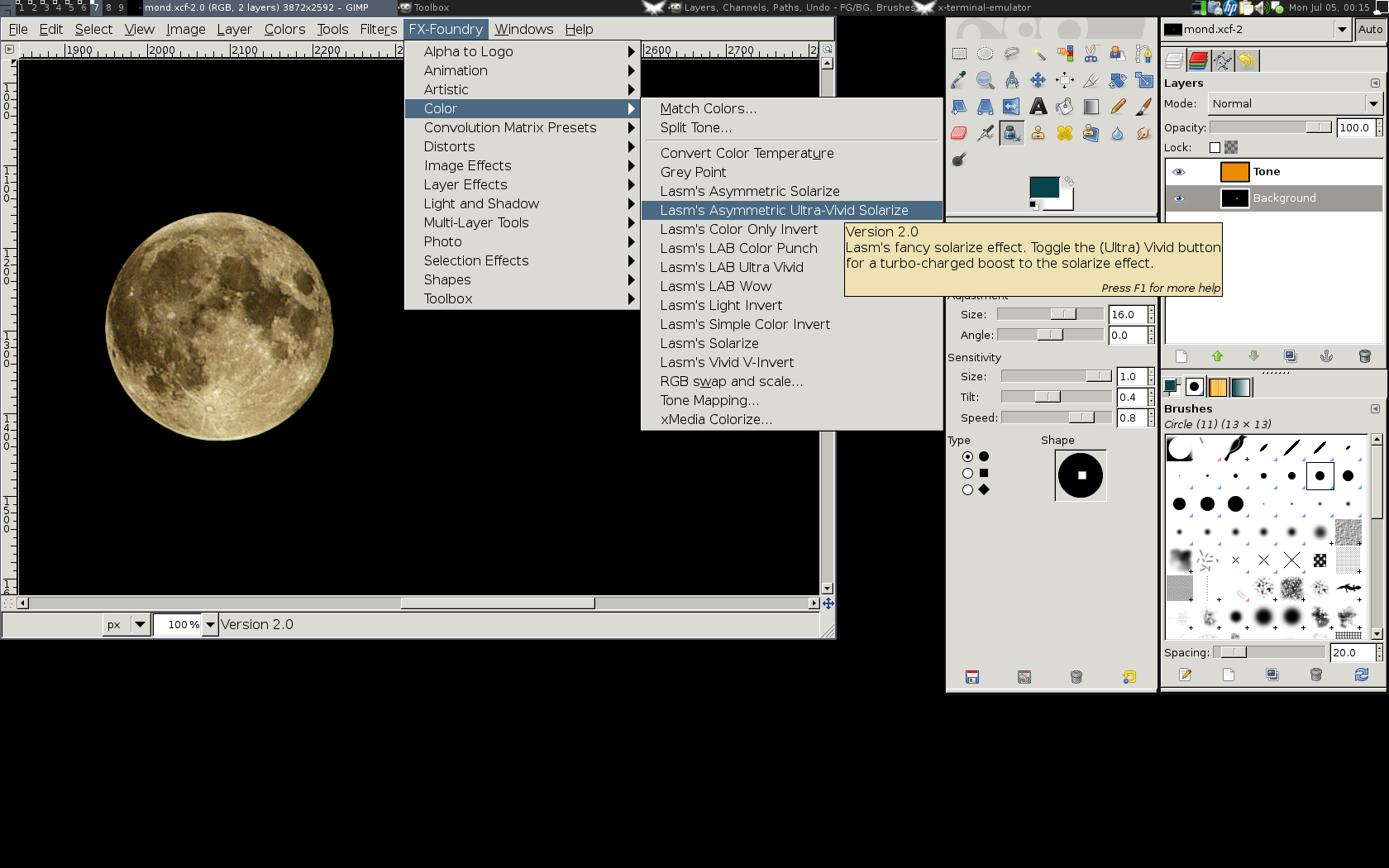
During the last three months and since my last blog-post about gimp-plugin-registry a lot happened: Mainly a large number of new plugins was added, but also various enhancements and bugfixes went into the package, together with updates for various already included plugins. The GIMP screenshot with open FX-Foundry menu For those who don't know gimp-plugin-registry yet, it is a collection of scripts and plugins for The GIMP. The name is based on the webpage GIMP Plugin Registry, where most (new) plugins and scripts are listed. So far the package ships with 170 scripts/plugins. Most of the scripts are written in TinyScheme, but there are also several plugins in C or Python. Probably most noticeable is the inclusion of the GIMP FX Foundry, which is an awesome collection of 124 scripts. Below follows a list of all scripts and plugins as shown in the long description of the Debian package. New plugins are marked with a bold fontface. If there is any interest from other distributions to include the package, I'd be happy to help out to make an integration as easy as possible. The few interesting parts could be ripped out of debian/rules and shipped as a normal Makefile, so they could be used easily. More complicated is the generation of the package description and copyright information, but I guess instead of writing debian/coyright and debian/control, it should be possible to integrate the information into a rpm spec file template or similar files. So in case you're interested to port the package to Fedora, OpenSuSE or some other distribution, don't hesitate to contact me! The sources are available via git, see git.recluse.de for details. For wishes, suggestions and bug reports either use the Debian BTS or Launchpad. While I prefer bugs via the BTS, it might be easier for non-Debian users to file bugs in the Ubuntu Launchpad.
30 June 2010

Dirk Eddelbuettel: Rcpp 0.8.3

A new version 0.8.3 of Rcpp is now CRAN and in Debian. It comes about three weeks after the 0.8.2 release. And even though we promised to concentrate on documentation, it contains a raft of new features: The main thing here is Rcpp sugar for which we also have a new (seventh !!) vignette Rcpp-sugar. As a quick example, consider this simple C++ function that takes two vectors from R and creates a new one conditional on the relative values:
export "C" SEXP foo( SEXP xs, SEXP ys)  
    Rcpp::NumericVector x(xs), y(ys);
    int n = x.size();
    Rcpp::NumericVector res( n );
    double xd = 0.0, yd = 0.0 ;
    for( int i=0; i<n; i++) 
        xd = x[i];
        yd = y[i];
        if( xd < yd ) 
            res[i] = xd * xd ;
          else  
            res[i] = -( yd * yd);
         
     
    return res ;
 
Now, if you use R, you really want to writes this more compactly. And now you can, thanks to Rcpp sugar:
extern "C" SEXP foo( SEXP xs, SEXP ys) 
    Rcpp::NumericVector x(xs), y(xs);
    return ifelse( x < y, x*x, -(y*y));
 
Same great taste, but much less filling! More details are in the Rcpp-sugar vignette. Doug Bates is already a fan of this and is employing it in the lme4a development version of the well-known lme4 package. The full NEWS entry for this release follows below:
0.8.3   2010-06-27
    o	This release adds Rcpp sugar which brings (a subset of) the R syntax
        into C++. This supports : 
         - binary operators : <,>,<=,>=,==,!= between R vectors
         - arithmetic operators: +,-,*,/ between compatible R vectors
         - several functions that are similar to the R function of the same name:
        abs, all, any, ceiling, diff, exp, ifelse, is_na, lapply, pmin, pmax, 
        pow, sapply, seq_along, seq_len, sign
        
        Simple examples :
        
          // two numeric vector of the same size
          NumericVector x ;
          NumericVector y ;
          NumericVector res = ifelse( x < y, x*x, -(y*y) ) ;
        
          // sapply'ing a C++ function
          double square( double x )  return x*x ;  
          NumericVector res = sapply( x, square ) ;
        
        Rcpp sugar uses the technique of expression templates, pioneered by the 
        Blitz++ library and used in many libraries (Boost::uBlas, Armadillo). 
        Expression templates allow lazy evaluation of expressions, which 
        coupled with inlining generates very efficient code, very closely 
        approaching the performance of hand written loop code, and often
        much more efficient than the equivalent (vectorized) R code.
        
        Rcpp sugar is curently limited to vectors, future releases will 
        include support for matrices with sugar functions such as outer, etc ...
        
        Rcpp sugar is documented in the Rcpp-sugar vignette, which contains
        implementation details.
    o   New helper function so that "Rcpp?something" brings up Rcpp help
    o   Rcpp Modules can now expose public data members
    o   New classes Date, Datetime, DateVector and DatetimeVector with proper
        'new' API integration such as as(), wrap(), iterators, ...
    o   The so-called classic API headers have been moved to a subdirectory
        classic/ This should not affect client-code as only Rcpp.h was ever
        included.
    o   RcppDate now has a constructor from SEXP as well
    o   RcppDateVector and RcppDatetimeVector get constructors from int
        and both const / non-const operator(int i) functions
        
    o   New API class Rcpp::InternalFunction that can expose C++ functions
    	to R without modules. The function is exposed as an S4 object of 
    	class C++Function
As always, even fuller details are in Rcpp Changelog page and the Rcpp page which also leads to the downloads, the browseable doxygen docs and zip files of doxygen output for the standard formats. A local directory has source and documentation too. Questions, comments etc should go to the rcpp-devel mailing list off the R-Forge page

28 June 2010

Russell Coker: Can you run SE Linux on a Xen Guest?

I was asked Can you run SELinux on a XEN guest without any problem? . In a generic sense the answer is of course YES, Xen allows you to run Linux kernels with all the usual range of features and SE Linux isn t a particularly difficult feature to enable. I do most of my SE Linux development and testing on virtual machines and until recently I didn t have any hardware suitable for running KVM, so in the last few years I ve done more SE Linux testing on Xen than on non-virtual machines. My SE Linux Play Machine [1] (which will be online again tomorrow) is one SE Linux system running under Xen. But the question was asked in the context of my blog post comparing the prices of virtual hosting providers [2], which changes things. Both Linode and Slicehost (the two virtual hosting providers that my clients use) provide kernels without SE Linux support, the command grep selinux /proc/filesystems (which is the easiest way to test for SE Linux support) gives no output. I am not aware of any other virtual hosting company that provides SE Linux support. If anyone knows of a virtual hosting company that runs Xen or KVM virtual machines with SE Linux support then please let me know, I ll write a blog post comparing such companies if there are some. For the people who work at ISPs: If your company supports SE Linux virtual machines then I would be happy to review your service, just give me a free DomU for a couple of weeks so I can test it out. If your company is considering offering such virtual machines then I would be happy to have a confidential discussion about the issues that you will face, while I am available for paid consulting work in this area I am more than happy to spend an hour or two helping a company that s going to help support my favorite free software project without expecting to be paid. But I have to note that if a dozen hosting companies happen to want advice I won t be able to provide two hours of free advice to each of them. I think that there is an unsatisfied market demand for SE Linux virtual machines. I don t expect all virtual hosting companies to support it in the near future, but this will make it more profitable for those that do. If for the sake of discussion we assume that 5% of sysadmins who are making purchasing decisions regarding virtual servers really want to have SE Linux support and if 5% of virtual hosting companies were to offer such support, then those hosting companies would almost double their market share as a result of supporting SE Linux. It s the usual economic factors relating to small companies that profit from providing good support for the needs of a minority of customers.

Next.

Previous.




