Search Results: "ema"

22 March 2021

Raphaël Hertzog: Freexian s report about Debian Long Term Support, February 2020

A Debian LTS logo
Like each month, have a look at the work funded by Freexian s Debian LTS offering. Debian project funding In February, we put aside 5475 EUR to fund Debian projects. The first project from this initiative was finished and thus Carles Pina was able to issue the first invoice! We are looking forward to receive more projects from various Debian teams and contributors. Learn more about the rationale behind this initiative in this article. Debian LTS contributors In February, 12 contributors have been paid to work on Debian LTS, their reports are available: Evolution of the situation In February we released 28 DLAs (including one regression update) and we held an internal team meeting using video chat.
Finally, as every month we would like to remark once again that we are constantly looking for new contributors. Please contact Holger if you are interested! The security tracker currently lists 46 packages with a known CVE and the dla-needed.txt file has 34 packages needing an update. Thanks to our sponsors Sponsors that joined recently are in bold.

Wouter Verhelst: Twenty years of Debian

Ten years ago, I reflected on the fact that -- by that time -- I had been in Debian for just over ten years. This year, in early February, I've passed the twenty year milestone. As I'm turning 43 this year, I will have been in Debian for half my life in about three years. Scary thought, that. In the past ten years, not much has changed, and yet at the same time, much has. I became involved in the Debian video team; I stepped down from the m68k port; and my organizing of the Debian devroom at FOSDEM resulted in me eventually joining the FOSDEM orga team, where I eventually ended up also doing video. As part of my video work, I wrote SReview, for which in these COVID-19 times in much of my spare time I have had to write new code and/or fix bugs. I was a candidate for the position of DPL one more time, without being elected. I was also a candidate for the technical committee a few times, also without success. I also added a few packages to the list of packages that I maintain for Debian; most obviously this includes SReview, but there's also things like extrepo and policy-rcd-declarative, both fairly recent packages that I hope will improve Debian as a whole in the longer term. On a more personal level, at one debconf I met a wonderful girl that I now have just celebrated my first wedding anniversary with. Before that could happen, I have had to move to South Africa two years ago. Moving is an involved process at any one time; moving to a different continent altogether is even more so. As it would have been complicated and involved to remain a business owner of a Belgian business while living 9500km away from the country, I sold my shares to my (now ex) business partner; it turned the page of a 15-year chapter of my life, something I could not do without feelings one way or the other. The things I do in Debian has changed over the past twenty years. I've been the maintainer of the second-highest number of packages in the project when I maintained the Linux Gazette packages; I've been an m68k porter; I've been an AM, and briefly even an NM frontdesk member; I've been a DPL candidate three times, and a TC candidate twice. At the turn of my first decade of being a Debian Developer, I noted that people started to recognize my name, and that I started to be one of the Debian Developers who had been with the project longer than most. This has, obviously, not changed. New in the "I'm getting old" department is the fact that during the last Debconf, I noticed for the first time that there was a speaker who had been alive for less long than I had been a Debian Developer. I'm assuming these types of things will continue happening in the next decade, and that the future will bring more of these kinds of changes that will make me feel older as I and the project mature more. I'm looking forward to it. Here's to you, Debian; may you continue to influence my life, in good ways and in bad (but hopefully mostly good), as well as continue to inspire me to improve the world, as you have over the past twenty years!

20 March 2021

Dirk Eddelbuettel: An Ode to Stable Interfaces: R and R Core Deserve So Much Praise

A few days ago, a friend and I were riffing about the wonderful stability of R and (subsets of) R packages. The rigorous ASAN/UBSAN/Valgrind/ checks, while at times frustrating for us package maintainers when we do not have easily replicable setups [1], really help in ensuring code quality. As do of course all other layers of quality control at CRAN, and for R. In passing, I mentioned there was an older blog post demonstrating a little power-law-alike behaviour between the most frequent R Core committer and everybody else. So I was intrigued. Could we just pick up a blog post I had written in August of 2007, or almost fourteen years ago, and run it as is? [2] Yes, we can. Which is truly, truly awesome. Back then I must have taken a minor shortcut and analysed just one calendar year of SVN that was pre-extracted (and a few more still exists here if one scrolls down). Maybe then I might not have had the r-devel SVN repo checkout. But these days (and for probably a decade now) I do, and just a few lines of bash get us a full log:
#!/bin/bash

## adjust as needed
svn=$ HOME /svn/r-devel

rev=$(cd $ svn  && svn info --show-item revision)
today=$(date +%Y-%m-%d)

echo -n "Extracting $ rev  revisions at $ today  ... "
(cd $ svn  && svn log --limit $ rev  )   gzip -9 > svn-log-$ today .txt.gz
echo "done"
So that leads to one code adjustments given the different input source. But otherwise the first paragraph runs as is (and now gives us 49.2% for the amazing Prof Ripley):
logfile <- "svn-log-2021-03-20.txt.gz"

## cf http://dirk.eddelbuettel.com/blog/2007/08/11/
x <- readLines(logfile)
rx <- x[grep("^r",x)]
who <- gsub(" ","",sapply(strsplit(rx,"\\ "),"[",2))
twho <- table(who)
twho["ripley"]/sum(twho)
That is what one gets by trusting stable interfaces: code untouched for fourteen years runs unchanged. R itself has had well over sixty releases since then, including two major and eighteen minor releases. Yet the code just runs, including the code for two graphs one can reproduce with the exact same code as we show next.
tod <- unlist(sapply(rx,function(x)strsplit(x,split=" ")[[1]][6]))
tod <- tod[who=="ripley"]

tz <- sub(pattern=".*(-[0-9] 4 ).*",replacement="\\1",x=rx)
tz <- tz[who=="ripley"]
tz <- as.numeric(tz)/100
offset <- 3600*tz

z <- strptime(tod,format="%H:%M:%S")
hist(z,"hours",main="Ripley Commit Times in SVN TZ")

h <- z - offset
h <- format(h,format="%H")
h <- factor(as.numeric(h), levels=0:23)
## added as.vector() here to suppress a warning
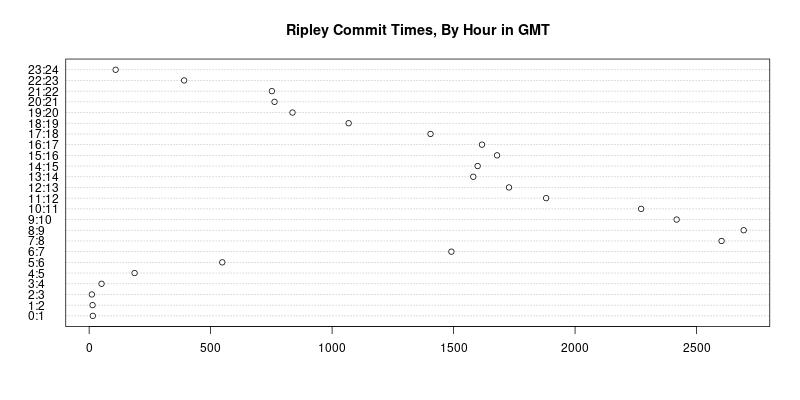
dotchart(as.vector(table(h)), main="Ripley Commit Times, By Hour in GMT",
         labels=paste(0:23,1:24,sep=":"))
The code reproduces the chart from 2008, but this time uses the full twenty plus years of SVN history. I added just one as.vector() to suppress one new warning which appears under current R and which was presumably added in the fourteen years since (at the chart is produces without it too). The remainder of the code also runs. I just added one library(zoo) my blog post had omitted. No other changes.
## rather extract both  date and time
dat <- unlist(sapply(rx, function(x)  
  txt <- strsplit(x,split=" ")[[1]]
  paste(txt[5], txt[6])
 ))
## subset on Prof Ripley
dat <- dat[who == "ripley"]
## and convert to POSIXct, correcting by tz as well
datpt <- as.POSIXct(strptime(dat,format="%Y-%m-%d %H:%M:%S")) - offset

## turn into zoo -- we use a constant series of ones as each
## committ is taken as a timestamped event
library(zoo)
datzoo <- zoo(1, order.by=datpt)
## and use zoo to aggregate into commits per date
daily <- aggregate(datzoo, as.Date(index(datzoo)), sum)

## now plot as grey bars
plot(daily, col='darkgrey', type='h', lwd=2,
     ylab="Nb of SVN commits, three-week median",
     xlab="R release dates 2.5.0 and 2.5.1 shown in orange",
     main="The amazing Prof. Ripley")
## mark the two R releases of 2007
abline(v=c(as.Date("2007-04-24"),as.Date("2007-06-28")),col='orange',lwd=1.5)
## and do a quick centered rolling median
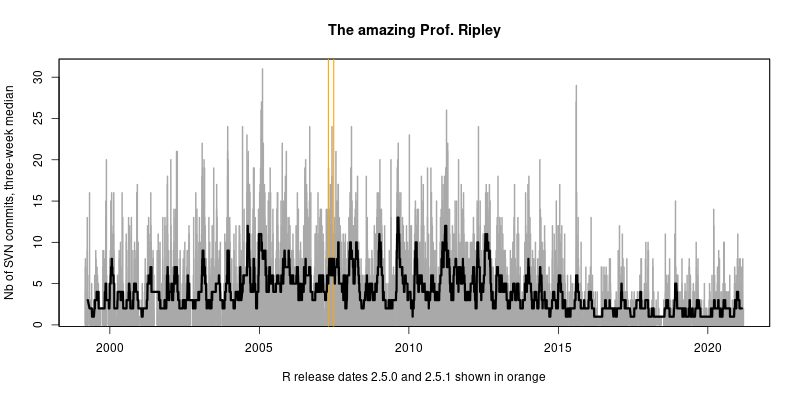
lines(rollmedian(daily, 21, align="center"), lwd=3)
It produces this chart spanning two decades of commits. [3] The subtitle highlighting the then-most-recent releases is a little quaint now given that R has had eighten major.minor releases, and over sixty total releases, since then. Stable and rigourously maintained interfaces are a fantastic resource that is dramatically under-appreciated. Efforts such as the ten-year reproduction challenge demonstrate that this really is not a given. Maybe instead of celebrating band aides ( look, I reproduce via code I have frozen in a virtual environment / container / machine / ) we should celebrate languages, ecosystems, packages, that allow us to rely on just the code itself. Because we can. And we should strengthen and reinforce that ability. And discourage rapid changes just for changes sake. Code running for a decade, or even longer, is a huge boon to everybody relying on it. Three cheers to R Core. [1] Docker containers would be really good, and a step above the specs in the README. Winston s nice r-debug sumo container comes closest and helps a lot, and is updated regularly (which my earlier r-devel-san container is not). [2] The post owes some of its code ideas to Ben Bolker and Simon Jackman, but links to now-stale prior affiliations of theirs. [3] And the singularly impressive contributions charted remain unparalled, but were already the focus of the previous post. Yet over three times as a long period, they remain even more stunning. Edit 2021-03-21: Two minor fixes for grammar and typing.

13 March 2021

Sean Whitton: lisp-use-for-transpose-chars

I had thought that Emacs C-t was mainly about correcting typos. It turns out to be extremely useful when working on Lisp macros which themselves write macros. This typically involves nested quasiquotation, where you can have multiple alternating sequences of open parentheses and backticks, or of commas, quotation marks and ampersats. While you re working on it you often need to reorder these character sequences and C-t does a great job.

12 March 2021

Ryan Kavanagh: Static Comments in Hugo

I switched from Jekyll to Hugo last week for a variety of reasons. One thing that was missing was a port of the jekyll-static-comments plugin that I used to use. I liked it because it saved readers from being tracked by Disqus or other comments solutions, and it required no javascript. To comment, users would email me their comment following a template attached to the bottom of each post. I then piped their email through a script to add it to the right post. As an added benefit, I could delegate comment spam detection to my mail server. I ve managed to reimplement this setup using Hugo. For those who are interested in a similar setup, here is what you need to do.

Pages with comments Instead of being single files, pages need to be leaf bundles. For example, this means that your blog post must be located at /content/blog/2021-03-12-static-comments-in-hugo/index.md instead of /content/blog/2021-03-12-static-comments-in-hugo.md. This lets you store the comments as page resources in the subdirectory /content/blog/2021-03-12-static-comments-in-hugo/comments/.

Partials You should create a comments.html partial and include it in the layout for the pages which should get comments:
<div class="post-comments">
  <p class="comment-notice"><b>Comments</b>: To comment on this post,
	send me an email following the template below. Your email address
	will not be posted, unless you choose to include it in
	the <span style="font-family: monospace;">link:</span> field.</p>
  <pre class="comment-notice">
To: Your Name &lt;your.email<span>@</span>example.org&gt;
Subject: [blog-comment]   .Page.RelPermalink  
post_id:   .Page.RelPermalink  
author: [How should you be identified? Usually your name or "Anonymous"]
link: [optional link to your website]
Your comments here. Markdown syntax accepted.</pre>
    $scratch := newScratch  
    $scratch.Set "comments" (.Resources.Match "comments/*yml")  
    if eq 1 (len ($scratch.Get "comments"))  
  <h2>1 Comment</h2>
    else  
  <h2>  len ($scratch.Get "comments")   Comments</h2>
    end  
    range ($scratch.Get "comments")  
  <div class="post-comment  % cycle 'odd', 'even' % ">
	  $comment := (.Content   transform.Unmarshal)  
	<span class="post-meta">
		 - $comment.date   dateFormat "Jan 2, 2006 at 15:04" - 
	</span>
	<h3 class="comment-header">
	    if $comment.link  
	  <a href="  $comment.link  ">  $comment.author  </a>
	    else  
	    $comment.author  
	    end  
	  <br />
	</h3>
	  $comment.comment   markdownify  
  </div>
    end  
</div>

Comments To associate comments received by email to posts, I pipe them from mutt (using the keybinding) to the following (admittedly janky) shell script. It takes the comment, reformats it appropriately, and puts it in the post s comments subdirectory. Note that it determines which filename to use based on the email s contents, so make sure to check that the email doesn t contain anything nefarious before you pipe it into the script!
#!/bin/sh
# Copyright (C) 2016-2021 Ryan Kavanagh <rak@rak.ac>
# Distributed under the ISC license
BLOG_BASE="/media/t/work/blog"
MESSAGE=$(cat)
EMAIL=$(echo "$ MESSAGE "   grep "From:"   sed -e 's/From[^<]*<\?\([^>]*\)>\?.*/\1/g;s/@/-at-/g')
DATE=$(echo "$ MESSAGE "   grep "Date:"   sed -e 's/Date:\s*//g'   xargs -0 date -Iseconds -u -d)
POST_ID=$(echo "$ MESSAGE "   grep "post_id:"   sed -e 's/post_id: //g')
COMMENTS_DIR="$ BLOG_BASE /content/$ POST_ID /comments/"
COMMENT_FILE="$ COMMENTS_DIR /$ DATE _$ EMAIL .yml"
# Strip out the email headers and whitespace until the start of the comment
COMMENT_WHOLE=$(echo "$ MESSAGE "   sed -e '/^\s*$/,$!d;/^[^\s]/,$!d')
# Indent everything after the comment header
COMMENT_INDENTED=$(echo "$ COMMENT_WHOLE "   sed -e '/^\s*$/,$ s/.*/  &/g ')
# And add the comment header
COMMENT_PREFIXED=$(echo "$ COMMENT_INDENTED "   sed -e '0,/^\s*$/ s/^\s*$/comment:  / ')
[ -d "$ COMMENTS_DIR " ]   mkdir -p "$ COMMENTS_DIR "
echo "Saving the comment to $ COMMENT_FILE "
echo "date: $ DATE "   tee "$ COMMENT_FILE "
echo "$ COMMENT_PREFIXED "   tee -a "$ COMMENT_FILE "
For example, the following comment in an email body:
post_id: /blog/2021-03-12-static-comments-in-hugo/
author: Ryan Kavanagh
link: https://rak.ac/
Dear self,
Here is a test comment for your blog post.
It supports *markdown* **syntax** and  stuff .
Best,
Yourself
results in a file content/blog/2021-03-12-static-comments-in-hugo/comments/2021-03-12T18:47:25+00:00_rak-at-example.org.yml containing:
date: 2021-03-12T18:47:25+00:00
post_id: /blog/2021-03-12-static-comments-in-hugo/
author: Ryan Kavanagh
link: https://rak.ac/
comment:  
  Dear self,

  Here is a test comment for your blog post.
  It supports *markdown* **syntax** and  stuff .

  Best,
  Yourself  
You can see the rendered output at the bottom of this page.

11 March 2021

Vincent Fourmond: All tips and tricks about QSoas

I've decided to post regular summaries of all the articles written here about QSoas; this is the first post of this kind. All the articles related to QSoas can be found here also. The articles written here can be separated into several categories. Tutorials to analyze real data These are posts about how to reproduce the data analysis of published articles, including links to the original data so you can fully reproduce our results. These posts all have the label tutorial. All about fits QSoas has a particularly powerful interface for non-linear least square minimisations (fits): Meta-data Meta data describe the conditions in which experiments were performed. Quiz and their solutions Quiz are small problems that take some skill to solve; they can teach you a lot about how to work with QSoas. Other tips and tricks Release annoucements These have generally lot of general information about the possibilities in QSoas:
About QSoas QSoas is a powerful open source data analysis program that focuses on flexibility and powerful fitting capacities. It is released under the GNU General Public License. It is described in Fourmond, Anal. Chem., 2016, 88 (10), pp 5050 5052. Current version is 3.0. You can download its source code there (or clone from the GitHub repository) and compile it yourself, or buy precompiled versions for MacOS and Windows there.

9 March 2021

Sylvestre Ledru: Debian running on Rust coreutils

tldr: Rust/coreutils ( https://github.com/uutils/coreutils/ ) is now available in Debian, good enough to boot a Debian with GNOME, install the top 1000 packages, build Firefox, the Linux Kernel and LLVM/Clang. Even if I wrote more than 100 patches to achieve that, it will probably be a bumpy ride for many other use cases.
It is also a terrific project to learn Rust. See the list of good first bugs. Even if I see Rust code every day at Mozilla, I was looking for an actual personal project (i.e. this isn't a Mozilla project) to learn Rust during the various COVID lockdowns. I started contributing to the alternative Coreutils developed in Rust. The project aims at proposing a drop-in replacement of the C-based GNU Coreutils, and I wanted to evaluate if this could be used to run a regular Debian. Similar to what I have done with clang.debian.net a few years ago (rebuilding the Debian archive using clang instead of gcc). I expect that most of the readers know what is the Coreutils. It is a set of programs performing simple operations (copy/move file, change permissions/ownership, etc). Even if some commands are from the 70s, they are at the base of Linux, Unix and macOS. While different implementations can be found, they are trying to remain compatible in terms of arguments, options, etc. This implementation of Coreutils isn t different! If you want to learn more about the history of Unix, I recommend this great Corecursive podcast with Brian Kernighan. While a lot of people contributed to this project, much was left to be done: To start easy, I defined 4 goals for this work:
  1. Package Coreutils in Debian/Ubuntu
  2. Boot a Debian system with a Rust-based coreutils
  3. Install the top 1000 packages in Debian - including GNOME
  4. Build Firefox, the Linux Kernel and LLV/Clang

Packaging of Coreutils in Debian Packaging in Debian isn't a trivial or even simple task. It requires uploading independently all the dependencies in the archive. Rust, with its new ecosystem and small crates, is making this task significantly harder. The package is called rust-coreutils - https://tracker.debian.org/pkg/rust-coreutils For Debian/Ubuntu users, to have an idea of the complexity of packaging such applications, just run
debtree --build-dep rust-coreutils dot -Tsvg > coreutils.svg (should be around 1M). Since it isn't production ready, the rust-coreutils is installable in parallel with coreutils. This package does NOT replace the GNU/coreutils files (yet?), the new files are installed in /usr/lib/cargo/bin/. They can be used with: export PATH=/usr/lib/cargo/bin/:$PATH Or, uglier, overriding the files with the new ones.

Booting Debian with rust-coreutils To achieve this, because I knew I would likely break the image a few times, I created a new project to quickly install a full Debian with PXE and preseed. The project is available here: https://github.com/opencollab/qemu-debian-install-pxe-preseed/ A script to create the full qemu image: build_qemu_debian_image.sh A second script to boot on the newly created image: boot.sh Then, building and installing coreutils on the system (yeah, it is ugly - don t do that at home): apt install rust-coreutils
cd /usr/lib/cargo/bin/
for f in *; do
cp -f $f /usr/bin/
done
First surprise, unlike the old init.d init system, as systemd is not relying on a series of scripts (it is mostly written in C), replacing the coreutils did not have an impact. Therefore, I didn't experience any issue during the boot process

Implementing missing options A significant number of problems could be easily identified as a lack of support for some options. Here is a list of most of the fixes I had to implement to make this plan work:

Different behavior Most of the programs behaved as expected. Here is a list of differences:
  • install doesn't support using /dev/null as source file
    Setting up libreoffice-common (1:6.1.5-3+deb10u6) ...
    install: error: install: cannot install /dev/null to /etc/apparmor.d/local/usr.lib.libreoffice.program.oosplash : the source path is not an existing regular file
    A limitation of rust itself https://github.com/rust-lang/rust/issues/79390

Compile Firefox, Clang and the Linux Kernel Build systems can vary significantly one from the other. To verify their usage of coreutils, I built these three major projects

Firefox As Firefox relies mostly on Python as a build system, it went smoothly. I didn t encounter any issue. The only unrelated issue that I noticed working on it was apt-key was broken because the script relied on a buggy option of mktemp.

Linux Kernel I identified only two issues compared to GNU Coreutils:
  • The chown command on a non-existing symlink target doesn t fail on the GNU version, the Rust one was triggering an error.
    https://github.com/uutils/coreutils/pull/1694
  • Linux kernel
    ln -fsn ../../x86/boot/bzImage ./arch/x86_64/boot/bzImage
    ln: error: Unrecognized option: 'n'

LLVM/Clang The llvm toolchain relies on Cmake. Just like for Firefox, I didn t face any issue.

Comparing with GNU coreutils using its testsuite Recently, James Robson added a new test to run the GNU testsuite on the Rust/coreutils.

# TOTAL: 611
# PASS: 144
# SKIP: 86
# XFAIL: 0
# FAIL: 342
# XPASS: 0
# ERROR: 39
compared to 546 test passing with the GNU version. Even if a bunch of errors are just different outputs, it demonstrates that there is still a long road ahead.

Next steps & contribute First, we will need more motivated contributors to work on this project. Many features remain to be implemented, optimizations to be done (e.g. decreasing the memory usage), etc.
I started to create a list of good first bugs for newcomers: https://github.com/uutils/coreutils/issues?q=is%3Aissue+is%3Aopen+label%3A%22Good+first+bug%22
I will update this list of there is some interest for this project.
Helping improve the support of the GNU coreutils testsuite would be a huge step while being a great way to learn Rust! Then, once it is in a better state, we will be able to make it a reliable alternative in Debian/Ubuntu to the GNU/Coreutils. This might be also interesting for other folks who prefer a BSD license over a GPL.

7 March 2021

Enrico Zini: Women in science

Timeline of women in science - Wikipedia
this is a timeline of women in science, spanning from ancient history up to the 21st century. While the timeline primarily focuses on women involved with natural sciences such as astronomy, biology, chemistry and physics, it also includes women from the social sciences (e.g. sociology, psychology) and the formal sciences (e.g. mathematics, computer science), as well as notable science educators and medical scientists. The chronological events listed in the timeline relate to both scientific achievements and gender equality within the sciences.
List of women's firsts - Wikipedia
This is a list of women's firsts noting the first time that a woman or women achieved a given historical feat. A shorthand phrase for this development is "breaking the gender barrier" or "breaking the glass ceiling." Other terms related to the glass ceiling can be used for specific fields related to those terms, such as "breaking the brass ceiling" for women in the military and "breaking the stained glass ceiling" for women clergy. Inclusion on the list is reserved for achievements by women that have significant historical impact.
List of Women in Technology International Hall of Fame inductees - Wikipedia
The Women in Technology International Hall of Fame was established in 1996 by Women in Technology International (WITI) to honor women who contribute to the fields of science and technology.
Women in Chemistry Compound Interest
8 March is International Women s Day. As in previous years, I ve put together another edition of this series looking at underappreciated women from chemistry history.
And some men, too:

Louis-Philippe V ronneau: New Year, New OpenPGP Key

-----BEGIN PGP SIGNED MESSAGE-----
Hash: SHA512
Sun, 07 Mar 2021 13:00:17 -0500
I've recently set up a new OpenPGP key and will be transitioning away from my
old one.
It is a chance for me to start using a OpenPGP hardware token and to transition
to a new personal email address (my main public contact is still my
 @debian.org  address).
Please note that I've partially redacted some email addresses from this
statement to minimise the amount of spam I receive. It shouldn't be hard for
actual humans to follow the instructions below to find the complete addresses.
The old key will continue to be valid for a few months, but will eventually be
revoked.
You might know my old OpenPGP certificate as:
pub   rsa4096/0x7AEAC4EC6AAA0A97 2014-12-22 [expires: 2021-06-02]
      Key fingerprint = 677F 54F1 FA86 81AD 8EC0  BCE6 7AEA C4EC 6AAA 0A97
uid       Louis-Philippe V ronneau <REDACTED@riseup.net>
uid       Louis-Philippe V ronneau (alias) <REDACTED@riseup.net>
uid       Louis-Philippe V ronneau (debian) <REDACTED@debian.org>
My new OpenPGP certificate is:
pub   ed25519/0xE1E5457C8BAD4113 2021-03-06 [expires: 2022-03-06]
      Key fingerprint = F64D 61D3 21F3 CB48 9156  753D E1E5 457C 8BAD 4113
uid       Louis-Philippe V ronneau <REDACTED@veronneau.org>
uid       Louis-Philippe V ronneau <REDACTED@debian.org>
These days, I mostly use my key for Debian and to sign git commit. I don't
really expect you to sign my new key if you had signed my old one.
I've published the new certificate on keys.openpgp.org as well as on my
personal website. You can fetch it like this:
    $ wget -O- https://veronneau.org/media/openpgp.key   gpg --import
-----BEGIN PGP SIGNATURE-----
iQIzBAEBCgAdFiEEZ39U8fqGga2OwLzmeurE7GqqCpcFAmBFFM8ACgkQeurE7Gqq
CpcuchAAscAeszdtA+TlCI4YvK5nlk+nJnCnNBSnl7Et+jiNjq8kB/Fud+dWMTXC
Zag8oJkalbbxub0BT0bEAn+BiBunu58E0gd0Xq4syTbqZ5o5IN17S/tfxCD0k1hf
ewrnYZ2l0i5g4YvHGKC+Xv4D+Z84BylnIRaXHqlUdluOVfVYDfLybOAqoktO/KUH
I+vQBwXj0Fr/QAtgiz5Nwh/YHFiU9xMSvr5ozRwAFs6+xfIqFHuVPRRkEN5iVo4D
kkMIz+kFfkoh4aWIP4dgAu39XnEgxwTR9J+4yE8TzCCMzO7xCK0X6vqgPAxYMPvb
RuP4FnGWOnGnlcudCUAUkOaryrwRi+dPQTnNICHTYsvVc7dg+W0EhVUkwEuuEwpI
qtcB/Y5AGhqK0Cc11uXiFjIQwLTgwcUez4F0xrGeqsTtAM5gyRup2w0jbocTuYSh
ZRv/2zwrq/S3xVrUYGqdT+L5odmkBzz9zOwY5WlU2H9CMFOdh71XOv9wWQXan9ou
hLRodeOQ8MinIBP+sX36ol1zg/aP7mCHvRRSBzWt7l3WhVxgZFpNwIfp/RZqU0R4
IEq48mntFhPvHJjFmAKLKK/ckzNMtSn+HWQPJV3HTInKCTu5PTNMU3SAvPHOHEps
V6WWSOPB+1Lm/tlIULDc+0SopWoiWO4NObCSs8zMZHlYPBk5x/KIdQQBFgoAHRYh
BMqnQAcHqBawIC/DzfQlelCyHPqFBQJgRRTPAAoJEPQlelCyHPqFFVEA/1qScaAk
O+eBEE4q0BaJDsqweCS1XCcuQGkQCKi5Zv6kAQChQ96Ve7cKbN/wRkT9pdIhmx01
+CmIsnp3k6N0ZYLLCg==
=onl0
-----END PGP SIGNATURE-----

6 March 2021

Shirish Agarwal: Making life difficult

Freedom house puts India in partly free Just couple of days ago, freedom house published its 2020 rankings for all countries including India. While freedom house shared how democracy in the world has weakened, India chose to take offense about it being called partly free .
India, leader in Internet shutdowns Access Now (copyright)
The above illustration is shared by accessnow . The next big ones who have Internet shutdowns are Yemen 6 and Ethiopia 4. Such internet shutdowns have and will have sad repercussions as would share in another story as well.

Color-coding journalists A story was broken by caravan magazine yesterday and which was followed by newslaundry which shows how the Govt. is looking to just drive some narrative, does not matter whether it s true or false, it should just show that the Govt. is right and others are all wrong. As can be seen, almost all reporters barring a few have kept silent rather than refuting statements attributed to them or happenings which didn t happen. And this goes to a much larger narrative and disinformation route taken by the Govt. which doesn t have any semblance to the truth or reality as people know it. I would illustrate couple of examples below which shares that. In all my young and even adult-life I hadn t seen a Govt. this much against its own people.

Omega Seiki puts a manufacturing plant in Bangladesh Now Omega Seiki is an Indian vendor who chose or had to go to manufacture their electric vehicles in Bangladesh. Now while this is a slightly old story this was broken on social media recently. Everybody starting blaming both the vendor and saying we should break FTA (Free Trade Agreement) with Bangladesh, not knowing that despite the FTA, India has put tariff barriers between India and Bangladesh. I had to share research from Brookings to show where India has been losing. Of course, those who don t want to see, wouldn t see anything wrong in the picture.

Teen raped, asked to marry the accused when she turns 18 Now you may see the above headlines and feel it is ridiculous, but the fact is that these orders were put or given by Madras High Court couple of months back. This was then reported by both Livelaw and BarandBench respectively. Now to be truthful, this news didn t make much noise as it should have, probably as I had shared previously that the Govt. wants to lower the marriageable age to 15 or even less. And this is despite all the medical evidence on the contrary, because it assuages this Govt s masculinity. There is also the very recent case where the SC CJI asked the rapist if he is willing to marry a girl who was underage when she reaches maturity. Another one in which it seems martial rape is not a crime according to the CJI. So it seems these are the state of things in which India finds itself today. There are judges like Vrinda Grover who do question CJI but they are few and there are costs to them who ask questions. Although, as shared this news was overtaken by other news and would have remained so, if not one of the leaders of the present Govt. , a Ramesh Jarkiholi, who hails from Belagavi region of north Karnataka was caught in a sex CD scandal basically asking sexual favors for a permanent Govt. job. He had made statements after the Madras High Court case applauding the judgement given by the judge. While, due to public pressure he had to resign, but not before stating that he had everybody blue films including the Chief Minister of the State. And sad to report that six Karnataka Ministers rushed today or rather yesterday to put a petition in the civil court to restrain media from airing/printing/publishing any defamatory content against them. The court has granted a media gag against 68 media houses for the same. Sadly, the recent happening only reinforce what has been happening in Karnataka since a decade. Update 07/03/2021 Seems yesterday another 10 odd ministers rushed to get the same order. Seems different laws apply to politicians vis-a-vis others. A recent example of Rhea Chakravarthy, an actress and girlfriend of Sushant Singh who was hounded in his suicide case and many accusations made on TV but no evidence till date. From what we know as facts, Sushant committed suicide as he was not getting work due to cronyism in Bollywood. In fact, those who were behind it have white-washed themselves, deleted their tweets etc. and while the public knows, no accountability on them. In fact, there is and was so much that I wanted to share as to what has been happening to women, sadly and thankfully arre did the needful for me. They wrote an entire article which tells what the situation for women in India today is. And if you are wondering why I said, that is because when a site which was made exclusively for people to laugh and have a good time and get relief, when they start writing serious articles, you can be sure that things have gone horribly wrong

Asking Tesla to come to India and at the same time ambivalent on battery Recently, Mr. Nitin Gadkari, a prominent minister of the present Govt. invited Tesla and gave all sorts of incentives to start a manufacturing plant here in India. And while it seems that Tesla has accepted, looking at the Vodafone case, hopefully Tesla does make such contracts where if something goes wrong and they need to sue the Govt. they can do it in States or elsewhere. The way the Govt. acted in the Vodafone case had been a dampener to any MNC investments so far. Although to be fair to both Tesla and GOI, the basic models even if they are manufactured in India will go to less than 1% of the population. The cheapest Tesla Model Y which retails in the U.S. for USD 40k would be around INR 30 lakh. And this is their cheapest car to date. I do know there are rumors of the 25k but that is probably 2-3 years away as shared by Tesla China President Tom Zhu in an interview shared on YT.

https://www.youtube.com/watch?v=aH5leMWFBxI There are couple of interesting comments being made. The fact that China is going to fully open its automobile market to western companies shows how confident China feels about their own vendors. And I m not much impressed about Tesla as I am about the tiny car revolution happening in China. India, if it wanted to, could learn many lessons from China. Even the electric buses they had started in 2010 itself where people in our auto industry thought it was all a fad. Sadly, we are missing most of the technology and if and by the time Tesla starts a production line, dunno where we could get our lithium. India hasn t been as aggressive as other countries when it comes to securing raw natural resources in other countries, as some other countries have.  Even besides that, it has been tough when you have so many people who still believe that ICE vehicles (Internal Combustion Engines) are better than EV s and even if they know they choose to believe the propaganda. Couple of months ago a young UK girl who had died due to asthma, an inquest found that air pollution was a factor. The girl s name was Ella Adoo-Kissi-Debrah. This is the first case where the doctor ruled air pollution as a chief factor in a person s death. Probably first of its kind of ruling anywhere in the world. I also shared TCO studies between BEV and ICE vehicles done by people who are considering an electric vehicle but those studies seem to fall on deaf ears.

Starlink This is another of Elon Musk s ventures and would be a money spinner for sure in around the globe. While Starlink has asked TRAI for permission, I don t think they will get it. There is also Bharti Global s Oneweb which probably has a better chance of getting permissions. The reason is censorship. As shared above, India is now a leader in Internet shutdowns and do see this trend only accelerate rather than go the other way around. For people who don t remember, remember how satellite phones were made illegal even though only businessmen could afford it. And this was just 5 years ago. As shared Oneweb would have better shot as they would accept all Government directives without a second thought. Unless Starlink gives a binding to the Govt. to be a willing partner when it wants to have internet shutdowns, it will not work. Now how Elon approaches that is to be seen and known. FWIW, you can t access Starlink webpage on BSNL broadband. My broadband provider gives at the most 300 kbps and sometimes, at late nights or early mornings, around 500 kbps.

Farmer Protests
Lastly, farmer protests have entered 100 days. In the interim, Vivek Kaul, an economist took stock of the Bihar APMC to see if things have really worked as the Govt. supporters were telling. The investigation and the results didn t inspire the confidence as the Govt. said. The sad part is though, that nowadays nobody, at least those in power as well as those who are supporters are keen to read, understand and even argue otherwise. They are all happy with whatsapp knowledge. Till date 200+ people have died in the farmer protests. All mainstream media houses have stopped talking about farmers in the hope that they will disappear. At the end of the day the Govt. wants that the corporates should win at whatever the cost.

5 March 2021

Sergio Durigan Junior: A debuginfod service for Debian

Hi there. Long time no write! On Tuesday, February 23, 2021, I made an announcement at debian-devel-announce about a new service that I configured for Debian: a debuginfod server. This post serves two purposes: pay the promise I made to Jonathan Carter that I would write a blog post about the service, and go into a bit more detail about it. What's debuginfod? From the announcement above:
debuginfod is a new-ish project whose purpose is to serve
ELF/DWARF/source-code information over HTTP.  It is developed under the
elfutils umbrella.  You can find more information about it here:
  https://sourceware.org/elfutils/Debuginfod.html
In a nutshell, by using a debuginfod service you will not need to
install debuginfo (a.k.a. dbgsym) files anymore; the symbols will be
served to GDB (or any other debuginfo consumer that supports debuginfod)
over the network.  Ultimately, this makes the debugging experience much
smoother (I myself never remember the full URL of our debuginfo
repository when I need it).
Perhaps not everybody knows this, but until last year I was a Debugger Engineer (a.k.a. GDB hacker) at Red Hat. I was not involved with the creation of debuginfod directly, but I witnessed discussions about "having way to serve debug symbols over the internet" multiple times during my tenure at the company. So this is not a new idea, and it's not even the first implementation, but it's the first time that some engineers actually got their hands dirty enough to have something concrete to show. The idea to set up a debuginfod server for Debian started to brew after 2019's GNU Tools Cauldron, but as usual several things happened in $LIFE (including a global pandemic and leaving Red Hat and starting a completely different job at Canonical) which had the effect of shuffling my TODO list "a little". Benefits for Debian Debian unfortunately is lagging behind when it comes to offer its users a good debugging experience. Before the advent of our debuginfod server, if you wanted to debug a package in Debian you would need to:
  1. Add the debian-debug apt repository to your /etc/apt/sources.list.
  2. Install the dbgsym package that contains the debug symbols for the package you are debugging. Note that the version of the dbgsym package needs to be exactly the same as the version of the package you want to debug.
  3. Figure out which shared libraries your package uses and install the dbgsym packages for all of them. Arguably, this step is optional but recommended if you would like to perform a more in-depth debugging.
  4. Download the package source, possibly using apt source or some equivalent command.
  5. Open GDB, and make sure you adjust the source paths properly (more below). This can be non-trivial.
  6. Finally, debug the program.
Now, with the new service, you will be able to start from step 4, without having to mess with sources.list, dbgsym packages and version mismatches. The package source It is important to mention an existing (but perhaps not well-known) limitation of our debugging experience in Debian: the need to manually download the source packages and adjust GDB to properly find them (see step 4 above). debuginfod is able to serve source code as well, but our Debian instance is not doing that at the moment. Debian does not provide a patched source tree that is ready to be consumed by GDB or debuginfod (for a good example of a distribution that does this, see Fedora's debugsource packages). Let me show you an example of debugging GDB itself (using debuginfod) on Debian:
$ HOME=/tmp DEBUGINFOD_URLS=https://debuginfod.debian.net gdb -q gdb
Reading symbols from gdb...
Downloading separate debug info for /tmp/gdb...
Reading symbols from /tmp/.cache/debuginfod_client/02046bac4352940d19d9164bab73b2f5cefc8c73/debuginfo...
(gdb) start
Temporary breakpoint 1 at 0xd18e0: file /build/gdb-Nav6Es/gdb-10.1/gdb/gdb.c, line 28.
Starting program: /usr/bin/gdb 
Downloading separate debug info for /lib/x86_64-linux-gnu/libreadline.so.8...
Downloading separate debug info for /lib/x86_64-linux-gnu/libz.so.1...
Downloading separate debug info for /lib/x86_64-linux-gnu/libncursesw.so.6...
Downloading separate debug info for /lib/x86_64-linux-gnu/libtinfo.so.6...
Downloading separate debug info for /tmp/.cache/debuginfod_client/d6920dbdd057f44edaf4c1fbce191b5854dfd9e6/debuginfo...
[Thread debugging using libthread_db enabled]
Using host libthread_db library "/lib/x86_64-linux-gnu/libthread_db.so.1".
Downloading separate debug info for /lib/x86_64-linux-gnu/libexpat.so.1...
Downloading separate debug info for /lib/x86_64-linux-gnu/liblzma.so.5...
Downloading separate debug info for /usr/lib/x86_64-linux-gnu/libbabeltrace.so.1...
Downloading separate debug info for /usr/lib/x86_64-linux-gnu/libbabeltrace-ctf.so.1...
Downloading separate debug info for /usr/lib/x86_64-linux-gnu/libipt.so.2...
Downloading separate debug info for /usr/lib/x86_64-linux-gnu/libmpfr.so.6...
Downloading separate debug info for /usr/lib/x86_64-linux-gnu/libsource-highlight.so.4...
Downloading separate debug info for /usr/lib/x86_64-linux-gnu/libxxhash.so.0...
Downloading separate debug info for /usr/lib/x86_64-linux-gnu/libdebuginfod.so.1...
Downloading separate debug info for /usr/lib/x86_64-linux-gnu/libstdc++.so.6...
Downloading separate debug info for /lib/x86_64-linux-gnu/libgcc_s.so.1...
Downloading separate debug info for /usr/lib/x86_64-linux-gnu/libglib-2.0.so.0...
Downloading separate debug info for /tmp/.cache/debuginfod_client/dbfea245d26065975b4084f4e9cd2d83c65973ee/debuginfo...
Downloading separate debug info for /usr/lib/x86_64-linux-gnu/libdw.so.1...
Downloading separate debug info for /usr/lib/x86_64-linux-gnu/libelf.so.1...
Downloading separate debug info for /usr/lib/x86_64-linux-gnu/libuuid.so.1...
Downloading separate debug info for /usr/lib/x86_64-linux-gnu/libgmp.so.10...
Downloading separate debug info for /usr/lib/x86_64-linux-gnu/libboost_regex.so.1.74.0...
Downloading separate debug info for /usr/lib/x86_64-linux-gnu/libcurl-gnutls.so.4...
Downloading separate debug info for /lib/x86_64-linux-gnu/libbz2.so.1.0...
Downloading separate debug info for /usr/lib/x86_64-linux-gnu/libicui18n.so.67...
Downloading separate debug info for /tmp/.cache/debuginfod_client/acaa831dbbc8aa70bb2131134e0c83206a0701f9/debuginfo...
Downloading separate debug info for /usr/lib/x86_64-linux-gnu/libicuuc.so.67...
Downloading separate debug info for /usr/lib/x86_64-linux-gnu/libnghttp2.so.14...
Downloading separate debug info for /usr/lib/x86_64-linux-gnu/libidn2.so.0...
Downloading separate debug info for /usr/lib/x86_64-linux-gnu/librtmp.so.1...
Downloading separate debug info for /usr/lib/x86_64-linux-gnu/libssh2.so.1...
Downloading separate debug info for /usr/lib/x86_64-linux-gnu/libpsl.so.5...
Downloading separate debug info for /usr/lib/x86_64-linux-gnu/libnettle.so.8...
Downloading separate debug info for /usr/lib/x86_64-linux-gnu/libgnutls.so.30...
Downloading separate debug info for /usr/lib/x86_64-linux-gnu/libldap_r-2.4.so.2...
Downloading separate debug info for /usr/lib/x86_64-linux-gnu/liblber-2.4.so.2...
Downloading separate debug info for /usr/lib/x86_64-linux-gnu/libbrotlidec.so.1...
Downloading separate debug info for /tmp/.cache/debuginfod_client/39739740c2f8a033de95c1c0b1eb8be445610b31/debuginfo...
Downloading separate debug info for /usr/lib/x86_64-linux-gnu/libunistring.so.2...
Downloading separate debug info for /usr/lib/x86_64-linux-gnu/libhogweed.so.6...
Downloading separate debug info for /usr/lib/x86_64-linux-gnu/libgcrypt.so.20...
Downloading separate debug info for /usr/lib/x86_64-linux-gnu/libp11-kit.so.0...
Downloading separate debug info for /usr/lib/x86_64-linux-gnu/libtasn1.so.6...
Downloading separate debug info for /lib/x86_64-linux-gnu/libcom_err.so.2...
Downloading separate debug info for /usr/lib/x86_64-linux-gnu/libsasl2.so.2...
Downloading separate debug info for /usr/lib/x86_64-linux-gnu/libbrotlicommon.so.1...
Downloading separate debug info for /lib/x86_64-linux-gnu/libgpg-error.so.0...
Downloading separate debug info for /usr/lib/x86_64-linux-gnu/libffi.so.7...
Downloading separate debug info for /lib/x86_64-linux-gnu/libkeyutils.so.1...
Temporary breakpoint 1, main (argc=1, argv=0x7fffffffebf8) at /build/gdb-Nav6Es/gdb-10.1/gdb/gdb.c:28
28      /build/gdb-Nav6Es/gdb-10.1/gdb/gdb.c: Directory not empty.
(gdb) list
23      in /build/gdb-Nav6Es/gdb-10.1/gdb/gdb.c
(gdb) 
(See all those Downloading separate debug info for... lines? Nice!) As you can see, when we try to list the contents of the file we're in, nothing shows up. This happens because GDB doesn't know where the file is. So you have to tell it. In this case, it's relatively easy: you see that the GDB package's build directory is /build/gdb-Nav6Es/gdb-10.1/. When you apt source gdb, you will end up with a directory called $PWD/gdb-10.1/ containing the full source of the package. Notice that the last directory's name in both paths is the same, so in this case we can use GDB's set substitute-path command do the job for us (in this example $PWD is /tmp/):
$ HOME=/tmp DEBUGINFOD_URLS=https://debuginfod.debian.net gdb -q gdb
Reading symbols from gdb...
Reading symbols from /tmp/.cache/debuginfod_client/02046bac4352940d19d9164bab73b2f5cefc8c73/debuginfo...
(gdb) set substitute-path /build/gdb-Nav6Es/ /tmp/
(gdb) start
Temporary breakpoint 1 at 0xd18e0: file /build/gdb-Nav6Es/gdb-10.1/gdb/gdb.c, line 28.
Starting program: /usr/bin/gdb 
[Thread debugging using libthread_db enabled]
Using host libthread_db library "/lib/x86_64-linux-gnu/libthread_db.so.1".
Temporary breakpoint 1, main (argc=1, argv=0x7fffffffebf8) at /build/gdb-Nav6Es/gdb-10.1/gdb/gdb.c:28
warning: Source file is more recent than executable.
28        memset (&args, 0, sizeof args);
(gdb) list
23      int
24      main (int argc, char **argv)
25       
26        struct captured_main_args args;
27
28        memset (&args, 0, sizeof args);
29        args.argc = argc;
30        args.argv = argv;
31        args.interpreter_p = INTERP_CONSOLE;
32        return gdb_main (&args);
(gdb)
Much better, huh? The problem is that this process is manual, and changes depending on how the package you're debugging was built. What can we do to improve this? What I personally would like to see is something similar to what the Fedora project already does: create a new debug package which will contain the full, patched source package. This would mean changing our building infrastructure and possibly other somewhat complex things. Using the service (by default) At the time of this writing, I am working on an elfutils Merge Request whose purpose is to implement a debconf question to ask the user whether she wants to use our service by default. If you would like to start using the service right now, all you have to do is set the following environment variable in your shell:
DEBUGINFOD_URLS="https://debuginfod.debian.net"
More information You can find more information about our debuginfod service here. Try to keep an eye on the page as it's being constantly updated. If you'd like to get in touch with me, my email is my domain at debian dot org. I sincerely believe that this service is a step in the right direction, and hope that it can be useful to you :-).

4 March 2021

Sean Whitton: waylandmar21

While struggling with Pfizer second dose side effects yesterday, with little ability to do anything serious so surreal to have a fever yet also certainty you re not actually ill[1] I thought I d try building the branch of Emacs with native Wayland support, and try starting up Sway instead of i3. I recently upgraded my laptop to Debian bullseye, as I usually do at this stage of our pre-release freeze, and was wondering whether bullseye would be the release which would enable me to switch to Wayland. Why might I want to do this? I don t care about screen tearing and don t have any fancy monitors with absurd numbers of pixels. Previously, I had been hoping to cling on to my X11 setup for as long as possible, and switch to Wayland only once things I want to use started working worse on X11, because all the developers of those things have stopped using X11. But then after upgrading to bullseye, I found I had to forward-port an old patch to xfce4-session to prevent it from resetting SSH_AUTH_SOCK to the wrong value, and I thought to myself, maybe I could cut out some of the layers here, and maybe it ll be a bit less annoying. I have a pile of little scripts trying to glue together xfce4 and i3 to get all the functionality I need, but since there have been people who use their computers for similar purposes to me trying to make Sway useful for quite some time now, maybe there are more integrated solutions available. I have also been getting tired of things which have only ever half-worked under X, like toggling autolock off when there isn t fullscreen video playing (when I m video conferencing on another device, I often want to prevent my laptop s screen from locking, and it works most of the time, but sometimes still locks, sigh). I have a normalise desktop keybinding which tries to fix recurrent issues by doing things like restarting ibus, and it would be nice to drop something so hackish. And indeed, a lot of basic things do work way better under Sway. swayidle is clean and sane, and I was easily able to add a keybinding which inhibits locking the screen when a certain window is visible. I could bind brightness up/down keys without having to invoke xfce4-power-manager never managed that before and, excitingly, I could have those keys bound such that they still work when the screen is locked. I still need two old scripts which interact with the i3/sway IPC, but those two are reasonable ways to extend functionality, rather than bad hacks. The main thing that I could not figure out is IME various people claim online to have got typing their Asian languages working natively under Sway, not just into Xwayland windows, but I couldn t, and there is no standard way to do it yet, it would seem. Also, it seems Qt in Debian doesn t support Wayland natively, so far as I could tell. And there isn t really a drop-in replacement for dmenu yet, so you have to run that under Xwayland. A lot of this is probably going to be fixed during 2021, but the thing is, I ll be on Debian bullseye, so how it works now is probably as good as it is going to get for the next two years or so. So, wanting to get back to doing something more useful today, I reluctantly booted back into X11. I m really looking forward to switching to Sway, and getting rid of some of my hacks, but I think I am probably going to have to wait for Debian bookworm unless I completely run out of patience with the various X11 annoyances described above, and start furiously backporting things. Update, later that afternoon Newer versions of fcitx5 packages hit Debian testing within the past few days, it turns out, and the IME problem is solved! So looks like I am slowly going to be able to migrate to Sway during the Debian bullseye lifecycle after all. How nice. Many thanks to various upstreams and those who have been working on these packages in Debian. [1] Okay, I suppose I could have caught the disease a few days ago and it became symptomatic at the same time I was experiencing the side effects.

2 March 2021

Russ Allbery: Review: The Lion, the Witch and the Wardrobe

Review: The Lion, the Witch and the Wardrobe, by C.S. Lewis
Illustrator: Pauline Baynes
Series: Chronicles of Narnia #1
Publisher: Collier Books
Copyright: 1950
Printing: 1978
ISBN: 0-02-044220-3
Format: Mass market
Pages: 186
Although it's been more than 20 years since I last read it, I believe I have read The Lion, the Witch and the Wardrobe more times than any other book. The count is certainly in double digits. As you might guess, I also have strong opinions about it, some of which are unorthodox, and I've been threatening to write this review for years. It seemed a fitting choice for my 1000th review. There is quite a lot that can and has been said about this book and this series, and this review is already going to be much too long, so I'm only going to say a fraction of it. I'm going to focus on my personal reactions as someone raised a white evangelical Christian but no longer part of that faith, and the role this book played in my religion. I'm not going to talk much about some of its flaws, particularly Lewis's treatment of race and gender. This is not because I don't agree they're there, but only that I don't have much to say that isn't covered far better in other places. Unlike my other reviews, this one will contain major spoilers. If you have managed to remain unspoiled for a 70-year-old novel that spawned multiple movies and became part of the shared culture of evangelical Christianity, and want to stay that way, I'll warn you in ALL CAPS when it's time to go. But first, a few non-spoiler notes. First, reading order. Most modern publications of The Chronicles of Narnia will list The Magician's Nephew as the first book. This follows internal chronological order and is at C.S. Lewis's request. However, I think Lewis was wrong. You should read this series in original publication order, starting with The Lion, the Witch and the Wardrobe (which I'm going to abbreviate as TLtWatW like everyone else who writes about it). I will caveat this by saying that I have a bias towards reading books in the order an author wrote them because I like seeing the development of the author's view of their work, and I love books that jump back in time and fill in background, so your experience may vary. But the problem I see with the revised publication order is that The Magician's Nephew explains the origins of Narnia and, thus, many of the odd mysteries of TLtWatW that Lewis intended to be mysterious. Reading it first damages both books, like watching a slow-motion how-to video for a magic trick before ever seeing it performed. The reader is not primed to care about the things The Magician's Nephew is explaining, which makes it less interesting. And the bits of unexpected magic and mystery in TLtWatW that give it so much charm (and which it needs, given the thinness of the plot) are already explained away and lose appeal because of it. I have read this series repeatedly in both internal chronological order and in original publication order. I have even read it in strict chronological order, wherein one pauses halfway through the last chapter of TLtWatW to read The Horse and His Boy before returning. I think original publication order is the best. (The Horse and His Boy is a side story and it doesn't matter that much where you read it as long as you read it after TLtWatW. For this re-read, I will follow original publication order and read it fifth.) Second, allegory. The common understanding of TLtWatW is that it's a Christian allegory for children, often provoking irritated reactions from readers who enjoyed the story on its own terms and later discovered all of the religion beneath it. I think this view partly misunderstands how Lewis thought about the world and there is a more interesting way of looking at the book. I'm not as dogmatic about this as I used to be; if you want to read it as an allegory, there are plenty of carefully crafted parallels to the gospels to support that reading. But here's my pitch for a different reading. To C.S. Lewis, the redemption of the world through the death of Jesus Christ is as foundational a part of reality as gravity. He spent much of his life writing about religion and Christianity in both fiction and non-fiction, and this was the sort of thing he constantly thought about. If somewhere there is another group of sentient creatures, Lewis's theology says that they must fit into that narrative in some way. Either they would have to be unfallen and thus not need redemption (roughly the position taken by The Space Trilogy), or they would need their own version of redemption. So yes, there are close parallels in Narnia to events of the Christian Bible, but I think they can be read as speculating how Christian salvation would play out in a separate creation with talking animals, rather than an attempt to disguise Christianity in an allegory for children. It's a subtle difference, but I think Narnia more an answer to "how would Christ appear in this fantasy world?" than to "how do I get children interested in the themes of Christianity?", although certainly both are in play. Put more bluntly, where other people see allegory, I see the further adventures of Jesus Christ as an anthropomorphic lion, which in my opinion is an altogether more delightful way to read the books. So much for the preamble; on to the book. The Pevensie kids, Peter, Susan, Edmund, and Lucy, have been evacuated to a huge old house in the country due to the air raids (setting this book during World War II, something that is passed over with barely a mention and not a hint of trauma in a way that a modern book would never do). While exploring this house, which despite the scant description is still stuck in my mind as the canonical huge country home, Lucy steps into a wardrobe because she wants to feel the fur of the coats. Much to her surprise, the wardrobe appears not to have a back, and she finds herself eventually stepping into a snow-covered pine forest where she meets a Fawn named Mr. Tumnus by an unlikely lamp-post. MAJOR SPOILERS BELOW, so if you don't want to see those, here's your cue to stop reading. Two things surprised me when re-reading TLtWatW. The first, which I remember surprising me every time I read it, is how far into this (very short) book one has to go before the plot kicks into gear. It's not until "What Happened After Dinner" more than a third in that we learn much of substance about Narnia, and not until "The Spell Begins to Break" halfway through the book that things start to happen. The early chapters are concerned primarily with the unreliability of the wardrobe portal, with a couple of early and brief excursions by Edmund and Lucy, and with Edmund being absolutely awful to Lucy. The second thing that surprised me is how little of what happens is driven by the kids. The second half of TLtWatW is about the fight between Aslan and the White Witch, but this fight was not set off by the children and their decisions don't shape it in any significant way. They're primarily bystanders; the few times they take action, it's either off-camera or they're told explicitly what to do. The arguable exception is Edmund, who provides the justification for the final conflict, but he functions more as plot device than as a character with much agency. When that is combined with how much of the story is also on rails via its need to recapitulate part of the gospels (more on that in a moment), it makes the plot feel astonishingly thin and simple. Edmund is the one protagonist who gets to make some decisions, all of them bad. As a kid, I hated reading these parts because Edmund is an ass, the White Witch is obviously evil, and everyone knows not to eat the food. Re-reading now, I have more appreciation for how Lewis shows Edmund's slide into treachery. He starts teasing Lucy because he thinks it's funny (even though it's not), has a moment when he realizes he was wrong and almost apologizes, but then decides to blame his discomfort on the victim. From that point, he is caught, with some help from the White Witch's magic, in a spiral of doubling down on his previous cruelty and then feeling unfairly attacked. Breaking the cycle is beyond him because it would require admitting just how badly he behaved and, worse, that he was wrong and his little sister was right. He instead tries to justify himself by spreading poisonous bits of doubt, and looks for reasons to believe the friends of the other children are untrustworthy. It's simplistic, to be sure, but it's such a good model of how people slide into believing conspiracy theories and joining hate groups. The Republican Party is currently drowning in Edmunds. That said, Lewis does one disturbing thing with Edmund that leaped out on re-reading. Everyone in this book has a reaction when Aslan's name is mentioned. For the other three kids, that reaction is awe or delight. For Edmund, it's mysterious horror. I know where Lewis is getting this from, but this is a nasty theological trap. One of the problems that religion should confront directly is criticism that questions the moral foundations of that religion. If one postulates that those who have thrown in with some version of the Devil have an instinctual revulsion for God, it's a free intellectual dodge. Valid moral criticism can be hand-waved away as Edmund's horrified reaction to Aslan: a sign of Edmund's guilt, rather than a possible flaw to consider seriously. It's also, needless to say, not the effect you would expect from a god who wants universal salvation! But this is only an odd side note, and once Edmund is rescued it's never mentioned again. This brings us to Aslan himself, the Great Lion, and to the heart of why I think this book and series are so popular. In reinterpreting Christianity for the world of Narnia, Lewis created a far more satisfying and relatable god than Jesus Christ, particularly for kids. I'm not sure I can describe, for someone who didn't grow up in that faith, how central the idea of a personal relationship with Jesus is to evangelical Christianity. It's more than a theological principle; it's the standard by which one's faith is judged. And it is very difficult for a kid to mentally bootstrap themselves into a feeling of a personal relationship with a radical preacher from 2000 years ago who spoke in gnomic parables about subtle points of adult theology. It's hard enough for adults with theological training to understand what that phrase is intended to mean. For kids, you may as well tell them they have a personal relationship with Aristotle. But a giant, awe-inspiring lion with understanding eyes, a roar like thunder, and a warm mane that you can bury your fingers into? A lion who sacrifices himself for your brother, who can be comforted and who comforts you in turn, and who makes a glorious surprise return? That's the kind of god with which one can imagine having a personal relationship. Aslan felt physical and embodied and present in the imagination in a way that Jesus never did. I am certain I was not the only Christian kid for whom Aslan was much more viscerally real than Jesus, and who had a tendency to mentally substitute Aslan for Jesus in most thoughts about religion. I am getting ahead of myself a bit because this is a review of TLtWatW and not of the whole series, and Aslan in this book is still a partly unformed idea. He's much more mundanely present here than he is later, more of a field general than a god, and there are some bits that are just wrong (like him clapping his paws together). But the scenes with Susan and Lucy, the night at the Stone Table and the rescue of the statues afterwards, remain my absolute favorite parts of this book and some of the best bits of the whole series. They strike just the right balance of sadness, awe, despair, and delight. The image of a lion also lets Lewis show joy in a relatable way. Aslan plays, he runs, he wrestles with the kids, he thrills in the victory over evil just as much as Susan and Lucy do, and he is clearly having the time of his life turning people back to flesh from stone. The combination of translation, different conventions, and historical distance means the Bible has none of this for the modern reader, and while people have tried to layer it on with Bible stories for kids, none of them (and I read a lot of them) capture anything close to the sheer joy of this story. The trade-off Lewis makes for that immediacy is that Aslan is a wonderful god, but TLtWatW has very little religion. Lewis can have his characters interact with Aslan directly, which reduces the need for abstract theology and difficult questions of how to know God's will. But even when theology is unavoidable, this book doesn't ask for the type of belief that Christianity demands. For example, there is a crucifixion parallel, because in Lewis's world view there would have to be. That means Lewis has to deal with substitutionary atonement (the belief that Christ died for the sins of the world), which is one of the hardest parts of Christianity to justify. How he does this is fascinating. The Narnian equivalent is the Deep Magic, which says that the lives of all traitors belong to the White Witch. If she is ever denied a life, Narnia will be destroyed by fire and water. The Witch demands Edmund's life, which sets up Aslan to volunteer to be sacrificed in Edmund's place. This triggers the Deeper Magic that she did not know about, freeing Narnia from her power. You may have noticed the card that Lewis is palming, and to give him credit, so do the kids, leading to this exchange when the White Witch is still demanding Edmund:
"Oh, Aslan!" whispered Susan in the Lion's ear, "can't we I mean, you won't, will you? Can't we do something about the Deep Magic? Isn't there something you can work against it?" "Work against the Emperor's magic?" said Aslan, turning to her with something like a frown on his face. And nobody ever made that suggestion to him again.
The problem with substitutionary atonement is why would a supposedly benevolent god create such a morally abhorrent rule in the first place? And Lewis totally punts. Susan is simply not allowed to ask the question. Lewis does try to tackle this problem elsewhere in his apologetics for adults (without, in my opinion, much success). But here it's just a part of the laws of this universe, which all of the characters, including Aslan, have to work within. That leads to another interesting point of theology, which is that if you didn't already know about the Christian doctrine of the trinity, you would never guess it from this book. The Emperor-Beyond-the-Sea and Aslan are clearly separate characters, with Aslan below the Emperor in the pantheon. This makes rules like the above work out more smoothly than they do in Christianity because Aslan is bound by the Emperor's rules and the Emperor is inscrutable and not present in the story. (The Holy Spirit is Deity Not-appearing-in-this-book, but to be fair to Lewis, that's largely true of the Bible as well.) What all this means is that Aslan's death is presented straightforwardly as a magic spell. It works because Aslan has the deepest understanding of the fixed laws of the Emperor's magic, and it looks nothing like what we normally think of as religion. Faith is not that important in this book because Aslan is physically present, so it doesn't require any faith for the children to believe he exists. (The Beavers, who believed in him from prophecy without having seen him, are another matter, but this book never talks about that.) The structure of religion is therefore remarkably absent despite the story's Christian parallels. All that's expected of the kids is the normal moral virtues of loyalty and courage and opposition to cruelty. I have read this book so many times that I've scrutinized every word, so I have to resist the temptation to dig into every nook and cranny: the beautiful description of spring, the weird insertion of Lilith as Adam's first wife, how the controversial appearance of Santa Claus in this book reveals Lewis's love of Platonic ideals... the list is endless, and the review is already much longer than normal. But I never get to talk about book endings in reviews, so one more indulgence. The best thing that can be said about the ending of TLtWatW is that it is partly redeemed by the start of Prince Caspian. Other than that, the last chapter of this book has always been one of my least favorite parts of The Chronicles of Narnia. For those who haven't read it (and who by this point clearly don't mind spoilers), the four kids are immediately and improbably crowned Kings and Queens of Narnia. Apparently, to answer the Professor from earlier in the book, ruling magical kingdoms is what they were teaching in those schools? They then spend years in Narnia, never apparently giving a second thought to their parents (you know, the ones who are caught up in World War II, which prompted the evacuation of the kids to the country in the first place). This, for some reason, leaves them talking like medieval literature, which may be moderately funny if you read their dialogue in silly voices to a five-year-old and is otherwise kind of tedious. Finally, in a hunt for the white stag, they stumble across the wardrobe and tumble back into their own world, where they are children again and not a moment has passed. I will give Lewis credit for not doing a full reset and having the kids not remember anything, which is possibly my least favorite trope in fiction. But this is almost as bad. If the kids returned immediately, that would make sense. If they stayed in Narnia until they died, that arguably would also make sense (their poor parents!). But growing up in Narnia and then returning as if nothing happened doesn't work. Do they remember all of their skills? How do you readjust to going to school after you've lived a life as a medieval Queen? Do they remember any of their friends after fifteen years in Narnia? Argh. It's a very "adventures are over, now time for bed" sort of ending, although the next book does try to patch some of this up. As a single book taken on its own terms, TLtWatW is weirdly slight, disjointed, and hits almost none of the beats that one would expect from a children's novel. What saves it is a sense of delight and joy that suffuses the descriptions of Narnia, even when locked in endless winter, and Aslan. The plot is full of holes, the role of the children in that plot makes no sense, and Santa Claus literally shows up in the middle of the story to hand out plot devices and make an incredibly sexist statement about war. And yet, I memorized every gift the children received as a kid, I can still feel the coziness of the Beaver's home while Mr. Beaver is explaining prophecy, and the night at the Stone Table remains ten times more emotionally effective for me than the description of the analogous event in the Bible. And, of course, there's Aslan.
"Safe?" said Mr. Beaver. "Don't you hear what Mrs. Beaver tells you? Who said anything about safe? 'Course he isn't safe. But he's good. He's the king, I tell you."
Aslan is not a tame lion, to use the phrase that echos through this series. That, I think, is the key to the god that I find the most memorable in all of fantasy literature, even in this awkward, flawed, and decidedly strange introduction. Followed by Prince Caspian, in which the children return to a much-changed Narnia. Lewis has gotten most of the obligatory cosmological beats out of the way in this book, so subsequent books can tell more conventional stories. Rating: 7 out of 10

1 March 2021

Utkarsh Gupta: FOSS Activites in February 2021

Here s my (seventeenth) monthly update about the activities I ve done in the F/L/OSS world.

Debian
This was my 26th month of active contributing to Debian. I became a DM in late March 2019 and a DD on Christmas 19! \o/ This month was a nice mix of amusement, excitement, nervousness, and craziness. More on it below.
Anyway, whilst I was super-insanely busy this month, I still did some Debian stuff here and there. Here are the following things I worked on:

Uploads and bug fixes:

Other $things:
  • Attended the Debian LTS team meeting.
  • Mentoring for newcomers.
  • Moderation of -project mailing list.
  • Sponsored ruby-rspec-stubbed-env for C dric Boutillier, heh :P

Interesting Bits!
  • Last month, I wrote:
    Besides, there s something more that is in the pipelines. Can t talk about it now, shh. But hopefully very sooooooon!
    And now I can talk about it! So here it is..
    I ve joined Canonical as a SDE to work on Ubuntu, full time!!! \o/
    Fully remote + dream job/work + most of the work is in the open-source domain + the beessstttt co-workers one could ever ask for! It s been an amazing time so far and I ll talk more about it later this month.
    But for now, here s our team monitor selfie (with Rick missing because of his secret plan ! )

    We ll soon e-meet them in a more detailed manner in the next blog post, that is, later this month!
  • In another exciting news, I got 2 more CVEs assigned!!! \o/
    No, it is not something that I found, it was discovered by Tavis Ormandy. I just assigned them a CVE ID, CVE-2021-26937 for screen and CVE-2021-27135 for xterm.
    This is my 2nd and 3rd, so I am (still) very excited about this! ^_^

Debian (E)LTS
Debian Long Term Support (LTS) is a project to extend the lifetime of all Debian stable releases to (at least) 5 years. Debian LTS is not handled by the Debian security team, but by a separate group of volunteers and companies interested in making it a success. And Debian Extended LTS (ELTS) is its sister project, extending support to the Jessie release (+2 years after LTS support). This was my sixteenth month as a Debian LTS and seventh month as a Debian ELTS paid contributor.
I was assigned 60.00 hours for LTS and 60.00 hours for ELTS and worked on the following things:
(however, I had overworked for 9 hours for both, LTS and ELTS, last month so I had to work for 51 hours for both this month!)

LTS CVE Fixes and Announcements:

ELTS CVE Fixes and Announcements:

Other (E)LTS Work:
  • Front-desk duty from 22-02 until 28-02 for both LTS and ELTS.
  • Triaged privoxy, dnsmasq, openldap, libzstd, ruby-mechanize, firefox-esr, thunderbird, screen, xterm, glibc, isync, rails, openscad, imagemagick, avahi, gdk-pixbuf, python-reportlab, python-aiohttp, spip, gdisk, and jasper.
  • Marked CVE-2021-20214/privoxy as not-affected for stretch.
  • Marked CVE-2021-27645/glibc as no-dsa for stretch.
  • Marked CVE-2021-20247/isync as no-dsa for stretch.
  • Marked CVE-2020-28599/openscad as no-dsa for stretch.
  • Markec CVE-2021-2024 1,4-6 /imagemagick as ignored for stretch.
  • Marked CVE-2021-26720/avahi as postponed for jessie.
  • Marked CVE-2021-20240/gdk-pixbuf as not-affected for jessie.
  • Marked CVE-2021-27645/glibc as no-dsa for jessie.
  • Marked CVE-2020-28463/python-reportlab as postponed for jessie.
  • Document extra CVEs as notes for imagemagick in jessie.
  • Auto EOL ed libupnp, webkit2gtk, libraw, jackson-dataformat-cbor, node-lodash, linux, asterisk, yara, python-django, botan1.10, smarty3, xen, u-boot, steghide, mumble, gsoap, ruby-twitter-stream, isync, nodejs, openscad, mupdf, mongo-java-driver, firefox-esr, thunderbird, and salt for jessie.
  • Sponsored upload for php-horde-text-filter for Sylvain and published its DLA announcement.
  • Got CVE-2021-26937 for screen. Yay, this is the 2nd one I got assigned! \o/
  • Got CVE-2021-27135 for xterm. Woah, this is the 3rd one, am I on a roll or what? \o/
  • Co-ordinated with package maintainer (and upstream) of ca-certificates for backporting patch to stretch.
  • Co-ordinated with package maintainer of ca-certificates for backporting patch to stretch.
  • Co-ordinated with package maintainer of screen for fixing vulnerabilites in stretch.
  • Attended monthly meeting for Debian LTS.
  • Answered questions (& discussions) on IRC (#debian-lts and #debian-elts).
  • Cross-checked LTS survey results, emailed Ola about the problems found.
  • General and other discussions on LTS private and public mailing list.

Until next time.
:wq for today.

Ben Hutchings: Debian LTS work, January/February 2021

In January was assigned 7 hours of work by Freexian's Debian LTS initiative and carried over 8.5 hours from earlier months. However, I only used 0.25 hours of these to write December's report. In Feburary I was assigned another 16 hours to work, and have worked 19 hours. I will carry over the remaining hours to March. I uploaded a Linux 4.19 package update based on the recent security update for Debian 10 "buster", and issued DLA-2557-1 for this. I spent most of my time working on an update for Linux 4.9. However, some of the recent security fixes are not yet in a fully working state, so I have not been able to upload an update yet.

Paul Wise: FLOSS Activities February 2021

Focus This month I didn't have any particular focus. I just worked on issues in my info bubble.

Changes

Issues

Review

Administration
  • Debian: fix permissions for XMPP anti-spam git
  • Debian wiki: workaround moin bug with deleting deprecated pages, unblock IP addresses, approve accounts

Communication
  • Respond to queries from Debian users and contributors on the mailing lists and IRC
  • Edited and sent Debian DevNews #54

Sponsors The purple-discord/harmony/librecaptcha/libemail-outlook-message-perl work was sponsored by my employer. All other work was done on a volunteer basis.

28 February 2021

Junichi Uekawa: fiemap, fincore.

fiemap, fincore. I can use ioctl to understand which parts of file are placed contiguously using fiemap ioctl, and how they are read using fincore.

Jamie McClelland: From openbox to sway

I've been running the Openbox window manager since 2005. That's longer then I've lived in any one apartment in my entire life! However, over the years I've been bracing for a change. It seems clear the Wayland is the future, although when that future is supposed to begin is much more hazy. Really, I've felt a bit like a ping pong ball, from panicking over whether Xorg is abandoned (with a follow up from a X server maintainer) to anxiously wondering if literally everything will break the moment I switch to Wayland. In fact, I started this blog post over a year ago when I first decided to switch from the Openbox to Sway. This is my third major attempt to make the change and I think it will finally stick this time. In retrospect, it would have been more sensible to first switch from openbox to i3 (which is a huge transition) and then from i3 to sway, but I decided to dive into the deep end with both changes. So... I'm on debian bullseye so I installed sway and friends (from sid). Then I copied /etc/sway/config to ~/.config/sway/config. I start openbox after logging in with exec startx so after rebooting, I ran exec sway and to my astonishment sway started. Hooray! However, I found that ssh-agent wasn't running so I couldn't ssh into any servers. That's kinda a problem. Launching ssh-agent under openbox was buried deep in /etc/X11/Xsession.d/90x11-common_ssh-agent and clearly was not going to happen via wayland. Since programs using ssh-agent depend on the environment variables SSH_AUTH_SOCK and SSH_AGENT_PID being globally available I thought I could simply run $(eval ssh-agent) via my tty terminal before running exec sway. And, that would have worked. Except... I like to add my keys via ssh-add -c so that everytime my key is being used I get a ssh-askpass prompt to confirm the use. It seems that since ssh-add is started before a window manager is running, it can't run the prompt. Ok, we can fix this. After searching the web, I came upon a solution of running ssh-agent via systemctl --user:
# This service myst be started manually after sway
# starts.
[Unit]
Description=OpenSSH private key agent
IgnoreOnIsolate=true
[Service]
Type=forking
Environment=SSH_AUTH_SOCK=%t/ssh-agent.socket
ExecStart=/usr/bin/ssh-agent -a $SSH_AUTH_SOCK
Then, in my ~/.bashrc file I have:
if [ -n WAYLAND_DISPLAY ]; then
  export SSH_AUTH_SOCK=/run/user/1000/ssh-agent.socket
fi
I think $SSH_AGENT_PID is only used by ssh-agent to kill itself. Now that is running via systemd - killing it should be do-able without a global environment variable. Done? Hardly. I've been using impass (nee assword) happily for years but alas it is tightly integrated with xdo and xclip. So... I've switched to keepassxc which works out of the box with wayland. My next challenge was the status bar. Farewell faithful tint2. One of the reasons I failed on my first two attempts to switch to Sway was the difficulty of getting the swaybar to work how I wanted, particularly with nm-applet. Two things allowed me to move forward: Next up: the waybar clock module doesn't work, but that is easy enough to work around. Replacing my uses of xclip with wl-clipboard was a little tedious but really not that difficult. Getting my screen shot and screen recorder functionality was a bit harder. I did a lot of searching before I finally found and compiled both swappy, screen shot and wf-recorder. In the course of all my adventures, I came across the following helpful tips:
Updates
  1. I've installed libreoffice-gtk3 to ensure libre office runs under wayland
  2. I've installed the latest Gimp via flatpak to get proper wayland support
  3. I've exported MOZ_ENABLE_WAYLAND to ensure firefox works properly.
  4. I've found that passing -c to my ssh-add command to ensure I am prompted for each use of my key seems to cause sway to crash intermittently.
  5. I am working on a questionable work around to get screen sharing to work in zoom. I haven't actually tried it on a real zoom call yet.
  6. Speaking of screen sharing - when using Firefox, I can only share Xwayland screens. Firefox is running under wayland so I can't share it. Chromium is running under xwayland, so I have to use Chromium when screen sharing.
  7. Wait, scratch that about screen sharing in Firefox. I've installed xdg-desktop-portal-wlr, added export XDG_CURRENT_DESKTOP=sway and export XDG_SESSION_TYPE=wayland to my .bashrc, and after hours of frustration, realize that I needed to configured firejail to allow it so that I can share my entire screen in Firefox. It doesn't yet support sharing a specific window, so I still have to keep chromium around for that (and Chromium can only share xwayland windows). Sigh. Oh, one more thing about Firefox: the option to choose what to share doesn't have "Entire Screen" as an option, you are just supposed to know that you should choose "Use operating system settings".
  8. I still am getting weekly crashes. Some of them I've fixed by switching to wayland friendly versions (e.g. Libre Office and Gimp) but others I haven't yet tracked down.
  9. My keyboard does not have an altgr key, so even though I have selected the "English (US) - English (intl., with AltGr dead keys)" I can't get accent marks. I went down a rabbit hole of trying to re-map the Alt key to the right of my space bar but it all seemed too complicated. So - I found a way easier approach. In my ~/.config/sway/config file I have: bindsym Mod4+e exec wtype " ". I have repeated that line for the main accent marks I need.
  10. Due to a Firefox Bug, when I share my desktop or mic or camera, the sharing indicator expands like a normal tiling window instead of remaining a tiny little box on each desktop reminding me that I'm sharing something. I'd prefer to have it be a tiny little box, but since I can't figure that out, I've disabled it by typing about:config in the Firefox location window, searching for privacy.webrtc.legacyGlobalIndicator and setting it to False. The reddit thread also suggested finding privacy.webrtc.hideGlobalIndicator and setting it to True, but that setting doesn't seem to be available and setting the first one alone seems to do the trick.
  11. Oh, one more environment variable to set: GDK_BACKEND=wayland,x11. First I just set it to wayland to get gtk3 apps to use wayland (like gajim). But that broke electron apps (like signal) which notice that variable but don't have a way to display via wayland (at least not yet). Setting it to "wayland,x11" shows the priority. Thank you ubuntu community.
  12. I've also finally consolidated where my environment variables go. I've added them all to ~/.config/sway/env. That seems like an official sway place to put them, but sway doesn't pay any attention to them. So I start sway via my own bash script which sources that file via [ -f "$HOME/.config/sway/env" ] && . "$HOME/.config/sway/env" before exec'ing sway.

Dima Kogan: mrcal: principled camera calibrations

This is a big deal. In my day job I work with images captured by cameras, using those images to infer something about the geometry of the scene being observed. Naturally, to get good results you need to have a good estimate of the behavior of the lens (the "intrinsics"), and of the relative geometry of the cameras (the "extrinsics"; if there's more than one camera). The usual way to do this is to perform a "calibration" procedure to compute the intrinsics and extrinsics, and then to use the resulting "camera model" to process the subsequent images. Wikipedia has an article. And from experience, the most common current toolkit to do this appears to be OpenCV. People have been doing this for a while, but for whatever reason the existing tools all suck. They make basic questions like "how much data should I gather for a calibration?" and "how good is this calibration I just computed?" and "how different are these two models?" unanswerable. This is clearly seen from the links above. The wikipedia article talks about fitting a pinhole model to lenses, even though no real lenses follow this model (telephoto lenses do somewhat; wider lenses don't at all). And the OpenCV tutorial cheerfully says that
Re-projection error gives a good estimation of just how exact the found
parameters are. The closer the re-projection error is to zero, the more accurate
the parameters we found are.
This statement is trivially proven false: throw away most of your calibration data, and your reprojection error becomes very low. But we can all agree that a calibration computed from less data is actually worse. Right? All the various assumptions and hacks in the existing tooling are fine as long as you don't need a whole lot of accuracy out of your results. I need a lot of accuracy, however, so all the existing tools don't work for my applications. So I built a new set of tools, and have been using them with great delight. I just got the blessing to do a public release, so I'm announcing it here. The tools are mrcal does a whole lot to produce calibrations that are as good as possible, and it will tell you just how good they are, and it includes visualization capabilities for extensive user feedback. An overview of the capabilities of the toolkit (with lots of pretty pictures!) is at the tour of mrcal. There's a lot of documentation and examples, but up to now I have been the primary user of the tools. So I expect this to be somewhat rough when others look at it. Bug reports and patches are welcome. mrcal is an excellent base, but it's nowhere near "done". The documentation has some notes about the planned features and improvements, and I'm always reachable by email. Let me know if you try it out!

24 February 2021

Rog rio Brito: Alternatives to ikiwiki?

It's been quite a long time since I last posted anything on this blog and I can say that one of the reasons for that I don't feel comfortable using ikiwiki anymore. I am actively looking for alternatives to ikiwiki that allow me, mainly, to write blog posts with the following characteristics (not necessarily in order of importance): Connected to the fact that I only can have static sites (no CGI, no forms, nothing else), I am, at this time, using Disqus to host the comments of my blog. I am also thinking of alternatives to this, like sending people to Twitter (or mastodon or email) or some site similar to Disqus, but with more of a Free Software inclination. Anyway, I am almost ready for any kind of transition, since I have already converted most posts (of course, not yet this one ) with some Python scripts to a format that I feel is a bit more format-agnostic than what ikiwiki uses.

  1. That's not to mention the myriad of hugo themes and theme authors that try to bribe you into using their hosted solutions (despite branding everything as "open source! OMG!"), like "wowchemy" you will have a hard time untangling the instructions of their so bloated themes to be usable on your local computer; so much so to the point that you give up with their convoluted configuration (which, potentially, doesn't "transfer" to other themes, if you are worried about possibly changing themes in the future).
  2. I like the style of fenced blocks that GitHub used, where you prefix the code with the name of the language to give a hint of how to highlight the code snipped.

Next.

Previous.