Search Results: "dom"

6 August 2016

Robert Edmonds: Cable modems: Arris SB6190 vs. Netgear CM600

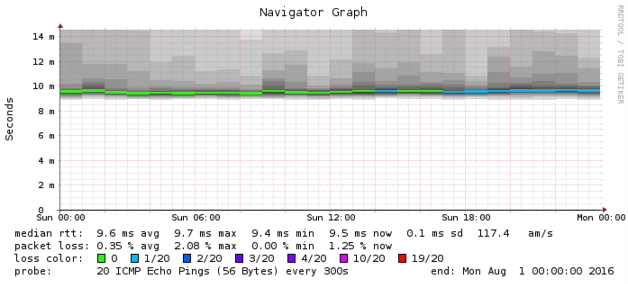
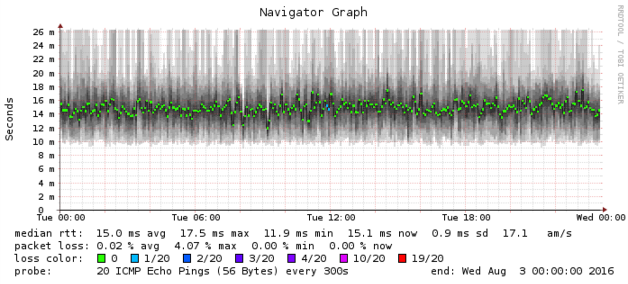
Recently I activated new cable ISP service at my home and needed to purchase a cable modem. There were only a few candidate devices that supported at least 24 downstream channels (preferably 32), and did not contain an integrated router or access point. The first modem I tried was the Arris SB6190, which supports 32 downstream channels. It is based on the Intel Puma 6 SoC, and looking at an older release of the SB6190 firmware source reveals that the device runs Linux. This device, running the latest 9.1.93N firmware, goes into a failure mode after several days of uptime which causes it to drop 1-2% of packets. Here is a SmokePing graph that measures latency to my ISP's recursive DNS server, showing the transition into the degraded mode: SmokePing Arris SB6190 Firmware 9.1.93N It didn't drop packets at random, though. Some traffic would be deterministically dropped, such as the parallel A/AAAA DNS lookups generated by the glibc DNS stub resolver. For instance, in the following tcpdump output:
[1] 17:31:46.989073 IP [My IP].50775 > 75.75.75.75.53: 53571+ A? www.comcast6.net. (34)
[2] 17:31:46.989102 IP [My IP].50775 > 75.75.75.75.53: 14987+ AAAA? www.comcast6.net. (34)
[3] 17:31:47.020423 IP 75.75.75.75.53 > [My IP].50775: 53571 2/0/0 CNAME comcast6.g.comcast.net., [ ]
[4] 17:31:51.993680 IP [My IP].50775 > 75.75.75.75.53: 53571+ A? www.comcast6.net. (34)
[5] 17:31:52.025138 IP 75.75.75.75.53 > [My IP].50775: 53571 2/0/0 CNAME comcast6.g.comcast.net., [ ]
[6] 17:31:52.025282 IP [My IP].50775 > 75.75.75.75.53: 14987+ AAAA? www.comcast6.net. (34)
[7] 17:31:52.056550 IP 75.75.75.75.53 > [My IP].50775: 14987 2/0/0 CNAME comcast6.g.comcast.net., [ ]
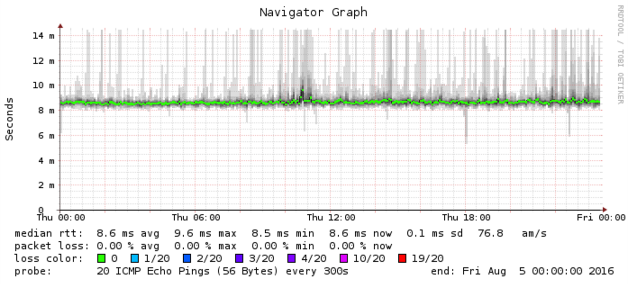
Packets [1] and [2] are the A and AAAA queries being initiated in parallel. Note that they both use the same 4-tuple of (Source IP, Destination IP, Source Port, Destination Port), but with different DNS IDs. Packet [3] is the response to packet [1]. The response to packet [2] never arrives, and five seconds later, the glibc stub resolver times out and retries in single-request mode, which performs the A and AAAA queries sequentially. Packets [4] and [5] are the type A query and response, and packets [6] and [7] are the AAAA query and response. The Arris SB6190 running firmware 9.1.93N would consistently interfere with these parallel DNS requests, but only when operating in its degraded mode. It also didn't matter whether glibc was configured to use an IPv4 or IPv6 nameserver, or which nameserver was being used. Power cycling the modem would fix the issue for a few days. My ISP offered to downgrade the firmware on the Arris SB6190 to version 9.1.93K. This firmware version doesn't go into a degraded mode after a few days, but it does exhibit higher latency, and more jitter: SmokePing Arris SB6190 Firmware 9.1.93K It seemed unlikely that Arris would fix the firmware issues in the SB6190 before the end of my 30-day return window, so I returned the SB6190 and purchased a Netgear CM600. This modem appears to be based on the Broadcom BCM3384 and looking at an older release of the CM600 firmware source reveals that the device runs the open source eCos embedded operating system. The Netgear CM600 so far hasn't exhibited any of the issues I found with the Arris SB6190 modem. Here is a SmokePing graph for the CM600, which shows median latency about 1 ms lower than the Arris modem: SmokePing Netgear CM600 It's not clear which company is to blame for the problems in the Arris modem. Looking at the DOCSIS drivers in the SB6190 firmware source reveals copyright statements from ARRIS Group, Texas Instruments, and Intel. However, I would recommend avoiding cable modems produced by Arris in particular, and cable modems based on the Intel Puma SoC in general.
Norbert Preining: Debian/TeX Live 2016.20160805-1

TUG 2016 is over, and I have returned from a wonderful trip to Toronto and Maine. High time to release a new checkout of the TeX Live packages. After that I will probably need some time for another checkout, as there are a lot of plans on the table: upstream created a new collection, which means new package in Debian, which needs to go through NEW, and I am also planning to integrate tex4ht to give it an update. Help greatly appreciated here. texlive2016-debian This package also sees the (third) revision of how config files for pdftex and luatex are structured, since then we have settled down. Hopefully this will close some of the issues that have appeared. New packages biblatex-ijsra, biblatex-nottsclassic, binarytree, diffcoeff, ecgdraw, fvextra, gitfile-info, graphics-def, ijsra, mgltex, milog, navydocs, nodetree, oldstandardt1, pdflatexpicscale, randomlist, texosquery Updated packages 2up, acmart, acro, amsmath, animate, apa6, arabluatex, archaeologie, autobreak, beebe, biblatex-abnt, biblatex-gost, biblatex-ieee, biblatex-mla, biblatex-source-division, biblatex-trad, binarytree, bxjscls, changes, cloze, covington, cs, csplain, csquotes, csvsimple, datatool, datetime2, disser, dvipdfmx, dvips, emisa, epstopdf, esami, etex-pkg, factura, fancytabs, forest, genealogytree, ghsystem, glyphlist, gost, graphics, hyperref, hyperxmp, imakeidx, jadetex, japanese-otf, kpathsea, latex, lstbayes, luatexja, mandi, mcf2graph, mfirstuc, minted, oldstandard, optidef, parnotes, philosophersimprint, platex, protex, pst-pdf, ptex, pythontex, readarray, reledmac, sepfootnotes, sf298, skmath, skrapport, stackengine, sttools, tcolorbox, tetex, texinfo, texlive-docindex, texlive-es, texlive-scripts, thesis-ekf, tools, toptesi, tudscr, turabian-formatting, updmap-map, uplatex, uptex, velthuis, xassoccnt, ycbook. Enjoy.

Dirk Eddelbuettel: RcppStreams 0.1.1

Streamulus A maintenance release of RcppStreams is now on CRAN. RcppStreams brings the excellent Streamulus C++ template library for event stream processing to R. Streamulus, written by Irit Katriel, uses very clever template meta-programming (via Boost Fusion) to implement an embedded domain-specific event language created specifically for event stream processing. This release updates the compilation standard to C++11 per CRAN's request as this helps with both current and upcoming compiler variants. A few edits were made to DESCRIPTION and README.md, the Travis driver file was updated, but no new code was added. The NEWS file entries follows below:
Changes in version 0.1.1 (2016-08-05)
  • Compilation is now done using C++11 standards per request of CRAN to help with an array of newer (pre-release) and older compilers
  • The Travis CI script was updated to use run.sh from our fork; it now also installs all dependencies as binary .deb files.
  • The README.md was updated with additional badges.
  • The DESCRIPTION file now has URL and BugReports entries.
Courtesy of CRANberries, there is also a copy of the DESCRIPTION file for this initial release. More detailed information is on the RcppStreams page page and of course on the Streamulus page.

This post by Dirk Eddelbuettel originated on his Thinking inside the box blog. Please report excessive re-aggregation in third-party for-profit settings.

3 August 2016

Bdale Garbee: ChaosKey

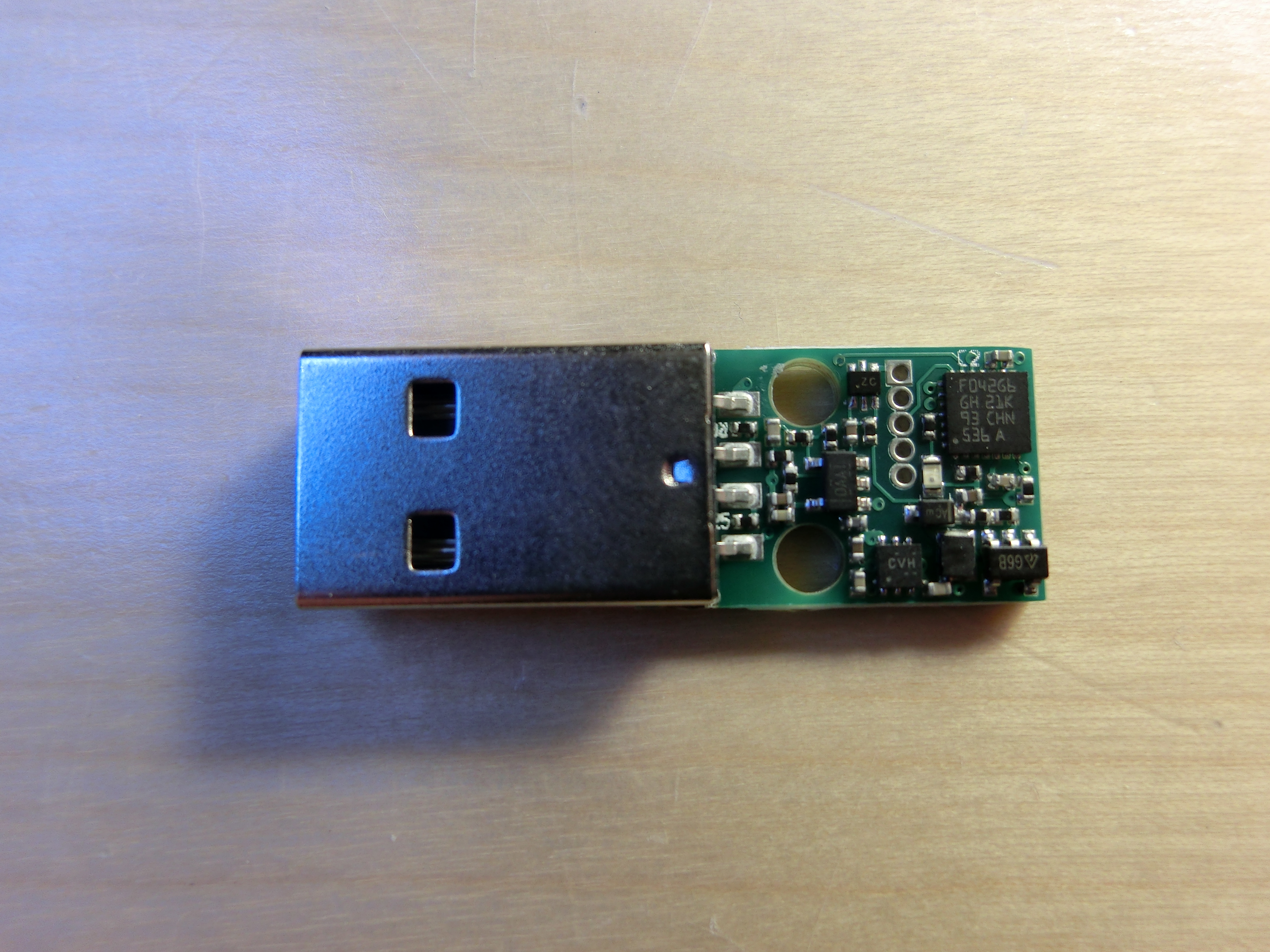
I'm pleased to announce that, at long last, the ChaosKey hardware random number generator described in talks at Debconf 14 in Portland and Debconf 16 in Cape Town is now available for purchase from Garbee and Garbee.

Keith Packard: chaoskey

ChaosKey v1.0 Released USB Attached True Random Number Generator ChaosKey, our random number generator that attaches via USB, is now available for sale from the altusmetrum store. We talked about this device at Debconf 16 last month Support for this device is included in Linux starting with version 4.1. Plug ChaosKey into your system and the driver will automatically add entropy into the kernel pool, providing a constant supply of true random numbers to help keep the system secure. ChaosKey is free hardware running free software, built with free software on a free operating system.

1 August 2016

Bits from Debian: Debian and Tor Services available as Onion Services

We, the Debian project and the Tor project are enabling Tor onion services for several of our sites. These sites can now be reached without leaving the Tor network, providing a new option for securely connecting to resources provided by Debian and Tor. The freedom to use open source software may be compromised when access to that software is monitored, logged, limited, prevented, or prohibited. As a community, we acknowledge that users should not feel that their every action is trackable or observable by others. Consequently, we are pleased to announce that we have started making several of the various web services provided by both Debian and Tor available via onion services. While onion services can be used to conceal the network location of the machine providing the service, this is not the goal here. Instead, we employ onion services because they provide end-to-end integrity and confidentiality, and they authenticate the onion service end point. For instance, when users connect to the onion service running at http://sejnfjrq6szgca7v.onion/, using a Tor-enabled browser such as the TorBrowser, they can be certain that their connection to the Debian website cannot be read or modified by third parties, and that the website that they are visiting is indeed the Debian website. In a sense, this is similar to what using HTTPS provides. However, crucially, onion services do not rely on third-party certification authorities (CAs). Instead, the onion service name cryptographically authenticates its cryptographic key. In addition to the Tor and Debian websites, the Debian FTP and the Debian Security archives are available from .onion addresses, enabling Debian users to update their systems using only Tor connections. With the apt-transport-tor package installed, the following entries can replace the normal debian mirror entries in the apt configuration file (/etc/apt/sources.list):
  deb  tor+http://vwakviie2ienjx6t.onion/debian          jessie            main
  deb  tor+http://vwakviie2ienjx6t.onion/debian          jessie-updates    main
  deb  tor+http://sgvtcaew4bxjd7ln.onion/debian-security jessie/updates    main
Likewise, Tor's Debian package repository is available from an onion service :
  deb tor+http://sdscoq7snqtznauu.onion/torproject.org   jessie    main
Where appropriate, we provide services redundantly from several backend machines using OnionBalance. The Debian OnionBalance package is available from the Debian backports repository. Lists of several other new onion services offered by Debian and Tor are available from https://onion.debian.org and https://onion.torproject.org respectively. We expect to expand these lists in the near future to cover even more of Debian's and Tor's services.

30 July 2016

Luke Faraone: Snappy Sprint Heidelberg

I recently attended Snappy Sprint Heidelberg, the first Snappy sprint focused on upstream and cross-distribution collaboration.

Snappy is a technology with an interesting history: initially started to provide App Store-like semantics (atomicity, declarative security) for the Ubuntu Phone project, it has since expanded to be a platform for desktop application deployment (e.g. VLC), as well as server applications and the IoT space.

There were a number of productive discussions with people working on Snappy itself, as well as folks from Fedora, elementary OS, KDE, and elsewhere.

At the start of the week, Snappy was technically usable in several different distributions, but only shipped fully-featured (in the main distribution repositories, with confinement, etc) in Ubuntu. Some great progress was made on AppArmor confinement in Arch Linux, and there is currently beta support for confinement via SELinux.

Providing a full-featured Snappy experience in Debian has its challenges, mostly relating to the lack of a default LSM. While AppArmor in Debian is supported and there's desire to have it be the default in "buster", Ubuntu carries a number of patches that add additional functionality not yet present upstream. I'm not sure whether pursuing getting those patches merged is more viable than waiting for SELinux support in snapd, however.

I've agreed to co-maintain the snapd package in Debian, and am excited to see intentions to support building snaps on a variety of distribution bases. While I do not expect Snappy (or Flatpak, or AppImage) to replace distribution-maintained software in the foreseeable future, nor do I feel that's a desirable outcome, I do think offering users freedom to choose to use software via these systems in a safe manner is critical.

29 July 2016

Luciano Prestes Cavalcanti: Contributing with Debian Recommendation System

Hi, my name is Luciano Prestes, I am participating in the program Google Summer of Code (GSoC), my mentor is Antonio Terceiro, and my co-mentor is Tassia Camoes, both are Debian Developers. The project that I am contributing is the AppRecommender, which is a package recommender for Debian systems, my goal is to add a new strategy of recommendation to AppRecommender, to make it recommend packages after the user installs a new package with 'apt'.
At principle AppRecommender has three recommendation strategies, being them, content-based, collaborative and hybrid. To my work on GSoC this text explains two of these strategies, content-based and collaborative. Content-based strategy get the user packages and analyzes yours descriptions to find another Debian packages that they are similar to the user packages, so AppRecommender uses the content of user packages to recommender similar packages to user. The collaborative strategy compare the user packages with the packages of another users, and then recommends packages that users with similar profile have, where a profile of user is your packages. On her work, Tassia Camoes uses the popularity-contest data to compare the users profiles on the collaborative strategy, the popularity-contest is an application that get the users packages into a submission and send to the popularity-contest server and generates statistical data analyzing the users packages.
I have been working with a classmate on our bachelor thesis since August 2015, in our work we created new strategies to AppRecommender, one using machine-learning and another using a deterministic method to generates the recommendation, another feature that we implemented its improve the user profile using the recently used packages to makes the profile. During our work we study the collaborative strategy and analyzed that strategy and remove it from AppRecommender, because this implementation of collaborative strategy needs to get the popularity-contest submissions on the user's pc, and this is against the privacy policy of popularity-contest.
My work on Google Summer of Code is create a new strategy on AppRecommender, as described above, where this strategy should be able to get an referenced package, or a list of referenced packages, then analyze the users packages making a recommendation using the referenced packages such as base, example: if users run "$ sudo apt install vim", the AppRecommender use "vim" as referenced package, and should recommender packages with relation between "vim" and the other packages that user has installed. This new strategy can be implemented like a content-based strategy, or the collaborative strategy.
The first month of Google Summer of Code its destined to students knows the community of the project, so I talk with the Debian community about my project, to get feedback and ideas about the project. I talk with Debian community on IRC channels, and then came the idea to use the data of popularity-contest to improve the recommendations. Talking with my mentors, they approve the idea of usage popularity-contest data, so we started a discussion about how to use the popularity-contest data on AppRecommender without broken the privacy policy of popularity-contest.
Now my work on Google Summer of Code is create the new strategy for AppRecommender that can makes recommendation using a list of packages as reference, so as explained above, when user install packages like "sudo apt install vim vagrant", AppRecommender should recommends packages with relation between the packages "vim" and "vagrant", and this recommendation should be relation with the user profile. The other work its use the popularity-contest data to improve the recommendations of AppRecommender using a new model of collaborative strategies.

Norbert Preining: TUG 2016 Day 4 Books, ooh Books (and Boats)

Talks have been finished, and as a special present to the participants, Pavneet has organized an excursion that probably was one of the best I ever had. First we visited the Toronto Reference Library where we were treated to a delicious collection of rare books (not to mention all the other books and architecture), and then a trip through the Ismaili Centre Toronto and the Aga Khan Museum.
Page from "A Dream of John Ball", Kelmscott Press Edition, 1892.
(Kelmscott press edition from 1892 of William Morris A Dream of John Ball.) All these places were great pieces of architecture with excellent samples of the writing and printing art. And after all that and not to be mentioned, the conference dinner evening cruise! Our first stop was the Toronto Reference Library. Designed by Raymond Moriyama, it features a large open atrium with skylights, and it gives the library an open and welcoming feeling. We were told that it resembles a tea cup that needs to be filled with knowledge.
The Toronto Reference Library's atrium
The library also features running water at several places the architect had the idea that natural ambient noise is more natural for a library than the eclectic silence that anyway never happens. Originally there were lots of greens hanging down into the Atrium, resembling the Hanging Gardens, but they have been scrapped due to financial reasons. But there are still green oasis like this beautiful green wall in a corner of the library.
Wall of Green in the middle of the library
We were guided first to the fifth floor where the special collection is housed. And what a special collection. The librarian in charge has laid out about 20 exquisite books starting from early illuminated manuscripts over incunabula to high pieces of printing art from the 18th and 19th century. Here we have a illuminated script in Carolingian minuscule.
Illuminated script in Carolingian minuscule
What was really surprising for all of us in this special collection that all these books were simply laid out in front of us, that the librarian touched and used it without gloves, and above all, that he told us that if one wants it is common practice to check out these books for study sessions and enjoy them on the spot in the reading room. I don t know any other library that allows you to actually handle these rare and beauty specimens! The library not only featured lots of great books, it also had some art installation like these light rods.
Art Light installation in the Toronto Reference Library
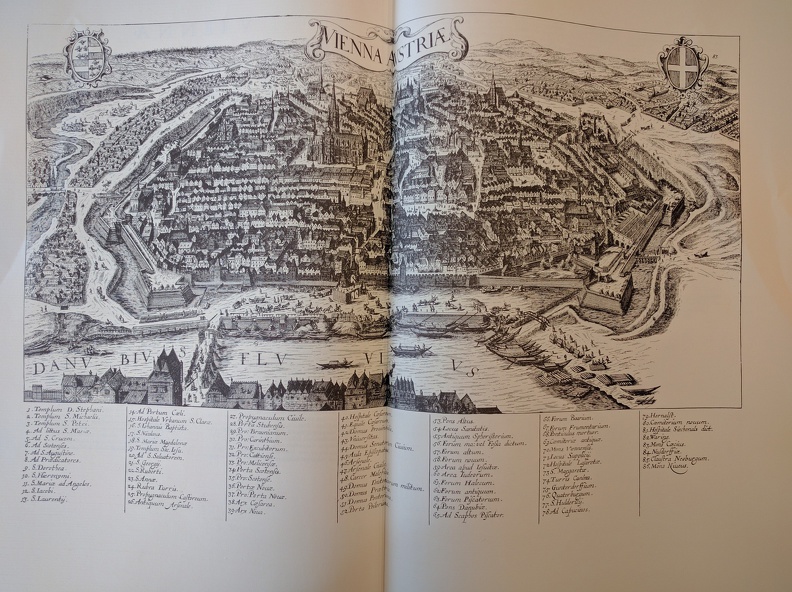
In one of the books I found by chance a map of my hometown of Vienna. Looking at this map from very old times, the place where I grew up is still uninhabited somewhere in the far upper right corner of the map. Times have changed.
Map op Vienna found in the Toronto Reference Library
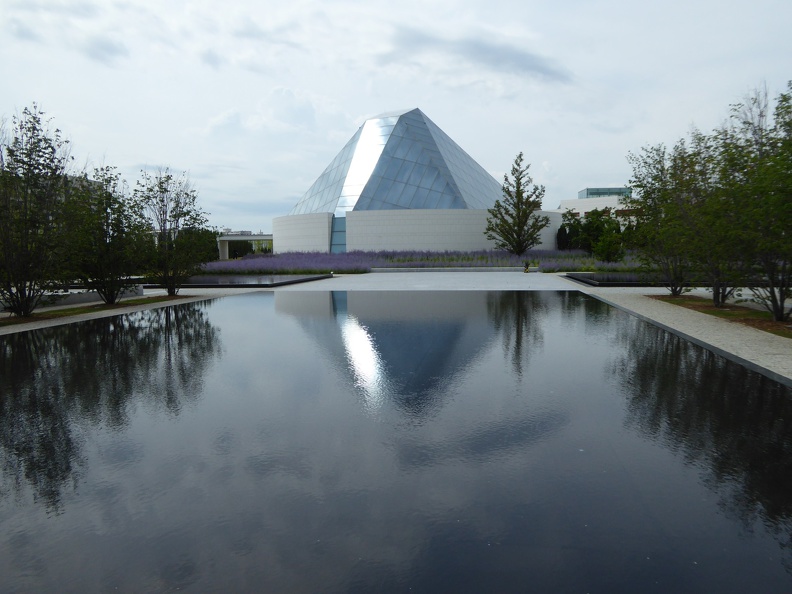
After we left this open and welcoming treasure house of beautiful books, we moved to the Aga Khan Museum and Ismaili Centre Toronto, which are standing face-to-face separated by some water ponds in the Aga Khan park a bit outside of central Toronto. Here we see the Ismaili Centre from the Aga Khan Museum entrance. The big glass dome is the central prayer room, and is illuminated at night. Just one detail one can see in the outer wall one part that looks like glass, too. This is the prayer alcove in the back of the prayer hall, and is made from huge slabs of Onyx that are also lit up in the night.
View onto the Ismaili Centre's Prayer Hall formed by a glass dome
The Ismaili Centre, designed by Charles Correa combines modern functional and simple style with the wonderful ornamental art of the Islam heritage. The inside of the Ismaili Centre features many pieces of exquisite art calligraphy, murals, stone work, etc here is a medallion made from precious stone and set onto a hand-carved wall.
Medaillon made of precious stones in hand carved wall, Ismaili Centre Toronto
A calligraphy on the wall in the Ismaili Centre
Wall Calligraphy in the Ismaili Centre Toronto
Following the Ismaili Centre we turned to the Aga Khan museum which documents Islamic art, science, and history with an extensive collection. We didn t have much time, and in addition I had to do some fire-fighting over the phone, but the short trip through the permanent collection with samples of excellent calligraphy was amazing.
Koran Calligraphy, Aga Khan Museum Toronto
After returning from this lovely excursion and a short break, we set off for the last stop for tonight, the dinner cruise. After a short bus ride we could board our ship and off we go. Although the beer selection was not on par with what we are used from carft breweries, the perfectly sized boat with two decks and lots of places to hang around invited us to many discussions and chitchats. And finally I could enjoy also the skyline of Toronto.
View onto Toronto from the boat
After the dinner we had some sweets, one of which was a specially made cake with the TUG 2016 logo on it. I have to say, it was not only this cake but the whole excellent and overboarding food we had during all these days, that will make me go on diet when I am back in Japan. Pavneet organized for the lunch breaks three different style of kitchens (Thai, Indian, Italian), then the excursions to local brewers and and and If it wouldn t be for TeX, I would call it a Mastkur .
TUG 2016 cake
During the cruise we also had a little ceremony thanking Jim for his work as president of the TUG, but above all Pavneet for this incredible well organized conference. I think everyone agreed that this was the best TUG conference since long.
Sunset near Toronto
pensDuring the ceremony, Pavneet also announced the winners of the TUG 2016 fountain pen auction. These pens have a long history/travel behind them, see details on the linked page, and were presented to the special guests of the conference. Two remaining pens were auctioned with funds going to the TUG. The first one was handed over to Steve Grathwohl, and to my utter surprise the second one to myself. So now I am a happy owner of a TUG 2016 fountain pen. What a special feature! Just one more detail about these pens: They are traditional style, so without ink capsules, but one needs to insert the ink with a syringe. I guess I need to stack up a bit at home, and more importantly, train my really ugly hand-writing, otherwise it would be a shame to use this exquisite tool. We returned to the harbor around 10pm, and back to the hotel, where there was much greeting and thanking, as many people will return the following day.

Heading back to Toronto
I will also leave on Friday morning to meet with friends, thus I will not be participating in (and not reporting on) the last excursion of the TUG 2016. I will leave Toronto and the TUG 2016 with (nearly) exclusively good memories of excellent talks, great presentations, wonderful excursions, and lots of things I have learned. I hope to see all of the participants on next year s TUG meeting and I hope I will be able to attend it. Thanks a lot to Pavneet, you have done an incredible job. And last but not least, thanks to your lovely wife for letting you do all this, I know how much time we did steal from her. A few more photos can be found at the album Day 4 Books, ooh books.

25 July 2016

Reproducible builds folks: Reprotest 0.2 released, with virtualization support

Author: ceridwen reprotest 0.2 is available in PyPi and should hit Debian soon. I have tested null (no container, build on the host system), schroot, and qemu, but it's likely that chroot, Linux containers (lxc/lxd), and quite possibly ssh are also working. I haven't tested the autopkgtest code on a non-Debian system, but again, it probably works. At this point, reprotest is not quite a replacement for the prebuilder script because I haven't implemented all the variations yet, but it offers better virtualization because it supports qemu, and it can build non-Debian software because it doesn't rely on pbuilder. With HW42's help, I fixed the schroot/disorderfs/autopkgtest permission error and got pip/setuptools to install the autopkgtest code from virt/. The permission error came from autopkgtest automatically running all commands on a testbed as root, if it can run commands as root, which caused schroot to mount disorderfs as root. This caused the build artifact to be owned by root, but unlike qemu, a chroot shares the same file system, so it would then try to copy this root-owned file with a process running with ordinary user permissions. The fix was to mount disorderfs with --multi-user=yes when the container has root permissions, allowing a user process to access it even when it's mounted by root. The fix for setuptools is an ugly hack: including the virt/ scripts as non-code data with include reprotest/virt/* in MANIFEST.in works. (According to the documentation, graft reprotest/virt/, which I also tried, ought to work, but in my testing it doesn't.) This still uses sys.path hacking as a consequence of autopkgtest's design choices. For the next release, I want to finish all the remaining variations, which at this point are build path, domain, host, group, shell, and user. I also want to ensure that reprotest runs on non-Debian and possibly non-Linux systems. For now, what I need most is more real-world testing. If you have any interest in reproducible builds, please try reprotest out! There's a README included which describes how to set up appropriate containers and run the tests.

24 July 2016

Gregor Herrmann: RC bugs 2016/01-29

seems I've neglected both my blog & my RC bug fixing activities in the last months. anyway, since I still keep track of RC bugs I worked on, I thought I might as well publish the list:

Russ Allbery: Review: The Run of His Life

Review: The Run of His Life, by Jeffrey Toobin
Publisher: Random House
Copyright: 1996, 1997
Printing: 2015
ISBN: 0-307-82916-2
Format: Kindle
Pages: 498
The O.J. Simpson trial needs little introduction to anyone who lived through it in the United States, but a brief summary for those who didn't. O.J. Simpson is a Hall of Fame football player and one of the best running backs to ever play the game. He's also black, which is very relevant much of what later happened. After he retired from professional play, he became a television football commentator and a spokesperson for various companies (particularly Hertz, a car rental business). In 1994, he was arrested for the murder of two people: his ex-wife, Nicole Brown Simpson, and Ron Goldman (a friend of Nicole's). The arrest happened after a bizarre low-speed police chase across Los Angeles in a white Bronco that was broadcast live on network television. The media turned the resulting criminal trial into a reality TV show, with live cable television broadcasts of all of the court proceedings. After nearly a full year of trial (with the jury sequestered for nine months more on that later), a mostly black jury returned a verdict of not guilty after a mere four hours of deliberation. Following the criminal trial, in an extremely unusual legal proceeding, Simpson was found civilly liable for Ron Goldman's death in a lawsuit brought by his family. Bizarre events surrounding the case continued long afterwards. A book titled If I Did It (with "if" in very tiny letters on the cover) was published, ghost-written but allegedly with Simpson's input and cooperation, and was widely considered a confession. Another legal judgment let the Goldman family get all the profits from that book's publication. In an unrelated (but also bizarre) incident in Las Vegas, Simpson was later arrested for kidnapping and armed robbery and is currently in prison until at least 2017. It is almost impossible to have lived through the O.J. Simpson trial in the United States and not have formed some opinion on it. I was in college and without a TV set at the time, and even I watched some of the live trial coverage. Reactions to the trial were extremely racially polarized, as you might have guessed. A lot of black people believed at the time that Simpson was innocent (probably fewer now, given subsequent events). A lot of white people thought he was obviously guilty and was let off by a black jury for racial reasons. My personal opinion, prior to reading this book, was a common "third way" among white liberals: Simpson almost certainly committed the murders, but the racist Los Angeles police department decided to frame him for a crime that he did commit by trying to make the evidence stronger. That's a legitimate reason in the US justice system for finding someone innocent: the state has an obligation to follow correct procedure and treat the defendant fairly in order to get a conviction. I have a strong bias towards trusting juries; frequently, it seems that the media second-guesses the outcome of a case that makes perfect sense as soon as you see all the information the jury had (or didn't have). Toobin's book changed my mind. Perhaps because I wasn't watching all of the coverage, I was greatly underestimating the level of incompetence and bad decision-making by everyone involved: the prosecution, the defense, the police, the jury, and the judge. This court case was a disaster from start to finish; no one involved comes away looking good. Simpson was clearly guilty given the evidence presented, but the case was so badly mishandled that it gave the jury room to reach the wrong verdict. (It's telling that, in the far better managed subsequent civil case, the jury had no trouble reaching a guilty verdict.) The Run of His Life is a very detailed examination of the entire Simpson case, from the night of the murder through the end of the trial and (in an epilogue) the civil case. Toobin was himself involved in the media firestorm, breaking some early news of the defense's decision to focus on race in The New Yorker and then involved throughout the trial as a legal analyst, and he makes it clear when he becomes part of the story. But despite that, this book felt objective to me. There are tons of direct quotes, lots of clear description of the evidence, underlying interviews with many of the people involved to source statements in the book, and a comprehensive approach to the facts. I think Toobin is a bit baffled by the black reaction to the case, and that felt like a gap in the comprehensiveness and the one place where he might be accused of falling back on stereotypes and easy judgments. But other than hole, Toobin applies his criticism even-handedly and devastatingly to all parties. I won't go into all the details of how Toobin changed my mind. It was a cumulative effect across the whole book, and if you're curious, I do recommend reading it. A lot was the detailed discussion of the forensic evidence, which was undermined for the jury at trial but looks very solid outside the hothouse of the case. But there is one critical piece that I would hope would be handled differently today, twenty years later, than it was by the prosecutors in that case: Simpson's history of domestic violence against Nicole. With what we now know about patterns of domestic abuse, the escalation to murder looks entirely unsurprising. And that history of domestic abuse was exceedingly well-documented: multiple external witnesses, police reports, and one actual prior conviction for spousal abuse (for which Simpson did "community service" that was basically a joke). The prosecution did a very poor job of establishing this history and the jury discounted it. That was a huge mistake by both parties. I'll mention one other critical collection of facts that Toobin explains well and that contradicted my previous impression of the case: the relationship between Simpson and the police. Today, in the era of Black Lives Matter, the routine abuse of black Americans by the police is more widely known. At the time of the murders, it was less recognized among white Americans, although black Americans certainly knew about it. But even in 1994, the Los Angeles police department was notorious as one of the most corrupt and racist big-city police departments in the United States. This is the police department that beat Rodney King. Mark Fuhrman, one of the police officers involved in the case (although not that significantly, despite his role at the trial), was clearly racist and had no business being a police officer. It was therefore entirely believable that these people would have decided to frame a black man for a murder he actually committed. What Toobin argues, quite persuasively and with quite a lot of evidence, is that this analysis may make sense given the racial tensions in Los Angeles but ignores another critical characteristic of Los Angeles politics, namely a deference to celebrity. Prior to this trial, O.J. Simpson largely followed the path of many black athletes who become broadly popular in white America: underplaying race and focusing on his personal celebrity and connections. (Toobin records a quote from Simpson earlier in his life that perfectly captures this approach: "I'm not black, I'm O.J.") Simpson spent more time with white businessmen than the black inhabitants of central Los Angeles. And, more to the point, the police treated him as a celebrity, not as a black man. Toobin takes some time to chronicle the remarkable history of deference and familiarity that the police showed Simpson. He regularly invited police officers to his house for parties. The police had a long history of largely ignoring or downplaying his abuse of his wife, including not arresting him in situations that clearly seemed to call for that, showing a remarkable amount of deference to his side of the story, not pursuing clear violations of the court judgment after his one conviction for spousal abuse, and never showing much inclination to believe or protect Nicole. Even on the night of the murder, they started following a standard playbook for giving a celebrity advance warning of investigations that might involve them before the news media found out about them. It seems clear, given the evidence that Toobin collected, that the racist Los Angeles police didn't focus that animus at Simpson, a wealthy celebrity living in Brentwood. He wasn't a black man in their eyes; he was a rich Hall of Fame football player and a friend. This obviously raises the question of how the jury could return an innocent verdict. Toobin provides plenty of material to analyze that question from multiple angles in his detailed account of the case, but I can tell you my conclusion: Judge Lance Ito did a horrifically incompetent job of managing the case. He let the lawyers wander all over the case, interacted bizarrely with the media coverage (and was part of letting the media turn it into a daytime drama), was not crisp or clear about his standards of evidence and admissibility, and, perhaps worst of all, let the case meander on at incredible length. With a fully sequestered jury allowed only brief conjugal visits and no media contact (not even bookstore shopping!). Quite a lot of anger was focused on the jury after the acquittal, and I do think they reached the wrong conclusion and had all the information they would have needed to reach the correct one. But Toobin touches on something that I think would be very hard to comprehend without having lived through it. The jury and alternate pool essentially lived in prison for nine months, with guards and very strict rules about contact with the outside world, in a country where compensation for jury duty is almost nonexistent. There were a lot of other factors behind their decision, including racial tensions and the sheer pressure from judging a celebrity case about which everyone has an opinion, but I think it's nearly impossible to underestimate the psychological tension and stress from being locked up with random other people under armed guard for three quarters of a year. It's hard for jury members to do an exhaustive and careful deliberation in a typical trial that takes a week and doesn't involve sequestration. People want to get back to their lives and families. I can only imagine the state I would be in after nine months of this, or how poor psychological shape I would be in to make a careful and considered decision. Similarly, for those who condemned the jury for profiting via books and media appearances after the trial, the current compensation for jurors is $15 per day (not hour). I believe at the time it was around $5 per day. There are a few employers who will pay full salary for the entire jury service, but only a few; many cap the length at a few weeks, and some employers treat all jury duty as unpaid leave. The only legal requirement for employers in the United States is that employees that serve on a jury have their job held for them to return to, but compensation is pathetic, not tied to minimum wage, and employers do not have to supplement it. I'm much less inclined to blame the jurors than the system that badly mistreated them. As you can probably tell from the length of this review, I found The Run of His Life fascinating. If I had followed the whole saga more closely at the time, this may have been old material, but I think my vague impressions and patchwork of assumptions were more typical than not among people who were around for the trial but didn't invest a lot of effort into following it. If you are like me, and you have any interest in the case or the details of how the US criminal justice system works, this is a fascinating case study, and Toobin does a great job with it. Recommended. Rating: 8 out of 10

22 July 2016

Norbert Preining: Yukio Mishima The Temple of the Golden Pavilion

A masterpiece of modern Japanese literature: Yukio Mishima ( ) The Temple of the Golden Pavilion ( ). The fictional story about the very real arson attack that destroyed the Golden Pavilion in 1950.
mishima-golden-temple A bit different treatise on beauty and ugliness!
How shall I put it? Beauty yes, beauty is like a decayed tooth. It rubs against one s tongue, it hangs there, hurting one, insisting on its own existence, finally [ ] the tooth extracted. Then, as one looks at the small, dirty, brown, blood-stained tooth lying in one s hand, one s thoughts are likely to be as follows: Is this it?
Mizoguchi, a stutterer, is from young years on taken by a near mystical imagination of the Golden Pavilion, influence by his father who considers it the most beautiful object in the world. After his father s death he moves to Kyoto and becomes acolyte in the temple. He develops a friendship with Kashiwagi, who uses his clubfeet to make women feel sorry for him and make them fall in love with his clubfeet, as he puts it. Kashiwagi also puts Mizoguchi onto the first tracks of amorous experiences, but Mizoguchi invariably turns out to be impotent but not due to his stuttering, but due to the image of the Golden Pavilion appearing in the essential moment and destroying every chance.
Yes, this was really the coast of the Sea of Japan! Here was the source of all my unhappiness, of all my gloomy thoughts, the origin of all my ugliness and all my strength. It was a wild sea.
Mizoguchi is getting more and more mentally about his relation with the head monk, neglects his studies, and after a stark reprimand he escapes to the north coast, from where he is brought back by police to the temple. He decides to burn down the Golden Pavilion, which has taken more and more command of his thinking and doing. He carries out the deed with the aim to burn himself in the top floor, but escapes in the last second to retreat into the hills to watch the spectacle.
Closely based on the true story of the arsonist of the Golden Pavilion, whom Mishima even visited in prison, the book is a treatise about beauty and ugly.
At his trial he [the real arsonist] said: I hate myself, my evil, ugly, stammering self. Yet he also said that he did not in any way regret having burned down the Kinkakuji.
Nancy Wilson Ross in the preface
Mishima is master in showing these two extremes by contrasting the refined qualities of Japanese culture flower arrangement, playing the shakuhachi, with immediate outburst of contrasting behavior: cold and brutal recklessness. Take for example the scene were Kashiwagi is arranging flowers, stolen by Mizoguchi from the temple grounds, while Mizoguchi is playing the flute. They also discuss koans and various interpretations. Enters the Ikebana teacher, and mistress of Kashiwagi. She congratulates Kashiwagi to his excellent arrangement, which he answers coldly by quitting their relationship, both as teacher as well as mistress, and telling her not to see him again in a formal style. She, still ceremonially kneeling, suddenly destroys the flower arrangement, only to be beaten and thrown out by Kashiwagi. And the beauty and harmony has turned to ugliness and hate in seconds. Beauty and Ugliness, two sides of the same medal, or inherently the same, because it is only up to the point of view. Mishima ingeniously plays with this duality, and leads us through the slow and painful development of Mizoguchi to the bitter end, which finally gives him freedom, freedom from the force of beauty. Sometimes seeing how our society is obsessed with beauty I cannot get rid of the feeling that there are far more Mizoguchis at heart.

Russell Coker: 802.1x Authentication on Debian

I recently had to setup some Linux workstations with 802.1x authentication (described as Ethernet authentication ) to connect to a smart switch. The most useful web site I found was the Ubuntu help site about 802.1x Authentication [1]. But it didn t describe exactly what I needed so I m writing a more concise explanation. The first thing to note is that the authentication mechanism works the same way as 802.11 wireless authentication, so it s a good idea to have the wpasupplicant package installed on all laptops just in case you need to connect to such a network. The first step is to create a wpa_supplicant config file, I named mine /etc/wpa_supplicant_SITE.conf. The file needs contents like the following:
network= 
 key_mgmt=IEEE8021X
 eap=PEAP
 identity="USERNAME"
 anonymous_identity="USERNAME"
 password="PASS"
 phase1="auth=MD5"
 phase2="auth=CHAP password=PASS"
 eapol_flags=0
 
The first difference between what I use and the Ubuntu example is that I m using eap=PEAP , that is an issue of the way the network is configured, whoever runs your switch can tell you the correct settings for that. The next difference is that I m using auth=CHAP and the Ubuntu example has auth=PAP . The difference between those protocols is that CHAP has a challenge-response and PAP just has the password sent (maybe encrypted) over the network. If whoever runs the network says that they don t store unhashed passwords or makes any similar claim then they are almost certainly using CHAP. Change USERNAME and PASS to your user name and password. wpa_supplicant -c /etc/wpa_supplicant_SITE.conf -D wired -i eth0 The above command can be used to test the operation of wpa_supplicant.
Successfully initialized wpa_supplicant
eth0: Associated with 00:01:02:03:04:05
eth0: CTRL-EVENT-EAP-STARTED EAP authentication started
eth0: CTRL-EVENT-EAP-PROPOSED-METHOD vendor=0 method=25
TLS: Unsupported Phase2 EAP method 'CHAP'
eth0: CTRL-EVENT-EAP-METHOD EAP vendor 0 method 25 (PEAP) selected
eth0: CTRL-EVENT-EAP-PEER-CERT depth=0 subject=''
EAP-MSCHAPV2: Authentication succeeded
EAP-TLV: TLV Result - Success - EAP-TLV/Phase2 Completed
eth0: CTRL-EVENT-EAP-SUCCESS EAP authentication completed successfully
eth0: CTRL-EVENT-CONNECTED - Connection to 00:01:02:03:04:05 completed [id=0 id_str=]
Above is the output of a successful test with wpa_supplicant. I replaced the MAC of the switch with 00:01:02:03:04:05. Strangely it doesn t like CHAP but is automatically selecting MSCHAPV2 and working, maybe anything other than PAP would do.
auto eth0
iface eth0 inet dhcp
  wpa-driver wired
  wpa-conf /etc/wpa_supplicant_SITE.conf
Above is a snippet of /etc/network/interfaces that works with this configuration.

21 July 2016

Reproducible builds folks: Reproducible builds: week 62 in Stretch cycle

What happened in the Reproducible Builds effort between June 26th and July 2nd 2016: Read on to find out why we're lagging some weeks behind ! GSoC and Outreachy updates Toolchain fixes With the doxygen upload we are now down to only 2 modified packages in our repository: dpkg and rdfind. Weekly reports delay and the future of statistics To catch up with our backlog of weekly reports we have decided to skip some of the statistics for this week. We might publish them in a future report, or we might switch to a format where we summarize them more (and which we can create (even) more automatically), we'll see. We are doing these weekly statistics because we believe it's appropriate and useful to credit people's work and make it more visible. What do you think? We would love to hear your thoughts on this matter! Do you read these statistics? Somewhat? Actually, thanks to the power of notmuch, Holger came up with what you can see below, so what's missing for this week are the uploads fixing irreprodubilities. Which we really would like to show for the reasons stated above and because we really really need these uploads to happen ;-) But then we also like to confirm the bugs are really gone, which (atm) requires manual checking, and to look for the words "reproducible" and "deterministic" (and spelling variations) in debian/changelogs of all uploads, to spot reproducible work not tracked via the BTS. And we still need to catch up on the backlog of weekly reports. Bugs submitted with reproducible usertags It seems DebCamp in Cape Town was hugely successful and made some people get a lot of work done: 61 bugs have been filed with reproducible builds usertags and 60 of them had patches: Package reviews 437 new reviews have been added (though most of them were just linking the bug, "only" 56 new issues in packages were found), an unknown number has been been updated and 60 have been removed in this week, adding to our knowledge about identified issues. 4 new issue types have been found: Weekly QA work 98 FTBFS bugs have been reported by Chris Lamb and Santiago Vila. diffoscope development strip-nondeterminism development tests.reproducible-builds.org Misc. This week's edition was written by Mattia Rizzolo, Reiner Herrmann, Ceridwen and Holger Levsen and reviewed by a bunch of Reproducible builds folks on IRC.

16 July 2016

Raphaël Hertzog: Freexian s report about Debian Long Term Support, June 2016

A Debian LTS logoLike each month, here comes a report about the work of paid contributors to Debian LTS. Individual reports In June, 158.25 work hours have been dispatched among 11 paid contributors. Their reports are available: DebConf 16 Presentation If you want to know more about how the LTS project is organized, you can watch the presentation I gave during DebConf 16 in Cape Town. Evolution of the situation The number of sponsored hours increased a little bit at 135 hours per month thanks to 3 new sponsors (Laboratoire LEGI UMR 5519 / CNRS, Quarantainenet BV, GNI MEDIA). Our funding goal is getting closer but it s not there yet. The security tracker currently lists 40 packages with a known CVE and the dla-needed.txt file lists 38 packages awaiting an update. Thanks to our sponsors New sponsors are in bold.

14 July 2016

Norbert Preining: Osamu Dazai No Longer Human

Japanese authors have a tendency to commit suicide, it seems. I have read Ryunosuke Akutagawa ( , at 35), Yukio Mishima ( , at 45), and also Osamu Dazai ( , at 39). Their end often reflects in their writings, and one of these examples is the book I just finished, No Longer Human. Dazai_Osamu-No_Longer_Human Considered as Dazai s master piece, and with Soseki s Kokoro the best selling novels in Japan. The book recounts the life of Oba Yozo, from childhood to the end in a mental hospital. The early years, described in the first chapter ( Memorandum ), are filled with the feeling of differentness, alienation from the rest, and Oba starts his way of living by playing the clown, permanently making jokes. The Second Memorandom spans the time to university, where he drops out, tries to become a painter, indulges in alcohol, smoking and prostitutes, leading to a suicide attempt together with a married woman, but he survived. The first part of the Third Memorandom sees a short recovering due to his relationship with a woman. He stops drinking and works as cartoonist, but in the last part his drinking pal from university times shows up again and they return into an ever increasing vicious drinking. Eventually he is separated from his wife, and confined to a mental hospital. Very depressing to read, but written in a way that one cannot stop reading. The disturbing thing about this book is that, although the main actor conceives many bad actions, we feel somehow attached to him and feel pity for him. It is somehow a exercise how circumstances and small predispositions can make a huge change in our lives. And it warns us that each one of us can easily come to this brink.

13 July 2016

Dominique Dumont: A survey for developers about application configuration

Hello Markus Raab, the author of Elektra project, has created a survey to get FLOSS developer s point of view on the configuration of application. If you are a developer, please fill this survey to help Markus work on improving application configuration management. Feeling this survey should take about 15 mns. Note that the survey will close on July 18th. The fact that this blog comes 1 month after the beginning of the survey is entirely my fault. Sorry about that All the best
Tagged: configuration, Perl

11 July 2016

Daniel Pocock: Let's Encrypt torpedoes cost and maintenance issues for Free RTC

Many people have now heard of the EFF-backed free certificate authority Let's Encrypt. Not only is it free of charge, it has also introduced a fully automated mechanism for certificate renewals, eliminating a tedious chore that has imposed upon busy sysadmins everywhere for many years. These two benefits - elimination of cost and elimination of annual maintenance effort - imply that server operators can now deploy certificates for far more services than they would have previously. The TLS chapter of the RTC Quick Start Guide has been updated with details about Let's Encrypt so anybody installing SIP or XMPP can use Let's Encrypt from the outset. For example, somebody hosting basic Drupal or Wordpress sites for family, friends and small community organizations can now offer them all full HTTPS encryption, WebRTC, SIP and XMPP without having to explain annual renewal fees or worry about losing time in their evenings and weekends renewing certificates manually. Even people who were willing to pay for a single certificate for their main web site may have snubbed their nose at the expense and ongoing effort of having certificates for their SMTP mail server, IMAP server, VPN gateway, SIP proxy, XMPP server, WebSocket and TURN servers too. Now they can all have certificates. Early efforts at SIP were doomed without encryption In the early days, SIP messages would be transported across the public Internet in UDP datagrams without any encryption. SIP itself wasn't originally designed for NAT and a variety of home routers were created with "NAT helper" algorithms that would detect and modify SIP packets to try and work through NAT. Sadly, in many cases these attempts to help actually clash with each other and lead to further instability. Conversely, many rogue ISPs could easily detect and punish VoIP users by blocking their calls or even cutting their DSL line. Operating SIP over TLS, usually on the HTTPS port (TCP port 443) has been an effective way to quash all of these different issues. While the example of SIP is one of the most extreme, it helps demonstrate the benefits of making encryption universal to ensure stability and cut out the "man-in-the-middle", regardless of whether he is trying to help or hinder the end user. Is one certificate enough? Modern SIP, XMPP and WebRTC require additional services, TURN servers and WebSocket servers. If they are all operated on port 443 then it is necessary to use different hostnames for each of them (e.g. turn.example.org and ws.example.org. Each different hostname requires a certificate. Let's Encrypt can provide those additional certificates too, without additional cost or effort. The future with Let's Encrypt The initial version of the Let's Encrypt client, certbot, fully automates the workflow for people using popular web servers such as Apache and nginx. The manual or certonly modes can be used for other services but hopefully certbot will evolve to integrate with many other popular applications too. Currently, Let's Encrypt's certbot tool issues certificates to servers running on TCP port 443 or 80. These are considered to be a privileged ports whereas any port over 1023, including the default ports used by applications such as SIP (5061), XMPP (5222, 5269) and TURN (5349), are not privileged ports. As long as certbot maintains this policy, it is generally necessary to either run a web server for the domain associated with each certificate or run the services themselves on port 443. There are other mechanisms for domain validation and various other clients supporting different subsets of them. Running the services themselves on port 443 turns out to be a good idea anyway as it ensures that RTC services can be reached through HTTP proxy servers who fail to let the HTTP CONNECT method access any other ports. Many configuration tasks are already scripted during the installation of packages on a GNU/Linux distribution (such as Debian or Fedora) or when setting up services using cloud images (for example, in Docker or OpenStack). Due to the heavily standardized nature of Let's Encrypt and the widespread availability of the tools, many of these package installation scripts can be easily adapted to find or create Let's Encrypt certificates on the target system, ensuring every service is running with TLS protection from the minute it goes live. If you have questions about Let's Encrypt for RTC or want to share your experiences, please come and discuss it on the Free-RTC mailing list.

10 July 2016

Michal Čihař: Weblate 2.7

Slightly later than on monthly schedule but Weblate 2.7 is out today. This release brings improvements to the API and is first to officially support wlc a command line client for Weblate. Full list of changes for 2.7: If you are upgrading from older version, please follow our upgrading instructions. You can find more information about Weblate on https://weblate.org, the code is hosted on Github. If you are curious how it looks, you can try it out on demo server. You can login there with demo account using demo password or register your own user. Weblate is also being used https://hosted.weblate.org/ as official translating service for phpMyAdmin, OsmAnd, Aptoide, FreedomBox, Weblate itself and many other projects. Should you be looking for hosting of translations for your project, I'm happy to host them for you or help with setting it up on your infrastructure. Further development of Weblate would not be possible without people providing donations, thanks to everybody who have helped so far! The roadmap for next release is just being prepared, you can influence this by expressing support for individual issues either by comments or by providing bounty for them.

Filed under: Debian English SUSE Weblate 0 comments

Next.

Previous.