Search Results: "angel"

23 August 2008

John Goerzen: Dot-Matrix Teletype Simulator Update and Request for Teletype Info

I recently wrote about wanting to have a teletype. Well, I have since realized that teletypes weigh hundreds of pounds, draw hundreds of watts, and aren't available on eBay for a reasonable price. Well I knew the hundreds of pounds bit, but still. I pretty well have had to give up on a real teletype.

So, now on to the next best thing: a teletype simulator. Enter the two free dot-matrix printers that found their way to my office earlier this week. One of them even works. I bicycled to the awesome local office supplies store (about 11 miles away) to buy a ribbon for it. This is the place that's been there since the 1890s. They still stock dot matrix ribbons, typewriter ribbons, and even fanfold paper.

On the project. Linux has its heritage in Unix, which was used with these devices. It can be made to work with them even now. But there's a trick: teletypes used a bidirectional serial link. Dot matrix printers have no keyboard. So we have to take input from a different device than we send output to.

A simple trick will do for that:

TERM=escpterm telnet localhost > /dev/lp0

Now, here's the next problem. Dot-matrix printers have a line buffer. They don't start printing the line at all until they see CR or LF. Makes it annoying for interactive use. So I wrote a quick tool to insert into that pipeline. After a certain timeout after the input stops, it will force the printer to flush its buffer. Took a little while to figure out how to do that, too; turns out there's a command ESC J that takes an increment for vertical spacing in 1/216 inch, and accepts 0. So I can send \x1BJ\x00 to flush the buffer. I can run it like this:

TERM=escpterm telnet localhost escpbuf > /dev/lp0

That leaves another problem, though: the printhead is right over the text. (Even though it moves to the right of the printing position, and then moves back left for the next character to print.) I modified the program to roll the paper out a bit, and then reverse feed it to continue printing the line. But that is slow and, I suspect, tough on the stepper motor.

Also, I have crafted a terminfo file for the Epson-compatible dot-matrix printers (which are almost all of them), which can also be found at the above link.

So here's the question, for anyone that has used a real teletype:

Did the printhead obscure the text there too, or could you see the entire current line at all times?

21 August 2008

Steve Kemp: I would have started with lasers, eight o'clock, Day One

This week has been a little hectic, as I've been struggling with testing different versions of the GNU/Linux kernel. Specifically I've been trying to solve a problem where a Phenom processor, when coupled with 8Gb, would kernel panic under heavy load. After testing various patches, kernel versions, and random things I believe the problem is fixed in the kernel version 2.6.27RC4 - however nothing in the changelog appears relevant, so I guess only time will tell. Now we need to solve the problem of Atom processors panicing when attempting to boot 64-bit kernels. That is still present in the 2.6.27RC4 kernel. (ObRandom: If there are any interested parties I can provide remote serial console access to such a system.) Finally I've also been playing with PAM, the plugabble authentication module. Again specific use-case here. At work we want to allow people to ssh to some systems (to access serial consoles, etc), and we wish their connections to be tested against our internal single-sign-on mechanism. That could have meant a whole new PAM module, which would do XML-RPC-fu. Instead it meant packaging libpam-external - which is a neat PAM module allowing you to specify a shellscript to validate users & passwords. (libpam-external is very similar to mod_authnz_external which is a similar pluggable Apache2 module) So, this week "kernel hacking", & "pam hacking". Does that make me a real developer now? ObQuote: Time Bandits

20 August 2008

Andrew Pollock: [life] Snail mail spam control

John Goerzen writes an entertaining piece on his ongoing battle with Dell to stop receiving advertising from them. (The comments on the post are rather interesting in themselves) I say "good on you, John" for taking a stand. Now that I know of these prohibitory orders, I might try them out on Pennysaver so I stop getting their stupid catalogs. A while ago our junk mail situation got completely out of hand, and at the time I found 41pounds.org, which for a very reasonable $41, did a very good job of stopping pretty much all of the addressed spam. About the only thing we get now is a small wad of catalogs that USPS delivers to every resident, which isn't explicitly address to us by name, just the apartment number. That and these stupid "checks" from Washington Mutual that we can use against our credit card account with them. They give me the screaming heebie jeebies, and I shred them on sight, because I've seen how insecure cheques are.

John Goerzen: From Dell, a Uniquely Terrible Experience

Ah, Dell. Seeming inventors of the tech support pit of bureaucratic indifferences, inventors of the flamingo pink Inspiron, perpetrators of fraud in New York...

I have, for over a year now, been on a crusade trying to get them to stop sending me their Dell Home and Home Office catalog to my mailbox. It has been a bundle of fun, let me tell you.

They have a nice-sounding privacy policy. It says you can opt out of all their mailings by filling out a form online. Yeah, good luck with that. First of all, there are different forms for different departments at Dell. I've filled out them all, multiple times. They do nothing whatsoever. Perhaps they use them as lists of known-good addresses to send new advertisements to, rather than lists of people to remove. Oh well.

Now, unfortunately I feel compelled to bore you with the saga so far, involving telephone hang-ups, broken privacy policies, and the like. But there is a silver lining at the end, in which I submitted a request to the postal service asking them to block Dell from sending me any more mail, and it appears that they are very likely to violate Federal Law any day now.

I have called them about it. Dealt with the old "let me transfer you to the correct department" then hang up on me ploy. Spoken to people that have promised up and down that I'll be off their list in 30-60 days. It's always 30-60 days, isn't it? Very convenient that I can't tell for 2 months whether or not they've processed my request.

I've tried their online chat. One of my attempts went like this:

Session Started with Agent (Sneha Ranga)

Agent (Sneha Ranga): "Due to circumstances that have affected Dell Communications I am temporarily unable to pull up any information. The down time is temporary. We apologize for the inconvenience, as we value your time as a customer. Please contact us back after an hour."

Session Ended


Ah Dell, only you could reach such a pinnacle of customer service. /kicking someone out of a chat room before they have a chance to say a word.

Finally, last fall, I blogged about the situation (that's the link above). Debbie from Dell red the post and emailed me. Great, I thought. She asked for my address information and catalog information and sent me a removal confirmation:


From: Debbie@Dell.com
Date: Thu, 18 Oct 2007 13:08:18 -0500
To: jgoerzen@complete.org
Subject: RE: Dell mailing list

Thank you, Mr. Goerzen, your request to have the below address
information removed from our marketing lists has been received:

[ my address here ]

We will process your request promptly. However, it may take several
weeks for some changes to take effect. If you are still receiving
catalogs after thirty (30) days feel free to email me. Sorry for any
inconvenience you may have experienced.

Thank you,
Debbie


So that was October. In December, I replied to that message, saying: "I received another mailing today, and it's been nearly 2 months since your initial message. If there's anything further you can do, I'd appreciate it." Debbie said, "I am very sorry Mr. Goerzen, I will resubmit your request." Guess how successful that was.

So in February, I manage to figure out a way to send in a support ticket without having a Dell system serial number. I wrote:

I keep getting your Dell Home and Home Office catalog. I have tried for months to get off your mailing list. I have called in, talked to people in multiple departments, who have promised to remove me from the list. I have contacted you online. NOTHING IS HELPING. This has gone on for MONTHS.

PLEASE NEVER SEND ME MAIL AGAIN, EVER, AND DO NOT RENT OR SHARE MY NAME.

My address is above.

The code on the mailing I received is: [ snipped ]


The form letter I got back said:

If you are currently receiving our catalog or mailings and would like to be removed, please visit the following web page and select the appropriate link under the "Opt-out of direct mail, phone or fax communications" heading: http://www.dell.com/OptOut


I replied, saying that form didn't work. Guess what I got back?

Thank you for signing up for Dell Email Subscriptions. Please save this email for your records.


Yes, that's right. Asking them to take me off their postal mailing lists got them to PUT ME ON their email lists. ARGH.

So they eventually manage to correctly take me off the email list, and of course promise to do the same with the postal list. This back in February.

I contacted them again in March and July, only to have a similar stupidity-laced run-in with clueless form-answer-laden Dell support reps. Each one claimed to have now, finally, and permanently removed me from the list. It never happened, and none of them lifted a finger to find out way, and no amount of begging could make them.

So, here's the good part.

Junkbusters has spent years educating people on how to get rid of unwanted mail, and documents getting a prohibitory order against the sender. It was originally designed for people that didn't want to receive obscene advertising mailings, but thanks to the happy fact that one non-adult-mailer challenged a prohibitory order all the way to the Supreme Court, you can now get prohibitory order against anyone. Yes, even Dell. (The supreme court's ruling even gave an example: you can prohibit a clothing catalog if you want.)

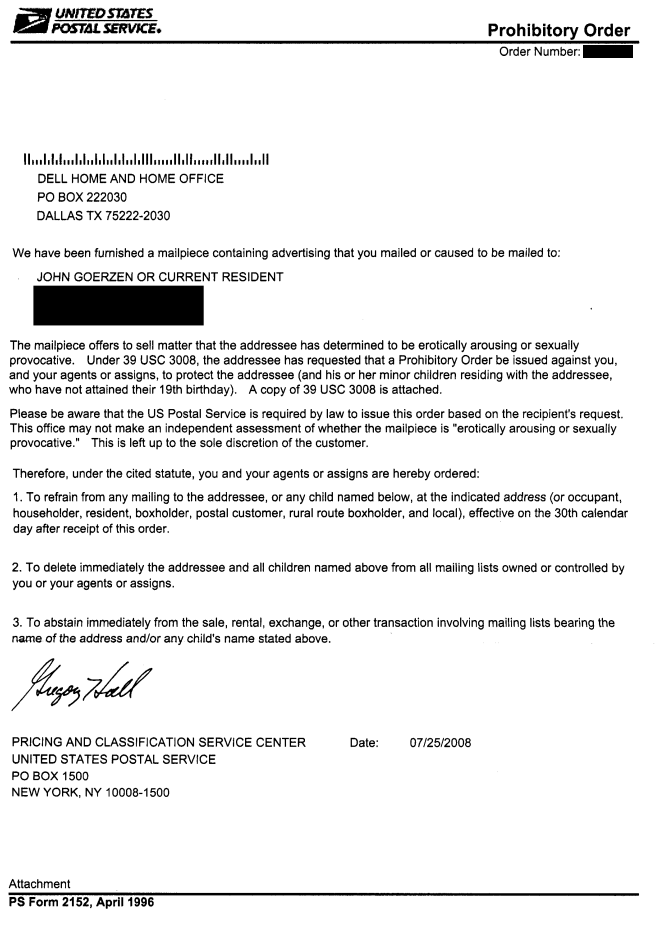
And last month, that's exactly what I did. The USPS sent me back a copy of the letter they sent to Dell, as well as a second page with instructions on reporting violations. Here's the letter they sent to Dell:

dell-usps

Somehow I get a chuckle over some Dell mail clerk trying to figure out how an 11-pound laptop is sexually provocative.

From August 25 on, it is a federal offense for Dell to send me another Home and Home Office catalog. This is a branch of criminal law, not civil law. That is, it's the maybe-go-to-jail branch of law.

How disappointed I was to receive yet another catalog from them today. If only they had waited 5 more days, I could have turned them in now.

Oh well. There's always next month's catalog. Let's just hope the clerk that received the USPS letter removed my name with a better system than everyone else at Dell uses, eh?

19 August 2008

Russell Coker: Ownership of the Local SE Linux Policy

A large part of the disagreement about the way to manage the policy seems to be based on who will be the primary “owner” of the policy on the machine. This isn’t a problem that only applies to SE Linux, the same issue applies for various types of configuration files and scripts throughout the process of distribution development. Having a range of modules which can be considered configuration data that come from a single source seems to make SE Linux policy unique among other packages. The reasons for packaging all Apache modules in the main package seem a lot clearer. One idea that keeps cropping up is that as the policy is modular it should be included in daemon packages and the person maintaining the distribution package of the policy should maintain it. The reason for this request seems to usually be based on the idea that the person who packages a daemon for a distribution knows more about how it works than anyone else, I believe that this is false in most cases. When I started working on SE Linux I had a reasonable amount of experience in maintaining Debian packages of daemons and server processes, but I had to learn a lot about how things REALLY work to be able to write good policy. Also if we were to have policy modules included in the daemon packages, then those packages would need to be updated whenever there were serious changes to the SE Linux policy. For example Debian/Unstable flip-flopped on MCS support recently, changing the policy packages to re-enable MCS was enough pain, getting 50 daemon packages updated would have been unreasonably painful. Then of course there is the case where two daemons need to communicate, if the interface which is provided with one policy module has to be updated before another module can be updated and they are in separate packages then synchronised updates to two separate packages might be required for a single change to the upstream policy. I believe that the idea of having policy modules owned by the maintainers of the various daemon packages is not viable. I also believe that most people who package daemons would violently oppose the idea of having to package SE Linux policy if they realised what would be required of them. Caleb Case seems to believe that ownership of policy can either be based on the distribution developer or the local sys-admin with apparently little middle-ground [1]. In the section titled “The Evils of Single Policy Packages” he suggests that if an application is upgraded for a security fix, and that upgrade requires a new policy, then it requires a new policy for the entire system if all the policy is in the same package. However the way things currently work is that upgrading a Debian SE Linux policy package does not install any of the new modules. They are stored under /usr/share/selinux/default but the active modules are under /etc/selinux/default/modules/active. An example of just such an upgrade is the Debian Security Advisory DSA-1617-1 for the SE Linux policy for Etch to address the recent BIND issue [2]. In summary the new version of BIND didn’t work well with the SE Linux policy, so an update was released to fix it. When the updated SE Linux policy package is installed it will upgrade the bind.pp module if the previous version of the package was known to have the version of bind.pp that didn’t allow named to bind() to most UDP ports - the other policy modules are not touched. I think that this is great evidence to show that the way things currently work in Debian work well. For the hypothetical case where a user had made local modifications to the bind.pp policy module, they could simply put the policy package on hold - I think it’s safe to assume that anyone who cares about security will read the changelogs for all updates to released versions of Debian, so they would realise the need to do this. Part of Caleb’s argument rests on the supposed need for end users to modify policy packages (IE to build their own packages from modified source). I run many SE Linux machines, and since the release of the “modular” policy (which first appeared in Fedora Core 5, Debian/Etch, and Red Hat Enterprise Linux 5) I have never needed to make such a modification. I modify policy regularly for the benefit of Debian users and have a number of test machines to try it out. But for the machines where I am a sysadmin I just create a local module that permits the access that is needed. The only reason why someone would need to modify an existing module is to remove privileges or to change automatic domain transition rules. Changing automatic domain transitions is a serious change to the policy which is not something that a typical user would want to do - if they were to do such things then they would probably grab the policy source and rebuild all the policy packages. Removing privileges is not something that a typical sysadmin desires, the reference policy is reasonably strict and users generally don’t look for ways to tighten up the policy. In almost all cases it seems best to consider that the policy modules which are shipped by the distribution are owned by the distribution not the sysadmin. The sysadmin will decide which policy modules to load, what roles and levels to assign to users with the semanage tool, and what local additions to add to the policy. For the CentOS systems I run I use the Red Hat policy, I don’t believe that there is a benefit for me to change the policy that Red Hat ships, and I think that for people who have less knowledge about SE Linux policy than me there are more reasons not to change such policy and less reasons to do so. Finally Caleb provides a suggestion for managing policy modules by having sym-links to the modules that you desire. Of course there is nothing preventing the existence of a postfix.pp file on the system provided by a package while there is a local postfix.pp file which is the target of the sym-link (so the sym-link idea does not support the idea of having multiple policy packages). With the way that policy modules can be loaded from any location, the only need for sym-links is if you want to have an automatic upgrade script that can be overridden for some modules. I have no objection to adding such a feature to the Debian policy packages if someone sends me a patch. Caleb also failed to discuss how policy would be initially loaded if packaged on a per-module basis. If for example I had a package selinux-policy-default-postfix which contains the file postfix.pp, how would this package get installed? I am not aware of the Debian package dependencies (or those of any other distribution) being about to represent that the postfix package depends on selinux-policy-default-postfix if and only if the selinux-policy-default package is installed. Please note that I am not suggesting that we add support for such things, a package management system that can solve Sudoku based on package dependency rules is not something that I think would be useful or worth having. As I noted in my previous post about how to package SE Linux policy for distributions [3] the current Debian policy packages have code in the postinst (which I believe originated with Erich Schubert) to load policy modules that match the Debian packages on the system. This means that initially setting up the policy merely requires installing the selinux-policy-default package and rebooting. I am inclined to reject any proposed change which makes the initial install of of the policy more difficult than this. After Debian/Lenny is released I plan to make some changes to the policy. One thing that I want to do is to have a Debconf option to allow users to choose to automatically upgrade their running policy whenever they upgrade the Debian policy package, this would probably only apply to changes within one release (IE it wouldn’t cause an automatic upgrade from Lenny+1 policy to Lenny+2). Another thing I would like to do is to have the policy modules which are currently copied to /etc/selinux/default/modules/active instead be hard linked when the source is a system directory. That would save about 12M of disk space on some of my systems. I’ve taken the unusual step of writing two blog posts in response to Caleb’s post not because I want to criticise him (he has done a lot of good work), but because he is important in the SE Linux community and his post deserves the two hours I have spent writing responses to it. While writing these posts I have noticed a number of issues that can be improved, I invite suggestions from Caleb and others on how to make such improvements.

18 August 2008

Romain Beauxis: Mediawiki 1.13.0

Mediawiki 1.13.0 has just been released. The debian package has been updated. I don't know yet wether it would be a good idea or not to ask for an inclusion into lenny. The changelog is important, and it seems a good release. I am looking for testers in order to nail down all possible issues in the package, as well as arguments, in favour or not, about this possible inclusion..

Russell Coker: SE Linux Policy Packaging for a Distribution

Caleb Case (Ubuntu contributer and Tresys employee) has written about the benefits of using separate packages for SE Linux policy modules [1]. Firstly I think it’s useful to consider some other large packages that could be split into multiple packages. The first example that springs to mind is coreutils which used to be textutils, shellutils, and fileutils. Each of those packages contained many programs and could conceivably have been split. Some of the utilities in that package are replaced for most use, for example no-one uses the cksum utility, generally md5sum and sha1sum (which are in the same package) are used instead. Also the pinky command probably isn’t even known by most users who use finger instead (apart from newer Unix users who don’t even know what finger is). So in spite of the potential benefit of splitting the package (or maintaining the previous split) it was decided that it would be easier for everyone to have a single package. The merge of the three packages was performed upstream, but there was nothing preventing the Debian package maintainer from splitting the package - apart from the inconvenience to everyone. The coreutils package in Etch takes 10M of disk space when installed, as it’s almost impossible to buy a new hard drive smaller than 80G that doesn’t seem to be a problem for most users. The second example is the X server which has separate packages for each video card. One thing to keep in mind about the X server is that the video drivers don’t change often. While it is quite possible to remove a hard drive from one machine and install it in another, or duplicate a hard drive to save the effort of a re-install (I have done both many times) they are not common operations in the life of a system. Of course when you do require such an update you need to first install the correct package (out of about 60 choices), which can be a challenge. I suspect that most Debian systems have all the video driver packages installed (along with drivers for wacom tablets and other hardware devices that might be used) as that appears to be the default. So it seems likely that a significant portion of the users have all the packages installed and therefore get no benefit from the split package. Now let’s consider the disk space use of the selinux-policy-default package - it’s 24M when installed. Of that 4.9M is in the base.pp file (the core part of the policy which is required), then there’s 848K for the X server (which is going to be loaded on all Debian systems that have X clients installed - due to an issue with /tmp/.ICE-unix labelling [2]). Then there’s 784K for the Postfix policy (which is larger than it needs to be - I’ve been planning to fix this for the past four years or so) and 696K for the SSH policy (used by almost everyone). The next largest is 592K for the Unconfined policy, the number of people who choose not to use this will be small, and as it’s enabled by default it seems impractical to provide a way of removing it. One possibility for splitting the policy is to create a separate package of modules used for the less common daemons and services, if modules for INN, Cyrus, distcc, ipsec, kerberos, ktalk, nis, PCMCIA, pcscd, RADIUS, rshd, SASL, and UUCP were in a separate package then that would reduce the installed size of the main package by 1.9M while providing no change in functionality to the majority of users. One thing to keep in mind is that each package at a minimum will have a changelog and a copyright file (residing in a separate directory under /usr/share/doc) and three files as part of the dpkg data store, each of which takes up at least one allocation unit on disk (usually 4K). So adding one extra package will add at least 24K of disk space to every system that installs it (or 32K if the package has postinst and postrm scripts). This is actually a highly optimal case, the current policy packages (selinux-policy-default and selinux-policy-mls) each take 72K of disk space for their doc directory. One of my SE Linux server sytems (randomly selected) has 23 policy modules installed, if they were in separate packages there would be a minimum of 552K of disk space used by packaging, 736K if there were postinst and postrm scripts, and as much as 2M if the doc directory for each package was similar to the current doc directories). As the system in question needs 5796K of policy modules, the 2M of overhead would make it approach 8M of disk space. So it would only be a saving of 16M over the current situation. While saving that amount of disk space is a good thing, I think that when balanced against the usability issues it’s not worth-while. Currently the SE Linux policy packages will determine what applications are installed and automatically load policy packages to match. I don’t believe that it’s possible to have a package post-inst script install other packages (and if it is possible I don’t think it’s desirable). Therefore to have separate packages would make a significant difference to the ease of use, it seems that the best way to manage it would be to have the core policy package include a script to install the other packages. Finally there’s the issue of when you recognise the need for a policy module. It’s not uncommon for me to do some work for a client while on a train, bus, or plane journey. I will grab packages needed to simulate a configuration that the client desires and then work out how to get it going correctly while on the journey. While it would not be a problem for me (I always have the SE Linux policy source and all packages on hand) I expect that many people who have similar needs might find themself a long way from net access without the policy package that they need to do their work. Sure such people could do their work in permissive mode, but that would encourage them to deploy in permissive mode too and thus defeat the goals of the SE Linux project (in terms of having wide-spread adoption). My next post on this topic will cover the issue of custom policy. Updated to note that Caleb is a contributor to Ubuntu not a developer.

16 August 2008

John Goerzen: I Want Something eBay Doesn't Have

I always have time to think while mowing the lawn. And today while mowing the lawn, I got the notion that it would be great fun to play Colossal Cave and other early text adventure games on a teletype. And, of course, since Linux has teletype support in its genes, if I played my cards right, I could probably get a login prompt to my workstation with the teletype, too.

Now, at this point, I am compelled to take a small diversion and explain just what a teletype is -- for those of you, like me, who are too young to remember them. (I will graciously omit comment on those of you too old to remember them!) Teletypes have been around since about the 1930s or so, but the ones I have in mind are the ones that were used to interact with computers in the 1960s and 1970s. Instead of a keyboard and monitor, you'd have a keyboard and printer. Believe it or not, surplus teletypes were the interface of choice for teletypes even in the later years because they were so much cheaper than video terminals.

So anyhow, back to the plot. Teletypes operated at speeds ranging from about 40bps to 110bps, but it seems that the most common protocol was Baudot-coded 50cps 5N2 serial format -- that is, 5 data bits, 2 stop bits. Amazingly, the serial UART in modern PCs is still capable of communicating with these devices (though it may take some circuitry to tweak the voltages), and at least one person has made it work with Linux.

So I zip on over to eBay to look for teletypes. What do I find? NOT A ONE! A few manuals, and apparently there is a GPS named the teletype. And some company that has something they think *might* be compatible with a teletype, but they don't know.

eBay has sorely let me down. An antique geeky item should be right up their alley, and zilch. They can sell everything from cars to advertisements on some guy's bald head, but not a teletype? C'mon!

So anyhow, I am afraid I will have to improvise. Perhaps I can find a dot-matrix printer with a serial port (or, I guess, a parallel port would do too) and an unbuffered printing mode. Then the trick would be getting keyboard input. Perhaps I could rig up a pty to do this, input from /dev/console, output to /dev/ttyS0. It would still be old, but not quite the real deal.

So if any of you have a working teletype you'd like to get rid of, do please let me know. I'll send you a photo of the printout of me getting lost in Colossal Cave.

Oh, and for those keeping track at home, I guess you can add this to the list of old technologies I'm interested in: Gopher, typewriters, teletypes... they're all alike, right?

15 August 2008

John Goerzen: Asus violating GPL again?

There was a small firestorm last year when people realized that Asus was not releasing source code to GPL'd components of the EeePC. At the time, they eventually did post source code on their website.

Recently I bought an Eee 901. Asus has modified the kernel's ACPI driver. They released the source code to that on an 8G surf model, but the 901 has additional hardware features in the ACPI space (bluetooth radio power toggle, for instance) that are not in the source they released back then. There are no sources released at all under the 901 section of their website.

Anyone know whom to contact at Asus about this?

8 August 2008

John Goerzen: Weird Firefox Problem

Once again, I find myself turning to this wonderful series of tubes for help on a weird problem.

I have Firefox (Iceweasel) on all the computers I regularly use. One of these computers has had a persistent problem.

After using it for awhile, it takes a really long time to look up hostnames in DNS. And after upgrading to Firefox 3, it got much worse. Not only did name resolution get slow, but sometimes page loads would get exceptionally slow as well. I could have 5 tabs open, and all of a sudden at the magic moment, nothing would load on any tab. It was as if I was being hit by 75% packet loss. And new pages wouldn't load, either.

tcpdump showed Firefox not even sending out packets at these times. After a few minutes, it might be back to normal. But I could always quit and restart and it would be fine.

Now, here's the weird thing: I've eliminated every possible difference I can think of between this one machine and the others I use Firefox on. My plugins and extensions are the same set with the same versions. My configuration is the same. When this problem is happening, other network-related programs (even other web browsers) on the same machine are working fine. Nobody else here seems to be having this problem.

Any ideas?

6 August 2008

Stefano Zacchiroli: yay from debcamp8

DebCamp8, shakiness, planes, python-debian Well, not unexpected news, but since I've been rather quite lately it is worth reminding that I'm now at DebConf8, enjoying the DebCamp. I've arrived today after a quite long trip made of unexpected extra plane stops in Madrid (thanks Iberia for not declaring it and letting me ponder about how can it possibly take 16 hours from Barcelona to Buenos Aires, now I know the reason ...) and shaky bus hours. First tiny teeny achievement of DebCamp (among a handful of beers already) is an upload of python-debian 0.1.11, implementing among other things support for parsed dependencies and a major overhaul changelog parsing (thanks to James Westby). Unfortunately we are going to miss Lenny with this release, but after all it is a package mostly meant for Debian Developers, so it is probably not a big deal.

Julien Danjou: The nochange-log

Saw in base-files changelog:
base-files (4.0.5) unstable; urgency=low
[ ]
* It's still soon to change /etc/debian_version. Please be patient.
-- Santiago Vila <sanvila@debian.org>  Tue,  5 Aug 2008 18:06:06 +0200
Applause.

Russell Coker: Time Zones and Remote Servers

It’s widely regarded that the best practice is to set the time zone of a server to UTC if people are going to be doing sys-admin work from various countries. I’m currently running some RHEL4 servers that are set to Los Angeles time. So I have to convert the time from Melbourne time to UTC and then from UTC to LA time when tracking down log entries. This isn’t really difficult for recent times (within the last few minutes) as my KDE clock applet allows me to select various time zones to display on a pop-up. For other times I can use the GNU date command to convert from other time zones to the local zone of the machine, for example the command date -d "2008-08-06 10:57 +1000" will display the current Melbourne time (which is in the +1000 time zone) converted to the local time zone. But it is still painful. In RHEL5, CentOS 5, and apparently all versions of Fedora newer Fedora Core 4 (including Fedora Core 4 updates) the command system-config-date allows you to select Etc/GMT as the time zone to get GMT. For reference selecting London is not a good option, particularly at the moment as it’s apparently daylight savings time there. For RHEL4 and CentOS 4 the solution is to edit /etc/sysconfig/clock and change the first line to ZONE="Etc/GMT" (the quotes are important), and then run the command ln -sf /usr/share/zoneinfo/Etc/GMT /etc/localtime. Thanks to the Red Hat support guy who found the solution to this, it took a while but it worked in the end! Hopefully this blog post will allow others to fix this without needing to call Red Hat. In Debian the command tzconfig allows you to select 12 (none of the above) and then GMT or UTC to set the zone. This works in Etch, I’m not sure about earlier versions (tzconfig always worked but I never tried setting UTC). In Lenny the tzconfig command seems to have disappeared, now to configure the time zone you use the command dpkg-reconfigure tzdata which has an option og Etc at the end of the list. Updated to describe how to do this in Lenny, thanks for the comments.

1 August 2008

John Goerzen: The Eee 901: Awesome

An Eee 901 showed up here recently, and I've had a (little) time to play with it.

What an awesome little machine that thing is. The keyboard is better than I expected, and so is the screen.

I got annoyed at the lack of things like Emacs on the default Xandros install, so decided to zap it and install Debian. But first, I wanted to take a backup of it.

I was thinking to myself that this is a Linux environment, but I can't just boot up a Linux rescue thingy to get stuff off it because it's not a regular PC.

Oh wait. It IS a regular PC. It is so small that I wasn't even thinking about it in the right terms. So a little dd, gzip, and nc later I have my backup image.

Debian went on smoothly -- booted from a 16MB image on a USB drive. X, suspend/resume, etc. all worked out of the box. Compiled the wifi driver and it works.

This is, I think, the perfect laptop size. Also the price is good, it's solid... what's not to love?

30 July 2008

John Goerzen: Seen in the Haskell wiki

Someone on the Haskell Cafe mailing list pointed out the Haskell humor page on the wiki. Here are a few snippets:

<shapr> In my experience, Flash is mostly used as the hi-tek replacement for <BLINK>

''sigfpe'': Haskell is so strict about type safety that randomly generated snippets of code that successfully typecheck are likely to do something useful, even if you've no idea what that useful thing is.

28 July 2008

John Goerzen: Jacob and Portland

Jacob has sure enjoyed our trip. And he should -- after all, he loves trains. His word for train is "toot" or "toh" (after the sound they make, I guess).

He sure was excited to get on the train in the middle of the night in Kansas, and didn't want to go to sleep after we got on because he was too excitedly jabbering about it. "Bih toot!" (big train) and "Too on!" (on the train) kept getting repeated, over and over.

Jacob loved walking up and down the train. It sways side to side, so he didn't want to walk by himself. Result: Terah and I got sore backs from holding his hands. But he got so many smiles as we walked back and forth, back and forth in the lounge car -- or up and down the entire train.

Los Angeles Union Station brought its own set of fun. A few puddles of water were exciting to splash in, but Jacob spotted a fountain nearby before I did, and we had to go over there and splash around a bit.

On the Coast Starlight, there is a parlor car in addition to the lounge car. The lower level of a parlor car is a theater with a wide-screen TV at the front, but it is usually completely empty during the day. Jacob and I liked to go down there -- Jacob because he could run around without getting into people or things, and me because I could sit down there and watch the scenery go by undisturbed.

Eating on the train was a bit of a challenge, though. On the train, you eat community-style in booths. There are no highchairs, so that meant keeping sticky little hands from touching everything. It turned out I had a knack for making this work, so Jacob sat next to me most of the time.

Sleeping, too, was a bit different than usual. Jacob is used to putting himself to sleep in his own room, and if he can see anyone else in the room, he doesn't want to sleep. So since Terah and I were always around, this didn't go so smooth. But Terah had a knack for that, as much as possible, so she held him for naps.

The greatest fun for Jacob was in Portland. Our hotel was right along the MAX light rail line, and we'd ride it to all sorts of places. While waiting on the platform, Jacob would repeat "Toot ahm?" (Train coming?) Then he'd see it, and go "TOOO!!! TOOO!!!", followed shortly by "Too ON!!! Toot ON!!" And, of course, "Jacob, we can't get on the train until it gets here."

Once on the MAX trains, he quickly noticed that at each stop, a prerecorded voice says "The doors are closing" right before they close. Pretty soon he started warning everybody that the doors would be closing. After the doors opened, he'd point to a door, and yell out, "Doh cloh! Doh cloh!" (door close) until they finally did. After a few more days, he'd notice when the train was coming to a stop and yell out "doh clo" before the doors ever opened. I think TriMet should hire him.

Pablo Lorenzzoni: Great News: Etch'n'Half

Great to hear about etch and a half . I ve just upgraded all my systems and everything went smooth. I dumped my home-compiled Ruby in favor of Debian s version now, since it fixes the annoying security bug. Thanks for the good work people!

John Goerzen: Cuil looks useless

So lots of technology sites are all excited about the launch of cuil.com, yet another in a long line of companies that the hype says could dethrone Google.

I went to cuil.com and searched for Amtrak.

It came up with hits for various routes, a historical society, etc. Everything except the actual homepage of Amtrak, amtrak.com, which has the most useful information about Amtrak.

#1 hit on Google.

If Cuil can't get that right, why bother?

27 July 2008

Russell Coker: New Net Connections

On Thursday my new InterNode ADSL2+ service was connected [1]. I needed to get a connection with a larger download cap and a better upload speed because one of my clients wants me to transfer some significant amounts of data as well as hosting some Xen DomU’s for him. Strangely InterNode couldn’t offer a regular ADSL service but could offer Naked DSL (which means DSL without a phone service on the same pair of wires). So I now have Naked ADSL 2+[2] although unfortunately the line speed is reported as being 8263/814 Kbps - ADSL2 speed. For the moment this will do, but I’ll investigate the possibility of improving this eventually. Another strange thing about this is that Optus is the carrier for the ADSL line, Telstra is the monopoly telco with the vast majority of local-loop copper pairs so it’s surprising that I end up with Optus owning my copper - the wires in question were used by the previous owner of my house for a Telstra connection! On Friday I converted my network to using the new ADSL link and on Saturday I got my SE Linux Play Machine online again [3]. I could have managed the transition without ~20 hours of down-time for the Play Machine, but as I only get a few logins per day it didn’t seem to be worth the effort of rushing it. Also on Friday I got a new 3G modem from Three [4]. They advertise that the USB or PC-Card modem will cost $5 per month on a 24 month plan, but when I ordered it I discovered that as I have an existing mobile phone plan with them the $5 per month is waived. So all that I have to pay is $15 per month for a 1GB data allowance (which is about the best deal available). A client is paying for this so that I can provide remote support for his network. I had previously written about my search for an ideal mobile SSH client [5], I ended up getting an EeePC 701 which cost $300, an 8G SD card and 8G USB stick (for expanding the internal storage and for moving files around respectively) which cost $83, and now $15 per month over 24 months for net access. That gives a total of $743 for two years of mobile net access. This compares well to the $960 that an iPhone would cost over two years and provides a lot more utility (while admittedly not fitting into a pocket). Dave Hall [6] gave me a lot of great advice about selecting and using 3G modems. He recommended that I get the E220 modem as it’s easy to configure (mine was easy on Debian/Lenny but didn’t work with a Debian/Etch kernel as the necessary driver was not available). Three also sells another model the E169G which is apparently tricky to set up. There was one mistake made in the design of the E220, the cable is installed in such a way that the LED which indicates connection status is going to be face-down when connected to almost any laptop which has horizontally mounted USB ports (which includes all the thinner ones). Here is the PPP chatscript for use with an E220 modem (suggested file name /etc/chatscripts/three):

ABORT 'BUSY'
ABORT 'NO CARRIER'
ABORT 'ERROR'
'' AT
OK ATQ0V1E1S0=0&C1&D2+FCLASS=0
OK 'AT+COPS=0,0,"3TELSTRA",2'
OK AT+CGATT=1
OK AT+CGDCONT=1,"IP","3netaccess"
OK ATDT*99**3# Here is the ppp configuration file which references the above chatscript:
/dev/ttyUSB0
230400
noauth
defaultroute
usepeerdns connect "/usr/sbin/chat -v -f /etc/chatscripts/three"

24 July 2008

John Goerzen: OSCon Update

On Wednesday, OSCon really goes into high gear (and the wifi croaks) at OSCon. The people that aren't going to the tutorials all arrive, and aren't yet sluggish from the late-night vendor parties and BOFs.

The keynotes were OK, and after that, I listened to Keith Packard talk about the future of X. Then it was off to finish the preparation for my own talk on Linux on the corporate desktop. It was the first time I spoke at OSCon, and it seems to have gone well. I keep running into people that were at the talk and thought of some more questions -- and of course I chatted with a number of people right after as well. There are a number of other companies that are planning on doing what we've done, or even started down the implementation path already. It's some effort making something of OSCon quality (Damian Conway suggests something like 10 hours preparing for every 1 hour presenting -- I didn't do that), but I'm glad I did.

The Expo Hall opened Wednesday as well. Met some interesting folks there -- Open Lina, a company that sells Linux hardware, an Open Source groupware product I hadn't heard of before (they are apparently working on Debian Packages too), and some others I can't remember right now...

Tuesday I had dinner at Andina, a Peruvian restaurant, with fellow Haskellers Bryan O'Sullivan and Don Stewart -- the first time the three of us Real World Haskell folks met in one place.

Today brought Nat Torkington's excellent keynote, and also r0ml's great talk this afternoon ("I started this talk in 2003, and it's run a bit long.") Another great time for some networking in the hallways and expo hall. One of the LinuxFest Northwest folks had attended my talk, happened to see me as I was stuffing one of the may free t-shirts that vendors were giving out into my laptop bag (by afternoon, they were getting quite in your face about it), and struck up a conversation.

Went for sushi over lunch with a couple of folks from #oscon on IRC, then dinner with Debian folks.

Been a busy week, but met lots of people. I didn't go to as many talks as I planned because I was so busy talking to people -- guess that means the conference was a hit.

Next.

Previous.