Search Results: "agi"

31 October 2017

Chris Lamb: Free software activities in October 2017

Here is my monthly update covering what I have been doing in the free software world in October 2017 (previous month):
Reproducible builds

Whilst anyone can inspect the source code of free software for malicious flaws, most software is distributed pre-compiled to end users. The motivation behind the Reproducible Builds effort is to allow verification that no flaws have been introduced either maliciously or accidentally during this compilation process by promising identical results are always generated from a given source, thus allowing multiple third-parties to come to a consensus on whether a build was compromised. I have generously been awarded a grant from the Core Infrastructure Initiative to fund my work in this area. This month I:


I also made the following changes to our tooling:
diffoscope

diffoscope is our in-depth and content-aware diff utility that can locate and diagnose reproducibility issues.

  • Improve names in output of "internal" binwalk members. (#877525).
  • Don't crash on malformed md5sums files. (#877473).
  • Omit misleading "any of" prefix when only complaining about a single module on import. [...]
  • Adjust tests as ps2ascii now varies its output on timezone. [...]

strip-nondeterminism

strip-nondeterminism is our tool to remove specific non-deterministic results from a completed build.

  • Clojure considers .class file to be stale if it shares the same timestamp of the .clj. We thus adjust the timestamps of the .clj to always be younger. (#877418).
  • Print a message in --verbose mode if no canonical time was specified. [...]

buildinfo.debian.net

buildinfo.debian.net is my experiment into how to process, store and distribute .buildinfo files after the Debian archive software has processed them.

  • Always show SHA-256 checksums, regardless of the browser viewport size. [...]
  • Add an API endpoint to fetch specific .buildinfo files for a certain package/version/architecture. [...]


Debian My activities as the current Debian Project Leader are covered in my "Bits from the DPL" email to the debian-devel-announce mailing list.
Patches contributed
  • devscripts: Please print the actual arguments debuild makes to Lintian. (#880124)
  • hw-detect: Drop reference to floppy disks; it's almost 2018. (#880122)
  • debci:
    • Use deb.debian.org over http.debian.net. (#879654)
    • Document how to use an alternative mirror. (#879655)

Debian LTS

This month I have been paid to work 18 hours on Debian Long Term Support (LTS). In that time I did the following:
  • "Frontdesk" duties, triaging CVEs, etc.
  • Followed up on a large number of upstream "pings" that have been left dormant.
  • Issued DLA 1121-1 to fix an out-of-bounds read vulnerability in curl where a malicious FTP server could abuse this to prevent clients from interacting with it.
  • Issued DLA 1123-1 for the "Go" programming language where an attacker could generate a MIME request such that the server ran out of file descriptors.
  • Issued DLA 1126-1 for the libxfont font selection and rasterisation library, correcting two vulnerabilities, both involving the library being tricked into reading invalid/random memory.
  • Issued DLA 1134-1 for sdl-image1.2, an image loading library. A maliciously-crafted .xcf file could cause a stack-based buffer overflow resulting in potential code execution.

Uploads
  • python-django:
    • 2.0~beta1-1 New upstream 2.x release.
    • 1.11.6-1 New upstream bugfix release.
  • gunicorn (19.6.0-10+deb9u1) Prepared a release for stable to avoid a runtime dependency on a compiler. (#877722)
  • redis:
    • 4:4.0.2-3:
      • Drop the Debian-specific /etc/redis/redis-server.pre-up.d (etc.) hooks and remove them if unchanged.
      • Include systemd redis-server@.service and redis-sentinel@.service template files to easily run multiple Redis instances. (#877702)
      • Patch redis.conf and sentinel.conf with quilt instead of maintaining our own versions under debian/.
    • 4:4.0.2-4:
      • Add input validity checking to cluster config slot numbers to fix CVE-2017-15047. (#878076)
      • Drop debian/bin/generate-parts now we aren't calling it.
      • Correct Bash-ism in NEWS file.
    • 4:4.0.2-5: Replace the existing patch for CVE-2017-15047 with an upstream-blessed version that covers another case.
  • redisearch (0.21.3-5) Initial release.
  • docbook2man (2.0.0-40) Correct spelling mistakes in binaries and other misc packaging tidying.
  • python-redis (2.10.6-1) New upstream release.
  • bfs (1.1.3-1) New upstream release.

FTP Team

As a Debian FTP assistant I ACCEPTed 103 packages: amcheck, argagg, binutils, blockui, bro-pkg, chkservice, citus, django-axes, docker-containerd, doctest, dtkwidget, duktape, feed2exec, fontforge, fonttools, gcc-8, gcc-8-cross, generator-scripting-language, gitgraph.js, haskell-uri-encode, hoel, iniparser, its, jquery-areyousure, kodi, libcatmandu-mods-perl, libcatmandu-template-perl, libcatmandu-xml-perl, libcatmandu-xsd-perl, libcode-tidyall-plugin-sortlines-naturally-perl, libgdamm5.0, libinfinity, libmods-record-perl, libreoffice-dictionaries, libset-intervaltree-perl, libsodium, linux, linux-grsec, ltsp-manager, lxqt-themes, mailman3-core, measurement-kit, mini-buildd, musescore, node-babel, node-babel-eslint, node-babel-loader, node-babel-plugin-add-module-exports, node-babel-plugin-transform-define, node-gulp-newer, node-regenerate-unicode-properties, node-regexpu-core, node-regjsparser, node-unicode-data, node-unicode-loose-match, openjdk-9, orafce, pgaudit, pgsql-ogr-fdw, pk4, postgresql-mysql-fdw, powa-archivist, python-azure-devtools, python-colormap, python-darkslide, python-dotenv, python-karborclient, python-logfury, python-lupa, python-marshmallow, python-murano-pkg-check, python-octaviaclient, python-pathspec, python-pgpy, python-pydub, python-randomize, python-sabyenc, python-searchlightclient, python-stestr, python-subunit2sql, python-twitter, python-utils, python-wsgilog, r-cran-bindr, r-cran-desc, r-cran-hms, r-cran-readstata13, r-cran-rprojroot, r-cran-wikidatar, r-cran-wikipedir, r-cran-wikitaxa, repmgr, requests-file, resteasy3.0, sdl-kitchensink, stardicter, systemd-el, thunderbird, tomcat8.0, uwsgi-plugin-luajit, uwsgi-plugin-mongo, uwsgi-plugin-php & uwsgi-plugin-v8. I additionally filed 3 RC bugs against packages that had incomplete debian/copyright files against: fonttools, generator-scripting-language & libsodium.

30 October 2017

Russell Coker: Logic of Zombies

Most zombie movies feature shuffling hordes which prefer to eat brains but also generally eat any human flesh available. Because in most movies (pretty much everything but the 28 Days Later series [1]) zombies move slowly they rely on flocking to be dangerous. Generally the main way of killing zombies is severe head injury, so any time zombies succeed in their aim of eating brains they won t get a new recruit for their horde. The TV series iZombie [2] has zombies that are mostly like normal humans as long as they get enough brains and are smart enough to plan to increase their horde. But most zombies don t have much intelligence and show no signs of restraint so can t plan to recruit new zombies. In 28 Days Later the zombies aren t smart enough to avoid starving to death, in contrast to most zombie movies where the zombies aren t smart enough to find food other than brains but seem to survive on magic. For a human to become a member of a shuffling horde of zombies they need to be bitten but not killed. They then need to either decide to refrain from a method of suicide that precludes becoming a zombie (gunshot to the head or jumping off a building) or unable to go through with it. Most zombie movies (I think everything other than 28 Days Later) has the transition process taking some hours so there s plenty of time for an infected person to kill themself or be killed by others. Then they need to avoid having other humans notice that they are infected and kill them before they turn into a zombie. This doesn t seem likely to be a common occurrence. It doesn t seem likely that shuffling zombies (as opposed to the zombies in 28 Days Later or iZombie) would be able to form a horde. In the unlikely event that shuffling zombies managed to form a horde that police couldn t deal with I expect that earth-moving machinery could deal with them quickly. The fact that people don t improvise armoured vehicles capable of squashing zombies is almost as ridiculous as all the sci-fi movies that feature infantry. It s obvious that logic isn t involved in the choice of shuffling zombies. It s more of a choice of whether to have the jump-scare aspect of 18 Days Later, the human-drama aspect of zombies that pass for human in iZombie, or the terror of a slowly approaching horrible fate that you can t escape in most zombie movies. I wonder if any of the music streaming services have a horror-movie playlist that has screechy music to set your nerves on edge without the poor plot of a horror movie. Could listening to scary music in the dark become a thing?

29 October 2017

Niels Thykier: Building packages without (fake)root

Turns out that it is surprisingly easy to build most packages without (fake)root. You just need to basic changes:
  1. A way to set ownership to root:root of paths when dpkg-deb build constructs the binary.
  2. A way to have debhelper not do a bunch of (now) pointless chowns to root:root .
The above is sufficient for dpkg, debhelper, lintian, apt-file, mscgen, pbuilder and a long list of other packages that only provide paths owned by root:root . Obviously, packages differ and yours might need more tweaks than this (e.g. dh_usrlocal had to change behaviour to support this). But for me, the best part is that the above is not just some random prototype stuck in two git repos on alioth: Unfortunately, if you are working with games or core packages like shadow with need for static ownership different from root:root (usually with a setuid or setgid bit), then our first implementation does not support your needs at the moment[1]. We are working on a separate way to solve static ownership in a declarative way. [1] Note regarding /usr/local : If your package needs to provide directories there owned by root:staff with mode 02775, then dh_usrlocal can handle that. The non- root:root ownership here works because the directories are created in a maintainer script run as root during installation. Unfortunately, it cannot provide different ownership or modes with R != binary-targets at the moment.
Filed under: Debhelper, Debian

Russ Allbery: Review: Why We Sleep

Review: Why We Sleep, by Matthew Walker
Publisher: Scribner
Copyright: October 2017
ISBN: 1-5011-4433-2
Format: Kindle
Pages: 341
The world is full of theories, and corresponding books, about things that will make you healthier or prevent disease. Nearly all of them are scams, either intentional or created through the placebo effect and the human tendency to see patterns that don't exist. The rare ones that aren't have a certain pattern: they're grounded in our best understanding of biology, align with what our body wants to do anyway, have been thoroughly studied using proper testing methodology, and don't make money for powerful corporations. I'm fairly sure this is one of those rare ones that isn't a scam. And, if so, it's rather important and worth your attention. Matthew Walker is a professor of neuroscience and biology at the University of California at Berkeley, where he's the founder of the Center for Human Sleep Science. He's not a doctor; he started medical training, but (as he says in the book) found himself more attracted to questions than answers. He's a professional academic researcher who has been studying sleep for decades. This book is a combination of summary of the current state of knowledge of academic sleep research and a plea: get more sleep, because we're literally killing ourselves with the lack of it. Walker opens the book with a discussion of the mechanisms of sleep: how we biologically fall asleep and why, how this has changed over time, and how it changes with age. Along with that, he defines sleep: the REM and NREM sleep cycle that you may have already heard of, how it manifests itself in most people, and where dreams fit in. The second part then discusses what happens when you sleep, with a focus on what goes wrong when you don't. (Spoiler: A lot. Study after study, all cited and footnoted, has found connections between sleep and just about every aspect of mental and physical health.) The third part does the same for dreams, fitting them into the picture along with a scientific discussion of just what's going on during dreams. The fourth and final part tackles the problem: why don't we get enough sleep, and what can we do about it? I will warn in advance that this book will make you paranoid about your sleeping patterns. Walker has the missionary zeal of an academic who has sunk his teeth into something really important that society needs to take into account and will try to drown you in data, analysis, analogies, and sheer earnestness until you will believe him. He wants you to get at least seven, and preferably eight, hours of sleep a night. Every night, with as little variation as you can manage. Everyone, even if you think you're someone who doesn't need as much sleep (you're probably not). There's a ton of science here, a great popularization of a whole field of research, but this is also a book that's trying to get you to do something. Normally, that sort of book raises my shields. I'm not much of a believer in any book of the general genre of "most people are doing this basic part of life wrong, and should do it my way instead." But the hallmarks of good science are here: very widespread medical consensus, no corporate interest or obvious path to profit, and lots of studies (footnoted here, with some discussions of methodology although not the statistical details, which will require looking up the underlying studies and careful caveats where studies indicate correlation but may not find causes). And Walker makes the very telling point early in the book that nearly every form of life on the planet sleeps in one way or another (defined as a daily recurring period of time during which it doesn't respond to outside stimulus), which is a strong indicator of universal necessity. Given the vulnerability and loss of useful hours that come with sleep, one would expect some species to find an evolutionary path away from it if it were dispensable. But except for extremely short-lived species, we've never found a living creature that didn't sleep. Walker's argument for duration is also backed up by repeated studies on human capability before and after various quantities of sleep, and on studies of the sleep phases in various parts of the night. Study after study used six hours as the cutoff point and showed substantial deterioration in physical and mental capabilities even after only one night of short sleeping. (Reducing sleep to four hours is nearly catastrophic.) And, more worrisomely, that degradation is still measurable after "catching up" on sleep on subsequent nights. Sleeping in on weekends doesn't appear to fully compensate for the damage done by short-sleeping during the week. When Walker gets into the biological reasons for sleep, one starts to understand why it's so important. I think the part I found the most fascinating was the detailed analysis of what the brain is doing while you sleep. It's not inactive at all, even outside of REM sleep. Walker and other sleep researchers have done intriguing experiments showing how different parts of the sleep cycle transfer memories from short to long term storage, transfer physical skills into subconscious parts of the brain, discard short term memories that the conscious brain has tagged as being unwanted, and free up space for new knowledge acquisition. REM sleep appears to attempt to connect otherwise unrelated memories and bits of knowledge, inverting how association normally works in the brain, thus providing some concrete explanation for sleep's role in creativity. And (this research is fairly new), deep NREM sleep causes temporary physical changes in the brain that appear to be involved in flushing metabolic waste products away, including the plaque involved in Alzheimer's. The last part of the book is probably the most concretely useful: what can one practically do to get more sleep? There is quite a lot that's proven effective, but Walker starts with something else: sleeping pills. Here, you can almost see the lines drawn by a lawyer around what Walker should say. He stresses that he's not a medical doctor while laying out study after study that all point in the same direction: sleeping pills are a highly dangerous medical fraud that will shorten your lifespan for negligible benefit in helping you fall asleep, while limiting your brain's ability to enter true sleep. They're sedation, sedation is not sleep, and the four billion dollar sleeping pill market is literally making everything worse. The good news is there is an effective treatment for insomnia that works for many people; the better news is that it's completely free (although Walker does suggest some degree of medical supervision for serious insomnia so that some parts of it can be tailored to you). He walks through CBT-I (cognitive behavior therapy for insomnia), which is now the medically recommended primary treatment for insomnia, and takes apart the pieces to show how they line up with the results of sleep research studies. Alongside that are recommendations for improving sleep for people who don't have clinical insomnia but who aren't regularly getting the recommended amount of sleep. There are a lot of interesting bits here (and he of course talks about blue LED light and its relationship to melatonin cycles), but I think the most interesting for me was that you have to lower your core body temperature by a couple of degrees (Fahrenheit) to enter sleep. The temperature of your sleeping environment is therefore doubly important: temperature changes are one of the signals your body uses to regulate circadian rhythms (cold being a signal of night), and a colder sleeping area helps you lower your core body temperature so that you can fall asleep. (The average person does best with a sleeping room temperature of 65F, 18C.) There's even more in here: I haven't touched on Walker's attack on the US tendency to push high school start times earlier and earlier in the day (particularly devastating for teenagers, whose circadian rhythms move two hours later in the day than adults before slowly returning to an adult cycle). Or the serious problems of waking to an alarm clock, and the important benefits of the sleep that comes at the end of a full night's cycle. Or the benefits of dreams in dealing with trauma and some theories for how PTSD may interfere with that process. Or the effect of sleep on the immune system. Walker's writing style throughout Why We Sleep is engaging and clear, although sometimes too earnest. He really wants the reader to believe him and to get more sleep, and sometimes that leaks around the edges. One can also see the effort he's putting into not reading too much into research studies, but if there's a flaw in the science here, it's that I think Walker takes a few tentative conclusions a bit too far. (I'm sure these studies have the standard research problem of being frequently done on readily-available grad students rather than representative samples of the population, although the universality of sleep works in science's favor here.) Some of the recitations of research studies can get rather dry, and I once again discovered how boring I find most discussion of dreams, but for a first book written by an academic, this is quite readable. This is one of those books that I want everyone to read mostly so that they can get the information in it, not as much for the enjoyment of reading the book itself. I've been paying closer attention to my own sleep patterns for the last few years, and my personal experience lines up neatly with the book in both techniques to get better sleep and the benefits of that sleep. I'd already reached the point where I was cringing when people talk about regularly going on four or five hours of sleep; this is an entire book full of researched reasons to not do that. (Walker points out that both Reagan and Thatcher, who bragged about not requiring much sleep, developed Alzheimer's, and calls out Trump for making the same brag.) The whole book may not be of interest to everyone, but I think everyone should at least understand why the World Heath Organization recommends eight hours a night and labels shift work a probable carcinogen. And, as Walker points out, we should be teaching some of this stuff in school health classes alongside nutrition and sex education. Alas, Walker can't provide much advice on what I think is the largest robber of sleep: the constant time pressure of modern life, in which an uninterrupted nine hour sleep opportunity feels like an unaffordable luxury. Rating: 9 out of 10

27 October 2017

Sam Hartman: How Can Debian Turn Disagreement into Something that Makes us Stronger

Recently, when asked to engage with the Debian Technical Committee, a maintainer chose to orphan their package rather than discuss the issue brought before the committee. In another decision earlier this year, a maintainer orphaned their package indicating a lack of respect for the approach being taken and the process. Unfortunately, this joins an ever longer set of issues where people walk away from the TC process disheartened and upset.

For me personally the situations where maintainers walked away from the process were hard. People I respect and admire were telling me that they were unwilling to participate in our dispute resolution process. In one case the maintainer explicitly did not respect a process I had been heavily involved in. As someone who values understanding and build a team, I feel disappointed and hurt thinking about this.

Unfortunately, I don't feel much better when I consider several of the other issues brought before the TC. In a number of cases, the process has concluded, but it feels like a pyrrhic victory. We have an answer, but often we never reached an understanding of one of the key stakeholder's positions. People are sufficiently disappointed or frustrated that they reduce their involvement. That is, the answer is not one they can live with. Sometimes, I'm not even sure that answering the question was worth the cost.

My initial suspicion as I begin to consider issues that have come before the TC in the last few years is that as a necessary consequence of how the TC operates, we will drive a significant chunk of those who come to us away from our community. I will not be part of that. If I end up eventually agreeing with this suspicion, I will either work to improve the TC process or find a different way to contribute to the project that is more aligned with my goals.


Our Community is More Important than Technical Correctness I firmly believe that Debian's strength is its community. Distributions, upstreams, free-software advocates, corporate interests, and everything in between work together. Because we are working on a concrete product,we actually have to understand how our needs conflict and compliment each other. Also, like any organization, our ability to get things done is dependent on our contributors and the time we all put in.

I cannot think of anything more harmful we can do than drive away a constructive contributor. Technical quality is important: many of us will eventually go away if quality drops too much. However, Debian itself can be improved incrementally. Yes, new people do join Debian. However, it takes a lot of new people to make up for a situation where everyone involved is frustrated, and some leave and tell their friends to stay away from Debian.

When a Disagreement Reaches the TC When a disagreement reaches the TC, we know a few things. First, people have not have not been able to resolve it on their own. Second, the disagreement is important enough to at least one of the parties to ask for outside help.

If the TC were to simply announce a decision, it is very likely that at least one party would feel frustrated and disappointed. If the decision is important to someone it almost always means that they care about the outcome. If previous efforts have not reached agreement then there is an outcome that is undesired. While it's possible under the constitution that two parties could bring an issue to the TC mutually where the dynamics could be different, this does not happen in practice.

When we "lose" When a decision making process decides to select one of my undesired outcomes, I have strong negative feelings. First, there is the technical result itself. Because of an adverse decision it is generally harder for me to do my technical work, or some ethical position or group I care about is disadvantaged. However, the strongest feelings are related to needs about my place in the community, not a direct response to the technical decision. I worry about whether issues I care about will be valued in the future; I would likely feel weary or scared thinking of contributing in an environment where issues that matter to me aren't going to be considered. I tend to feel frustrated if my position was not adequately considered this time around.

Often, the strongest feelings do not stem from how I am impacted by the decision itself. Thus, if my more general needs are addressed, I will feel a lot better about not having my preferred outcome selected. Confidence that my position was understood is the single biggest factor in being able to accept the result. If the community took the time to understand me, then I have confidence that I am valued. I can advocate for change and be part of the ongoing discussion. If I understand the other positions then I can understand that the position was not arbitrary. Understanding the other positions is also a prerequisite to seeing how things I value were considered, especially when the tradeoff did not ultimately favor these values.

My conversations with others about their experience with conflict suggest my feelings and needs are common.


However, the TC focuses almost exclusively on the technical matter before it. I don't think the TC has done a good job of actually understanding maintainers or the people bringing issues to us. Especially when we're fairly sure we understand what the ultimate decision will be, we focus on getting to that decision. Of course part of actually understanding someone is considering what they have to say. Even when you have high confidence in an outcome, if you want someone to feel understood, you do have to listen at a point where you can consider what they bring forward.

Frustration of Being Questioned

On the other side, it's frustrating to have your decisions questioned. Reviewing a decision takes time. Even if the TC agrees with a maintainer, asking that maintainer to sit through a long process can create frustrations as deep as any I discussed in the previous section.

So the process is doubly bad for maintainers. Someone can bring up an issue which requires precious time. Then if the TC decides against the maintainer, we have all the problems I discussed previously.

I acknowledge this. A good process must respect the maintainer's time. However, it must respect the community members who disagree with maintainers. Everyone who brings an issue to the TC is a developer. They have contributed significantly to our community and are part of our team. Yes, we need to protect the process against abuse. But in a very real sense if we aren't willing to consider an issue and we aren't willing to engage with someone, understand why they think the issue should be considered, and work until they understand why we made our decision, we are saying we do not respect them enough to take that time. We should expect that to drive people away.

I wonder if the solution here involves a two phase process. During the first phase we work with someone bringing an issue to us until we understand it. We either engage the maintainer at that point, spend the time to help the person bringing an issue to us understand why we are not engaging the maintainer, or have decided the issue is abusive of the processs/misdirected. For this to work maintainers would have to trust us enough to actually be willing to sit back and not spend a lot of their time.

Sam, It's Just Personalities

One criticism I've heard as I discuss this is that a lot of the negative feelings surround interpersonal conflict and are personality conflicts. Yes, personalities matter. Yes, we re still healing from the Systemd discussion.

However, as a community, I think we need to figure out how we respect the inevitable personality conflicts. I can think of one or two developers I'm still upset with years after an issue. It happens. Perhaps if I were a maintainer when one of these developers raised a concern with my packages, I could ask that someone else be a primary advocate for an issue. Similarly, if a developer wanted to address an issue with me as a maintainer but would prefer not to deal with me, perhaps we could figure out some way that we could see if someone else shared the concern.

Dropping a Package is Sometimes an Answer

My concerns were sparked by instances where a maintainer dropped a package rather than interact with the TC. Sometimes that can be a healthy step in a transition. At Debconf this year, Enrico Zini gave a talk on consent culture in Debian. One of the key points of his talk is that we can find over time that what we're being asked to do in Debian is no longer consistent with our boundaries. If it isn t helping us move forward if it isn t fun then it is likely time to stop.

In that sense, approaching disagreement can be a great time to take stock and ask whether we still enjoy maintaining a package. If we don t, then stepping aside and letting others take it on can be a great way that we and they can be happier. I don t really think that s what happened in these instances though. Based on comments made to me, this sounded more like a lack of faith in being treated well or in our ability as a committee.

Even so, Enrico s talk applies in a number of ways here. He suggests that the approach we should take when someone is done and steps away is to thank then. I couldn t agree more. From the depth of my heart I offer thanks: Thank you for taking care of yourself and stepping away when it is no longer fun. Thank you for all the effort you have put into these packages. I hope to work with you on great things in the future.

Russ Allbery: Review: The Black Gryphon

Review: The Black Gryphon, by Mercedes Lackey & Larry Dixon
Series: Mage Wars #1
Publisher: DAW
Copyright: 1994
Printing: January 1995
ISBN: 0-88677-643-0
Format: Mass market
Pages: 460
The Mage Wars series (or the Gryphon series, which isn't its official title but which is in all of the titles) is part of the sprawling Valdemar mega-series, but it's a prequel to all of the other stories. It's also slightly challenging if you're reading in publication order, since it was published simultaneously with the Mage Storms series. If you're following publication order, in theory you should interleave the two series, but I hate doing that. I'm therefore reading it after Mage Winds and before Mage Storms. We'll see whether that was a good idea when I get to the next series. You could, if you really wanted to, read this series before any other Valdemar book. As a prequel from the deep past of Valdemar's world, it doesn't depend on the other series, and you'll get a rediscovery of lost knowledge feel from later books. The downside is that it's a rather boring introduction, and that order would spoil a lot of the revelatory flow of the other series (particularly Elspeth's adventures in the Mage Winds books). I'm now getting into the Valdemar books that I've only read once. I've been putting off continuing my Valdemar re-read because this series was next and I remember being rather bored with it the first time I read it. But I'm re-reading for the world-building and background as much as for the characters, and this is a huge chunk of world background that fills in the bones underneath Winds of Fate and its sequels. Here's why Dhorisha is a crater, here's why the Pelagiris forests are such a mess, here's where Ma'ar starts, here's the origin of both the gryphons and K'Leshya, and here, finally, we get to see the legendary Urtho on the page. The problem with writing novels set in the epic backstory of your universe is that it's hard to live up to the drama that readers have invented for themselves. A lot of The Black Gryphon is background to events Valdemar readers already know will happen, creating a corresponding lack of surprise. I reached the end of the book and said "yup, that's pretty much what everyone said had happened." Lackey and Dixon do try to do some interesting things here, one of which being the backgrounding of the war. The Black Gryphon starts in the middle of a long-running conflict between Urtho and Ma'ar and doesn't follow the generals or the battles. The protagonists, instead, are a kestra'chern (a type of psychiatrist and spiritual healer who also uses sex, with the expected conflicts of people who incorrectly think of them as prostitutes) and the eventual leader of the gryphons (Skandranon, who is referenced in later books and who provides the title). We get some combat scenes from Skandranon and later another gryphon, but a lot of the book is Amberdrake fighting the effects of the war instead of the details of the war itself. There's a deep and moving story in that idea, and in some of the attached love stories that play out in the army camps. There's also a great story somewhere around Urtho: a brilliant but detached mage who is way out of his depth trying to run an army but smart enough to gather good people around him. He's also a creator of new life, including the gryphons. The Black Gryphon tries to talk about Urtho's paternalism, the weird emotional currents of his relationship with his creations, and the places Urtho keeps things from others for, supposedly, their own good. If this book had looked a bit deeper at the support structure for an army that's trying to be humane, or at the ways in which Urtho strays far too close to being an abusive tyrant through inaction despite having the best of intentions at every step, I think it could have said something significant. Unfortunately, that's not this book. This book is full of relentlessly black and white morality (the flaw of much of the Valdemar series) that bleaches away interesting shades of grey. Urtho is good and wise by authorial fiat, and Ma'ar is the same utterly irredeemable force of evil that he is in other books. The story skitters over Urtho's odd tyrannies, making them all better with the pure power of friendship and good intentions. There just isn't much emotional depth, and while I don't expect that of Lackey in general, this story really needed that depth to work. What we get instead is repetition, as Lackey and Dixon hit the same emotional notes with Amberdrake repeatedly. This is one of those books that makes me wonder if Lackey was trying to write too many novels in a short time than was good for their individual quality. (Collaborations often mean that the lesser-known name is doing all the work, but Dixon is Lackey's husband and the tone of the book is sufficiently Lackey that I don't think that happened here.) It felt padded by Amberdrake turning over the same emotional rocks repeatedly, to largely the same effect. This is, in short, not Lackey's finest effort, although it does have its moments. As always, Lackey is at her best when writing psychological healing narratives. Zhaneel's story is a bit too easy, but the dynamic between Amberdrake and Winterhart is the best part of the book. And The Black Gryphon does tell the reader exactly what led up to the Cataclysm and why. There are no major surprises, but there are some small ones, and it's a nice payoff for the lore-obsessed (like me). This is missable unless you want the full world-building behind Valdemar's past, and it's not the best writing. But if you're heavily invested in the Valdemar universe, it's at least readable and provides an important bit of the history. Followed by The White Gryphon. Rating: 5 out of 10

26 October 2017

Russ Allbery: Review: Waypoint Kangaroo

Review: Waypoint Kangaroo, by Curtis C. Chen
Series: Kangaroo #1
Publisher: Thomas Dunne
Copyright: June 2016
ISBN: 1-250-08179-3
Format: Kindle
Pages: 312
Disclaimer: Curtis was a classmate of mine at Stanford and part of the same social circle. That was a surprisingly long time ago. Kangaroo is a spy (and, for this book, you should think James Bond). Agency training, fake identities, lots of gadgets, grumpy yet ridiculously competent support staff... the typical package. But Kangaroo also has a special power, which is the entire reason he ended up in the position he has. He's apparently the only person in the world who can open the pocket: a hole into another dimension, which can function as infinite storage and quite a bit more. Waypoint Kangaroo opens with the tail end of a mission and Kangaroo in action, as an introduction to Kangaroo's first-person narrative voice, job, and the capabilities of the pocket. But the real story starts when Kangaroo is sent on vacation. The office is being audited, Kangaroo hasn't had time off basically ever, and his boss insists on a trip to Mars on the space equivalent of a cruise ship. No work. An expense account. Just relax and have fun. Kangaroo isn't sure he knows how to not work. Or how to avoid boredom when trying hard to not work. It leads to probably ill-advised decisions like falling in love at first glance with the chief engineer, or going on entirely unauthorized spacewalks in the middle of the night. It's very lucky for him that the captain of this commercial cruise ship appears to also work for his agency. And it's good for his inability to stop working that there's a murder on board. For a first novel, this is refreshingly free of a lot of first novel problems. It's lean, well-structured, easy to follow, moves right along, and doesn't feel over-stuffed with exposition or world-building. There's an interplanetary war in the past background, and of course a lot of loving description of the precise mechanics of the pocket and the tricks with momentum and retrieval Kangaroo can do with it, but the book never falls into too much explanation. And the plot is satisfyingly twisty. It's an action story plot, to be clear: don't expect deep puzzles or complex deduction. But there are enough players and hidden motives to keep things interesting. The downside is that I didn't like Kangaroo very much. He's a bit of an ass. Some of this goes with the spy novel territory, and some of it is good (if occasionally grating) characterization. Kangaroo doesn't know how to turn off the part of his brain that makes everything a mission. But his flippant, know-it-all attitude got on my nerves after a book full of first-person narration, and while (full credit to Curtis here) the romance in this book is clearly consensual and stays well away from the creepy romances so common in spy stories, the love-at-first sight bits and some of Kangaroo's awkward reactions provoked more eye-rolling than enjoyment. A lot of this is just personal taste, but that's the peril of books told with first-person narration. The reader has to really like the protagonist to spend a whole book in their head. If that relationship doesn't click, the supporting characters have a harder time salvaging the experience. Waypoint Kangaroo avoids the problem of too many loving descriptions of guns, partly because it's a spy novel and instead has loving descriptions of spy equipment in a future that supports implanted devices. I think there was a smidgen too much of this, but it was within genre conventions and spy stuff is more interesting than guns. But (and I admit that this is probably idiosyncratic), it also had way too many loving descriptions of alcohol and one drunk scene. I don't care to ever read another book with a drunk protagonist (particularly first-person), and I care considerably less about alcohol than I do about spy equipment or guns. That said, I still liked this well enough that I'll probably buy the sequel. (No cliffhangers; Waypoint Kangaroo is a complete story. But this is a character who could easily support a long episodic series.) The pocket is a neat gimmick, the world background is at least mildly interesting, and some of the supporting characters were excellent. (Particularly the security chief and the engineer.) I might even warm to Kangaroo over time if subsequent stories stay more on his creative fast-talking rather than his drinking and awkward romances. I don't think this is quite good enough for me to recommend it, but if you're in the mood for a light and fast-moving first-person Bond-style story with science fiction trappings, it does deliver. Rating: 6 out of 10

25 October 2017

Russ Allbery: Review: Clean Sweep

Review: Clean Sweep, by Ilona Andrews
Series: Innkeeper Chronicles #1
Publisher: NYLA
Copyright: 2013
ISBN: 1-62517-343-1
Format: Kindle
Pages: 228
Dina owns a bed and breakfast in a small town in Texas. As the book opens, her neighbor's dogs are being killed by some beast. As far as Dina is concerned, this should be the problem of the local werewolf, given that this is his territory, and she takes him to task for apparently doing nothing about it. The werewolf doesn't take that well, nor wants to admit to being a werewolf, and reacts by threatening Dina. Given Dina's position and the nature of her bed and breakfast, that turns out to be ill-advised. At this point, you're doubtless thinking urban fantasy, and you're not exactly wrong. You're probably also thinking love interest, and you're not entirely wrong there either. The dead dogs are, of course, an early warning sign of an evil monster who has moved into the area and whose violence may escalate. And if I mention that a vampire shows up later in the story and the werewolf and vampire dislike each other at first sight, you'll probably start rolling your eyes. But this also isn't quite what it looks like on the surface. I'm going to gleefully spoil what you find out about a fifth of the way into the book, since it's what got me to buy this book: neither the werewolves nor the vampires are magical creatures. They're aliens. Werewolves are bio-engineered soldiers; vampires are members of a militaristic order with advanced technology and almost imperceptible circulatory systems. And Dina doesn't truly have a bed and breakfast. She maintains an inn: a refuge for aliens traveling on Earth, part of the secrecy that keeps them out of the eyes of normal humans, and an institution sworn to neutrality in local problems. Dina is straining the last part. The alien creatures who are hunting and killing her neighbors' pets aren't exactly threatening the inn, but she's not willing to stand idly by while her neighbors are threatened. It's a dangerous path, since her inn is struggling already. Failure to prioritize correctly and protect her guests might lower her inn's rating, possibly fatally. She's also without a guide ever since her parents (prominent innkeepers themselves) mysteriously disappeared. But she does have an inn. It may be a weaker one, coaxed out of dormancy and desperately in need of more visitors, but it still has considerable technological resources and other abilities that are indistinguishable from magic. It's also sentient, although more like a large animal than a person, and it knows its innkeeper. This is a light, straightforward sort of book that does not take itself particularly seriously, as you might have guessed. It is very aware of the conventions of urban fantasy and is both following them and intentionally poking fun at them. The authors (Ilona Andrews is a husband and wife writing team) play an impish game of wedging fantasy tropes into a science fiction framework, preserving much of the outward appearance while playing with the explanations. I particularly liked the clannish reworking of vampires into a sort of crusader knight, which works considerably better than it has any right to. Clean Sweep is at its best when the story seems to be going down well-trodden urban fantasy paths and then takes an abrupt right turn into science fiction: Dina going through a dimensional gate to an interstellar marketplace to stock up on weapons, for instance. Also, it has a sentient house. This is one of my favorite story elements ever, provided that the story isn't horror (which is all too often the case with sentient houses, but which is not at all the case here). I found the early parts of this book, during which Sean is insulting Dina and Dina is unimpressed but not doing anything about it, rather tedious. Thankfully, once Dina finally loses her patience and knocks some sense into him it gets a lot better. It never becomes great literature, but sometimes that's a feature. If you're in the mood for some urban fantasy with an adequate, if hand-waved, re-spun science fiction justification and an uncomplicated and loyal sentient house, I can wholeheartedly recommend Clean Sweep. I liked it better than I had expected to. Followed by Sweep in Peace. Rating: 7 out of 10

24 October 2017

Daniel Silverstone: Introducing the car

For many years now, I have been driving a diesel based VW Passat Estate. It has served me very well and been as reliable as I might have hoped given how awful I am with cars. Sadly Gunther was reaching the point where it was going to cost more per year to maintain than the car was worth, and also I've been being more and more irked by not having a car from the future. I spent many months doing spreadsheets, trying to convince myself I could somehow afford a Tesla of some variety. Sadly I never quite managed it. As such I set my sights on the more viable BEVs such as the Nissan Leaf. For a while, nothing I saw was something I wanted. I am quite unusual it seems, in that I don't want a car which is a "Look at me, I'm driving an electric car" fashion statement. I felt like I'd never get something which looked like a normal car, but happened to be a BEV. Then along came the Hyundai Ioniq. Hybrid, Plug-in Hybrid, and BEV all looking basically the same, and not in-your-face-special. I began to covet. Eventually I caved and arranged a test drive of an Ioniq plug-in hybrid because the BEV was basically on 9 month lead. I enjoyed the drive and was instantly very sad because I didn't want a plug-in hybrid, I wanted a BEV. Despondent, I left the dealership and went home. I went online and found a small number of second-hand Ioniq BEVs but as I scrolled through the list, none seemed to be of the right trim level. Then, just as I was ready to give up hope, I saw a new listing, no photo, of the right thing. One snag, it was 200 miles away. No matter, I rang the place, confirmed it was available, and agreed to sleep on the decision. The following morning, I hadn't decided to not buy, so I called them up, put down a deposit to hold the car until I could test drive it, and then began the long and awkward process of working out how I would charge the car given I have no off-street parking so I can't charge at home. (Yeah yeah, you'd think I'd have checked that first, but no I'm just not that sensible). Over the week I convinced myself I could do it, I ordered RFID cards for various schemes, signed up with a number of services, and then, on Friday last week, I drove down to a hotel near the dealership and had a fitful night's sleep. I rocked up to the dealership exactly as they opened for business, shook the hand of the very helpful salesman who had gone through the purchase process with me over the phone during the week, and got to see the car. Instant want coursed through me as I sat in it and decided "Yes, this somehow feels right". I took the car for about a 45 minute test drive just to see how it felt relative to the plug-in hybrid I'd driven the week before and it was like night and day. The BEV felt so much better to drive. I was hooked. Back to the dealership and we began the paperwork. Emptying Gunther of all of the bits and bobs scattered throughout his nooks and crannies took a while and gave me a chance to say goodbye to a car which, on reflection, had actually been a pleasure to own, even when its expensive things went wrong, more than once. But once I'd closed the Passat for the last time, and handed the keys over, it was quite a bittersweet moment as the salesman drove off in what still felt like my car, despite (by this point) it not being so. Sitting in the Ioniq though, I headed off for the 200 mile journey back home. With about 90% charge left after the test drive, I had two stops planned at rapid chargers and I headed toward my first. Unfortunately disaster struck, the rapid (50KW) charger refused to initialise, and I ended up with my car on the slower (7KW) charger to get enough juice into it to drive on to the next rapid charger enabled service station. When I got the message that my maximum charge period (45m) had elapsed, I headed back to the car to discover I couldn't persuade it to unlock from the car. Much hassle later, and an AA man came and together we learned that it takes 2 to tango, one to pull the emergency release in the boot, the other to then unplug the cable. Armed with this knowledge, I headed on my way to a rapid charger I'd found on the map which wasn't run by the same company. Vainly hoping that this would work better, I plugged the car in, set the charger going, and headed into the adjacent shop for a rest break. I went back to the car about 20 minutes later to see the charger wasn't running. Horror of horrors. I imagined maybe some nasty little oik had pressed 'stop' so I started the charger up again, and sat in the car to read my book. After about 3 minutes, the charge stopped. Turns out that charger was slightly iffy and couldn't cope with the charge current and kept emergency-stopping as a result. The lovely lady I spoke to about it directed me to a nearby (12 miles or so, easily done with the charge I had) charger in the grounds of a gorgeous chateau hotel. That one worked perfectly and I filled up. I drove on to my second planned stop and that charge went perfectly too. In fact, every charge since has gone flawlessly. So perhaps my baptism of failed charges has hardened me to the problems with owning a BEV. I've spent the past few days trying different charge points around Manchester enjoying my free charge capability, and trying different names for the car before I finally settled on which is a reasonable Korean boy's name (since the car is Korean I even got to set that as the bluetooth ID) and it's roughly pronounced sock/gin which are two wonderful things in life. I'm currently sat in a pub, eating a burger, enjoying myself while suckles on the teat of "free" electricity to make up for the fact that I've developed a non-trivial habit of leaving Audi drivers in the dust at traffic lights. Further updates may happen as I play with Android Auto and other toys in an attempt to eventually be able to ask the car to please "freeze my buttocks" (a feature it has in the form of air-conditioned seats.)

Russ Allbery: Review: Raven Stratagem

Review: Raven Stratagem, by Yoon Ha Lee
Series: Machineries of Empire #2
Publisher: Solaris
Copyright: 2017
ISBN: 1-78618-046-4
Format: Kindle
Pages: 400
Raven Stratagem is the sequel to Ninefox Gambit and will make very little sense if you've not read the previous book. In fact, I'll add a rare warning, one that I wish I'd had and followed: you need to be deeply familiar with the details of the end of Ninefox Gambit or large chunks of this book will make no sense. I read the previous book earlier this year, but my memory of some of the specifics of the ending had slipped, and I ended up having to skim the ending of the previous book several times. Consider re-reading that bit before starting this book if you share my lack of memory for plot specifics and it's been more than a few months. I unfortunately can't provide a plot summary, since there's almost nothing I can say about the plot that doesn't spoil Ninefox Gambit. It is basically the story that you would expect from the very end of Ninefox Gambit, though, although the way it's carried out is not quite as dramatic as I was expecting. I wanted to like this book a great deal. Ninefox Gambit introduced a beautiful magitech system, but it was otherwise mostly setup and one extended battle. Its ending promised engagement with larger universe politics, and prospects of doing something about the deep unfairness of the current political system. I was hoping this book would contain the payoff of that escalation. It does deliver on that payoff, but something about it didn't quite work for me. The best description I've been able to come up with is that Raven Stratagem skitters. Some of this is an increase in the number of viewpoint characters, which made it harder for me to get into a reading rhythm with any of them. But most of it, I think, is that the characters have so many layers of deception, emotional shielding, weariness, and resignation that it's hard to find the true emotional beats of the story except in retrospect. I kept bouncing off surfaces, so many different and conflicting surfaces. This book is full of people who are not being honest with each other, or sometimes with themselves, and who are pretending to motives they don't really have. As a reader, I wanted to be placed in a privileged position where I could experience the character emotions even when they were lying about them. For good or ill, Raven Stratagem doesn't do that. There was also something about the dramatic structure of the story that didn't work for me. When describing the book to a friend, I said that the main plot climax was off-camera. In skimming the book again for this review, I found that wasn't the case, but it still felt that way. I think that's because, despite some event build-up, the emotional build-up wasn't in place for me, so I wasn't ready as a reader for the climax when it came. The build-up to the climax is partly sacrificed to keep the secrecy of a couple of long-awaited revelations. I very much enjoyed those revelations (one satisfying one was set up with Cheris's behavior at the start of Ninefox Gambit), but I wanted the catharsis of the climax as well. As written, the strongest emotional hit was from a somewhat ancillary climax, and that involved characters who mattered considerably less to me than Cheris. The climax also involves quite a lot of hand-waving. While some of that is expected in magitech, I would have liked to understand the mechanisms of what happened, not just the effects. Lee introduces several new viewpoint characters here, including two very contrasting Kel. I warmed to them by the end of the book, but I liked Cheris as a viewpoint character considerably better than either of them. Both of them spend most of this book in conditions of varying powerlessness; Cheris, despite difficult circumstances, was at least driving the plot. I can kind of see why Lee picked the viewpoint characters he did, but I still feel grumbly about it. I would have loved to have a servitor as a primary viewpoint character in this story. All that said, I'm still glad I read this book. The climax is satisfying, as is the growing respect of the characters and the growing realization of just how the universe is being changed. I wanted more of that on camera rather than being held for dramatic surprise, but I still savored it when it happened. The mechanisms of the Hexarchate, particularly formation instinct, are considerably creepier than Ninefox Gambit reveals, which is saying something, and yet oddly logical in their own magitech way. I liked all the pieces; I just wanted them to have more emotional oomph and momentum. Instead, I felt like I was bringing my own emotion to the story rather than letting the story sweep me away, which meant being more analytical and less engrossed than I prefer to be in a novel. I'm still going to read the third book, though. By the end of Raven Stratagem, Lee has set most of the scenery on fire, and I want to see what sort of world rises from the flames. Rating: 6 out of 10

23 October 2017

Patrick Schoenfeld: Testing javascript in a dockerized rails application with rspec-rails

The other day I wanted to add support for tests of javascript functionality in a (dockerized) rails application using rspec-rails. Since rails 5.1 includes system tests with niceties like automatically taking a screenshot on failed tests, I hoped for a way to benefit from this
features without changing to another test framework. Lucky me only recently the authors of rspec-rails added support for so-called system specs. There is not much documentation so far (but there are a lot of useful information in the corresponding bug report #1838 and a friendly guy named Thomas Walpole (@twalpole) is helpfully answering to questions in that issue. To make things a little bit more complicated: the application in question is usually running in a docker container and thus the tests of the application are also run in a docker container. I didn t want to change this, so here is what it took me to get this running. Overview Let s see what we want to achieve exactly: From a technical point of view, we will have the application under test (AUT) and the tests in one container (let s call it: web) and we will need another container running a javascript-capable browser (let s call it browser). Thus we need the tests to drive a remote running browser (at least when running in a docker environment) which needs to access the application under a different address than usually. Namely an address reachable by the chrome-container, since it will not be reachable via 127.0.0.1 as is (rightfully) assumed by default. If we want Warden authentication stubbing to work (as we do, since our application uses Devise) and transactional fixtures as well (e.g. rails handling database cleanup between tests without database_cleaner gem) we also need to ensure that the application server is being started by the tests and the tests are actually run against that server. Otherwise we might run into problems. Getting the containers ready Assuming you already have a container setup (and are using docker-compose like we do) there is not that much to change on the docker front. Basically you need to add a new service called chrome and point it to an appropriate image and add a link to it in your existing web-container. I ve decided to use standalone-chrome for the browser part, for which there are docker images provided by the selenium project (they also have images for other browsers). Kudos for that.
...
services:
  chrome:
    image: selenium/standalone-chrome
   
  web:
   
    links:
      - chrome
The link ensures that the chrome instance is available before we run the tests and that the the web-container is able to resolve the name of this container. Unfortunately this is not true for the other way round, so we need some magic in our test code to find out the ip-address of the web-container. More to this later. Other than that, you probably want to configure a volume for you to be able to access the screenshots, which get saved to tmp/screenshots
in the application directory. Preparing the application for running system tests There is a bit more to do on the application side. The steps are roughly:
  1. Add necessary depends / version constraints
  2. Register a driver for the remote chrome
  3. Configure capybara to use the appropriate host for your tests (and your configured driver)
  4. Add actual tests with type: :system and js: true
Let s walk them through. Add necessary depends What we need is the following: The required features are already part of 3.7.0, but this version is the version I used and it contains a bugfix, which may or may not be relevant. One comment about the rails version: for the tests to properly work it s viable to have puma use certain settings. In rails 5.1.4 (the version released, at time of writing this) uses the settings from config/puma.rb which most likely collides with the necessary settings. You can ensure these settings yourself or use rails from branch 5-1-stable which includes this change. I decided for the latter and pinned my Gemfile to the then current commit. Register a driver for the remote chrome To register the required driver, you ll have to add some lines to your rails_helper.rb:
if ENV['DOCKER']
  selenium_url =
      "http://chrome:4444/wd/hub"
  Capybara.register_driver :selenium_remote do  app 
    Capybara::Selenium::Driver.new(app,
         :url => selenium_url, :browser => :remote, desired_capabilities: :chrome )
  end
end
Note that I added those lines conditionally (since I still want to be able to use a local chrome via chromedriver) if an environment variable DOCKER is set. We defined that environment variable in our Dockerfile and thus you might need to adapt this to your case. Also note that the selenium_url is hard-coded. You could very well take a different approach, e.g. using an externally specified SELENIUM_URL, but ultimately the requirement is that the driver needs to know that the chrome instance is running on host chrome, port 4444 (the containers default). Configure capybara to use the appropriate host and driver The next step is to ensure that javascript-requiring system tests are actually run with the given driver and use the right host. To achieve that we need to add a before-hook to the corresponding tests or we can configure rspec accordingly to always include such a hook by modifying the rspec-configuration in rails_helper.rb like this:
RSpec.configure do  config 
  ...
  config.before(:each, type: :system, js: true) do
    if ENV['DOCKER']
      driven_by :selenium_remote
      ip = Socket.ip_address_list.detect addr  addr.ipv4_private?  .ip_address
      host! "http://# ip :# Capybara.server_port "
    else
      driven_by :headless_chrome
    end
  end
Note the part with the ip-address: it tries to find an IPv4 private address for the web-container (the container running the tests) to ensure the chrome-container uses this address to access the application. The Capybara.server_port is important here, since it will correspond to the puma instance launched by the tests. That heuristic (first ipv4 private address) works for us at the moment, but it might not work for you. It is basically a workaround to the fact that I couldn t get web resolvable for the chrome container which may be fixable on the docker side, but I was to lazy to further investigate that. If you change it: Just make sure the host! method uses an URI pointing to an address of the web-container that is reachable to the chrome-container. Define tests with type: :system and js: true Last but certainly not least, you need actual tests of the required type and with or without js: true. This can be achieved by creating tests files starting like this:
RSpec.feature "Foobar", type: :system, js: true do
Since the new rspec-style system tests are based around the feature-specs which used to be around previously, the rest of the tests is exactly like it is described for feature specs. Run the tests To run the tests a commandline like the following should do: docker-compose run web rspec It won t make a big noise about running the tests against chrome, unless something fails. In that case you ll see a message telling you where the screenshot has been placed. Troubleshooting Below I add some hints about problems I ve seen during configuring that: Test failing, screenshot shows login screen In that case puma might be configured wrongly or you are not using transactional fixtures. See the hints above about the rails version to use which also includes some pointers to helpful explanations. Note that rspec-rails by default does not output the puma startup output as it clutters the tests. For debugging purposes it might be helpful to change that by adding the following line to your tests:
ActionDispatch::SystemTesting::Server.silence_puma = false
Error message: Unable to find chromedriver This indicates that your driver is not configured properly, because the default for system tests is to be driven_by selenium, which tries to spawn an own chrome instance and is suitable for non-dockerized tests. Check if your tests are marked as js: true (if you followed the instructions above) and that you properly added the before-hook to your rspec-configuration. Collisions with VCR If you happen to have tests that make use of the vcr gem you might see it complaining about not knowing what to do with the requests between the driver and the chrome instance. You can fix this, by telling VCR to ignore that requests, by adding a line where you configured VCR:
VCR.configure do  config 
# required so we don't collide with capybara tests
config.ignore_hosts 'chrome'
...

22 October 2017

Michael Stapelberg: Which VCS do Debian s Go package upstreams use?

In the pkg-go team, we are currently discussing which workflows we should standardize on. One of the considerations is what goes into the upstream Git branch of our repositories: should it track the upstream Git repository, or should it contain orig tarball imports? Now, tracking the upstream Git repository only works if upstream actually uses Git. The go tool, which is widely used within the Go community for managing Go packages, supports Git, Mercurial, Bazaar and Subversion. But which of these are actually used in practice? Let s find out! Option 1: If you have the sources lists of all suites locally anyway
/usr/lib/apt/apt-helper cat-file \
  $(apt-get indextargets --format '$(FILENAME)' 'ShortDesc: Sources' 'Origin: Debian') \
    sed -n 's,Go-Import-Path: ,,gp' \
    sort -u
Option 2: If you prefer to use a relational database over textfiles This is the harder option, but also the more complete one. First, we ll need the Go package import paths of all Go packages which are in Debian. We can get them from the ProjectB database, Debian s main PostgreSQL database containing all of the state about the Debian archive. Unfortunately, only Debian Developers have SSH access to a mirror of ProjectB at the moment. I contacted DSA to ask about providing public ProjectB access.
  ssh mirror.ftp-master.debian.org "echo \"SELECT value FROM source_metadata \
  LEFT JOIN metadata_keys ON (source_metadata.key_id = metadata_keys.key_id) \
  WHERE metadata_keys.key = 'Go-Import-Path' GROUP BY value\"   \
    psql -A -t service=projectb" > go_import_path.txt
I uploaded a copy of resulting go_import_path.txt, if you re curious. Now, let s come up with a little bit of Go to print the VCS responsible for each specified Go import path:
go get -u golang.org/x/tools/go/vcs
cat >vcs4.go <<'EOT'
package main
import (
	"fmt"
	"log"
	"os"
	"sync"
	"golang.org/x/tools/go/vcs"
)
func main()  
	var wg sync.WaitGroup
	for _, arg := range os.Args[1:]  
		wg.Add(1)
		go func(arg string)  
			defer wg.Done()
			rr, err := vcs.RepoRootForImportPath(arg, false)
			if err != nil  
				log.Println(err)
				return
			 
			fmt.Println(rr.VCS.Name)
		 (arg)
	 
	wg.Wait()
 
EOT
Lastly, run it in combination with uniq(1) to discover
go run vcs4.go $(tr '\n' ' ' < go_import_path.txt)   sort   uniq -c
    760 Git
      1 Mercurial

Sean Whitton: Debian Policy call for participation -- October 2017

Here s are some of the bugs against the Debian Policy Manual. In particular, there really are quite a few patches needing seconds from DDs. Consensus has been reached and help is needed to write a patch: #759316 Document the use of /etc/default for cron jobs #761219 document versioned Provides #767839 Linking documentation of arch:any package to arch:all #770440 policy should mention systemd timers #773557 Avoid unsafe RPATH/RUNPATH #780725 PATH used for building is not specified #793499 The Installed-Size algorithm is out-of-date #810381 Update wording of 5.6.26 VCS-* fields to recommend encryption #823256 Update maintscript arguments with dpkg >= 1.18.5 #833401 virtual packages: dbus-session-bus, dbus-default-session-bus #835451 Building as root should be discouraged #838777 Policy 11.8.4 for x-window-manager needs update for freedesktop menus #845715 Please document that packages are not allowed to write outside thei #853779 Clarify requirements about update-rc.d and invoke-rc.d usage in mai #874019 Note that the -e argument to x-terminal-emulator works like #874206 allow a trailing comma in package relationship fields Wording proposed, awaiting review from anyone and/or seconds by DDs: #688251 Built-Using description too aggressive #737796 copyright-format: support Files: paragraph with both abbreviated na #756835 Extension of the syntax of the Packages-List field. #786470 [copyright-format] Add an optional License-Grant field #810381 Update wording of 5.6.26 VCS-* fields to recommend encryption #835451 Building as root should be discouraged #845255 Include best practices for packaging database applications #846970 Proposal for a Build-Indep-Architecture: control file field #850729 Documenting special version number suffixes #864615 please update version of posix standard for scripts (section 10.4) #874090 Clarify wording of some passages #874095 copyright-format: Use the synopsis term established in the de Merged for the next release: #683495 perl scripts: #!/usr/bin/perl MUST or SHOULD? #877674 [debian-policy] update links to the pdf and other formats of the do #878523 [PATCH] Spelling fixes

17 October 2017

Russ Allbery: Bundle haul

Confession time: I started making these posts (eons ago) because a close friend did as well, and I enjoyed reading them. But the main reason why I continue is because the primary way I have to keep track of the books I've bought and avoid duplicates is, well, grep on these posts. I should come up with a non-bullshit way of doing this, but time to do more elegant things is in short supply, and, well, it's my blog. So I'm boring all of you who read this in various places with my internal bookkeeping. I do try to at least add a bit of commentary. This one will be more tedious than most since it includes five separate Humble Bundles, which increases the volume a lot. (I just realized I'd forgotten to record those purchases from the past several months.) First, the individual books I bought directly: Ilona Andrews Sweep in Peace (sff)
Ilona Andrews One Fell Sweep (sff)
Steven Brust Vallista (sff)
Nicky Drayden The Prey of Gods (sff)
Meg Elison The Book of the Unnamed Midwife (sff)
Pat Green Night Moves (nonfiction)
Ann Leckie Provenance (sff)
Seanan McGuire Once Broken Faith (sff)
Seanan McGuire The Brightest Fell (sff)
K. Arsenault Rivera The Tiger's Daughter (sff)
Matthew Walker Why We Sleep (nonfiction)
Some new books by favorite authors, a few new releases I heard good things about, and two (Night Moves and Why We Sleep) from references in on-line articles that impressed me. The books from security bundles (this is mostly work reading, assuming I'll get to any of it), including a blockchain bundle: Wil Allsop Unauthorised Access (nonfiction)
Ross Anderson Security Engineering (nonfiction)
Chris Anley, et al. The Shellcoder's Handbook (nonfiction)
Conrad Barsky & Chris Wilmer Bitcoin for the Befuddled (nonfiction)
Imran Bashir Mastering Blockchain (nonfiction)
Richard Bejtlich The Practice of Network Security (nonfiction)
Kariappa Bheemaiah The Blockchain Alternative (nonfiction)
Violet Blue Smart Girl's Guide to Privacy (nonfiction)
Richard Caetano Learning Bitcoin (nonfiction)
Nick Cano Game Hacking (nonfiction)
Bruce Dang, et al. Practical Reverse Engineering (nonfiction)
Chris Dannen Introducing Ethereum and Solidity (nonfiction)
Daniel Drescher Blockchain Basics (nonfiction)
Chris Eagle The IDA Pro Book, 2nd Edition (nonfiction)
Nikolay Elenkov Android Security Internals (nonfiction)
Jon Erickson Hacking, 2nd Edition (nonfiction)
Pedro Franco Understanding Bitcoin (nonfiction)
Christopher Hadnagy Social Engineering (nonfiction)
Peter N.M. Hansteen The Book of PF (nonfiction)
Brian Kelly The Bitcoin Big Bang (nonfiction)
David Kennedy, et al. Metasploit (nonfiction)
Manul Laphroaig (ed.) PoC GTFO (nonfiction)
Michael Hale Ligh, et al. The Art of Memory Forensics (nonfiction)
Michael Hale Ligh, et al. Malware Analyst's Cookbook (nonfiction)
Michael W. Lucas Absolute OpenBSD, 2nd Edition (nonfiction)
Bruce Nikkel Practical Forensic Imaging (nonfiction)
Sean-Philip Oriyano CEHv9 (nonfiction)
Kevin D. Mitnick The Art of Deception (nonfiction)
Narayan Prusty Building Blockchain Projects (nonfiction)
Prypto Bitcoin for Dummies (nonfiction)
Chris Sanders Practical Packet Analysis, 3rd Edition (nonfiction)
Bruce Schneier Applied Cryptography (nonfiction)
Adam Shostack Threat Modeling (nonfiction)
Craig Smith The Car Hacker's Handbook (nonfiction)
Dafydd Stuttard & Marcus Pinto The Web Application Hacker's Handbook (nonfiction)
Albert Szmigielski Bitcoin Essentials (nonfiction)
David Thiel iOS Application Security (nonfiction)
Georgia Weidman Penetration Testing (nonfiction)
Finally, the two SF bundles: Buzz Aldrin & John Barnes Encounter with Tiber (sff)
Poul Anderson Orion Shall Rise (sff)
Greg Bear The Forge of God (sff)
Octavia E. Butler Dawn (sff)
William C. Dietz Steelheart (sff)
J.L. Doty A Choice of Treasons (sff)
Harlan Ellison The City on the Edge of Forever (sff)
Toh Enjoe Self-Reference ENGINE (sff)
David Feintuch Midshipman's Hope (sff)
Alan Dean Foster Icerigger (sff)
Alan Dean Foster Mission to Moulokin (sff)
Alan Dean Foster The Deluge Drivers (sff)
Taiyo Fujii Orbital Cloud (sff)
Hideo Furukawa Belka, Why Don't You Bark? (sff)
Haikasoru (ed.) Saiensu Fikushon 2016 (sff anthology)
Joe Haldeman All My Sins Remembered (sff)
Jyouji Hayashi The Ouroboros Wave (sff)
Sergei Lukyanenko The Genome (sff)
Chohei Kambayashi Good Luck, Yukikaze (sff)
Chohei Kambayashi Yukikaze (sff)
Sakyo Komatsu Virus (sff)
Miyuki Miyabe The Book of Heroes (sff)
Kazuki Sakuraba Red Girls (sff)
Robert Silverberg Across a Billion Years (sff)
Allen Steele Orbital Decay (sff)
Bruce Sterling Schismatrix Plus (sff)
Michael Swanwick Vacuum Flowers (sff)
Yoshiki Tanaka Legend of the Galactic Heroes, Volume 1: Dawn (sff)
Yoshiki Tanaka Legend of the Galactic Heroes, Volume 2: Ambition (sff)
Yoshiki Tanaka Legend of the Galactic Heroes, Volume 3: Endurance (sff)
Tow Ubukata Mardock Scramble (sff)
Sayuri Ueda The Cage of Zeus (sff)
Sean Williams & Shane Dix Echoes of Earth (sff)
Hiroshi Yamamoto MM9 (sff)
Timothy Zahn Blackcollar (sff)
Phew. Okay, all caught up, and hopefully won't have to dump something like this again in the near future. Also, more books than I have any actual time to read, but what else is new.

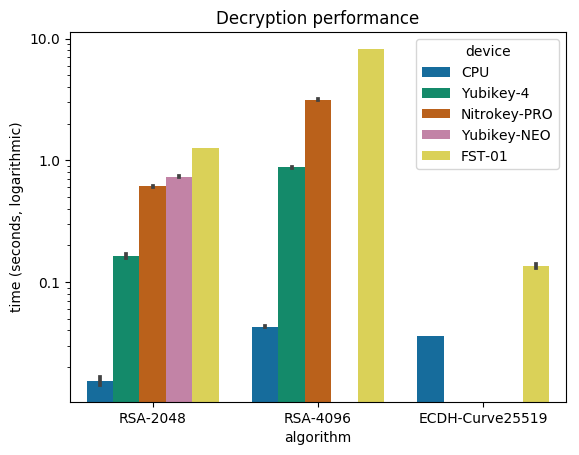
Antoine Beaupr : A comparison of cryptographic keycards

An earlier article showed that private key storage is an important problem to solve in any cryptographic system and established keycards as a good way to store private key material offline. But which keycard should we use? This article examines the form factor, openness, and performance of four keycards to try to help readers choose the one that will fit their needs. I have personally been using a YubiKey NEO, since a 2015 announcement on GitHub promoting two-factor authentication. I was also able to hook up my SSH authentication key into the YubiKey's 2048 bit RSA slot. It seemed natural to move the other subkeys onto the keycard, provided that performance was sufficient. The mail client that I use, (Notmuch), blocks when decrypting messages, which could be a serious problems on large email threads from encrypted mailing lists. So I built a test harness and got access to some more keycards: I bought a FST-01 from its creator, Yutaka Niibe, at the last DebConf and Nitrokey donated a Nitrokey Pro. I also bought a YubiKey 4 when I got the NEO. There are of course other keycards out there, but those are the ones I could get my hands on. You'll notice none of those keycards have a physical keypad to enter passwords, so they are all vulnerable to keyloggers that could extract the key's PIN. Keep in mind, however, that even with the PIN, an attacker could only ask the keycard to decrypt or sign material but not extract the key that is protected by the card's firmware.

Form factor The Nitrokey Pro, YubiKey NEO (worn out), YubiKey 4, and FST-01 The four keycards have similar form factors: they all connect to a standard USB port, although both YubiKey keycards have a capacitive button by which the user triggers two-factor authentication and the YubiKey 4 can also require a button press to confirm private key use. The YubiKeys feel sturdier than the other two. The NEO has withstood two years of punishment in my pockets along with the rest of my "real" keyring and there is only minimal wear on the keycard in the picture. It's also thinner so it fits well on the keyring. The FST-01 stands out from the other two with its minimal design. Out of the box, the FST-01 comes without a case, so the circuitry is exposed. This is deliberate: one of its goals is to be as transparent as possible, both in terms of software and hardware design and you definitely get that feeling at the physical level. Unfortunately, that does mean it feels more brittle than other models: I wouldn't carry it in my pocket all the time, although there is a case that may protect the key a little better, but it does not provide an easy way to hook it into a keyring. In the group picture above, the FST-01 is the pink plastic thing, which is a rubbery casing I received along with the device when I got it. Notice how the USB connectors of the YubiKeys differ from the other two: while the FST-01 and the Nitrokey have standard USB connectors, the YubiKey has only a "half-connector", which is what makes it thinner than the other two. The "Nano" form factor takes this even further and almost disappears in the USB port. Unfortunately, this arrangement means the YubiKey NEO often comes loose and falls out of the USB port, especially when connected to a laptop. On my workstation, however, it usually stays put even with my whole keyring hanging off of it. I suspect this adds more strain to the host's USB port but that's a tradeoff I've lived with without any noticeable wear so far. Finally, the NEO has this peculiar feature of supporting NFC for certain operations, as LWN previously covered, but I haven't used that feature yet. The Nitrokey Pro looks like a normal USB key, in contrast with the other two devices. It does feel a little brittle when compared with the YubiKey, although only time will tell how much of a beating it can take. It has a small ring in the case so it is possible to carry it directly on your keyring, but I would be worried the cap would come off eventually. Nitrokey devices are also two times thicker than the Yubico models which makes them less convenient to carry around on keyrings.

Open and closed designs The FST-01 is as open as hardware comes, down to the PCB design available as KiCad files in this Git repository. The software running on the card is the Gnuk firmware that implements the OpenPGP card protocol, but you can also get it with firmware implementing a true random number generator (TRNG) called NeuG (pronounced "noisy"); the device is programmable through a standard Serial Wire Debug (SWD) port. The Nitrokey Start model also runs the Gnuk firmware. However, the Nitrokey website announces only ECC and RSA 2048-bit support for the Start, while the FST-01 also supports RSA-4096. Nitrokey's founder Jan Suhr, in a private email, explained that this is because "Gnuk doesn't support RSA-3072 or larger at a reasonable speed". Its devices (the Pro, Start, and HSM models) use a similar chip to the FST-01: the STM32F103 microcontroller. Nitrokey Pro with STM32F103TBU6 MCU Nitrokey also publishes its hardware designs, on GitHub, which shows the Pro is basically a fork of the FST-01, according to the ChangeLog. I opened the case to confirm it was using the STM MCU, something I should warn you against; I broke one of the pins holding it together when opening it so now it's even more fragile. But at least, I was able to confirm it was built using the STM32F103TBU6 MCU, like the FST-01. Nitrokey back side But this is where the comparison ends: on the back side, we find a SIM card reader that holds the OpenPGP card that, in turn, holds the private key material and does the cryptographic operations. So, in effect, the Nitrokey Pro is really a evolution of the original OpenPGP card readers. Nitrokey confirmed the OpenPGP card featured in the Pro is the same as the one shipped by the Free Software Foundation Europe (FSFE): the BasicCard built by ZeitControl. Those cards, however, are covered by NDAs and the firmware is only partially open source. This makes the Nitrokey Pro less open than the FST-01, but that's an inevitable tradeoff when choosing a design based on the OpenPGP cards, which Suhr described to me as "pretty proprietary". There are other keycards out there, however, for example the SLJ52GDL150-150k smartcard suggested by Debian developer Yves-Alexis Perez, which he prefers as it is certified by French and German authorities. In that blog post, he also said he was experimenting with the GPL-licensed OpenPGP applet implemented by the French ANSSI. But the YubiKey devices are even further away in the closed-design direction. Both the hardware designs and firmware are proprietary. The YubiKey NEO, for example, cannot be upgraded at all, even though it is based on an open firmware. According to Yubico's FAQ, this is due to "best security practices": "There is a 'no upgrade' policy for our devices since nothing, including malware, can write to the firmware." I find this decision questionable in a context where security updates are often more important than trying to design a bulletproof design, which may simply be impossible. And the YubiKey NEO did suffer from critical security issue that allowed attackers to bypass the PIN protection on the card, which raises the question of the actual protection of the private key material on those cards. According to Niibe, "some OpenPGP cards store the private key unencrypted. It is a common attitude for many smartcard implementations", which was confirmed by Suhr: "the private key is protected by hardware mechanisms which prevent its extraction and misuse". He is referring to the use of tamper resistance. After that security issue, there was no other option for YubiKey NEO users than to get a new keycard (for free, thankfully) from Yubico, which also meant discarding the private key material on the key. For OpenPGP keys, this may mean having to bootstrap the web of trust from scratch if the keycard was responsible for the main certification key. But at least the NEO is running free software based on the OpenPGP card applet and the source is still available on GitHub. The YubiKey 4, on the other hand, is now closed source, which was controversial when the new model was announced last year. It led the main Linux Foundation system administrator, Konstantin Ryabitsev, to withdraw his endorsement of Yubico products. In response, Yubico argued that this approach was essential to the security of its devices, which are now based on "a secure chip, which has built-in countermeasures to mitigate a long list of attacks". In particular, it claims that:
A commercial-grade AVR or ARM controller is unfit to be used in a security product. In most cases, these controllers are easy to attack, from breaking in via a debug/JTAG/TAP port to probing memory contents. Various forms of fault injection and side-channel analysis are possible, sometimes allowing for a complete key recovery in a shockingly short period of time.
While I understand those concerns, they eventually come down to the trust you have in an organization. Not only do we have to trust Yubico, but also hardware manufacturers and designs they have chosen. Every step in the hidden supply chain is then trusted to make correct technical decisions and not introduce any backdoors. History, unfortunately, is not on Yubico's side: Snowden revealed the example of RSA security accepting what renowned cryptographer Bruce Schneier described as a "bribe" from the NSA to weaken its ECC implementation, by using the presumably backdoored Dual_EC_DRBG algorithm. What makes Yubico or its suppliers so different from RSA Security? Remember that RSA Security used to be an adamant opponent to the degradation of encryption standards, campaigning against the Clipper chip in the first crypto wars. Even if we trust the Yubico supply chain, how can we trust a closed design using what basically amounts to security through obscurity? Publicly auditable designs are an important tradition in cryptography, and that principle shouldn't stop when software is frozen into silicon. In fact, a critical vulnerability called ROCA disclosed recently affects closed "smartcards" like the YubiKey 4 and allows full private key recovery from the public key if the key was generated on a vulnerable keycard. When speaking with Ars Technica, the researchers outlined the importance of open designs and questioned the reliability of certification:
Our work highlights the dangers of keeping the design secret and the implementation closed-source, even if both are thoroughly analyzed and certified by experts. The lack of public information causes a delay in the discovery of flaws (and hinders the process of checking for them), thereby increasing the number of already deployed and affected devices at the time of detection.
This issue with open hardware designs seems to be recurring topic of conversation on the Gnuk mailing list. For example, there was a discussion in September 2017 regarding possible hardware vulnerabilities in the STM MCU that would allow extraction of encrypted key material from the key. Niibe referred to a talk presented at the WOOT 17 workshop, where Johannes Obermaier and Stefan Tatschner, from the Fraunhofer Institute, demonstrated attacks against the STMF0 family MCUs. It is still unclear if those attacks also apply to the older STMF1 design used in the FST-01, however. Furthermore, extracted private key material is still protected by user passphrase, but the Gnuk uses a weak key derivation function, so brute-forcing attacks may be possible. Fortunately, there is work in progress to make GnuPG hash the passphrase before sending it to the keycard, which should make such attacks harder if not completely pointless. When asked about the Yubico claims in a private email, Niibe did recognize that "it is true that there are more weak points in general purpose implementations than special implementations". During the last DebConf in Montreal, Niibe explained:
If you don't trust me, you should not buy from me. Source code availability is only a single factor: someone can maliciously replace the firmware to enable advanced attacks.
Niibe recommends to "build the firmware yourself", also saying the design of the FST-01 uses normal hardware that "everyone can replicate". Those advantages are hard to deny for a cryptographic system: using more generic components makes it harder for hostile parties to mount targeted attacks. A counter-argument here is that it can be difficult for a regular user to audit such designs, let alone physically build the device from scratch but, in a mailing list discussion, Debian developer Ian Jackson explained that:
You don't need to be able to validate it personally. The thing spooks most hate is discovery. Backdooring supposedly-free hardware is harder (more costly) because it comes with greater risk of discovery. To put it concretely: if they backdoor all of them, someone (not necessarily you) might notice. (Backdooring only yours involves messing with the shipping arrangements and so on, and supposes that you specifically are of interest.)
Since that, as far as we know, the STM microcontrollers are not backdoored, I would tend to favor those devices instead of proprietary ones, as such a backdoor would be more easily detectable than in a closed design. Even though physical attacks may be possible against those microcontrollers, in the end, if an attacker has physical access to a keycard, I consider the key compromised, even if it has the best chip on the market. In our email exchange, Niibe argued that "when a token is lost, it is better to revoke keys, even if the token is considered secure enough". So like any other device, physical compromise of tokens may mean compromise of the key and should trigger key-revocation procedures.

Algorithms and performance To establish reliable performance results, I wrote a benchmark program naively called crypto-bench that could produce comparable results between the different keys. The program takes each algorithm/keycard combination and runs 1000 decryptions of a 16-byte file (one AES-128 block) using GnuPG, after priming it to get the password cached. I assume the overhead of GnuPG calls to be negligible, as it should be the same across all tokens, so comparisons are possible. AES encryption is constant across all tests as it is always performed on the host and fast enough to be irrelevant in the tests. I used the following:
  • Intel(R) Core(TM) i3-6100U CPU @ 2.30GHz running Debian 9 ("stretch"/stable amd64), using GnuPG 2.1.18-6 (from the stable Debian package)
  • Nitrokey Pro 0.8 (latest firmware)
  • FST-01, running Gnuk version 1.2.5 (latest firmware)
  • YubiKey NEO OpenPGP applet 1.0.10 (not upgradable)
  • YubiKey 4 4.2.6 (not upgradable)
I ran crypto-bench for each keycard, which resulted in the following:
Algorithm Device Mean time (s)
ECDH-Curve25519 CPU 0.036
FST-01 0.135
RSA-2048 CPU 0.016
YubiKey-4 0.162
Nitrokey-Pro 0.610
YubiKey-NEO 0.736
FST-01 1.265
RSA-4096 CPU 0.043
YubiKey-4 0.875
Nitrokey-Pro 3.150
FST-01 8.218
Decryption graph There we see the performance of the four keycards I tested, compared with the same operations done without a keycard: the "CPU" device. That provides the baseline time of GnuPG decrypting the file. The first obvious observation is that using a keycard is slower: in the best scenario (FST-01 + ECC) we see a four-fold slowdown, but in the worst case (also FST-01, but RSA-4096), we see a catastrophic 200-fold slowdown. When I presented the results on the Gnuk mailing list, GnuPG developer Werner Koch confirmed those "numbers are as expected":
With a crypto chip RSA is much faster. By design the Gnuk can't be as fast - it is just a simple MCU. However, using Curve25519 Gnuk is really fast.
And yes, the FST-01 is really fast at doing ECC, but it's also the only keycard that handles ECC in my tests; the Nitrokey Start and Nitrokey HSM should support it as well, but I haven't been able to test those devices. Also note that the YubiKey NEO doesn't support RSA-4096 at all, so we can only compare RSA-2048 across keycards. We should note, however, that ECC is slower than RSA on the CPU, which suggests the Gnuk ECC implementation used by the FST-01 is exceptionally fast. In discussions about improving the performance of the FST-01, Niibe estimated the user tolerance threshold to be "2 seconds decryption time". In a new design using the STM32L432 microcontroller, Aurelien Jarno was able to bring the numbers for RSA-2048 decryption from 1.27s down to 0.65s, and for RSA-4096, from 8.22s down to 3.87s seconds. RSA-4096 is still beyond the two-second threshold, but at least it brings the FST-01 close to the YubiKey NEO and Nitrokey Pro performance levels. We should also underline the superior performance of the YubiKey 4: whatever that thing is doing, it's doing it faster than anyone else. It does RSA-4096 faster than the FST-01 does RSA-2048, and almost as fast as the Nitrokey Pro does RSA-2048. We should also note that the Nitrokey Pro also fails to cross the two-second threshold for RSA-4096 decryption. For me, the FST-01's stellar performance with ECC outshines the other devices. Maybe it says more about the efficiency of the algorithm than the FST-01 or Gnuk's design, but it's definitely an interesting avenue for people who want to deploy those modern algorithms. So, in terms of performance, it is clear that both the YubiKey 4 and the FST-01 take the prize in their own areas (RSA and ECC, respectively).

Conclusion In the above presentation, I have evaluated four cryptographic keycards for use with various OpenPGP operations. What the results show is that the only efficient way of storing a 4096-bit encryption key on a keycard would be to use the YubiKey 4. Unfortunately, I do not feel we should put our trust in such closed designs so I would argue you should either stick with 2048-bit encryption subkeys or keep the keys on disk. Considering that losing such a key would be catastrophic, this might be a good approach anyway. You should also consider switching to ECC encryption: even though it may not be supported everywhere, GnuPG supports having multiple encryption subkeys on a keyring: if one algorithm is unsupported (e.g. GnuPG 1.4 doesn't support ECC), it will fall back to a supported algorithm (e.g. RSA). Do not forget your previously encrypted material doesn't magically re-encrypt itself using your new encryption subkey, however. For authentication and signing keys, speed is not such an issue, so I would warmly recommend either the Nitrokey Pro or Start, or the FST-01, depending on whether you want to start experimenting with ECC algorithms. Availability also seems to be an issue for the FST-01. While you can generally get the device when you meet Niibe in person for a few bucks (I bought mine for around \$30 Canadian), the Seeed online shop says the device is out of stock at the time of this writing, even though Jonathan McDowell said that may be inaccurate in a debian-project discussion. Nevertheless, this issue may make the Nitrokey devices more attractive. When deciding on using the Pro or Start, Suhr offered the following advice:
In practice smart card security has been proven to work well (at least if you use a decent smart card). Therefore the Nitrokey Pro should be used for high security cases. If you don't trust the smart card or if Nitrokey Start is just sufficient for you, you can choose that one. This is why we offer both models.
So far, I have created a signing subkey and moved that and my authentication key to the YubiKey NEO, because it's a device I physically trust to keep itself together in my pockets and I was already using it. It has served me well so far, especially with its extra features like U2F and HOTP support, which I use frequently. Those features are also available on the Nitrokey Pro, so that may be an alternative if I lose the YubiKey. I will probably move my main certification key to the FST-01 and a LUKS-encrypted USB disk, to keep that certification key offline but backed up on two different devices. As for the encryption key, I'll wait for keycard performance to improve, or simply switch my whole keyring to ECC and use the FST-01 or Nitrokey Start for that purpose.
[The author would like to thank Nitrokey for providing hardware for testing.] This article first appeared in the Linux Weekly News.

15 October 2017

Iain R. Learmonth: Free Software Efforts (2017W41)

Here s my weekly report for week 41 of 2017. In this week I have explored some Java 8 features, looked at automatic updates in a few Linux distributions and decided that actually I don t need swap anymore.

Debian The issue that was preventing the migration of the Tasktools Packaging Team s mailing list from Alioth to Savannah has now been resolved. Ana s chkservice package that I sponsored last week has been ACCEPTED into unstable and since MIGRATED to testing.

Tor Project I have produced a patch for the Tor Project website to update links to the Onionoo documentation now this has moved (#23802 ). I ve updated the Debian and Ubuntu relay configuration instructions to use systemctl instead of service where appropriate (#23048 ). When a Tor relay is less than 2 years old, an alert will now appear on Atlas to link to the new relay lifecycle blog post (#23767 ). This should hopefully help new relay operators understand why their relay is not immediately fully loaded but instead it takes some time to ramp up. I have gone through the tickets for Tor Cloud and did not find any tickets that contain any important information that would be useful to someone reviving the project. I have closed out these tickets and the Tor Cloud component no longer has any non-closed tickets (#7763, #8544, #8768, #9064, #9751, #10282, #10637, #11153, #11502, #13391, #14035, #14036, #14073, #15821 ). I ve continued to work on turning the Atlas application into an integrated part of Tor Metrics (#23518 ) and you can see some progress here. Finally, I ve continued hacking on a Twitter bot to tweet factoids about the public Tor network and you can now enjoy some JavaDoc documentation if you d like to learn a little about its internals. I am still waiting for a git repository to be created (#23799 ) but will be publishing the sources shortly after that ticket is actioned.

Sustainability I believe it is important to be clear not only about the work I have already completed but also about the sustainability of this work into the future. I plan to include a short report on the current sustainability of my work in each weekly report. I have not had any free software related expenses this week. The current funds I have available for equipment, travel and other free software expenses remains 60.52. I do not believe that any hardware I rely on is looking at imminent failure. I d like to thank Digital Ocean for providing me with futher credit for their platform to support my open source work. I do not find it likely that I ll be travelling to Cambridge for the miniDebConf as the train alone would be around 350 and hotel accomodation a further 600 (to include both me and Ana).

12 October 2017

Joachim Breitner: Isabelle functions: Always total, sometimes undefined

Often, when I mention how things work in the interactive theorem prover [Isabelle/HOL] (in the following just Isabelle 1) to people with a strong background in functional programming (whether that means Haskell or Coq or something else), I cause confusion, especially around the issue of what is a function, are function total and what is the business with undefined. In this blog post, I want to explain some these issues, aimed at functional programmers or type theoreticians. Note that this is not meant to be a tutorial; I will not explain how to do these things, and will focus on what they mean.

HOL is a logic of total functions If I have a Isabelle function f :: a b between two types a and b (the function arrow in Isabelle is , not ), then by definition of what it means to be a function in HOL whenever I have a value x :: a, then the expression f x (i.e. f applied to x) is a value of type b. Therefore, and without exception, every Isabelle function is total. In particular, it cannot be that f x does not exist for some x :: a. This is a first difference from Haskell, which does have partial functions like
spin :: Maybe Integer -> Bool
spin (Just n) = spin (Just (n+1))
Here, neither the expression spin Nothing nor the expression spin (Just 42) produce a value of type Bool: The former raises an exception ( incomplete pattern match ), the latter does not terminate. Confusingly, though, both expressions have type Bool. Because every function is total, this confusion cannot arise in Isabelle: If an expression e has type t, then it is a value of type t. This trait is shared with other total systems, including Coq. Did you notice the emphasis I put on the word is here, and how I deliberately did not write evaluates to or returns ? This is because of another big source for confusion:

Isabelle functions do not compute We (i.e., functional programmers) stole the word function from mathematics and repurposed it2. But the word function , in the context of Isabelle, refers to the mathematical concept of a function, and it helps to keep that in mind. What is the difference?
  • A function a b in functional programming is an algorithm that, given a value of type a, calculates (returns, evaluates to) a value of type b.
  • A function a b in math (or Isabelle) associates with each value of type a a value of type b.
For example, the following is a perfectly valid function definition in math (and HOL), but could not be a function in the programming sense:
definition foo :: "(nat   real)   real" where
  "foo seq = (if convergent seq then lim seq else 0)"
This assigns a real number to every sequence, but it does not compute it in any useful sense. From this it follows that

Isabelle functions are specified, not defined Consider this function definition:
fun plus :: "nat   nat   nat"  where
   "plus 0       m = m"
   "plus (Suc n) m = Suc (plus n m)"
To a functional programmer, this reads
plus is a function that analyses its first argument. If that is 0, then it returns the second argument. Otherwise, it calls itself with the predecessor of the first argument and increases the result by one.
which is clearly a description of a computation. But to Isabelle, the above reads
plus is a binary function on natural numbers, and it satisfies the following two equations:
And in fact, it is not so much Isabelle that reads it this way, but rather the fun command, which is external to the Isabelle logic. The fun command analyses the given equations, constructs a non-recursive definition of plus under the hood, passes that to Isabelle and then proves that the given equations hold for plus. One interesting consequence of this is that different specifications can lead to the same functions. In fact, if we would define plus' by recursing on the second argument, we d obtain the the same function (i.e. plus = plus' is a theorem, and there would be no way of telling the two apart).

Termination is a property of specifications, not functions Because a function does not evaluate, it does not make sense to ask if it terminates. The question of termination arises before the function is defined: The fun command can only construct plus in a way that the equations hold if it passes a termination check very much like Fixpoint in Coq. But while the termination check of Fixpoint in Coq is a deep part of the basic logic, in Isabelle it is simply something that this particular command requires for its internal machinery to go through. At no point does a termination proof of the function exist as a theorem inside the logic. And other commands may have other means of defining a function that do not even require such a termination argument! For example, a function specification that is tail-recursive can be turned in to a function, even without a termination proof: The following definition describes a higher-order function that iterates its first argument f on the second argument x until it finds a fixpoint. It is completely polymorphic (the single quote in 'a indicates that this is a type variable):
partial_function (tailrec)
  fixpoint :: "('a   'a)   'a   'a"
where
  "fixpoint f x = (if f x = x then x else fixpoint f (f x))"
We can work with this definition just fine. For example, if we instantiate f with ( x. x-1), we can prove that it will always return 0:
lemma "fixpoint (  n . n - 1) (n::nat) = 0"
  by (induction n) (auto simp add: fixpoint.simps)
Similarly, if we have a function that works within the option monad (i.e. Maybe in Haskell), its specification can always be turned into a function without an explicit termination proof here one that calculates the Collatz sequence:
partial_function (option) collatz :: "nat   nat list option"
 where "collatz n =
        (if n = 1 then Some [n]
         else if even n
           then do   ns <- collatz (n div 2);    Some (n # ns)  
           else do   ns <- collatz (3 * n + 1);  Some (n # ns) )"
Note that lists in Isabelle are finite (like in Coq, unlike in Haskell), so this function returns a list only if the collatz sequence eventually reaches 1. I expect these definitions to make a Coq user very uneasy. How can fixpoint be a total function? What is fixpoint ( n. n+1)? What if we run collatz n for a n where the Collatz sequence does not reach 1?3 We will come back to that question after a little detour

HOL is a logic of non-empty types Another big difference between Isabelle and Coq is that in Isabelle, every type is inhabited. Just like the totality of functions, this is a very fundamental fact about what HOL defines to be a type. Isabelle gets away with that design because in Isabelle, we do not use types for propositions (like we do in Coq), so we do not need empty types to denote false propositions. This design has an important consequence: It allows the existence of a polymorphic expression that inhabits any type, namely
undefined :: 'a
The naming of this term alone has caused a great deal of confusion for Isabelle beginners, or in communication with users of different systems, so I implore you to not read too much into the name. In fact, you will have a better time if you think of it as arbitrary or, even better, unknown. Since undefined can be instantiated at any type, we can instantiate it for example at bool, and we can observe an important fact: undefined is not an extra value besides the usual ones . It is simply some value of that type, which is demonstrated in the following lemma:
lemma "undefined = True   undefined = False" by auto
In fact, if the type has only one value (such as the unit type), then we know the value of undefined for sure:
lemma "undefined = ()" by auto
It is very handy to be able to produce an expression of any type, as we will see as follows

Partial functions are just underspecified functions For example, it allows us to translate incomplete function specifications. Consider this definition, Isabelle s equivalent of Haskell s partial fromJust function:
fun fromSome :: "'a option   'a" where
  "fromSome (Some x) = x"
This definition is accepted by fun (albeit with a warning), and the generated function fromSome behaves exactly as specified: when applied to Some x, it is x. The term fromSome None is also a value of type 'a, we just do not know which one it is, as the specification does not address that. So fromSome None behaves just like undefined above, i.e. we can prove
lemma "fromSome None = False   fromSome None = True" by auto
Here is a small exercise for you: Can you come up with an explanation for the following lemma:
fun constOrId :: "bool   bool" where
  "constOrId True = True"
lemma "constOrId = ( _.True)   constOrId = ( x. x)"
  by (metis (full_types) constOrId.simps)
Overall, this behavior makes sense if we remember that function definitions in Isabelle are not really definitions, but rather specifications. And a partial function definition is simply a underspecification. The resulting function is simply any function hat fulfills the specification, and the two lemmas above underline that observation.

Nonterminating functions are also just underspecified Let us return to the puzzle posed by fixpoint above. Clearly, the function seen as a functional program is not total: When passed the argument ( n. n + 1) or ( b. b) it will loop forever trying to find a fixed point. But Isabelle functions are not functional programs, and the definitions are just specifications. What does the specification say about the case when f has no fixed-point? It states that the equation fixpoint f x = fixpoint f (f x) holds. And this equation has a solution, for example fixpoint f _ = undefined. Or more concretely: The specification of the fixpoint function states that fixpoint ( b. b) True = fixpoint ( b. b) False has to hold, but it does not specify which particular value (True or False) it should denote any is fine.

Not all function specifications are ok At this point you might wonder: Can I just specify any equations for a function f and get a function out of that? But rest assured: That is not the case. For example, no Isabelle command allows you define a function bogus :: () nat with the equation bogus () = Suc (bogus ()), because this equation does not have a solution. We can actually prove that such a function cannot exist:
lemma no_bogus: "  bogus. bogus () = Suc (bogus ())" by simp
(Of course, not_bogus () = not_bogus () is just fine )

You cannot reason about partiality in Isabelle We have seen that there are many ways to define functions that one might consider partial . Given a function, can we prove that it is not partial in that sense? Unfortunately, but unavoidably, no: Since undefined is not a separate, recognizable value, but rather simply an unknown one, there is no way of stating that A function result is not specified . Here is an example that demonstrates this: Two partial functions (one with not all cases specified, the other one with a self-referential specification) are indistinguishable from the total variant:
fun partial1 :: "bool   unit" where
  "partial1 True = ()"
partial_function (tailrec) partial2 :: "bool   unit" where
  "partial2 b = partial2 b"
fun total :: "bool   unit" where
  "total True = ()"
  "total False = ()"
lemma "partial1 = total   partial2 = total" by auto
If you really do want to reason about partiality of functional programs in Isabelle, you should consider implementing them not as plain HOL functions, but rather use HOLCF, where you can give equational specifications of functional programs and obtain continuous functions between domains. In that setting, () and partial2 = total. We have done that to verify some of HLint s equations.

You can still compute with Isabelle functions I hope by this point, I have not scared away anyone who wants to use Isabelle for functional programming, and in fact, you can use it for that. If the equations that you pass to fun are a reasonable definition for a function (in the programming sense), then these equations, used as rewriting rules, will allow you to compute that function quite like you would in Coq or Haskell. Moreover, Isabelle supports code extraction: You can take the equations of your Isabelle functions and have them expored into Ocaml, Haskell, Scala or Standard ML. See Concon for a conference management system with confidentially verified in Isabelle. While these usually are the equations you defined the function with, they don't have to: You can declare other proved equations to be used for code extraction, e.g. to refine your elegant definitions to performant ones. Like with code extraction from Coq to, say, Haskell, the adequacy of the translations rests on a moral reasoning foundation. Unlike extraction from Coq, where you have an (unformalized) guarantee that the resulting Haskell code is terminating, you do not get that guarantee from Isabelle. Conversely, this allows you do reason about and extract non-terminating programs, like fixpoint, which is not possible in Coq. There is currently ongoing work about verified code generation, where the code equations are reflected into a deep embedding of HOL in Isabelle that would allow explicit termination proofs.

Conclusion We have seen how in Isabelle, every function is total. Function declarations have equations, but these do not define the function in an computational sense, but rather specify them. Because in HOL, there are no empty types, many specifications that appear partial (incomplete patterns, non-terminating recursion) have solutions in the space of total functions. Partiality in the specification is no longer visible in the final product.

PS: Axiom undefined in Coq This section is speculative, and an invitation for discussion. Coq already distinguishes between types used in programs (Set) and types used in proofs Prop. Could Coq ensure that every t : Set is non-empty? I imagine this would require additional checks in the Inductive command, similar to the checks that the Isabelle command datatype has to perform4, and it would disallow Empty_set. If so, then it would be sound to add the following axiom
Axiom undefined : forall (a : Set), a.
wouldn't it? This axiom does not have any computational meaning, but that seems to be ok for optional Coq axioms, like classical reasoning or function extensionality. With this in place, how much of what I describe above about function definitions in Isabelle could now be done soundly in Coq. Certainly pattern matches would not have to be complete and could sport an implicit case _ undefined. Would it help with non-obviously terminating functions? Would it allow a Coq command Tailrecursive that accepts any tailrecursive function without a termination check?

  1. Isabelle is a metalogical framework, and other logics, e.g. Isabelle/ZF, behave differently. For the purpose of this blog post, I always mean Isabelle/HOL.
  2. Isabelle is a metalogical framework, and other logics, e.g. Isabelle/ZF, behave differently. For the purpose of this blog post, I always mean Isabelle/HOL.
  3. Let me know if you find such an n. Besides n = 0.
  4. Like fun, the constructions by datatype are not part of the logic, but create a type definition from more primitive notions that is isomorphic to the specified data type.

10 October 2017

Carl Chenet: The Slack Threat

During a long era, electronic mail was the main communication tool for enterprises. Slack, which offer public or private group discussion boards and instant messaging between two people, challenge its position, especially in the IT industry. Not only Slack has features known and used since IRC launch in the late 80s, but Slack also offers file sending and sharing, code quoting, and it indexing for ulterior searches everything that goes through the application. Slack is also modular with numerous plug-in to easily add new features. Using the Software-As-A-Service (SAAS) model, Slack basic version is free, and users pay for options. Slack is now considered by the Github generation like the new main enterprise communication tool. As I did in my previous article on the Github threat, this one won t promote Slask s advantages, as many other articles have already covered all these points ad nauseam, but to show the other side and to warn the companies using this service about its inherent risks. So far, these risks have been ignored, sometimes voluntary in the name of the It works ideology. Neglecting all economic and safety consideration, neglecting all threat to privacy and individual freedom. We ll see about them below.

Github, a software forge as a SAAS, with all the advantage but also all the risk of its economic model

All your company communication since its creation When a start-up chooses Slack, all of its internal communication will be stored by Slack. When someone uses this service, the simple fact to chat through it means that the whole communication is archived. One may point that within the basic Slack offer, only the last 10.000 messages can be read and searched. Bad argument. Slack stored every message and every file shared as it pleases. We ll see below this application behavior is of capital importance in the Slack threat to enterprises. And the problem is the same for all other companies which choose Slack at one point or another. If they replace their traditional communication method with it, Slack will have access to capital data, not only in volume, but also because of their value for the company itself Or anyone interested in this company life. Search Your Entire Archive One of the main arguments to use Slack is its Search your entire archive feature. One can search almost anything one can think of. Why? Because everything is indexed. Your team chat archive or the more or less confidential documents exchanged with the accountant department; everything is in it in order to provide the most effective search tool.

The search bar, well-known by Slack users

We can t deny it s a very attractive feature for everyone inside the company. But it is also a very attractive feature for everyone outside of the company who would want to know more about its internal life. Even more if you re looking for a specific subject. If Slack is the main communication tool of your company, and if as I ve experienced in my professional life, some teams prefer to use it than to go to the office next door or even bug you to put the information on the dedicated channel, one can easily deduce that nothing in this type of company escape Slack. The automatic indexation and the search feature efficiency are excellent tools to get all the information needed, in quantity and in quality. As such, it s a great social engineering tool for everyone who has access to it, with a history as old as the use of Slack as a communication tool in the company. Across borders And Beyond! Slack is a Web service which uses mainly Amazon Web services and most specially Cloudfront, as stated by the available information on Slack infrastructure. Even without a complete study of said infrastructure, it s easy to state that all the data regarding many innovative global companies around the world (and some of them including for all their internal communication since their creation) are located in the United States, or at least in the hands of a US company, which must follow US laws, a country with a well-known history of large scale industrial espionage, as the whistleblower Edward Snowden demonstrated it in 2013 and where company data access has no restriction under the Patriot Act, as in the Microsoft case (2014) where data stored in Ireland by the Redmond software editor have been given to US authorities.

Edward Snowden, an individual and corporate freedom fighter

As such, Slack s automatic indexation and search tool are a boon for anyone spy agency or hacker which get authorized access to it. To trust a third party with all, or at least most of, your internal corporate communication is a certain risk for your company if the said third party doesn t follow the same regulations as yours or if it has different interests, from a data security point of view or more globally on its competitiveness. A badly timed data leak can be catastrophic. What s the point of secretly preparing a new product launch or an aggressive takeover if all your recent Slack conversations have leaked, including your secret plans? What if Slack is hacked? First let s remember that even if a cyber attack may appear as a rare or hypothetical scenario to a badly informed and hurried manager, it is far from being as rare as she or he believes it (or wants to believe it). Infrastructure hacking is quite common, as a regular visit to Hacker News will give you multiple evidence. And Slack itself has already been hacked. February 2015: Slack is the victim during four days of a cyber attack, which was made public by the company in March. Officially, the unauthorized access was limited to information on the users profiles. It is impossible to measure exactly what and who was impacted by this attack. In a recent announcement, Yahoo confessed that these 3 billion accounts (you ve read well: 3 billions) were compromised late 2014!

Yahoo, the company which suffered the largest recorded cyberattack regarding the compromised account numbers

Officially, Slack stated that No financial or payment information was accessed or compromised in this attack. Which is, and by far, the least interesting of all data stored within Slack! With company internal communication indexed sometimes from the very beginning of said company and searchable, Slack may be a potential target for cybercriminal not looking for its users financial credentials but more their internal data already in a usable format. One can imagine Slack must give information on a massive data leak, which can t be ignored. But what would happen if only one Slack user is the victim of said leak? The Free Alternative Solutions As we demonstrated above, companies need to find an alternative solution to Slack, one they can host themselves to reduce data leaks and industrial espionage and dependency on the Internet connection. Luckily, Slack success created its own copycats, some of them being also free software. Rocket.chat is one of them. Its comprehensive service offers chat rooms, direct messages and file sharing but also videoconferencing and screen sharing, and even most features. Check their dedicated page. You can also try an online demo. And even more, Rocket Chat has a very simple extension system and an API. Mattermost is another service which has the advantages of proximity and of compatibility with Slack. It offers numerous features including the main expected by this type of software. It also offers numerous apps and plug-ins to interact with online services, software forges, and continuous integration tools. It works In the introduction, we discussed the It works effect, usually invoked to dispel any arguments about data protection and exchange confidentiality we discussed in this article. True, one single developer can ask: why worry about it? All I want is to chat with my colleagues and send files! Because Slack service subscription in the long term put the company continuously at risk. Maybe it s not the employees place to worry about it, they just have to do their job the more efficiently possible. On the other side, the company management, usually non-technical, may not be aware of what risks will threaten their company with this technical choice. The technical management may pretend to be omniscient, nobody is fooled. Either someone from the direction will ask the right question (where are our data and who can access them?) or someone from the technical side alert them officially on these problems. This is this technical audience, even if not always heard by their direction, which is the target of this article. May they find in it the right arguments to be convincing. We hope that the several points we developed in this article will help you to make the right choice. About Me Carl Chenet, Free Software Indie Hacker, founder of the French-speaking Hacker News-like Journal du hacker. Follow me on social networks Translated from French by St phanie Chaptal. Original article written in October 2016.

8 October 2017

Daniel Pocock: A step change in managing your calendar, without social media

Have you been to an event recently involving free software or a related topic? How did you find it? Are you organizing an event and don't want to fall into the trap of using Facebook or Meetup or other services that compete for a share of your community's attention? Are you keen to find events in foreign destinations related to your interest areas to coincide with other travel intentions? Have you been concerned when your GSoC or Outreachy interns lost a week of their project going through the bureaucracy to get a visa for your community's event? Would you like to make it easier for them to find the best events in the countries that welcome and respect visitors? In many recent discussions about free software activism, people have struggled to break out of the illusion that social media is the way to cultivate new contacts. Wouldn't it be great to make more meaningful contacts by attending more a more diverse range of events rather than losing time on social media? Making it happen There are already a number of tools (for example, Drupal plugins and Wordpress plugins) for promoting your events on the web and in iCalendar format. There are also a number of sites like Agenda du Libre and GriCal who aggregate events from multiple communities where people can browse them. How can we take these concepts further and make a convenient, compelling and global solution? Can we harvest event data from a wide range of sources and compile it into a large database using something like PostgreSQL or a NoSQL solution or even a distributed solution like OpenDHT? Can we use big data techniques to mine these datasources and help match people to events without compromising on privacy? Why not build an automated iCalendar "to-do" list of deadlines for events you want to be reminded about, so you never miss the deadlines for travel sponsorship or submitting a talk proposal? I've started documenting an architecture for this on the Debian wiki and proposed it as an Outreachy project. It will also be offered as part of GSoC in 2018. Ways to get involved If you would like to help this project, please consider introducing yourself on the debian-outreach mailing list and helping to mentor or refer interns for the project. You can also help contribute ideas for the specification through the mailing list or wiki. Mini DebConf Prishtina 2017 This weekend I've been at the MiniDebConf in Prishtina, Kosovo. It has been hosted by the amazing Prishtina hackerspace community. Watch out for future events in Prishtina, the pizzas are huge, but that didn't stop them disappearing before we finished the photos:
6 October 2017

Rapha&#235;l Hertzog: My Free Software Activities in September 2017

My monthly report covers a large part of what I have been doing in the free software world. I write it for my donors (thanks to them!) but also for the wider Debian community because it can give ideas to newcomers and it s one of the best ways to find volunteers to work with me on projects that matter to me. Debian LTS This month I was allocated 12h but I only spent 10.5h. During this time, I continued my work on exiv2. I finished reproducing all the issues and then went on doing code reviews to confirm that vulnerabilities were not present when the issue was not reproducible. I found two CVE where the vulnerability was present in the wheezy version and I posted patches in the upstream bug tracker: #57 and #55. Then another batch of 10 CVE appeared and I started the process over I m currently trying to reproduce the issues. While doing all this work on exiv2, I also uncovered a failure to build on the package in experimental (reported here). Misc Debian/Kali work Debian Live. I merged 3 live-build patches prepared by Matthijs Kooijman and added an armel fix to cope with the the rename of the orion5x image into the marvell one. I also uploaded a new live-config to fix a bug with the keyboard configuration. Finally, I also released a new live-installer udeb to cope with a recent live-build change that broke the locale selection during the installation process. Debian Installer. I prepared a few patches on pkgsel to merge a few features that had been added to Ubuntu, most notably the possibility to enable unattended-upgrades by default. More bug reports. I investigated much further my problem with non-booting qemu images when they are built by vmdebootstrap in a chroot managed by schroot (cf #872999) and while we have much more data, it s not yet clear why it doesn t work. But we have a working work-around While investigating issues seen in Kali, I opened a bunch of reports on the Debian side: Packaging. I sponsored two uploads (dirb and python-elasticsearch). Debian Handbook. My work on updating the book mostly stalled. The only thing I did was to review the patch about wireless configuration in #863496. I must really get back to work on the book! Thanks See you next month for a new summary of my activities.

No comment Liked this article? Click here. My blog is Flattr-enabled.

Next.

Previous.